The PPF: Position, Properties and Opportunity Costs Dr. Jennifer P. Wissink 2011 John M. Abowd and Jennifer P. Wissink, all rights reserved. One More Time Economics: the study of the allocation of scare resources to produce commodities to
"The PPF: Position, Properties and Opportunity" is the property of its rightful owner. Permission is granted to
download and print the materials on this website for personal, non-commercial use only, and to display it
on your personal computer provided you do not modify the materials and that you retain all copyright
notices contained in the materials. By downloading content from our website, you accept the terms of this
agreement.
One More Time… Economics: the study of
the allocation of
scare resources to
produce commodities to
satisfy infinite human wants.<br>
03
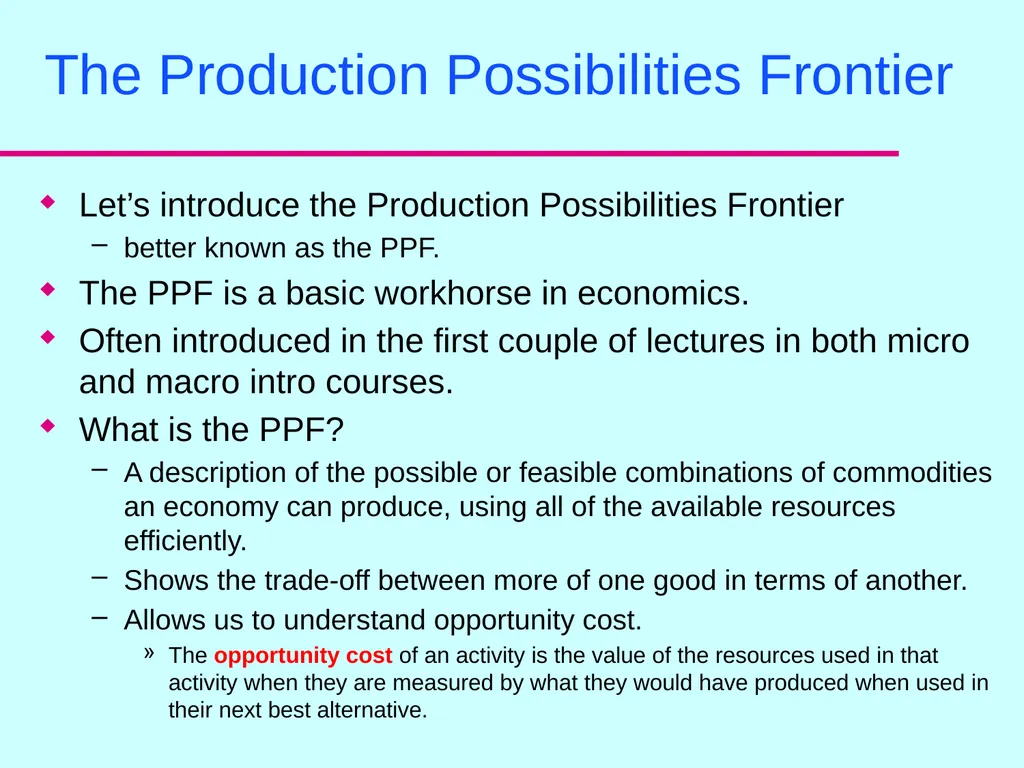
The Production Possibilities Frontier Let’s introduce the Production Possibilities Frontier
better known as the PPF.
The PPF is a basic workhorse in economics.
Often introduced in the first couple of lectures in both micro and macro intro courses.
What is the PPF?
A description of the possible or feasible combinations of commodities an economy can produce, using all of the available resources efficiently.
Shows the trade-off between more of one good in terms of another.
Allows us to understand opportunity cost.
The opportunity cost of an activity is the value of the resources used in that activity when they are measured by what they would have produced when used in their next best alternative.<br>
04
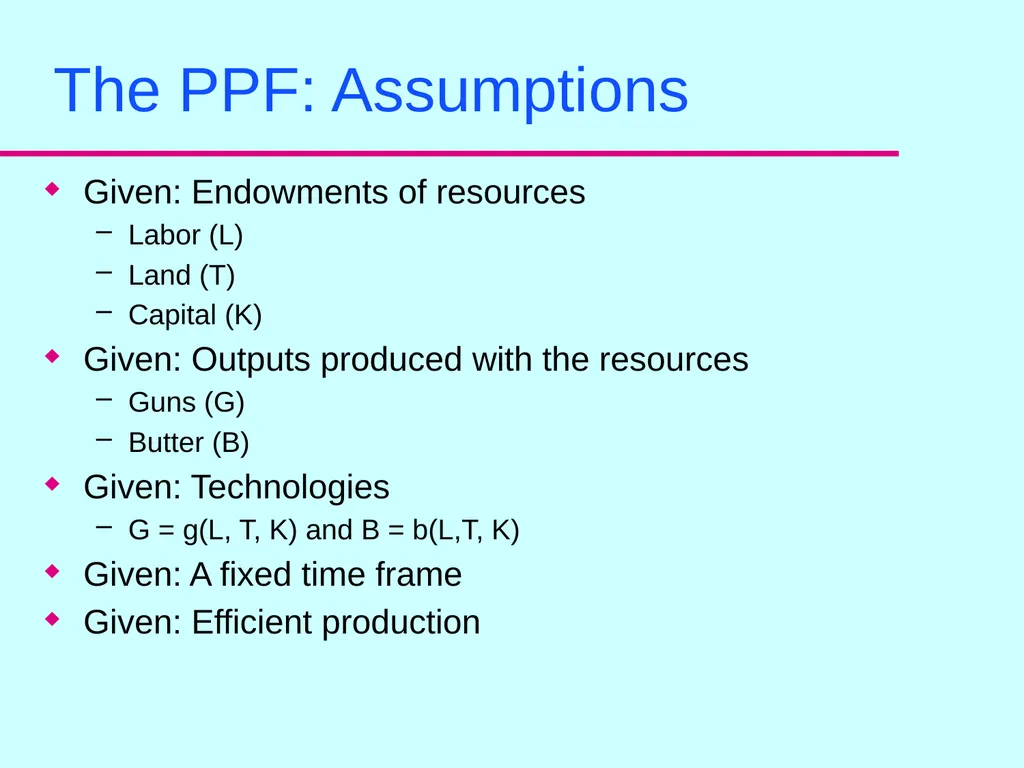
The PPF: Assumptions Given: Endowments of resources
Labor (L)
Land (T)
Capital (K)
Given: Outputs produced with the resources
Guns (G)
Butter (B)
Given: Technologies
G = g(L, T, K) and B = b(L,T, K)
Given: A fixed time frame
Given: Efficient production<br>
05
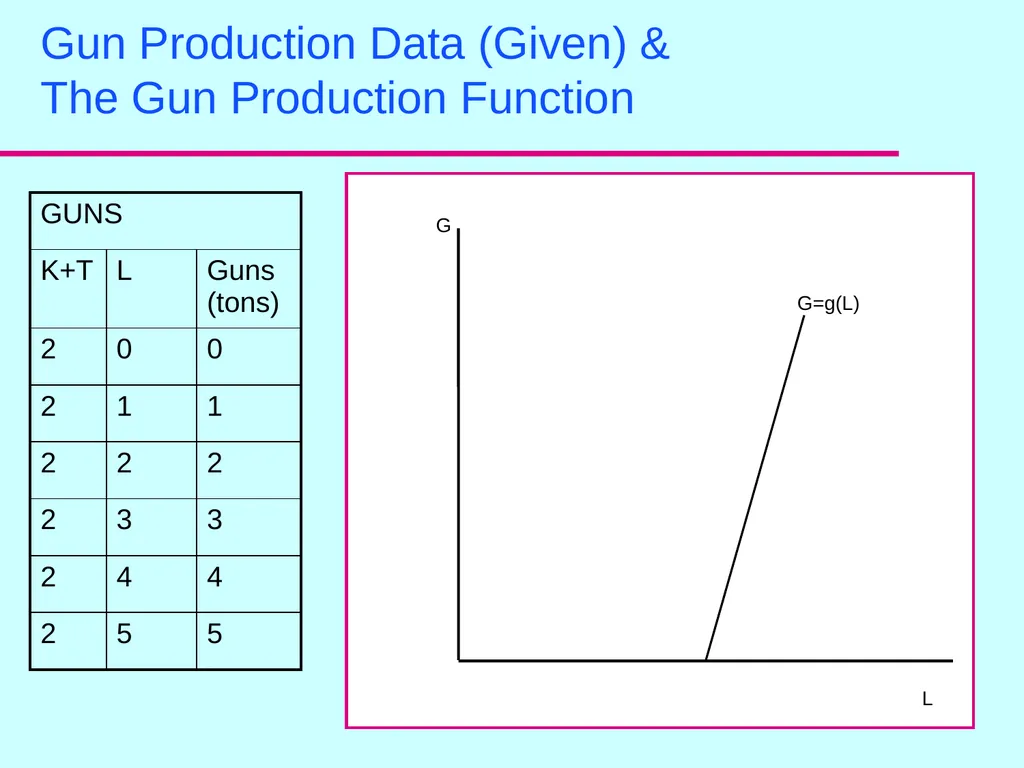
Gun Production Data (Given) & The Gun Production Function L G G=g(L)<br>
06
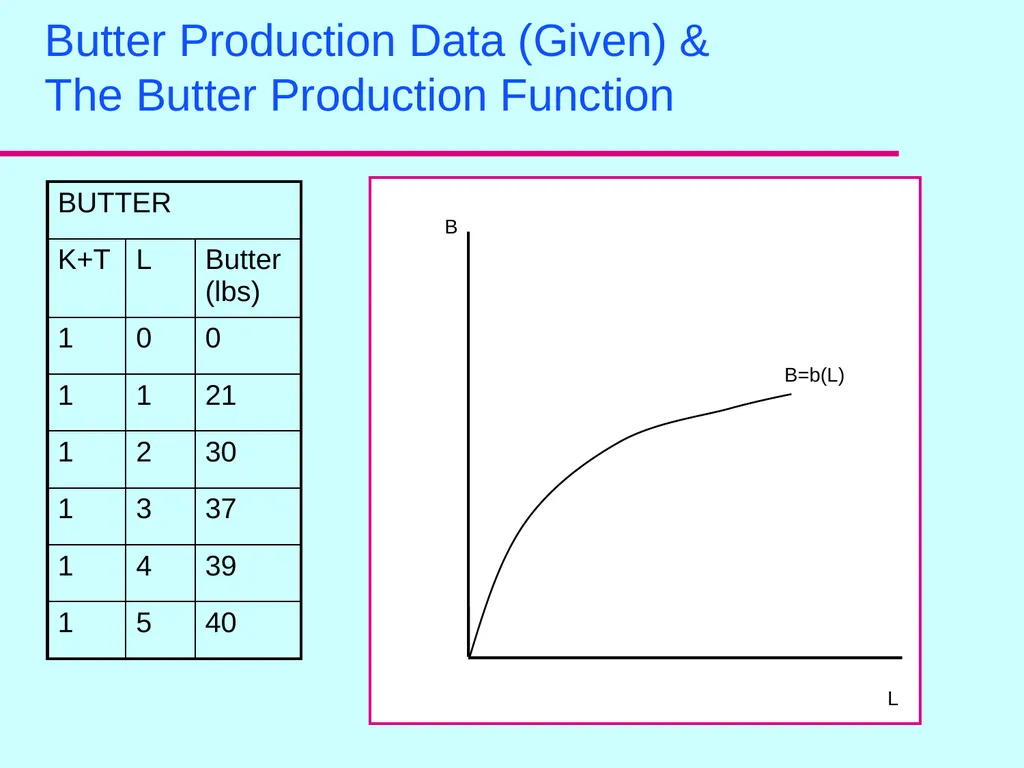
Butter Production Data (Given) & The Butter Production Function L B B=b(L)<br>
07
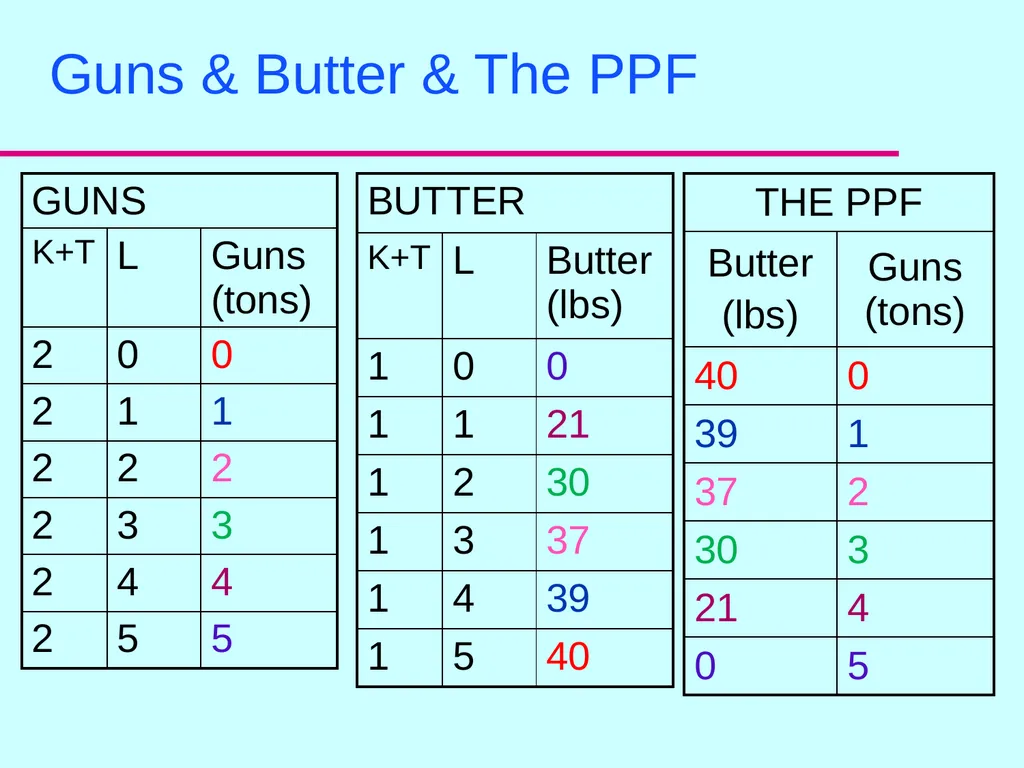
Guns & Butter & The PPF<br>
08
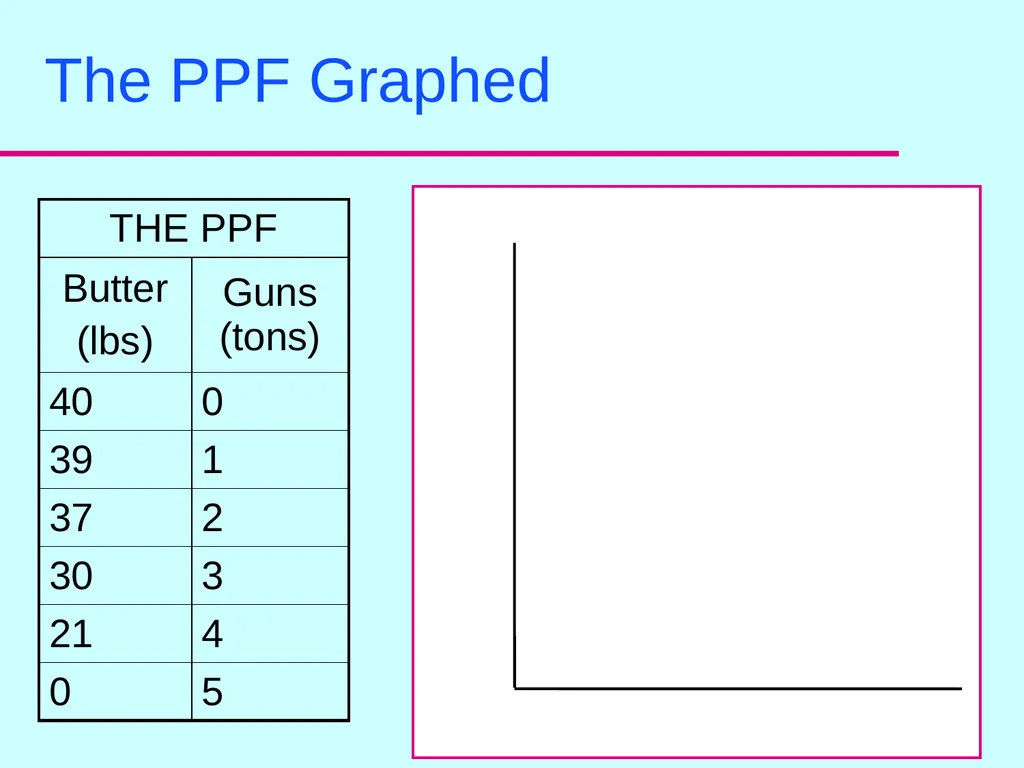
The PPF Graphed<br>
09
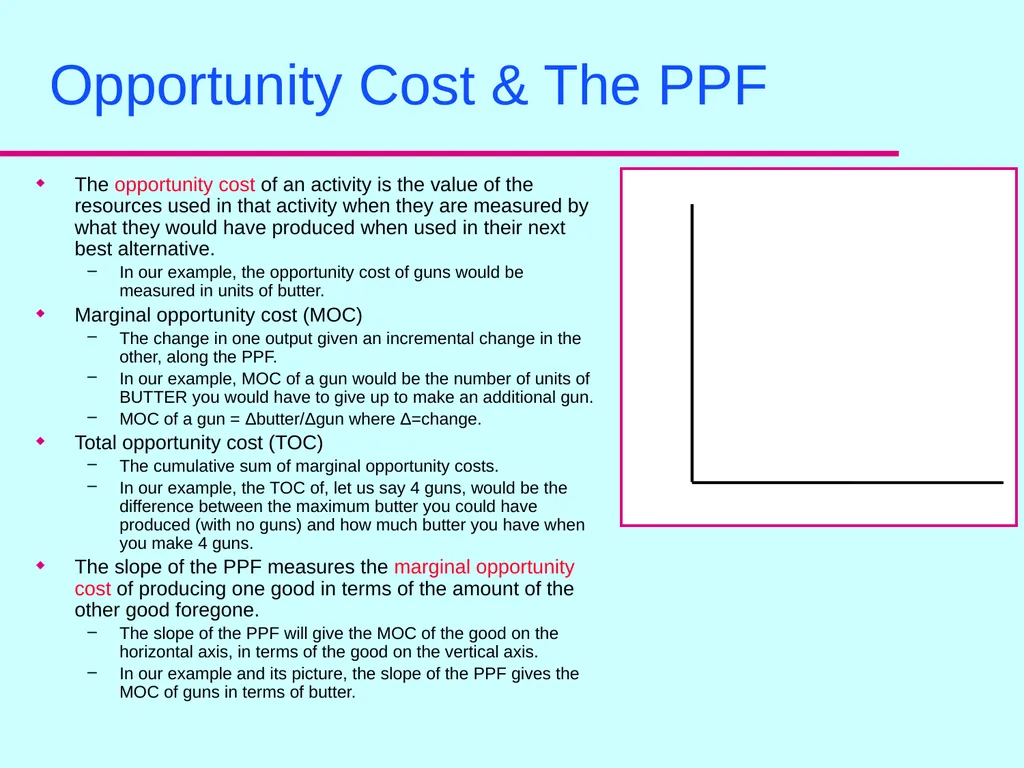
Opportunity Cost & The PPF The opportunity cost of an activity is the value of the resources used in that activity when they are measured by what they would have produced when used in their next best alternative.
In our example, the opportunity cost of guns would be measured in units of butter.
Marginal opportunity cost (MOC)
The change in one output given an incremental change in the other, along the PPF.
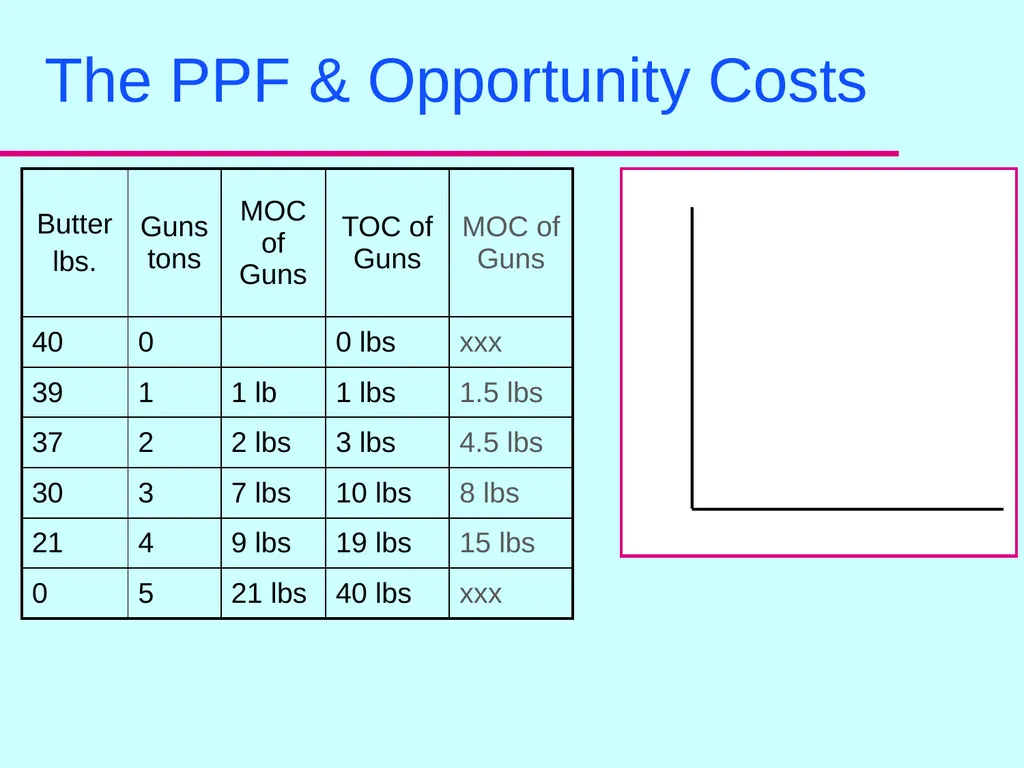
In our example, MOC of a gun would be the number of units of BUTTER you would have to give up to make an additional gun.
MOC of a gun = Δbutter/Δgun where Δ=change.
Total opportunity cost (TOC)
The cumulative sum of marginal opportunity costs.
In our example, the TOC of, let us say 4 guns, would be the difference between the maximum butter you could have produced (with no guns) and how much butter you have when you make 4 guns.
The slope of the PPF measures the marginal opportunity cost of producing one good in terms of the amount of the other good foregone.
The slope of the PPF will give the MOC of the good on the horizontal axis, in terms of the good on the vertical axis.
In our example and its picture, the slope of the PPF gives the MOC of guns in terms of butter.<br>
10
The PPF & Opportunity Costs<br>
11
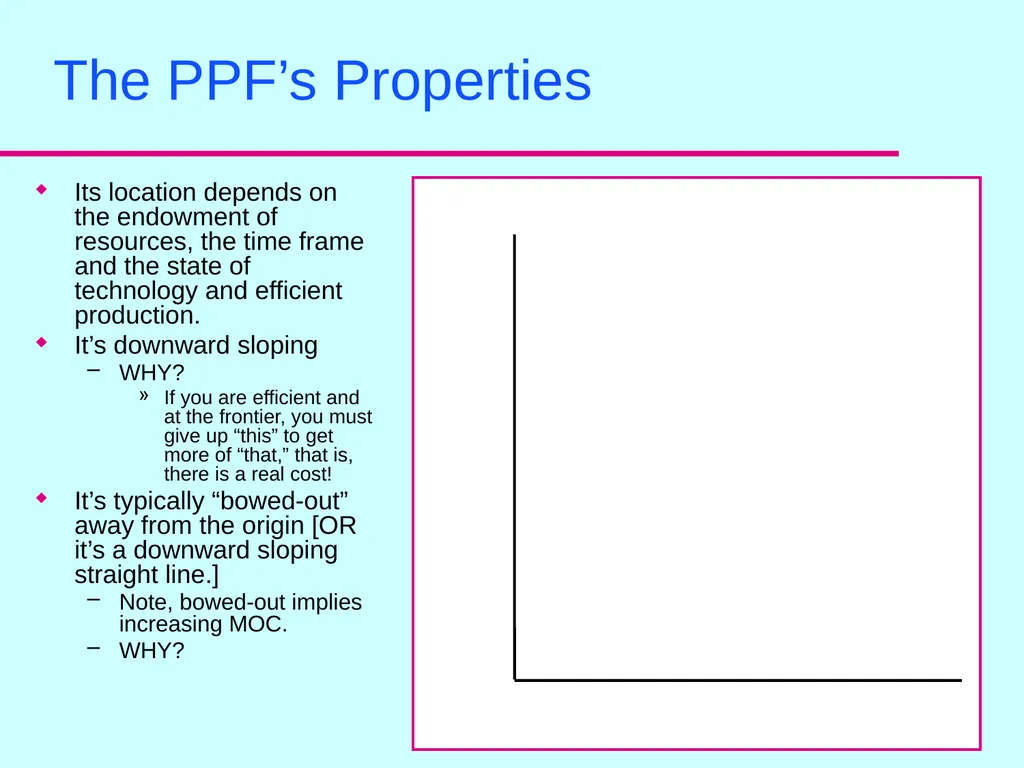
macro-S2011-Lec3-page 11 The PPF’s Properties Its location depends on the endowment of resources, the time frame and the state of technology and efficient production.
It’s downward sloping
WHY?
If you are efficient and at the frontier, you must give up “this” to get more of “that,” that is, there is a real cost!
It’s typically “bowed-out” away from the origin [OR it’s a downward sloping straight line.]
Note, bowed-out implies increasing MOC.
WHY?<br>
12
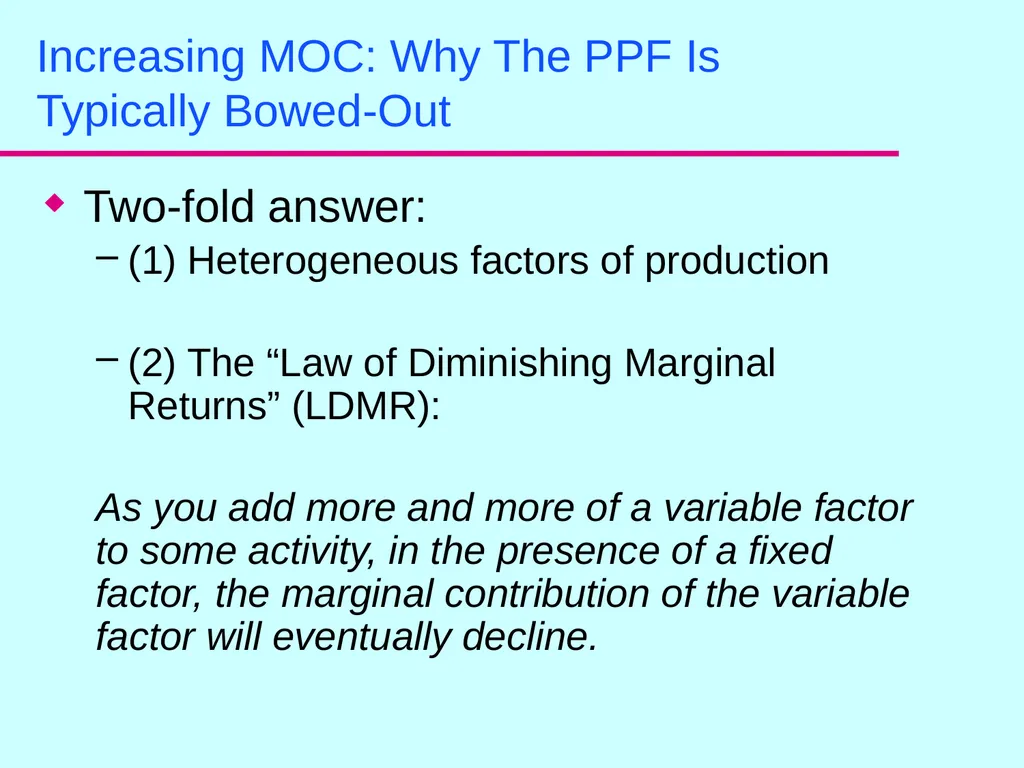
Increasing MOC: Why The PPF Is Typically Bowed-Out Two-fold answer:
(1) Heterogeneous factors of production
(2) The “Law of Diminishing Marginal Returns” (LDMR):
As you add more and more of a variable factor to some activity, in the presence of a fixed factor, the marginal contribution of the variable factor will eventually decline.<br>
13
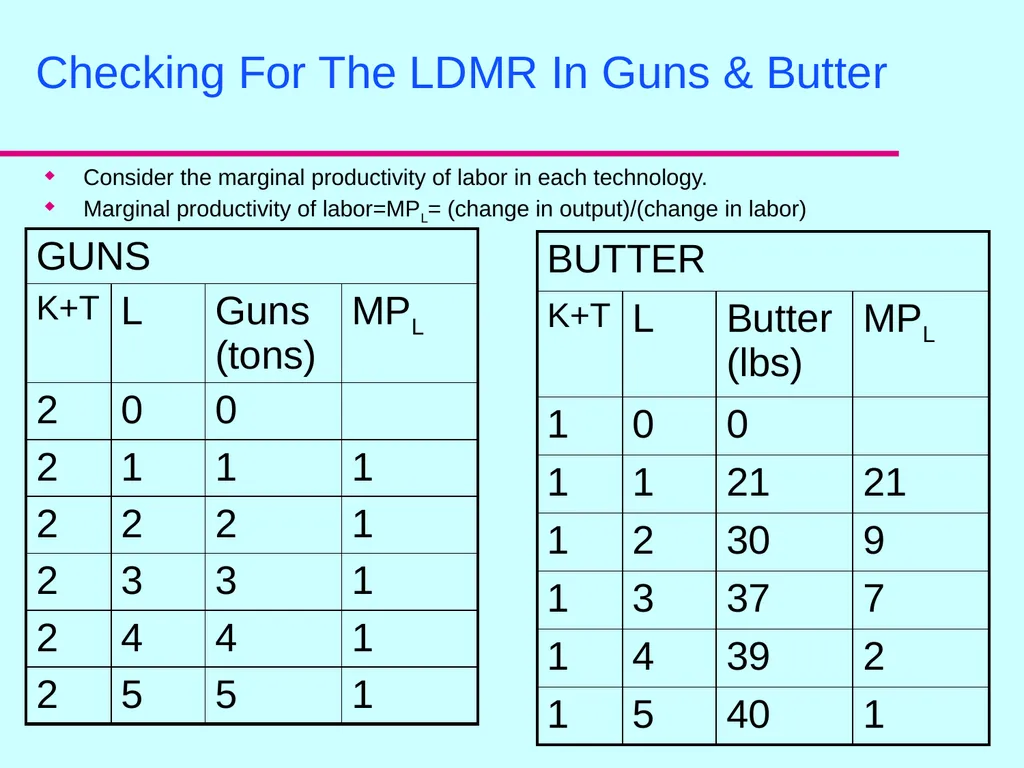
Checking For The LDMR In Guns & Butter Consider the marginal productivity of labor in each technology.
Marginal productivity of labor=MPL= (change in output)/(change in labor)<br>
14
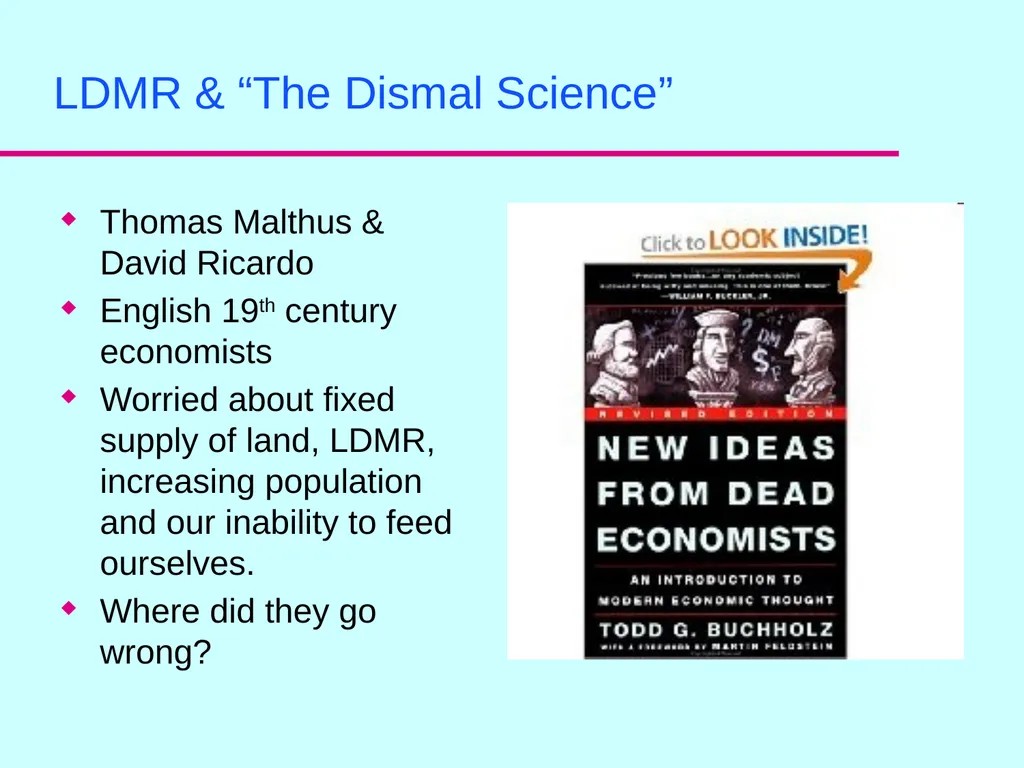
LDMR & “The Dismal Science” Thomas Malthus & David Ricardo
English 19th century economists
Worried about fixed supply of land, LDMR, increasing population and our inability to feed ourselves.
Where did they go wrong?<br>
15
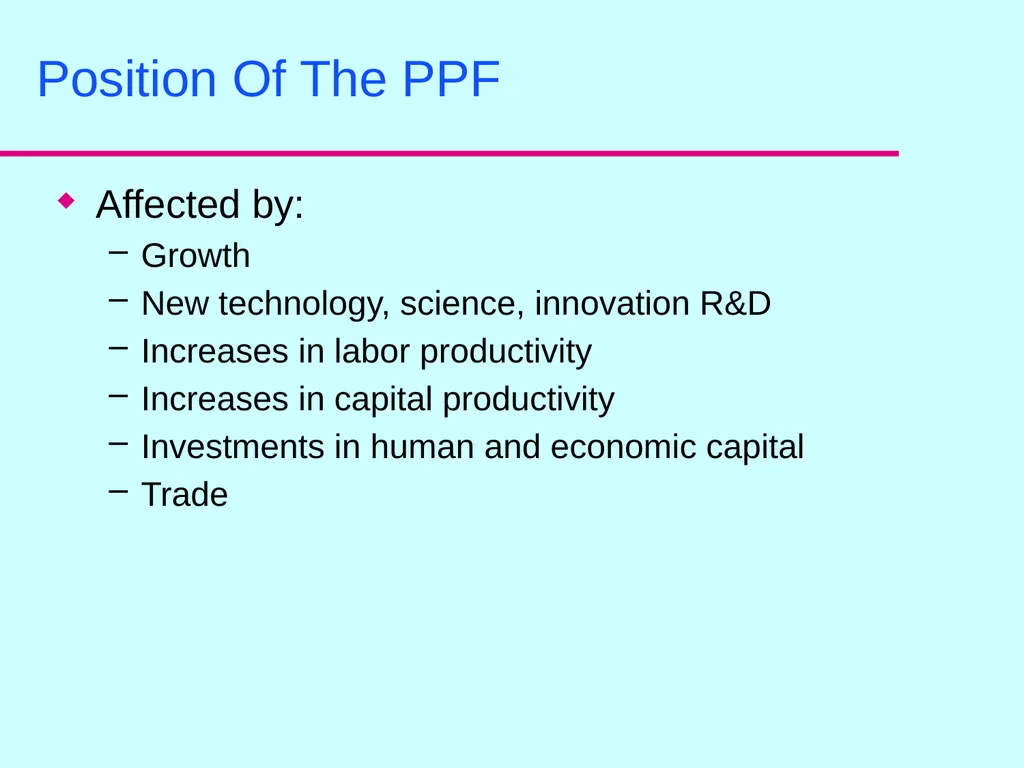
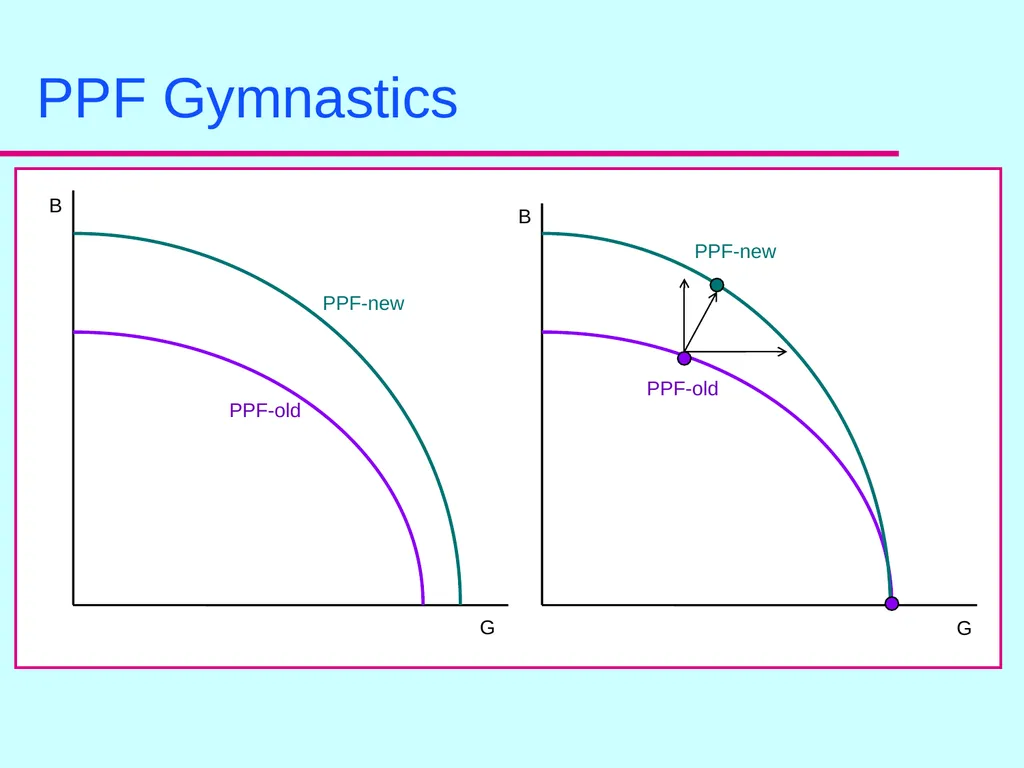
Position Of The PPF Affected by:
Growth
New technology, science, innovation R&D
Increases in labor productivity
Increases in capital productivity
Investments in human and economic capital
Trade<br>
16
PPF Gymnastics G B G B PPF-old PPF-old PPF-new PPF-new<br>
17
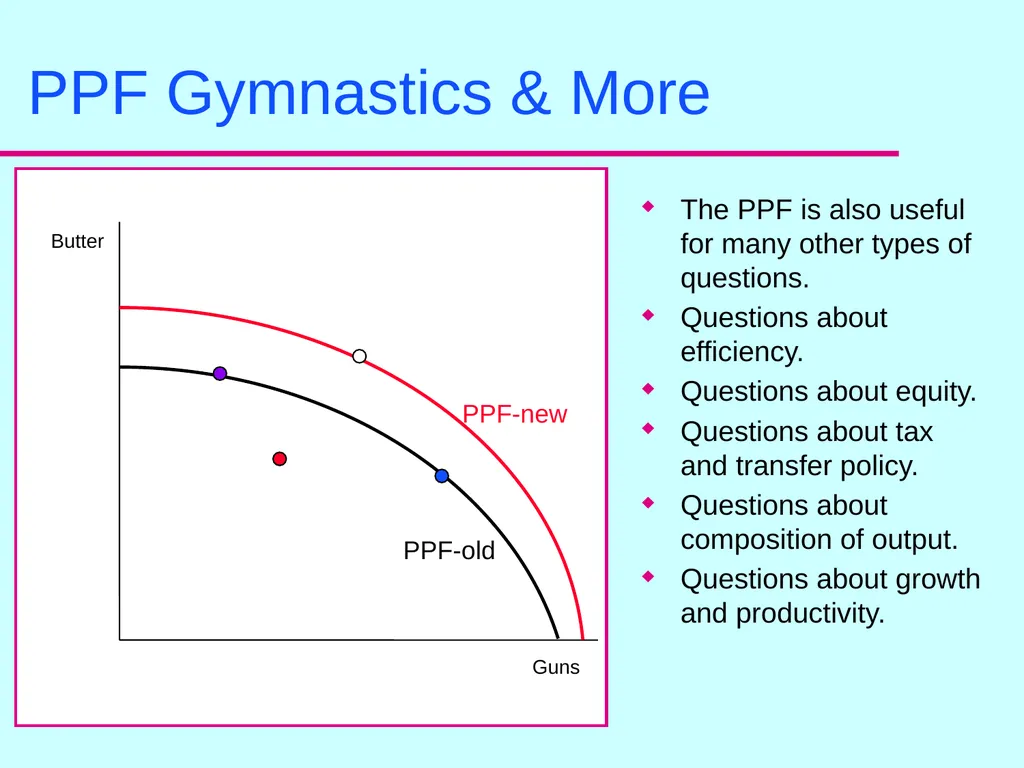
PPF Gymnastics & More Guns Butter PPF-old PPF-new The PPF is also useful for many other types of questions.
Questions about efficiency.
Questions about equity.
Questions about tax and transfer policy.
Questions about composition of output.
Questions about growth and productivity.<br>