The Revised Strengthening Families Self-Assessments: Whats Different? About the Self-Assessment Key implementation tool for programs adopting a Strengthening Families Approach Helps programs identify small but significant changes that
"The Revised Strengthening Families" is the property of its rightful owner. Permission is granted to
download and print the materials on this website for personal, non-commercial use only, and to display it
on your personal computer provided you do not modify the materials and that you retain all copyright
notices contained in the materials. By downloading content from our website, you accept the terms of this
agreement.
Presentation Transcript
01
The Revised Strengthening Families Self-Assessments: What’s Different?<br>
02
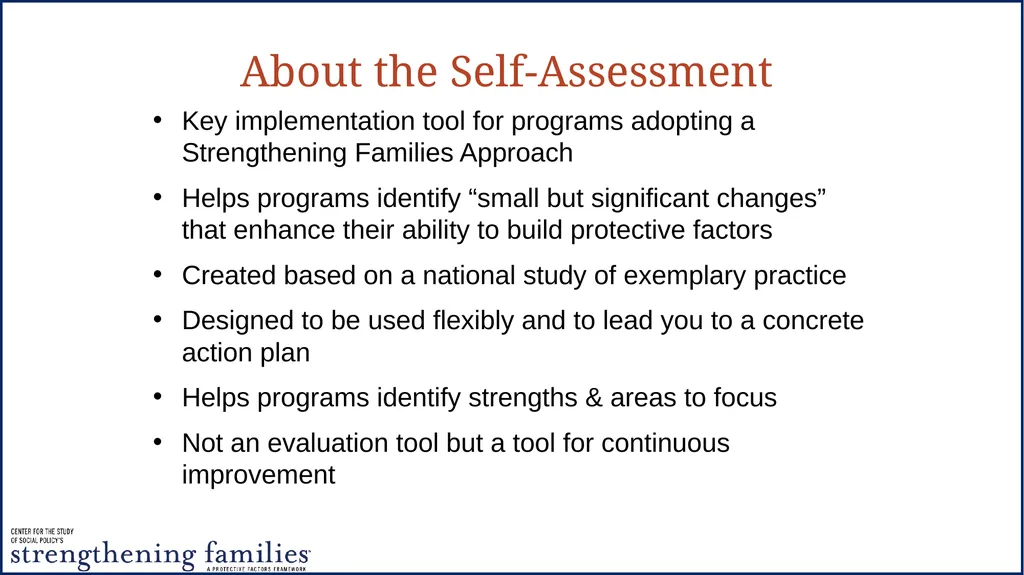
About the Self-Assessment Key implementation tool for programs adopting a Strengthening Families Approach
Helps programs identify “small but significant changes” that enhance their ability to build protective factors
Created based on a national study of exemplary practice
Designed to be used flexibly and to lead you to a concrete action plan
Helps programs identify strengths & areas to focus
Not an evaluation tool but a tool for continuous improvement<br>
03
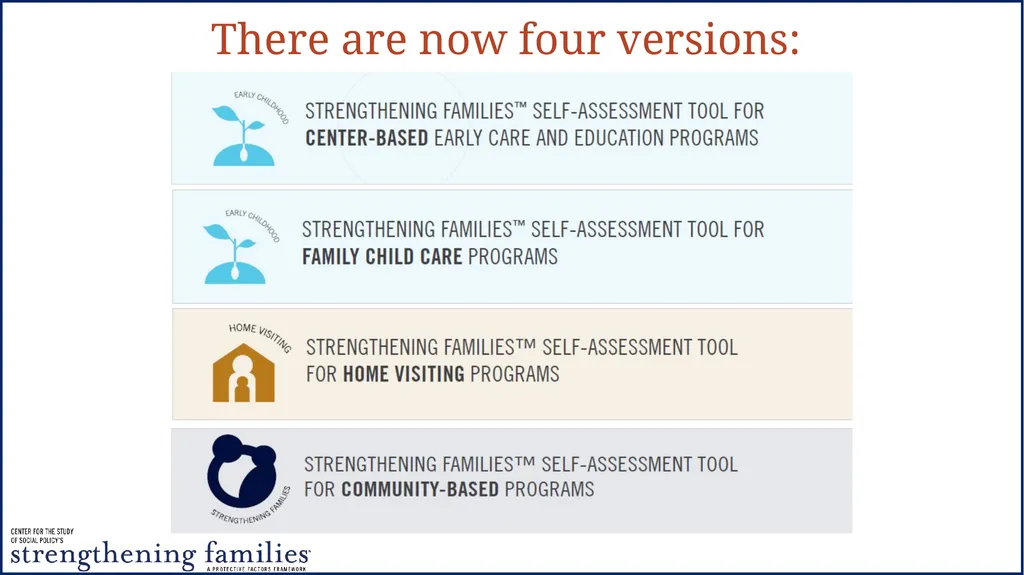
There are now four versions:<br>
04
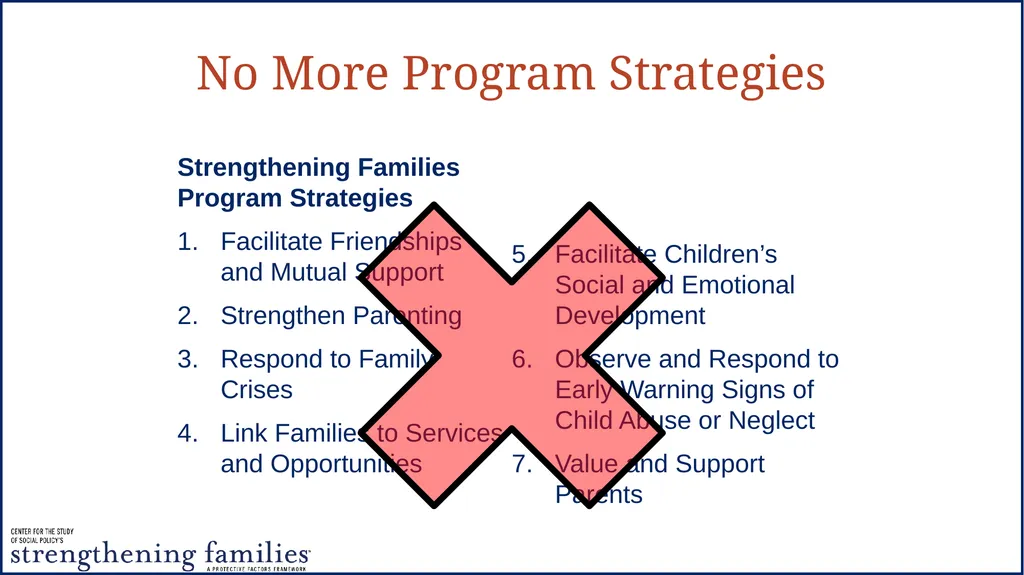
No More Program Strategies Strengthening Families Program Strategies
Facilitate Friendships and Mutual Support
Strengthen Parenting
Respond to Family Crises
Link Families to Services and Opportunities
Facilitate Children’s Social and Emotional Development
Observe and Respond to Early Warning Signs of Child Abuse or Neglect
Value and Support Parents<br>
05
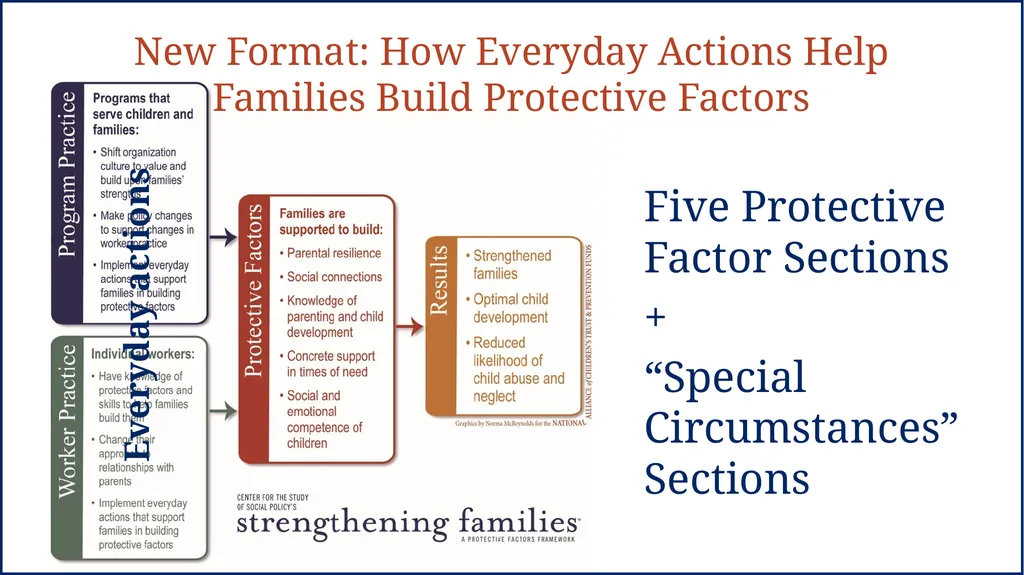
New Format: How Everyday Actions Help Families Build Protective Factors Five Protective Factor Sections
+
“Special Circumstances” Sections Everyday actions<br>
06
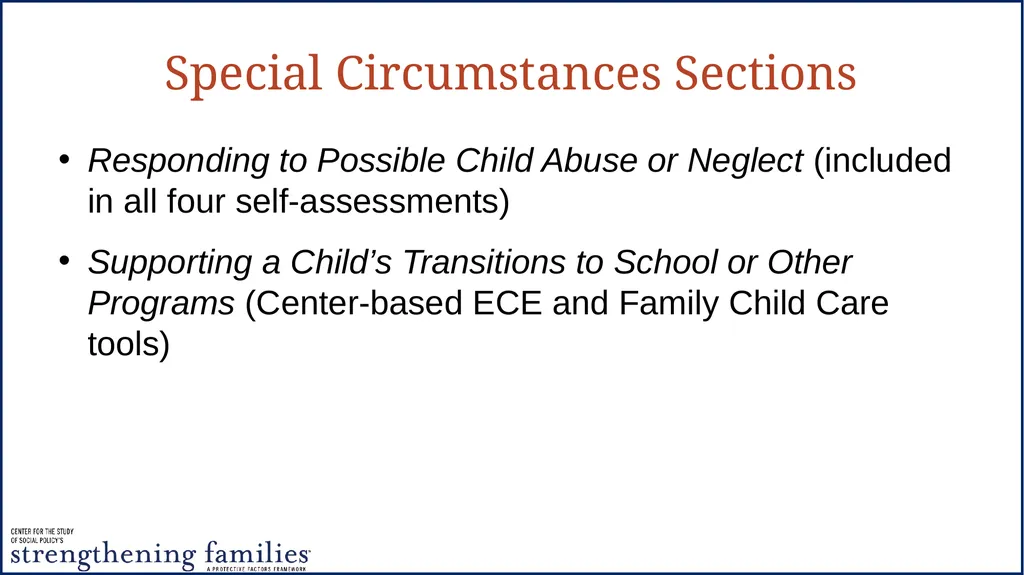
Special Circumstances Sections Responding to Possible Child Abuse or Neglect (included in all four self-assessments)
Supporting a Child’s Transitions to School or Other Programs (Center-based ECE and Family Child Care tools)<br>
07
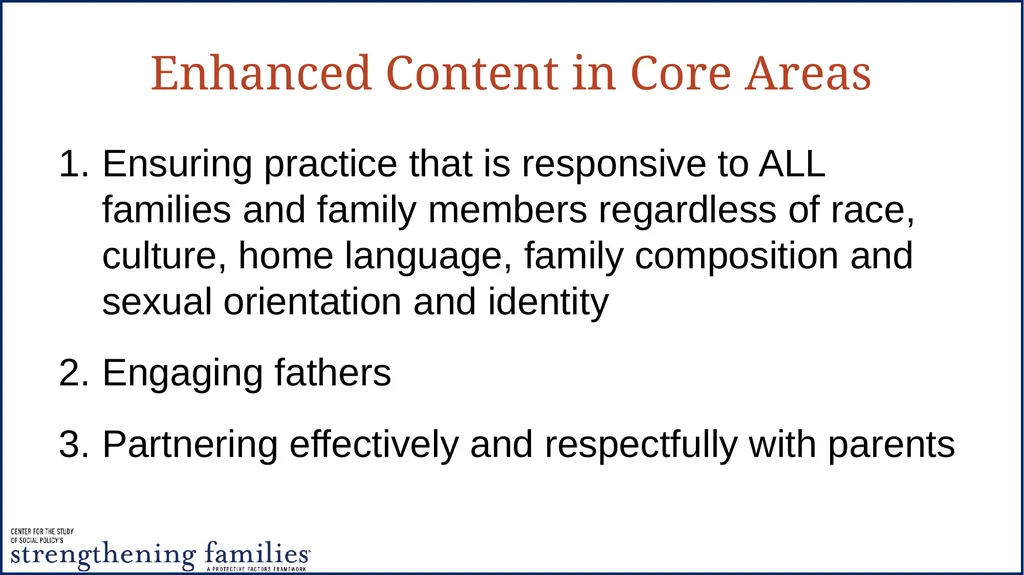
Enhanced Content in Core Areas Ensuring practice that is responsive to ALL families and family members regardless of race, culture, home language, family composition and sexual orientation and identity
Engaging fathers
Partnering effectively and respectfully with parents<br>
08
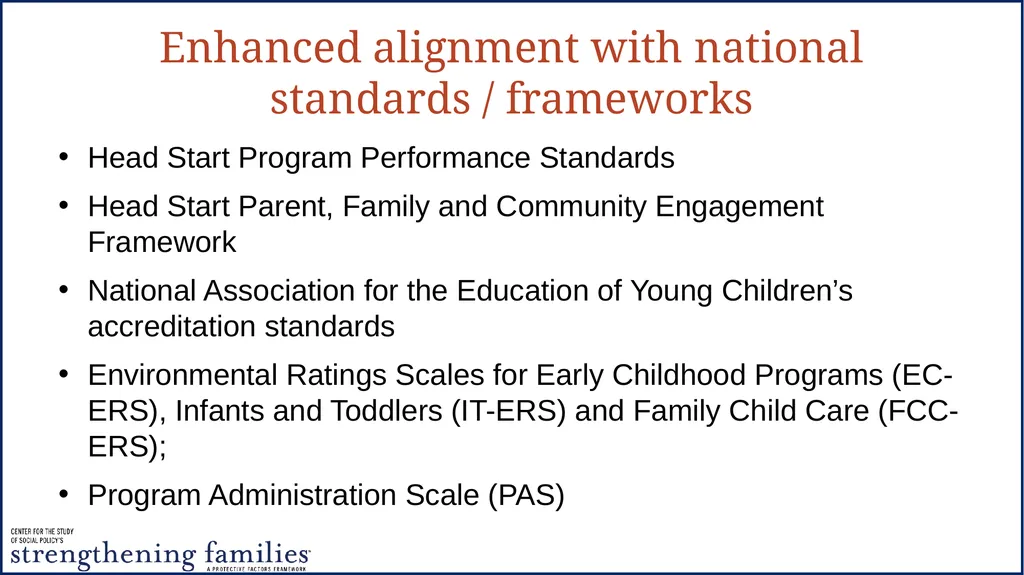
Enhanced alignment with national standards / frameworks Head Start Program Performance Standards
Head Start Parent, Family and Community Engagement Framework
National Association for the Education of Young Children’s accreditation standards
Environmental Ratings Scales for Early Childhood Programs (EC-ERS), Infants and Toddlers (IT-ERS) and Family Child Care (FCC-ERS);
Program Administration Scale (PAS)<br>
09
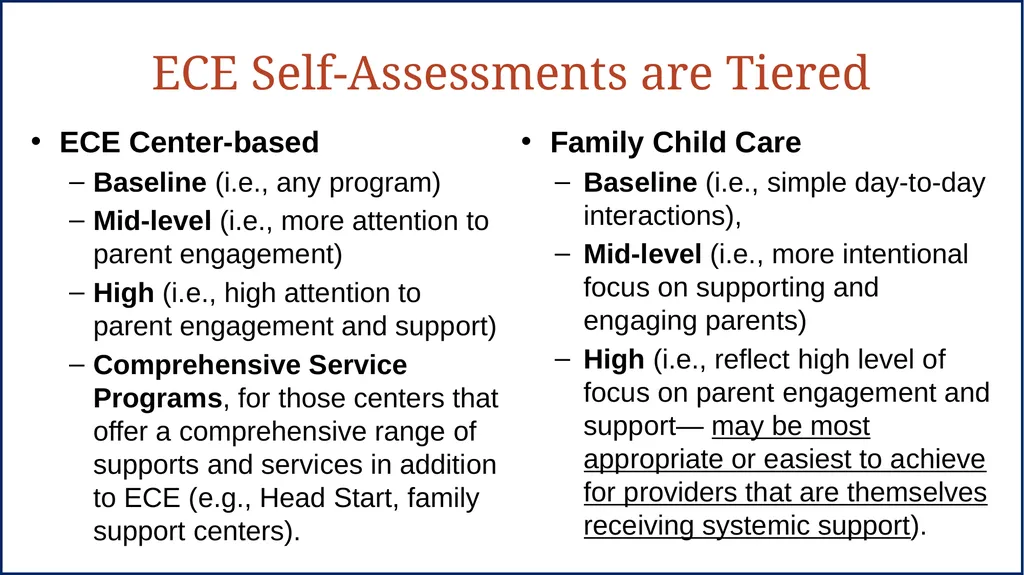
ECE Self-Assessments are Tiered ECE Center-based
Baseline (i.e., any program)
Mid-level (i.e., more attention to parent engagement)
High (i.e., high attention to parent engagement and support)
Comprehensive Service Programs, for those centers that offer a comprehensive range of supports and services in addition to ECE (e.g., Head Start, family support centers). Family Child Care
Baseline (i.e., simple day-to-day interactions),
Mid-level (i.e., more intentional focus on supporting and engaging parents)
High (i.e., reflect high level of focus on parent engagement and support— may be most appropriate or easiest to achieve for providers that are themselves receiving systemic support).<br>
10
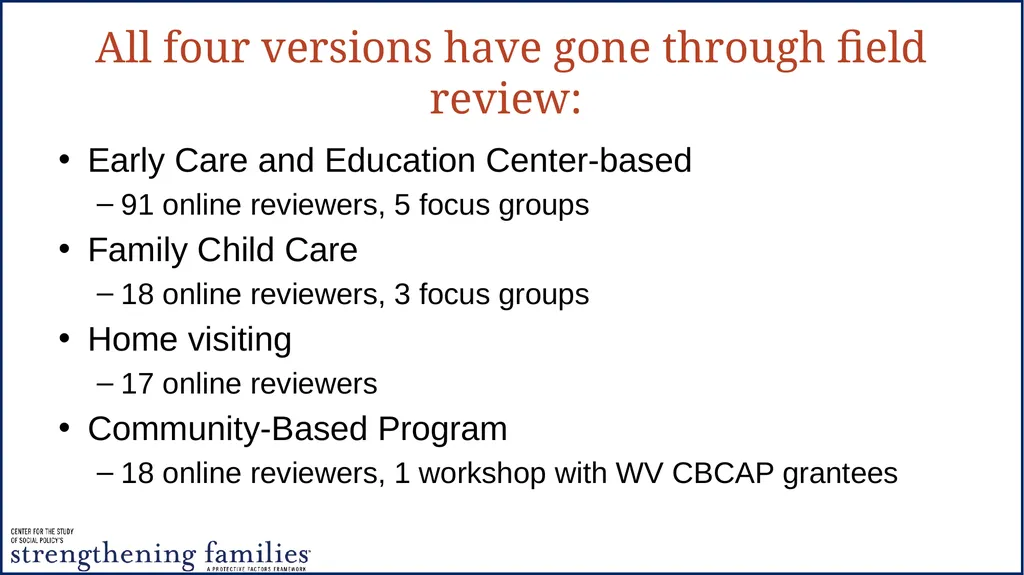
All four versions have gone through field review: Early Care and Education Center-based
91 online reviewers, 5 focus groups
Family Child Care
18 online reviewers, 3 focus groups
Home visiting
17 online reviewers
Community-Based Program
18 online reviewers, 1 workshop with WV CBCAP grantees<br>
11
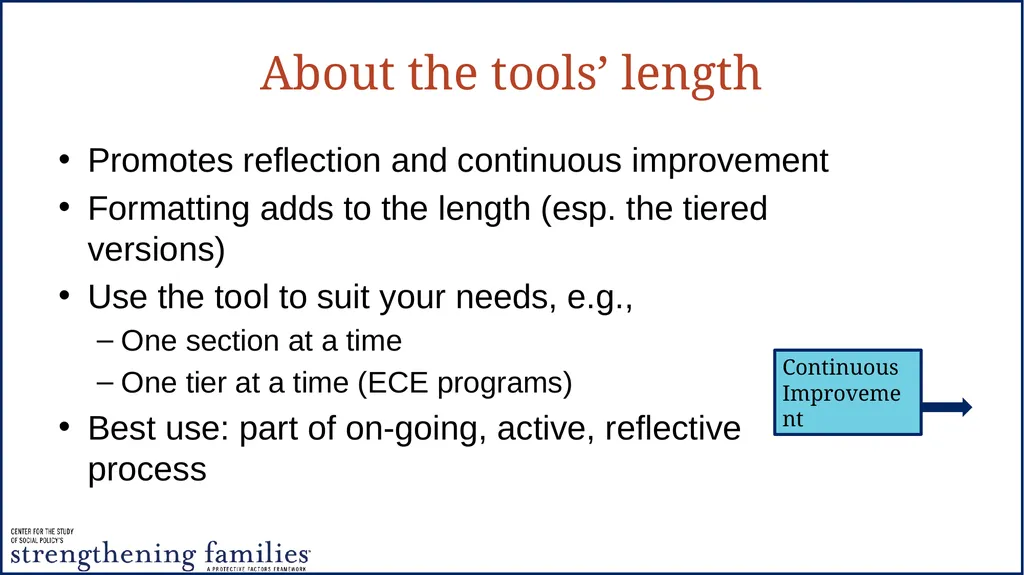
About the tools’ length Promotes reflection and continuous improvement
Formatting adds to the length (esp. the tiered versions)
Use the tool to suit your needs, e.g.,
One section at a time
One tier at a time (ECE programs)
Best use: part of on-going, active, reflective process Continuous Improvement<br>
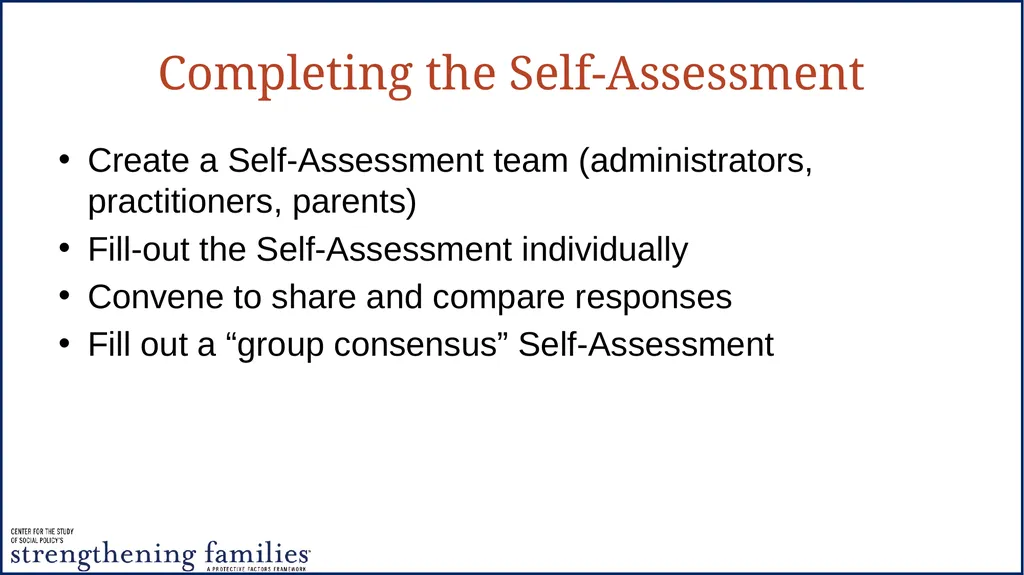
Completing the Self-Assessment Create a Self-Assessment team (administrators, practitioners, parents)
Fill-out the Self-Assessment individually
Convene to share and compare responses
Fill out a “group consensus” Self-Assessment<br>
14
Developing an Action Plan Hint – it’s easier to do this using the on-line tools
Identify areas of program strength
Create a sustainability plan to keep these areas strong
Identify practice areas that a majority rated poorly
Decide which should be addressed (1) immediately, (2) over time, or (3) not at all.
Brainstorm plans for improvement.<br>
15
Tracking Progress and Using Results Programs will be able to document progress over time
Results can become part of an active continuous improvement process
Local and state-level decision-makers can aggregate responses across programs to inform technical assistance and training offerings, target resources where they are needed most, and monitor trends.<br>
16
Self-Assessment FAQ’s How hard will it be for my program to transition to the revised tool?
Will I be able to compare results of previous self-assessments with results from the revised tool?
What do the changes mean for my state’s QRIS policy and support infrastructure?
Will the revised tools be available in Spanish or other languages?<br>
17
For More Information Strengthening Families Self-Assessments:
http://www.cssp.org/reform/strengtheningfamilies/practice#program-self-assesments
About the Self-Assessments (2-pager):
http://www.cssp.org/reform/strengtheningfamilies/2014/ AboutTheSelfAssessments.pdf
Strengthening Families Evaluation Portal:
http://www.strengtheningfamiliesevaluationportal.com<br>