The Role and Responsibilities of Those Using Animals in Research and Teaching Colleges obligation to the AWA Reasonable and professional commitment to animal welfare Completing the Protocol ESFs Obligation 9 CFR, 2.31 says we must have an
"The Role and Responsibilities of Those Using" is the property of its rightful owner. Permission is granted to
download and print the materials on this website for personal, non-commercial use only, and to display it
on your personal computer provided you do not modify the materials and that you retain all copyright
notices contained in the materials. By downloading content from our website, you accept the terms of this
agreement.
Presentation Transcript
01
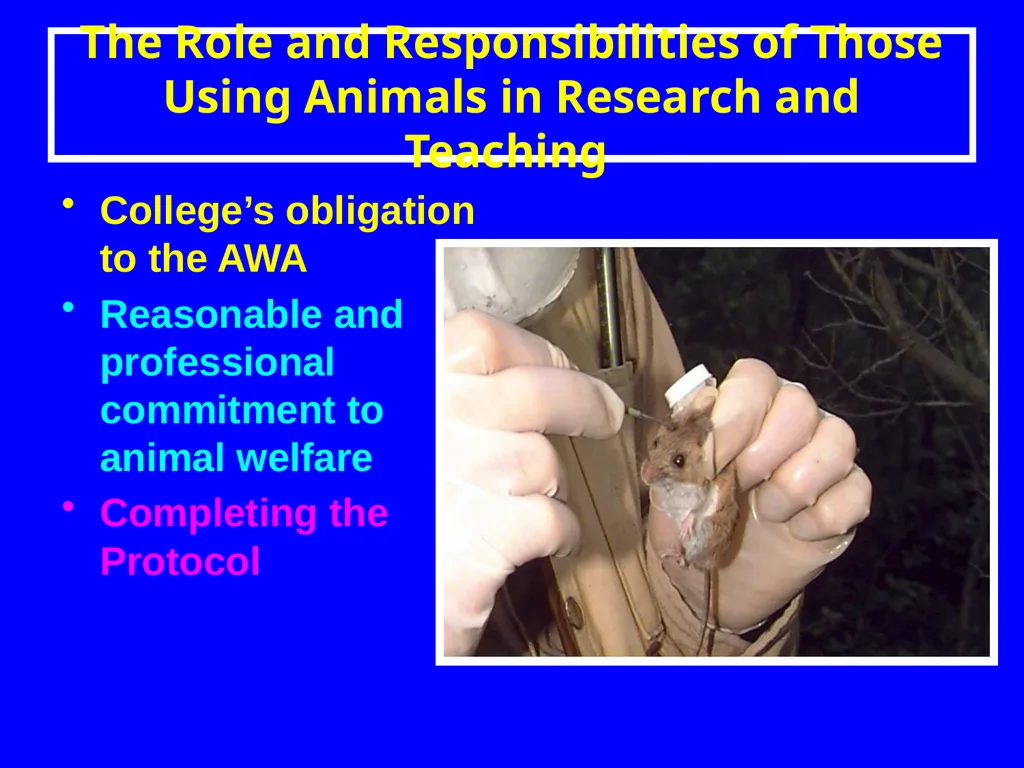
The Role and Responsibilities of Those Using Animals in Research and Teaching College’s obligation to the AWA
Reasonable and professional commitment to animal welfare
Completing the Protocol<br>
02
ESF’s Obligation 9 CFR, 2.31 says we must have an Institutional Animal Care and Use Committee that oversees compliance with the AWA (7 U.S.C. 2131 et. Seq.)
IACUC meets twice annually to review protocols and inspect premises where animals are being held<br>
03
USDA and PHS (NIH) PHS Policy covers all NIH grants
USDA guidelines cover all others
They are similar, but not identical policies<br>
04
USDA and IACUC At least 3 members
Chairperson
Attending Veterinarian
Non-affiliated member
Recruit others on an as-needed basis (e.g., 5 for NIH or NSF proposals)<br>
05
The Animal Welfare Act What’s specifically covered?
Warm blooded vertebrates, except Rattus, Mus, birds, domestic farm animals
Each IACUC may define the scope of covered species more broadly
Primarily concerned with laboratory animals
“Field Studies” are treated differently<br>
06
What is a “Field Study”? Not held in captivity > 24 hours AND
No invasive procedures AND
Biopsy, surgery, implantation, tooth extraction
Will not harm subject or materially alter its behavior
Affirmation of all conditions meets definition of field study; all others are NOT field studies.<br>
07
Questions You Should Ask What are my legal obligations?
Must comply with College policy
What are my professional obligations?
Must certify that you are adopting procedures and practices recommended by your professional society
What are my personal obligations?
You must adhere to rules, regulations and policies that ensure the safety and welfare of yourself and your animal research subjects<br>
08
Common Myths My species is not regulated so I have no obligation to the AWA
I’m conducting a “field study” so I don’t need to complete a protocol
Because I’m a Grad Student, I am automatically qualified to conduct studies on vertebrate research subjects
I don’t need to consult a vet, health & safety officer, or controlled substances officer if I’m doing a “field study”<br>
09
The Protocol Project Description
Course Number or Project Title
Project Directors
Project Details and Personnel
You
Your advisor
Attending veterinarian
Experience/Qualifications<br>
10
Project Description Need a 150-250 word abstract on ALL projects involving vertebrates
Project species, methods, goals or aims, objectives
Anticipated results<br>
11
Project Details & Personnel Title or Course Number
Directors
Faculty
Source of Funding
Duration
Potential Hazards to Humans
Personnel & Qualifications<br>
12
Survey and Disposition Captivity
Provide details
Invasive Procedure
Provide details
Harm or Alteration of Behavior
Provide details
Field Studies
10 items to address
Certification
For all studies<br>
13
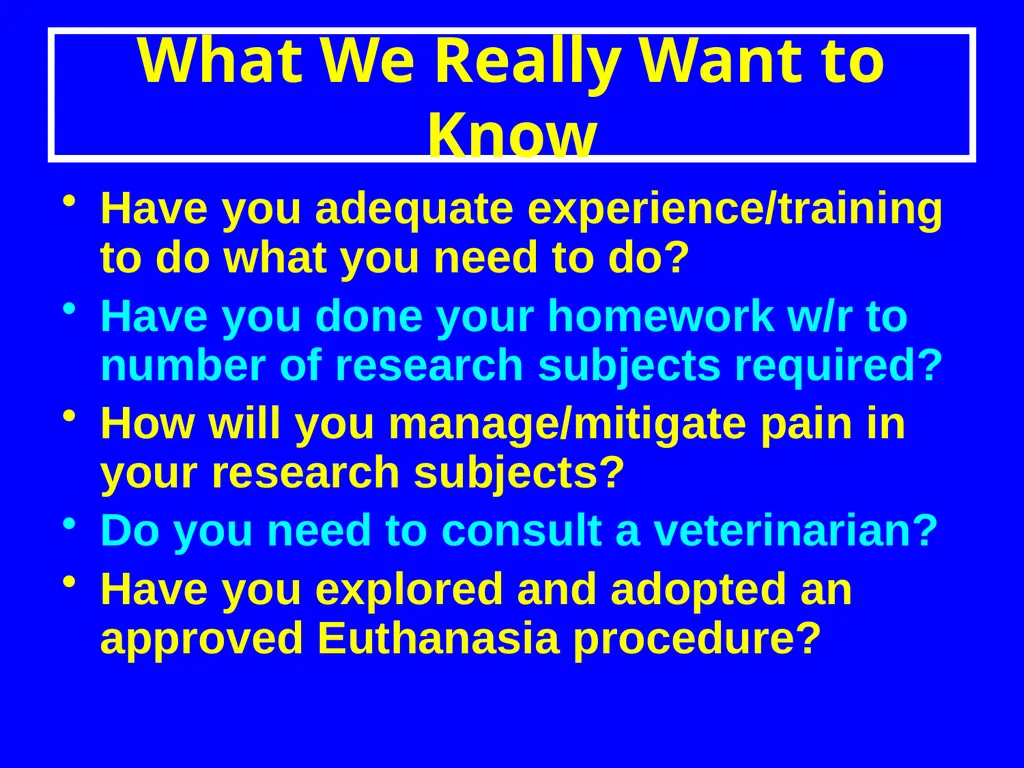
What We Really Want to Know Have you adequate experience/training to do what you need to do?
Have you done your homework w/r to number of research subjects required?
How will you manage/mitigate pain in your research subjects?
Do you need to consult a veterinarian?
Have you explored and adopted an approved Euthanasia procedure?<br>
14
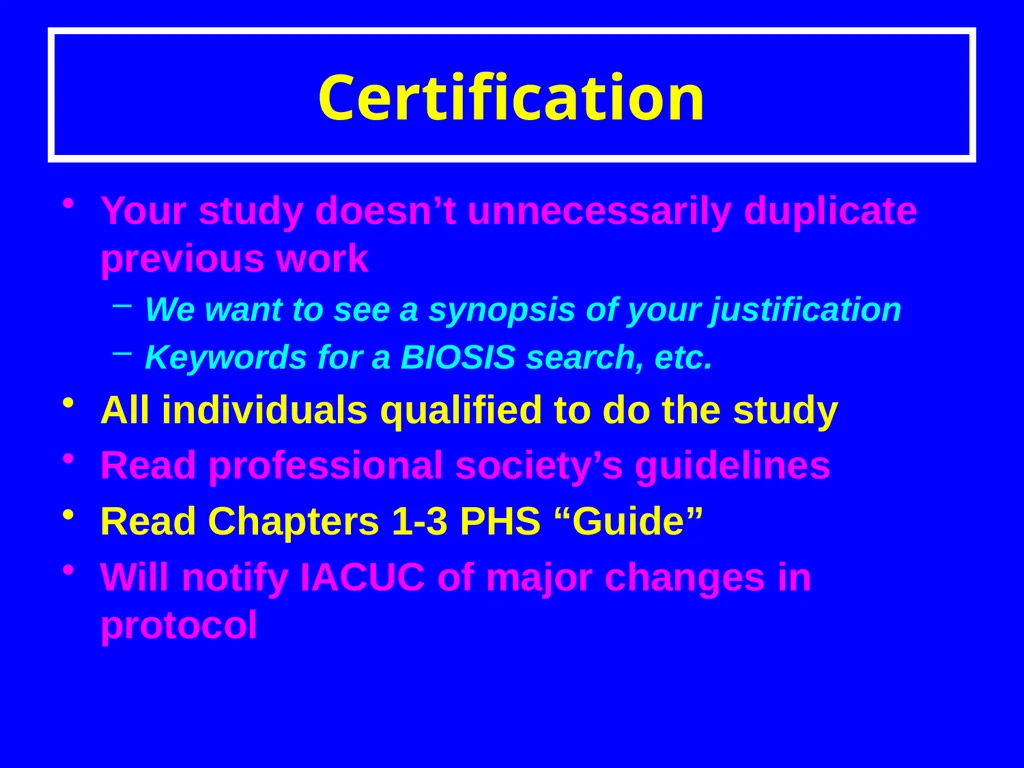
Certification Your study doesn’t unnecessarily duplicate previous work
We want to see a synopsis of your justification
Keywords for a BIOSIS search, etc.
All individuals qualified to do the study
Read professional society’s guidelines
Read Chapters 1-3 PHS “Guide”
Will notify IACUC of major changes in protocol<br>