
The Software Assurance Competency Model: A Roadmap
OM
Published · 31 slides · 0 views
1 / 1
Description
The Software Assurance Competency Model: A Roadmap to Enhance Personal Professional Capability Software Engineering Institute Carnegie Mellon University Pittsburgh, PA 15213 Nancy R. Mead, PhD Definition of Software Assurance The following
Related Topics
Share
Embed code
Download this presentation From Below
"The Software Assurance Competency Model: A Roadmap" is the property of its rightful owner. Permission is granted to download and print the materials on this website for personal, non-commercial use only, and to display it on your personal computer provided you do not modify the materials and that you retain all copyright notices contained in the materials. By downloading content from our website, you accept the terms of this agreement.
Presentation Transcript
01
The Software Assurance Competency Model: A Roadmap to Enhance Personal Professional Capability Software Engineering Institute
Carnegie Mellon University
Pittsburgh, PA 15213
Nancy R. Mead, PhD<br>
Carnegie Mellon University
Pittsburgh, PA 15213
Nancy R. Mead, PhD<br>
02
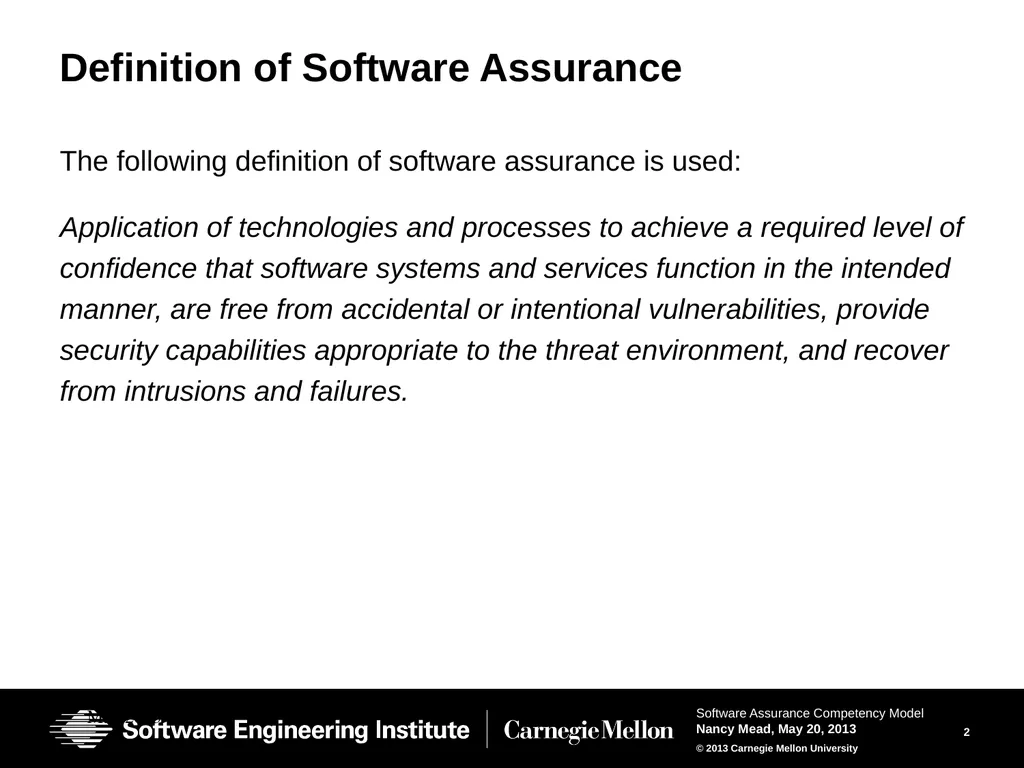
Definition of Software Assurance The following definition of software assurance is used:
Application of technologies and processes to achieve a required level of confidence that software systems and services function in the intended manner, are free from accidental or intentional vulnerabilities, provide security capabilities appropriate to the threat environment, and recover from intrusions and failures. May 2013<br>
Application of technologies and processes to achieve a required level of confidence that software systems and services function in the intended manner, are free from accidental or intentional vulnerabilities, provide security capabilities appropriate to the threat environment, and recover from intrusions and failures. May 2013<br>
03
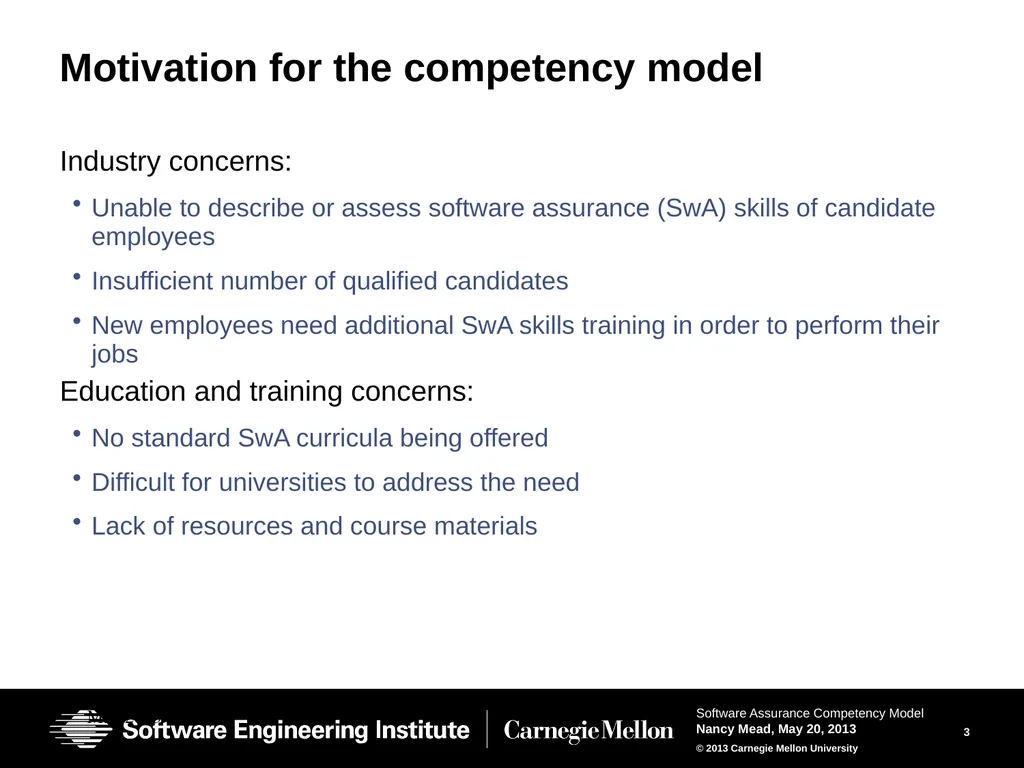
Motivation for the competency model Industry concerns:
Unable to describe or assess software assurance (SwA) skills of candidate employees
Insufficient number of qualified candidates
New employees need additional SwA skills training in order to perform their jobs
Education and training concerns:
No standard SwA curricula being offered
Difficult for universities to address the need
Lack of resources and course materials May 2013<br>
Unable to describe or assess software assurance (SwA) skills of candidate employees
Insufficient number of qualified candidates
New employees need additional SwA skills training in order to perform their jobs
Education and training concerns:
No standard SwA curricula being offered
Difficult for universities to address the need
Lack of resources and course materials May 2013<br>
04
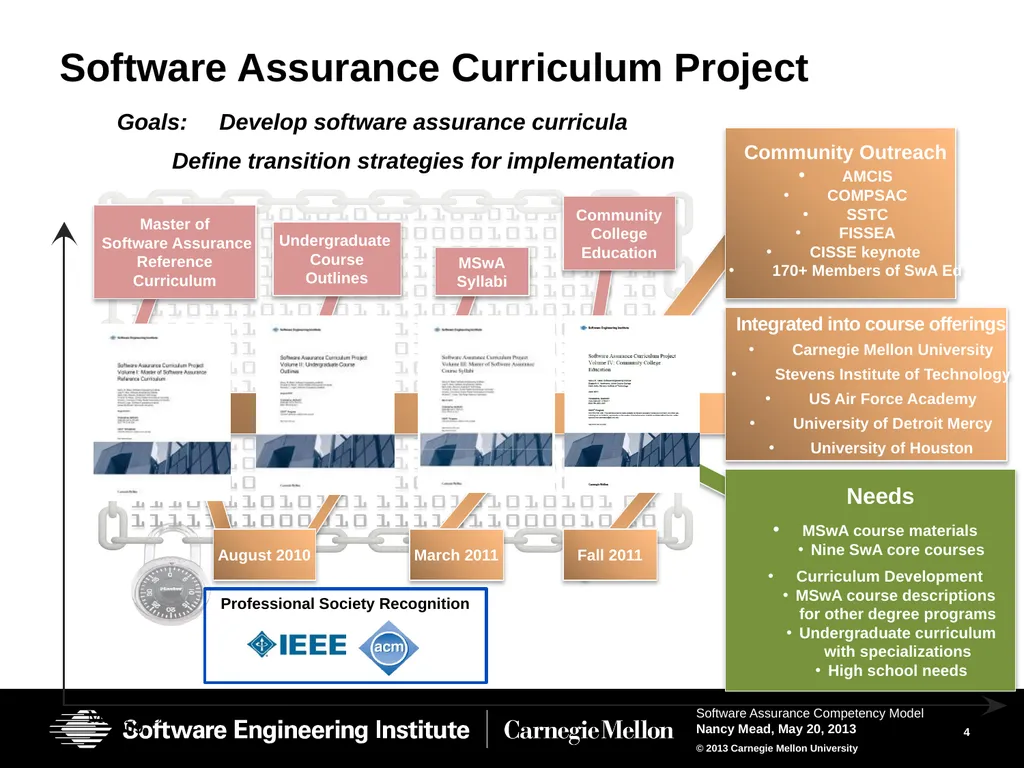
Software Assurance Curriculum Project August 2010 Master of
Software Assurance
Reference
Curriculum 2009 2013 Community Outreach
AMCIS
COMPSAC
SSTC
FISSEA
CISSE keynote
170+ Members of SwA Ed March 2011 Goals: Develop software assurance curricula
Define transition strategies for implementation Integrated into course offerings
Carnegie Mellon University
Stevens Institute of Technology
US Air Force Academy
University of Detroit Mercy
University of Houston Undergraduate Course Outlines MSwA Syllabi Community College Education Fall 2011 Needs
MSwA course materials
Nine SwA core courses
Curriculum Development
MSwA course descriptions
for other degree programs
Undergraduate curriculum
with specializations
High school needs May 2013<br>
AMCIS
COMPSAC
SSTC
FISSEA
CISSE keynote
170+ Members of SwA Ed March 2011 Goals: Develop software assurance curricula
Define transition strategies for implementation Integrated into course offerings
Carnegie Mellon University
Stevens Institute of Technology
US Air Force Academy
University of Detroit Mercy
University of Houston Undergraduate Course Outlines MSwA Syllabi Community College Education Fall 2011 Needs
MSwA course materials
Nine SwA core courses
Curriculum Development
MSwA course descriptions
for other degree programs
Undergraduate curriculum
with specializations
High school needs May 2013<br>
05
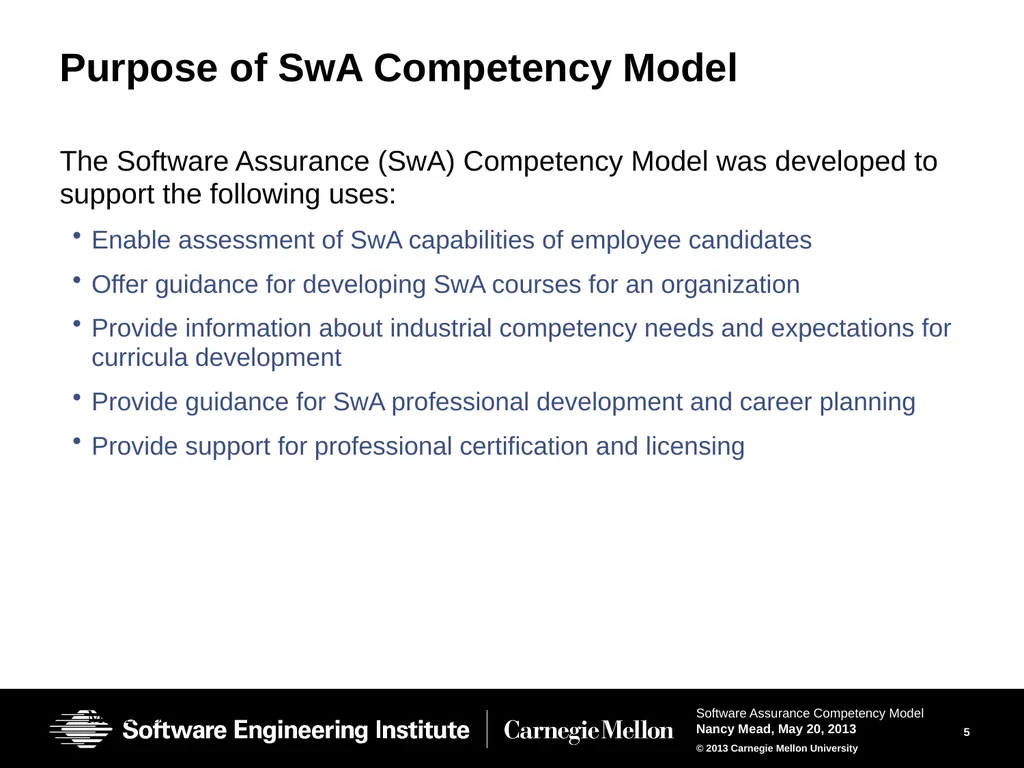
Purpose of SwA Competency Model The Software Assurance (SwA) Competency Model was developed to support the following uses:
Enable assessment of SwA capabilities of employee candidates
Offer guidance for developing SwA courses for an organization
Provide information about industrial competency needs and expectations for curricula development
Provide guidance for SwA professional development and career planning
Provide support for professional certification and licensing May 2013<br>
Enable assessment of SwA capabilities of employee candidates
Offer guidance for developing SwA courses for an organization
Provide information about industrial competency needs and expectations for curricula development
Provide guidance for SwA professional development and career planning
Provide support for professional certification and licensing May 2013<br>
06
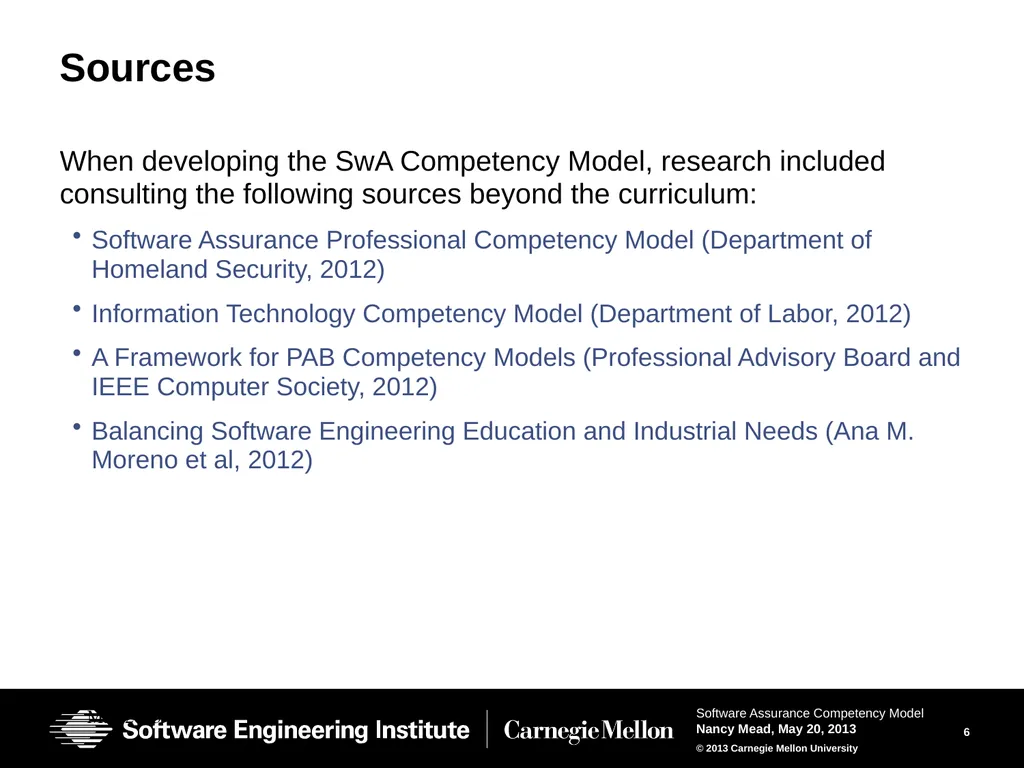
Sources When developing the SwA Competency Model, research included consulting the following sources beyond the curriculum:
Software Assurance Professional Competency Model (Department of Homeland Security, 2012)
Information Technology Competency Model (Department of Labor, 2012)
A Framework for PAB Competency Models (Professional Advisory Board and IEEE Computer Society, 2012)
Balancing Software Engineering Education and Industrial Needs (Ana M. Moreno et al, 2012) May 2013<br>
Software Assurance Professional Competency Model (Department of Homeland Security, 2012)
Information Technology Competency Model (Department of Labor, 2012)
A Framework for PAB Competency Models (Professional Advisory Board and IEEE Computer Society, 2012)
Balancing Software Engineering Education and Industrial Needs (Ana M. Moreno et al, 2012) May 2013<br>
07
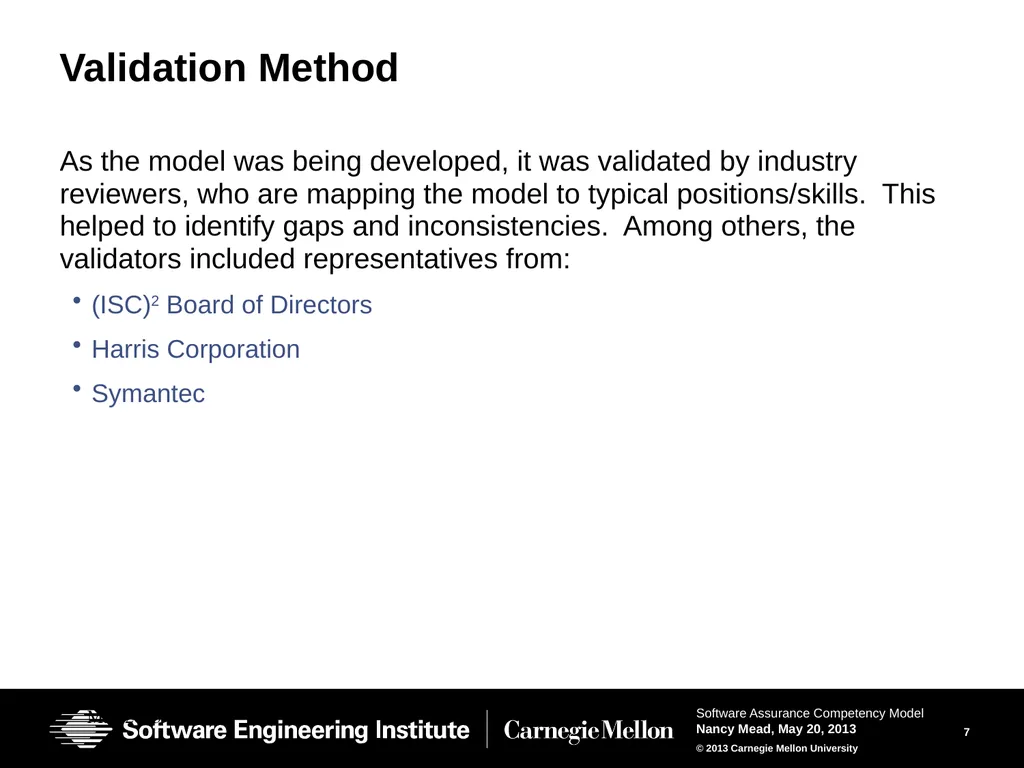
Validation Method As the model was being developed, it was validated by industry reviewers, who are mapping the model to typical positions/skills. This helped to identify gaps and inconsistencies. Among others, the validators included representatives from:
(ISC)2 Board of Directors
Harris Corporation
Symantec May 2013<br>
(ISC)2 Board of Directors
Harris Corporation
Symantec May 2013<br>
08
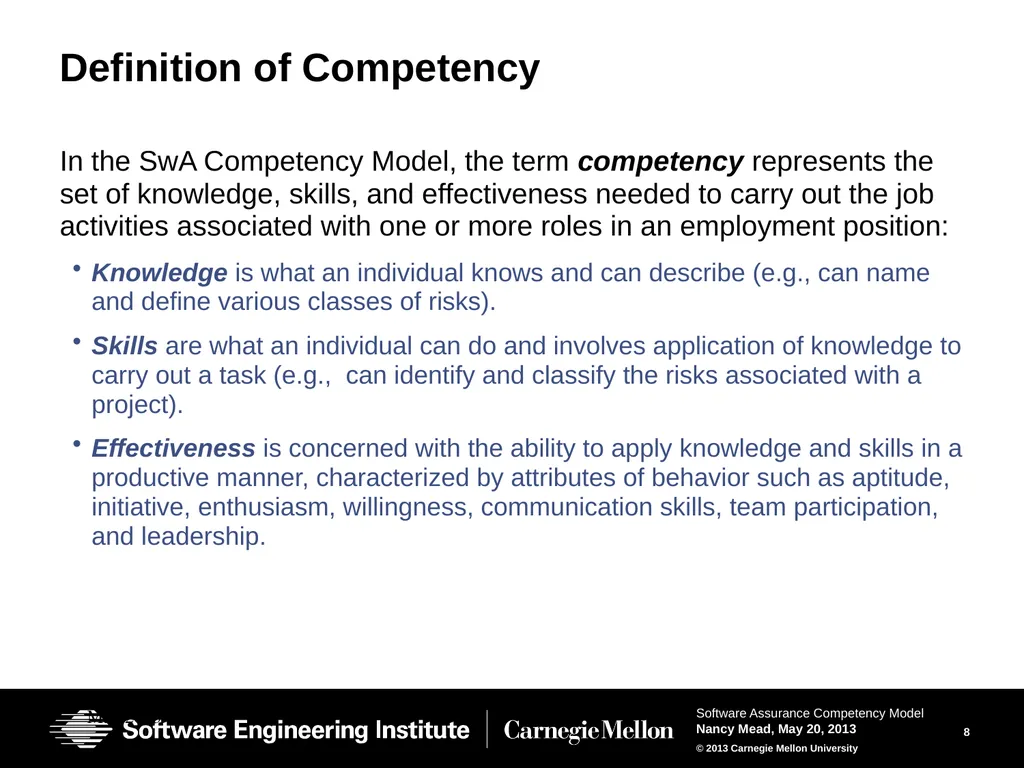
Definition of Competency In the SwA Competency Model, the term competency represents the set of knowledge, skills, and effectiveness needed to carry out the job activities associated with one or more roles in an employment position:
Knowledge is what an individual knows and can describe (e.g., can name and define various classes of risks).
Skills are what an individual can do and involves application of knowledge to carry out a task (e.g., can identify and classify the risks associated with a project).
Effectiveness is concerned with the ability to apply knowledge and skills in a productive manner, characterized by attributes of behavior such as aptitude, initiative, enthusiasm, willingness, communication skills, team participation, and leadership. May 2013<br>
Knowledge is what an individual knows and can describe (e.g., can name and define various classes of risks).
Skills are what an individual can do and involves application of knowledge to carry out a task (e.g., can identify and classify the risks associated with a project).
Effectiveness is concerned with the ability to apply knowledge and skills in a productive manner, characterized by attributes of behavior such as aptitude, initiative, enthusiasm, willingness, communication skills, team participation, and leadership. May 2013<br>
09
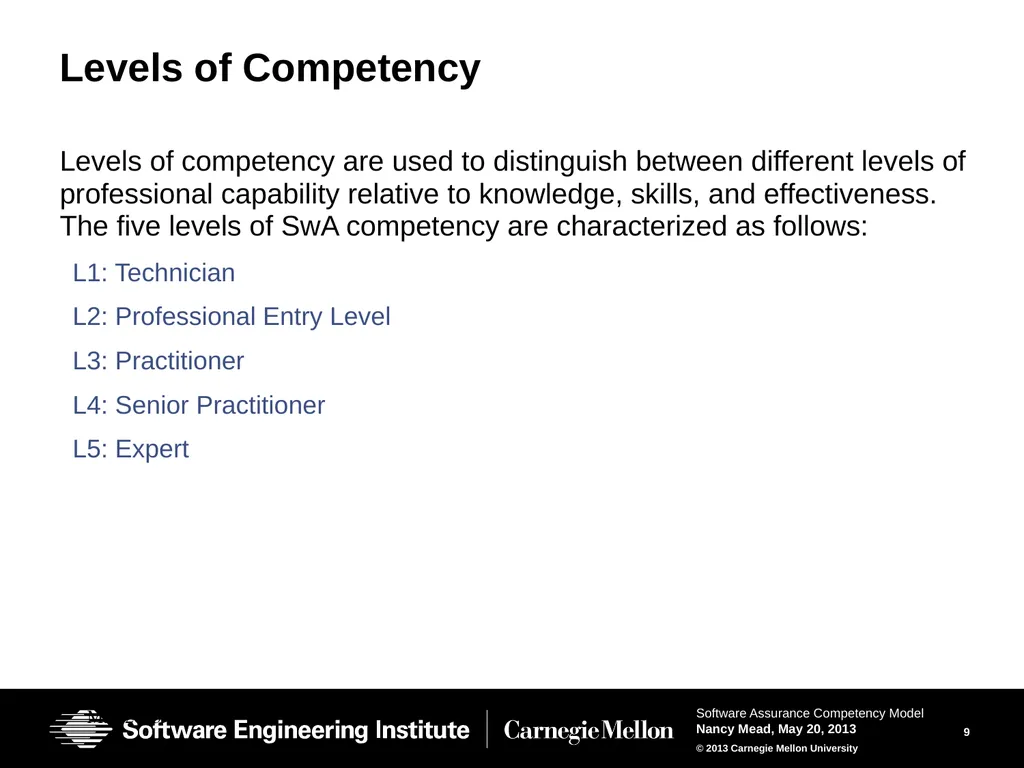
Levels of Competency Levels of competency are used to distinguish between different levels of professional capability relative to knowledge, skills, and effectiveness. The five levels of SwA competency are characterized as follows:
L1: Technician
L2: Professional Entry Level
L3: Practitioner
L4: Senior Practitioner
L5: Expert May 2013<br>
L1: Technician
L2: Professional Entry Level
L3: Practitioner
L4: Senior Practitioner
L5: Expert May 2013<br>
10
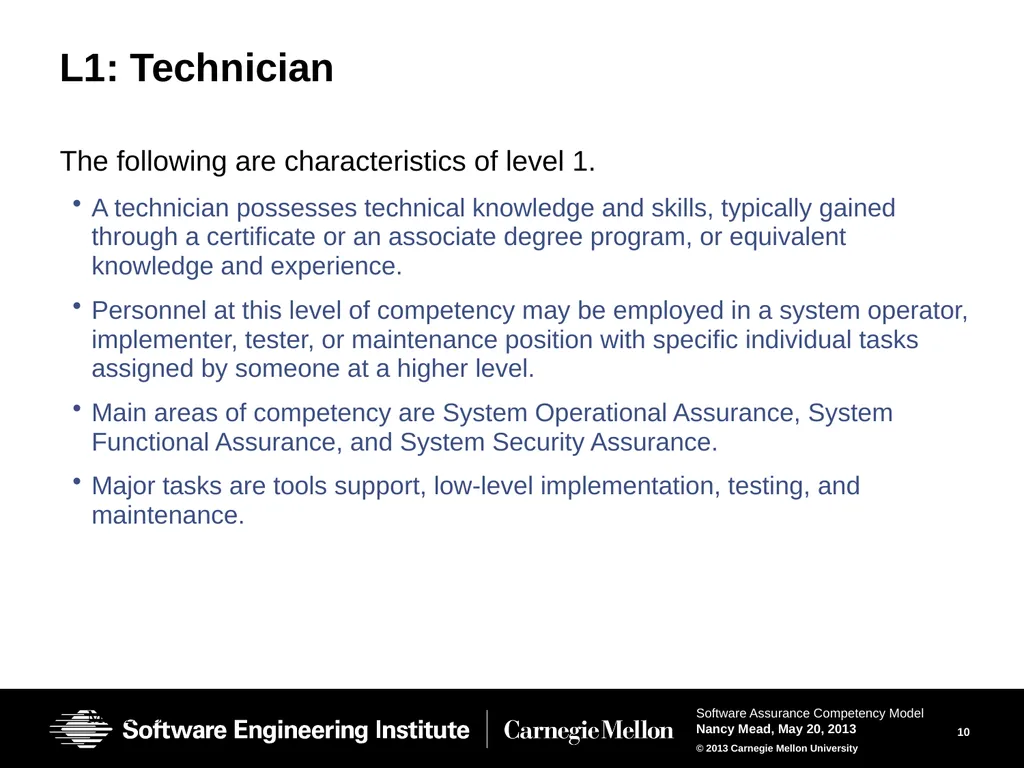
L1: Technician The following are characteristics of level 1.
A technician possesses technical knowledge and skills, typically gained through a certificate or an associate degree program, or equivalent knowledge and experience.
Personnel at this level of competency may be employed in a system operator, implementer, tester, or maintenance position with specific individual tasks assigned by someone at a higher level.
Main areas of competency are System Operational Assurance, System Functional Assurance, and System Security Assurance.
Major tasks are tools support, low-level implementation, testing, and maintenance. May 2013<br>
A technician possesses technical knowledge and skills, typically gained through a certificate or an associate degree program, or equivalent knowledge and experience.
Personnel at this level of competency may be employed in a system operator, implementer, tester, or maintenance position with specific individual tasks assigned by someone at a higher level.
Main areas of competency are System Operational Assurance, System Functional Assurance, and System Security Assurance.
Major tasks are tools support, low-level implementation, testing, and maintenance. May 2013<br>
11
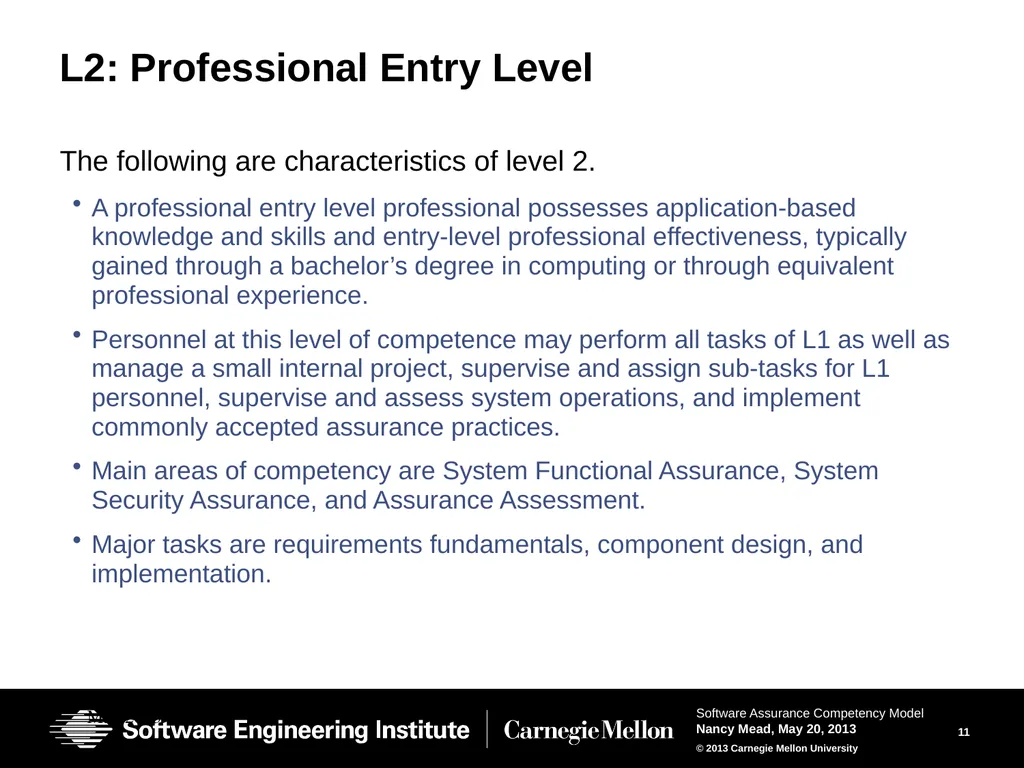
L2: Professional Entry Level The following are characteristics of level 2.
A professional entry level professional possesses application-based knowledge and skills and entry-level professional effectiveness, typically gained through a bachelor’s degree in computing or through equivalent professional experience.
Personnel at this level of competence may perform all tasks of L1 as well as manage a small internal project, supervise and assign sub-tasks for L1 personnel, supervise and assess system operations, and implement commonly accepted assurance practices.
Main areas of competency are System Functional Assurance, System Security Assurance, and Assurance Assessment.
Major tasks are requirements fundamentals, component design, and implementation. May 2013<br>
A professional entry level professional possesses application-based knowledge and skills and entry-level professional effectiveness, typically gained through a bachelor’s degree in computing or through equivalent professional experience.
Personnel at this level of competence may perform all tasks of L1 as well as manage a small internal project, supervise and assign sub-tasks for L1 personnel, supervise and assess system operations, and implement commonly accepted assurance practices.
Main areas of competency are System Functional Assurance, System Security Assurance, and Assurance Assessment.
Major tasks are requirements fundamentals, component design, and implementation. May 2013<br>
12
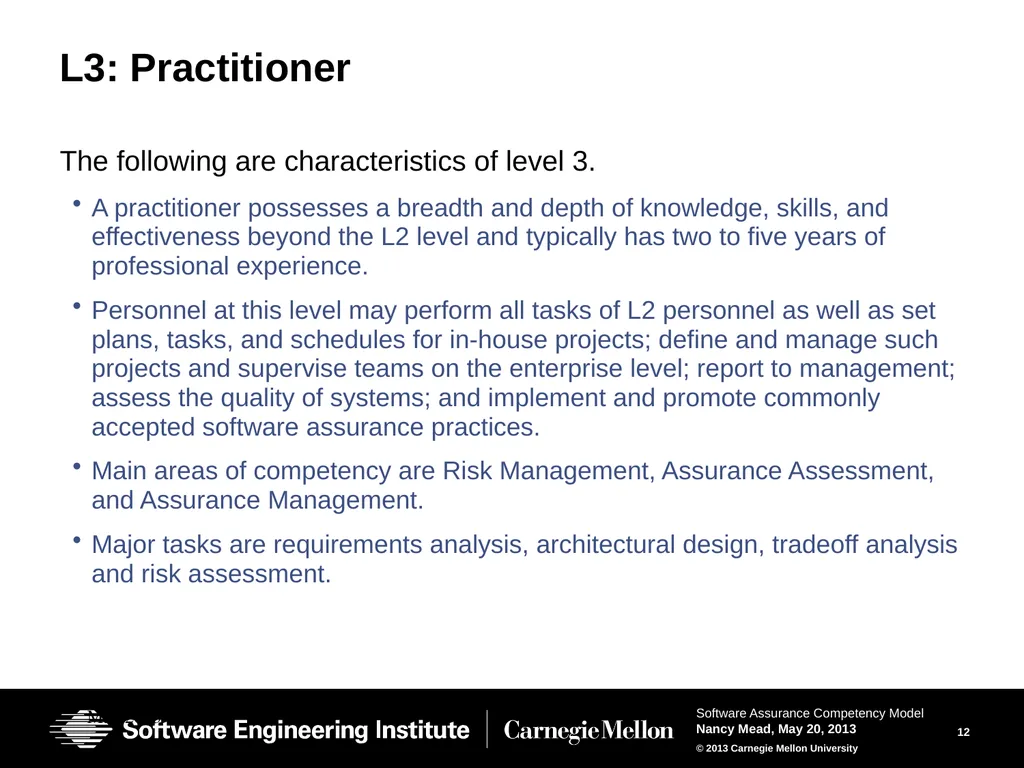
L3: Practitioner The following are characteristics of level 3.
A practitioner possesses a breadth and depth of knowledge, skills, and effectiveness beyond the L2 level and typically has two to five years of professional experience.
Personnel at this level may perform all tasks of L2 personnel as well as set plans, tasks, and schedules for in-house projects; define and manage such projects and supervise teams on the enterprise level; report to management; assess the quality of systems; and implement and promote commonly accepted software assurance practices.
Main areas of competency are Risk Management, Assurance Assessment, and Assurance Management.
Major tasks are requirements analysis, architectural design, tradeoff analysis and risk assessment. May 2013<br>
A practitioner possesses a breadth and depth of knowledge, skills, and effectiveness beyond the L2 level and typically has two to five years of professional experience.
Personnel at this level may perform all tasks of L2 personnel as well as set plans, tasks, and schedules for in-house projects; define and manage such projects and supervise teams on the enterprise level; report to management; assess the quality of systems; and implement and promote commonly accepted software assurance practices.
Main areas of competency are Risk Management, Assurance Assessment, and Assurance Management.
Major tasks are requirements analysis, architectural design, tradeoff analysis and risk assessment. May 2013<br>
13
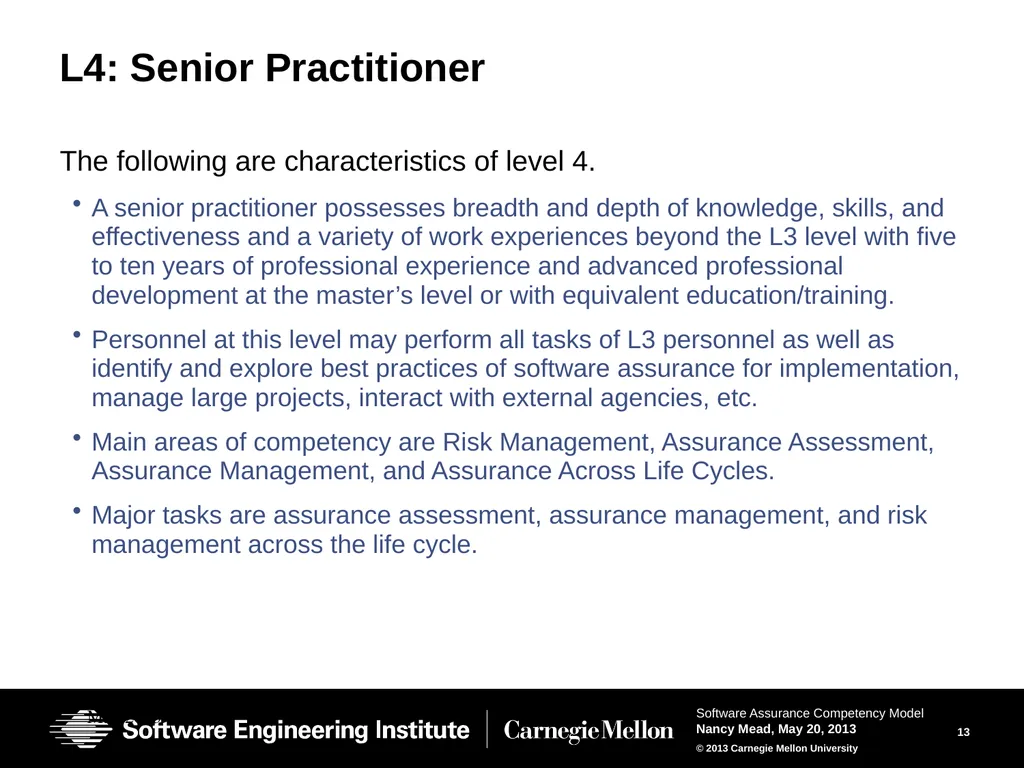
L4: Senior Practitioner The following are characteristics of level 4.
A senior practitioner possesses breadth and depth of knowledge, skills, and effectiveness and a variety of work experiences beyond the L3 level with five to ten years of professional experience and advanced professional development at the master’s level or with equivalent education/training.
Personnel at this level may perform all tasks of L3 personnel as well as identify and explore best practices of software assurance for implementation, manage large projects, interact with external agencies, etc.
Main areas of competency are Risk Management, Assurance Assessment, Assurance Management, and Assurance Across Life Cycles.
Major tasks are assurance assessment, assurance management, and risk management across the life cycle. May 2013<br>
A senior practitioner possesses breadth and depth of knowledge, skills, and effectiveness and a variety of work experiences beyond the L3 level with five to ten years of professional experience and advanced professional development at the master’s level or with equivalent education/training.
Personnel at this level may perform all tasks of L3 personnel as well as identify and explore best practices of software assurance for implementation, manage large projects, interact with external agencies, etc.
Main areas of competency are Risk Management, Assurance Assessment, Assurance Management, and Assurance Across Life Cycles.
Major tasks are assurance assessment, assurance management, and risk management across the life cycle. May 2013<br>
14
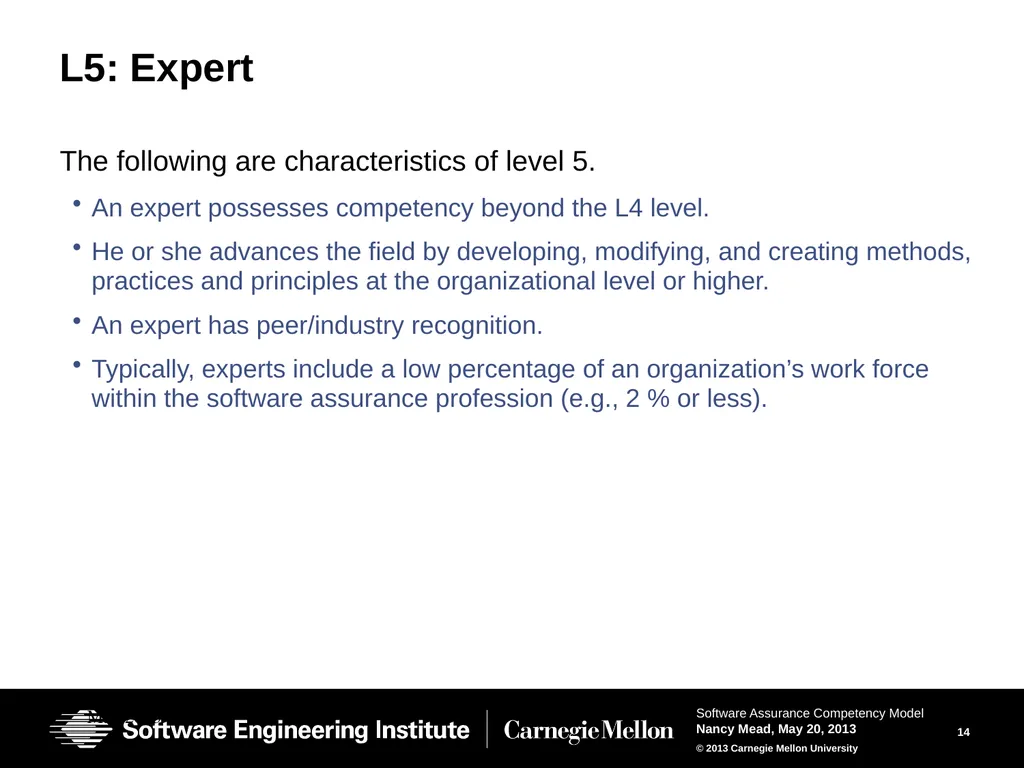
L5: Expert The following are characteristics of level 5.
An expert possesses competency beyond the L4 level.
He or she advances the field by developing, modifying, and creating methods, practices and principles at the organizational level or higher.
An expert has peer/industry recognition.
Typically, experts include a low percentage of an organization’s work force within the software assurance profession (e.g., 2 % or less). May 2013<br>
An expert possesses competency beyond the L4 level.
He or she advances the field by developing, modifying, and creating methods, practices and principles at the organizational level or higher.
An expert has peer/industry recognition.
Typically, experts include a low percentage of an organization’s work force within the software assurance profession (e.g., 2 % or less). May 2013<br>
15
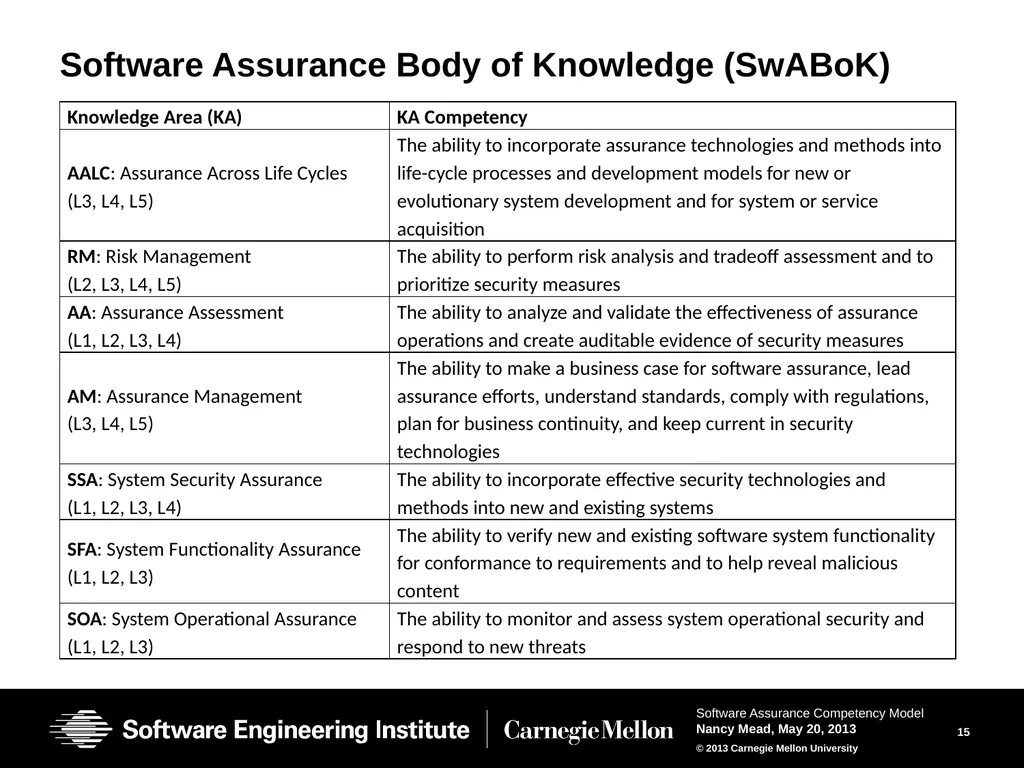
Software Assurance Body of Knowledge (SwABoK)<br>
16
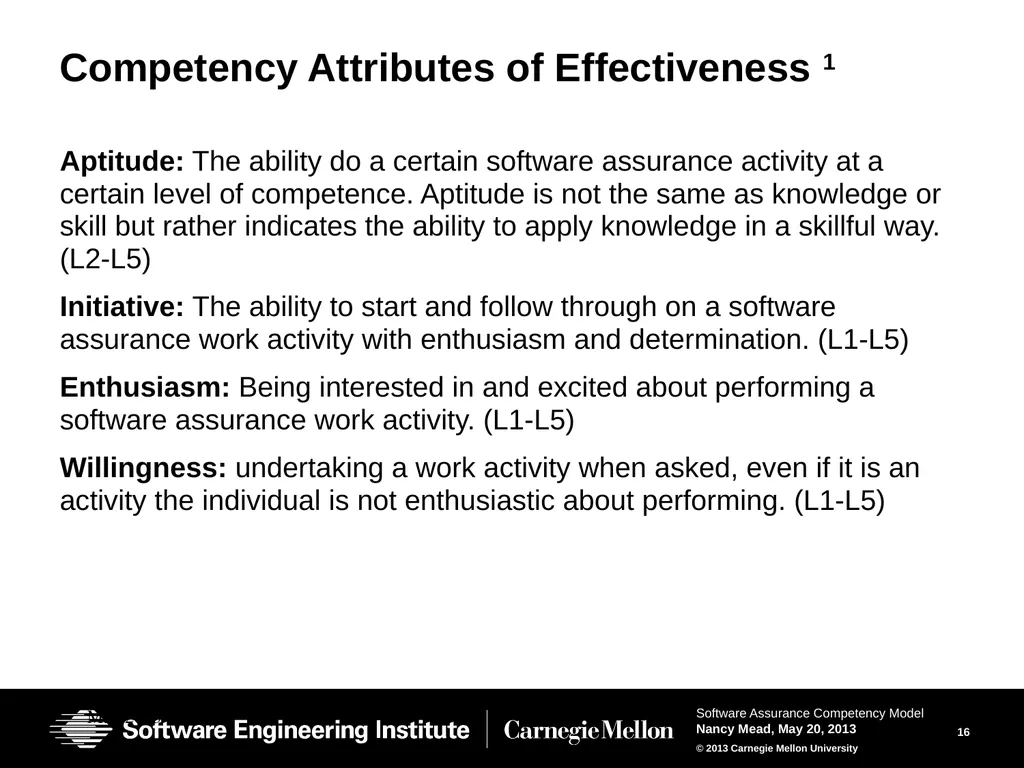
Competency Attributes of Effectiveness 1 Aptitude: The ability do a certain software assurance activity at a certain level of competence. Aptitude is not the same as knowledge or skill but rather indicates the ability to apply knowledge in a skillful way. (L2-L5)
Initiative: The ability to start and follow through on a software assurance work activity with enthusiasm and determination. (L1-L5)
Enthusiasm: Being interested in and excited about performing a software assurance work activity. (L1-L5)
Willingness: undertaking a work activity when asked, even if it is an activity the individual is not enthusiastic about performing. (L1-L5) May 2013<br>
Initiative: The ability to start and follow through on a software assurance work activity with enthusiasm and determination. (L1-L5)
Enthusiasm: Being interested in and excited about performing a software assurance work activity. (L1-L5)
Willingness: undertaking a work activity when asked, even if it is an activity the individual is not enthusiastic about performing. (L1-L5) May 2013<br>
17
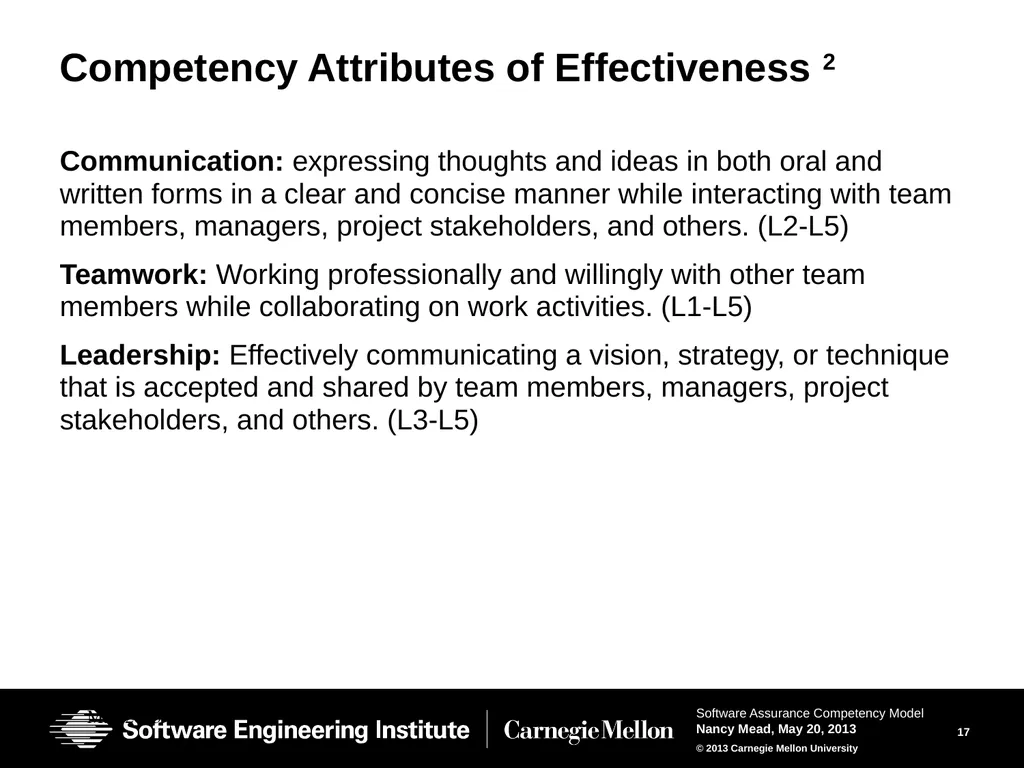
Competency Attributes of Effectiveness 2 Communication: expressing thoughts and ideas in both oral and written forms in a clear and concise manner while interacting with team members, managers, project stakeholders, and others. (L2-L5)
Teamwork: Working professionally and willingly with other team members while collaborating on work activities. (L1-L5)
Leadership: Effectively communicating a vision, strategy, or technique that is accepted and shared by team members, managers, project stakeholders, and others. (L3-L5) May 2013<br>
Teamwork: Working professionally and willingly with other team members while collaborating on work activities. (L1-L5)
Leadership: Effectively communicating a vision, strategy, or technique that is accepted and shared by team members, managers, project stakeholders, and others. (L3-L5) May 2013<br>
18
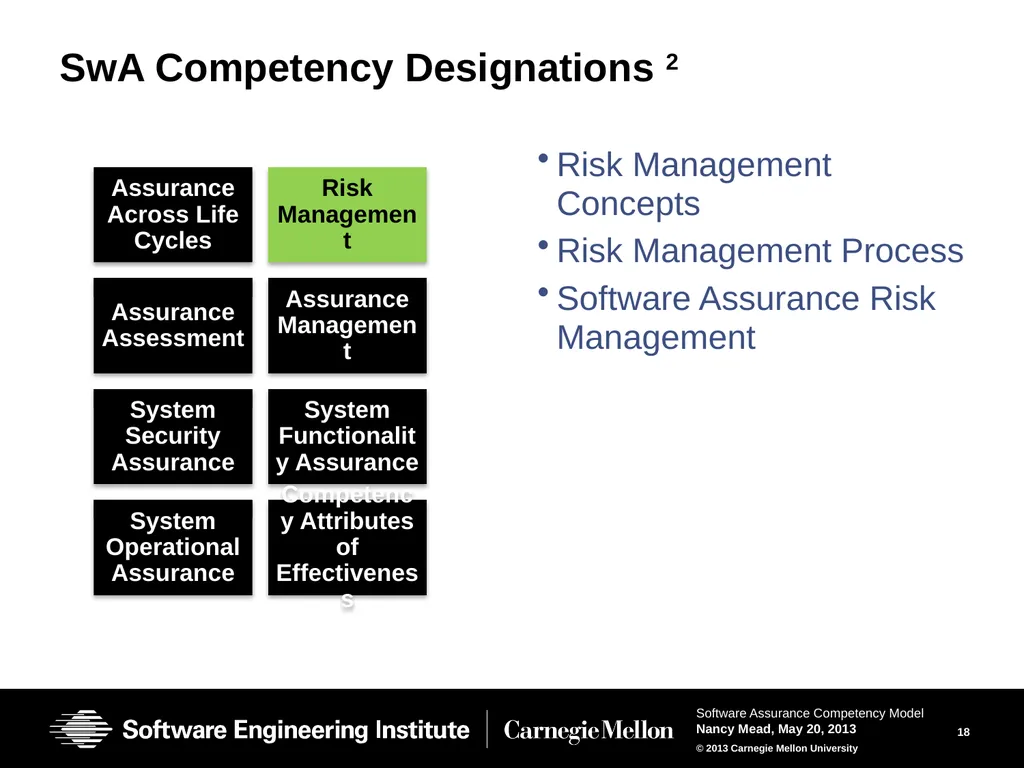
SwA Competency Designations 2 Risk Management Concepts
Risk Management Process
Software Assurance Risk Management<br>
Risk Management Process
Software Assurance Risk Management<br>
19
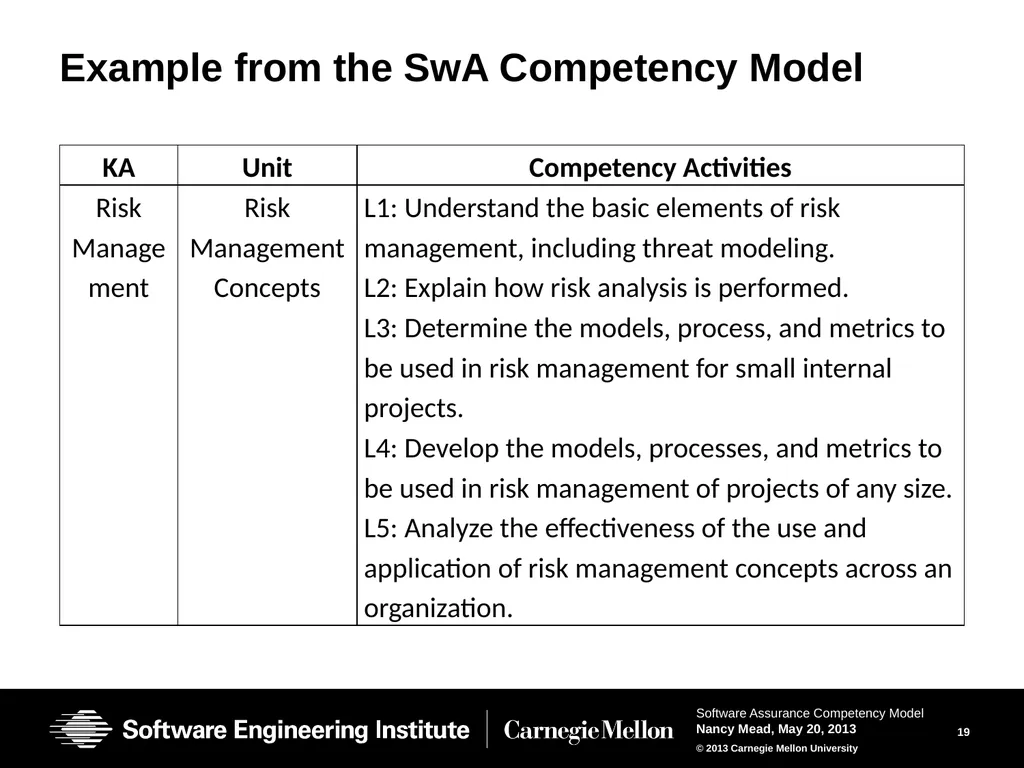
Example from the SwA Competency Model<br>
20
Uses of the model We envision the following uses:
Since it is a general model, industry and government organizations can instantiate the model for their own use.
Faculty can use the model in conjunction with course development and outcomes.
Industry managers can use the model for assessing SwA competencies and also for recruiting and building teams.
SwA professionals can use the model for career planning.
New graduates can use the model to map their SwA skills to job position descriptions and interviews, as well as for planning their next career growth steps. May 2013<br>
Since it is a general model, industry and government organizations can instantiate the model for their own use.
Faculty can use the model in conjunction with course development and outcomes.
Industry managers can use the model for assessing SwA competencies and also for recruiting and building teams.
SwA professionals can use the model for career planning.
New graduates can use the model to map their SwA skills to job position descriptions and interviews, as well as for planning their next career growth steps. May 2013<br>
21
Summary and Plans To summarize the competency model work activities:
The model builds on the prior software assurance curriculum work, and on other competency models.
The model has been published as an SEI report and presented at DHS meetings, as a BrightTalk Webinar, and here.
An additional short paper for IEEE Security and Privacy is planned. May 2013<br>
The model builds on the prior software assurance curriculum work, and on other competency models.
The model has been published as an SEI report and presented at DHS meetings, as a BrightTalk Webinar, and here.
An additional short paper for IEEE Security and Privacy is planned. May 2013<br>
22
Additional Resources Hilburn, Thomas; Ardis, Mark; Johnson, Glenn; Kornecki, Andrew; & Mead, Nancy. Software Assurance Competency Model (CMU/SEI-2013-TN-004). Software Engineering Institute, Carnegie Mellon University, 2013. http://www.sei.cmu.edu/library/abstracts/reports/13tn004.cfm
SwA Curriculum Website: http://www.cert.org/mswa/ May 2013<br>
SwA Curriculum Website: http://www.cert.org/mswa/ May 2013<br>
23
Questions? May 2013<br>
24
Copyright 2013 Carnegie Mellon University.
This material is based upon work supported by the Department of Defense under Contract No. FA8721-05-C-0003 with Carnegie Mellon University for the operation of the Software Engineering Institute, a federally funded research and development center.
Any opinions, findings and conclusions or recommendations expressed in this material are those of the author(s) and do not necessarily reflect the views of the United States Department of Defense.
NO WARRANTY
THIS CARNEGIE MELLON UNIVERSITY AND SOFTWARE ENGINEERING INSTITUTE MATERIAL IS FURNISHED ON AN “AS-IS” BASIS. CARNEGIE MELLON UNIVERSITY MAKES NO WARRANTIES OF ANY KIND, EITHER EXPRESSED OR IMPLIED, AS TO ANY MATTER INCLUDING, BUT NOT LIMITED TO, WARRANTY OF FITNESS FOR PURPOSE OR MERCHANTABILITY, EXCLUSIVITY, OR RESULTS OBTAINED FROM USE OF THE MATERIAL. CARNEGIE MELLON UNIVERSITY DOES NOT MAKE ANY WARRANTY OF ANY KIND WITH RESPECT TO FREEDOM FROM PATENT, TRADEMARK, OR COPYRIGHT INFRINGEMENT.
This material has been approved for public release and unlimited distribution except as restricted below.
Internal use:* Permission to reproduce this material and to prepare derivative works from this material for internal use is granted, provided the copyright and “No Warranty” statements are included with all reproductions and derivative works.
External use:* This material may be reproduced in its entirety, without modification, and freely distributed in written or electronic form without requesting formal permission. Permission is required for any other external and/or commercial use. Requests for permission should be directed to the Software Engineering Institute at permission@sei.cmu.edu.
*These restrictions do not apply to U.S. government entities.<br>
This material is based upon work supported by the Department of Defense under Contract No. FA8721-05-C-0003 with Carnegie Mellon University for the operation of the Software Engineering Institute, a federally funded research and development center.
Any opinions, findings and conclusions or recommendations expressed in this material are those of the author(s) and do not necessarily reflect the views of the United States Department of Defense.
NO WARRANTY
THIS CARNEGIE MELLON UNIVERSITY AND SOFTWARE ENGINEERING INSTITUTE MATERIAL IS FURNISHED ON AN “AS-IS” BASIS. CARNEGIE MELLON UNIVERSITY MAKES NO WARRANTIES OF ANY KIND, EITHER EXPRESSED OR IMPLIED, AS TO ANY MATTER INCLUDING, BUT NOT LIMITED TO, WARRANTY OF FITNESS FOR PURPOSE OR MERCHANTABILITY, EXCLUSIVITY, OR RESULTS OBTAINED FROM USE OF THE MATERIAL. CARNEGIE MELLON UNIVERSITY DOES NOT MAKE ANY WARRANTY OF ANY KIND WITH RESPECT TO FREEDOM FROM PATENT, TRADEMARK, OR COPYRIGHT INFRINGEMENT.
This material has been approved for public release and unlimited distribution except as restricted below.
Internal use:* Permission to reproduce this material and to prepare derivative works from this material for internal use is granted, provided the copyright and “No Warranty” statements are included with all reproductions and derivative works.
External use:* This material may be reproduced in its entirety, without modification, and freely distributed in written or electronic form without requesting formal permission. Permission is required for any other external and/or commercial use. Requests for permission should be directed to the Software Engineering Institute at permission@sei.cmu.edu.
*These restrictions do not apply to U.S. government entities.<br>
25
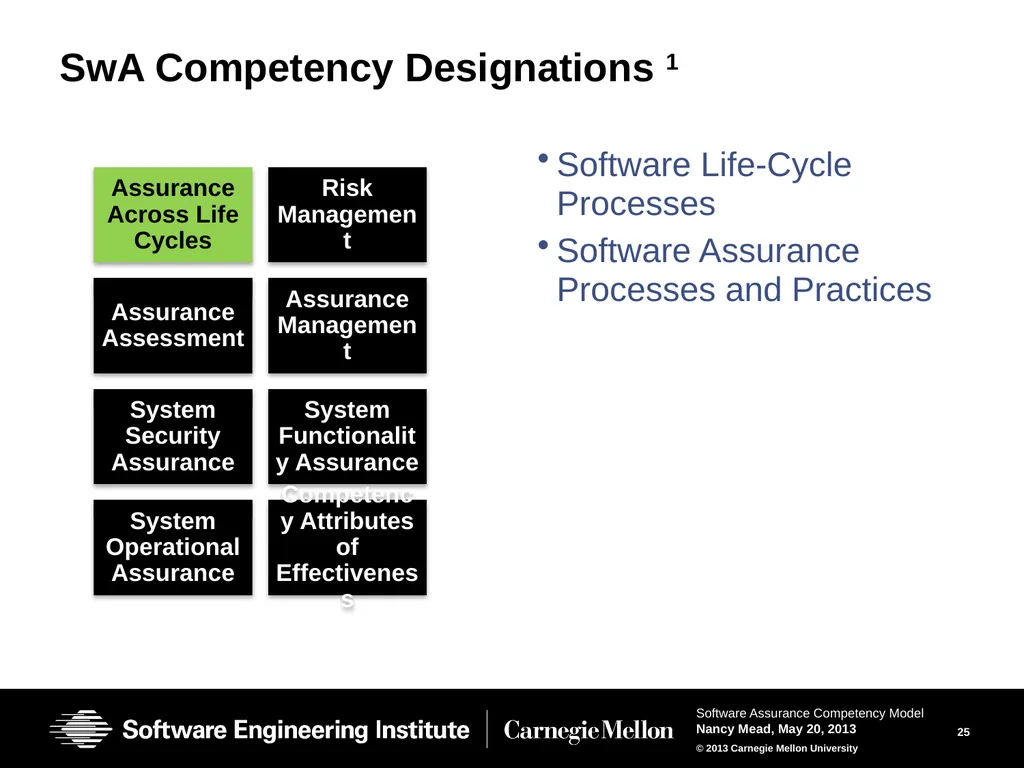
SwA Competency Designations 1 Software Life-Cycle Processes
Software Assurance Processes and Practices<br>
Software Assurance Processes and Practices<br>
26
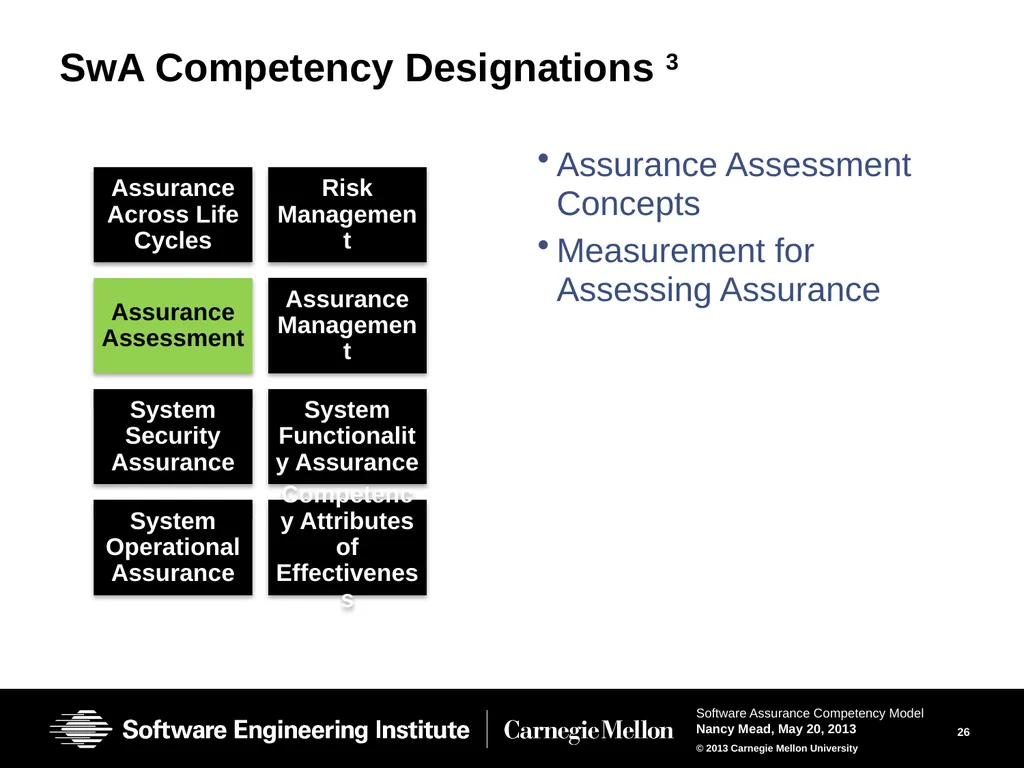
SwA Competency Designations 3 Assurance Assessment Concepts
Measurement for Assessing Assurance<br>
Measurement for Assessing Assurance<br>
27
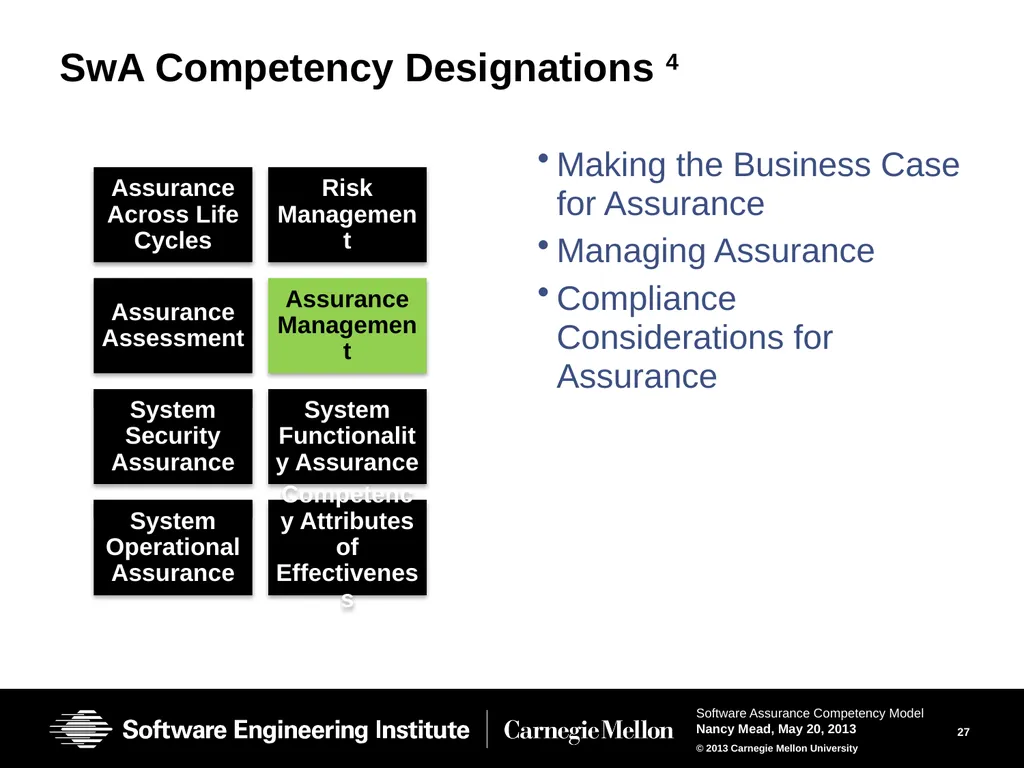
SwA Competency Designations 4 Making the Business Case for Assurance
Managing Assurance
Compliance Considerations for Assurance<br>
Managing Assurance
Compliance Considerations for Assurance<br>
28
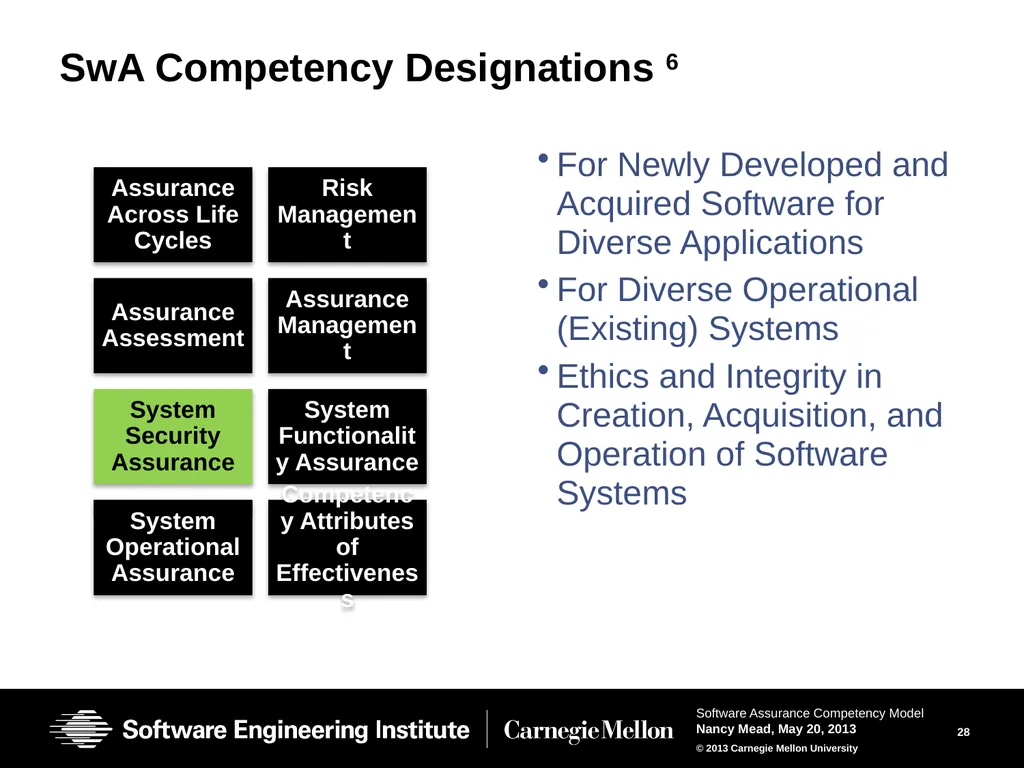
SwA Competency Designations 6 For Newly Developed and Acquired Software for Diverse Applications
For Diverse Operational (Existing) Systems
Ethics and Integrity in Creation, Acquisition, and Operation of Software Systems<br>
For Diverse Operational (Existing) Systems
Ethics and Integrity in Creation, Acquisition, and Operation of Software Systems<br>
29
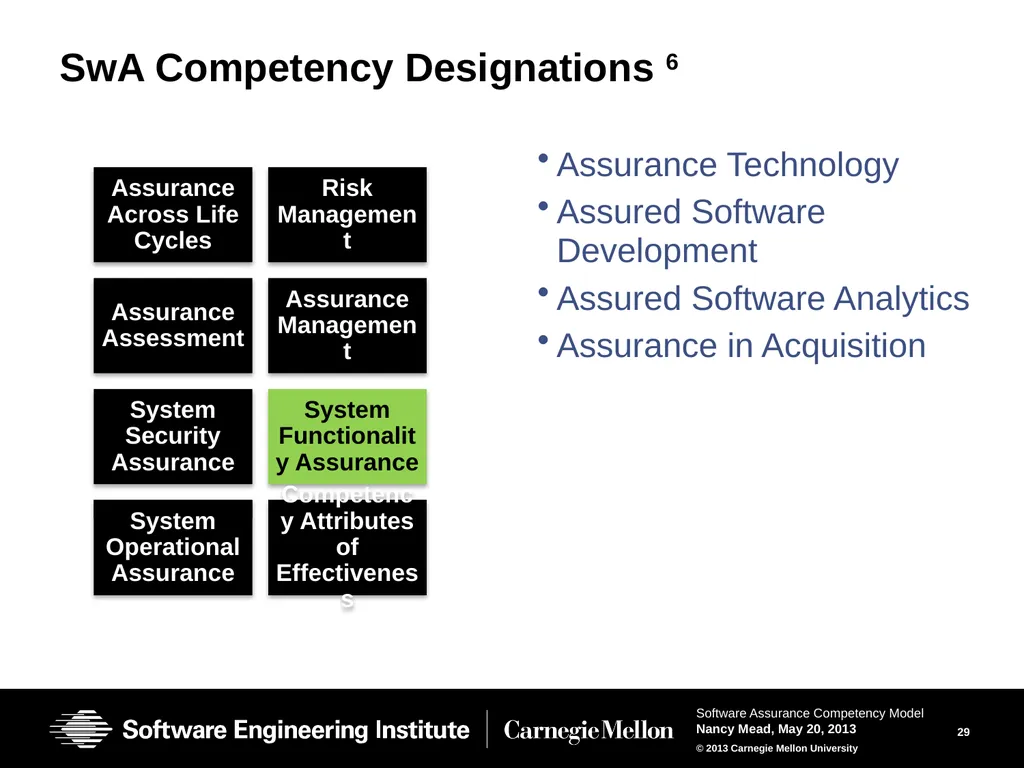
SwA Competency Designations 6 Assurance Technology
Assured Software Development
Assured Software Analytics
Assurance in Acquisition<br>
Assured Software Development
Assured Software Analytics
Assurance in Acquisition<br>
30
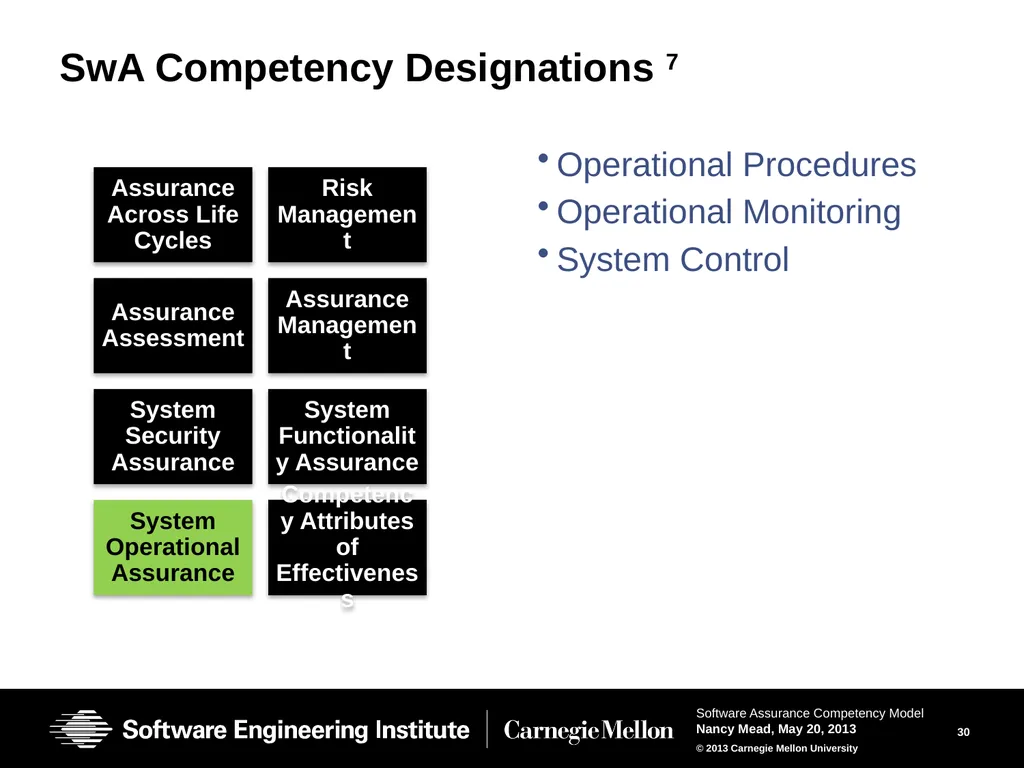
SwA Competency Designations 7 Operational Procedures
Operational Monitoring
System Control<br>
Operational Monitoring
System Control<br>
31
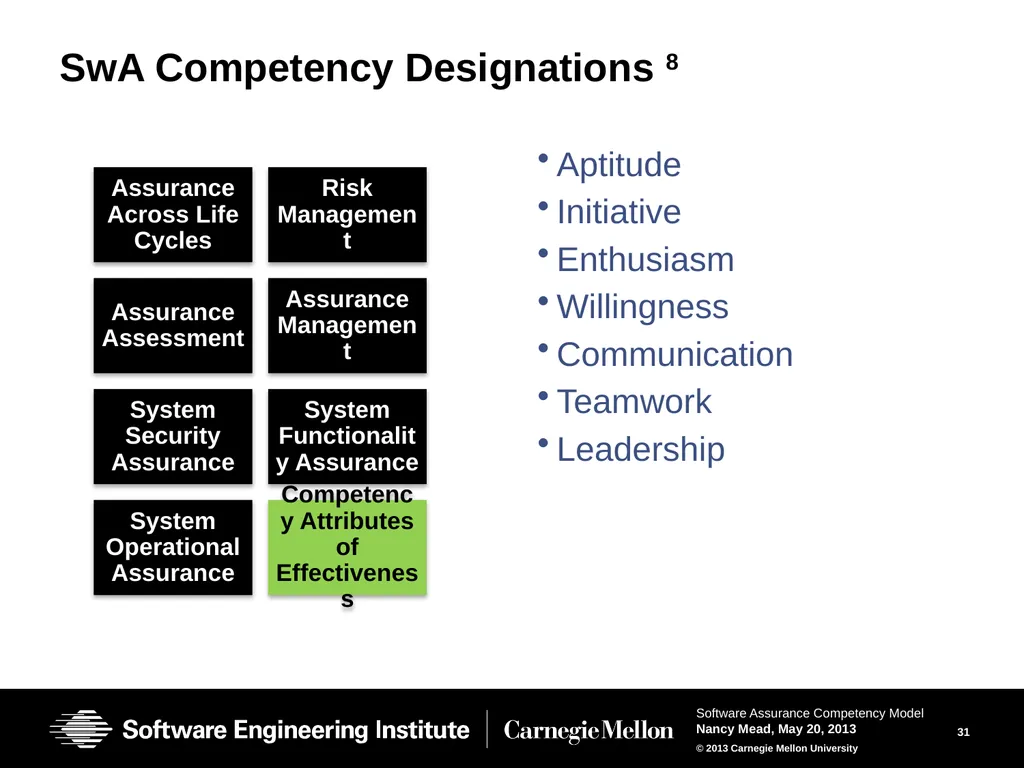
SwA Competency Designations 8 Aptitude
Initiative
Enthusiasm
Willingness
Communication
Teamwork
Leadership<br>
Initiative
Enthusiasm
Willingness
Communication
Teamwork
Leadership<br>