
The sun’s effect on climate Lesson 2B Why Are

Description: The suns effect on climate Lesson 2B Why Are Places Closer to Earths Equator Hotter than Places Farther Away from the Equator? Key Science Idea Sunlight shines more directly at the equator and is more spread out moving toward the poles.
Related Topics
Download Presentation
"The sun’s effect on climate Lesson 2B Why Are" is the property of its rightful owner. Permission is granted to download and print the materials on this website for personal, non-commercial use only, and to display it on your personal computer provided you do not modify the materials and that you retain all copyright notices contained in the materials. By downloading content from our website, you accept the terms of this agreement.
Presentation Transcript
slide1. The sun’s effect on climate Lesson 2B Why Are Places Closer to Earth’s Equator Hotter than Places Farther Away from the Equator?<br>
slide2. Key Science Idea Sunlight shines more directly at the equator and is more spread out moving toward the poles. That’s why temperatures are warmer closer to the equator and are cooler closer to the poles.
What evidence from yesterday’s investigations can we use to explain this science idea?
Hint: Think about the data from our tray-and-flashlight activity.<br>
slide3. Lesson Focus Question Why are places closer to Earth’s equator hotter than places farther away from the equator?<br>
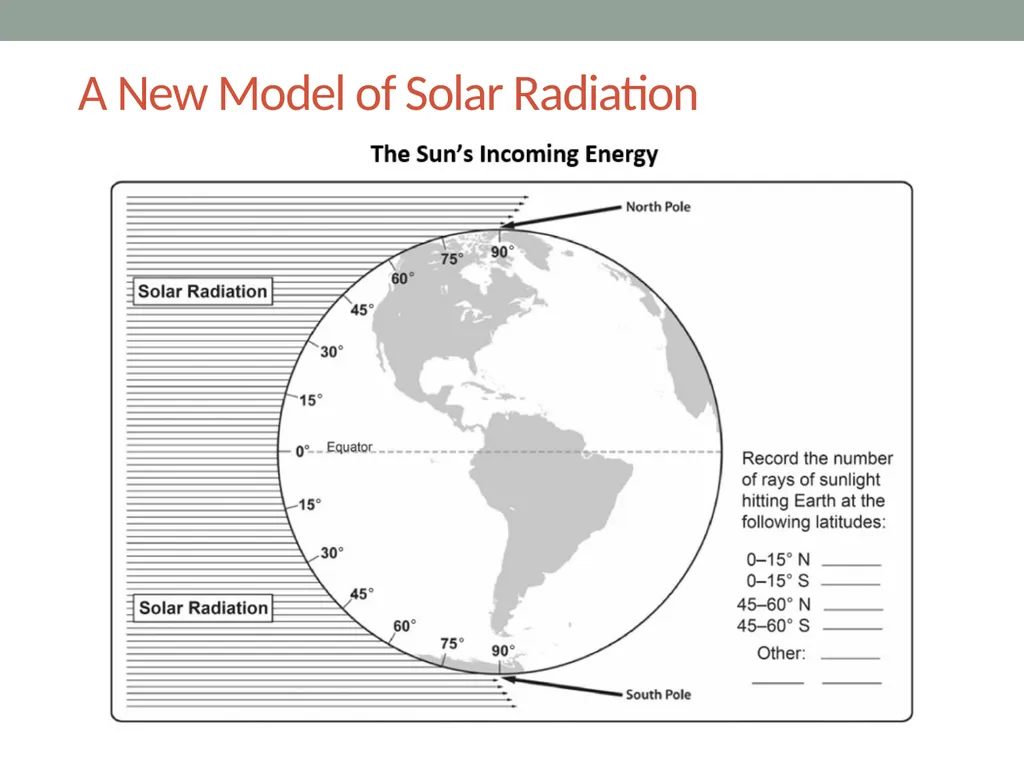
slide4. A New Model of Solar Radiation<br>
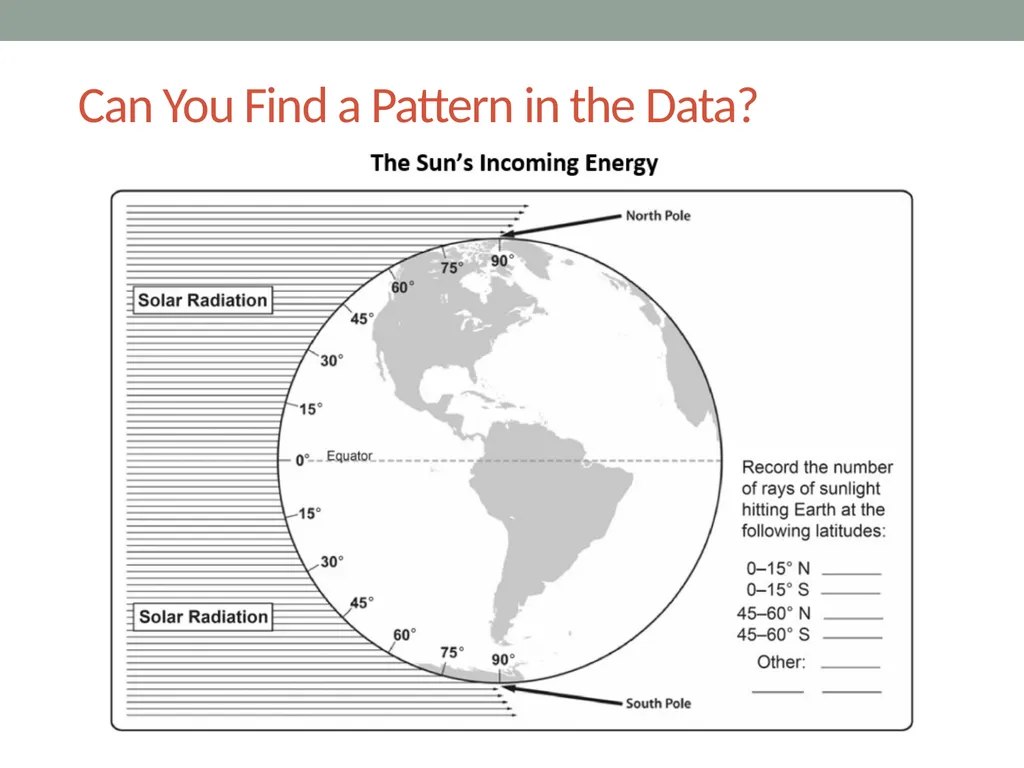
slide5. Key Science Ideas The lines in our diagram represent the Sun’s rays, or light energy, striking Earth’s surface. Another term for the Sun’s light energy is solar radiation.
Solar radiation provides Earth with light energy to heat the planet and maintain temperatures so we can survive.<br>
slide6. Angles of Light Energy and Solar Radiation How do angles of light energy and Earth’s curved surface affect the amount of solar radiation (the number of light rays) hitting different locations (latitudes) on Earth?
Let’s find out!<br>
slide7. Counting Rays of Sunlight Count the number of lines (rays of sunlight) hitting Earth’s surface at these latitudes on your handout:
0–15° N
0–15° S
45–60° N
45–60° S
Write the number of lines for these latitudes on the handout (the bottom right-hand corner).
Don’t stop there! Count as many rays of sunlight in other latitude segments as you can and record these numbers on your handout as well.<br>
slide8. Can You Find a Pattern in the Data?<br>
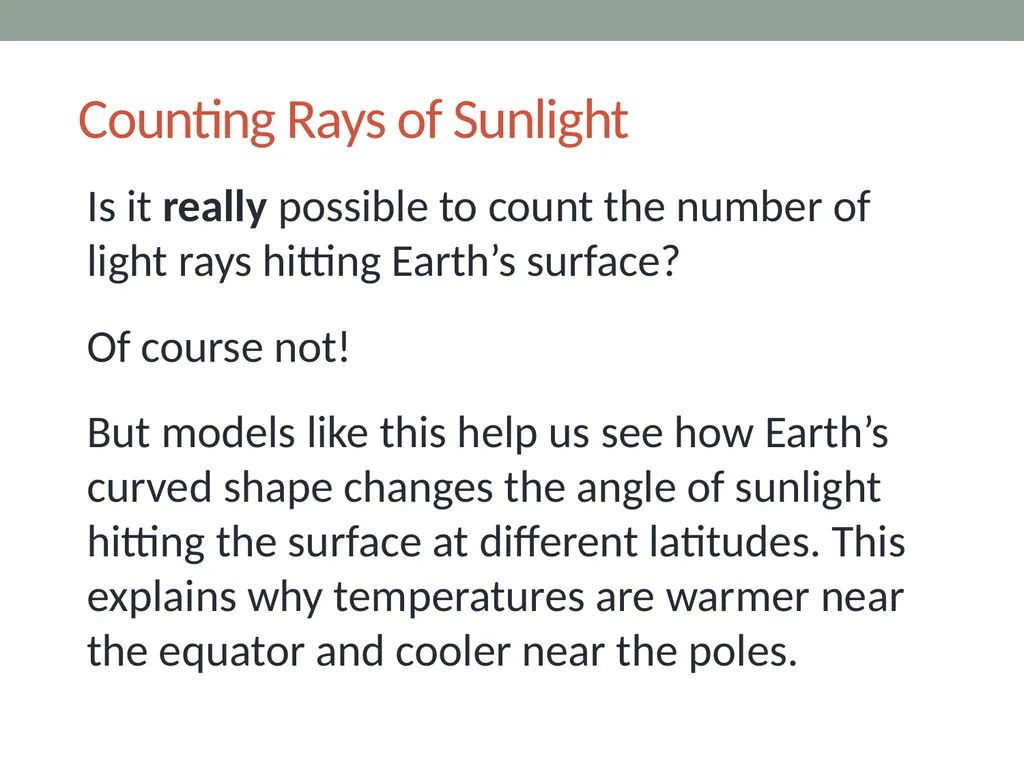
slide9. Counting Rays of Sunlight Is it really possible to count the number of light rays hitting Earth’s surface?
Of course not!
But models like this help us see how Earth’s curved shape changes the angle of sunlight hitting the surface at different latitudes. This explains why temperatures are warmer near the equator and cooler near the poles.<br>
slide10. Patterns in the Data What patterns did you find in your data?
Where on Earth is the Sun’s light energy more concentrated? What is your evidence?
Where is the Sun’s light energy more spread out? What is your evidence?
What do you think these patterns have to do with temperatures near the equator and farther away?<br>
slide11. Today’s Focus Question Why are places closer to Earth’s equator hotter than places farther away from the equator?<br>
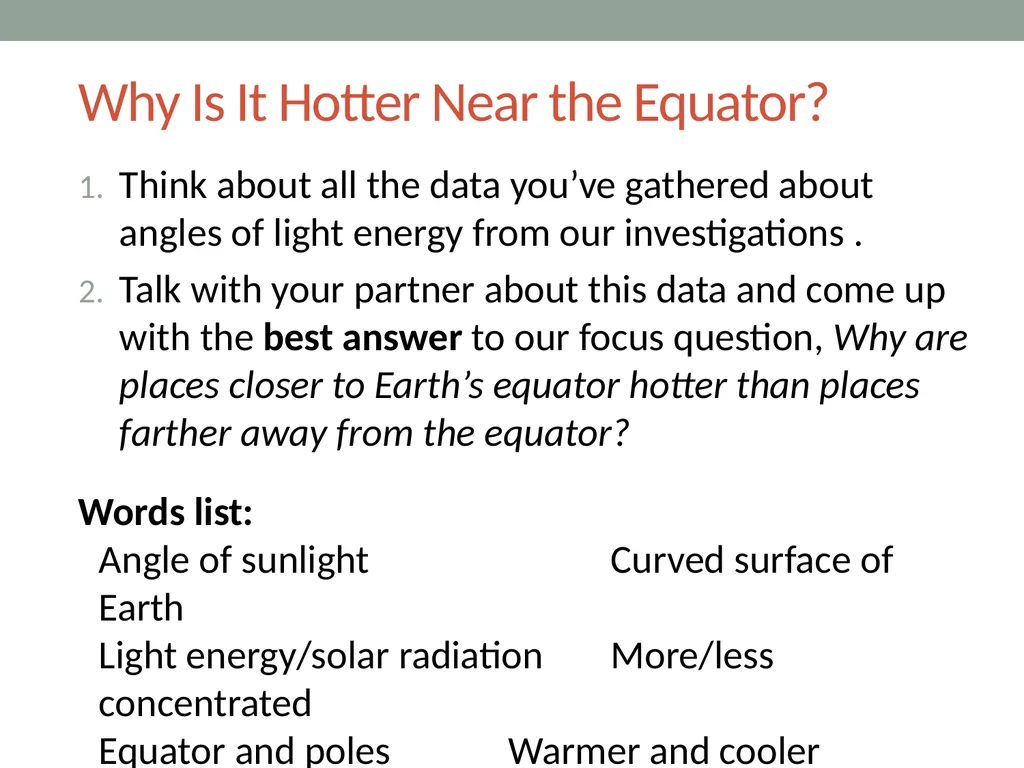
slide12. Why Is It Hotter Near the Equator? Think about all the data you’ve gathered about angles of light energy from our investigations .
Talk with your partner about this data and come up with the best answer to our focus question, Why are places closer to Earth’s equator hotter than places farther away from the equator?
Words list:
Angle of sunlight Curved surface of Earth
Light energy/solar radiation More/less concentrated
Equator and poles Warmer and cooler
More direct/less direct Latitude<br>
slide13. Let’s Summarize! Key science ideas:
When sunlight strikes Earth’s surface more directly near the equator, the light energy, or solar radiation, is more intense and concentrated, making the surface warmer.
When sunlight strikes Earth’s surface at a less direct angle moving toward the poles, the light energy, or solar radiation, is less concentrated, and the surface doesn’t warm up as much.<br>
slide14. It’s Your Turn! To summarize what you’ve learned so far, write in your own words a description of how the Sun’s light energy hits Earth’s surface and how this affects temperatures in different locations.
Record your ideas in your science notebook and draw a picture to illustrate them.<br>
slide15. Next Time Today we learned how the angle of sunlight hitting Earth’s surface at different latitudes affects temperatures.
The equator receives more direct sunlight than anywhere else on Earth, so now we know why it’s hotter near the equator than it is farther away!
Tomorrow we’ll talk about why temperatures are different in the Northern and Southern Hemispheres at the same time of year.<br>
slide2. Key Science Idea Sunlight shines more directly at the equator and is more spread out moving toward the poles. That’s why temperatures are warmer closer to the equator and are cooler closer to the poles.
What evidence from yesterday’s investigations can we use to explain this science idea?
Hint: Think about the data from our tray-and-flashlight activity.<br>
slide3. Lesson Focus Question Why are places closer to Earth’s equator hotter than places farther away from the equator?<br>
slide4. A New Model of Solar Radiation<br>
slide5. Key Science Ideas The lines in our diagram represent the Sun’s rays, or light energy, striking Earth’s surface. Another term for the Sun’s light energy is solar radiation.
Solar radiation provides Earth with light energy to heat the planet and maintain temperatures so we can survive.<br>
slide6. Angles of Light Energy and Solar Radiation How do angles of light energy and Earth’s curved surface affect the amount of solar radiation (the number of light rays) hitting different locations (latitudes) on Earth?
Let’s find out!<br>
slide7. Counting Rays of Sunlight Count the number of lines (rays of sunlight) hitting Earth’s surface at these latitudes on your handout:
0–15° N
0–15° S
45–60° N
45–60° S
Write the number of lines for these latitudes on the handout (the bottom right-hand corner).
Don’t stop there! Count as many rays of sunlight in other latitude segments as you can and record these numbers on your handout as well.<br>
slide8. Can You Find a Pattern in the Data?<br>
slide9. Counting Rays of Sunlight Is it really possible to count the number of light rays hitting Earth’s surface?
Of course not!
But models like this help us see how Earth’s curved shape changes the angle of sunlight hitting the surface at different latitudes. This explains why temperatures are warmer near the equator and cooler near the poles.<br>
slide10. Patterns in the Data What patterns did you find in your data?
Where on Earth is the Sun’s light energy more concentrated? What is your evidence?
Where is the Sun’s light energy more spread out? What is your evidence?
What do you think these patterns have to do with temperatures near the equator and farther away?<br>
slide11. Today’s Focus Question Why are places closer to Earth’s equator hotter than places farther away from the equator?<br>
slide12. Why Is It Hotter Near the Equator? Think about all the data you’ve gathered about angles of light energy from our investigations .
Talk with your partner about this data and come up with the best answer to our focus question, Why are places closer to Earth’s equator hotter than places farther away from the equator?
Words list:
Angle of sunlight Curved surface of Earth
Light energy/solar radiation More/less concentrated
Equator and poles Warmer and cooler
More direct/less direct Latitude<br>
slide13. Let’s Summarize! Key science ideas:
When sunlight strikes Earth’s surface more directly near the equator, the light energy, or solar radiation, is more intense and concentrated, making the surface warmer.
When sunlight strikes Earth’s surface at a less direct angle moving toward the poles, the light energy, or solar radiation, is less concentrated, and the surface doesn’t warm up as much.<br>
slide14. It’s Your Turn! To summarize what you’ve learned so far, write in your own words a description of how the Sun’s light energy hits Earth’s surface and how this affects temperatures in different locations.
Record your ideas in your science notebook and draw a picture to illustrate them.<br>
slide15. Next Time Today we learned how the angle of sunlight hitting Earth’s surface at different latitudes affects temperatures.
The equator receives more direct sunlight than anywhere else on Earth, so now we know why it’s hotter near the equator than it is farther away!
Tomorrow we’ll talk about why temperatures are different in the Northern and Southern Hemispheres at the same time of year.<br>