The suns effect on climate Lesson 4a Why Is It Warmer in the Summer than in the Winter? Review: The Suns Effect on Climate Lets review what weve learned so far about the Suns effect on climate and temperatures on Earth. (Use complete
"The sun’s effect on climate Lesson 4a Why Is It" is the property of its rightful owner. Permission is granted to
download and print the materials on this website for personal, non-commercial use only, and to display it
on your personal computer provided you do not modify the materials and that you retain all copyright
notices contained in the materials. By downloading content from our website, you accept the terms of this
agreement.
Presentation Transcript
01
The sun’s effect on climate Lesson 4a Why Is It Warmer in the Summer than in the Winter?<br>
02
Review: The Sun’s Effect on Climate Let’s review what we’ve learned so far about the Sun’s effect on climate and temperatures on Earth. (Use complete sentences!)
Lesson 1: What temperature patterns did we observe from the bar graphs in this lesson?
Lesson 2: How does the angle of sunlight affect temperatures on Earth?
Lesson 3: How did our model of Earth’s orbit around the Sun help us understand seasons?<br>
03
Lesson Focus Question Why is it warmer in the summer than in the winter?
Copy this question into your science notebook and draw a box around it.
Then write down some initial ideas for answering this question based on what you’ve learned so far. Make sure to explain your thinking!<br>
04
Review: Earth’s Orbit around the Sun Watch and listen carefully as your classmates demonstrate Earth’s orbit around the Sun and the four positions from yesterday’s lesson.
Do you agree or disagree with this model of Earth’s orbit? Why?
What would you add or change to make the simulation more scientifically accurate?<br>
05
Review: Earth’s Orbit around the Sun Compare our Earth-Sun model from yesterday’s lesson with the diagram from lesson 2 showing the Sun’s rays hitting Earth’s surface at different angles based on latitude.
What’s different about the position of Earth in these two models?<br>
06
Your Predictions Do you think the tilt of Earth on its axis will change whether sunlight will strike Earth’s surface more directly or at an angle?
I predict that Earth’s tilt [will change/will not change] whether sunlight will strike Earth’s surface more directly or at an angle. My evidence is ___________.<br>
07
The Angle of Sunlight and Seasons on Earth Purpose: This activity will help us collect evidence to answer our focus question: Why is it warmer in the summer than in the winter?<br>
08
The Angle of Sunlight and Seasons on Earth The task: As Earth orbits the Sun, describe what happens to the angle of sunlight hitting Earth at different times of the year. Focus your attention on the effect of Earth’s orbit and axis tilt. Be prepared to share your ideas.<br>
09
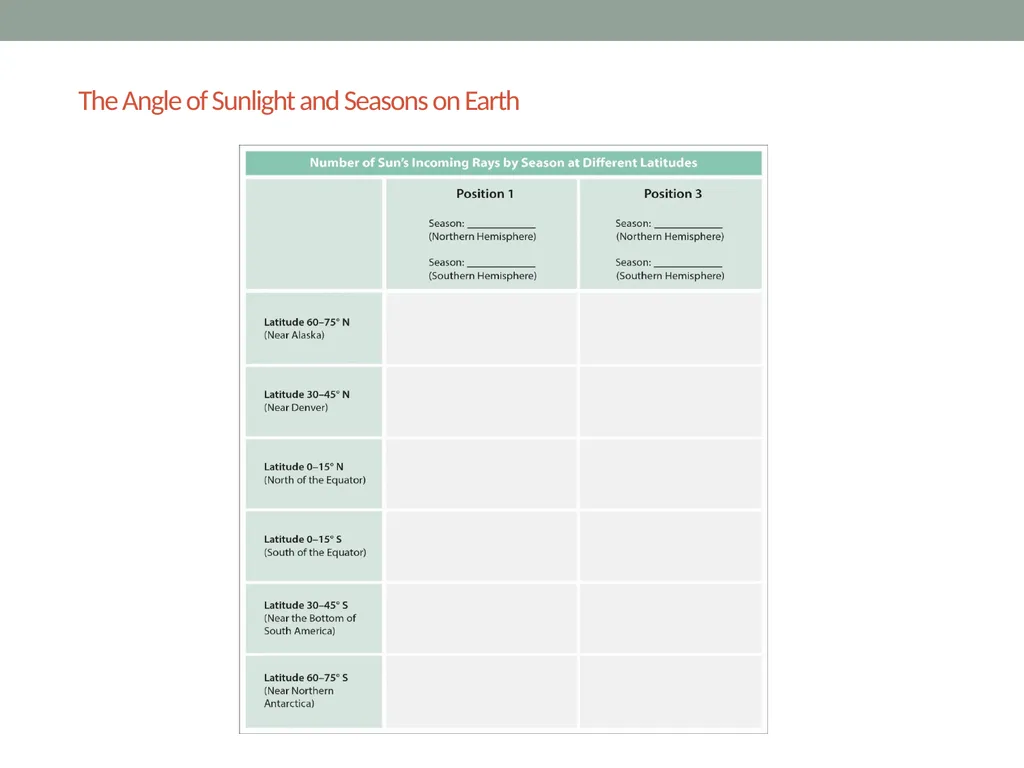
The Angle of Sunlight and Seasons on Earth<br>
10
The Angle of Sunlight and Seasons on Earth Follow the directions on handout 4.1 (The Angle of Sunlight and Seasons on Earth).
Work together to collect the data and then record this information on your own data tables (handout 4.4).
I will distribute other handouts when your group is ready for them.<br>
11
Today’s Focus Question Why is it warmer in the summer than in the winter?
Using the data from your data table and what you’ve learned in previous lessons, work together as in your small group to develop an answer to this question.
Then write this answer in your science notebook.<br>
12
Let’s Summarize! Key science ideas from lesson 1:
Temperatures vary by latitude. In general, it’s warmer closer to the equator and cooler farther from the equator.
What was our evidence for this?<br>
13
Let’s Summarize! Key science ideas from lesson 2:
Earth’s curved surface causes sunlight to strike Earth at an angle above and below the equator.
When sunlight hits Earth more directly, the light energy (solar radiation) is more concentrated and intense, and Earth’s surface will warm up more. When sunlight hits the surface at an angle, the light energy is more spread out and less intense, and the surface doesn’t warm up as much.
What was our evidence for this?<br>
14
Let’s Summarize! Key science ideas from lesson 3:
The tilt of Earth’s axis always points in one direction—toward the North Star. This consistent tilt produces opposite seasons in the Northern and Southern Hemispheres. When it’s summer in the Northern Hemisphere, it’s winter in the Southern Hemisphere, and vice versa.
What was our evidence for this?<br>
15
Next Time Do you think Earth’s tilt has anything to do with why it’s warmer in the summer than in the winter?
Let’s find out!<br>