
The Transformative Effects of Privatization in
GB
Published · 32 slides · 0 views
1 / 1





Description
The Transformative Effects of Privatization in China: A Natural Experiment Based on Politician Career Concern The purpose of the paper How large are the causal effects of privatization in China? Government activism (i.e., direct involvement
Related Topics
Share
Embed code
Download this presentation From Below
"The Transformative Effects of Privatization in" is the property of its rightful owner. Permission is granted to download and print the materials on this website for personal, non-commercial use only, and to display it on your personal computer provided you do not modify the materials and that you retain all copyright notices contained in the materials. By downloading content from our website, you accept the terms of this agreement.
Presentation Transcript
01
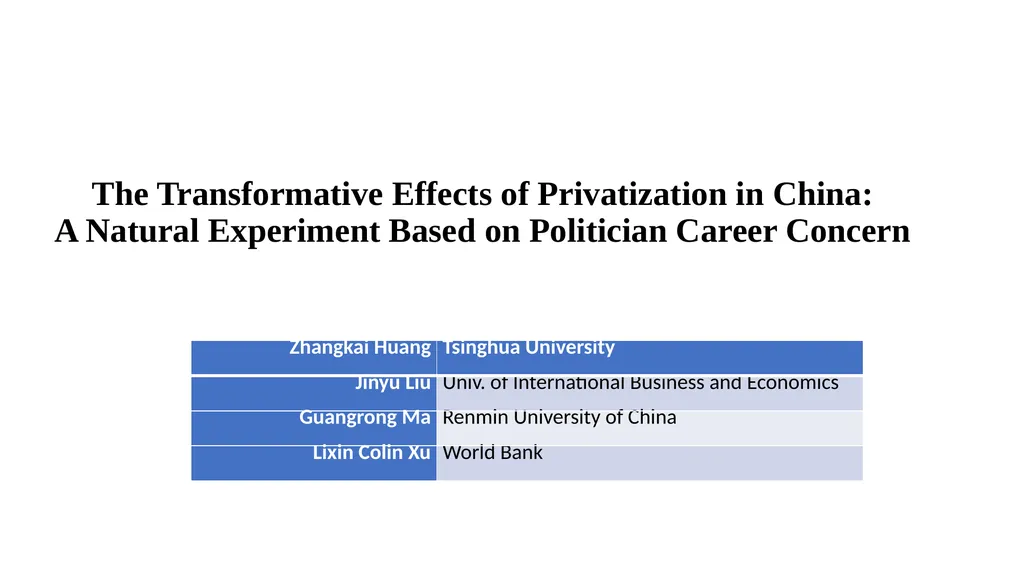
The Transformative Effects of Privatization in China:
A Natural Experiment Based on Politician Career Concern<br>
02
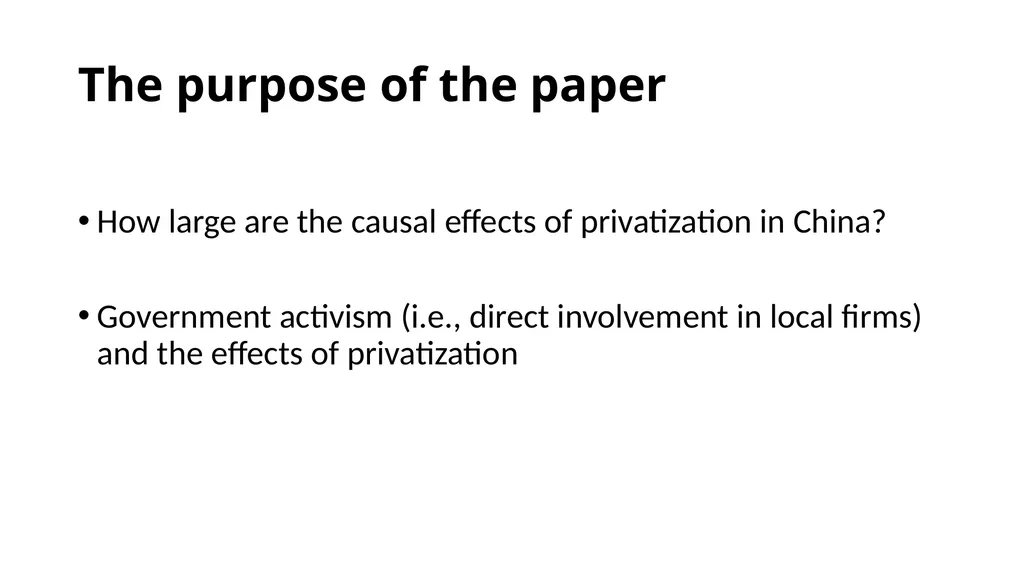
The purpose of the paper How large are the causal effects of privatization in China?
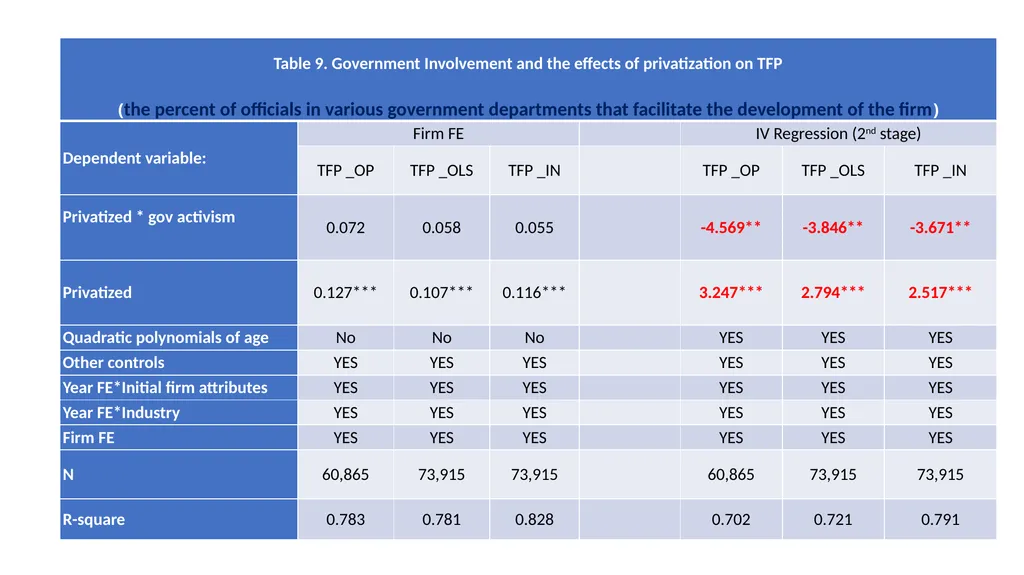
Government activism (i.e., direct involvement in local firms) and the effects of privatization<br>
Government activism (i.e., direct involvement in local firms) and the effects of privatization<br>
03
Why another paper on privatization? Widespread privatization programs since the Thatcher government popularized large-scale privatizations four decades ago.
A large literature on the privatization of state-owned enterprises (SOEs)
Megginson and Netter (2001), Djankov and Murrell (2002), Estrin et al. (2009), Megginson (2017).
Typical findings and concerns:
modest gains in firm performance,
acknowledging the selectivity of privatizations.
Several relevant facts motivate our research.<br>
A large literature on the privatization of state-owned enterprises (SOEs)
Megginson and Netter (2001), Djankov and Murrell (2002), Estrin et al. (2009), Megginson (2017).
Typical findings and concerns:
modest gains in firm performance,
acknowledging the selectivity of privatizations.
Several relevant facts motivate our research.<br>
04
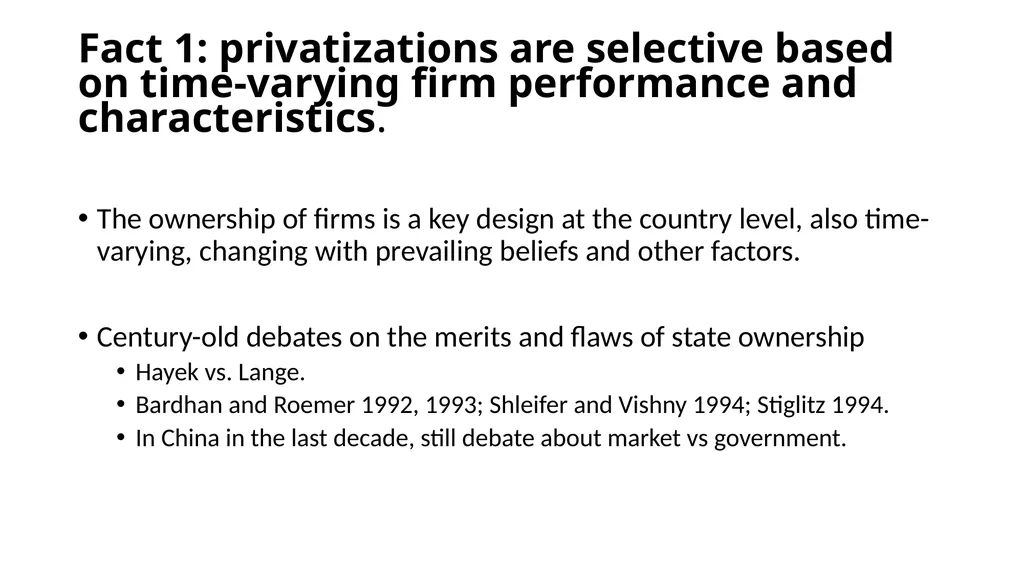
Fact 1: privatizations are selective based on time-varying firm performance and characteristics. The ownership of firms is a key design at the country level, also time-varying, changing with prevailing beliefs and other factors.
Century-old debates on the merits and flaws of state ownership
Hayek vs. Lange.
Bardhan and Roemer 1992, 1993; Shleifer and Vishny 1994; Stiglitz 1994.
In China in the last decade, still debate about market vs government.<br>
Century-old debates on the merits and flaws of state ownership
Hayek vs. Lange.
Bardhan and Roemer 1992, 1993; Shleifer and Vishny 1994; Stiglitz 1994.
In China in the last decade, still debate about market vs government.<br>
05
Selectivity at the firm level as well Privatizations: deliberate considerations of many involved parties.
When SOEs are profitable, the politicians benefit: cash flows, jobs.
When SOEs are unprofitable, the government shoulders the burden of subsidies.
Decisions are made to benefit politicians and advance their careers.
Even in the case of central-mandated privatization, local governments still have much discretion.
“Grab the big and let go the small.” Let local governments experiment.<br>
When SOEs are profitable, the politicians benefit: cash flows, jobs.
When SOEs are unprofitable, the government shoulders the burden of subsidies.
Decisions are made to benefit politicians and advance their careers.
Even in the case of central-mandated privatization, local governments still have much discretion.
“Grab the big and let go the small.” Let local governments experiment.<br>
06
Most existing studies on the effects of privatization Mostly the firm fixed effect model,
Or further control for firm-specific growth rate.
Do not otherwise deal with selectivity of privatization.
Exceptions: election incentives in India as the IV to identify the causal effects of privatization.<br>
Or further control for firm-specific growth rate.
Do not otherwise deal with selectivity of privatization.
Exceptions: election incentives in India as the IV to identify the causal effects of privatization.<br>
07
Fact 2: the causal effects of privatizations differ across countries and periods The effects of privatization differ by the institutional context of privatizations (Djankov and Murrell 2002; Estrin et al. 2009):
More positive effects or associations have been found in CEE (Central and Eastern Europe) than in CIS countries (i.e., formerly affiliated with the Soviet Union).
The effects of privatization also depend on competition in the economy.
Understanding of privatization effects requires considering the political and economic contexts in which privatizations take place.<br>
More positive effects or associations have been found in CEE (Central and Eastern Europe) than in CIS countries (i.e., formerly affiliated with the Soviet Union).
The effects of privatization also depend on competition in the economy.
Understanding of privatization effects requires considering the political and economic contexts in which privatizations take place.<br>
08
Fact 3: a lack of convincing studies on the causal effect of privatization on firm performance in China Most studies on privatization focus on CEE and CIS countries,
with exceptions on other large countries (i.e., U.S., India …)
Estrin et al. (2009):
“There are as yet no TFP studies using data from China that employ robust methodologies and, perhaps because of this, the available papers find diverse results, with the effect of nonstate ownership being mostly positive but sometimes statistically insignificant and sometimes negative” (Estrin et al. 2009, p. 702).<br>
with exceptions on other large countries (i.e., U.S., India …)
Estrin et al. (2009):
“There are as yet no TFP studies using data from China that employ robust methodologies and, perhaps because of this, the available papers find diverse results, with the effect of nonstate ownership being mostly positive but sometimes statistically insignificant and sometimes negative” (Estrin et al. 2009, p. 702).<br>
09
Lack of study on China Megginson (2017): many papers on Chinese privatizations in the last decade, but mostly on share issue privatizations (SIPs),
Only thousands of firms, very large, with the government retaining controlling stake.
Accounting for a tiny share of privatizations in China.
Sun and Tong (2003), Chen et al. (2008), Berkman et al. (2010), Li et al. (2011), Tan et al. (2015), Liao et al. (2014).
The majority of the privatized SOEs under the SOE restructuring program:
smaller and non-listed;
subsequently fully privatized.
the effects of full privatization are much more pronounced than partial privatization.
the effects of SIPs are not representative of the privatization effects in China.
Convincing identification of the privatization effect in China remains rare.<br>
Only thousands of firms, very large, with the government retaining controlling stake.
Accounting for a tiny share of privatizations in China.
Sun and Tong (2003), Chen et al. (2008), Berkman et al. (2010), Li et al. (2011), Tan et al. (2015), Liao et al. (2014).
The majority of the privatized SOEs under the SOE restructuring program:
smaller and non-listed;
subsequently fully privatized.
the effects of full privatization are much more pronounced than partial privatization.
the effects of SIPs are not representative of the privatization effects in China.
Convincing identification of the privatization effect in China remains rare.<br>
10
Need to understand the effects of China’s privatization Hidden to the world: the largest privatization program in human history (Megginson et al. 1994).
worldwide privatization revenues by the end of the last century estimated to be $860 billion.
the revenues from China’s privatization program had been US$700 billion.
Transparent to the world: China’s government involvement in the economy has been strong.
In 2018, SOEs accounted for 27% of total industrial output.
China’s post-reform economic system has been a dual-track system with both a strong government and strong marketization (Lau et al. 2000; Long, Xu and Yang 2019).
China’s growth:
privatization and marketization reforms?
Strong state control, industrial policies and a large SOE sector?<br>
worldwide privatization revenues by the end of the last century estimated to be $860 billion.
the revenues from China’s privatization program had been US$700 billion.
Transparent to the world: China’s government involvement in the economy has been strong.
In 2018, SOEs accounted for 27% of total industrial output.
China’s post-reform economic system has been a dual-track system with both a strong government and strong marketization (Lau et al. 2000; Long, Xu and Yang 2019).
China’s growth:
privatization and marketization reforms?
Strong state control, industrial policies and a large SOE sector?<br>
11
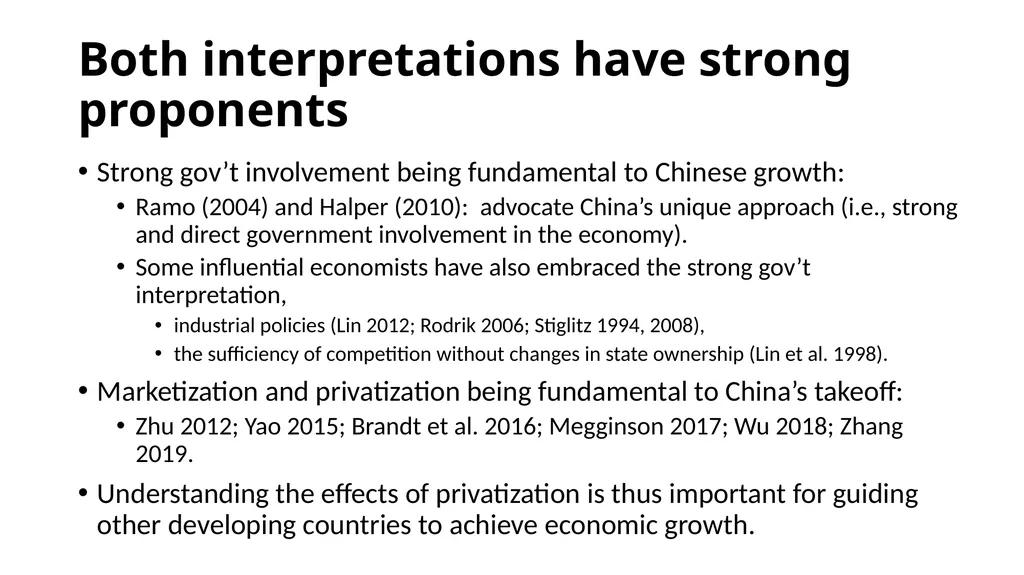
Both interpretations have strong proponents Strong gov’t involvement being fundamental to Chinese growth:
Ramo (2004) and Halper (2010): advocate China’s unique approach (i.e., strong and direct government involvement in the economy).
Some influential economists have also embraced the strong gov’t interpretation,
industrial policies (Lin 2012; Rodrik 2006; Stiglitz 1994, 2008),
the sufficiency of competition without changes in state ownership (Lin et al. 1998).
Marketization and privatization being fundamental to China’s takeoff:
Zhu 2012; Yao 2015; Brandt et al. 2016; Megginson 2017; Wu 2018; Zhang 2019.
Understanding the effects of privatization is thus important for guiding other developing countries to achieve economic growth.<br>
Ramo (2004) and Halper (2010): advocate China’s unique approach (i.e., strong and direct government involvement in the economy).
Some influential economists have also embraced the strong gov’t interpretation,
industrial policies (Lin 2012; Rodrik 2006; Stiglitz 1994, 2008),
the sufficiency of competition without changes in state ownership (Lin et al. 1998).
Marketization and privatization being fundamental to China’s takeoff:
Zhu 2012; Yao 2015; Brandt et al. 2016; Megginson 2017; Wu 2018; Zhang 2019.
Understanding the effects of privatization is thus important for guiding other developing countries to achieve economic growth.<br>
12
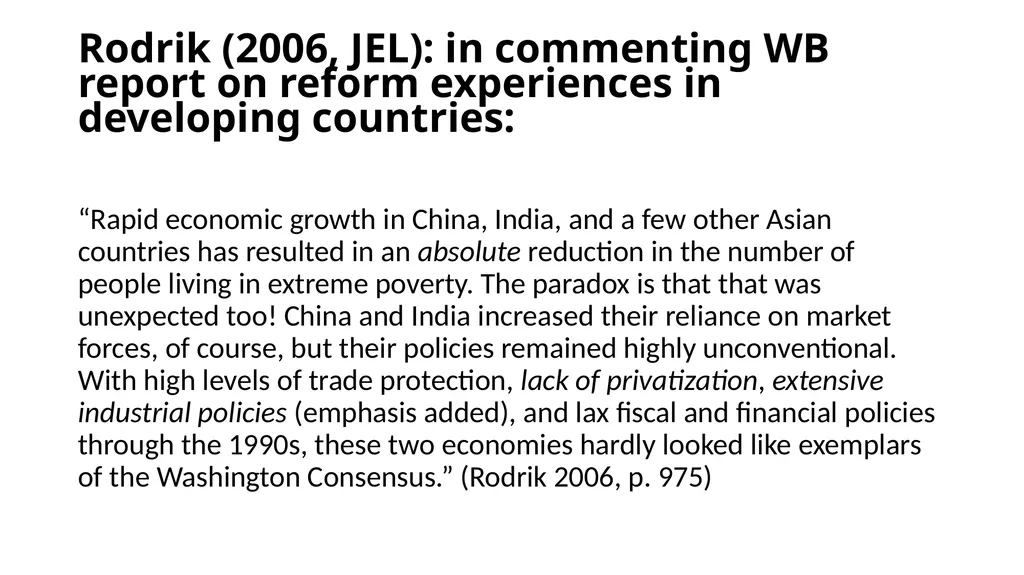
Rodrik (2006, JEL): in commenting WB report on reform experiences in developing countries: “Rapid economic growth in China, India, and a few other Asian countries has resulted in an absolute reduction in the number of people living in extreme poverty. The paradox is that that was unexpected too! China and India increased their reliance on market forces, of course, but their policies remained highly unconventional. With high levels of trade protection, lack of privatization, extensive industrial policies (emphasis added), and lax fiscal and financial policies through the 1990s, these two economies hardly looked like exemplars of the Washington Consensus.” (Rodrik 2006, p. 975)<br>
13
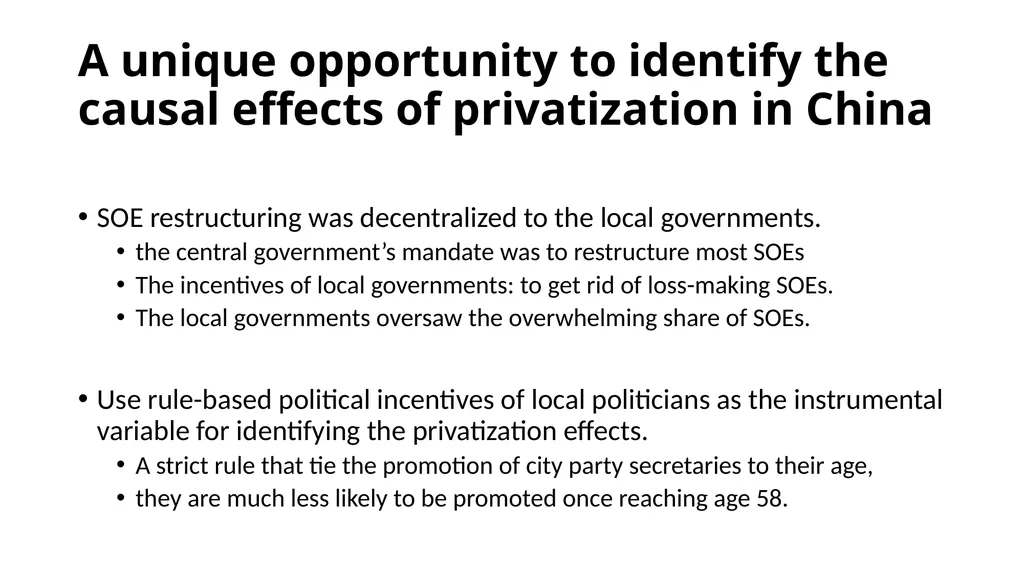
A unique opportunity to identify the causal effects of privatization in China SOE restructuring was decentralized to the local governments.
the central government’s mandate was to restructure most SOEs
The incentives of local governments: to get rid of loss-making SOEs.
The local governments oversaw the overwhelming share of SOEs.
Use rule-based political incentives of local politicians as the instrumental variable for identifying the privatization effects.
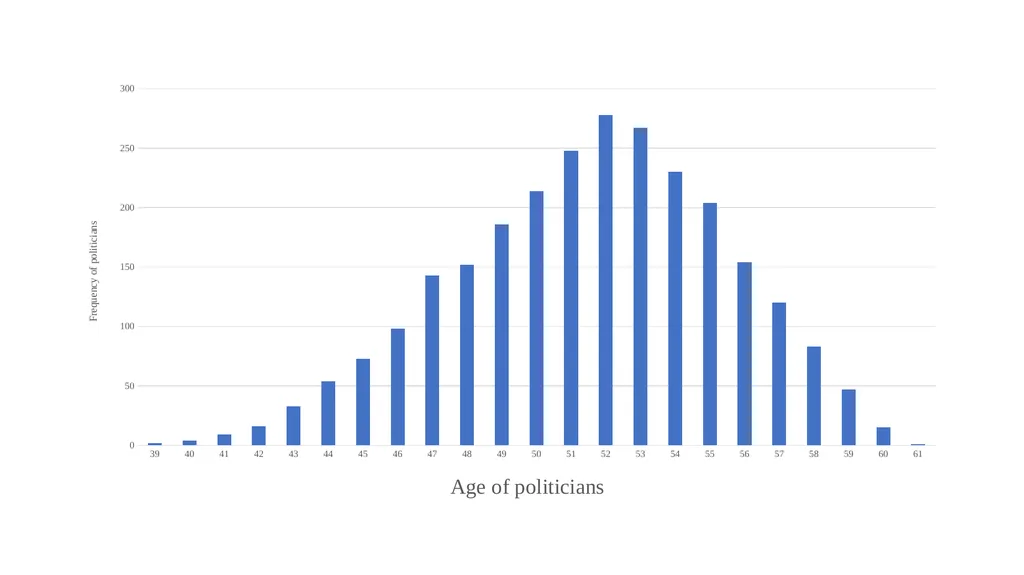
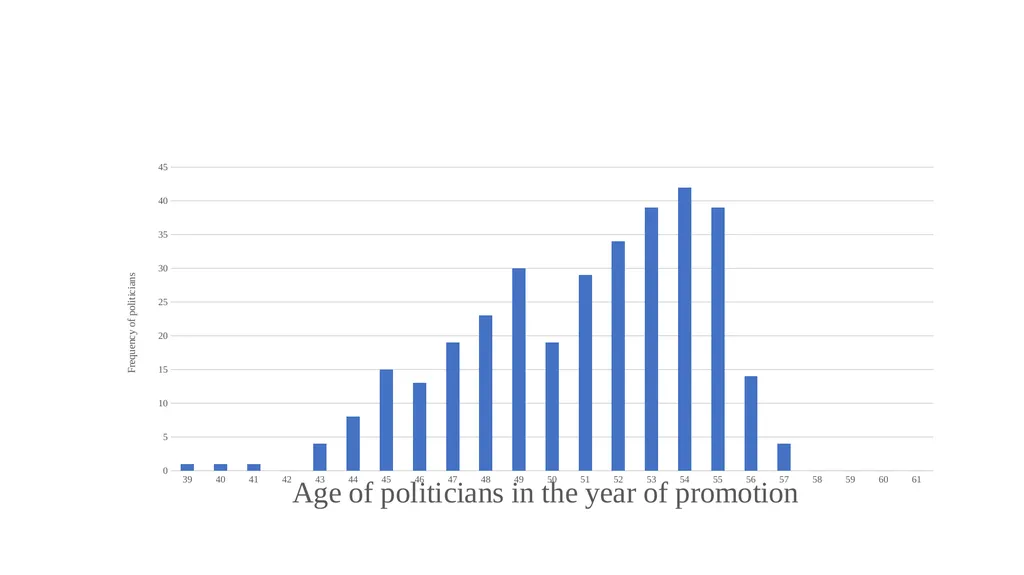
A strict rule that tie the promotion of city party secretaries to their age,
they are much less likely to be promoted once reaching age 58.<br>
the central government’s mandate was to restructure most SOEs
The incentives of local governments: to get rid of loss-making SOEs.
The local governments oversaw the overwhelming share of SOEs.
Use rule-based political incentives of local politicians as the instrumental variable for identifying the privatization effects.
A strict rule that tie the promotion of city party secretaries to their age,
they are much less likely to be promoted once reaching age 58.<br>
14
The “7-up-8-down” (七上八下)rule Local officials are appointed by the upper gov’t.
The promotion of a politician depends on his ability to deliver on key priorities.
The priorities change over time, depending on the top leader(s).
The incentives of local politicians decline as they cross certain age thresholds
For (prefecture-level) city politicians, non-promotion at 60.
Each term is 5 years.
If the 5-year tenure is unfinished when reaching the retirement age (i.e. 62):
a max of 2-year extension.
City-officials, 58+: must retire at 62, < 5 years; and non-promotion.
City-officials, 57-: could have a full-term; could be promoted.
When a local politician reaches age 58: unlikely to be promoted.<br>
The promotion of a politician depends on his ability to deliver on key priorities.
The priorities change over time, depending on the top leader(s).
The incentives of local politicians decline as they cross certain age thresholds
For (prefecture-level) city politicians, non-promotion at 60.
Each term is 5 years.
If the 5-year tenure is unfinished when reaching the retirement age (i.e. 62):
a max of 2-year extension.
City-officials, 58+: must retire at 62, < 5 years; and non-promotion.
City-officials, 57-: could have a full-term; could be promoted.
When a local politician reaches age 58: unlikely to be promoted.<br>
15
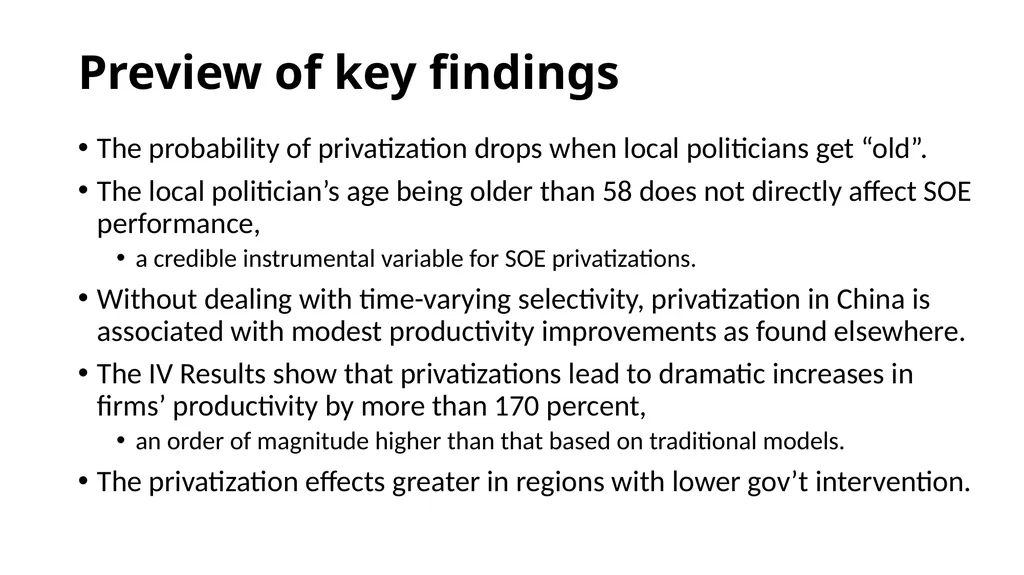
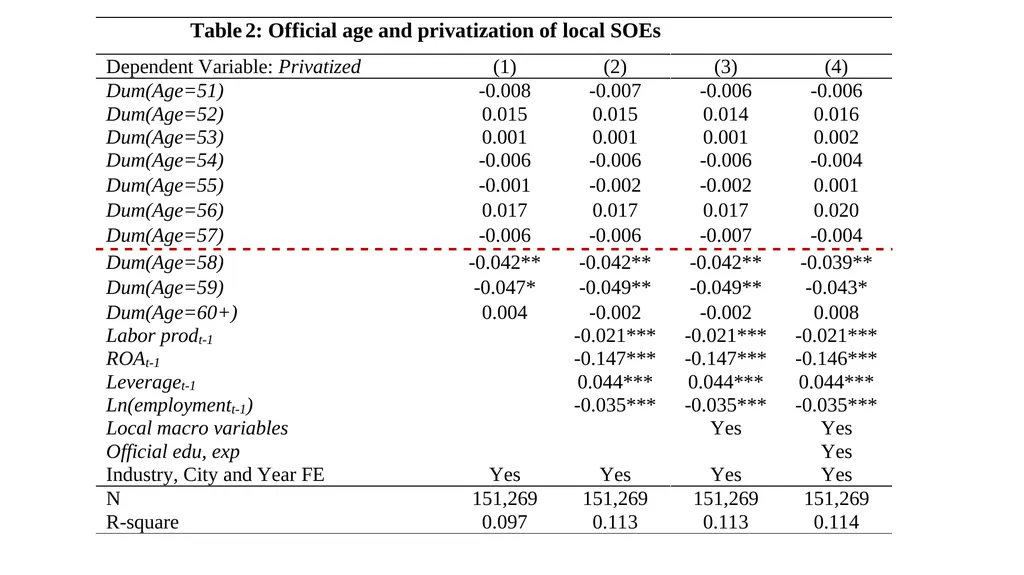
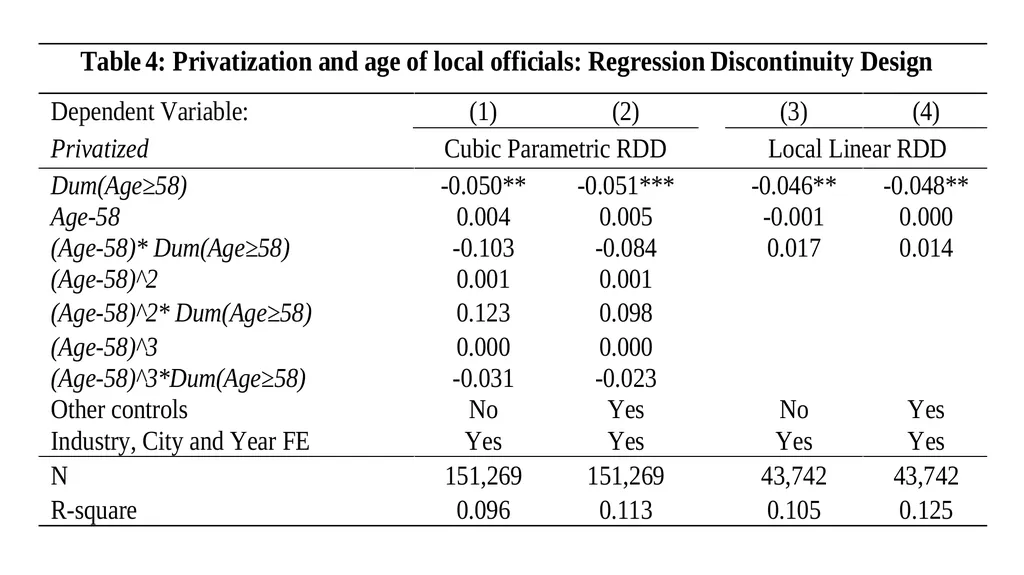
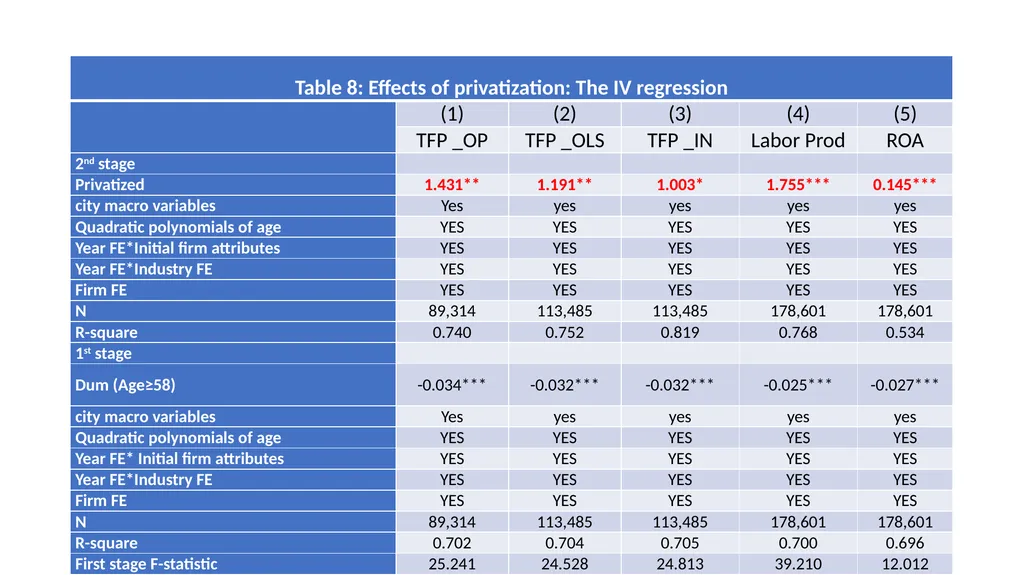
Preview of key findings The probability of privatization drops when local politicians get “old”.
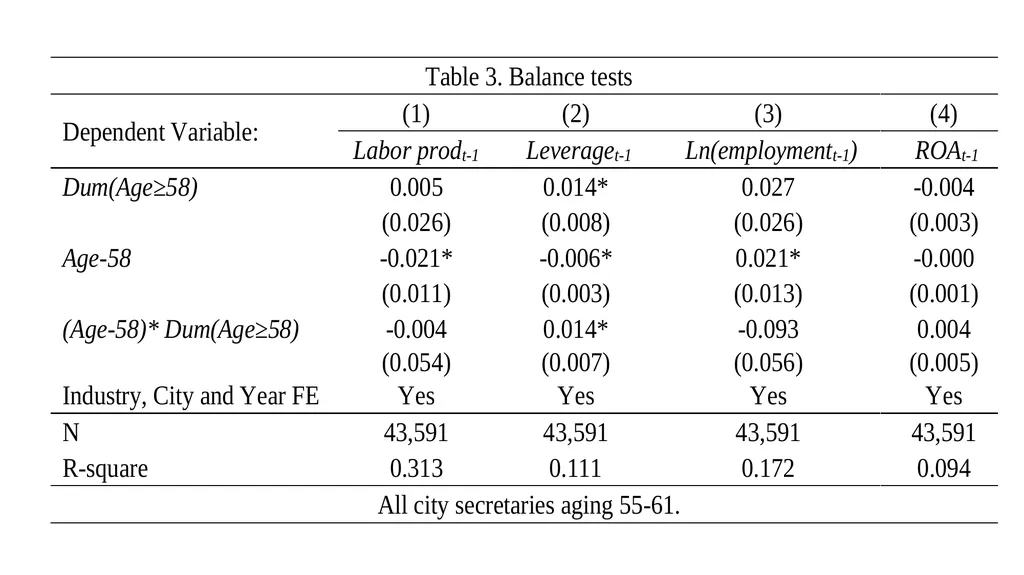
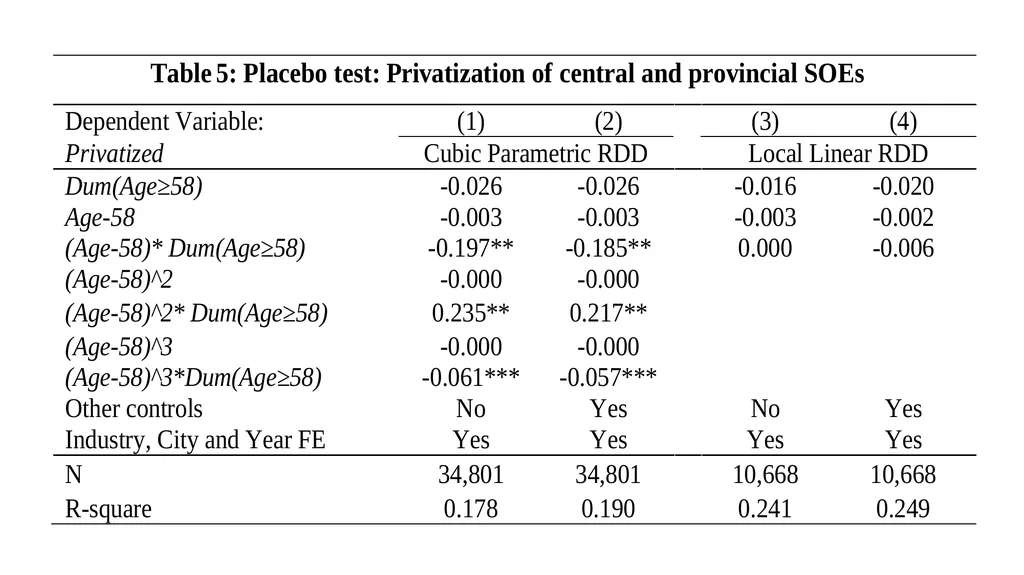
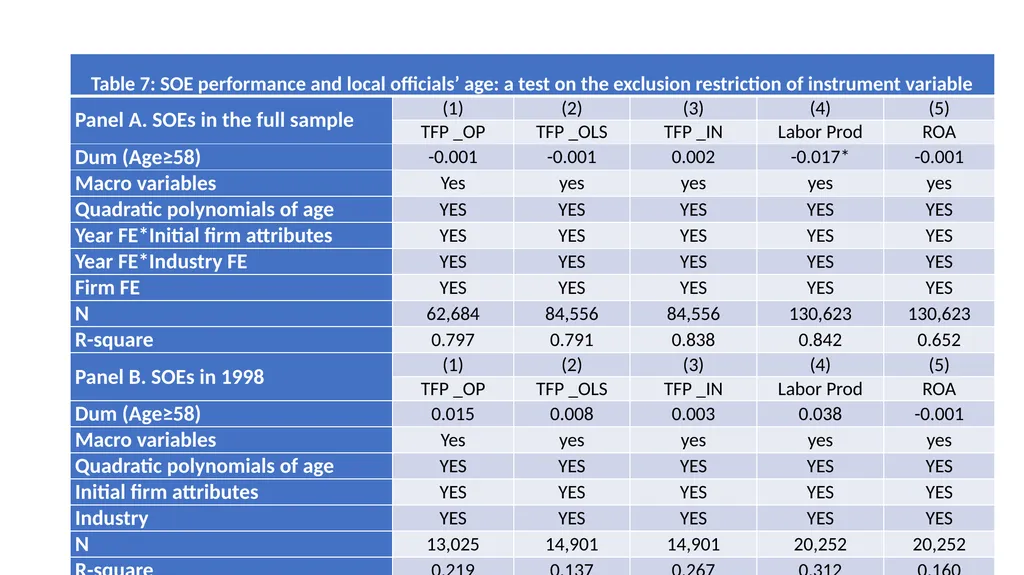
The local politician’s age being older than 58 does not directly affect SOE performance,
a credible instrumental variable for SOE privatizations.
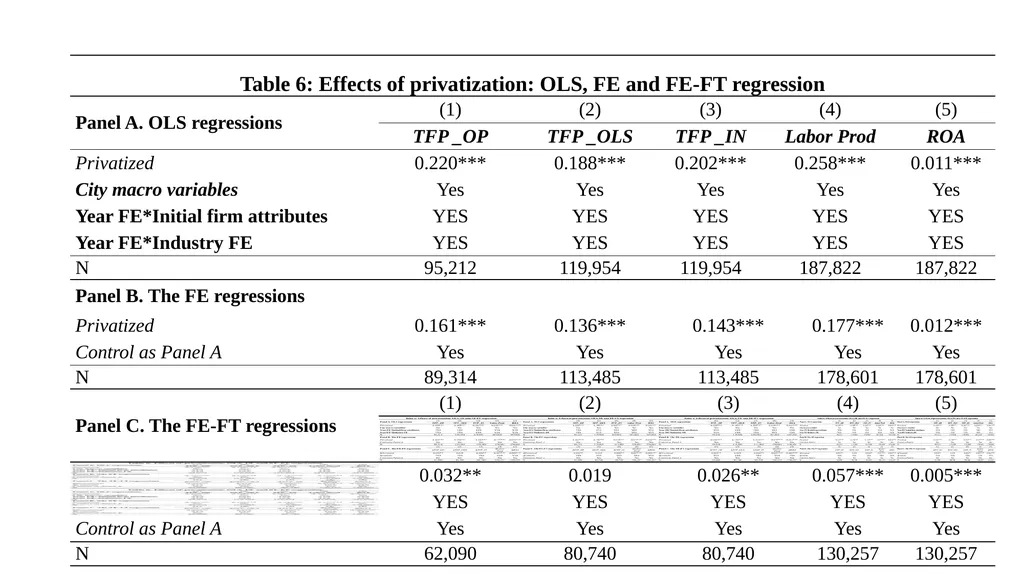
Without dealing with time-varying selectivity, privatization in China is associated with modest productivity improvements as found elsewhere.
The IV Results show that privatizations lead to dramatic increases in firms’ productivity by more than 170 percent,
an order of magnitude higher than that based on traditional models.
The privatization effects greater in regions with lower gov’t intervention.<br>
The local politician’s age being older than 58 does not directly affect SOE performance,
a credible instrumental variable for SOE privatizations.
Without dealing with time-varying selectivity, privatization in China is associated with modest productivity improvements as found elsewhere.
The IV Results show that privatizations lead to dramatic increases in firms’ productivity by more than 170 percent,
an order of magnitude higher than that based on traditional models.
The privatization effects greater in regions with lower gov’t intervention.<br>
16
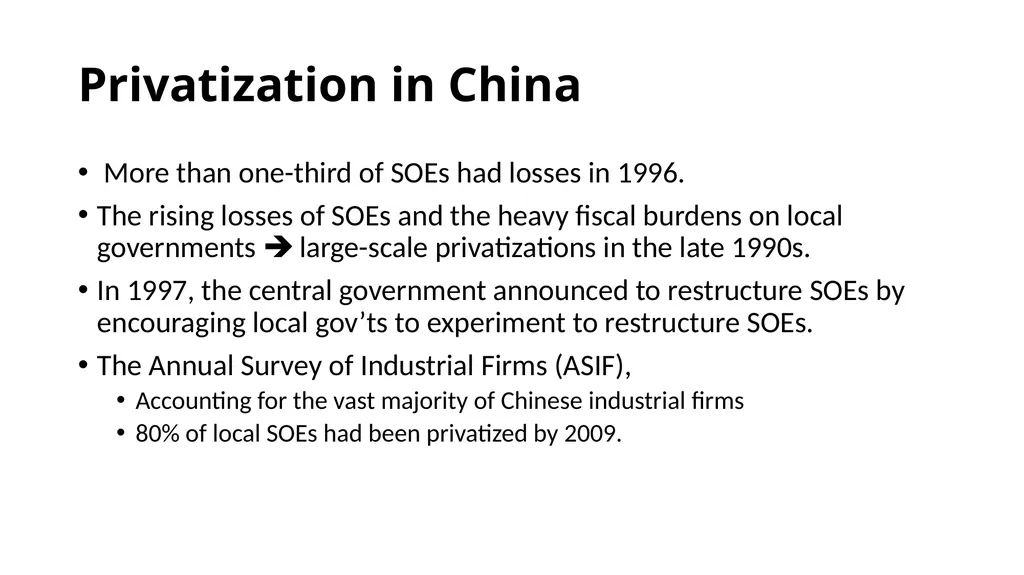
Privatization in China More than one-third of SOEs had losses in 1996.
The rising losses of SOEs and the heavy fiscal burdens on local governments large-scale privatizations in the late 1990s.
In 1997, the central government announced to restructure SOEs by encouraging local gov’ts to experiment to restructure SOEs.
The Annual Survey of Industrial Firms (ASIF),
Accounting for the vast majority of Chinese industrial firms
80% of local SOEs had been privatized by 2009.<br>
The rising losses of SOEs and the heavy fiscal burdens on local governments large-scale privatizations in the late 1990s.
In 1997, the central government announced to restructure SOEs by encouraging local gov’ts to experiment to restructure SOEs.
The Annual Survey of Industrial Firms (ASIF),
Accounting for the vast majority of Chinese industrial firms
80% of local SOEs had been privatized by 2009.<br>
17
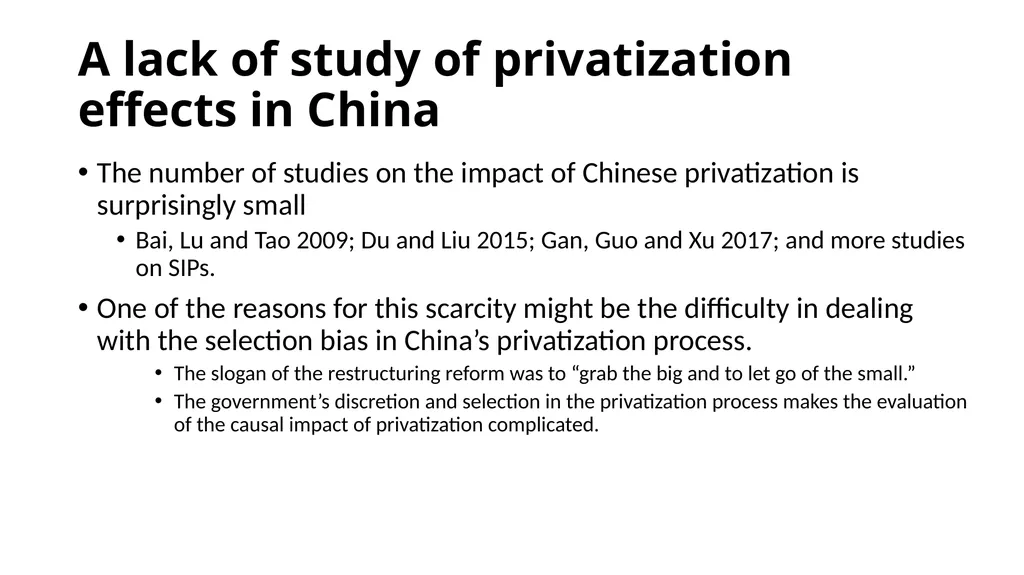
A lack of study of privatization effects in China The number of studies on the impact of Chinese privatization is surprisingly small
Bai, Lu and Tao 2009; Du and Liu 2015; Gan, Guo and Xu 2017; and more studies on SIPs.
One of the reasons for this scarcity might be the difficulty in dealing with the selection bias in China’s privatization process.
The slogan of the restructuring reform was to “grab the big and to let go of the small.”
The government’s discretion and selection in the privatization process makes the evaluation of the causal impact of privatization complicated.<br>
Bai, Lu and Tao 2009; Du and Liu 2015; Gan, Guo and Xu 2017; and more studies on SIPs.
One of the reasons for this scarcity might be the difficulty in dealing with the selection bias in China’s privatization process.
The slogan of the restructuring reform was to “grab the big and to let go of the small.”
The government’s discretion and selection in the privatization process makes the evaluation of the causal impact of privatization complicated.<br>
18
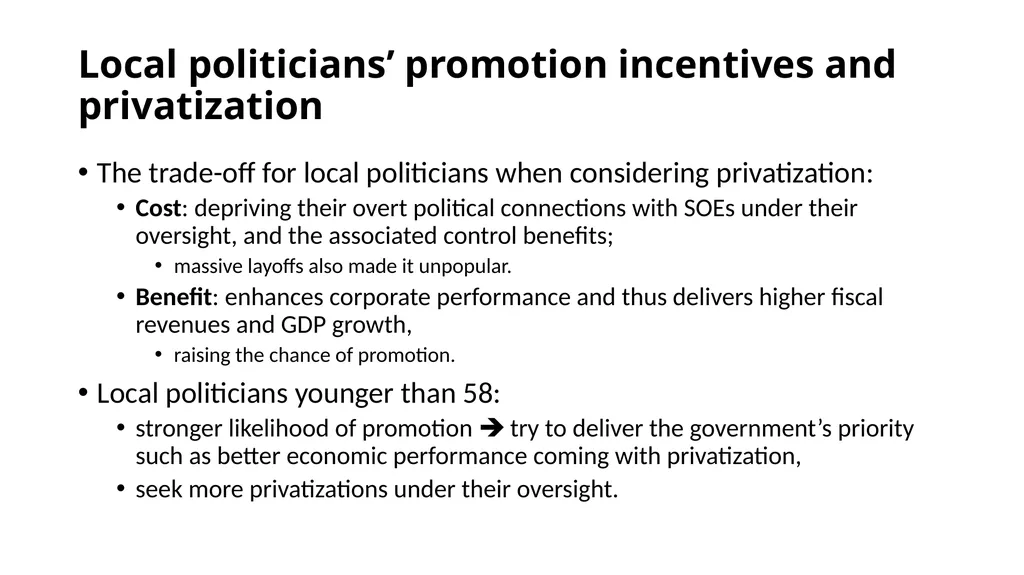
Local politicians’ promotion incentives and privatization The trade-off for local politicians when considering privatization:
Cost: depriving their overt political connections with SOEs under their oversight, and the associated control benefits;
massive layoffs also made it unpopular.
Benefit: enhances corporate performance and thus delivers higher fiscal revenues and GDP growth,
raising the chance of promotion.
Local politicians younger than 58:
stronger likelihood of promotion try to deliver the government’s priority such as better economic performance coming with privatization,
seek more privatizations under their oversight.<br>
Cost: depriving their overt political connections with SOEs under their oversight, and the associated control benefits;
massive layoffs also made it unpopular.
Benefit: enhances corporate performance and thus delivers higher fiscal revenues and GDP growth,
raising the chance of promotion.
Local politicians younger than 58:
stronger likelihood of promotion try to deliver the government’s priority such as better economic performance coming with privatization,
seek more privatizations under their oversight.<br>
19
The age of local politicians should not directly affect the performance of local SOEs After the 1980s SOE reforms, local SOE managers had been autonomous in running their enterprises (Groves et al. 1994).
Even if local politicians had wanted to interfere with SOEs :
constrained by their short tenures (i.e., typically 3-4 years),
the large number of SOEs in each city,
their time constraint.
The SOEs in cities under the oversight of local politicians being older than 58 should not otherwise have distinct performance except through privatization decisions.<br>
Even if local politicians had wanted to interfere with SOEs :
constrained by their short tenures (i.e., typically 3-4 years),
the large number of SOEs in each city,
their time constraint.
The SOEs in cities under the oversight of local politicians being older than 58 should not otherwise have distinct performance except through privatization decisions.<br>
20
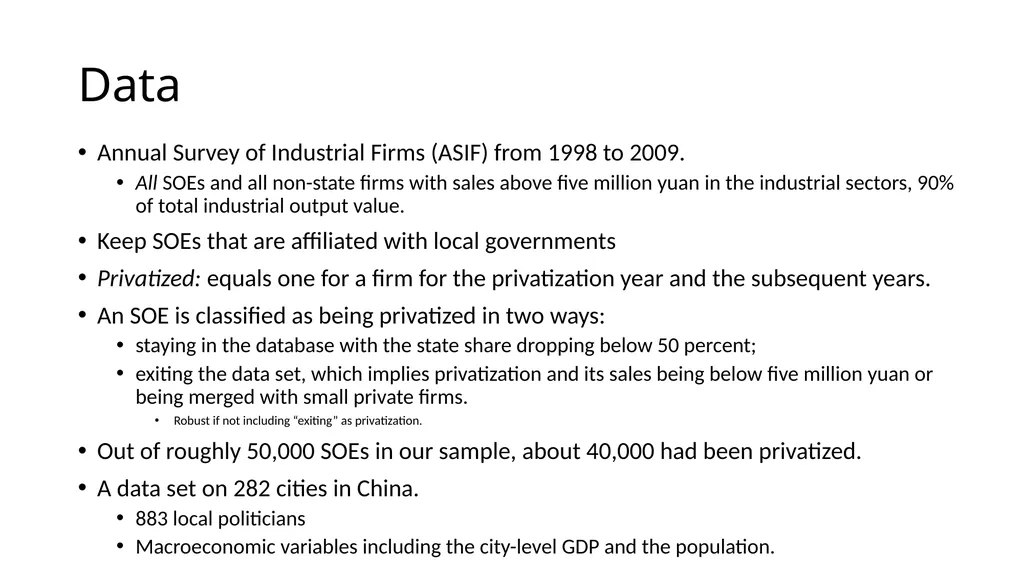
Data Annual Survey of Industrial Firms (ASIF) from 1998 to 2009.
All SOEs and all non-state firms with sales above five million yuan in the industrial sectors, 90% of total industrial output value.
Keep SOEs that are affiliated with local governments
Privatized: equals one for a firm for the privatization year and the subsequent years.
An SOE is classified as being privatized in two ways:
staying in the database with the state share dropping below 50 percent;
exiting the data set, which implies privatization and its sales being below five million yuan or being merged with small private firms.
Robust if not including “exiting” as privatization.
Out of roughly 50,000 SOEs in our sample, about 40,000 had been privatized.
A data set on 282 cities in China.
883 local politicians
Macroeconomic variables including the city-level GDP and the population.<br>
All SOEs and all non-state firms with sales above five million yuan in the industrial sectors, 90% of total industrial output value.
Keep SOEs that are affiliated with local governments
Privatized: equals one for a firm for the privatization year and the subsequent years.
An SOE is classified as being privatized in two ways:
staying in the database with the state share dropping below 50 percent;
exiting the data set, which implies privatization and its sales being below five million yuan or being merged with small private firms.
Robust if not including “exiting” as privatization.
Out of roughly 50,000 SOEs in our sample, about 40,000 had been privatized.
A data set on 282 cities in China.
883 local politicians
Macroeconomic variables including the city-level GDP and the population.<br>
21
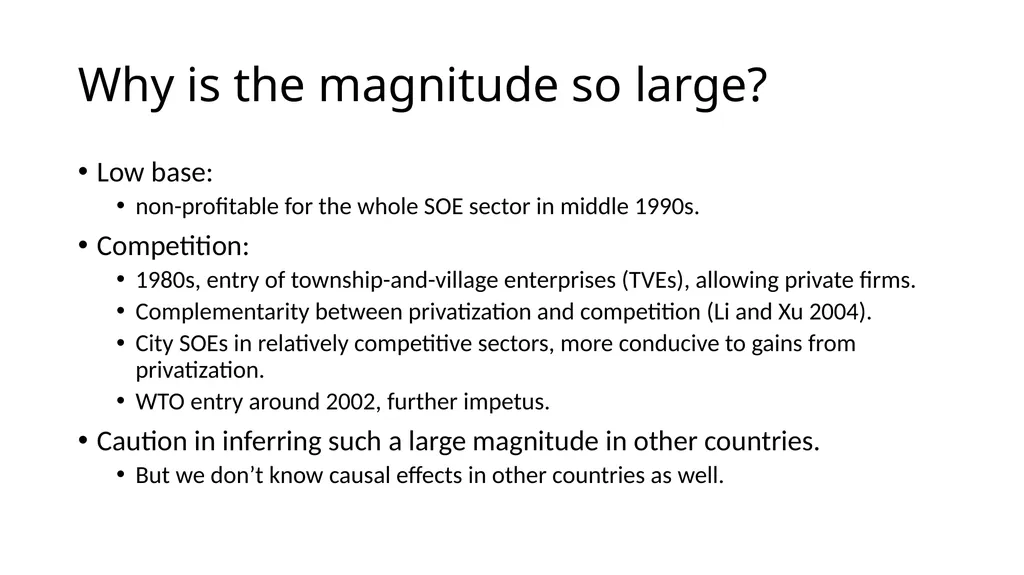
Why is the magnitude so large? Low base:
non-profitable for the whole SOE sector in middle 1990s.
Competition:
1980s, entry of township-and-village enterprises (TVEs), allowing private firms.
Complementarity between privatization and competition (Li and Xu 2004).
City SOEs in relatively competitive sectors, more conducive to gains from privatization.
WTO entry around 2002, further impetus.
Caution in inferring such a large magnitude in other countries.
But we don’t know causal effects in other countries as well.<br>
non-profitable for the whole SOE sector in middle 1990s.
Competition:
1980s, entry of township-and-village enterprises (TVEs), allowing private firms.
Complementarity between privatization and competition (Li and Xu 2004).
City SOEs in relatively competitive sectors, more conducive to gains from privatization.
WTO entry around 2002, further impetus.
Caution in inferring such a large magnitude in other countries.
But we don’t know causal effects in other countries as well.<br>
22
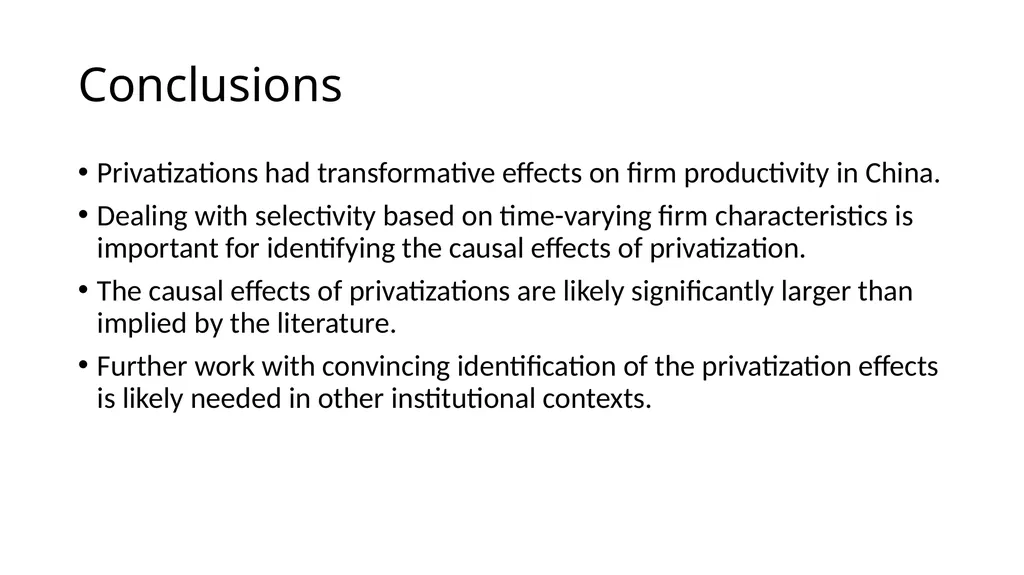
Conclusions Privatizations had transformative effects on firm productivity in China.
Dealing with selectivity based on time-varying firm characteristics is important for identifying the causal effects of privatization.
The causal effects of privatizations are likely significantly larger than implied by the literature.
Further work with convincing identification of the privatization effects is likely needed in other institutional contexts.<br>
Dealing with selectivity based on time-varying firm characteristics is important for identifying the causal effects of privatization.
The causal effects of privatizations are likely significantly larger than implied by the literature.
Further work with convincing identification of the privatization effects is likely needed in other institutional contexts.<br>