The Use of ICT based Technologies to Create, Preserve and Disseminate Indigenous Knowledge by the Assam State Archives and the District Library (Guwahati), Assam The Use of ICT based Technologies to Create, Preserve and Disseminate
"The Use of ICT based Technologies to Create," is the property of its rightful owner. Permission is granted to
download and print the materials on this website for personal, non-commercial use only, and to display it
on your personal computer provided you do not modify the materials and that you retain all copyright
notices contained in the materials. By downloading content from our website, you accept the terms of this
agreement.
Presentation Transcript
01
The Use of ICT based Technologies to Create, Preserve and Disseminate Indigenous Knowledge by the Assam State Archives and the District Library (Guwahati), Assam The Use of ICT based Technologies to Create, Preserve and Disseminate Indigenous Knowledge by the Assam State Archives and the District Library (Guwahati), Assam By
-Ms. Sangita Mazumdar
Librarian, Asian Institute of Nursing Education, Guwahati
(Affiliated to SNDT Women’s University, Mumbai; Assam Nursing Council)
GNRC Hospitals, Ganeshguri, Guwahati:05
Contact detail: Email-sangitamazumdar@rediffmail.com, ph.no-8486326647 &
- Ms. Phool Rani Das
Asstt. Librarian, RG Baruah College, Guwahati:25
Contact detail: Email-phool.rani@rediffmail.com, Ph.no- 9577343562<br>
02
Introduction
Masango (2010) defined indigenous knowledge (IK) as “the totality of all knowledge and practices established on past experiences and observations that is held and used by people”.
While IK is of immense value in knowing every aspects of a culture its preservation, management, documentation and dissemination remain a big challenge confronting librarians, archivists, and other information professionals, particularly in Assam.
This brief paper discusses the role of ICT in gathering, storing, preserving and disseminating IK and the problems involved in its management in the selected organizations for the study viz. Assam State Archives, Assam and District Library (Guwahati), Assam.<br>
03
Objectives:
To find out the status of ICT based techniques for the documentation and dissemination of Indigenous knowledge(IK) in the selected organizations.
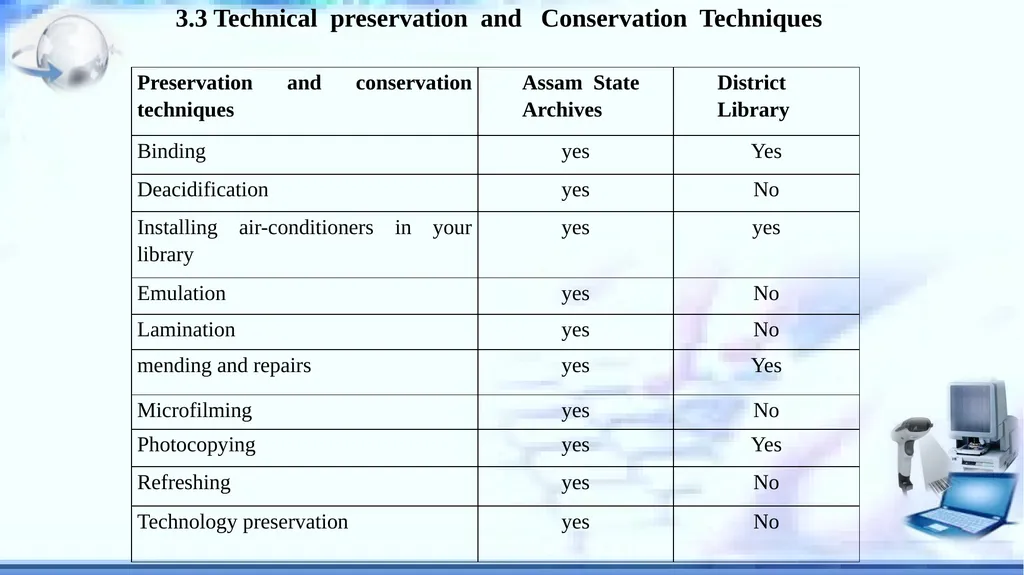
To assess the status of technical preservation and conservation techniques for print and digitized resources on IK, practiced in the cited organizations.
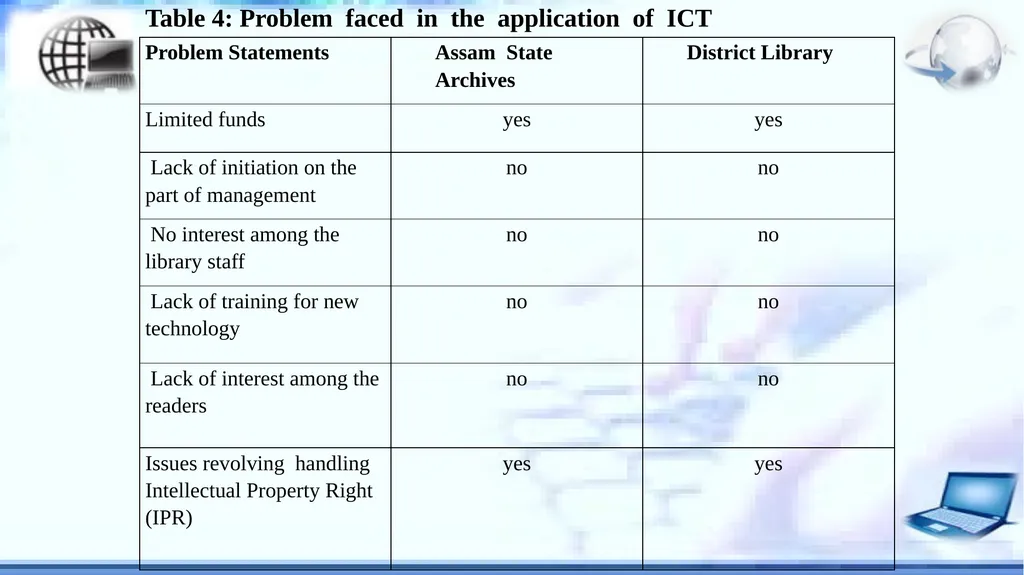
To investigate Challenges of applying ICTs to IK management.<br>
04
Methodology
A survey research design was adopted for the study.
Queries included in questionnaire were those seeking information on the
nature of institutional collections/holdings,
IT based documentation and dissemination processes for IK management ;
status and kind of technical preservation and conservation methods used
the Problems faced to manage IK.<br>
05
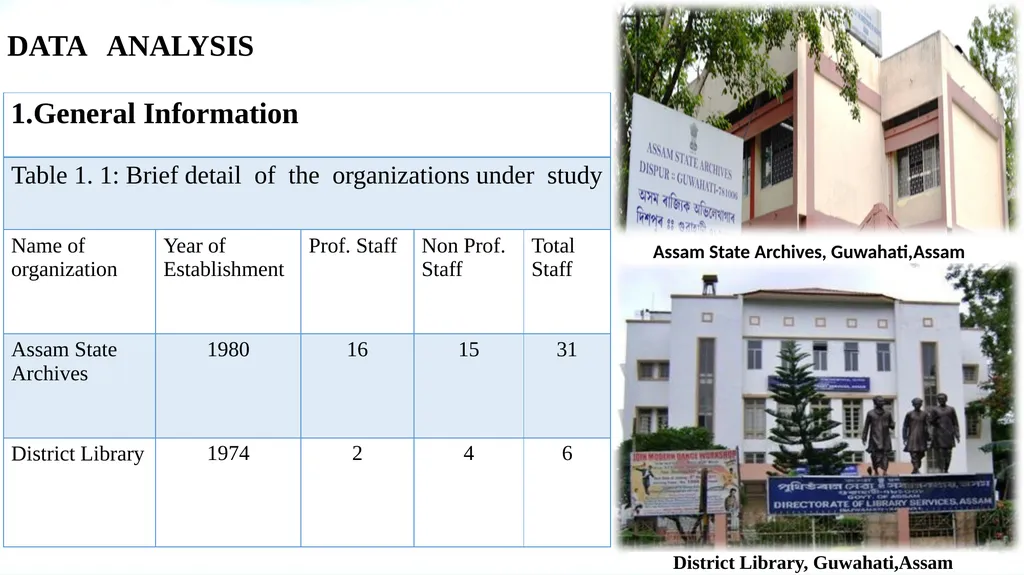
Assam State Archives, Guwahati,Assam District Library, Guwahati,Assam DATA ANALYSIS<br>
06
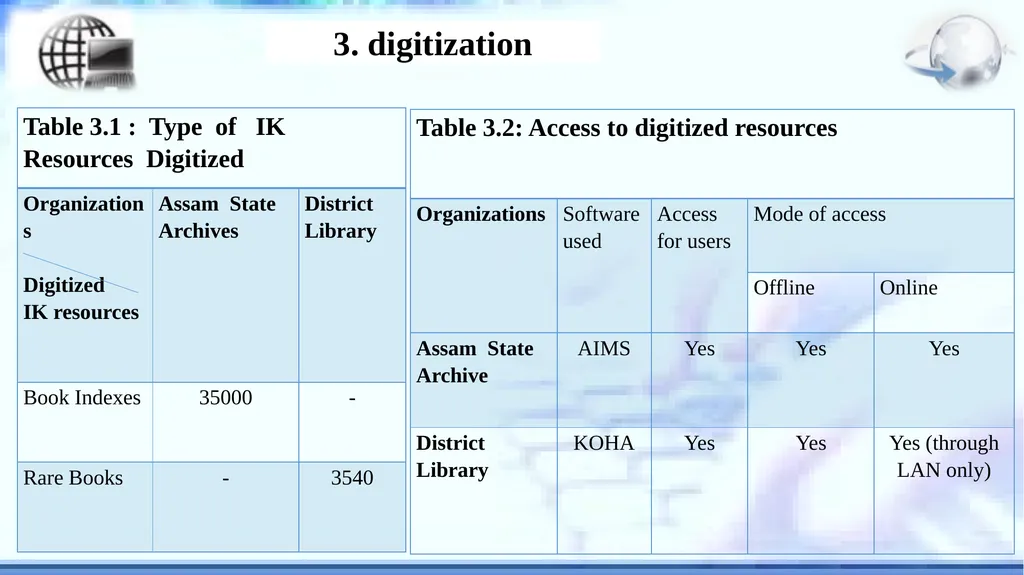
3. digitization<br>
07
Findings of the study
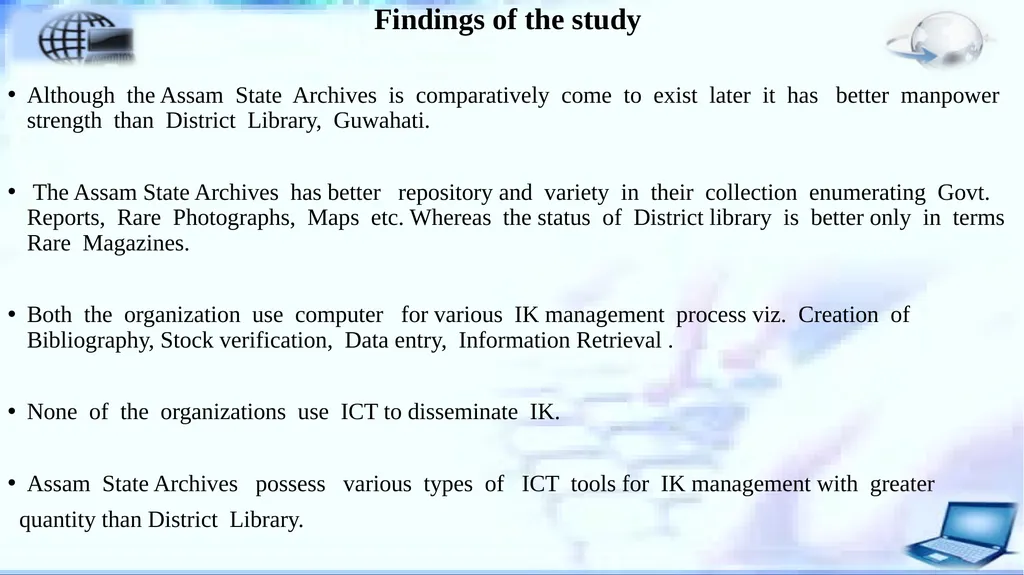
Although the Assam State Archives is comparatively come to exist later it has better manpower strength than District Library, Guwahati.
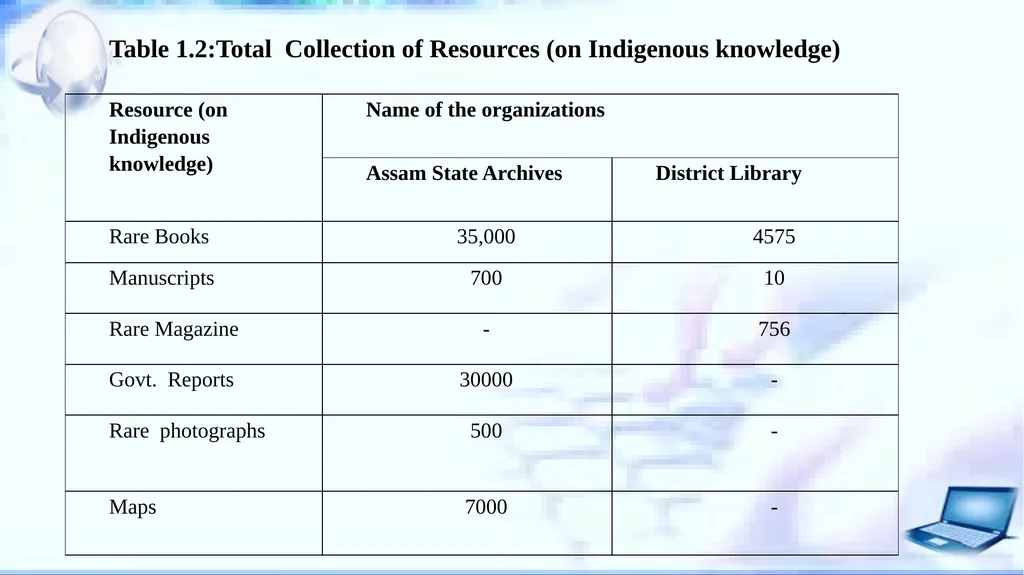
The Assam State Archives has better repository and variety in their collection enumerating Govt. Reports, Rare Photographs, Maps etc. Whereas the status of District library is better only in terms Rare Magazines.
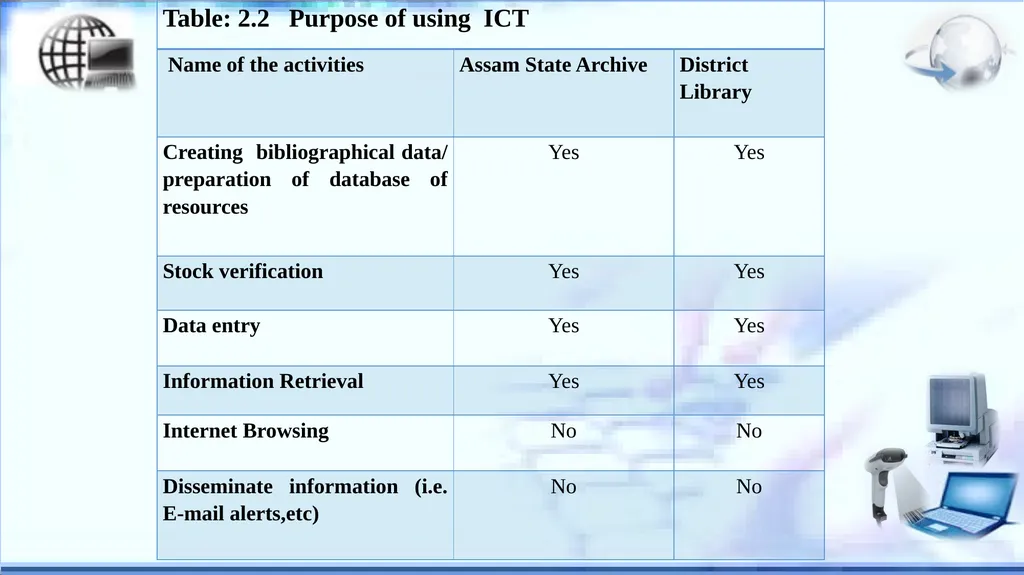
Both the organization use computer for various IK management process viz. Creation of Bibliography, Stock verification, Data entry, Information Retrieval .
None of the organizations use ICT to disseminate IK.
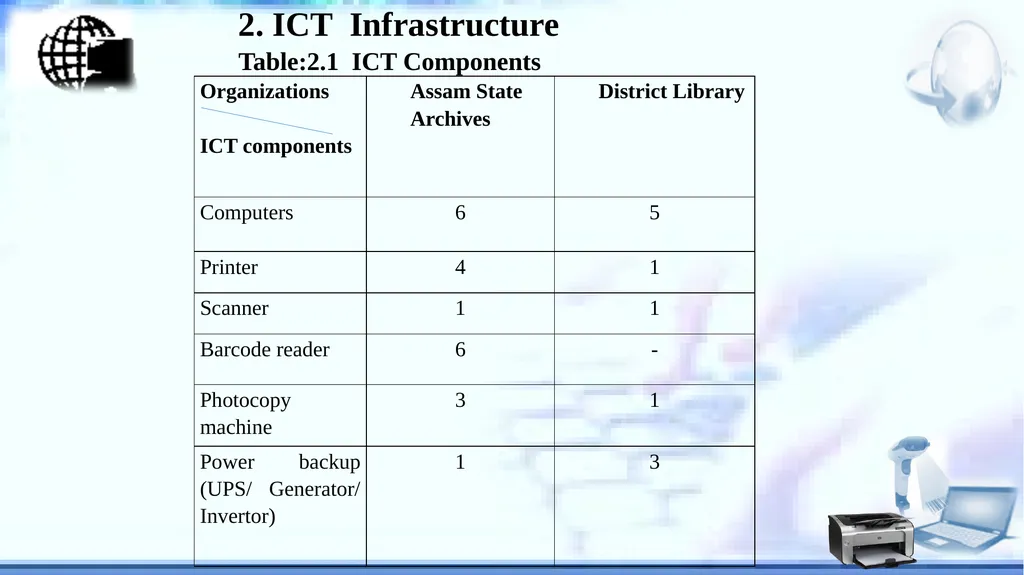
Assam State Archives possess various types of ICT tools for IK management with greater
quantity than District Library.<br>
08
Findings of the study
Both the organizations have digitized IK resources and provide access to the digitized resources through both online and offline mode.
Assam State Archive uses AIMS software and the District Library uses KOHA software for the management of digitized IK resources.
The methods of Preservation and Conservation of IK resources are more technology based in Assam State Archives than District Library which is still relying on manual assistance.
Although both the organizations have denied the majority of the obstacles mentioned in the questionnaire ,it is found the there is lack of professionals like taxonomists, IT professionals, lack of training based on advanced methods, etc. more specifically in District Library.
Lack of fund and handling issues revolving safeguard of IPR of is indeed the most common problem for both the organizations on more or less extend.
The comparative study has found Assam State Archive in advantageous position in all the aspects over District Library .<br>
09
Suggestions/Conclusion
Equal access to the relevant local knowledge for all stakeholders within the community must be allowed.
Efforts should be made to convert indigenous knowledge into electronic storage so as to increase the life span of such knowledge.
There should be development of pilot interventions to learn how ICT impact on IK that in turn improve livelihoods.
All the heritage organizations variably require to attend them modern preventive measures without any delay.
The introduction, expansion and integration of Social Medias and Mobile Technologies with heritage organization
The more quality system should be made for developing intellectual property rights protection systems .
The efforts of the heritage organizations can be collaborated. Such Collaboration will result in attracting new audiences and blurring of boundaries among libraries, and archives for sharing physical or digitized resources.<br>