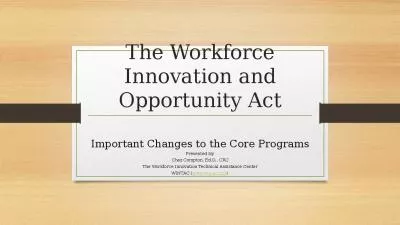
The Workforce Innovation and Opportunity Act
Description: The Workforce Innovation and Opportunity Act Important Changes to the Core Programs Presented by: Chaz Compton, Ed.D., CRC The Workforce Innovation Technical Assistance Center WINTAC (www.wintac.org) A Few Quick Facts Signed into law July
Related Topics
Download Presentation
"The Workforce Innovation and Opportunity Act" is the property of its rightful owner. Permission is granted to download and print the materials on this website for personal, non-commercial use only, and to display it on your personal computer provided you do not modify the materials and that you retain all copyright notices contained in the materials. By downloading content from our website, you accept the terms of this agreement.
Presentation Transcript
slide1. The Workforce Innovation and Opportunity Act Important Changes to the Core Programs
Presented by:
Chaz Compton, Ed.D., CRC
The Workforce Innovation Technical Assistance Center
WINTAC (www.wintac.org)<br>
slide2. A Few Quick Facts Signed into law July 22, 2014
The full Act took effect on July 1, 2015, with a few exceptions like VR
First legislative reform in 16 years of the workforce system
A bipartisan effort
Still awaiting final regulations – maybe April<br>
slide3. Core Partners DOL Programs Include:
the Adult Program (title I),
the Dislocated Worker Program (title I),
the Youth Program (title I),
the Wagner-Peyser Act Program (title III),
Department of Education Programs Include:
the Adult Education and Literacy Program (title II), and
the Vocational Rehabilitation Program (title IV of WIOA and title I of the Rehabilitation Act of 1973).<br>
slide4. Other Workforce Development Partners Perkins career and technical education programs
TANF – Temporary Assistance for Needs Families Program
SNAP – Employment and training programs under the Supplemental Nutrition Assistance Program
TAA – Trade adjustment assistance for workers program
JVSG - Jobs for Veterans State Grants Program UI - Unemployment Insurance Programs
SCSEP - Senior Community Service Employment Program
HUD - Employment and training activities carried out by the Department of Housing and Urban Development
CSBG - Community Services Block Grant Program
ReXo - Reintegration of Ex-Offenders Program<br>
slide5. How did we get to WIOA? The recession of 2007
The changing and evolving workplace – what that meant for training and jobs
Major skills gap identified
Employment and training programs working in silos, even with WIA
Identified need for starting early and creating career pathways
Financial bailout, ARRA, the automakers and the need to change our usual way of doing business<br>
slide6. Important Elements of WIOA Strategic alignment of workforce development programs
Requires unified planning
Requires the adoption of common performance measures for all core programs
Focuses on improving services to employers and job-driven training
Improves the American Job Center System
Improves services to youth, individuals with disabilities and other vulnerable populations<br>
slide7. Important Changes to the Rehab Act in WIOA Requires pre-employment transition services and a 15% reserve or set-aside for the provision of PETS
Requires 50% of the Supported Employment funds be spent on youth
Requires VR programs to engage with employers
Promotes competitive integrated employment (Section 511)
Promotes customized employment for individuals with the most significant disabilities
Reduces the minimum level of education needed for qualified rehabilitation professionals
Moves IL to the Department of Health and Human Services<br>
slide8. More Changes to VR IPE must be written within 90 days
Extended services in SE can go up to 4 years by the VR program if it is for youth
Support advance training in STEM fields
Eligibility for individuals whose disability prevents them from advancing in employment
No longer use the Standards and Indicators but the common performance measures<br>
slide9. Integration and Alignment of Programs What does the law mean when it says that the core program should be integrated and strategically aligned?
Goes well beyond cross-referral
Consider VR for a moment. How would you define integration for the VR program? How would you know it is integrated?
Groups: Identify at least three current challenges to full integration of the core programs in CNMI.
Identify at least three specific actions that will demonstrate integration of the partners. What will you specifically do differently as a result of the new law?<br>
slide10. RSA’s Definition of Integration How is RSA defining whether the VR program is integrated into the workforce development system?
An increase in the number of individuals with disabilities that obtain competitive employment as a result of the partnership with Workforce Development core partners.
How is that determined?
Shared cases
2nd way – increased and improved collaboration with core partners
How is that determined?<br>
slide11. An Example of Integrated Service 23 year old with ADHD dropped out of high school prior to graduation and no GED
Obtains GED
Enters the nursing program with shared funding from OVR and workforce
Support services provided by both OVR and workforce
Internship/work experience arranged through any of the agencies
Job referral and placement provided in concert with Wagner-Peyser funded program
Tracking of progress and shared information by all entities<br>
slide12. Job-Driven Training Report to the President from VP Joe Biden. When was it released?
America’s workforce system must focus its resources on preparing individuals to acquire the skills that are in demand by employers.
Demand-side in addition to supply-side
Major focus on work experience, apprenticeships, internships, OJTs, and any other kind of work experience
Customized Training
All funded programs working together to prepare individuals to meet employer needs (Strategically aligned)<br>
slide13. What Works to Achieve the Vision Engaging employers – Not just in hiring, but in training
Earn and learn – work experiences, internships, apprenticeships
Use of data to drive choices and decisions
Measurement of success of programs – program evaluation
Career Pathways
Breaking down barriers for people who have needs like child care, transportation, other support services, as well as people with disabilities<br>
slide14. Accountability Common Performance Accountability Measures for Adults:
% in unsubsidized employment during the second quarter after exit from the program;
% in unsubsidized employment during the fourth quarter after exit from the program;
Median earnings of those in unsubsidized employment during the second quarter after exit from the program;
% of participants who obtained a recognized postsecondary credential or secondary school diploma or equivalent during participation in, or within one year of, exit from the program;
% of participants, who during a program year, are in an education or training program that leads to a recognized postsecondary credential or employment and who are achieving measurable skill gains toward such a credential or employment; and
Indicators of effectiveness in serving employers.<br>
slide15. Accountability Measures for Youth The percentage of program participants who are in education or training activities, or in unsubsidized employment, during the second quarter after exit from the program;
The percentage of program participants who are in education or training activities, or in unsubsidized employment, during the fourth quarter after exit from the program;
Median earnings of those in unsubsidized employment during the second quarter after exit from the program;
% of participants who obtained a recognized postsecondary credential or secondary school diploma or equivalent during participation in, or within one year of, exit from the program;
% of participants, who during a program year, are in an education or training program that leads to a recognized postsecondary credential or employment and who are achieving measurable skill gains toward such a credential or employment<br>
slide16. Accountability Continued Performance levels established for all core programs
Negotiated with DOL and DOE for the first two years and set during the 3rd and 4th year based on several factors identified in the law
What is the most common way to begin to set performance standards that you haven’t had before?
Do you gather this information now? If not, it is time to begin.
Let’s review the outcome measures again and see what you data you would have to gather and report on<br>
slide17. Accountability with Teeth You don’t hit your performance standards for any one program year – what happens?
TA and a performance improvement plan (PIP)
2nd year in a row – what happens?
5% reduction in State allocation of funding withheld until performance is met
3rd year in a row?
Reorganization of Board, prohibit use of underperforming providers, and other actions deemed necessary<br>
slide18. CNMI and WIOA Who will define for you what CNMI should be doing under WIOA?
Who will identify what job-driven training means here?
The opportunities and challenges of size
Partnerships with employers are going to be a key
Secondary education is a crucial partner, even though they are not identified as a core partner
Each program has to go beyond their traditional walls while retaining their identity<br>
slide19. Questions?<br>
Presented by:
Chaz Compton, Ed.D., CRC
The Workforce Innovation Technical Assistance Center
WINTAC (www.wintac.org)<br>
slide2. A Few Quick Facts Signed into law July 22, 2014
The full Act took effect on July 1, 2015, with a few exceptions like VR
First legislative reform in 16 years of the workforce system
A bipartisan effort
Still awaiting final regulations – maybe April<br>
slide3. Core Partners DOL Programs Include:
the Adult Program (title I),
the Dislocated Worker Program (title I),
the Youth Program (title I),
the Wagner-Peyser Act Program (title III),
Department of Education Programs Include:
the Adult Education and Literacy Program (title II), and
the Vocational Rehabilitation Program (title IV of WIOA and title I of the Rehabilitation Act of 1973).<br>
slide4. Other Workforce Development Partners Perkins career and technical education programs
TANF – Temporary Assistance for Needs Families Program
SNAP – Employment and training programs under the Supplemental Nutrition Assistance Program
TAA – Trade adjustment assistance for workers program
JVSG - Jobs for Veterans State Grants Program UI - Unemployment Insurance Programs
SCSEP - Senior Community Service Employment Program
HUD - Employment and training activities carried out by the Department of Housing and Urban Development
CSBG - Community Services Block Grant Program
ReXo - Reintegration of Ex-Offenders Program<br>
slide5. How did we get to WIOA? The recession of 2007
The changing and evolving workplace – what that meant for training and jobs
Major skills gap identified
Employment and training programs working in silos, even with WIA
Identified need for starting early and creating career pathways
Financial bailout, ARRA, the automakers and the need to change our usual way of doing business<br>
slide6. Important Elements of WIOA Strategic alignment of workforce development programs
Requires unified planning
Requires the adoption of common performance measures for all core programs
Focuses on improving services to employers and job-driven training
Improves the American Job Center System
Improves services to youth, individuals with disabilities and other vulnerable populations<br>
slide7. Important Changes to the Rehab Act in WIOA Requires pre-employment transition services and a 15% reserve or set-aside for the provision of PETS
Requires 50% of the Supported Employment funds be spent on youth
Requires VR programs to engage with employers
Promotes competitive integrated employment (Section 511)
Promotes customized employment for individuals with the most significant disabilities
Reduces the minimum level of education needed for qualified rehabilitation professionals
Moves IL to the Department of Health and Human Services<br>
slide8. More Changes to VR IPE must be written within 90 days
Extended services in SE can go up to 4 years by the VR program if it is for youth
Support advance training in STEM fields
Eligibility for individuals whose disability prevents them from advancing in employment
No longer use the Standards and Indicators but the common performance measures<br>
slide9. Integration and Alignment of Programs What does the law mean when it says that the core program should be integrated and strategically aligned?
Goes well beyond cross-referral
Consider VR for a moment. How would you define integration for the VR program? How would you know it is integrated?
Groups: Identify at least three current challenges to full integration of the core programs in CNMI.
Identify at least three specific actions that will demonstrate integration of the partners. What will you specifically do differently as a result of the new law?<br>
slide10. RSA’s Definition of Integration How is RSA defining whether the VR program is integrated into the workforce development system?
An increase in the number of individuals with disabilities that obtain competitive employment as a result of the partnership with Workforce Development core partners.
How is that determined?
Shared cases
2nd way – increased and improved collaboration with core partners
How is that determined?<br>
slide11. An Example of Integrated Service 23 year old with ADHD dropped out of high school prior to graduation and no GED
Obtains GED
Enters the nursing program with shared funding from OVR and workforce
Support services provided by both OVR and workforce
Internship/work experience arranged through any of the agencies
Job referral and placement provided in concert with Wagner-Peyser funded program
Tracking of progress and shared information by all entities<br>
slide12. Job-Driven Training Report to the President from VP Joe Biden. When was it released?
America’s workforce system must focus its resources on preparing individuals to acquire the skills that are in demand by employers.
Demand-side in addition to supply-side
Major focus on work experience, apprenticeships, internships, OJTs, and any other kind of work experience
Customized Training
All funded programs working together to prepare individuals to meet employer needs (Strategically aligned)<br>
slide13. What Works to Achieve the Vision Engaging employers – Not just in hiring, but in training
Earn and learn – work experiences, internships, apprenticeships
Use of data to drive choices and decisions
Measurement of success of programs – program evaluation
Career Pathways
Breaking down barriers for people who have needs like child care, transportation, other support services, as well as people with disabilities<br>
slide14. Accountability Common Performance Accountability Measures for Adults:
% in unsubsidized employment during the second quarter after exit from the program;
% in unsubsidized employment during the fourth quarter after exit from the program;
Median earnings of those in unsubsidized employment during the second quarter after exit from the program;
% of participants who obtained a recognized postsecondary credential or secondary school diploma or equivalent during participation in, or within one year of, exit from the program;
% of participants, who during a program year, are in an education or training program that leads to a recognized postsecondary credential or employment and who are achieving measurable skill gains toward such a credential or employment; and
Indicators of effectiveness in serving employers.<br>
slide15. Accountability Measures for Youth The percentage of program participants who are in education or training activities, or in unsubsidized employment, during the second quarter after exit from the program;
The percentage of program participants who are in education or training activities, or in unsubsidized employment, during the fourth quarter after exit from the program;
Median earnings of those in unsubsidized employment during the second quarter after exit from the program;
% of participants who obtained a recognized postsecondary credential or secondary school diploma or equivalent during participation in, or within one year of, exit from the program;
% of participants, who during a program year, are in an education or training program that leads to a recognized postsecondary credential or employment and who are achieving measurable skill gains toward such a credential or employment<br>
slide16. Accountability Continued Performance levels established for all core programs
Negotiated with DOL and DOE for the first two years and set during the 3rd and 4th year based on several factors identified in the law
What is the most common way to begin to set performance standards that you haven’t had before?
Do you gather this information now? If not, it is time to begin.
Let’s review the outcome measures again and see what you data you would have to gather and report on<br>
slide17. Accountability with Teeth You don’t hit your performance standards for any one program year – what happens?
TA and a performance improvement plan (PIP)
2nd year in a row – what happens?
5% reduction in State allocation of funding withheld until performance is met
3rd year in a row?
Reorganization of Board, prohibit use of underperforming providers, and other actions deemed necessary<br>
slide18. CNMI and WIOA Who will define for you what CNMI should be doing under WIOA?
Who will identify what job-driven training means here?
The opportunities and challenges of size
Partnerships with employers are going to be a key
Secondary education is a crucial partner, even though they are not identified as a core partner
Each program has to go beyond their traditional walls while retaining their identity<br>
slide19. Questions?<br>