The World Bank Financial Literacy through Mainstream Media: Evaluating the Impact of Financial Messages in a South African Soap Opera Presenter: Florentina Mulaj World Bank Evaluation Authors: Gunhild Berg and Bilal Zia World Bank
"The World Bank Financial Literacy through" is the property of its rightful owner. Permission is granted to
download and print the materials on this website for personal, non-commercial use only, and to display it
on your personal computer provided you do not modify the materials and that you retain all copyright
notices contained in the materials. By downloading content from our website, you accept the terms of this
agreement.
Presentation Transcript
01
The World Bank Financial Literacy through Mainstream Media:
Evaluating the Impact of Financial Messages in a South African Soap Opera Presenter:
Florentina Mulaj
World Bank
Evaluation Authors:
Gunhild Berg and Bilal Zia
World Bank<br>
02
Over-indebtedness is a significant concern
Ratio of household debt to disposable income amounted to 76.3% in the second quarter of 2012.
In June 2012, the National Credit Regulator (NCR) reported that of the 19.6 million credit-active consumers, more than 9.22 million (>47%) had impaired records.
The percentage of consumers with impaired records has been above 45% since December 2009.
Financial education is one avenue to encourage individuals to change behavior and attitudes
Important to keep target population engaged and interested
Important to keep the content relevant
Important to sustain exposure longer than just one session 2 Strategic Context – Indebtedness in South Africa<br>
03
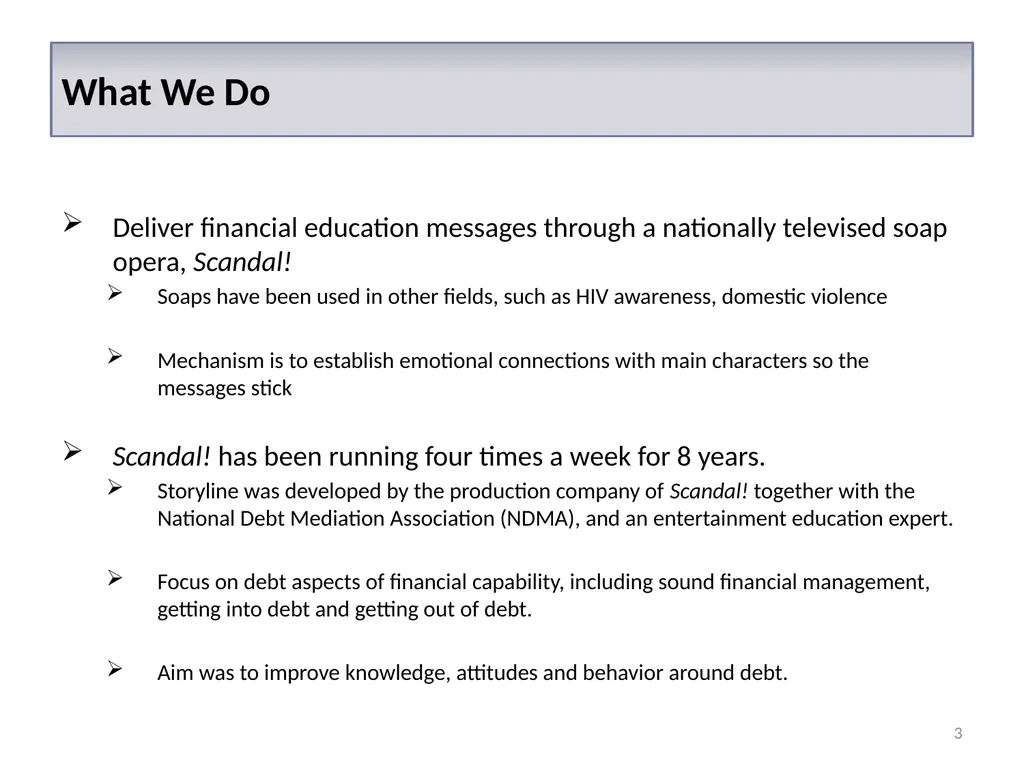
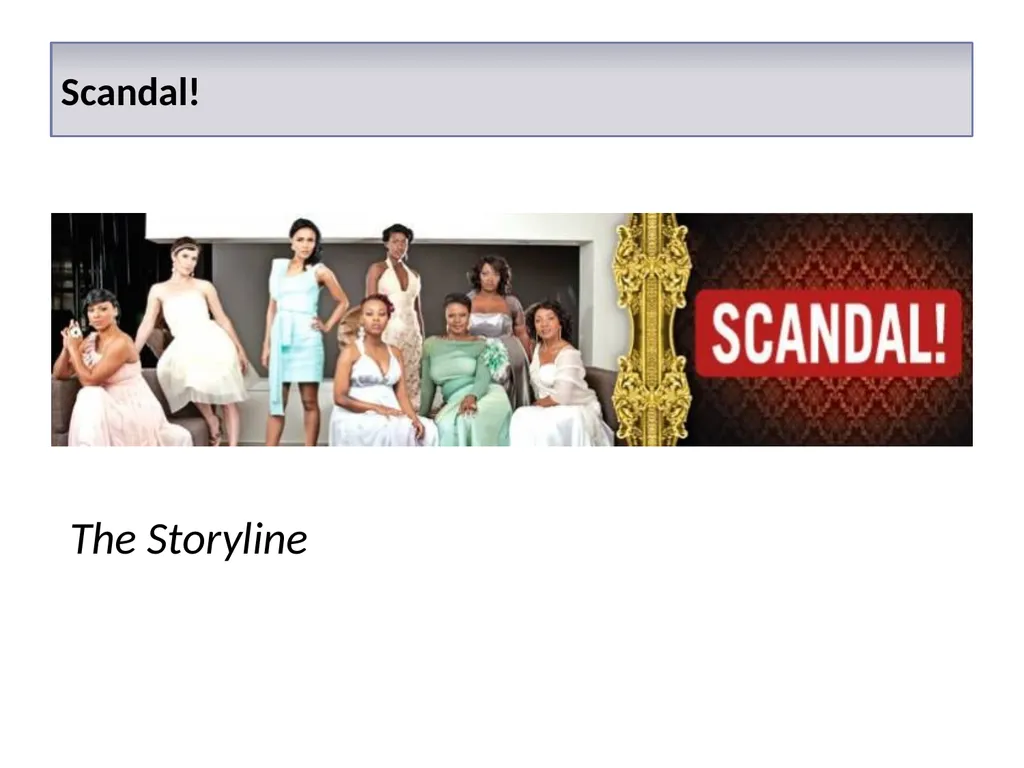
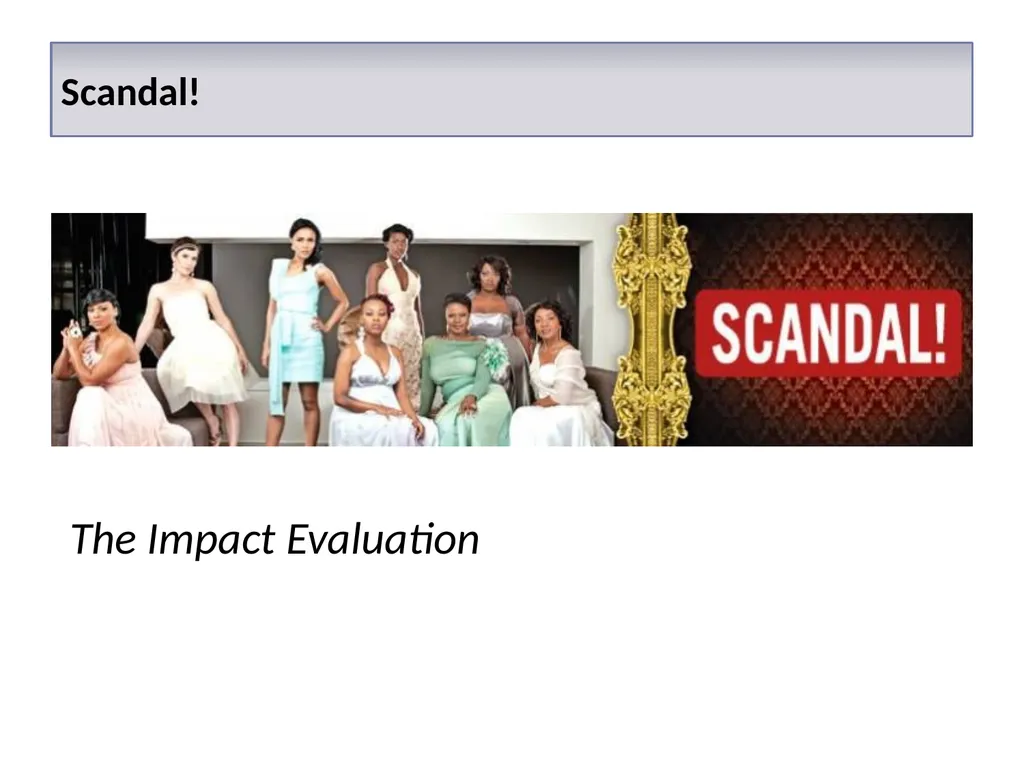
Deliver financial education messages through a nationally televised soap opera, Scandal!
Soaps have been used in other fields, such as HIV awareness, domestic violence
Mechanism is to establish emotional connections with main characters so the messages stick
Scandal! has been running four times a week for 8 years.
Storyline was developed by the production company of Scandal! together with the National Debt Mediation Association (NDMA), and an entertainment education expert.
Focus on debt aspects of financial capability, including sound financial management, getting into debt and getting out of debt.
Aim was to improve knowledge, attitudes and behavior around debt. 3 What We Do<br>
04
The Storyline Scandal!<br>
05
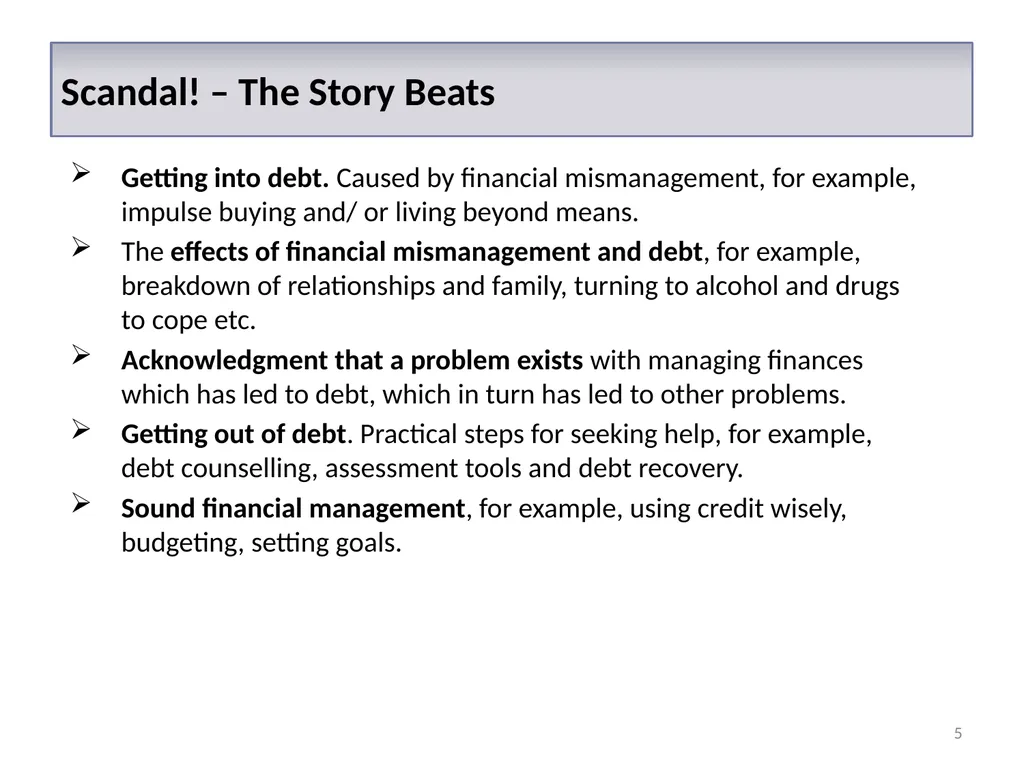
Getting into debt. Caused by financial mismanagement, for example, impulse buying and/ or living beyond means.
The effects of financial mismanagement and debt, for example, breakdown of relationships and family, turning to alcohol and drugs to cope etc.
Acknowledgment that a problem exists with managing finances which has led to debt, which in turn has led to other problems.
Getting out of debt. Practical steps for seeking help, for example, debt counselling, assessment tools and debt recovery.
Sound financial management, for example, using credit wisely, budgeting, setting goals. Scandal! – The Story Beats 5<br>
06
Successful edutainment projects require a delicate balance between education and entertainment.
The stories must resonate with the audience, the characters must be believable and reflect the often complex lives of the intended target.
They should also role-model realistic solutions that the audience believe is within their reach.
In order to fulfil this, the creative team and the expert team should work together to craft the storyline.
In order to ensure that the stories resonate, they should be tested with the target audience and feedback incorporated into the story design when needed.
Each story works well if there is a link to services (NDMA). Scandal! – The process 6<br>
07
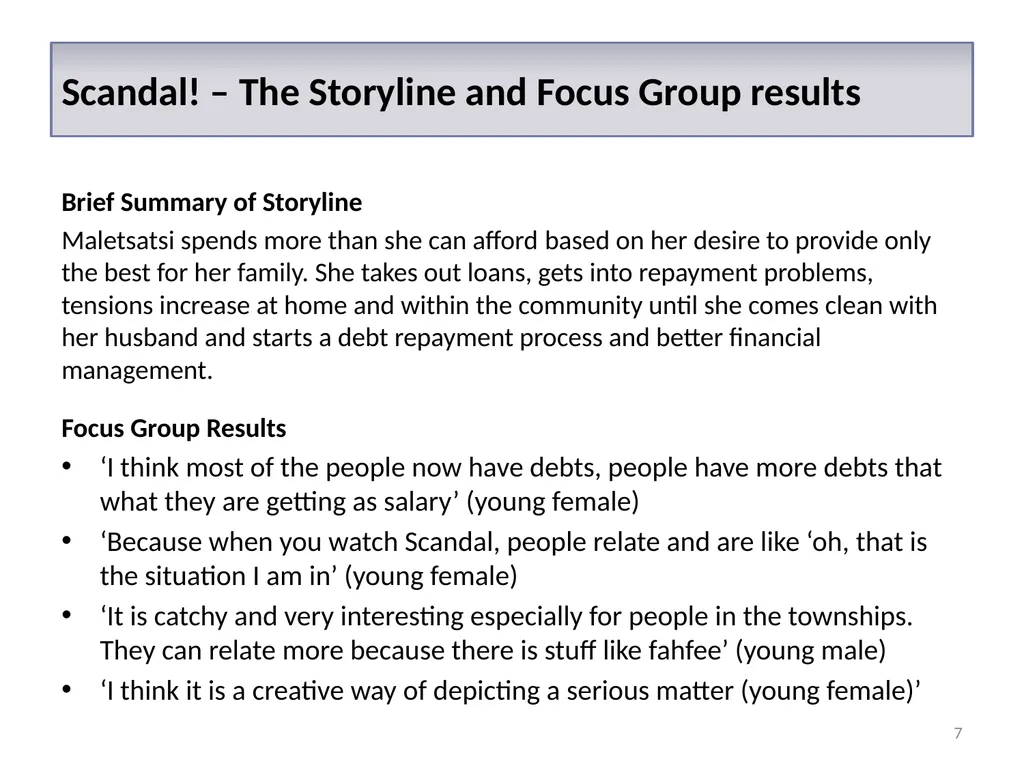
Brief Summary of Storyline
Maletsatsi spends more than she can afford based on her desire to provide only the best for her family. She takes out loans, gets into repayment problems, tensions increase at home and within the community until she comes clean with her husband and starts a debt repayment process and better financial management.
Focus Group Results
‘I think most of the people now have debts, people have more debts that what they are getting as salary’ (young female)
‘Because when you watch Scandal, people relate and are like ‘oh, that is the situation I am in’ (young female)
‘It is catchy and very interesting especially for people in the townships. They can relate more because there is stuff like fahfee’ (young male)
‘I think it is a creative way of depicting a serious matter (young female)’ 7 Scandal! – The Storyline and Focus Group results<br>
08
The Impact Evaluation Scandal!<br>
09
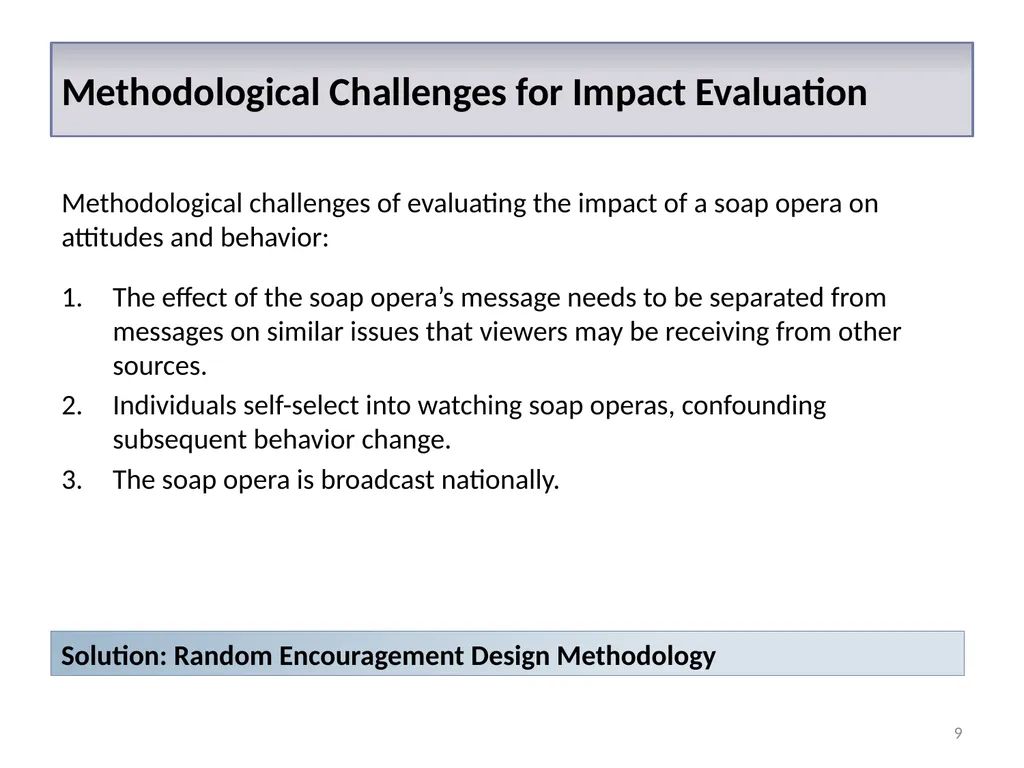
Methodological challenges of evaluating the impact of a soap opera on attitudes and behavior:
The effect of the soap opera’s message needs to be separated from messages on similar issues that viewers may be receiving from other sources.
Individuals self-select into watching soap operas, confounding subsequent behavior change.
The soap opera is broadcast nationally. 9 Methodological Challenges for Impact Evaluation Solution: Random Encouragement Design Methodology<br>
10
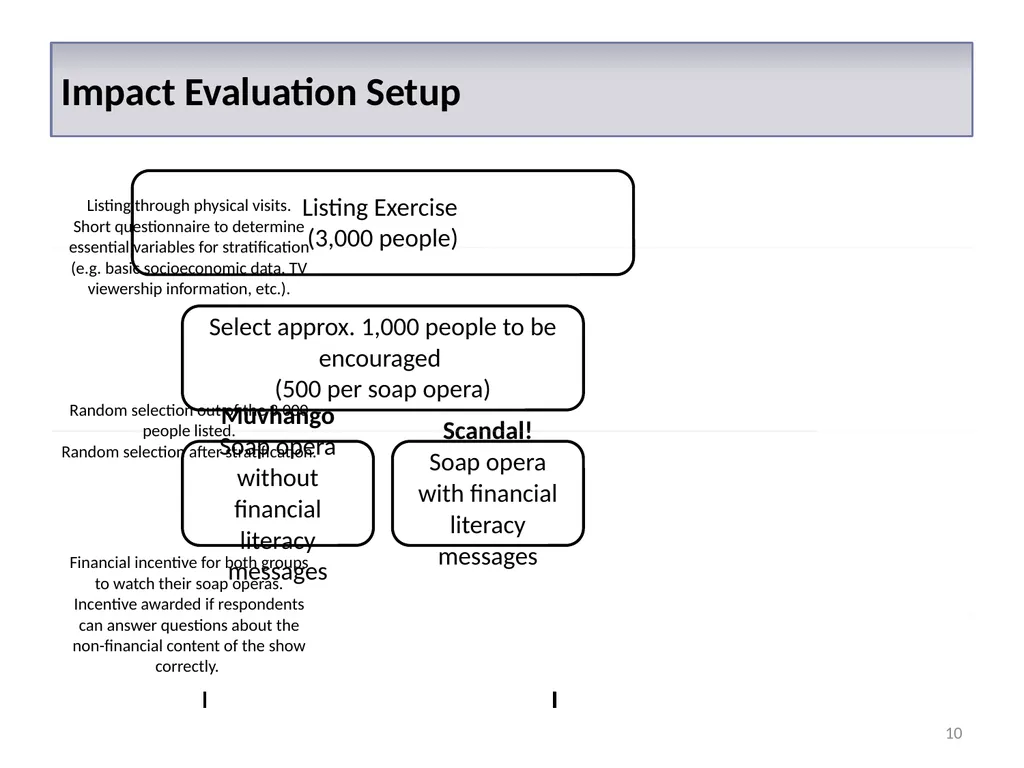
10 Impact Evaluation Setup<br>
11
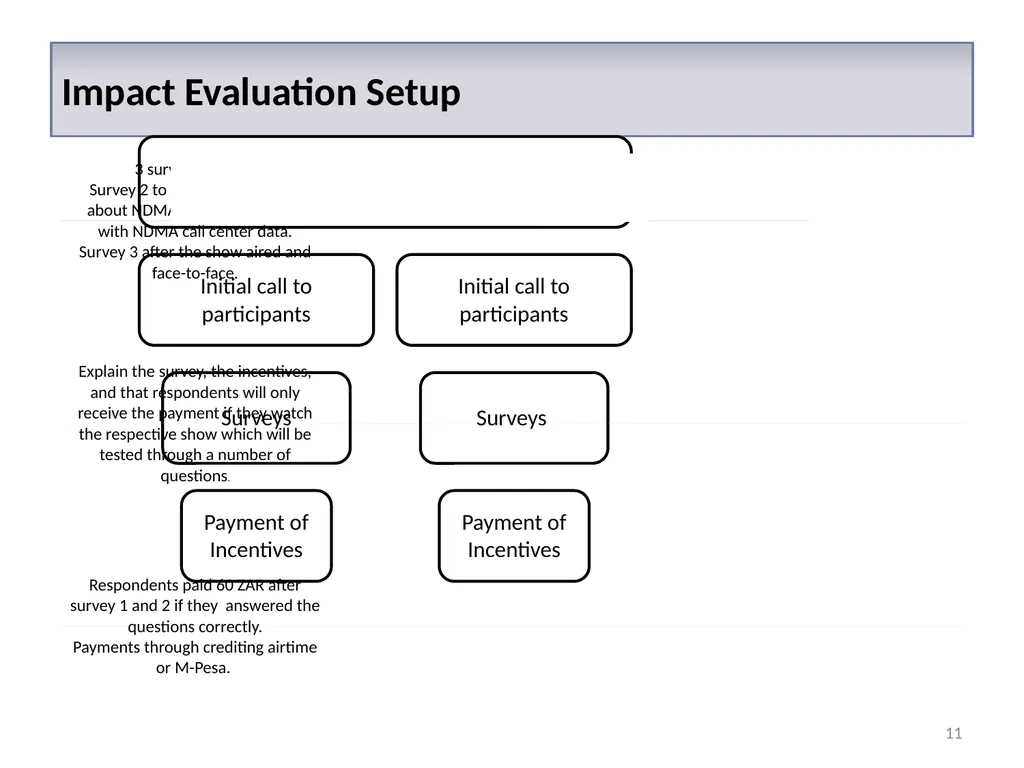
Impact Evaluation Setup 11<br>
12
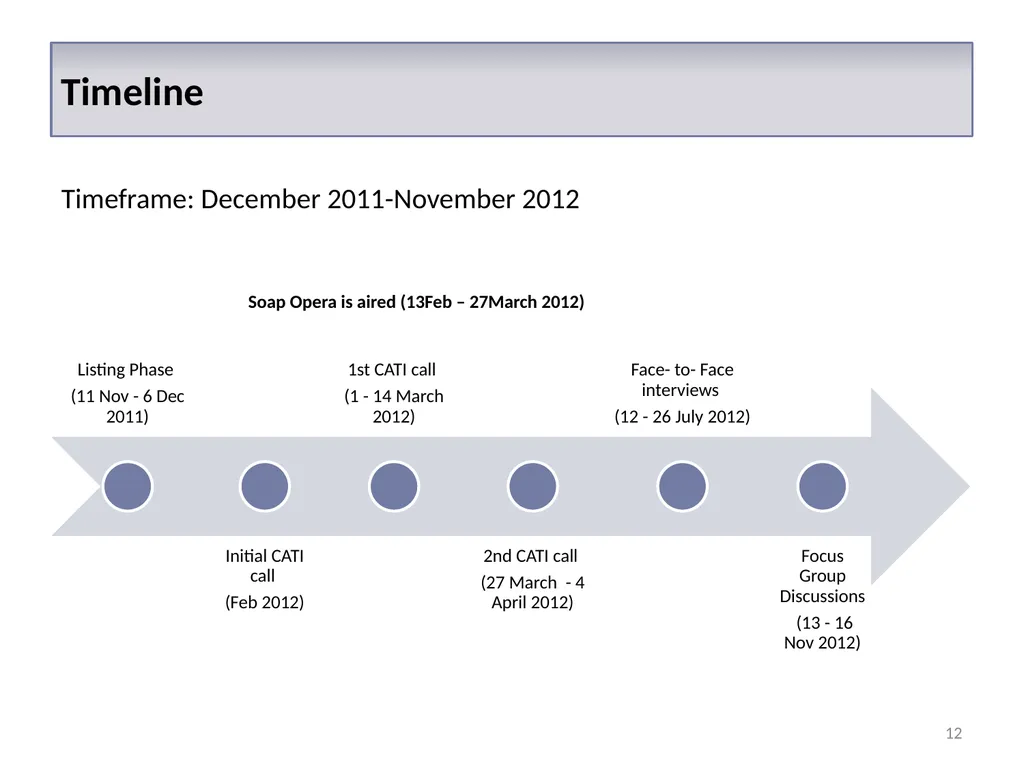
Timeline 12 Timeframe: December 2011-November 2012 Soap Opera is aired (13Feb – 27March 2012)<br>
13
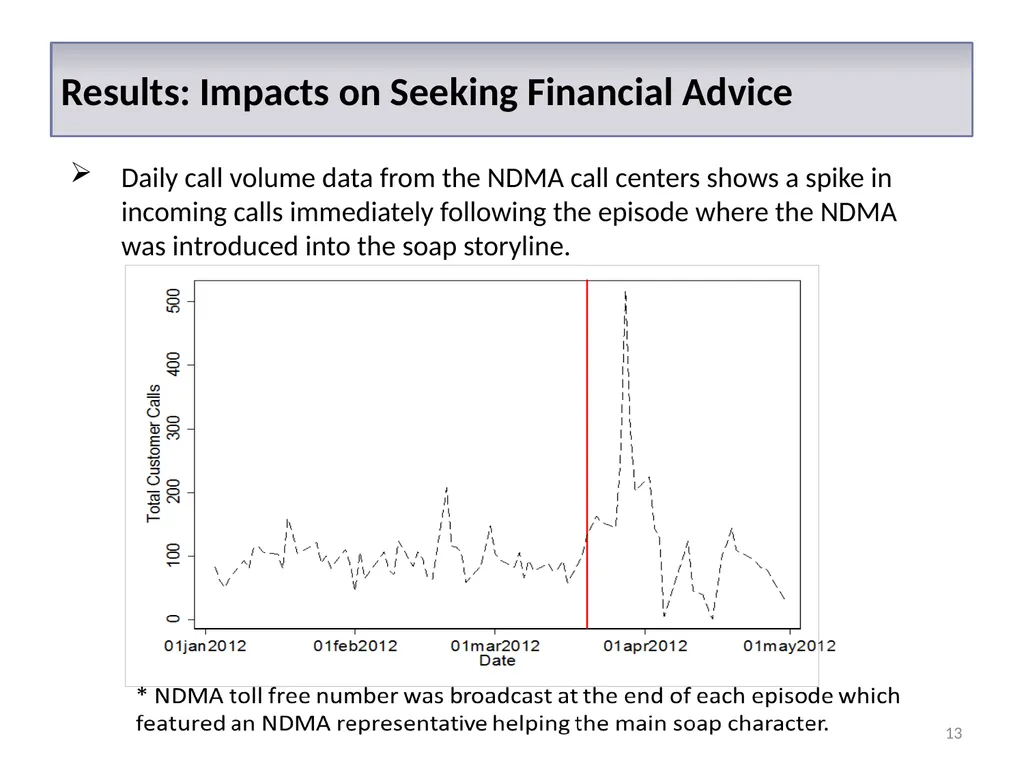
Daily call volume data from the NDMA call centers shows a spike in incoming calls immediately following the episode where the NDMA was introduced into the soap storyline. Results: Impacts on Seeking Financial Advice 13<br>
14
The results show significant improvements in content specific financial knowledge, affinity towards borrowing formally, moving away from hire purchase deals, and gambling less.
All these messages were conveyed in the soap opera storyline.
Focus group discussions confirm these findings and further highlight some key gender differences in the way men and women think about borrowing.
The effect of a televised public call to action towards seeking financial advice through the National Debt Management Association leads to significant upsurge in calls immediately after the messages are shown on TV, but dissipates over time.
This suggests the need for complementary interventions to ensure greater target group knowledge retention.
Overall the results show that entertainment media has the power to capture the attention of individuals and can provide policy makers with an effective and accessible vehicle to deliver carefully designed educational messages. Results Summary 14<br>
15
In focus groups, women generally came across as being reluctant to borrow, and only preferred to borrow as a last resort. This helps explain the muted impact on formal borrowing and borrowing only for unexpected emergencies.
One female response was, “If you do loans you will end up paying a lot of money back, they are very costly. It is better to budget and save for what you want.” Another female reacted to information from a colleague about her multiple loans, “Three accounts? That is damaging!”
Men were more willing to use borrowing, often to pay for consumption items and consumer electronics.
Despite thinking differently about reasons to borrow, both male and female respondents agreed that formal borrowing was key to successful financial management. Qualitative Results 15<br>