
Theme 2: Challenges to religious belief E:
Description: Theme 2: Challenges to religious belief E: Religious Belief as a product of the Human mind: Carl Jung Jung realised that Freuds work of the subconscious was too narrow. Jung saw religion as necessary for personal growth. Religion necessary
Related Topics
Download Presentation
"Theme 2: Challenges to religious belief E:" is the property of its rightful owner. Permission is granted to download and print the materials on this website for personal, non-commercial use only, and to display it on your personal computer provided you do not modify the materials and that you retain all copyright notices contained in the materials. By downloading content from our website, you accept the terms of this agreement.
Presentation Transcript
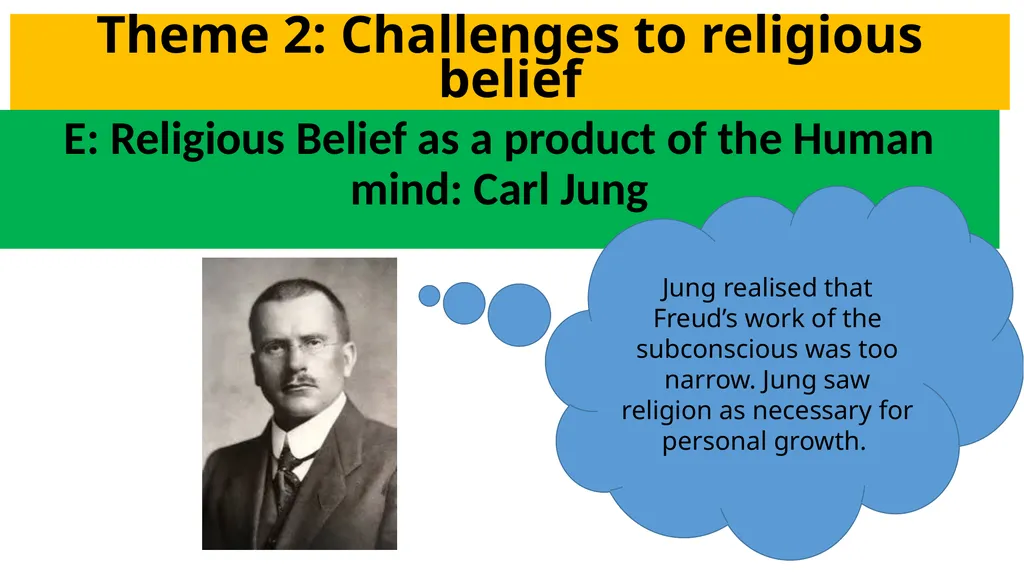
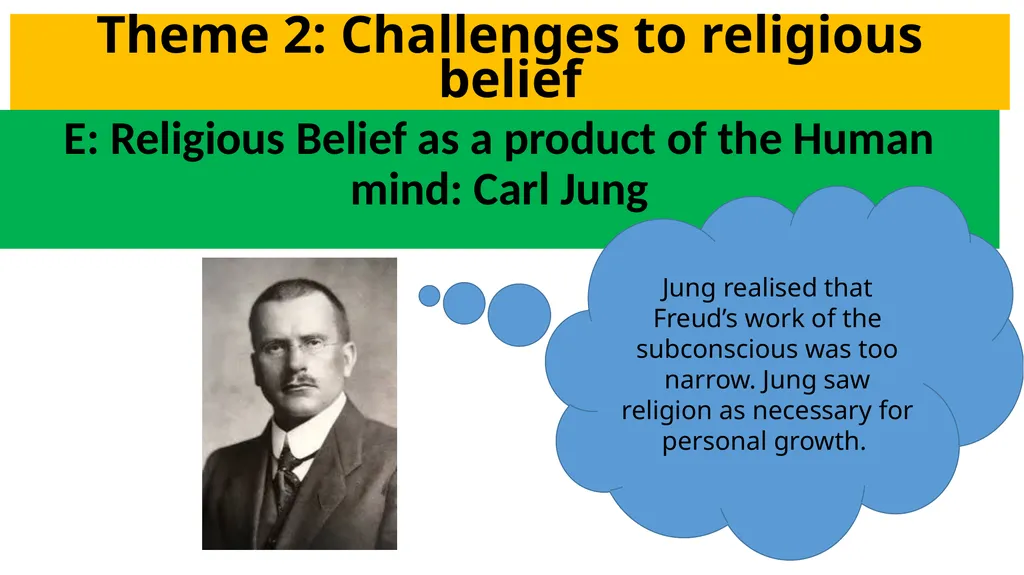
slide1. Theme 2: Challenges to religious belief E: Religious Belief as a product of the Human mind: Carl Jung Jung realised that Freud’s work of the subconscious was too narrow. Jung saw religion as necessary for personal growth.<br>
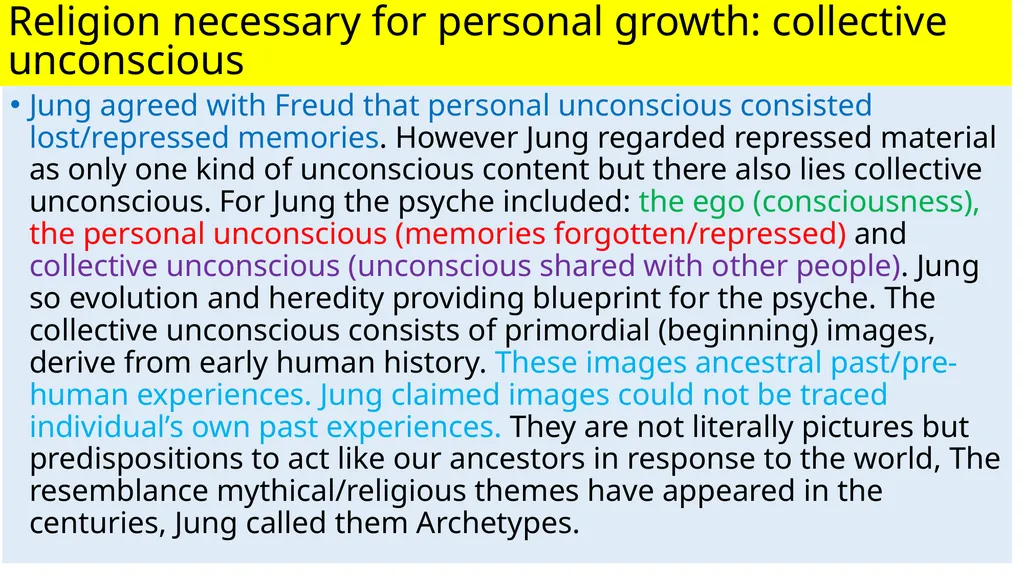
slide2. Religion necessary for personal growth: collective unconscious Jung agreed with Freud that personal unconscious consisted lost/repressed memories. However Jung regarded repressed material as only one kind of unconscious content but there also lies collective unconscious. For Jung the psyche included: the ego (consciousness), the personal unconscious (memories forgotten/repressed) and collective unconscious (unconscious shared with other people). Jung so evolution and heredity providing blueprint for the psyche. The collective unconscious consists of primordial (beginning) images, derive from early human history. These images ancestral past/pre-human experiences. Jung claimed images could not be traced individual’s own past experiences. They are not literally pictures but predispositions to act like our ancestors in response to the world, The resemblance mythical/religious themes have appeared in the centuries, Jung called them Archetypes.<br>
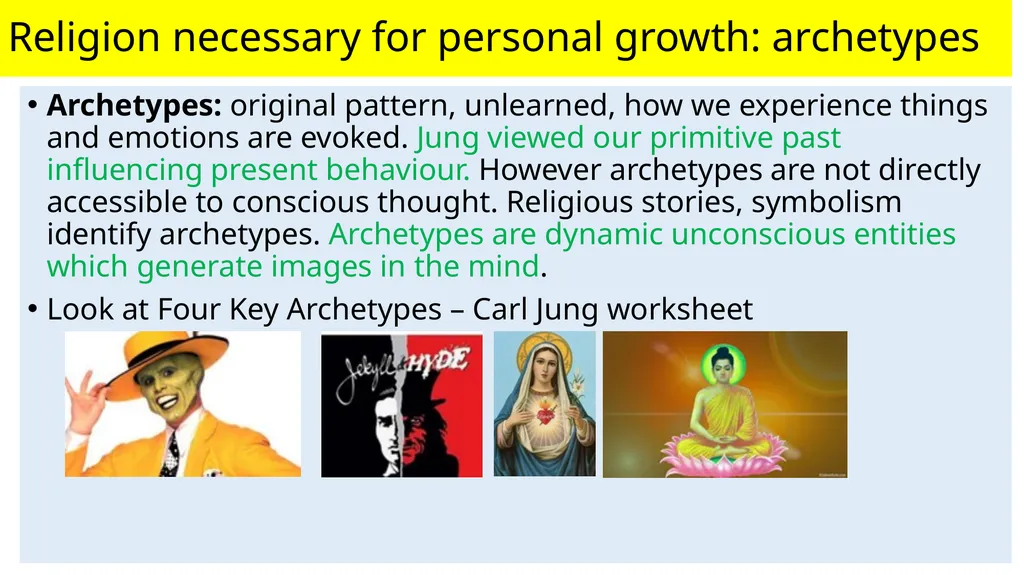
slide3. Religion necessary for personal growth: archetypes Archetypes: original pattern, unlearned, how we experience things and emotions are evoked. Jung viewed our primitive past influencing present behaviour. However archetypes are not directly accessible to conscious thought. Religious stories, symbolism identify archetypes. Archetypes are dynamic unconscious entities which generate images in the mind.
Look at Four Key Archetypes – Carl Jung worksheet<br>
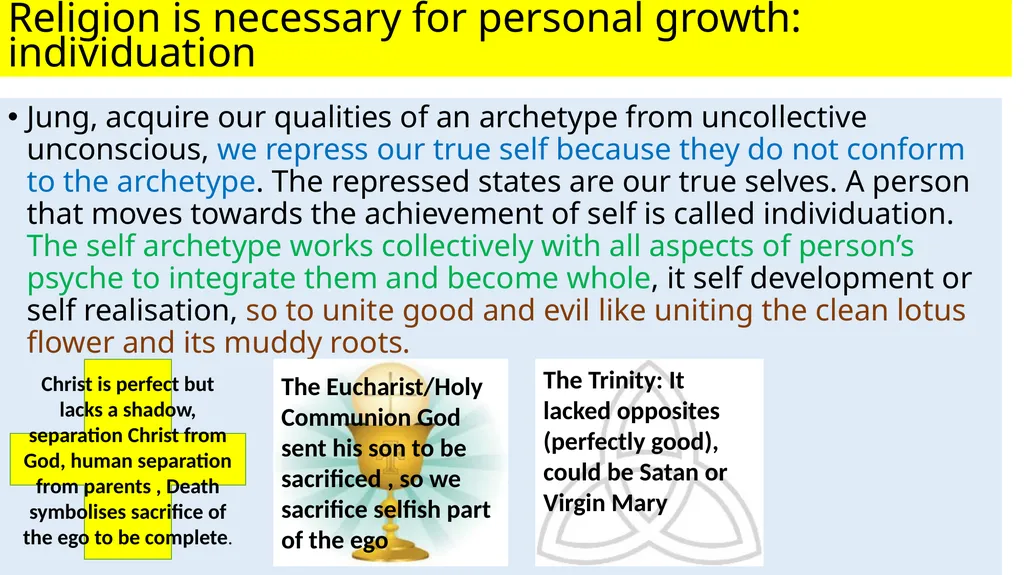
slide4. Religion is necessary for personal growth: individuation Jung, acquire our qualities of an archetype from uncollective unconscious, we repress our true self because they do not conform to the archetype. The repressed states are our true selves. A person that moves towards the achievement of self is called individuation. The self archetype works collectively with all aspects of person’s psyche to integrate them and become whole, it self development or self realisation, so to unite good and evil like uniting the clean lotus flower and its muddy roots. Christ is perfect but lacks a shadow, separation Christ from God, human separation from parents , Death symbolises sacrifice of the ego to be complete. The Eucharist/Holy Communion God sent his son to be sacrificed , so we sacrifice selfish part of the ego The Trinity: It lacked opposites (perfectly good), could be Satan or Virgin Mary<br>
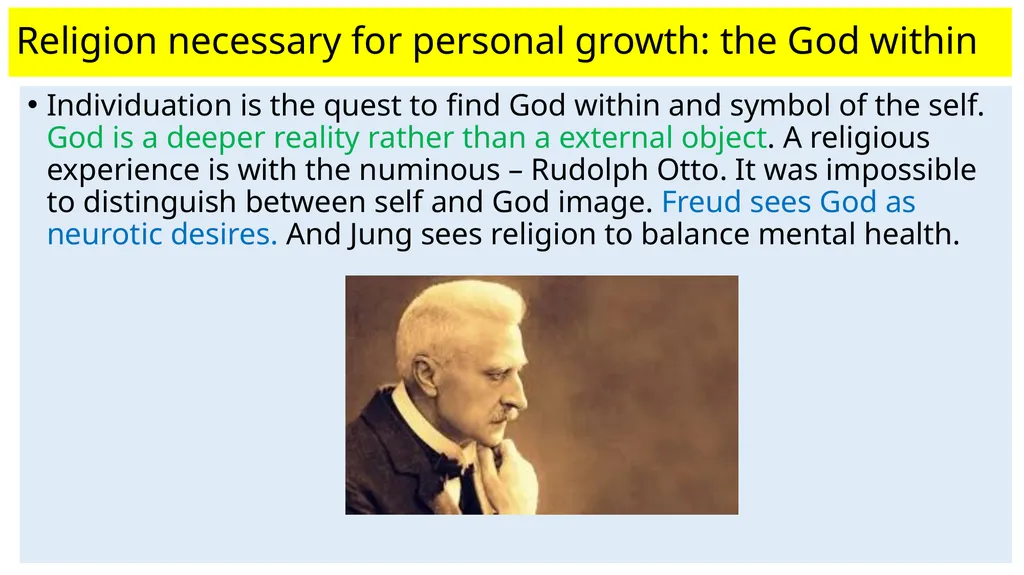
slide5. Religion necessary for personal growth: the God within Individuation is the quest to find God within and symbol of the self. God is a deeper reality rather than a external object. A religious experience is with the numinous – Rudolph Otto. It was impossible to distinguish between self and God image. Freud sees God as neurotic desires. And Jung sees religion to balance mental health.<br>
slide6. Supportive evidence including recognition of religion as a source of comfort Jung’s concepts were constructed personal experience , archetypes appear in all cultures, they provide features of traditional religions. Religion was a positive error that provided humankind with assurance and strength.
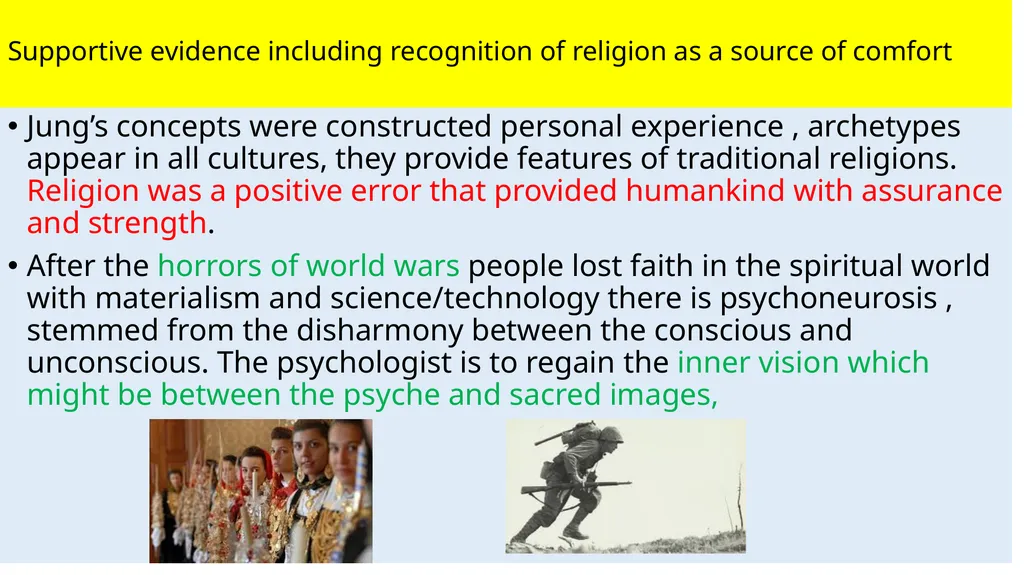
After the horrors of world wars people lost faith in the spiritual world with materialism and science/technology there is psychoneurosis , stemmed from the disharmony between the conscious and unconscious. The psychologist is to regain the inner vision which might be between the psyche and sacred images,<br>
slide7. Supportive evidence including recognition of religion as promotion of personal and social mind-sets arising from religious belief. Human beings religious beliefs was seen as aiding individuation and leading wholeness of the individual. The western mind he saw as extroverted and in search of outer reality. Asian was introverted in search of existence for example meditation, removal ignorance is vital , meditation seeks to uncover misconceptions about who we are. The self archetype harmonises the fuller picture of the idea of meditation leading to enlightenment.
In the west that was not comparable to the East, Symbols worked if there were dynamic, organised religion are just objects and therefore lost meaning to actualise God archetype, religion is a failure. Surveys on religion there is better mental health , social cohesion in a church which is a source of comfort.<br>
slide8. Challenges – lack of empirical evidence for Jungian concepts There is no methodology to measure
No empirical evidence that there is a collective unconscious which contains archetypes
Psychologist Gordon Allport images result to conformity of culture
Jung does not provide a criteria by which we can distinguish one archetypal image from another.
Jung assumes humans have a priori disposition to construct God images- but Jung avoided predictions.
Hall and Lindzey accuse Jung rely on clinical armchair rather than experiments and observations.<br>
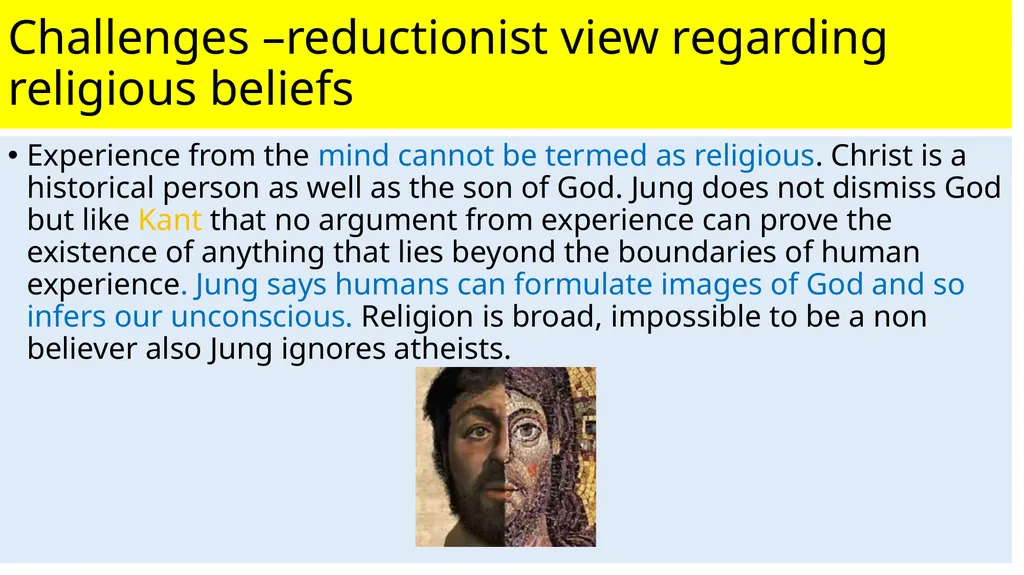
slide9. Challenges –reductionist view regarding religious beliefs Experience from the mind cannot be termed as religious. Christ is a historical person as well as the son of God. Jung does not dismiss God but like Kant that no argument from experience can prove the existence of anything that lies beyond the boundaries of human experience. Jung says humans can formulate images of God and so infers our unconscious. Religion is broad, impossible to be a non believer also Jung ignores atheists.<br>
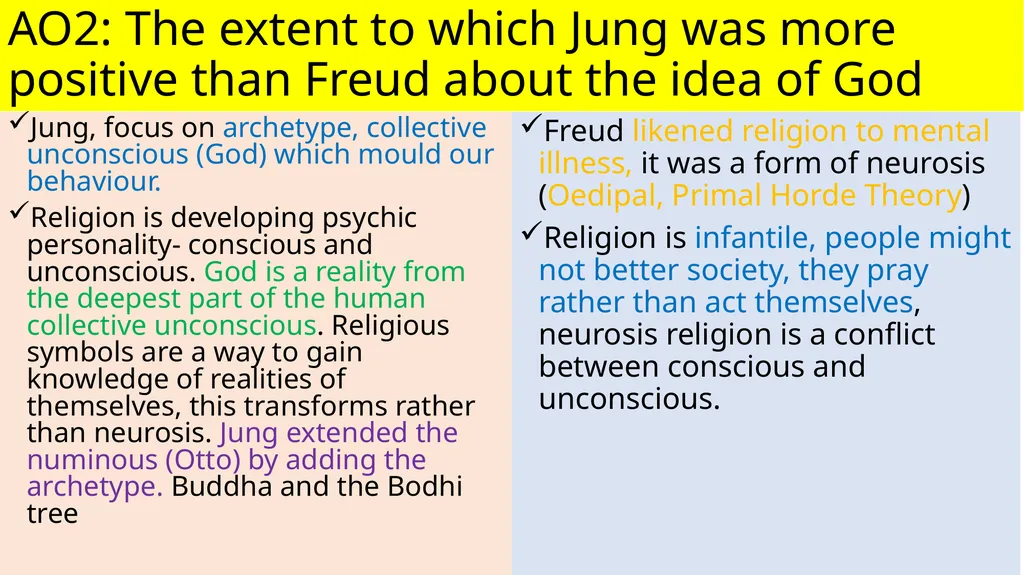
slide10. AO2: The extent to which Jung was more positive than Freud about the idea of God Jung, focus on archetype, collective unconscious (God) which mould our behaviour.
Religion is developing psychic personality- conscious and unconscious. God is a reality from the deepest part of the human collective unconscious. Religious symbols are a way to gain knowledge of realities of themselves, this transforms rather than neurosis. Jung extended the numinous (Otto) by adding the archetype. Buddha and the Bodhi tree Freud likened religion to mental illness, it was a form of neurosis (Oedipal, Primal Horde Theory)
Religion is infantile, people might not better society, they pray rather than act themselves, neurosis religion is a conflict between conscious and unconscious.<br>
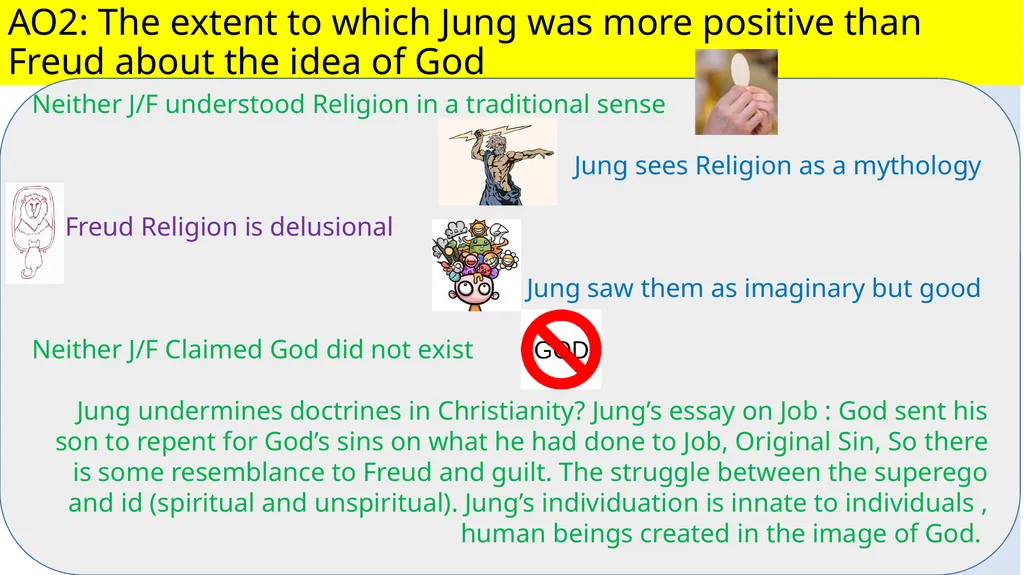
slide11. AO2: The extent to which Jung was more positive than Freud about the idea of God Neither J/F understood Religion in a traditional sense
Jung sees Religion as a mythology
Freud Religion is delusional
Jung saw them as imaginary but good
Neither J/F Claimed God did not exist
Jung undermines doctrines in Christianity? Jung’s essay on Job : God sent his son to repent for God’s sins on what he had done to Job, Original Sin, So there is some resemblance to Freud and guilt. The struggle between the superego and id (spiritual and unspiritual). Jung’s individuation is innate to individuals , human beings created in the image of God.<br>
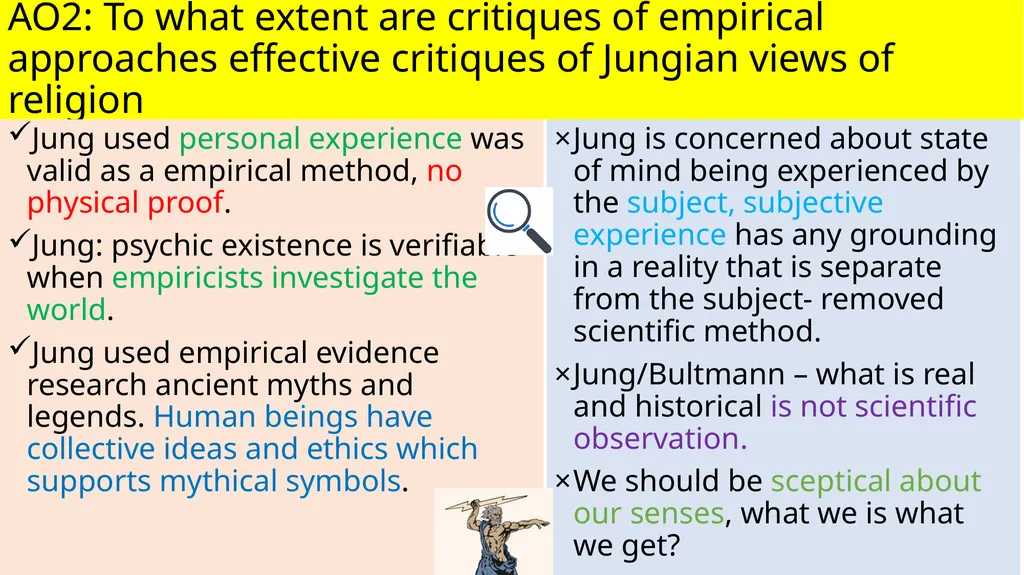
slide12. AO2: To what extent are critiques of empirical approaches effective critiques of Jungian views of religion Jung used personal experience was valid as a empirical method, no physical proof.
Jung: psychic existence is verifiable when empiricists investigate the world.
Jung used empirical evidence research ancient myths and legends. Human beings have collective ideas and ethics which supports mythical symbols. Jung is concerned about state of mind being experienced by the subject, subjective experience has any grounding in a reality that is separate from the subject- removed scientific method.
Jung/Bultmann – what is real and historical is not scientific observation.
We should be sceptical about our senses, what we is what we get?<br>
slide2. Religion necessary for personal growth: collective unconscious Jung agreed with Freud that personal unconscious consisted lost/repressed memories. However Jung regarded repressed material as only one kind of unconscious content but there also lies collective unconscious. For Jung the psyche included: the ego (consciousness), the personal unconscious (memories forgotten/repressed) and collective unconscious (unconscious shared with other people). Jung so evolution and heredity providing blueprint for the psyche. The collective unconscious consists of primordial (beginning) images, derive from early human history. These images ancestral past/pre-human experiences. Jung claimed images could not be traced individual’s own past experiences. They are not literally pictures but predispositions to act like our ancestors in response to the world, The resemblance mythical/religious themes have appeared in the centuries, Jung called them Archetypes.<br>
slide3. Religion necessary for personal growth: archetypes Archetypes: original pattern, unlearned, how we experience things and emotions are evoked. Jung viewed our primitive past influencing present behaviour. However archetypes are not directly accessible to conscious thought. Religious stories, symbolism identify archetypes. Archetypes are dynamic unconscious entities which generate images in the mind.
Look at Four Key Archetypes – Carl Jung worksheet<br>
slide4. Religion is necessary for personal growth: individuation Jung, acquire our qualities of an archetype from uncollective unconscious, we repress our true self because they do not conform to the archetype. The repressed states are our true selves. A person that moves towards the achievement of self is called individuation. The self archetype works collectively with all aspects of person’s psyche to integrate them and become whole, it self development or self realisation, so to unite good and evil like uniting the clean lotus flower and its muddy roots. Christ is perfect but lacks a shadow, separation Christ from God, human separation from parents , Death symbolises sacrifice of the ego to be complete. The Eucharist/Holy Communion God sent his son to be sacrificed , so we sacrifice selfish part of the ego The Trinity: It lacked opposites (perfectly good), could be Satan or Virgin Mary<br>
slide5. Religion necessary for personal growth: the God within Individuation is the quest to find God within and symbol of the self. God is a deeper reality rather than a external object. A religious experience is with the numinous – Rudolph Otto. It was impossible to distinguish between self and God image. Freud sees God as neurotic desires. And Jung sees religion to balance mental health.<br>
slide6. Supportive evidence including recognition of religion as a source of comfort Jung’s concepts were constructed personal experience , archetypes appear in all cultures, they provide features of traditional religions. Religion was a positive error that provided humankind with assurance and strength.
After the horrors of world wars people lost faith in the spiritual world with materialism and science/technology there is psychoneurosis , stemmed from the disharmony between the conscious and unconscious. The psychologist is to regain the inner vision which might be between the psyche and sacred images,<br>
slide7. Supportive evidence including recognition of religion as promotion of personal and social mind-sets arising from religious belief. Human beings religious beliefs was seen as aiding individuation and leading wholeness of the individual. The western mind he saw as extroverted and in search of outer reality. Asian was introverted in search of existence for example meditation, removal ignorance is vital , meditation seeks to uncover misconceptions about who we are. The self archetype harmonises the fuller picture of the idea of meditation leading to enlightenment.
In the west that was not comparable to the East, Symbols worked if there were dynamic, organised religion are just objects and therefore lost meaning to actualise God archetype, religion is a failure. Surveys on religion there is better mental health , social cohesion in a church which is a source of comfort.<br>
slide8. Challenges – lack of empirical evidence for Jungian concepts There is no methodology to measure
No empirical evidence that there is a collective unconscious which contains archetypes
Psychologist Gordon Allport images result to conformity of culture
Jung does not provide a criteria by which we can distinguish one archetypal image from another.
Jung assumes humans have a priori disposition to construct God images- but Jung avoided predictions.
Hall and Lindzey accuse Jung rely on clinical armchair rather than experiments and observations.<br>
slide9. Challenges –reductionist view regarding religious beliefs Experience from the mind cannot be termed as religious. Christ is a historical person as well as the son of God. Jung does not dismiss God but like Kant that no argument from experience can prove the existence of anything that lies beyond the boundaries of human experience. Jung says humans can formulate images of God and so infers our unconscious. Religion is broad, impossible to be a non believer also Jung ignores atheists.<br>
slide10. AO2: The extent to which Jung was more positive than Freud about the idea of God Jung, focus on archetype, collective unconscious (God) which mould our behaviour.
Religion is developing psychic personality- conscious and unconscious. God is a reality from the deepest part of the human collective unconscious. Religious symbols are a way to gain knowledge of realities of themselves, this transforms rather than neurosis. Jung extended the numinous (Otto) by adding the archetype. Buddha and the Bodhi tree Freud likened religion to mental illness, it was a form of neurosis (Oedipal, Primal Horde Theory)
Religion is infantile, people might not better society, they pray rather than act themselves, neurosis religion is a conflict between conscious and unconscious.<br>
slide11. AO2: The extent to which Jung was more positive than Freud about the idea of God Neither J/F understood Religion in a traditional sense
Jung sees Religion as a mythology
Freud Religion is delusional
Jung saw them as imaginary but good
Neither J/F Claimed God did not exist
Jung undermines doctrines in Christianity? Jung’s essay on Job : God sent his son to repent for God’s sins on what he had done to Job, Original Sin, So there is some resemblance to Freud and guilt. The struggle between the superego and id (spiritual and unspiritual). Jung’s individuation is innate to individuals , human beings created in the image of God.<br>
slide12. AO2: To what extent are critiques of empirical approaches effective critiques of Jungian views of religion Jung used personal experience was valid as a empirical method, no physical proof.
Jung: psychic existence is verifiable when empiricists investigate the world.
Jung used empirical evidence research ancient myths and legends. Human beings have collective ideas and ethics which supports mythical symbols. Jung is concerned about state of mind being experienced by the subject, subjective experience has any grounding in a reality that is separate from the subject- removed scientific method.
Jung/Bultmann – what is real and historical is not scientific observation.
We should be sceptical about our senses, what we is what we get?<br>