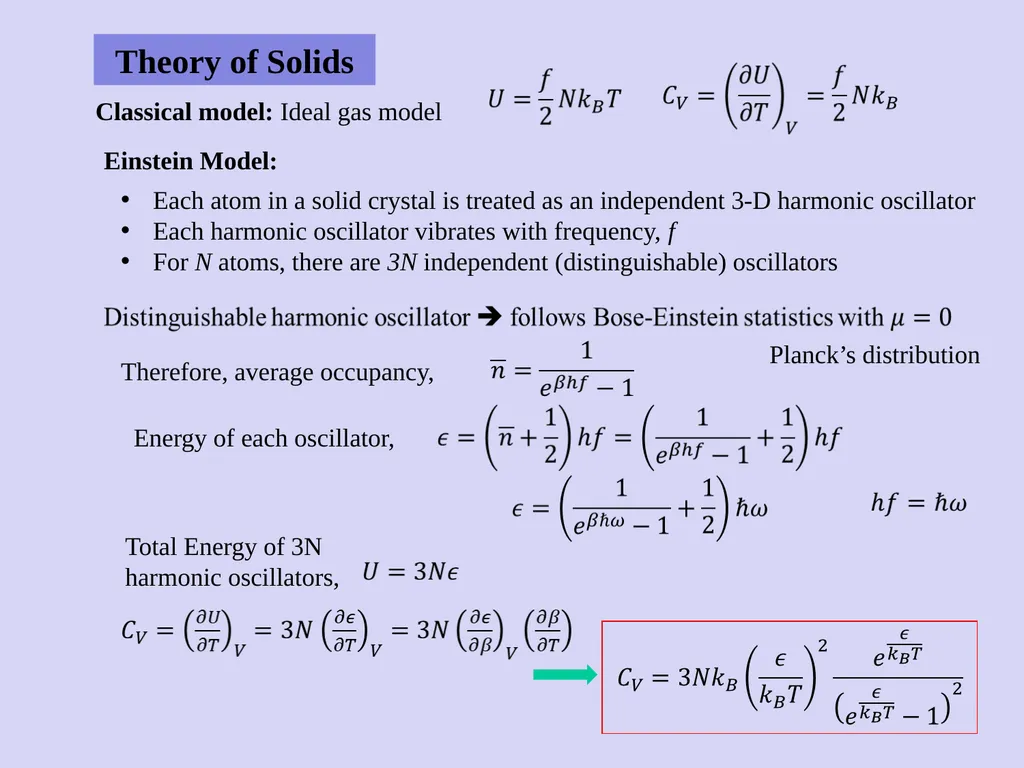
Theory of Solids Classical model: Ideal gas model Einstein Model: Each atom in a solid crystal is treated as an independent 3-D harmonic oscillator Each harmonic oscillator vibrates with frequency, f For N atoms, there are 3N independent
"Theory of Solids Classical model: Ideal gas model" is the property of its rightful owner. Permission is granted to
download and print the materials on this website for personal, non-commercial use only, and to display it
on your personal computer provided you do not modify the materials and that you retain all copyright
notices contained in the materials. By downloading content from our website, you accept the terms of this
agreement.
Presentation Transcript
01
Theory of Solids Classical model: Ideal gas model Einstein Model: Each atom in a solid crystal is treated as an independent 3-D harmonic oscillator
Each harmonic oscillator vibrates with frequency, f
For N atoms, there are 3N independent (distinguishable) oscillators Therefore, average occupancy, Energy of each oscillator, Total Energy of 3N harmonic oscillators, Planck’s distribution<br>
02
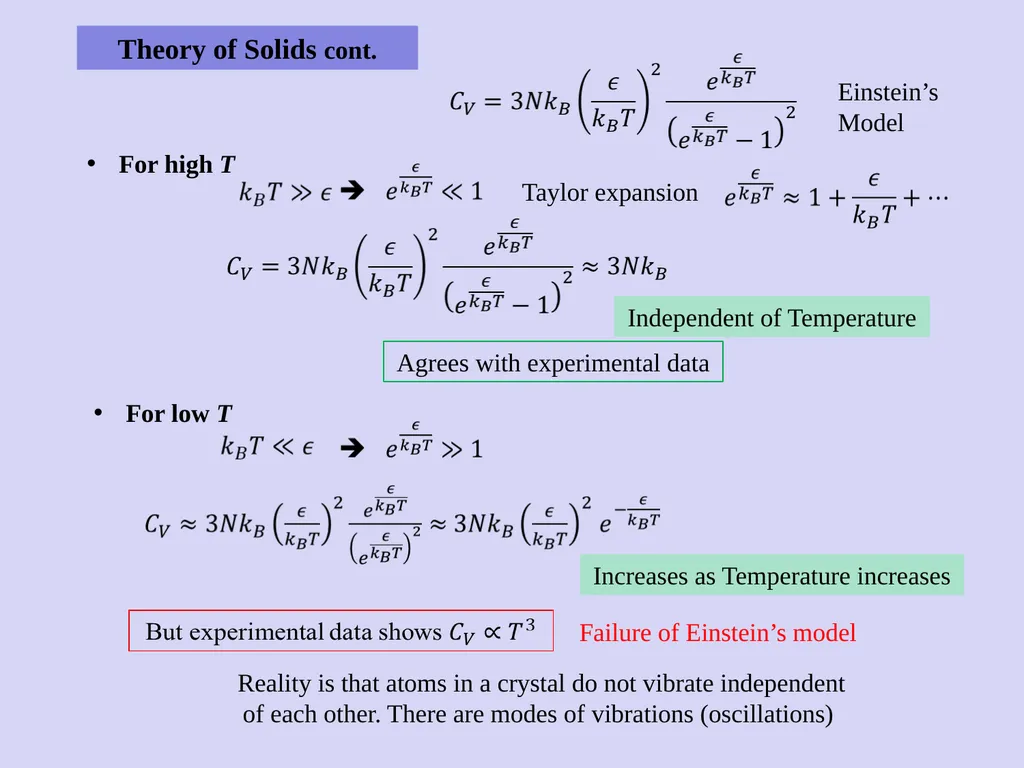
Theory of Solids cont. Einstein’s Model For high T Taylor expansion For low T Independent of Temperature Increases as Temperature increases Agrees with experimental data Failure of Einstein’s model Reality is that atoms in a crystal do not vibrate independent of each other. There are modes of vibrations (oscillations)<br>
03
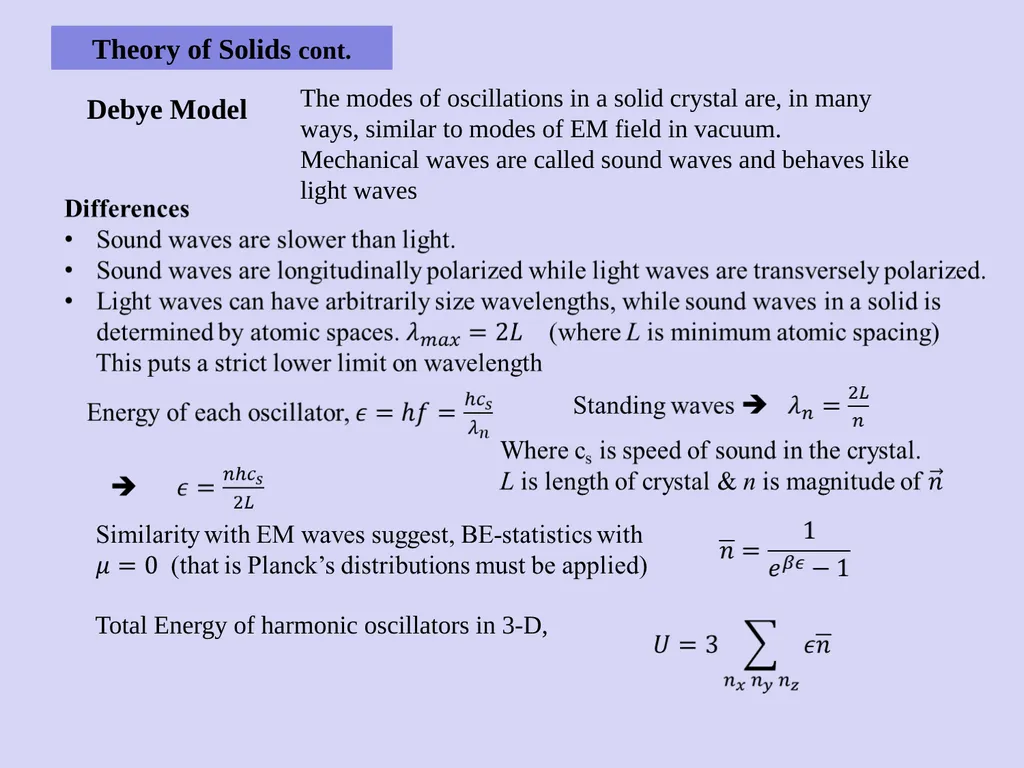
Theory of Solids cont. Debye Model The modes of oscillations in a solid crystal are, in many ways, similar to modes of EM field in vacuum.
Mechanical waves are called sound waves and behaves like light waves Total Energy of harmonic oscillators in 3-D,<br>
04
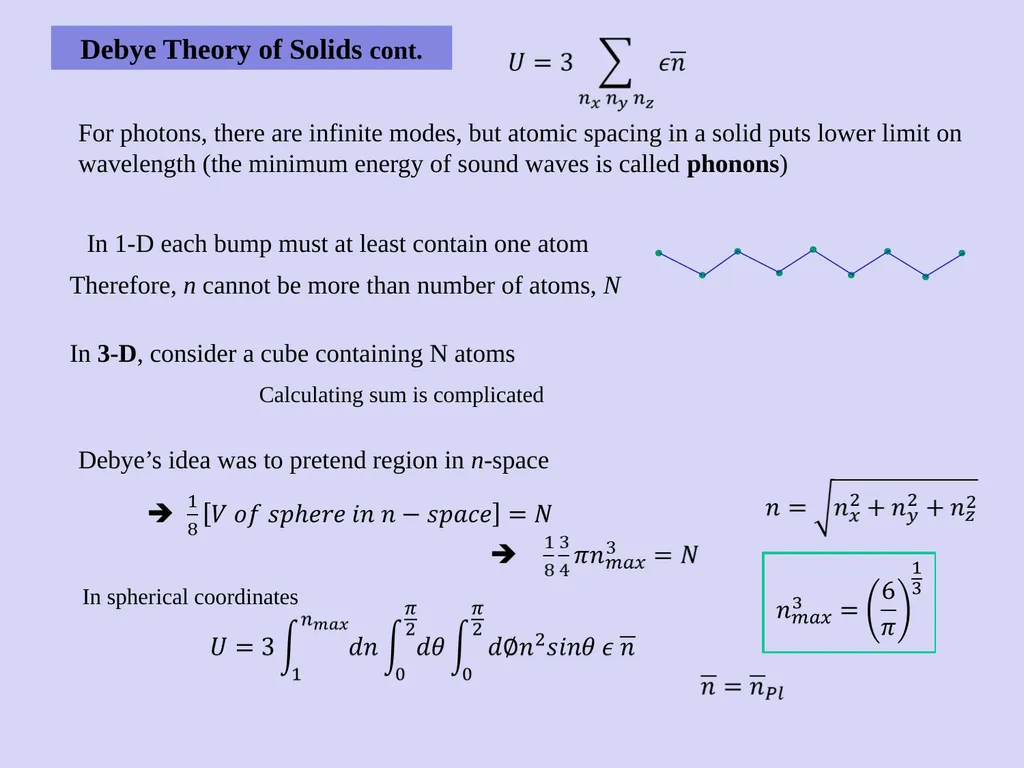
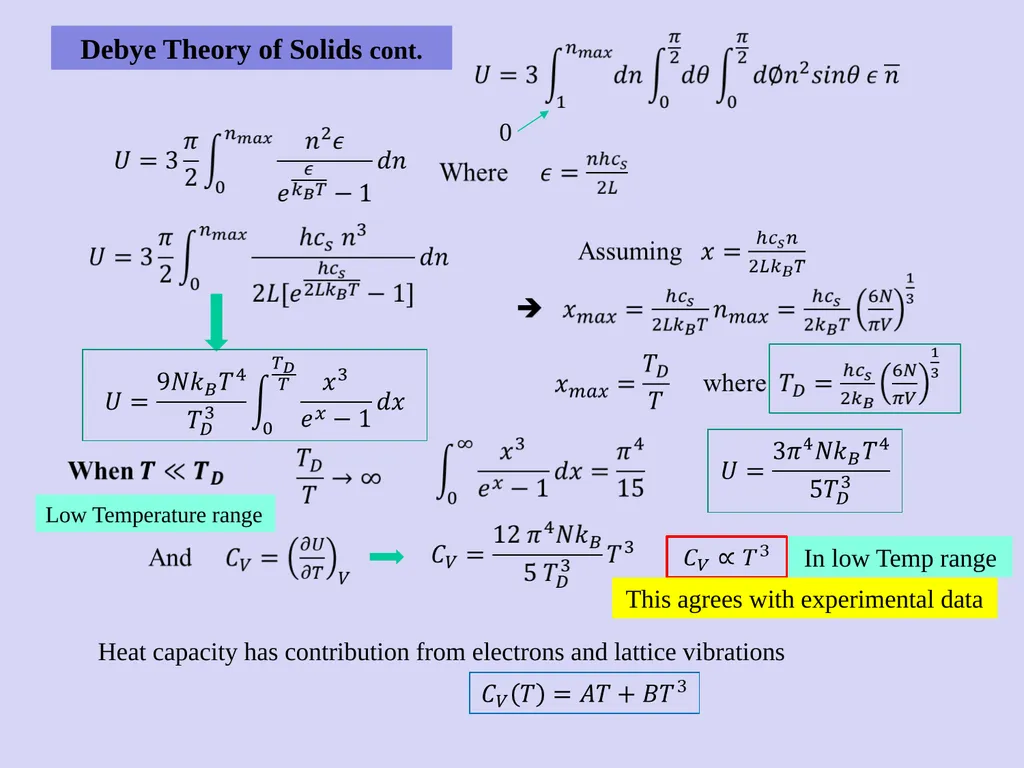
Debye Theory of Solids cont. For photons, there are infinite modes, but atomic spacing in a solid puts lower limit on wavelength (the minimum energy of sound waves is called phonons) In 1-D each bump must at least contain one atom Therefore, n cannot be more than number of atoms, N In 3-D, consider a cube containing N atoms Debye’s idea was to pretend region in n-space Calculating sum is complicated In spherical coordinates<br>
05
Debye Theory of Solids cont. 0 In low Temp range This agrees with experimental data Heat capacity has contribution from electrons and lattice vibrations Low Temperature range<br>
06
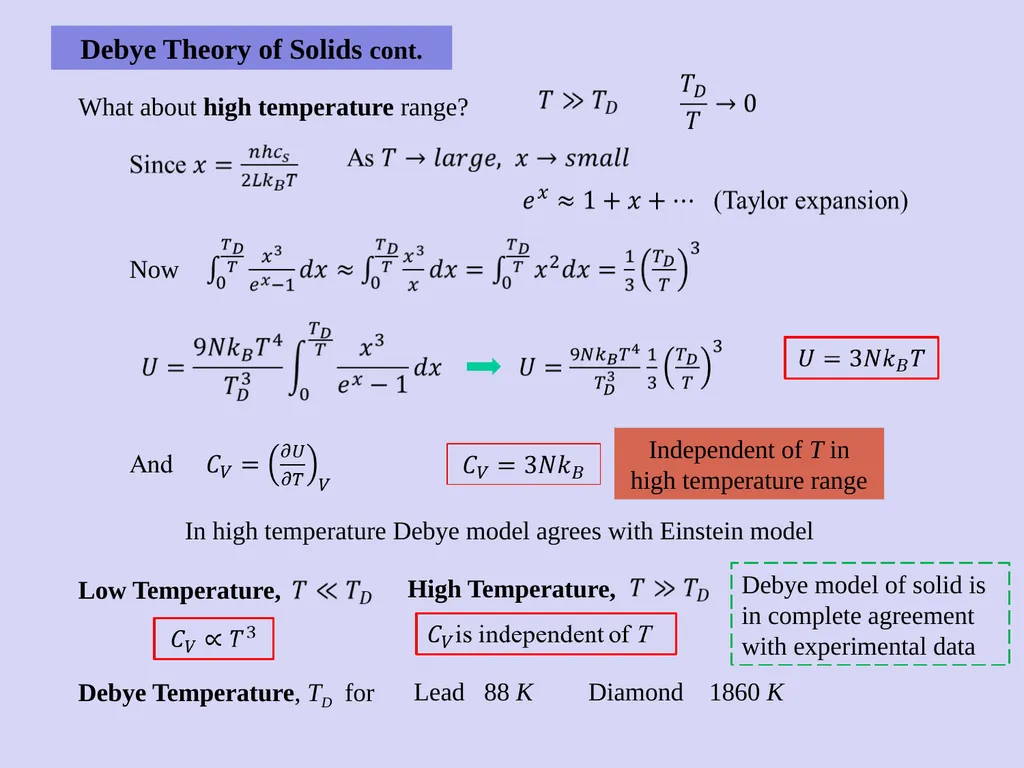
What about high temperature range? Debye Theory of Solids cont. Now Independent of T in high temperature range In high temperature Debye model agrees with Einstein model Low Temperature, High Temperature, Debye Temperature, TD for Lead 88 K Diamond 1860 K Debye model of solid is in complete agreement with experimental data<br>
07
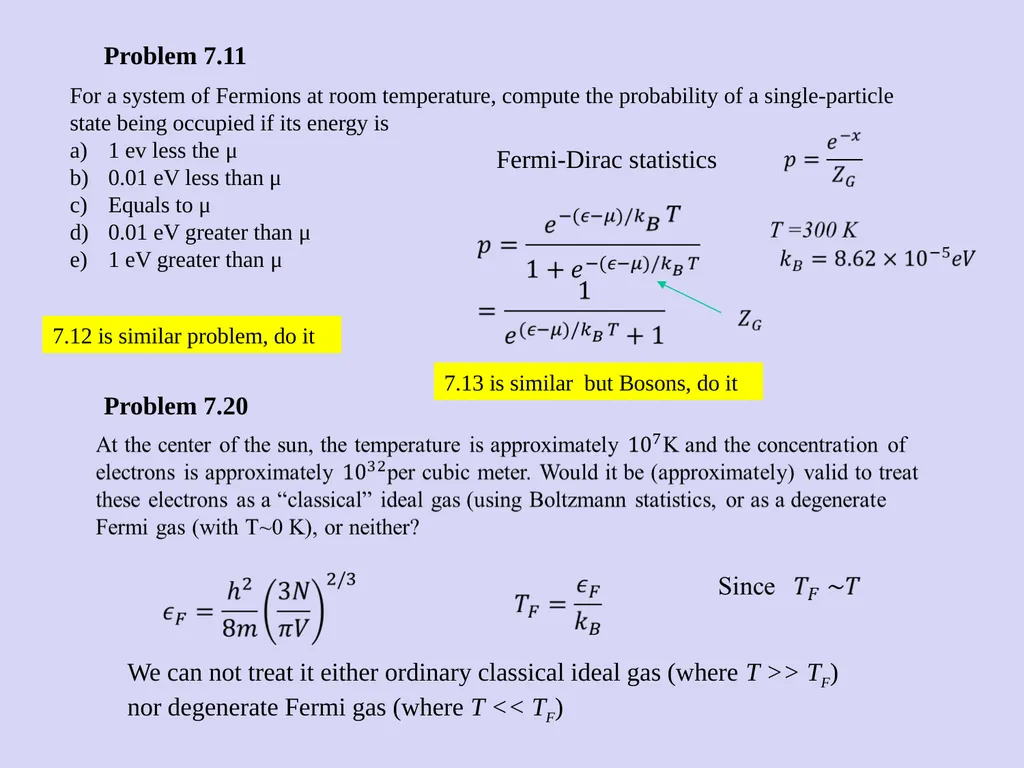
Problem 7.11 For a system of Fermions at room temperature, compute the probability of a single-particle state being occupied if its energy is
1 ev less the μ
0.01 eV less than μ
Equals to μ
0.01 eV greater than μ
1 eV greater than μ Fermi-Dirac statistics Problem 7.20 We can not treat it either ordinary classical ideal gas (where T >> TF) nor degenerate Fermi gas (where T << TF) 7.12 is similar problem, do it 7.13 is similar but Bosons, do it<br>
08
Problem 7.58 Problem 7.25 Problem 7.26<br>
09
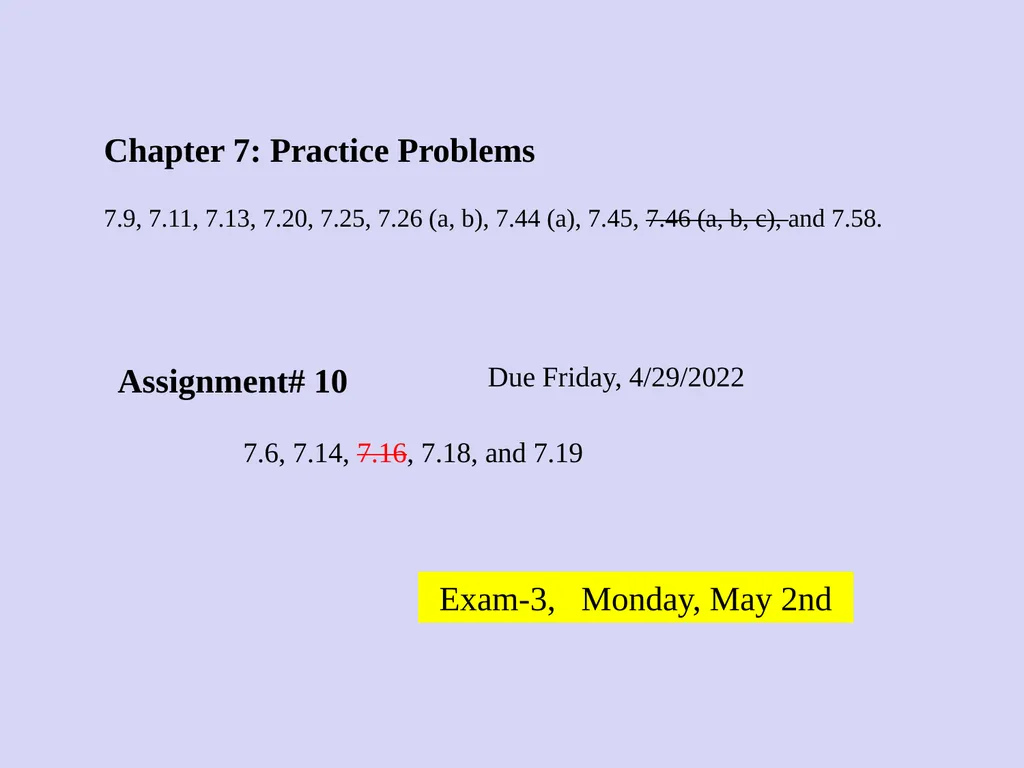
Chapter 7: Practice Problems
7.9, 7.11, 7.13, 7.20, 7.25, 7.26 (a, b), 7.44 (a), 7.45, 7.46 (a, b, c), and 7.58. Assignment# 10
7.6, 7.14, 7.16, 7.18, and 7.19 Due Friday, 4/29/2022 Exam-3, Monday, May 2nd<br>