
Theory, Skills and Methods Dr Claudia Stein What
T
Published · 30 slides · 0 views

1 / 1



Description
Theory, Skills and Methods Dr Claudia Stein What is Academic History Writing? What is History? (1961): inquiry into the methods and theories of history. One of the major claims is that the socio-cultural, political, economic context in
Related Topics
Share
Embed code
Download this presentation From Below
"Theory, Skills and Methods Dr Claudia Stein What" is the property of its rightful owner. Permission is granted to download and print the materials on this website for personal, non-commercial use only, and to display it on your personal computer provided you do not modify the materials and that you retain all copyright notices contained in the materials. By downloading content from our website, you accept the terms of this agreement.
Presentation Transcript
01
Theory, Skills and Methods Dr Claudia Stein<br>
02
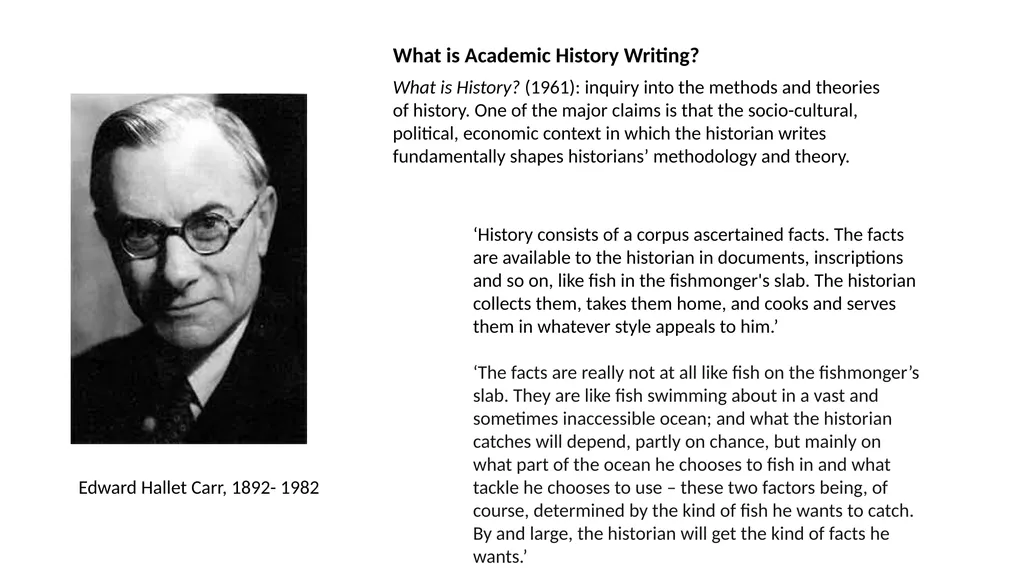
What is Academic History Writing? What is History? (1961): inquiry into the methods and theories of history. One of the major claims is that the socio-cultural, political, economic context in which the historian writes fundamentally shapes historians’ methodology and theory. ‘History consists of a corpus ascertained facts. The facts are available to the historian in documents, inscriptions and so on, like fish in the fishmonger's slab. The historian collects them, takes them home, and cooks and serves them in whatever style appeals to him.’
‘The facts are really not at all like fish on the fishmonger’s slab. They are like fish swimming about in a vast and sometimes inaccessible ocean; and what the historian catches will depend, partly on chance, but mainly on what part of the ocean he chooses to fish in and what tackle he chooses to use – these two factors being, of course, determined by the kind of fish he wants to catch. By and large, the historian will get the kind of facts he wants.’ Edward Hallet Carr, 1892- 1982<br>
‘The facts are really not at all like fish on the fishmonger’s slab. They are like fish swimming about in a vast and sometimes inaccessible ocean; and what the historian catches will depend, partly on chance, but mainly on what part of the ocean he chooses to fish in and what tackle he chooses to use – these two factors being, of course, determined by the kind of fish he wants to catch. By and large, the historian will get the kind of facts he wants.’ Edward Hallet Carr, 1892- 1982<br>
03
‘The historian without his facts is rootless and futile; the facts without their historian are dead and meaningless. ‘It used to be said that facts speak for themselves. This is, of course, untrue. The facts speak only when the historian calls on them: it is he who decides to which facts to give the floor, and in what order or context.’<br>
04
‘What is history? ... it is a continuous process of interaction between the historian and his facts, an unending dialogue between the present and the past.’ ‘Study the historian before you begin to study the facts.’ So, what is History according to Carr?<br>
05
What is Method and What is Theory in History Writing? ‘The historical method is the set of structured rules and techniques for analysing and interpreting the past, while a theory is the broader conceptual framework that explains phenomena or provides a way of understanding a situation. Methods are the practical tools for research, whereas theory is the underlying knowledge and perspective that guides the application of those methods.’
What does that mean?
For clarity’s sake, let’s separate method and theory from each other…..
.<br>
What does that mean?
For clarity’s sake, let’s separate method and theory from each other…..
.<br>
06
Historical Method
Defined in the 19th century by the German historian Leopold von Ranke
Empirical gathering of primary material (archival documents, visual material objects, oral testimony. digital sources, scientific data)
Source criticism: is the source genuine (e.g. digital sources)? Who is the author/the maker/the speaker? Is it an eyewitness report or a report on an event by someone else? Is it anonymous? Were did the source originate? In what context did the source emerge at the time of its production? How did it get to the place where it is kept (e.g. colonial archives?); what are the biases within the source itself – from the perspective of time; what is left out?)
Analysis: analysis of the internal logic of source within the knowledge of the time it was produced; the intention of author/maker at the time? What is said in the source and what is perhaps absence from the source? Language and concepts used (meaning of terms/concepts change)? Modes of production?
Relation of source to other sources that talk about the same event?
But what is the ‘meaning’ of all this empirical information and critical source analysis?<br>
Defined in the 19th century by the German historian Leopold von Ranke
Empirical gathering of primary material (archival documents, visual material objects, oral testimony. digital sources, scientific data)
Source criticism: is the source genuine (e.g. digital sources)? Who is the author/the maker/the speaker? Is it an eyewitness report or a report on an event by someone else? Is it anonymous? Were did the source originate? In what context did the source emerge at the time of its production? How did it get to the place where it is kept (e.g. colonial archives?); what are the biases within the source itself – from the perspective of time; what is left out?)
Analysis: analysis of the internal logic of source within the knowledge of the time it was produced; the intention of author/maker at the time? What is said in the source and what is perhaps absence from the source? Language and concepts used (meaning of terms/concepts change)? Modes of production?
Relation of source to other sources that talk about the same event?
But what is the ‘meaning’ of all this empirical information and critical source analysis?<br>
07
Theory:
In history writing, the majority of ‘theories’ – or ‘frameworks’ to interpret the empirical material -- do not originate in academic history writing itself but in neighbouring disciplines such as social and political theory, philosophy, anthropology, but also increasingly from the natural sciences, life sciences (e.g. evolutionary cognitive brain sciences, evolutionary psychology, epigenetics, geography, environmental sciences et).
Such theories usually deal with the present (e.g. sociology) and today’s societies and cultures (e.g. cultural anthropology).
Historians use such theories to establish ‘meaning’ of their sources to their readership. Theories allow them to synthesis their material and offer a hypothesis (thesis) that guides the logic and organisation of their narrative.
Use theories to offer insights into two main areas of interest:
Human individual and/or collective agency and human experience at a particular moment in time (synchronic)
Theoretical explanations of historical change over time (diachronic)
Synchronic and diachronic theoretical explanations can be pursued independently from each other. Some historians focus on synchronic explanations (e.g. microhistory); some were only interested ‘in long duree’ change (e.g. Annales school).<br>
In history writing, the majority of ‘theories’ – or ‘frameworks’ to interpret the empirical material -- do not originate in academic history writing itself but in neighbouring disciplines such as social and political theory, philosophy, anthropology, but also increasingly from the natural sciences, life sciences (e.g. evolutionary cognitive brain sciences, evolutionary psychology, epigenetics, geography, environmental sciences et).
Such theories usually deal with the present (e.g. sociology) and today’s societies and cultures (e.g. cultural anthropology).
Historians use such theories to establish ‘meaning’ of their sources to their readership. Theories allow them to synthesis their material and offer a hypothesis (thesis) that guides the logic and organisation of their narrative.
Use theories to offer insights into two main areas of interest:
Human individual and/or collective agency and human experience at a particular moment in time (synchronic)
Theoretical explanations of historical change over time (diachronic)
Synchronic and diachronic theoretical explanations can be pursued independently from each other. Some historians focus on synchronic explanations (e.g. microhistory); some were only interested ‘in long duree’ change (e.g. Annales school).<br>
08
Claim: While the empiricist historical method remains more or less consistent since its was first ‘invented’ in the 19th century (the sources change of course, e.g. digital sources), all theories are time and place specific. But they also ‘travel’ and are then adopted to different social-cultural contexts (e.g. poststructural theories from France of the 1960s where only to US 1980s/90s)
Most theories are ‘invented’ to explain the present moment of the Intellectual (or offer alternative or utopian explanations of the present). New theories usually emerge when society/culture is transforming (1960s/70; 1980s/90). Powerful theories are always intellectual reactions to such wider transformations; they make sense of them. They often produce strong reactions at the time and often furious debates arise (mirroring the many debates in the society/culture in transformation).
But as times goes on, such theories may lose their significance for later generations of historians and their readers because the wider moment of society/cultural transformation that brought them about has itself become ‘history’ (e.g. Marxist materialism of 19th century, psycho-history or or 2nd wave feminism of the 1960s, or poststructuralism of 1980s/90s). They lose their ‘edge’ and become ‘mainstream’ theories in the discipline. Later generations of historian may no longer understand why they were exciting in the first place!<br>
Most theories are ‘invented’ to explain the present moment of the Intellectual (or offer alternative or utopian explanations of the present). New theories usually emerge when society/culture is transforming (1960s/70; 1980s/90). Powerful theories are always intellectual reactions to such wider transformations; they make sense of them. They often produce strong reactions at the time and often furious debates arise (mirroring the many debates in the society/culture in transformation).
But as times goes on, such theories may lose their significance for later generations of historians and their readers because the wider moment of society/cultural transformation that brought them about has itself become ‘history’ (e.g. Marxist materialism of 19th century, psycho-history or or 2nd wave feminism of the 1960s, or poststructuralism of 1980s/90s). They lose their ‘edge’ and become ‘mainstream’ theories in the discipline. Later generations of historian may no longer understand why they were exciting in the first place!<br>
09
Theories do not necessarily disappear but they will be adopted to the new social, cultural, political, economic scientific circumstances historians who uses them find themselves in. Old theories can often take on radical new meanings. Every generation of historians has to ‘test’ the theories they were taught by an older generation for historians to see whether they are still fit ‘fit’ for their own purposes.
Conclusion:
To use theory requires not only an awareness of the historical moment in which the theory was first formulated and the social/cultural moment it addressed. But the historians also have to pay attention to the changes the theory underwent over time and in different social/cultural contexts).
But most of all, it requires an acute awareness of the present historical moment and the existing theories (frameworks) used to explain human existence and historical change. History is written in the present and for the present. What Happens Then?<br>
Conclusion:
To use theory requires not only an awareness of the historical moment in which the theory was first formulated and the social/cultural moment it addressed. But the historians also have to pay attention to the changes the theory underwent over time and in different social/cultural contexts).
But most of all, it requires an acute awareness of the present historical moment and the existing theories (frameworks) used to explain human existence and historical change. History is written in the present and for the present. What Happens Then?<br>
10
Claim: In historical practice theory and method always go together and cannot be separated. Historians do not enter an archive, library or museum and leave their personal and professional life, their feelings, political views or activism at home. All their thoughts and experiences affect the way historians select, analyse their sources and give ‘meaning’ to them.
‘Study the historian before you study the facts’.<br>
‘Study the historian before you study the facts’.<br>
11
History Matters but Why? bell hooks, Teaching to Transgress: Education as the Practice of Freedom (1994)
Geoff Eley, A Crooked Line : From Cultural History to the History of Society (2006) Questions:
Why do both authors consider theory important in the classroom?
What do they consider the ‘pedagogical purpose’ of theory in their respective disciplines?
What do we learn from their accounts about the wider historical context that shaped their ’favorite’ theory?
The aim of hooks’ Critical Pedagogy (1994) is to transform students into ‘political subjects who recognize their historical, racial, class and gender situatedness (…) and are politically and ethically motivated to struggle in the interest of greater human freedom and emancipation’. But how can her critical pedagogy succeed if it fails to understand its own ‘historical situatedness’?
The new cultural history (Eley) and critical pedagogy reflect the neoliberal transformation of American and British society in the 1980/90. Discuss<br>
Geoff Eley, A Crooked Line : From Cultural History to the History of Society (2006) Questions:
Why do both authors consider theory important in the classroom?
What do they consider the ‘pedagogical purpose’ of theory in their respective disciplines?
What do we learn from their accounts about the wider historical context that shaped their ’favorite’ theory?
The aim of hooks’ Critical Pedagogy (1994) is to transform students into ‘political subjects who recognize their historical, racial, class and gender situatedness (…) and are politically and ethically motivated to struggle in the interest of greater human freedom and emancipation’. But how can her critical pedagogy succeed if it fails to understand its own ‘historical situatedness’?
The new cultural history (Eley) and critical pedagogy reflect the neoliberal transformation of American and British society in the 1980/90. Discuss<br>
12
Seminar questions for this afternoon:
What do the authors tell us o you know about the wider historical context of social history, the new social history and cultural history?
Which experiences do you think shaped the two author’s views and perspective?<br>
What do the authors tell us o you know about the wider historical context of social history, the new social history and cultural history?
Which experiences do you think shaped the two author’s views and perspective?<br>
13
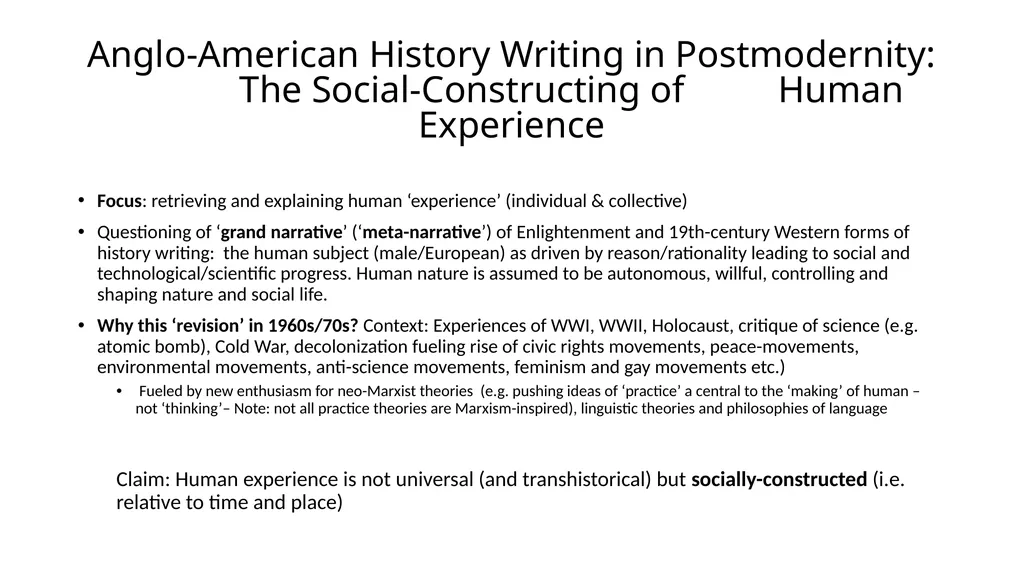
Anglo-American History Writing in Postmodernity:
The Social-Constructing of Human Experience Focus: retrieving and explaining human ‘experience’ (individual & collective)
Questioning of ‘grand narrative’ (‘meta-narrative’) of Enlightenment and 19th-century Western forms of history writing: the human subject (male/European) as driven by reason/rationality leading to social and technological/scientific progress. Human nature is assumed to be autonomous, willful, controlling and shaping nature and social life.
Why this ‘revision’ in 1960s/70s? Context: Experiences of WWI, WWII, Holocaust, critique of science (e.g. atomic bomb), Cold War, decolonization fueling rise of civic rights movements, peace-movements, environmental movements, anti-science movements, feminism and gay movements etc.)
Fueled by new enthusiasm for neo-Marxist theories (e.g. pushing ideas of ‘practice’ a central to the ‘making’ of human – not ‘thinking’– Note: not all practice theories are Marxism-inspired), linguistic theories and philosophies of language
Claim: Human experience is not universal (and transhistorical) but socially-constructed (i.e. relative to time and place)<br>
Questioning of ‘grand narrative’ (‘meta-narrative’) of Enlightenment and 19th-century Western forms of history writing: the human subject (male/European) as driven by reason/rationality leading to social and technological/scientific progress. Human nature is assumed to be autonomous, willful, controlling and shaping nature and social life.
Why this ‘revision’ in 1960s/70s? Context: Experiences of WWI, WWII, Holocaust, critique of science (e.g. atomic bomb), Cold War, decolonization fueling rise of civic rights movements, peace-movements, environmental movements, anti-science movements, feminism and gay movements etc.)
Fueled by new enthusiasm for neo-Marxist theories (e.g. pushing ideas of ‘practice’ a central to the ‘making’ of human – not ‘thinking’– Note: not all practice theories are Marxism-inspired), linguistic theories and philosophies of language
Claim: Human experience is not universal (and transhistorical) but socially-constructed (i.e. relative to time and place)<br>
14
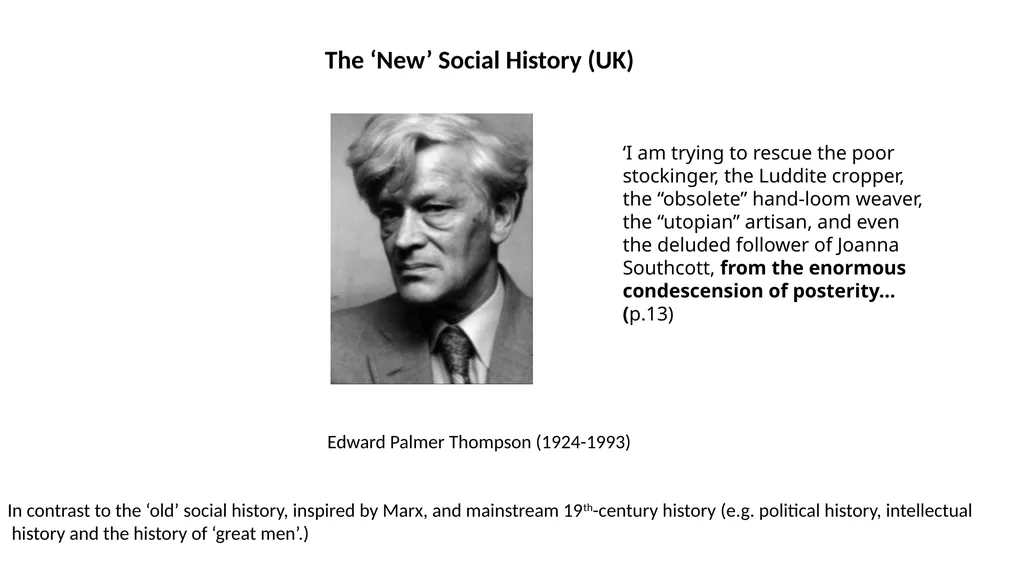
Edward Palmer Thompson (1924-1993) The ‘New’ Social History (UK) In contrast to the ‘old’ social history, inspired by Marx, and mainstream 19th-century history (e.g. political history, intellectual
history and the history of ‘great men’.) ‘I am trying to rescue the poor stockinger, the Luddite cropper, the “obsolete” hand-loom weaver, the “utopian” artisan, and even the deluded follower of Joanna Southcott, from the enormous condescension of posterity...(p.13)<br>
history and the history of ‘great men’.) ‘I am trying to rescue the poor stockinger, the Luddite cropper, the “obsolete” hand-loom weaver, the “utopian” artisan, and even the deluded follower of Joanna Southcott, from the enormous condescension of posterity...(p.13)<br>
15
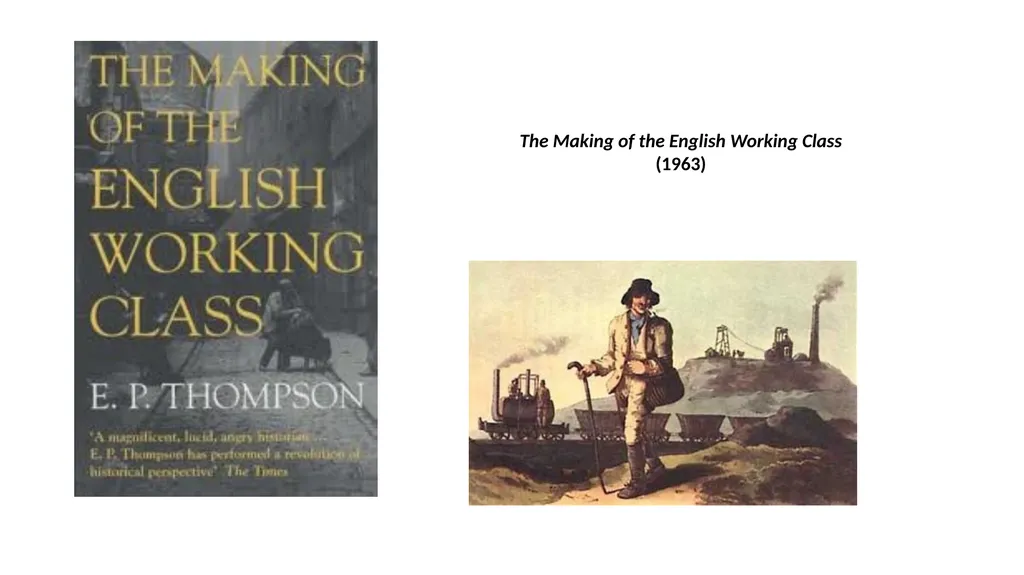
The Making of the English Working Class (1963)<br>
16
‘I do not see class as a “structure”, nor even as a “category”, but as something which in fact happens (and can be shown to have happened) in human relationships...Like any other relationship, it is a fluency which evades analysis if we attempt to stop it dead at any given moment and anatomize its structure.
The finest-meshed sociological net cannot give us a pure definition of class, any more than it can give us one of deference or of love. The relationship must always be embodied in real people and in a real context. Moreover, we cannot have two distinct classes, each with an independent being, and then bring them into relationship with each other. We cannot have love without lovers, nor deference without squires and laborers. (p.1) A new definition of ‘class’ in opposition to older Marxist views that understand class as arising automatically from an underlying economic structure (so-called forces of production; review next week!) ‘The working class did not rise like the sun at an appointed hour. It was present at its own making.’<br>
The finest-meshed sociological net cannot give us a pure definition of class, any more than it can give us one of deference or of love. The relationship must always be embodied in real people and in a real context. Moreover, we cannot have two distinct classes, each with an independent being, and then bring them into relationship with each other. We cannot have love without lovers, nor deference without squires and laborers. (p.1) A new definition of ‘class’ in opposition to older Marxist views that understand class as arising automatically from an underlying economic structure (so-called forces of production; review next week!) ‘The working class did not rise like the sun at an appointed hour. It was present at its own making.’<br>
17
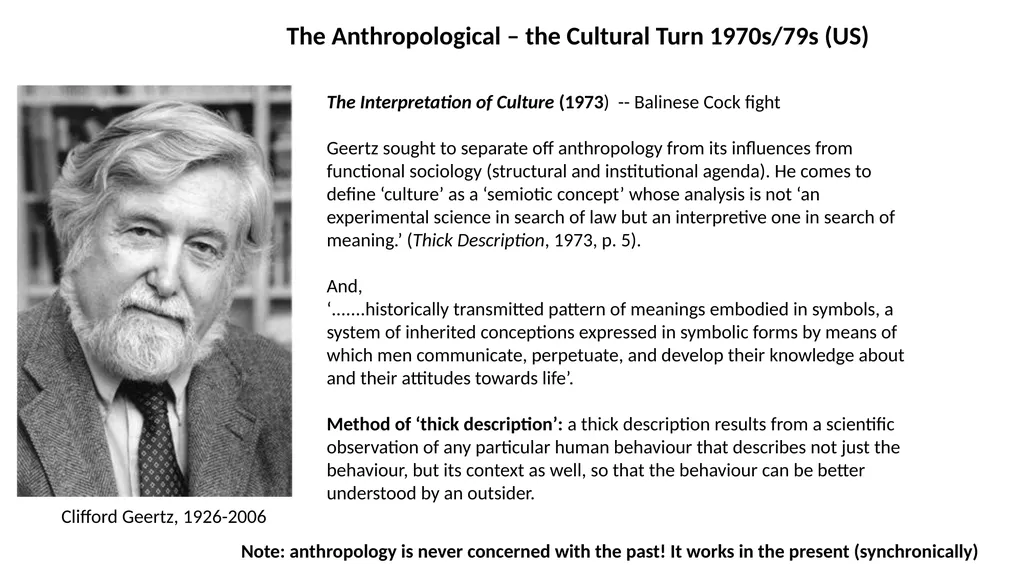
Clifford Geertz, 1926-2006 The Interpretation of Culture (1973) -- Balinese Cock fight
Geertz sought to separate off anthropology from its influences from functional sociology (structural and institutional agenda). He comes to define ‘culture’ as a ‘semiotic concept’ whose analysis is not ‘an experimental science in search of law but an interpretive one in search of meaning.’ (Thick Description, 1973, p. 5).
And,
‘.......historically transmitted pattern of meanings embodied in symbols, a system of inherited conceptions expressed in symbolic forms by means of which men communicate, perpetuate, and develop their knowledge about and their attitudes towards life’.
Method of ‘thick description’: a thick description results from a scientific observation of any particular human behaviour that describes not just the behaviour, but its context as well, so that the behaviour can be better understood by an outsider. Note: anthropology is never concerned with the past! It works in the present (synchronically) The Anthropological – the Cultural Turn 1970s/79s (US)<br>
Geertz sought to separate off anthropology from its influences from functional sociology (structural and institutional agenda). He comes to define ‘culture’ as a ‘semiotic concept’ whose analysis is not ‘an experimental science in search of law but an interpretive one in search of meaning.’ (Thick Description, 1973, p. 5).
And,
‘.......historically transmitted pattern of meanings embodied in symbols, a system of inherited conceptions expressed in symbolic forms by means of which men communicate, perpetuate, and develop their knowledge about and their attitudes towards life’.
Method of ‘thick description’: a thick description results from a scientific observation of any particular human behaviour that describes not just the behaviour, but its context as well, so that the behaviour can be better understood by an outsider. Note: anthropology is never concerned with the past! It works in the present (synchronically) The Anthropological – the Cultural Turn 1970s/79s (US)<br>
18
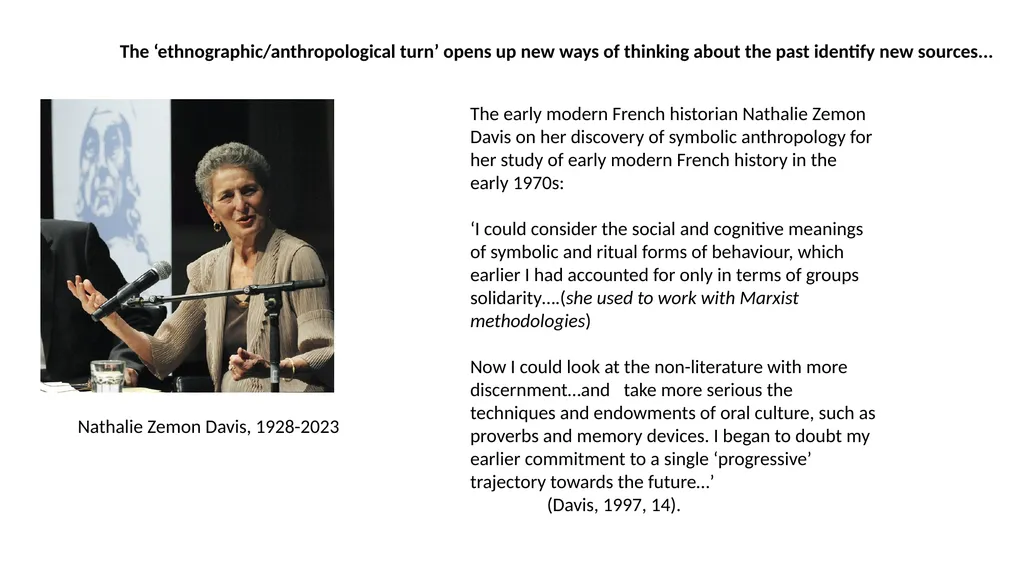
The early modern French historian Nathalie Zemon Davis on her discovery of symbolic anthropology for her study of early modern French history in the early 1970s:
‘I could consider the social and cognitive meanings of symbolic and ritual forms of behaviour, which earlier I had accounted for only in terms of groups solidarity….(she used to work with Marxist methodologies)
Now I could look at the non-literature with more discernment…and take more serious the techniques and endowments of oral culture, such as proverbs and memory devices. I began to doubt my earlier commitment to a single ‘progressive’ trajectory towards the future…’
(Davis, 1997, 14). The ‘ethnographic/anthropological turn’ opens up new ways of thinking about the past identify new sources... Nathalie Zemon Davis, 1928-2023<br>
‘I could consider the social and cognitive meanings of symbolic and ritual forms of behaviour, which earlier I had accounted for only in terms of groups solidarity….(she used to work with Marxist methodologies)
Now I could look at the non-literature with more discernment…and take more serious the techniques and endowments of oral culture, such as proverbs and memory devices. I began to doubt my earlier commitment to a single ‘progressive’ trajectory towards the future…’
(Davis, 1997, 14). The ‘ethnographic/anthropological turn’ opens up new ways of thinking about the past identify new sources... Nathalie Zemon Davis, 1928-2023<br>
19
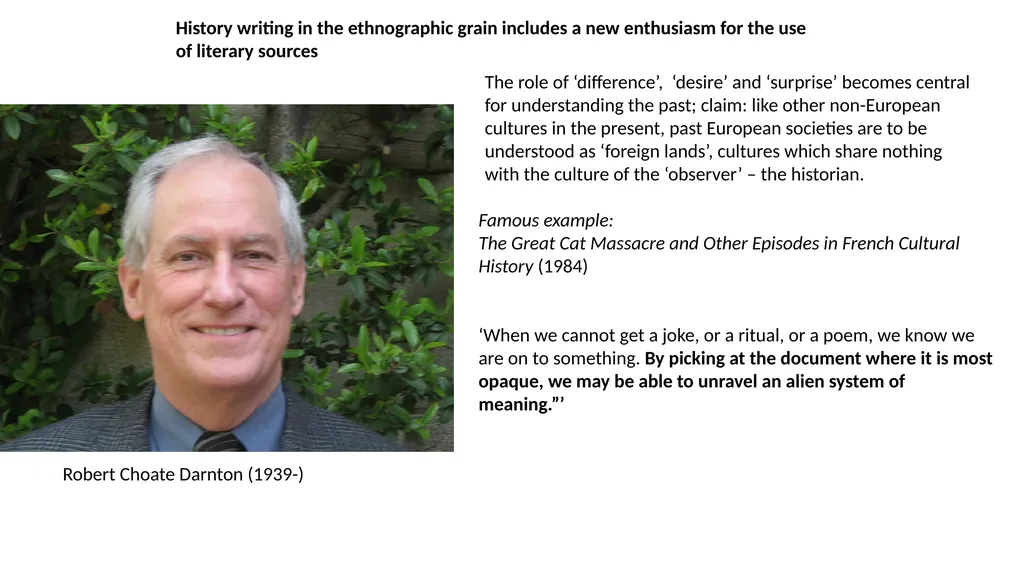
Robert Choate Darnton (1939-) Famous example:
The Great Cat Massacre and Other Episodes in French Cultural History (1984)
‘When we cannot get a joke, or a ritual, or a poem, we know we are on to something. By picking at the document where it is most opaque, we may be able to unravel an alien system of meaning.”’ History writing in the ethnographic grain includes a new enthusiasm for the use of literary sources The role of ‘difference’, ‘desire’ and ‘surprise’ becomes central for understanding the past; claim: like other non-European cultures in the present, past European societies are to be understood as ‘foreign lands’, cultures which share nothing with the culture of the ‘observer’ – the historian.<br>
The Great Cat Massacre and Other Episodes in French Cultural History (1984)
‘When we cannot get a joke, or a ritual, or a poem, we know we are on to something. By picking at the document where it is most opaque, we may be able to unravel an alien system of meaning.”’ History writing in the ethnographic grain includes a new enthusiasm for the use of literary sources The role of ‘difference’, ‘desire’ and ‘surprise’ becomes central for understanding the past; claim: like other non-European cultures in the present, past European societies are to be understood as ‘foreign lands’, cultures which share nothing with the culture of the ‘observer’ – the historian.<br>
20
‘…other people are other. They do not think the way we do. And if we want to understand their way of thinking, we should set out with the idea of capturing otherness. […] nothing is easier than to slip into the comfortable assumption that Europeans thought and felt two centuries ago just as we do today – allowing for the wigs and wooden shoes. We constantly need to be shaken out of a false sense of familiarity with the past, to be administered doses of culture shock.’ (Robert, Darnton)
Claim: To understand and accept something as ‘difference’ makes you question your own culture and opens up ways into a ‘different’ future. It makes you aware of your biases.
Some consequences to be considered: during ‘the cultural turn’ the term ‘society’ gets lost in history writing and with it, Marxist notions of power and conceptions of historical change (e.g. revolutions); cultural history writing tends to be ‘descriptive’ (thick descrioption) and synchronic (focussed on a moment in time); problem: how to explain ‘change’ and ‘transformation’ through time (diachronic approach) The Past is ‘the Other’: No links between the Historian and the Past?<br>
Claim: To understand and accept something as ‘difference’ makes you question your own culture and opens up ways into a ‘different’ future. It makes you aware of your biases.
Some consequences to be considered: during ‘the cultural turn’ the term ‘society’ gets lost in history writing and with it, Marxist notions of power and conceptions of historical change (e.g. revolutions); cultural history writing tends to be ‘descriptive’ (thick descrioption) and synchronic (focussed on a moment in time); problem: how to explain ‘change’ and ‘transformation’ through time (diachronic approach) The Past is ‘the Other’: No links between the Historian and the Past?<br>
21
Linguistic Turn (def.):
Analytical turn upon (or problematisation of) words/language used in a given field of study.
Term is first used by the American analytical (then pragmatic) philosopher Richard Rorty in his The Linguistic Turn (1967) By the 1990s, the historian-anthropologists gets influenced by linguistic theories and language philosophies and they
embrace new notions of ‘power’<br>
Analytical turn upon (or problematisation of) words/language used in a given field of study.
Term is first used by the American analytical (then pragmatic) philosopher Richard Rorty in his The Linguistic Turn (1967) By the 1990s, the historian-anthropologists gets influenced by linguistic theories and language philosophies and they
embrace new notions of ‘power’<br>
22
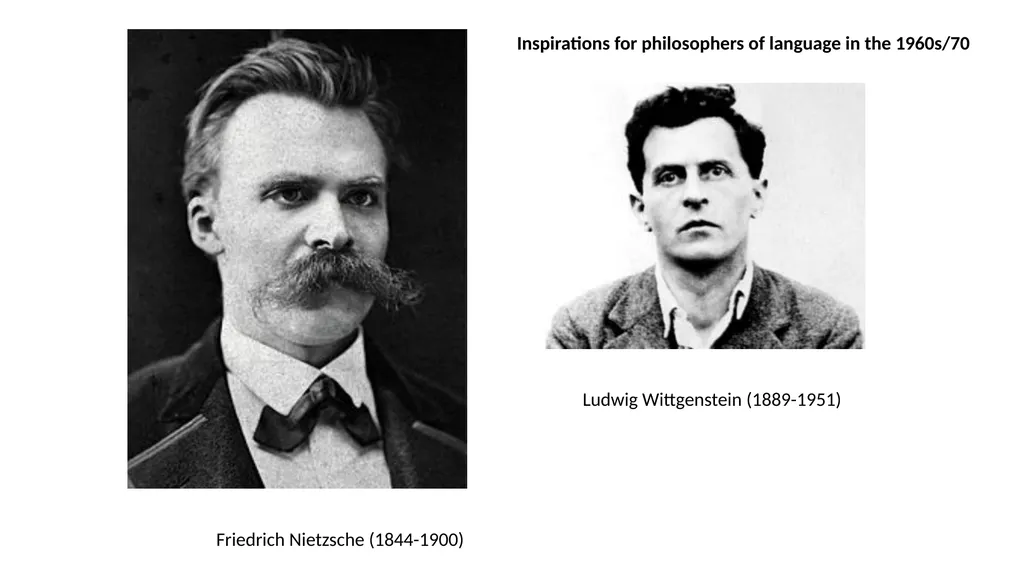
Friedrich Nietzsche (1844-1900) Ludwig Wittgenstein (1889-1951) Inspirations for philosophers of language in the 1960s/70<br>
23
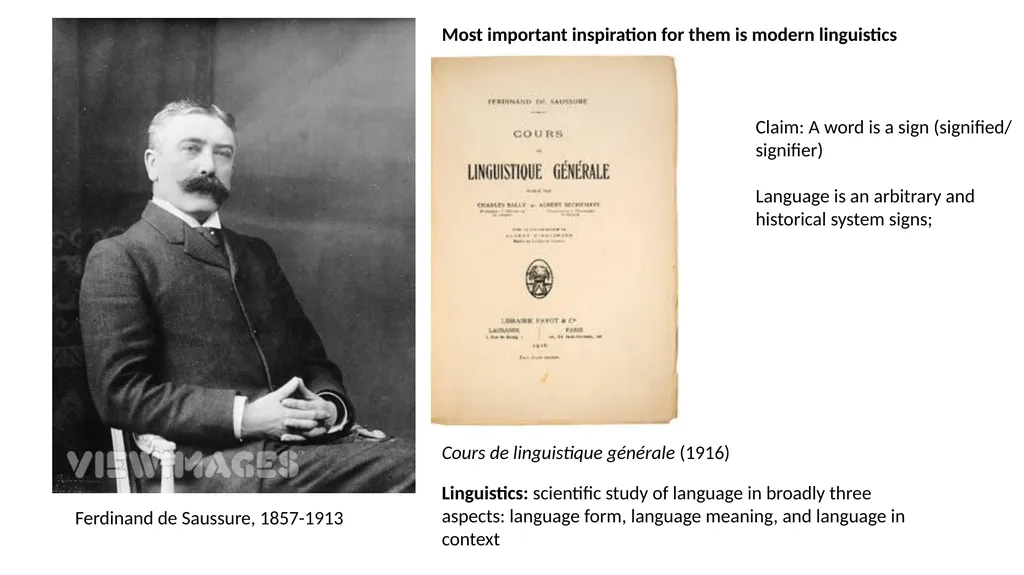
Ferdinand de Saussure, 1857-1913 Cours de linguistique générale (1916) Linguistics: scientific study of language in broadly three aspects: language form, language meaning, and language in context Most important inspiration for them is modern linguistics Claim: A word is a sign (signified/
signifier)
Language is an arbitrary and
historical system signs;<br>
signifier)
Language is an arbitrary and
historical system signs;<br>
24
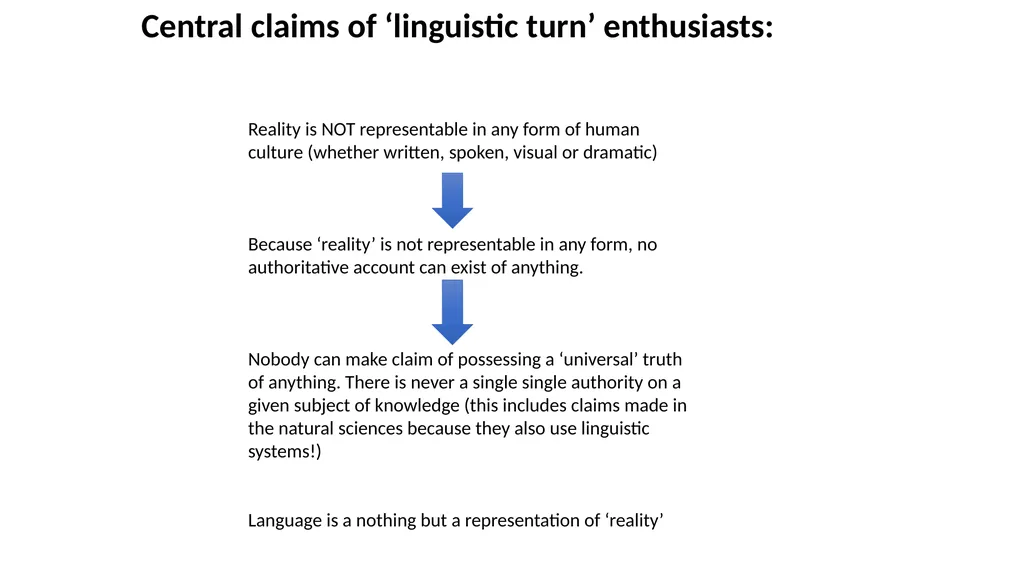
Reality is NOT representable in any form of human culture (whether written, spoken, visual or dramatic)
Because ‘reality’ is not representable in any form, no authoritative account can exist of anything.
Nobody can make claim of possessing a ‘universal’ truth of anything. There is never a single single authority on a given subject of knowledge (this includes claims made in the natural sciences because they also use linguistic systems!)
Language is a nothing but a representation of ‘reality’ Central claims of ‘linguistic turn’ enthusiasts:<br>
Because ‘reality’ is not representable in any form, no authoritative account can exist of anything.
Nobody can make claim of possessing a ‘universal’ truth of anything. There is never a single single authority on a given subject of knowledge (this includes claims made in the natural sciences because they also use linguistic systems!)
Language is a nothing but a representation of ‘reality’ Central claims of ‘linguistic turn’ enthusiasts:<br>
25
Michel Foucault 1926-1984 A French philosopher who does ‘history’ and changes Western thinking about power, knowledge and human identity forever....is has long become mainstream in cultural history Aim of history writing should be:
a history of the present
Quote here:<br>
a history of the present
Quote here:<br>
26
Geoff Eley
I’ve tried to capture the ways in which politics and the writing of history are constantly informing each other. Politics —whether in the grand, institutional, and macro-discursive dimensions or in the micropolitical, personal, and everyday— can profoundly infuence the kinds of history we’re able to think and do.
History and politics bleed into each other all the time. Thus my book is about the politics of knowledge associated with social history and cultural history in the broadest of ways.
Eley, Geoff. A Crooked Line : From Cultural History to the History of Society, University of Michigan Press, 2005.<br>
I’ve tried to capture the ways in which politics and the writing of history are constantly informing each other. Politics —whether in the grand, institutional, and macro-discursive dimensions or in the micropolitical, personal, and everyday— can profoundly infuence the kinds of history we’re able to think and do.
History and politics bleed into each other all the time. Thus my book is about the politics of knowledge associated with social history and cultural history in the broadest of ways.
Eley, Geoff. A Crooked Line : From Cultural History to the History of Society, University of Michigan Press, 2005.<br>
27
We saw it not only as an aid to effective political thinking but also as a tool for honing a critical social consciousness and for making our way toward a workable political ethics.;
Eley, Geoff. A Crooked Line : From Cultural History to the History of Society, University of Michigan Press, 2005, p.2. This relationship of history to politics is not simple. History is more than either an instrument or a mirror. But the scholarly debates of historians are inseparable from politics in the widest sense of the term— all the partially visible philosophical, sociocultural, and strictly political baggage historians bring with them into the scholarly arena; the wider contentiousness implied by their position-taking within institutions and the public sphere; and the broader political issues and controversies that shadow their concerns.
Eley, Geoff. A Crooked Line : From Cultural History to the History of Society, University of Michigan Press, 2005, p.5<br>
28
During my years as a student in Oxford, it was completely clear to me that history was insuffcient by itself, that it needed “theory,” and that other disciplines had to be enlisted for this purpose. In the context of the time (when claims for history’s social and political relevance were invoked so irresistibly in materialist terms), this meant turning principally to sociology and political science, less frequently to anthropology, but at all events to the general repertoire of critical social science.
Eley, Geoff. A Crooked Line : From Cultural History to the History of Society, University of Michigan Press, 2005, p. 25/26<br>
29
Were are we know in 2024?<br>