04
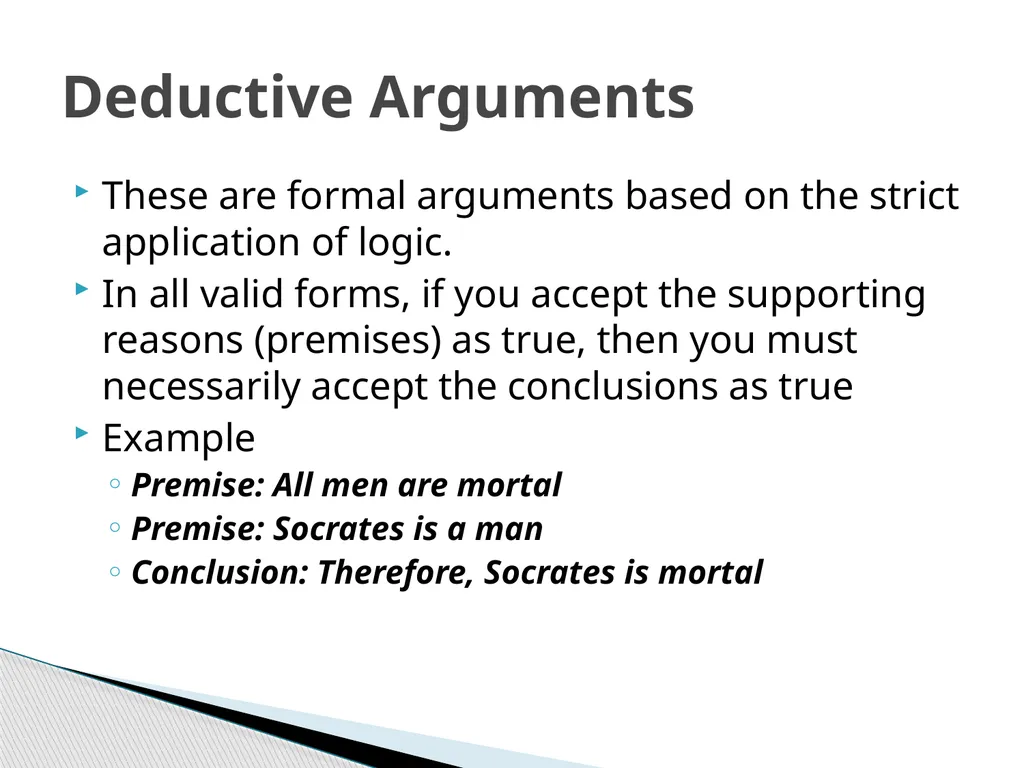
These are formal arguments based on the strict application of logic.
In all valid forms, if you accept the supporting reasons (premises) as true, then you must necessarily accept the conclusions as true
Example
Premise: All men are mortal
Premise: Socrates is a man
Conclusion: Therefore, Socrates is mortal Deductive Arguments<br>
05
The next four slides demonstrate types of deductive arguments. Note that all of the examples of have two premises and a conclusion that follows logically from the premises.<br>
06
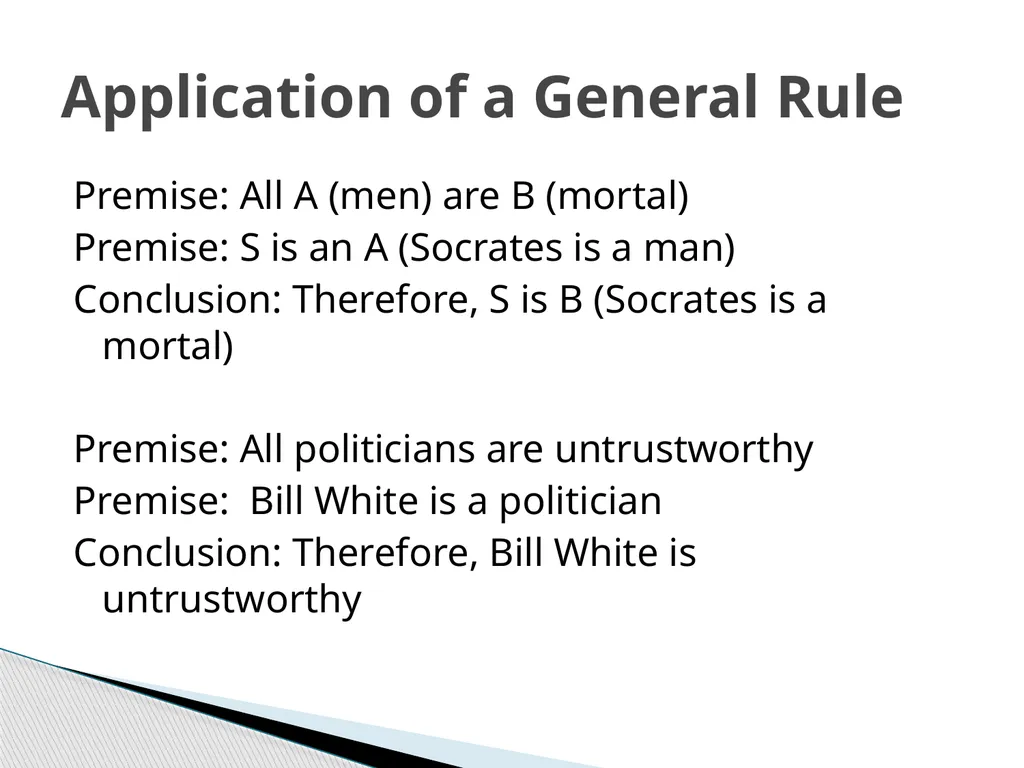
Premise: All A (men) are B (mortal)
Premise: S is an A (Socrates is a man)
Conclusion: Therefore, S is B (Socrates is a mortal)
Premise: All politicians are untrustworthy
Premise: Bill White is a politician
Conclusion: Therefore, Bill White is untrustworthy Application of a General Rule<br>
07
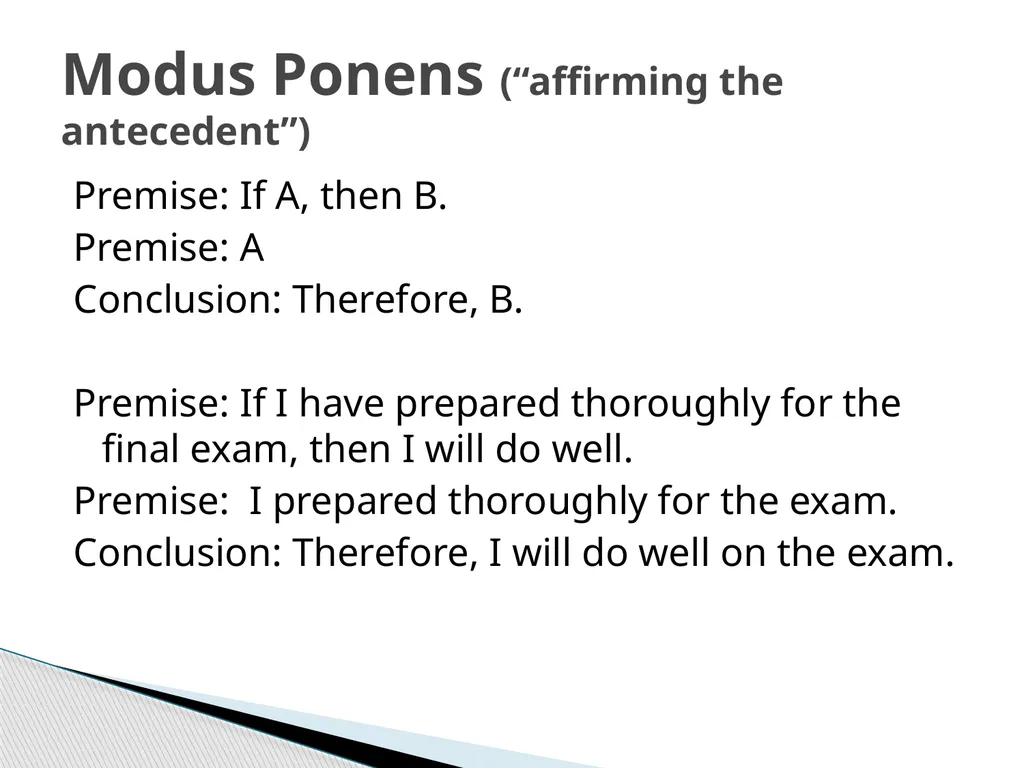
Premise: If A, then B.
Premise: A
Conclusion: Therefore, B.
Premise: If I have prepared thoroughly for the final exam, then I will do well.
Premise: I prepared thoroughly for the exam.
Conclusion: Therefore, I will do well on the exam. Modus Ponens (“affirming the antecedent”)<br>
08
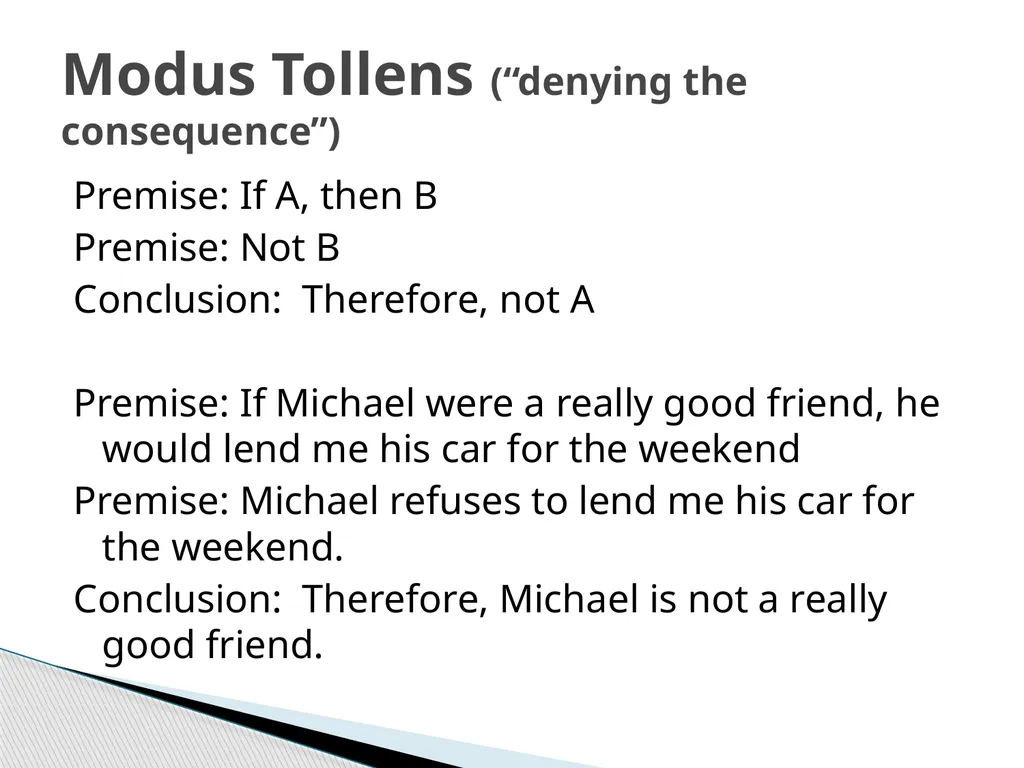
Premise: If A, then B
Premise: Not B
Conclusion: Therefore, not A
Premise: If Michael were a really good friend, he would lend me his car for the weekend
Premise: Michael refuses to lend me his car for the weekend.
Conclusion: Therefore, Michael is not a really good friend. Modus Tollens (“denying the consequence”)<br>
09
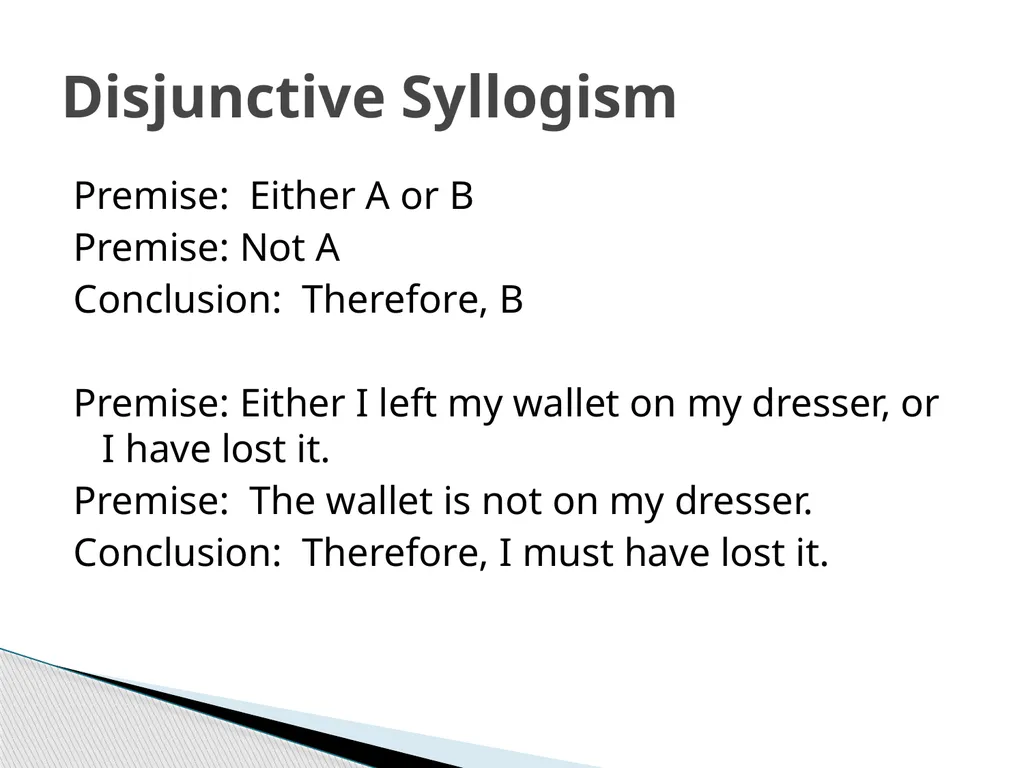
Premise: Either A or B
Premise: Not A
Conclusion: Therefore, B
Premise: Either I left my wallet on my dresser, or I have lost it.
Premise: The wallet is not on my dresser.
Conclusion: Therefore, I must have lost it. Disjunctive Syllogism<br>
10
An argument is valid if the premises entail the conclusion. In other words, if the premises are true, then the conclusion must be true.
An argument can be valid even if the premises are not true. More on this in a bit. Valid and Invalid Arguments<br>
11
All teachers have students.
Prof. Barnes is a teacher
Therefore, Prof. Barnes has students.
Is this argument valid? Validity: Example 1<br>
12
The conclusion follows with certainty from the premises. Yes, it is valid.<br>
13
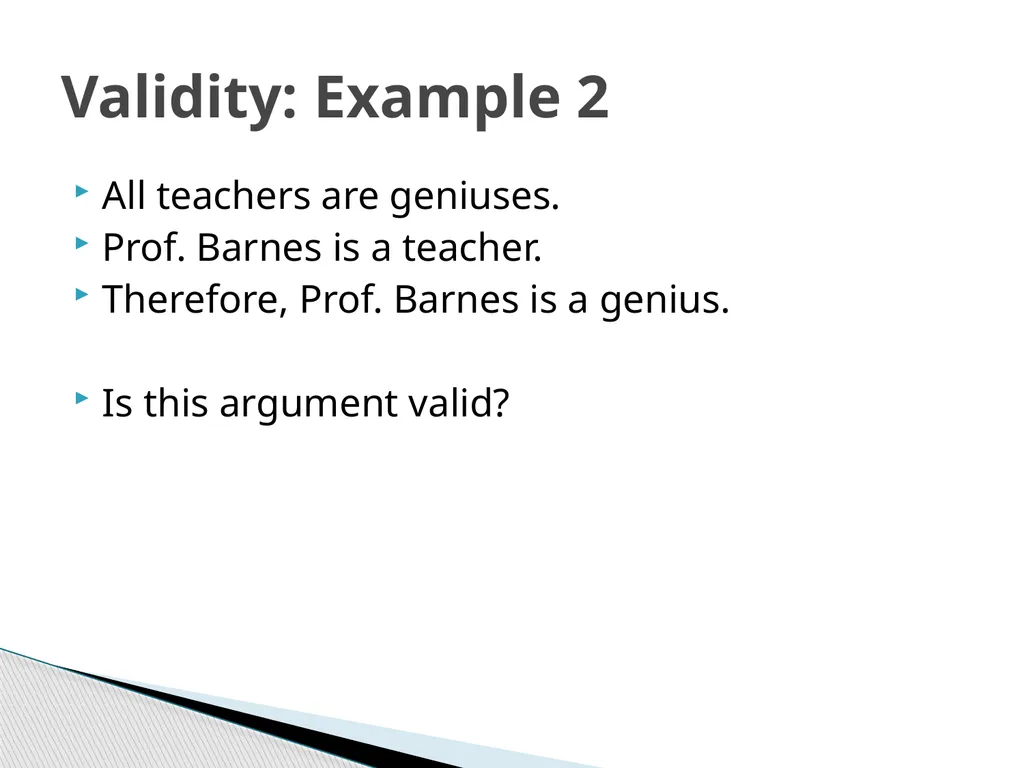
All teachers are geniuses.
Prof. Barnes is a teacher.
Therefore, Prof. Barnes is a genius.
Is this argument valid? Validity: Example 2<br>
14
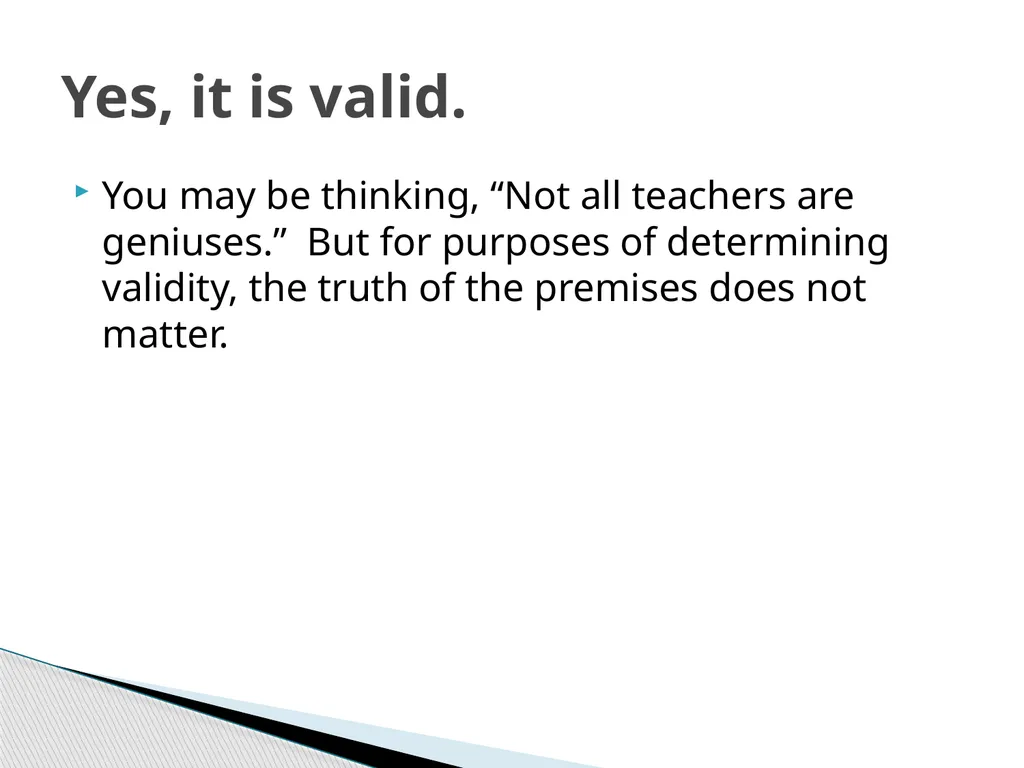
You may be thinking, “Not all teachers are geniuses.” But for purposes of determining validity, the truth of the premises does not matter. Yes, it is valid.<br>
15
All men wear neckties.
Mr. Jones wears neckties.
Therefore, Mr. Jones is a man.
Is it valid? Validity: Example 3<br>
16
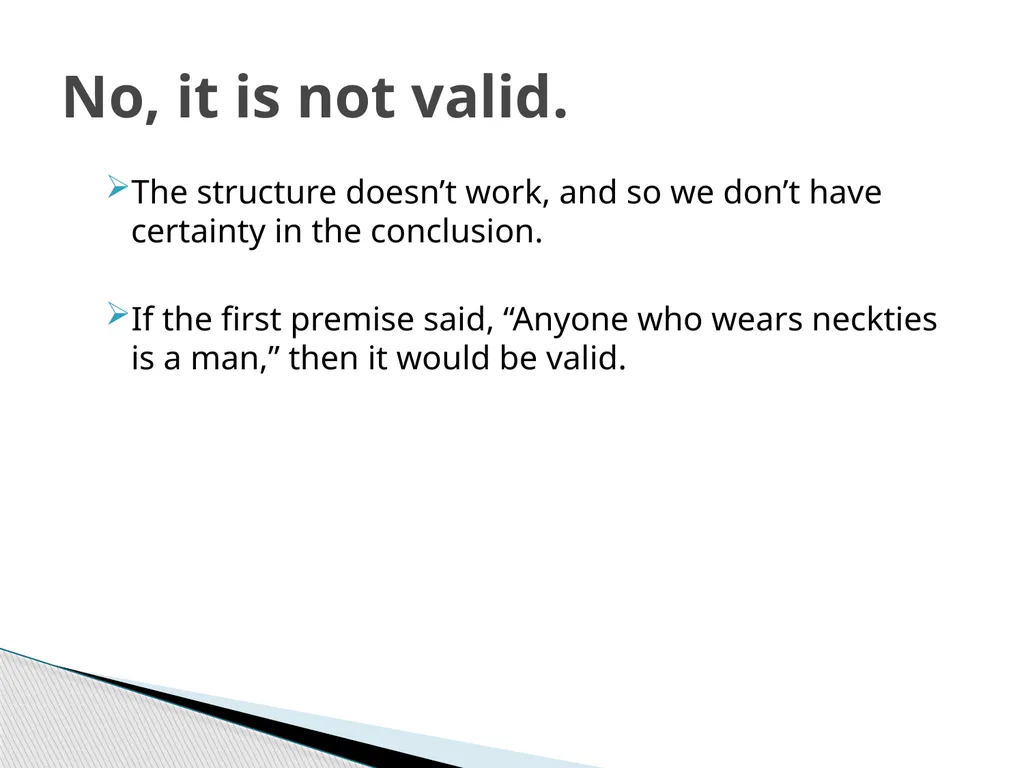
The structure doesn’t work, and so we don’t have certainty in the conclusion.
If the first premise said, “Anyone who wears neckties is a man,” then it would be valid. No, it is not valid.<br>
17
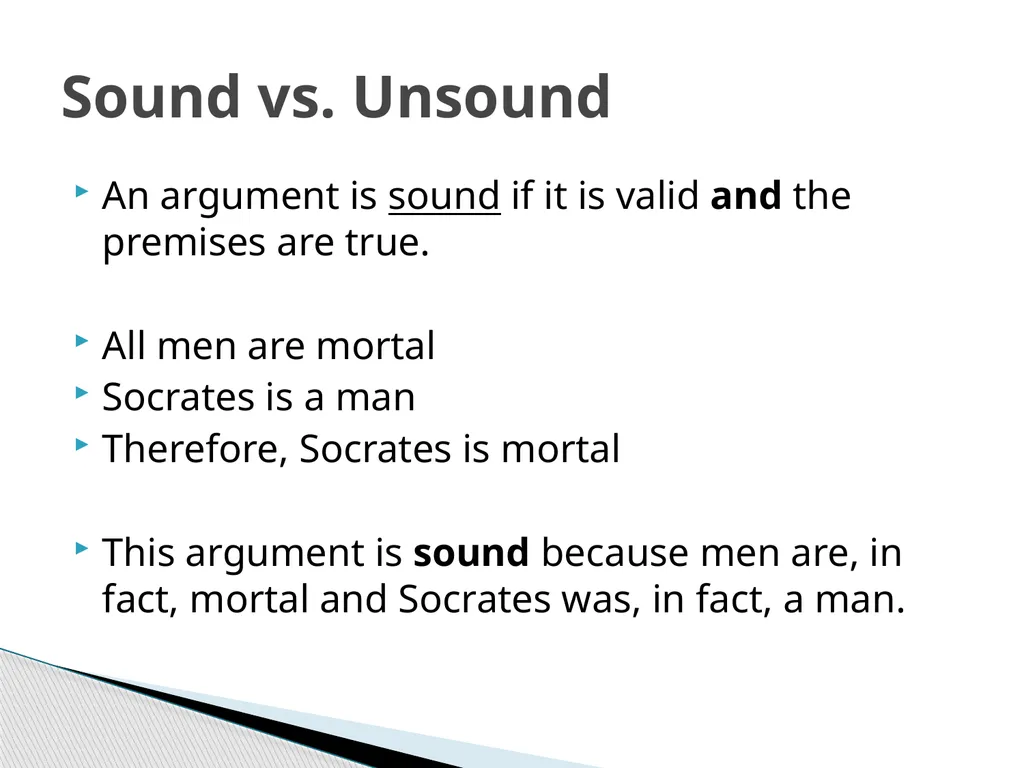
An argument is sound if it is valid and the premises are true.
All men are mortal
Socrates is a man
Therefore, Socrates is mortal
This argument is sound because men are, in fact, mortal and Socrates was, in fact, a man. Sound vs. Unsound<br>
18
Squirrels breathe fire out of their nostrils.
Mr. Nutty is a squirrel.
Therefore, Mr. Nutty breathes fire out of his nostrils.
The conclusion does follow from the premises, but the first premise is not true, so the argument is valid, but not sound. A valid but unsound argument<br>
19
An argument form in which one reasons from premises that are not known to a conclusion that is supported by the premises but does not follow logically from them.
When you use inductive reasoning, your premises provide evidence that make it probable, but not certain, that the conclusion is true. Inductive Reasoning<br>
20
The next few slides introduce some common forms of inductive reasoning. These are the types of arguments we make most often in daily life.<br>
21
Reasoning from a limited sample to a general conclusion based on this sample
Example: A recent survey of 1,000 TV viewers demonstrates that reality shows are more popular than sitcoms.
Example: A recent study of 10,000 Americans shows that children under age 10 who play violent video games are 40% more likely to commit real-life violence. Therefore, we can conclude that violent video games do contribute to real-life violence. Empirical Generalization<br>
22
If we invest more in health care, the long term savings will more than offset the short-term expenses.
The sun has risen every day since the beginning of time. Therefore, we can safely assume the sun will rise tomorrow.
Note: This is only a probability, not a certainty. Prediction<br>
23
I only got four hours of sleep last night, and I failed my math quiz. Most likely, lack of sleep caused me to fail the quiz.
Note: Beware of oversimplifying cause and effect. Correlation does not necessarily mean causation. Causal Inference<br>
24
Is the sample known?
Is the sample sufficient?
Is the sample representative?
Are the reasons relevant?
Are the conclusions are likely to be accurate?
In inductive arguments, we talk about strength and weakness rather than validity. Evaluating Inductive Arguments<br>
25
I spoke to fifteen different students at State University, and they all seemed intelligent. Therefore, it’s safe to say that State University is full of outstanding students. Is this argument strong or weak?<br>
26
The sample is too small.
We don’t know if the sample is representative. For instance, did it include a mix of male and female students?
The evidence is subjective, based on unclear criteria for “intelligent.”
The conclusion changes the focus from intelligence to being a good student, which is not the same thing. It’s weak.<br>
27
In a recent survey of 5,000 New York City residents from all five boroughs, 65% of those surveyed called the subways “unreliable,” while only 25% said they “enjoyed” riding the subways. We can conclude that New Yorkers today are more likely to have a negative view of the subways than a positive view. How about this one?<br>
28
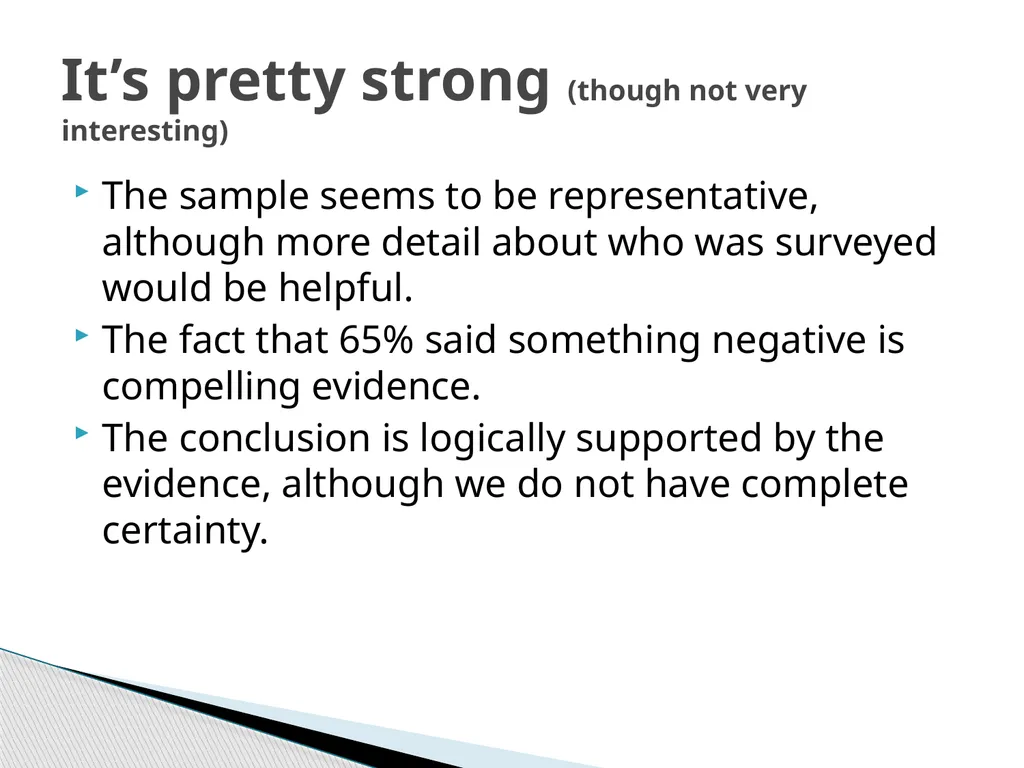
The sample seems to be representative, although more detail about who was surveyed would be helpful.
The fact that 65% said something negative is compelling evidence.
The conclusion is logically supported by the evidence, although we do not have complete certainty. It’s pretty strong (though not very interesting)<br>
29
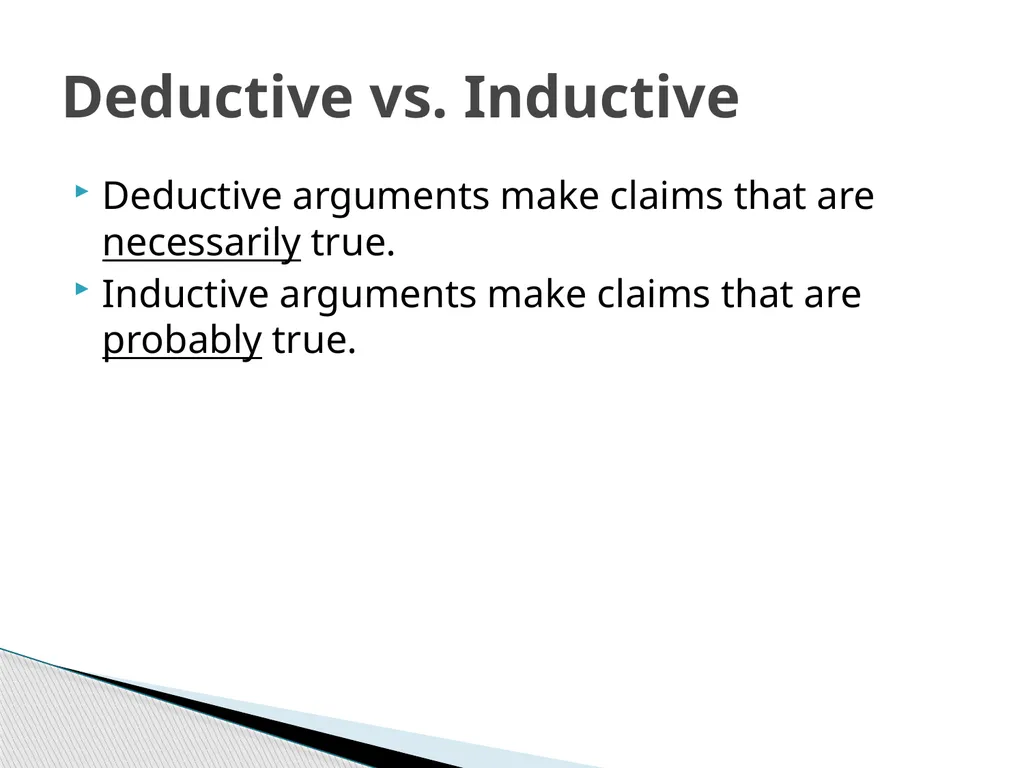
Deductive arguments make claims that are necessarily true.
Inductive arguments make claims that are probably true. Deductive vs. Inductive<br>