THIRD YEAR T.D.C., SCIENCE PAPER-III Paper Code - 3163 SOLID STATE, NUCLEAR AND PARTICLE PHYSICS Syllabus UNIT I Crystal geometry: crystal lattice, crystal planes and Miller indices, unit cells. Typical crystal structures, coordination
"THIRD YEAR T.D.C., SCIENCE PAPER-III Paper Code -" is the property of its rightful owner. Permission is granted to
download and print the materials on this website for personal, non-commercial use only, and to display it
on your personal computer provided you do not modify the materials and that you retain all copyright
notices contained in the materials. By downloading content from our website, you accept the terms of this
agreement.
Presentation Transcript
01
THIRD YEAR T.D.C., SCIENCE PAPER-III Paper Code - 3163 SOLID STATE, NUCLEAR
AND PARTICLE PHYSICS<br>
02
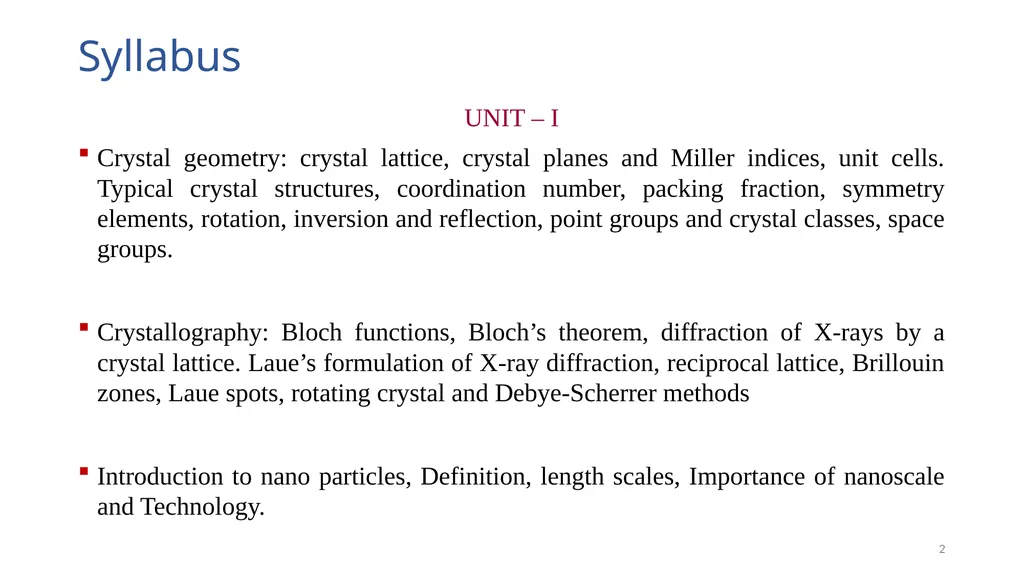
Syllabus UNIT – I
Crystal geometry: crystal lattice, crystal planes and Miller indices, unit cells. Typical crystal structures, coordination number, packing fraction, symmetry elements, rotation, inversion and reflection, point groups and crystal classes, space groups.
Crystallography: Bloch functions, Bloch’s theorem, diffraction of X-rays by a crystal lattice. Laue’s formulation of X-ray diffraction, reciprocal lattice, Brillouin zones, Laue spots, rotating crystal and Debye-Scherrer methods
Introduction to nano particles, Definition, length scales, Importance of nanoscale and Technology. 2<br>
03
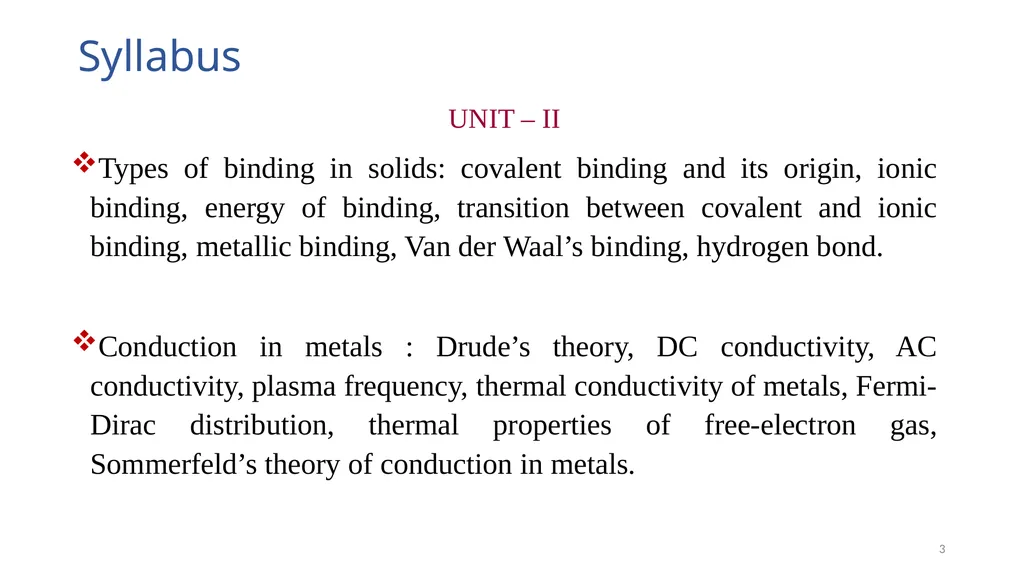
Syllabus UNIT – II
Types of binding in solids: covalent binding and its origin, ionic binding, energy of binding, transition between covalent and ionic binding, metallic binding, Van der Waal’s binding, hydrogen bond.
Conduction in metals : Drude’s theory, DC conductivity, AC conductivity, plasma frequency, thermal conductivity of metals, Fermi-Dirac distribution, thermal properties of free-electron gas, Sommerfeld’s theory of conduction in metals. 3<br>
04
UNIT – III
Conduction in semiconductor: Bands in solids, metals, insulators and semiconductors.
Motion of free electrons on a chain of atoms, effective mass, electrons and holes, donor and acceptor impurities, donor impurity levels. Thermal excitation of carriers, electrical conductivity. Elementary ideas of Hall effect in metals and semiconductors and magnetoresistance.
Charge transport in semi-conductors: Ionization energy of impurity atoms, carrier concentration in doped semiconductors at high and low temperatures, control of conductivity of semiconductors by impurities and current flow in semi-conductors. Syllabus 4<br>
05
UNIT – IV
Structure of nucleus: discovery of the nucleus, composition. Basic properties: charge, mass, size, spin, magnetic moment, electric quadrupole moment, binding energy, binding energy per nucleon and its observed variation with mass number of the nucleus. Coulomb energy, volume energy, surface energy, other corrections, explanation of the binding energy curve. Liquid drop model of the nucleus.
Nuclear forces: two-nucleon system, deuteron problem, binding energy, nuclear potential well, results of p-p and n-p scattering experiments, meson theory of nuclear forces e.g. Bartlett, Heisenberg, Majorana forces and potentials (No derivations)
Radioactivity: decay constant and half-life, spectra of emitters, Geiger-Nuttal law, Gamow’s explanation. Beta decay: elementary Fermi’s theory (No derivations). Antineutrino. Nuclear radiation, energy levels. Syllabus 5<br>
06
UNIT – V
Detectors for charged particles: Ion chamber, Geiger counter, resolving time, cloud chamber
Accelerators: Need for accelerators; cyclic accelerators, cyclotron, betatron, synchrocyclotron, variable energy cyclotron, phase stability. Brief introduction to Accelerator facilities in India.
Rutherford scattering formula, different types of nuclear reactions Syllabus 6<br>
07
UNIT – V
Artificial radioactivity: Nuclear fission, neutron reactions, Fermi and transuranic elements, chain reaction, criticality, moderators. Brief discussion of Reactor facilities in India
Discovery of cosmic rays: hard and soft components, discovery of muon, pion, heavy mesons and hyperons, mass and life time determination for muon and pion. Primary cosmic rays: Extensive air showers, solar modulation of primary cosmic rays, effect of earth’s magnetic field on the cosmic ray trajectories. Syllabus 7<br>
08
UNIT – V
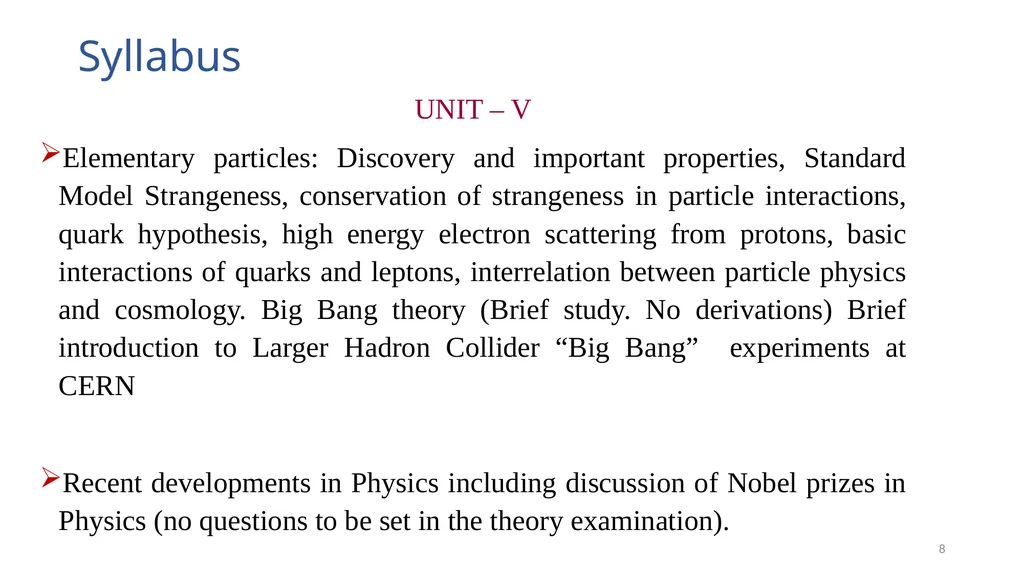
Elementary particles: Discovery and important properties, Standard Model Strangeness, conservation of strangeness in particle interactions, quark hypothesis, high energy electron scattering from protons, basic interactions of quarks and leptons, interrelation between particle physics and cosmology. Big Bang theory (Brief study. No derivations) Brief introduction to Larger Hadron Collider “Big Bang” experiments at CERN
Recent developments in Physics including discussion of Nobel prizes in Physics (no questions to be set in the theory examination). Syllabus 8<br>
09
Nuclear Physics, Brijlal & Subramannian
Solid State Physics, Charles Kittel
Solid State Physics, Nuclear Physics and Particle Physics (In Hindi) Kalra, Kakani and Mandot Text Books Reference books:
D.J. Griffiths: Introduction to Electrodynamics, Prentice Hall of India, 1989.
Reitz and Milford: Introduction to Electrodynamics, Addison-Wesley.
A.M. Portis: Electromagnetic Fields
J.B. Marion: Classical Electromagnetic radiation (Academic Press)
R.P. Feynmann, R.B. Leighton and M. Sands: The Feynmann lectures in Physics, Vol. II (B.I. Publications).
B. Saraf et al. : Physics through experiments Vol. I – EMF, constant and varying, Vikas Publishing House.
D.R. Corson and P. Lorrain: Introduction to Electromagnetic fields and waves, Freeman-Taraporevala, Bombay, 1970.
E.C. Jordan and K.G. Balmain: Electromagnetic waves and radiating systems, 2nd Ed., Prentice Hall of India, New Delhi, 1971. 9<br>
10
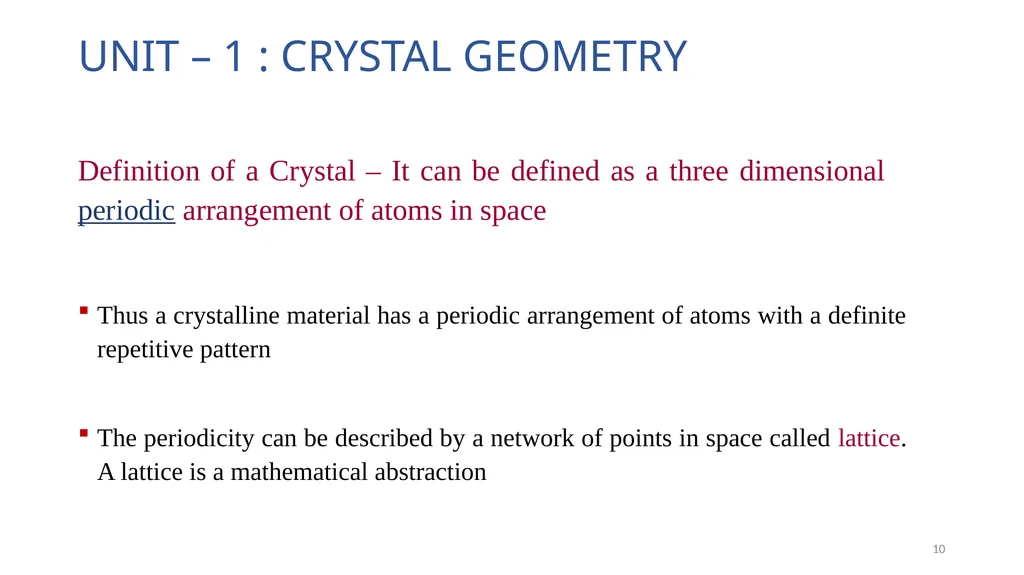
Thus a crystalline material has a periodic arrangement of atoms with a definite repetitive pattern
The periodicity can be described by a network of points in space called lattice. A lattice is a mathematical abstraction UNIT – 1 : CRYSTAL GEOMETRY Definition of a Crystal – It can be defined as a three dimensional periodic arrangement of atoms in space 10<br>
11
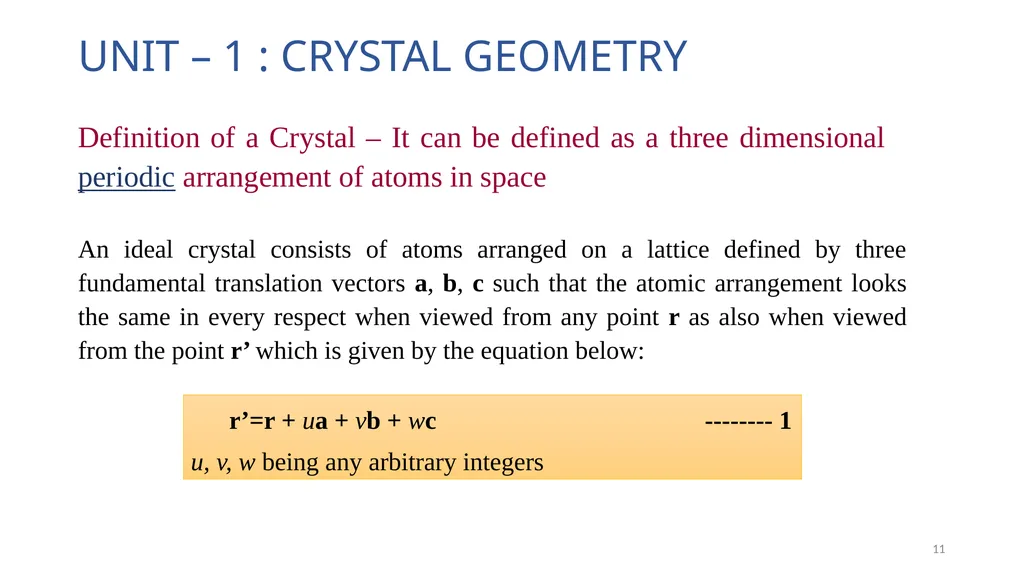
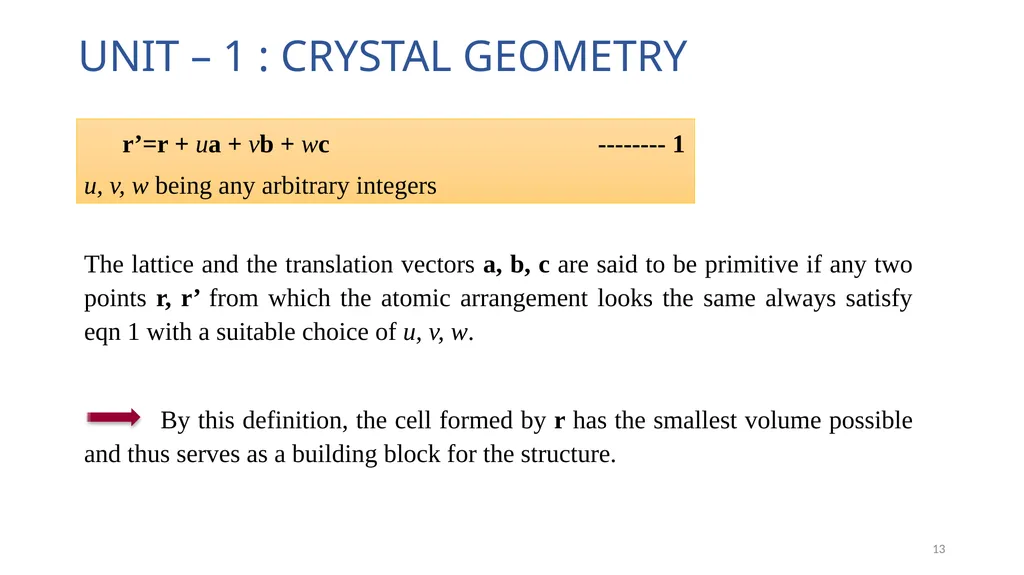
An ideal crystal consists of atoms arranged on a lattice defined by three fundamental translation vectors a, b, c such that the atomic arrangement looks the same in every respect when viewed from any point r as also when viewed from the point r’ which is given by the equation below: UNIT – 1 : CRYSTAL GEOMETRY Definition of a Crystal – It can be defined as a three dimensional periodic arrangement of atoms in space r’=r + ua + vb + wc -------- 1
u, v, w being any arbitrary integers 11<br>
12
The group of atoms attached to each lattice is called basis. It can be a single atom (for metals, noble gases) or can be more than 1000 atoms for eg. in proteins.
The basis consists of atoms which are identical in composition, arrangement and orientation.
So a crystal = Lattice + Basis UNIT – 1 : CRYSTAL GEOMETRY 12<br>
13
UNIT – 1 : CRYSTAL GEOMETRY 13<br>
14
The group of atoms attached to each lattice is called basis. It can be a single atom (for metals, noble gases) or can be more than 1000 atoms for eg. in proteins.
There are 4 types of symmetry operations :
(a) Translation (b) Rotation (c) Reflection (d) Inversion. UNIT – 1 : CRYSTAL GEOMETRY Symmetry
Symmetry refers to a certain pattern or arrangement. A body is symmetrical under a particular operation when it is reproduced by a certain operation. 14<br>
15
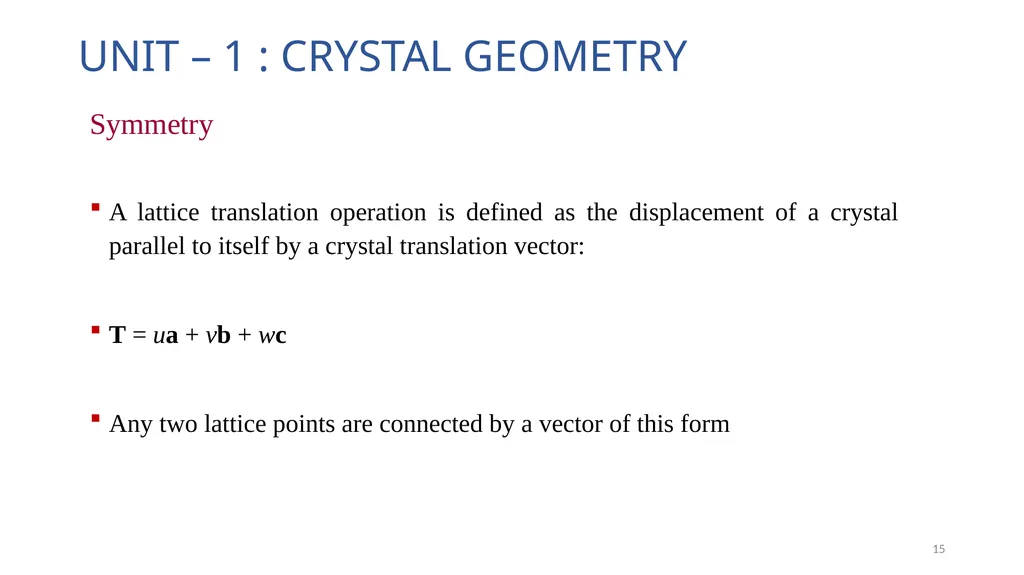
A lattice translation operation is defined as the displacement of a crystal parallel to itself by a crystal translation vector:
T = ua + vb + wc
Any two lattice points are connected by a vector of this form UNIT – 1 : CRYSTAL GEOMETRY Symmetry 15<br>
16
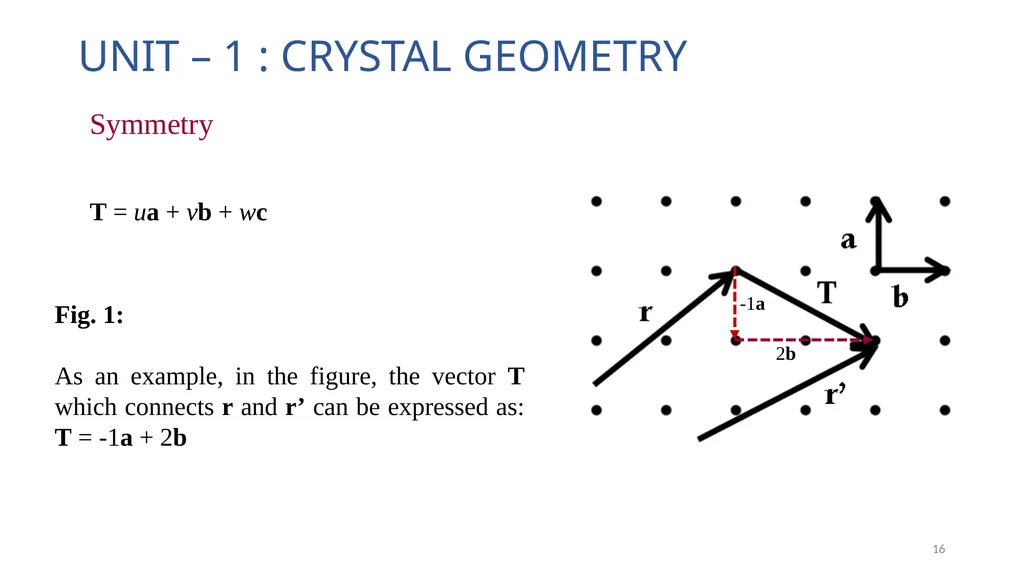
T = ua + vb + wc UNIT – 1 : CRYSTAL GEOMETRY Symmetry Fig. 1:
As an example, in the figure, the vector T which connects r and r’ can be expressed as: T = -1a + 2b 16<br>