THIRD YEAR T.D.C., SCIENCE PAPER-III, Part D Paper Code - 3163 SOLID STATE, NUCLEAR AND PARTICLE PHYSICS The seven crystal systems are characterized by three symmetry elements namely : 1. Centre of symmetry 2. Planes of symmetry 3. Axes of
Related Topics
Share
Embed code
Download this presentation From Below
"THIRD YEAR T.D.C., SCIENCE PAPER-III, Part D Paper" is the property of its rightful owner. Permission is granted to
download and print the materials on this website for personal, non-commercial use only, and to display it
on your personal computer provided you do not modify the materials and that you retain all copyright
notices contained in the materials. By downloading content from our website, you accept the terms of this
agreement.
Presentation Transcript
01
THIRD YEAR T.D.C., SCIENCE PAPER-III, Part D Paper Code - 3163 SOLID STATE, NUCLEAR
AND PARTICLE PHYSICS<br>
02
The seven crystal systems are characterized by three symmetry elements namely :
1. Centre of symmetry
2. Planes of symmetry
3. Axes of symmetry.
I. CENTRE OF SYMMETRY UNIT – 1 : CRYSTAL GEOMETRY Symmetry Elements:
CRYSTAL SYMMETRY 2 It is a point such that any line drawn through it will meet the surface of the crystal at equal distances on either side.
Since centre lies at equal distances from various symmetrical positions it is also known as `centre of inversions’.
It is equivalent to reflection through a point.<br>
03
The seven crystal systems are characterized by three symmetry elements namely :
I. CENTRE OF SYMMETRY UNIT – 1 : CRYSTAL GEOMETRY Symmetry Elements:
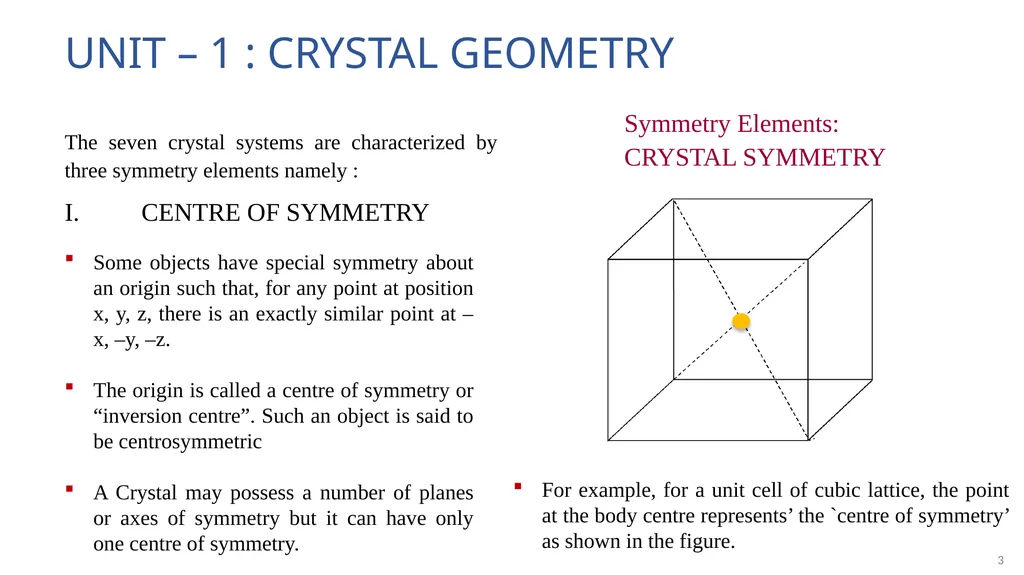
CRYSTAL SYMMETRY 3 Some objects have special symmetry about an origin such that, for any point at position x, y, z, there is an exactly similar point at –x, –y, –z.
The origin is called a centre of symmetry or “inversion centre”. Such an object is said to be centrosymmetric
A Crystal may possess a number of planes or axes of symmetry but it can have only one centre of symmetry. For example, for a unit cell of cubic lattice, the point at the body centre represents’ the `centre of symmetry’ as shown in the figure.<br>
04
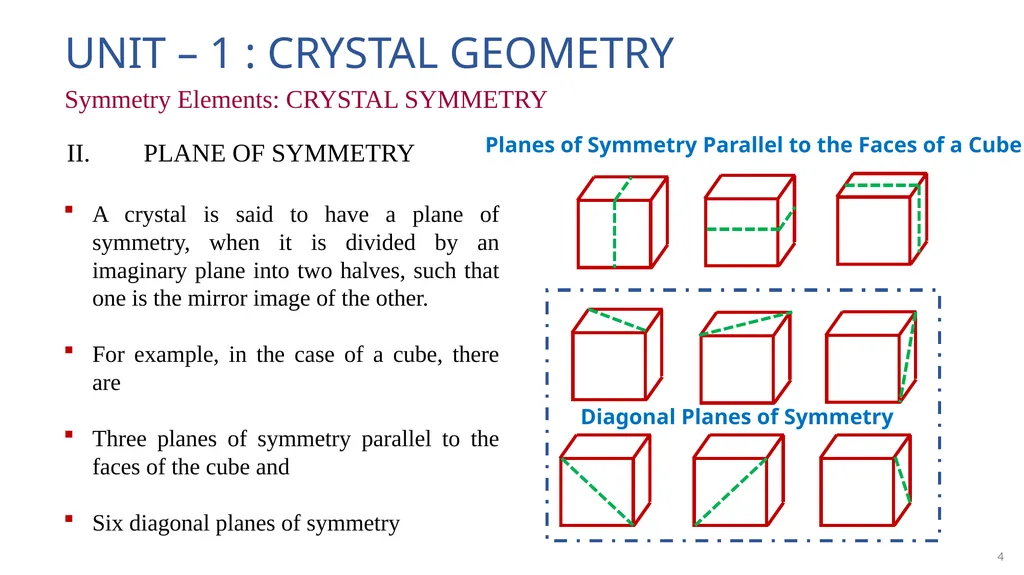
II. PLANE OF SYMMETRY UNIT – 1 : CRYSTAL GEOMETRY Symmetry Elements: CRYSTAL SYMMETRY 4 A crystal is said to have a plane of symmetry, when it is divided by an imaginary plane into two halves, such that one is the mirror image of the other.
For example, in the case of a cube, there are
Three planes of symmetry parallel to the faces of the cube and
Six diagonal planes of symmetry<br>
05
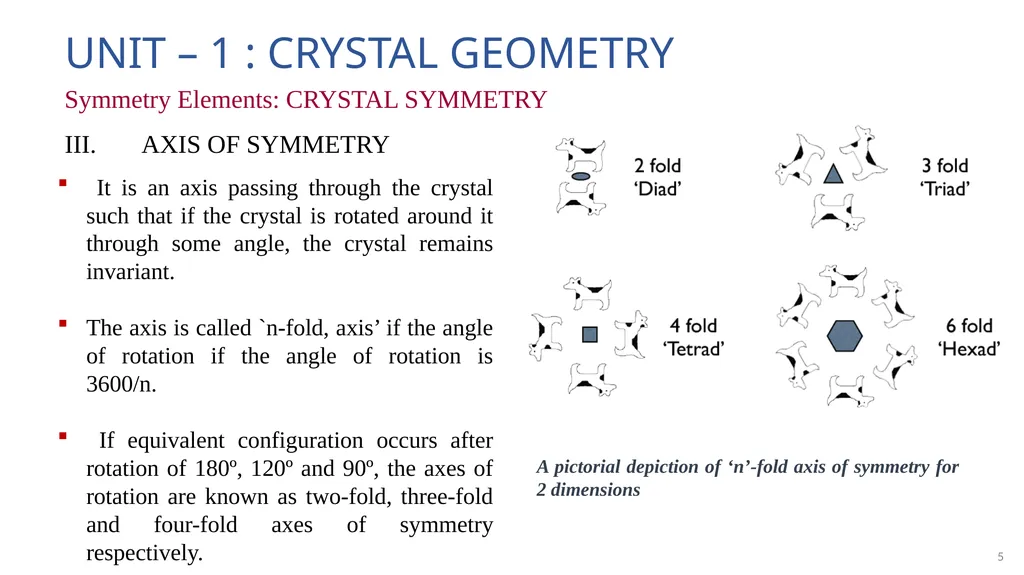
III. AXIS OF SYMMETRY UNIT – 1 : CRYSTAL GEOMETRY Symmetry Elements: CRYSTAL SYMMETRY 5 It is an axis passing through the crystal such that if the crystal is rotated around it through some angle, the crystal remains invariant.
The axis is called `n-fold, axis’ if the angle of rotation if the angle of rotation is 3600/n.
If equivalent configuration occurs after rotation of 180º, 120º and 90º, the axes of rotation are known as two-fold, three-fold and four-fold axes of symmetry respectively.<br>
06
III. AXIS OF SYMMETRY UNIT – 1 : CRYSTAL GEOMETRY Symmetry Elements: CRYSTAL SYMMETRY 6 If a cube is rotated through 90º, about an axis normal to one of its faces at its mid point, it brings the cube into the same position.
Hence during one complete rotation (360º) about this axisthe cube is coincident with its original position at four positions.
Thus this axis has four-fold axes of symmetry or is called a tetrad axis
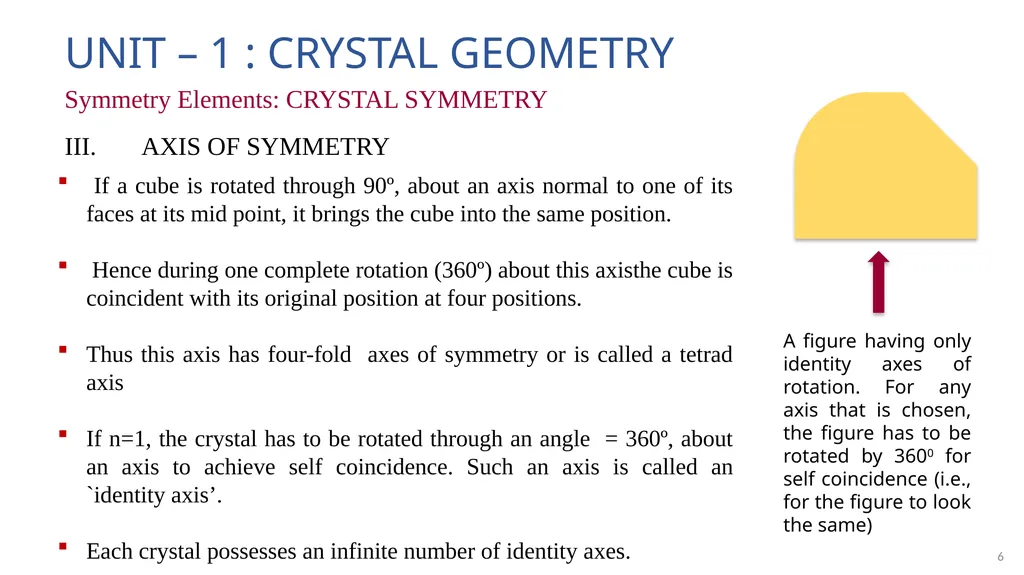
If n=1, the crystal has to be rotated through an angle = 360º, about an axis to achieve self coincidence. Such an axis is called an `identity axis’.
Each crystal possesses an infinite number of identity axes.<br>
07
III. AXIS OF SYMMETRY UNIT – 1 : CRYSTAL GEOMETRY Symmetry Elements: CRYSTAL SYMMETRY 7 If n=2, the crystal has to be rotated through an angle = 180º about an axis to achieve self coincidence. Such an axis is called a `diad axis’.
Since there are 12 such edges in a cube, the number of diad axes is six.
If n=3, the crystal has to be rotated through an angle = 120º about an axis to achieve self coincidence. Such an axis is called is `triad axis’. In a cube, the axis passing through a solid diagonal acts as a triad axis.<br>
08
III. AXIS OF SYMMETRY UNIT – 1 : CRYSTAL GEOMETRY Symmetry Elements: CRYSTAL SYMMETRY 8 Since there are 4 solid diagonals in a cube, the number of triad axis is four.
If n=6, the corresponding angle of rotation is 60º and the axis of rotation is called a hexad axis. A cubic crystal does not possess any hexad axis.
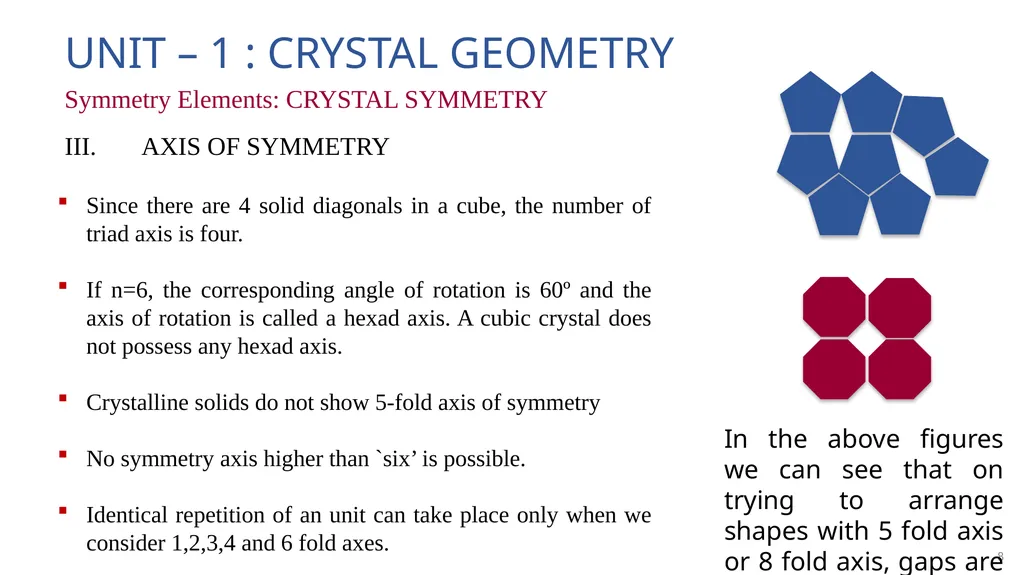
Crystalline solids do not show 5-fold axis of symmetry
No symmetry axis higher than `six’ is possible.
Identical repetition of an unit can take place only when we consider 1,2,3,4 and 6 fold axes.<br>
09
IV. ROTO INVERSION AXES UNIT – 1 : CRYSTAL GEOMETRY Symmetry Elements: CRYSTAL SYMMETRY 9 Rotation inversion axis is a symmetry element which has a compound operation of a proper rotation and an inversion [(x, y, z) (-x, -y, -z)]
A crystal structure is said to possess a rotation – inversion axis if it is brought into self coincidence by rotation followed by an inversion about a lattice point through which the rotation axis passes.<br>
10
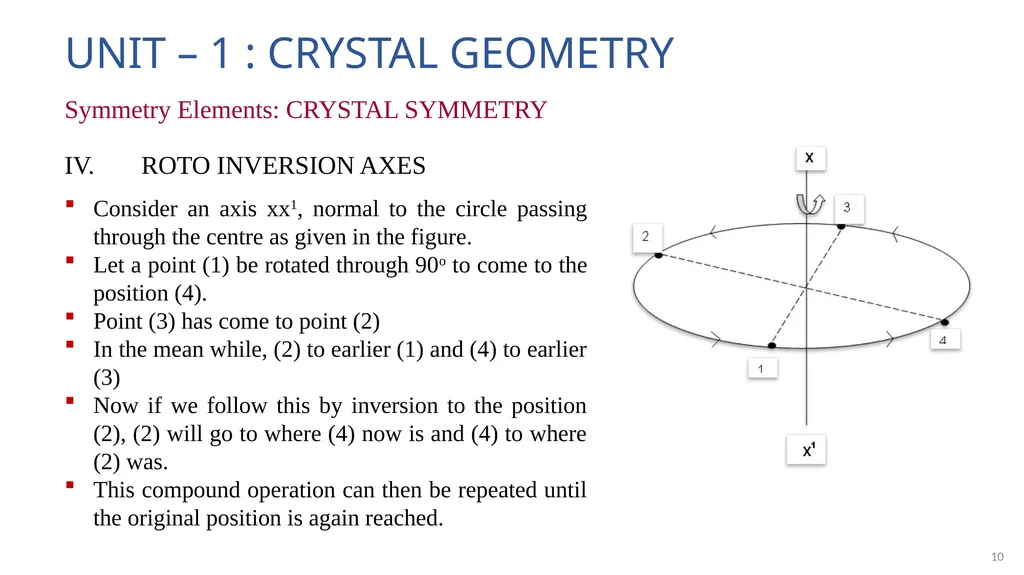
IV. ROTO INVERSION AXES UNIT – 1 : CRYSTAL GEOMETRY Symmetry Elements: CRYSTAL SYMMETRY 10 Consider an axis xx1, normal to the circle passing through the centre as given in the figure.
Let a point (1) be rotated through 90o to come to the position (4).
Point (3) has come to point (2)
In the mean while, (2) to earlier (1) and (4) to earlier (3)
Now if we follow this by inversion to the position (2), (2) will go to where (4) now is and (4) to where (2) was.
This compound operation can then be repeated until the original position is again reached.<br>
11
V. Combination of symmetry elements: Point groups and space groups UNIT – 1 : CRYSTAL GEOMETRY Symmetry Elements: CRYSTAL SYMMETRY 11 Apart from the different symmetry elements different combinations of the basic symmetry elements are also possible
They give rise to different symmetry points in the crystal.
The combination of symmetry elements at a point is called a `point group’.<br>
12
V. Combination of symmetry elements: Point groups and space groups UNIT – 1 : CRYSTAL GEOMETRY Symmetry Elements: CRYSTAL SYMMETRY 12 In crystals, 32 point groups are possible.
The combination of 32 point groups with 14 Bravais lattices lead to 230 unique arrangements of points in space.