This powerpoint contains activities and resources to prepare you to start A level in Biology in September. It is aimed to be used after you complete your GCSEs to ensure you are ready to start your course in September. All the links have
"This powerpoint contains activities and resources" is the property of its rightful owner. Permission is granted to
download and print the materials on this website for personal, non-commercial use only, and to display it
on your personal computer provided you do not modify the materials and that you retain all copyright
notices contained in the materials. By downloading content from our website, you accept the terms of this
agreement.
Presentation Transcript
01
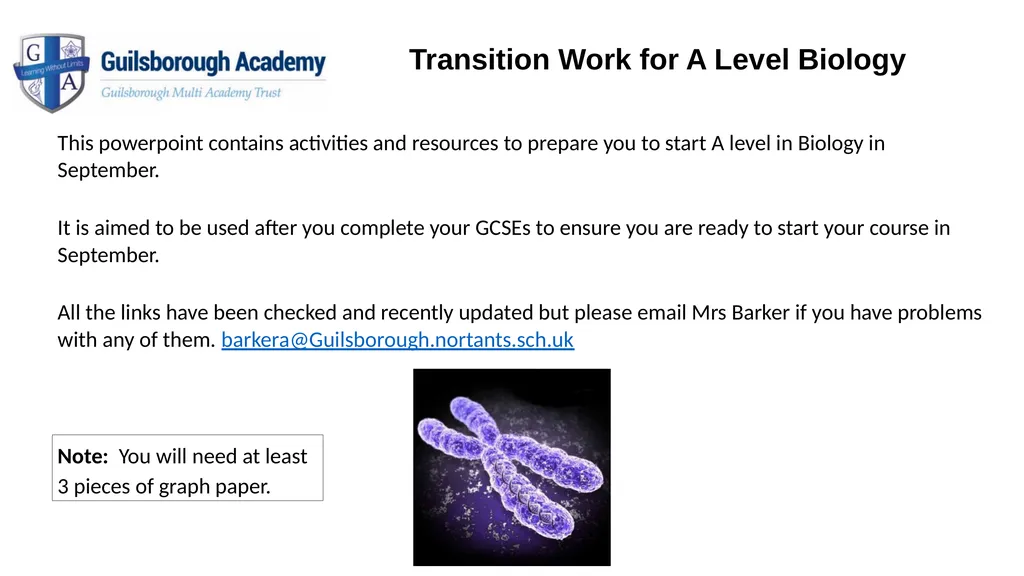
This powerpoint contains activities and resources to prepare you to start A level in Biology in September.
It is aimed to be used after you complete your GCSEs to ensure you are ready to start your course in September.
All the links have been checked and recently updated but please email Mrs Barker if you have problems with any of them. barkera@Guilsborough.nortants.sch.uk Transition Work for A Level Biology Note: You will need at least 3 pieces of graph paper.<br>
The cell is a unifying concept in biology, you will come across it many times during your two years of A level study. Prokaryotic and eukaryotic cells can be distinguished on the basis of their structure and ultrastructure.
Read the information on these websites (you could make more Cornell notes if you wish):
A-Level OCR Biology Notes - Foundations in Biology - Cell Structure - Revisely
Organelle Structure And Function | A-Level Biology Revision Notes (alevelbiology.co.uk)
And watch these videos:
https://www.youtube.com/watch?v=vwAJ8ByQH2U
https://www.youtube.com/watch?v=cj8dDTHGJBY
https://www.youtube.com/watch?v=9UvlqAVCoqY
Task:
Produce a one page revision guide summarising one of the following topics:
Cells and Cell Ultrastructure or Prokaryotes and Eukaryotes.
Whichever topic you choose, your revision guide should include:
Key words and definitions
Clearly labelled diagrams
Short explanations of key ideas or processes. Task 1:
Pre-Knowledge Topic - Cells<br>
04
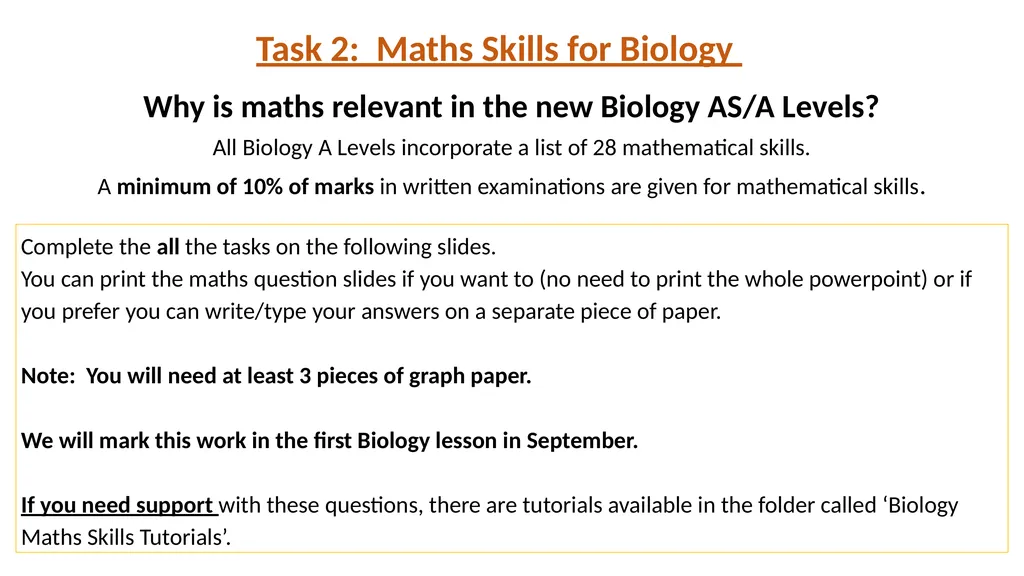
Why is maths relevant in the new Biology AS/A Levels?
All Biology A Levels incorporate a list of 28 mathematical skills.
A minimum of 10% of marks in written examinations are given for mathematical skills. Complete the all the tasks on the following slides.
You can print the maths question slides if you want to (no need to print the whole powerpoint) or if you prefer you can write/type your answers on a separate piece of paper.
Note: You will need at least 3 pieces of graph paper.
We will mark this work in the first Biology lesson in September.
If you need support with these questions, there are tutorials available in the folder called ‘Biology Maths Skills Tutorials’. Task 2: Maths Skills for Biology<br>
05
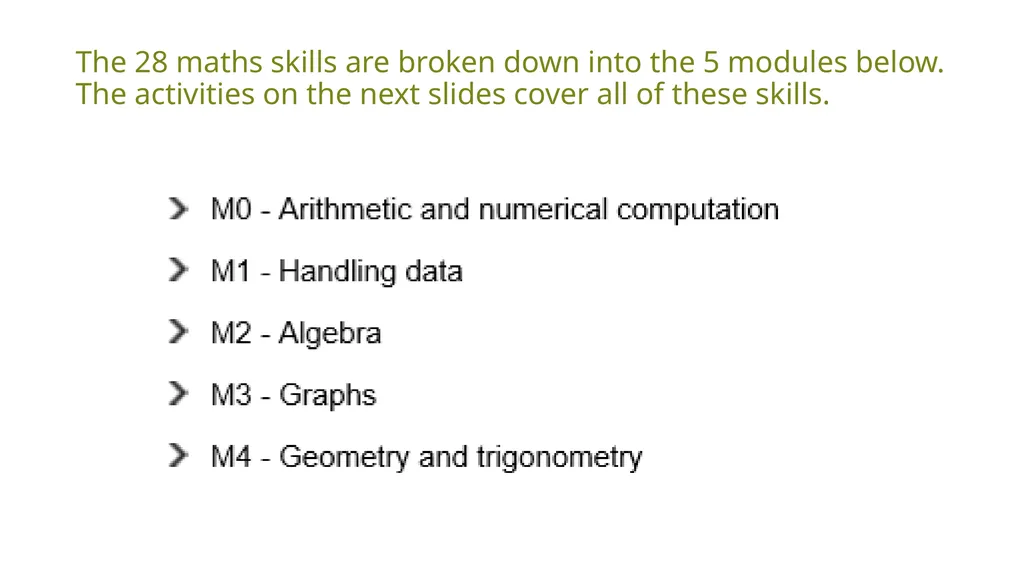
The 28 maths skills are broken down into the 5 modules below. The activities on the next slides cover all of these skills.<br>
06
M0 Arithmetic and numerical computation<br>
07
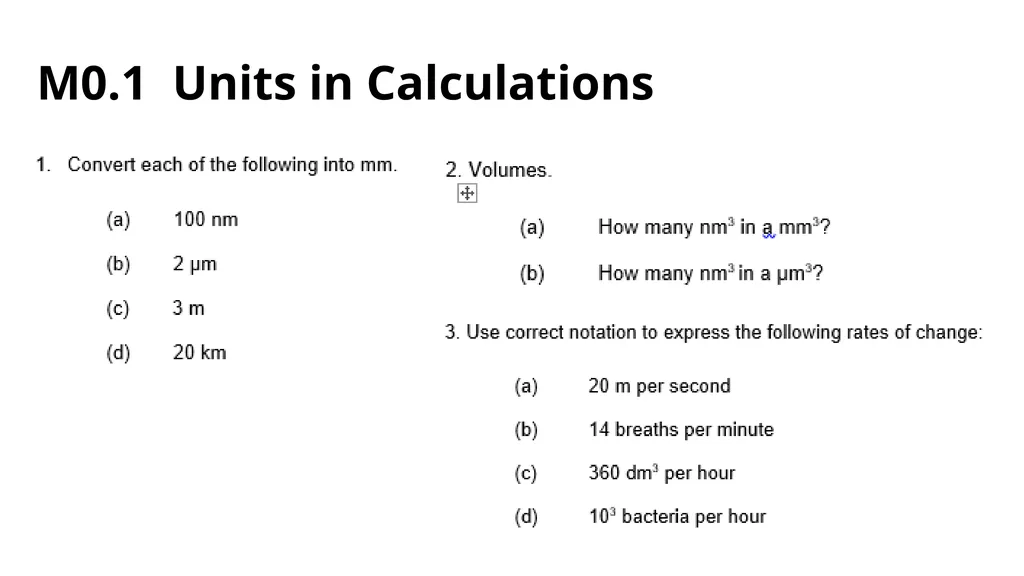
M0.1 Units in Calculations<br>
08
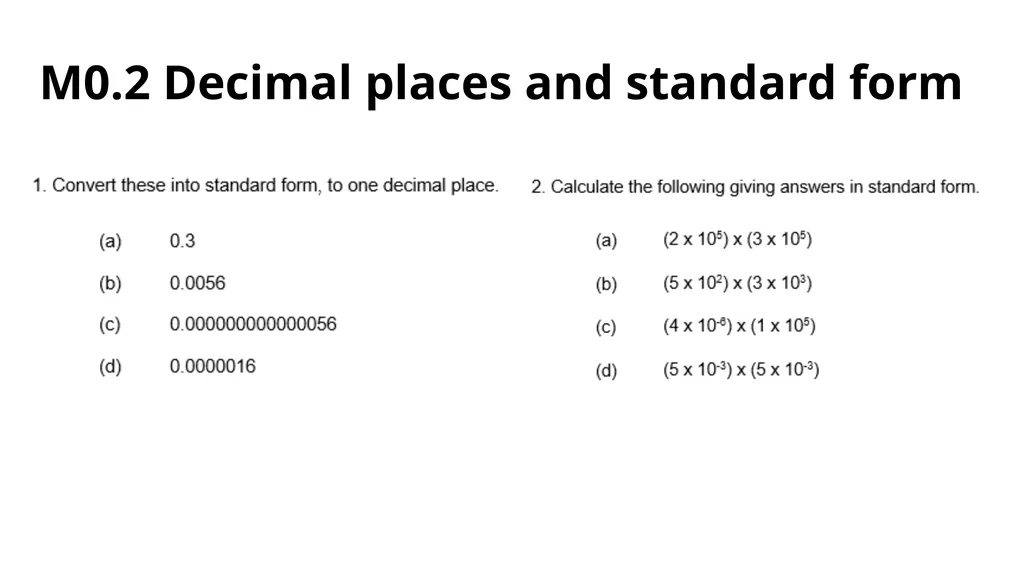
M0.2 Decimal places and standard form<br>
09
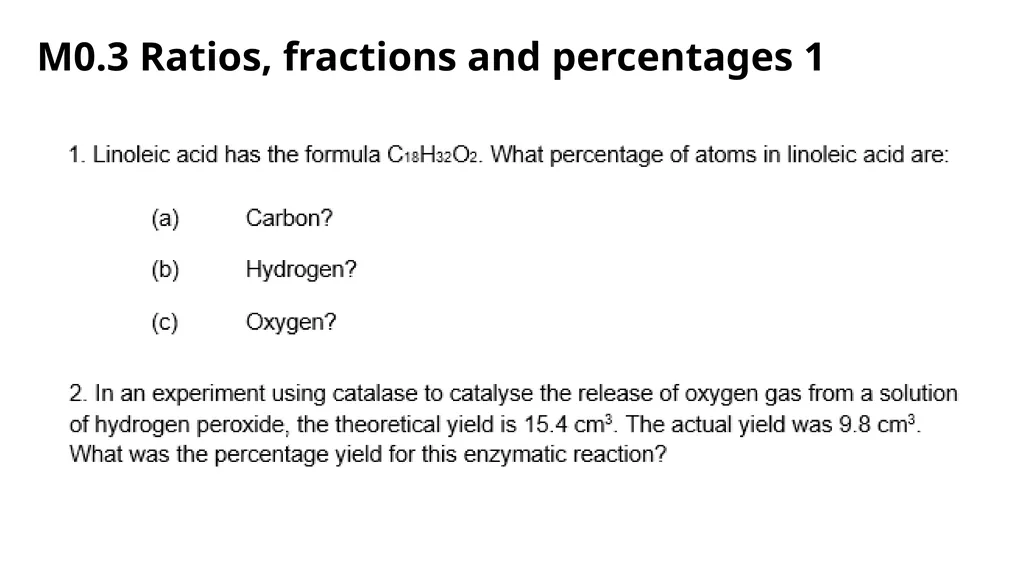
M0.3 Ratios, fractions and percentages 1<br>
10
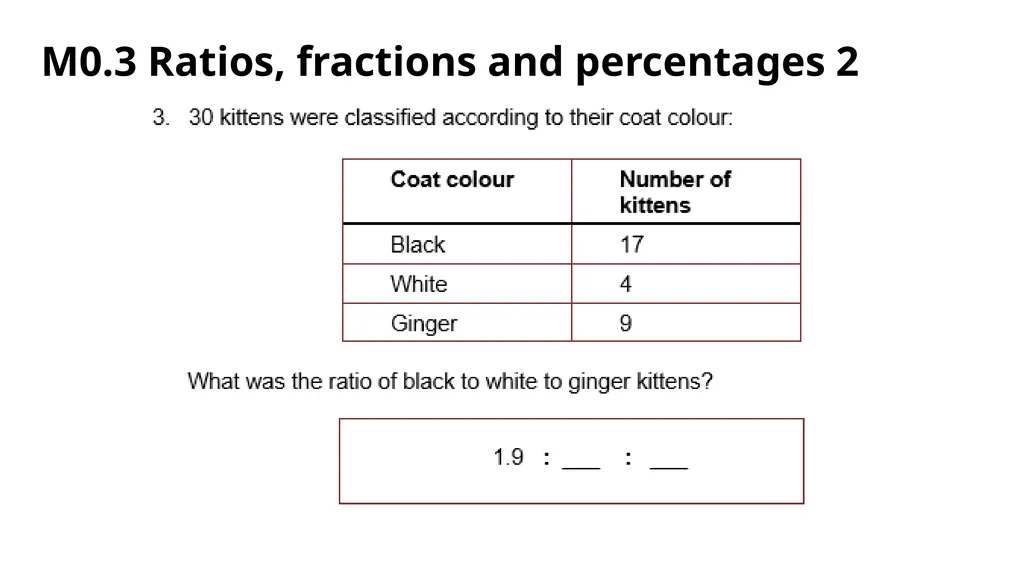
M0.3 Ratios, fractions and percentages 2<br>
11
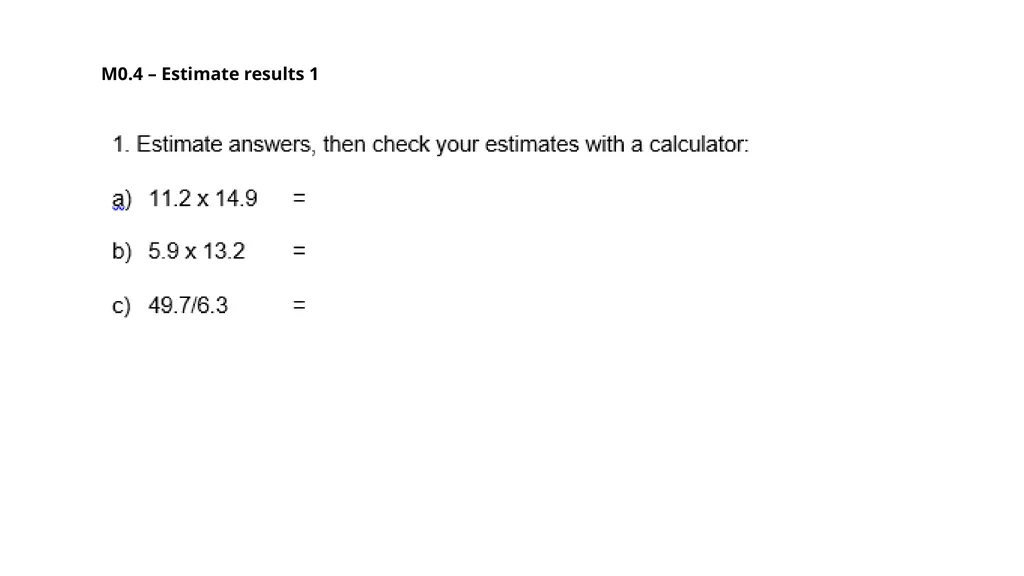
M0.4 – Estimate results 1<br>
12
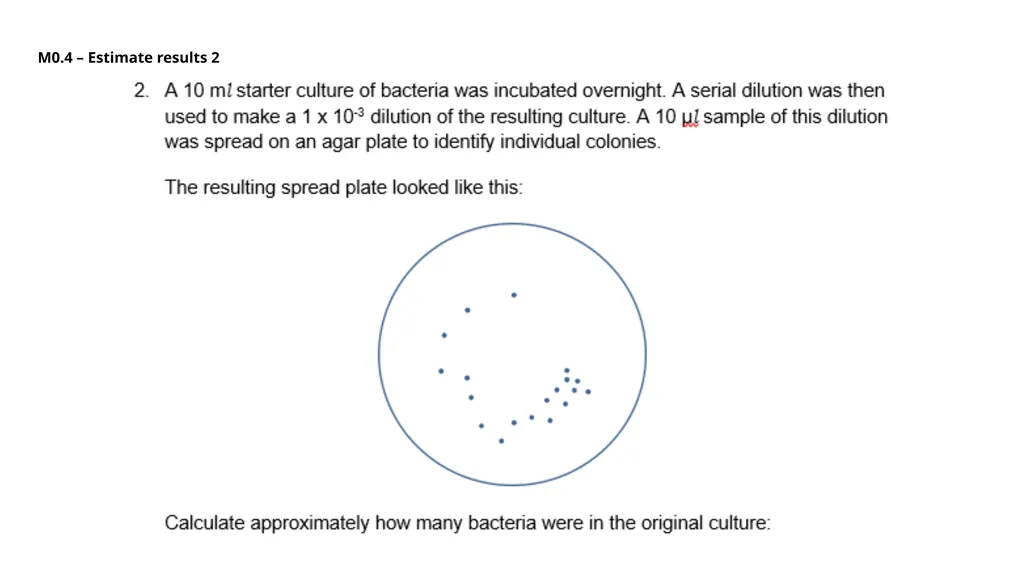
M0.4 – Estimate results 2<br>
13
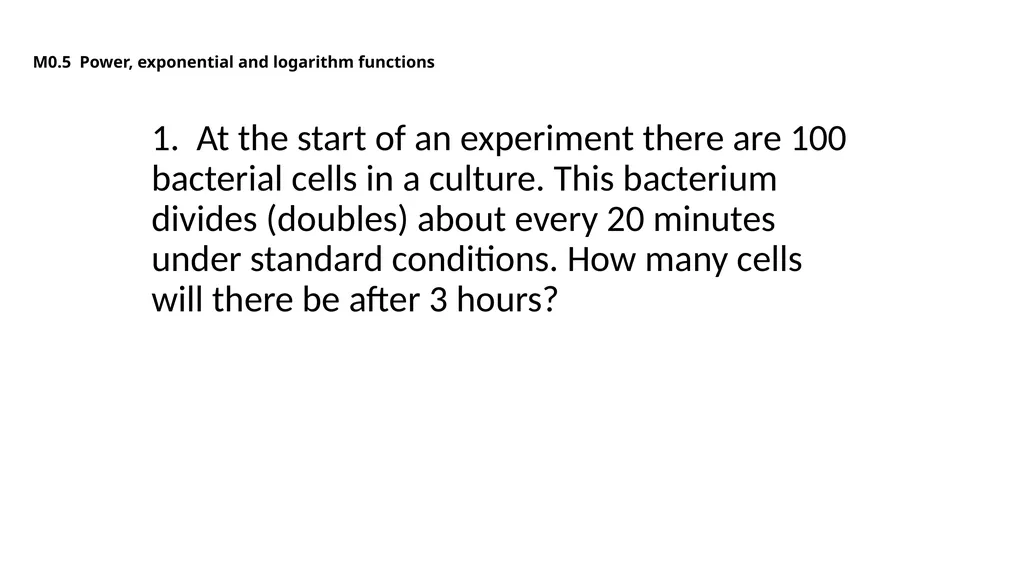
M0.5 Power, exponential and logarithm functions 1. At the start of an experiment there are 100 bacterial cells in a culture. This bacterium divides (doubles) about every 20 minutes under standard conditions. How many cells will there be after 3 hours?<br>
14
M1 Handling data<br>
15
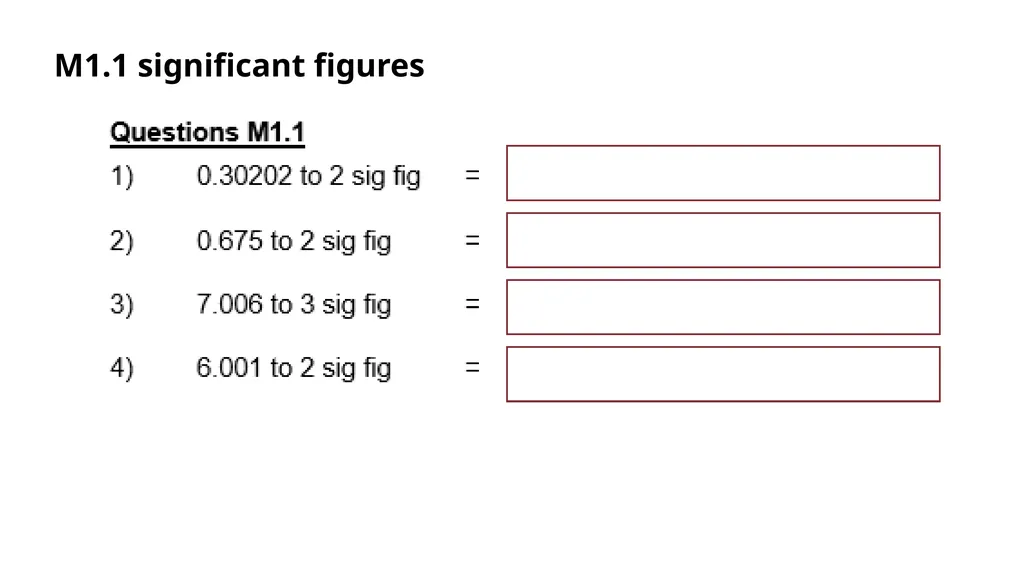
M1.1 significant figures<br>
16
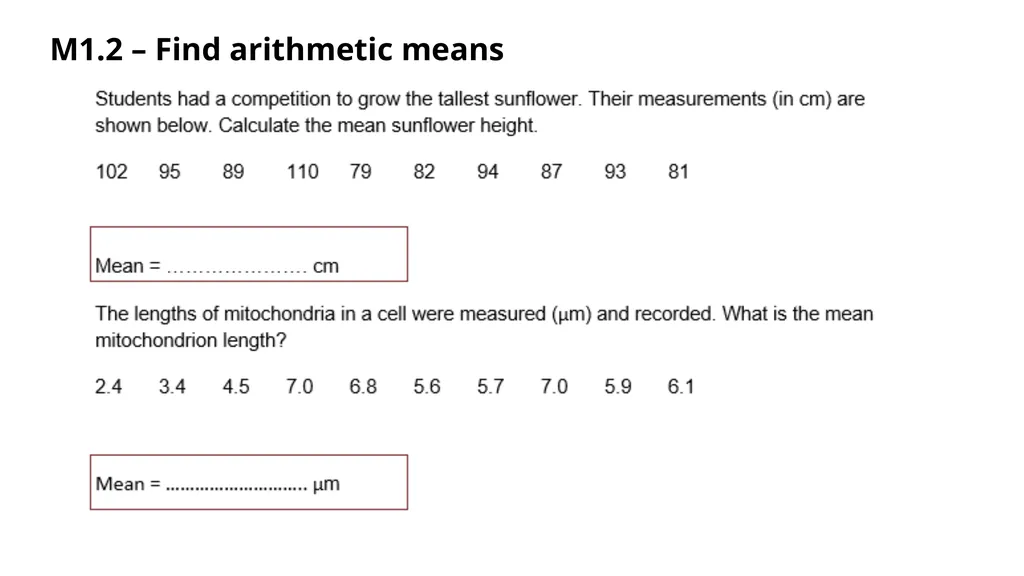
M1.2 – Find arithmetic means<br>
17
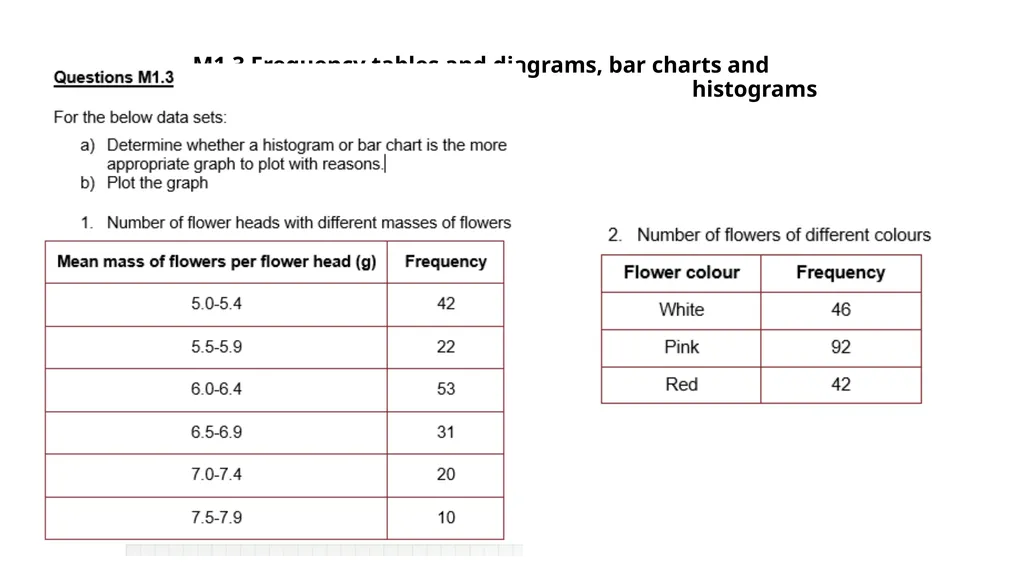
M1.3 Frequency tables and diagrams, bar charts and histograms<br>
18
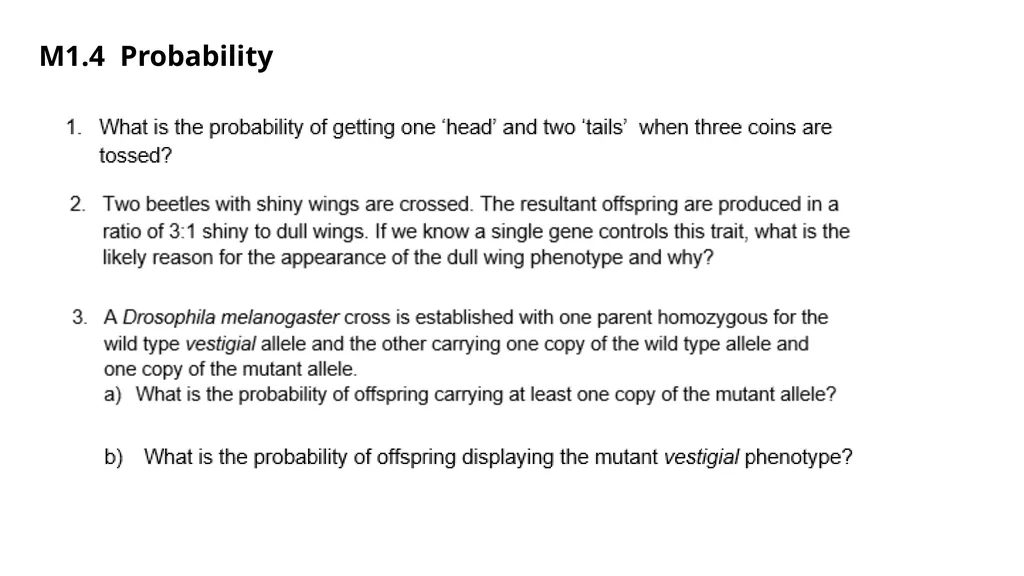
M1.4 Probability<br>
19
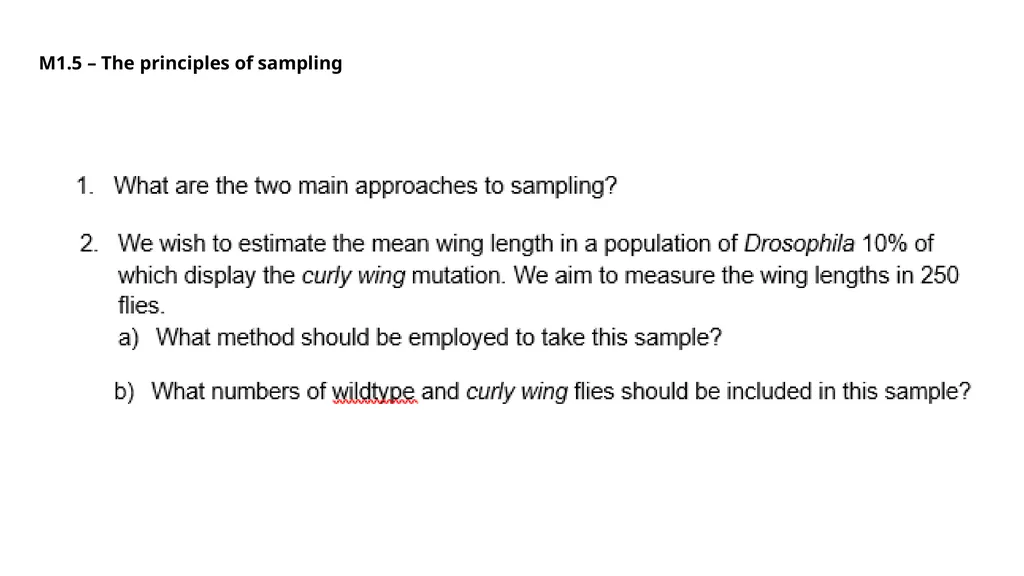
M1.5 – The principles of sampling<br>
20
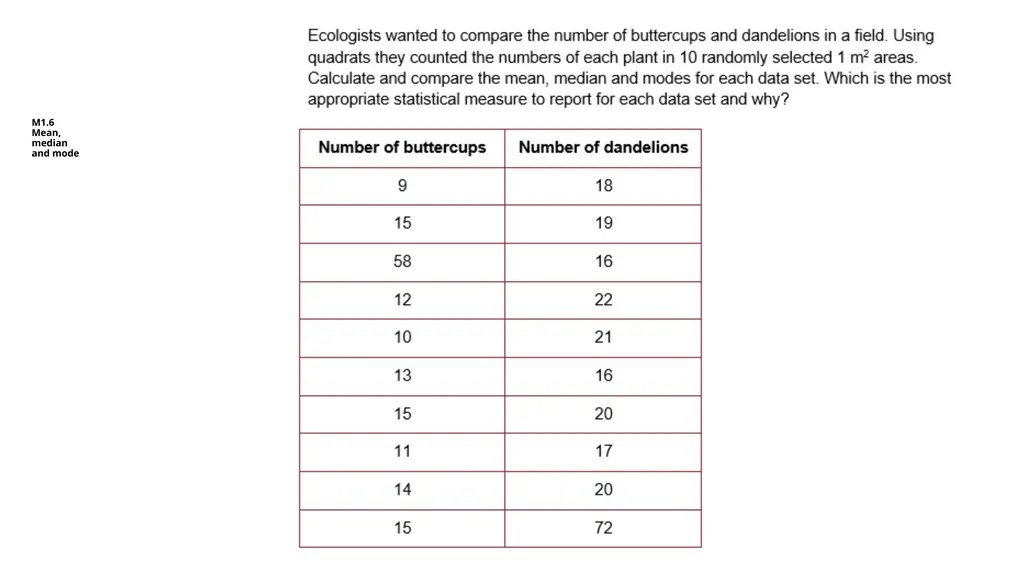
M1.6 Mean, median and mode<br>
21
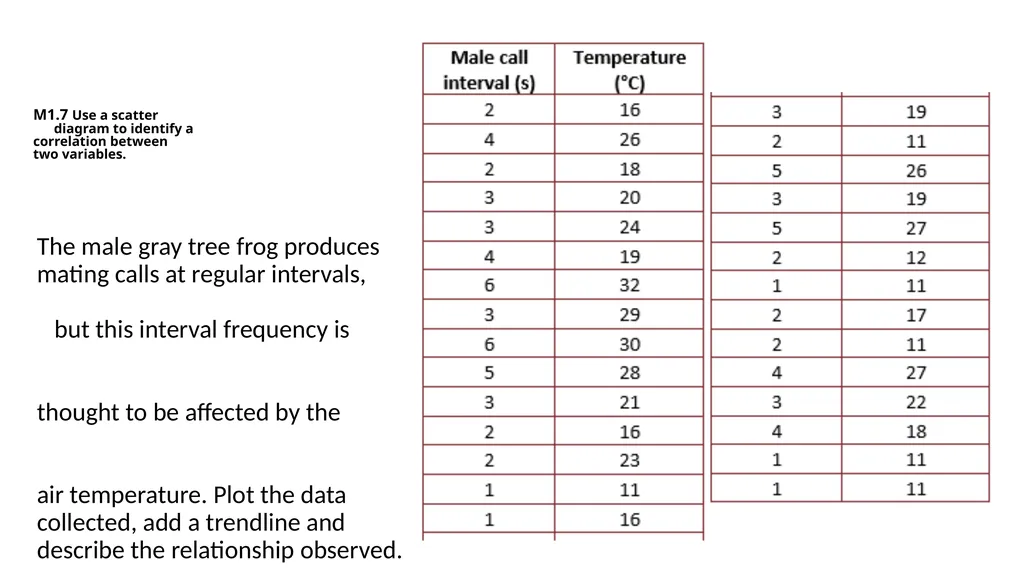
M1.7 Use a scatter diagram to identify a correlation between two variables. The male gray tree frog produces mating calls at regular intervals, but this interval frequency is thought to be affected by the air temperature. Plot the data collected, add a trendline and describe the relationship observed.<br>
22
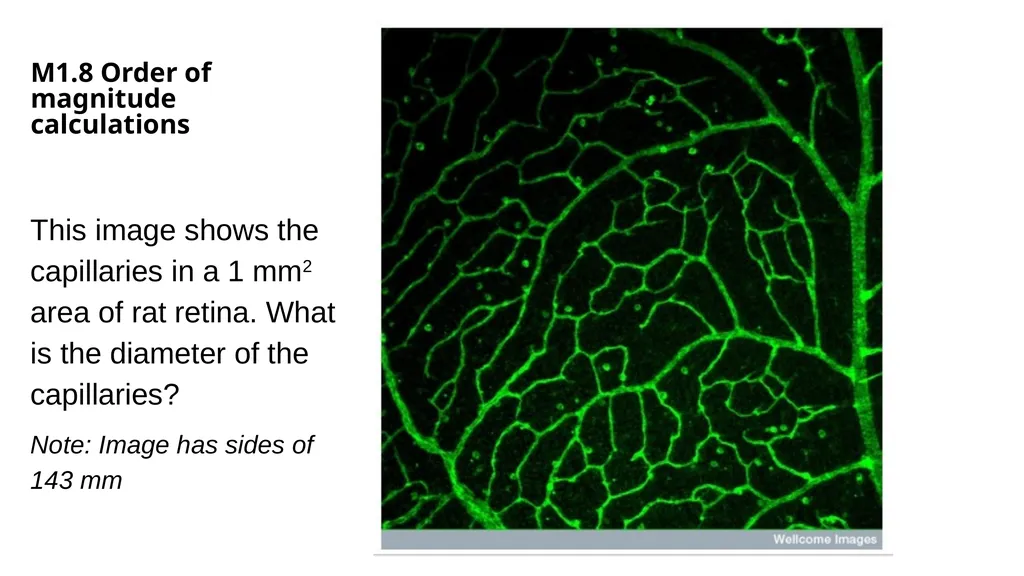
M1.8 Order of magnitude calculations This image shows the capillaries in a 1 mm2 area of rat retina. What is the diameter of the capillaries?
Note: Image has sides of 143 mm<br>
23
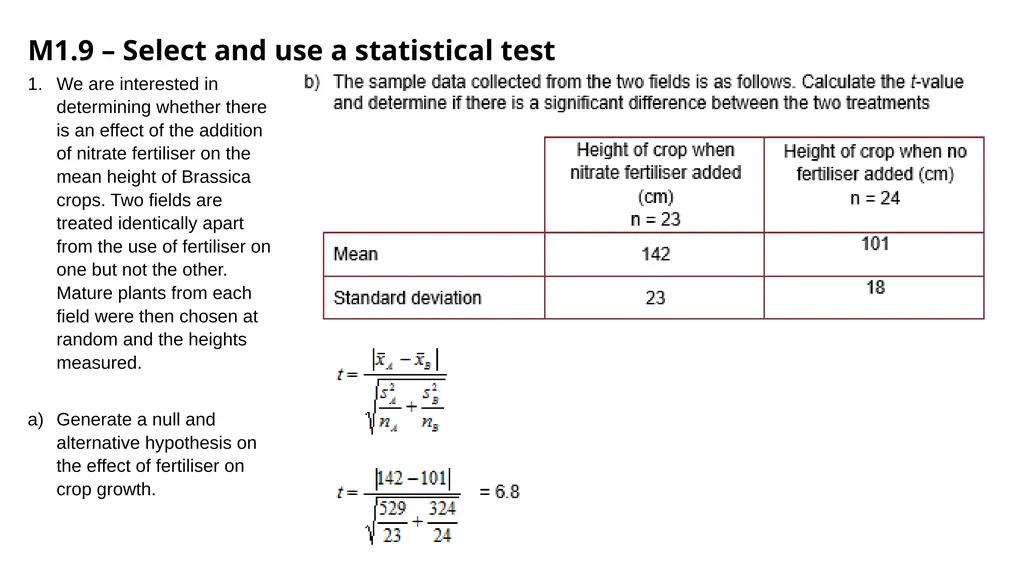
M1.9 – Select and use a statistical test We are interested in determining whether there is an effect of the addition of nitrate fertiliser on the mean height of Brassica crops. Two fields are treated identically apart from the use of fertiliser on one but not the other. Mature plants from each field were then chosen at random and the heights measured.
Generate a null and alternative hypothesis on the effect of fertiliser on crop growth.<br>
24
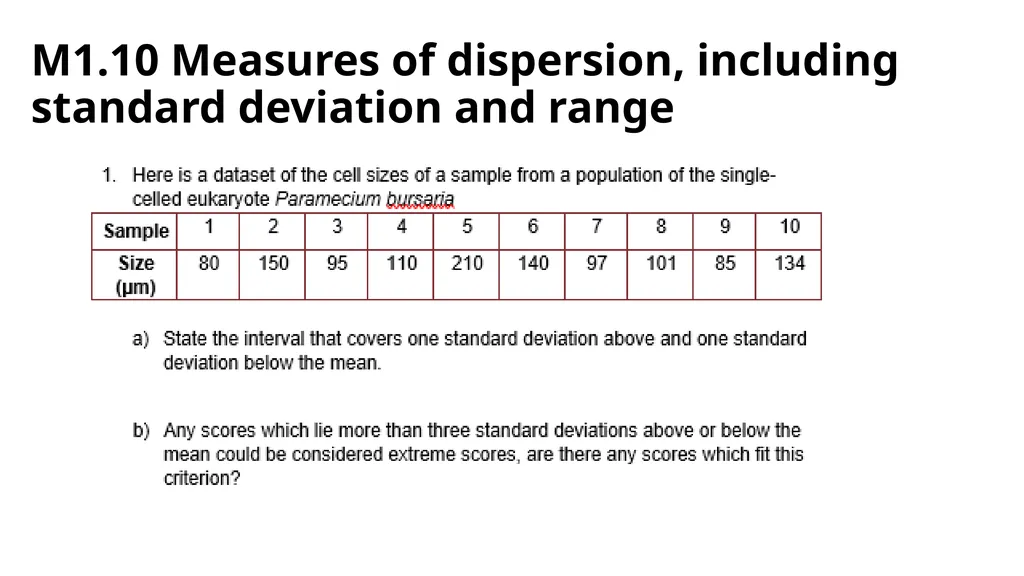
M1.10 Measures of dispersion, including standard deviation and range<br>
25
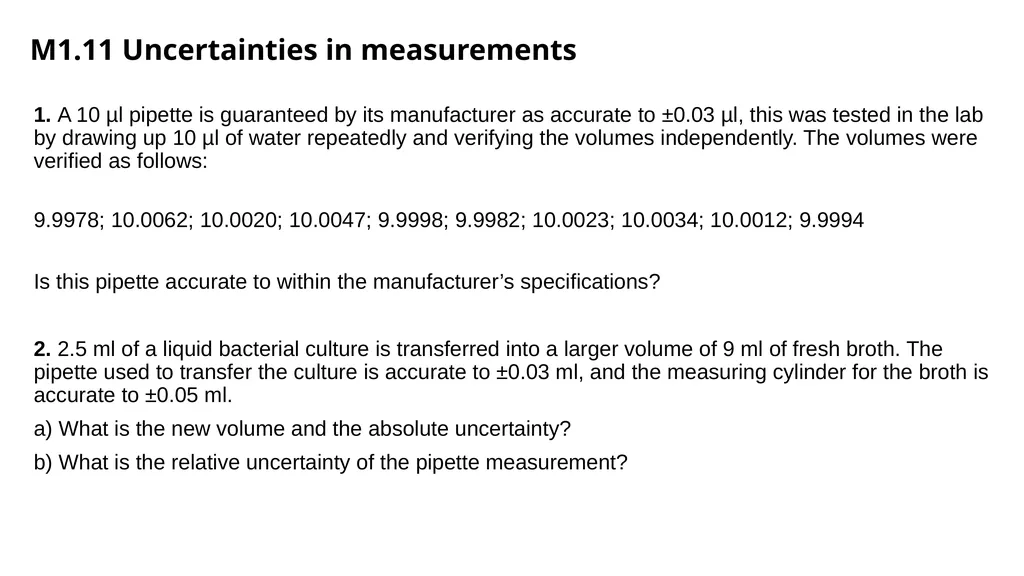
M1.11 Uncertainties in measurements 1. A 10 µl pipette is guaranteed by its manufacturer as accurate to ±0.03 µl, this was tested in the lab by drawing up 10 µl of water repeatedly and verifying the volumes independently. The volumes were verified as follows:
9.9978; 10.0062; 10.0020; 10.0047; 9.9998; 9.9982; 10.0023; 10.0034; 10.0012; 9.9994
Is this pipette accurate to within the manufacturer’s specifications?
2. 2.5 ml of a liquid bacterial culture is transferred into a larger volume of 9 ml of fresh broth. The pipette used to transfer the culture is accurate to ±0.03 ml, and the measuring cylinder for the broth is accurate to ±0.05 ml.
a) What is the new volume and the absolute uncertainty?
b) What is the relative uncertainty of the pipette measurement?<br>
26
M2 Algebra<br>
27
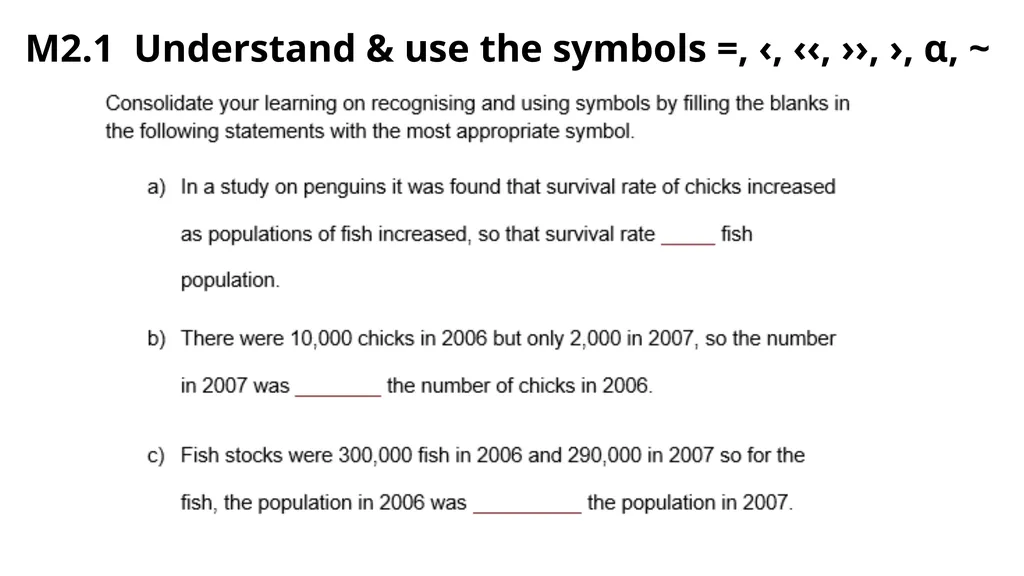
M2.1 Understand & use the symbols =, ‹, ‹‹, ››, ›, α, ~<br>