This product was funded under a cooperative agreement from the Substance Abuse and Mental Health Services Administration (SAMHSA) Center for Substance Abuse Treatment (CSAT) (Grant Number TI-080200). All material, except that taken directly
"This product was funded under a cooperative" is the property of its rightful owner. Permission is granted to
download and print the materials on this website for personal, non-commercial use only, and to display it
on your personal computer provided you do not modify the materials and that you retain all copyright
notices contained in the materials. By downloading content from our website, you accept the terms of this
agreement.
Presentation Transcript
01
This product was funded under a cooperative agreement from the Substance Abuse and Mental Health Services Administration (SAMHSA) Center for Substance Abuse Treatment (CSAT) (Grant Number TI-080200). All material, except that taken directly from copyrighted sources, is in the public domain and may be used and reprinted for training purposes without special permission. However, any content used should be attributed to the Mountain Plains Addiction Technology Transfer Center.<br>
02
Substance Use Disorder: A Chronic, Relapsing Brain Disease Prepared by Mountain Plains ATTC University of North Dakota Grand Forks, ND 58202 701-777-4520<br>
03
Objectives: After completing this presentation, participants will:
Reflect on their own thoughts/biases related to addiction.
Review the brain reward system associated with addiction
Acknowledge that addiction is a chronic, relapsing disease<br>
04
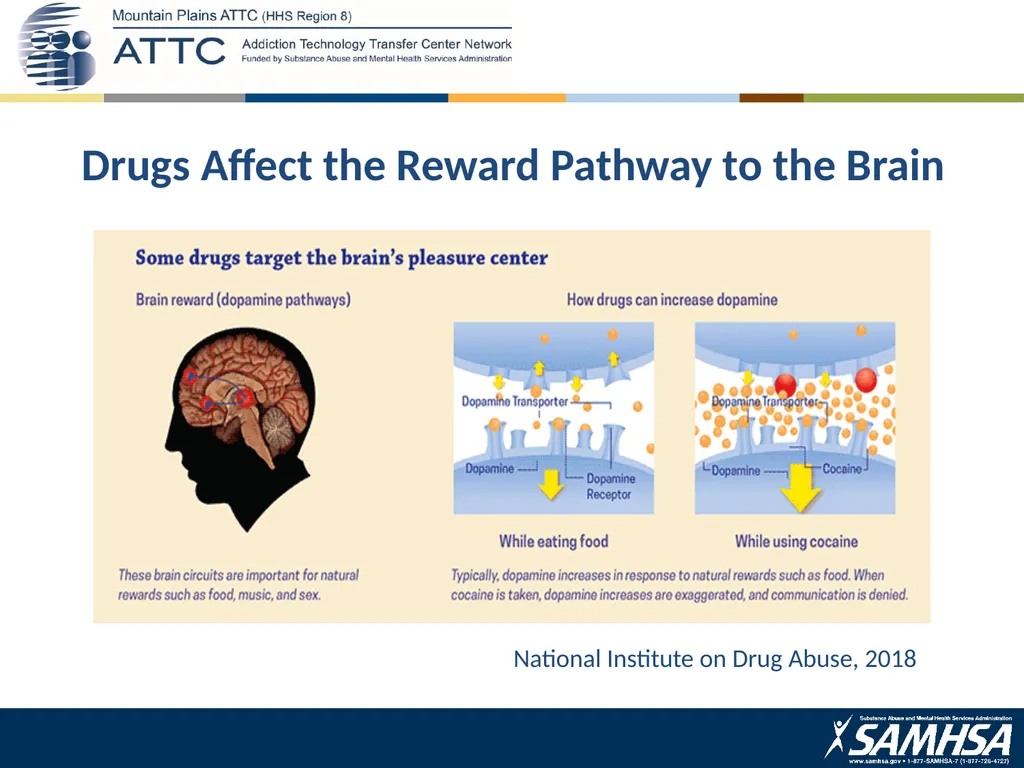
Drugs Affect the Reward Pathway to the Brain National Institute on Drug Abuse, 2018<br>
05
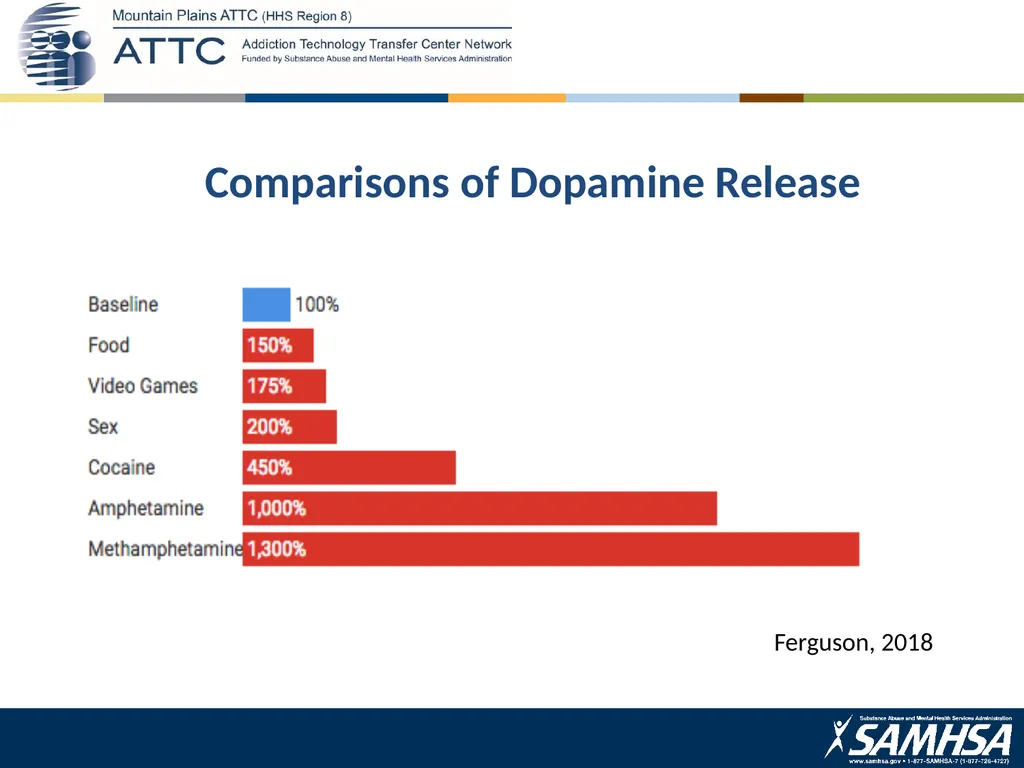
Comparisons of Dopamine Release Ferguson, 2018<br>
06
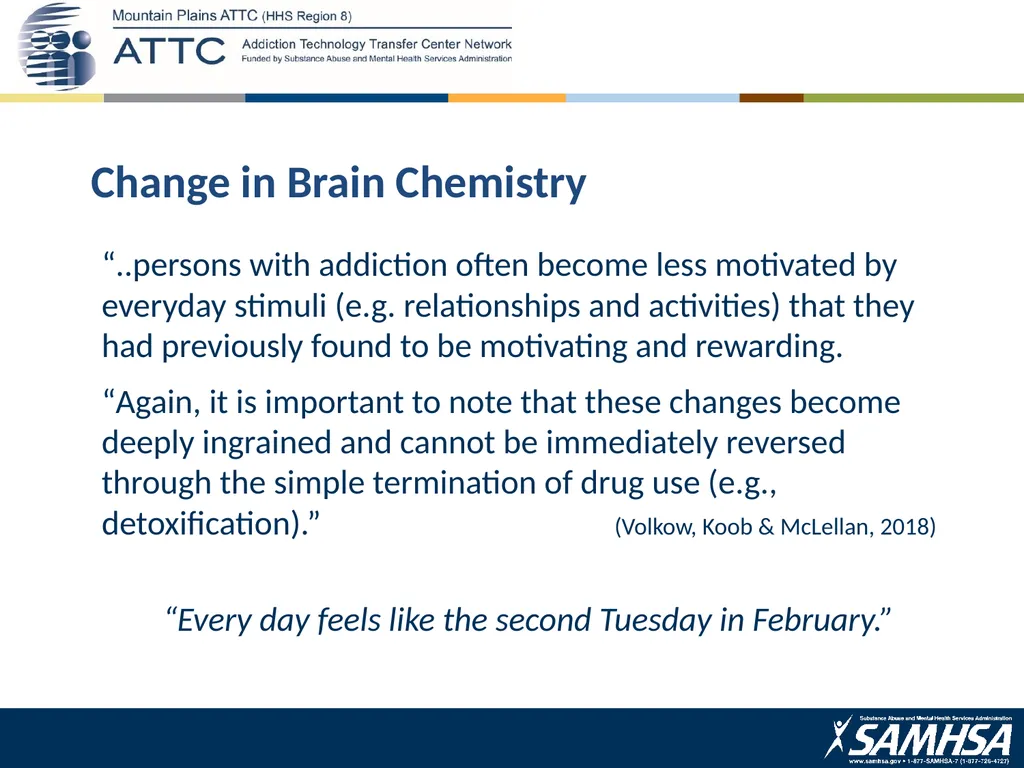
Change in Brain Chemistry “..persons with addiction often become less motivated by everyday stimuli (e.g. relationships and activities) that they had previously found to be motivating and rewarding.
“Again, it is important to note that these changes become deeply ingrained and cannot be immediately reversed through the simple termination of drug use (e.g., detoxification).” (Volkow, Koob & McLellan, 2018)
“Every day feels like the second Tuesday in February.”<br>
07
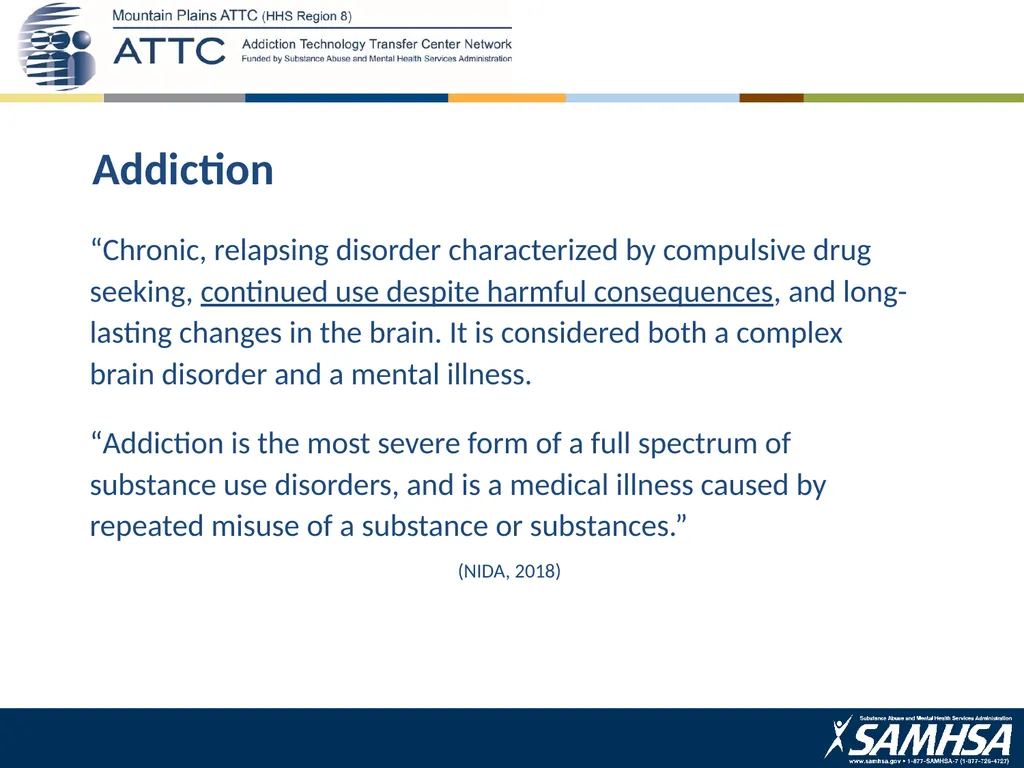
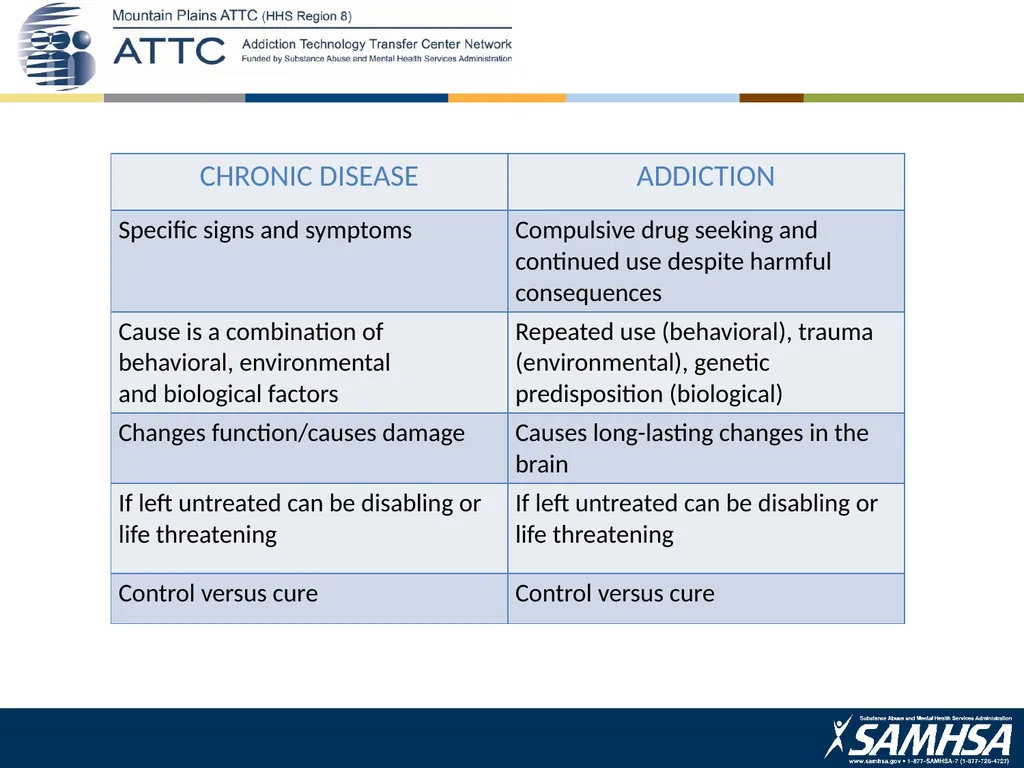
Addiction “Chronic, relapsing disorder characterized by compulsive drug seeking, continued use despite harmful consequences, and long-lasting changes in the brain. It is considered both a complex brain disorder and a mental illness.
“Addiction is the most severe form of a full spectrum of substance use disorders, and is a medical illness caused by repeated misuse of a substance or substances.” (NIDA, 2018)<br>
08
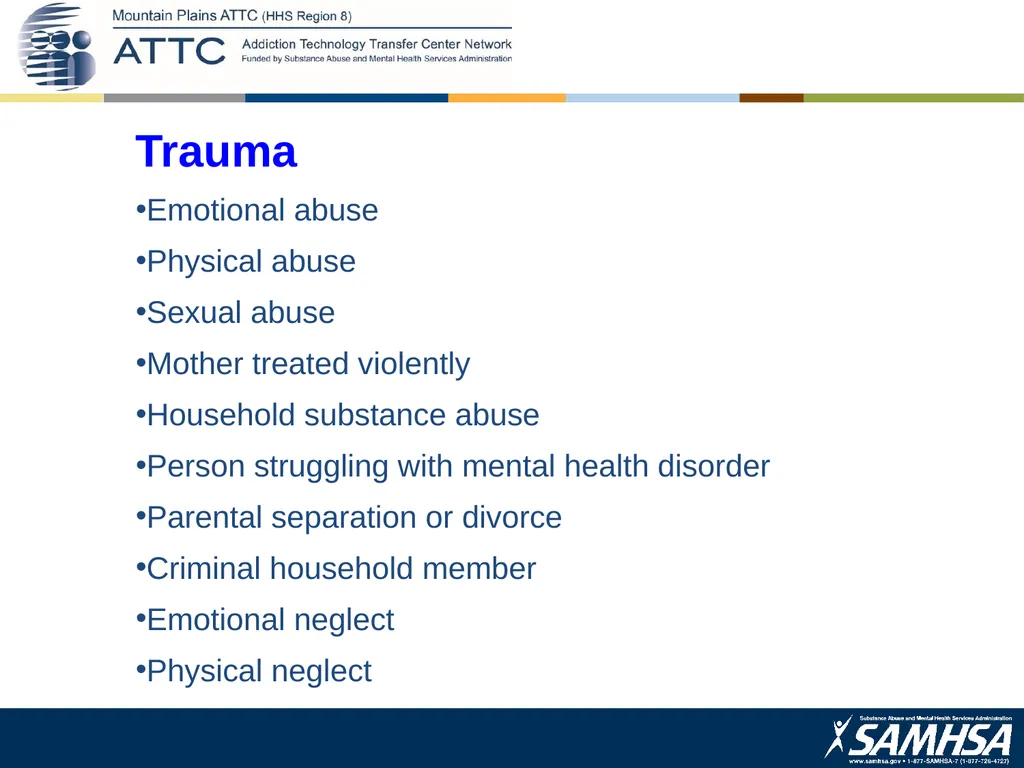
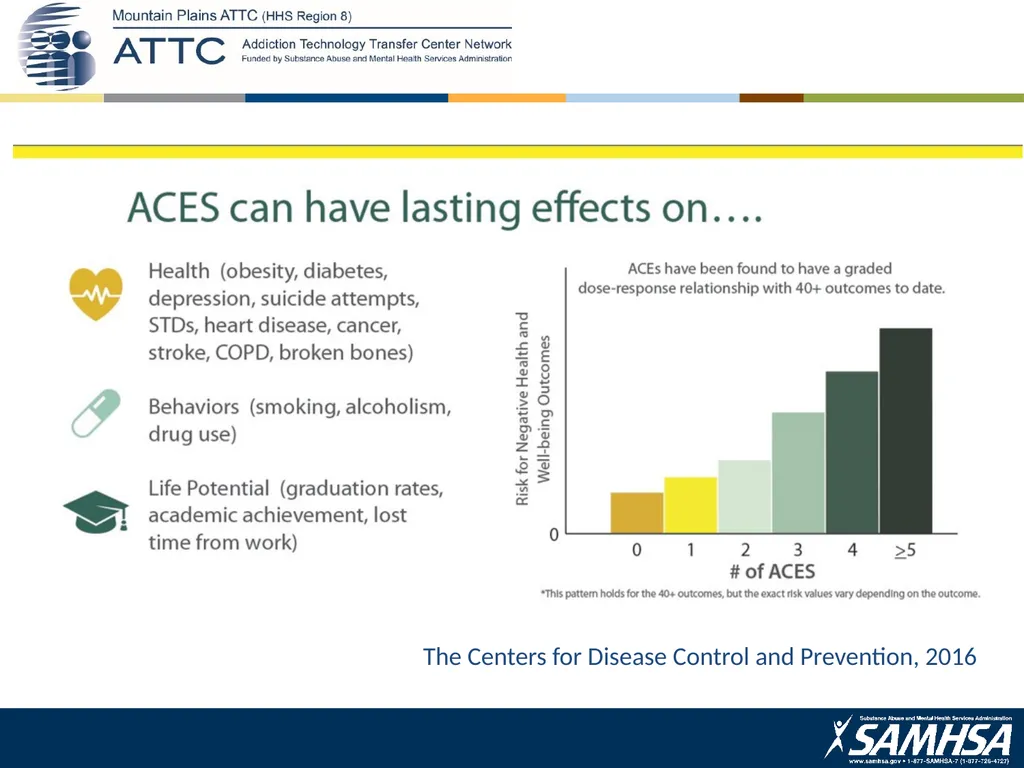
Trauma
Emotional abuse
Physical abuse
Sexual abuse
Mother treated violently
Household substance abuse
Person struggling with mental health disorder
Parental separation or divorce
Criminal household member
Emotional neglect
Physical neglect<br>
09
The Centers for Disease Control and Prevention, 2016<br>
10
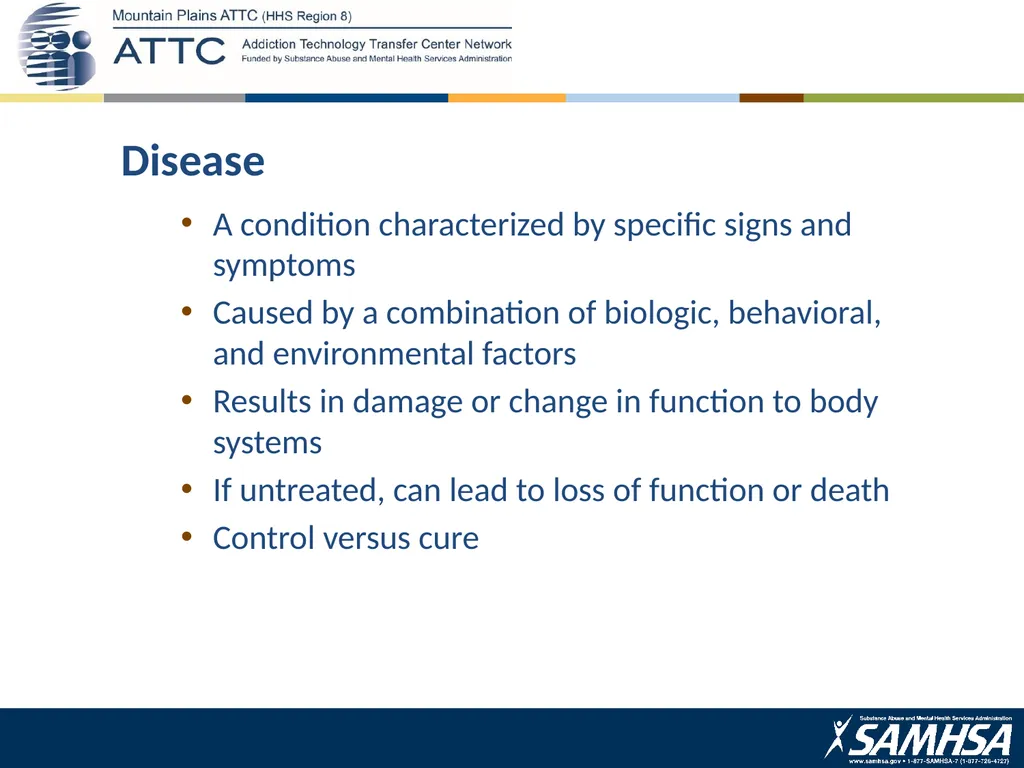
Disease A condition characterized by specific signs and symptoms
Caused by a combination of biologic, behavioral, and environmental factors
Results in damage or change in function to body systems
If untreated, can lead to loss of function or death
Control versus cure<br>
11
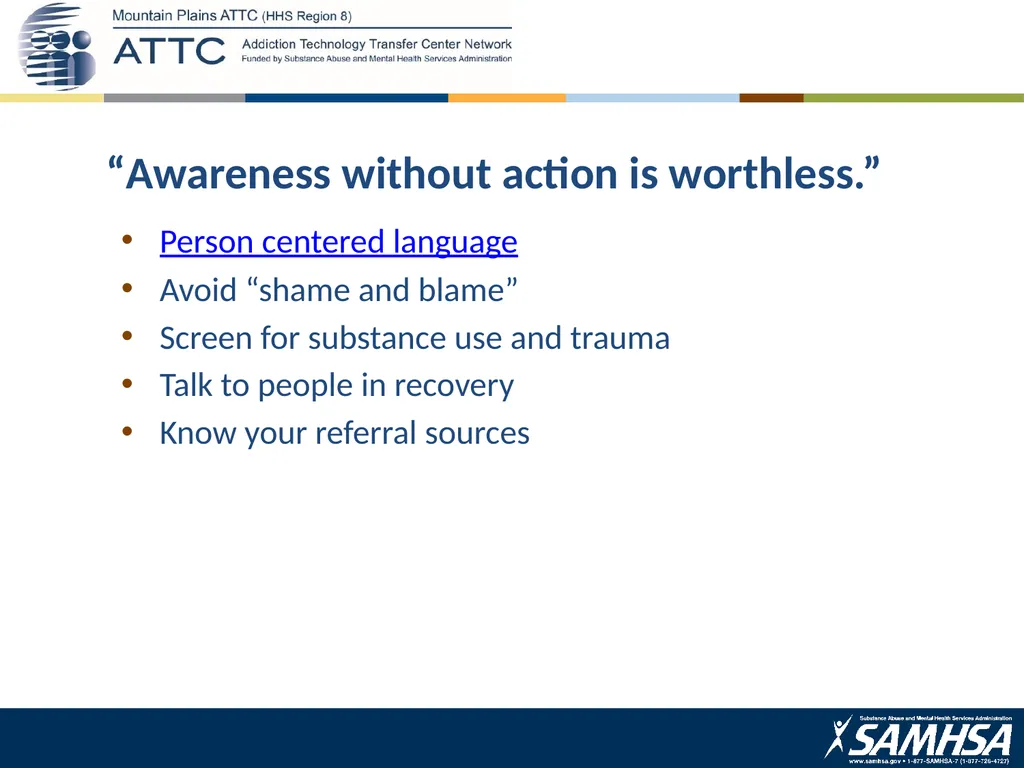
“Awareness without action is worthless.” Person centered language
Avoid “shame and blame”
Screen for substance use and trauma
Talk to people in recovery
Know your referral sources<br>
12
Madelyn Linsenmeier
1988 - 2018 A Powerful Message from Family<br>
13
References Centers for Disease Control and Prevention (2016) About Adverse Childhood Experiences. https://www.cdc.gov/violenceprevention/acestudy/about_ace.html
Ferguson, C.J. (2018) Debunking the Biggest Myths About Technology Addiction. Discover. http://blogs.discovermagazine.com/crux/2018/05/23/debunking-myths-technology-addiction/#.W9Z7OOJRfb1
National Institute on Drug Abuse (2018). Drugs, Brains, and Behavior: The Science of Addiction. https://www.drugabuse.gov/publications/drugs-brains-behavior-science-addiction/drugs-brain
Volkow, N.D., Koob, G.F. & McLellan, T. (2016) Neurobiologic Advances from the Brain Disease Model of Addiction New England Journal of Medicine 374:363-317.<br>