
This resource pack aims to raise awareness about






Description: This resource pack aims to raise awareness about the topics we want to embed into practice. The expectation is that you will share this resource pack widely and use it: in team meetings, as part of groupindividual supervision, for own
Related Topics
Download Presentation
"This resource pack aims to raise awareness about" is the property of its rightful owner. Permission is granted to download and print the materials on this website for personal, non-commercial use only, and to display it on your personal computer provided you do not modify the materials and that you retain all copyright notices contained in the materials. By downloading content from our website, you accept the terms of this agreement.
Presentation Transcript
slide1. This resource pack aims to raise awareness about the topics we want to embed into practice.
The expectation is that you will share this resource pack widely and use it:
in team meetings,
as part of group/individual supervision,
for own development.
You can look at it as a whole or dip in or out of it at your convenience. Use the icons below to navigate through. What is professional curiosity? Top tips Watch/listen to films Navigation bar - dip in/out: Credit and thanks to Waltham Forest Safeguarding Adults Board for sharing these resources<br>
slide2. A lack of professional curiosity can lead to:
missed opportunities to identify less obvious indicators of vulnerability or significant harm,
assumptions made in assessments of needs and risk which are incorrect and lead to wrong intervention for individuals and families. WHAT is professional curiosity? Professional curiosity is a combination of looking, listening, asking direct questions, checking out and reflecting on information received. It means:
testing out your professional hypothesis and not making assumptions,
gathering all the information from different sources to gain a better understanding of individuals and family functioning,
getting an understanding of individuals’ and families’ past history which in turn, may help you think about what may happen in the future,
obtaining multiple sources of information and not accepting a single set of details you are given at face value,
having an awareness of your own personal bias and how that affects how you see those you are working with,
being respectively curious. Why is it important? Watch/listen to films Home Navigation bar - dip in/out:<br>
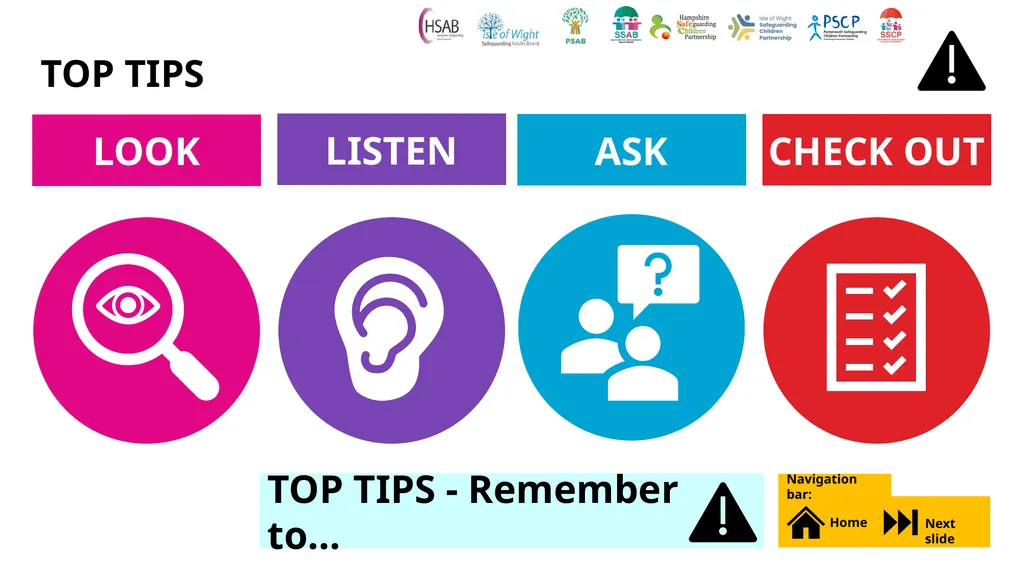
slide3. TOP TIPS Home Navigation bar: TOP TIPS - Remember to…<br>
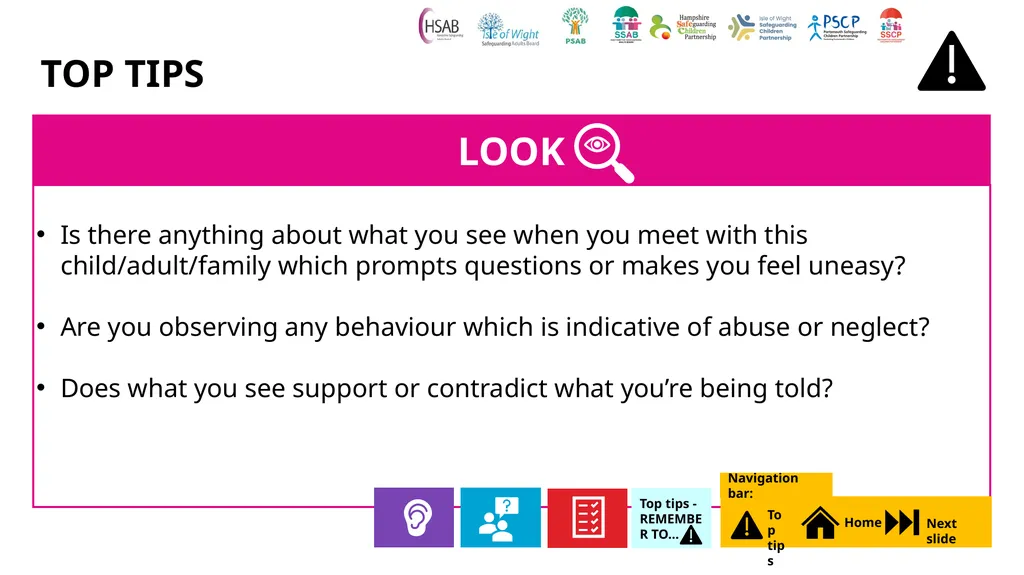
slide4. Is there anything about what you see when you meet with this child/adult/family which prompts questions or makes you feel uneasy?
Are you observing any behaviour which is indicative of abuse or neglect?
Does what you see support or contradict what you’re being told? LOOK TOP TIPS Home Navigation bar:<br>
slide5. Are you being told anything which needs further clarification?
Are you concerned about what you hear family members say to each other?
Is someone in this family trying to tell you something but is finding it difficult to express themselves? If so, how can you help them to do so? LISTEN TOP TIPS Home Navigation bar:<br>
slide6. Are there direct questions you could ask when you meet this child/adult/family which will provide more information about the vulnerability of individual family members?
Here are some examples:
- How do you spend a typical day? - How did you get that injury?
- Who do you live with? - Who is this with you?
- When were you last happy? - When do you feel safe?
- What do you look forward to? - Why are you not at school? ASK TOP TIPS Home Navigation bar:<br>
slide7. Are other professionals involved? Check with adult and children’s services, ask the family.
Have other professionals seen the same as you?
Are professionals being told the same or different things?
Are others concerned? If so, what action has been taken so far and is there anything else which should or could be done by you or anyone else? CHECK OUT TOP TIPS Home Navigation bar:<br>
slide8. Question your own assumptions about how individuals/families function and watch out for over optimism.
Recognise your own feelings (for example, tiredness, feeling rushed or illness) and how this might impact on your view of a child/adult/family on a given day.
Think about why someone may not be telling you the whole truth.
Demonstrate a willingness to have honest conversations.
Address any professional anxiety about how hostile or resistant individuals/families might react to being asked direct or difficult questions.
Remain open minded and expect the unexpected.
Appreciate that respectful scepticism and challenge are healthy. It is good practice and ok to question what you are told.
Recognise when individuals/adults repeatedly do not do what they said they would and discuss with them.
Understand the cumulative impact of multiple or combined risk factors, for example, domestic abuse, drug/alcohol misuse, mental health.
Ensure that your practice is reflective and that you have access to good quality supervision. TOP TIPS - Remember to: Navigation bar - dip in/out:<br>
slide9. WATCH/LISTEN to this film Re-thinking did not attend Navigation bar - dip in/out:<br>
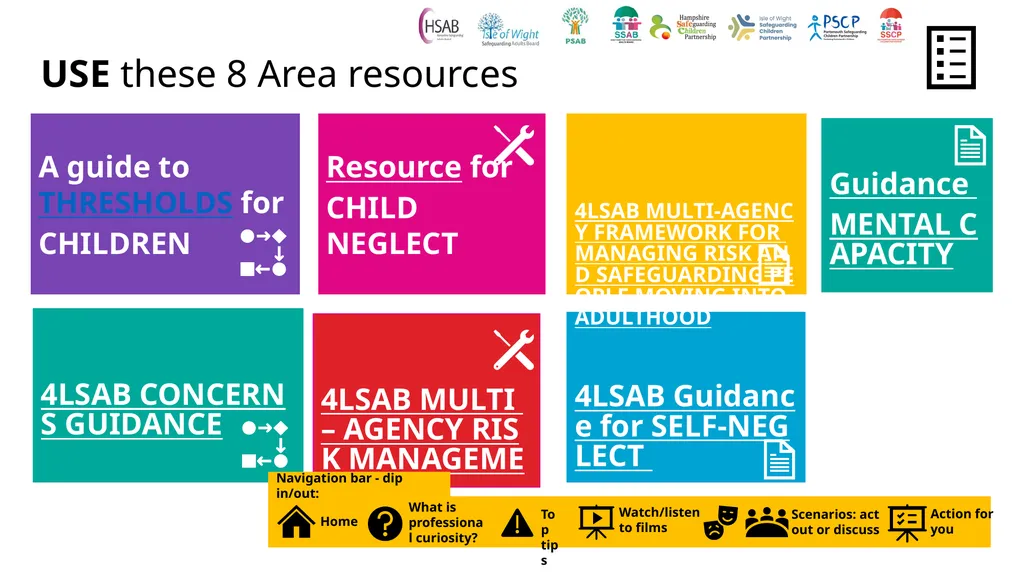
slide10. 4LSAB CONCERNS GUIDANCE 4LSAB MULTI – AGENCY RISK MANAGEMENT 4LSAB Guidance for SELF-NEGLECT USE these 8 Area resources Navigation bar - dip in/out: Guidance
MENTAL CAPACITY 4LSAB MULTI-AGENCY FRAMEWORK FOR MANAGING RISK AND SAFEGUARDING PEOPLE MOVING INTO ADULTHOOD<br>
slide11. ACT OUT or DISCUSS scenarios You are about to get four scenarios
Choose how you use them Navigation bar - dip in/out: OR Discuss A Discuss B Discuss C Discuss D<br>
slide12. You have limited background information.
Use your imagination and do ad lib to suitably test your colleague(s). 3. In your pair/group of three:
Discuss the scenario afterwards. Were the right questions asked? Swap over for the next scenario. 1.
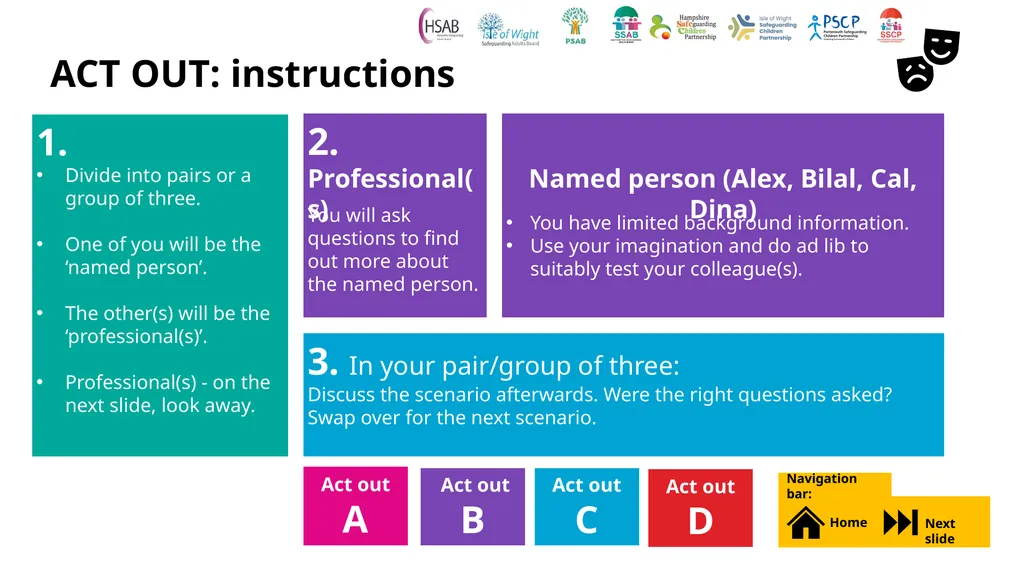
Divide into pairs or a group of three.
One of you will be the ‘named person’.
The other(s) will be the ‘professional(s)’.
Professional(s) - on the next slide, look away. You will ask questions to find out more about the named person. ACT OUT: instructions Navigation bar: 2.
Professional(s) 2.
Named person (Alex, Bilal, Cal, Dina)<br>
slide13. Alex aged 46 and lives alone
In Alex’s mid-30s, serious health issues resulted in them becoming a wheelchair user, with limited mobility. Alex now has a range of more acute health concerns: muscular spasms, physical impairments and intermittent speech loss.
Home is a ground floor one bedroom flat which is very cluttered, not wheelchair friendly and in need of major repairs. Alex likes the flat to be ‘cosy’, with a preference for living in darkness.
Alex is well known to health and social care professionals. Capacity assessments concluded that they do have mental capacity.
Alex often cancels medical appointments or does not turn up. The last professional that visited the home noticed that medication was stacked up unopened in the kitchen.
On a recent admission to hospital following a urine infection, health professionals noticed that Alex was unkempt, underweight and dehydrated.
Alex has become isolated from groups of friends and family.
Alex has recently lost a lot of weight and is known to self-medicate with alcohol.
Alex has started to refuse anyone entry to the home including utility services. ACT OUT this scenario – what questions would you ask? Navigation bar:<br>
slide14. Bilal aged 15 and lives with his mother, elderly grandparents and four younger siblings
Home is a compact four bedroomed house in an area of social deprivation.
Bilal shares a room with two younger brothers (twins, aged seven) but is often missing from home. This is not always reported by his mother.
Although he has no criminal record, Bilal is known to the police who say that he is a nuisance.
School says he is regularly absent. When he does attend, he is late and disruptive in lessons. Bilal never has his PE kit, and he goes missing at lunch times. The only time he does seem to engage is at events where lunch is provided. Teachers have noticed that Bilal often looks somewhat dishevelled.
Bilal’s mum says she is fed up with the shame her oldest son has brought to the family and that he is good for nothing.
A local youth group have banned Bilal from their activities following an incident where he came into the youth club seemingly drunk, disrupted the activities and was suspected to have stolen a coat on his way out.
Bilal appears to have a constant cold and a deep, hacking cough but his GP has not seen him since he was 11 years old. ACT OUT this scenario – what questions would you ask? Navigation bar:<br>
slide15. Cox family Mum (Cal) aged 38, Dad (Chris) aged 36, Ella aged six and Oli aged two
Home is a spacious two bedroomed flat that is always immaculate.
Mum has physical and mental health needs. Dad is her main carer and works full time.
Health visitor reports that on the last two visits, she saw Oli and Ella with Dad who explained that Mum was in bed unwell. Healthwise, all seemed well with both children although Ella seemed a little on edge on both occasions.
Ella has mentioned to her teachers that Mum and Dad sometimes argue at home, and she worries about this.
There have been multiple occasions when Ella and Oli have not been brought to health appointments.
Mum has missed many of her health appointments, some of which have been cancelled by Dad.
Mum puts herself down quite a lot. Since losing her mother whom she was very close to about five years ago, she says that she has lost contact with family and friends and often feels isolated.
Mum has mentioned that Dad likes things at home to be neat and orderly. She states that he earns the money for the family and creatively manages the budgets, for example, by keeping food locked away - she says she likes to snack and often gets carried away. She says that she is very lucky to have him and that he sometimes reminds her that she would probably not cope without him around. ACT OUT this scenario – what questions would you ask? Navigation bar:<br>
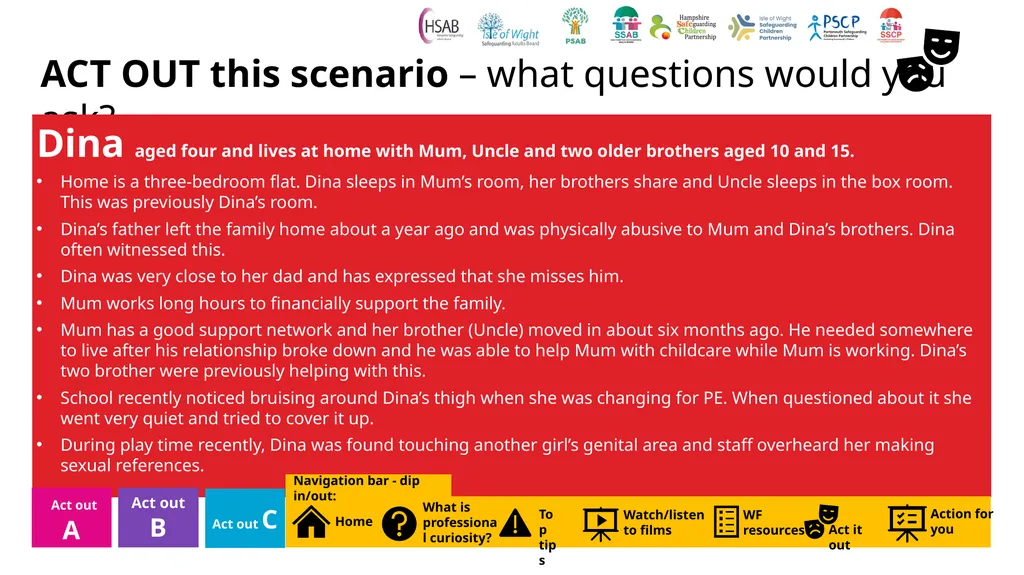
slide16. ACT OUT this scenario – what questions would you ask? Dina aged four and lives at home with Mum, Uncle and two older brothers aged 10 and 15.
Home is a three-bedroom flat. Dina sleeps in Mum’s room, her brothers share and Uncle sleeps in the box room. This was previously Dina’s room.
Dina’s father left the family home about a year ago and was physically abusive to Mum and Dina’s brothers. Dina often witnessed this.
Dina was very close to her dad and has expressed that she misses him.
Mum works long hours to financially support the family.
Mum has a good support network and her brother (Uncle) moved in about six months ago. He needed somewhere to live after his relationship broke down and he was able to help Mum with childcare while Mum is working. Dina’s two brother were previously helping with this.
School recently noticed bruising around Dina’s thigh when she was changing for PE. When questioned about it she went very quiet and tried to cover it up.
During play time recently, Dina was found touching another girl’s genital area and staff overheard her making sexual references. Navigation bar - dip in/out:<br>
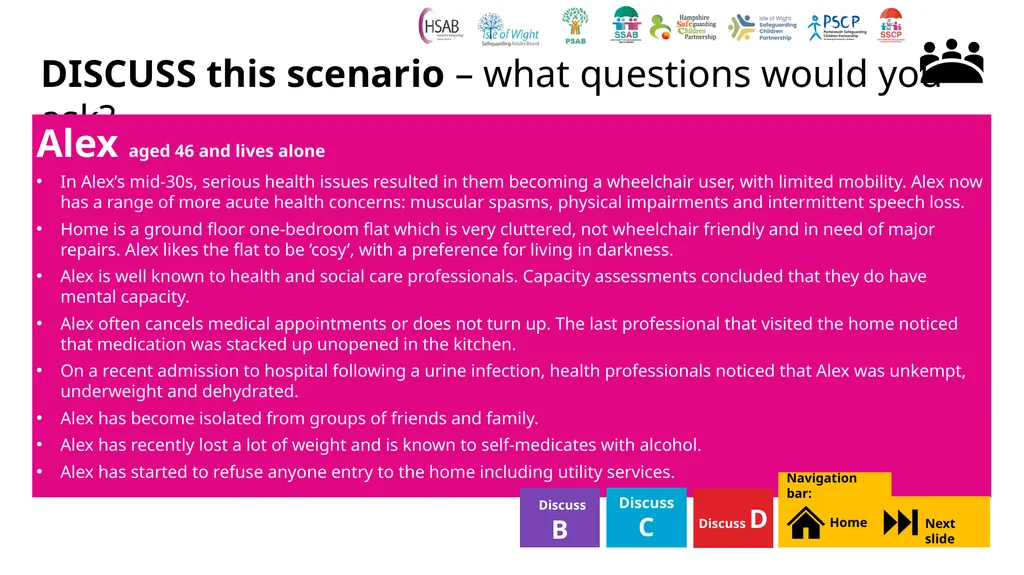
slide17. DISCUSS this scenario – what questions would you ask? Alex aged 46 and lives alone
In Alex’s mid-30s, serious health issues resulted in them becoming a wheelchair user, with limited mobility. Alex now has a range of more acute health concerns: muscular spasms, physical impairments and intermittent speech loss.
Home is a ground floor one-bedroom flat which is very cluttered, not wheelchair friendly and in need of major repairs. Alex likes the flat to be ‘cosy’, with a preference for living in darkness.
Alex is well known to health and social care professionals. Capacity assessments concluded that they do have mental capacity.
Alex often cancels medical appointments or does not turn up. The last professional that visited the home noticed that medication was stacked up unopened in the kitchen.
On a recent admission to hospital following a urine infection, health professionals noticed that Alex was unkempt, underweight and dehydrated.
Alex has become isolated from groups of friends and family.
Alex has recently lost a lot of weight and is known to self-medicates with alcohol.
Alex has started to refuse anyone entry to the home including utility services. Navigation bar:<br>
slide18. Bilal aged 15 and lives with his mother, elderly grandparents and four younger siblings
Home is a compact four-bedroomed house in an area of social deprivation.
Bilal shares a room with two younger brothers (twins, aged seven) but is often missing from home. This is not always reported by his mother.
Although he has no criminal record, Bilal is known to the police who say that he is a nuisance.
School says he is regularly absent. When he does attend, he is late and disruptive in lessons. Bilal never has his PE kit, and he goes missing at lunch times. The only time he does seem to engage is at events where lunch is provided. Teachers have noticed that Bilal often looks somewhat dishevelled.
Bilal’s mum says she is fed up with the shame her oldest son has brought to the family and that he is good for nothing.
A local youth group have banned Bilal from their activities following an incident where he came into the youth club seemingly drunk, disrupted the activities and was suspected to have stolen a coat on his way out.
Bilal appears to have a constant cold and a deep, hacking cough but his GP has not seen him since he was 11 years old. DISCUSS this scenario – what questions would you ask? Next slide Navigation bar:<br>
slide19. Cox family Mum (Cal) aged 38, Dad (Chris) aged 36, Ella aged 6 and Oli aged 2
Home is a spacious two bedroomed flat that is always immaculate.
Mum has physical and mental health needs. Dad is her main carer and works full time.
Health visitor reports that on the last two visits, she saw Oli and Ella with Dad who explained that Mum was in bed unwell. Healthwise, all seemed well with both children although Ella seemed a little on edge on both occasions.
Ella has mentioned to her teachers that Mum and Dad sometimes argue at home and she worries about this.
There have been multiple occasions when Ella and Oli have not been brought to health appointments.
Mum has missed many of her health appointments, some of which have been cancelled by Dad.
Mum puts herself down quite a lot. Since losing her mother whom she was very close to about five years ago, she says that she has lost contact with family and friends and often feels isolated.
Mum has mentioned that Dad likes things at home to be neat and orderly. She states that he earns the money for the family and creatively manages the budgets, for example, by keeping food locked away - she says she likes to snack and often gets carried away. She says that she is very lucky to have him and that he sometimes reminds her that she would probably not cope without him around. DISCUSS this scenario – what questions would you ask? Navigation bar:<br>
slide20. Dina aged four and lives at home with Mum, Uncle and two older brothers aged 10 and 15.
Home is a three-bedroom flat. Dina sleeps in Mum’s room, her brothers share and Uncle sleeps in the box room. This was previously Dina’s room.
Dina’s father left the family home about a year ago and was physically abusive to Mum and Dina’s brothers. Dina often witnessed this.
Dina was very close to her dad and has expressed that she misses him.
Mum works long hours to financially support the family.
Mum has a good support network and her brother (the children’s Uncle) moved in about six months ago. He needed somewhere to live after his relationship broke down and he was able to help Mum with childcare while Mum is working. Dina’s two brother were previously helping with this.
School recently noticed bruising around Dina’s thigh when she was changing for PE. When questioned about it she went very quiet and tried to cover it up.
During play time recently, Dina was found touching another girl’s genital area and staff overheard her making sexual references. DISCUSS this scenario – what questions would you ask? Navigation bar - dip in/out:<br>
slide21. ACTIONS for you to take Have you viewed/used all the slides in this resource? Send us your comments about this resource and tell us about your good practice:
Email: hscp@hants.gov.uk Hampshire Safeguarding Adults Board (hampshiresab.org.uk)
Isle of Wight Safeguarding Adults Board (IOWSAB.org.uk)
Portsmouth Safeguarding Adults Board (portsmouthsab.uk)
Southampton Local Safeguarding Adults Board (southamptonlsab.org.uk) Home What is professional curiosity? Top tips Watch/listen to film Scenarios: act out or discuss WF resources Check out your local Safeguarding Board or Partnership's websites for local workshops on the Family Approach. Hampshire Safeguarding Children Partnership (hampshirescp.org.uk)
Isle of Wight Safeguarding Children Partnership (iowscp.org.uk)
Portsmouth Safeguarding Children Partnership (portsmouthscp.org.uk)
Southampton Safeguarding Children Partnership (www.southampton.gov.uk/children-families/childrens-social-care/southampton-safeguarding-children-partnership) Credit and thanks to Waltham Forest Safeguarding Adults Board for sharing these resources<br>
The expectation is that you will share this resource pack widely and use it:
in team meetings,
as part of group/individual supervision,
for own development.
You can look at it as a whole or dip in or out of it at your convenience. Use the icons below to navigate through. What is professional curiosity? Top tips Watch/listen to films Navigation bar - dip in/out: Credit and thanks to Waltham Forest Safeguarding Adults Board for sharing these resources<br>
slide2. A lack of professional curiosity can lead to:
missed opportunities to identify less obvious indicators of vulnerability or significant harm,
assumptions made in assessments of needs and risk which are incorrect and lead to wrong intervention for individuals and families. WHAT is professional curiosity? Professional curiosity is a combination of looking, listening, asking direct questions, checking out and reflecting on information received. It means:
testing out your professional hypothesis and not making assumptions,
gathering all the information from different sources to gain a better understanding of individuals and family functioning,
getting an understanding of individuals’ and families’ past history which in turn, may help you think about what may happen in the future,
obtaining multiple sources of information and not accepting a single set of details you are given at face value,
having an awareness of your own personal bias and how that affects how you see those you are working with,
being respectively curious. Why is it important? Watch/listen to films Home Navigation bar - dip in/out:<br>
slide3. TOP TIPS Home Navigation bar: TOP TIPS - Remember to…<br>
slide4. Is there anything about what you see when you meet with this child/adult/family which prompts questions or makes you feel uneasy?
Are you observing any behaviour which is indicative of abuse or neglect?
Does what you see support or contradict what you’re being told? LOOK TOP TIPS Home Navigation bar:<br>
slide5. Are you being told anything which needs further clarification?
Are you concerned about what you hear family members say to each other?
Is someone in this family trying to tell you something but is finding it difficult to express themselves? If so, how can you help them to do so? LISTEN TOP TIPS Home Navigation bar:<br>
slide6. Are there direct questions you could ask when you meet this child/adult/family which will provide more information about the vulnerability of individual family members?
Here are some examples:
- How do you spend a typical day? - How did you get that injury?
- Who do you live with? - Who is this with you?
- When were you last happy? - When do you feel safe?
- What do you look forward to? - Why are you not at school? ASK TOP TIPS Home Navigation bar:<br>
slide7. Are other professionals involved? Check with adult and children’s services, ask the family.
Have other professionals seen the same as you?
Are professionals being told the same or different things?
Are others concerned? If so, what action has been taken so far and is there anything else which should or could be done by you or anyone else? CHECK OUT TOP TIPS Home Navigation bar:<br>
slide8. Question your own assumptions about how individuals/families function and watch out for over optimism.
Recognise your own feelings (for example, tiredness, feeling rushed or illness) and how this might impact on your view of a child/adult/family on a given day.
Think about why someone may not be telling you the whole truth.
Demonstrate a willingness to have honest conversations.
Address any professional anxiety about how hostile or resistant individuals/families might react to being asked direct or difficult questions.
Remain open minded and expect the unexpected.
Appreciate that respectful scepticism and challenge are healthy. It is good practice and ok to question what you are told.
Recognise when individuals/adults repeatedly do not do what they said they would and discuss with them.
Understand the cumulative impact of multiple or combined risk factors, for example, domestic abuse, drug/alcohol misuse, mental health.
Ensure that your practice is reflective and that you have access to good quality supervision. TOP TIPS - Remember to: Navigation bar - dip in/out:<br>
slide9. WATCH/LISTEN to this film Re-thinking did not attend Navigation bar - dip in/out:<br>
slide10. 4LSAB CONCERNS GUIDANCE 4LSAB MULTI – AGENCY RISK MANAGEMENT 4LSAB Guidance for SELF-NEGLECT USE these 8 Area resources Navigation bar - dip in/out: Guidance
MENTAL CAPACITY 4LSAB MULTI-AGENCY FRAMEWORK FOR MANAGING RISK AND SAFEGUARDING PEOPLE MOVING INTO ADULTHOOD<br>
slide11. ACT OUT or DISCUSS scenarios You are about to get four scenarios
Choose how you use them Navigation bar - dip in/out: OR Discuss A Discuss B Discuss C Discuss D<br>
slide12. You have limited background information.
Use your imagination and do ad lib to suitably test your colleague(s). 3. In your pair/group of three:
Discuss the scenario afterwards. Were the right questions asked? Swap over for the next scenario. 1.
Divide into pairs or a group of three.
One of you will be the ‘named person’.
The other(s) will be the ‘professional(s)’.
Professional(s) - on the next slide, look away. You will ask questions to find out more about the named person. ACT OUT: instructions Navigation bar: 2.
Professional(s) 2.
Named person (Alex, Bilal, Cal, Dina)<br>
slide13. Alex aged 46 and lives alone
In Alex’s mid-30s, serious health issues resulted in them becoming a wheelchair user, with limited mobility. Alex now has a range of more acute health concerns: muscular spasms, physical impairments and intermittent speech loss.
Home is a ground floor one bedroom flat which is very cluttered, not wheelchair friendly and in need of major repairs. Alex likes the flat to be ‘cosy’, with a preference for living in darkness.
Alex is well known to health and social care professionals. Capacity assessments concluded that they do have mental capacity.
Alex often cancels medical appointments or does not turn up. The last professional that visited the home noticed that medication was stacked up unopened in the kitchen.
On a recent admission to hospital following a urine infection, health professionals noticed that Alex was unkempt, underweight and dehydrated.
Alex has become isolated from groups of friends and family.
Alex has recently lost a lot of weight and is known to self-medicate with alcohol.
Alex has started to refuse anyone entry to the home including utility services. ACT OUT this scenario – what questions would you ask? Navigation bar:<br>
slide14. Bilal aged 15 and lives with his mother, elderly grandparents and four younger siblings
Home is a compact four bedroomed house in an area of social deprivation.
Bilal shares a room with two younger brothers (twins, aged seven) but is often missing from home. This is not always reported by his mother.
Although he has no criminal record, Bilal is known to the police who say that he is a nuisance.
School says he is regularly absent. When he does attend, he is late and disruptive in lessons. Bilal never has his PE kit, and he goes missing at lunch times. The only time he does seem to engage is at events where lunch is provided. Teachers have noticed that Bilal often looks somewhat dishevelled.
Bilal’s mum says she is fed up with the shame her oldest son has brought to the family and that he is good for nothing.
A local youth group have banned Bilal from their activities following an incident where he came into the youth club seemingly drunk, disrupted the activities and was suspected to have stolen a coat on his way out.
Bilal appears to have a constant cold and a deep, hacking cough but his GP has not seen him since he was 11 years old. ACT OUT this scenario – what questions would you ask? Navigation bar:<br>
slide15. Cox family Mum (Cal) aged 38, Dad (Chris) aged 36, Ella aged six and Oli aged two
Home is a spacious two bedroomed flat that is always immaculate.
Mum has physical and mental health needs. Dad is her main carer and works full time.
Health visitor reports that on the last two visits, she saw Oli and Ella with Dad who explained that Mum was in bed unwell. Healthwise, all seemed well with both children although Ella seemed a little on edge on both occasions.
Ella has mentioned to her teachers that Mum and Dad sometimes argue at home, and she worries about this.
There have been multiple occasions when Ella and Oli have not been brought to health appointments.
Mum has missed many of her health appointments, some of which have been cancelled by Dad.
Mum puts herself down quite a lot. Since losing her mother whom she was very close to about five years ago, she says that she has lost contact with family and friends and often feels isolated.
Mum has mentioned that Dad likes things at home to be neat and orderly. She states that he earns the money for the family and creatively manages the budgets, for example, by keeping food locked away - she says she likes to snack and often gets carried away. She says that she is very lucky to have him and that he sometimes reminds her that she would probably not cope without him around. ACT OUT this scenario – what questions would you ask? Navigation bar:<br>
slide16. ACT OUT this scenario – what questions would you ask? Dina aged four and lives at home with Mum, Uncle and two older brothers aged 10 and 15.
Home is a three-bedroom flat. Dina sleeps in Mum’s room, her brothers share and Uncle sleeps in the box room. This was previously Dina’s room.
Dina’s father left the family home about a year ago and was physically abusive to Mum and Dina’s brothers. Dina often witnessed this.
Dina was very close to her dad and has expressed that she misses him.
Mum works long hours to financially support the family.
Mum has a good support network and her brother (Uncle) moved in about six months ago. He needed somewhere to live after his relationship broke down and he was able to help Mum with childcare while Mum is working. Dina’s two brother were previously helping with this.
School recently noticed bruising around Dina’s thigh when she was changing for PE. When questioned about it she went very quiet and tried to cover it up.
During play time recently, Dina was found touching another girl’s genital area and staff overheard her making sexual references. Navigation bar - dip in/out:<br>
slide17. DISCUSS this scenario – what questions would you ask? Alex aged 46 and lives alone
In Alex’s mid-30s, serious health issues resulted in them becoming a wheelchair user, with limited mobility. Alex now has a range of more acute health concerns: muscular spasms, physical impairments and intermittent speech loss.
Home is a ground floor one-bedroom flat which is very cluttered, not wheelchair friendly and in need of major repairs. Alex likes the flat to be ‘cosy’, with a preference for living in darkness.
Alex is well known to health and social care professionals. Capacity assessments concluded that they do have mental capacity.
Alex often cancels medical appointments or does not turn up. The last professional that visited the home noticed that medication was stacked up unopened in the kitchen.
On a recent admission to hospital following a urine infection, health professionals noticed that Alex was unkempt, underweight and dehydrated.
Alex has become isolated from groups of friends and family.
Alex has recently lost a lot of weight and is known to self-medicates with alcohol.
Alex has started to refuse anyone entry to the home including utility services. Navigation bar:<br>
slide18. Bilal aged 15 and lives with his mother, elderly grandparents and four younger siblings
Home is a compact four-bedroomed house in an area of social deprivation.
Bilal shares a room with two younger brothers (twins, aged seven) but is often missing from home. This is not always reported by his mother.
Although he has no criminal record, Bilal is known to the police who say that he is a nuisance.
School says he is regularly absent. When he does attend, he is late and disruptive in lessons. Bilal never has his PE kit, and he goes missing at lunch times. The only time he does seem to engage is at events where lunch is provided. Teachers have noticed that Bilal often looks somewhat dishevelled.
Bilal’s mum says she is fed up with the shame her oldest son has brought to the family and that he is good for nothing.
A local youth group have banned Bilal from their activities following an incident where he came into the youth club seemingly drunk, disrupted the activities and was suspected to have stolen a coat on his way out.
Bilal appears to have a constant cold and a deep, hacking cough but his GP has not seen him since he was 11 years old. DISCUSS this scenario – what questions would you ask? Next slide Navigation bar:<br>
slide19. Cox family Mum (Cal) aged 38, Dad (Chris) aged 36, Ella aged 6 and Oli aged 2
Home is a spacious two bedroomed flat that is always immaculate.
Mum has physical and mental health needs. Dad is her main carer and works full time.
Health visitor reports that on the last two visits, she saw Oli and Ella with Dad who explained that Mum was in bed unwell. Healthwise, all seemed well with both children although Ella seemed a little on edge on both occasions.
Ella has mentioned to her teachers that Mum and Dad sometimes argue at home and she worries about this.
There have been multiple occasions when Ella and Oli have not been brought to health appointments.
Mum has missed many of her health appointments, some of which have been cancelled by Dad.
Mum puts herself down quite a lot. Since losing her mother whom she was very close to about five years ago, she says that she has lost contact with family and friends and often feels isolated.
Mum has mentioned that Dad likes things at home to be neat and orderly. She states that he earns the money for the family and creatively manages the budgets, for example, by keeping food locked away - she says she likes to snack and often gets carried away. She says that she is very lucky to have him and that he sometimes reminds her that she would probably not cope without him around. DISCUSS this scenario – what questions would you ask? Navigation bar:<br>
slide20. Dina aged four and lives at home with Mum, Uncle and two older brothers aged 10 and 15.
Home is a three-bedroom flat. Dina sleeps in Mum’s room, her brothers share and Uncle sleeps in the box room. This was previously Dina’s room.
Dina’s father left the family home about a year ago and was physically abusive to Mum and Dina’s brothers. Dina often witnessed this.
Dina was very close to her dad and has expressed that she misses him.
Mum works long hours to financially support the family.
Mum has a good support network and her brother (the children’s Uncle) moved in about six months ago. He needed somewhere to live after his relationship broke down and he was able to help Mum with childcare while Mum is working. Dina’s two brother were previously helping with this.
School recently noticed bruising around Dina’s thigh when she was changing for PE. When questioned about it she went very quiet and tried to cover it up.
During play time recently, Dina was found touching another girl’s genital area and staff overheard her making sexual references. DISCUSS this scenario – what questions would you ask? Navigation bar - dip in/out:<br>
slide21. ACTIONS for you to take Have you viewed/used all the slides in this resource? Send us your comments about this resource and tell us about your good practice:
Email: hscp@hants.gov.uk Hampshire Safeguarding Adults Board (hampshiresab.org.uk)
Isle of Wight Safeguarding Adults Board (IOWSAB.org.uk)
Portsmouth Safeguarding Adults Board (portsmouthsab.uk)
Southampton Local Safeguarding Adults Board (southamptonlsab.org.uk) Home What is professional curiosity? Top tips Watch/listen to film Scenarios: act out or discuss WF resources Check out your local Safeguarding Board or Partnership's websites for local workshops on the Family Approach. Hampshire Safeguarding Children Partnership (hampshirescp.org.uk)
Isle of Wight Safeguarding Children Partnership (iowscp.org.uk)
Portsmouth Safeguarding Children Partnership (portsmouthscp.org.uk)
Southampton Safeguarding Children Partnership (www.southampton.gov.uk/children-families/childrens-social-care/southampton-safeguarding-children-partnership) Credit and thanks to Waltham Forest Safeguarding Adults Board for sharing these resources<br>