
Threshold Doctrines “The most important thing we
PT
Published · 23 slides · 0 views
1 / 1

Description
Threshold Doctrines The most important thing we do is not doing. Justice Brandeis Jurisdiction Definition: the power, right, or authority to interpret and apply the law Constitution defines courts jurisdiction as all cases, in law or
Related Topics
Share
Embed code
Download this presentation From Below
"Threshold Doctrines “The most important thing we" is the property of its rightful owner. Permission is granted to download and print the materials on this website for personal, non-commercial use only, and to display it on your personal computer provided you do not modify the materials and that you retain all copyright notices contained in the materials. By downloading content from our website, you accept the terms of this agreement.
Presentation Transcript
01
Threshold Doctrines “The most important thing we do is not doing.”
Justice Brandeis<br>
Justice Brandeis<br>
02
Jurisdiction Definition: the power, right, or authority to interpret and apply the law
Constitution defines courts’ jurisdiction as “all cases, in law or equity” and “controversies between two or more states”<br>
Constitution defines courts’ jurisdiction as “all cases, in law or equity” and “controversies between two or more states”<br>
03
Standing The ability of a party to demonstrate to the court sufficient connection to and harm from the law or action challenged to support that party's participation<br>
04
Justiciability That which is capable of being determined by a court of law.
The case must present a legal question, rather than a question of politics, or a question in which there is no clear legal standard.<br>
The case must present a legal question, rather than a question of politics, or a question in which there is no clear legal standard.<br>
05
Jurisdiction Doctrines
Advisory Opinions
Ripeness
Mootness<br>
Advisory Opinions
Ripeness
Mootness<br>
06
Advisory Opinions No non-adversarial proceedings
Used to gain judicial “blessing” in some state proceedings
Used in many European legal systems<br>
Used to gain judicial “blessing” in some state proceedings
Used in many European legal systems<br>
07
Ripeness Issue has not matured. There are still alternative forms of resolution, no harm has occurred or imminent
Poe v. Ullman (1962). CT had not prosecuted anyone for using contraception in years.<br>
Poe v. Ullman (1962). CT had not prosecuted anyone for using contraception in years.<br>
08
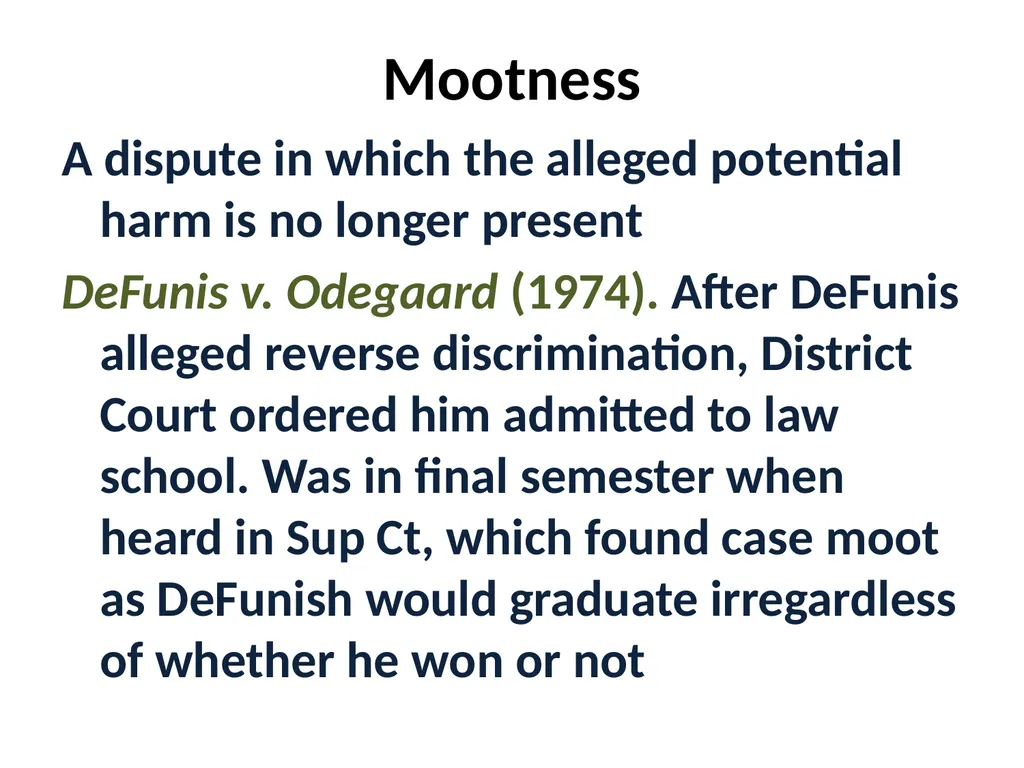
Mootness A dispute in which the alleged potential harm is no longer present
DeFunis v. Odegaard (1974). After DeFunis alleged reverse discrimination, District Court ordered him admitted to law school. Was in final semester when heard in Sup Ct, which found case moot as DeFunish would graduate irregardless of whether he won or not<br>
DeFunis v. Odegaard (1974). After DeFunis alleged reverse discrimination, District Court ordered him admitted to law school. Was in final semester when heard in Sup Ct, which found case moot as DeFunish would graduate irregardless of whether he won or not<br>
09
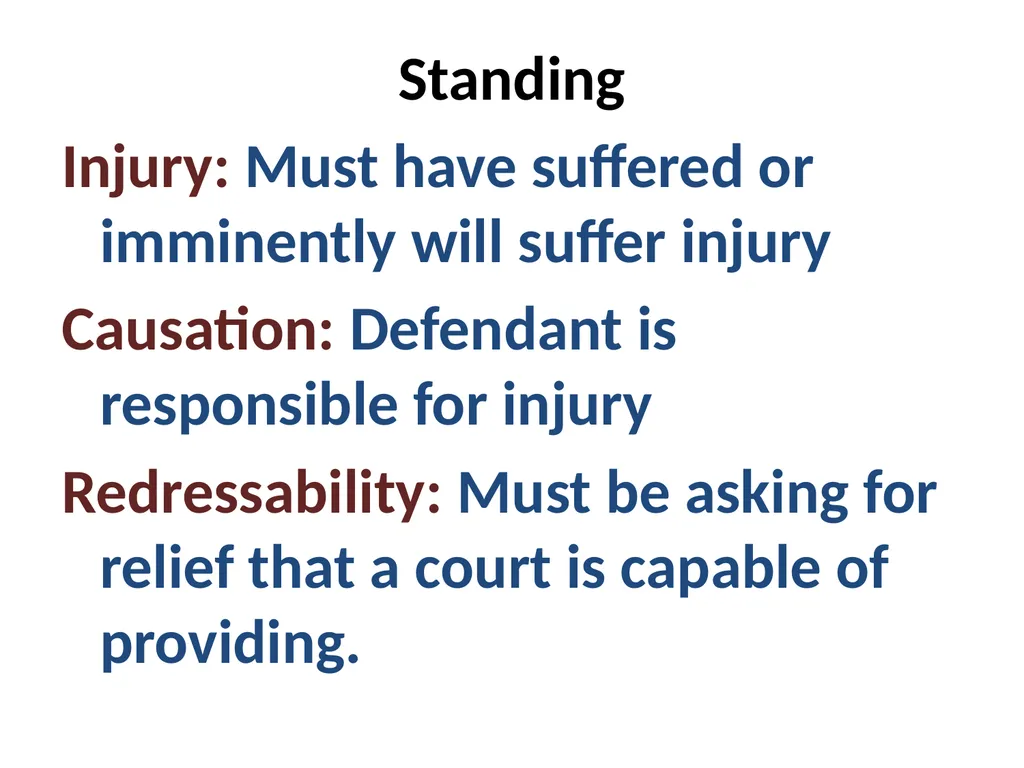
Standing Injury: Must have suffered or imminently will suffer injury
Causation: Defendant is responsible for injury
Redressability: Must be asking for relief that a court is capable of providing.<br>
Causation: Defendant is responsible for injury
Redressability: Must be asking for relief that a court is capable of providing.<br>
10
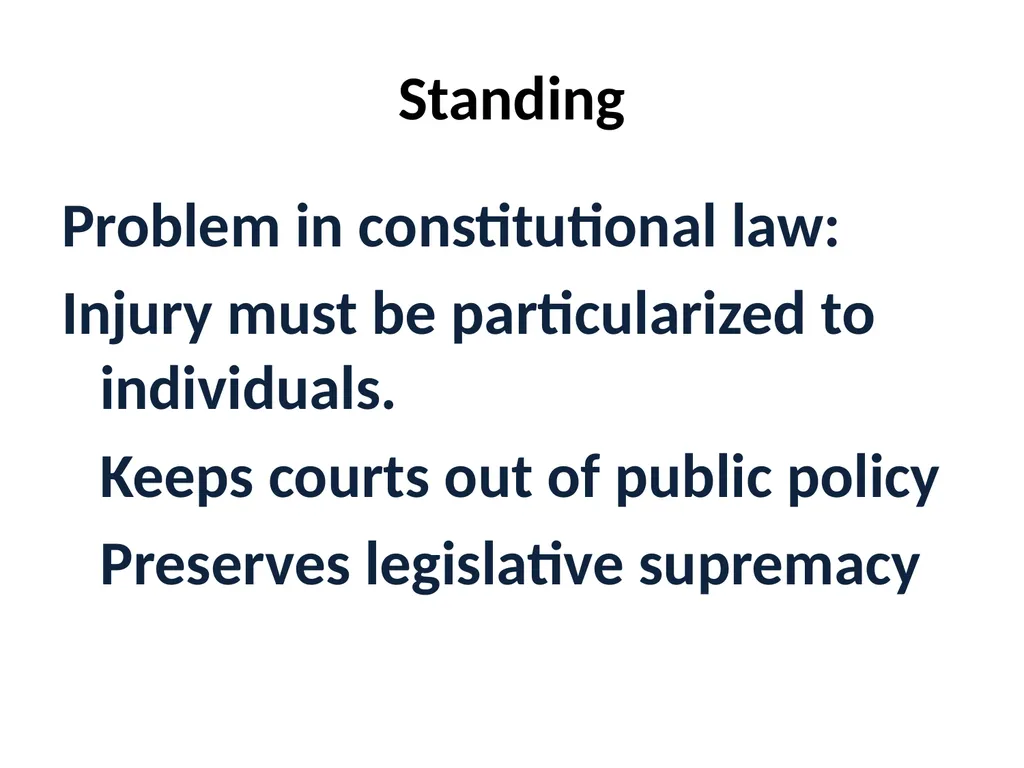
Standing Problem in constitutional law:
Injury must be particularized to individuals.
Keeps courts out of public policy
Preserves legislative supremacy<br>
Injury must be particularized to individuals.
Keeps courts out of public policy
Preserves legislative supremacy<br>
11
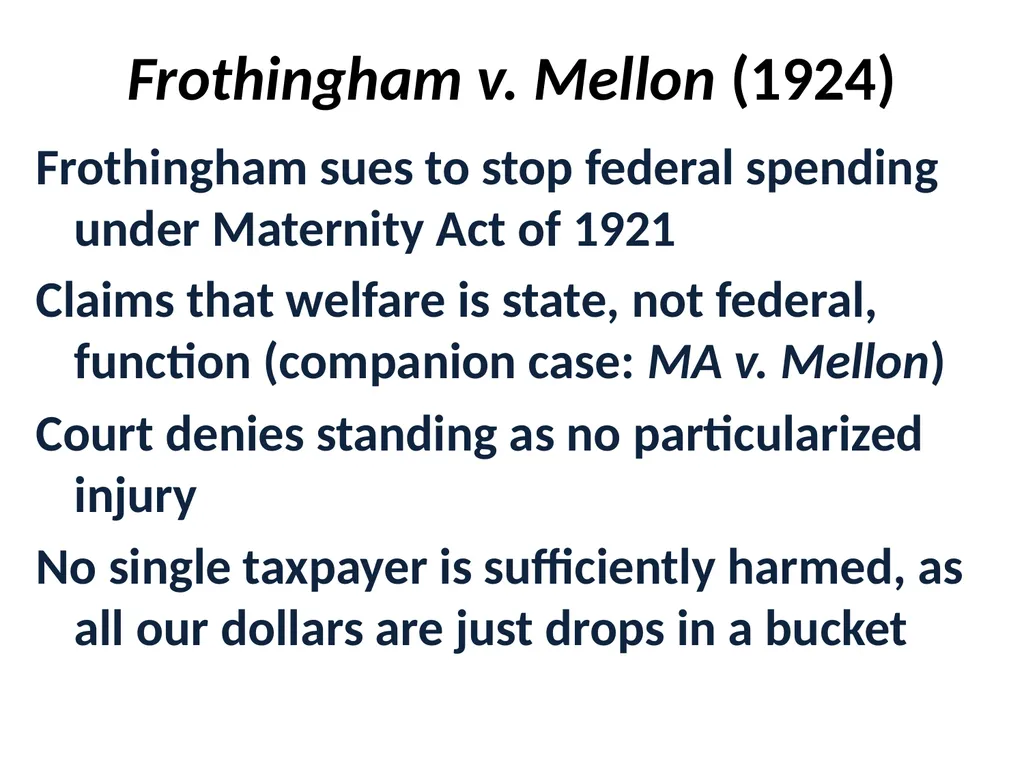
Frothingham v. Mellon (1924) Frothingham sues to stop federal spending under Maternity Act of 1921
Claims that welfare is state, not federal, function (companion case: MA v. Mellon)
Court denies standing as no particularized injury
No single taxpayer is sufficiently harmed, as all our dollars are just drops in a bucket<br>
Claims that welfare is state, not federal, function (companion case: MA v. Mellon)
Court denies standing as no particularized injury
No single taxpayer is sufficiently harmed, as all our dollars are just drops in a bucket<br>
12
Flast v. Cohen Congress enacts Elementary and Secondary School Act of 1965, includes funding for non-public schools, including parochial schools, serving poor students<br>
13
Flast v. Cohen “Double Nexus" test:
“logical link between [taxpayer] status and the type of legislative enactment attacked."
“taxpayer must show the challenged enactment is generally beyond the powers delegated to Congress by Article I, Section 8."<br>
“logical link between [taxpayer] status and the type of legislative enactment attacked."
“taxpayer must show the challenged enactment is generally beyond the powers delegated to Congress by Article I, Section 8."<br>
14
Valley Forge Coll. v. Americans United<br>
15
Hein v. Freedom from Religion Foundation FFRF challenged the use of discretionary executive branch funding to support the White House Office of Faith-Based and Community Initiatives
Sup Ct found that lack of congressional action meant that FFRF lacked standing under the 2 part test<br>
Sup Ct found that lack of congressional action meant that FFRF lacked standing under the 2 part test<br>
16
Berg v. Obama (3rd Circuit, 2009) Berg, a “birther,” challenged Obama’s status as a “natural born” citizen and thus his qualifications to serve as President
Court denied Berg standing, noting that he shared any possible injury w/ >300 million others, and noting multiple political remedies (electoral college, Congress) and other litigants (states, other candidates, political parties, members of Congress, etc)<br>
Court denied Berg standing, noting that he shared any possible injury w/ >300 million others, and noting multiple political remedies (electoral college, Congress) and other litigants (states, other candidates, political parties, members of Congress, etc)<br>
17
Arizonans for Official English v. AZ (1997) Arizonans passed initiative requiring all official state acts to be carried out in English
District Court struck down part of initiative as overbroad. AZ chose not to appeal, AOE files to appeal District Court ruling
Sup Ct denies for other reasons, but also notes that AOE was not “authorized by state law to represent the State's interests” and denies standing<br>
District Court struck down part of initiative as overbroad. AZ chose not to appeal, AOE files to appeal District Court ruling
Sup Ct denies for other reasons, but also notes that AOE was not “authorized by state law to represent the State's interests” and denies standing<br>
18
Environmental Standing Legal Personality: A person or organization that can legally enter into a contract, and may therefore be sued for failure to comply with the terms of the contract.
Also includes: Corporations, Ships<br>
Also includes: Corporations, Ships<br>
19
Sierra Club v. Morton (1972)<br>
20
The Threat to Mineral King<br>
21
Sierra Club v. Morton (1972) Sierra Club challenges Forest Service permit for ski resort in valley then near (now in) Sequoia Nat’l Park
Question was: Should Sierra Club have standing to sue?
Majority found no injury to SC members, rather than generalized harm<br>
Question was: Should Sierra Club have standing to sue?
Majority found no injury to SC members, rather than generalized harm<br>
22
Sierra Club v. Morton (1972) “The river as plaintiff speaks for the ecological unit of life that is part of it. Those people who have a meaningful relation to that body of water - whether it be a fisherman, a canoeist, a zoologist, or a logger - must be able to speak for the values which the river represents and which are threatened with destruction....”
William O. Douglas (dissenting)<br>
William O. Douglas (dissenting)<br>
23
U. S. v. Students Challenging Regulatory Agency Procedures (S.C.R.A.P.) (1973) SCRAP challenges railroad rate setting that made shipping recyclables more expensive
Claims standing because each member’s outdoor experience “was disturbed by the adverse environmental impact caused by the nonuse of recyclable goods brought about by a rate increase on those commodities.”<br>
Claims standing because each member’s outdoor experience “was disturbed by the adverse environmental impact caused by the nonuse of recyclable goods brought about by a rate increase on those commodities.”<br>
24
Lujan v. Defenders of Wildlife (1992) Defenders challenge U.S. A.I.D. grants to Egypt and Sri Lanka by suing Secretary of Interior to require that he take action to stop disbursement of funds under Endangered Species Act.<br>
25
Lujan v. Defenders of Wildlife (1992)<br>
26
Lujan v. Defenders of Wildlife (1992)<br>
27
Lujan v. Defenders of Wildlife (1992) Two questions:
1. Do plaintiffs have particularized interest in welfare of endangered animals?
2. Is Lujan the proper defendant, as dams are primarily funded and erected by other governments, and USAID is part of State Dept?<br>
1. Do plaintiffs have particularized interest in welfare of endangered animals?
2. Is Lujan the proper defendant, as dams are primarily funded and erected by other governments, and USAID is part of State Dept?<br>
28
Massachusetts v. EPA (2007) Majority grant MA standing to challenge EPA inaction on greenhouse gases as
“the State has an interest independent of and behind the titles of its citizens, in all the earth and air within its domain. It has the last word as to whether its mountains shall be stripped of their forests and its inhabitants shall breathe pure air."<br>
“the State has an interest independent of and behind the titles of its citizens, in all the earth and air within its domain. It has the last word as to whether its mountains shall be stripped of their forests and its inhabitants shall breathe pure air."<br>
29
Enforcement Provisions – Private Attorney Generals Civil Rights Act of 1964. Allows any individual to sue a public accommodation on account of discrimination in service.
Americans with Disabilities Act of 1991. Provides disabled individual right to sue a public accommodation on account of discrimination because of lack of access.<br>
Americans with Disabilities Act of 1991. Provides disabled individual right to sue a public accommodation on account of discrimination because of lack of access.<br>
30
Justiciability That which is capable of being determined by a court of law.
The case must present a legal question, rather than a question of politics, or a question in which there is no clear legal standard.<br>
The case must present a legal question, rather than a question of politics, or a question in which there is no clear legal standard.<br>
31
Luther v. Borden (1849) During Dorr’s Rebellion, citizens attempted to overthrow the charter government of Rhode Island in order to expand the franchise to non-propertied white males.
Dorr’s supporters adopted a “People's Constitution” while state's General Assembly drafted the “Freemen's Constitution.” Each side held elections and “took office.”<br>
Dorr’s supporters adopted a “People's Constitution” while state's General Assembly drafted the “Freemen's Constitution.” Each side held elections and “took office.”<br>
32
Luther v. Borden (1849) Martin Luther, a Dorr supporter, was arrested by Luther M. Borden, a state official, and sued Borden for illegal search and seizure and damage to his property.
Key Question: Was Borden acting with proper state authority? Question required Court to decide which was proper government.<br>
Key Question: Was Borden acting with proper state authority? Question required Court to decide which was proper government.<br>
33
Luther v. Borden (1849) Court had to decide applicability of guarantee of a “republican form of government” (Art. IV)
“as the United States guarantee to each State a republican government, Congress must necessarily decide what government is established in the State before it can determine whether it is republican or not.”
C. J. Taney<br>
“as the United States guarantee to each State a republican government, Congress must necessarily decide what government is established in the State before it can determine whether it is republican or not.”
C. J. Taney<br>
34
Baker v. Carr<br>
35
Political Questions Republican Form of Government
Mode of amending Constitution
Partisan Gerrymandering
Termination of Treaties
Recognition of Indian Tribes
Form of Senate Impeachment Trials<br>
Mode of amending Constitution
Partisan Gerrymandering
Termination of Treaties
Recognition of Indian Tribes
Form of Senate Impeachment Trials<br>
36
Goldwater v. Carter<br>