Time Conversion and Time Formats April 2023 Topics Time Systems and Kernels Converting Time Strings Converting Numeric Times Use of Time Format Picture Additional Time Conversions Principal Time System Interfaces Time Conversion and Formats
"Time Conversion and Time Formats April 2023 Topics" is the property of its rightful owner. Permission is granted to
download and print the materials on this website for personal, non-commercial use only, and to display it
on your personal computer provided you do not modify the materials and that you retain all copyright
notices contained in the materials. By downloading content from our website, you accept the terms of this
agreement.
Presentation Transcript
01
Time Conversion and Time Formats April 2023<br>
02
Topics Time Systems and Kernels
Converting Time Strings
Converting Numeric Times
Use of Time Format Picture
Additional Time Conversions
Principal Time System Interfaces Time Conversion and Formats 2<br>
03
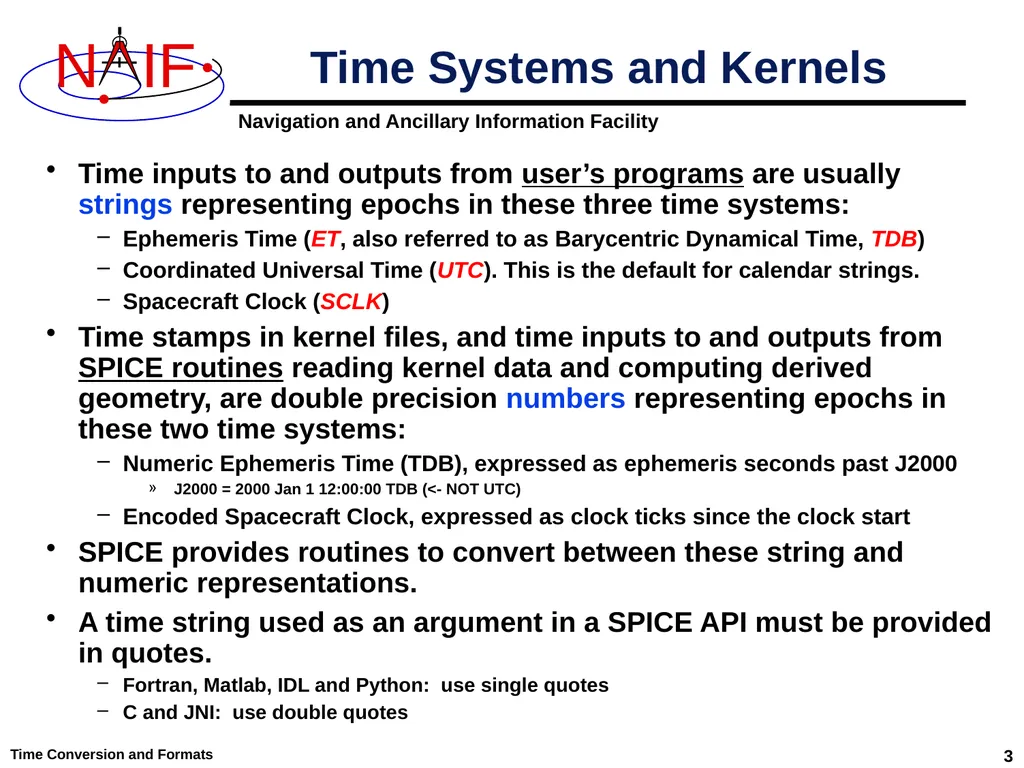
Time Conversion and Formats 3 Time inputs to and outputs from user’s programs are usually strings representing epochs in these three time systems:
Ephemeris Time (ET, also referred to as Barycentric Dynamical Time, TDB)
Coordinated Universal Time (UTC). This is the default for calendar strings.
Spacecraft Clock (SCLK)
Time stamps in kernel files, and time inputs to and outputs from SPICE routines reading kernel data and computing derived geometry, are double precision numbers representing epochs in these two time systems:
Numeric Ephemeris Time (TDB), expressed as ephemeris seconds past J2000
J2000 = 2000 Jan 1 12:00:00 TDB (<- NOT UTC)
Encoded Spacecraft Clock, expressed as clock ticks since the clock start
SPICE provides routines to convert between these string and numeric representations.
A time string used as an argument in a SPICE API must be provided in quotes.
Fortran, Matlab, IDL and Python: use single quotes
C and JNI: use double quotes Time Systems and Kernels<br>
04
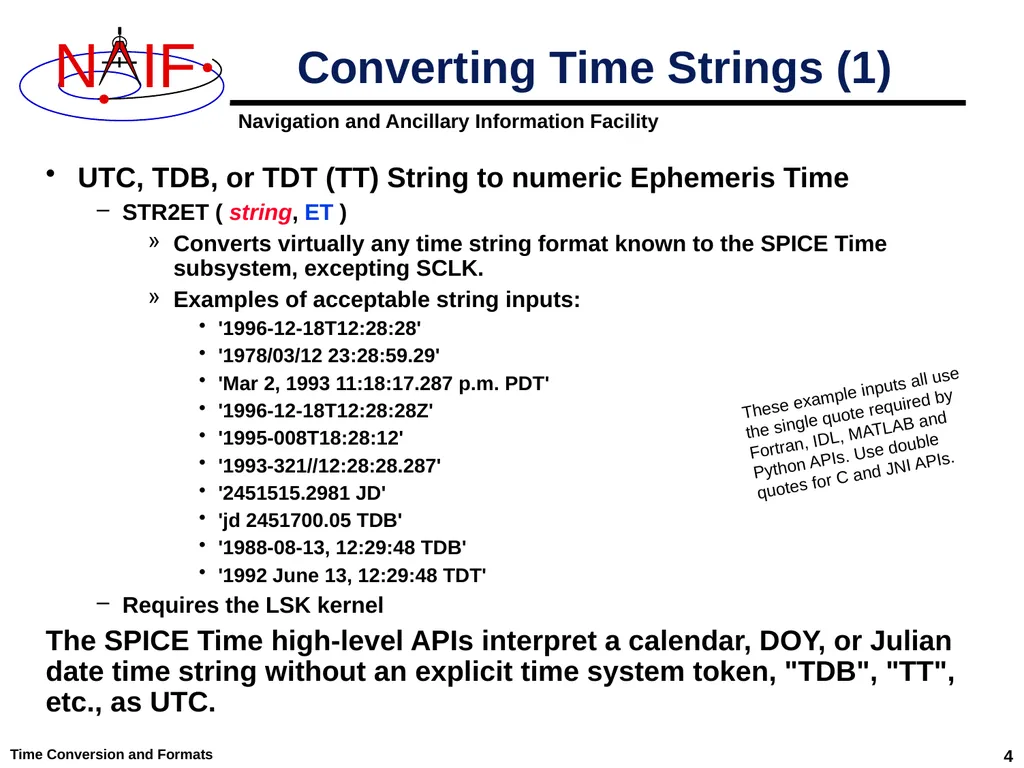
Time Conversion and Formats 4 UTC, TDB, or TDT (TT) String to numeric Ephemeris Time
STR2ET ( string, ET )
Converts virtually any time string format known to the SPICE Time subsystem, excepting SCLK.
Examples of acceptable string inputs:
'1996-12-18T12:28:28'
'1978/03/12 23:28:59.29'
'Mar 2, 1993 11:18:17.287 p.m. PDT'
'1996-12-18T12:28:28Z'
'1995-008T18:28:12'
'1993-321//12:28:28.287'
'2451515.2981 JD'
'jd 2451700.05 TDB'
'1988-08-13, 12:29:48 TDB'
'1992 June 13, 12:29:48 TDT'
Requires the LSK kernel
The SPICE Time high-level APIs interpret a calendar, DOY, or Julian date time string without an explicit time system token, "TDB", "TT", etc., as UTC. Converting Time Strings (1) These example inputs all use the single quote required by Fortran, IDL, MATLAB and Python APIs. Use double quotes for C and JNI APIs.<br>
05
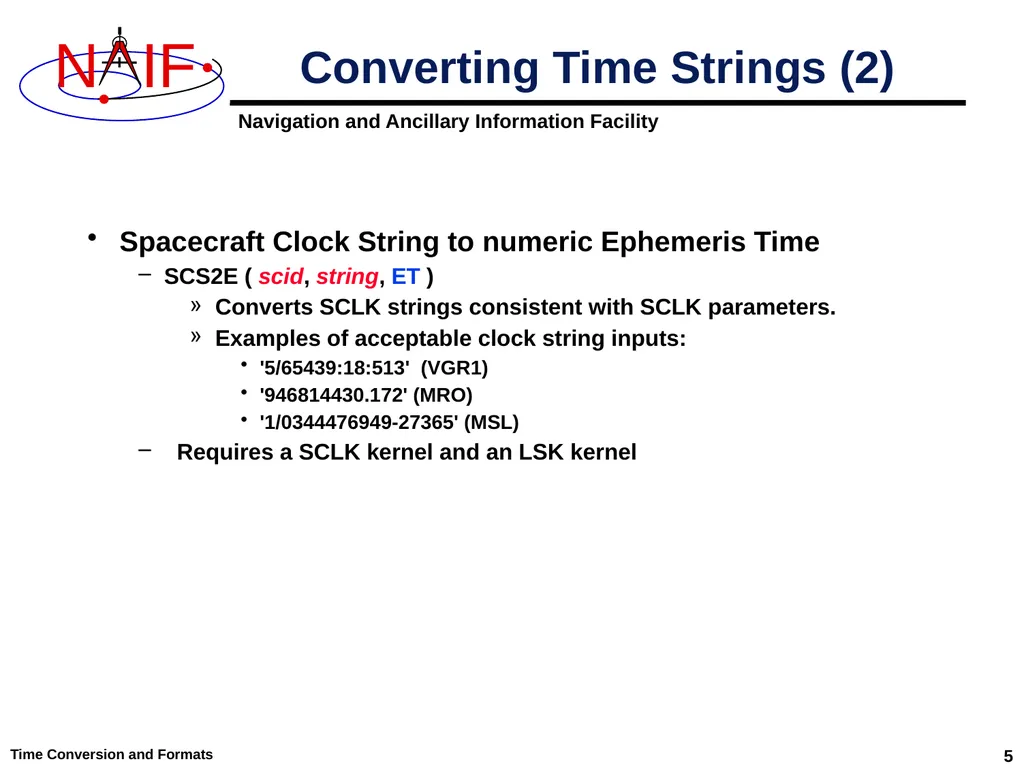
Converting Time Strings (2) Spacecraft Clock String to numeric Ephemeris Time
SCS2E ( scid, string, ET )
Converts SCLK strings consistent with SCLK parameters.
Examples of acceptable clock string inputs:
'5/65439:18:513' (VGR1)
'946814430.172' (MRO)
'1/0344476949-27365' (MSL)
Requires a SCLK kernel and an LSK kernel Time Conversion and Formats 5<br>
06
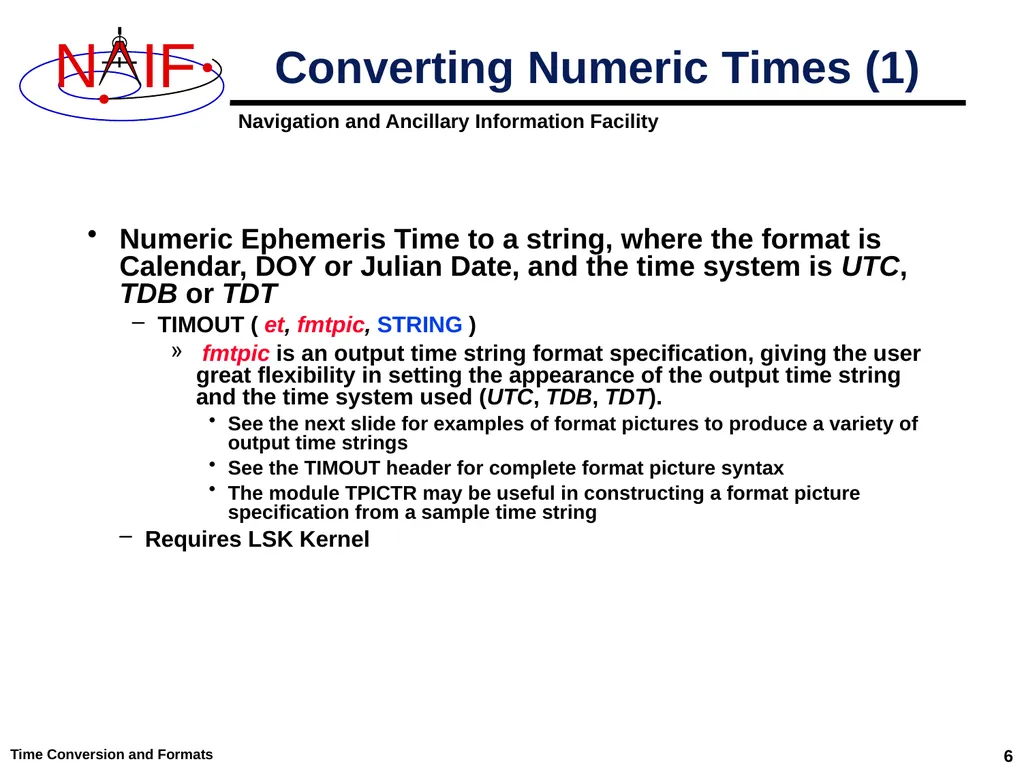
Converting Numeric Times (1) Numeric Ephemeris Time to a string, where the format is Calendar, DOY or Julian Date, and the time system is UTC, TDB or TDT
TIMOUT ( et, fmtpic, STRING )
fmtpic is an output time string format specification, giving the user great flexibility in setting the appearance of the output time string and the time system used (UTC, TDB, TDT).
See the next slide for examples of format pictures to produce a variety of output time strings
See the TIMOUT header for complete format picture syntax
The module TPICTR may be useful in constructing a format picture specification from a sample time string
Requires LSK Kernel Time Conversion and Formats 6<br>
07
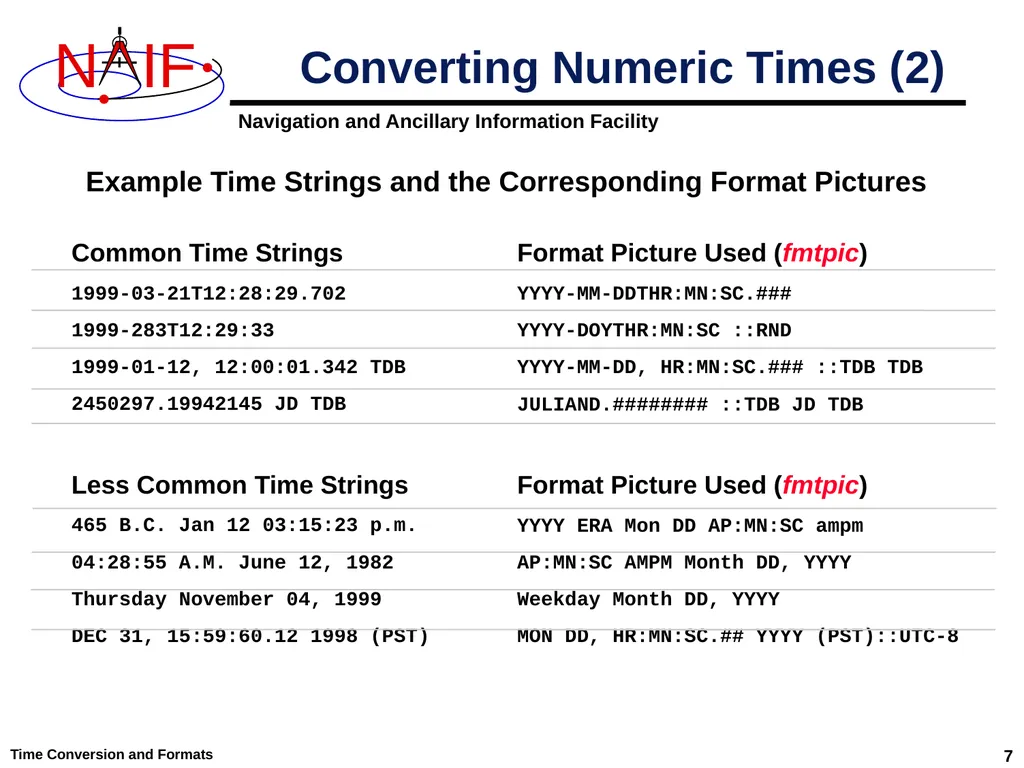
Time Conversion and Formats 7 Common Time Strings
1999-03-21T12:28:29.702
1999-283T12:29:33
1999-01-12, 12:00:01.342 TDB
2450297.19942145 JD TDB
Less Common Time Strings
465 B.C. Jan 12 03:15:23 p.m.
04:28:55 A.M. June 12, 1982
Thursday November 04, 1999
DEC 31, 15:59:60.12 1998 (PST) Format Picture Used (fmtpic)
YYYY-MM-DDTHR:MN:SC.###
YYYY-DOYTHR:MN:SC ::RND
YYYY-MM-DD, HR:MN:SC.### ::TDB TDB
JULIAND.######## ::TDB JD TDB
Format Picture Used (fmtpic)
YYYY ERA Mon DD AP:MN:SC ampm
AP:MN:SC AMPM Month DD, YYYY
Weekday Month DD, YYYY
MON DD, HR:MN:SC.## YYYY (PST)::UTC-8 Example Time Strings and the Corresponding Format Pictures Converting Numeric Times (2)<br>
08
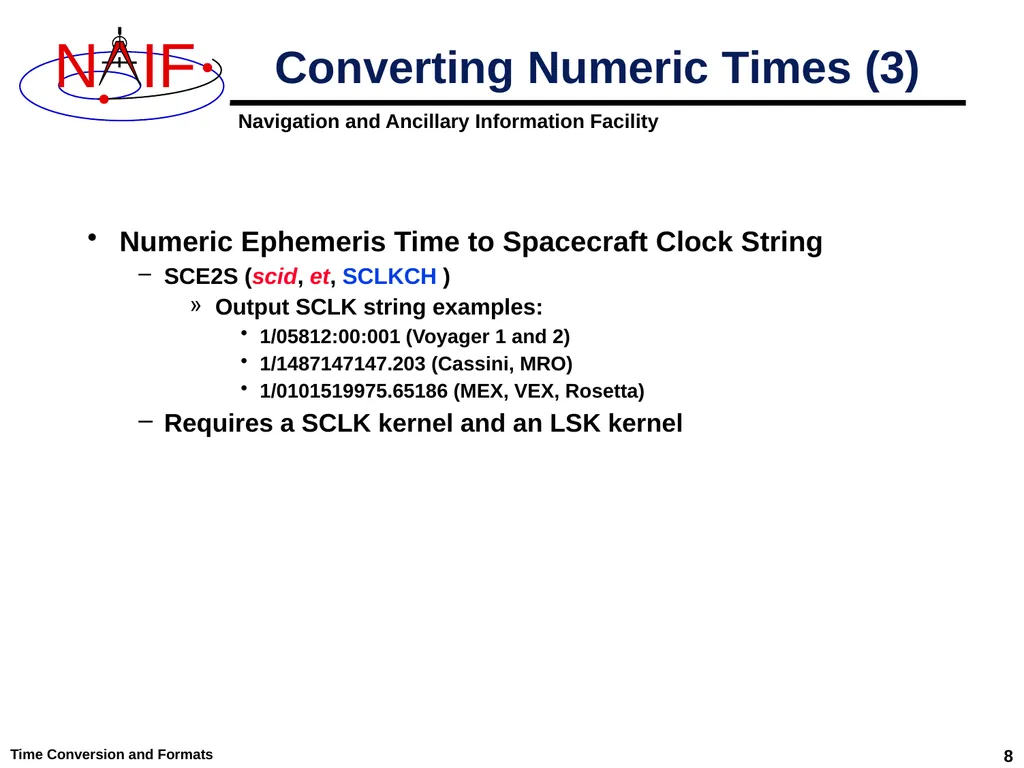
Converting Numeric Times (3) Numeric Ephemeris Time to Spacecraft Clock String
SCE2S (scid, et, SCLKCH )
Output SCLK string examples:
1/05812:00:001 (Voyager 1 and 2)
1/1487147147.203 (Cassini, MRO)
1/0101519975.65186 (MEX, VEX, Rosetta)
Requires a SCLK kernel and an LSK kernel Time Conversion and Formats 8<br>
09
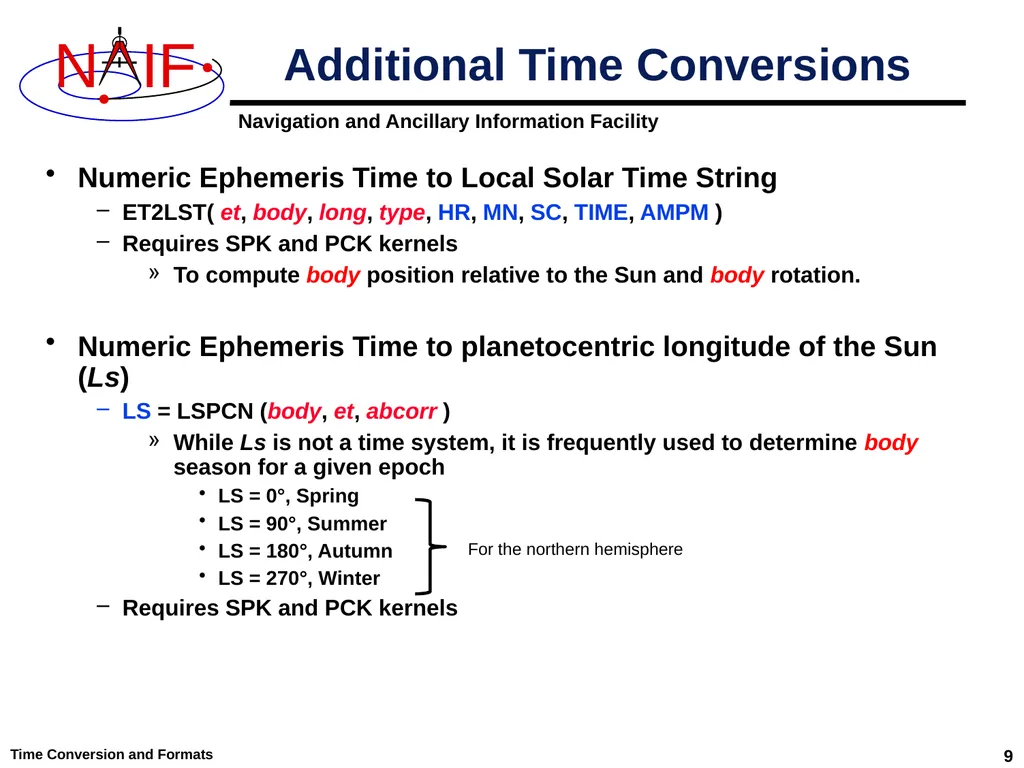
Time Conversion and Formats 9 Additional Time Conversions Numeric Ephemeris Time to Local Solar Time String
ET2LST( et, body, long, type, HR, MN, SC, TIME, AMPM )
Requires SPK and PCK kernels
To compute body position relative to the Sun and body rotation.
Numeric Ephemeris Time to planetocentric longitude of the Sun (Ls)
LS = LSPCN (body, et, abcorr )
While Ls is not a time system, it is frequently used to determine body season for a given epoch
LS = 0°, Spring
LS = 90°, Summer
LS = 180°, Autumn
LS = 270°, Winter
Requires SPK and PCK kernels For the northern hemisphere<br>
10
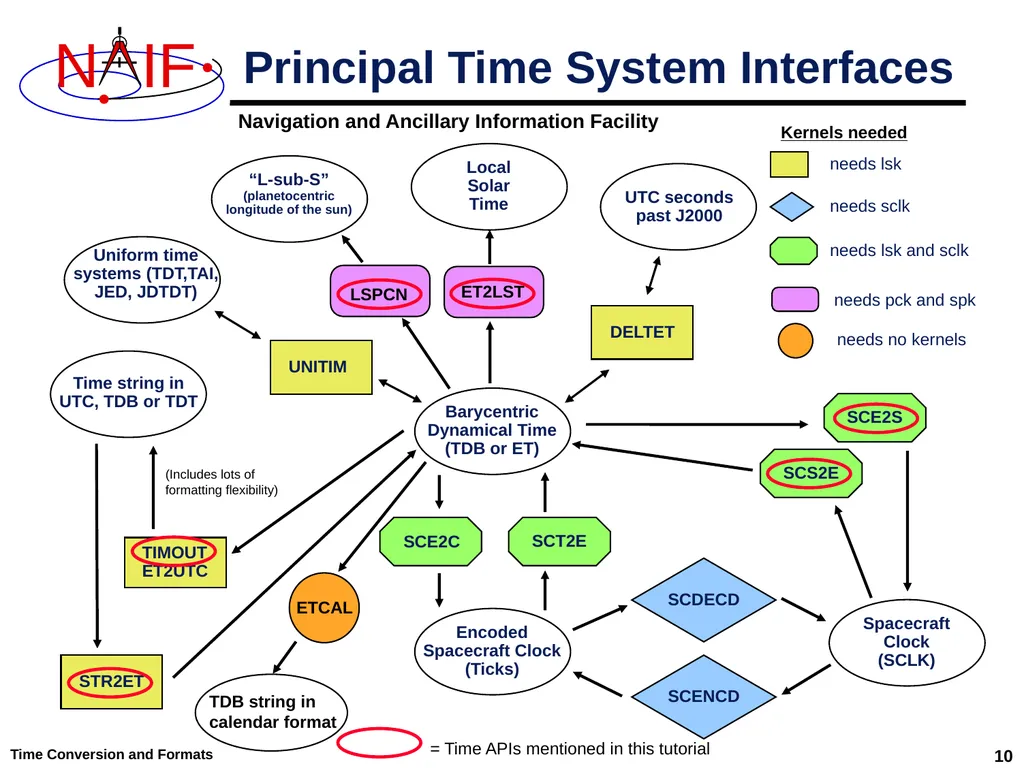
Time Conversion and Formats 10 needs lsk needs sclk needs lsk and sclk Principal Time System Interfaces needs pck and spk ET2LST SCE2C (Includes lots of
formatting flexibility) Kernels needed = Time APIs mentioned in this tutorial needs no kernels ETCAL TDB string in
calendar format<br>