
Time in Narrative Genette and Woolf Assessment
LD
Published · 15 slides · 0 views

1 / 1



Description
Time in Narrative Genette and Woolf Assessment (exm replacement arrangements) Assessments Formative (for all): formative 1000-word reading of a piece of literature, film or visual art in relation to time by Friday of week 8, term 1 (27th
Related Topics
Share
Embed code
Download this presentation From Below
"Time in Narrative Genette and Woolf Assessment" is the property of its rightful owner. Permission is granted to download and print the materials on this website for personal, non-commercial use only, and to display it on your personal computer provided you do not modify the materials and that you retain all copyright notices contained in the materials. By downloading content from our website, you accept the terms of this agreement.
Presentation Transcript
01
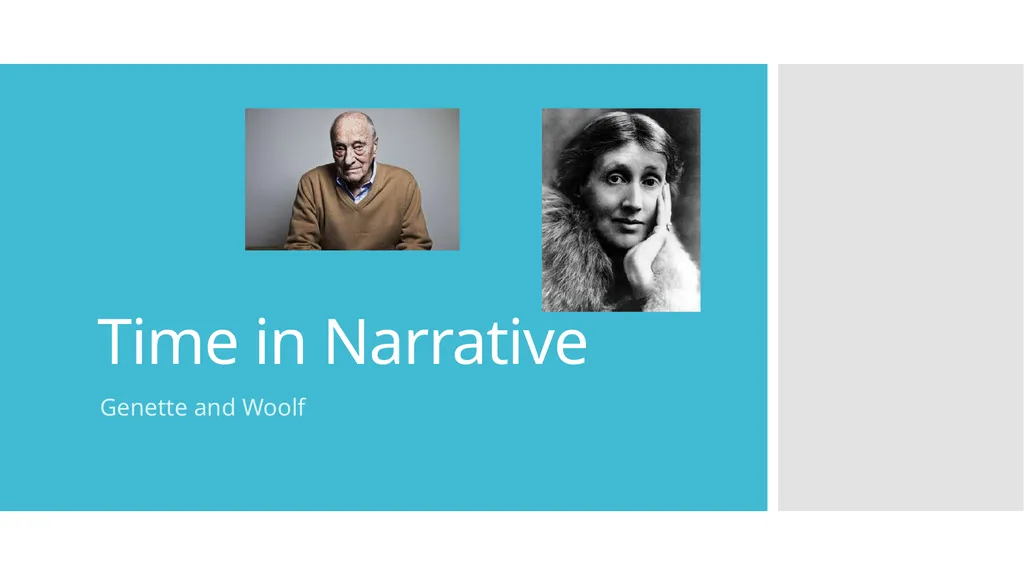
Time in Narrative Genette and Woolf<br>
02
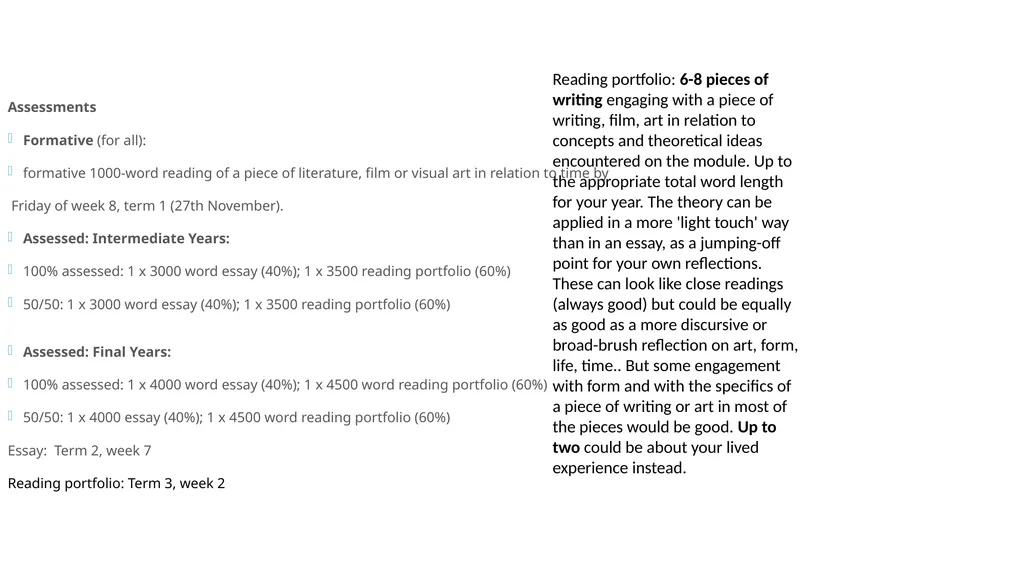
Assessment (exm replacement arrangements) Assessments
Formative (for all):
formative 1000-word reading of a piece of literature, film or visual art in relation to time by
Friday of week 8, term 1 (27th November).
Assessed: Intermediate Years:
100% assessed: 1 x 3000 word essay (40%); 1 x 3500 reading portfolio (60%)
50/50: 1 x 3000 word essay (40%); 1 x 3500 reading portfolio (60%)
Assessed: Final Years:
100% assessed: 1 x 4000 word essay (40%); 1 x 4500 word reading portfolio (60%)
50/50: 1 x 4000 essay (40%); 1 x 4500 word reading portfolio (60%)
Essay: Term 2, week 7
Reading portfolio: Term 3, week 2 Reading portfolio: 6-8 pieces of writing engaging with a piece of writing, film, art in relation to concepts and theoretical ideas encountered on the module. Up to the appropriate total word length for your year. The theory can be applied in a more 'light touch' way than in an essay, as a jumping-off point for your own reflections. These can look like close readings (always good) but could be equally as good as a more discursive or broad-brush reflection on art, form, life, time.. But some engagement with form and with the specifics of a piece of writing or art in most of the pieces would be good. Up to two could be about your lived experience instead.<br>
Formative (for all):
formative 1000-word reading of a piece of literature, film or visual art in relation to time by
Friday of week 8, term 1 (27th November).
Assessed: Intermediate Years:
100% assessed: 1 x 3000 word essay (40%); 1 x 3500 reading portfolio (60%)
50/50: 1 x 3000 word essay (40%); 1 x 3500 reading portfolio (60%)
Assessed: Final Years:
100% assessed: 1 x 4000 word essay (40%); 1 x 4500 word reading portfolio (60%)
50/50: 1 x 4000 essay (40%); 1 x 4500 word reading portfolio (60%)
Essay: Term 2, week 7
Reading portfolio: Term 3, week 2 Reading portfolio: 6-8 pieces of writing engaging with a piece of writing, film, art in relation to concepts and theoretical ideas encountered on the module. Up to the appropriate total word length for your year. The theory can be applied in a more 'light touch' way than in an essay, as a jumping-off point for your own reflections. These can look like close readings (always good) but could be equally as good as a more discursive or broad-brush reflection on art, form, life, time.. But some engagement with form and with the specifics of a piece of writing or art in most of the pieces would be good. Up to two could be about your lived experience instead.<br>
03
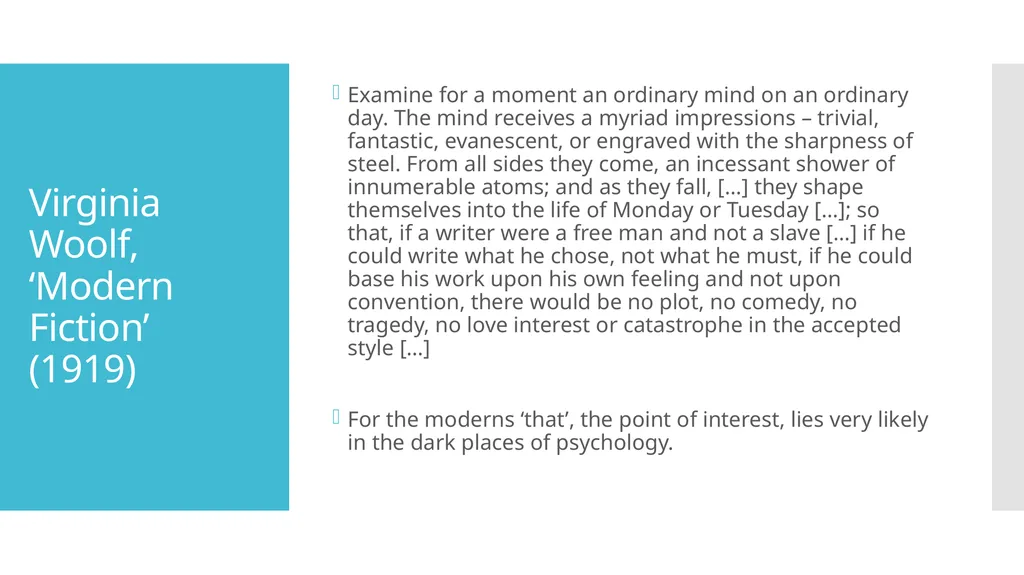
Virginia Woolf, ‘Modern Fiction’ (1919) Examine for a moment an ordinary mind on an ordinary day. The mind receives a myriad impressions – trivial, fantastic, evanescent, or engraved with the sharpness of steel. From all sides they come, an incessant shower of innumerable atoms; and as they fall, […] they shape themselves into the life of Monday or Tuesday […]; so that, if a writer were a free man and not a slave […] if he could write what he chose, not what he must, if he could base his work upon his own feeling and not upon convention, there would be no plot, no comedy, no tragedy, no love interest or catastrophe in the accepted style […]
For the moderns ‘that’, the point of interest, lies very likely in the dark places of psychology.<br>
For the moderns ‘that’, the point of interest, lies very likely in the dark places of psychology.<br>
04
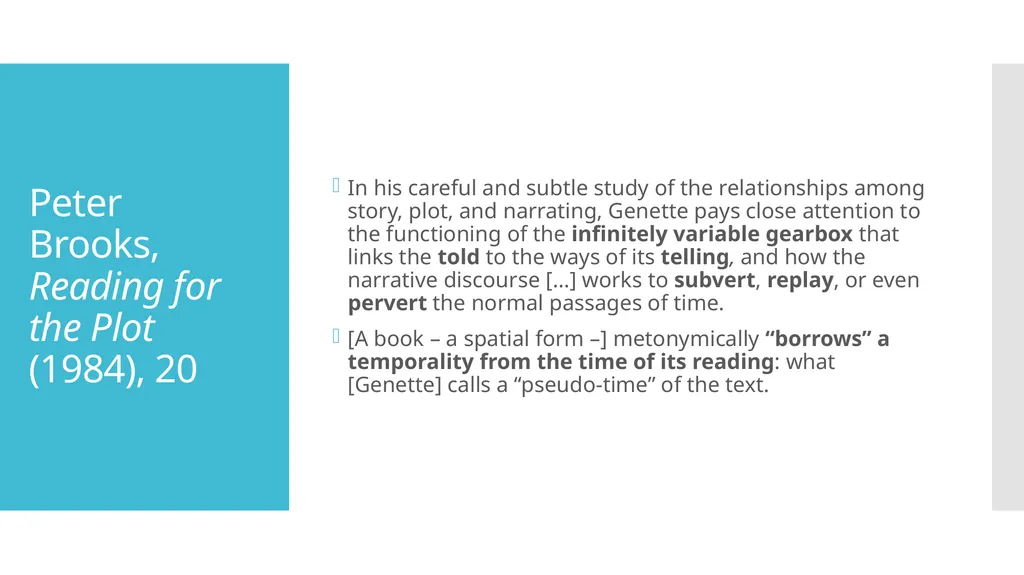
Peter Brooks, Reading for the Plot (1984), 20 In his careful and subtle study of the relationships among story, plot, and narrating, Genette pays close attention to the functioning of the infinitely variable gearbox that links the told to the ways of its telling, and how the narrative discourse […] works to subvert, replay, or even pervert the normal passages of time.
[A book – a spatial form –] metonymically “borrows” a temporality from the time of its reading: what [Genette] calls a “pseudo-time” of the text.<br>
[A book – a spatial form –] metonymically “borrows” a temporality from the time of its reading: what [Genette] calls a “pseudo-time” of the text.<br>
05
Story vs narrative/
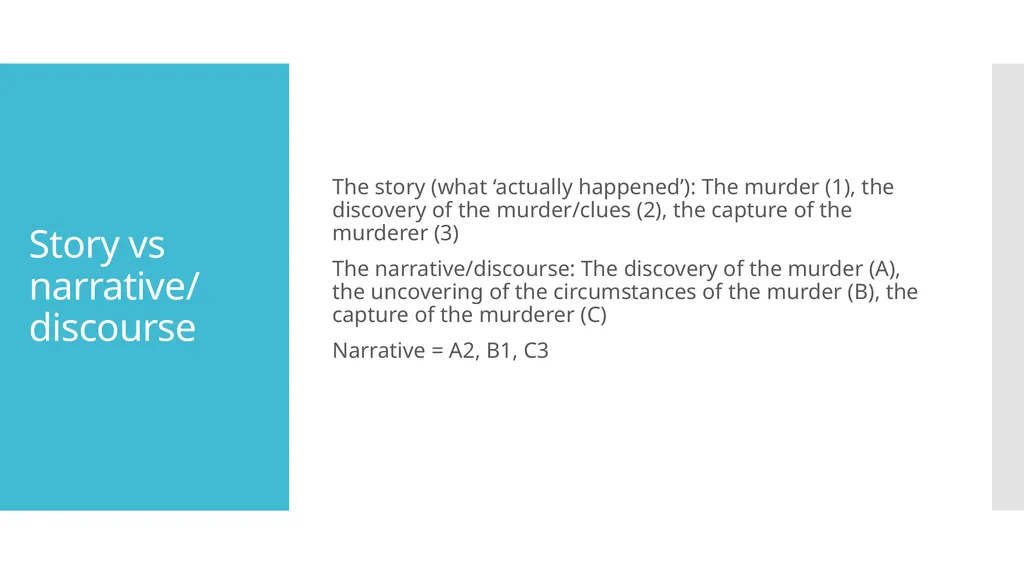
discourse The story (what ‘actually happened’): The murder (1), the discovery of the murder/clues (2), the capture of the murderer (3)
The narrative/discourse: The discovery of the murder (A), the uncovering of the circumstances of the murder (B), the capture of the murderer (C)
Narrative = A2, B1, C3<br>
The narrative/discourse: The discovery of the murder (A), the uncovering of the circumstances of the murder (B), the capture of the murderer (C)
Narrative = A2, B1, C3<br>
06
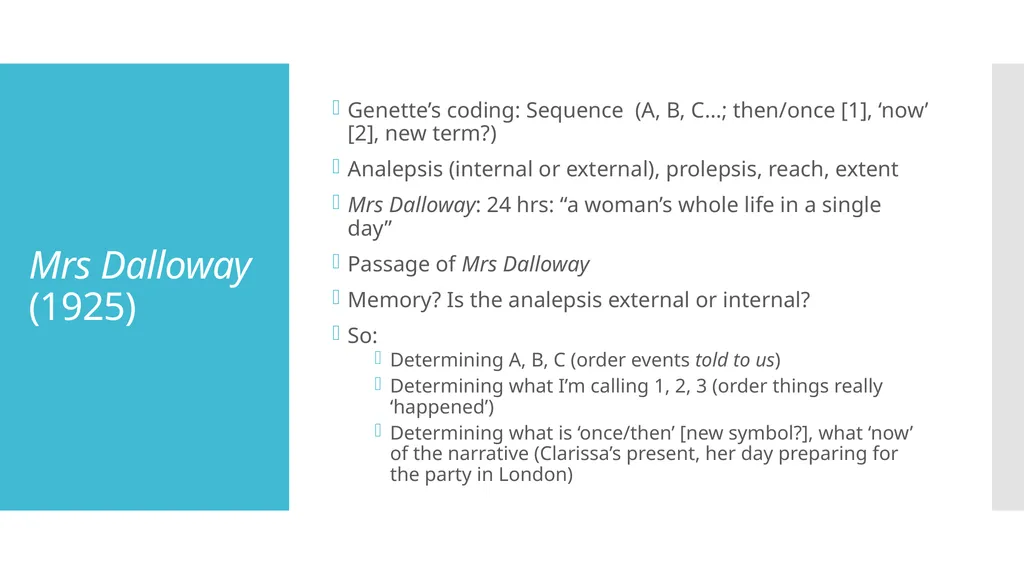
Mrs Dalloway (1925) Genette’s coding: Sequence (A, B, C…; then/once [1], ‘now’ [2], new term?)
Analepsis (internal or external), prolepsis, reach, extent
Mrs Dalloway: 24 hrs: “a woman’s whole life in a single day”
Passage of Mrs Dalloway
Memory? Is the analepsis external or internal?
So:
Determining A, B, C (order events told to us)
Determining what I’m calling 1, 2, 3 (order things really ‘happened’)
Determining what is ‘once/then’ [new symbol?], what ‘now’ of the narrative (Clarissa’s present, her day preparing for the party in London)<br>
Analepsis (internal or external), prolepsis, reach, extent
Mrs Dalloway: 24 hrs: “a woman’s whole life in a single day”
Passage of Mrs Dalloway
Memory? Is the analepsis external or internal?
So:
Determining A, B, C (order events told to us)
Determining what I’m calling 1, 2, 3 (order things really ‘happened’)
Determining what is ‘once/then’ [new symbol?], what ‘now’ of the narrative (Clarissa’s present, her day preparing for the party in London)<br>
07
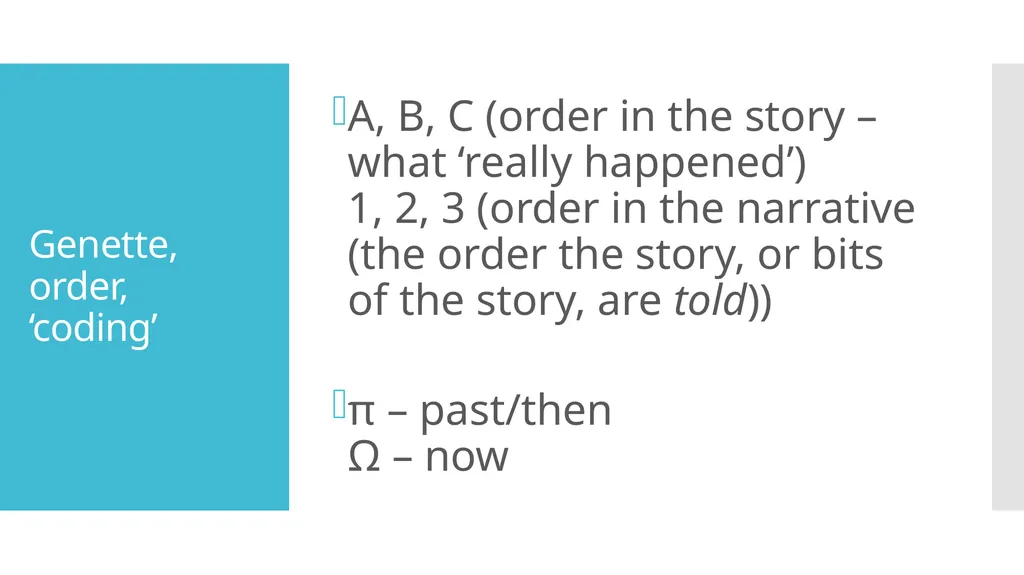
Genette, order, ‘coding’ A, B, C (order in the story – what ‘really happened’)
1, 2, 3 (order in the narrative (the order the story, or bits of the story, are told))
π – past/then Ω – now<br>
π – past/then Ω – now<br>
08
Have a go in your groups:
Channel 1
MATTHEWS, GABRIELLE (UG) [excused absence]
BATES, AIMÉE (UG) SCRIBE/ SPOKESPERSON
FLOYD, OLIVIA (UG)
CLARK, ISABELLA
LYNDON-STANFORD, SOPHIA (UG
Channel 2
SHARMA, KRISHNA (UG) SCRIBE/ SPOKESPERSON
DHALIWAL, ESHA (UG)
HULME-TEAGUE, SELWIN (UG)
HILL, ELIZABETH (UG) [excused absence]
MCMACKIN, CHARLI (UG)
Channel 3
TAYLOR, EVIE (UG) SCRIBE/ SPOKESPERSON
YANG, LONNIE (UG)
AHMAD, MEHR (UG)
ELGADDAL, NADIA (UG)<br>
Channel 1
MATTHEWS, GABRIELLE (UG) [excused absence]
BATES, AIMÉE (UG) SCRIBE/ SPOKESPERSON
FLOYD, OLIVIA (UG)
CLARK, ISABELLA
LYNDON-STANFORD, SOPHIA (UG
Channel 2
SHARMA, KRISHNA (UG) SCRIBE/ SPOKESPERSON
DHALIWAL, ESHA (UG)
HULME-TEAGUE, SELWIN (UG)
HILL, ELIZABETH (UG) [excused absence]
MCMACKIN, CHARLI (UG)
Channel 3
TAYLOR, EVIE (UG) SCRIBE/ SPOKESPERSON
YANG, LONNIE (UG)
AHMAD, MEHR (UG)
ELGADDAL, NADIA (UG)<br>
09
A, B, C (order in the narrative)
1, 2, 3 (order in the story)
π – past/then
Ω – now Mrs Dalloway, pp. 29-32
A Sally sitting on the floor
B Clarissa seeing a man dropping dead in a field
C Sally cutting heads off flowers
D Sally running down the passage naked
E feeling that Sally gives her [not a discrete event – but almost the point of all this so we need to register it…]
F NOW (can’t get feeling back)
G Clarissa at dressing table back in past and back at Bourton
H Sally in gauze, at the fireplace
I Clarissa meets Peter (intrudes upon her joy)
J NOW lays her brooch down
[lots of novel]
K Sally appears in the present of the novel, at the new party<br>
A Sally sitting on the floor
B Clarissa seeing a man dropping dead in a field
C Sally cutting heads off flowers
D Sally running down the passage naked
E feeling that Sally gives her [not a discrete event – but almost the point of all this so we need to register it…]
F NOW (can’t get feeling back)
G Clarissa at dressing table back in past and back at Bourton
H Sally in gauze, at the fireplace
I Clarissa meets Peter (intrudes upon her joy)
J NOW lays her brooch down
[lots of novel]
K Sally appears in the present of the novel, at the new party<br>
10
A, B, C (order in the narrative)
1, 2, 3 (order in the story)
π – past/then
Ω – now
Highlight – present of the novel A Sally sitting on the floor (2)
B Clarissa seeing a man dropping dead in a field (1)
C Sally cutting heads off flowers (3)
D Sally running down the passage naked (4)
E feeling that Sally gives her [not a discrete event – but almost the point of all this so we need to register it…]
F NOW (can’t get feeling back) (8)
G Clarissa at dressing table back in past and back at Bourton (5)
H Sally in gauze, at the fireplace (6)
I Clarissa meets Peter (intrudes upon her joy) (7)
J NOW lays her brooch down (9)
[lots of novel]
K NOW Sally appears in the present of the novel, at the new party (10)
B1πA2πC3πD4πG5πF8ΩH6πI7πJ9Ω….K10Ω
EEEEEEEEEEEEE EEEE<br>
B Clarissa seeing a man dropping dead in a field (1)
C Sally cutting heads off flowers (3)
D Sally running down the passage naked (4)
E feeling that Sally gives her [not a discrete event – but almost the point of all this so we need to register it…]
F NOW (can’t get feeling back) (8)
G Clarissa at dressing table back in past and back at Bourton (5)
H Sally in gauze, at the fireplace (6)
I Clarissa meets Peter (intrudes upon her joy) (7)
J NOW lays her brooch down (9)
[lots of novel]
K NOW Sally appears in the present of the novel, at the new party (10)
B1πA2πC3πD4πG5πF8ΩH6πI7πJ9Ω….K10Ω
EEEEEEEEEEEEE EEEE<br>
11
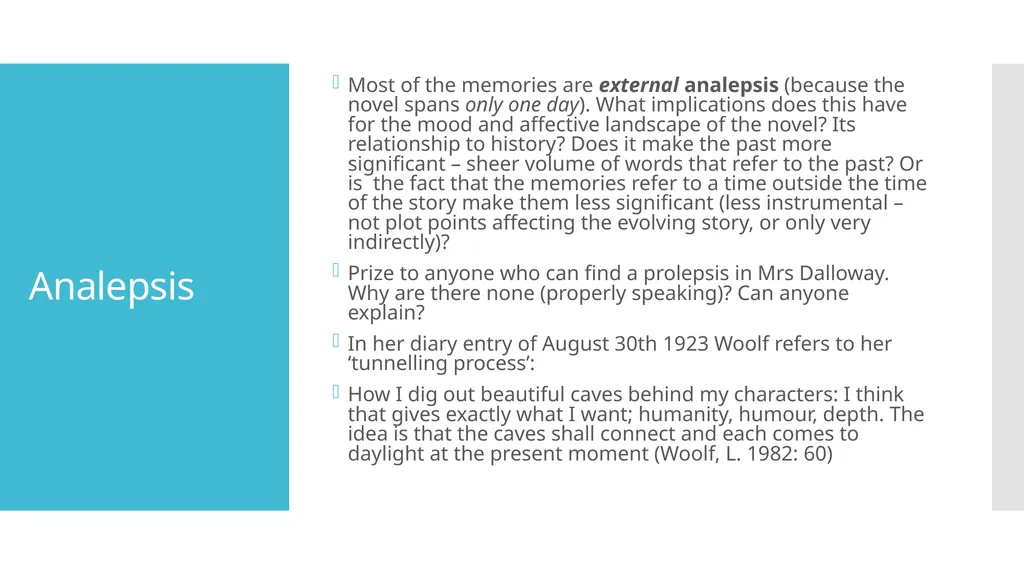
Analepsis Most of the memories are external analepsis (because the novel spans only one day). What implications does this have for the mood and affective landscape of the novel? Its relationship to history? Does it make the past more significant – sheer volume of words that refer to the past? Or is the fact that the memories refer to a time outside the time of the story make them less significant (less instrumental – not plot points affecting the evolving story, or only very indirectly)?
Prize to anyone who can find a prolepsis in Mrs Dalloway. Why are there none (properly speaking)? Can anyone explain?
In her diary entry of August 30th 1923 Woolf refers to her ‘tunnelling process’:
How I dig out beautiful caves behind my characters: I think that gives exactly what I want; humanity, humour, depth. The idea is that the caves shall connect and each comes to daylight at the present moment (Woolf, L. 1982: 60)<br>
Prize to anyone who can find a prolepsis in Mrs Dalloway. Why are there none (properly speaking)? Can anyone explain?
In her diary entry of August 30th 1923 Woolf refers to her ‘tunnelling process’:
How I dig out beautiful caves behind my characters: I think that gives exactly what I want; humanity, humour, depth. The idea is that the caves shall connect and each comes to daylight at the present moment (Woolf, L. 1982: 60)<br>
12
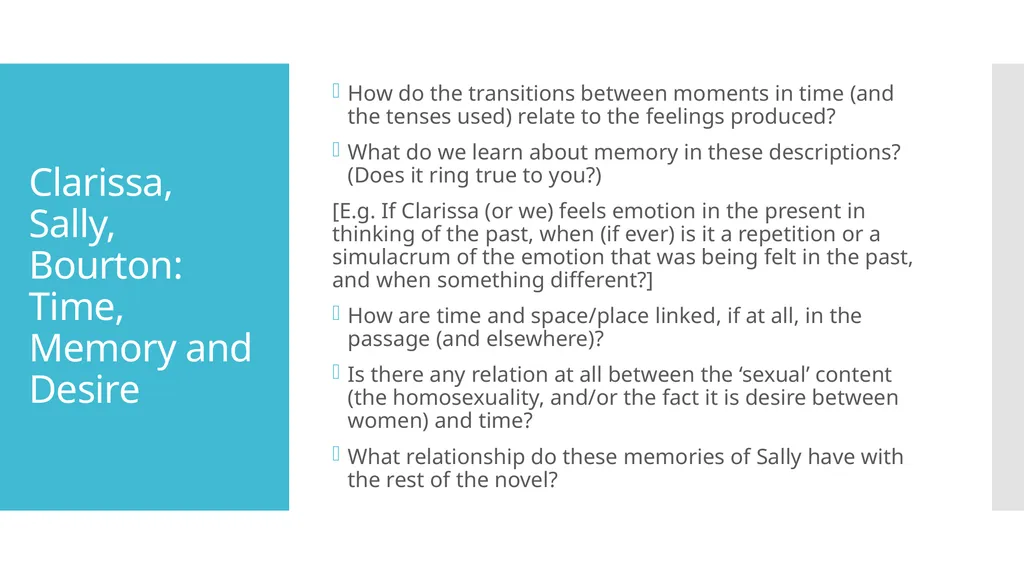
Clarissa, Sally, Bourton: Time, Memory and Desire How do the transitions between moments in time (and the tenses used) relate to the feelings produced?
What do we learn about memory in these descriptions? (Does it ring true to you?)
[E.g. If Clarissa (or we) feels emotion in the present in thinking of the past, when (if ever) is it a repetition or a simulacrum of the emotion that was being felt in the past, and when something different?]
How are time and space/place linked, if at all, in the passage (and elsewhere)?
Is there any relation at all between the ‘sexual’ content (the homosexuality, and/or the fact it is desire between women) and time?
What relationship do these memories of Sally have with the rest of the novel?<br>
What do we learn about memory in these descriptions? (Does it ring true to you?)
[E.g. If Clarissa (or we) feels emotion in the present in thinking of the past, when (if ever) is it a repetition or a simulacrum of the emotion that was being felt in the past, and when something different?]
How are time and space/place linked, if at all, in the passage (and elsewhere)?
Is there any relation at all between the ‘sexual’ content (the homosexuality, and/or the fact it is desire between women) and time?
What relationship do these memories of Sally have with the rest of the novel?<br>
13
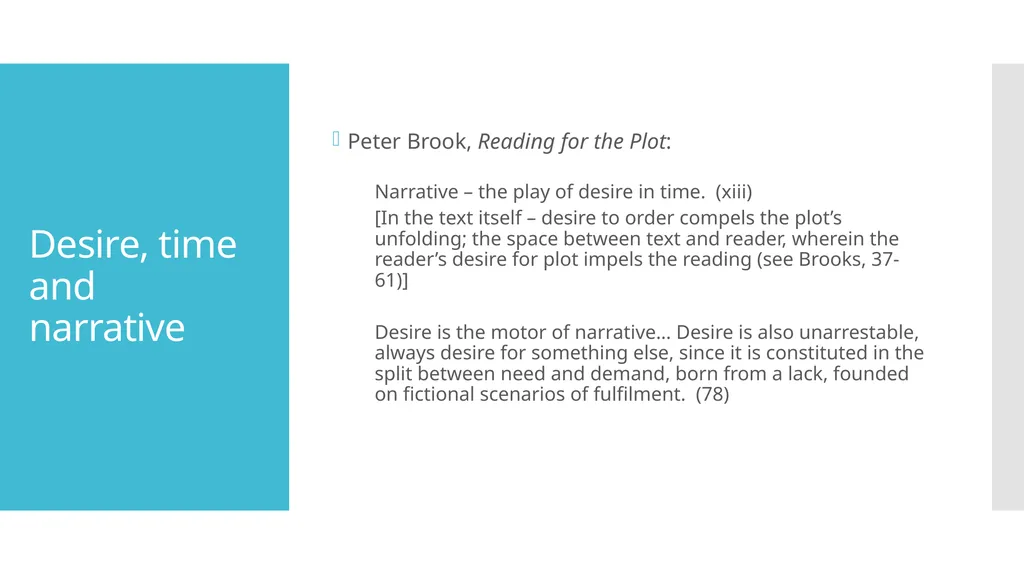
Desire, time and narrative Peter Brook, Reading for the Plot:
Narrative – the play of desire in time. (xiii)
[In the text itself – desire to order compels the plot’s unfolding; the space between text and reader, wherein the reader’s desire for plot impels the reading (see Brooks, 37-61)]
Desire is the motor of narrative… Desire is also unarrestable, always desire for something else, since it is constituted in the split between need and demand, born from a lack, founded on fictional scenarios of fulfilment. (78)<br>
Narrative – the play of desire in time. (xiii)
[In the text itself – desire to order compels the plot’s unfolding; the space between text and reader, wherein the reader’s desire for plot impels the reading (see Brooks, 37-61)]
Desire is the motor of narrative… Desire is also unarrestable, always desire for something else, since it is constituted in the split between need and demand, born from a lack, founded on fictional scenarios of fulfilment. (78)<br>
14
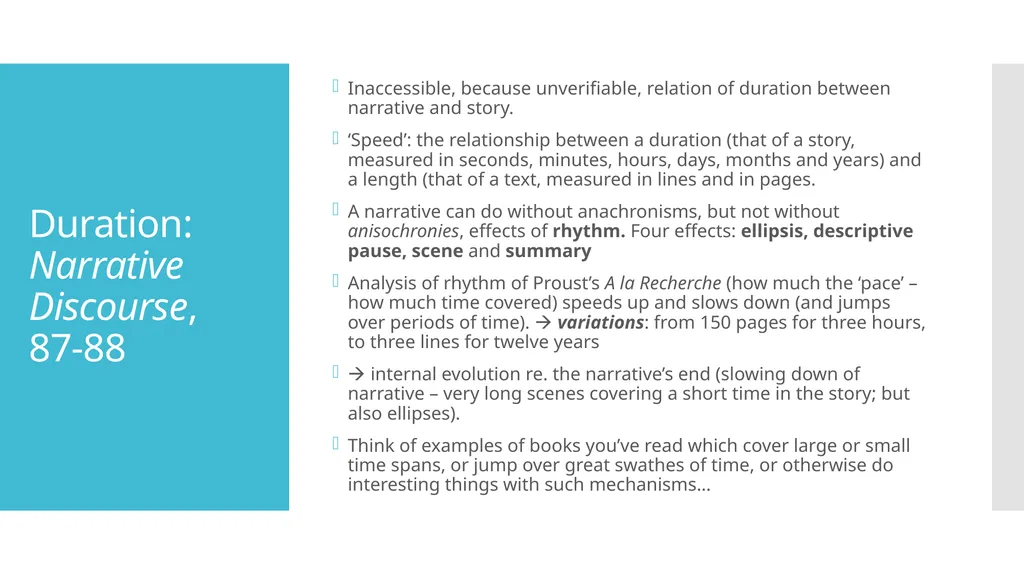
Duration: Narrative Discourse, 87-88 Inaccessible, because unverifiable, relation of duration between narrative and story.
‘Speed’: the relationship between a duration (that of a story, measured in seconds, minutes, hours, days, months and years) and a length (that of a text, measured in lines and in pages.
A narrative can do without anachronisms, but not without anisochronies, effects of rhythm. Four effects: ellipsis, descriptive pause, scene and summary
Analysis of rhythm of Proust’s A la Recherche (how much the ‘pace’ – how much time covered) speeds up and slows down (and jumps over periods of time). variations: from 150 pages for three hours, to three lines for twelve years
internal evolution re. the narrative’s end (slowing down of narrative – very long scenes covering a short time in the story; but also ellipses).
Think of examples of books you’ve read which cover large or small time spans, or jump over great swathes of time, or otherwise do interesting things with such mechanisms…<br>
‘Speed’: the relationship between a duration (that of a story, measured in seconds, minutes, hours, days, months and years) and a length (that of a text, measured in lines and in pages.
A narrative can do without anachronisms, but not without anisochronies, effects of rhythm. Four effects: ellipsis, descriptive pause, scene and summary
Analysis of rhythm of Proust’s A la Recherche (how much the ‘pace’ – how much time covered) speeds up and slows down (and jumps over periods of time). variations: from 150 pages for three hours, to three lines for twelve years
internal evolution re. the narrative’s end (slowing down of narrative – very long scenes covering a short time in the story; but also ellipses).
Think of examples of books you’ve read which cover large or small time spans, or jump over great swathes of time, or otherwise do interesting things with such mechanisms…<br>