Time to Change Physical Chemical Changes Presentation by T. Tomm 2019 sciencespot.net Image Source: http:www.peachschools.orguserfiles28Classes4698userfiles28my20filesphysical20and20chemical20changes202.pdf?id14158 1.
"Time to Change Physical & Chemical Changes" is the property of its rightful owner. Permission is granted to
download and print the materials on this website for personal, non-commercial use only, and to display it
on your personal computer provided you do not modify the materials and that you retain all copyright
notices contained in the materials. By downloading content from our website, you accept the terms of this
agreement.
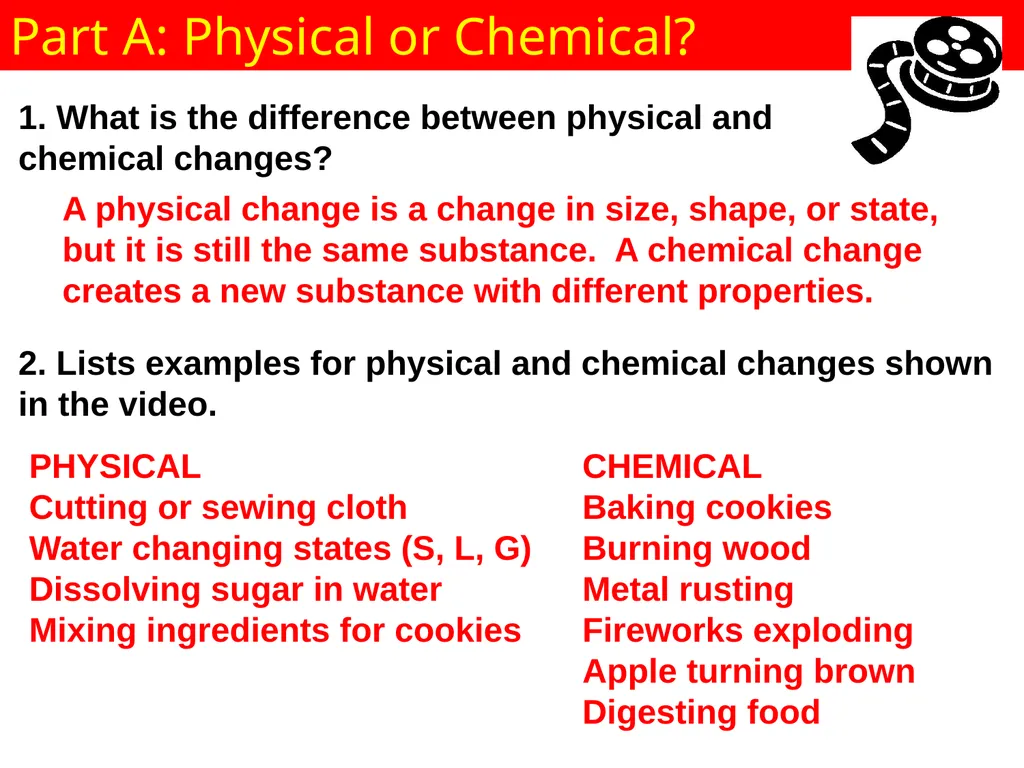
1. What is the difference between physical and chemical changes?
2. Lists examples for physical and chemical changes shown in the video. Part A: Physical or Chemical? CHEMICAL Baking cookies
Burning wood
Metal rusting
Fireworks exploding
Apple turning brown
Digesting food PHYSICAL Cutting or sewing cloth
Water changing states (S, L, G)
Dissolving sugar in water
Mixing ingredients for cookies A physical change is a change in size, shape, or state, but it is still the same substance. A chemical change creates a new substance with different properties.<br>
03
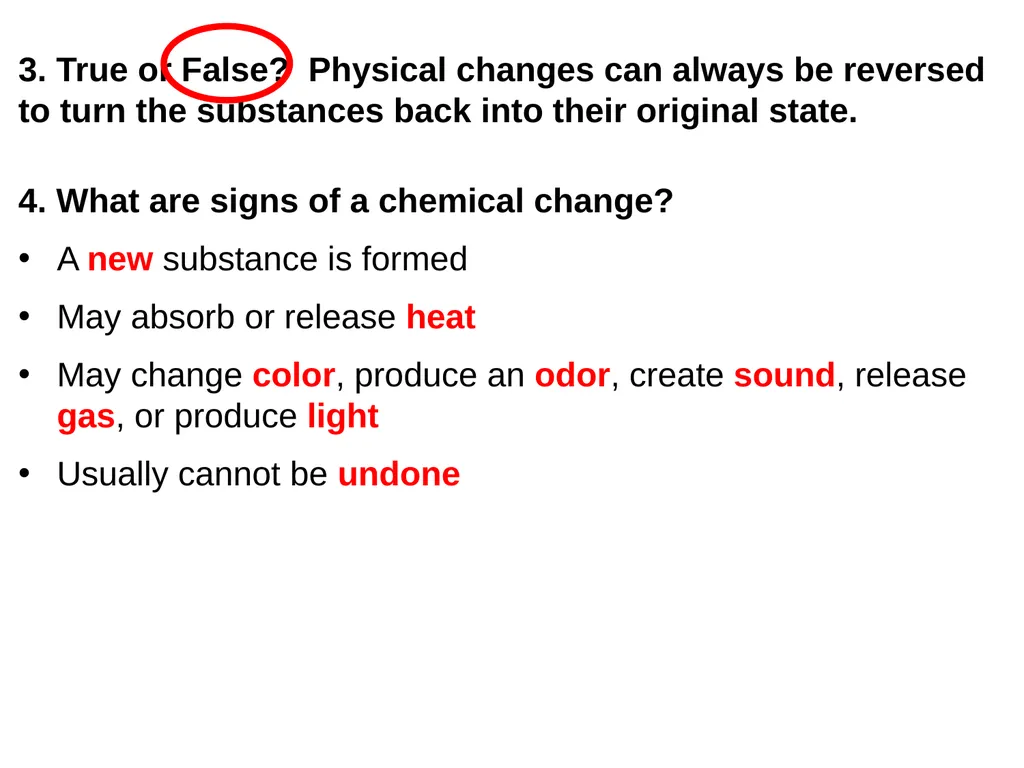
3. True or False? Physical changes can always be reversed to turn the substances back into their original state.
4. What are signs of a chemical change?
A new substance is formed
May absorb or release heat
May change color, produce an odor, create sound, release gas, or produce light
Usually cannot be undone<br>
04
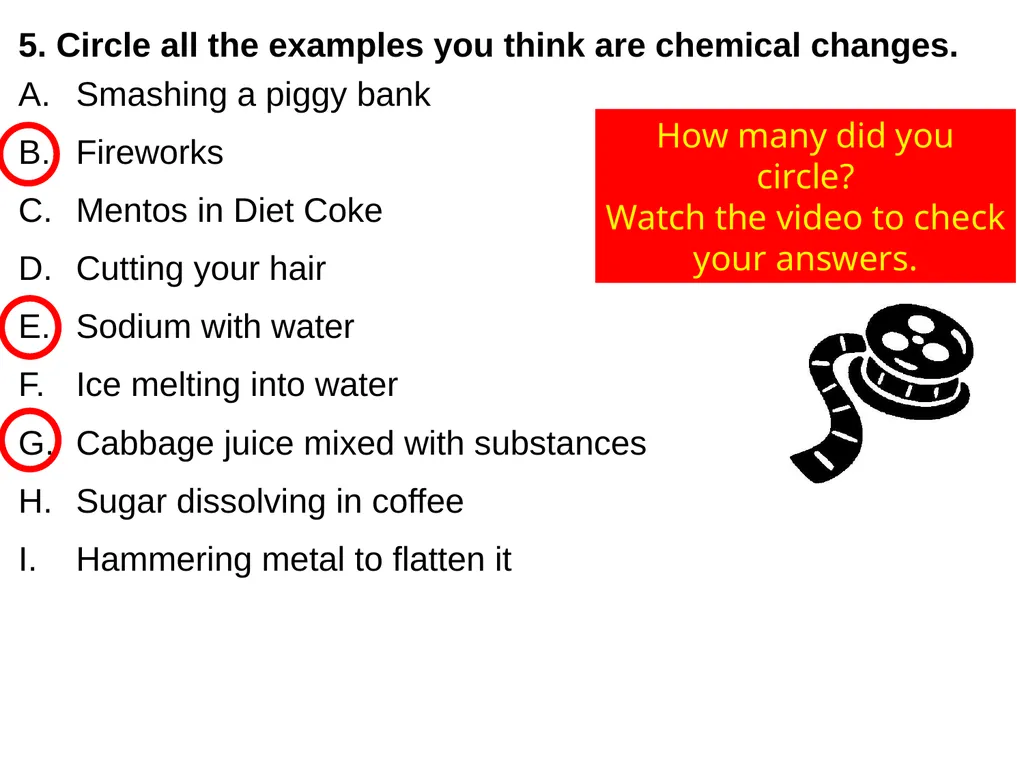
5. Circle all the examples you think are chemical changes.
Smashing a piggy bank
Fireworks
Mentos in Diet Coke
Cutting your hair
Sodium with water
Ice melting into water
Cabbage juice mixed with substances
Sugar dissolving in coffee
Hammering metal to flatten it<br>
05
8th Grade Science It’s time for … “Rocket Science” Part B: Rocket Reactions<br>
06
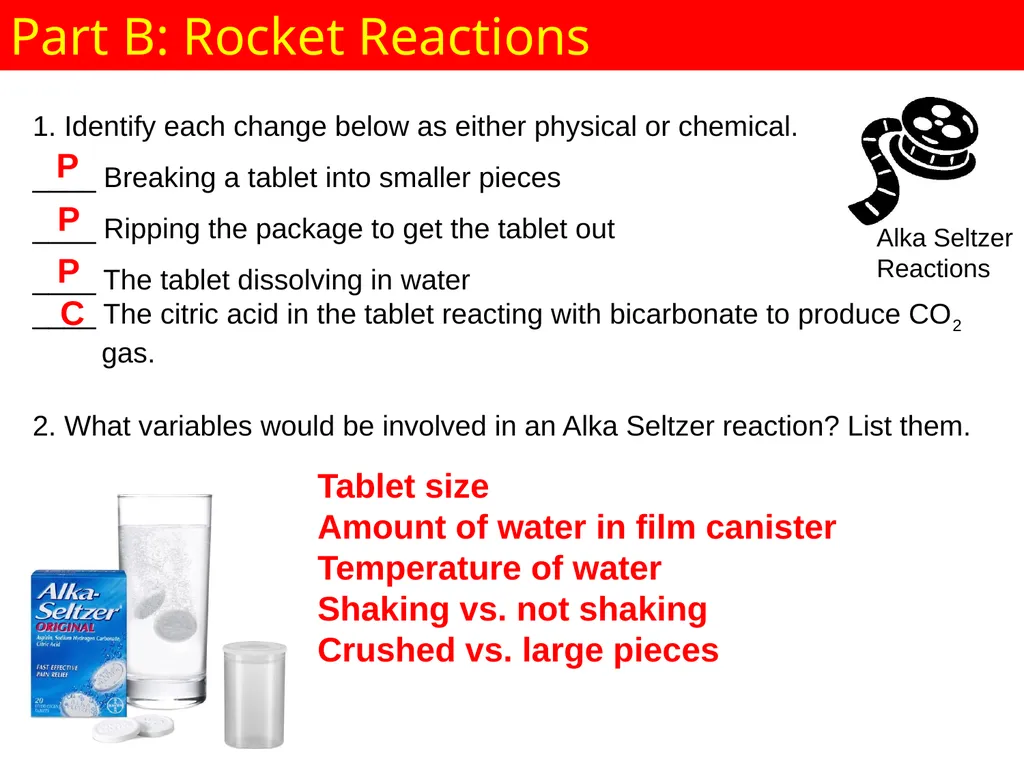
1. Identify each change below as either physical or chemical.
____ Breaking a tablet into smaller pieces
____ Ripping the package to get the tablet out
____ The tablet dissolving in water
____ The citric acid in the tablet reacting with bicarbonate to produce CO2
gas.
2. What variables would be involved in an Alka Seltzer reaction? List them. Part B: Rocket Reactions Alka Seltzer Reactions P P P C Tablet size
Amount of water in film canister
Temperature of water
Shaking vs. not shaking
Crushed vs. large pieces<br>
07
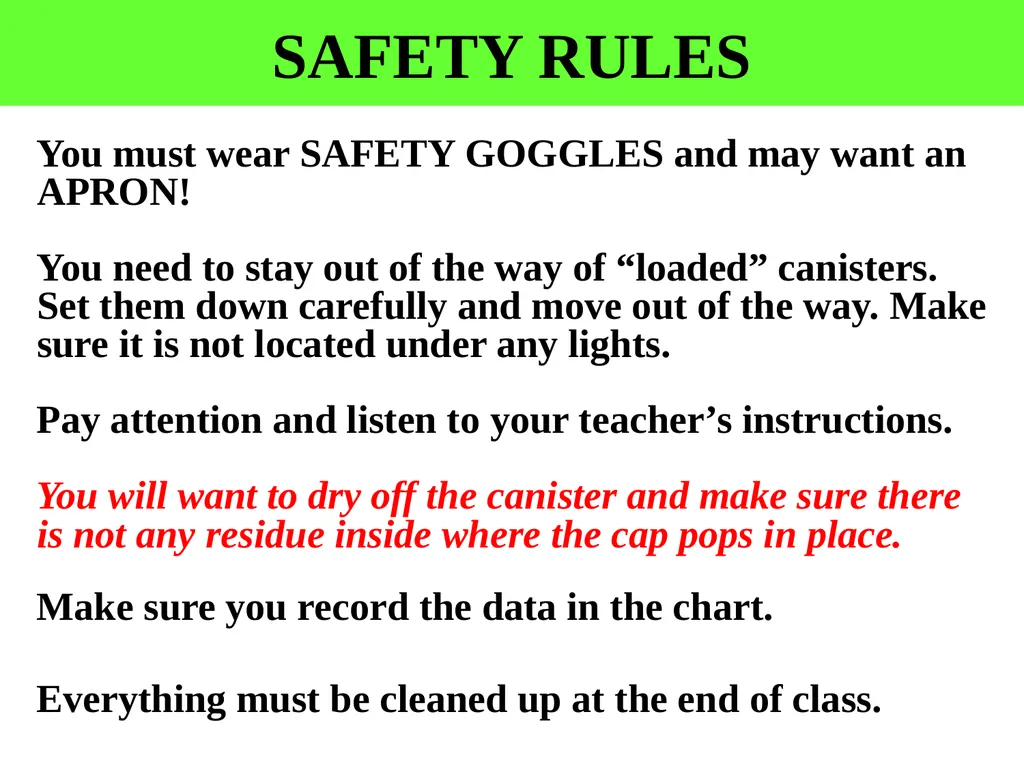
SAFETY RULES You must wear SAFETY GOGGLES and may want an APRON!
You need to stay out of the way of “loaded” canisters. Set them down carefully and move out of the way. Make sure it is not located under any lights.
Pay attention and listen to your teacher’s instructions.
You will want to dry off the canister and make sure there is not any residue inside where the cap pops in place.
Make sure you record the data in the chart.
Everything must be cleaned up at the end of class.<br>
08
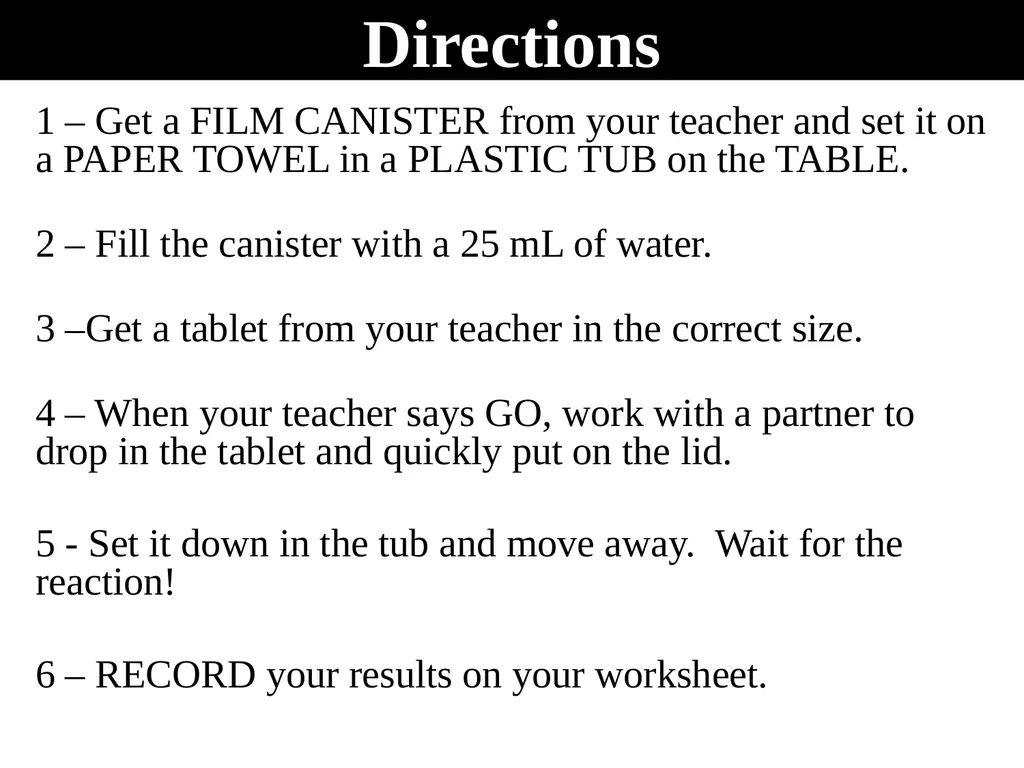
Directions 1 – Get a FILM CANISTER from your teacher and set it on a PAPER TOWEL in a PLASTIC TUB on the TABLE.
2 – Fill the canister with a 25 mL of water.
3 –Get a tablet from your teacher in the correct size.
4 – When your teacher says GO, work with a partner to drop in the tablet and quickly put on the lid.
5 - Set it down in the tub and move away. Wait for the reaction!
6 – RECORD your results on your worksheet.<br>
09
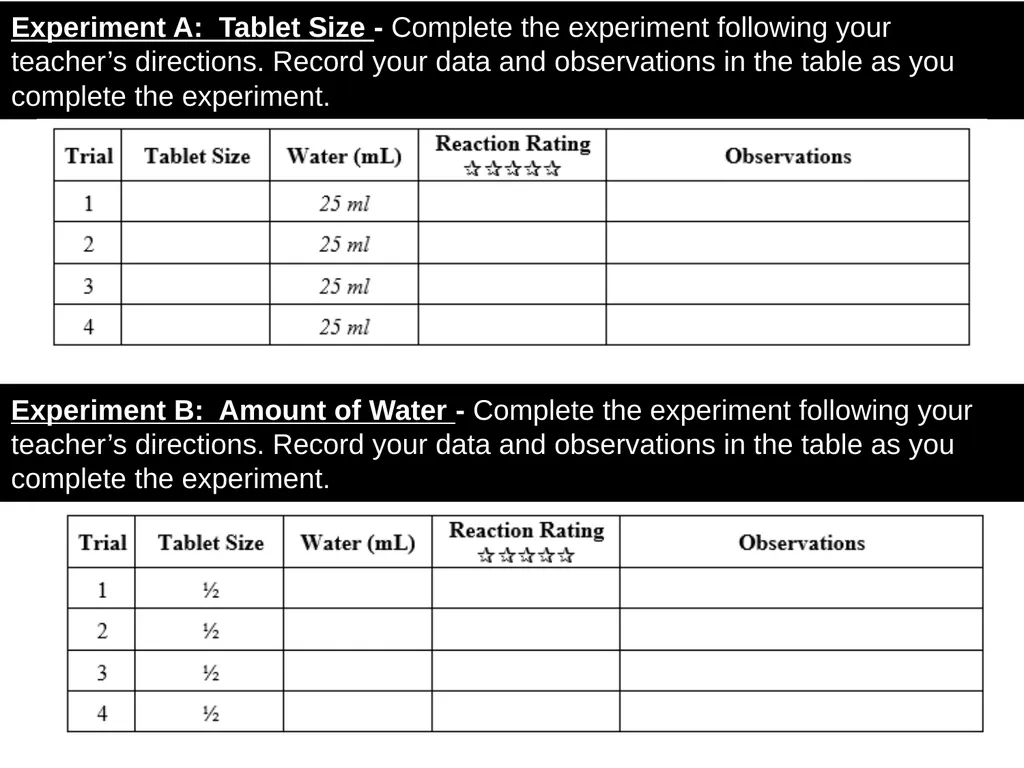
Experiment A: Tablet Size - Complete the experiment following your teacher’s directions. Record your data and observations in the table as you complete the experiment. Experiment B: Amount of Water - Complete the experiment following your teacher’s directions. Record your data and observations in the table as you complete the experiment.<br>
10
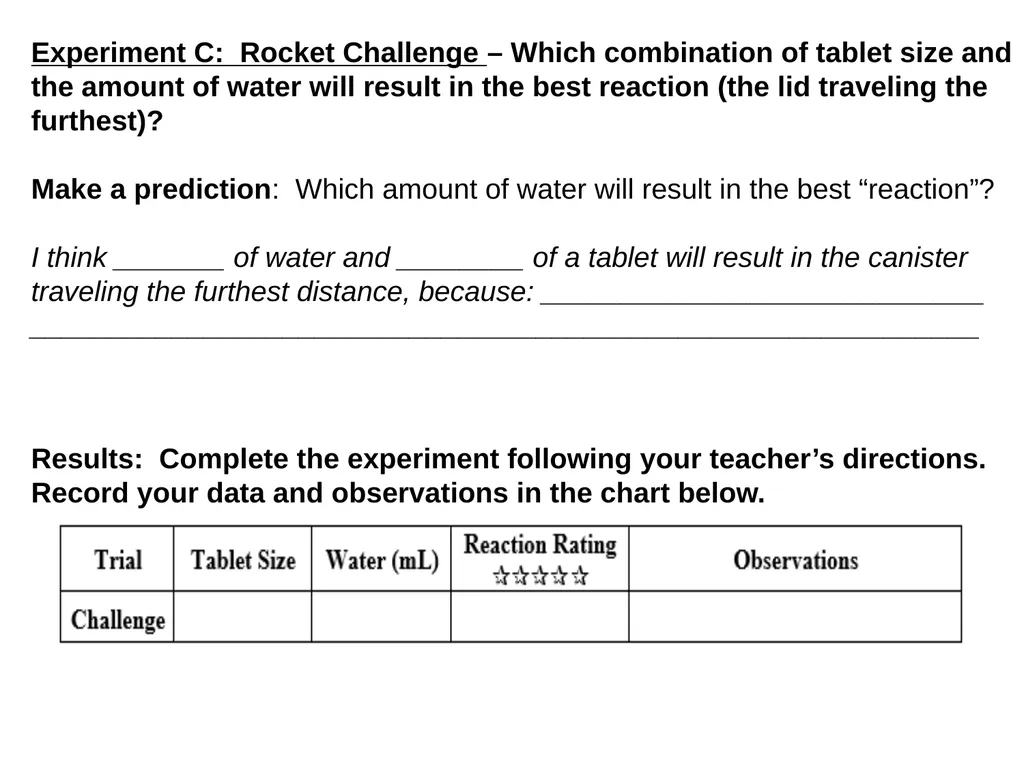
Experiment C: Rocket Challenge – Which combination of tablet size and the amount of water will result in the best reaction (the lid traveling the furthest)?
Make a prediction: Which amount of water will result in the best “reaction”?
I think _______ of water and ________ of a tablet will result in the canister traveling the furthest distance, because: ____________________________
____________________________________________________________ Trial
Tablet Size
Water (mL)
Reaction Rating
Observations
Challenge
½ Results: Complete the experiment following your teacher’s directions. Record your data and observations in the chart below.<br>
11
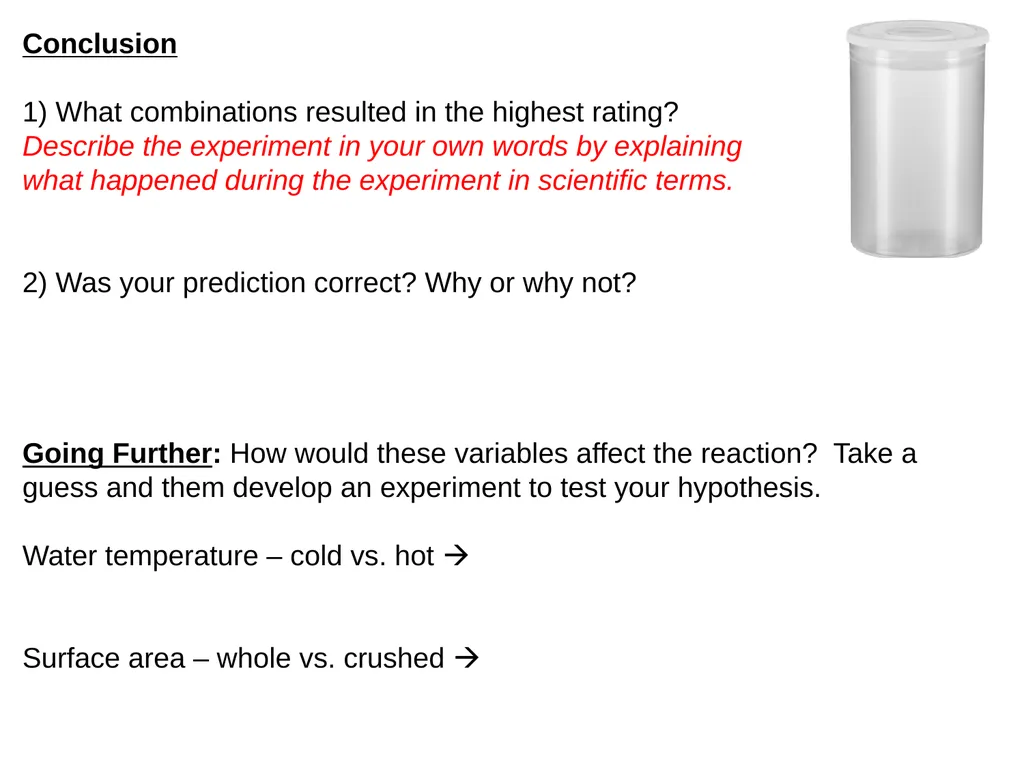
Conclusion
1) What combinations resulted in the highest rating?
Describe the experiment in your own words by explaining what happened during the experiment in scientific terms.
2) Was your prediction correct? Why or why not?
Going Further: How would these variables affect the reaction? Take a guess and them develop an experiment to test your hypothesis.
Water temperature – cold vs. hot
Surface area – whole vs. crushed <br>
12
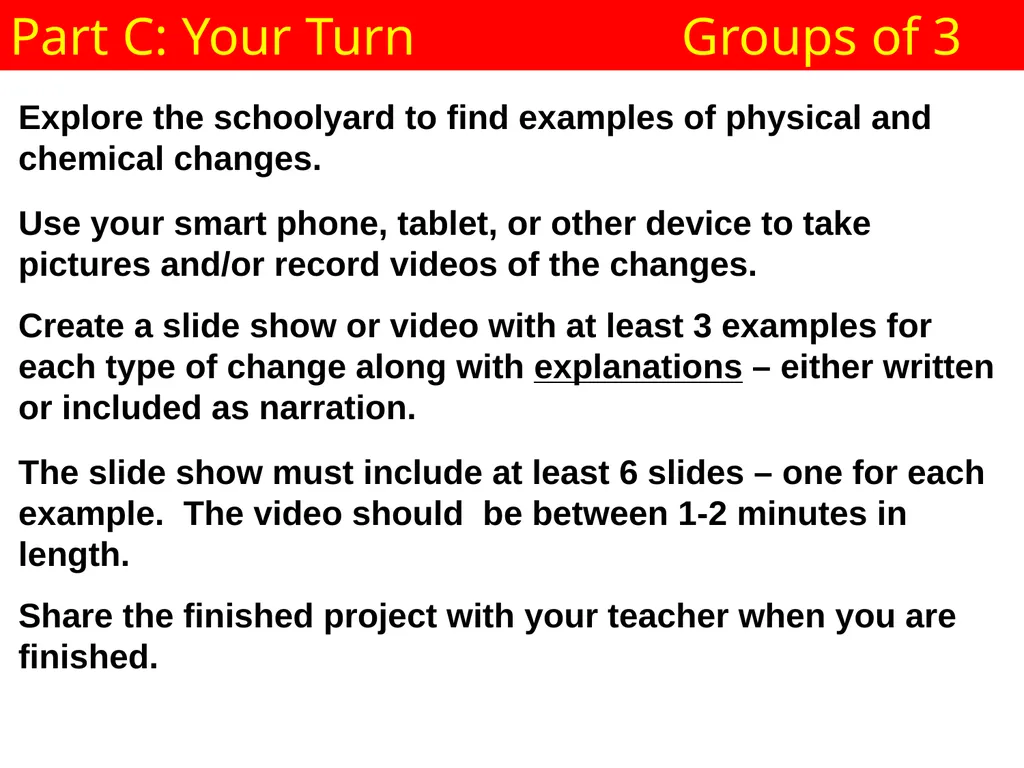
Explore the schoolyard to find examples of physical and chemical changes.
Use your smart phone, tablet, or other device to take pictures and/or record videos of the changes.
Create a slide show or video with at least 3 examples for each type of change along with explanations – either written or included as narration.
The slide show must include at least 6 slides – one for each example. The video should be between 1-2 minutes in length.
Share the finished project with your teacher when you are finished. Part C: Your Turn Groups of 3<br>