Times Higher Education Impact Ranking October 2020 Simon Pratt, Director Policy Analysis, University of Toronto Times Higher Education (THE) 2 Founded in 1971 as a weekly supplement to The Times. Launched the World University Rankings
"Times Higher Education – Impact Ranking October" is the property of its rightful owner. Permission is granted to
download and print the materials on this website for personal, non-commercial use only, and to display it
on your personal computer provided you do not modify the materials and that you retain all copyright
notices contained in the materials. By downloading content from our website, you accept the terms of this
agreement.
Presentation Transcript
01
Times Higher Education – Impact Ranking
October 2020
Simon Pratt, Director Policy & Analysis, University of Toronto<br>
02
Times Higher Education (THE) 2 Founded in 1971 as a weekly supplement to The Times.
Launched the World University Rankings in 2004
Became an independent trade magazine in 2008
Has undergone a series of changes in ownership since then
Has become increasingly commercial.
Rankings as a product
Consulting services<br>
03
IMPACT RANKINGS 3 Part of THE’s commercial strategy is to generate multiple rankings for different audiences.
In 2017 they started consultations around a ranking of university’s third mission
Initially focused on Knowledge Exchange, Economic Impact and Innovation the concept evolved
They developed the concept of an Impact Ranking based on the UN Sustainable Development Goals.<br>
04
IMPACT RANKINGS 4 In its first year (2019) 11 of the 17 SDGs were assessed and 467 universities were ranked
In year two all 17 SDGs were assessed and 766 universities participated
However, there was very limited participation by the traditional elite universities, especially from the US (only 31 universities in total)
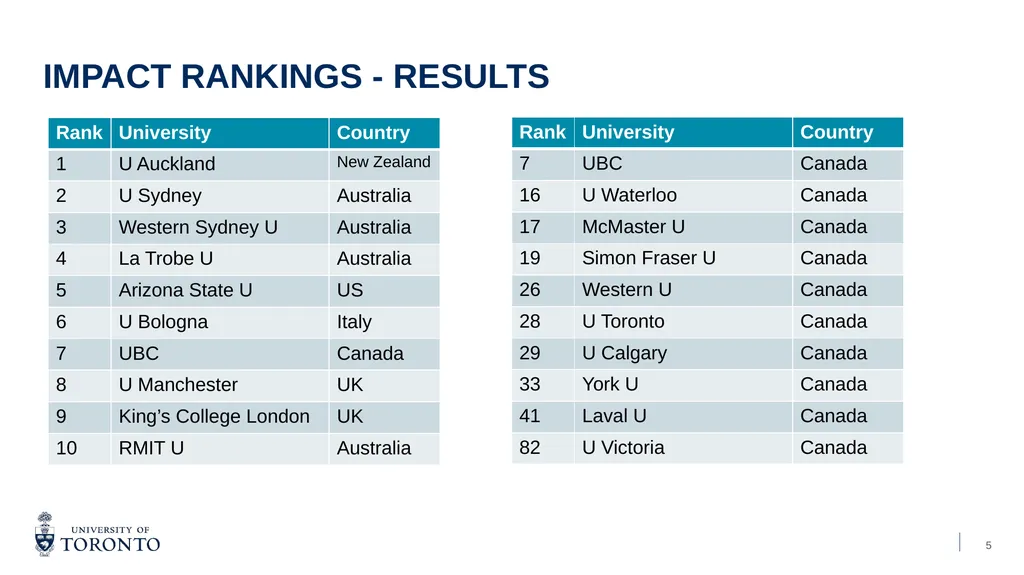
The results look quite different to other rankings<br>
05
IMPACT RANKINGS - RESULTS 5<br>
06
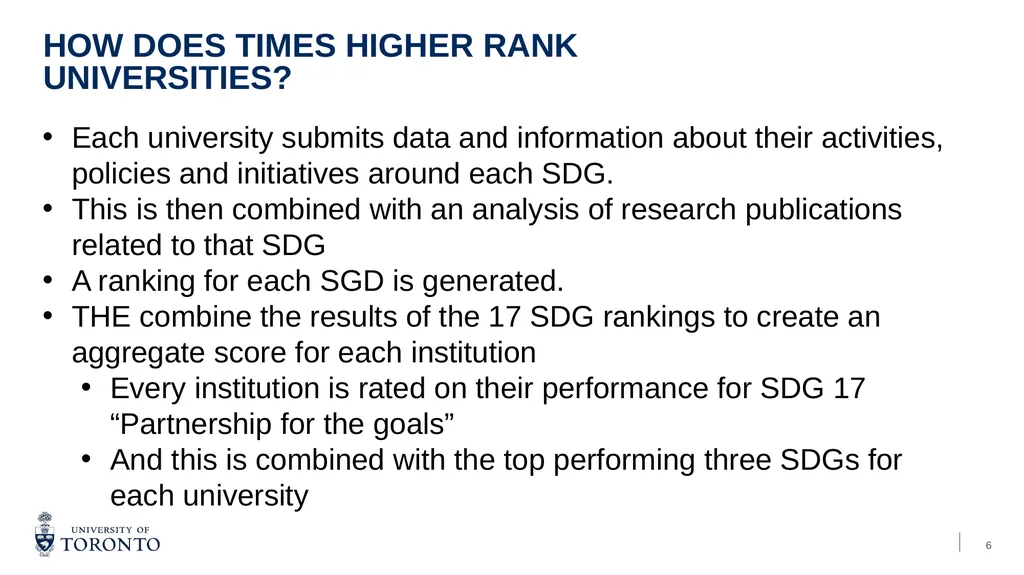
How does Times Higher RANK Universities? 6 Each university submits data and information about their activities, policies and initiatives around each SDG.
This is then combined with an analysis of research publications related to that SDG
A ranking for each SGD is generated.
THE combine the results of the 17 SDG rankings to create an aggregate score for each institution
Every institution is rated on their performance for SDG 17 “Partnership for the goals”
And this is combined with the top performing three SDGs for each university<br>
07
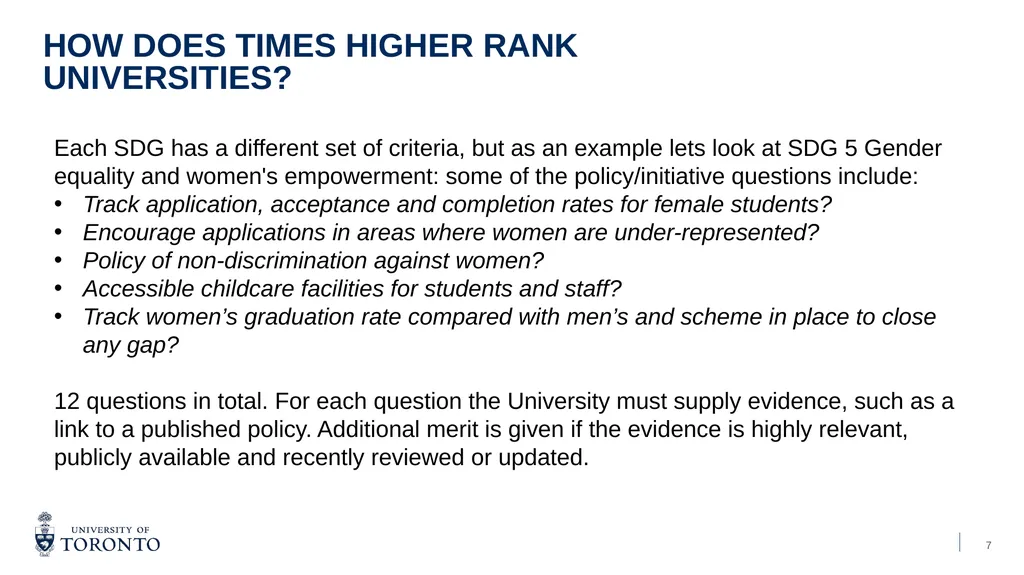
How does Times Higher RANK Universities? 7 Each SDG has a different set of criteria, but as an example lets look at SDG 5 Gender equality and women's empowerment: some of the policy/initiative questions include:
Track application, acceptance and completion rates for female students?
Encourage applications in areas where women are under-represented?
Policy of non-discrimination against women?
Accessible childcare facilities for students and staff?
Track women’s graduation rate compared with men’s and scheme in place to close any gap?
12 questions in total. For each question the University must supply evidence, such as a link to a published policy. Additional merit is given if the evidence is highly relevant, publicly available and recently reviewed or updated.<br>
08
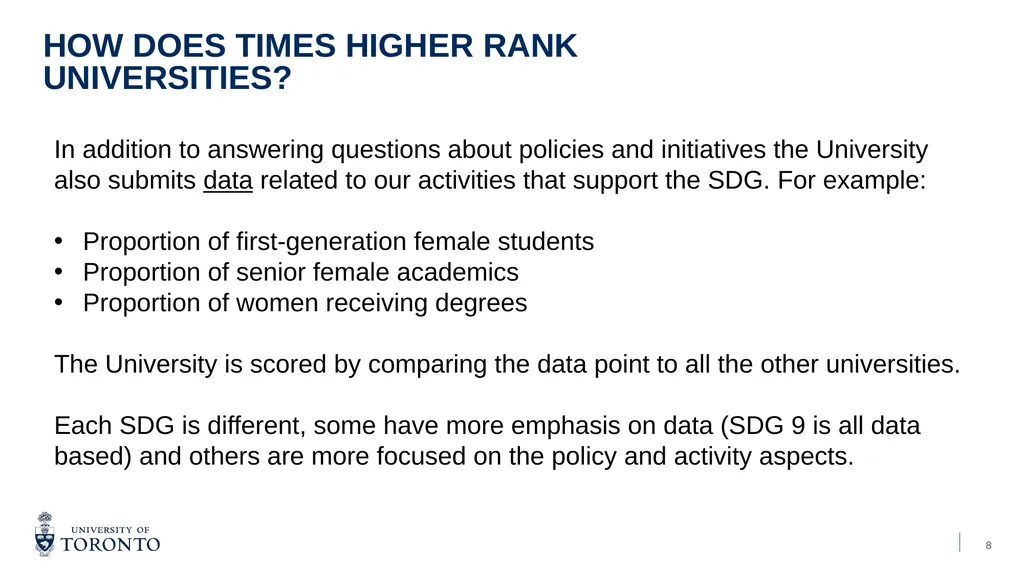
How does Times Higher RANK Universities? 8 In addition to answering questions about policies and initiatives the University also submits data related to our activities that support the SDG. For example:
Proportion of first-generation female students
Proportion of senior female academics
Proportion of women receiving degrees
The University is scored by comparing the data point to all the other universities.
Each SDG is different, some have more emphasis on data (SDG 9 is all data based) and others are more focused on the policy and activity aspects.<br>
09
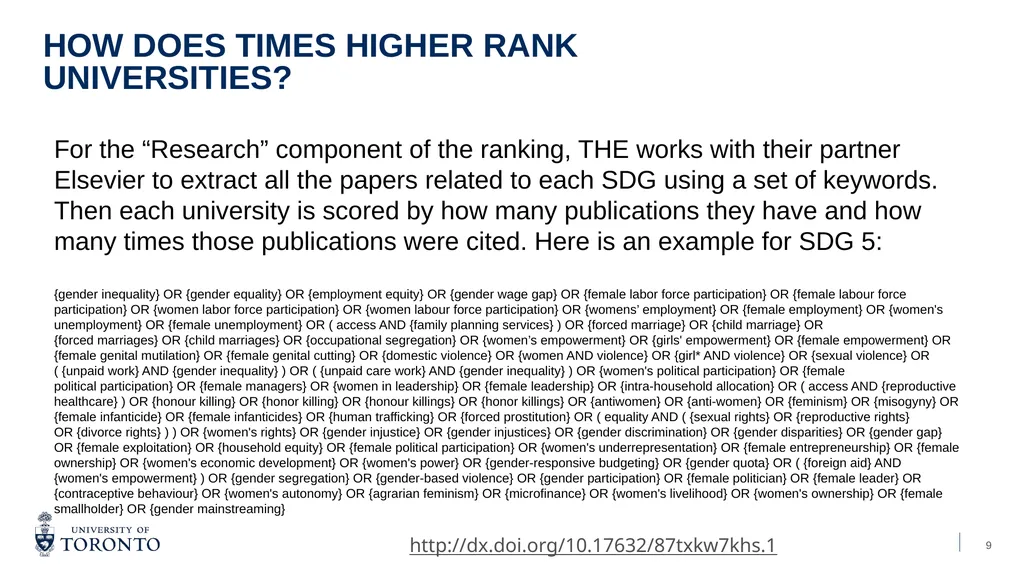
How does Times Higher RANK Universities? 9 For the “Research” component of the ranking, THE works with their partner Elsevier to extract all the papers related to each SDG using a set of keywords. Then each university is scored by how many publications they have and how many times those publications were cited. Here is an example for SDG 5:
{gender inequality} OR {gender equality} OR {employment equity} OR {gender wage gap} OR {female labor force participation} OR {female labour force participation} OR {women labor force participation} OR {women labour force participation} OR {womens’ employment} OR {female employment} OR {women's unemployment} OR {female unemployment} OR ( access AND {family planning services} ) OR {forced marriage} OR {child marriage} OR
{forced marriages} OR {child marriages} OR {occupational segregation} OR {women’s empowerment} OR {girls' empowerment} OR {female empowerment} OR {female genital mutilation} OR {female genital cutting} OR {domestic violence} OR {women AND violence} OR {girl* AND violence} OR {sexual violence} OR ( {unpaid work} AND {gender inequality} ) OR ( {unpaid care work} AND {gender inequality} ) OR {women's political participation} OR {female
political participation} OR {female managers} OR {women in leadership} OR {female leadership} OR {intra-household allocation} OR ( access AND {reproductive healthcare} ) OR {honour killing} OR {honor killing} OR {honour killings} OR {honor killings} OR {antiwomen} OR {anti-women} OR {feminism} OR {misogyny} OR {female infanticide} OR {female infanticides} OR {human trafficking} OR {forced prostitution} OR ( equality AND ( {sexual rights} OR {reproductive rights}
OR {divorce rights} ) ) OR {women's rights} OR {gender injustice} OR {gender injustices} OR {gender discrimination} OR {gender disparities} OR {gender gap} OR {female exploitation} OR {household equity} OR {female political participation} OR {women's underrepresentation} OR {female entrepreneurship} OR {female ownership} OR {women's economic development} OR {women's power} OR {gender-responsive budgeting} OR {gender quota} OR ( {foreign aid} AND
{women's empowerment} ) OR {gender segregation} OR {gender-based violence} OR {gender participation} OR {female politician} OR {female leader} OR {contraceptive behaviour} OR {women's autonomy} OR {agrarian feminism} OR {microfinance} OR {women's livelihood} OR {women's ownership} OR {female smallholder} OR {gender mainstreaming} http://dx.doi.org/10.17632/87txkw7khs.1<br>
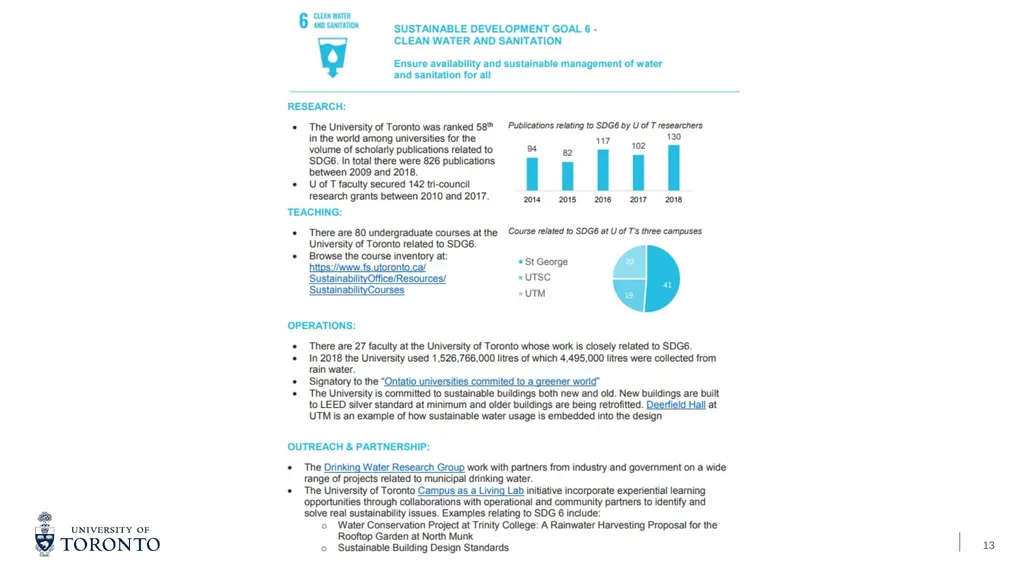
10
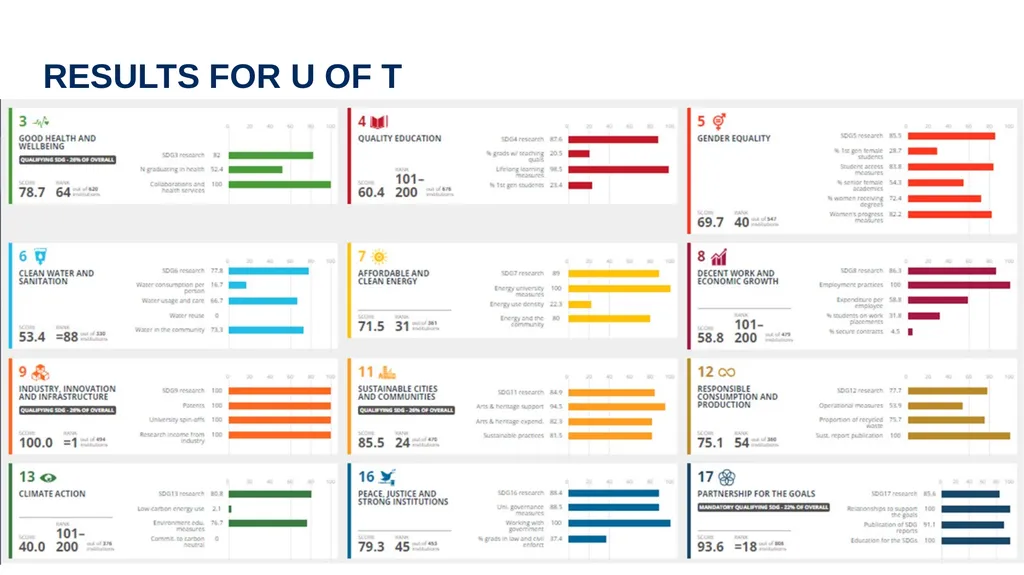
RESULTS FOR U of T 10<br>
11
Some problems with the Impact Rankings 11 Although THE have been very ambitious with their objectives, they are not consultative and sometimes their questions are a little off track or not relevant in all jurisdictions
They normalize for the size of the university in an illogical way that diminishes the impact of large multidisciplinary universities
They don’t take into account the jurisdictional environment
As a participant you don’t receive any feedback
The data are not made public
Too many universities do not participate and the results are meaningless without them<br>
12
Impact Rankings – influencing change 12 The data submission is complex and requires coordination with multiple departments.
In a small way it is influencing a tri-campus, centralized view of our data
In the first year of the Impact Ranking we didn’t have an “SDG Report” and it was problematic
We now have a conceptual SDG Report, draws on many of the things being discussed today
https://data.utoronto.ca/sustainable-development-goals-sdg-report/
The rankings form a part of a growing emphasis on SDGs at U of T<br>