
TITLE Zone Summit Global Grants Training Jim
KL
Published · 62 slides · 0 views
1 / 1



Description
TITLE Zone Summit Global Grants Training Jim Roxlo, D6780 jimroxlo.com 423-774-3183 Todays Agenda Part 1: Why be involved in a Global Grant? Part 2: Defining and designing a project Part 3: Completing a Grant Application Fill out the
Related Topics
Share
Embed code
Download this presentation From Below
"TITLE Zone Summit Global Grants Training Jim" is the property of its rightful owner. Permission is granted to download and print the materials on this website for personal, non-commercial use only, and to display it on your personal computer provided you do not modify the materials and that you retain all copyright notices contained in the materials. By downloading content from our website, you accept the terms of this agreement.
Presentation Transcript
01
TITLE Zone Summit Global Grants Training Jim Roxlo, D6780
jim@roxlo.com
423-774-3183<br>
jim@roxlo.com
423-774-3183<br>
02
Today’s Agenda Part 1: Why be involved in a Global Grant?
Part 2: Defining and designing a project
Part 3: Completing a Grant Application
Fill out the Survey of Knowledge<br>
Part 2: Defining and designing a project
Part 3: Completing a Grant Application
Fill out the Survey of Knowledge<br>
03
Why do a Global Grant?<br>
04
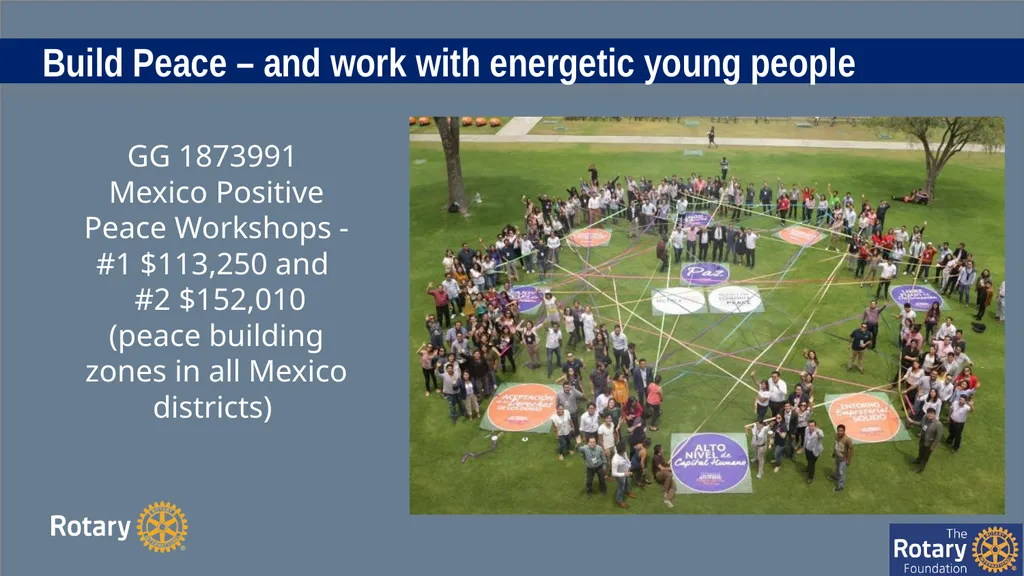
GG 1873991
Mexico Positive Peace Workshops - #1 $113,250 and
#2 $152,010
(peace building zones in all Mexico districts) Build Peace – and work with energetic young people<br>
05
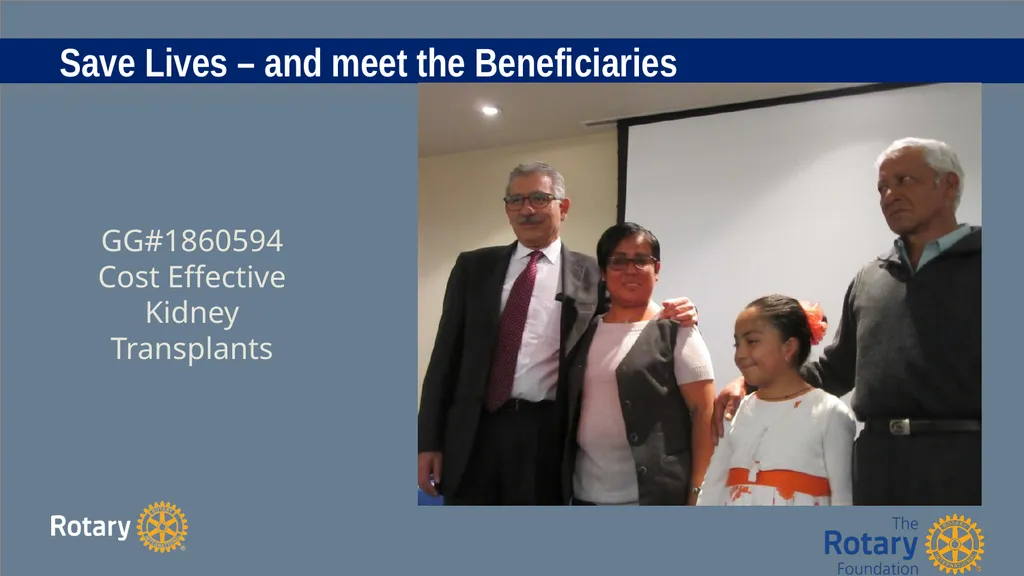
Save Lives – and meet the Beneficiaries GG#1860594 Cost Effective Kidney Transplants<br>
06
GG 1873073
Sam Owori Memorial School
in Uganda
$62,323 Provide Basic Education – and set an example for others<br>
Sam Owori Memorial School
in Uganda
$62,323 Provide Basic Education – and set an example for others<br>
07
2018-19 Projects in U.S. – supported by our partners overseas Global grants supported (“Reverse Global Grants”)
Kentucky D6740 Water and Sanitation project
Hot Meals USA Nebraska D5630 disaster recovery
Illinois D6490 anti-bullying<br>
Kentucky D6740 Water and Sanitation project
Hot Meals USA Nebraska D5630 disaster recovery
Illinois D6490 anti-bullying<br>
08
Rotary Foundation Project Funding 1,306 Global Grants were funded in Six Areas Of Focus (Fiscal 2018).
That’s only one grant for every 1000 Rotarians!
Fiscal 2018 Grant Funding = $86.7 Million
The investment in Polio grants is twice as much as Global Grants
What does this tell you about grants in the future?<br>
That’s only one grant for every 1000 Rotarians!
Fiscal 2018 Grant Funding = $86.7 Million
The investment in Polio grants is twice as much as Global Grants
What does this tell you about grants in the future?<br>
09
So why should WE do Global Grants? Fun and rewarding work
Funding is available
Rotary wants and needs us to do more GGs
We CAN do it<br>
Funding is available
Rotary wants and needs us to do more GGs
We CAN do it<br>
10
What does it take to make
a Global Grant become reality?<br>
11
Defining and Designing your Project<br>
12
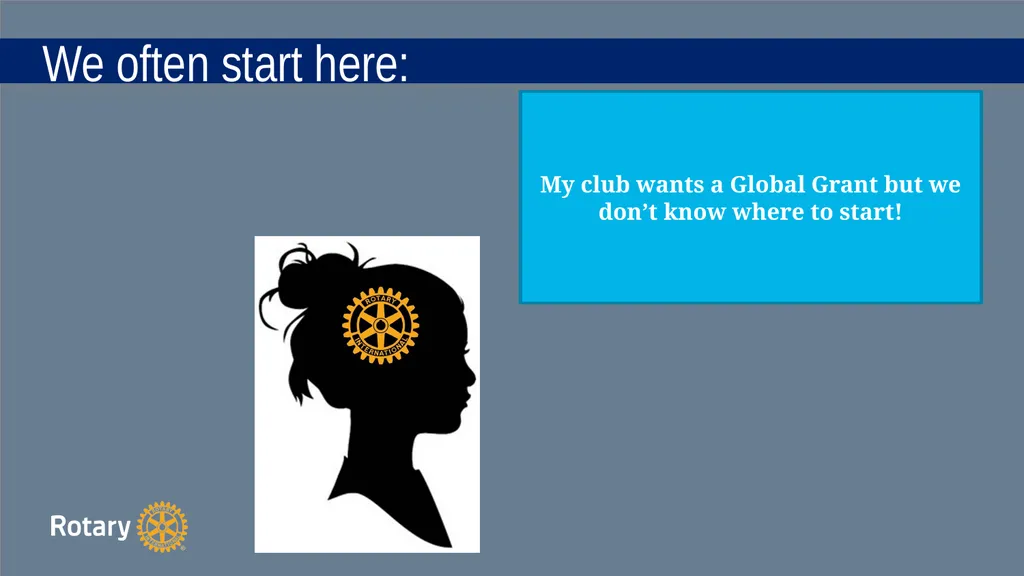
We often start here: My club wants a Global Grant but we don’t know where to start!<br>
13
Focus Area
Sustainability
Stewardship
Needs assessment
Partners
Beneficiaries
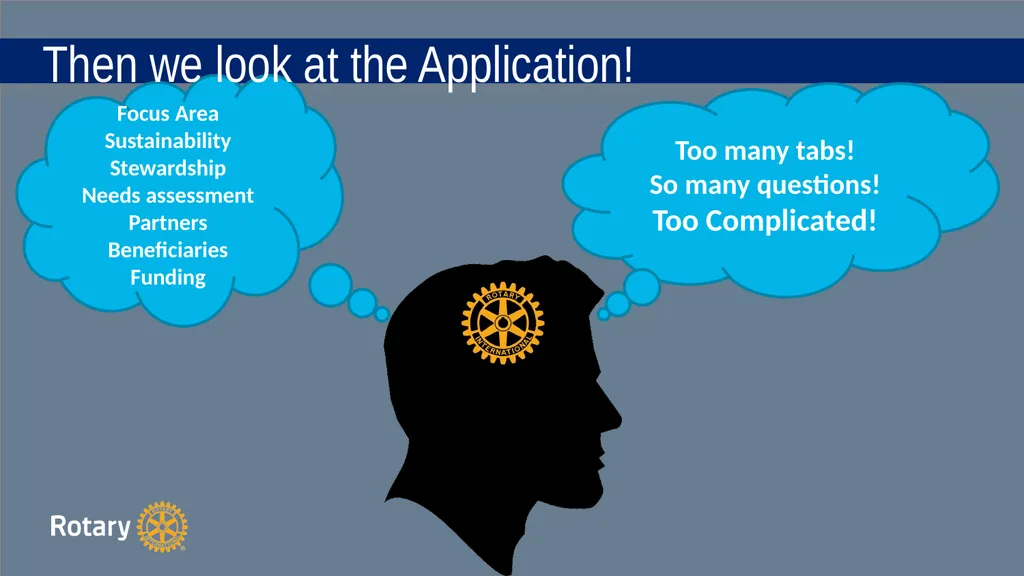
Funding Too many tabs!
So many questions!
Too Complicated! Then we look at the Application!<br>
Sustainability
Stewardship
Needs assessment
Partners
Beneficiaries
Funding Too many tabs!
So many questions!
Too Complicated! Then we look at the Application!<br>
14
Projects to join Join another club that is developing a Global Grant project
Find a club overseas with a project that needs an International Partner with money
Help fund Global Grants that have been developed by others. For example: Heart 2 Heart
References:
http://heart2heartprojects.org/
www.matchinggrants.org
http://ideas.rotary.org/Project/Find<br>
Find a club overseas with a project that needs an International Partner with money
Help fund Global Grants that have been developed by others. For example: Heart 2 Heart
References:
http://heart2heartprojects.org/
www.matchinggrants.org
http://ideas.rotary.org/Project/Find<br>
15
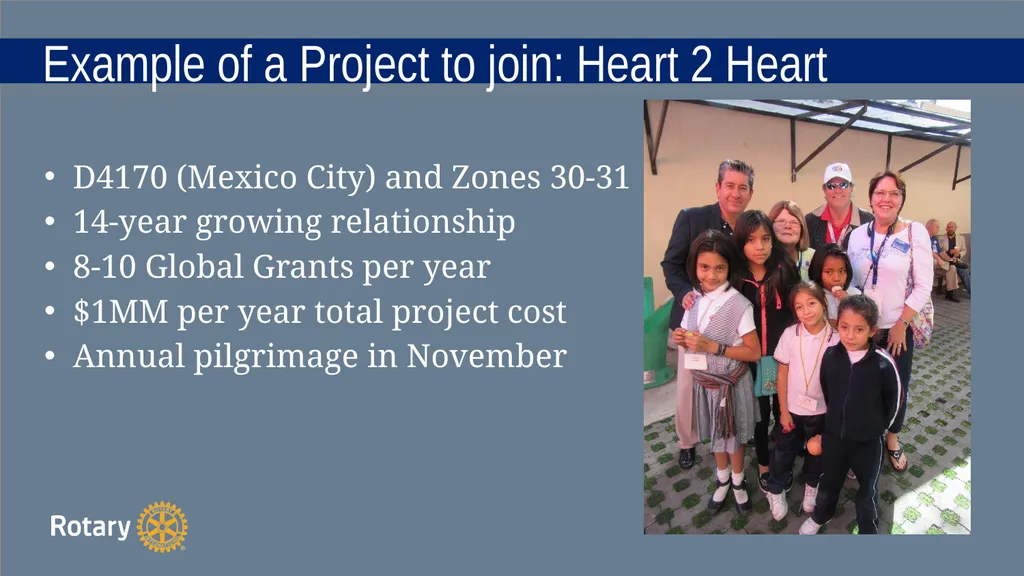
Example of a Project to join: Heart 2 Heart D4170 (Mexico City) and Zones 30-31
14-year growing relationship
8-10 Global Grants per year
$1MM per year total project cost
Annual pilgrimage in November<br>
14-year growing relationship
8-10 Global Grants per year
$1MM per year total project cost
Annual pilgrimage in November<br>
16
Projects you have joined Please tell us the following:
1. Briefly describe a Global Grant project your club has
joined with another club or district
2. What you personally got out of helping with that
Global Grant project<br>
1. Briefly describe a Global Grant project your club has
joined with another club or district
2. What you personally got out of helping with that
Global Grant project<br>
17
Some of us are now here That’s all nice but we want to have our own project!<br>
18
Be prepared to have your team: Be persistent
Make multiple contacts with your Host Sponsor
Find a way to do a Needs Assessment in country
Contact the RI staff member in charge of grants in that country
Spend hours writing the grant application
Be disappointed when the grant comes back to you for revision
Be diligent with respect to the grant funds
Be overwhelmed with awe when you see the results<br>
Make multiple contacts with your Host Sponsor
Find a way to do a Needs Assessment in country
Contact the RI staff member in charge of grants in that country
Spend hours writing the grant application
Be disappointed when the grant comes back to you for revision
Be diligent with respect to the grant funds
Be overwhelmed with awe when you see the results<br>
19
Suggestions to begin the process Find a team of people in your club who are passionate about doing International service.
Don’t start the application until you know what you want to do!
Be thinking about fundraising projects and other ways to fund the grant.<br>
Don’t start the application until you know what you want to do!
Be thinking about fundraising projects and other ways to fund the grant.<br>
20
Important!! Don’t let the funding define your project
Find a good project and then get the funding
We need big projects to be successful
Bigger projects are easier to fund<br>
Find a good project and then get the funding
We need big projects to be successful
Bigger projects are easier to fund<br>
21
Develop your own project Where
Who
What
Area of Focus
Goals
Short summary<br>
Who
What
Area of Focus
Goals
Short summary<br>
22
Where is your project? Do you have a traveler?
Someone who frequently visits another country
Has time to visit potential project areas
Can visit Rotary clubs
Can you travel with others?
Churches
Non-Profit organizations
Other Rotary clubs
Use a Group Study Exchange
All of this travel can be paid by your District Grant<br>
Someone who frequently visits another country
Has time to visit potential project areas
Can visit Rotary clubs
Can you travel with others?
Churches
Non-Profit organizations
Other Rotary clubs
Use a Group Study Exchange
All of this travel can be paid by your District Grant<br>
23
Find a Host Sponsor Determine what club (from the country you want to do the grant in) will be best to partner with:
Active and experienced in Grants
Willing to work with your club
Accepting a balanced relationship
Are District and Club qualified
Build a personal relationship from the beginning<br>
Active and experienced in Grants
Willing to work with your club
Accepting a balanced relationship
Are District and Club qualified
Build a personal relationship from the beginning<br>
24
Finding a Host Sponsor Briefly tell us how you found a Host Sponsor for your Global Grant<br>
25
Find potential project areas Check RI for other projects in country
Ask local officials if they have a needs assessment
Do the clubs have ideas?
Is there a specific population in need?
Are there local community health committees?<br>
Ask local officials if they have a needs assessment
Do the clubs have ideas?
Is there a specific population in need?
Are there local community health committees?<br>
26
Determine beneficiaries Beneficiaries are people, not organizations
Can you count them?
What do they need the most?<br>
Can you count them?
What do they need the most?<br>
27
Perform a Community Assessment Work with the local club
Involve community health groups and governments
Consider both assets and needs of the community
Select a project
Near the top of the needs list
Time and scope of work interesting to the clubs
Do you need special expertise?
Find relevant examples of success
Align with one of the six Areas of Focus
Community assessment can be covered by District Grant
Reference:
Needs Assessment Form<br>
Involve community health groups and governments
Consider both assets and needs of the community
Select a project
Near the top of the needs list
Time and scope of work interesting to the clubs
Do you need special expertise?
Find relevant examples of success
Align with one of the six Areas of Focus
Community assessment can be covered by District Grant
Reference:
Needs Assessment Form<br>
28
Performing a Community Assessment Tell us how you obtained a community assessment for your Global Grant project
Did you use the Rotary Community Assessment form?<br>
Did you use the Rotary Community Assessment form?<br>
29
Areas of Focus and Goals Areas of Focus are focused by the trustees
It’s best to have only one Area of Focus
Review Areas of Focus Policy Statements for alignment with your project
Pick specific goals you will be aligned with
Reference:
Areas of Focus Policy Statements<br>
It’s best to have only one Area of Focus
Review Areas of Focus Policy Statements for alignment with your project
Pick specific goals you will be aligned with
Reference:
Areas of Focus Policy Statements<br>
30
Rotary International’s Six Areas of Focus Peace and conflict prevention/resolution
Disease prevention and treatment
Water and sanitation
Maternal and child health
Basic education and literacy
Economic and community development<br>
Disease prevention and treatment
Water and sanitation
Maternal and child health
Basic education and literacy
Economic and community development<br>
31
Policy – Water and Sanitation Area of Focus Statement of Purpose and Goals
TRF enables Rotarians to ensure communities’ sustainable access to water, sanitation, and hygiene by:
Facilitating universal and equitable access to safe and affordable drinking water
Improving water quality by protecting and maintaining surface- and groundwater resources, reducing pollution and contaminants, and promoting wastewater reuse
Facilitating universal and equitable access to improved sanitation and waste management services in order to achieve open defecation-free communities
Improving community hygiene knowledge, behaviors, and practices that help prevent the spread of disease
Strengthening the capacity of governments, institutions, and communities to develop, finance, manage, and maintain sustainable water and sanitation services<br>
TRF enables Rotarians to ensure communities’ sustainable access to water, sanitation, and hygiene by:
Facilitating universal and equitable access to safe and affordable drinking water
Improving water quality by protecting and maintaining surface- and groundwater resources, reducing pollution and contaminants, and promoting wastewater reuse
Facilitating universal and equitable access to improved sanitation and waste management services in order to achieve open defecation-free communities
Improving community hygiene knowledge, behaviors, and practices that help prevent the spread of disease
Strengthening the capacity of governments, institutions, and communities to develop, finance, manage, and maintain sustainable water and sanitation services<br>
32
Steps of the Process You can take these steps in any order
Location
Partner
Beneficiaries and Needs
Project Selection
Area of Focus and Goals
Review these steps as you go
Review them again when you have them all in place<br>
Location
Partner
Beneficiaries and Needs
Project Selection
Area of Focus and Goals
Review these steps as you go
Review them again when you have them all in place<br>
33
Define your Project Combine the work so far into a 2-sentence summary
Example:
“The Rotary clubs of Cleveland, TN, USA and LaPaz, Honduras will partner to provide potable water to the high school and surrounding community in Lejamani, Honduras. By providing a bore hole well, pump and water tank on the school property, plus hygiene training, they will serve about 4000 people who do not have access to potable water.”<br>
Example:
“The Rotary clubs of Cleveland, TN, USA and LaPaz, Honduras will partner to provide potable water to the high school and surrounding community in Lejamani, Honduras. By providing a bore hole well, pump and water tank on the school property, plus hygiene training, they will serve about 4000 people who do not have access to potable water.”<br>
34
Defining your Project Exercise What’s your dream project?
Can you write a summary statement?
Include all 5 steps; make up the parts you don’t know yet.<br>
Can you write a summary statement?
Include all 5 steps; make up the parts you don’t know yet.<br>
35
Conclusion of Defining your Project Yay!!!
Break Time<br>
Break Time<br>
36
Completing a Global Grant Application<br>
37
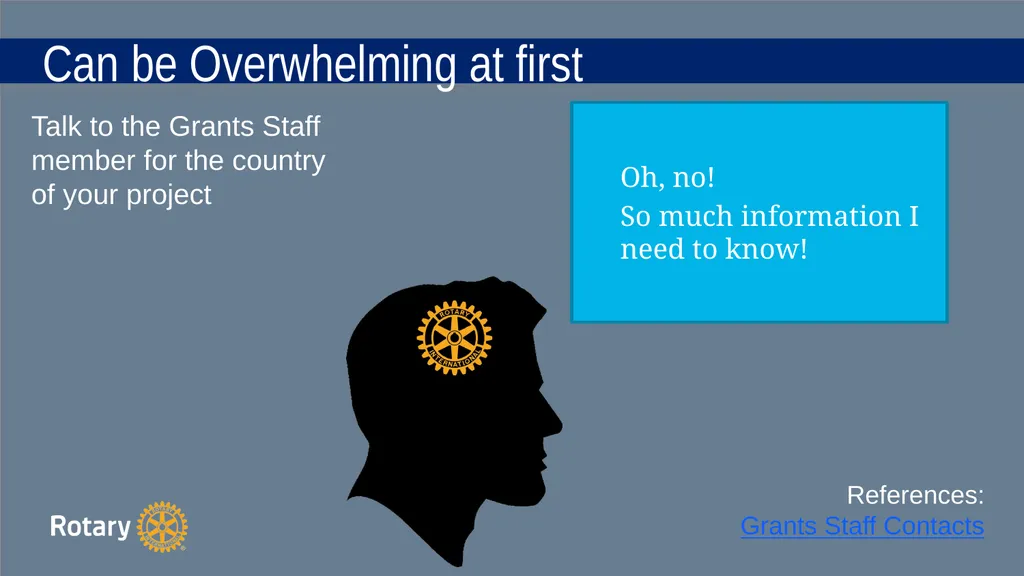
Can be Overwhelming at first Oh, no!
So much information I need to know! Talk to the Grants Staff member for the country of your project References:
Grants Staff Contacts<br>
So much information I need to know! Talk to the Grants Staff member for the country of your project References:
Grants Staff Contacts<br>
38
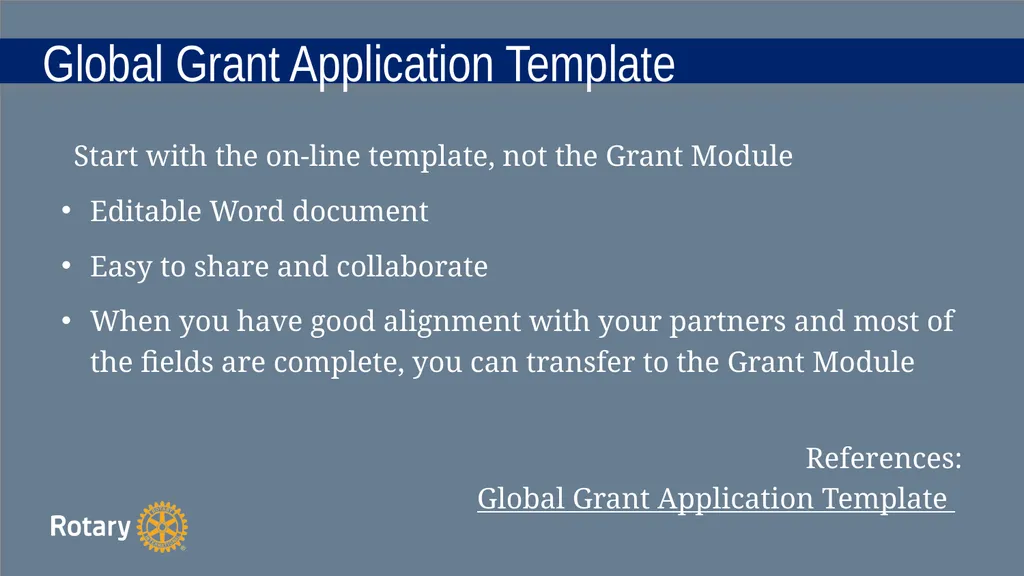
Global Grant Application Template Start with the on-line template, not the Grant Module
Editable Word document
Easy to share and collaborate
When you have good alignment with your partners and most of the fields are complete, you can transfer to the Grant Module
References:
Global Grant Application Template<br>
Editable Word document
Easy to share and collaborate
When you have good alignment with your partners and most of the fields are complete, you can transfer to the Grant Module
References:
Global Grant Application Template<br>
39
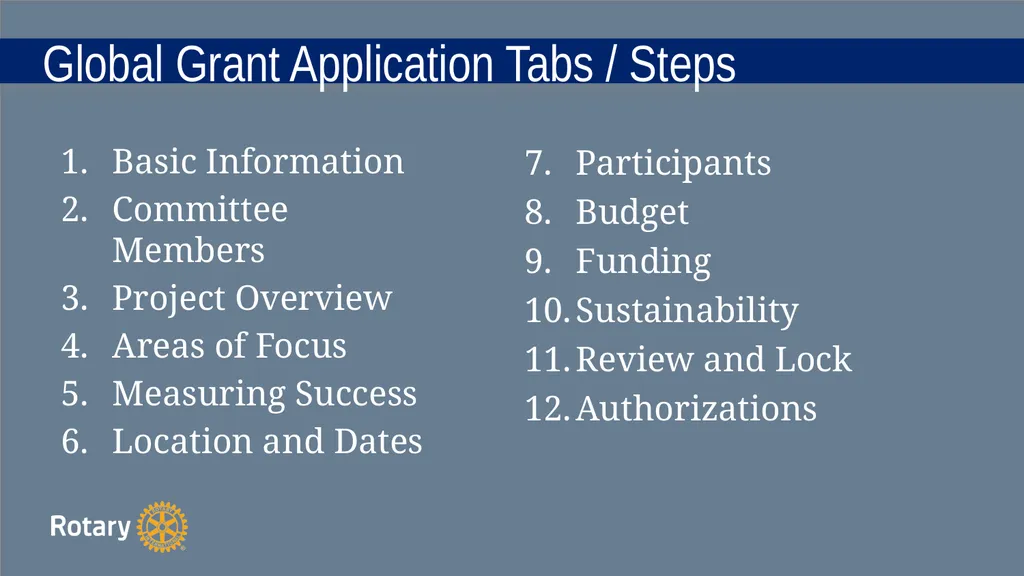
Global Grant Application Tabs / Steps Basic Information
Committee Members
Project Overview
Areas of Focus
Measuring Success
Location and Dates Participants
Budget
Funding
Sustainability
Review and Lock
Authorizations<br>
Committee Members
Project Overview
Areas of Focus
Measuring Success
Location and Dates Participants
Budget
Funding
Sustainability
Review and Lock
Authorizations<br>
40
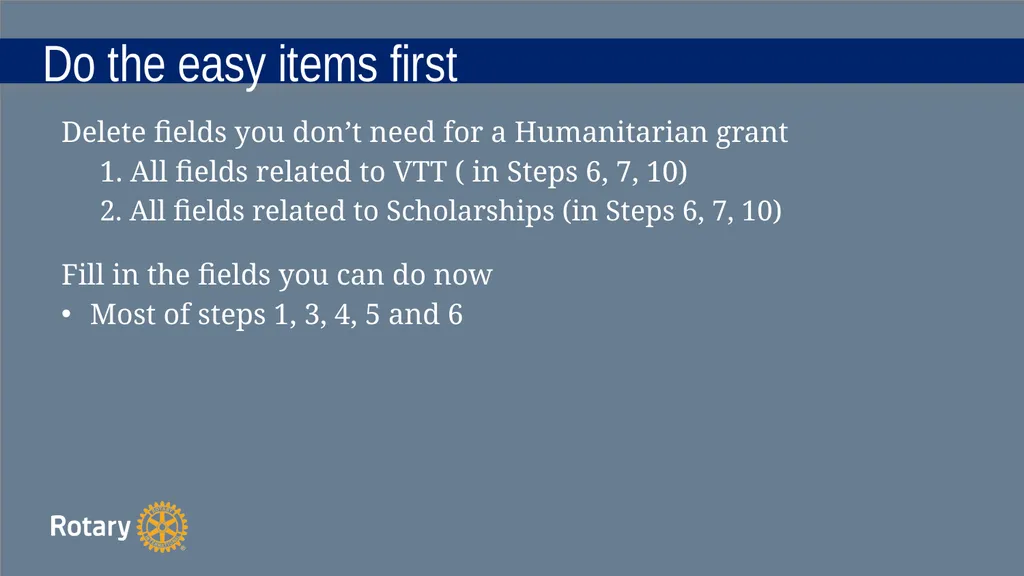
Do the easy items first Delete fields you don’t need for a Humanitarian grant
1. All fields related to VTT ( in Steps 6, 7, 10)
2. All fields related to Scholarships (in Steps 6, 7, 10)
Fill in the fields you can do now
Most of steps 1, 3, 4, 5 and 6<br>
1. All fields related to VTT ( in Steps 6, 7, 10)
2. All fields related to Scholarships (in Steps 6, 7, 10)
Fill in the fields you can do now
Most of steps 1, 3, 4, 5 and 6<br>
41
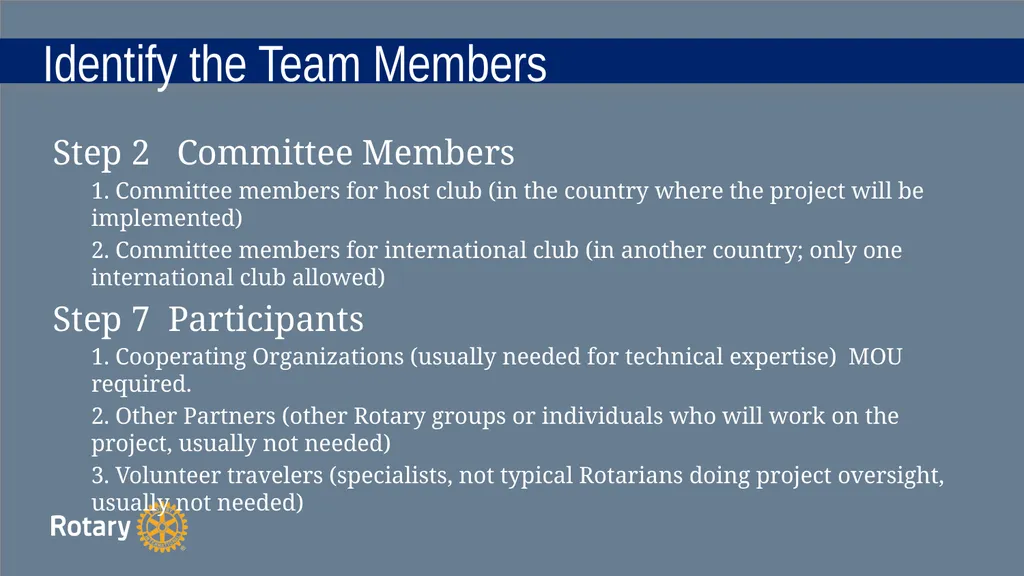
Identify the Team Members Step 2 Committee Members
1. Committee members for host club (in the country where the project will be implemented)
2. Committee members for international club (in another country; only one international club allowed)
Step 7 Participants
1. Cooperating Organizations (usually needed for technical expertise) MOU required.
2. Other Partners (other Rotary groups or individuals who will work on the project, usually not needed)
3. Volunteer travelers (specialists, not typical Rotarians doing project oversight, usually not needed)<br>
1. Committee members for host club (in the country where the project will be implemented)
2. Committee members for international club (in another country; only one international club allowed)
Step 7 Participants
1. Cooperating Organizations (usually needed for technical expertise) MOU required.
2. Other Partners (other Rotary groups or individuals who will work on the project, usually not needed)
3. Volunteer travelers (specialists, not typical Rotarians doing project oversight, usually not needed)<br>
42
Memorandum of Understanding Step 7 Participants
Must have an MOU signed by the Host Sponsor, International Sponsor and the Cooperating Organization(s).
The MOU designates the responsibilities of :
The Host Sponsor
The International Sponsor
The Cooperating Organization<br>
Must have an MOU signed by the Host Sponsor, International Sponsor and the Cooperating Organization(s).
The MOU designates the responsibilities of :
The Host Sponsor
The International Sponsor
The Cooperating Organization<br>
43
International Sponsor’s Responsibilities Direct and coordinate community education and public relations
Direct and coordinate International fundraising efforts
Travel to the project location to provide technical or professional service
Maintain the master schedule of events
Contact the Host partner and (optional) cooperating organization at least monthly to discuss progress and milestones
Assist the Host Sponsor in implementing and reporting on the Rotary grant project and ensure progress reports are timely
Issue monthly reports to leaders of both clubs and districts, plus key people in the relationship. Include a summary of contacts, milestones and accomplishments.<br>
Direct and coordinate International fundraising efforts
Travel to the project location to provide technical or professional service
Maintain the master schedule of events
Contact the Host partner and (optional) cooperating organization at least monthly to discuss progress and milestones
Assist the Host Sponsor in implementing and reporting on the Rotary grant project and ensure progress reports are timely
Issue monthly reports to leaders of both clubs and districts, plus key people in the relationship. Include a summary of contacts, milestones and accomplishments.<br>
44
Conflict of Interest Step 2 - See COI definition
1. Does your club have potential conflicts of interest?
2. How do you identify them?
3. How do you control them?
4. Does your partner club have potential conflicts of interest?<br>
1. Does your club have potential conflicts of interest?
2. How do you identify them?
3. How do you control them?
4. Does your partner club have potential conflicts of interest?<br>
45
Conflict of Interest What would make us as Rotarians be particularly careful with the issue of Conflict of Interest?
What can you do about a perceived Conflict of Interest?<br>
What can you do about a perceived Conflict of Interest?<br>
46
Project Plan 1. Develop an overall project plan with all the steps you know now. It will be used several places.
2. This plan is an important document. Identify all the steps you will need to make your project a success.
3. What elements need to be included?<br>
2. This plan is an important document. Identify all the steps you will need to make your project a success.
3. What elements need to be included?<br>
47
Sustainability (Step 10) Walk in the Beneficiaries’ Shoes!
Start with the community assessment
Respect natural resources
Think Local Everything!
Train the beneficiaries
Use local labor
Buy locally
Establish a local monitoring and maintenance plan
Reference:
Six Steps to Sustainability<br>
Start with the community assessment
Respect natural resources
Think Local Everything!
Train the beneficiaries
Use local labor
Buy locally
Establish a local monitoring and maintenance plan
Reference:
Six Steps to Sustainability<br>
48
Stewardship 1. Who is responsible for project funds and successful project completion?
2. How do you exercise responsibility?<br>
2. How do you exercise responsibility?<br>
49
Contingency Planning This is a critical part of Stewardship
1. What do you do if you have a financial overrun?
How could it happen?
2. What do you do if you have reporting issues?
3. What do you do if you have a communication problem?<br>
1. What do you do if you have a financial overrun?
How could it happen?
2. What do you do if you have reporting issues?
3. What do you do if you have a communication problem?<br>
50
Monitoring, Evaluating, and Reporting A critical part of Stewardship
1. How will you monitor the project?
- Observations, verbal reports, data?
2. How do you evaluate what you know?
3. Who will do the reporting?
Best Practice:
Link reporting to events, not the calendar.<br>
1. How will you monitor the project?
- Observations, verbal reports, data?
2. How do you evaluate what you know?
3. Who will do the reporting?
Best Practice:
Link reporting to events, not the calendar.<br>
51
Measuring Success Step 5 Measuring Success
1. Review standard measures in the Monitoring and Evaluation Plan Supplement
2. Select standard measures
3. Consider whether you should add measures based on sustainability and contingency planning
Reference:
Global Grant Monitoring and Evaluation Plan Supplement<br>
1. Review standard measures in the Monitoring and Evaluation Plan Supplement
2. Select standard measures
3. Consider whether you should add measures based on sustainability and contingency planning
Reference:
Global Grant Monitoring and Evaluation Plan Supplement<br>
52
Budget Step 8 Budget
Expense Categories:
Accommodations
Equipment
Monitoring and Evaluation
Operations
Personnel
Project Management Publicity
Signage
Supplies
Training
Travel
Tuition<br>
Expense Categories:
Accommodations
Equipment
Monitoring and Evaluation
Operations
Personnel
Project Management Publicity
Signage
Supplies
Training
Travel
Tuition<br>
53
Funding Step 9 Funding
Do you have sufficient funding for the project?
Does your District have as many global grants as it wants?
Does your District have funds available for more Global Grants?
Where can you get additional funding?
Work with your District leaders to get the funding you need<br>
Do you have sufficient funding for the project?
Does your District have as many global grants as it wants?
Does your District have funds available for more Global Grants?
Where can you get additional funding?
Work with your District leaders to get the funding you need<br>
54
Magic Show<br>
55
Funding Exercise You are working on a Global Grant creating a water well for an orphanage in Sierra Leone. The project budget is $45,000. Your club has raised $12,000. Your District Foundation Chair will match 1:1. Another district has contributed $7,000 to your Global Grant project. A Rotarian from another club has given her Paul Harris Society contribution of $1000 to your Global Grant. The World Fund will match DDF at 1:1 and club cash at 1:2. Do you have enough funding to submit the grant?<br>
56
Funding Who can share a successful fundraising project you had for a Global Grant: What was it and how much did you raise?
Tell us if you partnered with any group to raise funds for a Global Grant: What was the group and what made you pick that group to partner with?
Has anyone used their Paul Harris Society donation to fund your Global Grant?<br>
Tell us if you partnered with any group to raise funds for a Global Grant: What was the group and what made you pick that group to partner with?
Has anyone used their Paul Harris Society donation to fund your Global Grant?<br>
57
Approval Steps The two primary contacts (see Tab 1) review and approve and then the application is LOCKED (Tab 11)
All contributing Districts approve the DDF. (DG and DRFC in Tab 12)
The lead Districts DRFCs approve the grant for TRF compliance (Tab 12)
The application is SUBMITTED.
Partners sign to confirm acceptance of responsibility.
The application is reviewed, maybe revised, and APPROVED.
Partners set up banking instructions.
TRF transfers funds to the project bank account.
Reference:
Global Grant Lifecycle<br>
All contributing Districts approve the DDF. (DG and DRFC in Tab 12)
The lead Districts DRFCs approve the grant for TRF compliance (Tab 12)
The application is SUBMITTED.
Partners sign to confirm acceptance of responsibility.
The application is reviewed, maybe revised, and APPROVED.
Partners set up banking instructions.
TRF transfers funds to the project bank account.
Reference:
Global Grant Lifecycle<br>
58
You are now ready to submit your grant Yay!
Questions?<br>
Questions?<br>
59
Call to Action What will you do with this information you have about Global Grants?<br>
60
Zone 30 Rotary Foundation Coordinator Team Woody Northup, 6710 woodyn@radiosound.com 502-599-4179
Julie West, D6630 jwest@ameritech.net 216-392-6771
Craig Maxey, D6690 craig@targetbusinessservices.com 614-563-6888
Beth Stubbs, D6780 beth@cpaoffices.com 865-691-9450
Roger Sims, D6540 Roger.rotary@simspe.com 219-670-1694
Jerome Bannister, D6760 jbrotary@comcast.net 615-419-4976
J Fred Heitman, D6780 jfredd@aol.com 865-548-3474
Tamie Babb, D6760 tbabbmd@gmail.com 918-640-7748<br>
Julie West, D6630 jwest@ameritech.net 216-392-6771
Craig Maxey, D6690 craig@targetbusinessservices.com 614-563-6888
Beth Stubbs, D6780 beth@cpaoffices.com 865-691-9450
Roger Sims, D6540 Roger.rotary@simspe.com 219-670-1694
Jerome Bannister, D6760 jbrotary@comcast.net 615-419-4976
J Fred Heitman, D6780 jfredd@aol.com 865-548-3474
Tamie Babb, D6760 tbabbmd@gmail.com 918-640-7748<br>
61
Zone 31 Rotary Foundation Coordinator Team Mike Nowobilski dgrotarymike@gmail.com 618-531-5171
Paul Bucurel paul_bucurel@yahoo.com 601-480-6402
Larry Howell larryjh0902@yahoo.com 913-634-9121
Allen Morgan allenm@hunter-wasson.com 870-245-6212
David Robinette pdg.david.robinette6060@gmail.com 314-704-4811
Ted Huffhines tedhuffhines@gmail.com 903-930-0524
Brian Hall bhall@aim-technologies.com 985-966-1945
Pamela Stewart rotary6190pstewart@gmail.com 318-243-3358<br>
Paul Bucurel paul_bucurel@yahoo.com 601-480-6402
Larry Howell larryjh0902@yahoo.com 913-634-9121
Allen Morgan allenm@hunter-wasson.com 870-245-6212
David Robinette pdg.david.robinette6060@gmail.com 314-704-4811
Ted Huffhines tedhuffhines@gmail.com 903-930-0524
Brian Hall bhall@aim-technologies.com 985-966-1945
Pamela Stewart rotary6190pstewart@gmail.com 318-243-3358<br>
62
Exit Survey<br>