
TOOLS & EQUIPMENTS Presented By:- Er. Md. Shahid
KL
Published · 50 slides · 0 views
1 / 1

Description
TOOLS EQUIPMENTS Presented By:- Er. Md. Shahid Arshad Introduction Collection Transportation of solid waste involves use of a variety of tools, equipment and facilities. Tools Equipments should be selected with due care so as to
Related Topics
Share
Embed code
Download this presentation From Below
"TOOLS & EQUIPMENTS Presented By:- Er. Md. Shahid" is the property of its rightful owner. Permission is granted to download and print the materials on this website for personal, non-commercial use only, and to display it on your personal computer provided you do not modify the materials and that you retain all copyright notices contained in the materials. By downloading content from our website, you accept the terms of this agreement.
Presentation Transcript
01
TOOLS & EQUIPMENTS Presented By:-
Er. Md. Shahid Arshad<br>
Er. Md. Shahid Arshad<br>
02
Introduction Collection & Transportation of solid waste involves use of a variety of tools, equipment and facilities.
Tools & Equipments should be selected with due care so as to ensure optimum performance of the system.
Most of the equipments and tools that are currently used are have not been specifically designed for solid waste collection.
They are used just because that they are easily available in market.
This results in ineffective operation of the system.
Hence it is essential to describe the importance of tools & equipments for the improvement of the system.<br>
Tools & Equipments should be selected with due care so as to ensure optimum performance of the system.
Most of the equipments and tools that are currently used are have not been specifically designed for solid waste collection.
They are used just because that they are easily available in market.
This results in ineffective operation of the system.
Hence it is essential to describe the importance of tools & equipments for the improvement of the system.<br>
03
storage The storage of waste is necessary otherwise it will create nuisance.
The storage equipments at individual premises are provided by the owners who are responsible for their proper maintenance.
The capacities and material of the container to be provided by the owner should be stipulated by the municipal authorities.
The bye-laws should empower the municipal agency to replace such containers, which not satisfy the specifications, all the cost of the owner.<br>
The storage equipments at individual premises are provided by the owners who are responsible for their proper maintenance.
The capacities and material of the container to be provided by the owner should be stipulated by the municipal authorities.
The bye-laws should empower the municipal agency to replace such containers, which not satisfy the specifications, all the cost of the owner.<br>
04
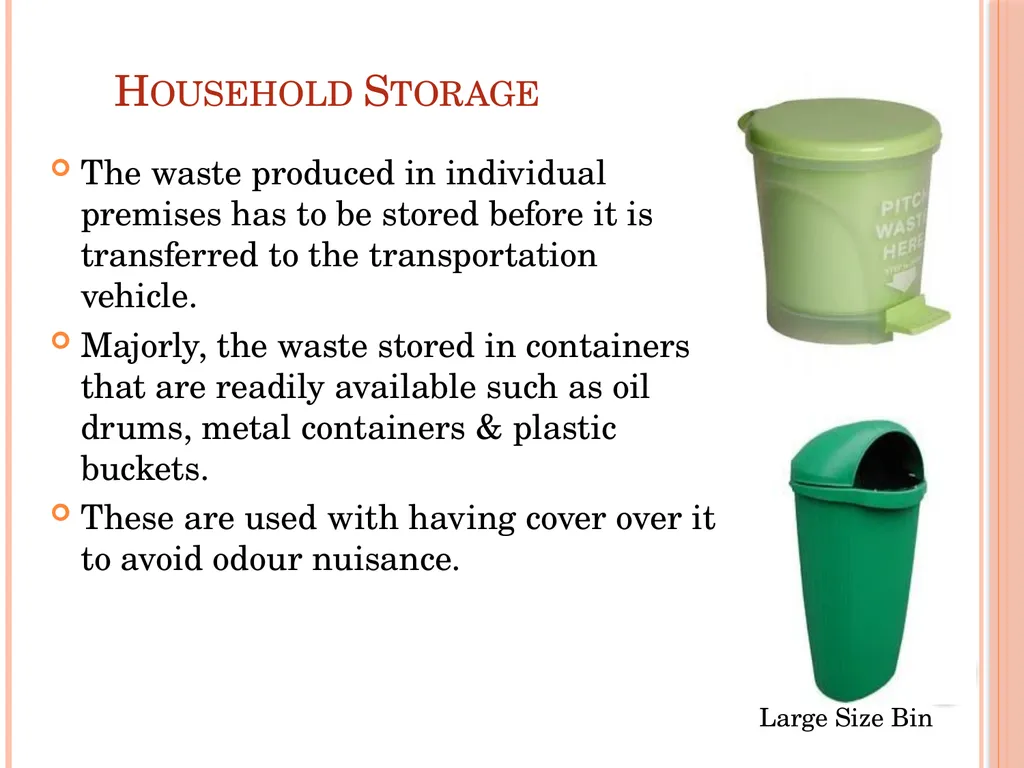
Household Storage The waste produced in individual premises has to be stored before it is transferred to the transportation vehicle.
Majorly, the waste stored in containers that are readily available such as oil drums, metal containers & plastic buckets.
These are used with having cover over it to avoid odour nuisance. Large Size Bin<br>
Majorly, the waste stored in containers that are readily available such as oil drums, metal containers & plastic buckets.
These are used with having cover over it to avoid odour nuisance. Large Size Bin<br>
05
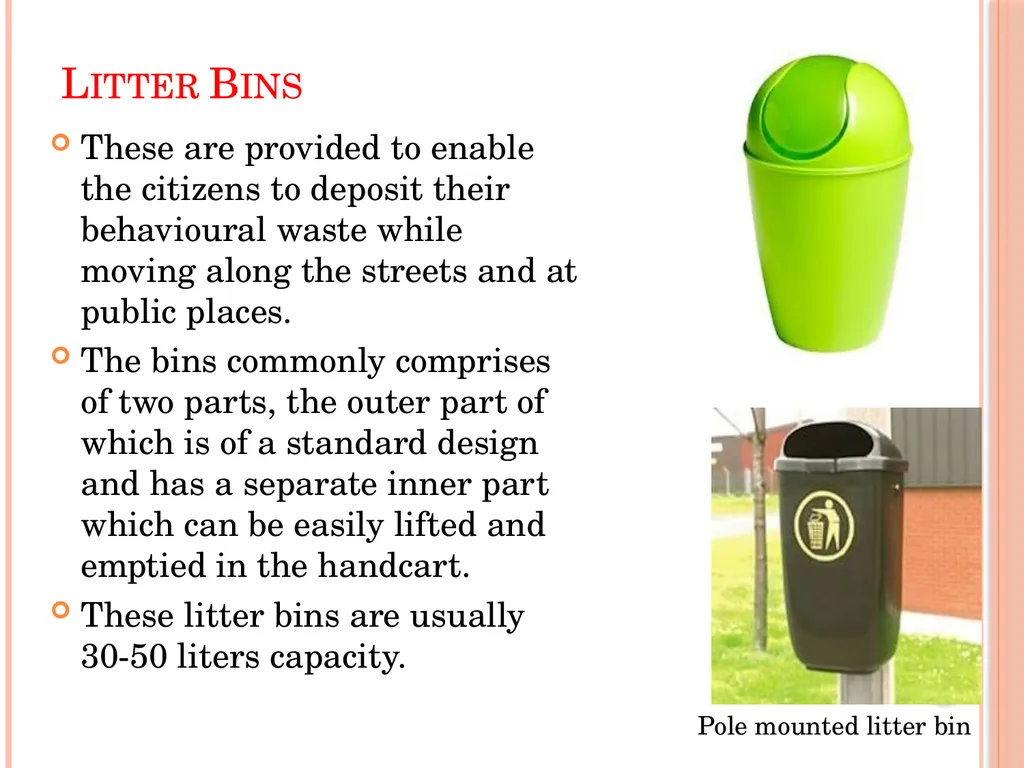
Litter Bins These are provided to enable the citizens to deposit their behavioural waste while moving along the streets and at public places.
The bins commonly comprises of two parts, the outer part of which is of a standard design and has a separate inner part which can be easily lifted and emptied in the handcart.
These litter bins are usually 30-50 liters capacity. Pole mounted litter bin<br>
The bins commonly comprises of two parts, the outer part of which is of a standard design and has a separate inner part which can be easily lifted and emptied in the handcart.
These litter bins are usually 30-50 liters capacity. Pole mounted litter bin<br>
06
Equipment for street cleansing Brooms
These are mainly two types
Short Handled Brooms
Long Handled Brooms<br>
These are mainly two types
Short Handled Brooms
Long Handled Brooms<br>
07
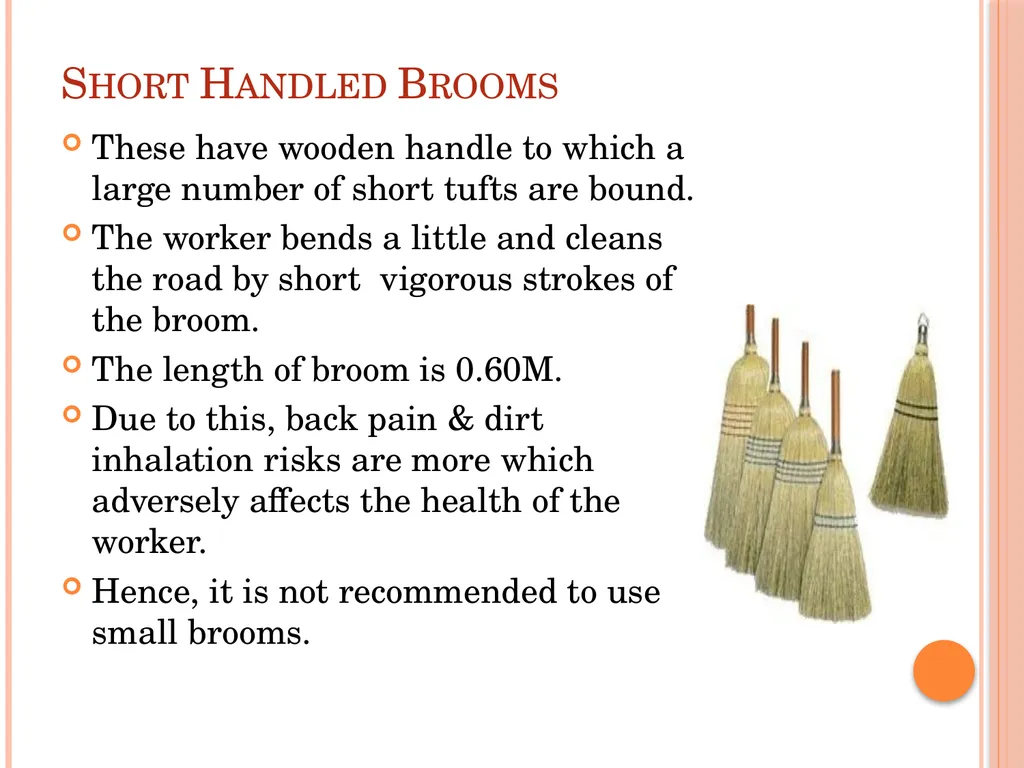
Short Handled Brooms These have wooden handle to which a large number of short tufts are bound.
The worker bends a little and cleans the road by short vigorous strokes of the broom.
The length of broom is 0.60M.
Due to this, back pain & dirt inhalation risks are more which adversely affects the health of the worker.
Hence, it is not recommended to use small brooms.<br>
The worker bends a little and cleans the road by short vigorous strokes of the broom.
The length of broom is 0.60M.
Due to this, back pain & dirt inhalation risks are more which adversely affects the health of the worker.
Hence, it is not recommended to use small brooms.<br>
08
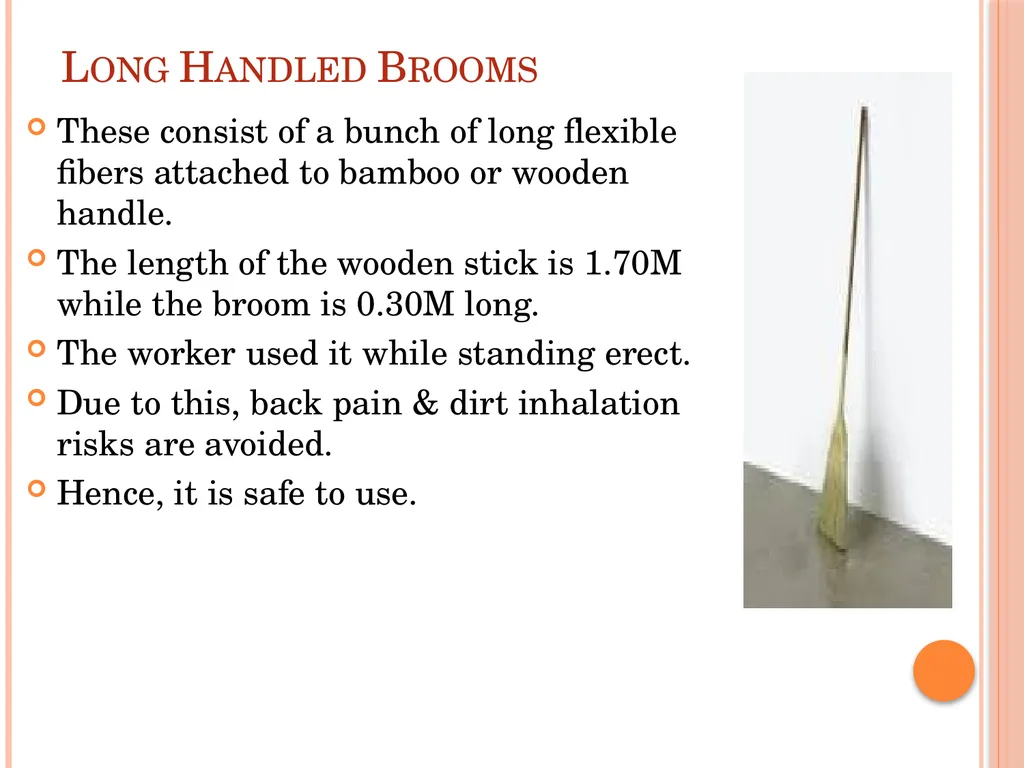
Long Handled Brooms These consist of a bunch of long flexible fibers attached to bamboo or wooden handle.
The length of the wooden stick is 1.70M while the broom is 0.30M long.
The worker used it while standing erect.
Due to this, back pain & dirt inhalation risks are avoided.
Hence, it is safe to use.<br>
The length of the wooden stick is 1.70M while the broom is 0.30M long.
The worker used it while standing erect.
Due to this, back pain & dirt inhalation risks are avoided.
Hence, it is safe to use.<br>
09
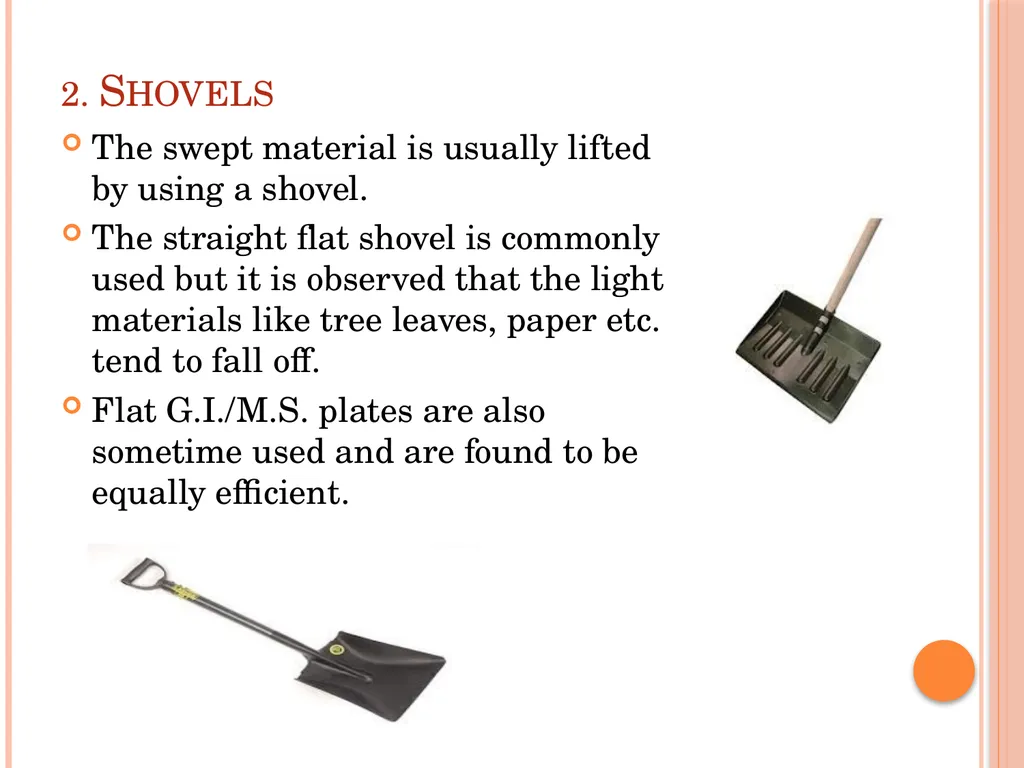
2. Shovels The swept material is usually lifted by using a shovel.
The straight flat shovel is commonly used but it is observed that the light materials like tree leaves, paper etc. tend to fall off.
Flat G.I./M.S. plates are also sometime used and are found to be equally efficient.<br>
The straight flat shovel is commonly used but it is observed that the light materials like tree leaves, paper etc. tend to fall off.
Flat G.I./M.S. plates are also sometime used and are found to be equally efficient.<br>
10
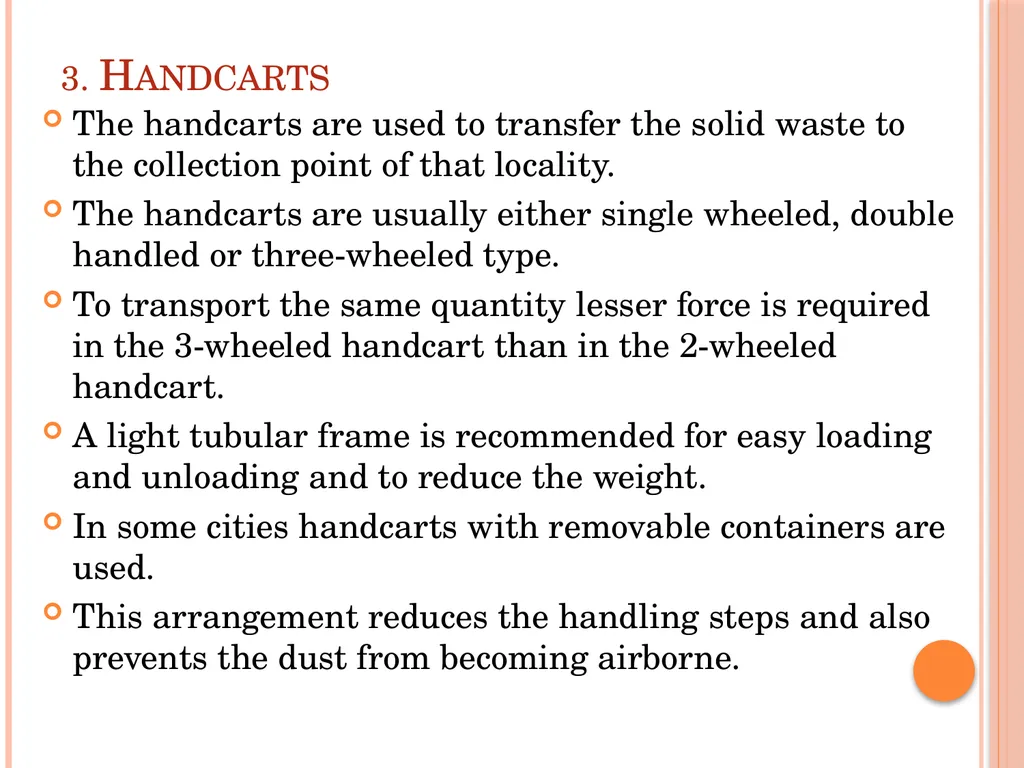
3. Handcarts The handcarts are used to transfer the solid waste to the collection point of that locality.
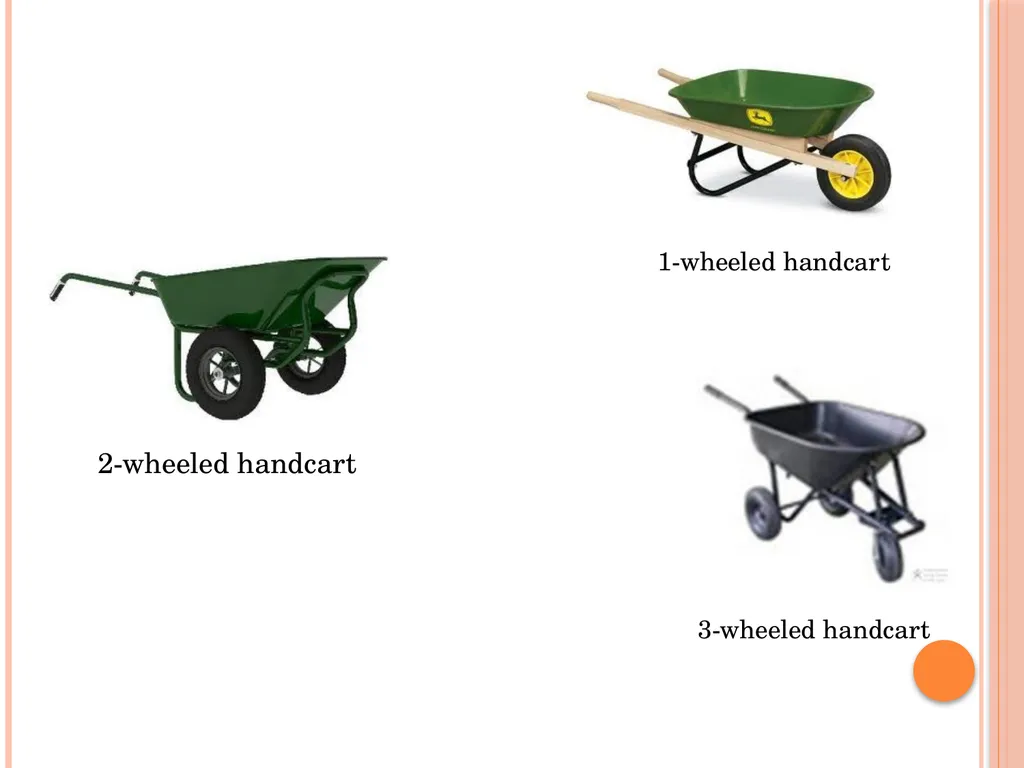
The handcarts are usually either single wheeled, double handled or three-wheeled type.
To transport the same quantity lesser force is required in the 3-wheeled handcart than in the 2-wheeled handcart.
A light tubular frame is recommended for easy loading and unloading and to reduce the weight.
In some cities handcarts with removable containers are used.
This arrangement reduces the handling steps and also prevents the dust from becoming airborne.<br>
The handcarts are usually either single wheeled, double handled or three-wheeled type.
To transport the same quantity lesser force is required in the 3-wheeled handcart than in the 2-wheeled handcart.
A light tubular frame is recommended for easy loading and unloading and to reduce the weight.
In some cities handcarts with removable containers are used.
This arrangement reduces the handling steps and also prevents the dust from becoming airborne.<br>
11
2-wheeled handcart 3-wheeled handcart 1-wheeled handcart<br>
12
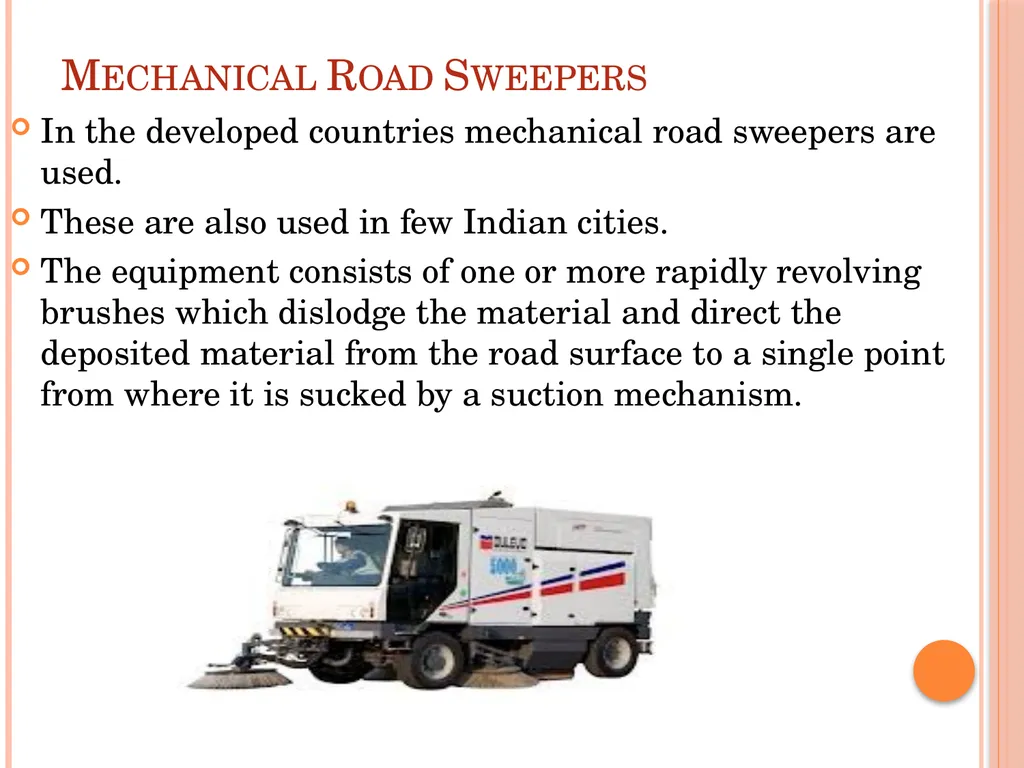
Mechanical Road Sweepers In the developed countries mechanical road sweepers are used.
These are also used in few Indian cities.
The equipment consists of one or more rapidly revolving brushes which dislodge the material and direct the deposited material from the road surface to a single point from where it is sucked by a suction mechanism.<br>
These are also used in few Indian cities.
The equipment consists of one or more rapidly revolving brushes which dislodge the material and direct the deposited material from the road surface to a single point from where it is sucked by a suction mechanism.<br>
13
Community Bins Community bins are classified into two categories
Stationary Bins
Small Capacity Bins
Large Uncovered Enclosures
Large Covered Enclosures
Movable Bins<br>
Stationary Bins
Small Capacity Bins
Large Uncovered Enclosures
Large Covered Enclosures
Movable Bins<br>
14
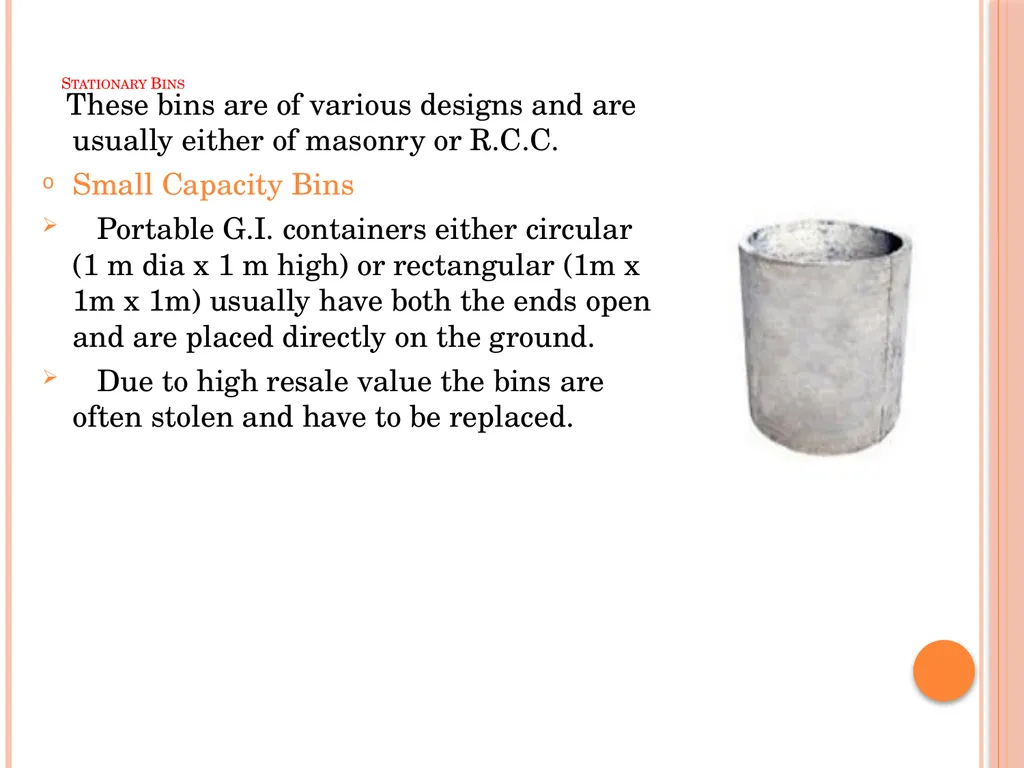
Stationary Bins These bins are of various designs and are usually either of masonry or R.C.C.
Small Capacity Bins
Portable G.I. containers either circular (1 m dia x 1 m high) or rectangular (1m x 1m x 1m) usually have both the ends open and are placed directly on the ground.
Due to high resale value the bins are often stolen and have to be replaced.<br>
Small Capacity Bins
Portable G.I. containers either circular (1 m dia x 1 m high) or rectangular (1m x 1m x 1m) usually have both the ends open and are placed directly on the ground.
Due to high resale value the bins are often stolen and have to be replaced.<br>
15
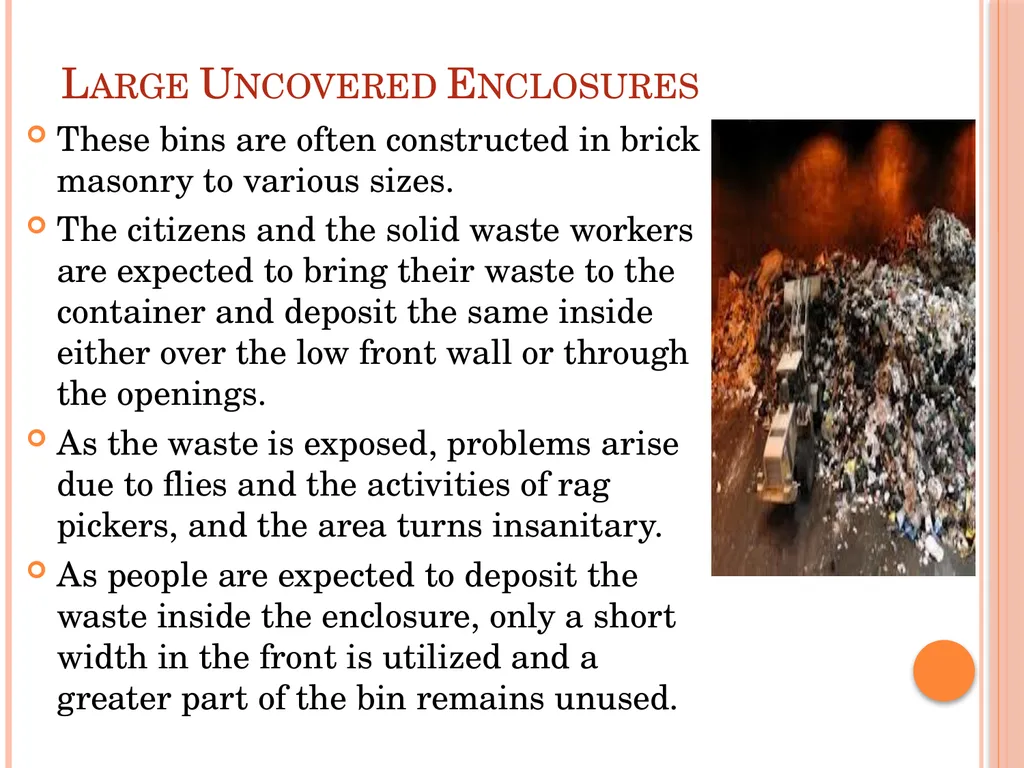
Large Uncovered Enclosures These bins are often constructed in brick masonry to various sizes.
The citizens and the solid waste workers are expected to bring their waste to the container and deposit the same inside either over the low front wall or through the openings.
As the waste is exposed, problems arise due to flies and the activities of rag pickers, and the area turns insanitary.
As people are expected to deposit the waste inside the enclosure, only a short width in the front is utilized and a greater part of the bin remains unused.<br>
The citizens and the solid waste workers are expected to bring their waste to the container and deposit the same inside either over the low front wall or through the openings.
As the waste is exposed, problems arise due to flies and the activities of rag pickers, and the area turns insanitary.
As people are expected to deposit the waste inside the enclosure, only a short width in the front is utilized and a greater part of the bin remains unused.<br>
16
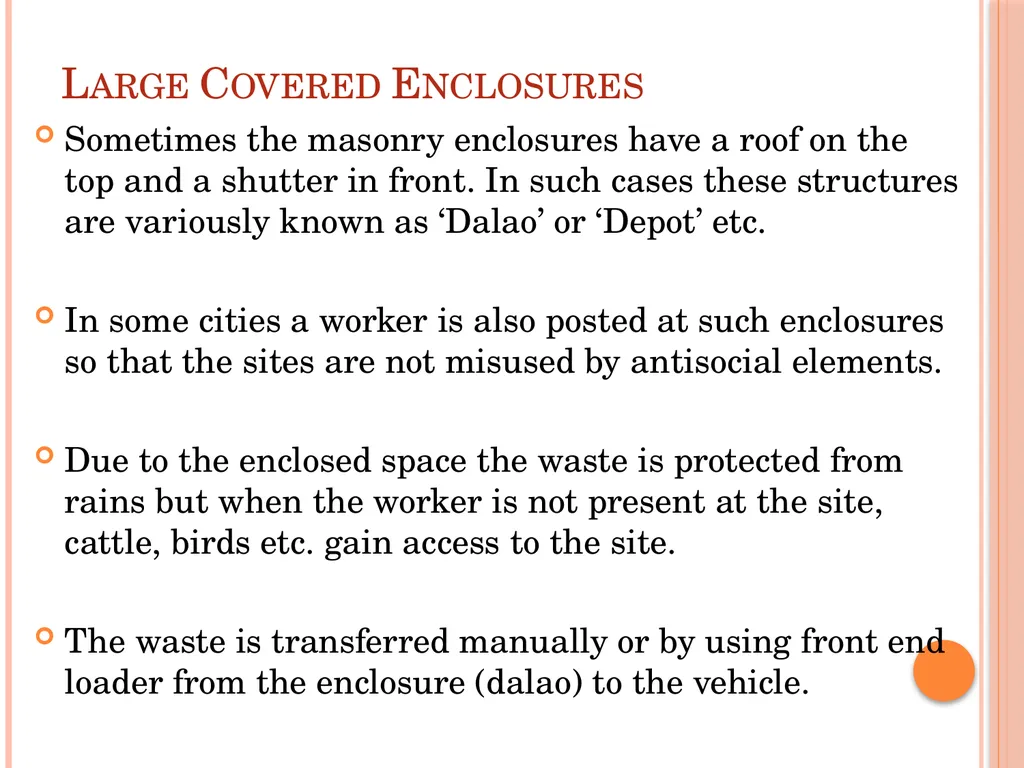
Large Covered Enclosures Sometimes the masonry enclosures have a roof on the top and a shutter in front. In such cases these structures are variously known as ‘Dalao’ or ‘Depot’ etc.
In some cities a worker is also posted at such enclosures so that the sites are not misused by antisocial elements.
Due to the enclosed space the waste is protected from rains but when the worker is not present at the site, cattle, birds etc. gain access to the site.
The waste is transferred manually or by using front end loader from the enclosure (dalao) to the vehicle.<br>
In some cities a worker is also posted at such enclosures so that the sites are not misused by antisocial elements.
Due to the enclosed space the waste is protected from rains but when the worker is not present at the site, cattle, birds etc. gain access to the site.
The waste is transferred manually or by using front end loader from the enclosure (dalao) to the vehicle.<br>
17
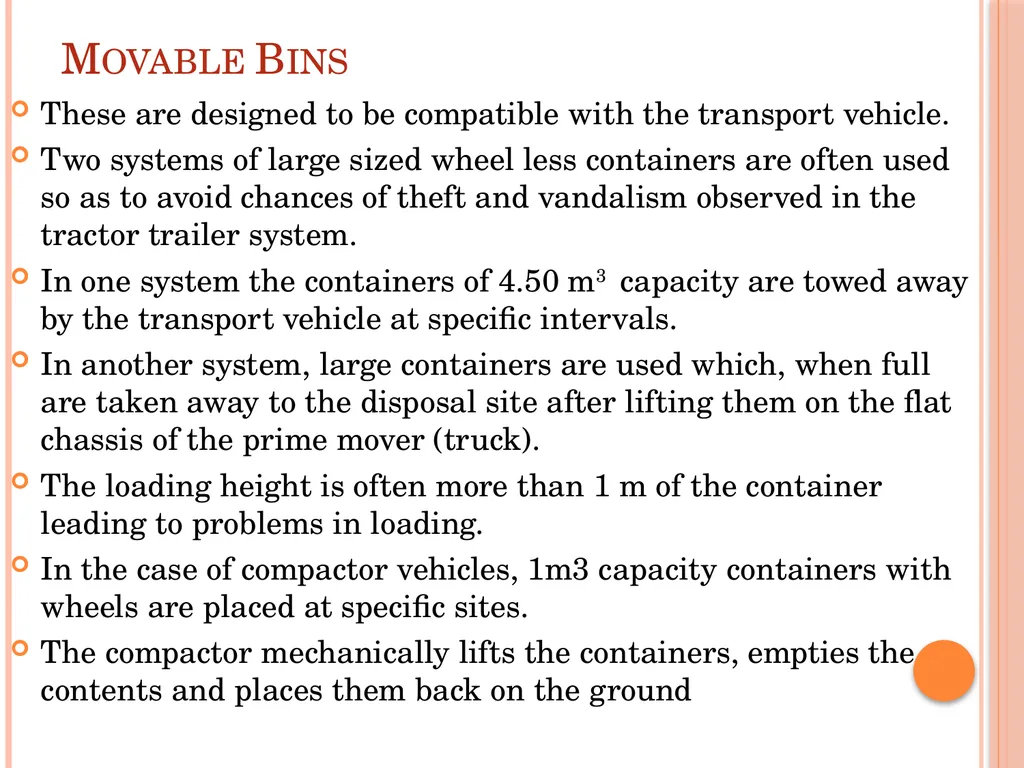
Movable Bins These are designed to be compatible with the transport vehicle.
Two systems of large sized wheel less containers are often used so as to avoid chances of theft and vandalism observed in the tractor trailer system.
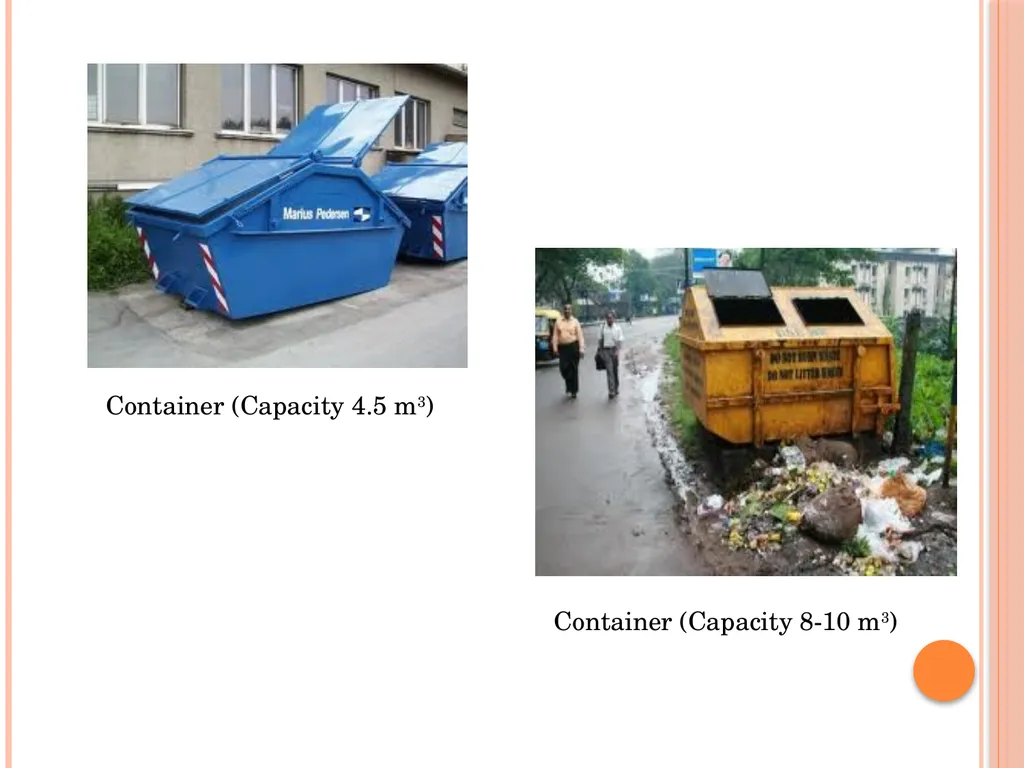
In one system the containers of 4.50 m3 capacity are towed away by the transport vehicle at specific intervals.
In another system, large containers are used which, when full are taken away to the disposal site after lifting them on the flat chassis of the prime mover (truck).
The loading height is often more than 1 m of the container leading to problems in loading.
In the case of compactor vehicles, 1m3 capacity containers with wheels are placed at specific sites.
The compactor mechanically lifts the containers, empties the contents and places them back on the ground<br>
Two systems of large sized wheel less containers are often used so as to avoid chances of theft and vandalism observed in the tractor trailer system.
In one system the containers of 4.50 m3 capacity are towed away by the transport vehicle at specific intervals.
In another system, large containers are used which, when full are taken away to the disposal site after lifting them on the flat chassis of the prime mover (truck).
The loading height is often more than 1 m of the container leading to problems in loading.
In the case of compactor vehicles, 1m3 capacity containers with wheels are placed at specific sites.
The compactor mechanically lifts the containers, empties the contents and places them back on the ground<br>
18
Container (Capacity 4.5 m3) Container (Capacity 8-10 m3)<br>
19
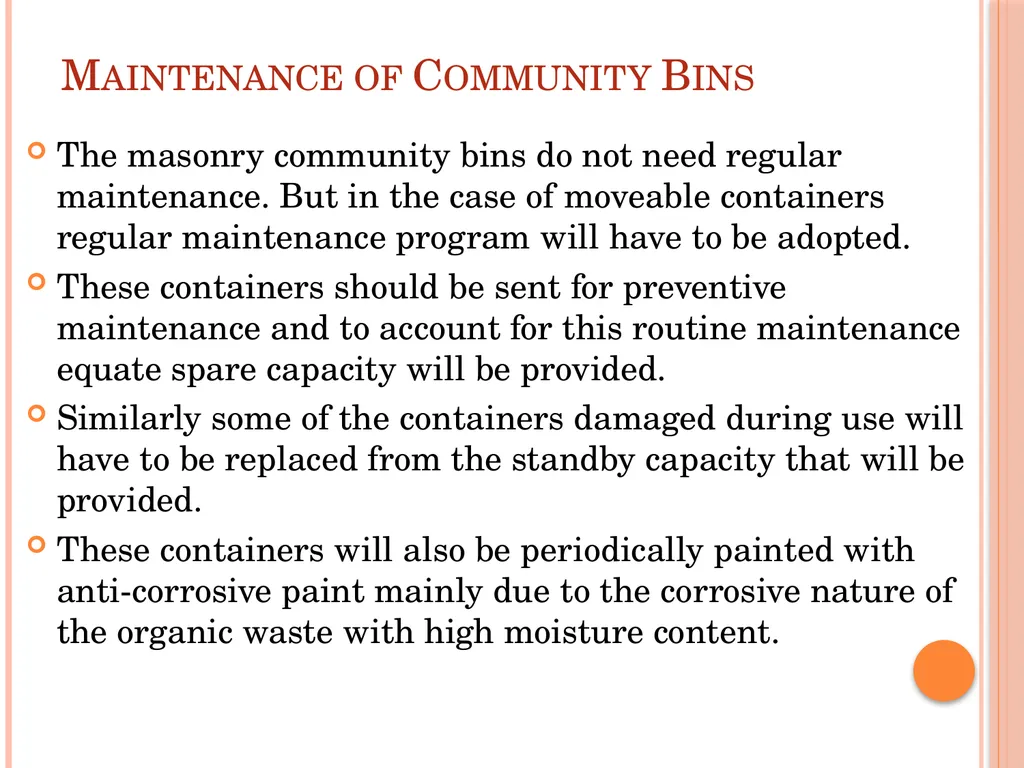
Maintenance of Community Bins The masonry community bins do not need regular maintenance. But in the case of moveable containers regular maintenance program will have to be adopted.
These containers should be sent for preventive maintenance and to account for this routine maintenance equate spare capacity will be provided.
Similarly some of the containers damaged during use will have to be replaced from the standby capacity that will be provided.
These containers will also be periodically painted with anti-corrosive paint mainly due to the corrosive nature of the organic waste with high moisture content.<br>
These containers should be sent for preventive maintenance and to account for this routine maintenance equate spare capacity will be provided.
Similarly some of the containers damaged during use will have to be replaced from the standby capacity that will be provided.
These containers will also be periodically painted with anti-corrosive paint mainly due to the corrosive nature of the organic waste with high moisture content.<br>
20
Unenclosed Points In many towns and cities, due to shortage of funds or frequent thefts of bins, the municipal authorities avoid provision of any containers.
The material is allowed to accumulate at specified points from where it is collected and taken away.
Such collection points are located in low income and slum areas.
Inspite of the large variety of containers in use none appears to be fully satisfactory.
Education and active participation of citizens will be necessary to obtain a satisfactory performance of the containers.<br>
The material is allowed to accumulate at specified points from where it is collected and taken away.
Such collection points are located in low income and slum areas.
Inspite of the large variety of containers in use none appears to be fully satisfactory.
Education and active participation of citizens will be necessary to obtain a satisfactory performance of the containers.<br>
21
Storage at Ward Office Each municipal ward should be provided with office space where the handcarts, community bins etc. can be stored.
The office should also provide toilets, change rooms etc. to the workers.
One ward office can efficiently serve 3-4 km radial distance or about 30,000 population.
This system is commonly used in developed countries as well as in some metropolitan Indian cites.<br>
The office should also provide toilets, change rooms etc. to the workers.
One ward office can efficiently serve 3-4 km radial distance or about 30,000 population.
This system is commonly used in developed countries as well as in some metropolitan Indian cites.<br>
22
Routine Maintenance of Equipments The equipment needs to be routinely maintained at the generation area.
Small capacity storage containers commonly consist of plastic bags or sacks. As these are often of single use type no maintenance is required. However, majority of the consumers in India use reusable metal or plastic containers.
The maintenance of small capacity containers will involve checking the air tightness of the lid and replacement of damaged lids.
Storage containers with wheels are provided for larger capacity which may get broken and can be again welded in the case of metal containers or in the case of plastic container either the wheel or the container itself will have to be replaced.<br>
Small capacity storage containers commonly consist of plastic bags or sacks. As these are often of single use type no maintenance is required. However, majority of the consumers in India use reusable metal or plastic containers.
The maintenance of small capacity containers will involve checking the air tightness of the lid and replacement of damaged lids.
Storage containers with wheels are provided for larger capacity which may get broken and can be again welded in the case of metal containers or in the case of plastic container either the wheel or the container itself will have to be replaced.<br>
23
Contd…. Larger capacity metal containers often have built-in wheels which will have to be maintained by regular greasing, welding and other necessary repairs.
In all these cases, the containers must be washed at specific frequency to remove any adhering organic matter which may otherwise decompose and corrode the material.
It is necessary to wash it every day or atleast every time the contents of the container are transferred to the municipal vehicle or to the community bin.
The municipal collection equipment consists of mainly street cleansing equipment, the handcarts and the community bins.<br>
In all these cases, the containers must be washed at specific frequency to remove any adhering organic matter which may otherwise decompose and corrode the material.
It is necessary to wash it every day or atleast every time the contents of the container are transferred to the municipal vehicle or to the community bin.
The municipal collection equipment consists of mainly street cleansing equipment, the handcarts and the community bins.<br>
24
Contd….. The brooms, baskets and plastic containers used for the street cleansing work have short life of 2-3 months and hence the routine maintenance should ensure that the brooms are properly tied and the fibres do not get loose early.
Adequate stock of the material should be maintained at the Ward Office to replenish the stock of the street cleansing equipment.
In the case of handcarts, routine preventive maintenance involves checking the tightness of nut-bolts, continuity of joints and lubrication of the wheels. The workers should carry it out before starting his work.
Mechanics and helpers with greasing gun or alternate equipment should be provided at the ward level.<br>
Adequate stock of the material should be maintained at the Ward Office to replenish the stock of the street cleansing equipment.
In the case of handcarts, routine preventive maintenance involves checking the tightness of nut-bolts, continuity of joints and lubrication of the wheels. The workers should carry it out before starting his work.
Mechanics and helpers with greasing gun or alternate equipment should be provided at the ward level.<br>
25
Contd…. The handcarts should also be washed and cleaned at the end of the shift every day so that any remaining organic matter does not decompose and corrode the plates of the handcart.
The handcarts should be painted every six months with anti-corrosive paint of specific colour.
Whenever corrosion of the sheets of the handarts is observed, the same should be replaced in the workshop.
The Community Bins also require continuous maintenance.
In the case of masonry bins, the loosening of the bricks and plastering should be checked every 3 months and necessary replacement and plastering carried out.
In the case of the MS containers, continuous inspection of the wheels and greasing of the bearings will be required. Damaged wheels should be replaced immediately & anticorrosive paint should be applied in every 3 months.<br>
The handcarts should be painted every six months with anti-corrosive paint of specific colour.
Whenever corrosion of the sheets of the handarts is observed, the same should be replaced in the workshop.
The Community Bins also require continuous maintenance.
In the case of masonry bins, the loosening of the bricks and plastering should be checked every 3 months and necessary replacement and plastering carried out.
In the case of the MS containers, continuous inspection of the wheels and greasing of the bearings will be required. Damaged wheels should be replaced immediately & anticorrosive paint should be applied in every 3 months.<br>
26
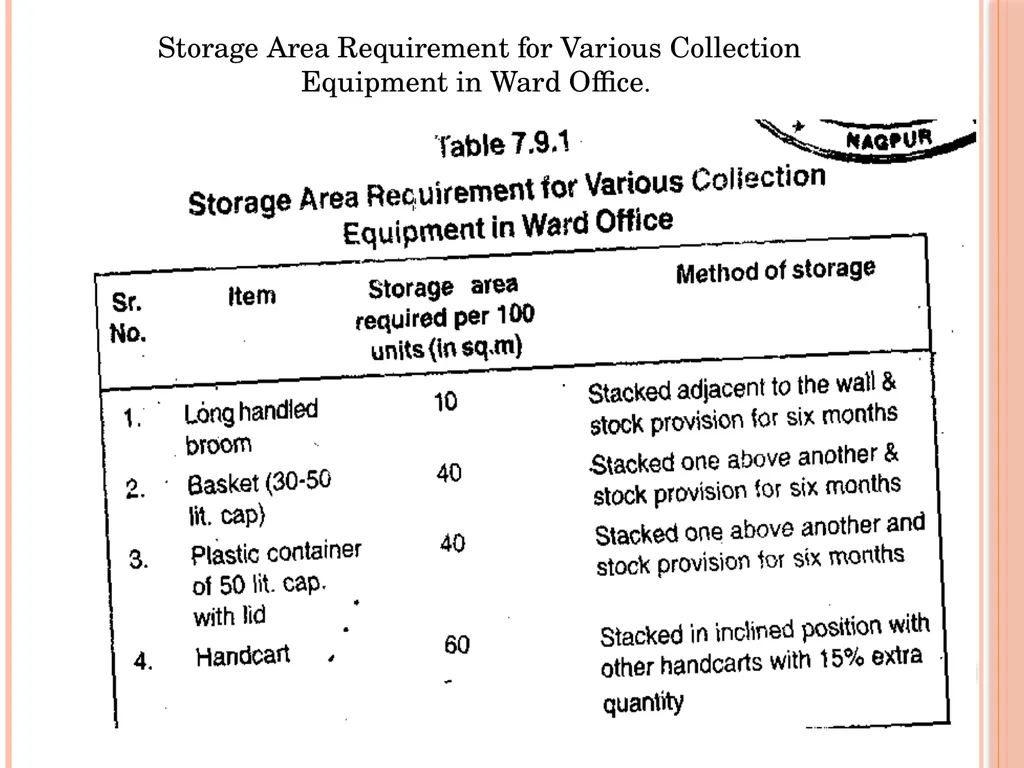
Storage Area Requirement for Various Collection Equipment in Ward Office.<br>
27
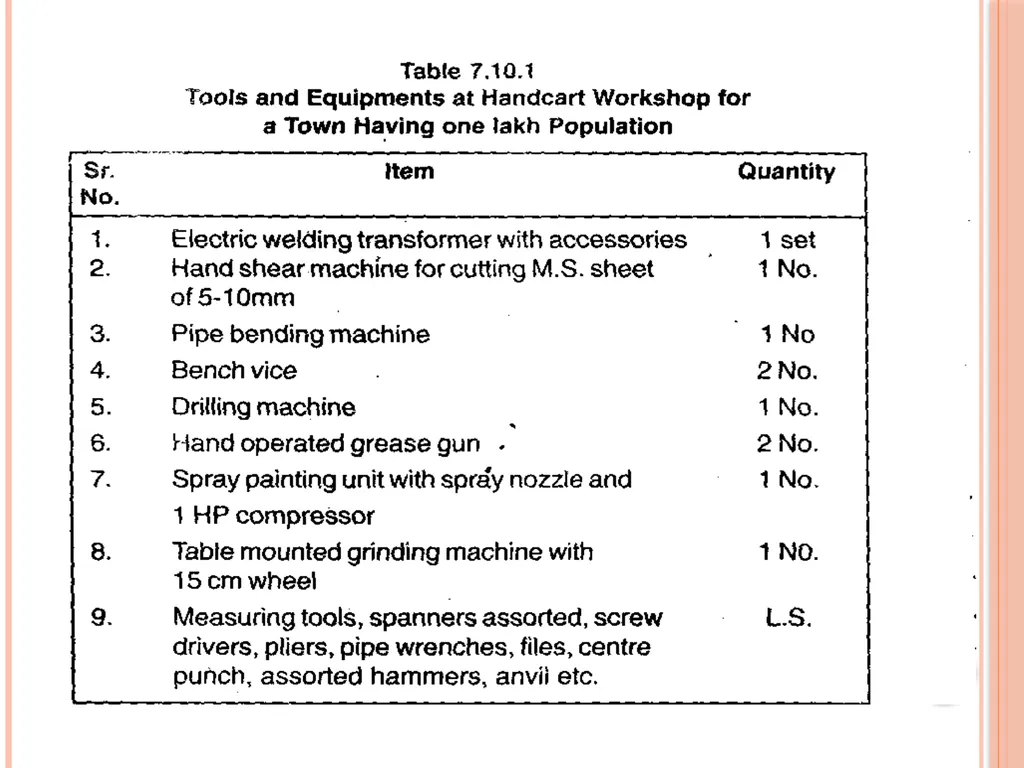
Workshop For Repairs The replacement of the wheels of the handcarts, provision of a new sheet and repairs to handle grip can be carried out in a central workshop.
Similarly the wheels and handles of metal community bins and the sheets of the containers can be replaced in a central workshop provided for these common repairs.
The area for such a workshop can be calculated by assuming that atleast 20% of the handcarts will have to be sent for repairs at any time and a smaller percentage (10-15%) of the metal community bins will have to be sent for the repairs to the workshop.
The manpower consisting of mechanics, welders, sheet metal workers, helpers etc. will have to be accordingly provided.
In such a workshop, adequate inventory of spares for replacement of wheels, handles, axles and sheets will have to be provided.
The stores inventory should be adequate for one year.<br>
Similarly the wheels and handles of metal community bins and the sheets of the containers can be replaced in a central workshop provided for these common repairs.
The area for such a workshop can be calculated by assuming that atleast 20% of the handcarts will have to be sent for repairs at any time and a smaller percentage (10-15%) of the metal community bins will have to be sent for the repairs to the workshop.
The manpower consisting of mechanics, welders, sheet metal workers, helpers etc. will have to be accordingly provided.
In such a workshop, adequate inventory of spares for replacement of wheels, handles, axles and sheets will have to be provided.
The stores inventory should be adequate for one year.<br>
28
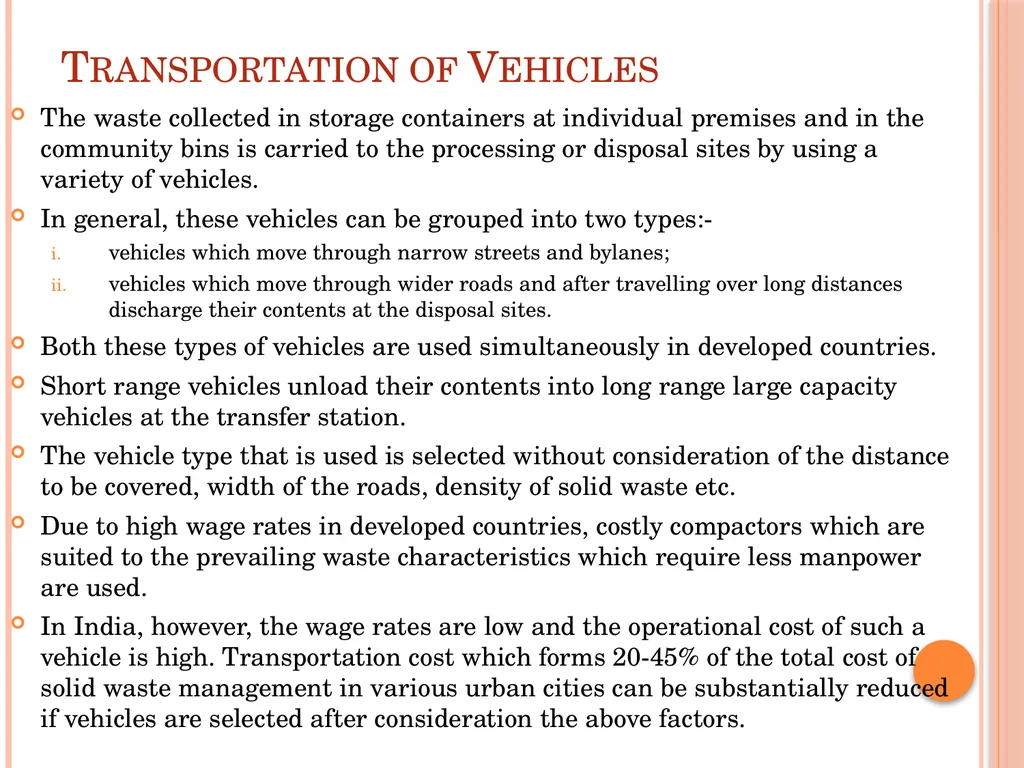
Transportation of Vehicles The waste collected in storage containers at individual premises and in the community bins is carried to the processing or disposal sites by using a variety of vehicles.
In general, these vehicles can be grouped into two types:-
vehicles which move through narrow streets and bylanes;
vehicles which move through wider roads and after travelling over long distances discharge their contents at the disposal sites.
Both these types of vehicles are used simultaneously in developed countries.
Short range vehicles unload their contents into long range large capacity vehicles at the transfer station.
The vehicle type that is used is selected without consideration of the distance to be covered, width of the roads, density of solid waste etc.
Due to high wage rates in developed countries, costly compactors which are suited to the prevailing waste characteristics which require less manpower are used.
In India, however, the wage rates are low and the operational cost of such a vehicle is high. Transportation cost which forms 20-45% of the total cost of solid waste management in various urban cities can be substantially reduced if vehicles are selected after consideration the above factors.<br>
In general, these vehicles can be grouped into two types:-
vehicles which move through narrow streets and bylanes;
vehicles which move through wider roads and after travelling over long distances discharge their contents at the disposal sites.
Both these types of vehicles are used simultaneously in developed countries.
Short range vehicles unload their contents into long range large capacity vehicles at the transfer station.
The vehicle type that is used is selected without consideration of the distance to be covered, width of the roads, density of solid waste etc.
Due to high wage rates in developed countries, costly compactors which are suited to the prevailing waste characteristics which require less manpower are used.
In India, however, the wage rates are low and the operational cost of such a vehicle is high. Transportation cost which forms 20-45% of the total cost of solid waste management in various urban cities can be substantially reduced if vehicles are selected after consideration the above factors.<br>
29
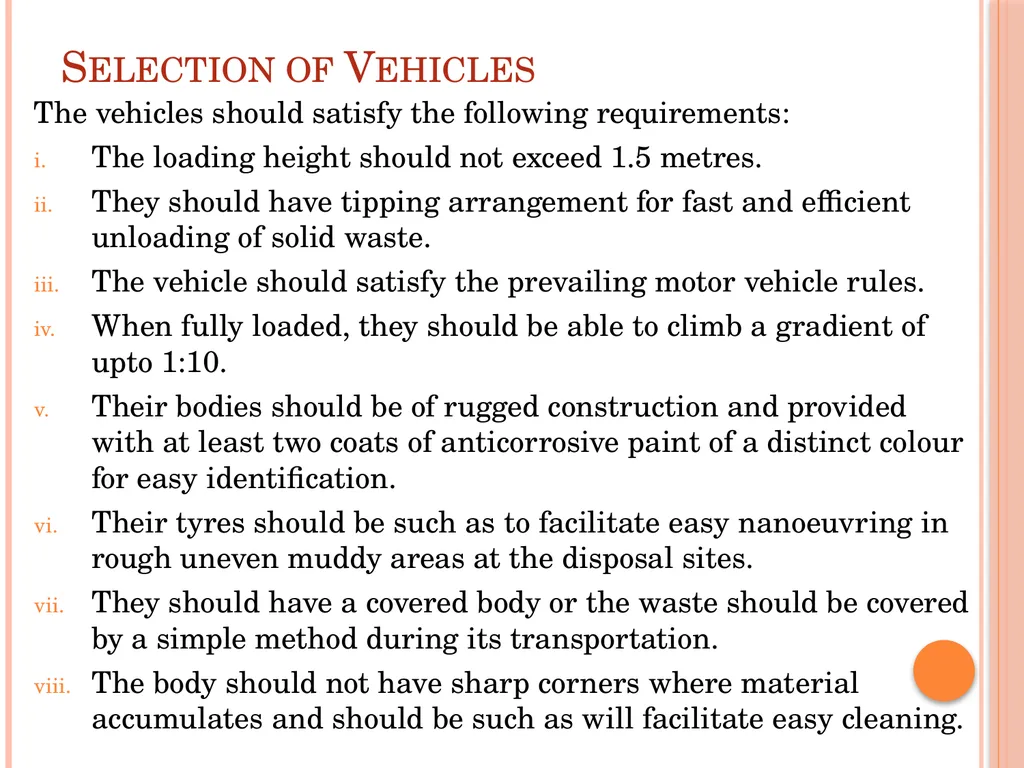
Selection of Vehicles The vehicles should satisfy the following requirements:
The loading height should not exceed 1.5 metres.
They should have tipping arrangement for fast and efficient unloading of solid waste.
The vehicle should satisfy the prevailing motor vehicle rules.
When fully loaded, they should be able to climb a gradient of upto 1:10.
Their bodies should be of rugged construction and provided with at least two coats of anticorrosive paint of a distinct colour for easy identification.
Their tyres should be such as to facilitate easy nanoeuvring in rough uneven muddy areas at the disposal sites.
They should have a covered body or the waste should be covered by a simple method during its transportation.
The body should not have sharp corners where material accumulates and should be such as will facilitate easy cleaning.<br>
The loading height should not exceed 1.5 metres.
They should have tipping arrangement for fast and efficient unloading of solid waste.
The vehicle should satisfy the prevailing motor vehicle rules.
When fully loaded, they should be able to climb a gradient of upto 1:10.
Their bodies should be of rugged construction and provided with at least two coats of anticorrosive paint of a distinct colour for easy identification.
Their tyres should be such as to facilitate easy nanoeuvring in rough uneven muddy areas at the disposal sites.
They should have a covered body or the waste should be covered by a simple method during its transportation.
The body should not have sharp corners where material accumulates and should be such as will facilitate easy cleaning.<br>
30
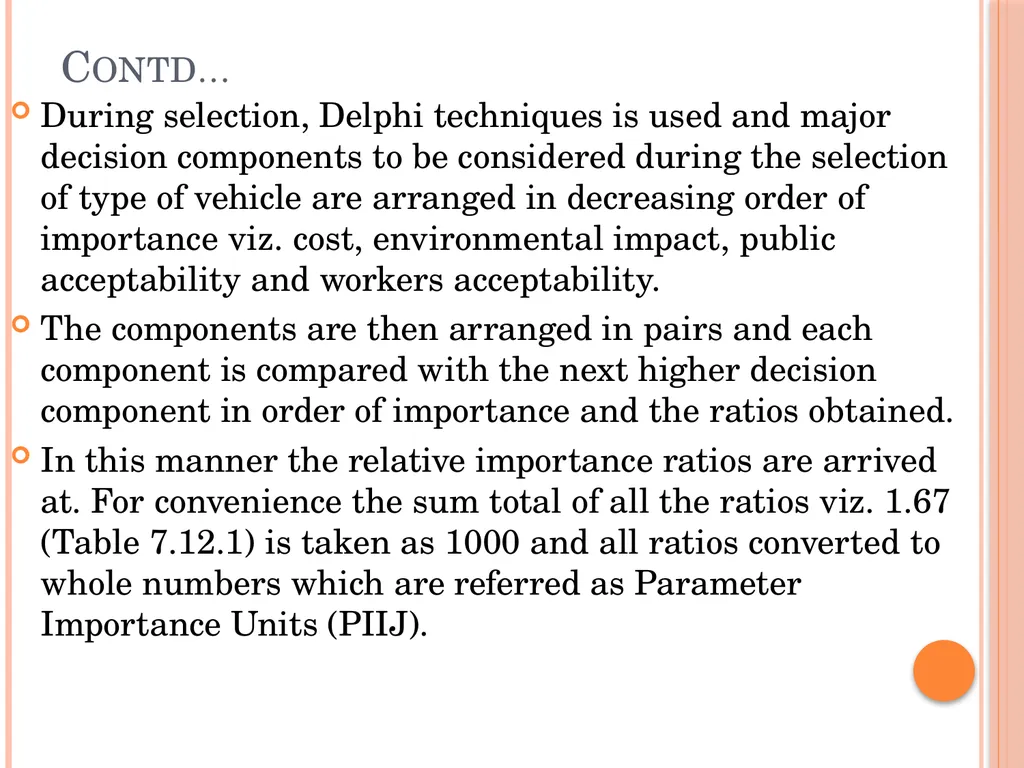
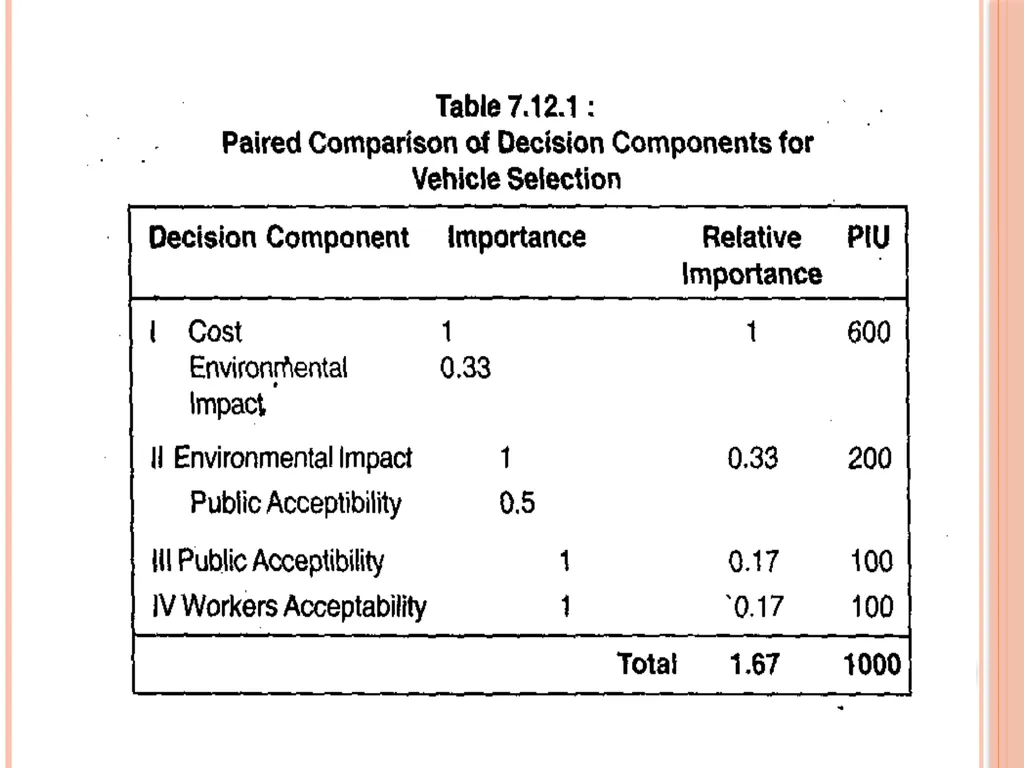
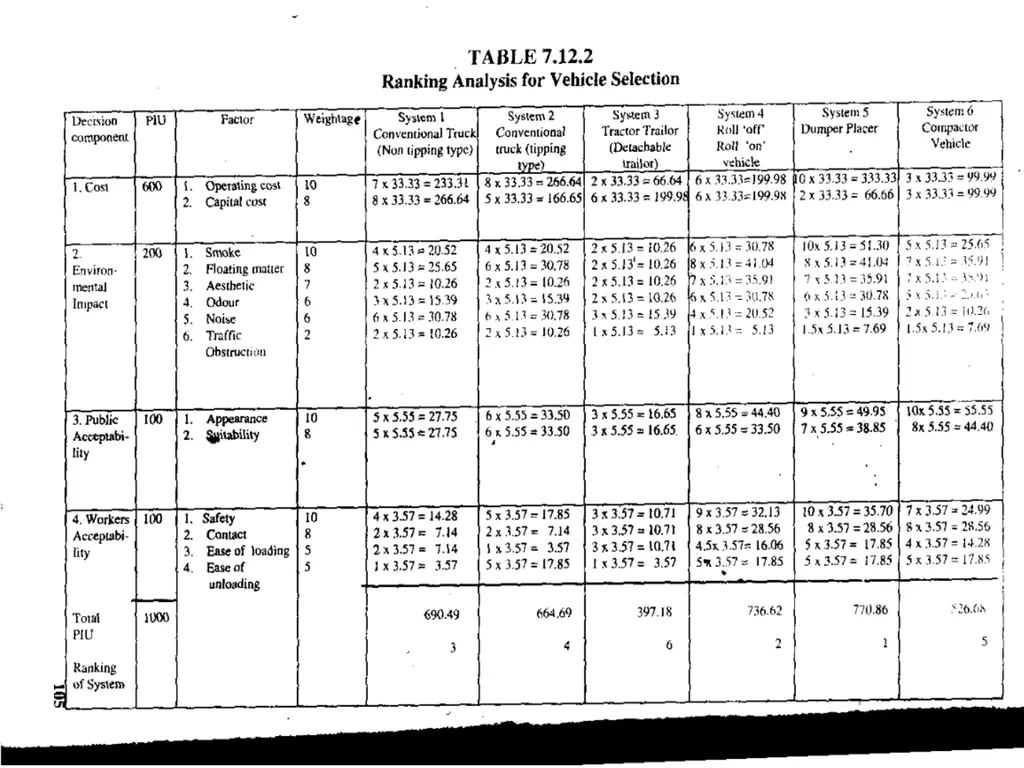
Contd… During selection, Delphi techniques is used and major decision components to be considered during the selection of type of vehicle are arranged in decreasing order of importance viz. cost, environmental impact, public acceptability and workers acceptability.
The components are then arranged in pairs and each component is compared with the next higher decision component in order of importance and the ratios obtained.
In this manner the relative importance ratios are arrived at. For convenience the sum total of all the ratios viz. 1.67 (Table 7.12.1) is taken as 1000 and all ratios converted to whole numbers which are referred as Parameter Importance Units (PIIJ).<br>
The components are then arranged in pairs and each component is compared with the next higher decision component in order of importance and the ratios obtained.
In this manner the relative importance ratios are arrived at. For convenience the sum total of all the ratios viz. 1.67 (Table 7.12.1) is taken as 1000 and all ratios converted to whole numbers which are referred as Parameter Importance Units (PIIJ).<br>
31
Short Range Transportation Vehicles These vehicles usually have a small turning radius and can easily move through narrow and congested roads and lanes. The common types of short range transportation vehicles are
animal carts,
pedal tricycles,
short range diesel vehicles,
tractor trailer and auto-rickshaws.<br>
animal carts,
pedal tricycles,
short range diesel vehicles,
tractor trailer and auto-rickshaws.<br>
32
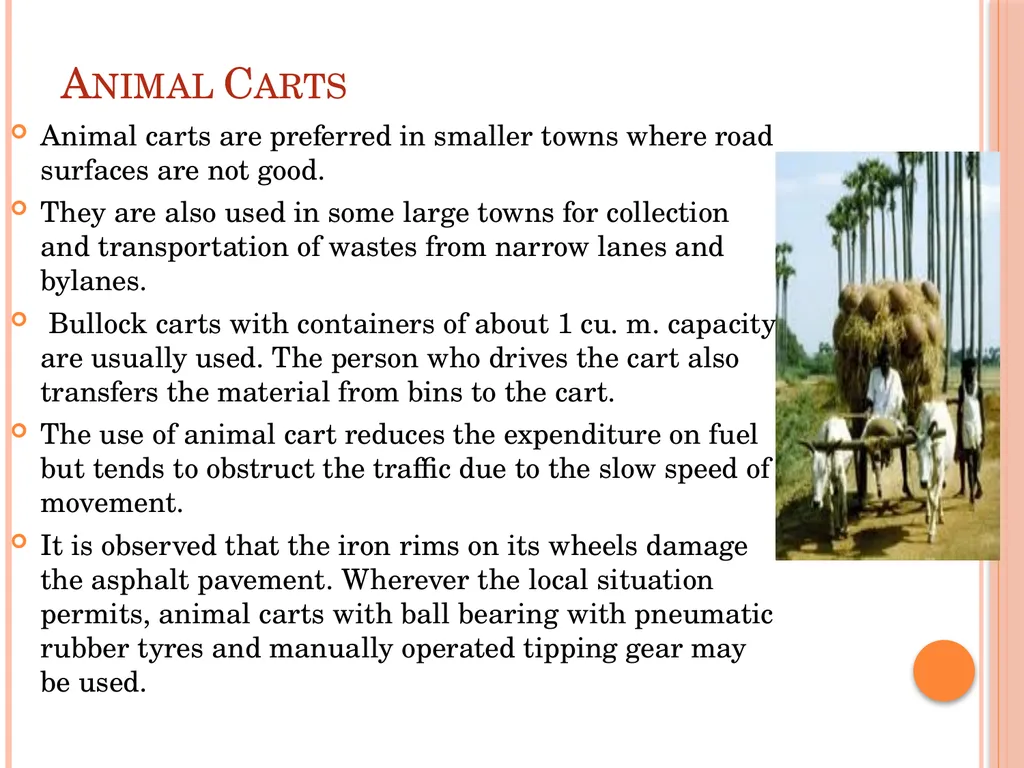
Animal Carts Animal carts are preferred in smaller towns where road surfaces are not good.
They are also used in some large towns for collection and transportation of wastes from narrow lanes and bylanes.
Bullock carts with containers of about 1 cu. m. capacity are usually used. The person who drives the cart also transfers the material from bins to the cart.
The use of animal cart reduces the expenditure on fuel but tends to obstruct the traffic due to the slow speed of movement.
It is observed that the iron rims on its wheels damage the asphalt pavement. Wherever the local situation permits, animal carts with ball bearing with pneumatic rubber tyres and manually operated tipping gear may be used.<br>
They are also used in some large towns for collection and transportation of wastes from narrow lanes and bylanes.
Bullock carts with containers of about 1 cu. m. capacity are usually used. The person who drives the cart also transfers the material from bins to the cart.
The use of animal cart reduces the expenditure on fuel but tends to obstruct the traffic due to the slow speed of movement.
It is observed that the iron rims on its wheels damage the asphalt pavement. Wherever the local situation permits, animal carts with ball bearing with pneumatic rubber tyres and manually operated tipping gear may be used.<br>
33
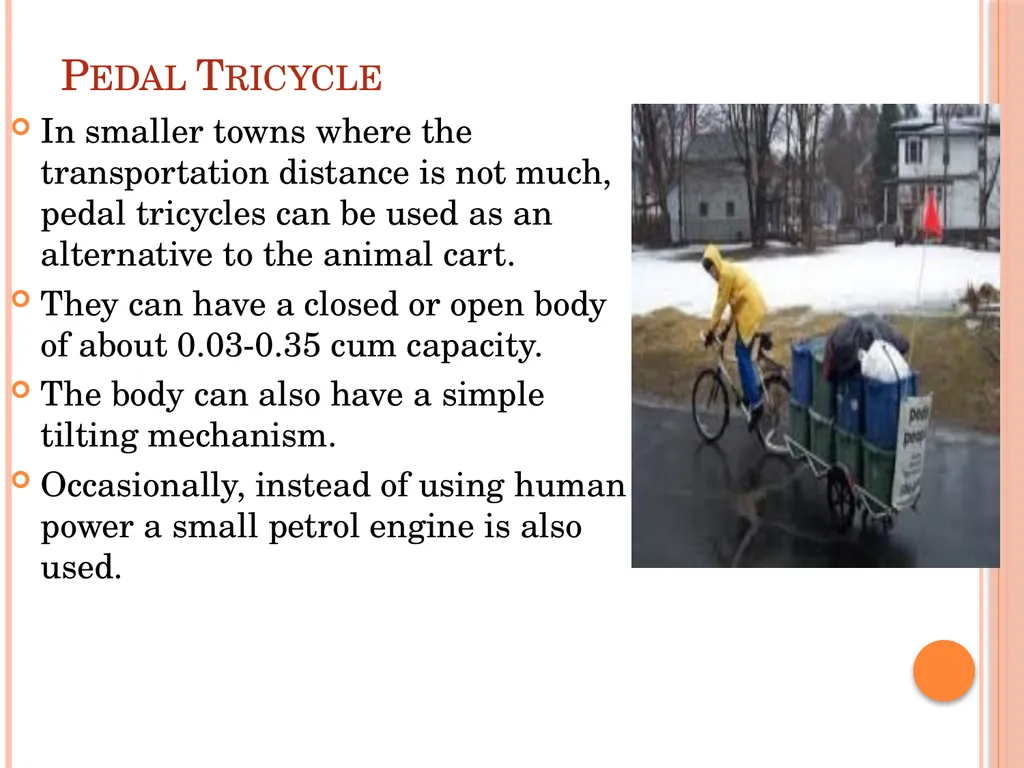
Pedal Tricycle In smaller towns where the transportation distance is not much, pedal tricycles can be used as an alternative to the animal cart.
They can have a closed or open body of about 0.03-0.35 cum capacity.
The body can also have a simple tilting mechanism.
Occasionally, instead of using human power a small petrol engine is also used.<br>
They can have a closed or open body of about 0.03-0.35 cum capacity.
The body can also have a simple tilting mechanism.
Occasionally, instead of using human power a small petrol engine is also used.<br>
34
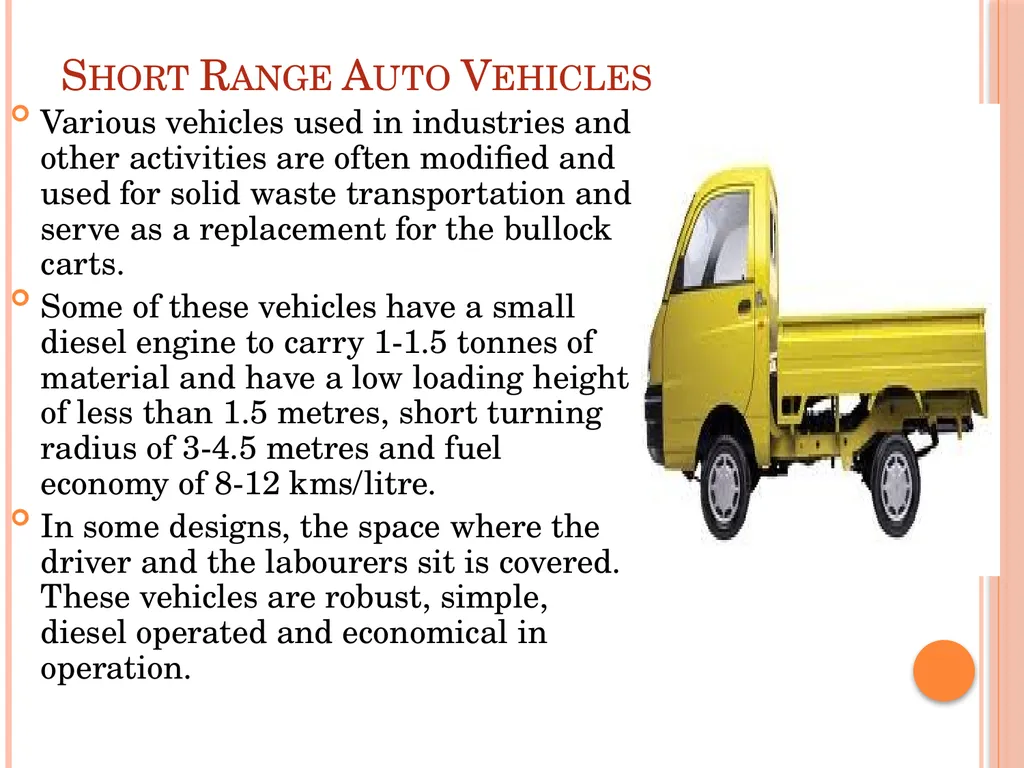
Short Range Auto Vehicles Various vehicles used in industries and other activities are often modified and used for solid waste transportation and serve as a replacement for the bullock carts.
Some of these vehicles have a small diesel engine to carry 1-1.5 tonnes of material and have a low loading height of less than 1.5 metres, short turning radius of 3-4.5 metres and fuel economy of 8-12 kms/litre.
In some designs, the space where the driver and the labourers sit is covered. These vehicles are robust, simple, diesel operated and economical in operation.<br>
Some of these vehicles have a small diesel engine to carry 1-1.5 tonnes of material and have a low loading height of less than 1.5 metres, short turning radius of 3-4.5 metres and fuel economy of 8-12 kms/litre.
In some designs, the space where the driver and the labourers sit is covered. These vehicles are robust, simple, diesel operated and economical in operation.<br>
35
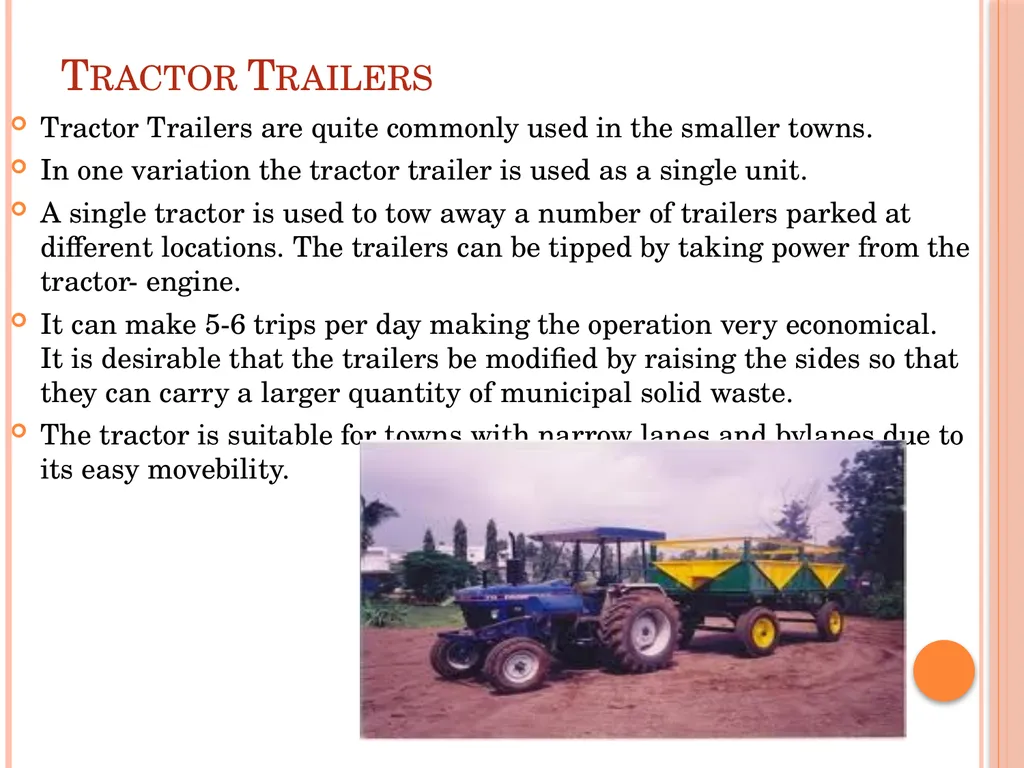
Tractor Trailers Tractor Trailers are quite commonly used in the smaller towns.
In one variation the tractor trailer is used as a single unit.
A single tractor is used to tow away a number of trailers parked at different locations. The trailers can be tipped by taking power from the tractor- engine.
It can make 5-6 trips per day making the operation very economical. It is desirable that the trailers be modified by raising the sides so that they can carry a larger quantity of municipal solid waste.
The tractor is suitable for towns with narrow lanes and bylanes due to its easy movebility.<br>
In one variation the tractor trailer is used as a single unit.
A single tractor is used to tow away a number of trailers parked at different locations. The trailers can be tipped by taking power from the tractor- engine.
It can make 5-6 trips per day making the operation very economical. It is desirable that the trailers be modified by raising the sides so that they can carry a larger quantity of municipal solid waste.
The tractor is suitable for towns with narrow lanes and bylanes due to its easy movebility.<br>
36
Long Range Transport Vehicles In the case of bigger towns and cities the distance over which the waste is required to be transported is large and the roads are also wide and well maintained.
Hence different types of vehicles are used. The most common vehicles in use are
normal open body trucks,
dumper placers,
special municipal vehicles,
the container carrier system,
compactor vehicles.<br>
Hence different types of vehicles are used. The most common vehicles in use are
normal open body trucks,
dumper placers,
special municipal vehicles,
the container carrier system,
compactor vehicles.<br>
37
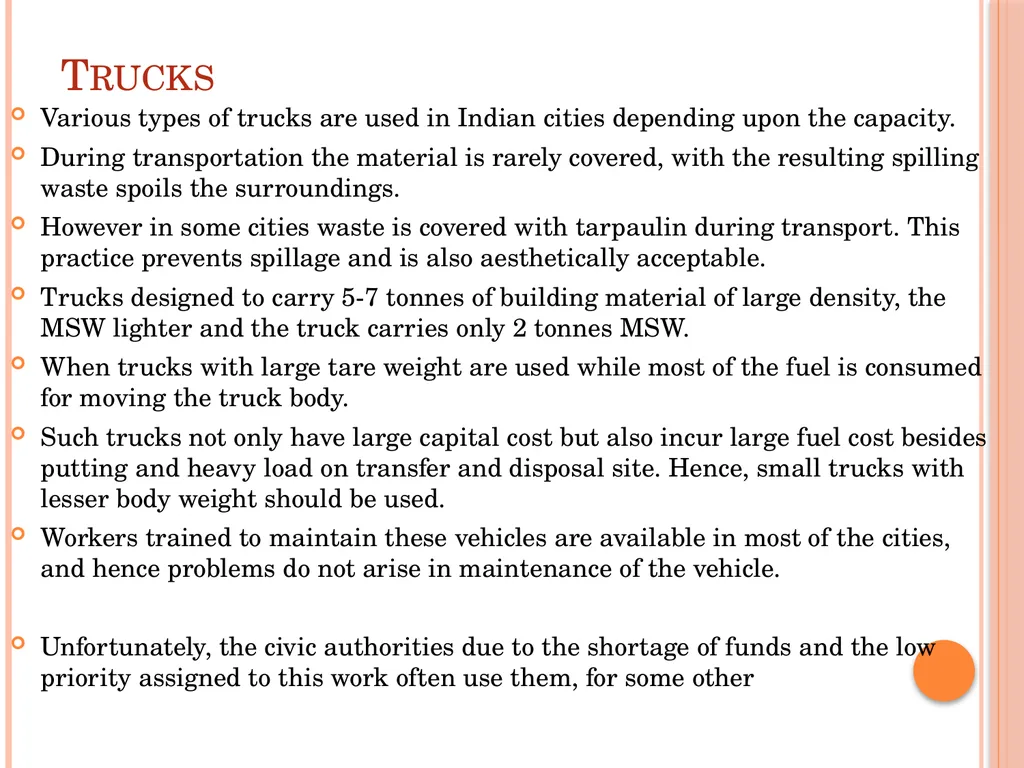
Trucks Various types of trucks are used in Indian cities depending upon the capacity.
During transportation the material is rarely covered, with the resulting spilling waste spoils the surroundings.
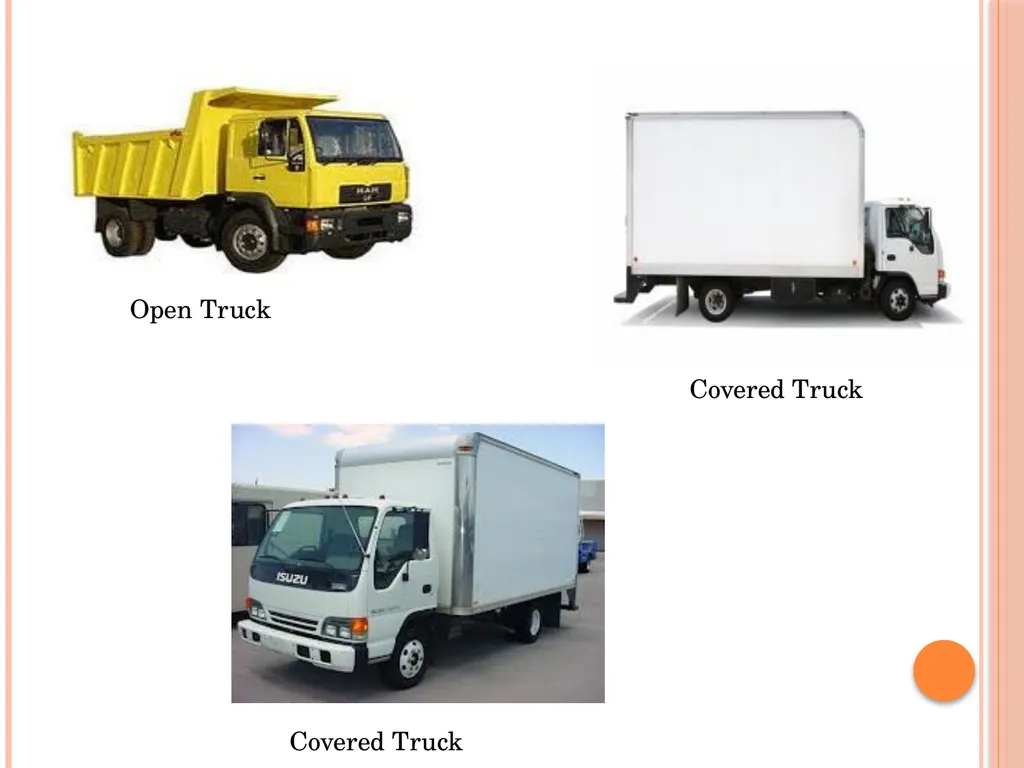
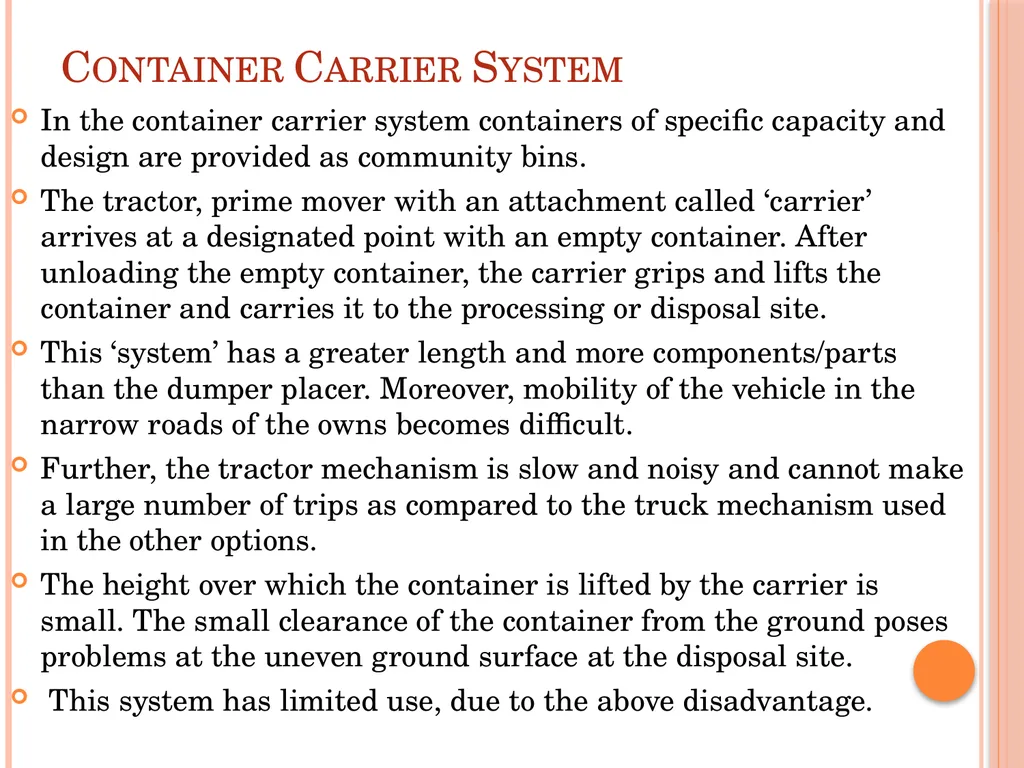
However in some cities waste is covered with tarpaulin during transport. This practice prevents spillage and is also aesthetically acceptable.
Trucks designed to carry 5-7 tonnes of building material of large density, the MSW lighter and the truck carries only 2 tonnes MSW.
When trucks with large tare weight are used while most of the fuel is consumed for moving the truck body.
Such trucks not only have large capital cost but also incur large fuel cost besides putting and heavy load on transfer and disposal site. Hence, small trucks with lesser body weight should be used.
Workers trained to maintain these vehicles are available in most of the cities, and hence problems do not arise in maintenance of the vehicle.
Unfortunately, the civic authorities due to the shortage of funds and the low priority assigned to this work often use them, for some other<br>
During transportation the material is rarely covered, with the resulting spilling waste spoils the surroundings.
However in some cities waste is covered with tarpaulin during transport. This practice prevents spillage and is also aesthetically acceptable.
Trucks designed to carry 5-7 tonnes of building material of large density, the MSW lighter and the truck carries only 2 tonnes MSW.
When trucks with large tare weight are used while most of the fuel is consumed for moving the truck body.
Such trucks not only have large capital cost but also incur large fuel cost besides putting and heavy load on transfer and disposal site. Hence, small trucks with lesser body weight should be used.
Workers trained to maintain these vehicles are available in most of the cities, and hence problems do not arise in maintenance of the vehicle.
Unfortunately, the civic authorities due to the shortage of funds and the low priority assigned to this work often use them, for some other<br>
38
Open Truck Covered Truck Covered Truck<br>
39
Container Carrier System In the container carrier system containers of specific capacity and design are provided as community bins.
The tractor, prime mover with an attachment called ‘carrier’ arrives at a designated point with an empty container. After unloading the empty container, the carrier grips and lifts the container and carries it to the processing or disposal site.
This ‘system’ has a greater length and more components/parts than the dumper placer. Moreover, mobility of the vehicle in the narrow roads of the owns becomes difficult.
Further, the tractor mechanism is slow and noisy and cannot make a large number of trips as compared to the truck mechanism used in the other options.
The height over which the container is lifted by the carrier is small. The small clearance of the container from the ground poses problems at the uneven ground surface at the disposal site.
This system has limited use, due to the above disadvantage.<br>
The tractor, prime mover with an attachment called ‘carrier’ arrives at a designated point with an empty container. After unloading the empty container, the carrier grips and lifts the container and carries it to the processing or disposal site.
This ‘system’ has a greater length and more components/parts than the dumper placer. Moreover, mobility of the vehicle in the narrow roads of the owns becomes difficult.
Further, the tractor mechanism is slow and noisy and cannot make a large number of trips as compared to the truck mechanism used in the other options.
The height over which the container is lifted by the carrier is small. The small clearance of the container from the ground poses problems at the uneven ground surface at the disposal site.
This system has limited use, due to the above disadvantage.<br>
40
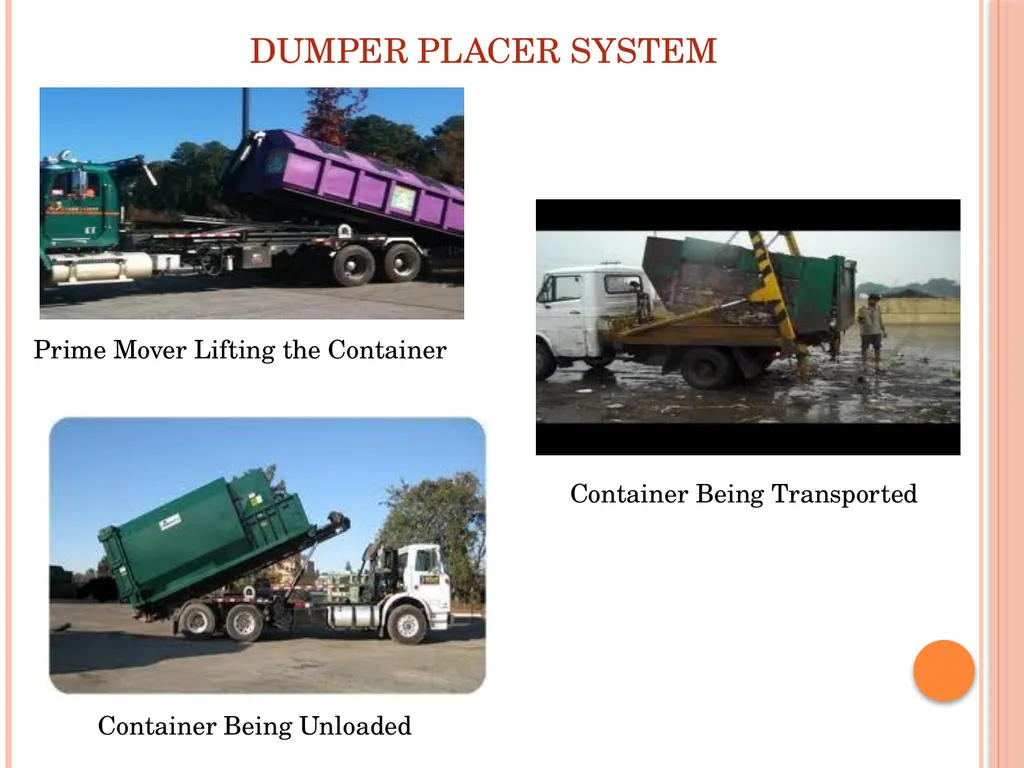
Dumper Placer These units were originally designed for collection and transportation of heavy metal and scrap from industrial establishments.
The vehicle is provided with a hoisting mechanism which lifts containers (commonly of 4.5 cu.m. capacity) placed at suitable locations.
Usually, the vehicle arrives with an empty container which is unloaded at a specific point, the filled container is lifted and carried away for waste disposal.
Each vehicle can take care of at least 5-6 containers in an 8 hr. working shift. With the present design only one container can be transported leaving a large vacant space on the chassis.
Modification of the container design in a manner so as to enable placing of a larger number of container will result in a more efficient utilisation of the vehicle chassis.<br>
The vehicle is provided with a hoisting mechanism which lifts containers (commonly of 4.5 cu.m. capacity) placed at suitable locations.
Usually, the vehicle arrives with an empty container which is unloaded at a specific point, the filled container is lifted and carried away for waste disposal.
Each vehicle can take care of at least 5-6 containers in an 8 hr. working shift. With the present design only one container can be transported leaving a large vacant space on the chassis.
Modification of the container design in a manner so as to enable placing of a larger number of container will result in a more efficient utilisation of the vehicle chassis.<br>
41
DUMPER PLACER SYSTEM Prime Mover Lifting the Container Container Being Transported Container Being Unloaded<br>
42
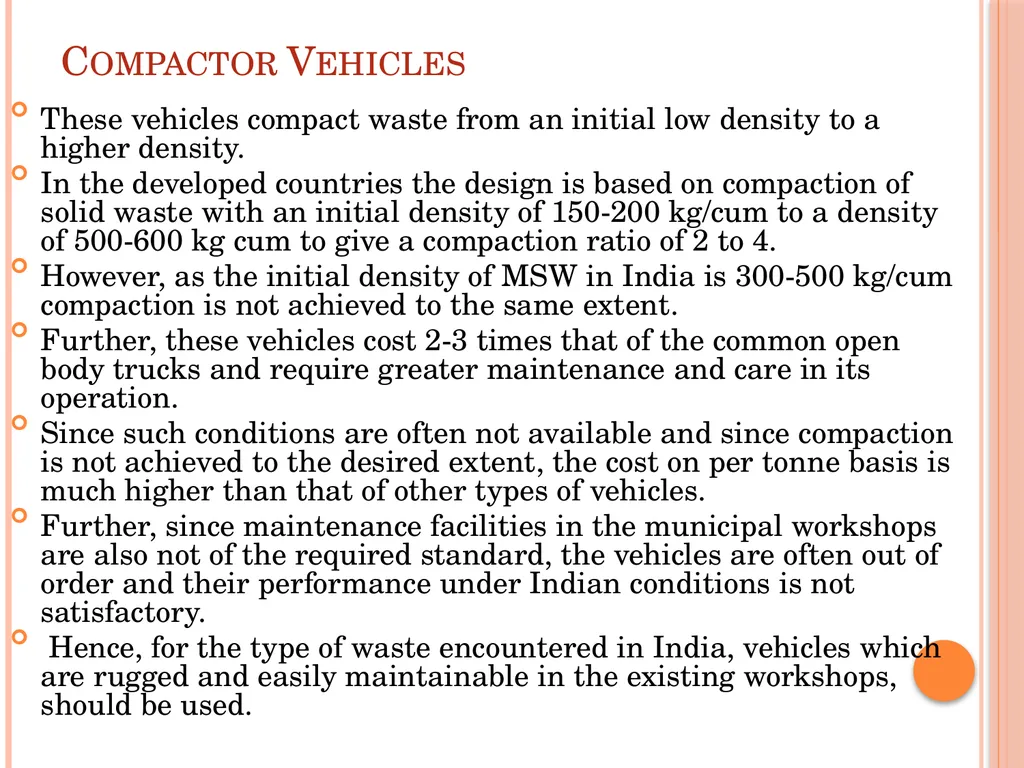
Compactor Vehicles These vehicles compact waste from an initial low density to a higher density.
In the developed countries the design is based on compaction of solid waste with an initial density of 150-200 kg/cum to a density of 500-600 kg cum to give a compaction ratio of 2 to 4.
However, as the initial density of MSW in India is 300-500 kg/cum compaction is not achieved to the same extent.
Further, these vehicles cost 2-3 times that of the common open body trucks and require greater maintenance and care in its operation.
Since such conditions are often not available and since compaction is not achieved to the desired extent, the cost on per tonne basis is much higher than that of other types of vehicles.
Further, since maintenance facilities in the municipal workshops are also not of the required standard, the vehicles are often out of order and their performance under Indian conditions is not satisfactory.
Hence, for the type of waste encountered in India, vehicles which are rugged and easily maintainable in the existing workshops, should be used.<br>
In the developed countries the design is based on compaction of solid waste with an initial density of 150-200 kg/cum to a density of 500-600 kg cum to give a compaction ratio of 2 to 4.
However, as the initial density of MSW in India is 300-500 kg/cum compaction is not achieved to the same extent.
Further, these vehicles cost 2-3 times that of the common open body trucks and require greater maintenance and care in its operation.
Since such conditions are often not available and since compaction is not achieved to the desired extent, the cost on per tonne basis is much higher than that of other types of vehicles.
Further, since maintenance facilities in the municipal workshops are also not of the required standard, the vehicles are often out of order and their performance under Indian conditions is not satisfactory.
Hence, for the type of waste encountered in India, vehicles which are rugged and easily maintainable in the existing workshops, should be used.<br>
43
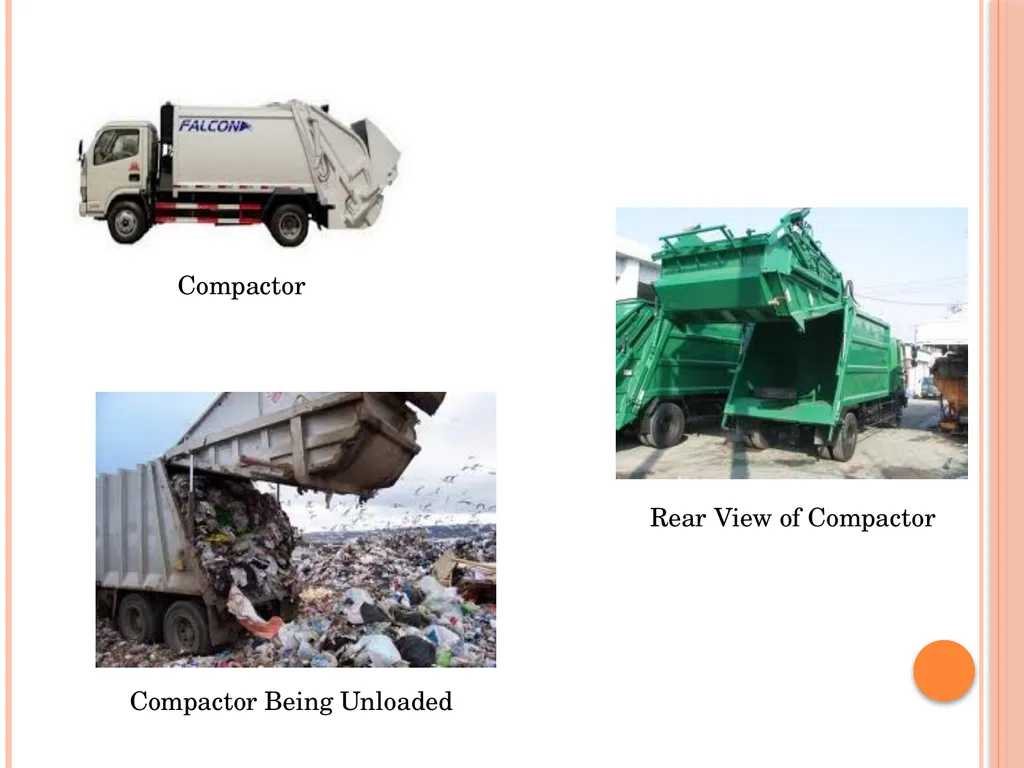
Compactor Rear View of Compactor Compactor Being Unloaded<br>
44
Bulk Refuse Carriers Bulk refuse carriers having a capacity of 16-24 cu.m. are sometimes used.
These are commonly provided at transfer stations where the short range vehicles unload in it.
Some of these vehicles have their own prime mover while others are hauled by a separate prime mover.
These Bulk Refuse Carriers usually have raised sides and are also closed from the top after filling.
They are hydraulically unloaded at the processing a disposal site.<br>
These are commonly provided at transfer stations where the short range vehicles unload in it.
Some of these vehicles have their own prime mover while others are hauled by a separate prime mover.
These Bulk Refuse Carriers usually have raised sides and are also closed from the top after filling.
They are hydraulically unloaded at the processing a disposal site.<br>
45
Rail Transport When solid waste is to be transported over a large distance as in case of Mumbai, Kolkata, Chennai etc. this mode of transport can be used.
The vehicles bring solid waste from different areas of the city and transfer their contents into the railway wagons at the transfer station.
Rail transports economical if the material is to be transported over a large distance.
Formerly, rail transport was used in Mumbai to carry waste from the Mahalaxmi transfer station and in Kolkata from Dhapa transfer station to the disposal site.
However, due to various reasons, use of this method has been discontinued in both cities.<br>
The vehicles bring solid waste from different areas of the city and transfer their contents into the railway wagons at the transfer station.
Rail transports economical if the material is to be transported over a large distance.
Formerly, rail transport was used in Mumbai to carry waste from the Mahalaxmi transfer station and in Kolkata from Dhapa transfer station to the disposal site.
However, due to various reasons, use of this method has been discontinued in both cities.<br>
46
Reference Solid Waste Management- Dr. Bhide<br>
47
Thank You<br>