Tools for Language Documentation Claire Bowern
Description: Tools for Language Documentation Claire Bowern Yale University LSA Summer Institute: 2013 Week 1: Overview Overview, Goals of Class Tools for documentation Physical tools: Hardware Software Stimuli Conceptual tools: What makes a good
Related Topics
Download Presentation
"Tools for Language Documentation Claire Bowern" is the property of its rightful owner. Permission is granted to download and print the materials on this website for personal, non-commercial use only, and to display it on your personal computer provided you do not modify the materials and that you retain all copyright notices contained in the materials. By downloading content from our website, you accept the terms of this agreement.
Presentation Transcript
slide1. Tools for Language Documentation Claire Bowern
Yale University
LSA Summer Institute: 2013 Week 1: Overview<br>
slide2. Overview, Goals of Class<br>
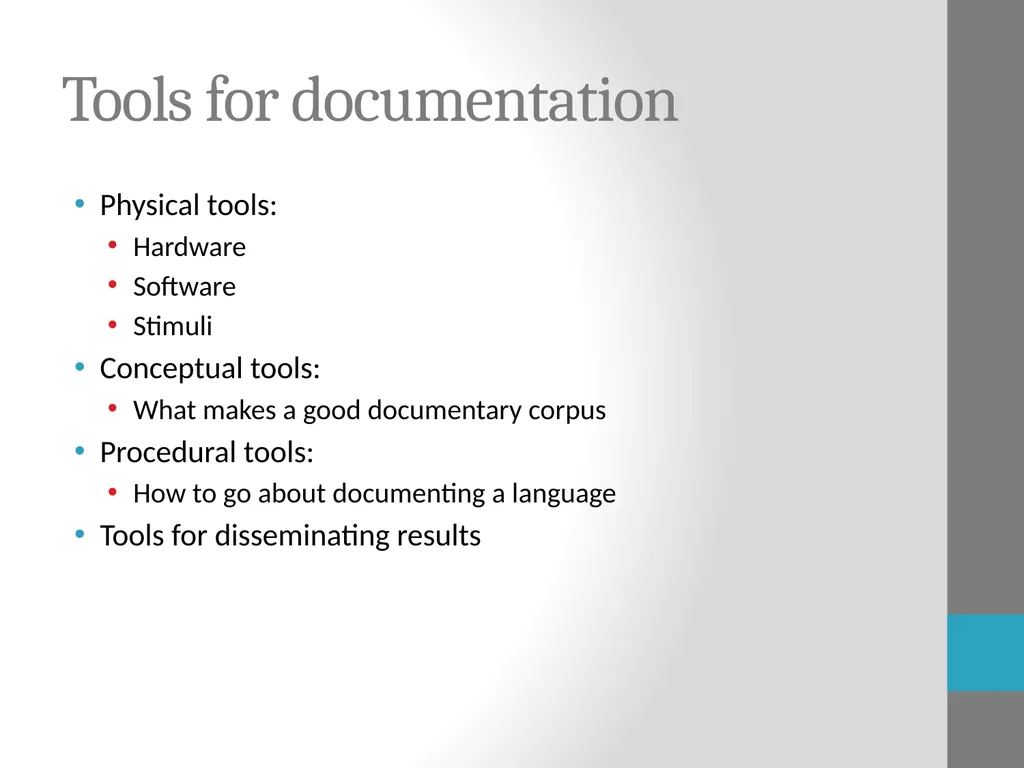
slide3. Tools for documentation Physical tools:
Hardware
Software
Stimuli
Conceptual tools:
What makes a good documentary corpus
Procedural tools:
How to go about documenting a language
Tools for disseminating results<br>
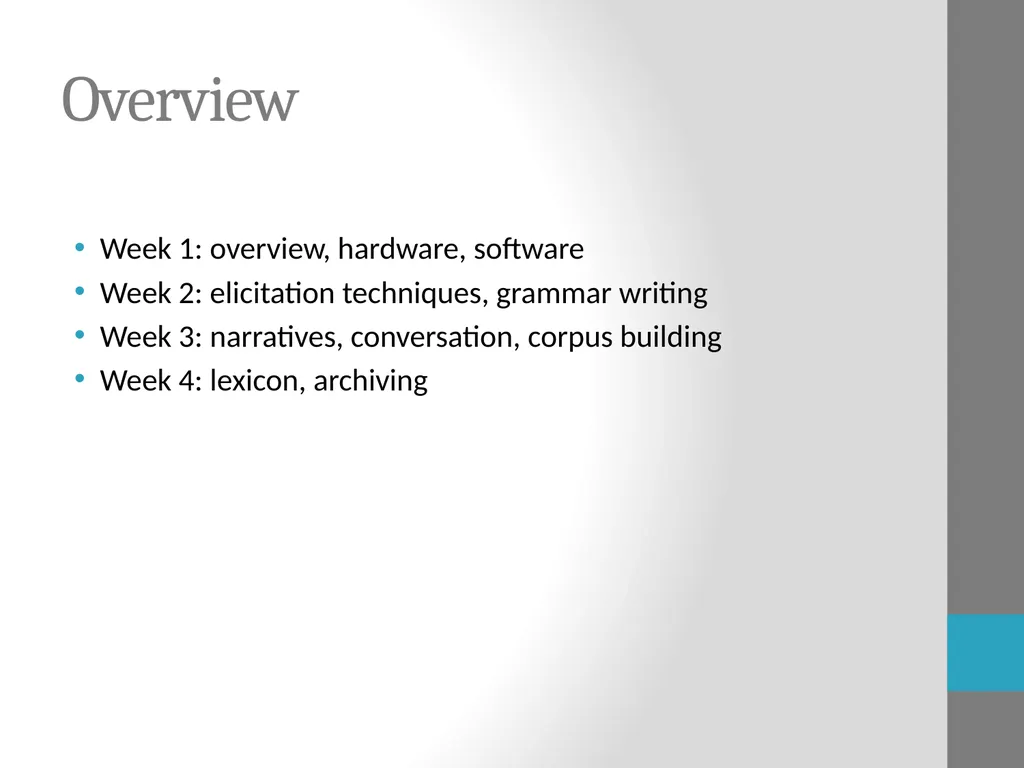
slide4. Overview Week 1: overview, hardware, software
Week 2: elicitation techniques, grammar writing
Week 3: narratives, conversation, corpus building
Week 4: lexicon, archiving<br>
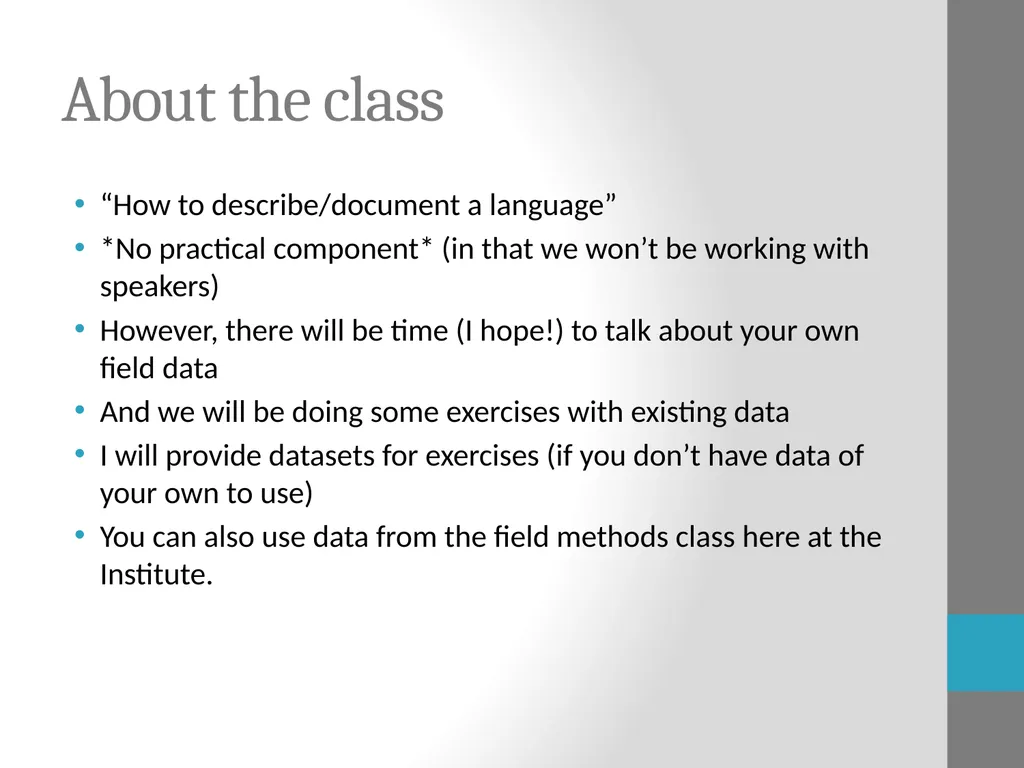
slide5. About the class “How to describe/document a language”
*No practical component* (in that we won’t be working with speakers)
However, there will be time (I hope!) to talk about your own field data
And we will be doing some exercises with existing data
I will provide datasets for exercises (if you don’t have data of your own to use)
You can also use data from the field methods class here at the Institute.<br>
slide6. A few assumptions for this class Not talking about community-oriented materials here (I see documentary materials as feeding into that though)
Assuming that the language doesn’t have a lot of other materials apart from what the linguist will be producing
Assuming that the linguist will be the one doing most of the writing.
Implicitly assuming a grammar/dictionary/texts model (more on this below).
None of these assumptions are crucial, they’re just there so we can limit the topic a bit.<br>
slide7. Principles of documentation<br>
slide8. What is language documentation? Documentary Linguistics as its own subfield.
Doing things with linguistic data:
Getting the data
Preserving it
Processing it
(Analyzing it)
Cf Woodbury (2002): Language documentation is the creation, annotation, preservation, and dissemination of transparent records of a language.
Important for both theoretical and empirical branches of linguistics:
typology, historical linguistics, etc<br>
slide9. What shapes the language record? The linguist (i.e. you!)
Their interests
Their abilities
The speakers and their interests!
External circumstances
funding
time available
lucky breaks
unlucky breaks<br>
slide10. Language Documentation as a Language Legacy Particularly relevant for endangered languages.
Your work might be the only substantive record of a language:
few speakers
field might view the language as “done”
speakers might view the language as “done”<br>
slide11. Planned Documentation vs “Collect it all” “making a record of the language” : ‘comprehensive grammar’
You can’t collect everything.
All documentation is sampling.
Unstructured, unanalyzed corpora usually aren’t very useful
They are hard to use;
They don’t get worked on;
They usually aren’t big enough to test hypotheses computationally;
They require native speakers (or people who are already very familiar with the language) -> fine for languages with a major presence, but what about the quarter of the world’s languages with fewer than 10,000 speakers?<br>
slide12. What counts as documentation? When is a collection big enough to count as language documentation?
Is an article in Linguistic Inquiry language documentation?
creation
annotation
preservation
dissemination
but only a very small fragment of a language.<br>
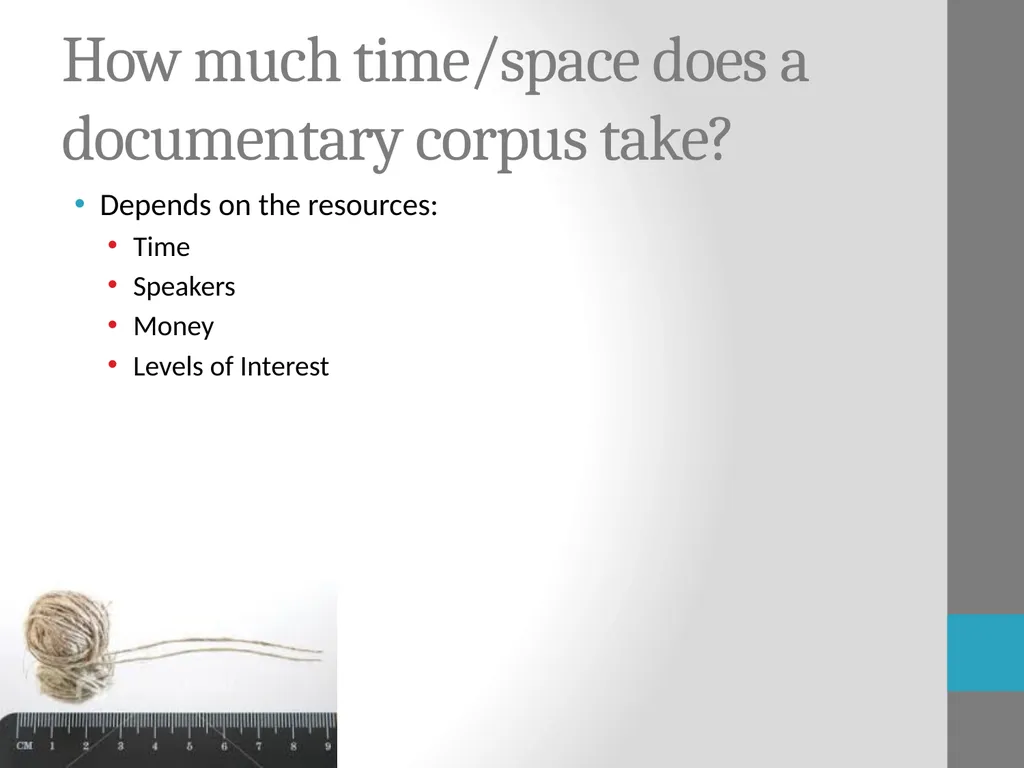
slide13. How much time/space does a documentary corpus take? Depends on the resources:
Time
Speakers
Money
Levels of Interest<br>
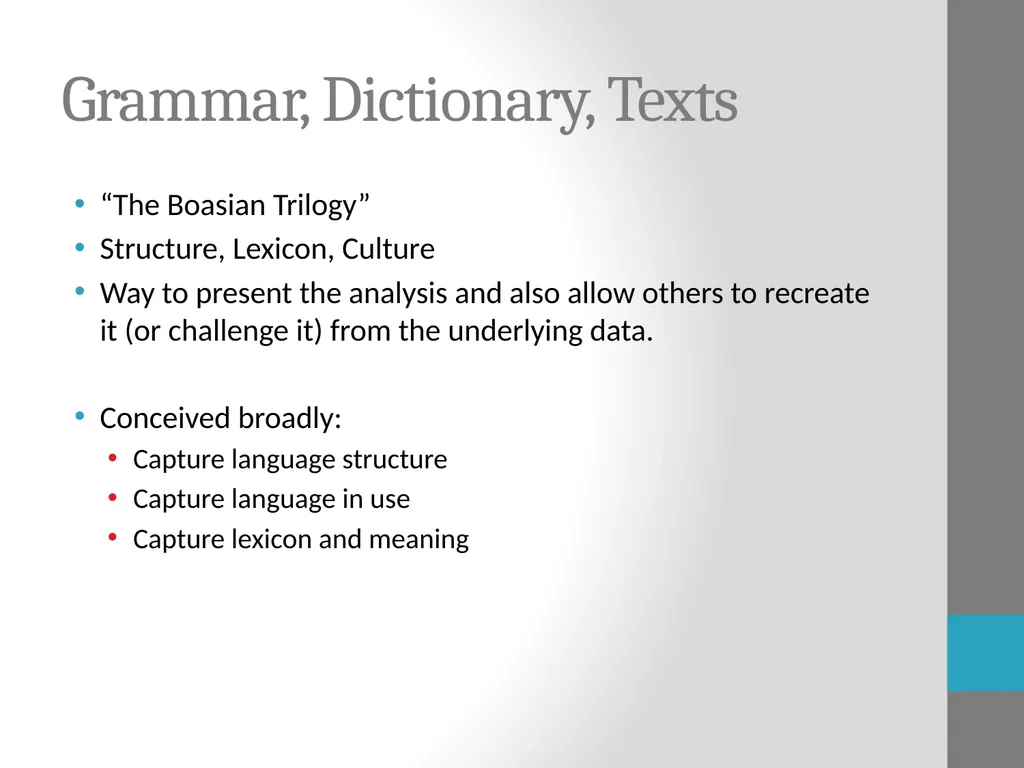
slide14. Grammar, Dictionary, Texts “The Boasian Trilogy”
Structure, Lexicon, Culture
Way to present the analysis and also allow others to recreate it (or challenge it) from the underlying data.
Conceived broadly:
Capture language structure
Capture language in use
Capture lexicon and meaning<br>
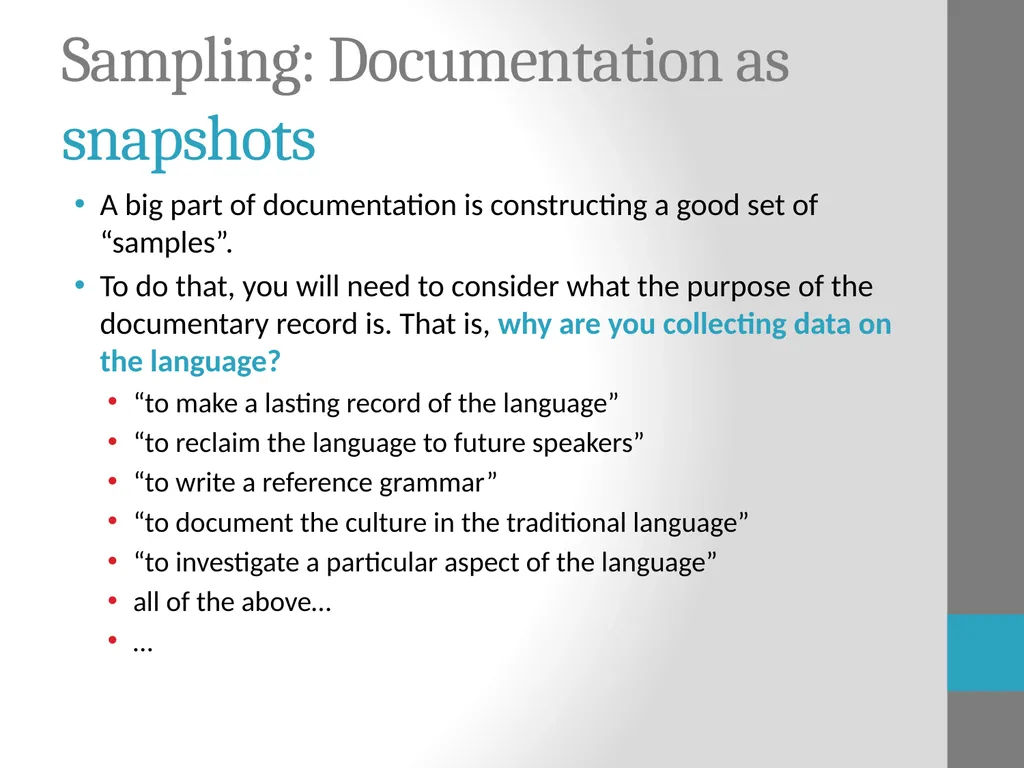
slide15. Sampling: Documentation as snapshots A big part of documentation is constructing a good set of “samples”.
To do that, you will need to consider what the purpose of the documentary record is. That is, why are you collecting data on the language?
“to make a lasting record of the language”
“to reclaim the language to future speakers”
“to write a reference grammar”
“to document the culture in the traditional language”
“to investigate a particular aspect of the language”
all of the above…
…<br>
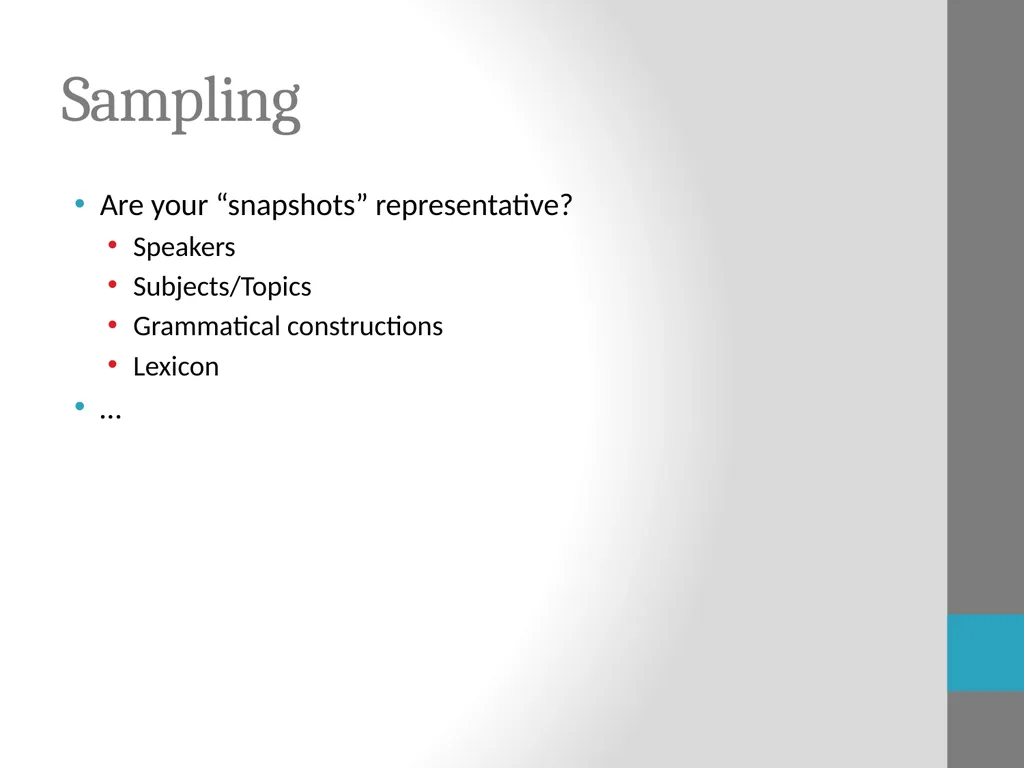
slide16. Sampling Are your “snapshots” representative?
Speakers
Subjects/Topics
Grammatical constructions
Lexicon
…<br>
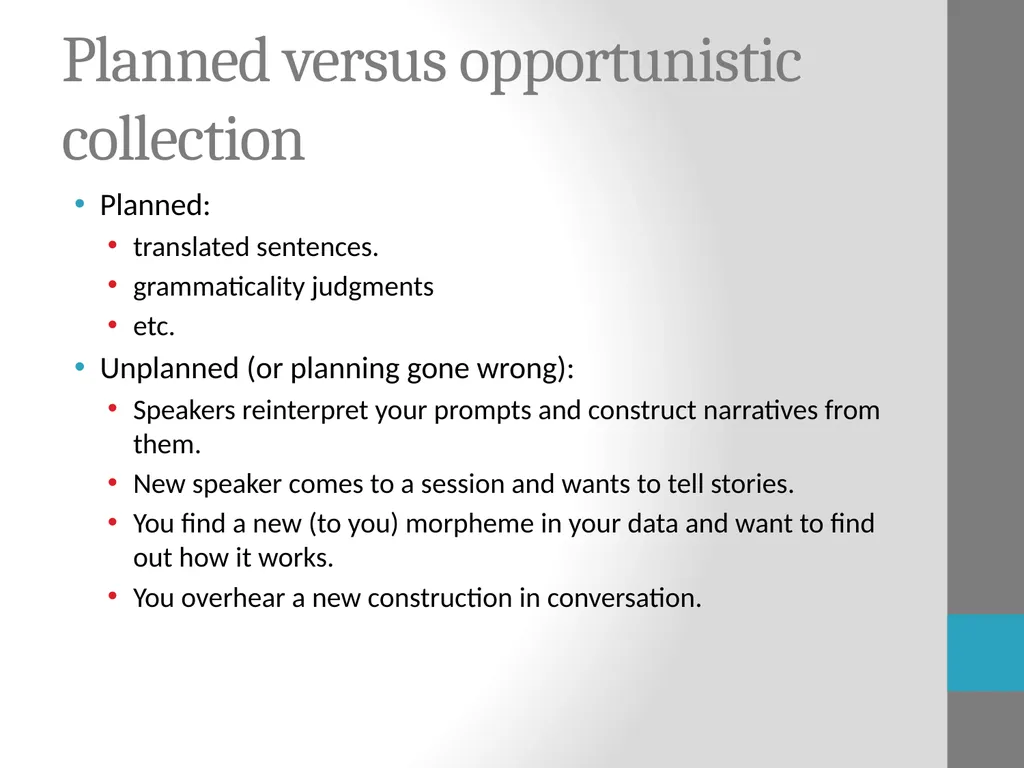
slide17. Planned versus opportunistic collection Planned:
translated sentences.
grammaticality judgments
etc.
Unplanned (or planning gone wrong):
Speakers reinterpret your prompts and construct narratives from them.
New speaker comes to a session and wants to tell stories.
You find a new (to you) morpheme in your data and want to find out how it works.
You overhear a new construction in conversation.<br>
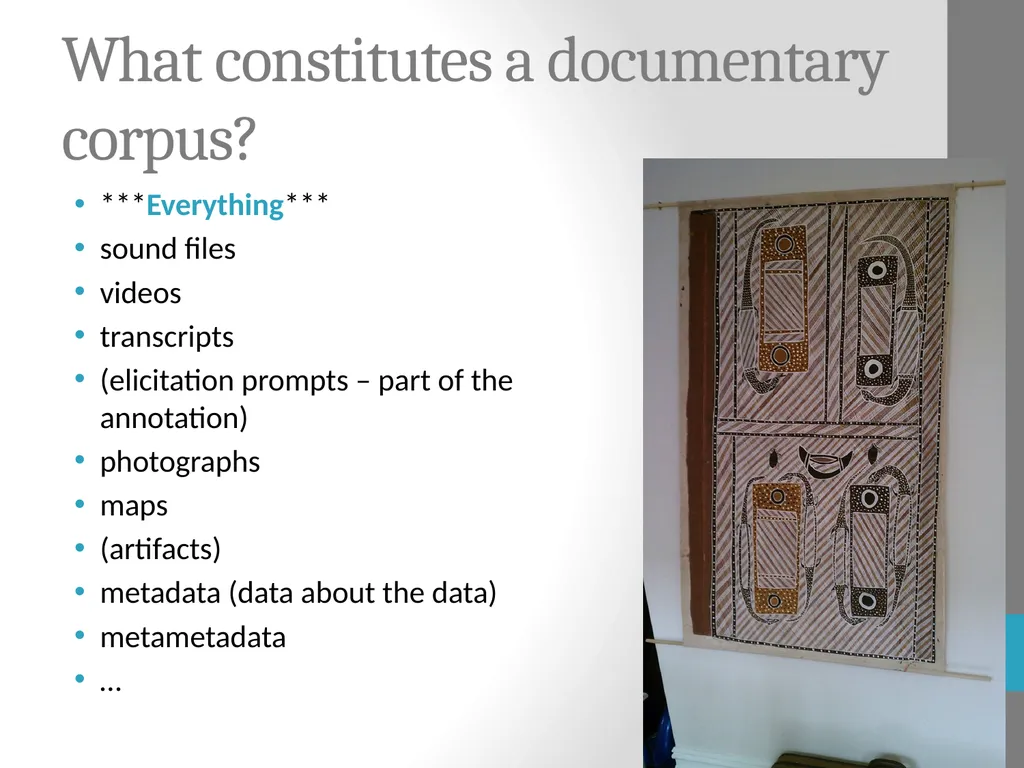
slide18. What constitutes a documentary corpus? ***Everything***
sound files
videos
transcripts
(elicitation prompts – part of the annotation)
photographs
maps
(artifacts)
metadata (data about the data)
metametadata
…<br>
slide19. Workflow and data types<br>
slide20. Workflow: What do you need to do to document a language?
What order do you need to do it in?
(How will you know if it’s been done right?)<br>
slide21. Scaled workflow Project as a whole (timescale of years)
e.g. “Bardi language documentation”
Immediate tasks (timescale of weeks or months)
e.g. “Bardi learners guide”
Subtasks (timescale of days or weeks)
e.g. “write the section on numbers”
Data gathering (timescale of single session)
e.g. “get data on numerals in use”<br>
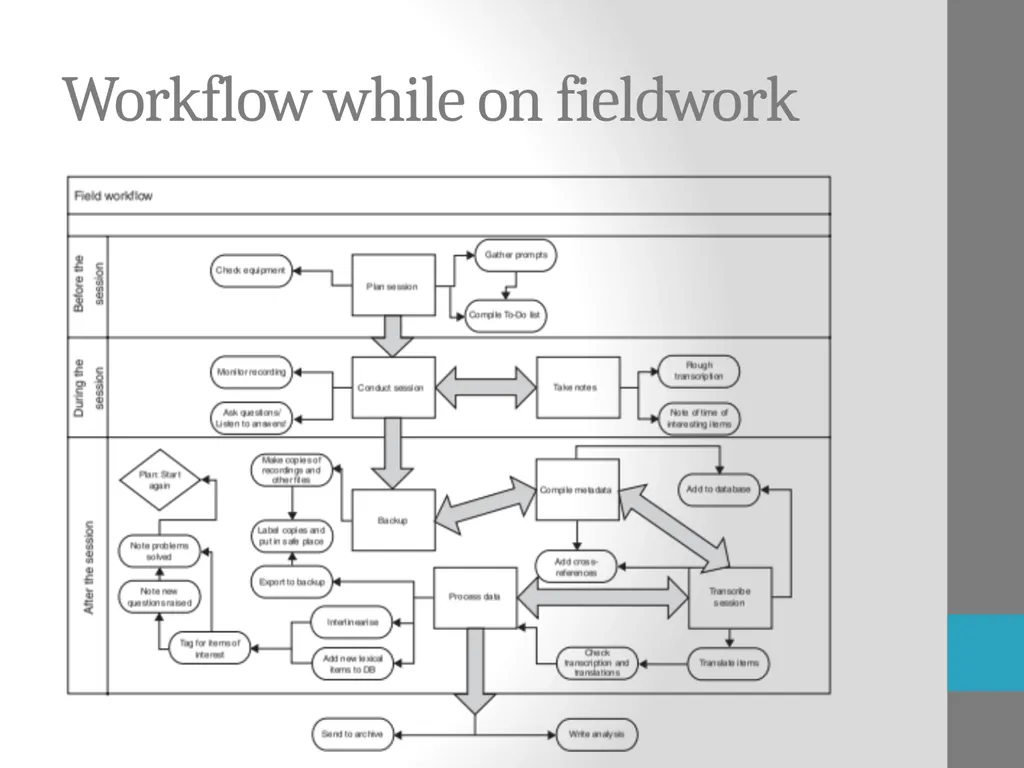
slide22. Workflow while on fieldwork<br>
slide23. Hardware<br>
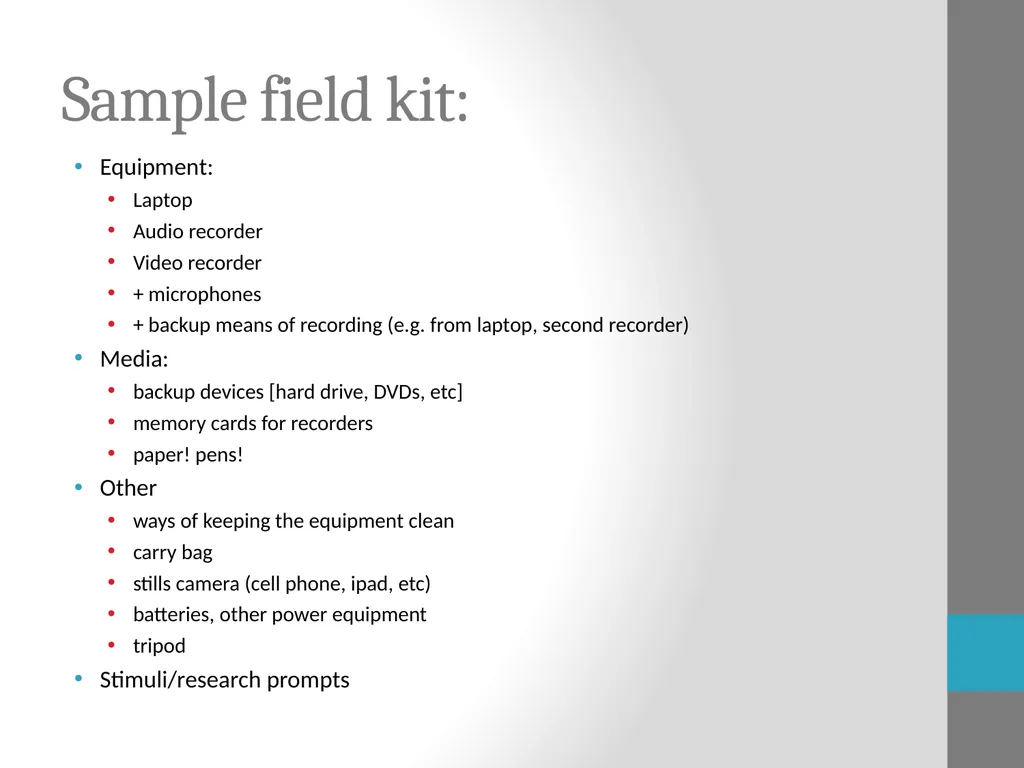
slide24. Sample field kit: Equipment:
Laptop
Audio recorder
Video recorder
+ microphones
+ backup means of recording (e.g. from laptop, second recorder)
Media:
backup devices [hard drive, DVDs, etc]
memory cards for recorders
paper! pens!
Other
ways of keeping the equipment clean
carry bag
stills camera (cell phone, ipad, etc)
batteries, other power equipment
tripod
Stimuli/research prompts<br>

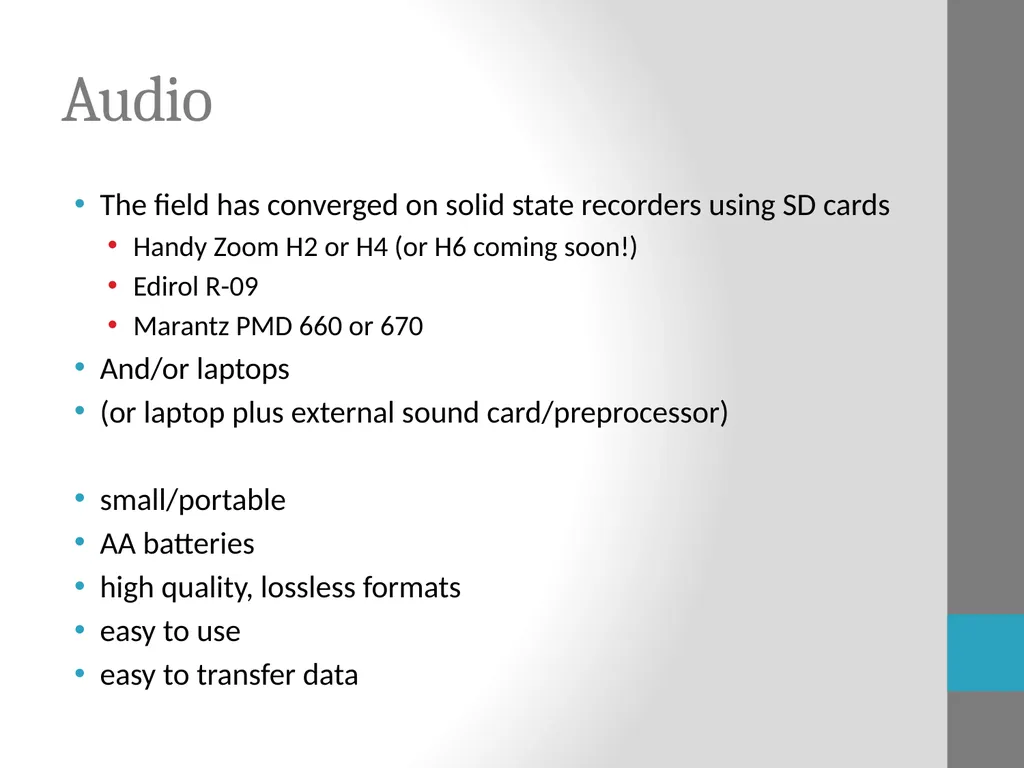
slide25. Audio The field has converged on solid state recorders using SD cards
Handy Zoom H2 or H4 (or H6 coming soon!)
Edirol R-09
Marantz PMD 660 or 670
And/or laptops
(or laptop plus external sound card/preprocessor)
small/portable
AA batteries
high quality, lossless formats
easy to use
easy to transfer data<br>
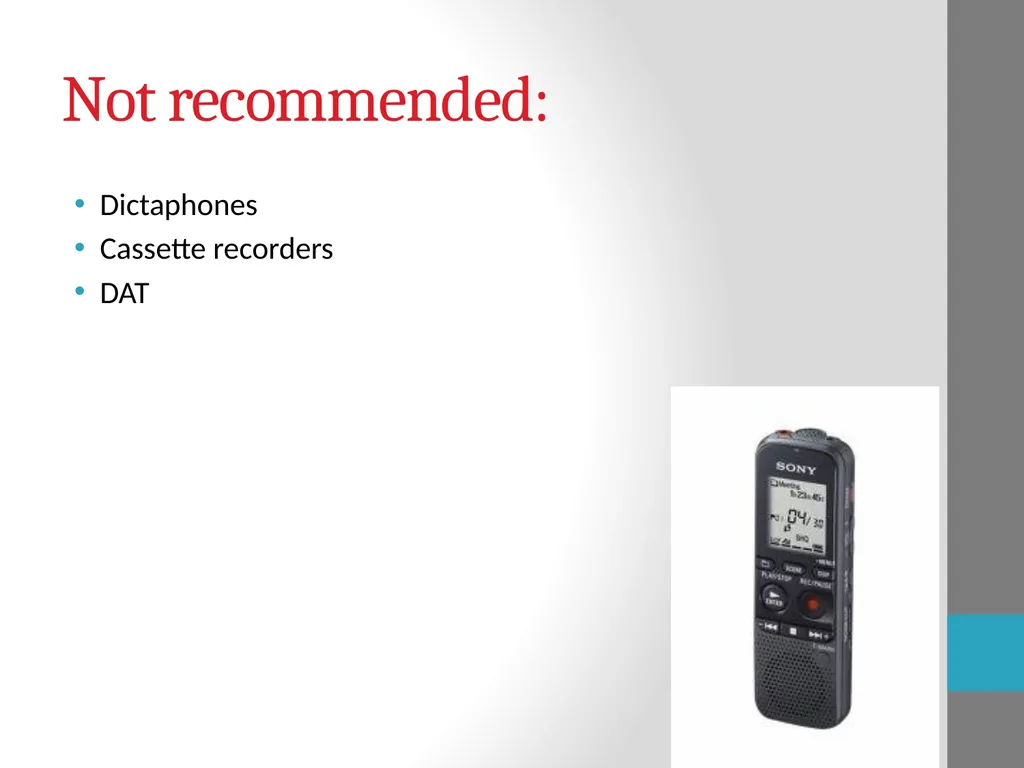
slide26. Not recommended: Dictaphones
Cassette recorders
DAT<br>
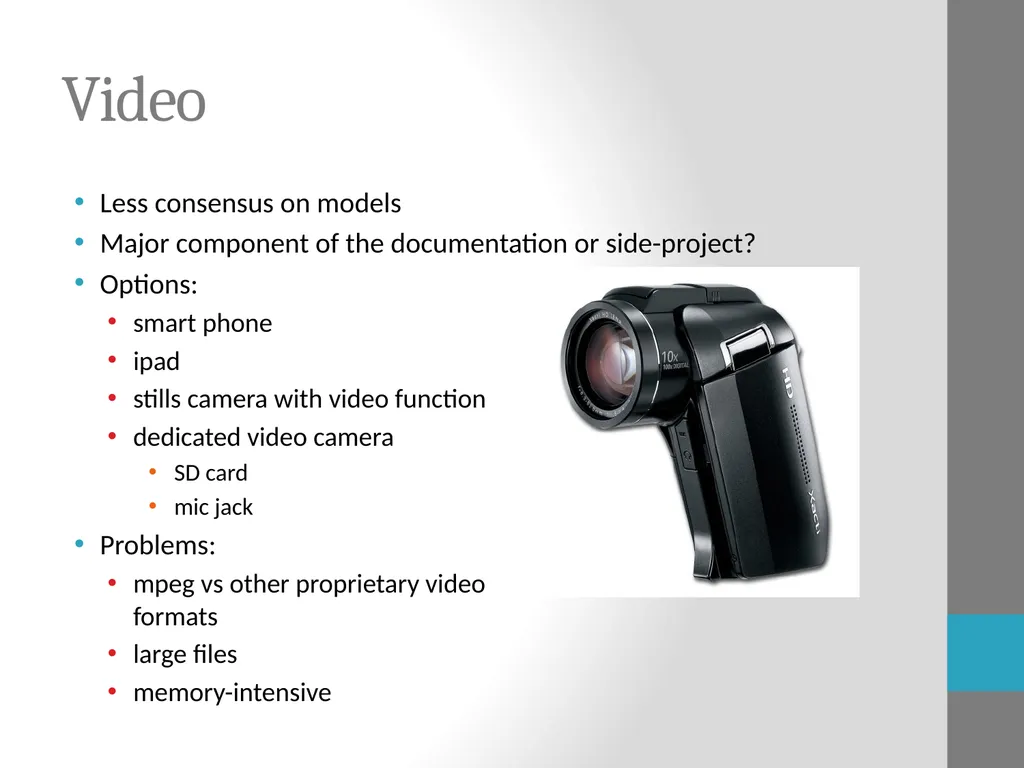
slide27. Video Less consensus on models
Major component of the documentation or side-project?
Options:
smart phone
ipad
stills camera with video function
dedicated video camera
SD card
mic jack
Problems:
mpeg vs other proprietary video formats
large files
memory-intensive<br>
slide28. Microphones headset vs lapel vs meeting microphone
dynamic vs cardioid
wired vs wireless
SLR vs 1/8” jack
The built-in mics in the Edirol, Handy, etc, are also ok
You get what you pay for, approximately.
Remember that microphone placement and volume monitoring is much more important than the quality of the microphone (far more recordings are ruined through the former than the latter).<br>
slide29. Computer Laptop
Lots of memory
Lots of hard drive space
Usually don’t need ruggedization features
Get cheapest possible and assume it won’t last for more than a season, or try for a higher end model
Special considerations for high altitude, high humidity, or low temperature work.
High altitude: hard drives fail: use solid state
High humidity: condensation issues
Low temperatures: battery issues (See Lanz 2010)<br>
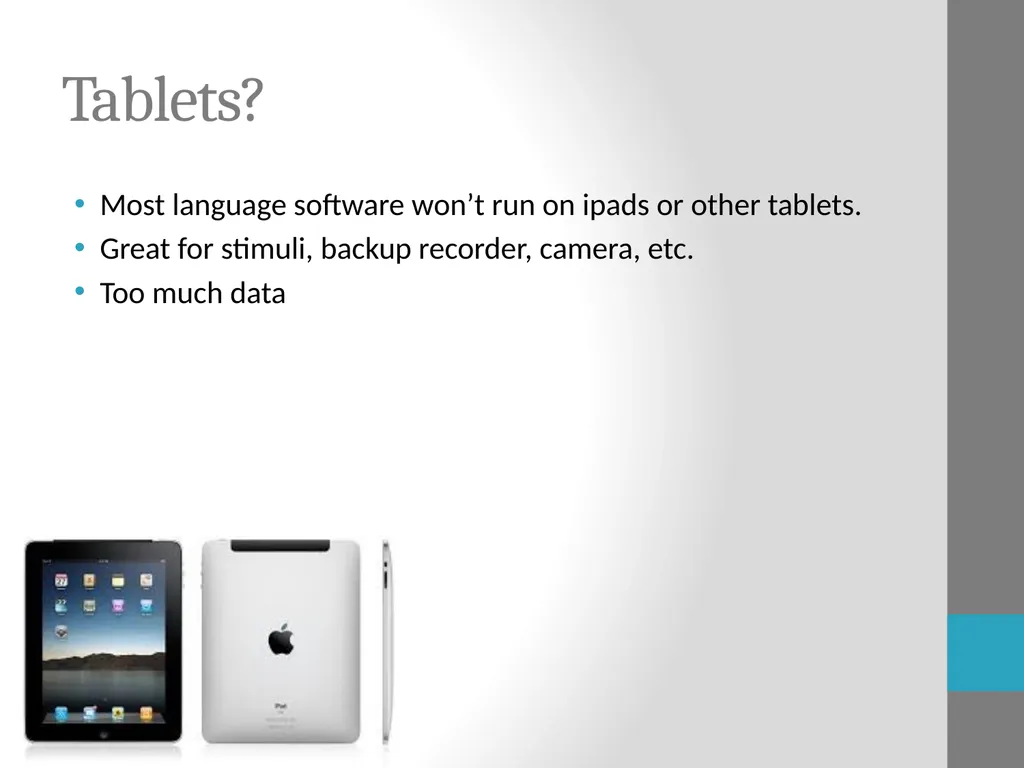
slide30. Tablets? Most language software won’t run on ipads or other tablets.
Great for stimuli, backup recorder, camera, etc.
Too much data<br>
slide31. Sample field kit: Equipment:
Laptop
Audio recorder
Video recorder
+ microphones
+ backup means of recording (e.g. from laptop, second recorder)
Media:
backup devices [hard drive, DVDs, etc]
memory cards for recorders
paper! pens!
Other
ways of keeping the equipment clean
carry bag
stills camera (cell phone, ipad, etc)
batteries, other power equipment
tripod
Stimuli/research prompts<br>
Yale University
LSA Summer Institute: 2013 Week 1: Overview<br>
slide2. Overview, Goals of Class<br>
slide3. Tools for documentation Physical tools:
Hardware
Software
Stimuli
Conceptual tools:
What makes a good documentary corpus
Procedural tools:
How to go about documenting a language
Tools for disseminating results<br>
slide4. Overview Week 1: overview, hardware, software
Week 2: elicitation techniques, grammar writing
Week 3: narratives, conversation, corpus building
Week 4: lexicon, archiving<br>
slide5. About the class “How to describe/document a language”
*No practical component* (in that we won’t be working with speakers)
However, there will be time (I hope!) to talk about your own field data
And we will be doing some exercises with existing data
I will provide datasets for exercises (if you don’t have data of your own to use)
You can also use data from the field methods class here at the Institute.<br>
slide6. A few assumptions for this class Not talking about community-oriented materials here (I see documentary materials as feeding into that though)
Assuming that the language doesn’t have a lot of other materials apart from what the linguist will be producing
Assuming that the linguist will be the one doing most of the writing.
Implicitly assuming a grammar/dictionary/texts model (more on this below).
None of these assumptions are crucial, they’re just there so we can limit the topic a bit.<br>
slide7. Principles of documentation<br>
slide8. What is language documentation? Documentary Linguistics as its own subfield.
Doing things with linguistic data:
Getting the data
Preserving it
Processing it
(Analyzing it)
Cf Woodbury (2002): Language documentation is the creation, annotation, preservation, and dissemination of transparent records of a language.
Important for both theoretical and empirical branches of linguistics:
typology, historical linguistics, etc<br>
slide9. What shapes the language record? The linguist (i.e. you!)
Their interests
Their abilities
The speakers and their interests!
External circumstances
funding
time available
lucky breaks
unlucky breaks<br>
slide10. Language Documentation as a Language Legacy Particularly relevant for endangered languages.
Your work might be the only substantive record of a language:
few speakers
field might view the language as “done”
speakers might view the language as “done”<br>
slide11. Planned Documentation vs “Collect it all” “making a record of the language” : ‘comprehensive grammar’
You can’t collect everything.
All documentation is sampling.
Unstructured, unanalyzed corpora usually aren’t very useful
They are hard to use;
They don’t get worked on;
They usually aren’t big enough to test hypotheses computationally;
They require native speakers (or people who are already very familiar with the language) -> fine for languages with a major presence, but what about the quarter of the world’s languages with fewer than 10,000 speakers?<br>
slide12. What counts as documentation? When is a collection big enough to count as language documentation?
Is an article in Linguistic Inquiry language documentation?
creation
annotation
preservation
dissemination
but only a very small fragment of a language.<br>
slide13. How much time/space does a documentary corpus take? Depends on the resources:
Time
Speakers
Money
Levels of Interest<br>
slide14. Grammar, Dictionary, Texts “The Boasian Trilogy”
Structure, Lexicon, Culture
Way to present the analysis and also allow others to recreate it (or challenge it) from the underlying data.
Conceived broadly:
Capture language structure
Capture language in use
Capture lexicon and meaning<br>
slide15. Sampling: Documentation as snapshots A big part of documentation is constructing a good set of “samples”.
To do that, you will need to consider what the purpose of the documentary record is. That is, why are you collecting data on the language?
“to make a lasting record of the language”
“to reclaim the language to future speakers”
“to write a reference grammar”
“to document the culture in the traditional language”
“to investigate a particular aspect of the language”
all of the above…
…<br>
slide16. Sampling Are your “snapshots” representative?
Speakers
Subjects/Topics
Grammatical constructions
Lexicon
…<br>
slide17. Planned versus opportunistic collection Planned:
translated sentences.
grammaticality judgments
etc.
Unplanned (or planning gone wrong):
Speakers reinterpret your prompts and construct narratives from them.
New speaker comes to a session and wants to tell stories.
You find a new (to you) morpheme in your data and want to find out how it works.
You overhear a new construction in conversation.<br>
slide18. What constitutes a documentary corpus? ***Everything***
sound files
videos
transcripts
(elicitation prompts – part of the annotation)
photographs
maps
(artifacts)
metadata (data about the data)
metametadata
…<br>
slide19. Workflow and data types<br>
slide20. Workflow: What do you need to do to document a language?
What order do you need to do it in?
(How will you know if it’s been done right?)<br>
slide21. Scaled workflow Project as a whole (timescale of years)
e.g. “Bardi language documentation”
Immediate tasks (timescale of weeks or months)
e.g. “Bardi learners guide”
Subtasks (timescale of days or weeks)
e.g. “write the section on numbers”
Data gathering (timescale of single session)
e.g. “get data on numerals in use”<br>
slide22. Workflow while on fieldwork<br>
slide23. Hardware<br>
slide24. Sample field kit: Equipment:
Laptop
Audio recorder
Video recorder
+ microphones
+ backup means of recording (e.g. from laptop, second recorder)
Media:
backup devices [hard drive, DVDs, etc]
memory cards for recorders
paper! pens!
Other
ways of keeping the equipment clean
carry bag
stills camera (cell phone, ipad, etc)
batteries, other power equipment
tripod
Stimuli/research prompts<br>
slide25. Audio The field has converged on solid state recorders using SD cards
Handy Zoom H2 or H4 (or H6 coming soon!)
Edirol R-09
Marantz PMD 660 or 670
And/or laptops
(or laptop plus external sound card/preprocessor)
small/portable
AA batteries
high quality, lossless formats
easy to use
easy to transfer data<br>
slide26. Not recommended: Dictaphones
Cassette recorders
DAT<br>
slide27. Video Less consensus on models
Major component of the documentation or side-project?
Options:
smart phone
ipad
stills camera with video function
dedicated video camera
SD card
mic jack
Problems:
mpeg vs other proprietary video formats
large files
memory-intensive<br>
slide28. Microphones headset vs lapel vs meeting microphone
dynamic vs cardioid
wired vs wireless
SLR vs 1/8” jack
The built-in mics in the Edirol, Handy, etc, are also ok
You get what you pay for, approximately.
Remember that microphone placement and volume monitoring is much more important than the quality of the microphone (far more recordings are ruined through the former than the latter).<br>
slide29. Computer Laptop
Lots of memory
Lots of hard drive space
Usually don’t need ruggedization features
Get cheapest possible and assume it won’t last for more than a season, or try for a higher end model
Special considerations for high altitude, high humidity, or low temperature work.
High altitude: hard drives fail: use solid state
High humidity: condensation issues
Low temperatures: battery issues (See Lanz 2010)<br>
slide30. Tablets? Most language software won’t run on ipads or other tablets.
Great for stimuli, backup recorder, camera, etc.
Too much data<br>
slide31. Sample field kit: Equipment:
Laptop
Audio recorder
Video recorder
+ microphones
+ backup means of recording (e.g. from laptop, second recorder)
Media:
backup devices [hard drive, DVDs, etc]
memory cards for recorders
paper! pens!
Other
ways of keeping the equipment clean
carry bag
stills camera (cell phone, ipad, etc)
batteries, other power equipment
tripod
Stimuli/research prompts<br>