
Topic 9b Evolution of Horizontal Merger Law








Description: Topic 9b Evolution of Horizontal Merger Law Overview: Background of The Structural Presumption Economic Theory Structure-Conduct-Performance Paradigm Market Structure predicts conduct, which in turn determines economic performance
Related Topics
Download Presentation
"Topic 9b Evolution of Horizontal Merger Law" is the property of its rightful owner. Permission is granted to download and print the materials on this website for personal, non-commercial use only, and to display it on your personal computer provided you do not modify the materials and that you retain all copyright notices contained in the materials. By downloading content from our website, you accept the terms of this agreement.
Presentation Transcript
slide1. Topic 9b
Evolution of Horizontal Merger Law<br>
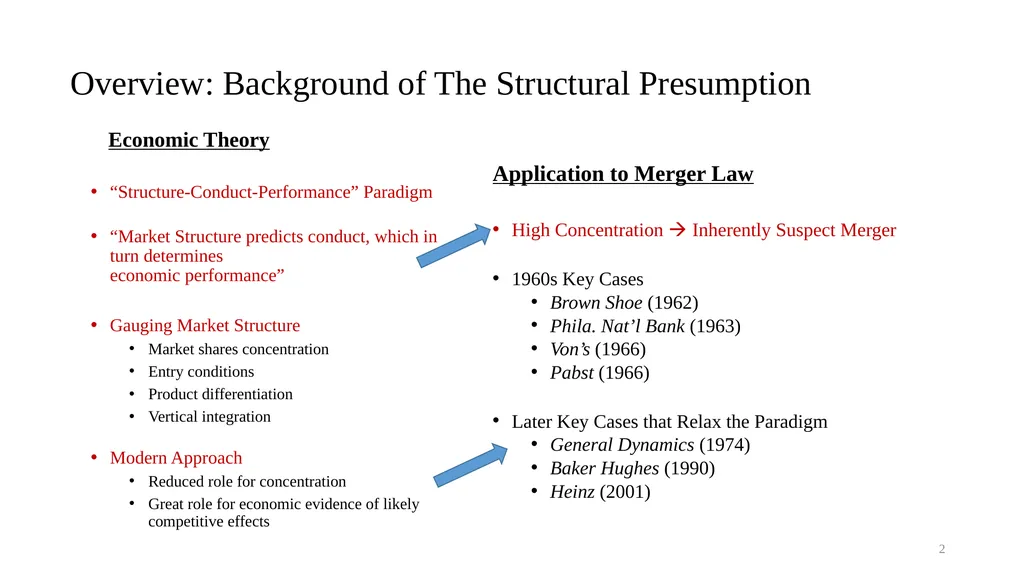
slide2. Overview: Background of The Structural Presumption Economic Theory
“Structure-Conduct-Performance” Paradigm
“Market Structure predicts conduct, which in turn determines economic performance”
Gauging Market Structure
Market shares concentration
Entry conditions
Product differentiation
Vertical integration
Modern Approach
Reduced role for concentration
Great role for economic evidence of likely competitive effects Application to Merger Law
High Concentration Inherently Suspect Merger
1960s Key Cases
Brown Shoe (1962)
Phila. Nat’l Bank (1963)
Von’s (1966)
Pabst (1966)
Later Key Cases that Relax the Paradigm
General Dynamics (1974)
Baker Hughes (1990)
Heinz (2001) 2<br>
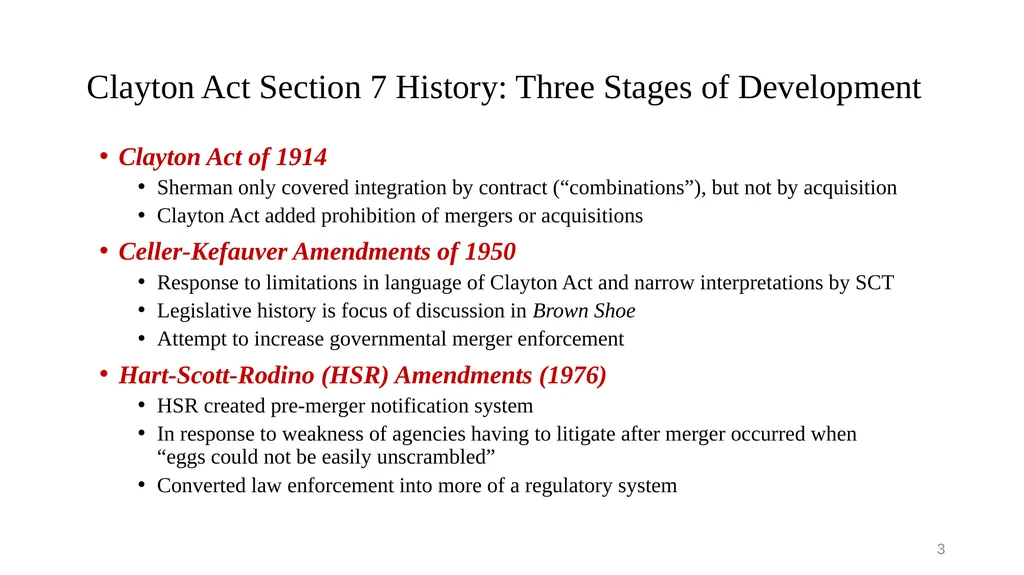
slide3. Clayton Act Section 7 History: Three Stages of Development Clayton Act of 1914
Sherman only covered integration by contract (“combinations”), but not by acquisition
Clayton Act added prohibition of mergers or acquisitions
Celler-Kefauver Amendments of 1950
Response to limitations in language of Clayton Act and narrow interpretations by SCT
Legislative history is focus of discussion in Brown Shoe
Attempt to increase governmental merger enforcement
Hart-Scott-Rodino (HSR) Amendments (1976)
HSR created pre-merger notification system
In response to weakness of agencies having to litigate after merger occurred when “eggs could not be easily unscrambled”
Converted law enforcement into more of a regulatory system 3<br>
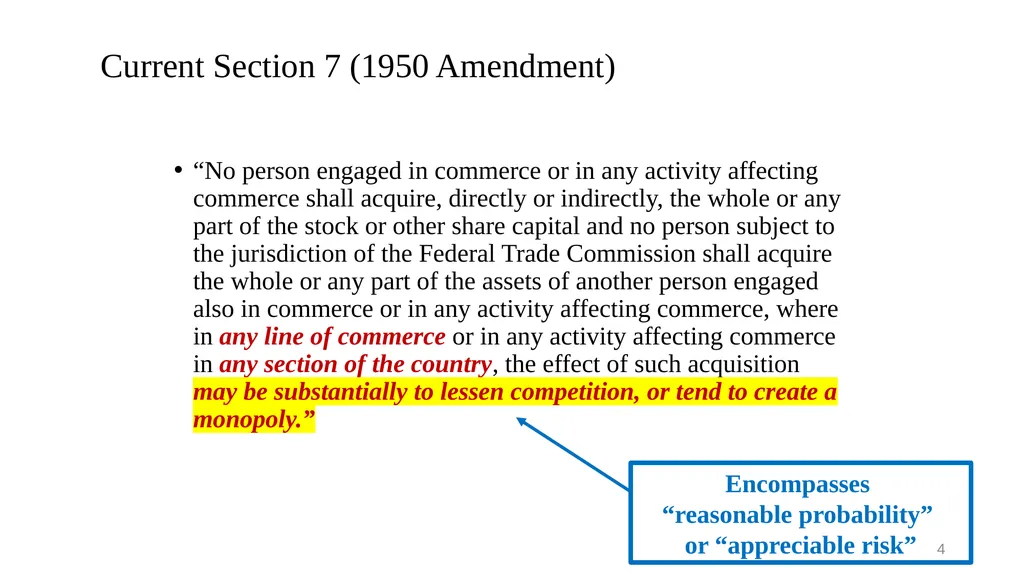
slide4. Current Section 7 (1950 Amendment) “No person engaged in commerce or in any activity affecting commerce shall acquire, directly or indirectly, the whole or any part of the stock or other share capital and no person subject to the jurisdiction of the Federal Trade Commission shall acquire the whole or any part of the assets of another person engaged also in commerce or in any activity affecting commerce, where in any line of commerce or in any activity affecting commerce in any section of the country, the effect of such acquisition may be substantially to lessen competition, or tend to create a monopoly.” 4 Encompasses “reasonable probability” or “appreciable risk”<br>
slide5. Brown Shoe – Motivations for Section 7 Amendments (p.682) The dominant theme pervading congressional consideration of the 1950 amendments was a fear of what was considered to be a rising tide of economic concentration in the American economy. *** Other considerations cited in support of the bill were the desirability of retaining ‘local control’ over industry and the protection of small businesses. Throughout the recorded discussion may be found examples of Congress’ fear not only of accelerated concentration of economic power on economic grounds, but also of the threat to other values a trend toward concentration was thought to pose. * * *
* * * [A] keystone in the erection of a barrier to what Congress saw was the rising tide of economic concentration, was its provision of authority for arresting mergers at a time when the trend to a lessening of competition in a line of commerce was still in its incipiency. Congress saw the process of concentration in American business as a dynamic force; it sought to assure the Federal Trade Commission and the courts the power to brake this force at its outset and before it gathered momentum. * * *
* * * [A]t the same time that it sought to create an effective tool for preventing all mergers having demonstrable anti-competitive effects, Congress recognized the stimulation to competition that might flow from particular mergers. 5 Brown Shoe – Motivations for Section 7 Amendments (p.682) Key language for NeoB’s<br>
slide6. Incipiency – Two Approaches Stop “trend towards concentration”…
Emphasized by Brown Shoe & other earlier cases
Emphasis on overall industry trends
No longer a focus of enforcement policy…
But growing populist movement to return focus here “Predict likely future impact” of merger…
Implemented by HSR system
Emphasis on merger’s probable effects
Degree of probability is key source of disagreement
Current approach 6 Antitrust policy and law never gets totally settled. Ideas are like Zombies that keep returning.
But some Zombies deserve to live!<br>
slide7. Brown Shoe: Basic Legal Standard The Court’s review of legislative history of 1950s amendment included the following discussion of the “may be … “ standard
“Congress used the words "may be substantially to lessen competition" (emphasis supplied), to indicate that its concern was with probabilities, not certainties. [Footnote 39] Statutes existed for dealing with clear-cut menaces to competition; no statute was sought for dealing with ephemeral possibilities. Mergers with a probable anticompetitive effect were to be proscribed by this Act.” 370 U. S. 323
Footnote 39: “"The use of these words ['may be'] means that the bill, if enacted, would not apply to the mere possibility, but only to the reasonable probability, of the prescribed [sic] effect. . . . The words 'may be' have been in section 7 of the Clayton Act since 1914. The concept of reasonable probability conveyed by these words is a necessary element in any statute which seeks to arrest restraints of trade in their incipiency and before they develop into full-fledged restraints violative of the Sherman Act. A requirement of certainty and actuality of injury to competition is incompatible with any effort to supplement the Sherman Act by reaching incipient restraints." 7<br>
slide8. Commentary on “Reasonable Probability Standard: “Reasonable probability” should be interpreted as a lower burden on the plaintiff (i.e., a more interventionist standard) than a standard of “more likely than not” to harm competition
“More likely than not” is the standard for the Sherman Act
By contrast, Section 7 was intended to reach additional conduct
The use of the term “incipiency” also expresses greater concern with false negatives than false positives
If the Congress or the Court meant that the standard should be “more likely than not,” they would have said so.
It follows that the plaintiff should have not have to show that the likelihood of harm is more than 50%
In later cases, the term “appreciable risk” sometimes is used, which also suggests a standard lower than 50+%
At the same time, the probability must be higher than what would be meant by “ephemeral” or “plausible”
But, note that conservative commentators or defense lawyers “likely” would push back on this commentary 8<br>
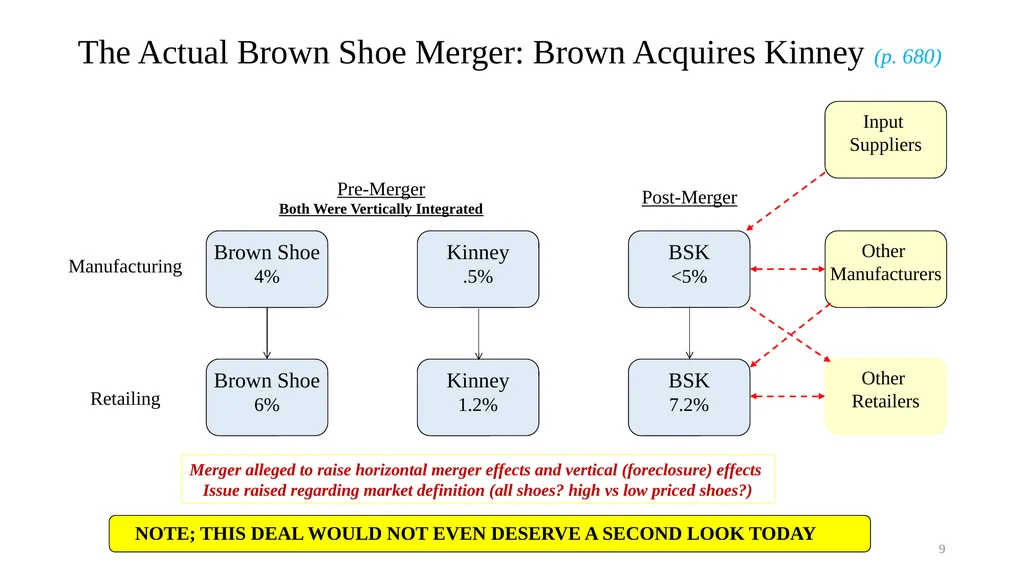
slide9. The Actual Brown Shoe Merger: Brown Acquires Kinney (p. 680) 9 Brown Shoe
4% Brown Shoe
6% Kinney
1.2% Kinney
.5% Manufacturing Retailing Pre-Merger
Both Were Vertically Integrated Merger alleged to raise horizontal merger effects and vertical (foreclosure) effects
Issue raised regarding market definition (all shoes? high vs low priced shoes?) BSK
<5% BSK
7.2% Post-Merger Other
Manufacturers Other
Retailers Input
Suppliers NOTE; THIS DEAL WOULD NOT EVEN DESERVE A SECOND LOOK TODAY<br>
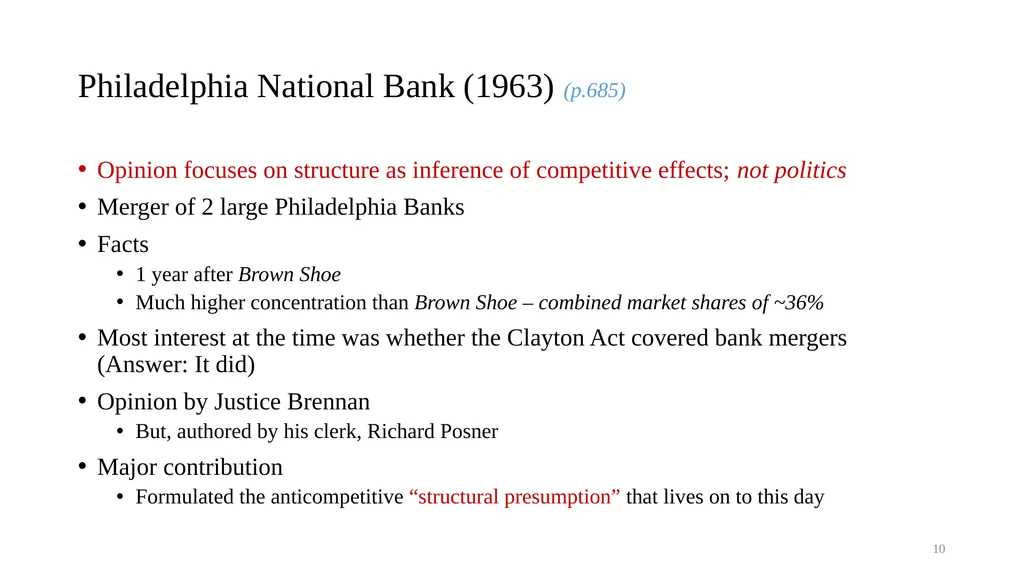
slide10. Philadelphia National Bank (1963) (p.685) Opinion focuses on structure as inference of competitive effects; not politics
Merger of 2 large Philadelphia Banks
Facts
1 year after Brown Shoe
Much higher concentration than Brown Shoe – combined market shares of ~36%
Most interest at the time was whether the Clayton Act covered bank mergers (Answer: It did)
Opinion by Justice Brennan
But, authored by his clerk, Richard Posner
Major contribution
Formulated the anticompetitive “structural presumption” that lives on to this day 10<br>
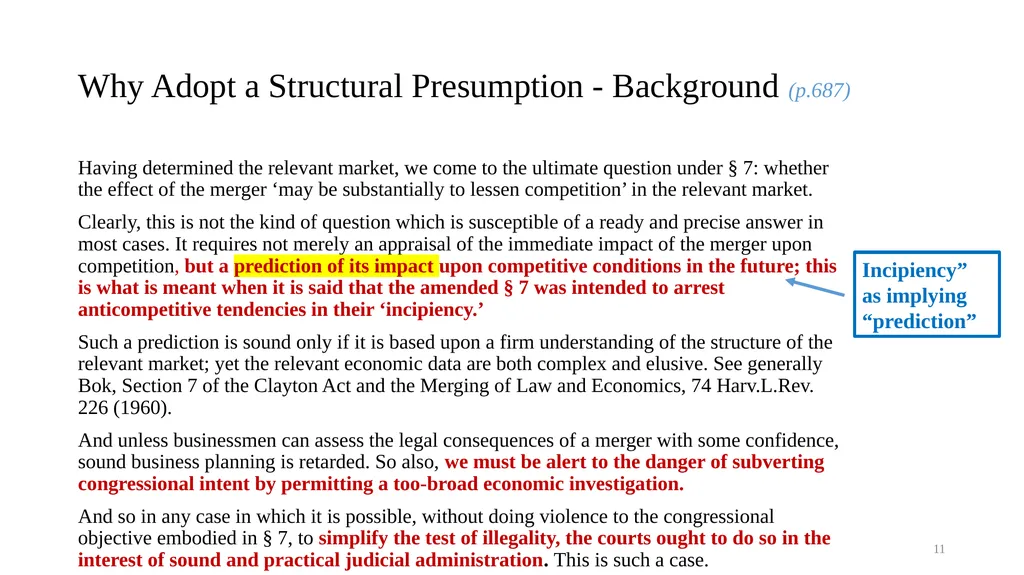
slide11. Why Adopt a Structural Presumption - Background (p.687) Having determined the relevant market, we come to the ultimate question under § 7: whether the effect of the merger ‘may be substantially to lessen competition’ in the relevant market.
Clearly, this is not the kind of question which is susceptible of a ready and precise answer in most cases. It requires not merely an appraisal of the immediate impact of the merger upon competition, but a prediction of its impact upon competitive conditions in the future; this is what is meant when it is said that the amended § 7 was intended to arrest anticompetitive tendencies in their ‘incipiency.’
Such a prediction is sound only if it is based upon a firm understanding of the structure of the relevant market; yet the relevant economic data are both complex and elusive. See generally Bok, Section 7 of the Clayton Act and the Merging of Law and Economics, 74 Harv.L.Rev. 226 (1960).
And unless businessmen can assess the legal consequences of a merger with some confidence, sound business planning is retarded. So also, we must be alert to the danger of subverting congressional intent by permitting a too-broad economic investigation.
And so in any case in which it is possible, without doing violence to the congressional objective embodied in § 7, to simplify the test of illegality, the courts ought to do so in the interest of sound and practical judicial administration. This is such a case. 11 Incipiency” as implying “prediction”<br>
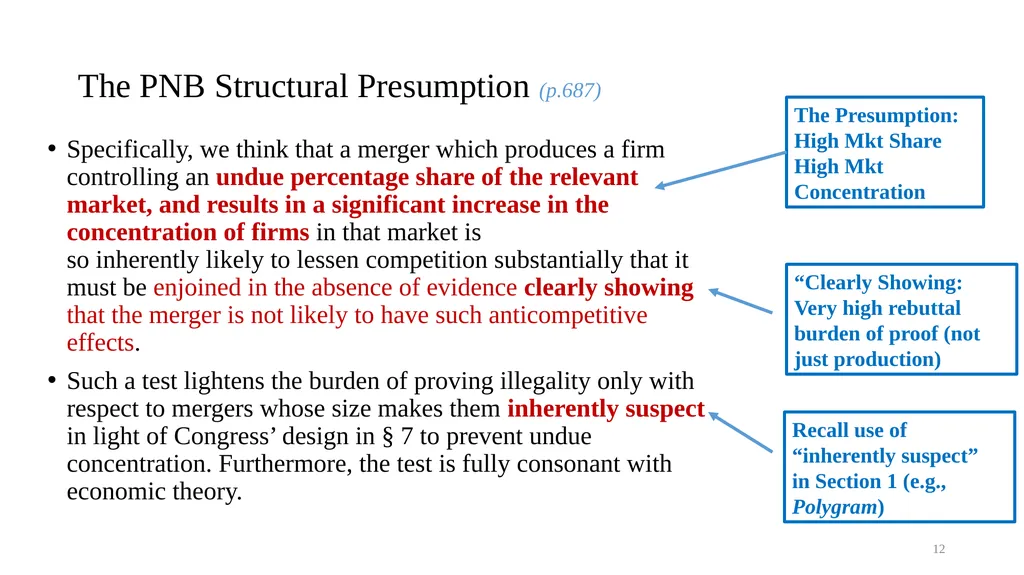
slide12. The PNB Structural Presumption (p.687) Specifically, we think that a merger which produces a firm controlling an undue percentage share of the relevant market, and results in a significant increase in the concentration of firms in that market is so inherently likely to lessen competition substantially that it must be enjoined in the absence of evidence clearly showing that the merger is not likely to have such anticompetitive effects.
Such a test lightens the burden of proving illegality only with respect to mergers whose size makes them inherently suspect in light of Congress’ design in § 7 to prevent undue concentration. Furthermore, the test is fully consonant with economic theory. 12 The Presumption: High Mkt Share
High Mkt Concentration “Clearly Showing: Very high rebuttal burden of proof (not just production) Recall use of “inherently suspect” in Section 1 (e.g., Polygram)<br>
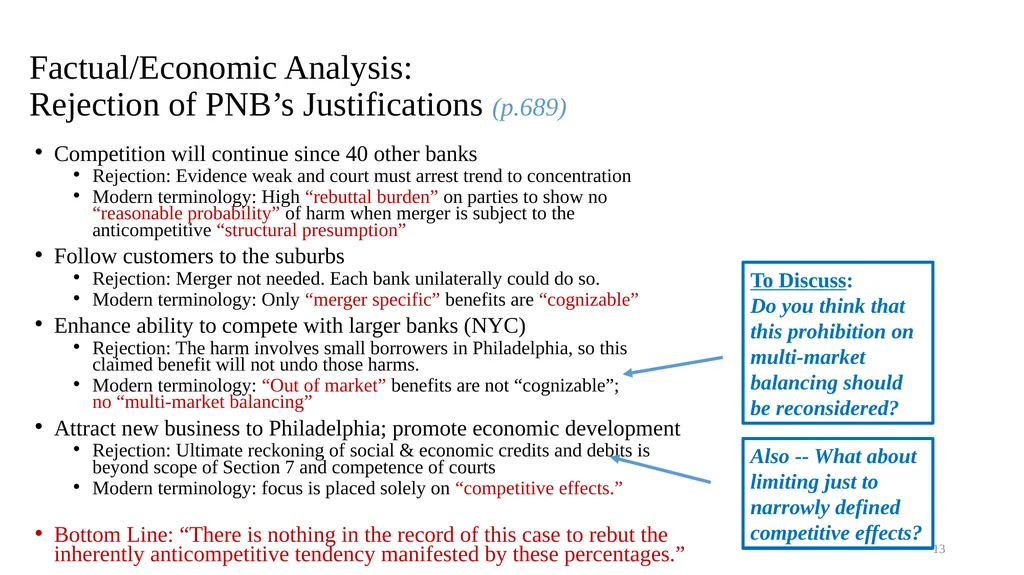
slide13. Factual/Economic Analysis: Rejection of PNB’s Justifications (p.689) Competition will continue since 40 other banks
Rejection: Evidence weak and court must arrest trend to concentration
Modern terminology: High “rebuttal burden” on parties to show no “reasonable probability” of harm when merger is subject to the anticompetitive “structural presumption”
Follow customers to the suburbs
Rejection: Merger not needed. Each bank unilaterally could do so.
Modern terminology: Only “merger specific” benefits are “cognizable”
Enhance ability to compete with larger banks (NYC)
Rejection: The harm involves small borrowers in Philadelphia, so this claimed benefit will not undo those harms.
Modern terminology: “Out of market” benefits are not “cognizable”; no “multi-market balancing”
Attract new business to Philadelphia; promote economic development
Rejection: Ultimate reckoning of social & economic credits and debits is beyond scope of Section 7 and competence of courts
Modern terminology: focus is placed solely on “competitive effects.”
Bottom Line: “There is nothing in the record of this case to rebut the inherently anticompetitive tendency manifested by these percentages.” 13 To Discuss:
Do you think that this prohibition on multi-market balancing should be reconsidered? Also -- What about limiting just to narrowly defined competitive effects?<br>
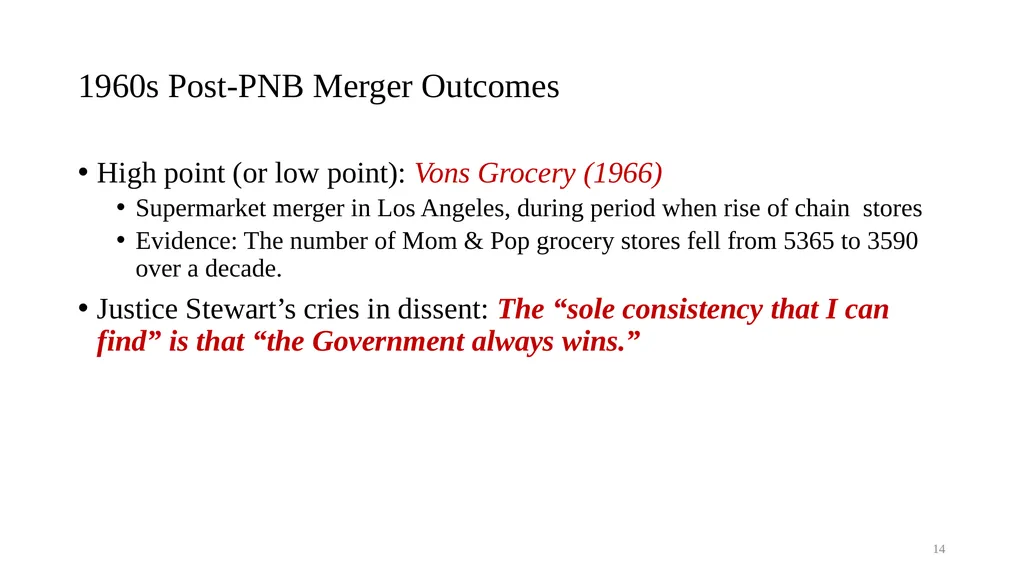
slide14. 1960s Post-PNB Merger Outcomes High point (or low point): Vons Grocery (1966)
Supermarket merger in Los Angeles, during period when rise of chain stores
Evidence: The number of Mom & Pop grocery stores fell from 5365 to 3590 over a decade.
Justice Stewart’s cries in dissent: The “sole consistency that I can find” is that “the Government always wins.” 14<br>
slide15. 1960s Treatment of Efficiencies: A Far Cry from the Future (e.g., BMI) Brown Shoe (1962)
Efficiency as an “offense”:– it harms smaller rivals, so can count against a merger
Inconsistent with modern views
Procter & Gamble (1967)
Efficiency as a defense: “Possible economies cannot be used as a defense to illegality. Congress was aware that some mergers which lessen competition may also result in economies but it struck the balance in favor of protecting competition.” (citing Brown Shoe) 15 NeoB’s stress both of these points.
In addition, there is very little economic evidence that may mergers increase efficiency substantially<br>
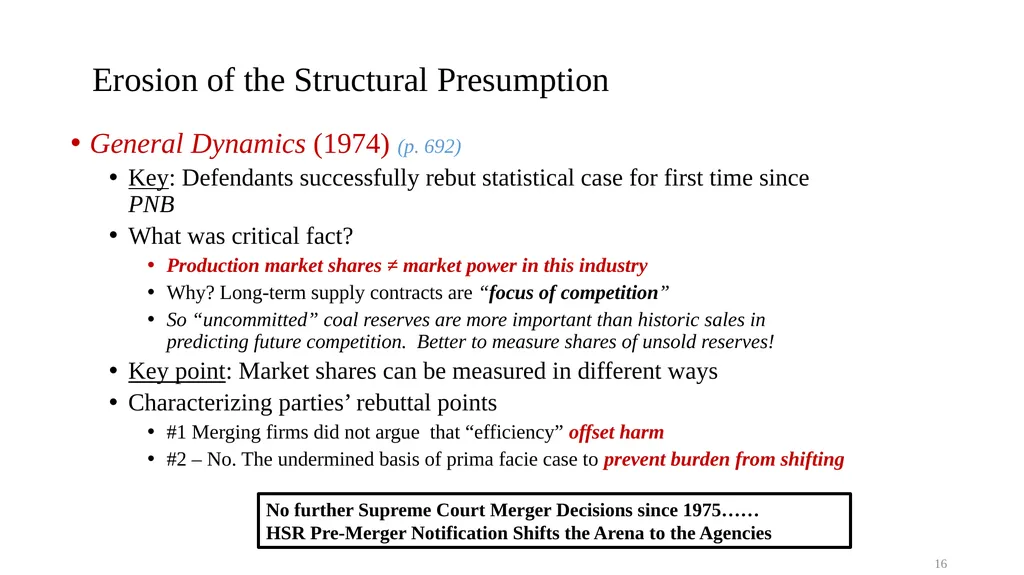
slide16. Erosion of the Structural Presumption General Dynamics (1974) (p. 692)
Key: Defendants successfully rebut statistical case for first time since PNB
What was critical fact?
Production market shares ≠ market power in this industry
Why? Long-term supply contracts are “focus of competition”
So “uncommitted” coal reserves are more important than historic sales in predicting future competition. Better to measure shares of unsold reserves!
Key point: Market shares can be measured in different ways
Characterizing parties’ rebuttal points
#1 Merging firms did not argue that “efficiency” offset harm
#2 – No. The undermined basis of prima facie case to prevent burden from shifting 16 No further Supreme Court Merger Decisions since 1975……
HSR Pre-Merger Notification Shifts the Arena to the Agencies<br>
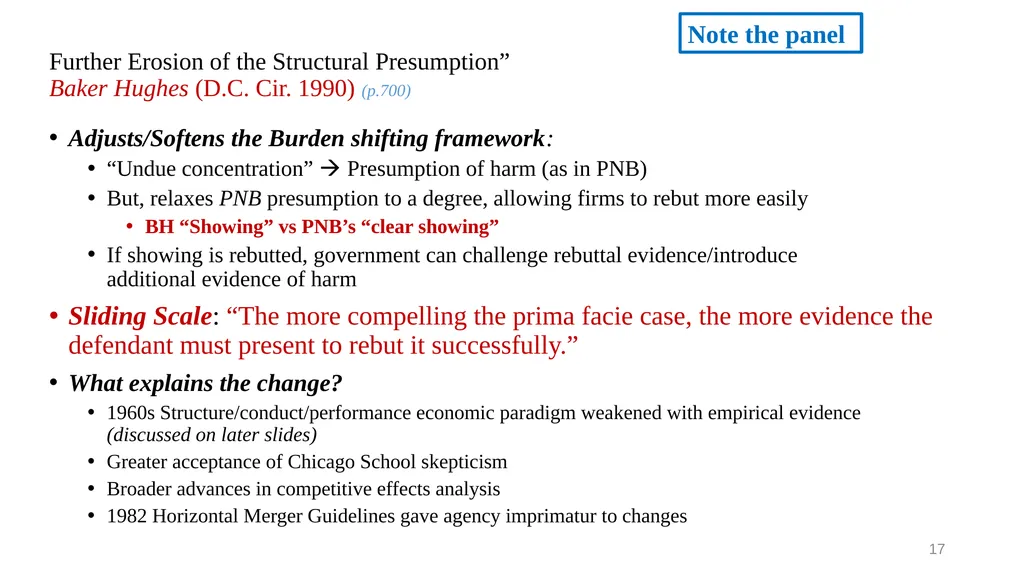
slide17. Further Erosion of the Structural Presumption” Baker Hughes (D.C. Cir. 1990) (p.700) Adjusts/Softens the Burden shifting framework:
“Undue concentration” Presumption of harm (as in PNB)
But, relaxes PNB presumption to a degree, allowing firms to rebut more easily
BH “Showing” vs PNB’s “clear showing”
If showing is rebutted, government can challenge rebuttal evidence/introduce additional evidence of harm
Sliding Scale: “The more compelling the prima facie case, the more evidence the defendant must present to rebut it successfully.”
What explains the change?
1960s Structure/conduct/performance economic paradigm weakened with empirical evidence (discussed on later slides)
Greater acceptance of Chicago School skepticism
Broader advances in competitive effects analysis
1982 Horizontal Merger Guidelines gave agency imprimatur to changes 17 Note the panel<br>
slide18. Baker Hughes Highlights (p.700) 18<br>
slide19. Baker Hughes (by Thomas) - Overall Characterization Section 7 involves probabilities, not certainties or possibilities.
The Supreme Court has adopted a totality-of-the-circumstances approach to the statute, weighing a variety of factors to determine the effects of particular transactions on competition. That the government can establish a prima facie case through evidence on only one factor, market concentration, does not negate the breadth of this analysis.
Evidence of market concentration simply provides a convenient starting point for a broader inquiry into future competitiveness; the Supreme Court has never indicated that a defendant seeking to rebut a prima facie case is restricted to producing evidence of ease of entry. Indeed, in numerous cases, defendants have relied entirely on non-entry factors in successfully rebutting a prima facie case. 19 This language alone seems to eliminate the “structural presumption.” But the rest of the opinion is more balanced. It even includes a “sliding scale.”<br>
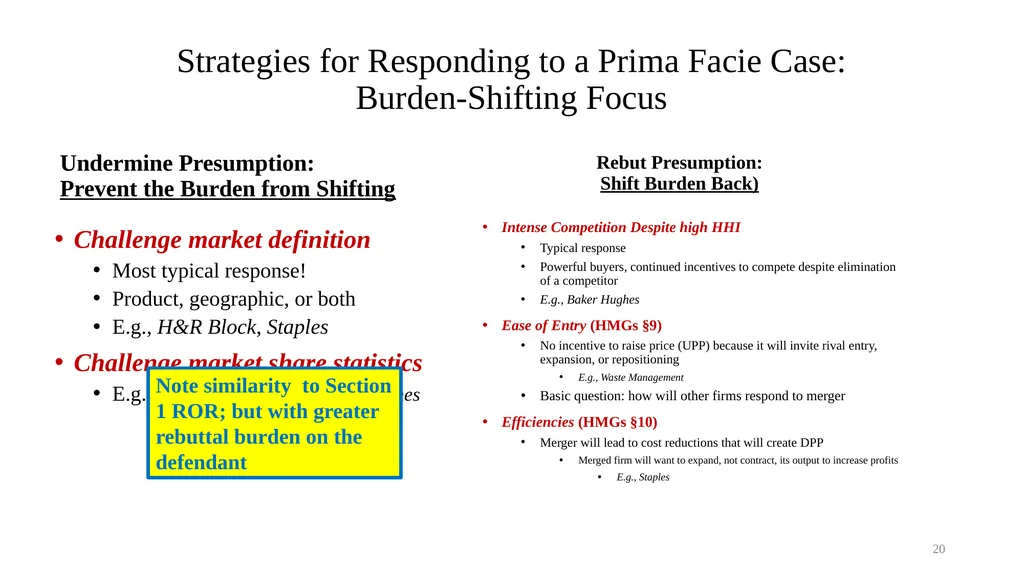
slide20. Strategies for Responding to a Prima Facie Case: Burden-Shifting Focus Undermine Presumption: Prevent the Burden from Shifting Challenge market definition
Most typical response!
Product, geographic, or both
E.g., H&R Block, Staples
Challenge market share statistics
E.g., General Dynamics, Baker Hughes Rebut Presumption: Shift Burden Back) Intense Competition Despite high HHI
Typical response
Powerful buyers, continued incentives to compete despite elimination of a competitor
E.g., Baker Hughes
Ease of Entry (HMGs §9)
No incentive to raise price (UPP) because it will invite rival entry, expansion, or repositioning
E.g., Waste Management
Basic question: how will other firms respond to merger
Efficiencies (HMGs §10)
Merger will lead to cost reductions that will create DPP
Merged firm will want to expand, not contract, its output to increase profits
E.g., Staples 20 Note similarity to Section 1 ROR; but with greater rebuttal burden on the defendant<br>
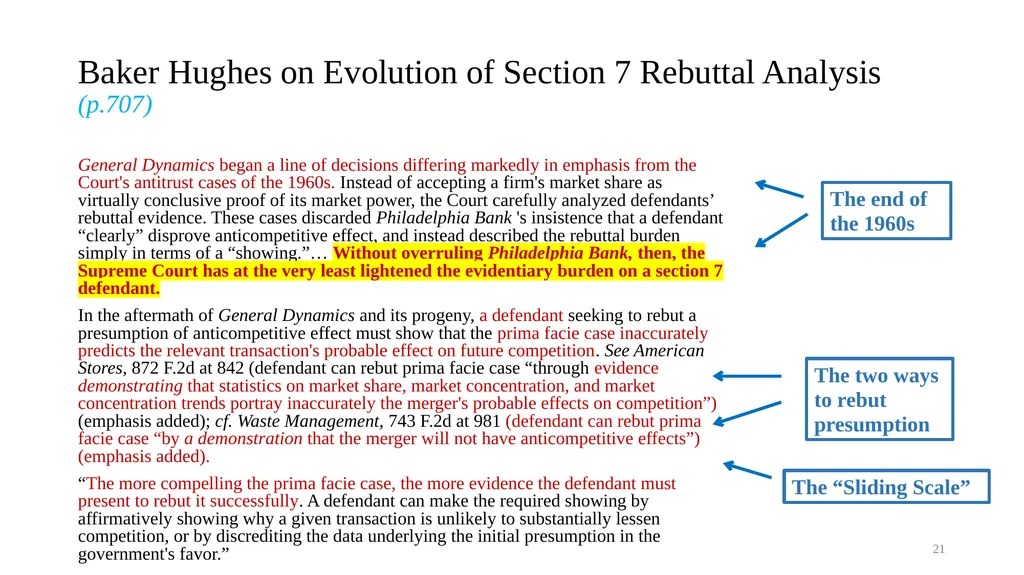
slide21. Baker Hughes on Evolution of Section 7 Rebuttal Analysis (p.707) General Dynamics began a line of decisions differing markedly in emphasis from the Court's antitrust cases of the 1960s. Instead of accepting a firm's market share as virtually conclusive proof of its market power, the Court carefully analyzed defendants’ rebuttal evidence. These cases discarded Philadelphia Bank 's insistence that a defendant “clearly” disprove anticompetitive effect, and instead described the rebuttal burden simply in terms of a “showing.”… Without overruling Philadelphia Bank, then, the Supreme Court has at the very least lightened the evidentiary burden on a section 7 defendant.
In the aftermath of General Dynamics and its progeny, a defendant seeking to rebut a presumption of anticompetitive effect must show that the prima facie case inaccurately predicts the relevant transaction's probable effect on future competition. See American Stores, 872 F.2d at 842 (defendant can rebut prima facie case “through evidence demonstrating that statistics on market share, market concentration, and market concentration trends portray inaccurately the merger's probable effects on competition”) (emphasis added); cf. Waste Management, 743 F.2d at 981 (defendant can rebut prima facie case “by a demonstration that the merger will not have anticompetitive effects”) (emphasis added).
“The more compelling the prima facie case, the more evidence the defendant must present to rebut it successfully. A defendant can make the required showing by affirmatively showing why a given transaction is unlikely to substantially lessen competition, or by discrediting the data underlying the initial presumption in the government's favor.” 21 The “Sliding Scale” The two ways to rebut presumption The end of the 1960s<br>
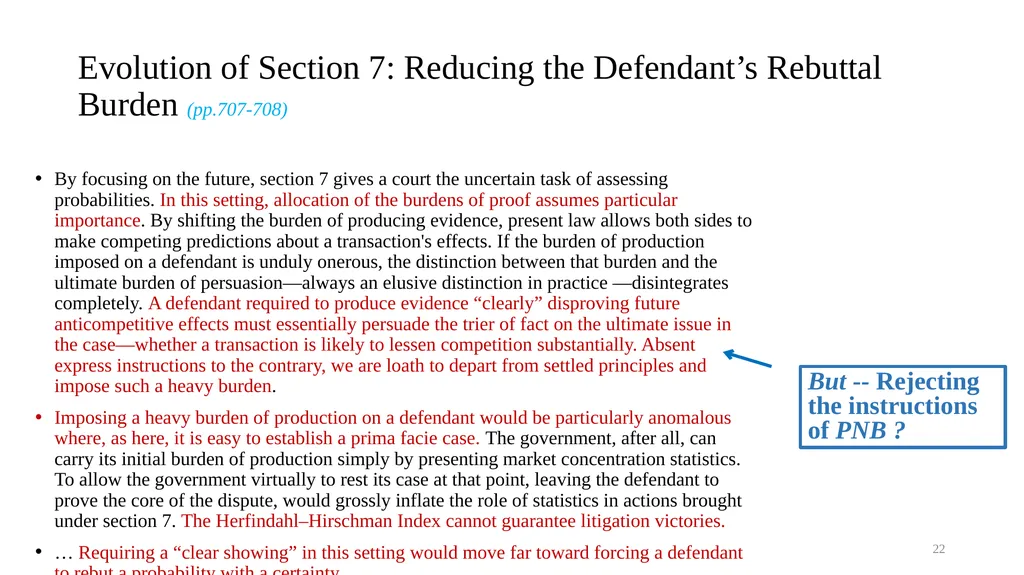
slide22. Evolution of Section 7: Reducing the Defendant’s Rebuttal Burden (pp.707-708) By focusing on the future, section 7 gives a court the uncertain task of assessing probabilities. In this setting, allocation of the burdens of proof assumes particular importance. By shifting the burden of producing evidence, present law allows both sides to make competing predictions about a transaction's effects. If the burden of production imposed on a defendant is unduly onerous, the distinction between that burden and the ultimate burden of persuasion—always an elusive distinction in practice —disintegrates completely. A defendant required to produce evidence “clearly” disproving future anticompetitive effects must essentially persuade the trier of fact on the ultimate issue in the case—whether a transaction is likely to lessen competition substantially. Absent express instructions to the contrary, we are loath to depart from settled principles and impose such a heavy burden.
Imposing a heavy burden of production on a defendant would be particularly anomalous where, as here, it is easy to establish a prima facie case. The government, after all, can carry its initial burden of production simply by presenting market concentration statistics. To allow the government virtually to rest its case at that point, leaving the defendant to prove the core of the dispute, would grossly inflate the role of statistics in actions brought under section 7. The Herfindahl–Hirschman Index cannot guarantee litigation victories.
… Requiring a “clear showing” in this setting would move far toward forcing a defendant to rebut a probability with a certainty. 22 But -- Rejecting the instructions of PNB ?<br>
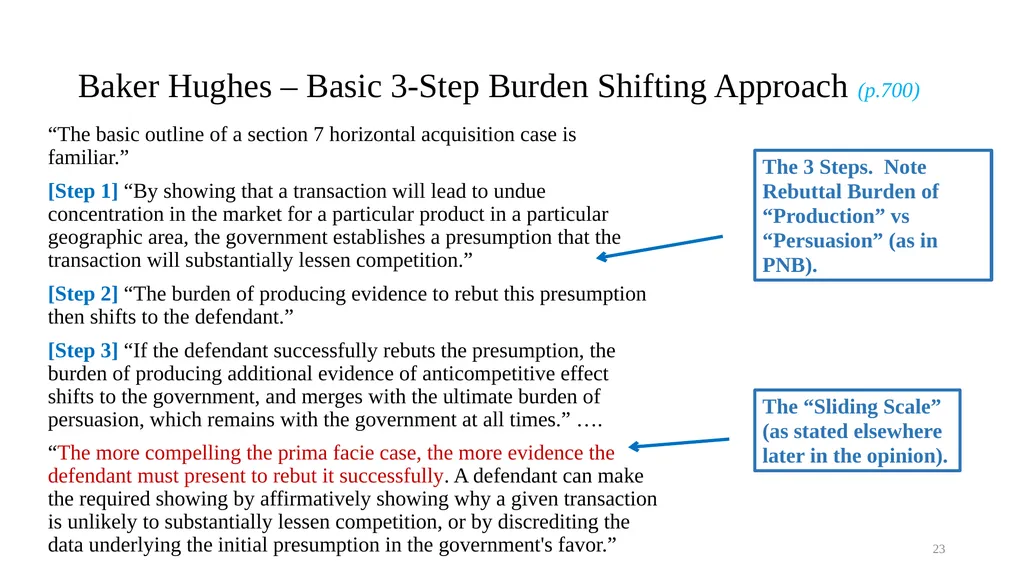
slide23. Baker Hughes – Basic 3-Step Burden Shifting Approach (p.700) “The basic outline of a section 7 horizontal acquisition case is familiar.”
[Step 1] “By showing that a transaction will lead to undue concentration in the market for a particular product in a particular geographic area, the government establishes a presumption that the transaction will substantially lessen competition.”
[Step 2] “The burden of producing evidence to rebut this presumption then shifts to the defendant.”
[Step 3] “If the defendant successfully rebuts the presumption, the burden of producing additional evidence of anticompetitive effect shifts to the government, and merges with the ultimate burden of persuasion, which remains with the government at all times.” ….
“The more compelling the prima facie case, the more evidence the defendant must present to rebut it successfully. A defendant can make the required showing by affirmatively showing why a given transaction is unlikely to substantially lessen competition, or by discrediting the data underlying the initial presumption in the government's favor.” 23 The 3 Steps. Note Rebuttal Burden of “Production” vs “Persuasion” (as in PNB). The “Sliding Scale” (as stated elsewhere later in the opinion).<br>
slide24. What Explains the Weakening of the Structural Presumption? Answer: Economics and Politics Changed, as Did the World Economy 24<br>
slide25. Sidebar 5-2: Decline of the Structure/Conduct/Performance Paradigm How economics explains the weakening of the structural presumption?
Critical empirical work showed that relationship was weak and noisy
Earlier work made cross-industry comparison of industries with different concentration levels.
But, studies did not adequately control for relevant industry-specific factors
E.g., High concentration might be caused by lower cost technology, so higher concentration should not be condemned
But more recent studies have corrected these flaws and do indicate the relevance of concentration, albeit along with other factors (p. 717)
Comment: Chicagoland commentators ignore these recent studies! 25<br>
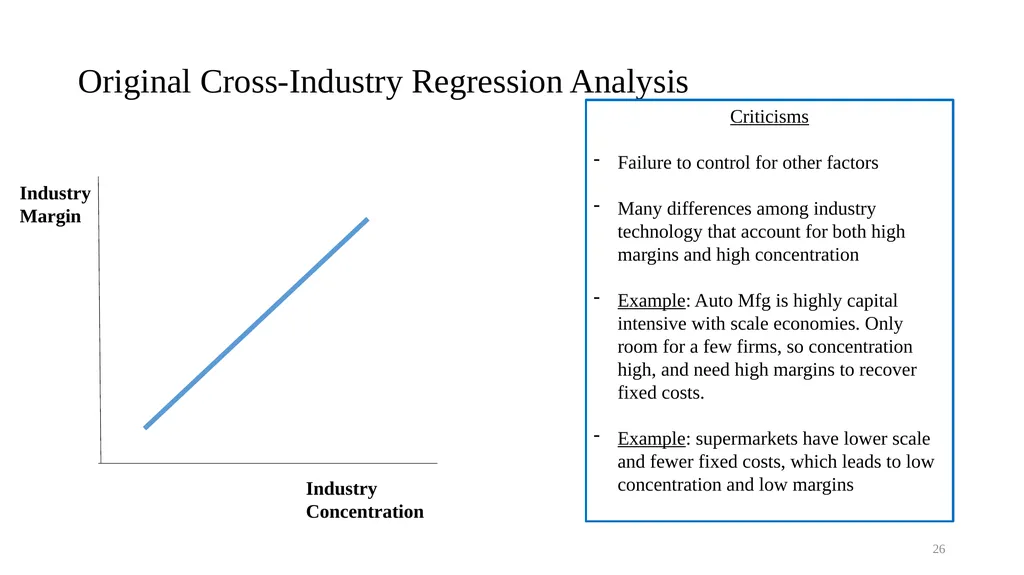
slide26. Original Cross-Industry Regression Analysis 26 IndustryMargin Industry Concentration Criticisms
Failure to control for other factors
Many differences among industry technology that account for both high margins and high concentration
Example: Auto Mfg is highly capital intensive with scale economies. Only room for a few firms, so concentration high, and need high margins to recover fixed costs.
Example: supermarkets have lower scale and fewer fixed costs, which leads to low concentration and low margins<br>
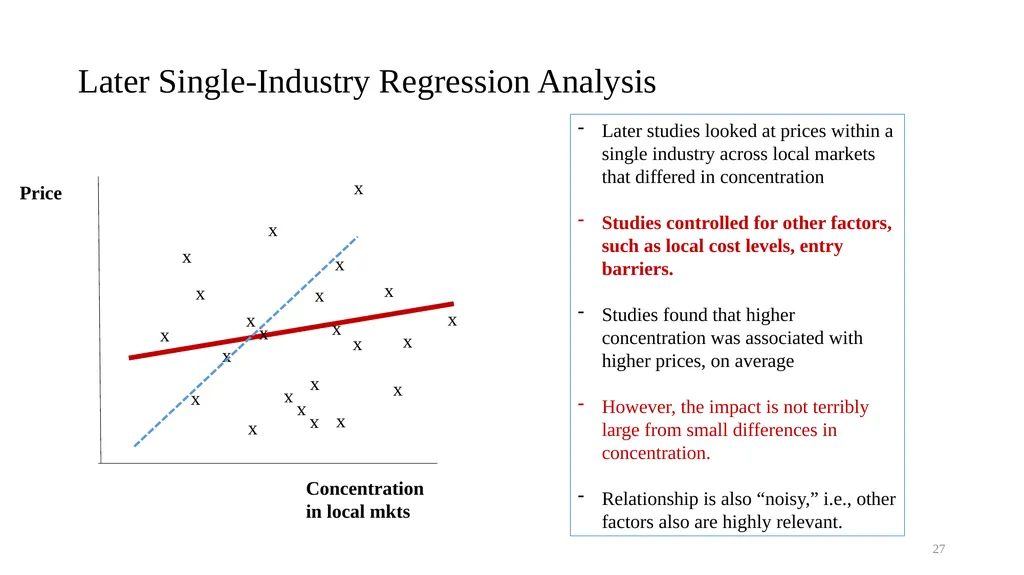
slide27. Later Single-Industry Regression Analysis 27 Price Concentration
in local mkts Later studies looked at prices within a single industry across local markets that differed in concentration
Studies controlled for other factors, such as local cost levels, entry barriers.
Studies found that higher concentration was associated with higher prices, on average
However, the impact is not terribly large from small differences in concentration.
Relationship is also “noisy,” i.e., other factors also are highly relevant. x x x x x x x x x x x x x x x x x x x x x x x<br>
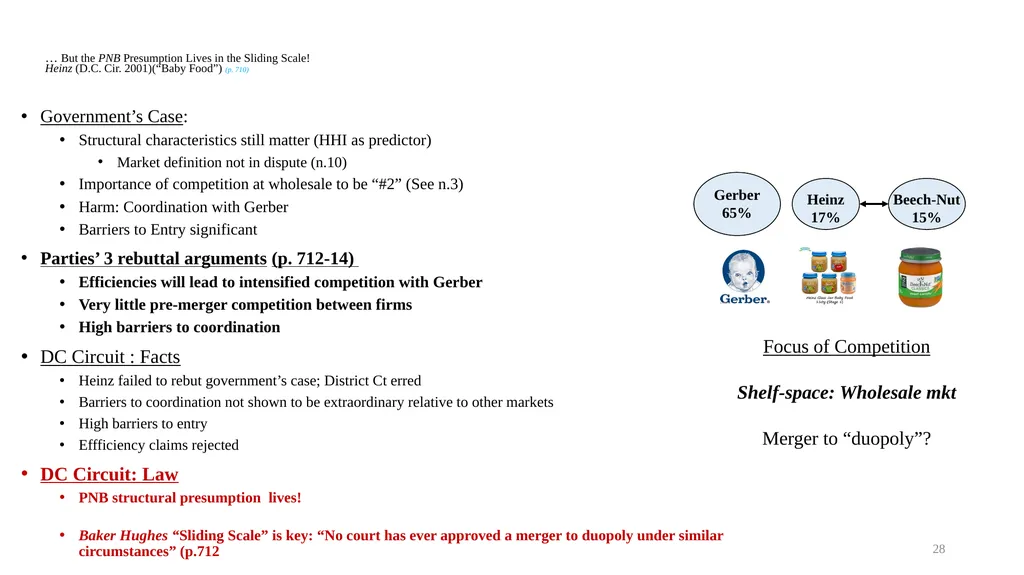
slide28. … But the PNB Presumption Lives in the Sliding Scale! Heinz (D.C. Cir. 2001)(“Baby Food”) (p. 710) Government’s Case:
Structural characteristics still matter (HHI as predictor)
Market definition not in dispute (n.10)
Importance of competition at wholesale to be “#2” (See n.3)
Harm: Coordination with Gerber
Barriers to Entry significant
Parties’ 3 rebuttal arguments (p. 712-14)
Efficiencies will lead to intensified competition with Gerber
Very little pre-merger competition between firms
High barriers to coordination
DC Circuit : Facts
Heinz failed to rebut government’s case; District Ct erred
Barriers to coordination not shown to be extraordinary relative to other markets
High barriers to entry
Effficiency claims rejected
DC Circuit: Law
PNB structural presumption lives!
Baker Hughes “Sliding Scale” is key: “No court has ever approved a merger to duopoly under similar circumstances” (p.712 28 Gerber
65% Heinz
17% Beech-Nut
15% Focus of Competition
Shelf-space: Wholesale mkt
Merger to “duopoly”?<br>
slide29. Heinz - Prima Facie Case (p.712) Merger law rests upon the theory that, where rivals are few, firms will be able to coordinate their behavior, either by overt collusion or implicit understanding, in order to restrict output and achieve profits above competitive levels. Increases in concentration above certain levels are thought to raise[ ] a likelihood of ‘interdependent anticompetitive conduct.
Sufficiently large HHI figures establish the FTC's prima facie case that a merger is anti-competitive. The district court found that the pre-merger HHI “score for the baby food industry is 4775—indicative of a highly concentrated industry.
Here, the FTC's market concentration statistics are bolstered by the indisputable fact that the merger will eliminate competition between the two merging parties at the wholesale level, where they are currently the only competitors for what the district court described as the “ second position on the supermarket shelves.”
Heinz's own documents recognize the wholesale competition and anticipate that the merger will end it. Indeed, those documents disclose that Heinz considered three options to end the vigorous wholesale competition with Beech–Nut: two involved innovative measures while the third entailed the acquisition of Beech–Nut. Heinz chose the third, and least pro-competitive, of the options.
Finally, the anticompetitive effect of the merger is further enhanced by high barriers to market entry. The district court found that there had been no significant entries in the baby food market in decades and that new entry was “difficult and improbable. This finding largely eliminates the possibility that the reduced competition caused by the merger will be ameliorated by new competition from outsiders and further strengthens the FTC's case.
As far as we can determine, no court has ever approved a merger to duopoly under similar circumstances. 29<br>
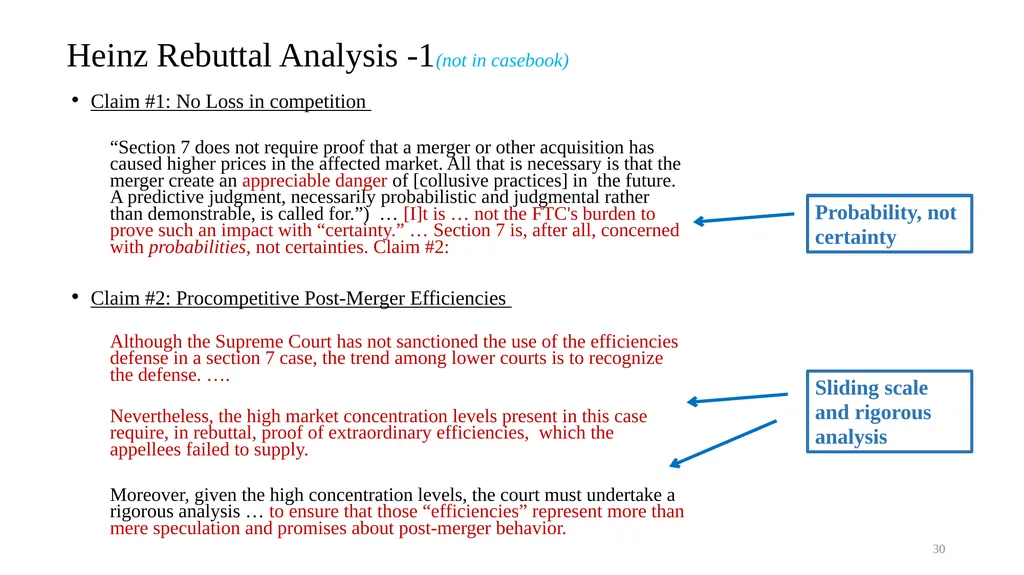
slide30. Heinz Rebuttal Analysis -1(not in casebook) Claim #1: No Loss in competition
“Section 7 does not require proof that a merger or other acquisition has caused higher prices in the affected market. All that is necessary is that the merger create an appreciable danger of [collusive practices] in the future. A predictive judgment, necessarily probabilistic and judgmental rather than demonstrable, is called for.”) … [I]t is … not the FTC's burden to prove such an impact with “certainty.” … Section 7 is, after all, concerned with probabilities, not certainties. Claim #2:
Claim #2: Procompetitive Post-Merger Efficiencies
Although the Supreme Court has not sanctioned the use of the efficiencies defense in a section 7 case, the trend among lower courts is to recognize the defense. ….
Nevertheless, the high market concentration levels present in this case require, in rebuttal, proof of extraordinary efficiencies, which the appellees failed to supply.
Moreover, given the high concentration levels, the court must undertake a rigorous analysis … to ensure that those “efficiencies” represent more than mere speculation and promises about post-merger behavior. 30 Sliding scale and rigorous analysis Probability, not certainty<br>
slide31. Heinz Rebuttal Analysis -2 (p.713) Claim #3: Cartel Problems
The district court dismissed the likelihood of collusion derived from the FTC's market concentration data. “[S]tructural market barriers to collusion” in the retail market for jarred baby food, the court said, rebut the normal presumption that increases in concentration will increase the likelihood of tacit collusion.
The court's sole citation, however, was to testimony by the appellees' expert, Jonathan B. Baker, who testified that in order to coordinate successfully, firms must solve “cartel problems” such as reaching a consensus on price and market share and deterring each other from deviating from that consensus by either lowering price or increasing production. He opined that after the merger the merged entity would want to expand its market share at Gerber's expense, thereby decreasing the likelihood of consensus on price and market share.
In his report, Baker elaborated on his theory, explaining that the efficiencies created by the merger will give the merged firm the ability and incentive to take on Gerber in price and product improvements. He also predicted that policing and monitoring of any agreement would be more difficult than it is now, due in part to a time lag in the ability of one firm to detect price cuts by another. But the district court made no finding that any of these “cartel problems” are so much greater in the baby food industry than in other industries that they rebut the normal presumption. In fact, Baker's testimony about “time lag” is refuted by the record which reflects that supermarket prices are available from industry-wide scanner data within 4–8 weeks. … His testimony is further undermined by the record evidence of past price leadership in the baby food industry.
The combination of a concentrated market and barriers to entry is a recipe for price coordination. 31 Recalling analysis of Cartel Tasks<br>
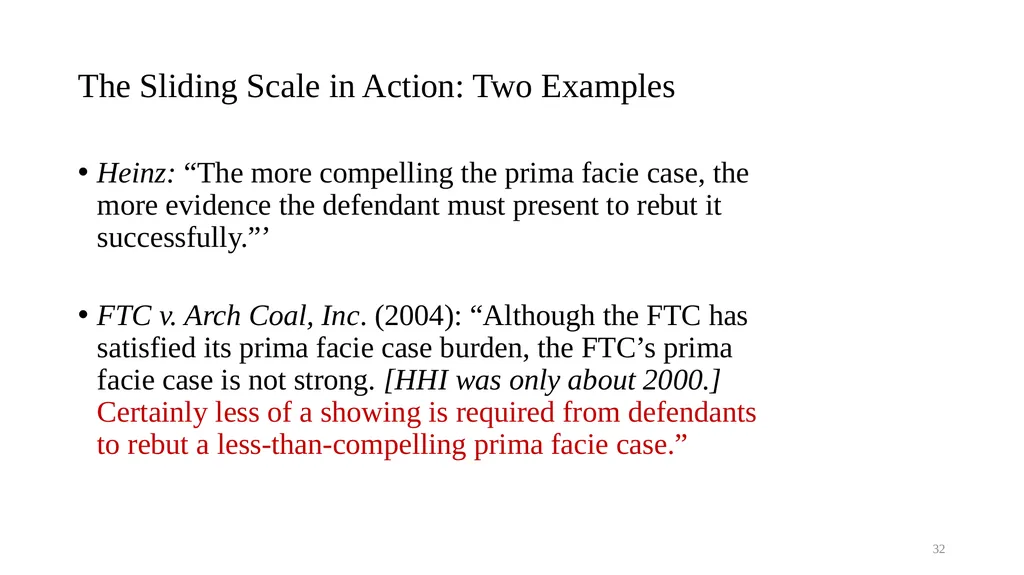
slide32. The Sliding Scale in Action: Two Examples Heinz: “The more compelling the prima facie case, the more evidence the defendant must present to rebut it successfully.”’
FTC v. Arch Coal, Inc. (2004): “Although the FTC has satisfied its prima facie case burden, the FTC’s prima facie case is not strong. [HHI was only about 2000.] Certainly less of a showing is required from defendants to rebut a less-than-compelling prima facie case.” 32<br>
slide33. Horizontal Merger Guidelines: Introduction 33<br>
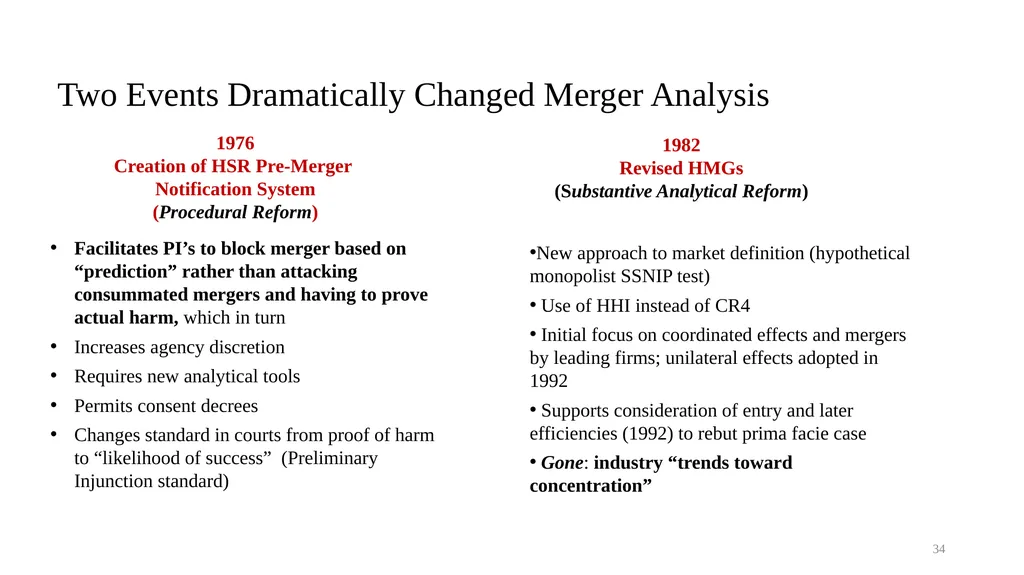
slide34. Two Events Dramatically Changed Merger Analysis 1976
Creation of HSR Pre-Merger
Notification System
(Procedural Reform) 1982
Revised HMGs
(Substantive Analytical Reform) Facilitates PI’s to block merger based on “prediction” rather than attacking consummated mergers and having to prove actual harm, which in turn
Increases agency discretion
Requires new analytical tools
Permits consent decrees
Changes standard in courts from proof of harm to “likelihood of success” (Preliminary Injunction standard) New approach to market definition (hypothetical monopolist SSNIP test)
Use of HHI instead of CR4
Initial focus on coordinated effects and mergers by leading firms; unilateral effects adopted in 1992
Supports consideration of entry and later efficiencies (1992) to rebut prima facie case
Gone: industry “trends toward concentration” 34<br>
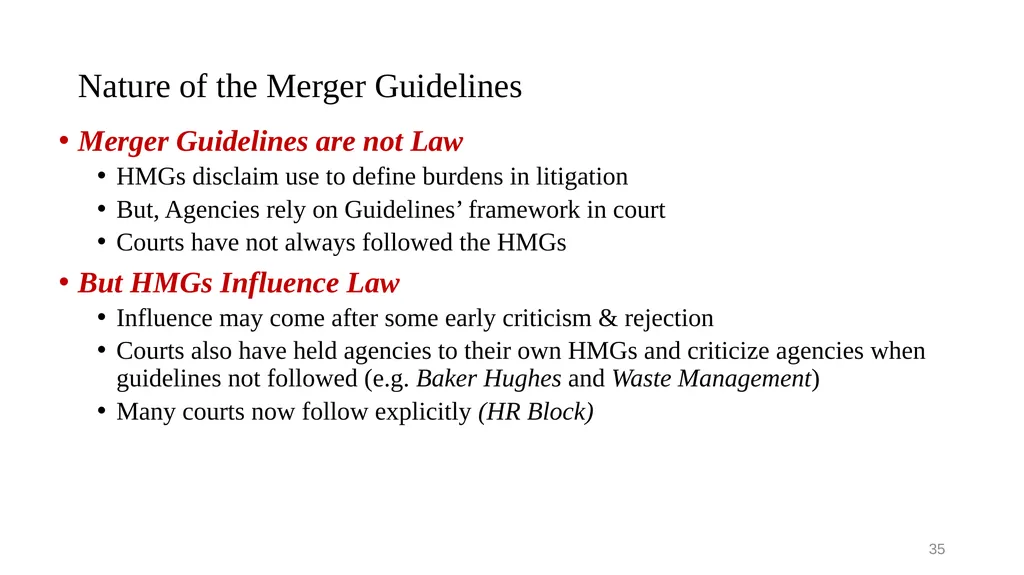
slide35. Nature of the Merger Guidelines Merger Guidelines are not Law
HMGs disclaim use to define burdens in litigation
But, Agencies rely on Guidelines’ framework in court
Courts have not always followed the HMGs
But HMGs Influence Law
Influence may come after some early criticism & rejection
Courts also have held agencies to their own HMGs and criticize agencies when guidelines not followed (e.g. Baker Hughes and Waste Management)
Many courts now follow explicitly (HR Block) 35<br>
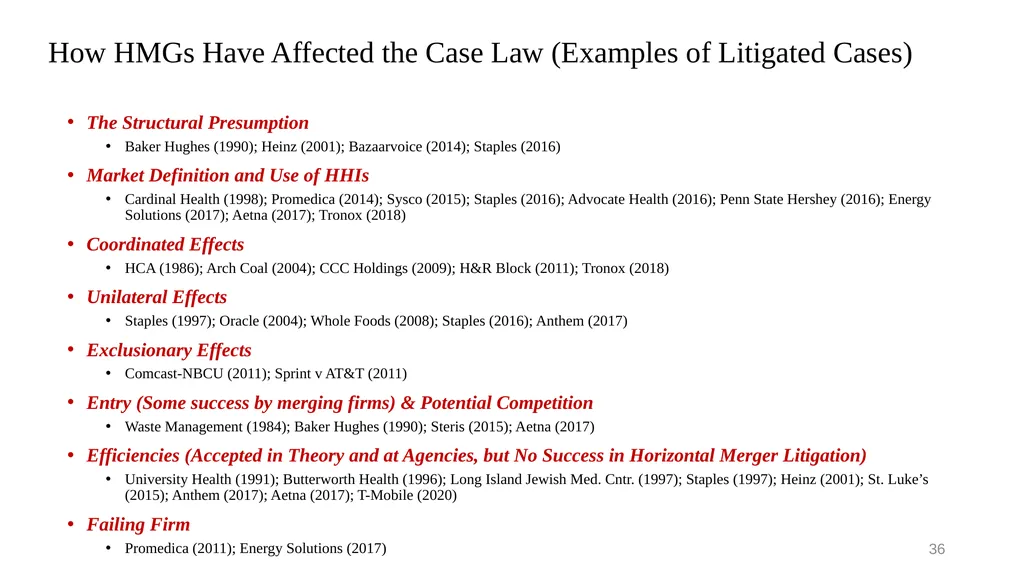
slide36. How HMGs Have Affected the Case Law (Examples of Litigated Cases) The Structural Presumption
Baker Hughes (1990); Heinz (2001); Bazaarvoice (2014); Staples (2016)
Market Definition and Use of HHIs
Cardinal Health (1998); Promedica (2014); Sysco (2015); Staples (2016); Advocate Health (2016); Penn State Hershey (2016); Energy Solutions (2017); Aetna (2017); Tronox (2018)
Coordinated Effects
HCA (1986); Arch Coal (2004); CCC Holdings (2009); H&R Block (2011); Tronox (2018)
Unilateral Effects
Staples (1997); Oracle (2004); Whole Foods (2008); Staples (2016); Anthem (2017)
Exclusionary Effects
Comcast-NBCU (2011); Sprint v AT&T (2011)
Entry (Some success by merging firms) & Potential Competition
Waste Management (1984); Baker Hughes (1990); Steris (2015); Aetna (2017)
Efficiencies (Accepted in Theory and at Agencies, but No Success in Horizontal Merger Litigation)
University Health (1991); Butterworth Health (1996); Long Island Jewish Med. Cntr. (1997); Staples (1997); Heinz (2001); St. Luke’s (2015); Anthem (2017); Aetna (2017); T-Mobile (2020)
Failing Firm
Promedica (2011); Energy Solutions (2017) 36<br>
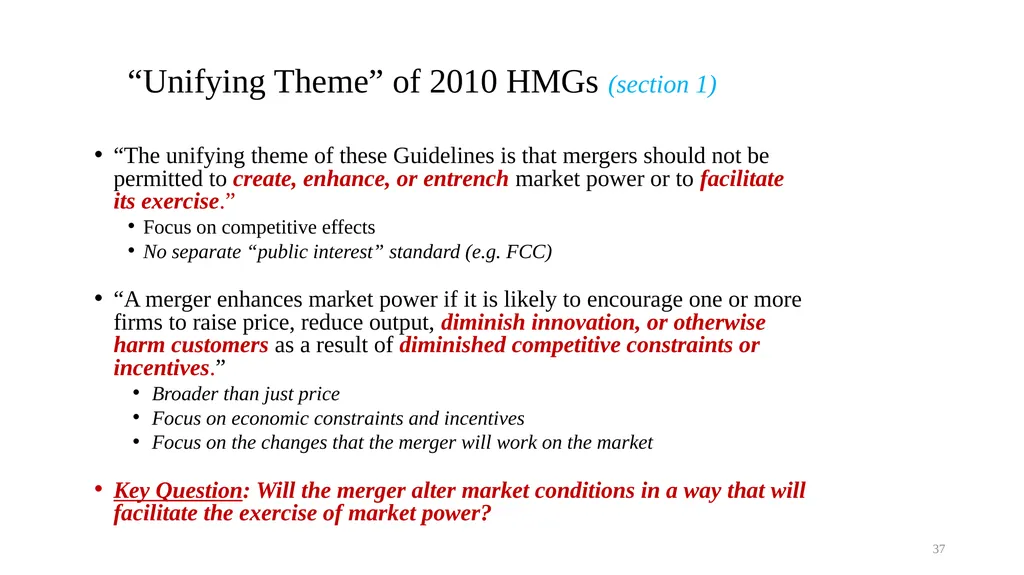
slide37. “Unifying Theme” of 2010 HMGs (section 1) “The unifying theme of these Guidelines is that mergers should not be permitted to create, enhance, or entrench market power or to facilitate its exercise.”
Focus on competitive effects
No separate “public interest” standard (e.g. FCC)
“A merger enhances market power if it is likely to encourage one or more firms to raise price, reduce output, diminish innovation, or otherwise harm customers as a result of diminished competitive constraints or incentives.”
Broader than just price
Focus on economic constraints and incentives
Focus on the changes that the merger will work on the market
Key Question: Will the merger alter market conditions in a way that will facilitate the exercise of market power? 37<br>
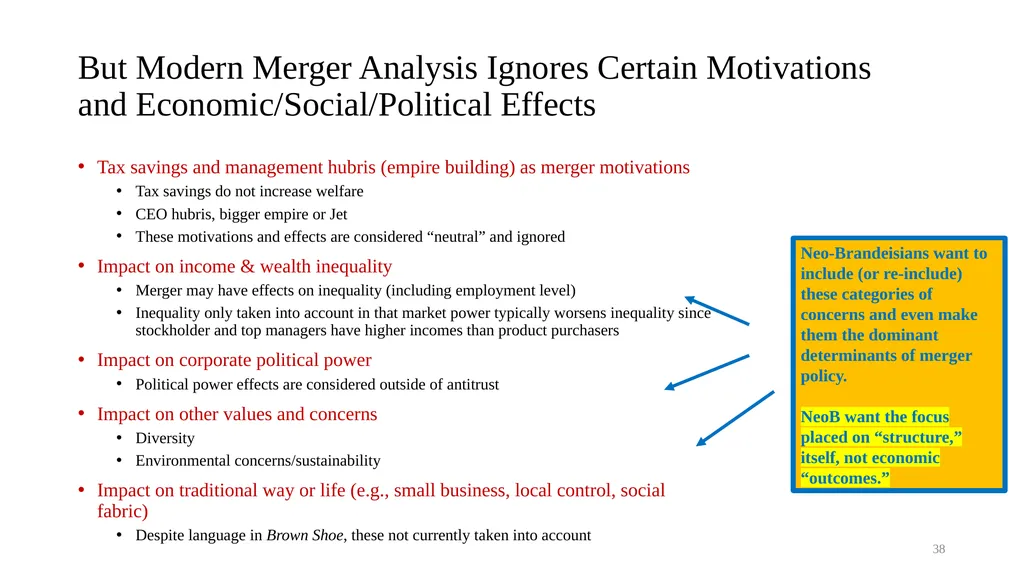
slide38. But Modern Merger Analysis Ignores Certain Motivations and Economic/Social/Political Effects Tax savings and management hubris (empire building) as merger motivations
Tax savings do not increase welfare
CEO hubris, bigger empire or Jet
These motivations and effects are considered “neutral” and ignored
Impact on income & wealth inequality
Merger may have effects on inequality (including employment level)
Inequality only taken into account in that market power typically worsens inequality since stockholder and top managers have higher incomes than product purchasers
Impact on corporate political power
Political power effects are considered outside of antitrust
Impact on other values and concerns
Diversity
Environmental concerns/sustainability
Impact on traditional way or life (e.g., small business, local control, social fabric)
Despite language in Brown Shoe, these not currently taken into account 38 Neo-Brandeisians want to include (or re-include) these categories of concerns and even make them the dominant determinants of merger policy.
NeoB want the focus placed on “structure,” itself, not economic “outcomes.”<br>
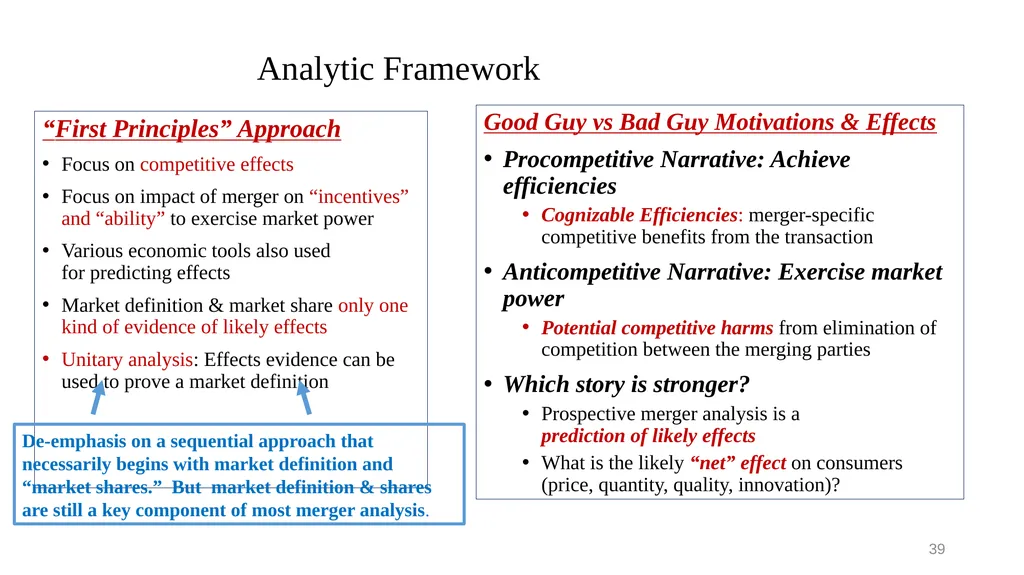
slide39. Analytic Framework “First Principles” Approach
Focus on competitive effects
Focus on impact of merger on “incentives” and “ability” to exercise market power
Various economic tools also used for predicting effects
Market definition & market share only one kind of evidence of likely effects
Unitary analysis: Effects evidence can be used to prove a market definition Good Guy vs Bad Guy Motivations & Effects
Procompetitive Narrative: Achieve efficiencies
Cognizable Efficiencies: merger-specific competitive benefits from the transaction
Anticompetitive Narrative: Exercise market power
Potential competitive harms from elimination of competition between the merging parties
Which story is stronger?
Prospective merger analysis is a prediction of likely effects
What is the likely “net” effect on consumers (price, quantity, quality, innovation)? 39 De-emphasis on a sequential approach that necessarily begins with market definition and “market shares.” But market definition & shares are still a key component of most merger analysis.<br>
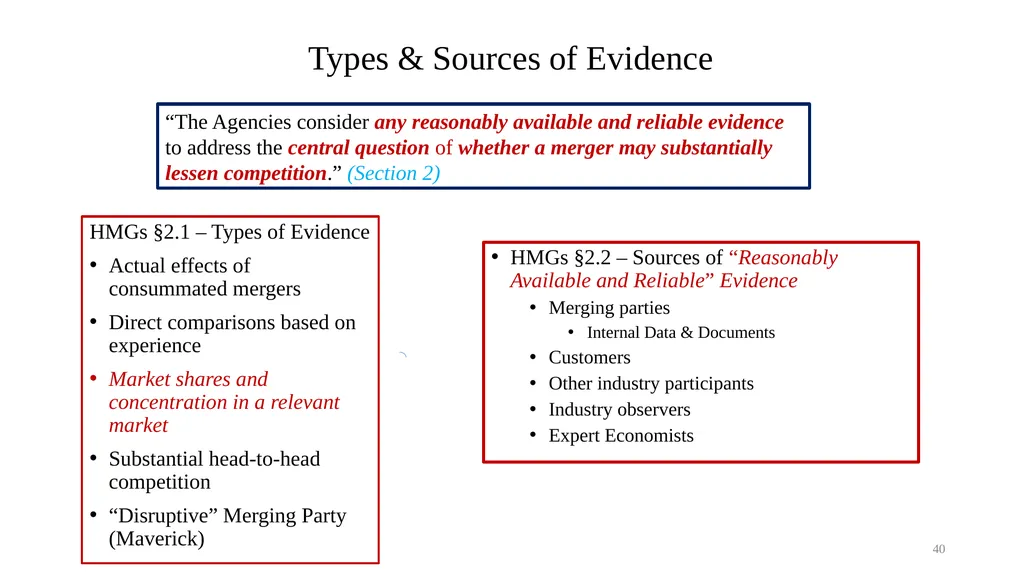
slide40. Types & Sources of Evidence HMGs §2.1 – Types of Evidence
Actual effects of consummated mergers
Direct comparisons based on experience
Market shares and concentration in a relevant market
Substantial head-to-head competition
“Disruptive” Merging Party (Maverick) HMGs §2.2 – Sources of “Reasonably Available and Reliable” Evidence
Merging parties
Internal Data & Documents
Customers
Other industry participants
Industry observers
Expert Economists 40 “The Agencies consider any reasonably available and reliable evidence to address the central question of whether a merger may substantially lessen competition.” (Section 2)<br>
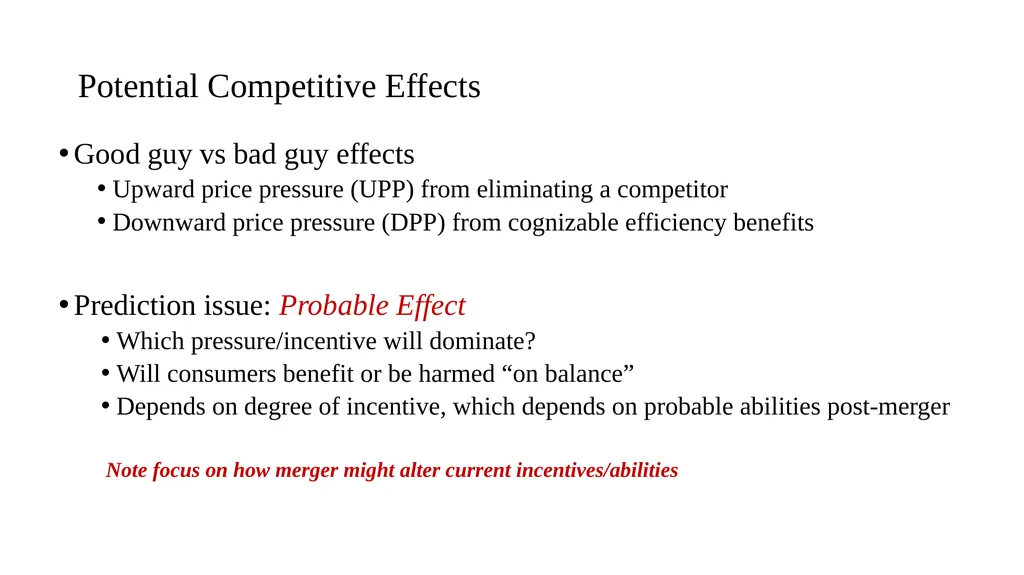
slide41. Potential Competitive Effects Good guy vs bad guy effects
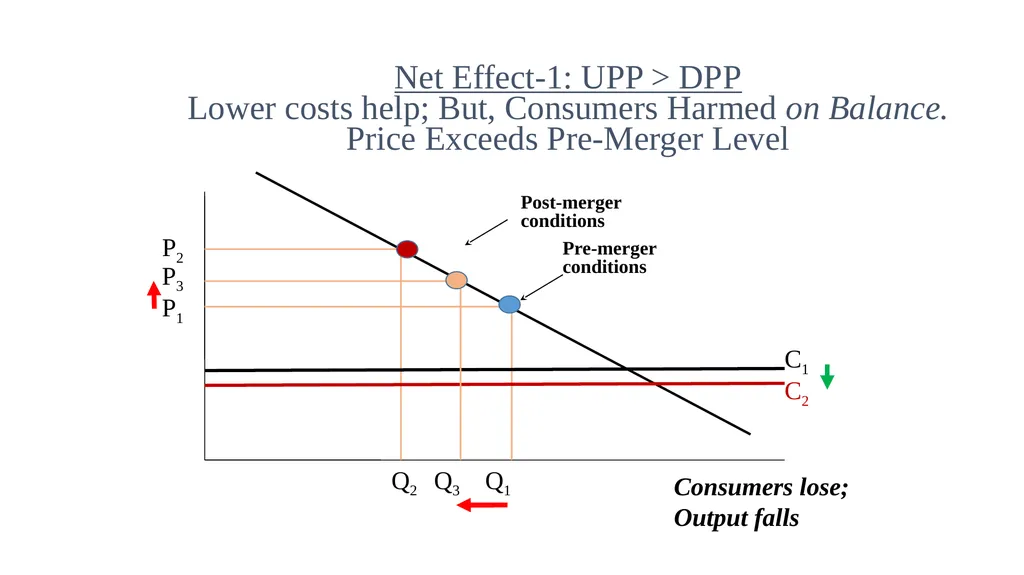
Upward price pressure (UPP) from eliminating a competitor
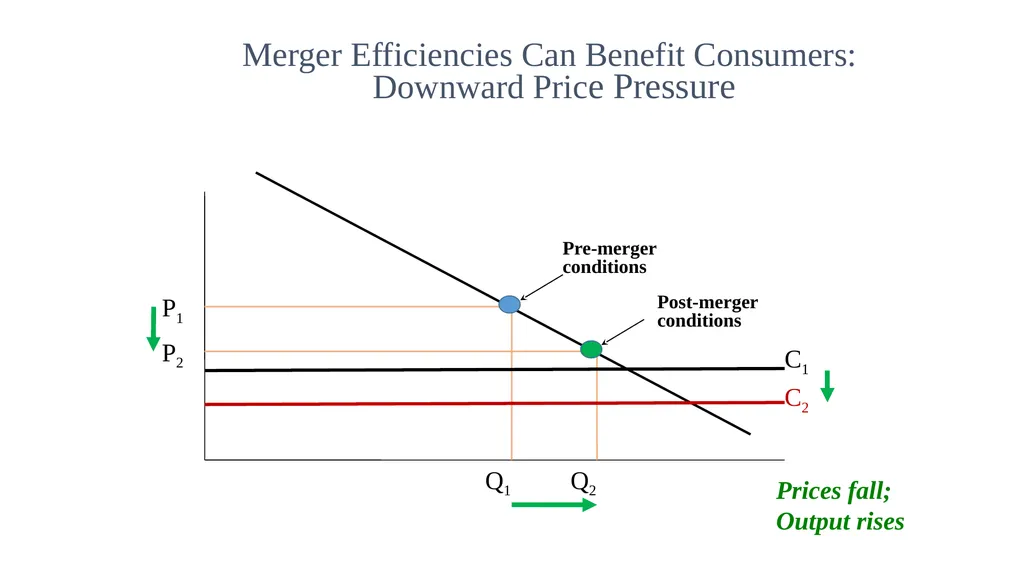
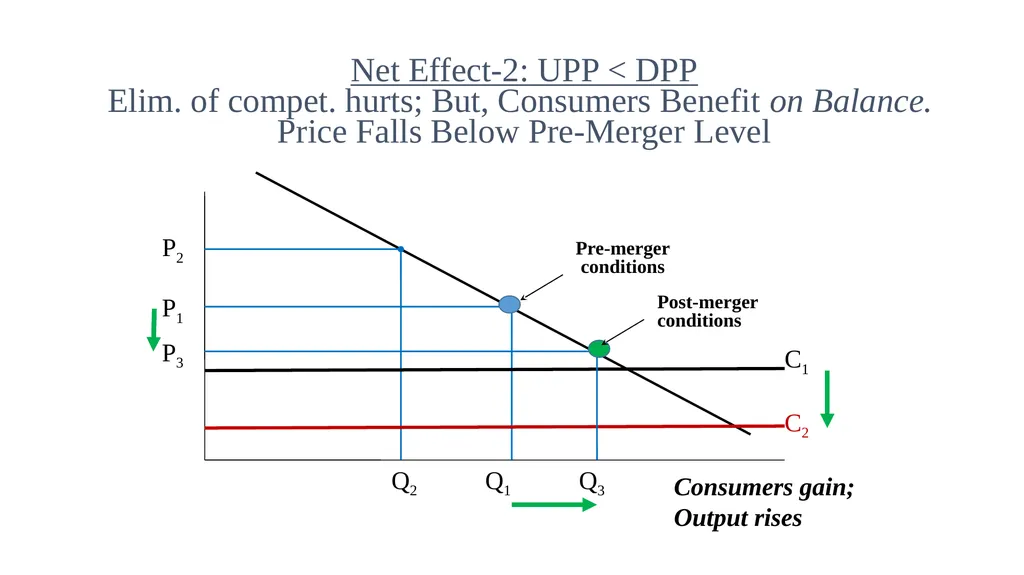
Downward price pressure (DPP) from cognizable efficiency benefits
Prediction issue: Probable Effect
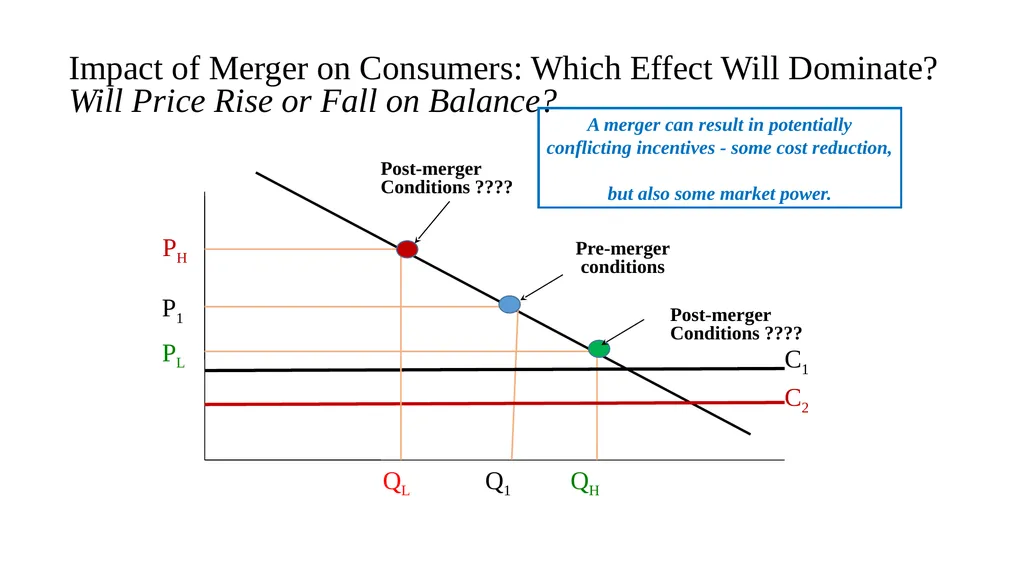
Which pressure/incentive will dominate?
Will consumers benefit or be harmed “on balance”
Depends on degree of incentive, which depends on probable abilities post-merger
Note focus on how merger might alter current incentives/abilities 41<br>
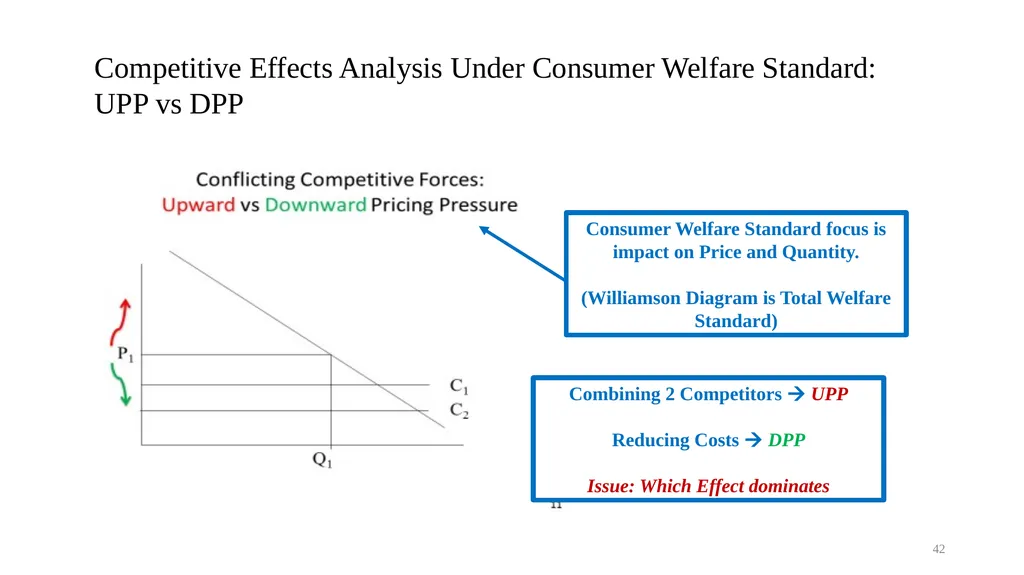
slide42. 42 Competitive Effects Analysis Under Consumer Welfare Standard: UPP vs DPP Consumer Welfare Standard focus is impact on Price and Quantity.
(Williamson Diagram is Total Welfare Standard) Combining 2 Competitors UPP
Reducing Costs DPP
Issue: Which Effect dominates<br>
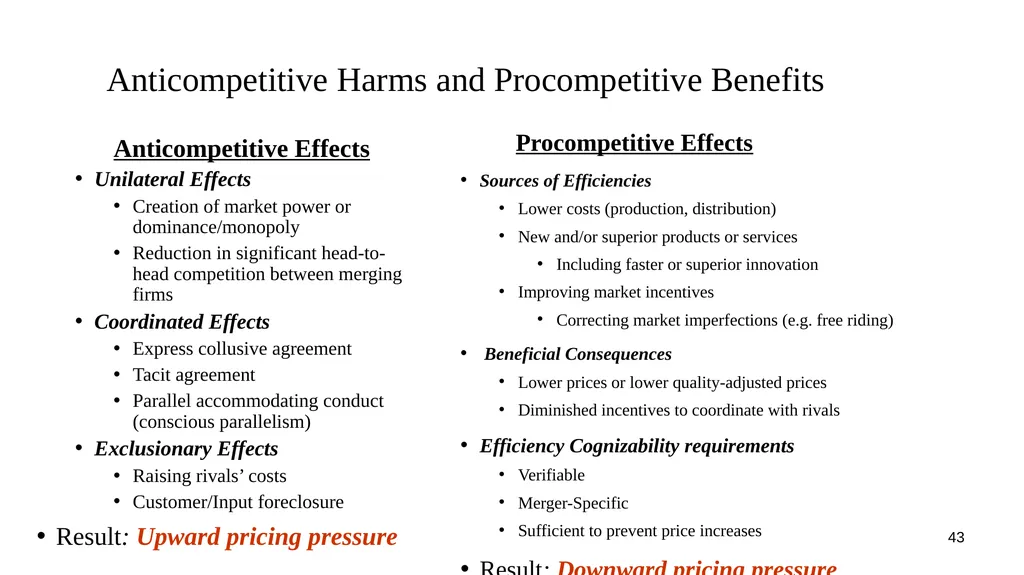
slide43. 43 Anticompetitive Harms and Procompetitive Benefits Procompetitive Effects
Sources of Efficiencies
Lower costs (production, distribution)
New and/or superior products or services
Including faster or superior innovation
Improving market incentives
Correcting market imperfections (e.g. free riding)
Beneficial Consequences
Lower prices or lower quality-adjusted prices
Diminished incentives to coordinate with rivals
Efficiency Cognizability requirements
Verifiable
Merger-Specific
Sufficient to prevent price increases
Result: Downward pricing pressure 43 Anticompetitive Effects
Unilateral Effects
Creation of market power or dominance/monopoly
Reduction in significant head-to-head competition between merging firms
Coordinated Effects
Express collusive agreement
Tacit agreement
Parallel accommodating conduct (conscious parallelism)
Exclusionary Effects
Raising rivals’ costs
Customer/Input foreclosure
Result: Upward pricing pressure<br>
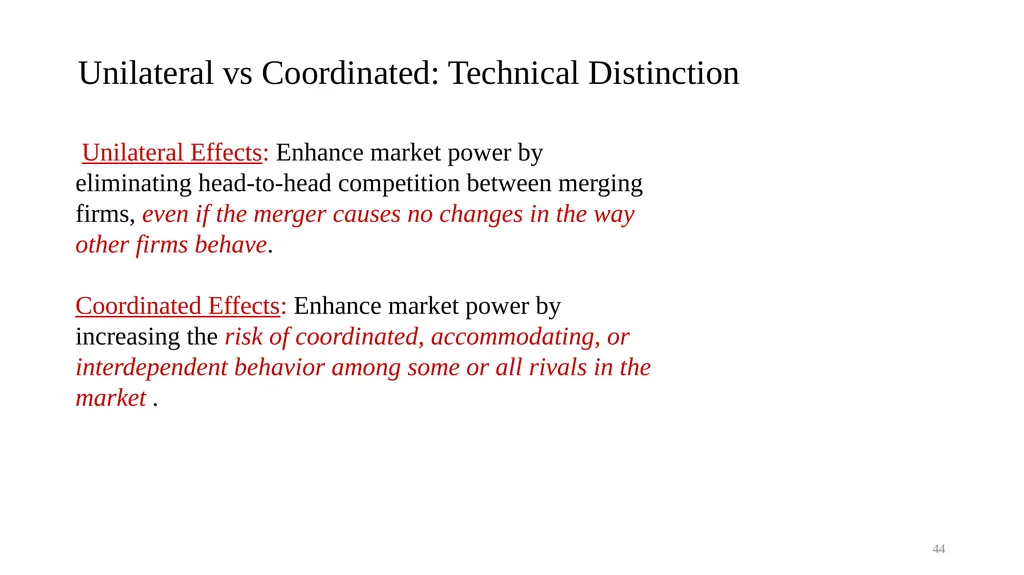
slide44. Unilateral vs Coordinated: Technical Distinction Unilateral Effects: Enhance market power by eliminating head-to-head competition between merging firms, even if the merger causes no changes in the way other firms behave.
Coordinated Effects: Enhance market power by increasing the risk of coordinated, accommodating, or interdependent behavior among some or all rivals in the market . 44<br>
slide45. The Current Structural Presumption Concentration, Safe Harbors and Anticompetitive Presumptions<br>
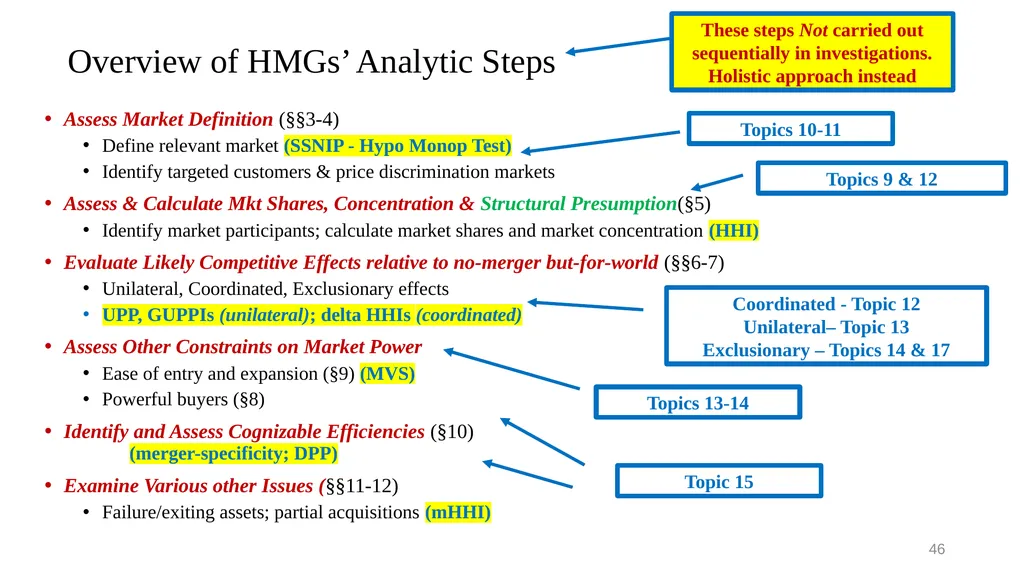
slide46. Overview of HMGs’ Analytic Steps Assess Market Definition (§§3-4)
Define relevant market (SSNIP - Hypo Monop Test)
Identify targeted customers & price discrimination markets
Assess & Calculate Mkt Shares, Concentration & Structural Presumption(§5)
Identify market participants; calculate market shares and market concentration (HHI)
Evaluate Likely Competitive Effects relative to no-merger but-for-world (§§6-7)
Unilateral, Coordinated, Exclusionary effects
UPP, GUPPIs (unilateral); delta HHIs (coordinated)
Assess Other Constraints on Market Power
Ease of entry and expansion (§9) (MVS)
Powerful buyers (§8)
Identify and Assess Cognizable Efficiencies (§10) (merger-specificity; DPP)
Examine Various other Issues (§§11-12)
Failure/exiting assets; partial acquisitions (mHHI) 46 Topic 15 Coordinated - Topic 12
Unilateral– Topic 13
Exclusionary – Topics 14 & 17 Topics 13-14 Topics 10-11 Topics 9 & 12 These steps Not carried out sequentially in investigations. Holistic approach instead<br>
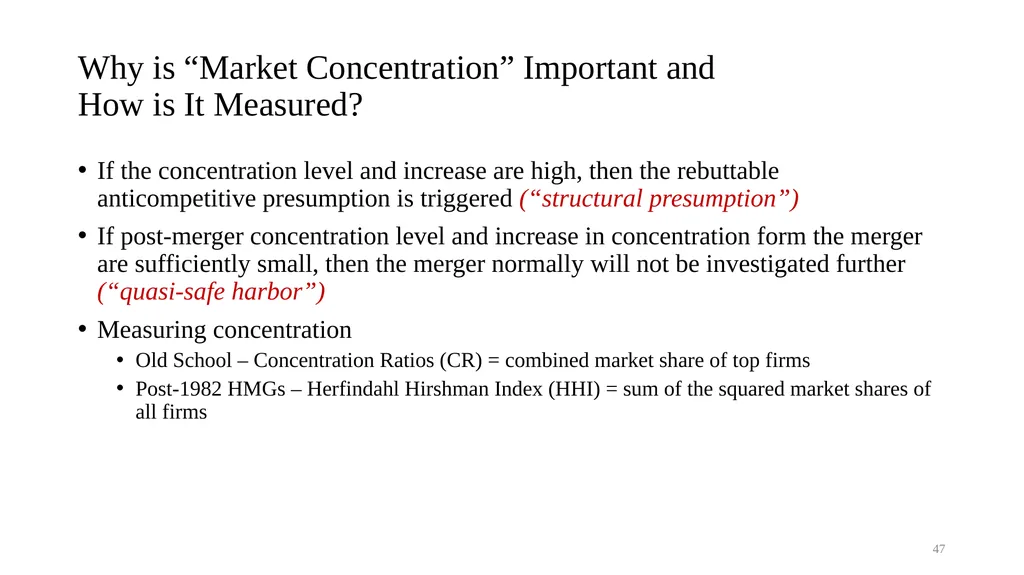
slide47. Why is “Market Concentration” Important and How is It Measured? If the concentration level and increase are high, then the rebuttable anticompetitive presumption is triggered (“structural presumption”)
If post-merger concentration level and increase in concentration form the merger are sufficiently small, then the merger normally will not be investigated further (“quasi-safe harbor”)
Measuring concentration
Old School – Concentration Ratios (CR) = combined market share of top firms
Post-1982 HMGs – Herfindahl Hirshman Index (HHI) = sum of the squared market shares of all firms 47<br>
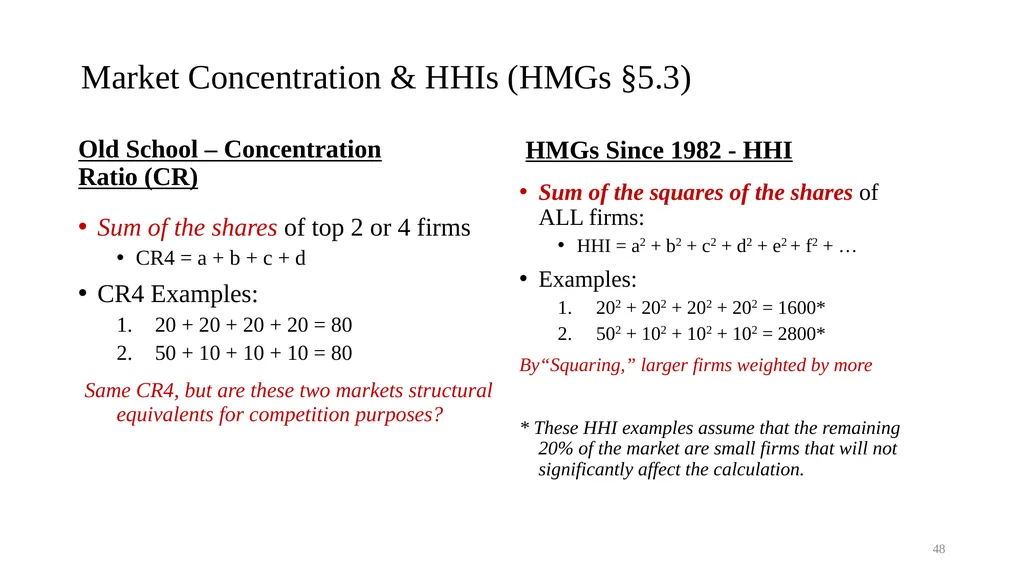
slide48. Market Concentration & HHIs (HMGs §5.3) Old School – Concentration Ratio (CR) Sum of the shares of top 2 or 4 firms
CR4 = a + b + c + d
CR4 Examples:
20 + 20 + 20 + 20 = 80
50 + 10 + 10 + 10 = 80
Same CR4, but are these two markets structural equivalents for competition purposes? HMGs Since 1982 - HHI Sum of the squares of the shares of ALL firms:
HHI = a2 + b2 + c2 + d2 + e2 + f2 + …
Examples:
202 + 202 + 202 + 202 = 1600*
502 + 102 + 102 + 102 = 2800*
By“Squaring,” larger firms weighted by more
* These HHI examples assume that the remaining 20% of the market are small firms that will not significantly affect the calculation. 48<br>
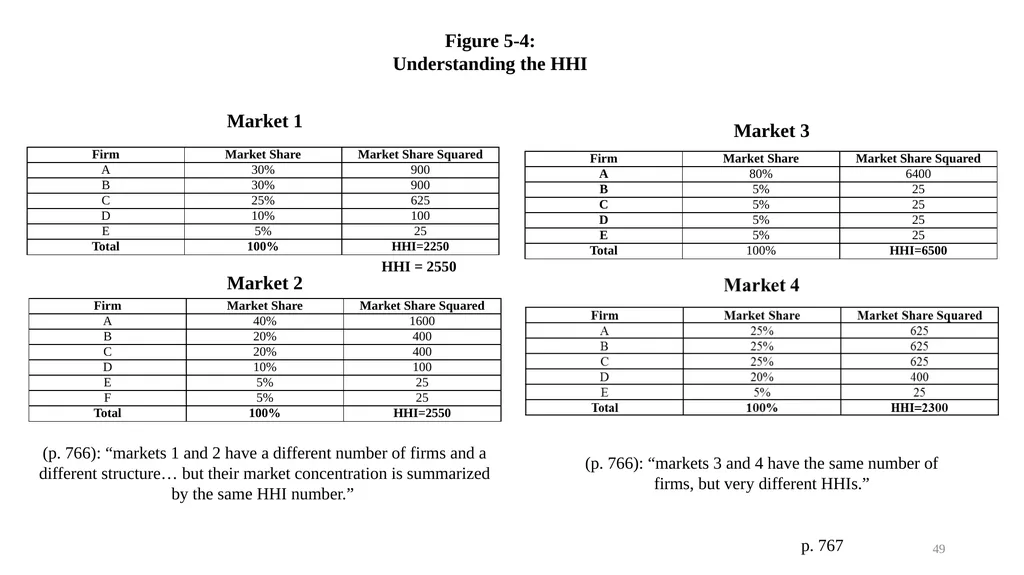
slide49. Figure 5-4:
Understanding the HHI Market 1 Market 2 Market 3 p. 767 49 HHI = 2550 (p. 766): “markets 1 and 2 have a different number of firms and a different structure… but their market concentration is summarized by the same HHI number.” (p. 766): “markets 3 and 4 have the same number of firms, but very different HHIs.”<br>
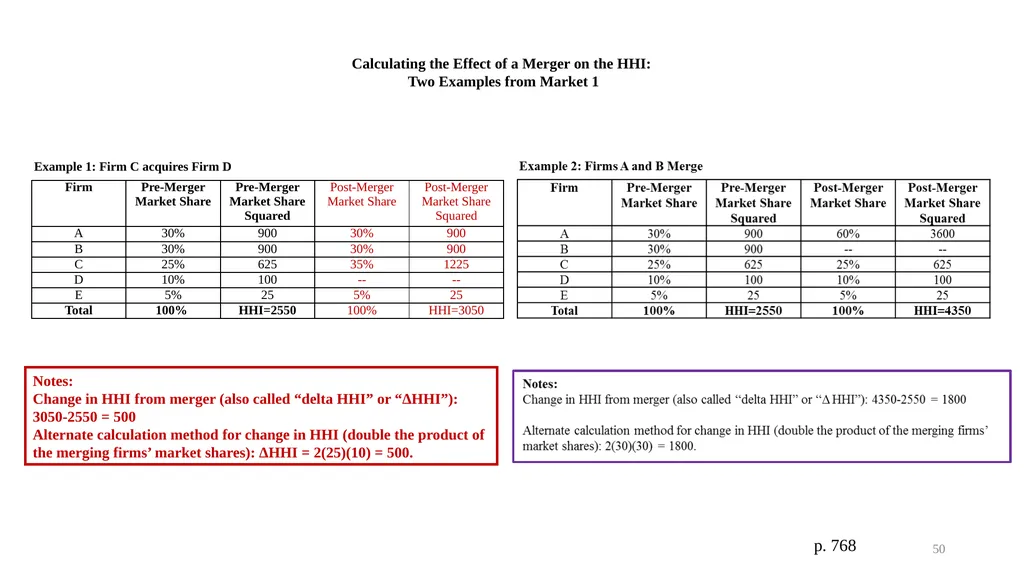
slide50. Calculating the Effect of a Merger on the HHI:
Two Examples from Market 1 Notes:
Change in HHI from merger (also called “delta HHI” or “ΔHHI”): 3050-2550 = 500
Alternate calculation method for change in HHI (double the product of the merging firms’ market shares): ΔHHI = 2(25)(10) = 500. p. 768 Example 1: Firm C acquires Firm D 50<br>
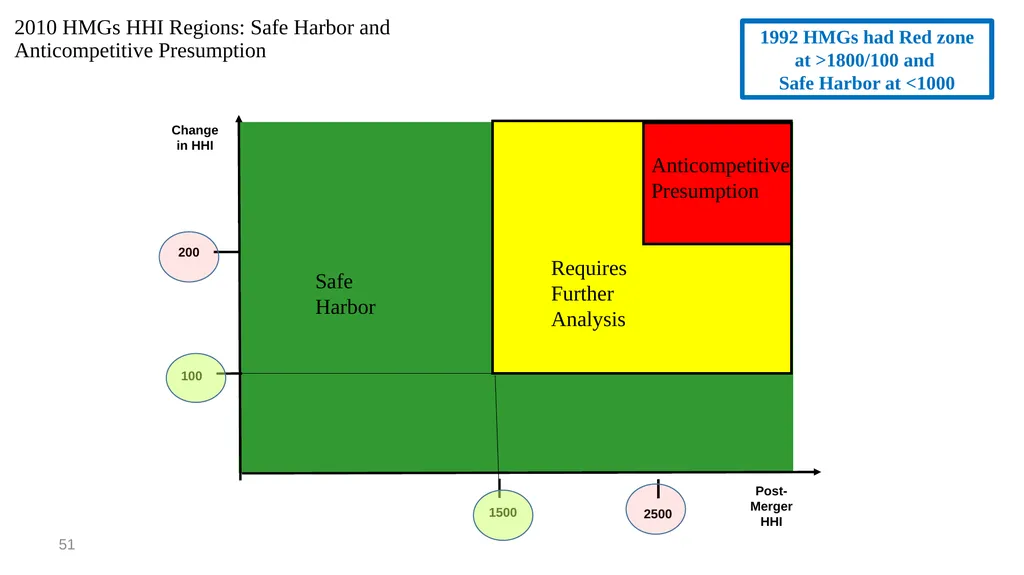
slide51. 51 2010 HMGs HHI Regions: Safe Harbor and Anticompetitive Presumption Change
in HHI Post-
Merger
HHI 1500 2500 100 200 Safe Harbor Anticompetitive
Presumption Requires Further Analysis 1992 HMGs had Red zone at >1800/100 and
Safe Harbor at <1000<br>
slide52. SideBar: Evolution of HHI Presumption Thresholds 52<br>
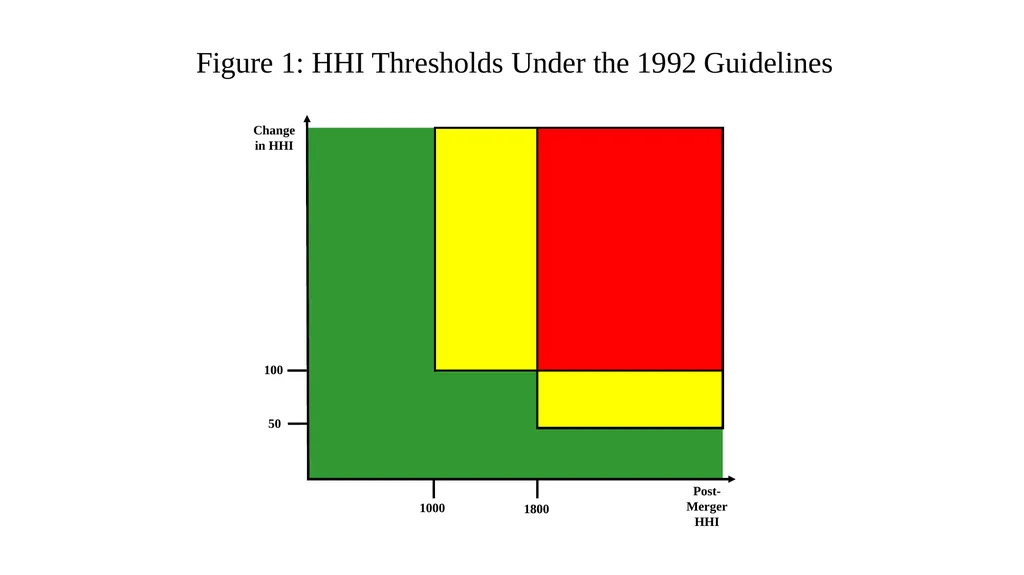
slide53. Figure 1: HHI Thresholds Under the 1992 Guidelines Change
in HHI Post-
Merger
HHI 1000 1800 50 100<br>
slide54. Mondrian: Composition II in Red, Blue, and Yellow Mondrian, 1930<br>
slide55. T-Mobile/Sprint Merger: A Case Study of Merger Analysis and Litigation 55<br>
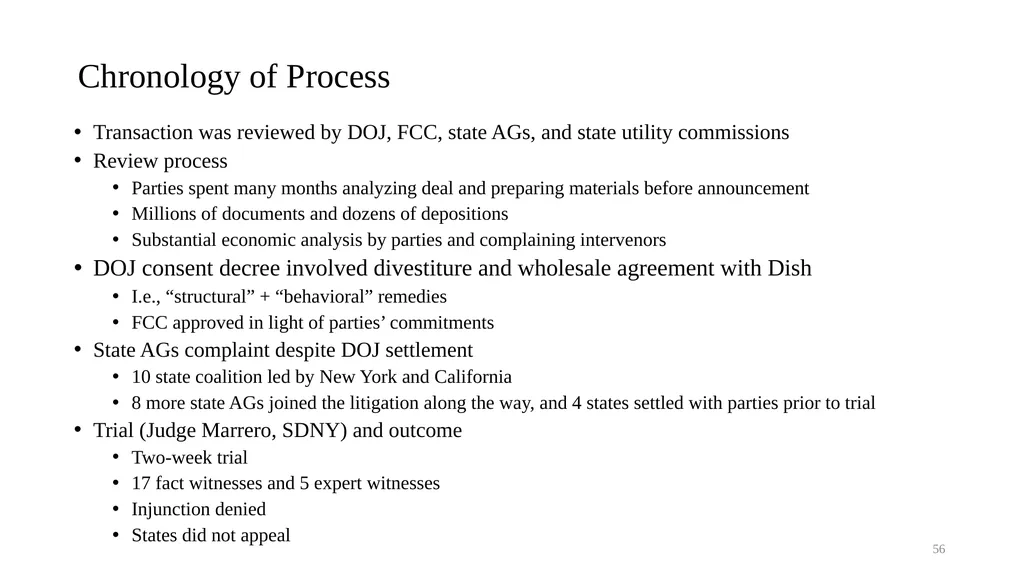
slide56. Chronology of Process Transaction was reviewed by DOJ, FCC, state AGs, and state utility commissions
Review process
Parties spent many months analyzing deal and preparing materials before announcement
Millions of documents and dozens of depositions
Substantial economic analysis by parties and complaining intervenors
DOJ consent decree involved divestiture and wholesale agreement with Dish
I.e., “structural” + “behavioral” remedies
FCC approved in light of parties’ commitments
State AGs complaint despite DOJ settlement
10 state coalition led by New York and California
8 more state AGs joined the litigation along the way, and 4 states settled with parties prior to trial
Trial (Judge Marrero, SDNY) and outcome
Two-week trial
17 fact witnesses and 5 expert witnesses
Injunction denied
States did not appeal 56<br>
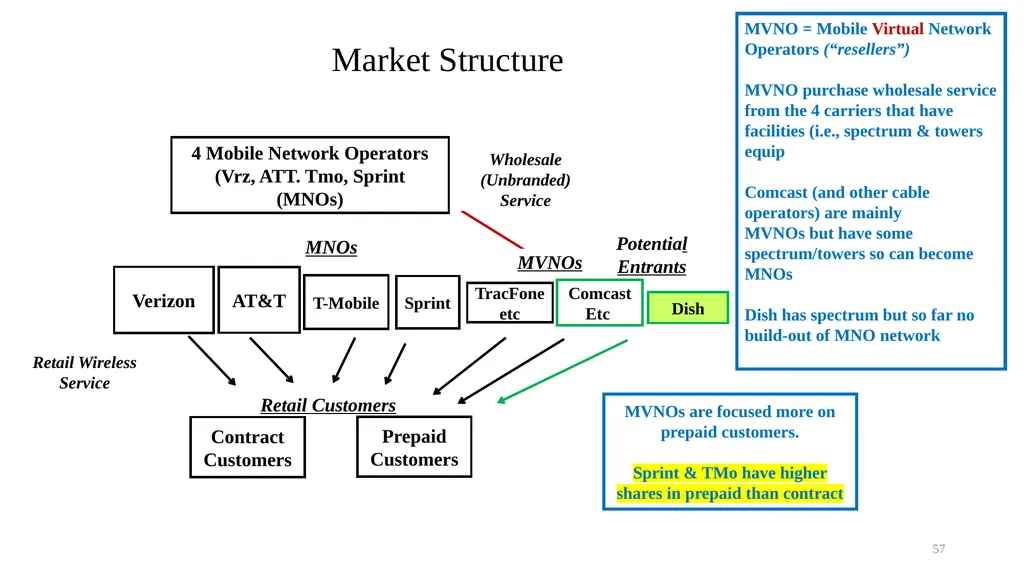
slide57. Market Structure Verizon Contract Customers 57 AT&T T-Mobile MVNOs Wholesale (Unbranded) Service MVNOs are focused more on prepaid customers.
Sprint & TMo have higher shares in prepaid than contract Sprint TracFoneetc Dish MNOs 4 Mobile Network Operators (Vrz, ATT. Tmo, Sprint
(MNOs) Retail Wireless Service Prepaid Customers Retail Customers Comcast
Etc Potential Entrants MVNO = Mobile Virtual Network Operators (“resellers”)
MVNO purchase wholesale service from the 4 carriers that have facilities (i.e., spectrum & towers equip
Comcast (and other cable operators) are mainly
MVNOs but have some spectrum/towers so can become MNOs
Dish has spectrum but so far no build-out of MNO network<br>
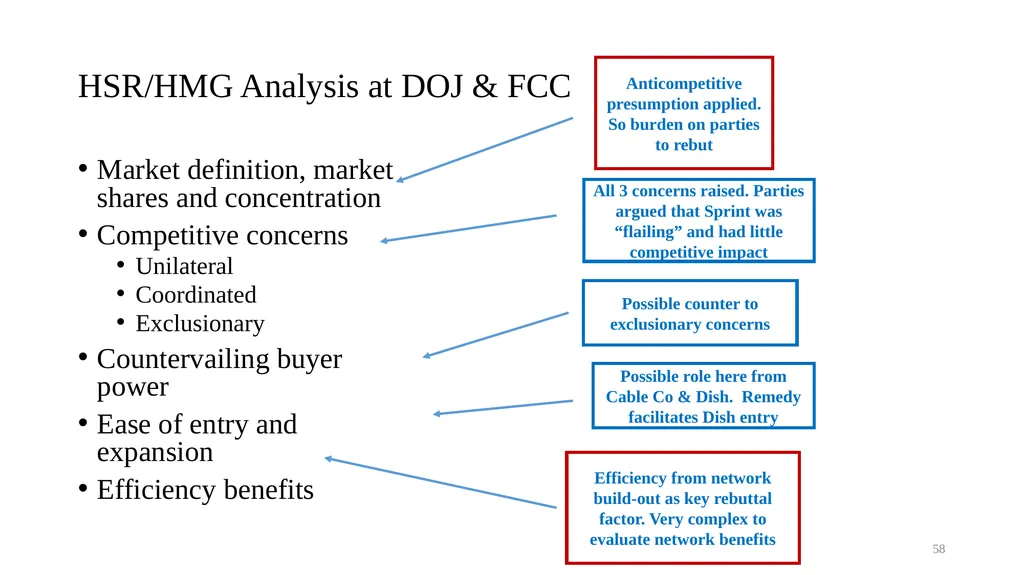
slide58. HSR/HMG Analysis at DOJ & FCC Market definition, market shares and concentration
Competitive concerns
Unilateral
Coordinated
Exclusionary
Countervailing buyer power
Ease of entry and expansion
Efficiency benefits Efficiency from network build-out as key rebuttal factor. Very complex to evaluate network benefits Anticompetitive presumption applied. So burden on parties to rebut All 3 concerns raised. Parties argued that Sprint was “flailing” and had little competitive impact Possible role here from Cable Co & Dish. Remedy facilitates Dish entry Possible counter to exclusionary concerns 58<br>
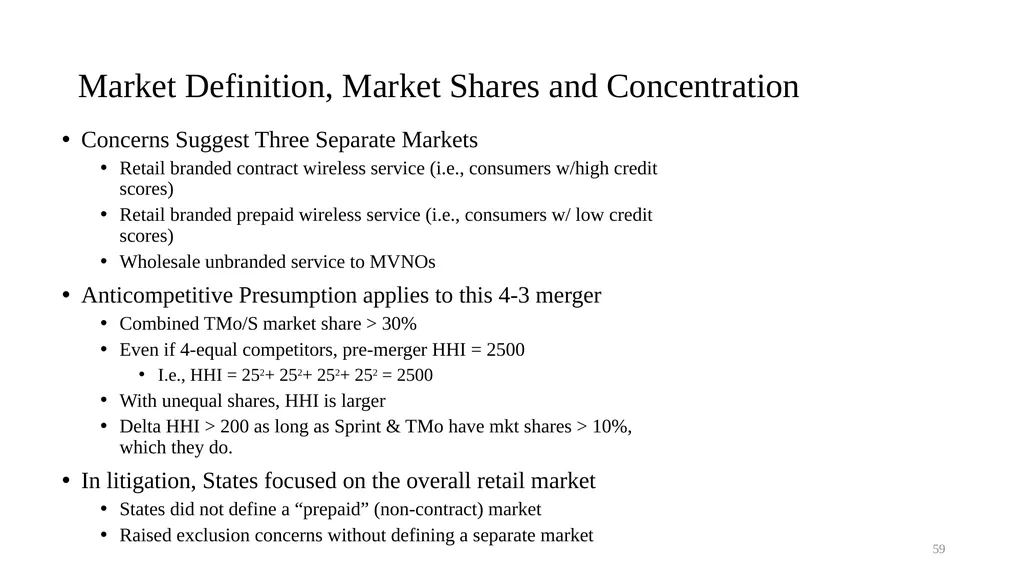
slide59. Market Definition, Market Shares and Concentration Concerns Suggest Three Separate Markets
Retail branded contract wireless service (i.e., consumers w/high credit scores)
Retail branded prepaid wireless service (i.e., consumers w/ low credit scores)
Wholesale unbranded service to MVNOs
Anticompetitive Presumption applies to this 4-3 merger
Combined TMo/S market share > 30%
Even if 4-equal competitors, pre-merger HHI = 2500
I.e., HHI = 252+ 252+ 252+ 252 = 2500
With unequal shares, HHI is larger
Delta HHI > 200 as long as Sprint & TMo have mkt shares > 10%, which they do.
In litigation, States focused on the overall retail market
States did not define a “prepaid” (non-contract) market
Raised exclusion concerns without defining a separate market 59<br>
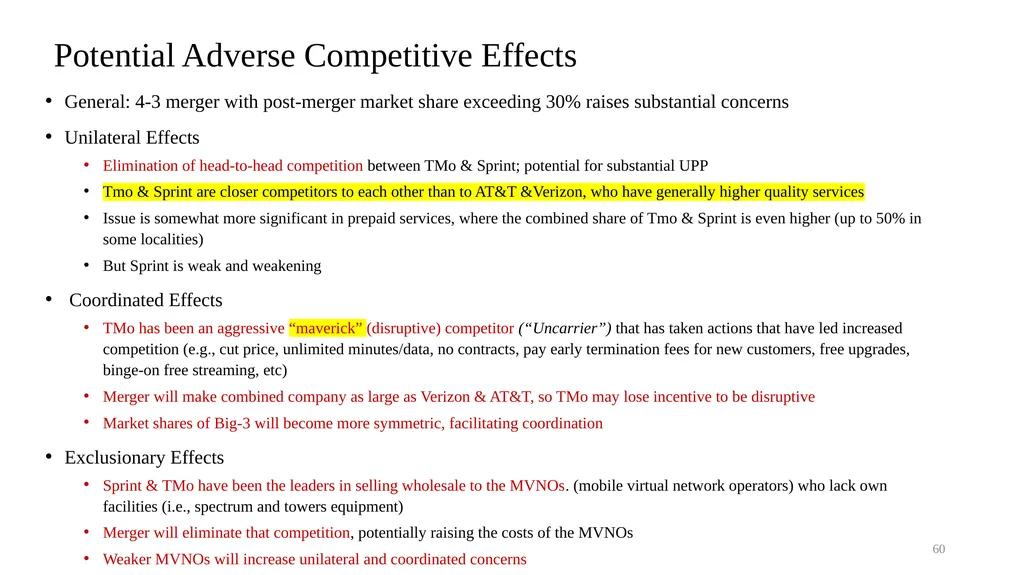
slide60. Potential Adverse Competitive Effects General: 4-3 merger with post-merger market share exceeding 30% raises substantial concerns
Unilateral Effects
Elimination of head-to-head competition between TMo & Sprint; potential for substantial UPP
Tmo & Sprint are closer competitors to each other than to AT&T &Verizon, who have generally higher quality services
Issue is somewhat more significant in prepaid services, where the combined share of Tmo & Sprint is even higher (up to 50% in some localities)
But Sprint is weak and weakening
Coordinated Effects
TMo has been an aggressive “maverick” (disruptive) competitor (“Uncarrier”) that has taken actions that have led increased competition (e.g., cut price, unlimited minutes/data, no contracts, pay early termination fees for new customers, free upgrades, binge-on free streaming, etc)
Merger will make combined company as large as Verizon & AT&T, so TMo may lose incentive to be disruptive
Market shares of Big-3 will become more symmetric, facilitating coordination
Exclusionary Effects
Sprint & TMo have been the leaders in selling wholesale to the MVNOs. (mobile virtual network operators) who lack own facilities (i.e., spectrum and towers equipment)
Merger will eliminate that competition, potentially raising the costs of the MVNOs
Weaker MVNOs will increase unilateral and coordinated concerns 60<br>
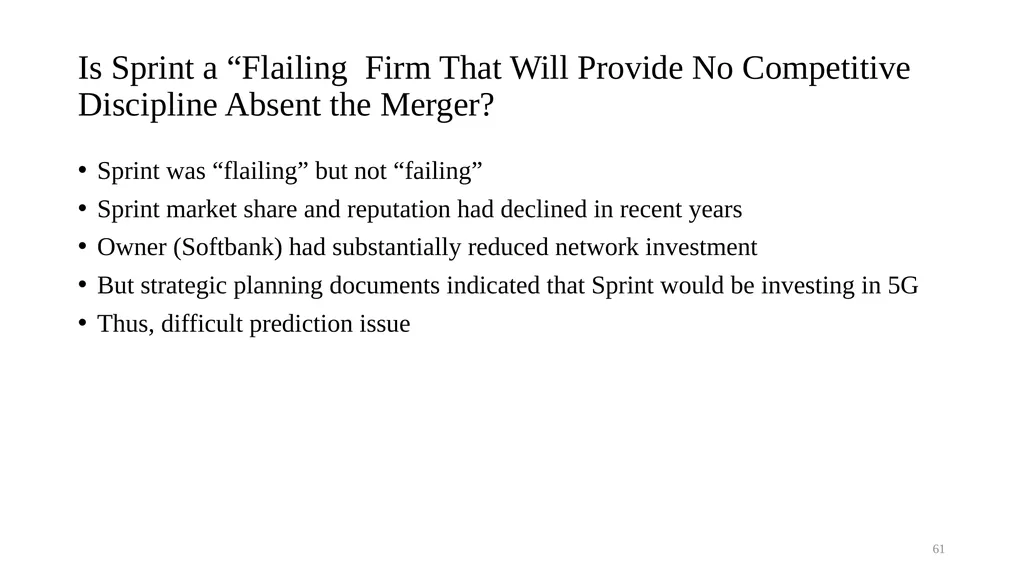
slide61. Is Sprint a “Flailing Firm That Will Provide No Competitive Discipline Absent the Merger? Sprint was “flailing” but not “failing”
Sprint market share and reputation had declined in recent years
Owner (Softbank) had substantially reduced network investment
But strategic planning documents indicated that Sprint would be investing in 5G
Thus, difficult prediction issue 61<br>
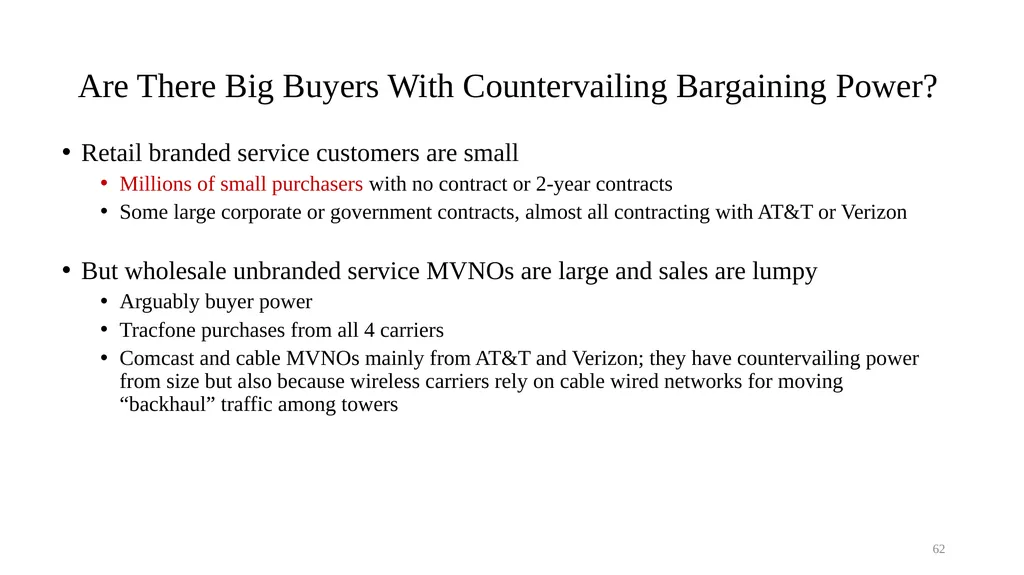
slide62. Are There Big Buyers With Countervailing Bargaining Power? Retail branded service customers are small
Millions of small purchasers with no contract or 2-year contracts
Some large corporate or government contracts, almost all contracting with AT&T or Verizon
But wholesale unbranded service MVNOs are large and sales are lumpy
Arguably buyer power
Tracfone purchases from all 4 carriers
Comcast and cable MVNOs mainly from AT&T and Verizon; they have countervailing power from size but also because wireless carriers rely on cable wired networks for moving “backhaul” traffic among towers 62<br>
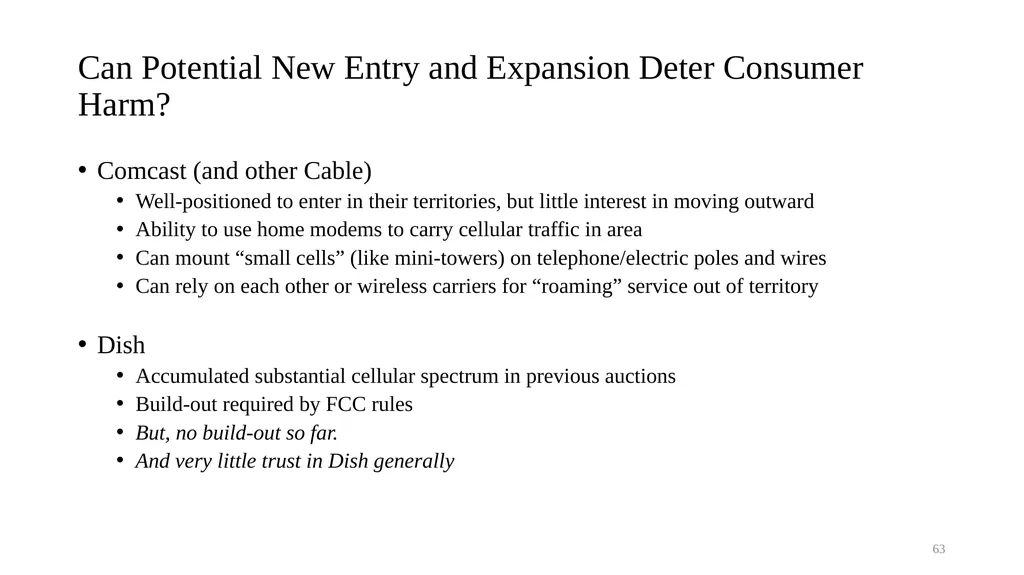
slide63. Can Potential New Entry and Expansion Deter Consumer Harm? Comcast (and other Cable)
Well-positioned to enter in their territories, but little interest in moving outward
Ability to use home modems to carry cellular traffic in area
Can mount “small cells” (like mini-towers) on telephone/electric poles and wires
Can rely on each other or wireless carriers for “roaming” service out of territory
Dish
Accumulated substantial cellular spectrum in previous auctions
Build-out required by FCC rules
But, no build-out so far.
And very little trust in Dish generally 63<br>
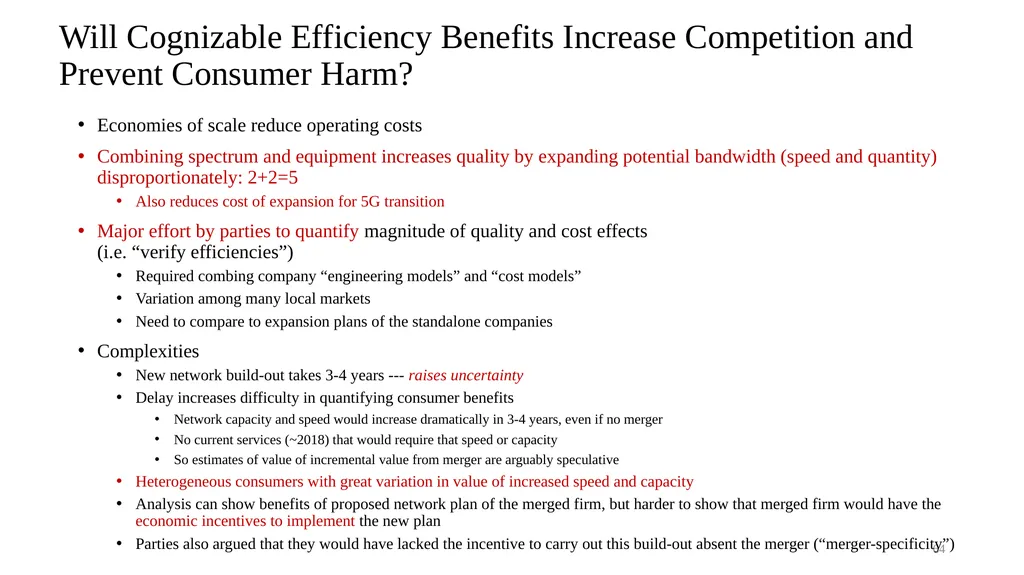
slide64. Will Cognizable Efficiency Benefits Increase Competition and Prevent Consumer Harm? Economies of scale reduce operating costs
Combining spectrum and equipment increases quality by expanding potential bandwidth (speed and quantity) disproportionately: 2+2=5
Also reduces cost of expansion for 5G transition
Major effort by parties to quantify magnitude of quality and cost effects (i.e. “verify efficiencies”)
Required combing company “engineering models” and “cost models”
Variation among many local markets
Need to compare to expansion plans of the standalone companies
Complexities
New network build-out takes 3-4 years --- raises uncertainty
Delay increases difficulty in quantifying consumer benefits
Network capacity and speed would increase dramatically in 3-4 years, even if no merger
No current services (~2018) that would require that speed or capacity
So estimates of value of incremental value from merger are arguably speculative
Heterogeneous consumers with great variation in value of increased speed and capacity
Analysis can show benefits of proposed network plan of the merged firm, but harder to show that merged firm would have the economic incentives to implement the new plan
Parties also argued that they would have lacked the incentive to carry out this build-out absent the merger (“merger-specificity”) 64<br>
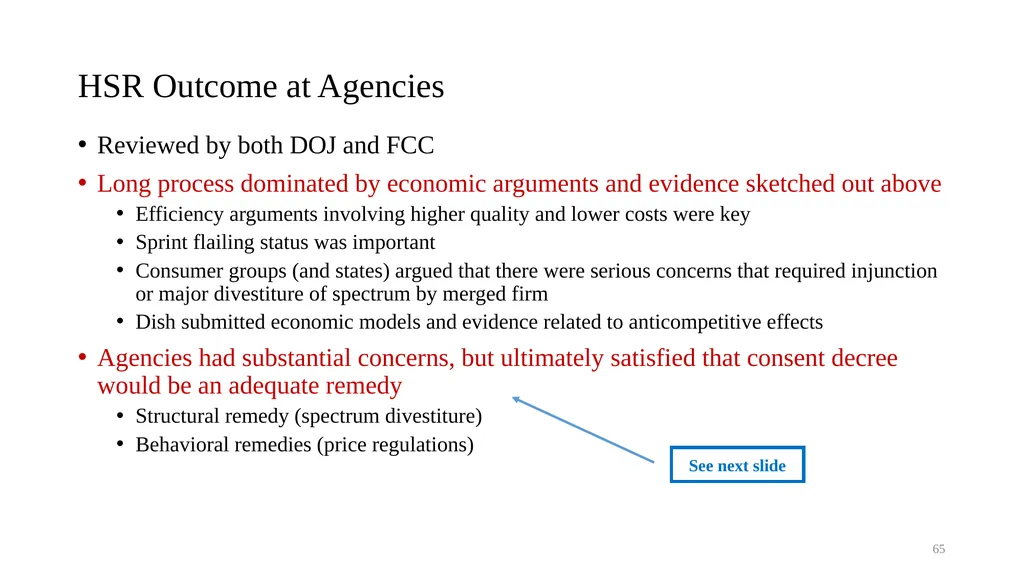
slide65. HSR Outcome at Agencies Reviewed by both DOJ and FCC
Long process dominated by economic arguments and evidence sketched out above
Efficiency arguments involving higher quality and lower costs were key
Sprint flailing status was important
Consumer groups (and states) argued that there were serious concerns that required injunction or major divestiture of spectrum by merged firm
Dish submitted economic models and evidence related to anticompetitive effects
Agencies had substantial concerns, but ultimately satisfied that consent decree would be an adequate remedy
Structural remedy (spectrum divestiture)
Behavioral remedies (price regulations) 65 See next slide<br>
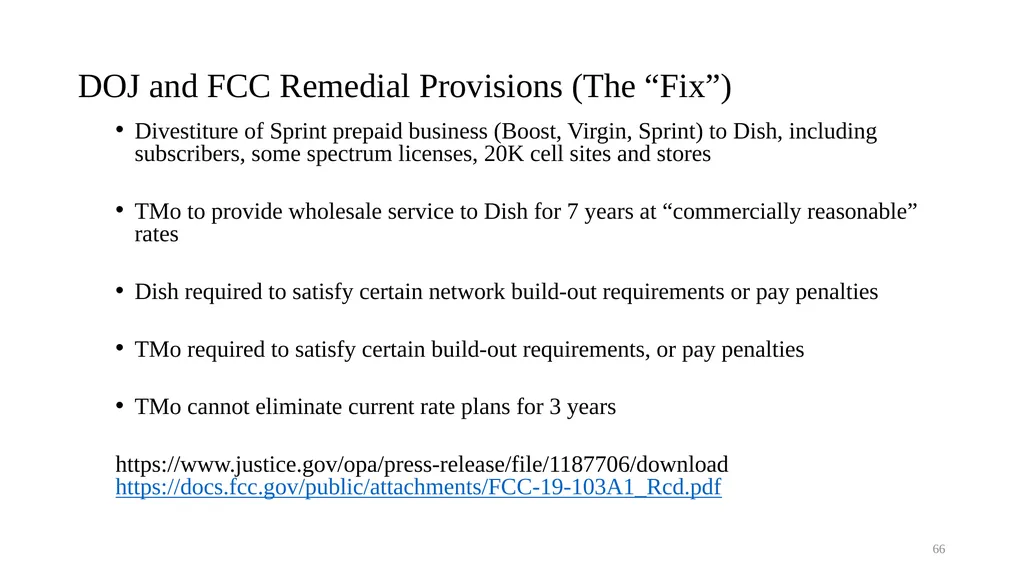
slide66. DOJ and FCC Remedial Provisions (The “Fix”) Divestiture of Sprint prepaid business (Boost, Virgin, Sprint) to Dish, including subscribers, some spectrum licenses, 20K cell sites and stores
TMo to provide wholesale service to Dish for 7 years at “commercially reasonable” rates
Dish required to satisfy certain network build-out requirements or pay penalties
TMo required to satisfy certain build-out requirements, or pay penalties
TMo cannot eliminate current rate plans for 3 years
https://www.justice.gov/opa/press-release/file/1187706/download https://docs.fcc.gov/public/attachments/FCC-19-103A1_Rcd.pdf 66<br>
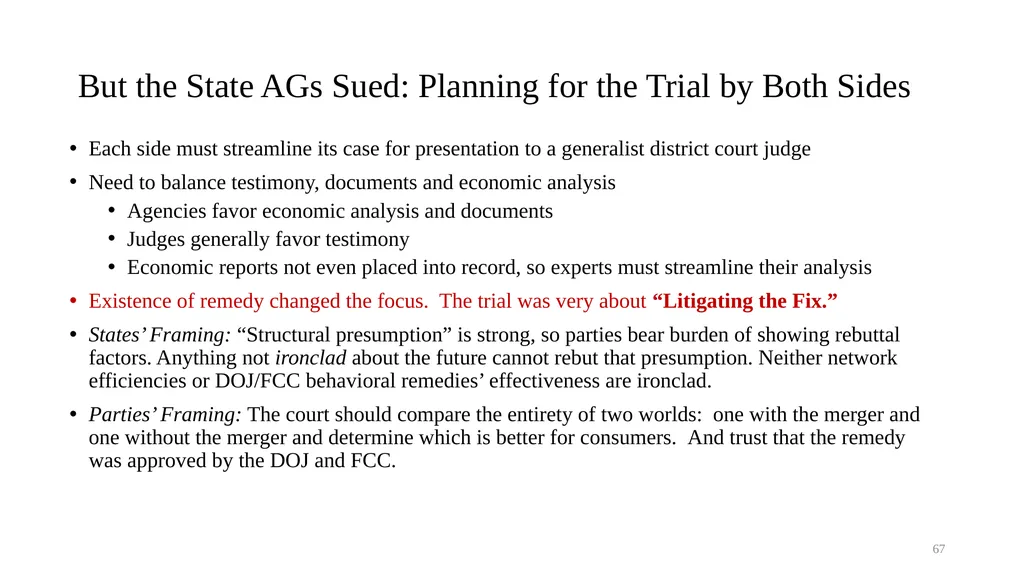
slide67. But the State AGs Sued: Planning for the Trial by Both Sides Each side must streamline its case for presentation to a generalist district court judge
Need to balance testimony, documents and economic analysis
Agencies favor economic analysis and documents
Judges generally favor testimony
Economic reports not even placed into record, so experts must streamline their analysis
Existence of remedy changed the focus. The trial was very about “Litigating the Fix.”
States’ Framing: “Structural presumption” is strong, so parties bear burden of showing rebuttal factors. Anything not ironclad about the future cannot rebut that presumption. Neither network efficiencies or DOJ/FCC behavioral remedies’ effectiveness are ironclad.
Parties’ Framing: The court should compare the entirety of two worlds: one with the merger and one without the merger and determine which is better for consumers. And trust that the remedy was approved by the DOJ and FCC. 67<br>
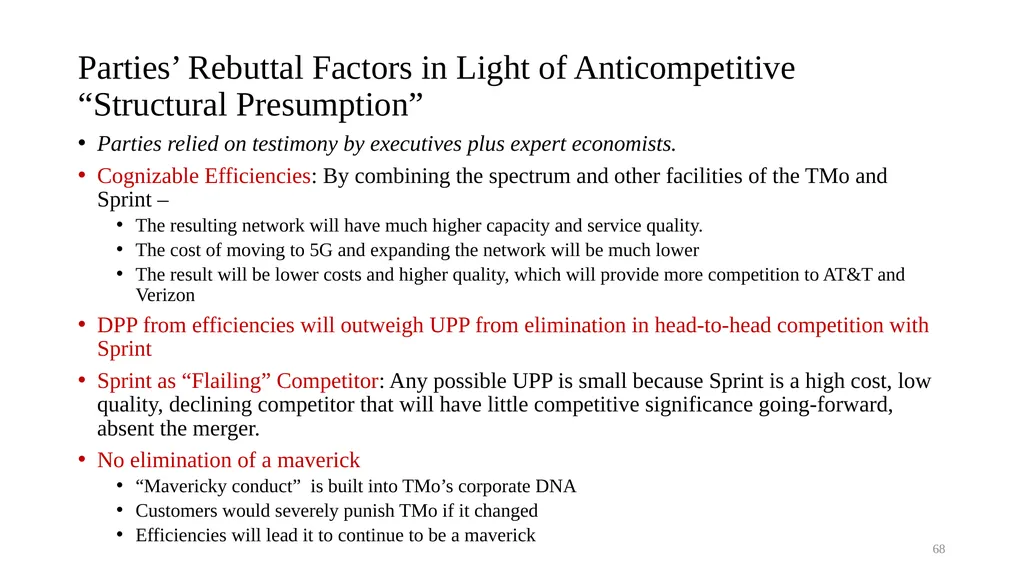
slide68. Parties’ Rebuttal Factors in Light of Anticompetitive “Structural Presumption” Parties relied on testimony by executives plus expert economists.
Cognizable Efficiencies: By combining the spectrum and other facilities of the TMo and Sprint –
The resulting network will have much higher capacity and service quality.
The cost of moving to 5G and expanding the network will be much lower
The result will be lower costs and higher quality, which will provide more competition to AT&T and Verizon
DPP from efficiencies will outweigh UPP from elimination in head-to-head competition with Sprint
Sprint as “Flailing” Competitor: Any possible UPP is small because Sprint is a high cost, low quality, declining competitor that will have little competitive significance going-forward, absent the merger.
No elimination of a maverick
“Mavericky conduct” is built into TMo’s corporate DNA
Customers would severely punish TMo if it changed
Efficiencies will lead it to continue to be a maverick 68<br>
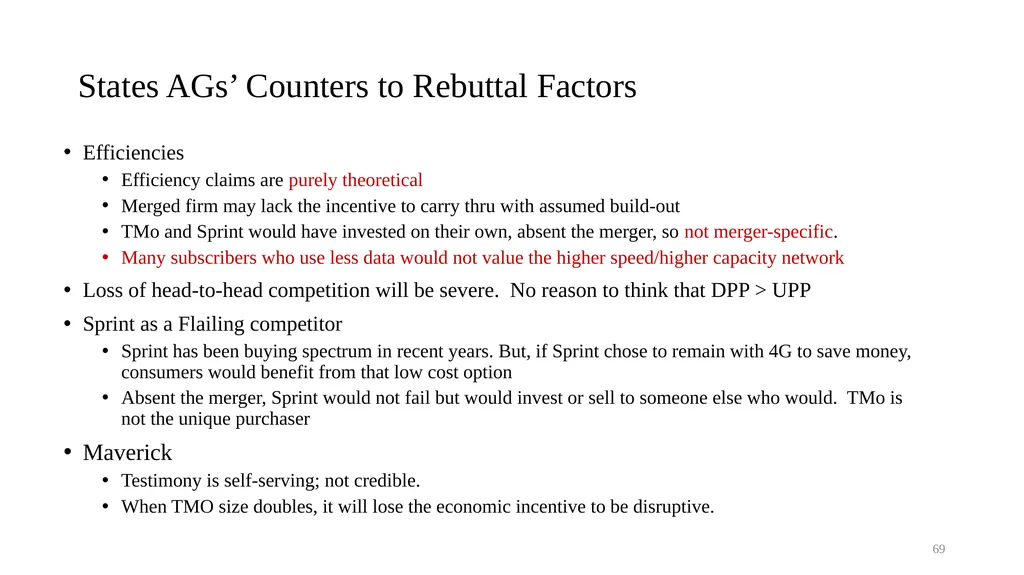
slide69. States AGs’ Counters to Rebuttal Factors Efficiencies
Efficiency claims are purely theoretical
Merged firm may lack the incentive to carry thru with assumed build-out
TMo and Sprint would have invested on their own, absent the merger, so not merger-specific.
Many subscribers who use less data would not value the higher speed/higher capacity network
Loss of head-to-head competition will be severe. No reason to think that DPP > UPP
Sprint as a Flailing competitor
Sprint has been buying spectrum in recent years. But, if Sprint chose to remain with 4G to save money, consumers would benefit from that low cost option
Absent the merger, Sprint would not fail but would invest or sell to someone else who would. TMo is not the unique purchaser
Maverick
Testimony is self-serving; not credible.
When TMO size doubles, it will lose the economic incentive to be disruptive. 69<br>
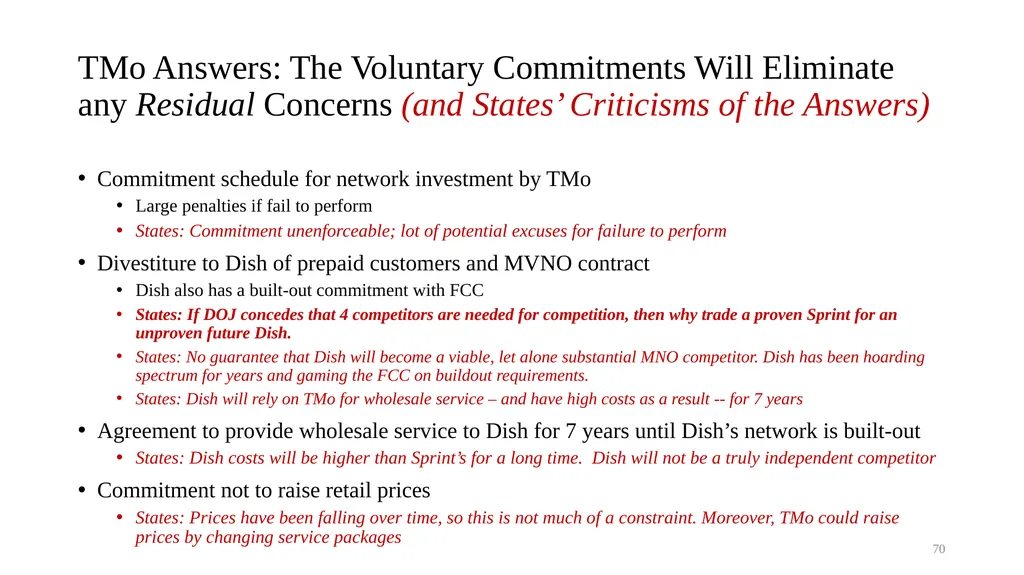
slide70. TMo Answers: The Voluntary Commitments Will Eliminate any Residual Concerns (and States’ Criticisms of the Answers) Commitment schedule for network investment by TMo
Large penalties if fail to perform
States: Commitment unenforceable; lot of potential excuses for failure to perform
Divestiture to Dish of prepaid customers and MVNO contract
Dish also has a built-out commitment with FCC
States: If DOJ concedes that 4 competitors are needed for competition, then why trade a proven Sprint for an unproven future Dish.
States: No guarantee that Dish will become a viable, let alone substantial MNO competitor. Dish has been hoarding spectrum for years and gaming the FCC on buildout requirements.
States: Dish will rely on TMo for wholesale service – and have high costs as a result -- for 7 years
Agreement to provide wholesale service to Dish for 7 years until Dish’s network is built-out
States: Dish costs will be higher than Sprint’s for a long time. Dish will not be a truly independent competitor
Commitment not to raise retail prices
States: Prices have been falling over time, so this is not much of a constraint. Moreover, TMo could raise prices by changing service packages 70<br>
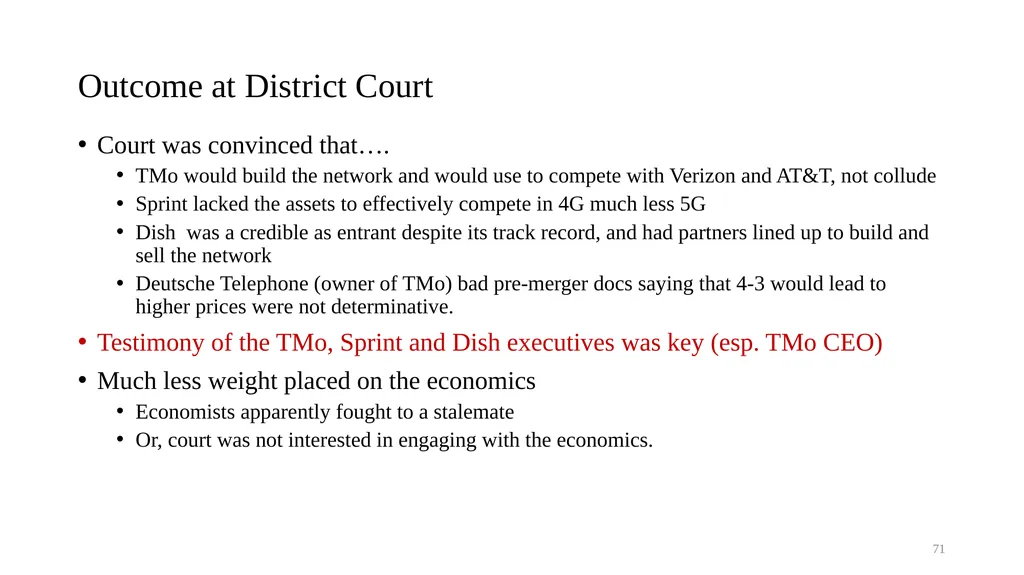
slide71. Outcome at District Court Court was convinced that….
TMo would build the network and would use to compete with Verizon and AT&T, not collude
Sprint lacked the assets to effectively compete in 4G much less 5G
Dish was a credible as entrant despite its track record, and had partners lined up to build and sell the network
Deutsche Telephone (owner of TMo) bad pre-merger docs saying that 4-3 would lead to higher prices were not determinative.
Testimony of the TMo, Sprint and Dish executives was key (esp. TMo CEO)
Much less weight placed on the economics
Economists apparently fought to a stalemate
Or, court was not interested in engaging with the economics. 71<br>
slide72. For a complementary analysis, see Skadden’s Webinar Deck (posted on Canvas) 72<br>
slide73. Looking Ahead to Topic 10 Market Definition in Merger Analysis<br>
slide74. Why Define Markets: Antitrust Law and Merger Law Antitrust law generally
Focus is harm from market power
But, to measure market power, it sometimes is convenient to define a market
(And some erroneously argue that you “must” define a market in order to measure market power.)
Merger law
Section 7 language line of commerce/section of the country (but arguably a matter of interpretation)
A formal market definition is necessary for calculating market shares and concentration
Anticompetitive Presumption based on Concentration (HHI)
Courts use concentration and market shares as evidence 74<br>
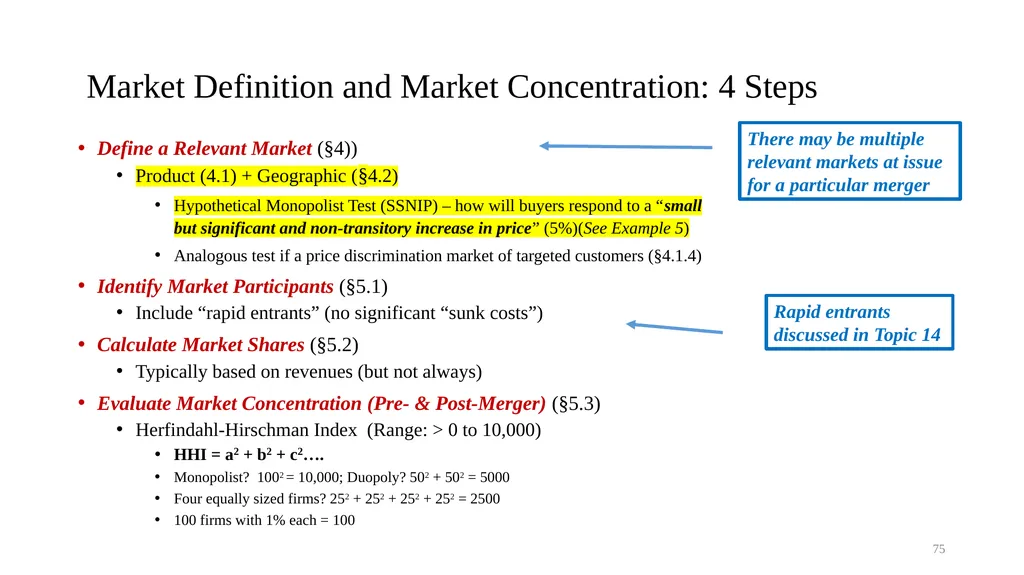
slide75. Market Definition and Market Concentration: 4 Steps Define a Relevant Market (§4))
Product (4.1) + Geographic (§4.2)
Hypothetical Monopolist Test (SSNIP) – how will buyers respond to a “small but significant and non-transitory increase in price” (5%)(See Example 5)
Analogous test if a price discrimination market of targeted customers (§4.1.4)
Identify Market Participants (§5.1)
Include “rapid entrants” (no significant “sunk costs”)
Calculate Market Shares (§5.2)
Typically based on revenues (but not always)
Evaluate Market Concentration (Pre- & Post-Merger) (§5.3)
Herfindahl-Hirschman Index (Range: > 0 to 10,000)
HHI = a2 + b2 + c2….
Monopolist? 1002 = 10,000; Duopoly? 502 + 502 = 5000
Four equally sized firms? 252 + 252 + 252 + 252 = 2500
100 firms with 1% each = 100 75 There may be multiple relevant markets at issue for a particular merger Rapid entrants discussed in Topic 14<br>
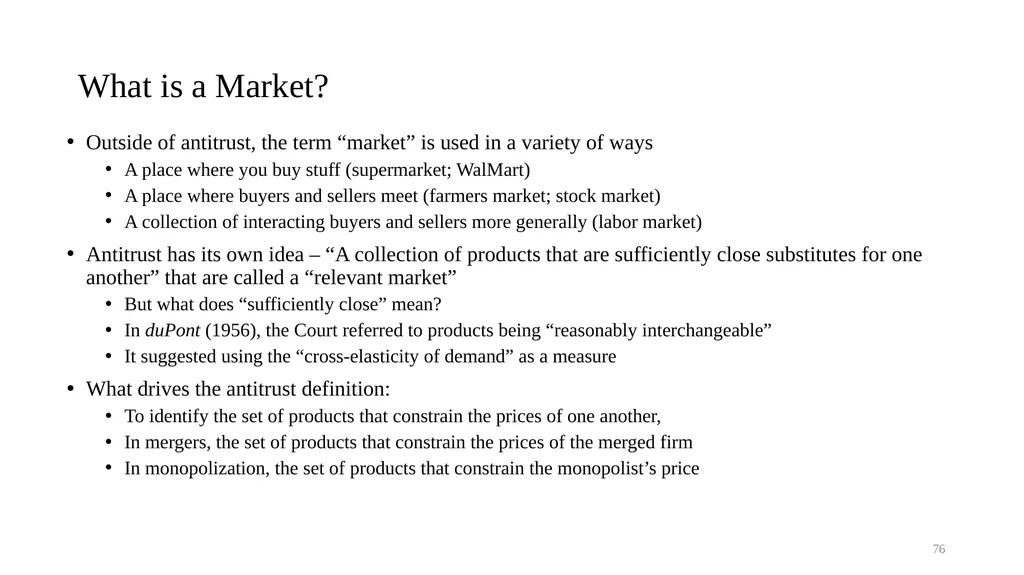
slide76. What is a Market? Outside of antitrust, the term “market” is used in a variety of ways
A place where you buy stuff (supermarket; WalMart)
A place where buyers and sellers meet (farmers market; stock market)
A collection of interacting buyers and sellers more generally (labor market)
Antitrust has its own idea – “A collection of products that are sufficiently close substitutes for one another” that are called a “relevant market”
But what does “sufficiently close” mean?
In duPont (1956), the Court referred to products being “reasonably interchangeable”
It suggested using the “cross-elasticity of demand” as a measure
What drives the antitrust definition:
To identify the set of products that constrain the prices of one another,
In mergers, the set of products that constrain the prices of the merged firm
In monopolization, the set of products that constrain the monopolist’s price 76<br>
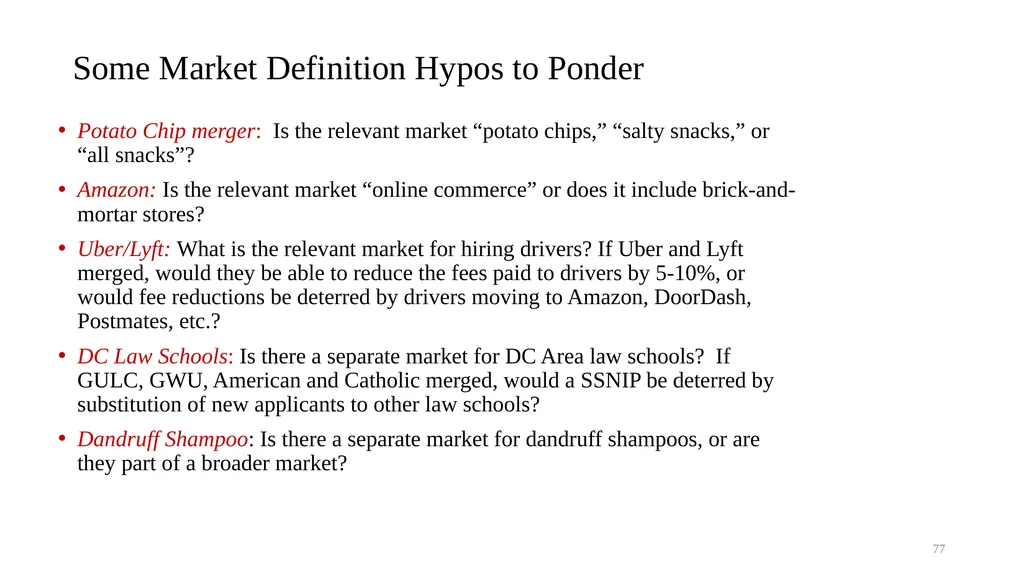
slide77. Some Market Definition Hypos to Ponder Potato Chip merger: Is the relevant market “potato chips,” “salty snacks,” or “all snacks”?
Amazon: Is the relevant market “online commerce” or does it include brick-and-mortar stores?
Uber/Lyft: What is the relevant market for hiring drivers? If Uber and Lyft merged, would they be able to reduce the fees paid to drivers by 5-10%, or would fee reductions be deterred by drivers moving to Amazon, DoorDash, Postmates, etc.?
DC Law Schools: Is there a separate market for DC Area law schools? If GULC, GWU, American and Catholic merged, would a SSNIP be deterred by substitution of new applicants to other law schools?
Dandruff Shampoo: Is there a separate market for dandruff shampoos, or are they part of a broader market? 77<br>
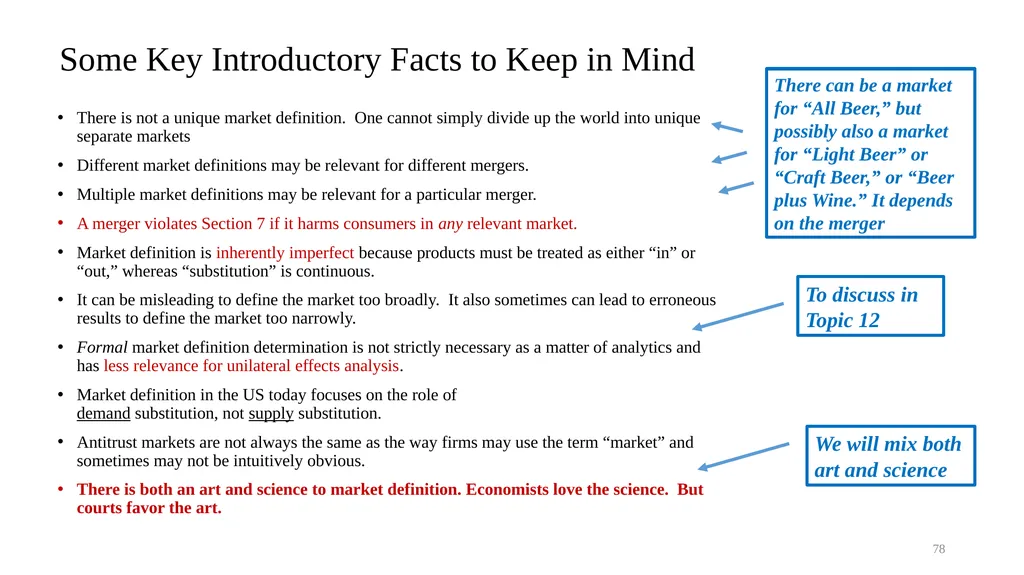
slide78. Some Key Introductory Facts to Keep in Mind There is not a unique market definition. One cannot simply divide up the world into unique separate markets
Different market definitions may be relevant for different mergers.
Multiple market definitions may be relevant for a particular merger.
A merger violates Section 7 if it harms consumers in any relevant market.
Market definition is inherently imperfect because products must be treated as either “in” or “out,” whereas “substitution” is continuous.
It can be misleading to define the market too broadly. It also sometimes can lead to erroneous results to define the market too narrowly.
Formal market definition determination is not strictly necessary as a matter of analytics and has less relevance for unilateral effects analysis.
Market definition in the US today focuses on the role of demand substitution, not supply substitution.
Antitrust markets are not always the same as the way firms may use the term “market” and sometimes may not be intuitively obvious.
There is both an art and science to market definition. Economists love the science. But courts favor the art. 78 There can be a market for “All Beer,” but possibly also a market for “Light Beer” or “Craft Beer,” or “Beer plus Wine.” It depends on the merger We will mix both art and science To discuss in Topic 12<br>
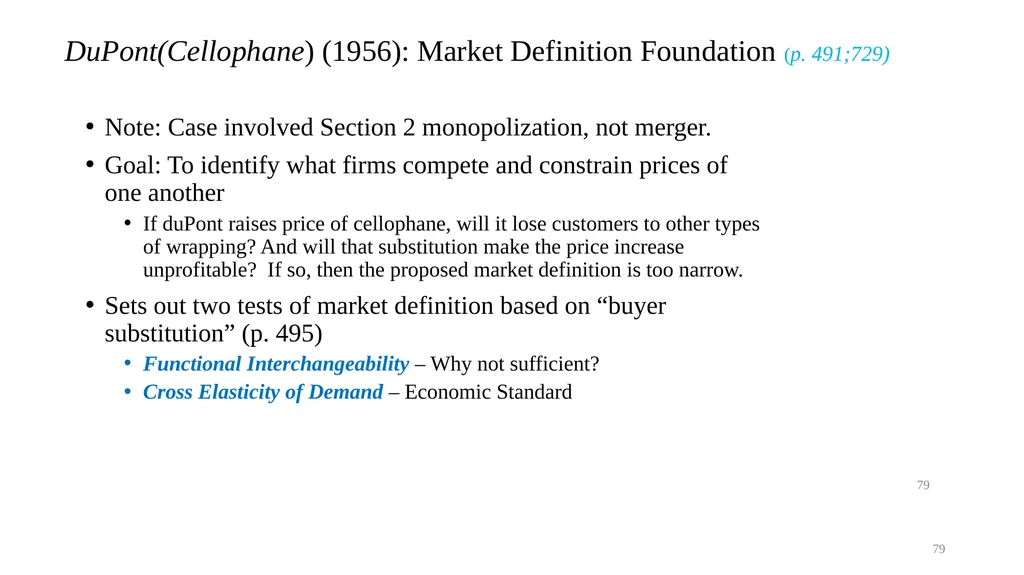
slide79. DuPont(Cellophane) (1956): Market Definition Foundation (p. 491;729) Note: Case involved Section 2 monopolization, not merger.
Goal: To identify what firms compete and constrain prices of one another
If duPont raises price of cellophane, will it lose customers to other types of wrapping? And will that substitution make the price increase unprofitable? If so, then the proposed market definition is too narrow.
Sets out two tests of market definition based on “buyer substitution” (p. 495)
Functional Interchangeability – Why not sufficient?
Cross Elasticity of Demand – Economic Standard 79 79<br>
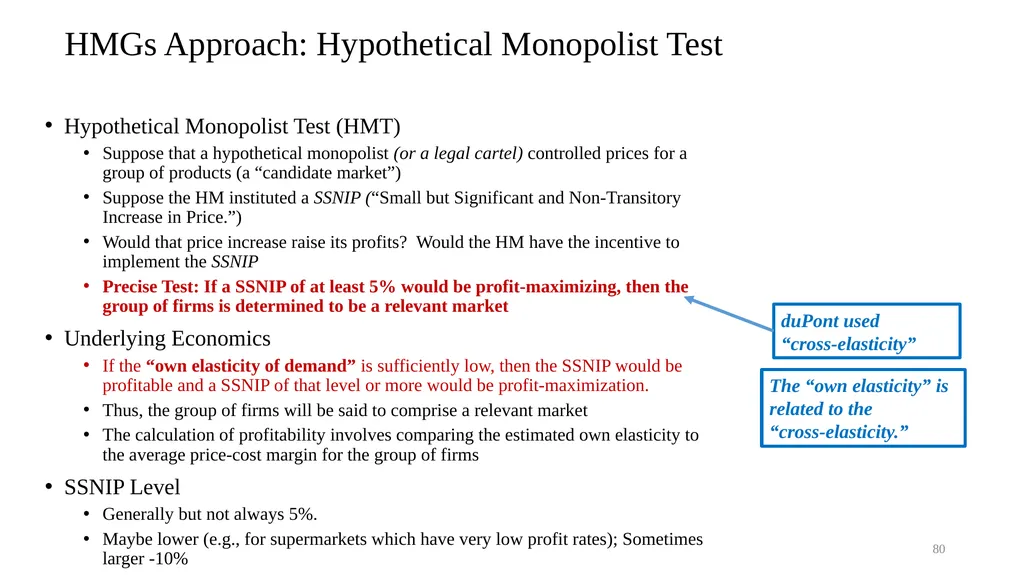
slide80. HMGs Approach: Hypothetical Monopolist Test Hypothetical Monopolist Test (HMT)
Suppose that a hypothetical monopolist (or a legal cartel) controlled prices for a group of products (a “candidate market”)
Suppose the HM instituted a SSNIP (“Small but Significant and Non-Transitory Increase in Price.”)
Would that price increase raise its profits? Would the HM have the incentive to implement the SSNIP
Precise Test: If a SSNIP of at least 5% would be profit-maximizing, then the group of firms is determined to be a relevant market
Underlying Economics
If the “own elasticity of demand” is sufficiently low, then the SSNIP would be profitable and a SSNIP of that level or more would be profit-maximization.
Thus, the group of firms will be said to comprise a relevant market
The calculation of profitability involves comparing the estimated own elasticity to the average price-cost margin for the group of firms
SSNIP Level
Generally but not always 5%.
Maybe lower (e.g., for supermarkets which have very low profit rates); Sometimes larger -10% 80 The “own elasticity” is related to the “cross-elasticity.” duPont used “cross-elasticity”<br>
slide81. Appendix/Sidebar: Economic Diagrams in More Detail 81<br>
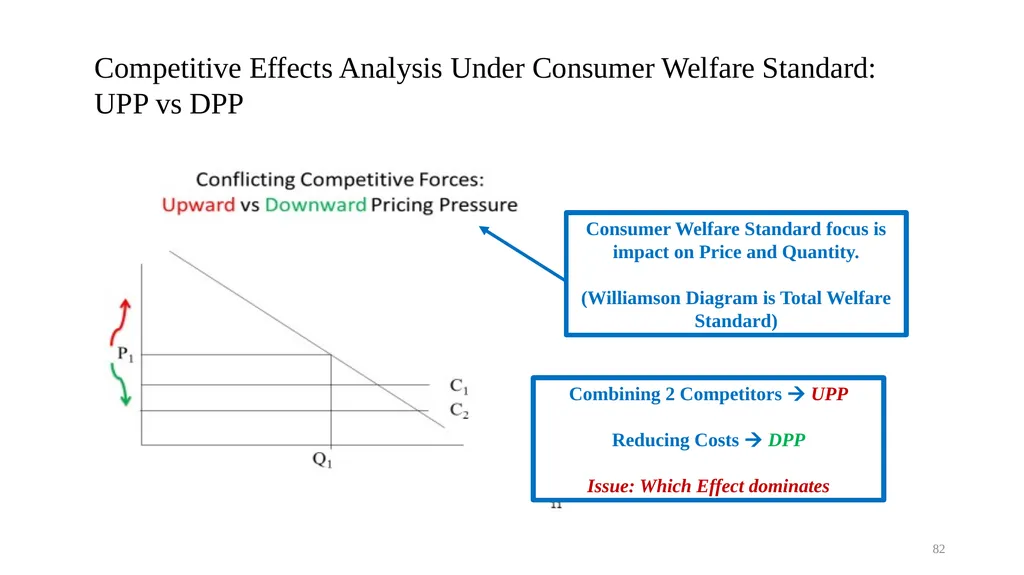
slide82. 82 Competitive Effects Analysis Under Consumer Welfare Standard: UPP vs DPP Consumer Welfare Standard focus is impact on Price and Quantity.
(Williamson Diagram is Total Welfare Standard) Combining 2 Competitors UPP
Reducing Costs DPP
Issue: Which Effect dominates<br>
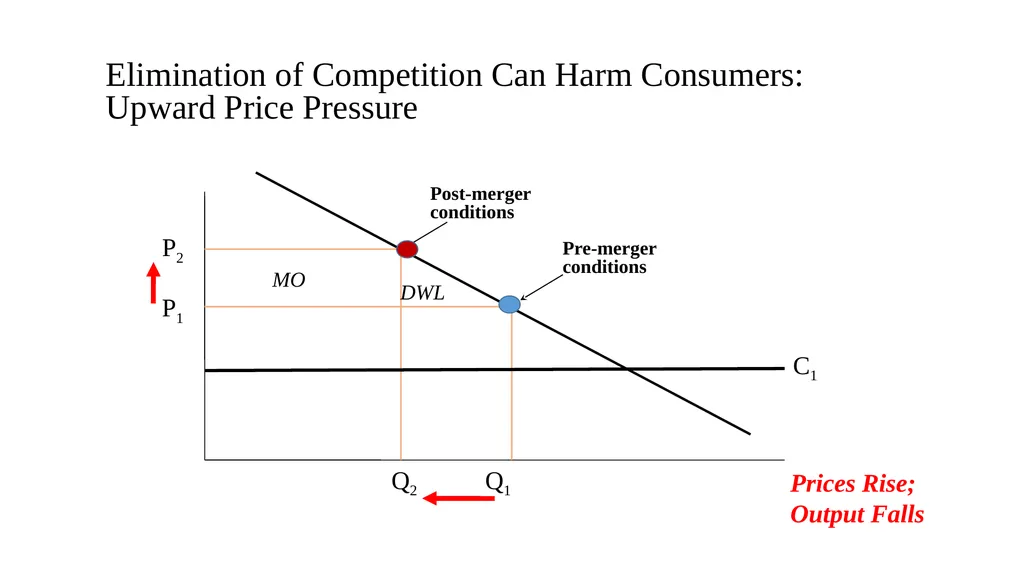
slide83. Elimination of Competition Can Harm Consumers: Upward Price Pressure 83 P1 P2 C1 Q2 Q1 MO DWL Pre-merger
conditions Prices Rise;
Output Falls Post-merger
conditions<br>
slide84. 84 Merger Efficiencies Can Benefit Consumers: Downward Price Pressure Prices fall;
Output rises P1 P2 C1 Q2 Q1 C2 Pre-merger
conditions Post-merger
conditions<br>
slide85. Impact of Merger on Consumers: Which Effect Will Dominate? Will Price Rise or Fall on Balance? 85 P1 PL C1 QH Q1 C2 PH QL Pre-merger
conditions A merger can result in potentially conflicting incentives - some cost reduction, but also some market power. Post-merger
Conditions ???? Post-merger
Conditions ????<br>
slide86. 86 Net Effect-1: UPP > DPP Lower costs help; But, Consumers Harmed on Balance. Price Exceeds Pre-Merger Level Consumers lose;
Output falls P1 P2 C1 Q2 Q1 C2 P3 Q3 Pre-merger
conditions Post-merger
conditions<br>
slide87. 87 Net Effect-2: UPP < DPP Elim. of compet. hurts; But, Consumers Benefit on Balance. Price Falls Below Pre-Merger Level Consumers gain;
Output rises P1 P2 C1 Q2 Q1 C2 P3 Q3 Pre-merger
conditions Post-merger
conditions<br>
slide2. Overview: Background of The Structural Presumption Economic Theory
“Structure-Conduct-Performance” Paradigm
“Market Structure predicts conduct, which in turn determines economic performance”
Gauging Market Structure
Market shares concentration
Entry conditions
Product differentiation
Vertical integration
Modern Approach
Reduced role for concentration
Great role for economic evidence of likely competitive effects Application to Merger Law
High Concentration Inherently Suspect Merger
1960s Key Cases
Brown Shoe (1962)
Phila. Nat’l Bank (1963)
Von’s (1966)
Pabst (1966)
Later Key Cases that Relax the Paradigm
General Dynamics (1974)
Baker Hughes (1990)
Heinz (2001) 2<br>
slide3. Clayton Act Section 7 History: Three Stages of Development Clayton Act of 1914
Sherman only covered integration by contract (“combinations”), but not by acquisition
Clayton Act added prohibition of mergers or acquisitions
Celler-Kefauver Amendments of 1950
Response to limitations in language of Clayton Act and narrow interpretations by SCT
Legislative history is focus of discussion in Brown Shoe
Attempt to increase governmental merger enforcement
Hart-Scott-Rodino (HSR) Amendments (1976)
HSR created pre-merger notification system
In response to weakness of agencies having to litigate after merger occurred when “eggs could not be easily unscrambled”
Converted law enforcement into more of a regulatory system 3<br>
slide4. Current Section 7 (1950 Amendment) “No person engaged in commerce or in any activity affecting commerce shall acquire, directly or indirectly, the whole or any part of the stock or other share capital and no person subject to the jurisdiction of the Federal Trade Commission shall acquire the whole or any part of the assets of another person engaged also in commerce or in any activity affecting commerce, where in any line of commerce or in any activity affecting commerce in any section of the country, the effect of such acquisition may be substantially to lessen competition, or tend to create a monopoly.” 4 Encompasses “reasonable probability” or “appreciable risk”<br>
slide5. Brown Shoe – Motivations for Section 7 Amendments (p.682) The dominant theme pervading congressional consideration of the 1950 amendments was a fear of what was considered to be a rising tide of economic concentration in the American economy. *** Other considerations cited in support of the bill were the desirability of retaining ‘local control’ over industry and the protection of small businesses. Throughout the recorded discussion may be found examples of Congress’ fear not only of accelerated concentration of economic power on economic grounds, but also of the threat to other values a trend toward concentration was thought to pose. * * *
* * * [A] keystone in the erection of a barrier to what Congress saw was the rising tide of economic concentration, was its provision of authority for arresting mergers at a time when the trend to a lessening of competition in a line of commerce was still in its incipiency. Congress saw the process of concentration in American business as a dynamic force; it sought to assure the Federal Trade Commission and the courts the power to brake this force at its outset and before it gathered momentum. * * *
* * * [A]t the same time that it sought to create an effective tool for preventing all mergers having demonstrable anti-competitive effects, Congress recognized the stimulation to competition that might flow from particular mergers. 5 Brown Shoe – Motivations for Section 7 Amendments (p.682) Key language for NeoB’s<br>
slide6. Incipiency – Two Approaches Stop “trend towards concentration”…
Emphasized by Brown Shoe & other earlier cases
Emphasis on overall industry trends
No longer a focus of enforcement policy…
But growing populist movement to return focus here “Predict likely future impact” of merger…
Implemented by HSR system
Emphasis on merger’s probable effects
Degree of probability is key source of disagreement
Current approach 6 Antitrust policy and law never gets totally settled. Ideas are like Zombies that keep returning.
But some Zombies deserve to live!<br>
slide7. Brown Shoe: Basic Legal Standard The Court’s review of legislative history of 1950s amendment included the following discussion of the “may be … “ standard
“Congress used the words "may be substantially to lessen competition" (emphasis supplied), to indicate that its concern was with probabilities, not certainties. [Footnote 39] Statutes existed for dealing with clear-cut menaces to competition; no statute was sought for dealing with ephemeral possibilities. Mergers with a probable anticompetitive effect were to be proscribed by this Act.” 370 U. S. 323
Footnote 39: “"The use of these words ['may be'] means that the bill, if enacted, would not apply to the mere possibility, but only to the reasonable probability, of the prescribed [sic] effect. . . . The words 'may be' have been in section 7 of the Clayton Act since 1914. The concept of reasonable probability conveyed by these words is a necessary element in any statute which seeks to arrest restraints of trade in their incipiency and before they develop into full-fledged restraints violative of the Sherman Act. A requirement of certainty and actuality of injury to competition is incompatible with any effort to supplement the Sherman Act by reaching incipient restraints." 7<br>
slide8. Commentary on “Reasonable Probability Standard: “Reasonable probability” should be interpreted as a lower burden on the plaintiff (i.e., a more interventionist standard) than a standard of “more likely than not” to harm competition
“More likely than not” is the standard for the Sherman Act
By contrast, Section 7 was intended to reach additional conduct
The use of the term “incipiency” also expresses greater concern with false negatives than false positives
If the Congress or the Court meant that the standard should be “more likely than not,” they would have said so.
It follows that the plaintiff should have not have to show that the likelihood of harm is more than 50%
In later cases, the term “appreciable risk” sometimes is used, which also suggests a standard lower than 50+%
At the same time, the probability must be higher than what would be meant by “ephemeral” or “plausible”
But, note that conservative commentators or defense lawyers “likely” would push back on this commentary 8<br>
slide9. The Actual Brown Shoe Merger: Brown Acquires Kinney (p. 680) 9 Brown Shoe
4% Brown Shoe
6% Kinney
1.2% Kinney
.5% Manufacturing Retailing Pre-Merger
Both Were Vertically Integrated Merger alleged to raise horizontal merger effects and vertical (foreclosure) effects
Issue raised regarding market definition (all shoes? high vs low priced shoes?) BSK
<5% BSK
7.2% Post-Merger Other
Manufacturers Other
Retailers Input
Suppliers NOTE; THIS DEAL WOULD NOT EVEN DESERVE A SECOND LOOK TODAY<br>
slide10. Philadelphia National Bank (1963) (p.685) Opinion focuses on structure as inference of competitive effects; not politics
Merger of 2 large Philadelphia Banks
Facts
1 year after Brown Shoe
Much higher concentration than Brown Shoe – combined market shares of ~36%
Most interest at the time was whether the Clayton Act covered bank mergers (Answer: It did)
Opinion by Justice Brennan
But, authored by his clerk, Richard Posner
Major contribution
Formulated the anticompetitive “structural presumption” that lives on to this day 10<br>
slide11. Why Adopt a Structural Presumption - Background (p.687) Having determined the relevant market, we come to the ultimate question under § 7: whether the effect of the merger ‘may be substantially to lessen competition’ in the relevant market.
Clearly, this is not the kind of question which is susceptible of a ready and precise answer in most cases. It requires not merely an appraisal of the immediate impact of the merger upon competition, but a prediction of its impact upon competitive conditions in the future; this is what is meant when it is said that the amended § 7 was intended to arrest anticompetitive tendencies in their ‘incipiency.’
Such a prediction is sound only if it is based upon a firm understanding of the structure of the relevant market; yet the relevant economic data are both complex and elusive. See generally Bok, Section 7 of the Clayton Act and the Merging of Law and Economics, 74 Harv.L.Rev. 226 (1960).
And unless businessmen can assess the legal consequences of a merger with some confidence, sound business planning is retarded. So also, we must be alert to the danger of subverting congressional intent by permitting a too-broad economic investigation.
And so in any case in which it is possible, without doing violence to the congressional objective embodied in § 7, to simplify the test of illegality, the courts ought to do so in the interest of sound and practical judicial administration. This is such a case. 11 Incipiency” as implying “prediction”<br>
slide12. The PNB Structural Presumption (p.687) Specifically, we think that a merger which produces a firm controlling an undue percentage share of the relevant market, and results in a significant increase in the concentration of firms in that market is so inherently likely to lessen competition substantially that it must be enjoined in the absence of evidence clearly showing that the merger is not likely to have such anticompetitive effects.
Such a test lightens the burden of proving illegality only with respect to mergers whose size makes them inherently suspect in light of Congress’ design in § 7 to prevent undue concentration. Furthermore, the test is fully consonant with economic theory. 12 The Presumption: High Mkt Share
High Mkt Concentration “Clearly Showing: Very high rebuttal burden of proof (not just production) Recall use of “inherently suspect” in Section 1 (e.g., Polygram)<br>
slide13. Factual/Economic Analysis: Rejection of PNB’s Justifications (p.689) Competition will continue since 40 other banks
Rejection: Evidence weak and court must arrest trend to concentration
Modern terminology: High “rebuttal burden” on parties to show no “reasonable probability” of harm when merger is subject to the anticompetitive “structural presumption”
Follow customers to the suburbs
Rejection: Merger not needed. Each bank unilaterally could do so.
Modern terminology: Only “merger specific” benefits are “cognizable”
Enhance ability to compete with larger banks (NYC)
Rejection: The harm involves small borrowers in Philadelphia, so this claimed benefit will not undo those harms.
Modern terminology: “Out of market” benefits are not “cognizable”; no “multi-market balancing”
Attract new business to Philadelphia; promote economic development
Rejection: Ultimate reckoning of social & economic credits and debits is beyond scope of Section 7 and competence of courts
Modern terminology: focus is placed solely on “competitive effects.”
Bottom Line: “There is nothing in the record of this case to rebut the inherently anticompetitive tendency manifested by these percentages.” 13 To Discuss:
Do you think that this prohibition on multi-market balancing should be reconsidered? Also -- What about limiting just to narrowly defined competitive effects?<br>
slide14. 1960s Post-PNB Merger Outcomes High point (or low point): Vons Grocery (1966)
Supermarket merger in Los Angeles, during period when rise of chain stores
Evidence: The number of Mom & Pop grocery stores fell from 5365 to 3590 over a decade.
Justice Stewart’s cries in dissent: The “sole consistency that I can find” is that “the Government always wins.” 14<br>
slide15. 1960s Treatment of Efficiencies: A Far Cry from the Future (e.g., BMI) Brown Shoe (1962)
Efficiency as an “offense”:– it harms smaller rivals, so can count against a merger
Inconsistent with modern views
Procter & Gamble (1967)
Efficiency as a defense: “Possible economies cannot be used as a defense to illegality. Congress was aware that some mergers which lessen competition may also result in economies but it struck the balance in favor of protecting competition.” (citing Brown Shoe) 15 NeoB’s stress both of these points.
In addition, there is very little economic evidence that may mergers increase efficiency substantially<br>
slide16. Erosion of the Structural Presumption General Dynamics (1974) (p. 692)
Key: Defendants successfully rebut statistical case for first time since PNB
What was critical fact?
Production market shares ≠ market power in this industry
Why? Long-term supply contracts are “focus of competition”
So “uncommitted” coal reserves are more important than historic sales in predicting future competition. Better to measure shares of unsold reserves!
Key point: Market shares can be measured in different ways
Characterizing parties’ rebuttal points
#1 Merging firms did not argue that “efficiency” offset harm
#2 – No. The undermined basis of prima facie case to prevent burden from shifting 16 No further Supreme Court Merger Decisions since 1975……
HSR Pre-Merger Notification Shifts the Arena to the Agencies<br>
slide17. Further Erosion of the Structural Presumption” Baker Hughes (D.C. Cir. 1990) (p.700) Adjusts/Softens the Burden shifting framework:
“Undue concentration” Presumption of harm (as in PNB)
But, relaxes PNB presumption to a degree, allowing firms to rebut more easily
BH “Showing” vs PNB’s “clear showing”
If showing is rebutted, government can challenge rebuttal evidence/introduce additional evidence of harm
Sliding Scale: “The more compelling the prima facie case, the more evidence the defendant must present to rebut it successfully.”
What explains the change?
1960s Structure/conduct/performance economic paradigm weakened with empirical evidence (discussed on later slides)
Greater acceptance of Chicago School skepticism
Broader advances in competitive effects analysis
1982 Horizontal Merger Guidelines gave agency imprimatur to changes 17 Note the panel<br>
slide18. Baker Hughes Highlights (p.700) 18<br>
slide19. Baker Hughes (by Thomas) - Overall Characterization Section 7 involves probabilities, not certainties or possibilities.
The Supreme Court has adopted a totality-of-the-circumstances approach to the statute, weighing a variety of factors to determine the effects of particular transactions on competition. That the government can establish a prima facie case through evidence on only one factor, market concentration, does not negate the breadth of this analysis.
Evidence of market concentration simply provides a convenient starting point for a broader inquiry into future competitiveness; the Supreme Court has never indicated that a defendant seeking to rebut a prima facie case is restricted to producing evidence of ease of entry. Indeed, in numerous cases, defendants have relied entirely on non-entry factors in successfully rebutting a prima facie case. 19 This language alone seems to eliminate the “structural presumption.” But the rest of the opinion is more balanced. It even includes a “sliding scale.”<br>
slide20. Strategies for Responding to a Prima Facie Case: Burden-Shifting Focus Undermine Presumption: Prevent the Burden from Shifting Challenge market definition
Most typical response!
Product, geographic, or both
E.g., H&R Block, Staples
Challenge market share statistics
E.g., General Dynamics, Baker Hughes Rebut Presumption: Shift Burden Back) Intense Competition Despite high HHI
Typical response
Powerful buyers, continued incentives to compete despite elimination of a competitor
E.g., Baker Hughes
Ease of Entry (HMGs §9)
No incentive to raise price (UPP) because it will invite rival entry, expansion, or repositioning
E.g., Waste Management
Basic question: how will other firms respond to merger
Efficiencies (HMGs §10)
Merger will lead to cost reductions that will create DPP
Merged firm will want to expand, not contract, its output to increase profits
E.g., Staples 20 Note similarity to Section 1 ROR; but with greater rebuttal burden on the defendant<br>
slide21. Baker Hughes on Evolution of Section 7 Rebuttal Analysis (p.707) General Dynamics began a line of decisions differing markedly in emphasis from the Court's antitrust cases of the 1960s. Instead of accepting a firm's market share as virtually conclusive proof of its market power, the Court carefully analyzed defendants’ rebuttal evidence. These cases discarded Philadelphia Bank 's insistence that a defendant “clearly” disprove anticompetitive effect, and instead described the rebuttal burden simply in terms of a “showing.”… Without overruling Philadelphia Bank, then, the Supreme Court has at the very least lightened the evidentiary burden on a section 7 defendant.
In the aftermath of General Dynamics and its progeny, a defendant seeking to rebut a presumption of anticompetitive effect must show that the prima facie case inaccurately predicts the relevant transaction's probable effect on future competition. See American Stores, 872 F.2d at 842 (defendant can rebut prima facie case “through evidence demonstrating that statistics on market share, market concentration, and market concentration trends portray inaccurately the merger's probable effects on competition”) (emphasis added); cf. Waste Management, 743 F.2d at 981 (defendant can rebut prima facie case “by a demonstration that the merger will not have anticompetitive effects”) (emphasis added).
“The more compelling the prima facie case, the more evidence the defendant must present to rebut it successfully. A defendant can make the required showing by affirmatively showing why a given transaction is unlikely to substantially lessen competition, or by discrediting the data underlying the initial presumption in the government's favor.” 21 The “Sliding Scale” The two ways to rebut presumption The end of the 1960s<br>
slide22. Evolution of Section 7: Reducing the Defendant’s Rebuttal Burden (pp.707-708) By focusing on the future, section 7 gives a court the uncertain task of assessing probabilities. In this setting, allocation of the burdens of proof assumes particular importance. By shifting the burden of producing evidence, present law allows both sides to make competing predictions about a transaction's effects. If the burden of production imposed on a defendant is unduly onerous, the distinction between that burden and the ultimate burden of persuasion—always an elusive distinction in practice —disintegrates completely. A defendant required to produce evidence “clearly” disproving future anticompetitive effects must essentially persuade the trier of fact on the ultimate issue in the case—whether a transaction is likely to lessen competition substantially. Absent express instructions to the contrary, we are loath to depart from settled principles and impose such a heavy burden.
Imposing a heavy burden of production on a defendant would be particularly anomalous where, as here, it is easy to establish a prima facie case. The government, after all, can carry its initial burden of production simply by presenting market concentration statistics. To allow the government virtually to rest its case at that point, leaving the defendant to prove the core of the dispute, would grossly inflate the role of statistics in actions brought under section 7. The Herfindahl–Hirschman Index cannot guarantee litigation victories.
… Requiring a “clear showing” in this setting would move far toward forcing a defendant to rebut a probability with a certainty. 22 But -- Rejecting the instructions of PNB ?<br>
slide23. Baker Hughes – Basic 3-Step Burden Shifting Approach (p.700) “The basic outline of a section 7 horizontal acquisition case is familiar.”
[Step 1] “By showing that a transaction will lead to undue concentration in the market for a particular product in a particular geographic area, the government establishes a presumption that the transaction will substantially lessen competition.”
[Step 2] “The burden of producing evidence to rebut this presumption then shifts to the defendant.”
[Step 3] “If the defendant successfully rebuts the presumption, the burden of producing additional evidence of anticompetitive effect shifts to the government, and merges with the ultimate burden of persuasion, which remains with the government at all times.” ….
“The more compelling the prima facie case, the more evidence the defendant must present to rebut it successfully. A defendant can make the required showing by affirmatively showing why a given transaction is unlikely to substantially lessen competition, or by discrediting the data underlying the initial presumption in the government's favor.” 23 The 3 Steps. Note Rebuttal Burden of “Production” vs “Persuasion” (as in PNB). The “Sliding Scale” (as stated elsewhere later in the opinion).<br>
slide24. What Explains the Weakening of the Structural Presumption? Answer: Economics and Politics Changed, as Did the World Economy 24<br>
slide25. Sidebar 5-2: Decline of the Structure/Conduct/Performance Paradigm How economics explains the weakening of the structural presumption?
Critical empirical work showed that relationship was weak and noisy
Earlier work made cross-industry comparison of industries with different concentration levels.
But, studies did not adequately control for relevant industry-specific factors
E.g., High concentration might be caused by lower cost technology, so higher concentration should not be condemned
But more recent studies have corrected these flaws and do indicate the relevance of concentration, albeit along with other factors (p. 717)
Comment: Chicagoland commentators ignore these recent studies! 25<br>
slide26. Original Cross-Industry Regression Analysis 26 IndustryMargin Industry Concentration Criticisms
Failure to control for other factors
Many differences among industry technology that account for both high margins and high concentration
Example: Auto Mfg is highly capital intensive with scale economies. Only room for a few firms, so concentration high, and need high margins to recover fixed costs.
Example: supermarkets have lower scale and fewer fixed costs, which leads to low concentration and low margins<br>
slide27. Later Single-Industry Regression Analysis 27 Price Concentration
in local mkts Later studies looked at prices within a single industry across local markets that differed in concentration
Studies controlled for other factors, such as local cost levels, entry barriers.
Studies found that higher concentration was associated with higher prices, on average
However, the impact is not terribly large from small differences in concentration.
Relationship is also “noisy,” i.e., other factors also are highly relevant. x x x x x x x x x x x x x x x x x x x x x x x<br>
slide28. … But the PNB Presumption Lives in the Sliding Scale! Heinz (D.C. Cir. 2001)(“Baby Food”) (p. 710) Government’s Case:
Structural characteristics still matter (HHI as predictor)
Market definition not in dispute (n.10)
Importance of competition at wholesale to be “#2” (See n.3)
Harm: Coordination with Gerber
Barriers to Entry significant
Parties’ 3 rebuttal arguments (p. 712-14)
Efficiencies will lead to intensified competition with Gerber
Very little pre-merger competition between firms
High barriers to coordination
DC Circuit : Facts
Heinz failed to rebut government’s case; District Ct erred
Barriers to coordination not shown to be extraordinary relative to other markets
High barriers to entry
Effficiency claims rejected
DC Circuit: Law
PNB structural presumption lives!
Baker Hughes “Sliding Scale” is key: “No court has ever approved a merger to duopoly under similar circumstances” (p.712 28 Gerber
65% Heinz
17% Beech-Nut
15% Focus of Competition
Shelf-space: Wholesale mkt
Merger to “duopoly”?<br>
slide29. Heinz - Prima Facie Case (p.712) Merger law rests upon the theory that, where rivals are few, firms will be able to coordinate their behavior, either by overt collusion or implicit understanding, in order to restrict output and achieve profits above competitive levels. Increases in concentration above certain levels are thought to raise[ ] a likelihood of ‘interdependent anticompetitive conduct.
Sufficiently large HHI figures establish the FTC's prima facie case that a merger is anti-competitive. The district court found that the pre-merger HHI “score for the baby food industry is 4775—indicative of a highly concentrated industry.
Here, the FTC's market concentration statistics are bolstered by the indisputable fact that the merger will eliminate competition between the two merging parties at the wholesale level, where they are currently the only competitors for what the district court described as the “ second position on the supermarket shelves.”
Heinz's own documents recognize the wholesale competition and anticipate that the merger will end it. Indeed, those documents disclose that Heinz considered three options to end the vigorous wholesale competition with Beech–Nut: two involved innovative measures while the third entailed the acquisition of Beech–Nut. Heinz chose the third, and least pro-competitive, of the options.
Finally, the anticompetitive effect of the merger is further enhanced by high barriers to market entry. The district court found that there had been no significant entries in the baby food market in decades and that new entry was “difficult and improbable. This finding largely eliminates the possibility that the reduced competition caused by the merger will be ameliorated by new competition from outsiders and further strengthens the FTC's case.
As far as we can determine, no court has ever approved a merger to duopoly under similar circumstances. 29<br>
slide30. Heinz Rebuttal Analysis -1(not in casebook) Claim #1: No Loss in competition
“Section 7 does not require proof that a merger or other acquisition has caused higher prices in the affected market. All that is necessary is that the merger create an appreciable danger of [collusive practices] in the future. A predictive judgment, necessarily probabilistic and judgmental rather than demonstrable, is called for.”) … [I]t is … not the FTC's burden to prove such an impact with “certainty.” … Section 7 is, after all, concerned with probabilities, not certainties. Claim #2:
Claim #2: Procompetitive Post-Merger Efficiencies
Although the Supreme Court has not sanctioned the use of the efficiencies defense in a section 7 case, the trend among lower courts is to recognize the defense. ….
Nevertheless, the high market concentration levels present in this case require, in rebuttal, proof of extraordinary efficiencies, which the appellees failed to supply.
Moreover, given the high concentration levels, the court must undertake a rigorous analysis … to ensure that those “efficiencies” represent more than mere speculation and promises about post-merger behavior. 30 Sliding scale and rigorous analysis Probability, not certainty<br>
slide31. Heinz Rebuttal Analysis -2 (p.713) Claim #3: Cartel Problems
The district court dismissed the likelihood of collusion derived from the FTC's market concentration data. “[S]tructural market barriers to collusion” in the retail market for jarred baby food, the court said, rebut the normal presumption that increases in concentration will increase the likelihood of tacit collusion.
The court's sole citation, however, was to testimony by the appellees' expert, Jonathan B. Baker, who testified that in order to coordinate successfully, firms must solve “cartel problems” such as reaching a consensus on price and market share and deterring each other from deviating from that consensus by either lowering price or increasing production. He opined that after the merger the merged entity would want to expand its market share at Gerber's expense, thereby decreasing the likelihood of consensus on price and market share.
In his report, Baker elaborated on his theory, explaining that the efficiencies created by the merger will give the merged firm the ability and incentive to take on Gerber in price and product improvements. He also predicted that policing and monitoring of any agreement would be more difficult than it is now, due in part to a time lag in the ability of one firm to detect price cuts by another. But the district court made no finding that any of these “cartel problems” are so much greater in the baby food industry than in other industries that they rebut the normal presumption. In fact, Baker's testimony about “time lag” is refuted by the record which reflects that supermarket prices are available from industry-wide scanner data within 4–8 weeks. … His testimony is further undermined by the record evidence of past price leadership in the baby food industry.
The combination of a concentrated market and barriers to entry is a recipe for price coordination. 31 Recalling analysis of Cartel Tasks<br>
slide32. The Sliding Scale in Action: Two Examples Heinz: “The more compelling the prima facie case, the more evidence the defendant must present to rebut it successfully.”’
FTC v. Arch Coal, Inc. (2004): “Although the FTC has satisfied its prima facie case burden, the FTC’s prima facie case is not strong. [HHI was only about 2000.] Certainly less of a showing is required from defendants to rebut a less-than-compelling prima facie case.” 32<br>
slide33. Horizontal Merger Guidelines: Introduction 33<br>
slide34. Two Events Dramatically Changed Merger Analysis 1976
Creation of HSR Pre-Merger
Notification System
(Procedural Reform) 1982
Revised HMGs
(Substantive Analytical Reform) Facilitates PI’s to block merger based on “prediction” rather than attacking consummated mergers and having to prove actual harm, which in turn
Increases agency discretion
Requires new analytical tools
Permits consent decrees
Changes standard in courts from proof of harm to “likelihood of success” (Preliminary Injunction standard) New approach to market definition (hypothetical monopolist SSNIP test)
Use of HHI instead of CR4
Initial focus on coordinated effects and mergers by leading firms; unilateral effects adopted in 1992
Supports consideration of entry and later efficiencies (1992) to rebut prima facie case
Gone: industry “trends toward concentration” 34<br>
slide35. Nature of the Merger Guidelines Merger Guidelines are not Law
HMGs disclaim use to define burdens in litigation
But, Agencies rely on Guidelines’ framework in court
Courts have not always followed the HMGs
But HMGs Influence Law
Influence may come after some early criticism & rejection
Courts also have held agencies to their own HMGs and criticize agencies when guidelines not followed (e.g. Baker Hughes and Waste Management)
Many courts now follow explicitly (HR Block) 35<br>
slide36. How HMGs Have Affected the Case Law (Examples of Litigated Cases) The Structural Presumption
Baker Hughes (1990); Heinz (2001); Bazaarvoice (2014); Staples (2016)
Market Definition and Use of HHIs
Cardinal Health (1998); Promedica (2014); Sysco (2015); Staples (2016); Advocate Health (2016); Penn State Hershey (2016); Energy Solutions (2017); Aetna (2017); Tronox (2018)
Coordinated Effects
HCA (1986); Arch Coal (2004); CCC Holdings (2009); H&R Block (2011); Tronox (2018)
Unilateral Effects
Staples (1997); Oracle (2004); Whole Foods (2008); Staples (2016); Anthem (2017)
Exclusionary Effects
Comcast-NBCU (2011); Sprint v AT&T (2011)
Entry (Some success by merging firms) & Potential Competition
Waste Management (1984); Baker Hughes (1990); Steris (2015); Aetna (2017)
Efficiencies (Accepted in Theory and at Agencies, but No Success in Horizontal Merger Litigation)
University Health (1991); Butterworth Health (1996); Long Island Jewish Med. Cntr. (1997); Staples (1997); Heinz (2001); St. Luke’s (2015); Anthem (2017); Aetna (2017); T-Mobile (2020)
Failing Firm
Promedica (2011); Energy Solutions (2017) 36<br>
slide37. “Unifying Theme” of 2010 HMGs (section 1) “The unifying theme of these Guidelines is that mergers should not be permitted to create, enhance, or entrench market power or to facilitate its exercise.”
Focus on competitive effects
No separate “public interest” standard (e.g. FCC)
“A merger enhances market power if it is likely to encourage one or more firms to raise price, reduce output, diminish innovation, or otherwise harm customers as a result of diminished competitive constraints or incentives.”
Broader than just price
Focus on economic constraints and incentives
Focus on the changes that the merger will work on the market
Key Question: Will the merger alter market conditions in a way that will facilitate the exercise of market power? 37<br>
slide38. But Modern Merger Analysis Ignores Certain Motivations and Economic/Social/Political Effects Tax savings and management hubris (empire building) as merger motivations
Tax savings do not increase welfare
CEO hubris, bigger empire or Jet
These motivations and effects are considered “neutral” and ignored
Impact on income & wealth inequality
Merger may have effects on inequality (including employment level)
Inequality only taken into account in that market power typically worsens inequality since stockholder and top managers have higher incomes than product purchasers
Impact on corporate political power
Political power effects are considered outside of antitrust
Impact on other values and concerns
Diversity
Environmental concerns/sustainability
Impact on traditional way or life (e.g., small business, local control, social fabric)
Despite language in Brown Shoe, these not currently taken into account 38 Neo-Brandeisians want to include (or re-include) these categories of concerns and even make them the dominant determinants of merger policy.
NeoB want the focus placed on “structure,” itself, not economic “outcomes.”<br>
slide39. Analytic Framework “First Principles” Approach
Focus on competitive effects
Focus on impact of merger on “incentives” and “ability” to exercise market power
Various economic tools also used for predicting effects
Market definition & market share only one kind of evidence of likely effects
Unitary analysis: Effects evidence can be used to prove a market definition Good Guy vs Bad Guy Motivations & Effects
Procompetitive Narrative: Achieve efficiencies
Cognizable Efficiencies: merger-specific competitive benefits from the transaction
Anticompetitive Narrative: Exercise market power
Potential competitive harms from elimination of competition between the merging parties
Which story is stronger?
Prospective merger analysis is a prediction of likely effects
What is the likely “net” effect on consumers (price, quantity, quality, innovation)? 39 De-emphasis on a sequential approach that necessarily begins with market definition and “market shares.” But market definition & shares are still a key component of most merger analysis.<br>
slide40. Types & Sources of Evidence HMGs §2.1 – Types of Evidence
Actual effects of consummated mergers
Direct comparisons based on experience
Market shares and concentration in a relevant market
Substantial head-to-head competition
“Disruptive” Merging Party (Maverick) HMGs §2.2 – Sources of “Reasonably Available and Reliable” Evidence
Merging parties
Internal Data & Documents
Customers
Other industry participants
Industry observers
Expert Economists 40 “The Agencies consider any reasonably available and reliable evidence to address the central question of whether a merger may substantially lessen competition.” (Section 2)<br>
slide41. Potential Competitive Effects Good guy vs bad guy effects
Upward price pressure (UPP) from eliminating a competitor
Downward price pressure (DPP) from cognizable efficiency benefits
Prediction issue: Probable Effect
Which pressure/incentive will dominate?
Will consumers benefit or be harmed “on balance”
Depends on degree of incentive, which depends on probable abilities post-merger
Note focus on how merger might alter current incentives/abilities 41<br>
slide42. 42 Competitive Effects Analysis Under Consumer Welfare Standard: UPP vs DPP Consumer Welfare Standard focus is impact on Price and Quantity.
(Williamson Diagram is Total Welfare Standard) Combining 2 Competitors UPP
Reducing Costs DPP
Issue: Which Effect dominates<br>
slide43. 43 Anticompetitive Harms and Procompetitive Benefits Procompetitive Effects
Sources of Efficiencies
Lower costs (production, distribution)
New and/or superior products or services
Including faster or superior innovation
Improving market incentives
Correcting market imperfections (e.g. free riding)
Beneficial Consequences
Lower prices or lower quality-adjusted prices
Diminished incentives to coordinate with rivals
Efficiency Cognizability requirements
Verifiable
Merger-Specific
Sufficient to prevent price increases
Result: Downward pricing pressure 43 Anticompetitive Effects
Unilateral Effects
Creation of market power or dominance/monopoly
Reduction in significant head-to-head competition between merging firms
Coordinated Effects
Express collusive agreement
Tacit agreement
Parallel accommodating conduct (conscious parallelism)
Exclusionary Effects
Raising rivals’ costs
Customer/Input foreclosure
Result: Upward pricing pressure<br>
slide44. Unilateral vs Coordinated: Technical Distinction Unilateral Effects: Enhance market power by eliminating head-to-head competition between merging firms, even if the merger causes no changes in the way other firms behave.
Coordinated Effects: Enhance market power by increasing the risk of coordinated, accommodating, or interdependent behavior among some or all rivals in the market . 44<br>
slide45. The Current Structural Presumption Concentration, Safe Harbors and Anticompetitive Presumptions<br>
slide46. Overview of HMGs’ Analytic Steps Assess Market Definition (§§3-4)
Define relevant market (SSNIP - Hypo Monop Test)
Identify targeted customers & price discrimination markets
Assess & Calculate Mkt Shares, Concentration & Structural Presumption(§5)
Identify market participants; calculate market shares and market concentration (HHI)
Evaluate Likely Competitive Effects relative to no-merger but-for-world (§§6-7)
Unilateral, Coordinated, Exclusionary effects
UPP, GUPPIs (unilateral); delta HHIs (coordinated)
Assess Other Constraints on Market Power
Ease of entry and expansion (§9) (MVS)
Powerful buyers (§8)
Identify and Assess Cognizable Efficiencies (§10) (merger-specificity; DPP)
Examine Various other Issues (§§11-12)
Failure/exiting assets; partial acquisitions (mHHI) 46 Topic 15 Coordinated - Topic 12
Unilateral– Topic 13
Exclusionary – Topics 14 & 17 Topics 13-14 Topics 10-11 Topics 9 & 12 These steps Not carried out sequentially in investigations. Holistic approach instead<br>
slide47. Why is “Market Concentration” Important and How is It Measured? If the concentration level and increase are high, then the rebuttable anticompetitive presumption is triggered (“structural presumption”)
If post-merger concentration level and increase in concentration form the merger are sufficiently small, then the merger normally will not be investigated further (“quasi-safe harbor”)
Measuring concentration
Old School – Concentration Ratios (CR) = combined market share of top firms
Post-1982 HMGs – Herfindahl Hirshman Index (HHI) = sum of the squared market shares of all firms 47<br>
slide48. Market Concentration & HHIs (HMGs §5.3) Old School – Concentration Ratio (CR) Sum of the shares of top 2 or 4 firms
CR4 = a + b + c + d
CR4 Examples:
20 + 20 + 20 + 20 = 80
50 + 10 + 10 + 10 = 80
Same CR4, but are these two markets structural equivalents for competition purposes? HMGs Since 1982 - HHI Sum of the squares of the shares of ALL firms:
HHI = a2 + b2 + c2 + d2 + e2 + f2 + …
Examples:
202 + 202 + 202 + 202 = 1600*
502 + 102 + 102 + 102 = 2800*
By“Squaring,” larger firms weighted by more
* These HHI examples assume that the remaining 20% of the market are small firms that will not significantly affect the calculation. 48<br>
slide49. Figure 5-4:
Understanding the HHI Market 1 Market 2 Market 3 p. 767 49 HHI = 2550 (p. 766): “markets 1 and 2 have a different number of firms and a different structure… but their market concentration is summarized by the same HHI number.” (p. 766): “markets 3 and 4 have the same number of firms, but very different HHIs.”<br>
slide50. Calculating the Effect of a Merger on the HHI:
Two Examples from Market 1 Notes:
Change in HHI from merger (also called “delta HHI” or “ΔHHI”): 3050-2550 = 500
Alternate calculation method for change in HHI (double the product of the merging firms’ market shares): ΔHHI = 2(25)(10) = 500. p. 768 Example 1: Firm C acquires Firm D 50<br>
slide51. 51 2010 HMGs HHI Regions: Safe Harbor and Anticompetitive Presumption Change
in HHI Post-
Merger
HHI 1500 2500 100 200 Safe Harbor Anticompetitive
Presumption Requires Further Analysis 1992 HMGs had Red zone at >1800/100 and
Safe Harbor at <1000<br>
slide52. SideBar: Evolution of HHI Presumption Thresholds 52<br>
slide53. Figure 1: HHI Thresholds Under the 1992 Guidelines Change
in HHI Post-
Merger
HHI 1000 1800 50 100<br>
slide54. Mondrian: Composition II in Red, Blue, and Yellow Mondrian, 1930<br>
slide55. T-Mobile/Sprint Merger: A Case Study of Merger Analysis and Litigation 55<br>
slide56. Chronology of Process Transaction was reviewed by DOJ, FCC, state AGs, and state utility commissions
Review process
Parties spent many months analyzing deal and preparing materials before announcement
Millions of documents and dozens of depositions
Substantial economic analysis by parties and complaining intervenors
DOJ consent decree involved divestiture and wholesale agreement with Dish
I.e., “structural” + “behavioral” remedies
FCC approved in light of parties’ commitments
State AGs complaint despite DOJ settlement
10 state coalition led by New York and California
8 more state AGs joined the litigation along the way, and 4 states settled with parties prior to trial
Trial (Judge Marrero, SDNY) and outcome
Two-week trial
17 fact witnesses and 5 expert witnesses
Injunction denied
States did not appeal 56<br>
slide57. Market Structure Verizon Contract Customers 57 AT&T T-Mobile MVNOs Wholesale (Unbranded) Service MVNOs are focused more on prepaid customers.
Sprint & TMo have higher shares in prepaid than contract Sprint TracFoneetc Dish MNOs 4 Mobile Network Operators (Vrz, ATT. Tmo, Sprint
(MNOs) Retail Wireless Service Prepaid Customers Retail Customers Comcast
Etc Potential Entrants MVNO = Mobile Virtual Network Operators (“resellers”)
MVNO purchase wholesale service from the 4 carriers that have facilities (i.e., spectrum & towers equip
Comcast (and other cable operators) are mainly
MVNOs but have some spectrum/towers so can become MNOs
Dish has spectrum but so far no build-out of MNO network<br>
slide58. HSR/HMG Analysis at DOJ & FCC Market definition, market shares and concentration
Competitive concerns
Unilateral
Coordinated
Exclusionary
Countervailing buyer power
Ease of entry and expansion
Efficiency benefits Efficiency from network build-out as key rebuttal factor. Very complex to evaluate network benefits Anticompetitive presumption applied. So burden on parties to rebut All 3 concerns raised. Parties argued that Sprint was “flailing” and had little competitive impact Possible role here from Cable Co & Dish. Remedy facilitates Dish entry Possible counter to exclusionary concerns 58<br>
slide59. Market Definition, Market Shares and Concentration Concerns Suggest Three Separate Markets
Retail branded contract wireless service (i.e., consumers w/high credit scores)
Retail branded prepaid wireless service (i.e., consumers w/ low credit scores)
Wholesale unbranded service to MVNOs
Anticompetitive Presumption applies to this 4-3 merger
Combined TMo/S market share > 30%
Even if 4-equal competitors, pre-merger HHI = 2500
I.e., HHI = 252+ 252+ 252+ 252 = 2500
With unequal shares, HHI is larger
Delta HHI > 200 as long as Sprint & TMo have mkt shares > 10%, which they do.
In litigation, States focused on the overall retail market
States did not define a “prepaid” (non-contract) market
Raised exclusion concerns without defining a separate market 59<br>
slide60. Potential Adverse Competitive Effects General: 4-3 merger with post-merger market share exceeding 30% raises substantial concerns
Unilateral Effects
Elimination of head-to-head competition between TMo & Sprint; potential for substantial UPP
Tmo & Sprint are closer competitors to each other than to AT&T &Verizon, who have generally higher quality services
Issue is somewhat more significant in prepaid services, where the combined share of Tmo & Sprint is even higher (up to 50% in some localities)
But Sprint is weak and weakening
Coordinated Effects
TMo has been an aggressive “maverick” (disruptive) competitor (“Uncarrier”) that has taken actions that have led increased competition (e.g., cut price, unlimited minutes/data, no contracts, pay early termination fees for new customers, free upgrades, binge-on free streaming, etc)
Merger will make combined company as large as Verizon & AT&T, so TMo may lose incentive to be disruptive
Market shares of Big-3 will become more symmetric, facilitating coordination
Exclusionary Effects
Sprint & TMo have been the leaders in selling wholesale to the MVNOs. (mobile virtual network operators) who lack own facilities (i.e., spectrum and towers equipment)
Merger will eliminate that competition, potentially raising the costs of the MVNOs
Weaker MVNOs will increase unilateral and coordinated concerns 60<br>
slide61. Is Sprint a “Flailing Firm That Will Provide No Competitive Discipline Absent the Merger? Sprint was “flailing” but not “failing”
Sprint market share and reputation had declined in recent years
Owner (Softbank) had substantially reduced network investment
But strategic planning documents indicated that Sprint would be investing in 5G
Thus, difficult prediction issue 61<br>
slide62. Are There Big Buyers With Countervailing Bargaining Power? Retail branded service customers are small
Millions of small purchasers with no contract or 2-year contracts
Some large corporate or government contracts, almost all contracting with AT&T or Verizon
But wholesale unbranded service MVNOs are large and sales are lumpy
Arguably buyer power
Tracfone purchases from all 4 carriers
Comcast and cable MVNOs mainly from AT&T and Verizon; they have countervailing power from size but also because wireless carriers rely on cable wired networks for moving “backhaul” traffic among towers 62<br>
slide63. Can Potential New Entry and Expansion Deter Consumer Harm? Comcast (and other Cable)
Well-positioned to enter in their territories, but little interest in moving outward
Ability to use home modems to carry cellular traffic in area
Can mount “small cells” (like mini-towers) on telephone/electric poles and wires
Can rely on each other or wireless carriers for “roaming” service out of territory
Dish
Accumulated substantial cellular spectrum in previous auctions
Build-out required by FCC rules
But, no build-out so far.
And very little trust in Dish generally 63<br>
slide64. Will Cognizable Efficiency Benefits Increase Competition and Prevent Consumer Harm? Economies of scale reduce operating costs
Combining spectrum and equipment increases quality by expanding potential bandwidth (speed and quantity) disproportionately: 2+2=5
Also reduces cost of expansion for 5G transition
Major effort by parties to quantify magnitude of quality and cost effects (i.e. “verify efficiencies”)
Required combing company “engineering models” and “cost models”
Variation among many local markets
Need to compare to expansion plans of the standalone companies
Complexities
New network build-out takes 3-4 years --- raises uncertainty
Delay increases difficulty in quantifying consumer benefits
Network capacity and speed would increase dramatically in 3-4 years, even if no merger
No current services (~2018) that would require that speed or capacity
So estimates of value of incremental value from merger are arguably speculative
Heterogeneous consumers with great variation in value of increased speed and capacity
Analysis can show benefits of proposed network plan of the merged firm, but harder to show that merged firm would have the economic incentives to implement the new plan
Parties also argued that they would have lacked the incentive to carry out this build-out absent the merger (“merger-specificity”) 64<br>
slide65. HSR Outcome at Agencies Reviewed by both DOJ and FCC
Long process dominated by economic arguments and evidence sketched out above
Efficiency arguments involving higher quality and lower costs were key
Sprint flailing status was important
Consumer groups (and states) argued that there were serious concerns that required injunction or major divestiture of spectrum by merged firm
Dish submitted economic models and evidence related to anticompetitive effects
Agencies had substantial concerns, but ultimately satisfied that consent decree would be an adequate remedy
Structural remedy (spectrum divestiture)
Behavioral remedies (price regulations) 65 See next slide<br>
slide66. DOJ and FCC Remedial Provisions (The “Fix”) Divestiture of Sprint prepaid business (Boost, Virgin, Sprint) to Dish, including subscribers, some spectrum licenses, 20K cell sites and stores
TMo to provide wholesale service to Dish for 7 years at “commercially reasonable” rates
Dish required to satisfy certain network build-out requirements or pay penalties
TMo required to satisfy certain build-out requirements, or pay penalties
TMo cannot eliminate current rate plans for 3 years
https://www.justice.gov/opa/press-release/file/1187706/download https://docs.fcc.gov/public/attachments/FCC-19-103A1_Rcd.pdf 66<br>
slide67. But the State AGs Sued: Planning for the Trial by Both Sides Each side must streamline its case for presentation to a generalist district court judge
Need to balance testimony, documents and economic analysis
Agencies favor economic analysis and documents
Judges generally favor testimony
Economic reports not even placed into record, so experts must streamline their analysis
Existence of remedy changed the focus. The trial was very about “Litigating the Fix.”
States’ Framing: “Structural presumption” is strong, so parties bear burden of showing rebuttal factors. Anything not ironclad about the future cannot rebut that presumption. Neither network efficiencies or DOJ/FCC behavioral remedies’ effectiveness are ironclad.
Parties’ Framing: The court should compare the entirety of two worlds: one with the merger and one without the merger and determine which is better for consumers. And trust that the remedy was approved by the DOJ and FCC. 67<br>
slide68. Parties’ Rebuttal Factors in Light of Anticompetitive “Structural Presumption” Parties relied on testimony by executives plus expert economists.
Cognizable Efficiencies: By combining the spectrum and other facilities of the TMo and Sprint –
The resulting network will have much higher capacity and service quality.
The cost of moving to 5G and expanding the network will be much lower
The result will be lower costs and higher quality, which will provide more competition to AT&T and Verizon
DPP from efficiencies will outweigh UPP from elimination in head-to-head competition with Sprint
Sprint as “Flailing” Competitor: Any possible UPP is small because Sprint is a high cost, low quality, declining competitor that will have little competitive significance going-forward, absent the merger.
No elimination of a maverick
“Mavericky conduct” is built into TMo’s corporate DNA
Customers would severely punish TMo if it changed
Efficiencies will lead it to continue to be a maverick 68<br>
slide69. States AGs’ Counters to Rebuttal Factors Efficiencies
Efficiency claims are purely theoretical
Merged firm may lack the incentive to carry thru with assumed build-out
TMo and Sprint would have invested on their own, absent the merger, so not merger-specific.
Many subscribers who use less data would not value the higher speed/higher capacity network
Loss of head-to-head competition will be severe. No reason to think that DPP > UPP
Sprint as a Flailing competitor
Sprint has been buying spectrum in recent years. But, if Sprint chose to remain with 4G to save money, consumers would benefit from that low cost option
Absent the merger, Sprint would not fail but would invest or sell to someone else who would. TMo is not the unique purchaser
Maverick
Testimony is self-serving; not credible.
When TMO size doubles, it will lose the economic incentive to be disruptive. 69<br>
slide70. TMo Answers: The Voluntary Commitments Will Eliminate any Residual Concerns (and States’ Criticisms of the Answers) Commitment schedule for network investment by TMo
Large penalties if fail to perform
States: Commitment unenforceable; lot of potential excuses for failure to perform
Divestiture to Dish of prepaid customers and MVNO contract
Dish also has a built-out commitment with FCC
States: If DOJ concedes that 4 competitors are needed for competition, then why trade a proven Sprint for an unproven future Dish.
States: No guarantee that Dish will become a viable, let alone substantial MNO competitor. Dish has been hoarding spectrum for years and gaming the FCC on buildout requirements.
States: Dish will rely on TMo for wholesale service – and have high costs as a result -- for 7 years
Agreement to provide wholesale service to Dish for 7 years until Dish’s network is built-out
States: Dish costs will be higher than Sprint’s for a long time. Dish will not be a truly independent competitor
Commitment not to raise retail prices
States: Prices have been falling over time, so this is not much of a constraint. Moreover, TMo could raise prices by changing service packages 70<br>
slide71. Outcome at District Court Court was convinced that….
TMo would build the network and would use to compete with Verizon and AT&T, not collude
Sprint lacked the assets to effectively compete in 4G much less 5G
Dish was a credible as entrant despite its track record, and had partners lined up to build and sell the network
Deutsche Telephone (owner of TMo) bad pre-merger docs saying that 4-3 would lead to higher prices were not determinative.
Testimony of the TMo, Sprint and Dish executives was key (esp. TMo CEO)
Much less weight placed on the economics
Economists apparently fought to a stalemate
Or, court was not interested in engaging with the economics. 71<br>
slide72. For a complementary analysis, see Skadden’s Webinar Deck (posted on Canvas) 72<br>
slide73. Looking Ahead to Topic 10 Market Definition in Merger Analysis<br>
slide74. Why Define Markets: Antitrust Law and Merger Law Antitrust law generally
Focus is harm from market power
But, to measure market power, it sometimes is convenient to define a market
(And some erroneously argue that you “must” define a market in order to measure market power.)
Merger law
Section 7 language line of commerce/section of the country (but arguably a matter of interpretation)
A formal market definition is necessary for calculating market shares and concentration
Anticompetitive Presumption based on Concentration (HHI)
Courts use concentration and market shares as evidence 74<br>
slide75. Market Definition and Market Concentration: 4 Steps Define a Relevant Market (§4))
Product (4.1) + Geographic (§4.2)
Hypothetical Monopolist Test (SSNIP) – how will buyers respond to a “small but significant and non-transitory increase in price” (5%)(See Example 5)
Analogous test if a price discrimination market of targeted customers (§4.1.4)
Identify Market Participants (§5.1)
Include “rapid entrants” (no significant “sunk costs”)
Calculate Market Shares (§5.2)
Typically based on revenues (but not always)
Evaluate Market Concentration (Pre- & Post-Merger) (§5.3)
Herfindahl-Hirschman Index (Range: > 0 to 10,000)
HHI = a2 + b2 + c2….
Monopolist? 1002 = 10,000; Duopoly? 502 + 502 = 5000
Four equally sized firms? 252 + 252 + 252 + 252 = 2500
100 firms with 1% each = 100 75 There may be multiple relevant markets at issue for a particular merger Rapid entrants discussed in Topic 14<br>
slide76. What is a Market? Outside of antitrust, the term “market” is used in a variety of ways
A place where you buy stuff (supermarket; WalMart)
A place where buyers and sellers meet (farmers market; stock market)
A collection of interacting buyers and sellers more generally (labor market)
Antitrust has its own idea – “A collection of products that are sufficiently close substitutes for one another” that are called a “relevant market”
But what does “sufficiently close” mean?
In duPont (1956), the Court referred to products being “reasonably interchangeable”
It suggested using the “cross-elasticity of demand” as a measure
What drives the antitrust definition:
To identify the set of products that constrain the prices of one another,
In mergers, the set of products that constrain the prices of the merged firm
In monopolization, the set of products that constrain the monopolist’s price 76<br>
slide77. Some Market Definition Hypos to Ponder Potato Chip merger: Is the relevant market “potato chips,” “salty snacks,” or “all snacks”?
Amazon: Is the relevant market “online commerce” or does it include brick-and-mortar stores?
Uber/Lyft: What is the relevant market for hiring drivers? If Uber and Lyft merged, would they be able to reduce the fees paid to drivers by 5-10%, or would fee reductions be deterred by drivers moving to Amazon, DoorDash, Postmates, etc.?
DC Law Schools: Is there a separate market for DC Area law schools? If GULC, GWU, American and Catholic merged, would a SSNIP be deterred by substitution of new applicants to other law schools?
Dandruff Shampoo: Is there a separate market for dandruff shampoos, or are they part of a broader market? 77<br>
slide78. Some Key Introductory Facts to Keep in Mind There is not a unique market definition. One cannot simply divide up the world into unique separate markets
Different market definitions may be relevant for different mergers.
Multiple market definitions may be relevant for a particular merger.
A merger violates Section 7 if it harms consumers in any relevant market.
Market definition is inherently imperfect because products must be treated as either “in” or “out,” whereas “substitution” is continuous.
It can be misleading to define the market too broadly. It also sometimes can lead to erroneous results to define the market too narrowly.
Formal market definition determination is not strictly necessary as a matter of analytics and has less relevance for unilateral effects analysis.
Market definition in the US today focuses on the role of demand substitution, not supply substitution.
Antitrust markets are not always the same as the way firms may use the term “market” and sometimes may not be intuitively obvious.
There is both an art and science to market definition. Economists love the science. But courts favor the art. 78 There can be a market for “All Beer,” but possibly also a market for “Light Beer” or “Craft Beer,” or “Beer plus Wine.” It depends on the merger We will mix both art and science To discuss in Topic 12<br>
slide79. DuPont(Cellophane) (1956): Market Definition Foundation (p. 491;729) Note: Case involved Section 2 monopolization, not merger.
Goal: To identify what firms compete and constrain prices of one another
If duPont raises price of cellophane, will it lose customers to other types of wrapping? And will that substitution make the price increase unprofitable? If so, then the proposed market definition is too narrow.
Sets out two tests of market definition based on “buyer substitution” (p. 495)
Functional Interchangeability – Why not sufficient?
Cross Elasticity of Demand – Economic Standard 79 79<br>
slide80. HMGs Approach: Hypothetical Monopolist Test Hypothetical Monopolist Test (HMT)
Suppose that a hypothetical monopolist (or a legal cartel) controlled prices for a group of products (a “candidate market”)
Suppose the HM instituted a SSNIP (“Small but Significant and Non-Transitory Increase in Price.”)
Would that price increase raise its profits? Would the HM have the incentive to implement the SSNIP
Precise Test: If a SSNIP of at least 5% would be profit-maximizing, then the group of firms is determined to be a relevant market
Underlying Economics
If the “own elasticity of demand” is sufficiently low, then the SSNIP would be profitable and a SSNIP of that level or more would be profit-maximization.
Thus, the group of firms will be said to comprise a relevant market
The calculation of profitability involves comparing the estimated own elasticity to the average price-cost margin for the group of firms
SSNIP Level
Generally but not always 5%.
Maybe lower (e.g., for supermarkets which have very low profit rates); Sometimes larger -10% 80 The “own elasticity” is related to the “cross-elasticity.” duPont used “cross-elasticity”<br>
slide81. Appendix/Sidebar: Economic Diagrams in More Detail 81<br>
slide82. 82 Competitive Effects Analysis Under Consumer Welfare Standard: UPP vs DPP Consumer Welfare Standard focus is impact on Price and Quantity.
(Williamson Diagram is Total Welfare Standard) Combining 2 Competitors UPP
Reducing Costs DPP
Issue: Which Effect dominates<br>
slide83. Elimination of Competition Can Harm Consumers: Upward Price Pressure 83 P1 P2 C1 Q2 Q1 MO DWL Pre-merger
conditions Prices Rise;
Output Falls Post-merger
conditions<br>
slide84. 84 Merger Efficiencies Can Benefit Consumers: Downward Price Pressure Prices fall;
Output rises P1 P2 C1 Q2 Q1 C2 Pre-merger
conditions Post-merger
conditions<br>
slide85. Impact of Merger on Consumers: Which Effect Will Dominate? Will Price Rise or Fall on Balance? 85 P1 PL C1 QH Q1 C2 PH QL Pre-merger
conditions A merger can result in potentially conflicting incentives - some cost reduction, but also some market power. Post-merger
Conditions ???? Post-merger
Conditions ????<br>
slide86. 86 Net Effect-1: UPP > DPP Lower costs help; But, Consumers Harmed on Balance. Price Exceeds Pre-Merger Level Consumers lose;
Output falls P1 P2 C1 Q2 Q1 C2 P3 Q3 Pre-merger
conditions Post-merger
conditions<br>
slide87. 87 Net Effect-2: UPP < DPP Elim. of compet. hurts; But, Consumers Benefit on Balance. Price Falls Below Pre-Merger Level Consumers gain;
Output rises P1 P2 C1 Q2 Q1 C2 P3 Q3 Pre-merger
conditions Post-merger
conditions<br>