
Topic : INTERCEPTIVE ORTHODONTICS-II Subject Code
PC
Published · 56 slides · 0 views
1 / 1

Description
Topic : INTERCEPTIVE ORTHODONTICS-II Subject Code : 008 Subject Name : Pedodontics Preventive Dentistry Delivered by : DR.AKILA.V Department :Pedodontics Preventive Dentistry Topic : Interceptive Orthodontics-part II sealants Staff name
Related Topics
Share
Embed code
Download this presentation From Below
"Topic : INTERCEPTIVE ORTHODONTICS-II Subject Code" is the property of its rightful owner. Permission is granted to download and print the materials on this website for personal, non-commercial use only, and to display it on your personal computer provided you do not modify the materials and that you retain all copyright notices contained in the materials. By downloading content from our website, you accept the terms of this agreement.
Presentation Transcript
01
Topic : INTERCEPTIVE ORTHODONTICS-II
Subject Code : 008
Subject Name : Pedodontics & Preventive Dentistry
Delivered by : DR.AKILA.V<br>
02
Department :Pedodontics & Preventive Dentistry
Topic : Interceptive Orthodontics-part II
sealants Staff name : Dr.Akila.V STAFF PHOTO<br>
Topic : Interceptive Orthodontics-part II
sealants Staff name : Dr.Akila.V STAFF PHOTO<br>
03
INTERCEPTIVE ORTHODONTICS-PART II<br>
04
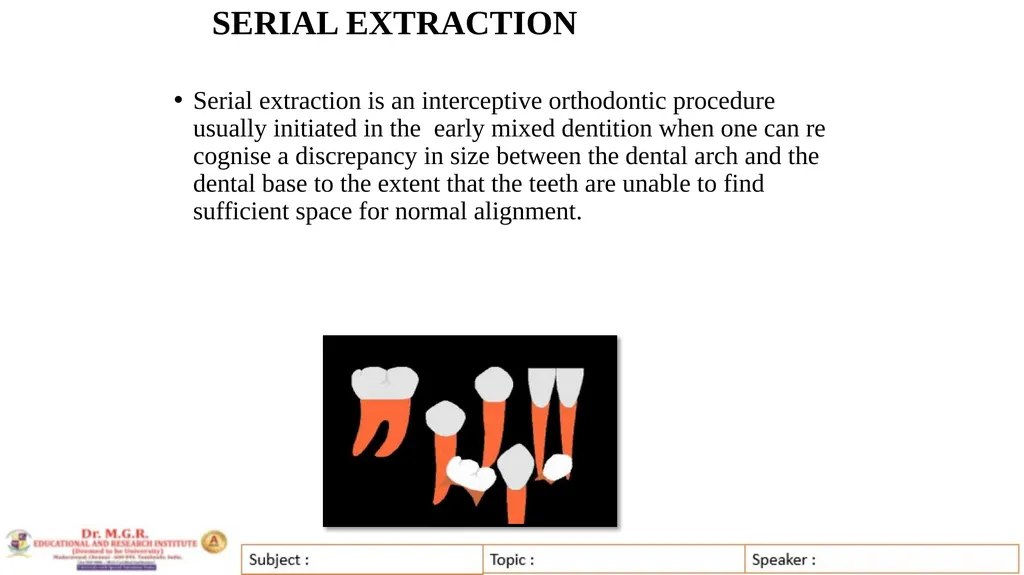
SERIAL EXTRACTION Serial extraction is an interceptive orthodontic procedure usually initiated in the early mixed dentition when one can re cognise a discrepancy in size between the dental arch and the dental base to the extent that the teeth are unable to find sufficient space for normal alignment.<br>
05
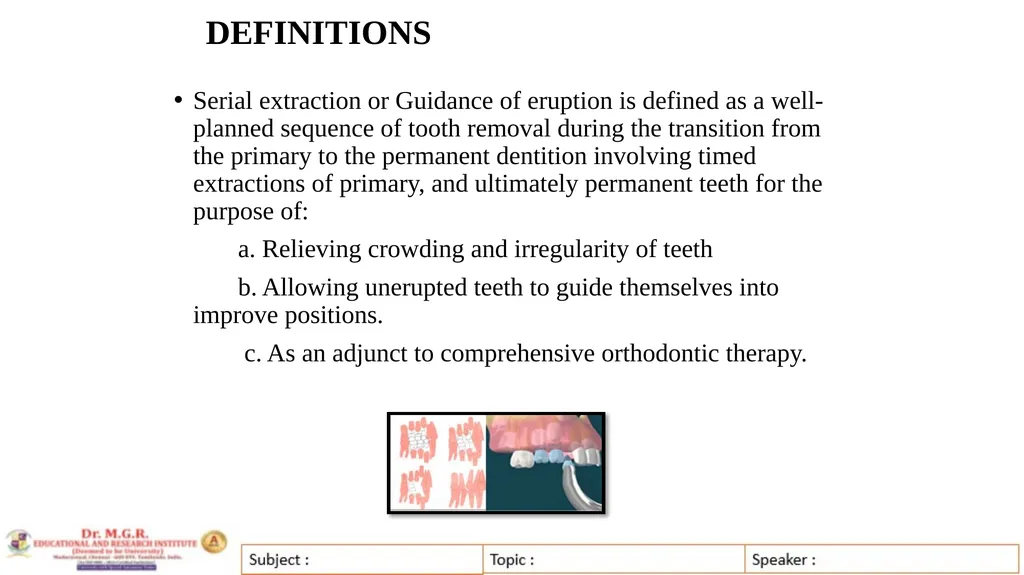
DEFINITIONS Serial extraction or Guidance of eruption is defined as a well-planned sequence of tooth removal during the transition from the primary to the permanent dentition involving timed extractions of primary, and ultimately permanent teeth for the purpose of:
a. Relieving crowding and irregularity of teeth
b. Allowing unerupted teeth to guide themselves into improve positions.
c. As an adjunct to comprehensive orthodontic therapy.<br>
a. Relieving crowding and irregularity of teeth
b. Allowing unerupted teeth to guide themselves into improve positions.
c. As an adjunct to comprehensive orthodontic therapy.<br>
06
‘It is a sequential plan of premature removal of one or more deciduous teeth in order to improve alignment of permanent succedanous permanent teeth and finally remove permanent teeth to maintain the proper ratio between tooth size and available bone.’
PROFITT:
Timed extraction of primary and, ultimately permanent teeth to relieve severe crowding.
DEWEL:
‘ An orthodontic treatment procedure that involves the orderly removal of selected deciduous and permanent teeth in a predetermined manner’.<br>
PROFITT:
Timed extraction of primary and, ultimately permanent teeth to relieve severe crowding.
DEWEL:
‘ An orthodontic treatment procedure that involves the orderly removal of selected deciduous and permanent teeth in a predetermined manner’.<br>
07
BERNARD LLOYD:
Early recognition or anticipation of deformity that will occur unless teeth are removed at strategic intervals to relieve in intensity the developing malocclusion.
TANDON:
Defined as correctly timed, planned removal of certain deciduous and permanent teeth in mixed dentition cases with dento-alveolar proportions.<br>
Early recognition or anticipation of deformity that will occur unless teeth are removed at strategic intervals to relieve in intensity the developing malocclusion.
TANDON:
Defined as correctly timed, planned removal of certain deciduous and permanent teeth in mixed dentition cases with dento-alveolar proportions.<br>
08
PRE-REQUISTE TERMINOLOGY Balanced enforced extractions:
Extraction of the tooth from the opposite side of the same arch designed to minimize central line shift.
Compensate enforced extractions:
Extraction of a tooth from the opposing quadrant to the enforced extraction.<br>
Extraction of the tooth from the opposite side of the same arch designed to minimize central line shift.
Compensate enforced extractions:
Extraction of a tooth from the opposing quadrant to the enforced extraction.<br>
09
HISTORY Bunon (1743): First person to propose that removal of deciduous teeth will achieve a better alignment of permanent teeth, in his book “ Essay on disease of teeth”
Kjellgren (1929): First person to suggest the term ‘serial extraction” for this procedure.
Nance (1940): Father of serial extraction philosophy. He presented the technique of progressive extraction.
Palsson (1956): Proposed that extraction can be done to improve irregular alignment and crowding of teeth.
Hotz (1970): Suggested the term “ Guidance of eruption "in lieu of serial extraction
According to him, The term guidance of eruption is comprehension and encompasses all measures available for influencing tooth eruption<br>
Kjellgren (1929): First person to suggest the term ‘serial extraction” for this procedure.
Nance (1940): Father of serial extraction philosophy. He presented the technique of progressive extraction.
Palsson (1956): Proposed that extraction can be done to improve irregular alignment and crowding of teeth.
Hotz (1970): Suggested the term “ Guidance of eruption "in lieu of serial extraction
According to him, The term guidance of eruption is comprehension and encompasses all measures available for influencing tooth eruption<br>
10
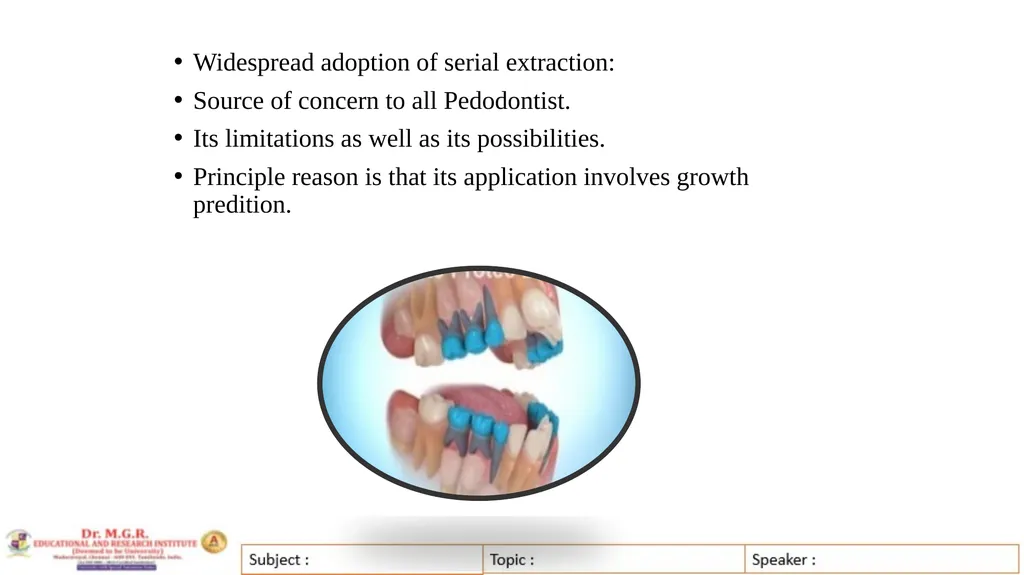
Widespread adoption of serial extraction:
Source of concern to all Pedodontist.
Its limitations as well as its possibilities.
Principle reason is that its application involves growth predition.<br>
Source of concern to all Pedodontist.
Its limitations as well as its possibilities.
Principle reason is that its application involves growth predition.<br>
11
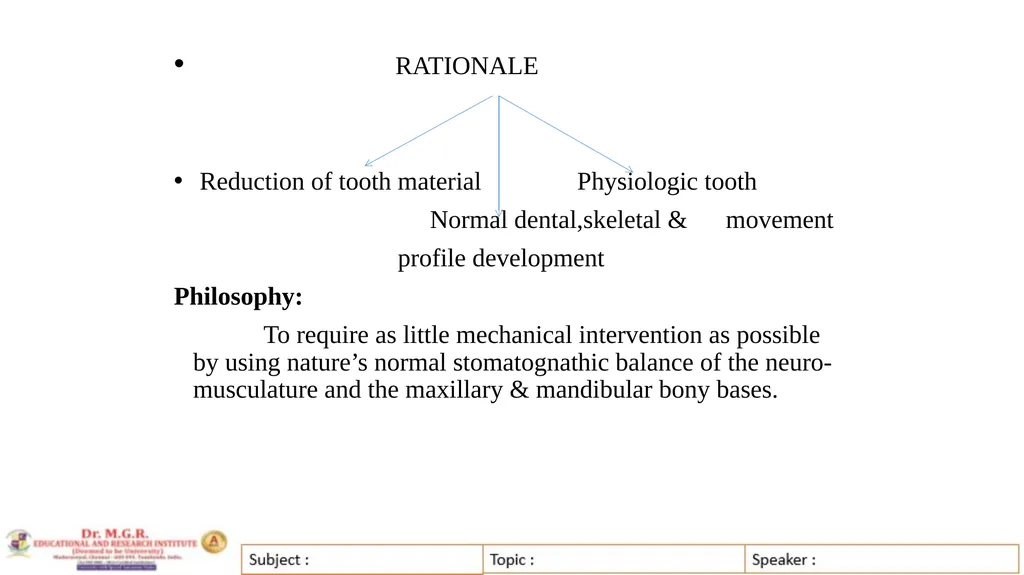
RATIONALE
Reduction of tooth material Physiologic tooth
Normal dental,skeletal & movement
profile development
Philosophy:
To require as little mechanical intervention as possible by using nature’s normal stomatognathic balance of the neuro-musculature and the maxillary & mandibular bony bases.<br>
Reduction of tooth material Physiologic tooth
Normal dental,skeletal & movement
profile development
Philosophy:
To require as little mechanical intervention as possible by using nature’s normal stomatognathic balance of the neuro-musculature and the maxillary & mandibular bony bases.<br>
12
INDICATIONS A true relatively severe herediatry tooth-size jaw-size discrepancy ( perimeter arch deficiency).
A mesial step mixed dentition developing into a Class I permanent realtionship.
A minimal overjet relationship of incisor teeth.
A minimal overbite realtionship of incisor teeth.
An orthognathic facial pattern, or a face with a slight alveodental protrusion(Class I maxillary alveodnetal protrusion).
Class II maxillary alveodental protrusion ( serial extraction only in the maxillary arch)
No skeletal discrepancy.
No aberrant muscle activity.<br>
A mesial step mixed dentition developing into a Class I permanent realtionship.
A minimal overjet relationship of incisor teeth.
A minimal overbite realtionship of incisor teeth.
An orthognathic facial pattern, or a face with a slight alveodental protrusion(Class I maxillary alveodnetal protrusion).
Class II maxillary alveodental protrusion ( serial extraction only in the maxillary arch)
No skeletal discrepancy.
No aberrant muscle activity.<br>
13
Severe crowding with arch deficiency of 8-10mm.
Absence of physiologic spacing.
Lingual eruption of permanent central incisor.
Unilateral deciduous canine loss and shift to the same side.
Mal positioned or impacted lateral incisors that erupt palatally out of the arch.
Abnormal/ Asymmetric primary canine root resorption.
Labial stripping / gingival recession of lower incisors.
Mesial eruption of canine over lateral incisors.
Mesial drift of buccal segment.
Abnormal eruption direction and eruption sequence.
Deleerious oral habits,
Flaring.
Ankylosis etc.<br>
Absence of physiologic spacing.
Lingual eruption of permanent central incisor.
Unilateral deciduous canine loss and shift to the same side.
Mal positioned or impacted lateral incisors that erupt palatally out of the arch.
Abnormal/ Asymmetric primary canine root resorption.
Labial stripping / gingival recession of lower incisors.
Mesial eruption of canine over lateral incisors.
Mesial drift of buccal segment.
Abnormal eruption direction and eruption sequence.
Deleerious oral habits,
Flaring.
Ankylosis etc.<br>
14
CONTRAINDICATIONS Severe Class II and Class III dental malocclusions.
Skeletal malocclusions.
Congenitally absent / missing 2nd premolars.
Extensive caries of permanent 1st molars.
Cleft lip and cleft palate cases.
Unilateral congenital absence of teeth.
Abnormal size, shape, colour etc.,
Presence of deepbite, open bite, crossbite, rotations and gross malpositions of teeth.
If arch length deficiency is less than 4mm.
Missing 3rd molars.<br>
Skeletal malocclusions.
Congenitally absent / missing 2nd premolars.
Extensive caries of permanent 1st molars.
Cleft lip and cleft palate cases.
Unilateral congenital absence of teeth.
Abnormal size, shape, colour etc.,
Presence of deepbite, open bite, crossbite, rotations and gross malpositions of teeth.
If arch length deficiency is less than 4mm.
Missing 3rd molars.<br>
15
ADVANTAGES Psychological trauma can be avoided by treatment.
Un erupted / erupted can be guided into proper occlusion.
A voids loss of alveolar bone.
Reduces the severity of malocclusion.
Reduces the duration of mechanotherapy.
Reduces the treatment time.
No TMJ problems.
No pain.
Less discomfort.
Retention is usually not needed because teeth are guided by muscular forces.
Cost of treatment reduced<br>
Un erupted / erupted can be guided into proper occlusion.
A voids loss of alveolar bone.
Reduces the severity of malocclusion.
Reduces the duration of mechanotherapy.
Reduces the treatment time.
No TMJ problems.
No pain.
Less discomfort.
Retention is usually not needed because teeth are guided by muscular forces.
Cost of treatment reduced<br>
16
DISADVANTAGES Long –term procedure. Requires thorough knowledge of growth, development, eruption sequence and calcification of permanent teeth.
Psychological trauma to the child because of extractions.
If extractions are carried out too early:
Space loss,
Delayed eruption of permanent successors,
Elimination of an opportunity to extract teeth which may become doubtful( like permanent 1st molar).
The lower permanent canines may erupt ahead of 1st premolar into the space left by deciduous 1st molar causing impaction of 1st premolar , making the latter’s removal difficult.
Serial extraction may not preclude appliance therapy.<br>
Psychological trauma to the child because of extractions.
If extractions are carried out too early:
Space loss,
Delayed eruption of permanent successors,
Elimination of an opportunity to extract teeth which may become doubtful( like permanent 1st molar).
The lower permanent canines may erupt ahead of 1st premolar into the space left by deciduous 1st molar causing impaction of 1st premolar , making the latter’s removal difficult.
Serial extraction may not preclude appliance therapy.<br>
17
Tendency to deepen the bite because of lingual tipping of incisors.
Abnormal tongue thrusting into the extraction space may develop.
May interfere with growth and development because masticatory forces are not transmitted properly.
Ditching between canine and second premolar.
Axial inclination should be corrected later<br>
Abnormal tongue thrusting into the extraction space may develop.
May interfere with growth and development because masticatory forces are not transmitted properly.
Ditching between canine and second premolar.
Axial inclination should be corrected later<br>
18
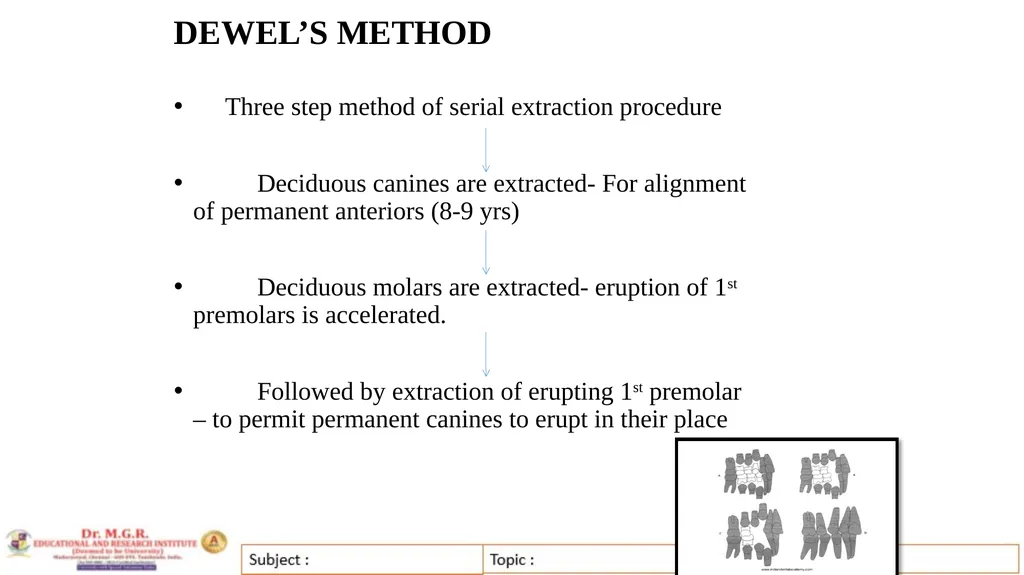
DEWEL’S METHOD Three step method of serial extraction procedure
Deciduous canines are extracted- For alignment of permanent anteriors (8-9 yrs)
Deciduous molars are extracted- eruption of 1st premolars is accelerated.
Followed by extraction of erupting 1st premolar – to permit permanent canines to erupt in their place<br>
Deciduous canines are extracted- For alignment of permanent anteriors (8-9 yrs)
Deciduous molars are extracted- eruption of 1st premolars is accelerated.
Followed by extraction of erupting 1st premolar – to permit permanent canines to erupt in their place<br>
19
OTHER VARIATION:
If canine is erupting is faster than premolar
Then enucleation of first premolar can be done.
Or extraction of 2nd deciduous molar followed by lingual arch space maintainer.<br>
If canine is erupting is faster than premolar
Then enucleation of first premolar can be done.
Or extraction of 2nd deciduous molar followed by lingual arch space maintainer.<br>
20
TWEED METHOD At 8 yrs, all deciduous 1st molars are removed.
For early eruption of 1st premolars.
Deciduous canine is maintained to retard the eruption of permanent canine.
After 4 to 10 months if crowns of 1st premolars are through the alveolar bone, they are extracted along with deciduous canines.
To retard crowding in the ant.segment.
To allow the canine to erupt posteriorly into the space left by deciduous 1st molars.<br>
For early eruption of 1st premolars.
Deciduous canine is maintained to retard the eruption of permanent canine.
After 4 to 10 months if crowns of 1st premolars are through the alveolar bone, they are extracted along with deciduous canines.
To retard crowding in the ant.segment.
To allow the canine to erupt posteriorly into the space left by deciduous 1st molars.<br>
21
NANCE METHOD At 8 years of age all deciduous first molars are extracted.
Extraction of 1st premolar
Deciduous canine extracted to permit / aloow the space for the eruption of permanent canine.<br>
Extraction of 1st premolar
Deciduous canine extracted to permit / aloow the space for the eruption of permanent canine.<br>
22
Class I malocclusion with severe mandibular ant. Crowding:
If 5mm discrepancy per quadrant
Dewel’s method of extraction.
Minimal mandibular Anterior crowding
Discrepancy of 6-10mm
crowding is more in the premolar region
Or with bimaxillary protrusion
Objective should be to eliminate the first premolars as soon as possible.<br>
If 5mm discrepancy per quadrant
Dewel’s method of extraction.
Minimal mandibular Anterior crowding
Discrepancy of 6-10mm
crowding is more in the premolar region
Or with bimaxillary protrusion
Objective should be to eliminate the first premolars as soon as possible.<br>
23
Arch length deficiency with concave facial profile:
Enucleation of second premolar rather the first premolar should be considered.
Arch length deficiency with open bite:
Depends on the type & severity of open bite.
If open bite- dental- sequence will be similar.
If skeletal, most posterior teeth in dental arch should be extracted.
Includes extracting of enucleating permanent molars or second premolars.
Arch length deficiency with deep overbite:
Overbite will increase after serial extraction<br>
Enucleation of second premolar rather the first premolar should be considered.
Arch length deficiency with open bite:
Depends on the type & severity of open bite.
If open bite- dental- sequence will be similar.
If skeletal, most posterior teeth in dental arch should be extracted.
Includes extracting of enucleating permanent molars or second premolars.
Arch length deficiency with deep overbite:
Overbite will increase after serial extraction<br>
24
Class II malocclusion:
Dental class II with normal overjet:
If no mandibular crowding present,
Management- by eliminating maxillary crowding.
Extract max.primary canine, Then extract primary 1st molar,-- Ltr max. First premolar is extracted.
Dental Class II with minimal overjet:
Extract primary max.1st molar & mand . Primary 2nd molar.
Then enucleation of permanent mandibular 2nd molar.
Then when max 1st premolar erupts, it s extracted along with the max canine.<br>
Dental class II with normal overjet:
If no mandibular crowding present,
Management- by eliminating maxillary crowding.
Extract max.primary canine, Then extract primary 1st molar,-- Ltr max. First premolar is extracted.
Dental Class II with minimal overjet:
Extract primary max.1st molar & mand . Primary 2nd molar.
Then enucleation of permanent mandibular 2nd molar.
Then when max 1st premolar erupts, it s extracted along with the max canine.<br>
25
DENTAL / SKELETAL CLASS II WITH SEVERE OVERJET:
Require concurrent orthopedic appliance along wth the serial extraction.
CLASS III MALOCCLUSION:
Poor candidates
PSEUDO-CLASSIII:
With ant.crossbite and functional side.
Problems associated:
Root paralleling,
Inadequate buccal digitations
Spaces remaining closed,
Excessive overbite & overjet.<br>
Require concurrent orthopedic appliance along wth the serial extraction.
CLASS III MALOCCLUSION:
Poor candidates
PSEUDO-CLASSIII:
With ant.crossbite and functional side.
Problems associated:
Root paralleling,
Inadequate buccal digitations
Spaces remaining closed,
Excessive overbite & overjet.<br>
26
ORTHODONTIC APPLIANCE UTILISED WITH SERIAL EXTRACTION:
Maxillary & mandibular lingual arches.
Fixed or removable headgears,
Removable hawleys appliance.<br>
Maxillary & mandibular lingual arches.
Fixed or removable headgears,
Removable hawleys appliance.<br>
27
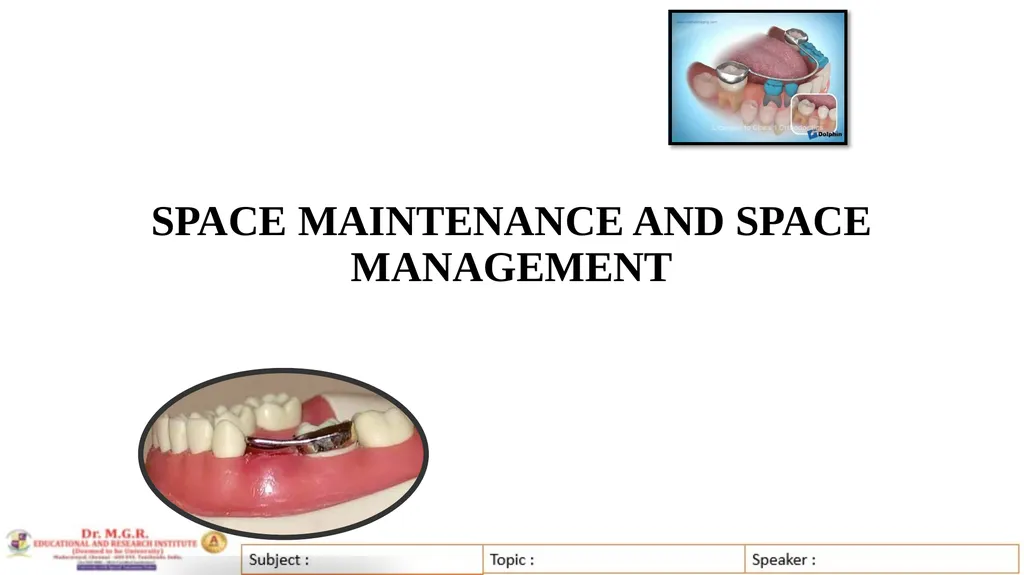
SPACE MAINTENANCE AND SPACE MANAGEMENT<br>
28
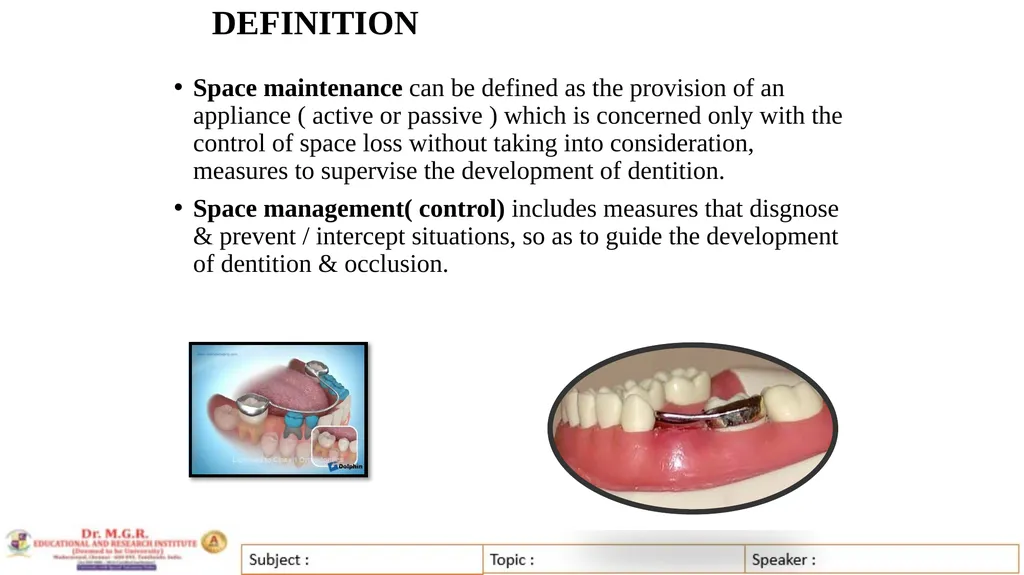
DEFINITION Space maintenance can be defined as the provision of an appliance ( active or passive ) which is concerned only with the control of space loss without taking into consideration, measures to supervise the development of dentition.
Space management( control) includes measures that disgnose & prevent / intercept situations, so as to guide the development of dentition & occlusion.<br>
Space management( control) includes measures that disgnose & prevent / intercept situations, so as to guide the development of dentition & occlusion.<br>
29
Space maintainers:
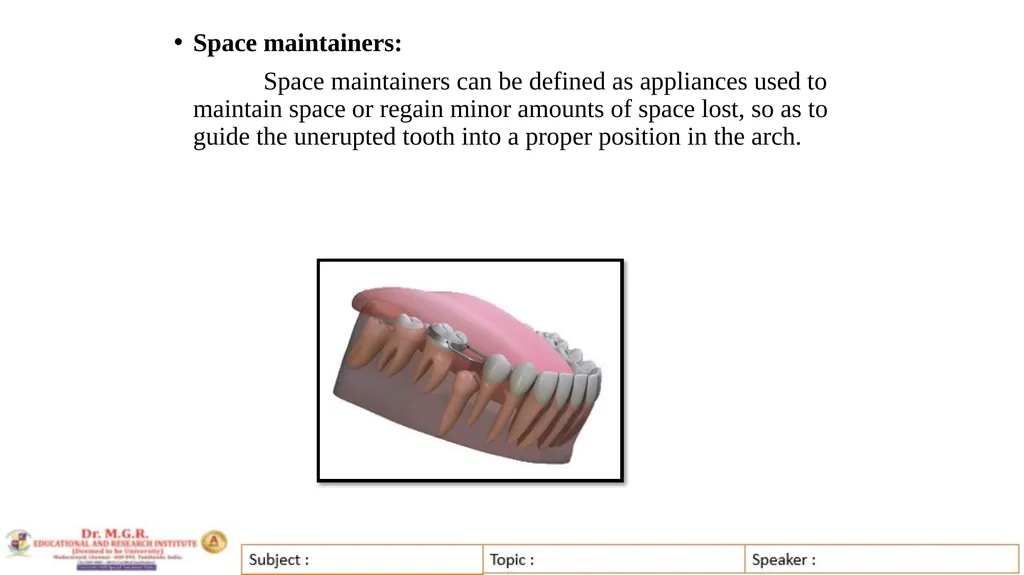
Space maintainers can be defined as appliances used to maintain space or regain minor amounts of space lost, so as to guide the unerupted tooth into a proper position in the arch.<br>
Space maintainers can be defined as appliances used to maintain space or regain minor amounts of space lost, so as to guide the unerupted tooth into a proper position in the arch.<br>
30
PURPOSE OF SPACE MAINTAINER:
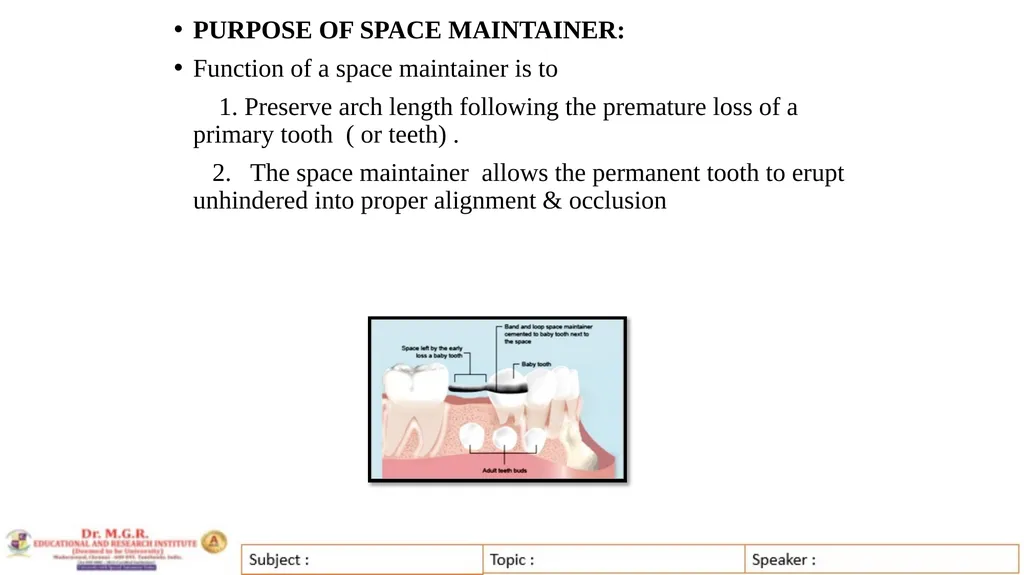
Function of a space maintainer is to
1. Preserve arch length following the premature loss of a primary tooth ( or teeth) .
2. The space maintainer allows the permanent tooth to erupt unhindered into proper alignment & occlusion<br>
Function of a space maintainer is to
1. Preserve arch length following the premature loss of a primary tooth ( or teeth) .
2. The space maintainer allows the permanent tooth to erupt unhindered into proper alignment & occlusion<br>
31
IDEAL REQUIREMENTS: ( Currier and austerman, moyers, profitt)
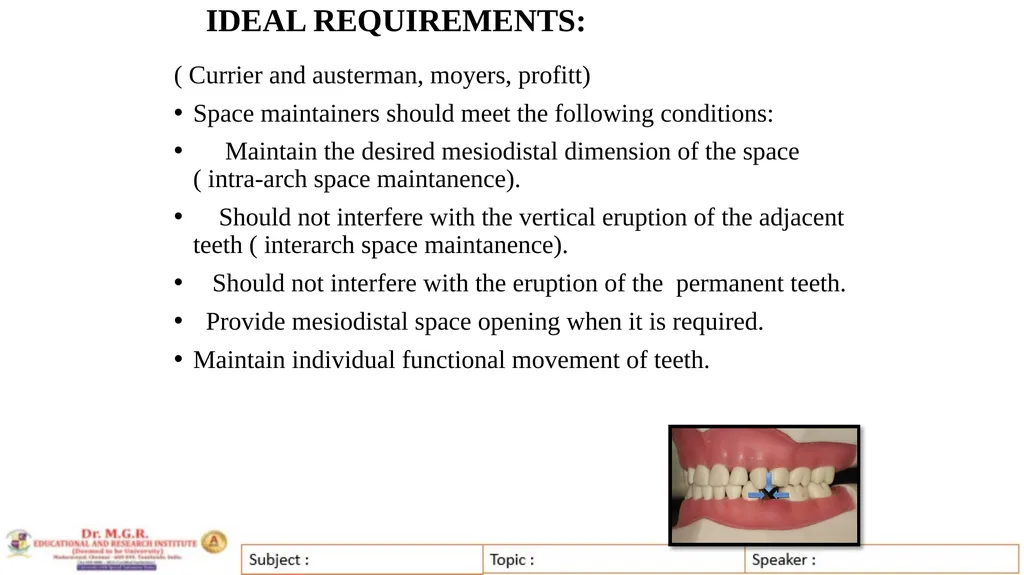
Space maintainers should meet the following conditions:
Maintain the desired mesiodistal dimension of the space ( intra-arch space maintanence).
Should not interfere with the vertical eruption of the adjacent teeth ( interarch space maintanence).
Should not interfere with the eruption of the permanent teeth.
Provide mesiodistal space opening when it is required.
Maintain individual functional movement of teeth.<br>
Space maintainers should meet the following conditions:
Maintain the desired mesiodistal dimension of the space ( intra-arch space maintanence).
Should not interfere with the vertical eruption of the adjacent teeth ( interarch space maintanence).
Should not interfere with the eruption of the permanent teeth.
Provide mesiodistal space opening when it is required.
Maintain individual functional movement of teeth.<br>
32
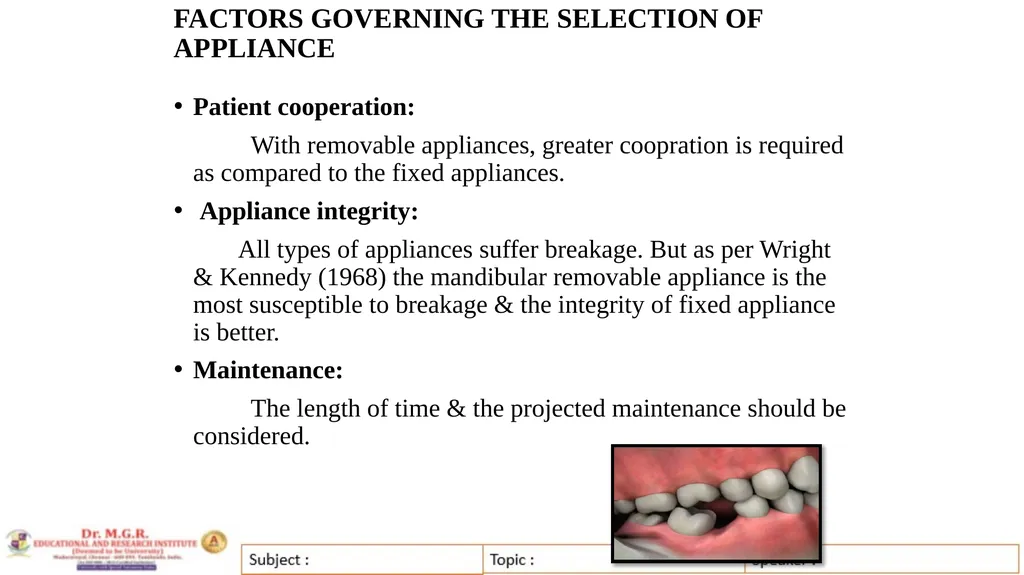
FACTORS GOVERNING THE SELECTION OF APPLIANCE Patient cooperation:
With removable appliances, greater coopration is required as compared to the fixed appliances.
Appliance integrity:
All types of appliances suffer breakage. But as per Wright & Kennedy (1968) the mandibular removable appliance is the most susceptible to breakage & the integrity of fixed appliance is better.
Maintenance:
The length of time & the projected maintenance should be considered.<br>
With removable appliances, greater coopration is required as compared to the fixed appliances.
Appliance integrity:
All types of appliances suffer breakage. But as per Wright & Kennedy (1968) the mandibular removable appliance is the most susceptible to breakage & the integrity of fixed appliance is better.
Maintenance:
The length of time & the projected maintenance should be considered.<br>
33
Modifiability:
Anticipation of future modifications is essential
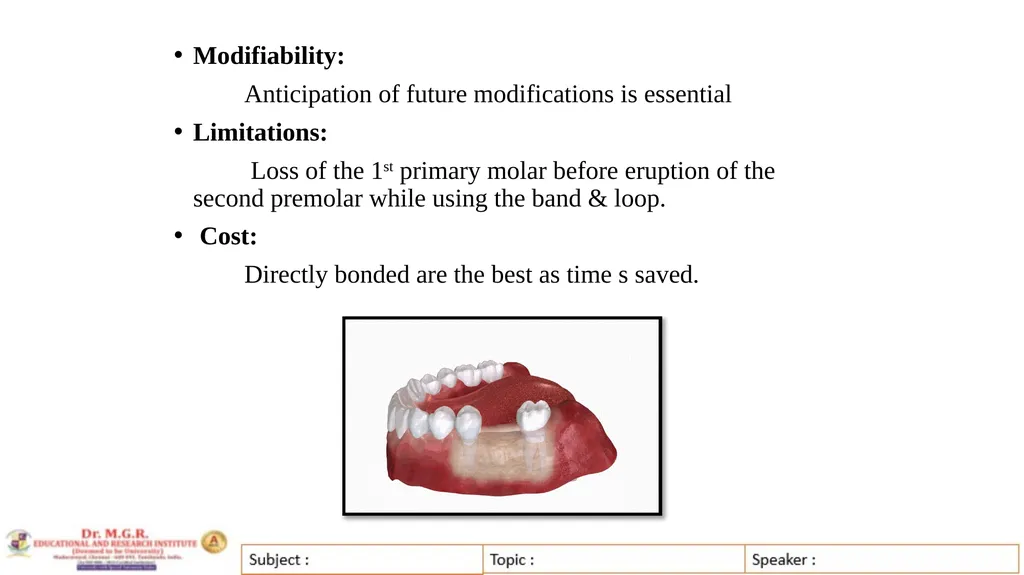
Limitations:
Loss of the 1st primary molar before eruption of the second premolar while using the band & loop.
Cost:
Directly bonded are the best as time s saved.<br>
Anticipation of future modifications is essential
Limitations:
Loss of the 1st primary molar before eruption of the second premolar while using the band & loop.
Cost:
Directly bonded are the best as time s saved.<br>
34
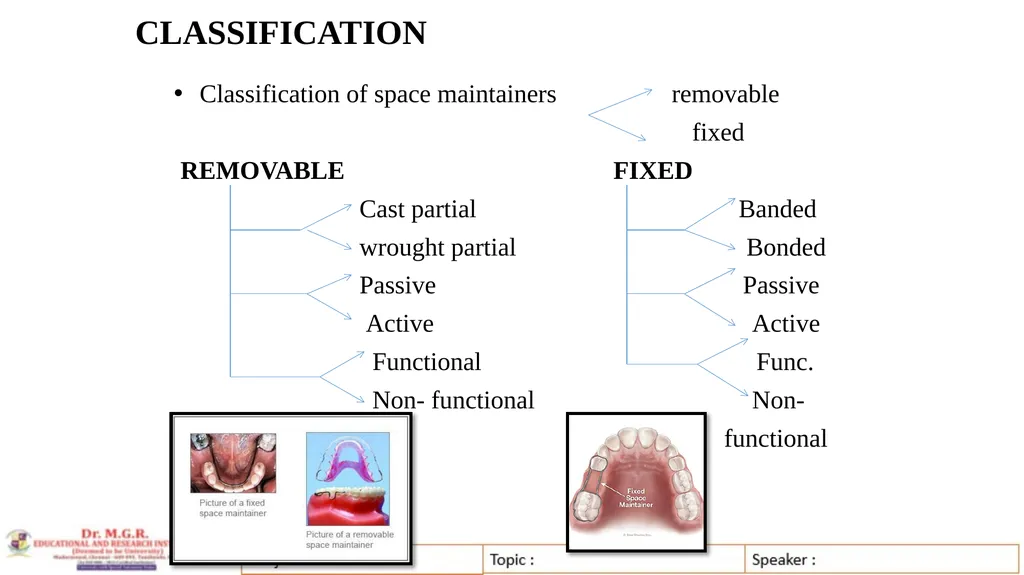
CLASSIFICATION Classification of space maintainers removable
fixed
REMOVABLE FIXED
Cast partial Banded
wrought partial Bonded
Passive Passive
Active Active
Functional Func.
Non- functional Non-
functional<br>
fixed
REMOVABLE FIXED
Cast partial Banded
wrought partial Bonded
Passive Passive
Active Active
Functional Func.
Non- functional Non-
functional<br>
35
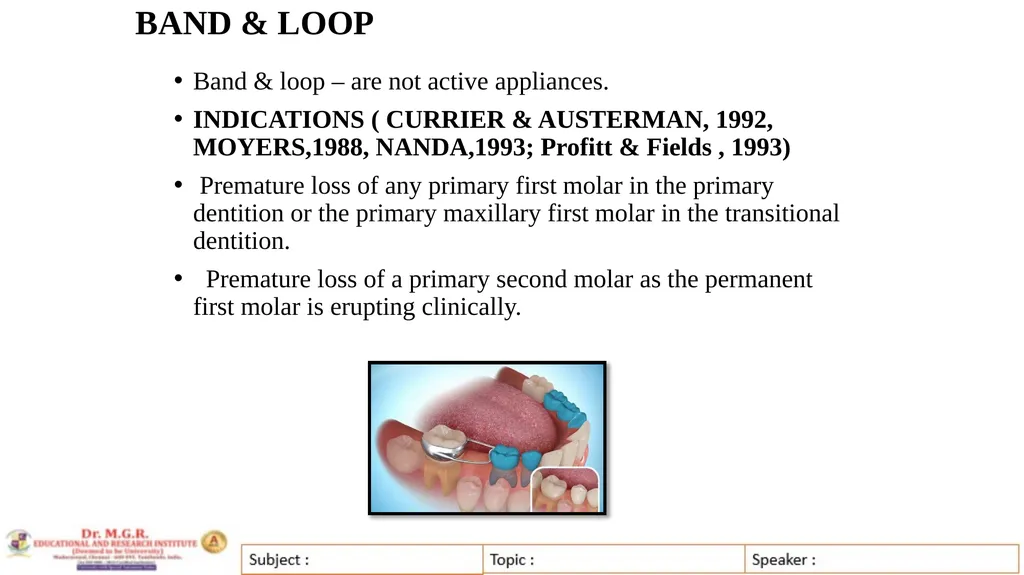
BAND & LOOP Band & loop – are not active appliances.
INDICATIONS ( CURRIER & AUSTERMAN, 1992, MOYERS,1988, NANDA,1993; Profitt & Fields , 1993)
Premature loss of any primary first molar in the primary dentition or the primary maxillary first molar in the transitional dentition.
Premature loss of a primary second molar as the permanent first molar is erupting clinically.<br>
INDICATIONS ( CURRIER & AUSTERMAN, 1992, MOYERS,1988, NANDA,1993; Profitt & Fields , 1993)
Premature loss of any primary first molar in the primary dentition or the primary maxillary first molar in the transitional dentition.
Premature loss of a primary second molar as the permanent first molar is erupting clinically.<br>
36
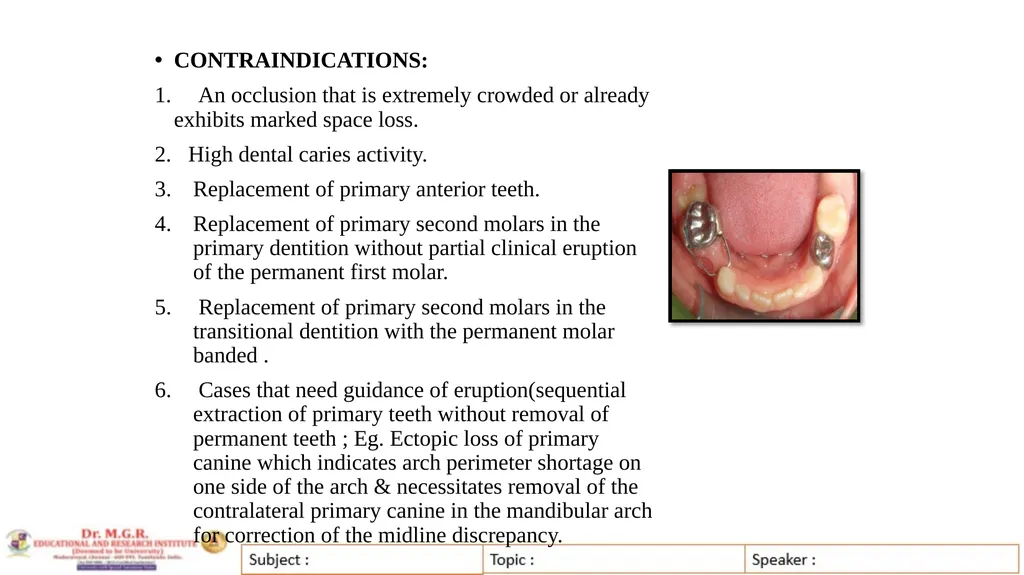
CONTRAINDICATIONS:
1. An occlusion that is extremely crowded or already exhibits marked space loss.
2. High dental caries activity.
Replacement of primary anterior teeth.
Replacement of primary second molars in the primary dentition without partial clinical eruption of the permanent first molar.
Replacement of primary second molars in the transitional dentition with the permanent molar banded .
Cases that need guidance of eruption(sequential extraction of primary teeth without removal of permanent teeth ; Eg. Ectopic loss of primary canine which indicates arch perimeter shortage on one side of the arch & necessitates removal of the contralateral primary canine in the mandibular arch for correction of the midline discrepancy.<br>
1. An occlusion that is extremely crowded or already exhibits marked space loss.
2. High dental caries activity.
Replacement of primary anterior teeth.
Replacement of primary second molars in the primary dentition without partial clinical eruption of the permanent first molar.
Replacement of primary second molars in the transitional dentition with the permanent molar banded .
Cases that need guidance of eruption(sequential extraction of primary teeth without removal of permanent teeth ; Eg. Ectopic loss of primary canine which indicates arch perimeter shortage on one side of the arch & necessitates removal of the contralateral primary canine in the mandibular arch for correction of the midline discrepancy.<br>
37
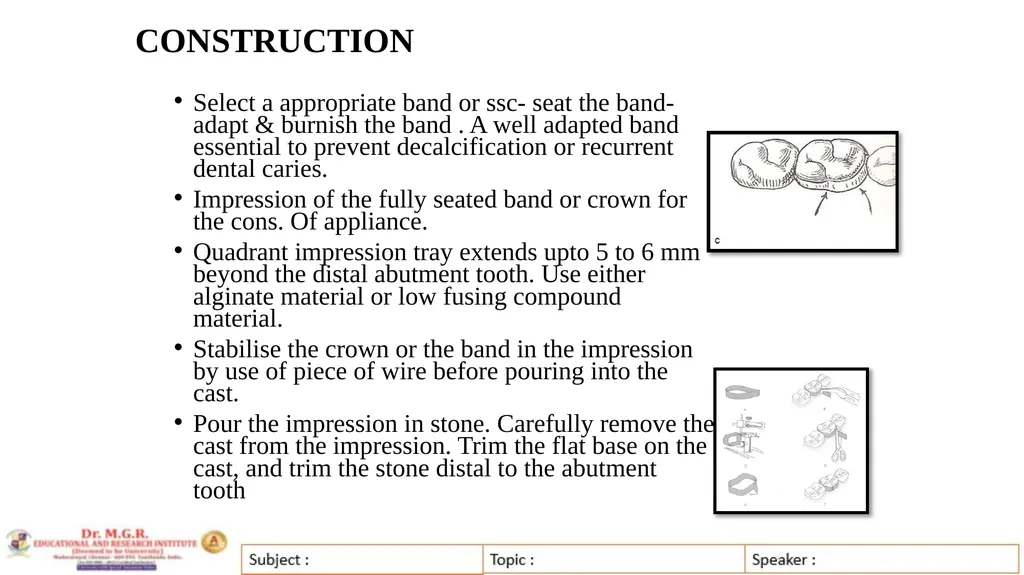
CONSTRUCTION Select a appropriate band or ssc- seat the band- adapt & burnish the band . A well adapted band essential to prevent decalcification or recurrent dental caries.
Impression of the fully seated band or crown for the cons. Of appliance.
Quadrant impression tray extends upto 5 to 6 mm beyond the distal abutment tooth. Use either alginate material or low fusing compound material.
Stabilise the crown or the band in the impression by use of piece of wire before pouring into the cast.
Pour the impression in stone. Carefully remove the cast from the impression. Trim the flat base on the cast, and trim the stone distal to the abutment tooth<br>
Impression of the fully seated band or crown for the cons. Of appliance.
Quadrant impression tray extends upto 5 to 6 mm beyond the distal abutment tooth. Use either alginate material or low fusing compound material.
Stabilise the crown or the band in the impression by use of piece of wire before pouring into the cast.
Pour the impression in stone. Carefully remove the cast from the impression. Trim the flat base on the cast, and trim the stone distal to the abutment tooth<br>
38
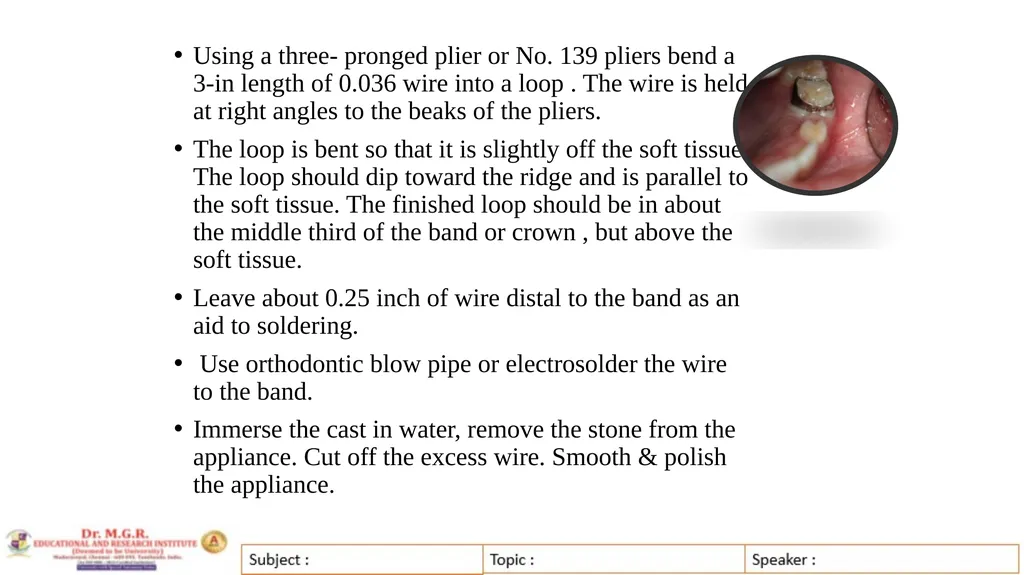
Using a three- pronged plier or No. 139 pliers bend a 3-in length of 0.036 wire into a loop . The wire is held at right angles to the beaks of the pliers.
The loop is bent so that it is slightly off the soft tissue. The loop should dip toward the ridge and is parallel to the soft tissue. The finished loop should be in about the middle third of the band or crown , but above the soft tissue.
Leave about 0.25 inch of wire distal to the band as an aid to soldering.
Use orthodontic blow pipe or electrosolder the wire to the band.
Immerse the cast in water, remove the stone from the appliance. Cut off the excess wire. Smooth & polish the appliance.<br>
The loop is bent so that it is slightly off the soft tissue. The loop should dip toward the ridge and is parallel to the soft tissue. The finished loop should be in about the middle third of the band or crown , but above the soft tissue.
Leave about 0.25 inch of wire distal to the band as an aid to soldering.
Use orthodontic blow pipe or electrosolder the wire to the band.
Immerse the cast in water, remove the stone from the appliance. Cut off the excess wire. Smooth & polish the appliance.<br>
39
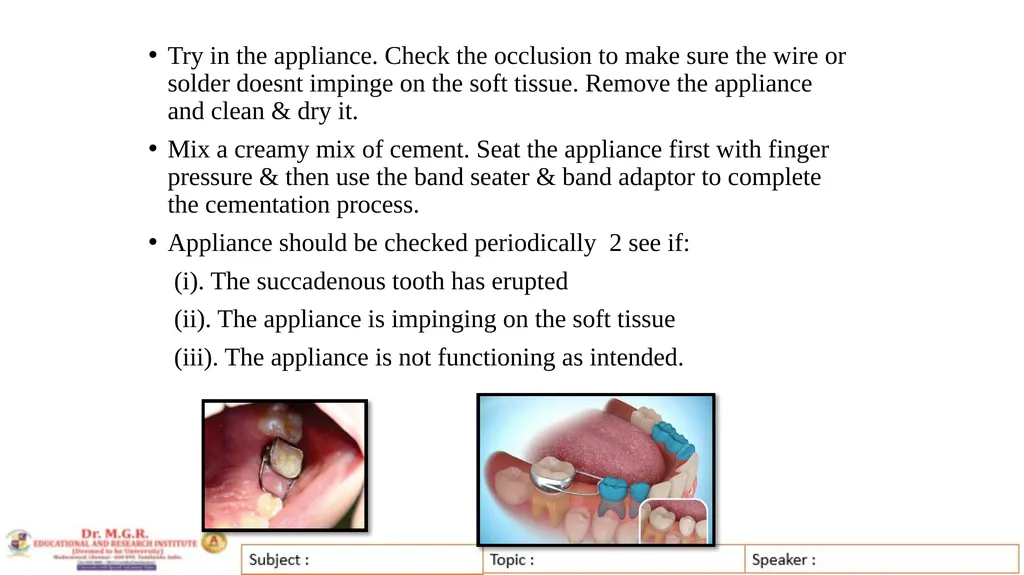
Try in the appliance. Check the occlusion to make sure the wire or solder doesnt impinge on the soft tissue. Remove the appliance and clean & dry it.
Mix a creamy mix of cement. Seat the appliance first with finger pressure & then use the band seater & band adaptor to complete the cementation process.
Appliance should be checked periodically 2 see if:
(i). The succadenous tooth has erupted
(ii). The appliance is impinging on the soft tissue
(iii). The appliance is not functioning as intended.<br>
Mix a creamy mix of cement. Seat the appliance first with finger pressure & then use the band seater & band adaptor to complete the cementation process.
Appliance should be checked periodically 2 see if:
(i). The succadenous tooth has erupted
(ii). The appliance is impinging on the soft tissue
(iii). The appliance is not functioning as intended.<br>
40
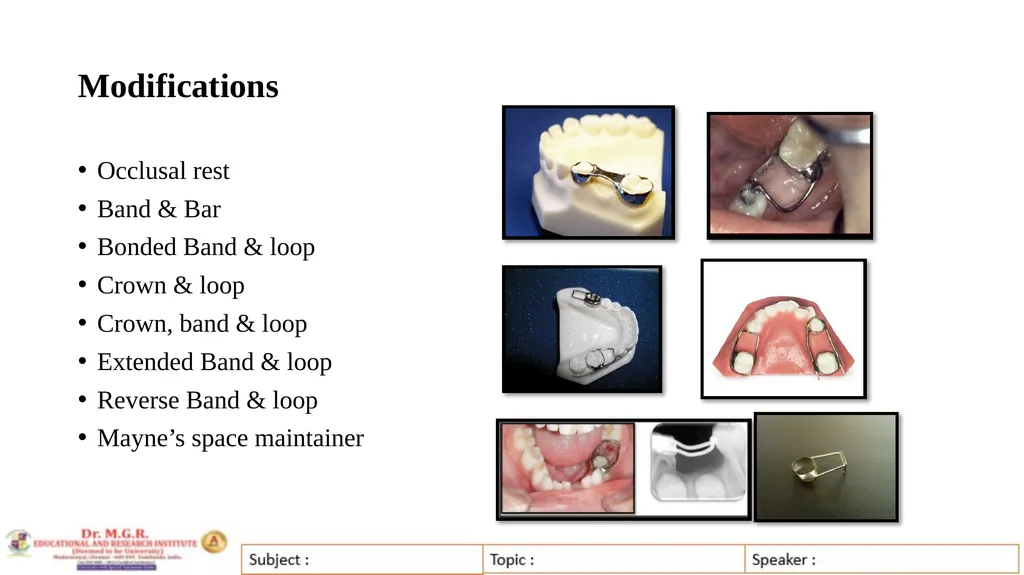
Modifications Occlusal rest
Band & Bar
Bonded Band & loop
Crown & loop
Crown, band & loop
Extended Band & loop
Reverse Band & loop
Mayne’s space maintainer<br>
Band & Bar
Bonded Band & loop
Crown & loop
Crown, band & loop
Extended Band & loop
Reverse Band & loop
Mayne’s space maintainer<br>
41
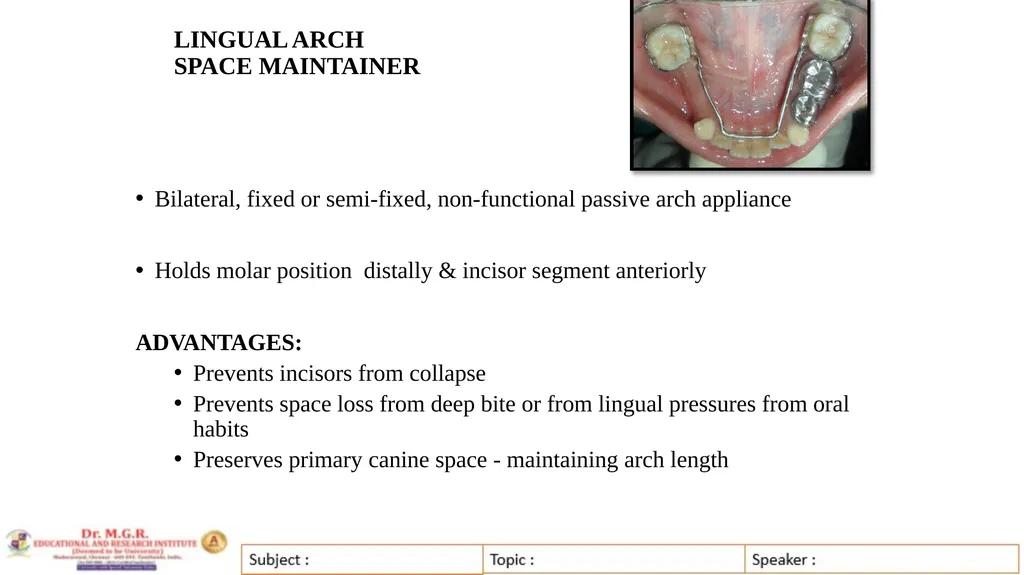
LINGUAL ARCH
SPACE MAINTAINER Bilateral, fixed or semi-fixed, non-functional passive arch appliance
Holds molar position distally & incisor segment anteriorly
ADVANTAGES:
Prevents incisors from collapse
Prevents space loss from deep bite or from lingual pressures from oral habits
Preserves primary canine space - maintaining arch length<br>
Holds molar position distally & incisor segment anteriorly
ADVANTAGES:
Prevents incisors from collapse
Prevents space loss from deep bite or from lingual pressures from oral habits
Preserves primary canine space - maintaining arch length<br>
42
CONTRA INDICATIONS
Prior to eruption of permanent lower incisors
Rampant caries, high plaque scores, poor patient cooperation
Anterior or posterior cross bite
Extreme mandibular crowding<br>
Prior to eruption of permanent lower incisors
Rampant caries, high plaque scores, poor patient cooperation
Anterior or posterior cross bite
Extreme mandibular crowding<br>
43
INDICATIONS
Maintenance of arch perimeter (not just quadrant perimeter)
Premature bilateral loss of primary molars after the eruption of permanent incisors
Maintenance or prevention of mandibular changes in arch length, over jet or over bite from incisor repositioning in transitional dentition (Serial extraction)
Retention or stabilization of mandibular anterior teeth after correction<br>
Maintenance of arch perimeter (not just quadrant perimeter)
Premature bilateral loss of primary molars after the eruption of permanent incisors
Maintenance or prevention of mandibular changes in arch length, over jet or over bite from incisor repositioning in transitional dentition (Serial extraction)
Retention or stabilization of mandibular anterior teeth after correction<br>
44
ADVANTAGES
Excellent source of anchorage – resistance against several teeth
Allows free of movement of teeth while maintaining space in desired arch
Little or no inconvenience to patient – as compared with removable acrylic space maintainer
Serves as space maintainer for more than 1 succedaneous teeth
DISADVANTAGES
Decalcification of banded tooth
Arch wire embedded into soft tissues (patients with poor oral hygiene)
Wire may be distorted by masticatory forces<br>
Excellent source of anchorage – resistance against several teeth
Allows free of movement of teeth while maintaining space in desired arch
Little or no inconvenience to patient – as compared with removable acrylic space maintainer
Serves as space maintainer for more than 1 succedaneous teeth
DISADVANTAGES
Decalcification of banded tooth
Arch wire embedded into soft tissues (patients with poor oral hygiene)
Wire may be distorted by masticatory forces<br>
45
NANCE HOLDING ARCH APPLIANCE Bilateral, fixed, passive & non-functional space maintainer
Indications
Bilateral loss of multiple primary teeth after eruption of PFM
Also serves as habit breaking appliance (tongue thrusting) – using spurs
Similar to lingual arch holding appliance except the anterior portion of arch wire do not contact the lingual surfaces of maxillary incisors
At rugae area, a small U-shaped bend is given which is 1-2mm away from the soft tissue- rest on the anterior and deepest point on the rugae<br>
Indications
Bilateral loss of multiple primary teeth after eruption of PFM
Also serves as habit breaking appliance (tongue thrusting) – using spurs
Similar to lingual arch holding appliance except the anterior portion of arch wire do not contact the lingual surfaces of maxillary incisors
At rugae area, a small U-shaped bend is given which is 1-2mm away from the soft tissue- rest on the anterior and deepest point on the rugae<br>
46
Bend enhances the retention of acrylic button (0.5” in diameter)
Acrylic button- distribute forces over the palatal area, so that wire does not get embedded into the tissue and prevents anterior movement of posterior teeth
Disadvantages:
Soft tissue irritation<br>
Acrylic button- distribute forces over the palatal area, so that wire does not get embedded into the tissue and prevents anterior movement of posterior teeth
Disadvantages:
Soft tissue irritation<br>
47
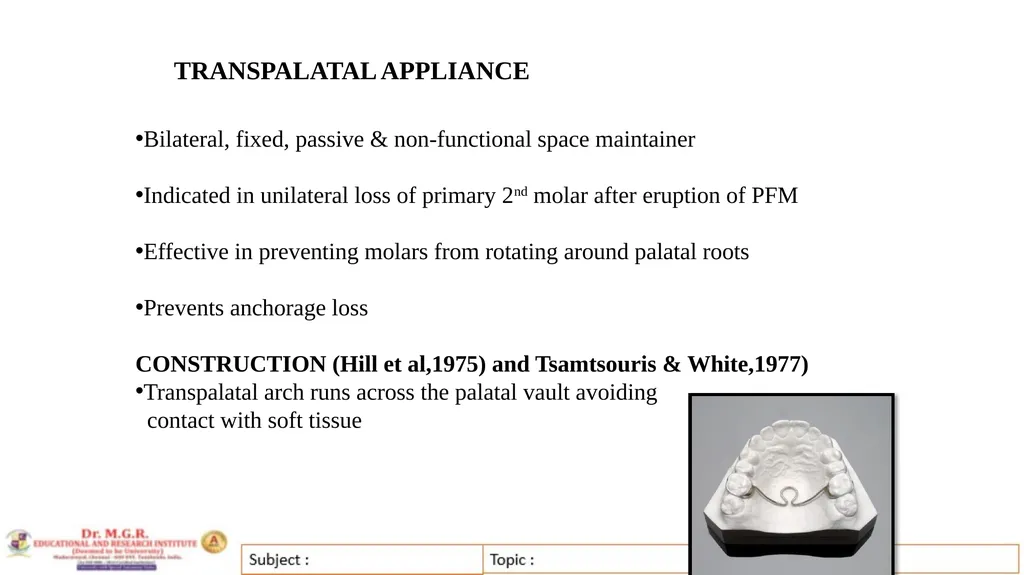
TRANSPALATAL APPLIANCE Bilateral, fixed, passive & non-functional space maintainer
Indicated in unilateral loss of primary 2nd molar after eruption of PFM
Effective in preventing molars from rotating around palatal roots
Prevents anchorage loss
CONSTRUCTION (Hill et al,1975) and Tsamtsouris & White,1977)
Transpalatal arch runs across the palatal vault avoiding
contact with soft tissue<br>
Indicated in unilateral loss of primary 2nd molar after eruption of PFM
Effective in preventing molars from rotating around palatal roots
Prevents anchorage loss
CONSTRUCTION (Hill et al,1975) and Tsamtsouris & White,1977)
Transpalatal arch runs across the palatal vault avoiding
contact with soft tissue<br>
48
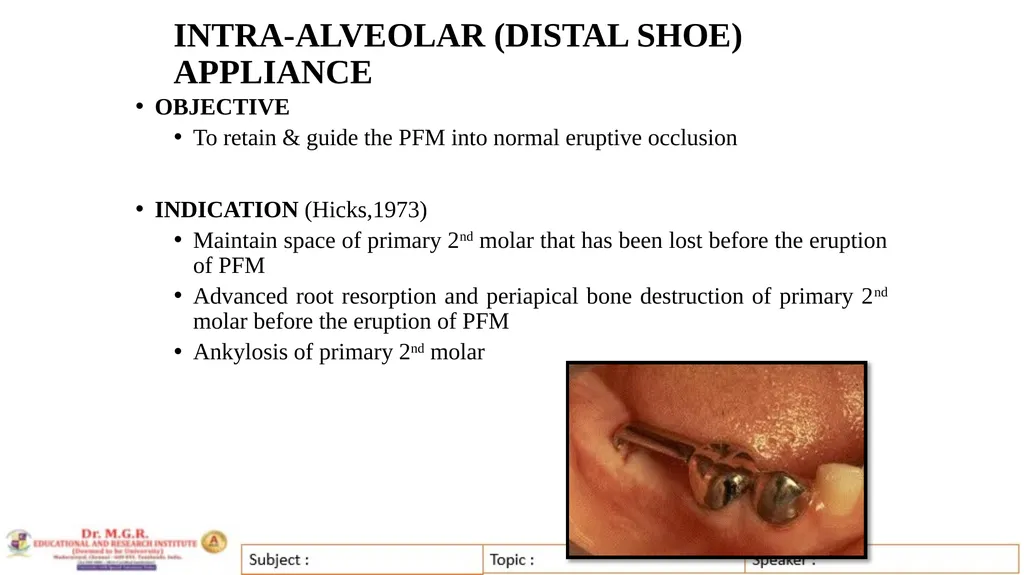
INTRA-ALVEOLAR (DISTAL SHOE) APPLIANCE OBJECTIVE
To retain & guide the PFM into normal eruptive occlusion
INDICATION (Hicks,1973)
Maintain space of primary 2nd molar that has been lost before the eruption of PFM
Advanced root resorption and periapical bone destruction of primary 2nd molar before the eruption of PFM
Ankylosis of primary 2nd molar<br>
To retain & guide the PFM into normal eruptive occlusion
INDICATION (Hicks,1973)
Maintain space of primary 2nd molar that has been lost before the eruption of PFM
Advanced root resorption and periapical bone destruction of primary 2nd molar before the eruption of PFM
Ankylosis of primary 2nd molar<br>
49
CONTRA INDICATION (Hicks,1973)
If several teeth are missing (abutment to support the cemented appliance may be missing)
Poor oral hygiene
Certain medical conditions like SABE, Blood dyscrasias, immunosupression, congenital heart diseaseetc.
Congenitally missing PFM (rare)
In cases of contra indication
Allow the tooth to erupt & then regain space
Use of removable or fixed appliance that does not penetrate the tissue but places pressure on the ridge mesial to the unerupted permanent molar- Pressure appliance (Caroll & Jones, 1982)<br>
If several teeth are missing (abutment to support the cemented appliance may be missing)
Poor oral hygiene
Certain medical conditions like SABE, Blood dyscrasias, immunosupression, congenital heart diseaseetc.
Congenitally missing PFM (rare)
In cases of contra indication
Allow the tooth to erupt & then regain space
Use of removable or fixed appliance that does not penetrate the tissue but places pressure on the ridge mesial to the unerupted permanent molar- Pressure appliance (Caroll & Jones, 1982)<br>
50
ADVANTAGES:
Less chairside time,
Less co-operation of the patient,
Fixed appliance and
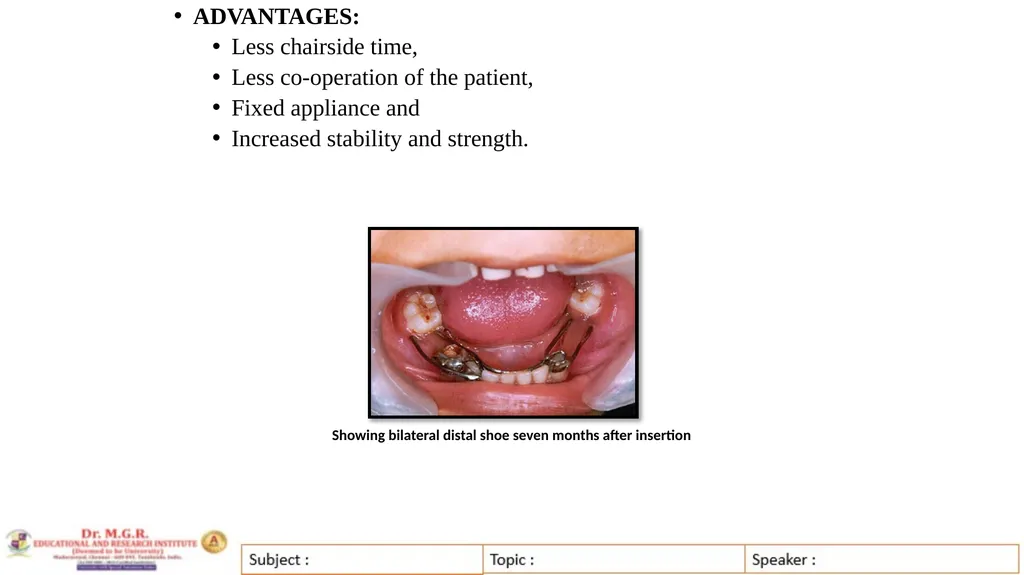
Increased stability and strength. Showing bilateral distal shoe seven months after insertion<br>
Less chairside time,
Less co-operation of the patient,
Fixed appliance and
Increased stability and strength. Showing bilateral distal shoe seven months after insertion<br>
51
SPACE MAINTENANCE FOR PRIMARY & PERMANENT INCISOR AREA REMOVABLE PARTIAL DENTURES
Esthetic
Maintains function
Prevents abnormal speech & tongue habits
Indicated in cooperative children with multiple primary teeth loss
Contraindicated in very young children<br>
Esthetic
Maintains function
Prevents abnormal speech & tongue habits
Indicated in cooperative children with multiple primary teeth loss
Contraindicated in very young children<br>
52
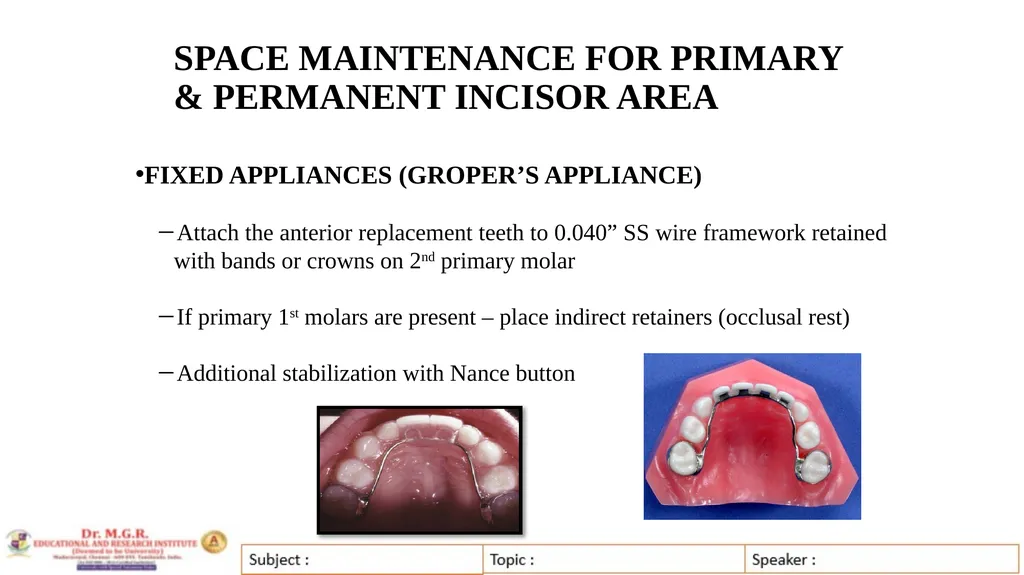
SPACE MAINTENANCE FOR PRIMARY & PERMANENT INCISOR AREA FIXED APPLIANCES (GROPER’S APPLIANCE)
Attach the anterior replacement teeth to 0.040” SS wire framework retained with bands or crowns on 2nd primary molar
If primary 1st molars are present – place indirect retainers (occlusal rest)
Additional stabilization with Nance button<br>
Attach the anterior replacement teeth to 0.040” SS wire framework retained with bands or crowns on 2nd primary molar
If primary 1st molars are present – place indirect retainers (occlusal rest)
Additional stabilization with Nance button<br>
53
THANK YOU<br>