
Toshiba/NSTA ExploraVision Introducing STEM
Description: ToshibaNSTA ExploraVision Introducing STEM Competition in Your Classroom -- Program Guide -- How to use this presentation and slide deck Feel free to use this presentation to share the ToshibaNSTA ExploraVision competition and program at
Related Topics
Download Presentation
"Toshiba/NSTA ExploraVision Introducing STEM" is the property of its rightful owner. Permission is granted to download and print the materials on this website for personal, non-commercial use only, and to display it on your personal computer provided you do not modify the materials and that you retain all copyright notices contained in the materials. By downloading content from our website, you accept the terms of this agreement.
Presentation Transcript
slide1. Toshiba/NSTA ExploraVision Introducing STEM Competition in Your Classroom
-- Program Guide --<br>
slide2. How to use this presentation and slide deck Feel free to use this presentation to share the Toshiba/NSTA ExploraVision competition and program at a high level to your school leadership, parents and students.
The following slide deck is meant to serve as a framework for your teams to get started and provide thoughts as to how the coach will approach the competition this year!
If you have any questions, feel free to contact us at exploravision@nsta.org.<br>
slide3. About Toshiba/NSTA ExploraVision ExploraVision is a STEM competition for K-12 students.
It encourages students to combine their imagination with their knowledge of science and technology to explore visions for the future.
Teams of 2-4 students select a technology, research how it works, learn why it was invented, and then predict how that technology may change in the future.
Students identify what “breakthroughs” are required for their idea to become a reality and describe the positive and negative consequences of their technology on society.
The students write a paper and draw a series of web pages to describe and communicate their idea.
Finalists make a visual poster (for K-3 grades) and an actual website (for 4-12 grades)* and a prototype of their future vision.
ExploraVision is more than a science fair or a competition—it can be a virtual or in-person tool to ignite every student’s enthusiasm for STEM subjects!<br>
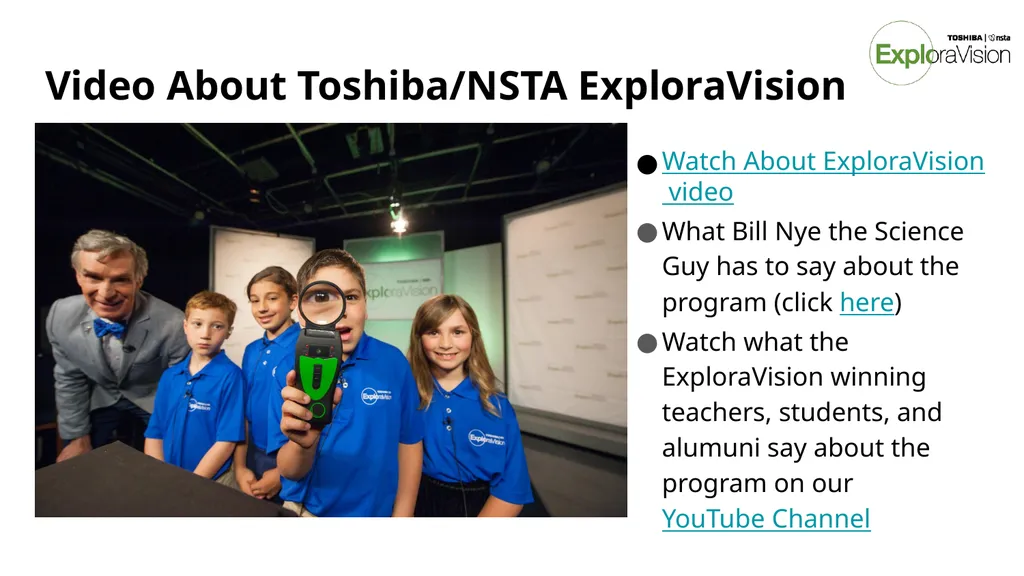
slide4. Video About Toshiba/NSTA ExploraVision Watch About ExploraVision video
What Bill Nye the Science Guy has to say about the program (click here)
Watch what the ExploraVision winning teachers, students, and alumuni say about the program on our YouTube Channel<br>
slide5. Why Participate in ExploraVision? Engage students in project-based learning to solve real world problems
Help students, teachers, and the community become interested in STEM
Help students develop skills such as critical thinking and communication
Teach students how to work effectively in groups on an interdisciplinary project
Help steer students toward a lifetime of learning and curiosity
Teach multiple subjects in one project: STEAM, English, research & history
FREE to enter and everyone who enters receives a gift and a certificate from ExploraVision!<br>
slide6. Prizes -- For The Students $10,000* savings bond for each first-place team member and $5,000* for each second-place team member
A trip to Washington, D.C. in June for ExploraVision Awards Weekend for each national winning student and their parents/guardians
A Chromebook for each regional winning student
A unique prize for all students on the 500 Honorable Mention winning teams
A certificate of participation and an entry gift for every student who submits a complete project
* Savings bonds maturity value<br>
slide7. Prizes -- For The Schools A technology/science-related gift for each of the schools of the regional winning teams
National press coverage and national recognition
An awards ceremony for each regional winning team at their school where they will receive a winner’s banner, plaque, and other gifts<br>
slide8. Prizes -- For Teachers/Coaches and Mentors A trip to Washington, D.C. in June for ExploraVision Awards Weekend for the teacher/coach or mentor of each national winning team
A one-year NSTA membership for teachers/coaches of the national winning teams
A certificate of participation and an entry gift for each coach and mentor of every team that submits a complete project
A Chromebook for the teacher/coach of each regional winning team
A trip to an NSTA conference for ExploraVision Ambassadors<br>
slide9. ExploraVision Key Dates Coach registration Open: July 18, 2022 at www.exploravision.org
Project Entry Due: January 31, 2023 at www.exploravision.org
Regional Winner Announcement: March 20, 2023
National Winner Announcement: May 5, 2023
Awards Weekend: June 7 - June 9, 2023 in Washington, D.C.<br>
slide10. General Requirements -- Students Must be full-time K-12 students
Must be currently enrolled in and attending a public, private, or homeschool in the U.S. or Canada
Must not be older than 21<br>
slide11. Teachers/Coaches:
Are required for each team
Must teach at a school attended by at least one of the team members
Cannot be a parent/guardian of a team member
May enter an unlimited number of teams
Should guide the students but not perform work on the project
Mentors:
Are optional
Can be an individual that represents an organization or business or be a parent/guardian of a team member
Should serve as a resource for the team but not perform work on the project General Requirements -- Teachers/Coaches/Mentors<br>
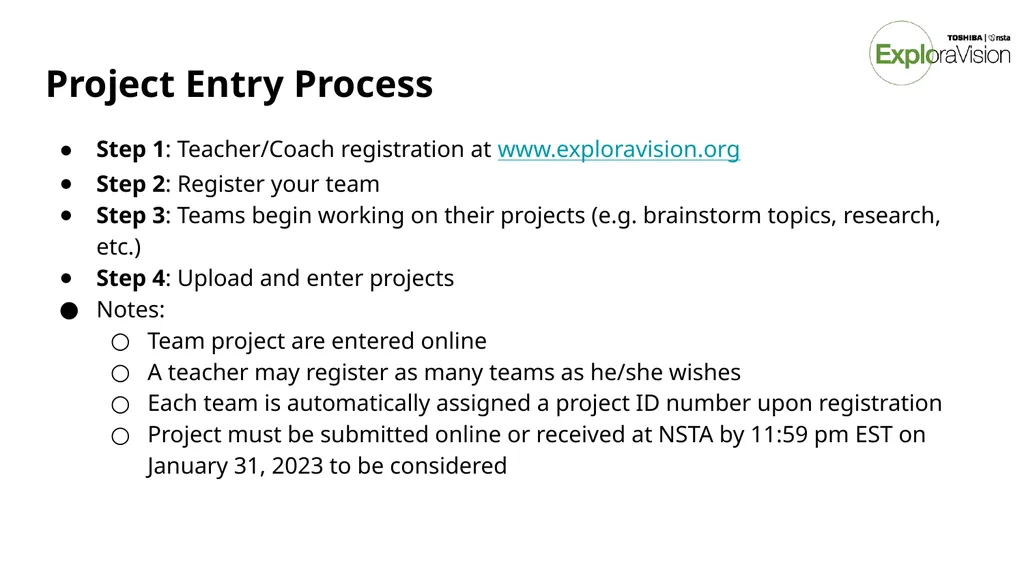
slide12. Project Entry Process Step 1: Teacher/Coach registration at www.exploravision.org
Step 2: Register your team
Step 3: Teams begin working on their projects (e.g. brainstorm topics, research, etc.)
Step 4: Upload and enter projects
Notes:
Team project are entered online
A teacher may register as many teams as he/she wishes
Each team is automatically assigned a project ID number upon registration
Project must be submitted online or received at NSTA by 11:59 pm EST on January 31, 2023 to be considered<br>
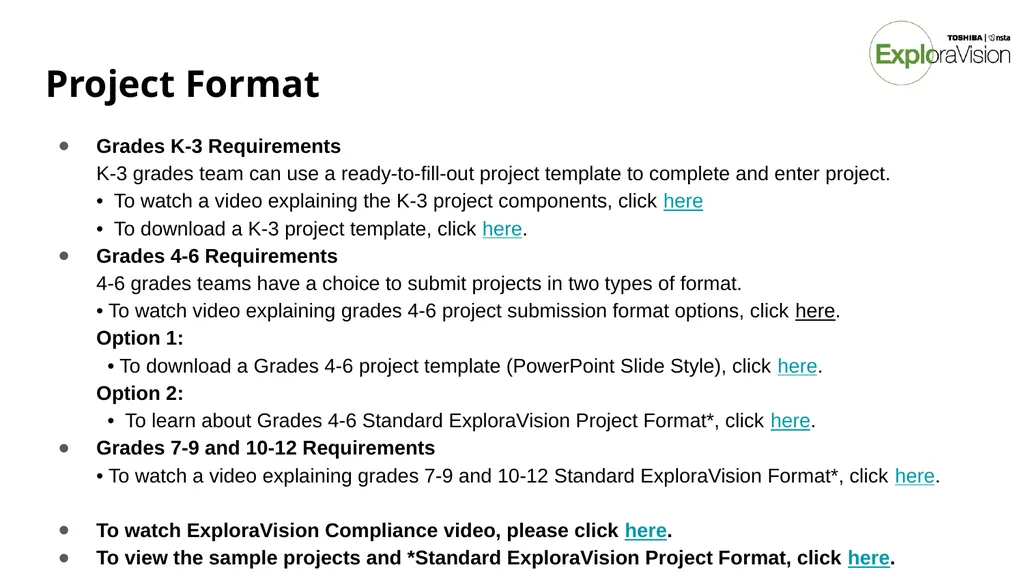
slide13. Project Format Grades K-3 Requirements K-3 grades team can use a ready-to-fill-out project template to complete and enter project. • To watch a video explaining the K-3 project components, click here • To download a K-3 project template, click here.
Grades 4-6 Requirements 4-6 grades teams have a choice to submit projects in two types of format. • To watch video explaining grades 4-6 project submission format options, click here. Option 1: • To download a Grades 4-6 project template (PowerPoint Slide Style), click here. Option 2: • To learn about Grades 4-6 Standard ExploraVision Project Format*, click here.
Grades 7-9 and 10-12 Requirements • To watch a video explaining grades 7-9 and 10-12 Standard ExploraVision Format*, click here.
To watch ExploraVision Compliance video, please click here.
To view the sample projects and *Standard ExploraVision Project Format, click here.<br>
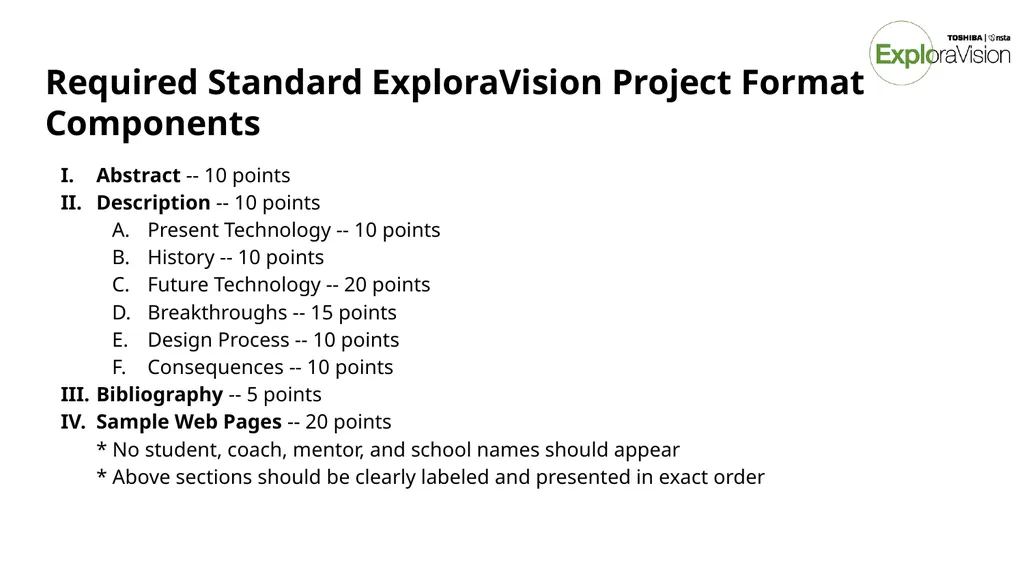
slide14. Abstract -- 10 points
Description -- 10 points
Present Technology -- 10 points
History -- 10 points
Future Technology -- 20 points
Breakthroughs -- 15 points
Design Process -- 10 points
Consequences -- 10 points
Bibliography -- 5 points
Sample Web Pages -- 20 points * No student, coach, mentor, and school names should appear * Above sections should be clearly labeled and presented in exact order Required Standard ExploraVision Project Format Components<br>
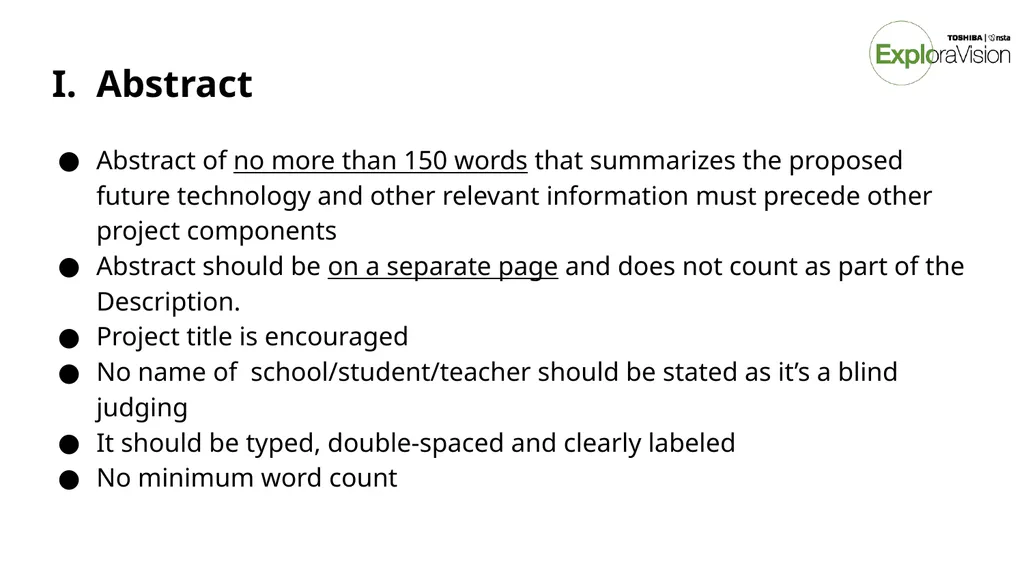
slide15. Abstract Abstract of no more than 150 words that summarizes the proposed future technology and other relevant information must precede other project components
Abstract should be on a separate page and does not count as part of the Description.
Project title is encouraged
No name of school/student/teacher should be stated as it’s a blind judging
It should be typed, double-spaced and clearly labeled
No minimum word count<br>
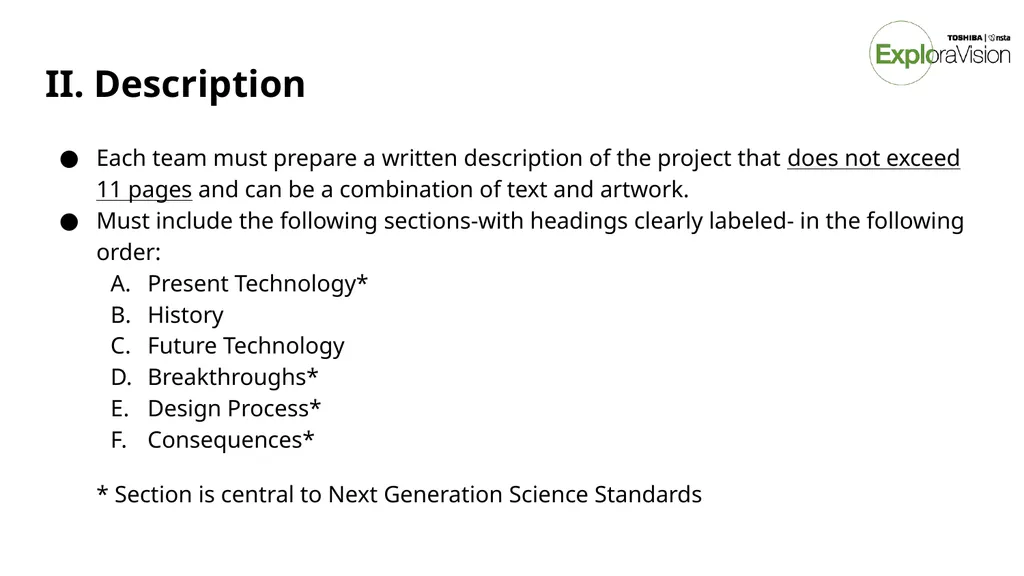
slide16. II. Description Each team must prepare a written description of the project that does not exceed 11 pages and can be a combination of text and artwork.
Must include the following sections-with headings clearly labeled- in the following order:
Present Technology*
History
Future Technology
Breakthroughs*
Design Process*
Consequences*
* Section is central to Next Generation Science Standards<br>
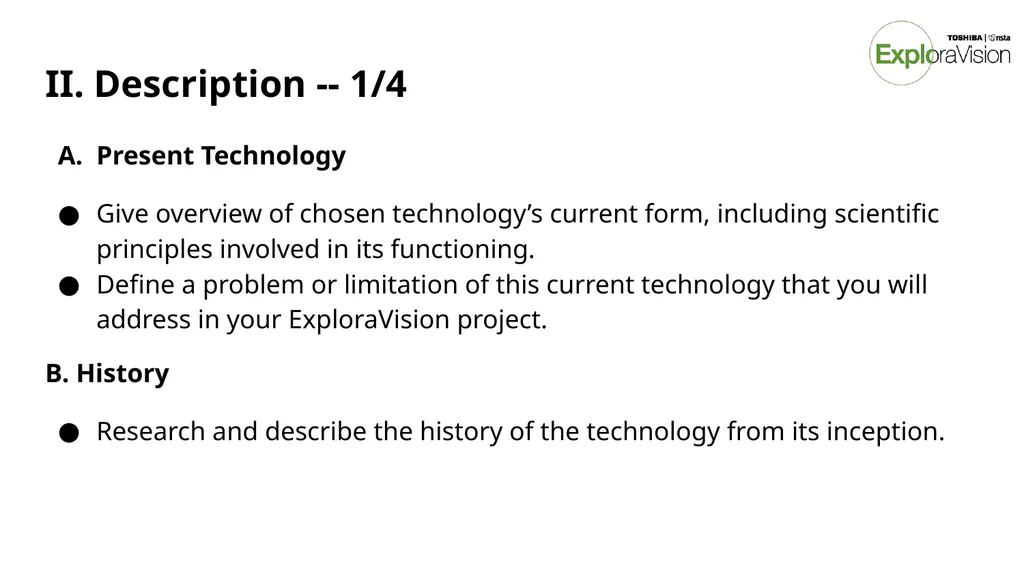
slide17. II. Description -- 1/4 Present Technology
Give overview of chosen technology’s current form, including scientific principles involved in its functioning.
Define a problem or limitation of this current technology that you will address in your ExploraVision project.
B. History
Research and describe the history of the technology from its inception.<br>
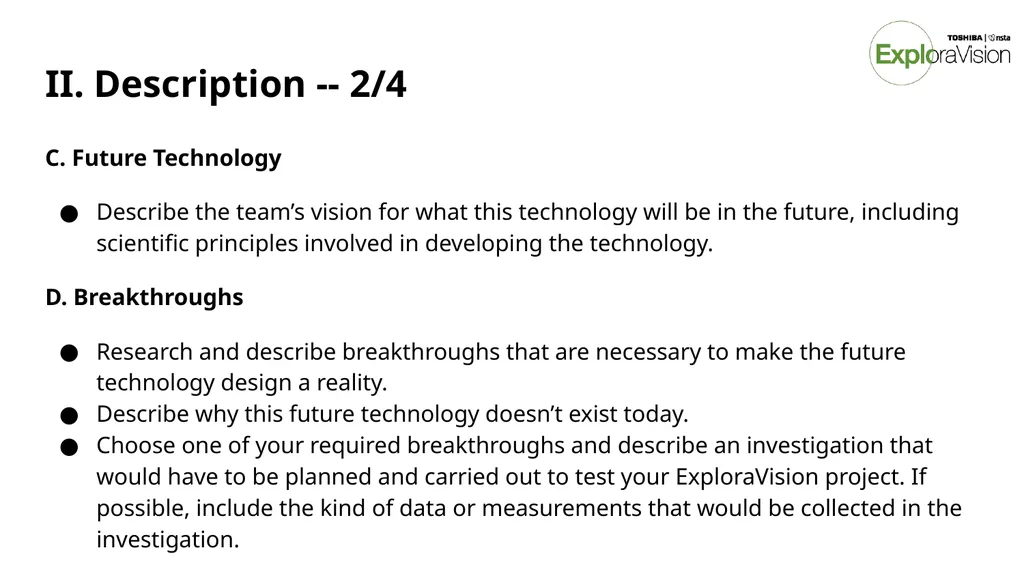
slide18. II. Description -- 2/4 C. Future Technology
Describe the team’s vision for what this technology will be in the future, including scientific principles involved in developing the technology.
D. Breakthroughs
Research and describe breakthroughs that are necessary to make the future technology design a reality.
Describe why this future technology doesn’t exist today.
Choose one of your required breakthroughs and describe an investigation that would have to be planned and carried out to test your ExploraVision project. If possible, include the kind of data or measurements that would be collected in the investigation.<br>
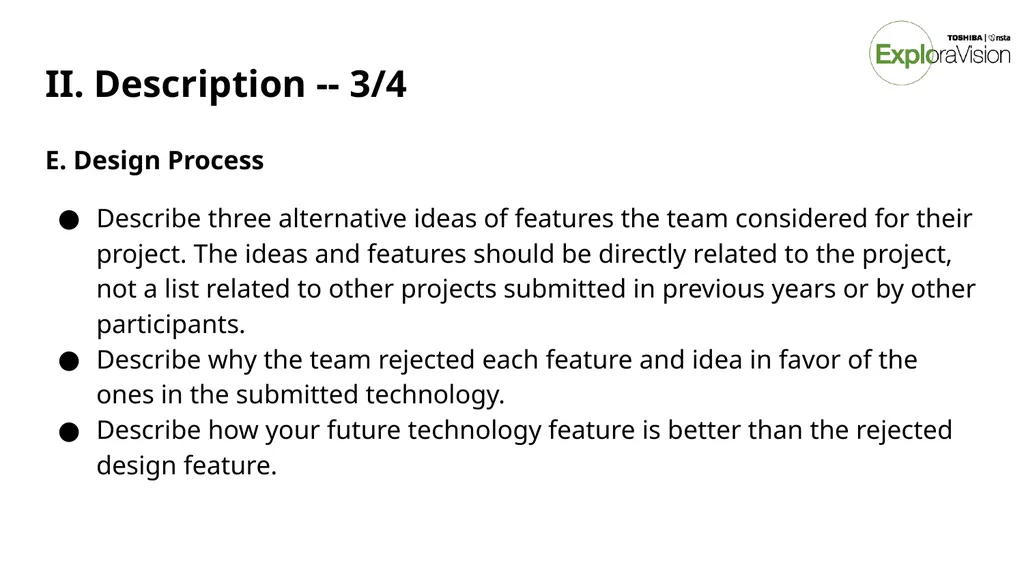
slide19. II. Description -- 3/4 E. Design Process
Describe three alternative ideas of features the team considered for their project. The ideas and features should be directly related to the project, not a list related to other projects submitted in previous years or by other participants.
Describe why the team rejected each feature and idea in favor of the ones in the submitted technology.
Describe how your future technology feature is better than the rejected design feature.<br>
slide20. II. Description -- 4/4 F. Consequences
Recognizing that all technologies have positive and negative consequences, describe the potential positive and negative consequences of the new technology on society<br>
slide21. III. Bibliography All sources used in researching the chosen technology should be referenced in the Bibliography.
Sources must be clearly labeled and include title, author, publisher, and copyright date.
Not counted as part of the 11-page limit for the Description.
Footnotes are encouraged, but not required.
No page limit for the Bibliography section.<br>
slide22. IV. Sample Web Pages Team members must prepare exactly five sample web pages that communicate and promote their future technology vision.
Must include description and illustration of the chosen technology.
One of the five pages should be a model or visual representation of the technology that could be used to create a prototype for display.
The model should help others visualize the design and should communicate the design features.
Web pages can be hand-drawn, on an actual website, or computer generated with text, pictures, photographs and diagrams.<br>
slide23. Regional Judging The judging committees are made up of leading science educators and science and technology experts
Judging is divided into two phases: regional and national judging
All eligible projects will be evaluated in the regional judging phase
24 regional winning teams will move on to national judging
The judging criteria for assigning points are based on creativity, scientific accuracy, communication, and feasibility of the project’s vision
Judges award higher scores to entries that are unique and different from those that have won previously<br>
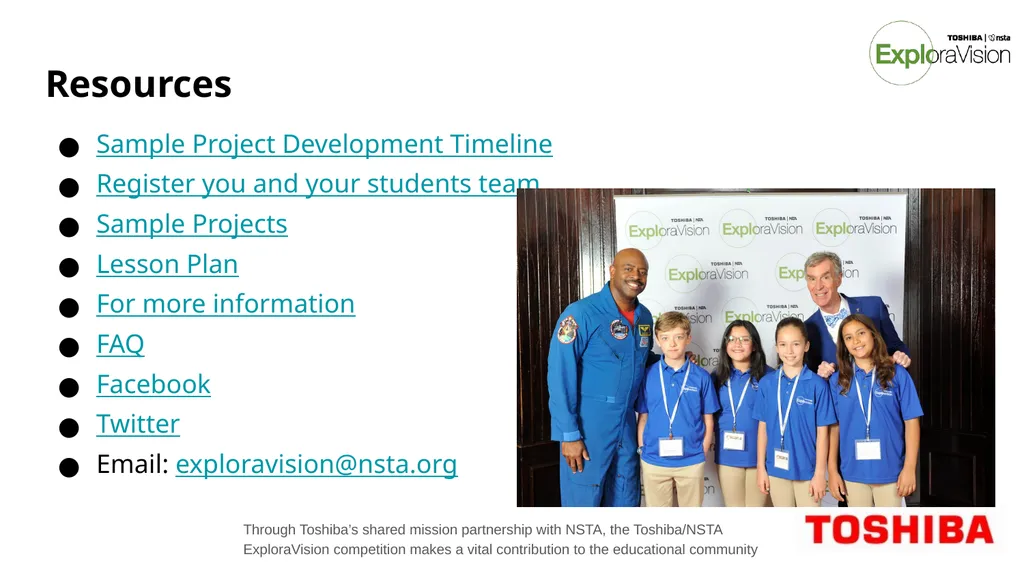
slide24. Through Toshiba’s shared mission partnership with NSTA, the Toshiba/NSTA ExploraVision competition makes a vital contribution to the educational community Resources Sample Project Development Timeline
Register you and your students team
Sample Projects
Lesson Plan
For more information
FAQ
Facebook
Twitter
Email: exploravision@nsta.org<br>
-- Program Guide --<br>
slide2. How to use this presentation and slide deck Feel free to use this presentation to share the Toshiba/NSTA ExploraVision competition and program at a high level to your school leadership, parents and students.
The following slide deck is meant to serve as a framework for your teams to get started and provide thoughts as to how the coach will approach the competition this year!
If you have any questions, feel free to contact us at exploravision@nsta.org.<br>
slide3. About Toshiba/NSTA ExploraVision ExploraVision is a STEM competition for K-12 students.
It encourages students to combine their imagination with their knowledge of science and technology to explore visions for the future.
Teams of 2-4 students select a technology, research how it works, learn why it was invented, and then predict how that technology may change in the future.
Students identify what “breakthroughs” are required for their idea to become a reality and describe the positive and negative consequences of their technology on society.
The students write a paper and draw a series of web pages to describe and communicate their idea.
Finalists make a visual poster (for K-3 grades) and an actual website (for 4-12 grades)* and a prototype of their future vision.
ExploraVision is more than a science fair or a competition—it can be a virtual or in-person tool to ignite every student’s enthusiasm for STEM subjects!<br>
slide4. Video About Toshiba/NSTA ExploraVision Watch About ExploraVision video
What Bill Nye the Science Guy has to say about the program (click here)
Watch what the ExploraVision winning teachers, students, and alumuni say about the program on our YouTube Channel<br>
slide5. Why Participate in ExploraVision? Engage students in project-based learning to solve real world problems
Help students, teachers, and the community become interested in STEM
Help students develop skills such as critical thinking and communication
Teach students how to work effectively in groups on an interdisciplinary project
Help steer students toward a lifetime of learning and curiosity
Teach multiple subjects in one project: STEAM, English, research & history
FREE to enter and everyone who enters receives a gift and a certificate from ExploraVision!<br>
slide6. Prizes -- For The Students $10,000* savings bond for each first-place team member and $5,000* for each second-place team member
A trip to Washington, D.C. in June for ExploraVision Awards Weekend for each national winning student and their parents/guardians
A Chromebook for each regional winning student
A unique prize for all students on the 500 Honorable Mention winning teams
A certificate of participation and an entry gift for every student who submits a complete project
* Savings bonds maturity value<br>
slide7. Prizes -- For The Schools A technology/science-related gift for each of the schools of the regional winning teams
National press coverage and national recognition
An awards ceremony for each regional winning team at their school where they will receive a winner’s banner, plaque, and other gifts<br>
slide8. Prizes -- For Teachers/Coaches and Mentors A trip to Washington, D.C. in June for ExploraVision Awards Weekend for the teacher/coach or mentor of each national winning team
A one-year NSTA membership for teachers/coaches of the national winning teams
A certificate of participation and an entry gift for each coach and mentor of every team that submits a complete project
A Chromebook for the teacher/coach of each regional winning team
A trip to an NSTA conference for ExploraVision Ambassadors<br>
slide9. ExploraVision Key Dates Coach registration Open: July 18, 2022 at www.exploravision.org
Project Entry Due: January 31, 2023 at www.exploravision.org
Regional Winner Announcement: March 20, 2023
National Winner Announcement: May 5, 2023
Awards Weekend: June 7 - June 9, 2023 in Washington, D.C.<br>
slide10. General Requirements -- Students Must be full-time K-12 students
Must be currently enrolled in and attending a public, private, or homeschool in the U.S. or Canada
Must not be older than 21<br>
slide11. Teachers/Coaches:
Are required for each team
Must teach at a school attended by at least one of the team members
Cannot be a parent/guardian of a team member
May enter an unlimited number of teams
Should guide the students but not perform work on the project
Mentors:
Are optional
Can be an individual that represents an organization or business or be a parent/guardian of a team member
Should serve as a resource for the team but not perform work on the project General Requirements -- Teachers/Coaches/Mentors<br>
slide12. Project Entry Process Step 1: Teacher/Coach registration at www.exploravision.org
Step 2: Register your team
Step 3: Teams begin working on their projects (e.g. brainstorm topics, research, etc.)
Step 4: Upload and enter projects
Notes:
Team project are entered online
A teacher may register as many teams as he/she wishes
Each team is automatically assigned a project ID number upon registration
Project must be submitted online or received at NSTA by 11:59 pm EST on January 31, 2023 to be considered<br>
slide13. Project Format Grades K-3 Requirements K-3 grades team can use a ready-to-fill-out project template to complete and enter project. • To watch a video explaining the K-3 project components, click here • To download a K-3 project template, click here.
Grades 4-6 Requirements 4-6 grades teams have a choice to submit projects in two types of format. • To watch video explaining grades 4-6 project submission format options, click here. Option 1: • To download a Grades 4-6 project template (PowerPoint Slide Style), click here. Option 2: • To learn about Grades 4-6 Standard ExploraVision Project Format*, click here.
Grades 7-9 and 10-12 Requirements • To watch a video explaining grades 7-9 and 10-12 Standard ExploraVision Format*, click here.
To watch ExploraVision Compliance video, please click here.
To view the sample projects and *Standard ExploraVision Project Format, click here.<br>
slide14. Abstract -- 10 points
Description -- 10 points
Present Technology -- 10 points
History -- 10 points
Future Technology -- 20 points
Breakthroughs -- 15 points
Design Process -- 10 points
Consequences -- 10 points
Bibliography -- 5 points
Sample Web Pages -- 20 points * No student, coach, mentor, and school names should appear * Above sections should be clearly labeled and presented in exact order Required Standard ExploraVision Project Format Components<br>
slide15. Abstract Abstract of no more than 150 words that summarizes the proposed future technology and other relevant information must precede other project components
Abstract should be on a separate page and does not count as part of the Description.
Project title is encouraged
No name of school/student/teacher should be stated as it’s a blind judging
It should be typed, double-spaced and clearly labeled
No minimum word count<br>
slide16. II. Description Each team must prepare a written description of the project that does not exceed 11 pages and can be a combination of text and artwork.
Must include the following sections-with headings clearly labeled- in the following order:
Present Technology*
History
Future Technology
Breakthroughs*
Design Process*
Consequences*
* Section is central to Next Generation Science Standards<br>
slide17. II. Description -- 1/4 Present Technology
Give overview of chosen technology’s current form, including scientific principles involved in its functioning.
Define a problem or limitation of this current technology that you will address in your ExploraVision project.
B. History
Research and describe the history of the technology from its inception.<br>
slide18. II. Description -- 2/4 C. Future Technology
Describe the team’s vision for what this technology will be in the future, including scientific principles involved in developing the technology.
D. Breakthroughs
Research and describe breakthroughs that are necessary to make the future technology design a reality.
Describe why this future technology doesn’t exist today.
Choose one of your required breakthroughs and describe an investigation that would have to be planned and carried out to test your ExploraVision project. If possible, include the kind of data or measurements that would be collected in the investigation.<br>
slide19. II. Description -- 3/4 E. Design Process
Describe three alternative ideas of features the team considered for their project. The ideas and features should be directly related to the project, not a list related to other projects submitted in previous years or by other participants.
Describe why the team rejected each feature and idea in favor of the ones in the submitted technology.
Describe how your future technology feature is better than the rejected design feature.<br>
slide20. II. Description -- 4/4 F. Consequences
Recognizing that all technologies have positive and negative consequences, describe the potential positive and negative consequences of the new technology on society<br>
slide21. III. Bibliography All sources used in researching the chosen technology should be referenced in the Bibliography.
Sources must be clearly labeled and include title, author, publisher, and copyright date.
Not counted as part of the 11-page limit for the Description.
Footnotes are encouraged, but not required.
No page limit for the Bibliography section.<br>
slide22. IV. Sample Web Pages Team members must prepare exactly five sample web pages that communicate and promote their future technology vision.
Must include description and illustration of the chosen technology.
One of the five pages should be a model or visual representation of the technology that could be used to create a prototype for display.
The model should help others visualize the design and should communicate the design features.
Web pages can be hand-drawn, on an actual website, or computer generated with text, pictures, photographs and diagrams.<br>
slide23. Regional Judging The judging committees are made up of leading science educators and science and technology experts
Judging is divided into two phases: regional and national judging
All eligible projects will be evaluated in the regional judging phase
24 regional winning teams will move on to national judging
The judging criteria for assigning points are based on creativity, scientific accuracy, communication, and feasibility of the project’s vision
Judges award higher scores to entries that are unique and different from those that have won previously<br>
slide24. Through Toshiba’s shared mission partnership with NSTA, the Toshiba/NSTA ExploraVision competition makes a vital contribution to the educational community Resources Sample Project Development Timeline
Register you and your students team
Sample Projects
Lesson Plan
For more information
FAQ
Email: exploravision@nsta.org<br>