
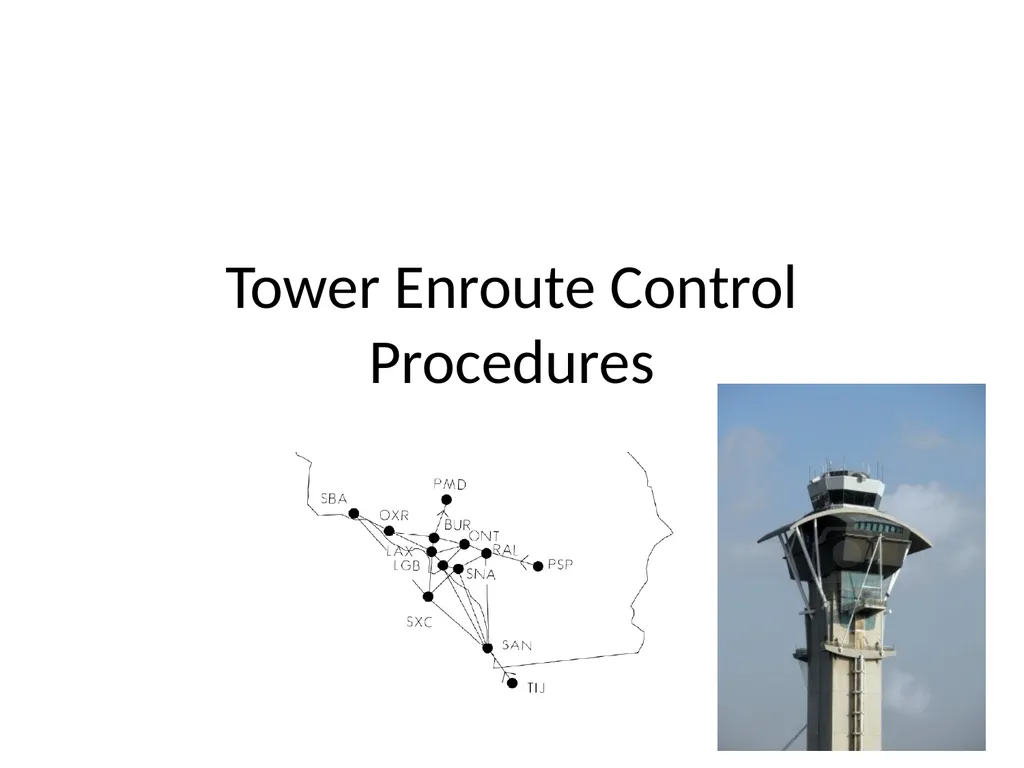
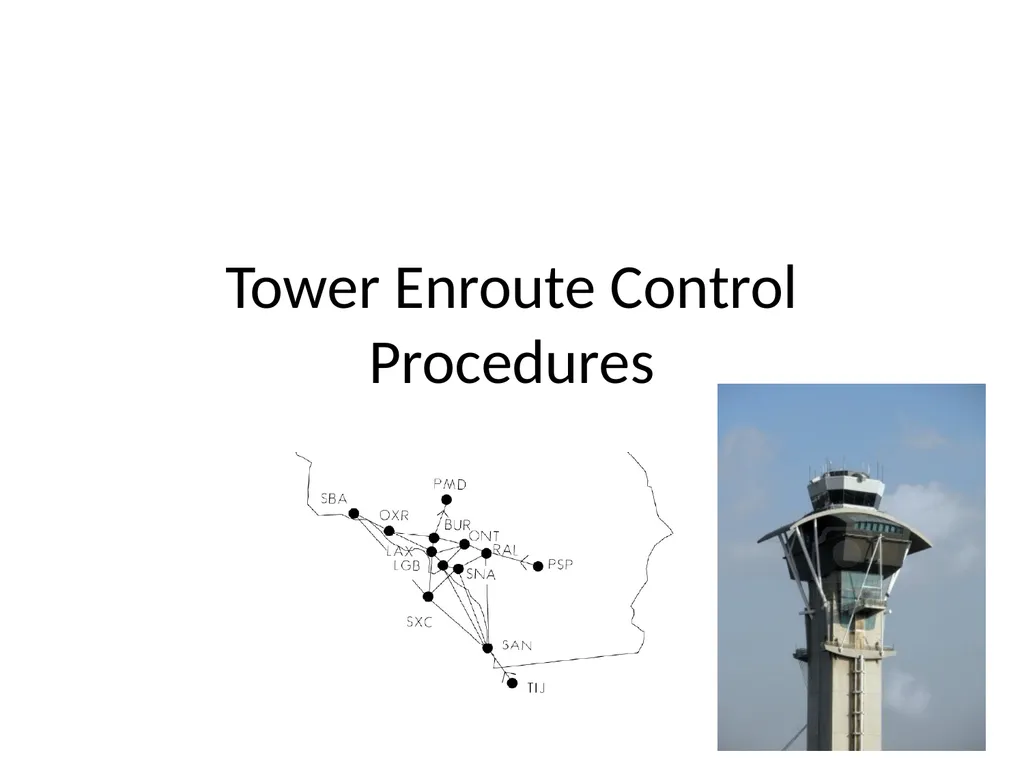
Tower Enroute Control Procedures 1 Tower Enroute

Description: Tower Enroute Control Procedures 1 Tower Enroute Control Procedure Low altitude system for aircraft going between adjacent metropolitan areas Tower Enroute Control does NOT mean youll only be talking to towers Can get TEC clearances from
Related Topics
Download Presentation
"Tower Enroute Control Procedures 1 Tower Enroute" is the property of its rightful owner. Permission is granted to download and print the materials on this website for personal, non-commercial use only, and to display it on your personal computer provided you do not modify the materials and that you retain all copyright notices contained in the materials. By downloading content from our website, you accept the terms of this agreement.
Presentation Transcript
slide1. Tower Enroute Control Procedures 1<br>
slide2. Tower Enroute Control Procedure Low altitude system for aircraft going between adjacent metropolitan areas
Tower Enroute Control does NOT mean you'll only be talking to towers
Can get TEC clearances from non-towered airports 2<br>
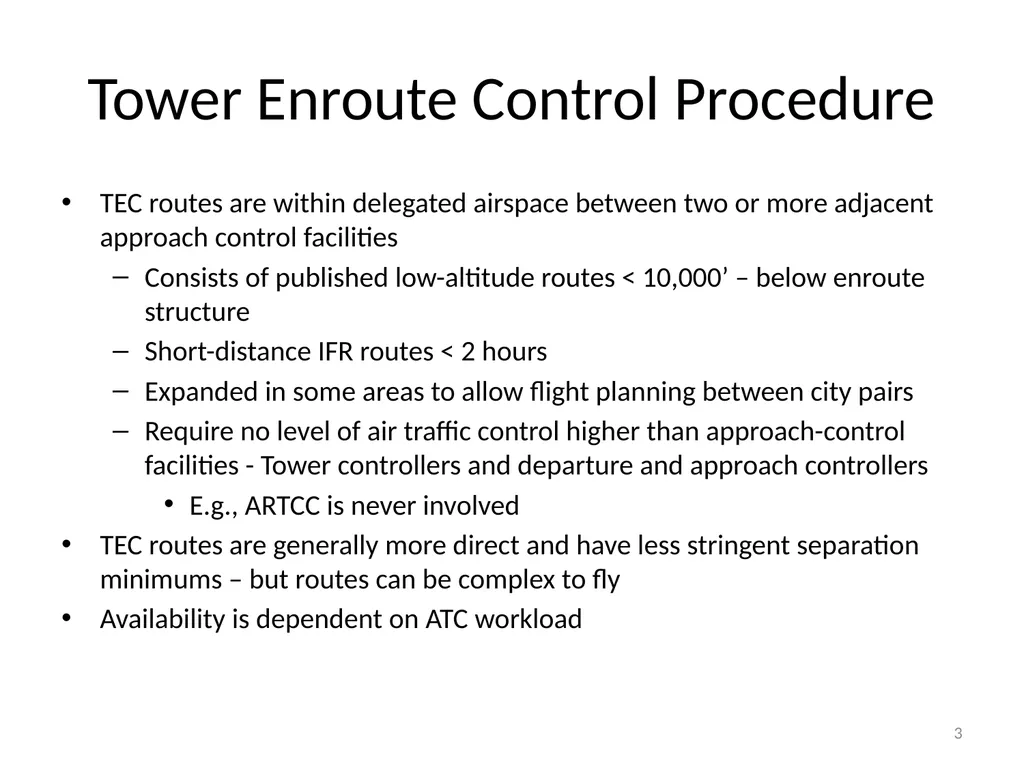
slide3. Tower Enroute Control Procedure TEC routes are within delegated airspace between two or more adjacent approach control facilities
Consists of published low-altitude routes < 10,000’ – below enroute structure
Short-distance IFR routes < 2 hours
Expanded in some areas to allow flight planning between city pairs
Require no level of air traffic control higher than approach-control facilities - Tower controllers and departure and approach controllers
E.g., ARTCC is never involved
TEC routes are generally more direct and have less stringent separation minimums – but routes can be complex to fly
Availability is dependent on ATC workload 3<br>
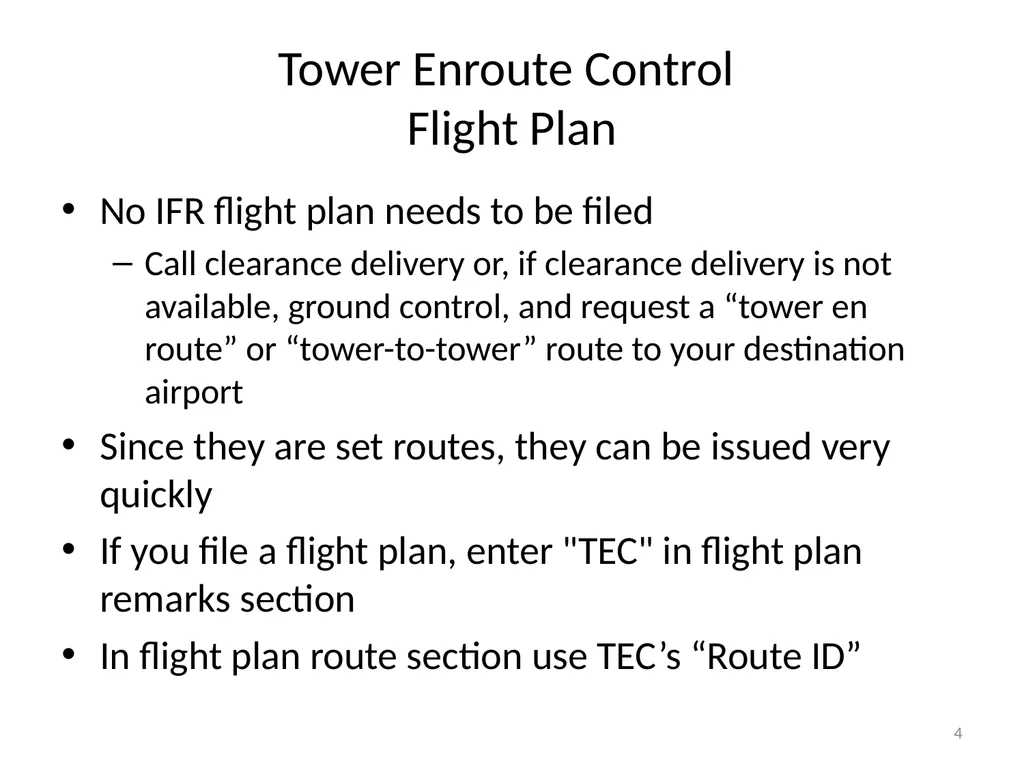
slide4. Tower Enroute Control Flight Plan No IFR flight plan needs to be filed
Call clearance delivery or, if clearance delivery is not available, ground control, and request a “tower en route” or “tower-to-tower” route to your destination airport
Since they are set routes, they can be issued very quickly
If you file a flight plan, enter "TEC" in flight plan remarks section
In flight plan route section use TEC’s “Route ID” 4<br>
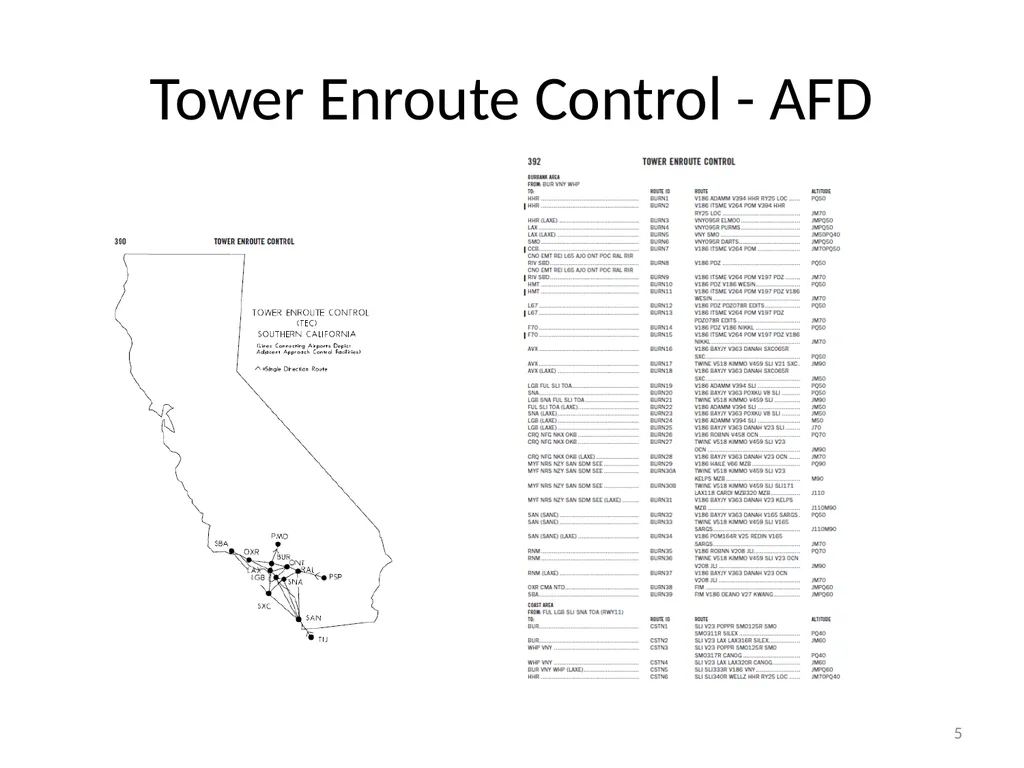
slide5. Tower Enroute Control - AFD 5<br>
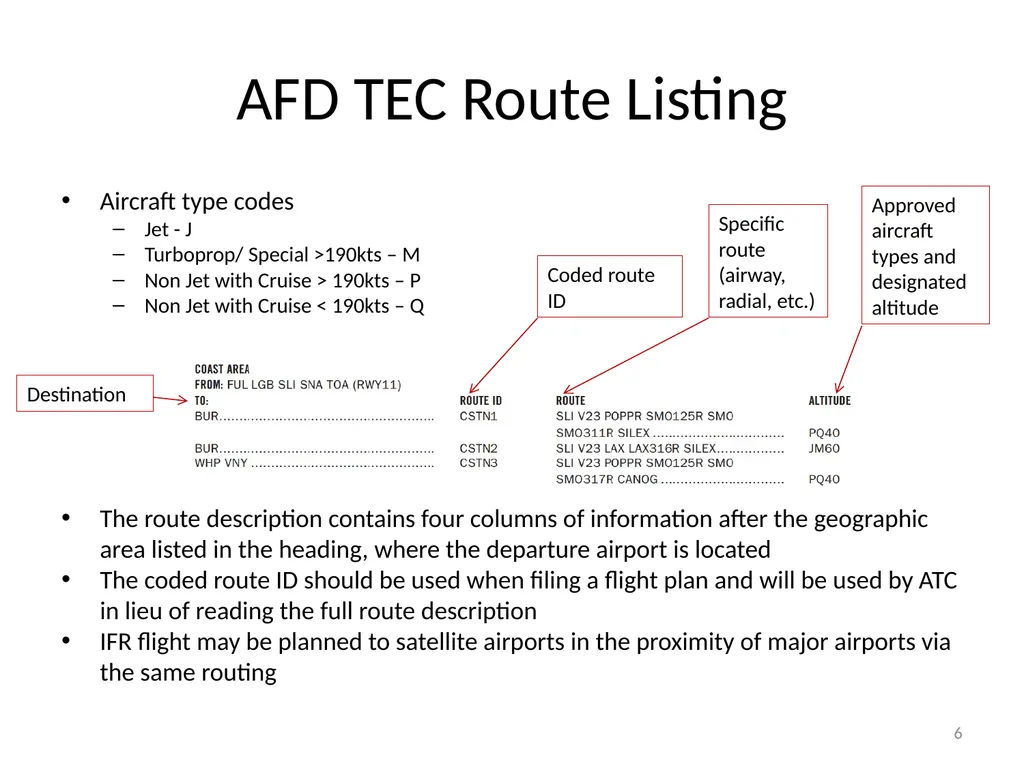
slide6. AFD TEC Route Listing Aircraft type codes
Jet - J
Turboprop/ Special >190kts – M
Non Jet with Cruise > 190kts – P
Non Jet with Cruise < 190kts – Q
The route description contains four columns of information after the geographic area listed in the heading, where the departure airport is located
The coded route ID should be used when filing a flight plan and will be used by ATC in lieu of reading the full route description
IFR flight may be planned to satellite airports in the proximity of major airports via the same routing Destination Coded route ID Specific route (airway, radial, etc.) Approved aircraft types and designated altitude 6<br>
slide7. AFD TEC Route Listing Different geographic areas may split traffic using different criteria – e.g., single, twin, different speeds, etc. 7<br>
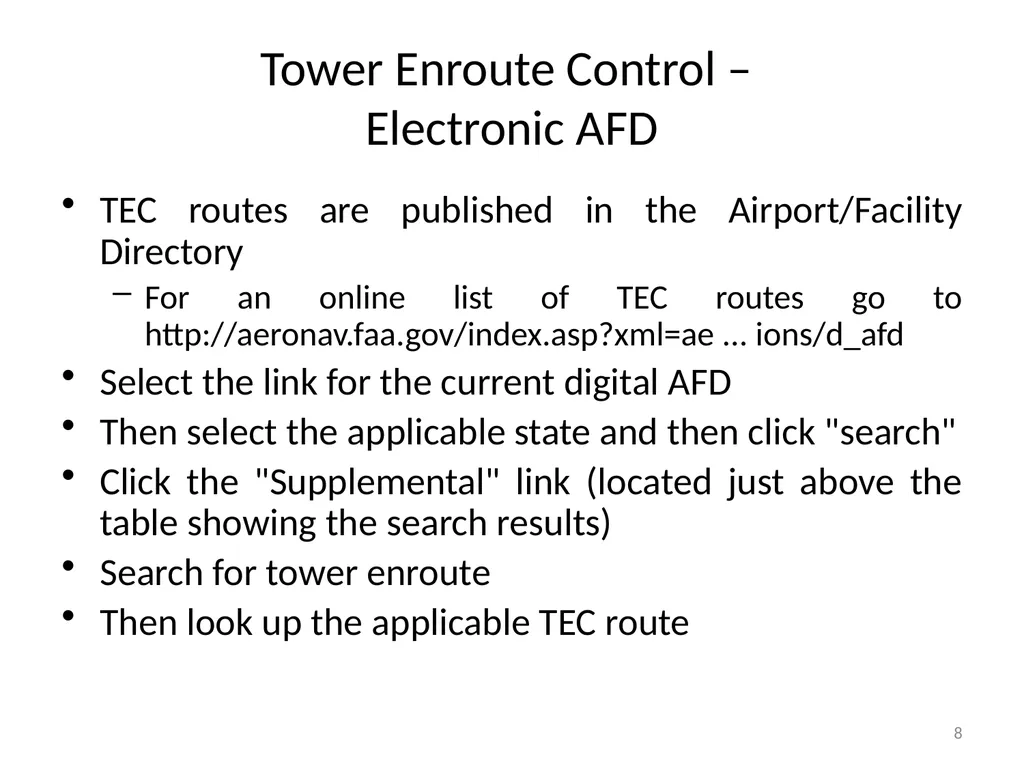
slide8. Tower Enroute Control – Electronic AFD TEC routes are published in the Airport/Facility Directory
For an online list of TEC routes go to http://aeronav.faa.gov/index.asp?xml=ae ... ions/d_afd
Select the link for the current digital AFD
Then select the applicable state and then click "search"
Click the "Supplemental" link (located just above the table showing the search results)
Search for tower enroute
Then look up the applicable TEC route 8<br>
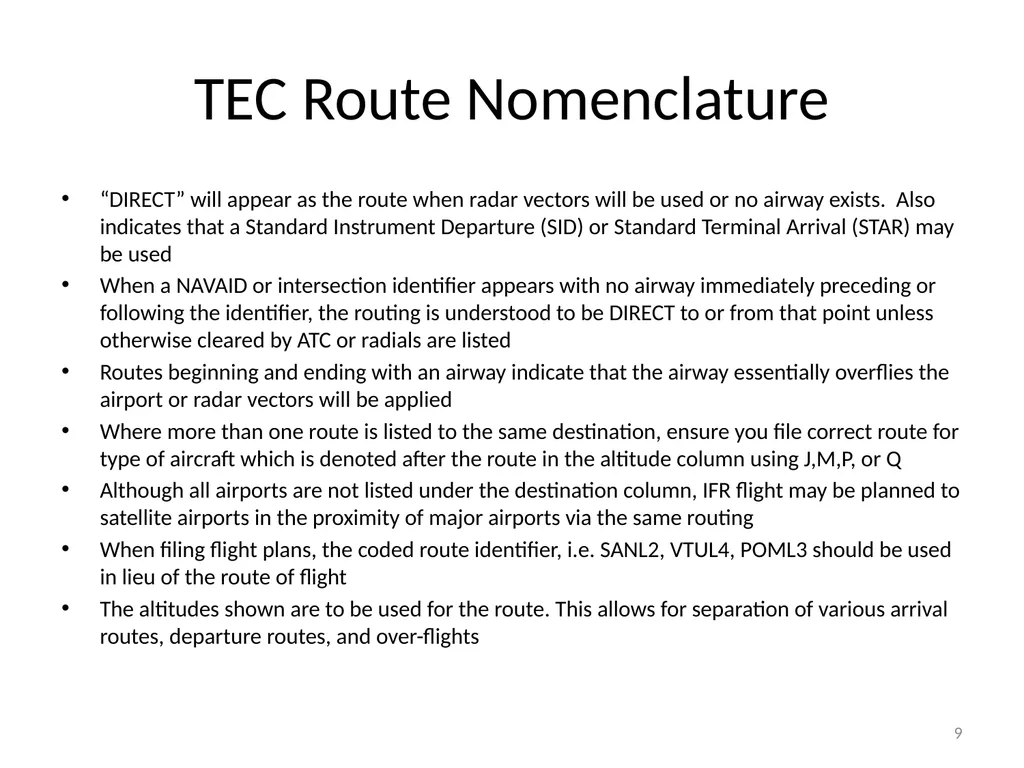
slide9. TEC Route Nomenclature “DIRECT” will appear as the route when radar vectors will be used or no airway exists. Also indicates that a Standard Instrument Departure (SID) or Standard Terminal Arrival (STAR) may be used
When a NAVAID or intersection identifier appears with no airway immediately preceding or following the identifier, the routing is understood to be DIRECT to or from that point unless otherwise cleared by ATC or radials are listed
Routes beginning and ending with an airway indicate that the airway essentially overflies the airport or radar vectors will be applied
Where more than one route is listed to the same destination, ensure you file correct route for type of aircraft which is denoted after the route in the altitude column using J,M,P, or Q
Although all airports are not listed under the destination column, IFR flight may be planned to satellite airports in the proximity of major airports via the same routing
When filing flight plans, the coded route identifier, i.e. SANL2, VTUL4, POML3 should be used in lieu of the route of flight
The altitudes shown are to be used for the route. This allows for separation of various arrival routes, departure routes, and over-flights 9<br>
slide10. Questions 10<br>
slide11. Disclaimer Instrument flight can be dangerous. Do not rely solely on this presentation – PROFESSIONAL INSTRUCTION IS REQUIRED
The foregoing material should not be relied upon for flight
ALTHOUGH THE ABOVE INFORMATION IS FROM SOURCES BELIEVED TO BE RELIABLE SUCH INFORMATION HAS NOT BEEN VERIFIED, AND NO EXPRESS REPRESENTATION IS MADE NOR IS ANY TO BE IMPLIED AS TO THE ACCURACY THEREOF, AND IT IS SUBMITTED SUBJECT TO ERRORS, OMISSIONS, CHANGE 11<br>
slide2. Tower Enroute Control Procedure Low altitude system for aircraft going between adjacent metropolitan areas
Tower Enroute Control does NOT mean you'll only be talking to towers
Can get TEC clearances from non-towered airports 2<br>
slide3. Tower Enroute Control Procedure TEC routes are within delegated airspace between two or more adjacent approach control facilities
Consists of published low-altitude routes < 10,000’ – below enroute structure
Short-distance IFR routes < 2 hours
Expanded in some areas to allow flight planning between city pairs
Require no level of air traffic control higher than approach-control facilities - Tower controllers and departure and approach controllers
E.g., ARTCC is never involved
TEC routes are generally more direct and have less stringent separation minimums – but routes can be complex to fly
Availability is dependent on ATC workload 3<br>
slide4. Tower Enroute Control Flight Plan No IFR flight plan needs to be filed
Call clearance delivery or, if clearance delivery is not available, ground control, and request a “tower en route” or “tower-to-tower” route to your destination airport
Since they are set routes, they can be issued very quickly
If you file a flight plan, enter "TEC" in flight plan remarks section
In flight plan route section use TEC’s “Route ID” 4<br>
slide5. Tower Enroute Control - AFD 5<br>
slide6. AFD TEC Route Listing Aircraft type codes
Jet - J
Turboprop/ Special >190kts – M
Non Jet with Cruise > 190kts – P
Non Jet with Cruise < 190kts – Q
The route description contains four columns of information after the geographic area listed in the heading, where the departure airport is located
The coded route ID should be used when filing a flight plan and will be used by ATC in lieu of reading the full route description
IFR flight may be planned to satellite airports in the proximity of major airports via the same routing Destination Coded route ID Specific route (airway, radial, etc.) Approved aircraft types and designated altitude 6<br>
slide7. AFD TEC Route Listing Different geographic areas may split traffic using different criteria – e.g., single, twin, different speeds, etc. 7<br>
slide8. Tower Enroute Control – Electronic AFD TEC routes are published in the Airport/Facility Directory
For an online list of TEC routes go to http://aeronav.faa.gov/index.asp?xml=ae ... ions/d_afd
Select the link for the current digital AFD
Then select the applicable state and then click "search"
Click the "Supplemental" link (located just above the table showing the search results)
Search for tower enroute
Then look up the applicable TEC route 8<br>
slide9. TEC Route Nomenclature “DIRECT” will appear as the route when radar vectors will be used or no airway exists. Also indicates that a Standard Instrument Departure (SID) or Standard Terminal Arrival (STAR) may be used
When a NAVAID or intersection identifier appears with no airway immediately preceding or following the identifier, the routing is understood to be DIRECT to or from that point unless otherwise cleared by ATC or radials are listed
Routes beginning and ending with an airway indicate that the airway essentially overflies the airport or radar vectors will be applied
Where more than one route is listed to the same destination, ensure you file correct route for type of aircraft which is denoted after the route in the altitude column using J,M,P, or Q
Although all airports are not listed under the destination column, IFR flight may be planned to satellite airports in the proximity of major airports via the same routing
When filing flight plans, the coded route identifier, i.e. SANL2, VTUL4, POML3 should be used in lieu of the route of flight
The altitudes shown are to be used for the route. This allows for separation of various arrival routes, departure routes, and over-flights 9<br>
slide10. Questions 10<br>
slide11. Disclaimer Instrument flight can be dangerous. Do not rely solely on this presentation – PROFESSIONAL INSTRUCTION IS REQUIRED
The foregoing material should not be relied upon for flight
ALTHOUGH THE ABOVE INFORMATION IS FROM SOURCES BELIEVED TO BE RELIABLE SUCH INFORMATION HAS NOT BEEN VERIFIED, AND NO EXPRESS REPRESENTATION IS MADE NOR IS ANY TO BE IMPLIED AS TO THE ACCURACY THEREOF, AND IT IS SUBMITTED SUBJECT TO ERRORS, OMISSIONS, CHANGE 11<br>