Training package on active tuberculosis drug
Description: Training package on active tuberculosis drug safety monitoring and management (aDSM) 2023 2.1vii. Consolidate aDSM data electronically Key steps in aDSM implementation Learning objective By the end of this presentation, the participant is
Related Topics
Download Presentation
"Training package on active tuberculosis drug" is the property of its rightful owner. Permission is granted to download and print the materials on this website for personal, non-commercial use only, and to display it on your personal computer provided you do not modify the materials and that you retain all copyright notices contained in the materials. By downloading content from our website, you accept the terms of this agreement.
Presentation Transcript
slide1. Training package on active tuberculosis drug safety monitoring and management (aDSM)
2023<br>
slide2. 2.1vii. Consolidate aDSM data electronically<br>
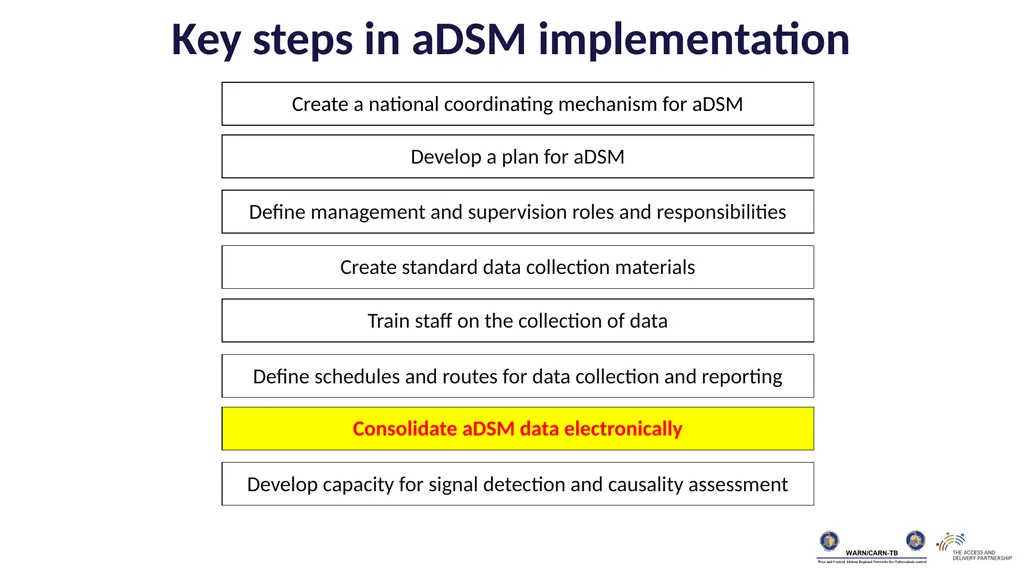
slide3. Key steps in aDSM implementation<br>
slide4. Learning objectiveBy the end of this presentation, the participant is expected to… Understand why and how to collect, manage and store aDSM data in an electronic format<br>
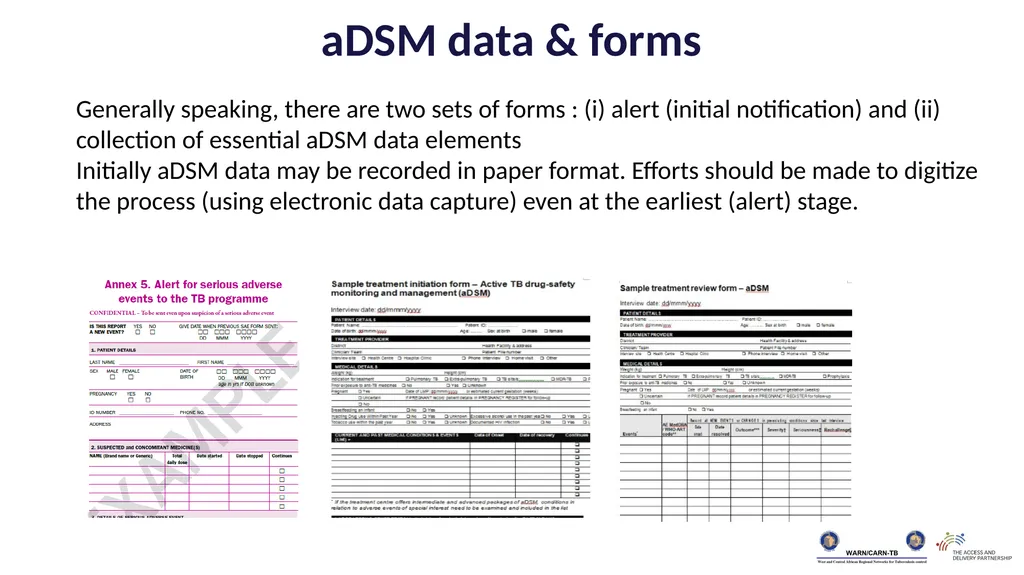
slide5. aDSM data & forms Generally speaking, there are two sets of forms : (i) alert (initial notification) and (ii) collection of essential aDSM data elements
Initially aDSM data may be recorded in paper format. Efforts should be made to digitize the process (using electronic data capture) even at the earliest (alert) stage.<br>
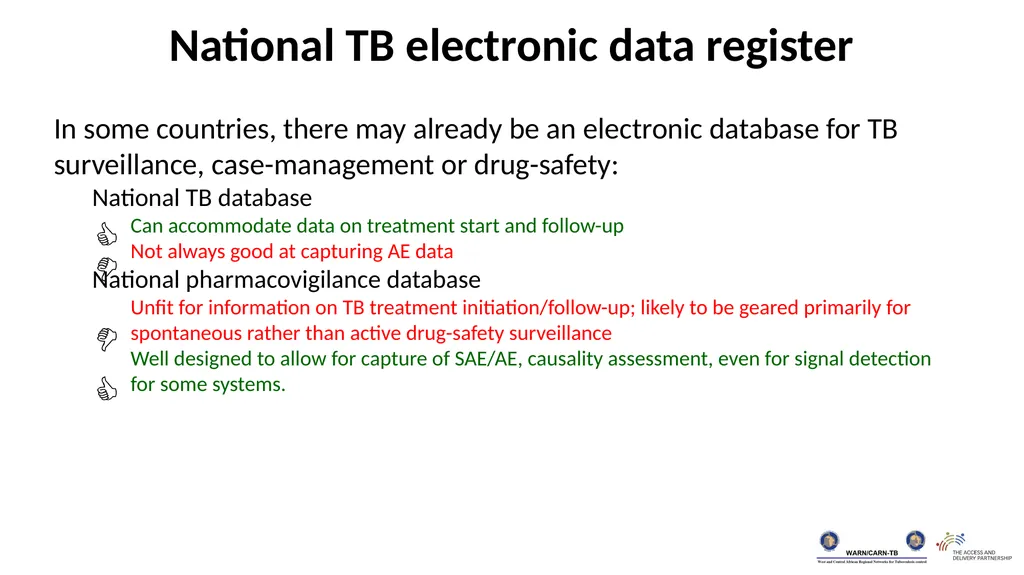
slide6. National TB electronic data register In some countries, there may already be an electronic database for TB surveillance, case-management or drug-safety:
National TB database
Can accommodate data on treatment start and follow-up
Not always good at capturing AE data
National pharmacovigilance database
Unfit for information on TB treatment initiation/follow-up; likely to be geared primarily for spontaneous rather than active drug-safety surveillance
Well designed to allow for capture of SAE/AE, causality assessment, even for signal detection for some systems.<br>
slide7. Adaptation of existing electronic surveillance databases Creation of an electronic database – or preferably adaptation of an existing TB patient database to accommodate the additional data fields required – is an important step.
Ensure standardization and safekeeping of data.
facilitate sharing of data, as well as generation of indicators and analyses A stepwise approach, for example starting with a simple standalone database pending the adaptation of a national TB database<br>
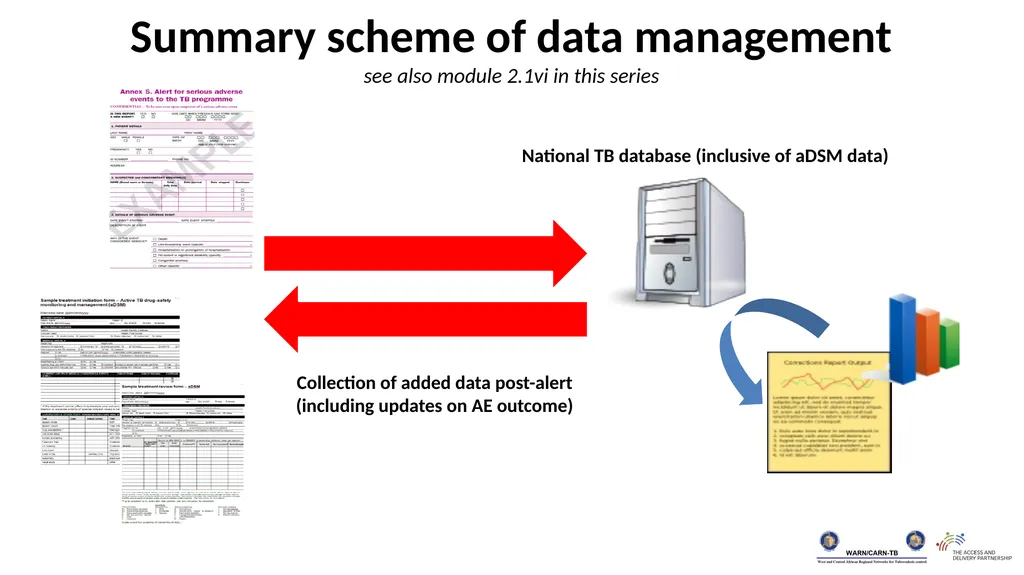
slide8. Summary scheme of data managementsee also module 2.1vi in this series<br>
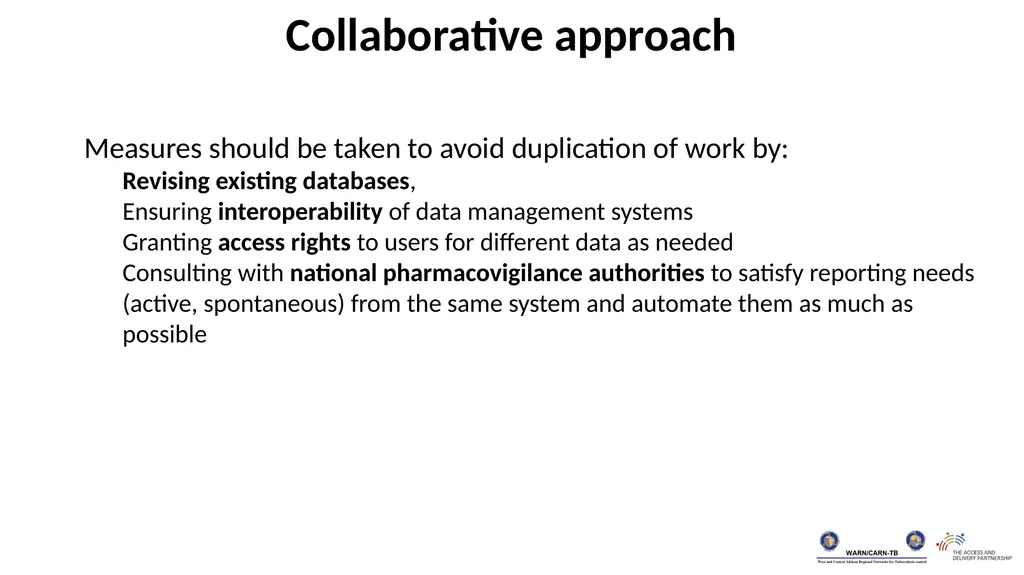
slide9. Collaborative approach Measures should be taken to avoid duplication of work by:
Revising existing databases,
Ensuring interoperability of data management systems
Granting access rights to users for different data as needed
Consulting with national pharmacovigilance authorities to satisfy reporting needs (active, spontaneous) from the same system and automate them as much as possible<br>
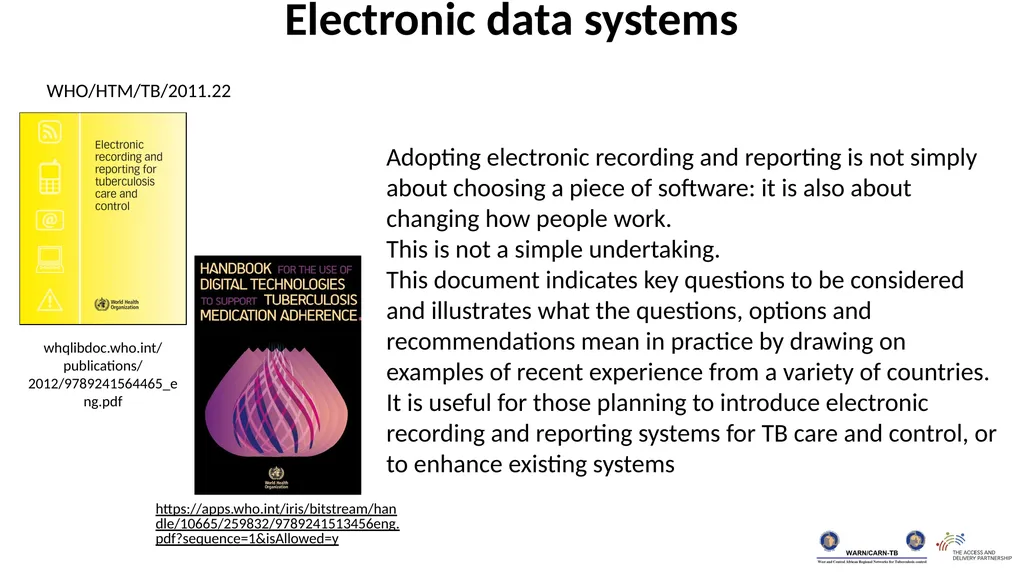
slide10. WHO/HTM/TB/2011.22 https://apps.who.int/iris/bitstream/handle/10665/259832/9789241513456eng.pdf?sequence=1&isAllowed=y Adopting electronic recording and reporting is not simply about choosing a piece of software: it is also about changing how people work.
This is not a simple undertaking.
This document indicates key questions to be considered and illustrates what the questions, options and recommendations mean in practice by drawing on examples of recent experience from a variety of countries.
It is useful for those planning to introduce electronic recording and reporting systems for TB care and control, or to enhance existing systems whqlibdoc.who.int/publications/2012/9789241564465_eng.pdf Electronic data systems<br>
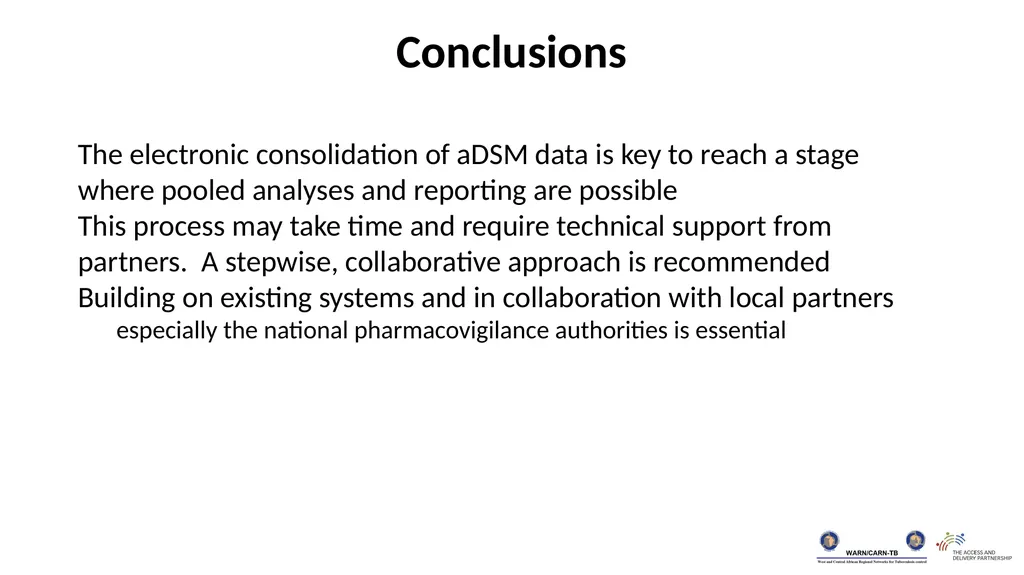
slide11. Conclusions The electronic consolidation of aDSM data is key to reach a stage where pooled analyses and reporting are possible
This process may take time and require technical support from partners. A stepwise, collaborative approach is recommended
Building on existing systems and in collaboration with local partners
especially the national pharmacovigilance authorities is essential<br>
slide12. Acknowledgements
The development of the aDSM training material was funded by TDR as part of the Access and Delivery Partnership (ADP) with funding from the Government of Japan.
These training materials were put together in 2016 the WHO Task Force on aDSM with technical partners KNCV Tuberculosis Foundation, Management Sciences for Health (SIAPS), MSF, WHO GTB, and TDR.
The materials were updated in 2022-23 by Mahamadou Bassirou Souleymane (TDR consultant) with Marie-Eve Raguenaud (TDR), Branwen J Hennig (TDR), and Corinne Merle (TDR), and reviewed by Linh Nhat Nguyen (WHO/GTB), Medea Gegia (WHO/GTB), and Fuad Mirzayev (WHO/GTB).
We thank all members of the WARN/CARN-TB working group on aDSM who contributed to the development of the aDSM generic guidelines as well as the secretariat, particularly Dr Christ Houessinon: Disadidi Ambrioso, Esse Marius, Adomou Jamal Rouamba Ruffine, Haro Sougrimani, Koumbem Boureima, Nsanzerugeze Josélyne, Tollo Tollo Daniel Alphonse Désiré, Mpaba Minkat Théophile Mistral, Julie Abessolo, Ursule IDOKO, Tijan Baldeh , Wandifa Samateh, Tida S Kinteh, Alieu Wurie, Mardemn Yeasuen, Benjamin K. Quenneh, Cheick Oumar Bah, Kane El Hadj Malick, Aw Idriss, Mamoudou Hama Rachida, Gagara I. M. Assiatou, Katambé Balkissa, Seiyabatou Elh Saidou, Liombo Anastasie, Lunganyu Junior, Kitambala Sentime, Lula Yves , Habimana-Mucyo Yves, Migambi Patrick, dos Santos Brigite, Castro Vânia, Wadson Cruz, Gueye Aminata, Mukeh Fahnbulleh, Bailor Samuel, Manjo Lamin, Saleh Mahareb Abdoulaye, Haroun Saleh Naima, Mouhoudine Yerima, Kpelafia Silifa<br>

2023<br>
slide2. 2.1vii. Consolidate aDSM data electronically<br>
slide3. Key steps in aDSM implementation<br>
slide4. Learning objectiveBy the end of this presentation, the participant is expected to… Understand why and how to collect, manage and store aDSM data in an electronic format<br>
slide5. aDSM data & forms Generally speaking, there are two sets of forms : (i) alert (initial notification) and (ii) collection of essential aDSM data elements
Initially aDSM data may be recorded in paper format. Efforts should be made to digitize the process (using electronic data capture) even at the earliest (alert) stage.<br>
slide6. National TB electronic data register In some countries, there may already be an electronic database for TB surveillance, case-management or drug-safety:
National TB database
Can accommodate data on treatment start and follow-up
Not always good at capturing AE data
National pharmacovigilance database
Unfit for information on TB treatment initiation/follow-up; likely to be geared primarily for spontaneous rather than active drug-safety surveillance
Well designed to allow for capture of SAE/AE, causality assessment, even for signal detection for some systems.<br>
slide7. Adaptation of existing electronic surveillance databases Creation of an electronic database – or preferably adaptation of an existing TB patient database to accommodate the additional data fields required – is an important step.
Ensure standardization and safekeeping of data.
facilitate sharing of data, as well as generation of indicators and analyses A stepwise approach, for example starting with a simple standalone database pending the adaptation of a national TB database<br>
slide8. Summary scheme of data managementsee also module 2.1vi in this series<br>
slide9. Collaborative approach Measures should be taken to avoid duplication of work by:
Revising existing databases,
Ensuring interoperability of data management systems
Granting access rights to users for different data as needed
Consulting with national pharmacovigilance authorities to satisfy reporting needs (active, spontaneous) from the same system and automate them as much as possible<br>
slide10. WHO/HTM/TB/2011.22 https://apps.who.int/iris/bitstream/handle/10665/259832/9789241513456eng.pdf?sequence=1&isAllowed=y Adopting electronic recording and reporting is not simply about choosing a piece of software: it is also about changing how people work.
This is not a simple undertaking.
This document indicates key questions to be considered and illustrates what the questions, options and recommendations mean in practice by drawing on examples of recent experience from a variety of countries.
It is useful for those planning to introduce electronic recording and reporting systems for TB care and control, or to enhance existing systems whqlibdoc.who.int/publications/2012/9789241564465_eng.pdf Electronic data systems<br>
slide11. Conclusions The electronic consolidation of aDSM data is key to reach a stage where pooled analyses and reporting are possible
This process may take time and require technical support from partners. A stepwise, collaborative approach is recommended
Building on existing systems and in collaboration with local partners
especially the national pharmacovigilance authorities is essential<br>
slide12. Acknowledgements
The development of the aDSM training material was funded by TDR as part of the Access and Delivery Partnership (ADP) with funding from the Government of Japan.
These training materials were put together in 2016 the WHO Task Force on aDSM with technical partners KNCV Tuberculosis Foundation, Management Sciences for Health (SIAPS), MSF, WHO GTB, and TDR.
The materials were updated in 2022-23 by Mahamadou Bassirou Souleymane (TDR consultant) with Marie-Eve Raguenaud (TDR), Branwen J Hennig (TDR), and Corinne Merle (TDR), and reviewed by Linh Nhat Nguyen (WHO/GTB), Medea Gegia (WHO/GTB), and Fuad Mirzayev (WHO/GTB).
We thank all members of the WARN/CARN-TB working group on aDSM who contributed to the development of the aDSM generic guidelines as well as the secretariat, particularly Dr Christ Houessinon: Disadidi Ambrioso, Esse Marius, Adomou Jamal Rouamba Ruffine, Haro Sougrimani, Koumbem Boureima, Nsanzerugeze Josélyne, Tollo Tollo Daniel Alphonse Désiré, Mpaba Minkat Théophile Mistral, Julie Abessolo, Ursule IDOKO, Tijan Baldeh , Wandifa Samateh, Tida S Kinteh, Alieu Wurie, Mardemn Yeasuen, Benjamin K. Quenneh, Cheick Oumar Bah, Kane El Hadj Malick, Aw Idriss, Mamoudou Hama Rachida, Gagara I. M. Assiatou, Katambé Balkissa, Seiyabatou Elh Saidou, Liombo Anastasie, Lunganyu Junior, Kitambala Sentime, Lula Yves , Habimana-Mucyo Yves, Migambi Patrick, dos Santos Brigite, Castro Vânia, Wadson Cruz, Gueye Aminata, Mukeh Fahnbulleh, Bailor Samuel, Manjo Lamin, Saleh Mahareb Abdoulaye, Haroun Saleh Naima, Mouhoudine Yerima, Kpelafia Silifa<br>