
Training Undergraduate Students in Conducting

Description: Training Undergraduate Students in Conducting Research with MinorityUnderrepresented Communities Anisah Bagasra, PhD Department of Psychological Science Kennesaw State University Workshop Learning Outcomes At the conclusion of this
Related Topics
Download Presentation
"Training Undergraduate Students in Conducting" is the property of its rightful owner. Permission is granted to download and print the materials on this website for personal, non-commercial use only, and to display it on your personal computer provided you do not modify the materials and that you retain all copyright notices contained in the materials. By downloading content from our website, you accept the terms of this agreement.
Presentation Transcript
slide1. Training Undergraduate Students in Conducting Research with Minority/Underrepresented Communities Anisah Bagasra, PhD
Department of Psychological Science
Kennesaw State University<br>
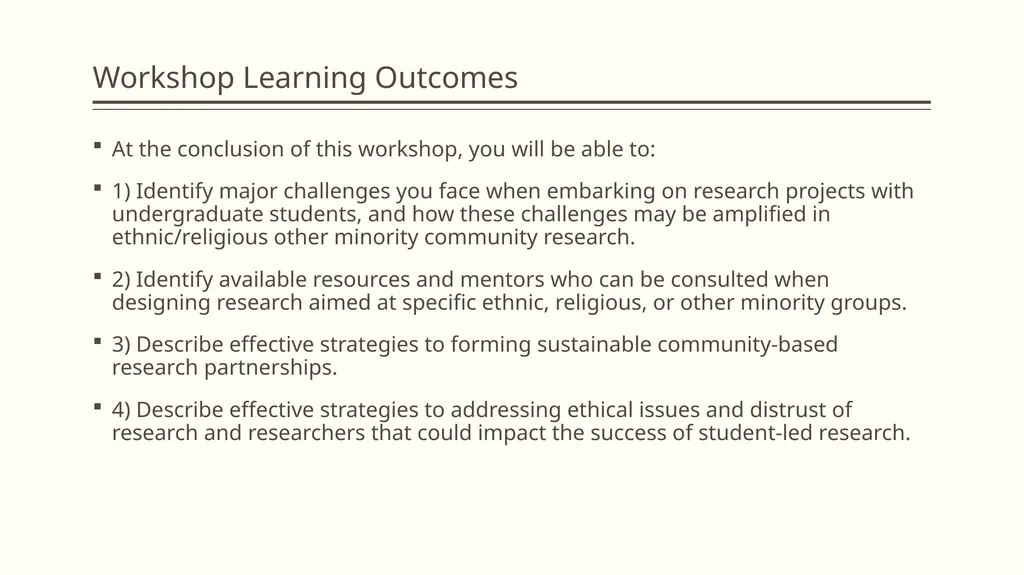
slide2. Workshop Learning Outcomes At the conclusion of this workshop, you will be able to:
1) Identify major challenges you face when embarking on research projects with undergraduate students, and how these challenges may be amplified in ethnic/religious other minority community research.
2) Identify available resources and mentors who can be consulted when designing research aimed at specific ethnic, religious, or other minority groups.
3) Describe effective strategies to forming sustainable community-based research partnerships.
4) Describe effective strategies to addressing ethical issues and distrust of research and researchers that could impact the success of student-led research.<br>
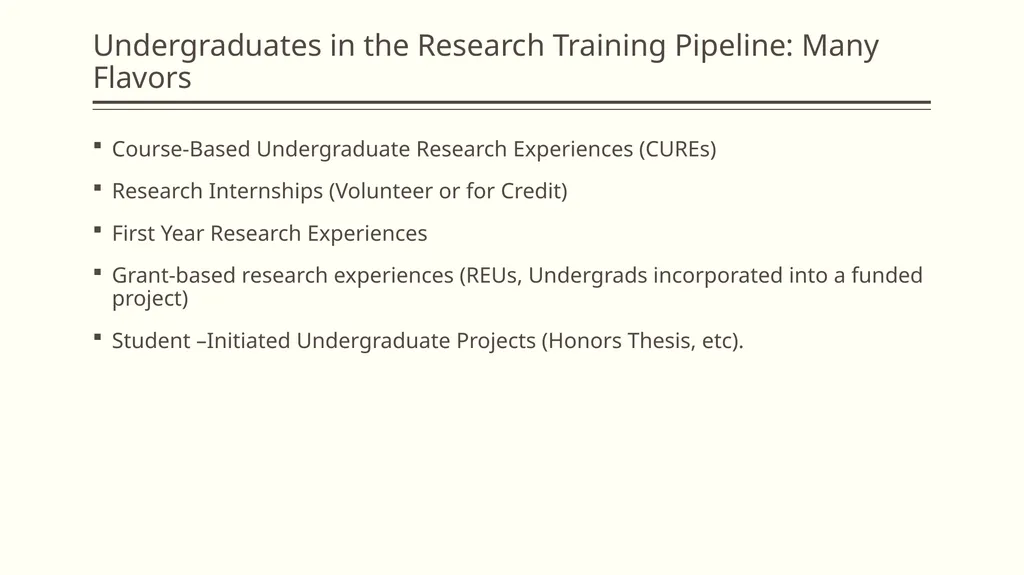
slide3. Undergraduates in the Research Training Pipeline: Many Flavors Course-Based Undergraduate Research Experiences (CUREs)
Research Internships (Volunteer or for Credit)
First Year Research Experiences
Grant-based research experiences (REUs, Undergrads incorporated into a funded project)
Student –Initiated Undergraduate Projects (Honors Thesis, etc).<br>
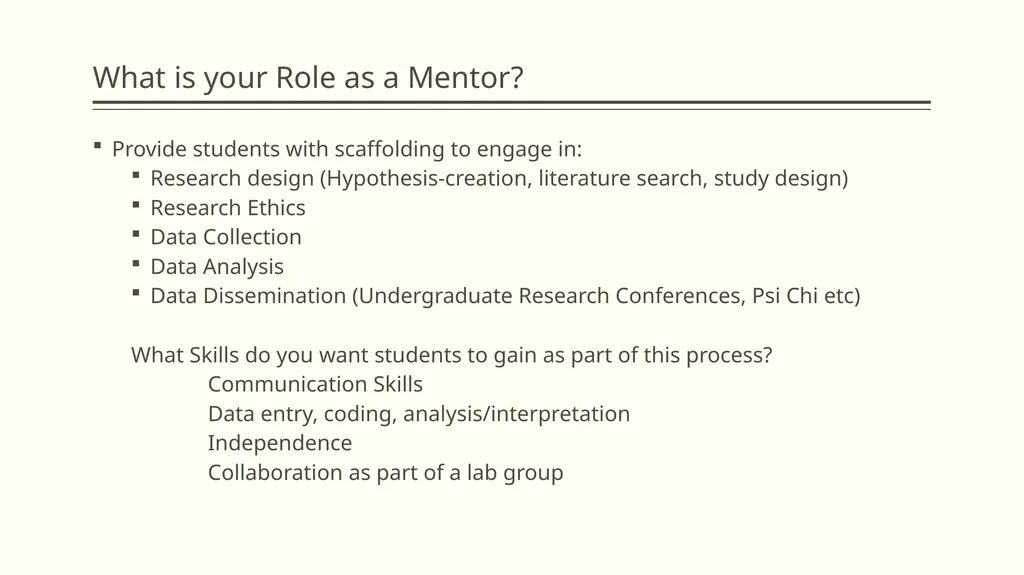
slide4. What is your Role as a Mentor? Provide students with scaffolding to engage in:
Research design (Hypothesis-creation, literature search, study design)
Research Ethics
Data Collection
Data Analysis
Data Dissemination (Undergraduate Research Conferences, Psi Chi etc)
What Skills do you want students to gain as part of this process?
Communication Skills
Data entry, coding, analysis/interpretation
Independence
Collaboration as part of a lab group<br>
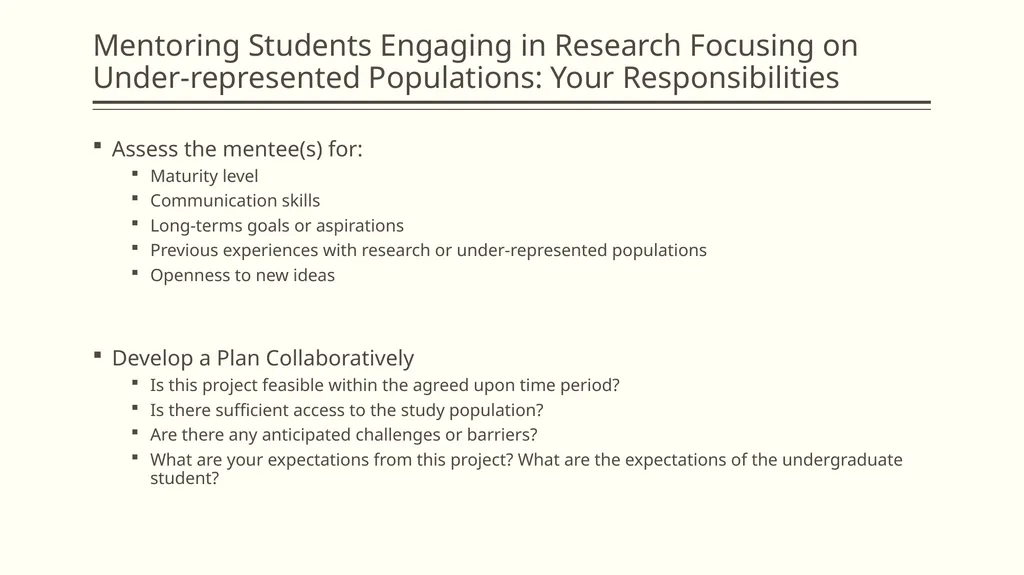
slide5. Mentoring Students Engaging in Research Focusing on Under-represented Populations: Your Responsibilities Assess the mentee(s) for:
Maturity level
Communication skills
Long-terms goals or aspirations
Previous experiences with research or under-represented populations
Openness to new ideas
Develop a Plan Collaboratively
Is this project feasible within the agreed upon time period?
Is there sufficient access to the study population?
Are there any anticipated challenges or barriers?
What are your expectations from this project? What are the expectations of the undergraduate student?<br>
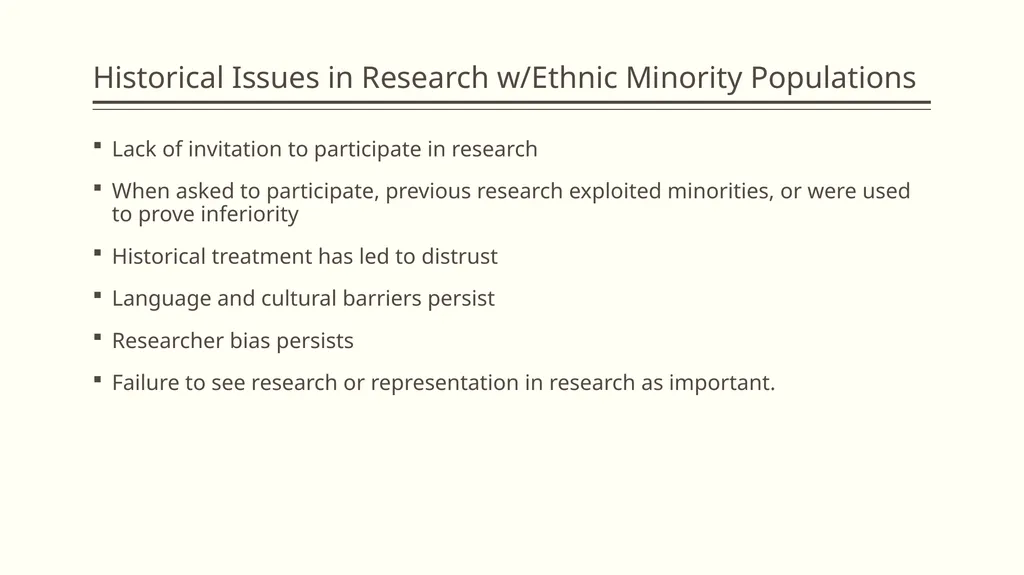
slide6. Historical Issues in Research w/Ethnic Minority Populations Lack of invitation to participate in research
When asked to participate, previous research exploited minorities, or were used to prove inferiority
Historical treatment has led to distrust
Language and cultural barriers persist
Researcher bias persists
Failure to see research or representation in research as important.<br>
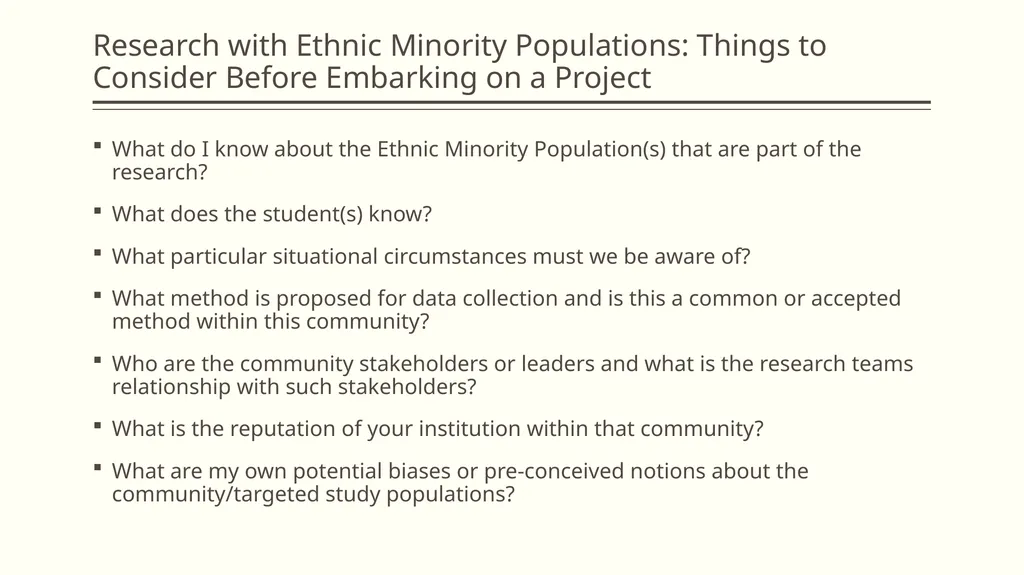
slide7. Research with Ethnic Minority Populations: Things to Consider Before Embarking on a Project What do I know about the Ethnic Minority Population(s) that are part of the research?
What does the student(s) know?
What particular situational circumstances must we be aware of?
What method is proposed for data collection and is this a common or accepted method within this community?
Who are the community stakeholders or leaders and what is the research teams relationship with such stakeholders?
What is the reputation of your institution within that community?
What are my own potential biases or pre-conceived notions about the community/targeted study populations?<br>
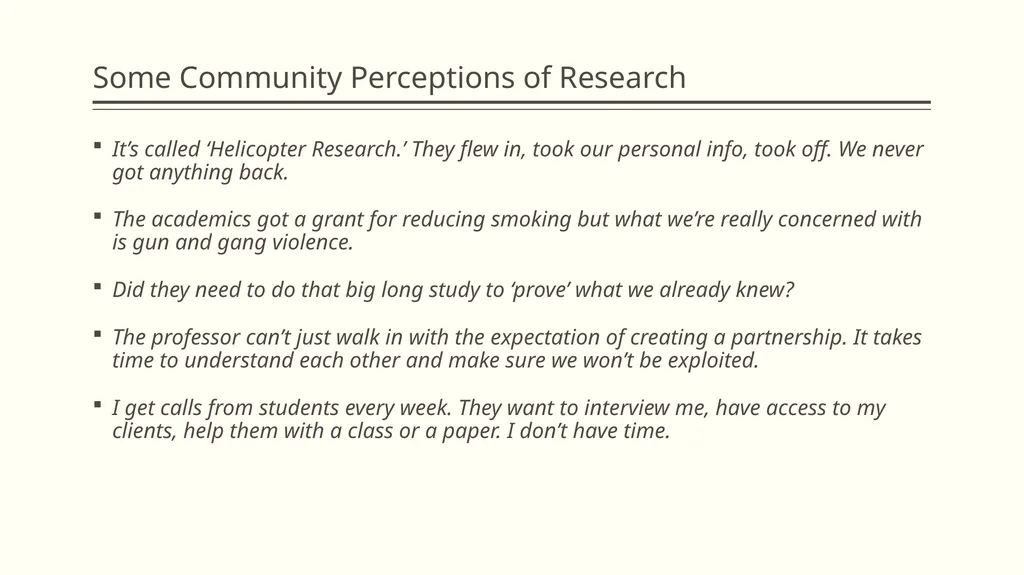
slide8. Some Community Perceptions of Research It’s called ‘Helicopter Research.’ They flew in, took our personal info, took off. We never got anything back.
The academics got a grant for reducing smoking but what we’re really concerned with is gun and gang violence.
Did they need to do that big long study to ‘prove’ what we already knew?
The professor can’t just walk in with the expectation of creating a partnership. It takes time to understand each other and make sure we won’t be exploited.
I get calls from students every week. They want to interview me, have access to my clients, help them with a class or a paper. I don’t have time.<br>
slide9. Important Steps Establish relationships with trusted stakeholders or community leaders
Engage in pilot testing/consult community stakeholders to avoid the design of an offensive or tone-deaf study.
Lead Frequent Check-ins with students.
If low response rate, discuss possible steps with stakeholders and study recruitment/distribution strategies.
Share findings with community<br>
slide10. Dealing with Ethical Issues and Community Mistrust Familiarize yourself with any causes of mistrust of research or researchers within the community.
Past histories of unethical research
Research that is perceived as targeting or exploiting the community
Research that is perceived as painting the community in a bad light
What steps can your undergraduate researcher, in consultation with you and community stakeholders take to address such concerns?<br>
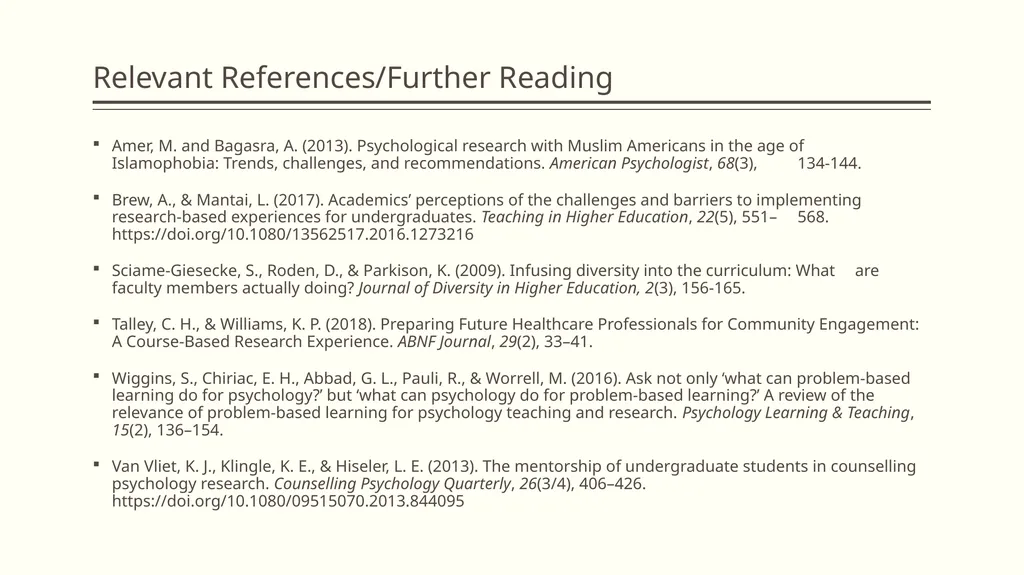
slide11. Relevant References/Further Reading Amer, M. and Bagasra, A. (2013). Psychological research with Muslim Americans in the age of Islamophobia: Trends, challenges, and recommendations. American Psychologist, 68(3), 134-144.
Brew, A., & Mantai, L. (2017). Academics’ perceptions of the challenges and barriers to implementing research-based experiences for undergraduates. Teaching in Higher Education, 22(5), 551– 568. https://doi.org/10.1080/13562517.2016.1273216
Sciame-Giesecke, S., Roden, D., & Parkison, K. (2009). Infusing diversity into the curriculum: What are faculty members actually doing? Journal of Diversity in Higher Education, 2(3), 156-165.
Talley, C. H., & Williams, K. P. (2018). Preparing Future Healthcare Professionals for Community Engagement: A Course-Based Research Experience. ABNF Journal, 29(2), 33–41.
Wiggins, S., Chiriac, E. H., Abbad, G. L., Pauli, R., & Worrell, M. (2016). Ask not only ‘what can problem-based learning do for psychology?’ but ‘what can psychology do for problem-based learning?’ A review of the relevance of problem-based learning for psychology teaching and research. Psychology Learning & Teaching, 15(2), 136–154.
Van Vliet, K. J., Klingle, K. E., & Hiseler, L. E. (2013). The mentorship of undergraduate students in counselling psychology research. Counselling Psychology Quarterly, 26(3/4), 406–426. https://doi.org/10.1080/09515070.2013.844095<br>
slide12. Contact Information<br>
Department of Psychological Science
Kennesaw State University<br>
slide2. Workshop Learning Outcomes At the conclusion of this workshop, you will be able to:
1) Identify major challenges you face when embarking on research projects with undergraduate students, and how these challenges may be amplified in ethnic/religious other minority community research.
2) Identify available resources and mentors who can be consulted when designing research aimed at specific ethnic, religious, or other minority groups.
3) Describe effective strategies to forming sustainable community-based research partnerships.
4) Describe effective strategies to addressing ethical issues and distrust of research and researchers that could impact the success of student-led research.<br>
slide3. Undergraduates in the Research Training Pipeline: Many Flavors Course-Based Undergraduate Research Experiences (CUREs)
Research Internships (Volunteer or for Credit)
First Year Research Experiences
Grant-based research experiences (REUs, Undergrads incorporated into a funded project)
Student –Initiated Undergraduate Projects (Honors Thesis, etc).<br>
slide4. What is your Role as a Mentor? Provide students with scaffolding to engage in:
Research design (Hypothesis-creation, literature search, study design)
Research Ethics
Data Collection
Data Analysis
Data Dissemination (Undergraduate Research Conferences, Psi Chi etc)
What Skills do you want students to gain as part of this process?
Communication Skills
Data entry, coding, analysis/interpretation
Independence
Collaboration as part of a lab group<br>
slide5. Mentoring Students Engaging in Research Focusing on Under-represented Populations: Your Responsibilities Assess the mentee(s) for:
Maturity level
Communication skills
Long-terms goals or aspirations
Previous experiences with research or under-represented populations
Openness to new ideas
Develop a Plan Collaboratively
Is this project feasible within the agreed upon time period?
Is there sufficient access to the study population?
Are there any anticipated challenges or barriers?
What are your expectations from this project? What are the expectations of the undergraduate student?<br>
slide6. Historical Issues in Research w/Ethnic Minority Populations Lack of invitation to participate in research
When asked to participate, previous research exploited minorities, or were used to prove inferiority
Historical treatment has led to distrust
Language and cultural barriers persist
Researcher bias persists
Failure to see research or representation in research as important.<br>
slide7. Research with Ethnic Minority Populations: Things to Consider Before Embarking on a Project What do I know about the Ethnic Minority Population(s) that are part of the research?
What does the student(s) know?
What particular situational circumstances must we be aware of?
What method is proposed for data collection and is this a common or accepted method within this community?
Who are the community stakeholders or leaders and what is the research teams relationship with such stakeholders?
What is the reputation of your institution within that community?
What are my own potential biases or pre-conceived notions about the community/targeted study populations?<br>
slide8. Some Community Perceptions of Research It’s called ‘Helicopter Research.’ They flew in, took our personal info, took off. We never got anything back.
The academics got a grant for reducing smoking but what we’re really concerned with is gun and gang violence.
Did they need to do that big long study to ‘prove’ what we already knew?
The professor can’t just walk in with the expectation of creating a partnership. It takes time to understand each other and make sure we won’t be exploited.
I get calls from students every week. They want to interview me, have access to my clients, help them with a class or a paper. I don’t have time.<br>
slide9. Important Steps Establish relationships with trusted stakeholders or community leaders
Engage in pilot testing/consult community stakeholders to avoid the design of an offensive or tone-deaf study.
Lead Frequent Check-ins with students.
If low response rate, discuss possible steps with stakeholders and study recruitment/distribution strategies.
Share findings with community<br>
slide10. Dealing with Ethical Issues and Community Mistrust Familiarize yourself with any causes of mistrust of research or researchers within the community.
Past histories of unethical research
Research that is perceived as targeting or exploiting the community
Research that is perceived as painting the community in a bad light
What steps can your undergraduate researcher, in consultation with you and community stakeholders take to address such concerns?<br>
slide11. Relevant References/Further Reading Amer, M. and Bagasra, A. (2013). Psychological research with Muslim Americans in the age of Islamophobia: Trends, challenges, and recommendations. American Psychologist, 68(3), 134-144.
Brew, A., & Mantai, L. (2017). Academics’ perceptions of the challenges and barriers to implementing research-based experiences for undergraduates. Teaching in Higher Education, 22(5), 551– 568. https://doi.org/10.1080/13562517.2016.1273216
Sciame-Giesecke, S., Roden, D., & Parkison, K. (2009). Infusing diversity into the curriculum: What are faculty members actually doing? Journal of Diversity in Higher Education, 2(3), 156-165.
Talley, C. H., & Williams, K. P. (2018). Preparing Future Healthcare Professionals for Community Engagement: A Course-Based Research Experience. ABNF Journal, 29(2), 33–41.
Wiggins, S., Chiriac, E. H., Abbad, G. L., Pauli, R., & Worrell, M. (2016). Ask not only ‘what can problem-based learning do for psychology?’ but ‘what can psychology do for problem-based learning?’ A review of the relevance of problem-based learning for psychology teaching and research. Psychology Learning & Teaching, 15(2), 136–154.
Van Vliet, K. J., Klingle, K. E., & Hiseler, L. E. (2013). The mentorship of undergraduate students in counselling psychology research. Counselling Psychology Quarterly, 26(3/4), 406–426. https://doi.org/10.1080/09515070.2013.844095<br>
slide12. Contact Information<br>