
Transfer Pricing Issues CMA S VENKANNA COST
SB
Published · 39 slides · 0 views

1 / 1

Description
Transfer Pricing Issues CMA S VENKANNA COST ACCOUNTANT Background of TP The regulations govern the prices between inter company transactions within the multinational companies. Cross Border Transactions between one country to another
Related Topics
Share
Embed code
Download this presentation From Below
"Transfer Pricing Issues CMA S VENKANNA COST" is the property of its rightful owner. Permission is granted to download and print the materials on this website for personal, non-commercial use only, and to display it on your personal computer provided you do not modify the materials and that you retain all copyright notices contained in the materials. By downloading content from our website, you accept the terms of this agreement.
Presentation Transcript
01
Transfer Pricing Issues CMA S VENKANNA
COST ACCOUNTANT<br>
COST ACCOUNTANT<br>
02
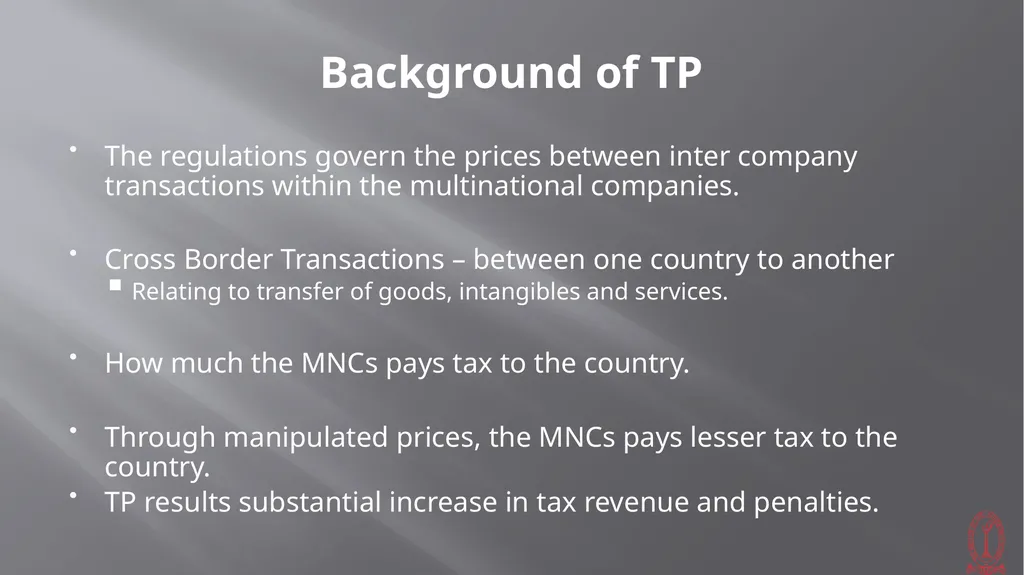
Background of TP The regulations govern the prices between inter company transactions within the multinational companies.
Cross Border Transactions – between one country to another
Relating to transfer of goods, intangibles and services.
How much the MNCs pays tax to the country.
Through manipulated prices, the MNCs pays lesser tax to the country.
TP results substantial increase in tax revenue and penalties.<br>
Cross Border Transactions – between one country to another
Relating to transfer of goods, intangibles and services.
How much the MNCs pays tax to the country.
Through manipulated prices, the MNCs pays lesser tax to the country.
TP results substantial increase in tax revenue and penalties.<br>
03
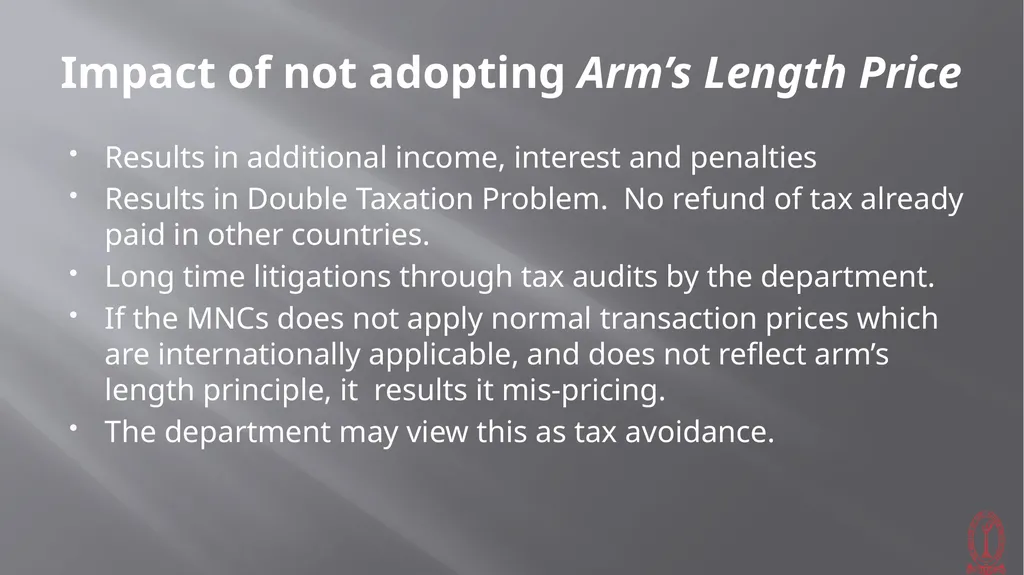
Impact of not adopting Arm’s Length Price Results in additional income, interest and penalties
Results in Double Taxation Problem. No refund of tax already paid in other countries.
Long time litigations through tax audits by the department.
If the MNCs does not apply normal transaction prices which are internationally applicable, and does not reflect arm’s length principle, it results it mis-pricing.
The department may view this as tax avoidance.<br>
Results in Double Taxation Problem. No refund of tax already paid in other countries.
Long time litigations through tax audits by the department.
If the MNCs does not apply normal transaction prices which are internationally applicable, and does not reflect arm’s length principle, it results it mis-pricing.
The department may view this as tax avoidance.<br>
04
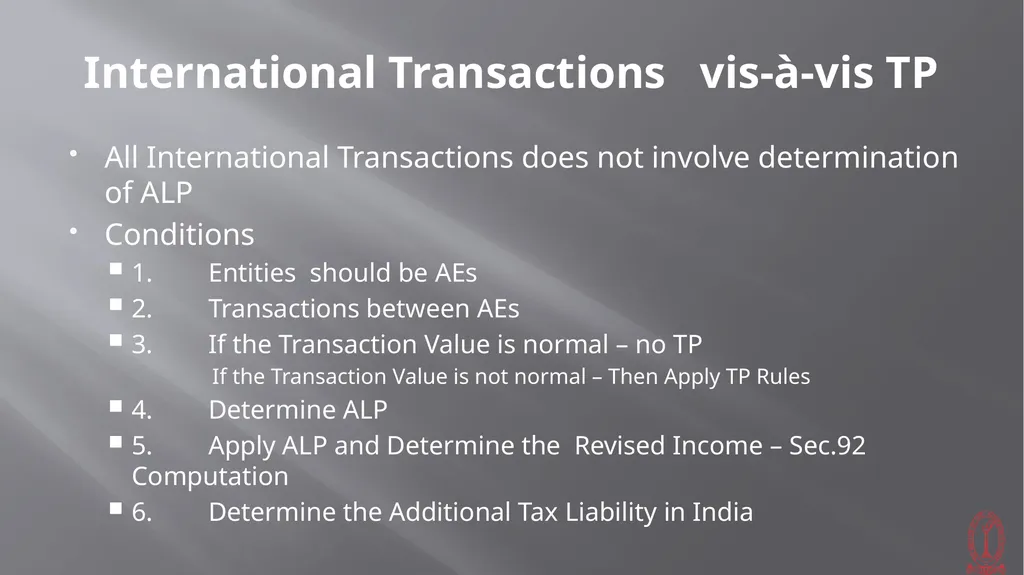
International Transactions vis-à-vis TP All International Transactions does not involve determination of ALP
Conditions
1. Entities should be AEs
2. Transactions between AEs
3. If the Transaction Value is normal – no TP
If the Transaction Value is not normal – Then Apply TP Rules
4. Determine ALP
5. Apply ALP and Determine the Revised Income – Sec.92 Computation
6. Determine the Additional Tax Liability in India<br>
Conditions
1. Entities should be AEs
2. Transactions between AEs
3. If the Transaction Value is normal – no TP
If the Transaction Value is not normal – Then Apply TP Rules
4. Determine ALP
5. Apply ALP and Determine the Revised Income – Sec.92 Computation
6. Determine the Additional Tax Liability in India<br>
05
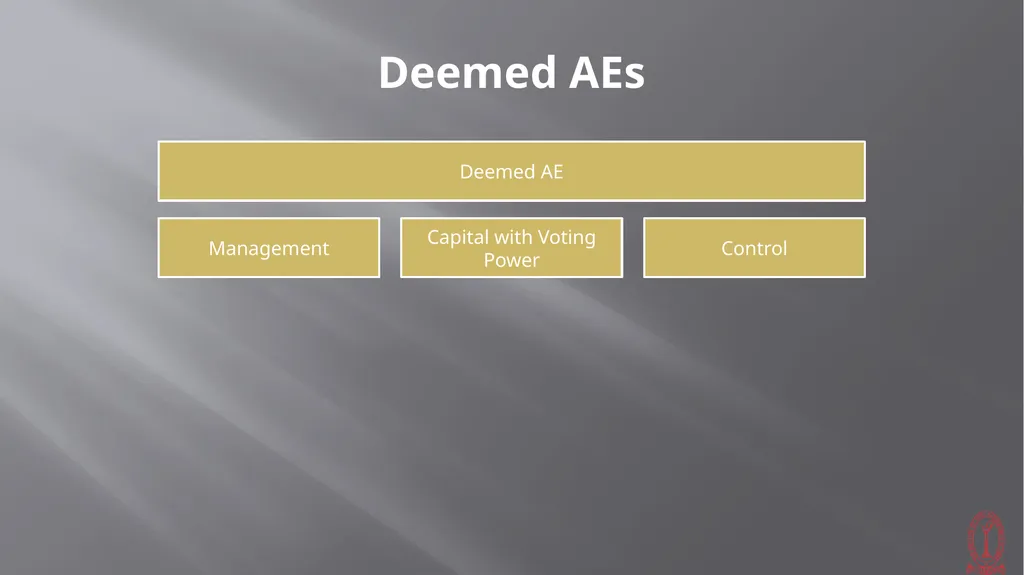
Deemed AEs<br>
06
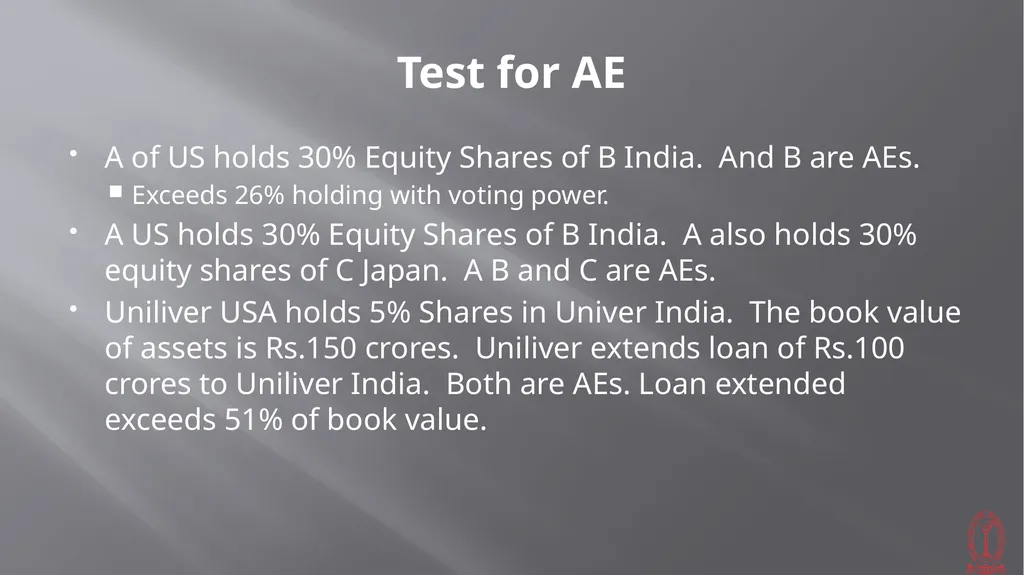
Test for AE A of US holds 30% Equity Shares of B India. And B are AEs.
Exceeds 26% holding with voting power.
A US holds 30% Equity Shares of B India. A also holds 30% equity shares of C Japan. A B and C are AEs.
Uniliver USA holds 5% Shares in Univer India. The book value of assets is Rs.150 crores. Uniliver extends loan of Rs.100 crores to Uniliver India. Both are AEs. Loan extended exceeds 51% of book value.<br>
Exceeds 26% holding with voting power.
A US holds 30% Equity Shares of B India. A also holds 30% equity shares of C Japan. A B and C are AEs.
Uniliver USA holds 5% Shares in Univer India. The book value of assets is Rs.150 crores. Uniliver extends loan of Rs.100 crores to Uniliver India. Both are AEs. Loan extended exceeds 51% of book value.<br>
07
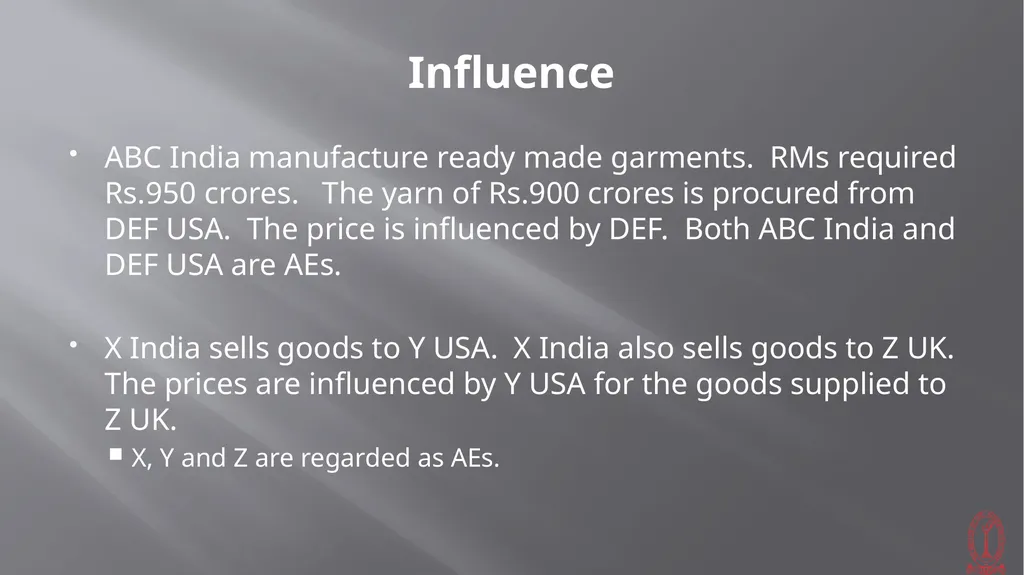
Influence ABC India manufacture ready made garments. RMs required Rs.950 crores. The yarn of Rs.900 crores is procured from DEF USA. The price is influenced by DEF. Both ABC India and DEF USA are AEs.
X India sells goods to Y USA. X India also sells goods to Z UK. The prices are influenced by Y USA for the goods supplied to Z UK.
X, Y and Z are regarded as AEs.<br>
X India sells goods to Y USA. X India also sells goods to Z UK. The prices are influenced by Y USA for the goods supplied to Z UK.
X, Y and Z are regarded as AEs.<br>
08
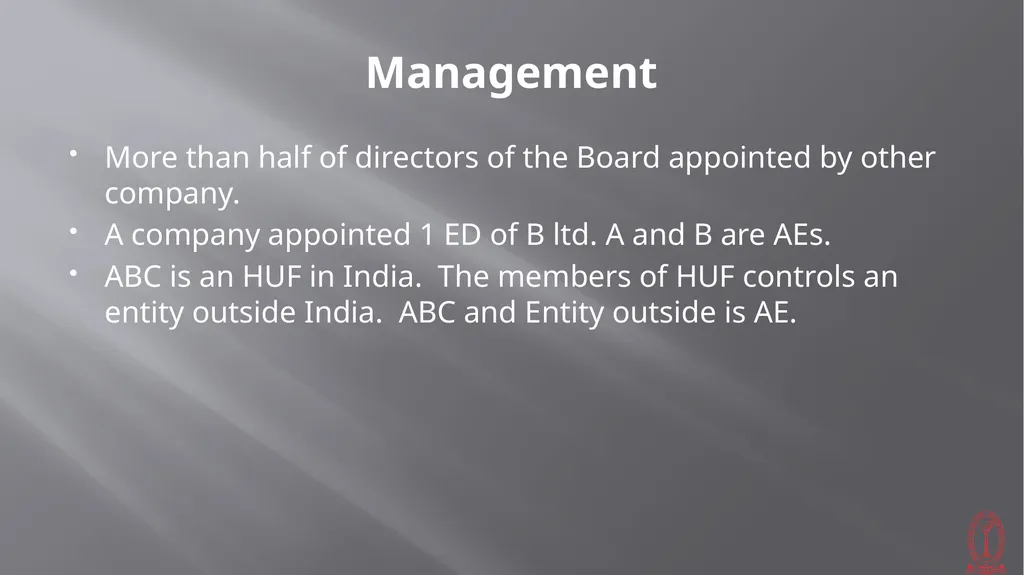
Management More than half of directors of the Board appointed by other company.
A company appointed 1 ED of B ltd. A and B are AEs.
ABC is an HUF in India. The members of HUF controls an entity outside India. ABC and Entity outside is AE.<br>
A company appointed 1 ED of B ltd. A and B are AEs.
ABC is an HUF in India. The members of HUF controls an entity outside India. ABC and Entity outside is AE.<br>
09
International Transactions Between AEs.
Supply or Procurement of Goods
Acquiring or selling intangibles. Ex. Technical Know, etc.
Providing or Receiving Services<br>
Supply or Procurement of Goods
Acquiring or selling intangibles. Ex. Technical Know, etc.
Providing or Receiving Services<br>
10
Intangibles Marketing Rights
Technology
Data Processing
Engineering
Contract
Humand
Methods and Systems
Licence<br>
Technology
Data Processing
Engineering
Contract
Humand
Methods and Systems
Licence<br>
11
ALP Methods Comparable Uncontrolled Price Method (CUP)
Resale Price Method (RSM)
Cost Plus Method (CPM)
Profit Split Method (PSM)
Transactional Net Margin Method (TNMM)
Such other method – Rule 10AB Prescribed by Board (CBDT)
How to Select the Method:
Nature of Transaction
Type of AE
Relevant Factors
Factors and Circumstances
Reliable Data
Comparability<br>
Resale Price Method (RSM)
Cost Plus Method (CPM)
Profit Split Method (PSM)
Transactional Net Margin Method (TNMM)
Such other method – Rule 10AB Prescribed by Board (CBDT)
How to Select the Method:
Nature of Transaction
Type of AE
Relevant Factors
Factors and Circumstances
Reliable Data
Comparability<br>
12
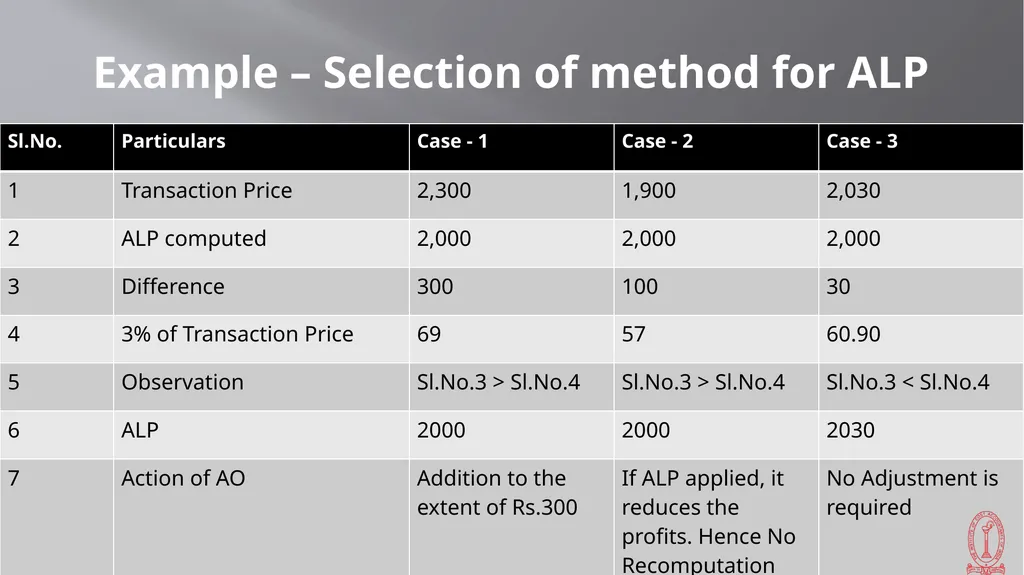
Alp – Tolerance Notified by Government If the Variation between ALP and Actual Price exceeds the Tolerance Limit, then actual price is deemed to be ALP
1% for whole sale trading
3% for other cases
Wholesale Trading – International Transaction
Purchase cost of FG is 80% or more of the total cost<br>
1% for whole sale trading
3% for other cases
Wholesale Trading – International Transaction
Purchase cost of FG is 80% or more of the total cost<br>
13
Example – Selection of method for ALP<br>
14
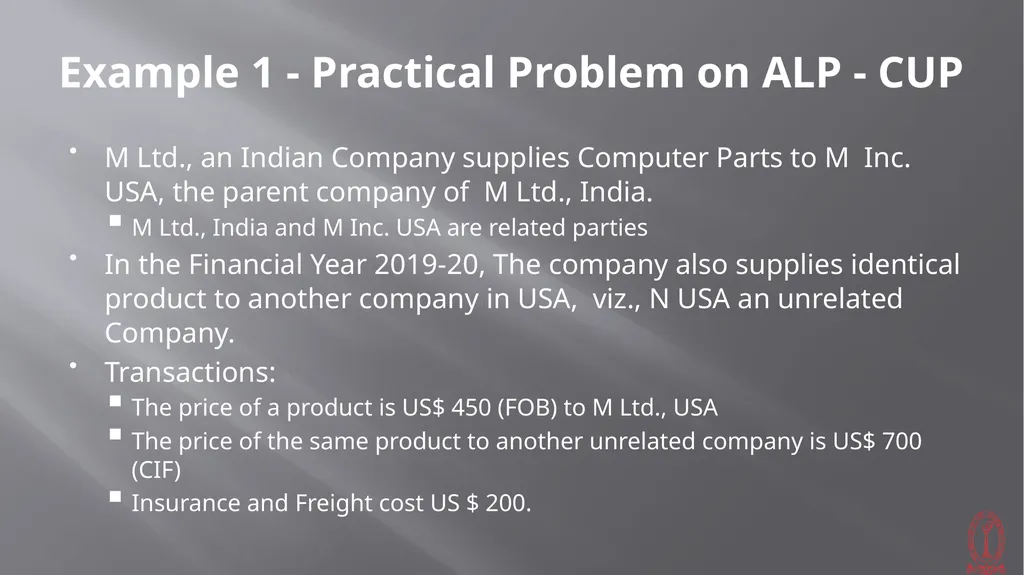
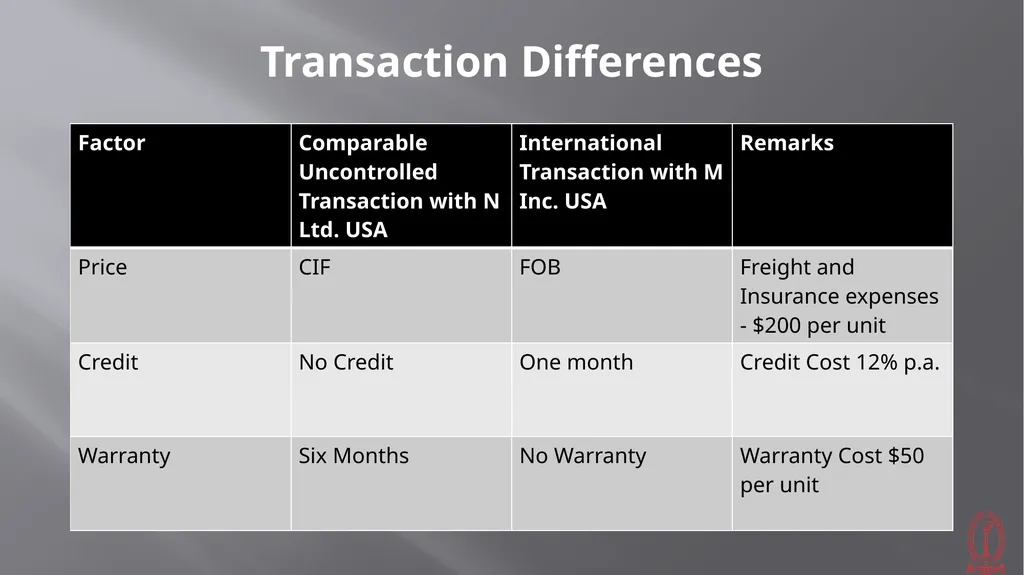
Example 1 - Practical Problem on ALP - CUP M Ltd., an Indian Company supplies Computer Parts to M Inc. USA, the parent company of M Ltd., India.
M Ltd., India and M Inc. USA are related parties
In the Financial Year 2019-20, The company also supplies identical product to another company in USA, viz., N USA an unrelated Company.
Transactions:
The price of a product is US$ 450 (FOB) to M Ltd., USA
The price of the same product to another unrelated company is US$ 700 (CIF)
Insurance and Freight cost US $ 200.<br>
M Ltd., India and M Inc. USA are related parties
In the Financial Year 2019-20, The company also supplies identical product to another company in USA, viz., N USA an unrelated Company.
Transactions:
The price of a product is US$ 450 (FOB) to M Ltd., USA
The price of the same product to another unrelated company is US$ 700 (CIF)
Insurance and Freight cost US $ 200.<br>
15
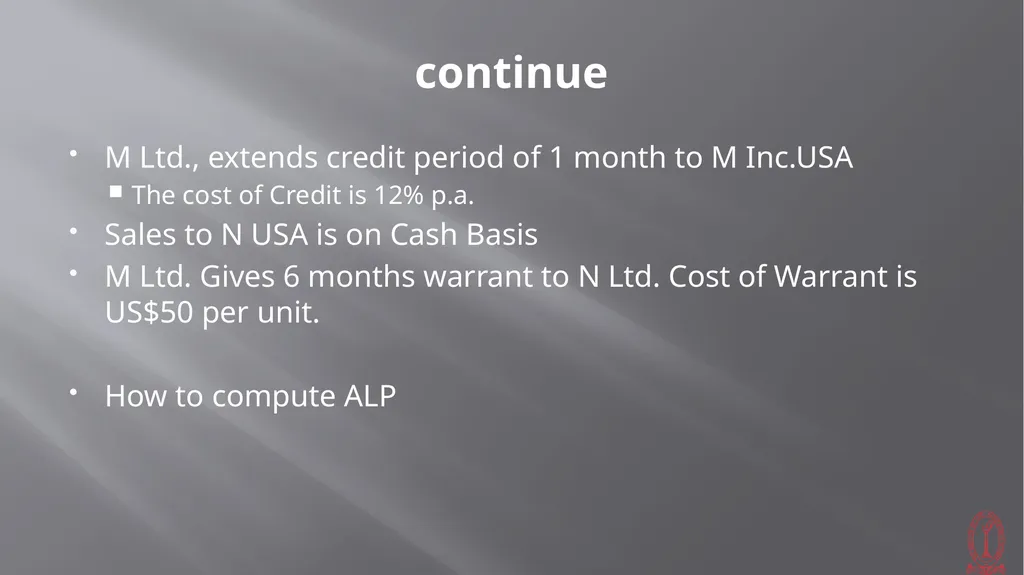
continue M Ltd., extends credit period of 1 month to M Inc.USA
The cost of Credit is 12% p.a.
Sales to N USA is on Cash Basis
M Ltd. Gives 6 months warrant to N Ltd. Cost of Warrant is US$50 per unit.
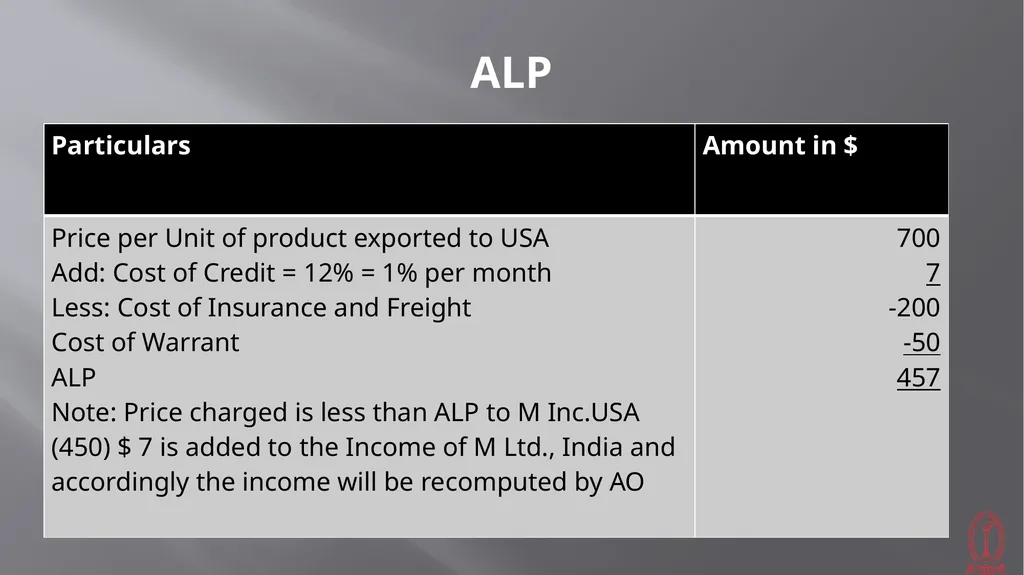
How to compute ALP<br>
The cost of Credit is 12% p.a.
Sales to N USA is on Cash Basis
M Ltd. Gives 6 months warrant to N Ltd. Cost of Warrant is US$50 per unit.
How to compute ALP<br>
16
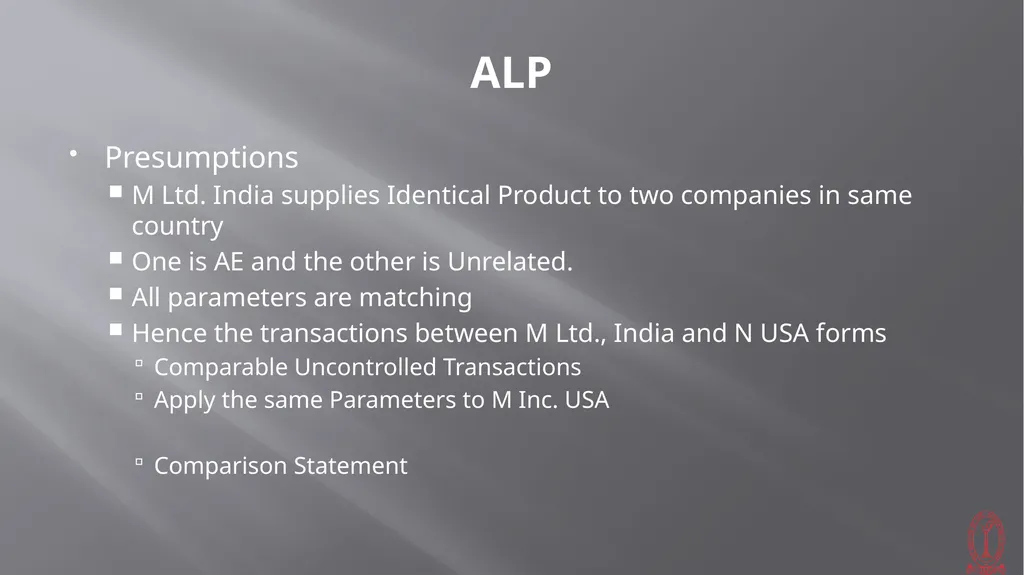
ALP Presumptions
M Ltd. India supplies Identical Product to two companies in same country
One is AE and the other is Unrelated.
All parameters are matching
Hence the transactions between M Ltd., India and N USA forms
Comparable Uncontrolled Transactions
Apply the same Parameters to M Inc. USA
Comparison Statement<br>
M Ltd. India supplies Identical Product to two companies in same country
One is AE and the other is Unrelated.
All parameters are matching
Hence the transactions between M Ltd., India and N USA forms
Comparable Uncontrolled Transactions
Apply the same Parameters to M Inc. USA
Comparison Statement<br>
17
Transaction Differences<br>
18
ALP<br>
19
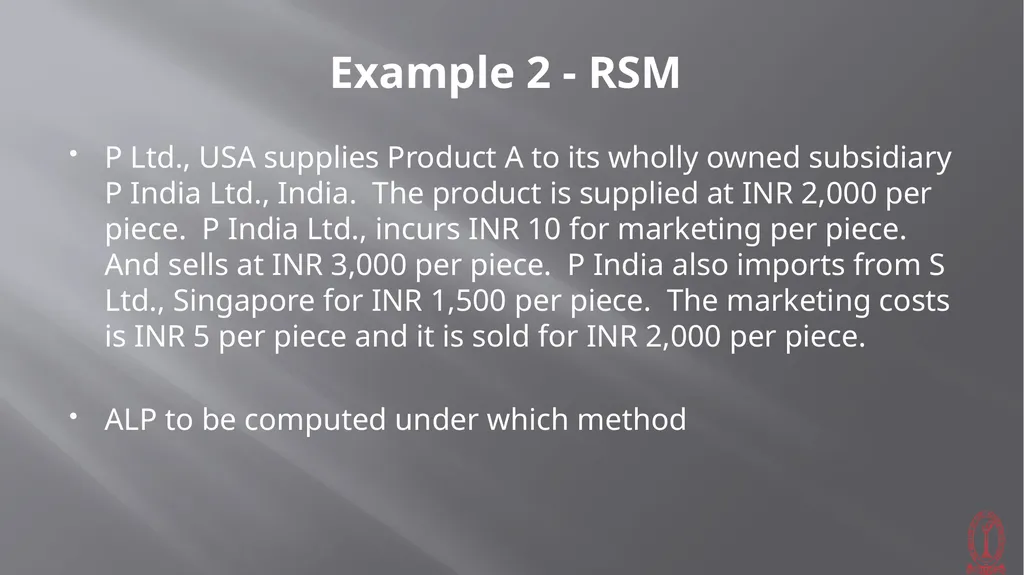
Example 2 - RSM P Ltd., USA supplies Product A to its wholly owned subsidiary P India Ltd., India. The product is supplied at INR 2,000 per piece. P India Ltd., incurs INR 10 for marketing per piece. And sells at INR 3,000 per piece. P India also imports from S Ltd., Singapore for INR 1,500 per piece. The marketing costs is INR 5 per piece and it is sold for INR 2,000 per piece.
ALP to be computed under which method<br>
ALP to be computed under which method<br>
20
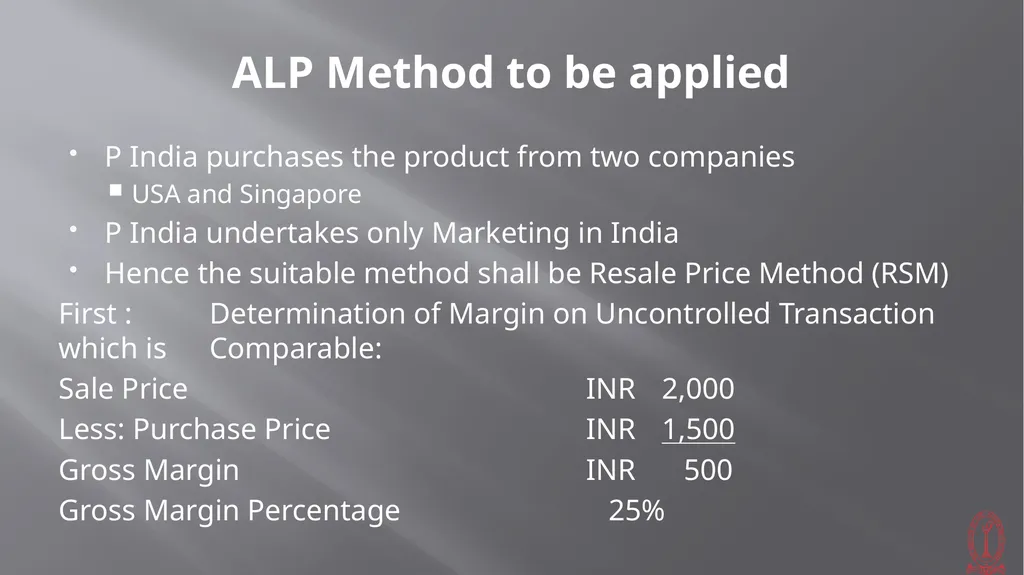
ALP Method to be applied P India purchases the product from two companies
USA and Singapore
P India undertakes only Marketing in India
Hence the suitable method shall be Resale Price Method (RSM)
First : Determination of Margin on Uncontrolled Transaction which is Comparable:
Sale Price INR 2,000
Less: Purchase Price INR 1,500
Gross Margin INR 500
Gross Margin Percentage 25%<br>
USA and Singapore
P India undertakes only Marketing in India
Hence the suitable method shall be Resale Price Method (RSM)
First : Determination of Margin on Uncontrolled Transaction which is Comparable:
Sale Price INR 2,000
Less: Purchase Price INR 1,500
Gross Margin INR 500
Gross Margin Percentage 25%<br>
21
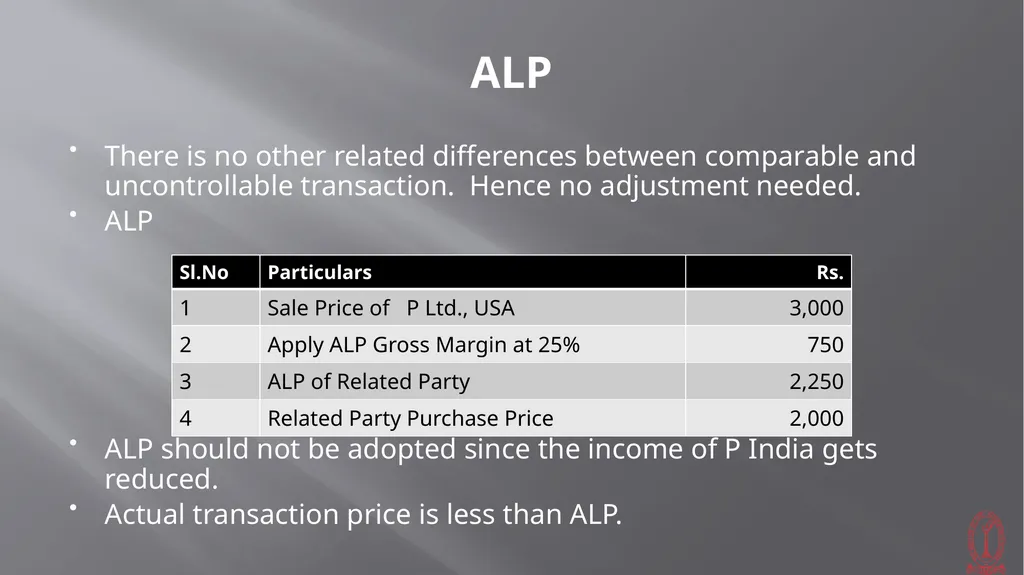
ALP There is no other related differences between comparable and uncontrollable transaction. Hence no adjustment needed.
ALP
ALP should not be adopted since the income of P India gets reduced.
Actual transaction price is less than ALP.<br>
ALP
ALP should not be adopted since the income of P India gets reduced.
Actual transaction price is less than ALP.<br>
22
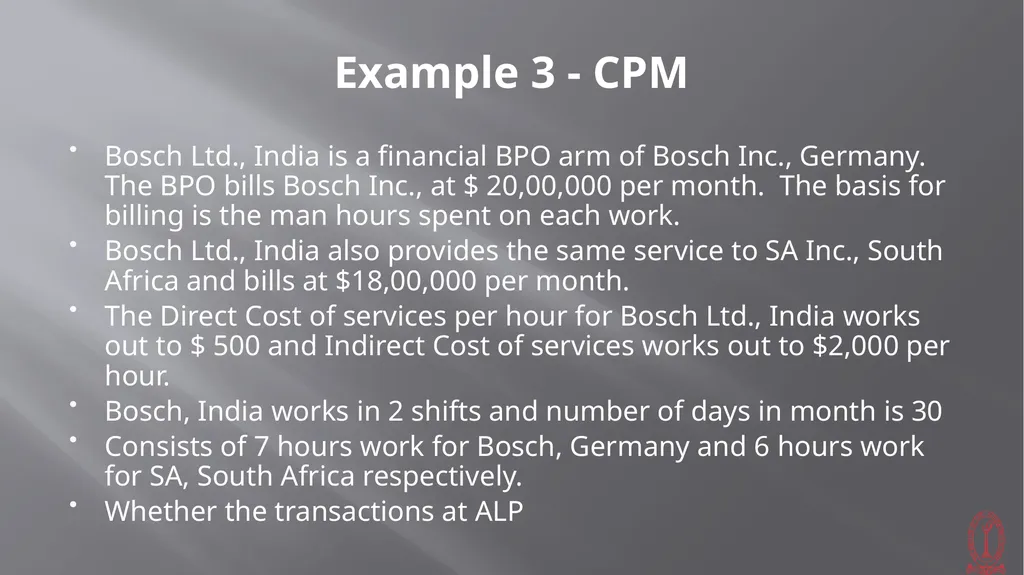
Example 3 - CPM Bosch Ltd., India is a financial BPO arm of Bosch Inc., Germany. The BPO bills Bosch Inc., at $ 20,00,000 per month. The basis for billing is the man hours spent on each work.
Bosch Ltd., India also provides the same service to SA Inc., South Africa and bills at $18,00,000 per month.
The Direct Cost of services per hour for Bosch Ltd., India works out to $ 500 and Indirect Cost of services works out to $2,000 per hour.
Bosch, India works in 2 shifts and number of days in month is 30
Consists of 7 hours work for Bosch, Germany and 6 hours work for SA, South Africa respectively.
Whether the transactions at ALP<br>
Bosch Ltd., India also provides the same service to SA Inc., South Africa and bills at $18,00,000 per month.
The Direct Cost of services per hour for Bosch Ltd., India works out to $ 500 and Indirect Cost of services works out to $2,000 per hour.
Bosch, India works in 2 shifts and number of days in month is 30
Consists of 7 hours work for Bosch, Germany and 6 hours work for SA, South Africa respectively.
Whether the transactions at ALP<br>
23
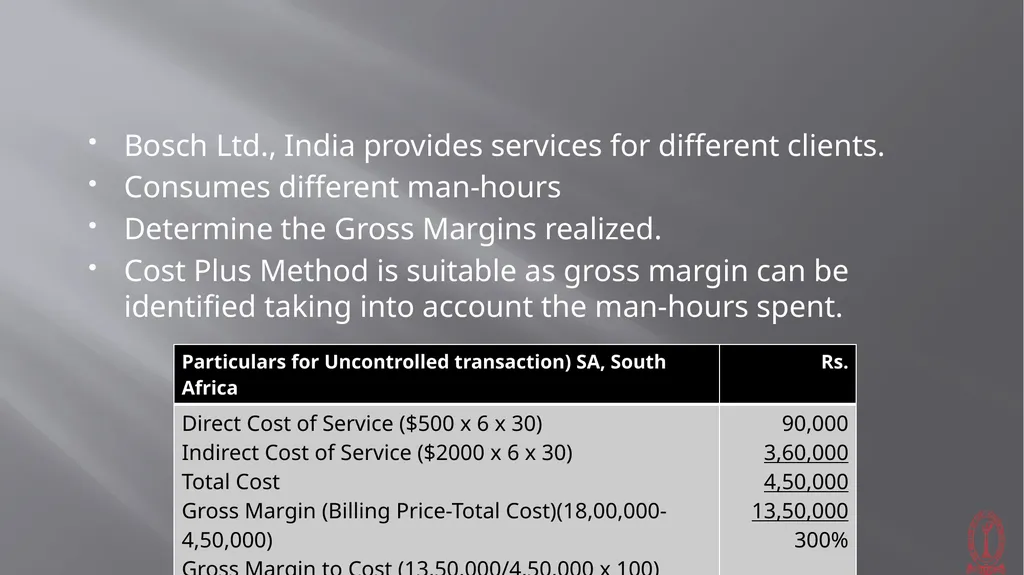
Bosch Ltd., India provides services for different clients.
Consumes different man-hours
Determine the Gross Margins realized.
Cost Plus Method is suitable as gross margin can be identified taking into account the man-hours spent.<br>
Consumes different man-hours
Determine the Gross Margins realized.
Cost Plus Method is suitable as gross margin can be identified taking into account the man-hours spent.<br>
24
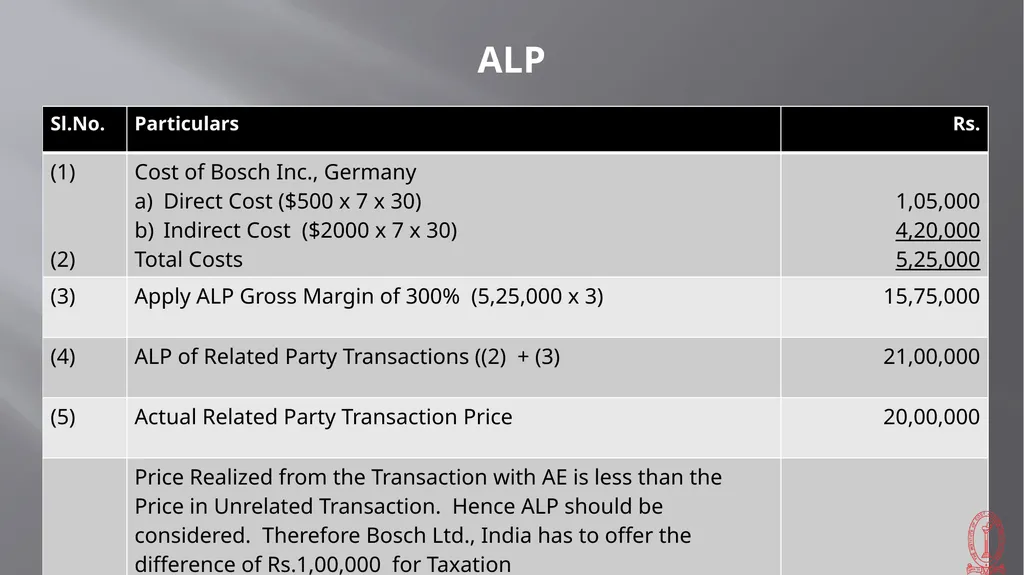
ALP<br>
25
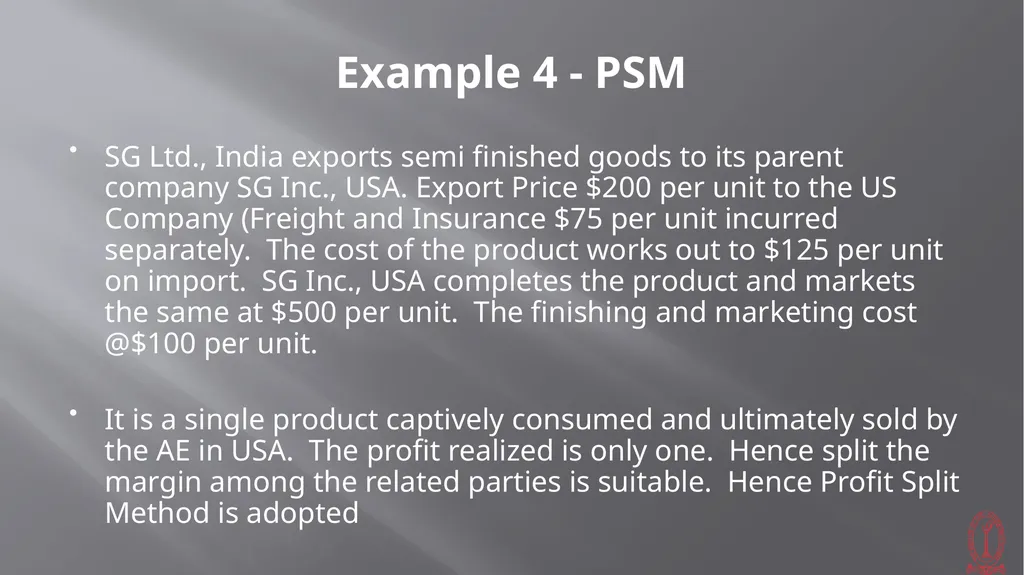
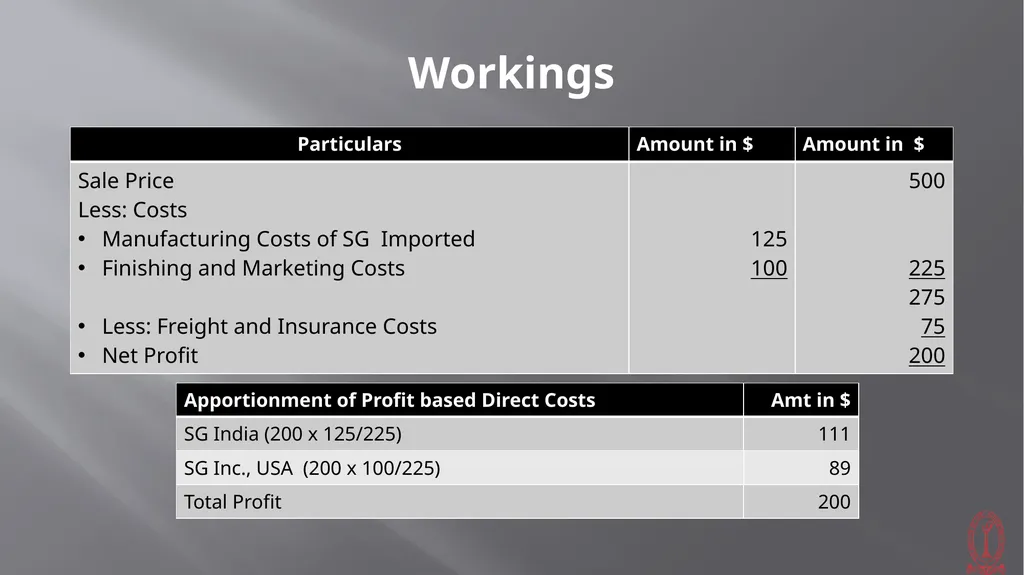
Example 4 - PSM SG Ltd., India exports semi finished goods to its parent company SG Inc., USA. Export Price $200 per unit to the US Company (Freight and Insurance $75 per unit incurred separately. The cost of the product works out to $125 per unit on import. SG Inc., USA completes the product and markets the same at $500 per unit. The finishing and marketing cost @$100 per unit.
It is a single product captively consumed and ultimately sold by the AE in USA. The profit realized is only one. Hence split the margin among the related parties is suitable. Hence Profit Split Method is adopted<br>
It is a single product captively consumed and ultimately sold by the AE in USA. The profit realized is only one. Hence split the margin among the related parties is suitable. Hence Profit Split Method is adopted<br>
26
Workings<br>
27
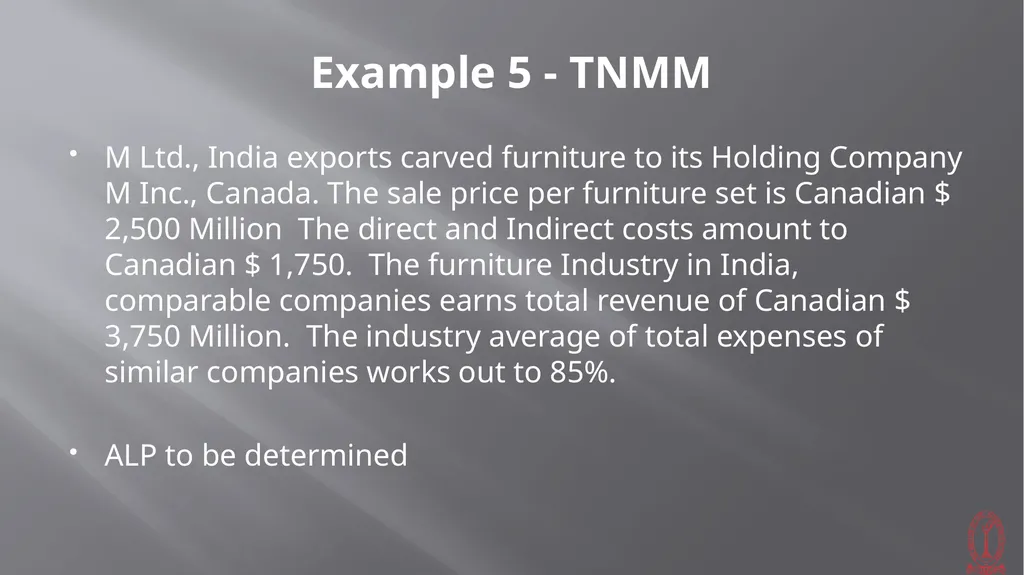
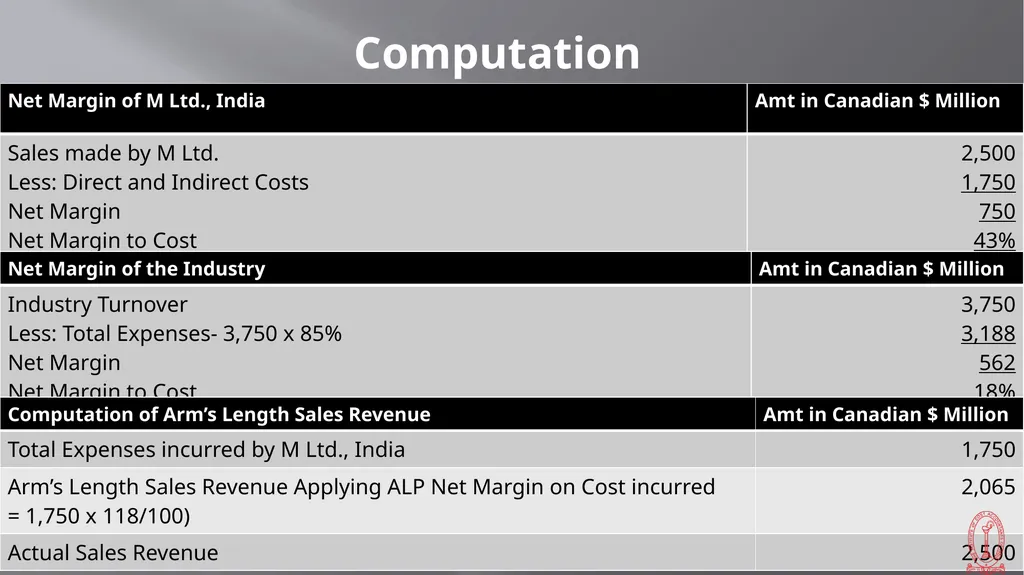
Example 5 - TNMM M Ltd., India exports carved furniture to its Holding Company M Inc., Canada. The sale price per furniture set is Canadian $ 2,500 Million The direct and Indirect costs amount to Canadian $ 1,750. The furniture Industry in India, comparable companies earns total revenue of Canadian $ 3,750 Million. The industry average of total expenses of similar companies works out to 85%.
ALP to be determined<br>
ALP to be determined<br>
28
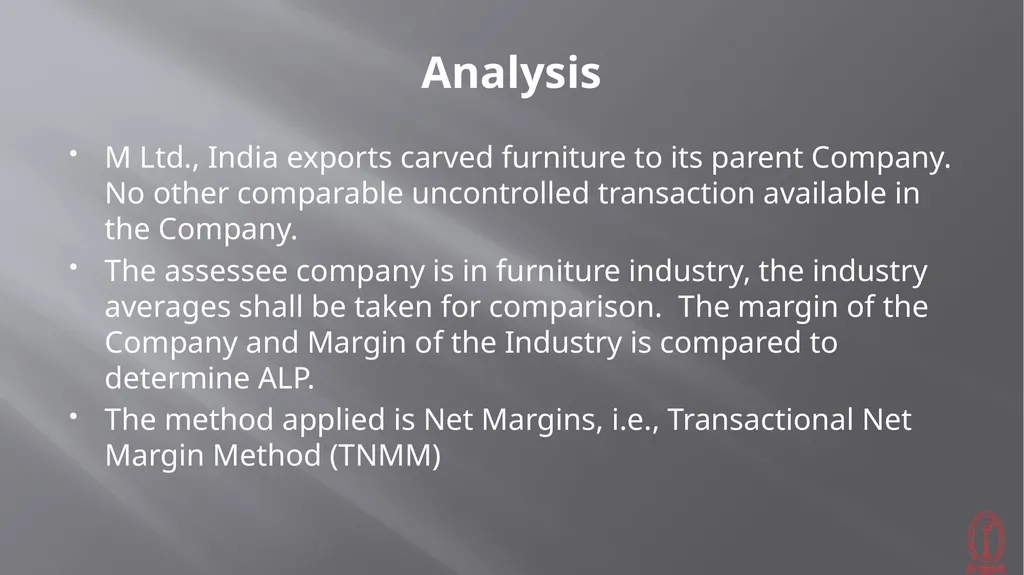
Analysis M Ltd., India exports carved furniture to its parent Company. No other comparable uncontrolled transaction available in the Company.
The assessee company is in furniture industry, the industry averages shall be taken for comparison. The margin of the Company and Margin of the Industry is compared to determine ALP.
The method applied is Net Margins, i.e., Transactional Net Margin Method (TNMM)<br>
The assessee company is in furniture industry, the industry averages shall be taken for comparison. The margin of the Company and Margin of the Industry is compared to determine ALP.
The method applied is Net Margins, i.e., Transactional Net Margin Method (TNMM)<br>
29
Computation<br>
30
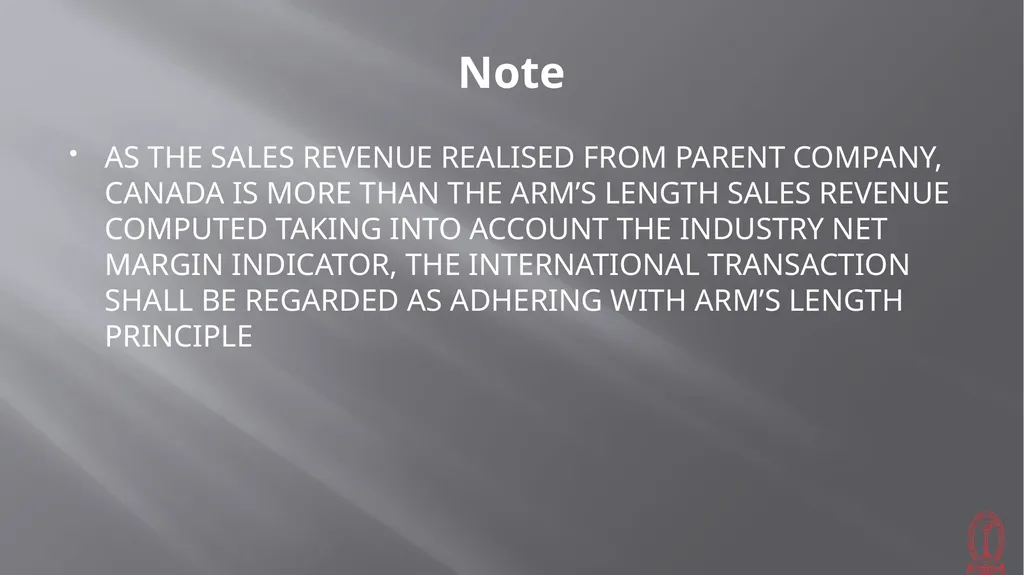
Note AS THE SALES REVENUE REALISED FROM PARENT COMPANY, CANADA IS MORE THAN THE ARM’S LENGTH SALES REVENUE COMPUTED TAKING INTO ACCOUNT THE INDUSTRY NET MARGIN INDICATOR, THE INTERNATIONAL TRANSACTION SHALL BE REGARDED AS ADHERING WITH ARM’S LENGTH PRINCIPLE<br>
31
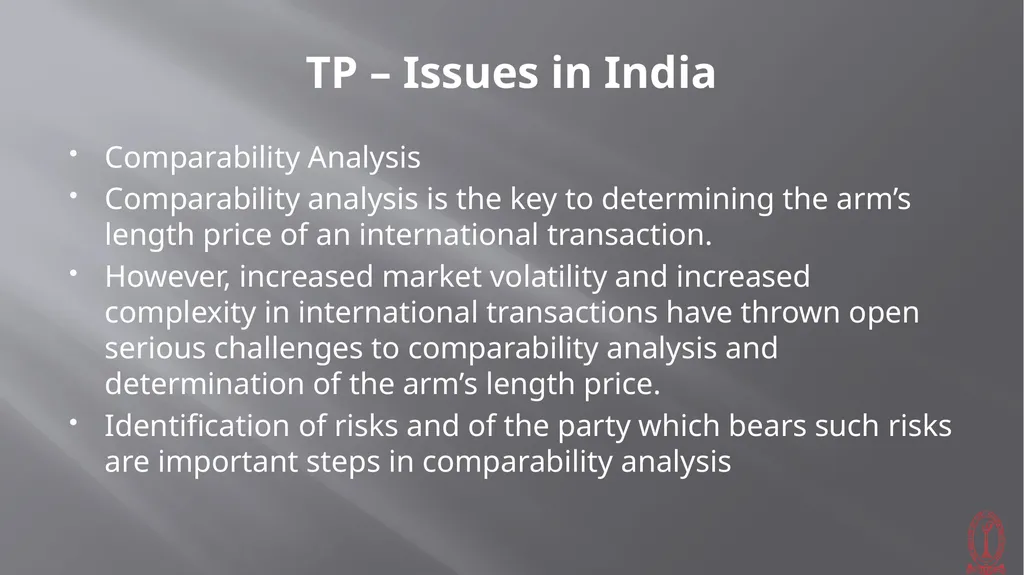
TP – Issues in India Comparability Analysis
Comparability analysis is the key to determining the arm’s length price of an international transaction.
However, increased market volatility and increased complexity in international transactions have thrown open serious challenges to comparability analysis and determination of the arm’s length price.
Identification of risks and of the party which bears such risks are important steps in comparability analysis<br>
Comparability analysis is the key to determining the arm’s length price of an international transaction.
However, increased market volatility and increased complexity in international transactions have thrown open serious challenges to comparability analysis and determination of the arm’s length price.
Identification of risks and of the party which bears such risks are important steps in comparability analysis<br>
32
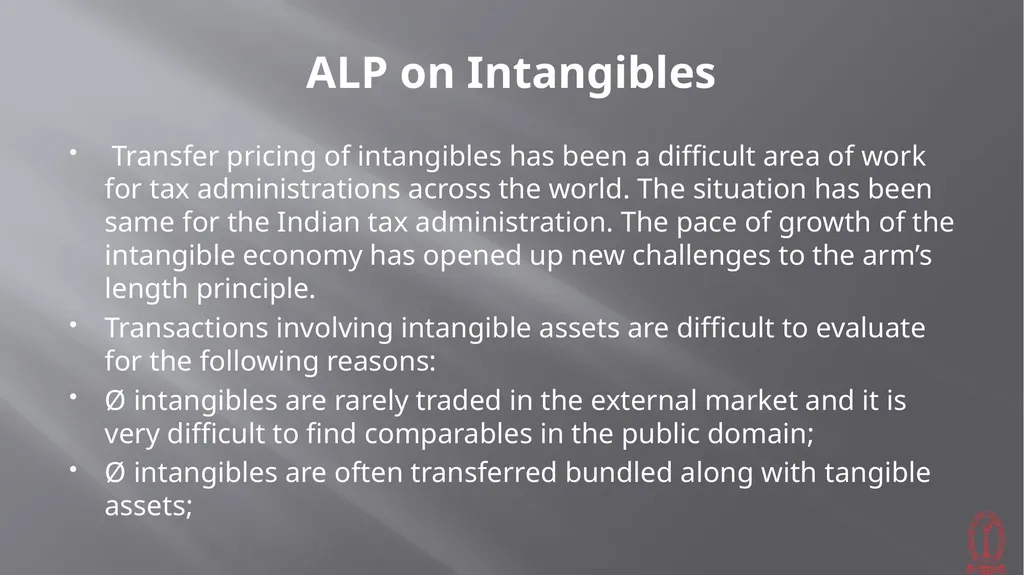
ALP on Intangibles Transfer pricing of intangibles has been a difficult area of work for tax administrations across the world. The situation has been same for the Indian tax administration. The pace of growth of the intangible economy has opened up new challenges to the arm’s length principle.
Transactions involving intangible assets are difficult to evaluate for the following reasons:
Ø intangibles are rarely traded in the external market and it is very difficult to find comparables in the public domain;
Ø intangibles are often transferred bundled along with tangible assets;<br>
Transactions involving intangible assets are difficult to evaluate for the following reasons:
Ø intangibles are rarely traded in the external market and it is very difficult to find comparables in the public domain;
Ø intangibles are often transferred bundled along with tangible assets;<br>
33
Serious difficulties have been encountered in determining the rate of royalty charged for the use of brands and trademarks in certain cases.
Indian subsidiaries using the technical know-how of their parent company have incurred significant expenditure to customize such know-how and to enhance its value by their R&D efforts. Costs of activities, such as R&D activities which have contributed to enhancing the value of the know-how owned by the parent company, are generally considered by the Indian transfer pricing administration while determining the arm’s length price of royalties for the use of technical know-how.<br>
Indian subsidiaries using the technical know-how of their parent company have incurred significant expenditure to customize such know-how and to enhance its value by their R&D efforts. Costs of activities, such as R&D activities which have contributed to enhancing the value of the know-how owned by the parent company, are generally considered by the Indian transfer pricing administration while determining the arm’s length price of royalties for the use of technical know-how.<br>
34
Issues and challenges Functional analysis – each enterprise to identify
R&D
Design
Engineering
Marketing and distribution function
Management
Financial Risks and market risks
Contractual terms
Market Conditions
Geographical Issues
Government and Regulations<br>
R&D
Design
Engineering
Marketing and distribution function
Management
Financial Risks and market risks
Contractual terms
Market Conditions
Geographical Issues
Government and Regulations<br>
35
Strategies Business
Use of data of different years previous year vs. current year
MNC losses
Set offs within the MNC Group Companies
Use of Customs Valuation under WTO Guidelines
Both for imports and exports<br>
Use of data of different years previous year vs. current year
MNC losses
Set offs within the MNC Group Companies
Use of Customs Valuation under WTO Guidelines
Both for imports and exports<br>
36
Selection of TP Methods No one method is generally applicable to different situations.
Ultimately computation of ALP is a highly complex task
Requires huge amount of efforts
Co-operation from the Tax Payer and Tax Authorities regarding documentation, ground work, analysis and research.
The adjustments made by the transfer pricing officers (TPOs) have been subject to judicial reviews in India and although the matter is still to be finally adjudicated by the Supreme Court and the decisions of the High Courts and Tribunals.
The Indian tax administration has been applying these principles to make adjustments but it is apparent that the process is complex, fact intensive and not free from disputes. The efforts being made by the Indian tax authorities to bring uniformity in approach and the expected judicial verdict from the Indian Supreme Court are likely to bring more clarity in the process.<br>
Ultimately computation of ALP is a highly complex task
Requires huge amount of efforts
Co-operation from the Tax Payer and Tax Authorities regarding documentation, ground work, analysis and research.
The adjustments made by the transfer pricing officers (TPOs) have been subject to judicial reviews in India and although the matter is still to be finally adjudicated by the Supreme Court and the decisions of the High Courts and Tribunals.
The Indian tax administration has been applying these principles to make adjustments but it is apparent that the process is complex, fact intensive and not free from disputes. The efforts being made by the Indian tax authorities to bring uniformity in approach and the expected judicial verdict from the Indian Supreme Court are likely to bring more clarity in the process.<br>
37
Legal Issues A comprehensive dispute resolution mechanism is available to the taxpayers in India facing transfer pricing adjustments. As a part of the legal process in all cases, the Assessing Officer (AO) incorporates the order of the Transfer Pricing Officer (TPO) in his order and issues a draft order to the taxpayer.
The taxpayer has the option to file an objection against the draft order before the Dispute Resolution Panel (DRP) which is a panel comprising three Commissioners of Income-tax. The AO issues a final order in compliance with the DRP’s directions.
At present, the direction of the DRP is final for the tax administration and it cannot appeal further against the DRP’s order. The taxpayer can challenge the direction of the DRP in appellate forums.<br>
The taxpayer has the option to file an objection against the draft order before the Dispute Resolution Panel (DRP) which is a panel comprising three Commissioners of Income-tax. The AO issues a final order in compliance with the DRP’s directions.
At present, the direction of the DRP is final for the tax administration and it cannot appeal further against the DRP’s order. The taxpayer can challenge the direction of the DRP in appellate forums.<br>
38
Steps by Government Government of India has taken several steps to reduce litigation and the time needed to resolve tax disputes. Some of the steps taken in this direction are the following:
introduction of the ‘Range’ concept in the Transfer Pricing Law along with the use of multiple-year data;
Ø use of the Mutual Agreement Procedure (MAP) for speedier resolution of pending cases;
Ø introduction of Advance Pricing Agreement (APA) provisions in the law; and
Ø introduction of Safe Harbour provisions in the transfer pricing law.<br>
introduction of the ‘Range’ concept in the Transfer Pricing Law along with the use of multiple-year data;
Ø use of the Mutual Agreement Procedure (MAP) for speedier resolution of pending cases;
Ø introduction of Advance Pricing Agreement (APA) provisions in the law; and
Ø introduction of Safe Harbour provisions in the transfer pricing law.<br>
39
Thank You Behind Every Successful Business Decision, There Is Always A CMA<br>