
Transgender support 102 (for non-therapists)
OM
Published · 62 slides · 0 views

1 / 1


Description
Transgender support 102 (for non-therapists) Samantha Chow 2023 Introduction Transwoman (assigned male at birth) Psychiatrist Immigrant Private practice (ex-TWO) Basic terminology AMAB or AFAB Assigned malefemale at birth
Related Topics
Share
Embed code
Download this presentation From Below
"Transgender support 102 (for non-therapists)" is the property of its rightful owner. Permission is granted to download and print the materials on this website for personal, non-commercial use only, and to display it on your personal computer provided you do not modify the materials and that you retain all copyright notices contained in the materials. By downloading content from our website, you accept the terms of this agreement.
Presentation Transcript
01
Transgender support 102 (for non-therapists) Samantha Chow 2023<br>
02
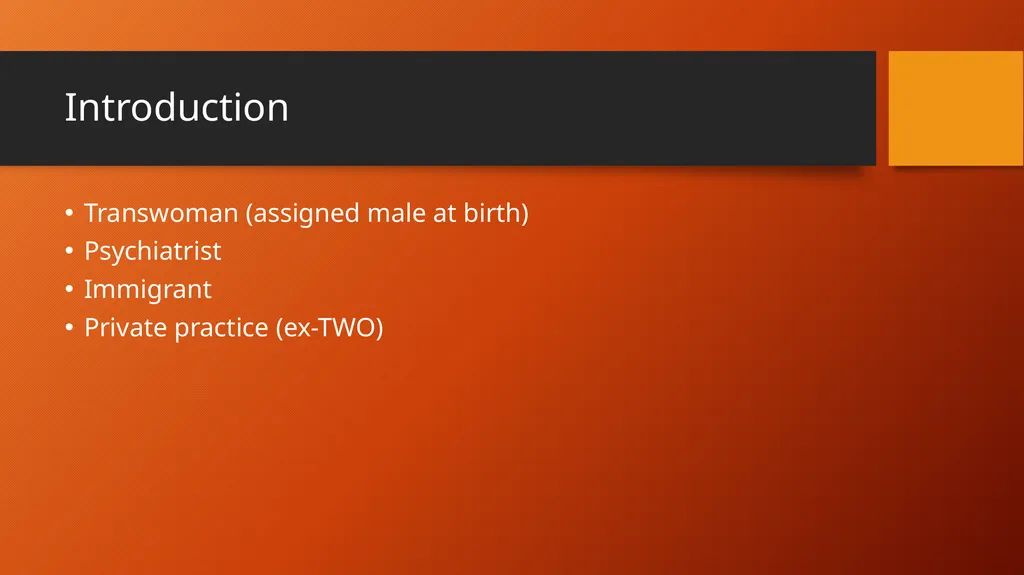
Introduction Transwoman (assigned male at birth)
Psychiatrist
Immigrant
Private practice (ex-TWO)<br>
Psychiatrist
Immigrant
Private practice (ex-TWO)<br>
03
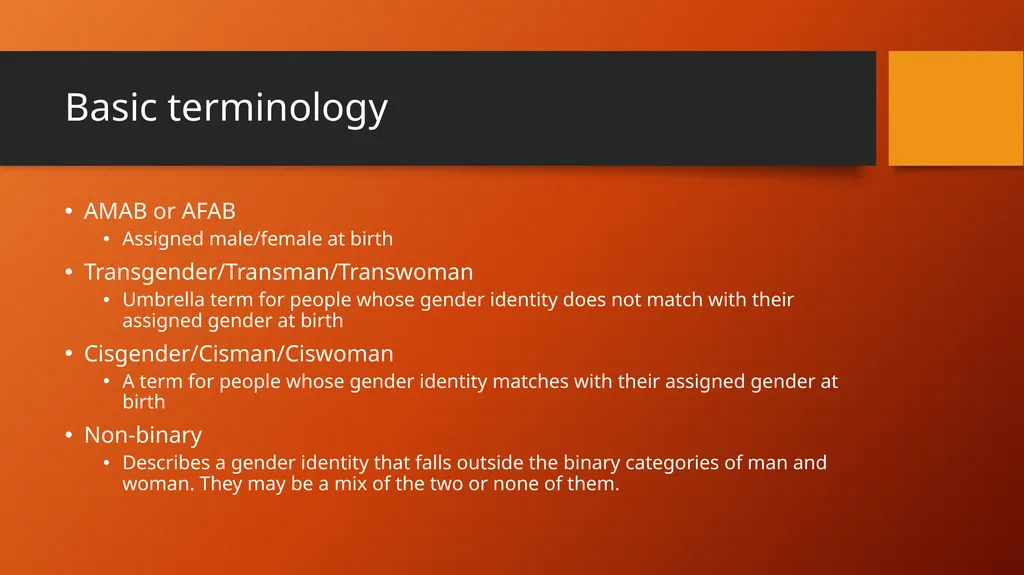
Basic terminology AMAB or AFAB
Assigned male/female at birth
Transgender/Transman/Transwoman
Umbrella term for people whose gender identity does not match with their assigned gender at birth
Cisgender/Cisman/Ciswoman
A term for people whose gender identity matches with their assigned gender at birth
Non-binary
Describes a gender identity that falls outside the binary categories of man and woman. They may be a mix of the two or none of them.<br>
Assigned male/female at birth
Transgender/Transman/Transwoman
Umbrella term for people whose gender identity does not match with their assigned gender at birth
Cisgender/Cisman/Ciswoman
A term for people whose gender identity matches with their assigned gender at birth
Non-binary
Describes a gender identity that falls outside the binary categories of man and woman. They may be a mix of the two or none of them.<br>
04
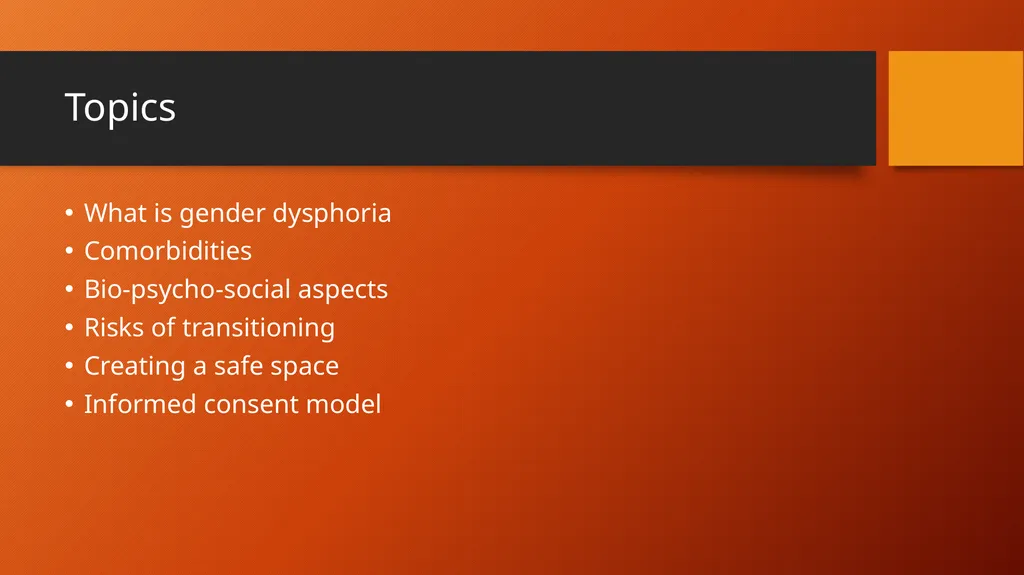
Topics What is gender dysphoria
Comorbidities
Bio-psycho-social aspects
Risks of transitioning
Creating a safe space
Informed consent model<br>
Comorbidities
Bio-psycho-social aspects
Risks of transitioning
Creating a safe space
Informed consent model<br>
05
What is gender dysphoria?<br>
06
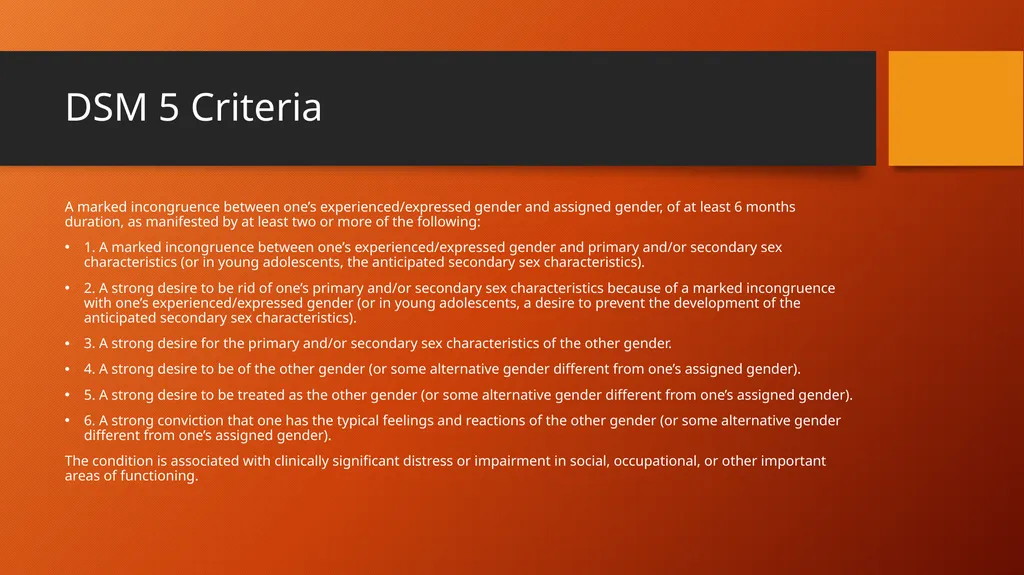
DSM 5 Criteria A marked incongruence between one’s experienced/expressed gender and assigned gender, of at least 6 months duration, as manifested by at least two or more of the following:
1. A marked incongruence between one’s experienced/expressed gender and primary and/or secondary sex characteristics (or in young adolescents, the anticipated secondary sex characteristics).
2. A strong desire to be rid of one’s primary and/or secondary sex characteristics because of a marked incongruence with one’s experienced/expressed gender (or in young adolescents, a desire to prevent the development of the anticipated secondary sex characteristics).
3. A strong desire for the primary and/or secondary sex characteristics of the other gender.
4. A strong desire to be of the other gender (or some alternative gender different from one’s assigned gender).
5. A strong desire to be treated as the other gender (or some alternative gender different from one’s assigned gender).
6. A strong conviction that one has the typical feelings and reactions of the other gender (or some alternative gender different from one’s assigned gender).
The condition is associated with clinically significant distress or impairment in social, occupational, or other important areas of functioning.<br>
1. A marked incongruence between one’s experienced/expressed gender and primary and/or secondary sex characteristics (or in young adolescents, the anticipated secondary sex characteristics).
2. A strong desire to be rid of one’s primary and/or secondary sex characteristics because of a marked incongruence with one’s experienced/expressed gender (or in young adolescents, a desire to prevent the development of the anticipated secondary sex characteristics).
3. A strong desire for the primary and/or secondary sex characteristics of the other gender.
4. A strong desire to be of the other gender (or some alternative gender different from one’s assigned gender).
5. A strong desire to be treated as the other gender (or some alternative gender different from one’s assigned gender).
6. A strong conviction that one has the typical feelings and reactions of the other gender (or some alternative gender different from one’s assigned gender).
The condition is associated with clinically significant distress or impairment in social, occupational, or other important areas of functioning.<br>
07
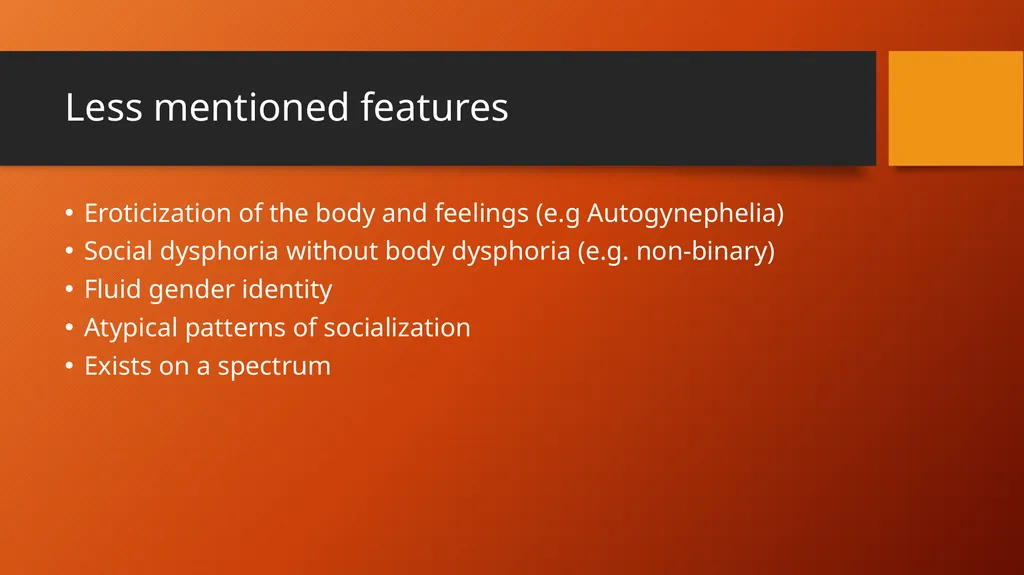
Less mentioned features Eroticization of the body and feelings (e.g Autogynephelia)
Social dysphoria without body dysphoria (e.g. non-binary)
Fluid gender identity
Atypical patterns of socialization
Exists on a spectrum<br>
Social dysphoria without body dysphoria (e.g. non-binary)
Fluid gender identity
Atypical patterns of socialization
Exists on a spectrum<br>
08
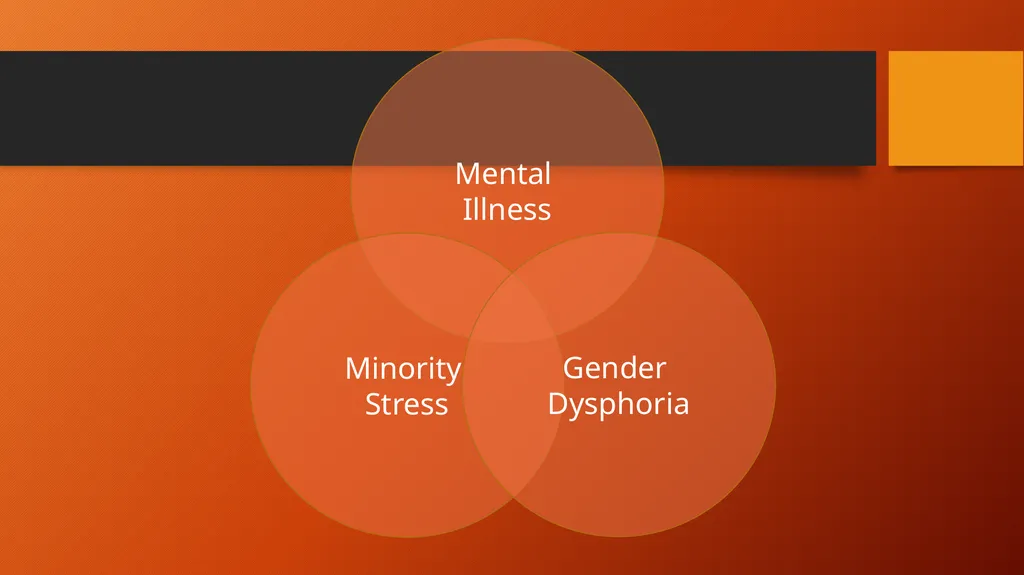
Mental
Illness Minority
Stress Gender
Dysphoria<br>
Illness Minority
Stress Gender
Dysphoria<br>
09
What causes it? Long story short…
We don’t know
But it is highly comorbid with autism (?neurodevelopmental disorder)<br>
We don’t know
But it is highly comorbid with autism (?neurodevelopmental disorder)<br>
10
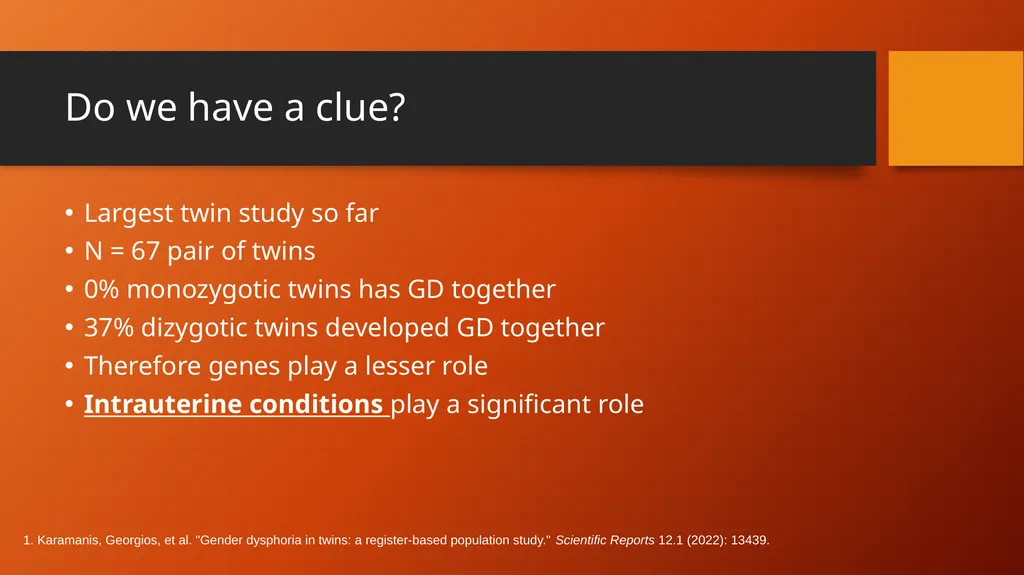
Do we have a clue? Largest twin study so far
N = 67 pair of twins
0% monozygotic twins has GD together
37% dizygotic twins developed GD together
Therefore genes play a lesser role
Intrauterine conditions play a significant role 1. Karamanis, Georgios, et al. "Gender dysphoria in twins: a register-based population study." Scientific Reports 12.1 (2022): 13439.<br>
N = 67 pair of twins
0% monozygotic twins has GD together
37% dizygotic twins developed GD together
Therefore genes play a lesser role
Intrauterine conditions play a significant role 1. Karamanis, Georgios, et al. "Gender dysphoria in twins: a register-based population study." Scientific Reports 12.1 (2022): 13439.<br>
11
Intrauterine factors and ASD Intrauterine hormonal imbalance is a significant risk for ASD
Exposure to marijuana, herbicide, and certain metals during pregnancy
Maternal depression
Maternal infection
Maternal diabetes Lu, Jianping, et al. "Rethinking autism: The impact of maternal risk factors on autism development." American Journal of Translational Research 14.2 (2022): 1136.<br>
Exposure to marijuana, herbicide, and certain metals during pregnancy
Maternal depression
Maternal infection
Maternal diabetes Lu, Jianping, et al. "Rethinking autism: The impact of maternal risk factors on autism development." American Journal of Translational Research 14.2 (2022): 1136.<br>
12
Other factors? Epigenetics?
Environmental?
Sociological?
Is this a culture-bound condition?? (sharp rise in Western countries)<br>
Environmental?
Sociological?
Is this a culture-bound condition?? (sharp rise in Western countries)<br>
13
Elephant in the room Most people with GD don’t have ASD
Only roughly 5 – 10% of individuals with GD has ASD
Is this even a pathology? Kallitsounaki, Aimilia, and David M. Williams. "Autism spectrum disorder and gender dysphoria/incongruence. A systematic literature review and meta-analysis." Journal of Autism and Developmental Disorders (2022): 1-15.<br>
Only roughly 5 – 10% of individuals with GD has ASD
Is this even a pathology? Kallitsounaki, Aimilia, and David M. Williams. "Autism spectrum disorder and gender dysphoria/incongruence. A systematic literature review and meta-analysis." Journal of Autism and Developmental Disorders (2022): 1-15.<br>
14
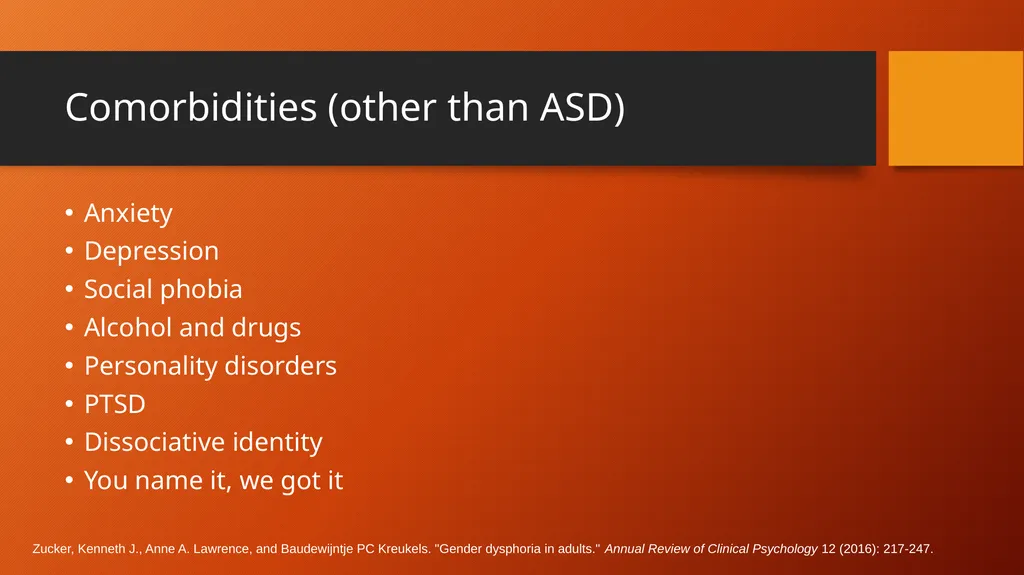
Comorbidities (other than ASD) Anxiety
Depression
Social phobia
Alcohol and drugs
Personality disorders
PTSD
Dissociative identity
You name it, we got it Zucker, Kenneth J., Anne A. Lawrence, and Baudewijntje PC Kreukels. "Gender dysphoria in adults." Annual Review of Clinical Psychology 12 (2016): 217-247.<br>
Depression
Social phobia
Alcohol and drugs
Personality disorders
PTSD
Dissociative identity
You name it, we got it Zucker, Kenneth J., Anne A. Lawrence, and Baudewijntje PC Kreukels. "Gender dysphoria in adults." Annual Review of Clinical Psychology 12 (2016): 217-247.<br>
15
Is it the GD? Or the stigma? Probably both
Individual impact is unclear
No studies<br>
Individual impact is unclear
No studies<br>
16
Bio-psycho-social aspects of GD<br>
17
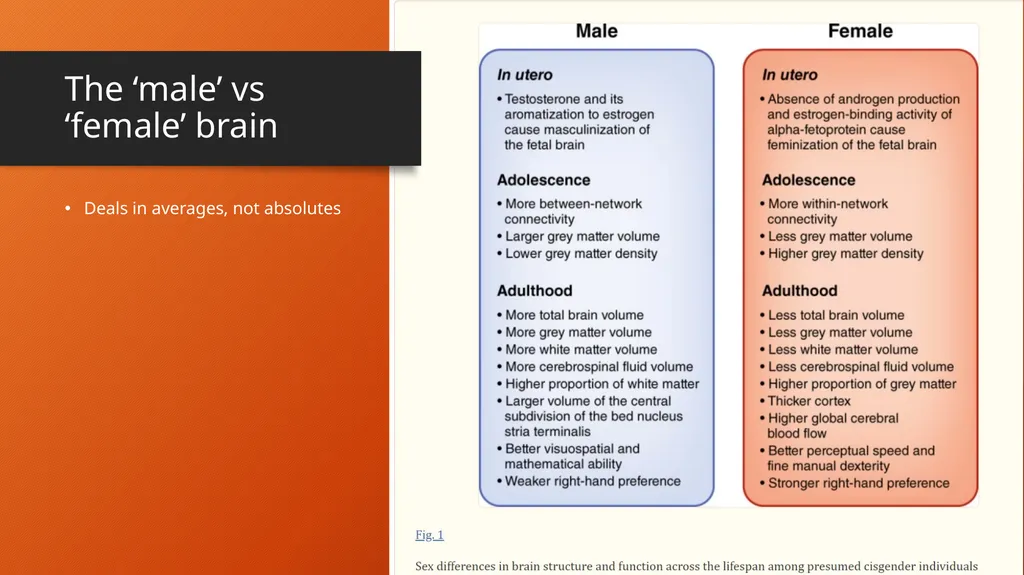
The ‘male’ vs ‘female’ brain Deals in averages, not absolutes<br>
18
The transgender brain Transwoman have brains morphology similar to ciswoman
Performance in cognitive tasks more congruent with gender identity (as opposed to gender assigned at birth)
Functional imaging shows activation patterns more representative of their gender identity Nguyen, Hillary B., et al. "What has sex got to do with it? The role of hormones in the transgender brain." Neuropsychopharmacology 44.1 (2019): 22-37.<br>
Performance in cognitive tasks more congruent with gender identity (as opposed to gender assigned at birth)
Functional imaging shows activation patterns more representative of their gender identity Nguyen, Hillary B., et al. "What has sex got to do with it? The role of hormones in the transgender brain." Neuropsychopharmacology 44.1 (2019): 22-37.<br>
19
Hormones changes the brain too Testosterone produces structural change in brains of transmen
Partly explains the immediate relief of dysphoria despite slower physical changes Zubiaurre-Elorza, Leire, et al. "The Effects of Testosterone on the Brain of Transgender Men." Androgens: Clinical Research and Therapeutics 2.1 (2021): 252-260.<br>
Partly explains the immediate relief of dysphoria despite slower physical changes Zubiaurre-Elorza, Leire, et al. "The Effects of Testosterone on the Brain of Transgender Men." Androgens: Clinical Research and Therapeutics 2.1 (2021): 252-260.<br>
20
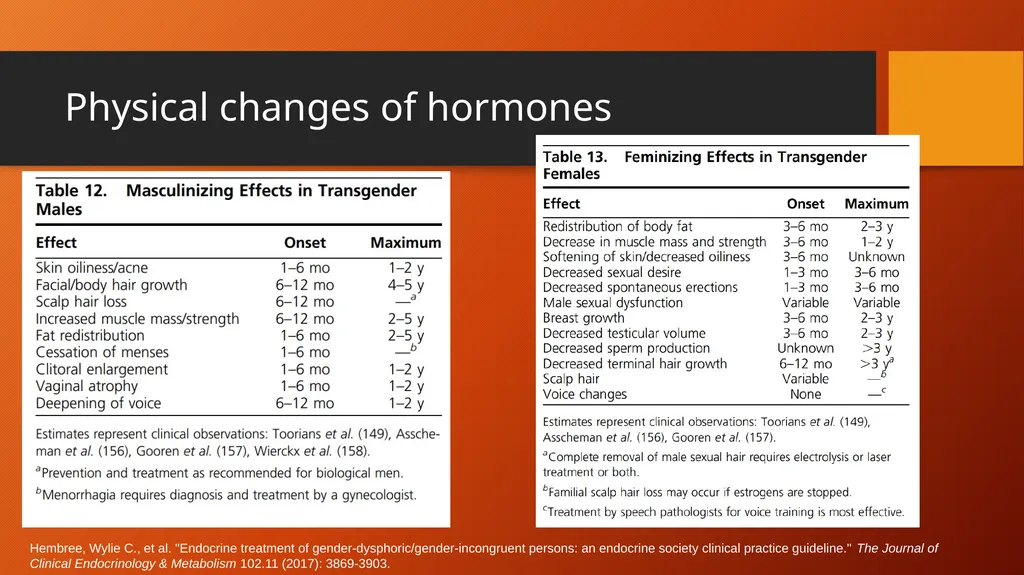
Physical changes of hormones Hembree, Wylie C., et al. "Endocrine treatment of gender-dysphoric/gender-incongruent persons: an endocrine society clinical practice guideline." The Journal of Clinical Endocrinology & Metabolism 102.11 (2017): 3869-3903.<br>
21
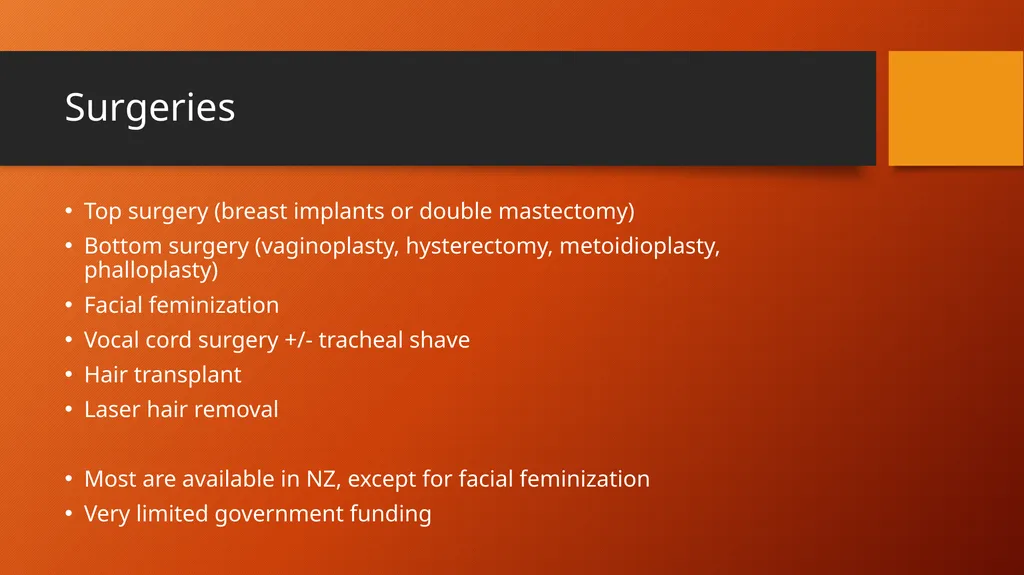
Surgeries Top surgery (breast implants or double mastectomy)
Bottom surgery (vaginoplasty, hysterectomy, metoidioplasty, phalloplasty)
Facial feminization
Vocal cord surgery +/- tracheal shave
Hair transplant
Laser hair removal
Most are available in NZ, except for facial feminization
Very limited government funding<br>
Bottom surgery (vaginoplasty, hysterectomy, metoidioplasty, phalloplasty)
Facial feminization
Vocal cord surgery +/- tracheal shave
Hair transplant
Laser hair removal
Most are available in NZ, except for facial feminization
Very limited government funding<br>
22
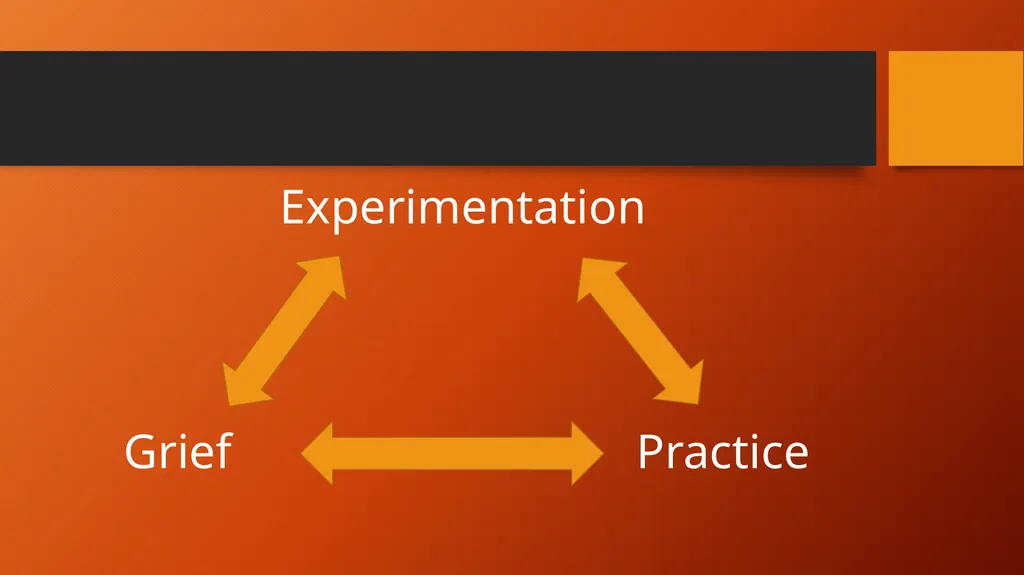
Psychological aspects Based on my clinical and lived experience
3 common phases:
Experimentation
Grief
Practice<br>
3 common phases:
Experimentation
Grief
Practice<br>
23
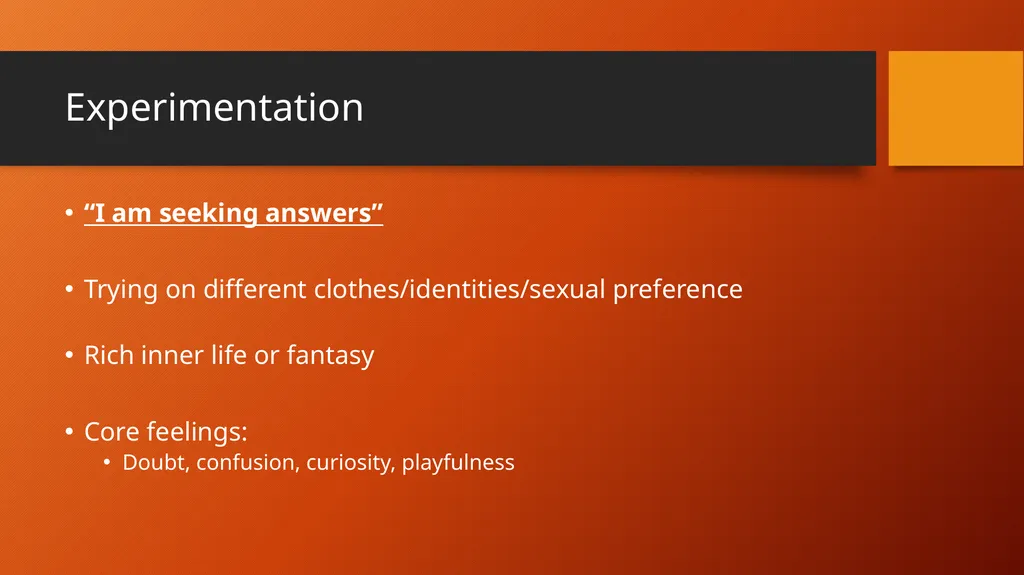
Experimentation “I am seeking answers”
Trying on different clothes/identities/sexual preference
Rich inner life or fantasy
Core feelings:
Doubt, confusion, curiosity, playfulness<br>
Trying on different clothes/identities/sexual preference
Rich inner life or fantasy
Core feelings:
Doubt, confusion, curiosity, playfulness<br>
24
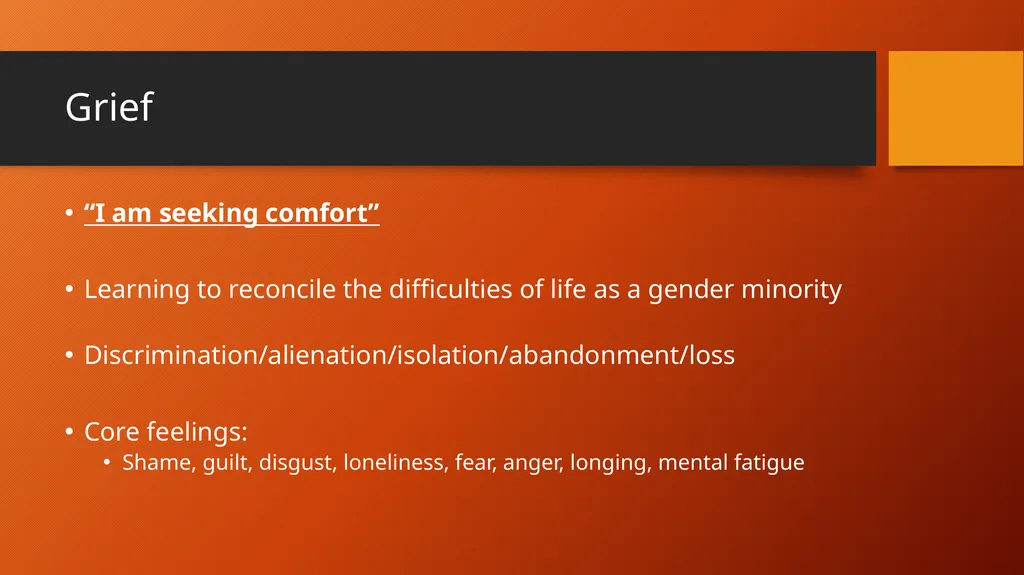
Grief “I am seeking comfort”
Learning to reconcile the difficulties of life as a gender minority
Discrimination/alienation/isolation/abandonment/loss
Core feelings:
Shame, guilt, disgust, loneliness, fear, anger, longing, mental fatigue<br>
Learning to reconcile the difficulties of life as a gender minority
Discrimination/alienation/isolation/abandonment/loss
Core feelings:
Shame, guilt, disgust, loneliness, fear, anger, longing, mental fatigue<br>
25
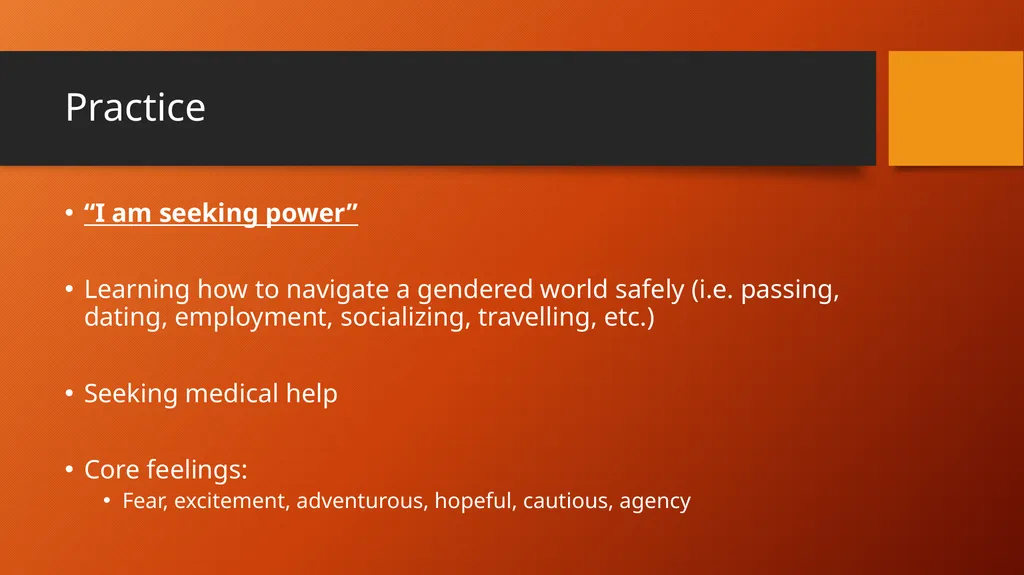
Practice “I am seeking power”
Learning how to navigate a gendered world safely (i.e. passing, dating, employment, socializing, travelling, etc.)
Seeking medical help
Core feelings:
Fear, excitement, adventurous, hopeful, cautious, agency<br>
Learning how to navigate a gendered world safely (i.e. passing, dating, employment, socializing, travelling, etc.)
Seeking medical help
Core feelings:
Fear, excitement, adventurous, hopeful, cautious, agency<br>
26
Experimentation Grief Practice<br>
27
There are exceptions Some don’t need to experiment (they just know)
Some don’t need a lot of practice (they pass naturally)
Some don’t grieve for very long (well supported)<br>
Some don’t need a lot of practice (they pass naturally)
Some don’t grieve for very long (well supported)<br>
28
Gradual psychological maturation Learning to be grateful and patient
Learning to pick your battles (resource management)
Learning to integrate with broader world
Finding one’s own community
Increasingly resilient and robust in the face of setbacks<br>
Learning to pick your battles (resource management)
Learning to integrate with broader world
Finding one’s own community
Increasingly resilient and robust in the face of setbacks<br>
29
Victim mentality Rooted in trauma (which is subject to perception)
Influenced by personality structure (narcissism)
Reinforced by environment
Anger is empowering and justifiable, but self-destructive at the same time<br>
Influenced by personality structure (narcissism)
Reinforced by environment
Anger is empowering and justifiable, but self-destructive at the same time<br>
30
Social aspects Financial costs
Relational costs
Legal ramifications
Minority stress
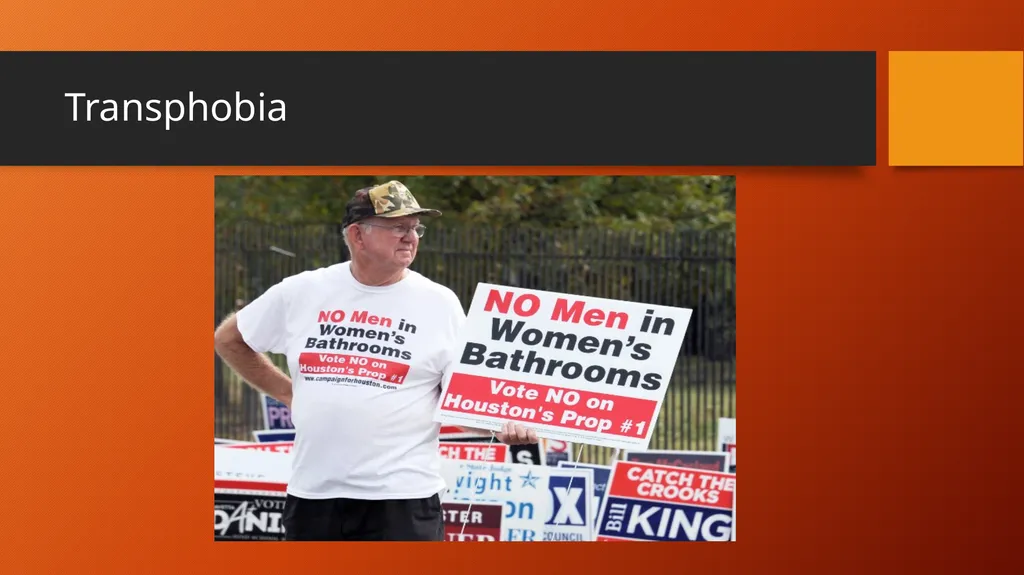
Transphobia<br>
Relational costs
Legal ramifications
Minority stress
Transphobia<br>
31
Financial costs Average surgery costs $5,000 to $30,000 (NZD)
Flights and accommodation
Loss of income +/- failure to retain employment
Follow-up and post-op complications
More than one gender-affirming surgery
Expect $50,000 to $150,000 (NZD) over a lifetime<br>
Flights and accommodation
Loss of income +/- failure to retain employment
Follow-up and post-op complications
More than one gender-affirming surgery
Expect $50,000 to $150,000 (NZD) over a lifetime<br>
32
Changes to relationship and employment Divorce and separations
Workplace discrimination
Alienation from friend group<br>
Workplace discrimination
Alienation from friend group<br>
33
Legal ramifications Travel restrictions
Certain countries outlaws LGBTQ
Name change and sex change on legal documents
Dealing with bureaucracies<br>
Certain countries outlaws LGBTQ
Name change and sex change on legal documents
Dealing with bureaucracies<br>
34
Minority stress First coined by Meyer in 2003
Conceptual framework to think about stressors faced by minorities
Stigma, prejudice, discrimination
Barriers to healthcare, hostile environment
Cumulative stress leads to or exacerbates pre-existing mental health conditions Meyer, Ilan H. "Prejudice, social stress, and mental health in lesbian, gay, and bisexual populations: conceptual issues and research evidence." Psychological bulletin 129.5 (2003): 674.<br>
Conceptual framework to think about stressors faced by minorities
Stigma, prejudice, discrimination
Barriers to healthcare, hostile environment
Cumulative stress leads to or exacerbates pre-existing mental health conditions Meyer, Ilan H. "Prejudice, social stress, and mental health in lesbian, gay, and bisexual populations: conceptual issues and research evidence." Psychological bulletin 129.5 (2003): 674.<br>
35
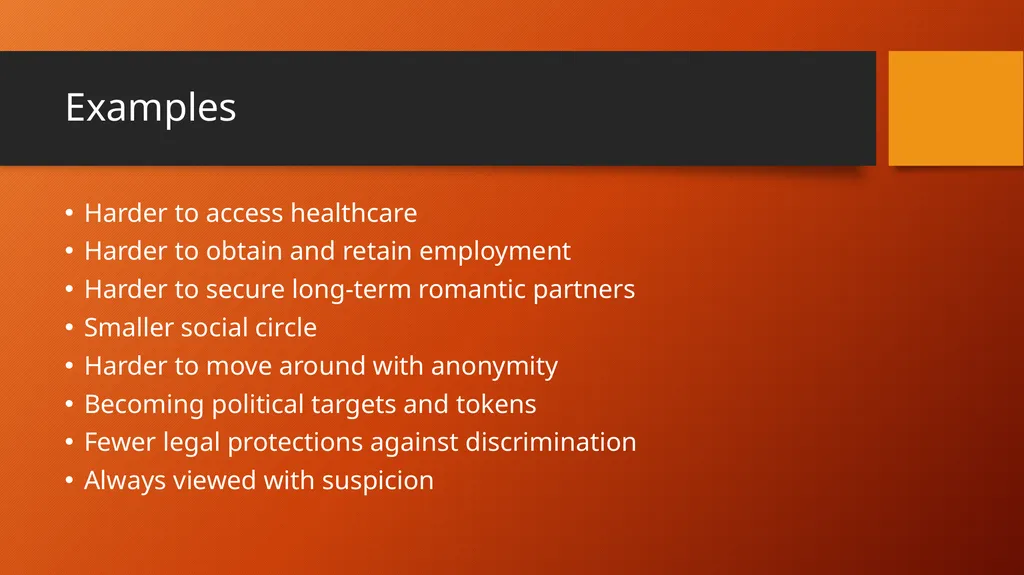
Examples Harder to access healthcare
Harder to obtain and retain employment
Harder to secure long-term romantic partners
Smaller social circle
Harder to move around with anonymity
Becoming political targets and tokens
Fewer legal protections against discrimination
Always viewed with suspicion<br>
Harder to obtain and retain employment
Harder to secure long-term romantic partners
Smaller social circle
Harder to move around with anonymity
Becoming political targets and tokens
Fewer legal protections against discrimination
Always viewed with suspicion<br>
36
Transphobia<br>
37
Risks of transitioning<br>
38
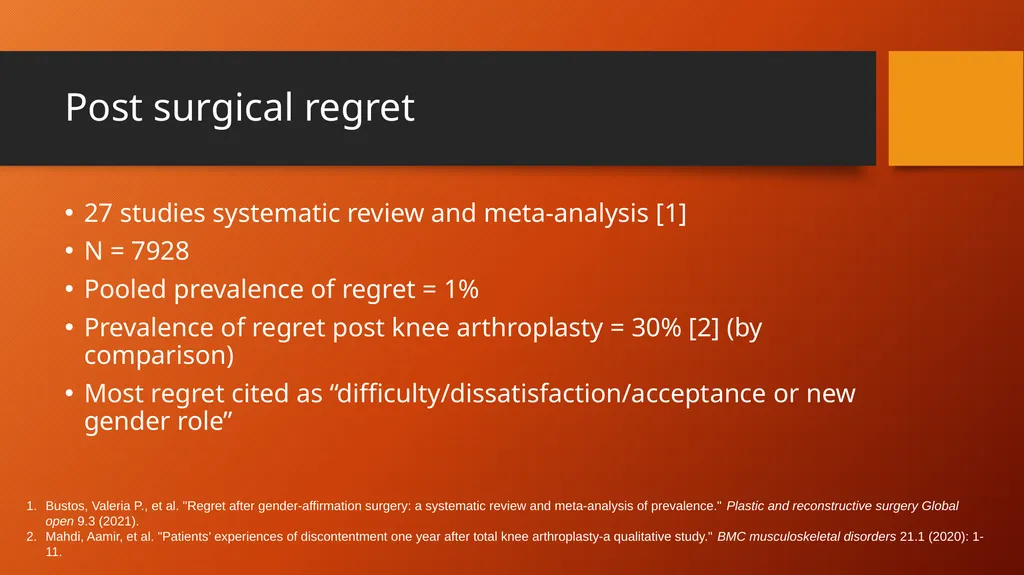
Post surgical regret 27 studies systematic review and meta-analysis [1]
N = 7928
Pooled prevalence of regret = 1%
Prevalence of regret post knee arthroplasty = 30% [2] (by comparison)
Most regret cited as “difficulty/dissatisfaction/acceptance or new gender role” Bustos, Valeria P., et al. "Regret after gender-affirmation surgery: a systematic review and meta-analysis of prevalence." Plastic and reconstructive surgery Global open 9.3 (2021).
Mahdi, Aamir, et al. "Patients’ experiences of discontentment one year after total knee arthroplasty-a qualitative study." BMC musculoskeletal disorders 21.1 (2020): 1-11.<br>
N = 7928
Pooled prevalence of regret = 1%
Prevalence of regret post knee arthroplasty = 30% [2] (by comparison)
Most regret cited as “difficulty/dissatisfaction/acceptance or new gender role” Bustos, Valeria P., et al. "Regret after gender-affirmation surgery: a systematic review and meta-analysis of prevalence." Plastic and reconstructive surgery Global open 9.3 (2021).
Mahdi, Aamir, et al. "Patients’ experiences of discontentment one year after total knee arthroplasty-a qualitative study." BMC musculoskeletal disorders 21.1 (2020): 1-11.<br>
39
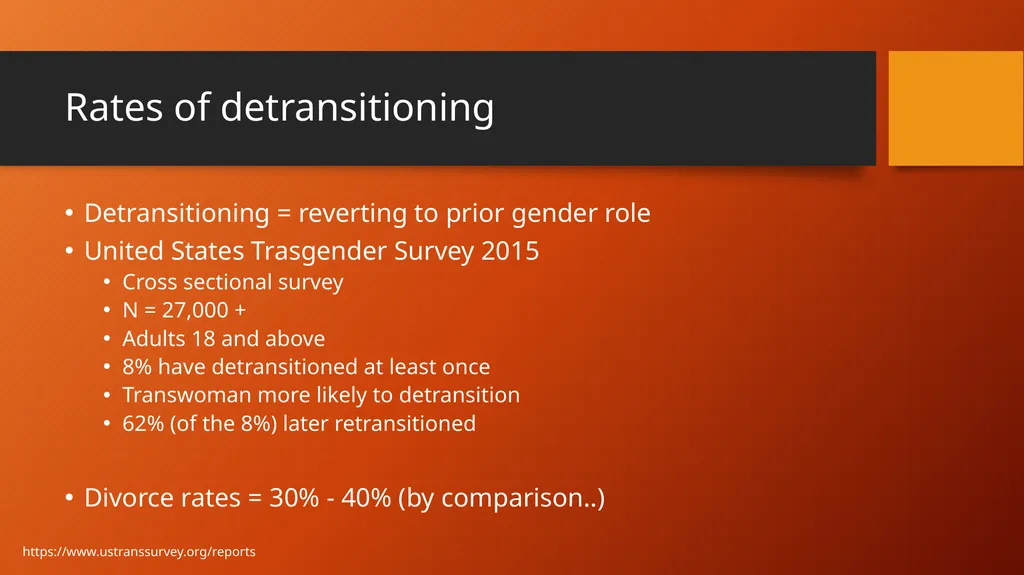
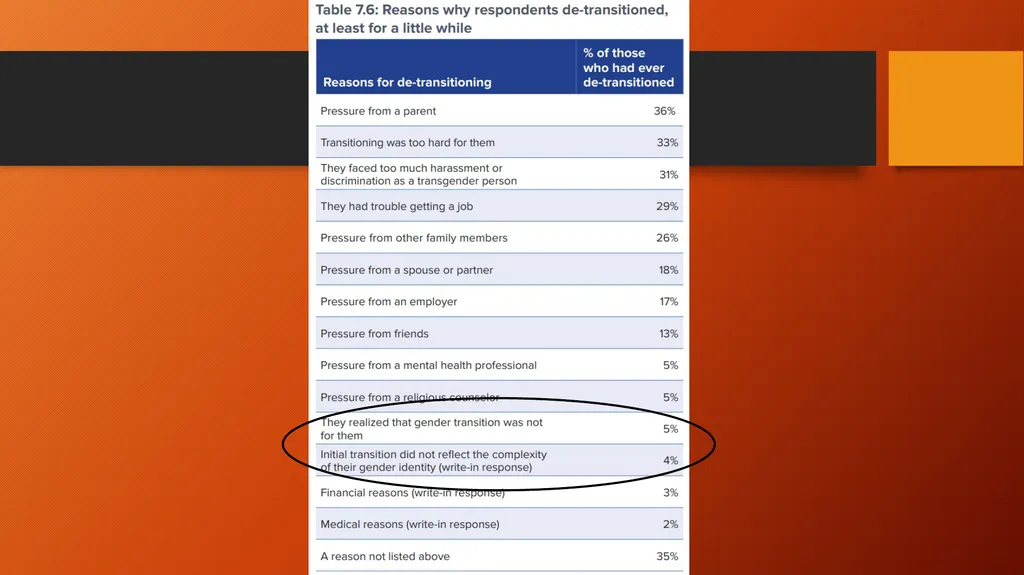
Rates of detransitioning Detransitioning = reverting to prior gender role
United States Trasgender Survey 2015
Cross sectional survey
N = 27,000 +
Adults 18 and above
8% have detransitioned at least once
Transwoman more likely to detransition
62% (of the 8%) later retransitioned
Divorce rates = 30% - 40% (by comparison..) https://www.ustranssurvey.org/reports<br>
United States Trasgender Survey 2015
Cross sectional survey
N = 27,000 +
Adults 18 and above
8% have detransitioned at least once
Transwoman more likely to detransition
62% (of the 8%) later retransitioned
Divorce rates = 30% - 40% (by comparison..) https://www.ustranssurvey.org/reports<br>
40
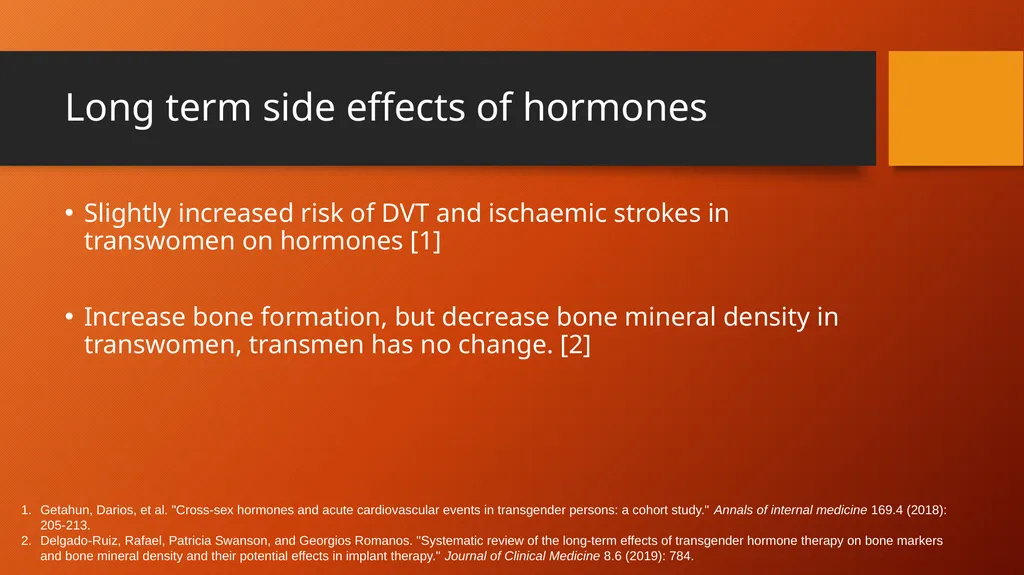
Long term side effects of hormones Slightly increased risk of DVT and ischaemic strokes in transwomen on hormones [1]
Increase bone formation, but decrease bone mineral density in transwomen, transmen has no change. [2] Getahun, Darios, et al. "Cross-sex hormones and acute cardiovascular events in transgender persons: a cohort study." Annals of internal medicine 169.4 (2018): 205-213.
Delgado-Ruiz, Rafael, Patricia Swanson, and Georgios Romanos. "Systematic review of the long-term effects of transgender hormone therapy on bone markers and bone mineral density and their potential effects in implant therapy." Journal of Clinical Medicine 8.6 (2019): 784.<br>
Increase bone formation, but decrease bone mineral density in transwomen, transmen has no change. [2] Getahun, Darios, et al. "Cross-sex hormones and acute cardiovascular events in transgender persons: a cohort study." Annals of internal medicine 169.4 (2018): 205-213.
Delgado-Ruiz, Rafael, Patricia Swanson, and Georgios Romanos. "Systematic review of the long-term effects of transgender hormone therapy on bone markers and bone mineral density and their potential effects in implant therapy." Journal of Clinical Medicine 8.6 (2019): 784.<br>
41
How do I create a safe space?<br>
42
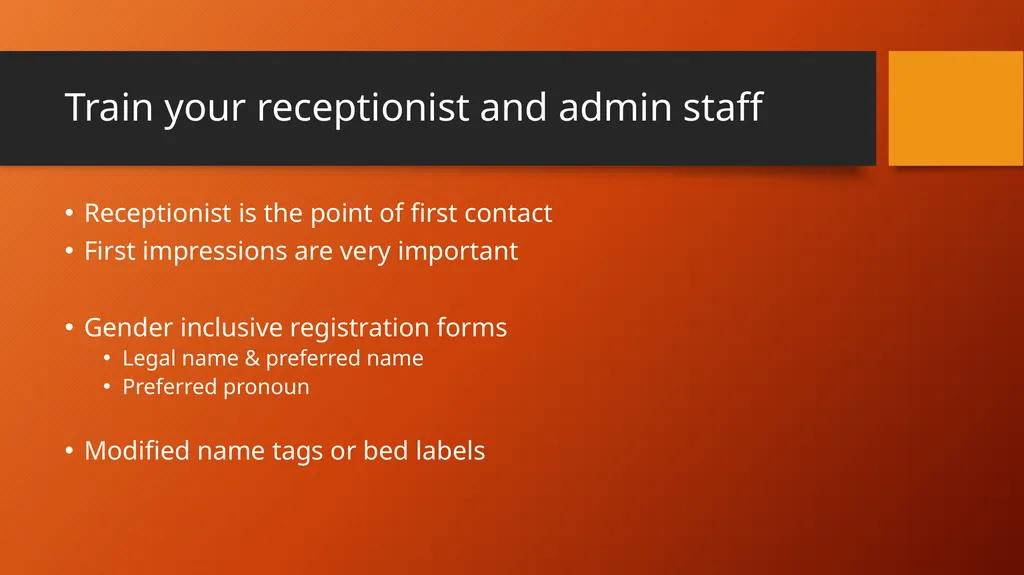
Train your receptionist and admin staff Receptionist is the point of first contact
First impressions are very important
Gender inclusive registration forms
Legal name & preferred name
Preferred pronoun
Modified name tags or bed labels<br>
First impressions are very important
Gender inclusive registration forms
Legal name & preferred name
Preferred pronoun
Modified name tags or bed labels<br>
43
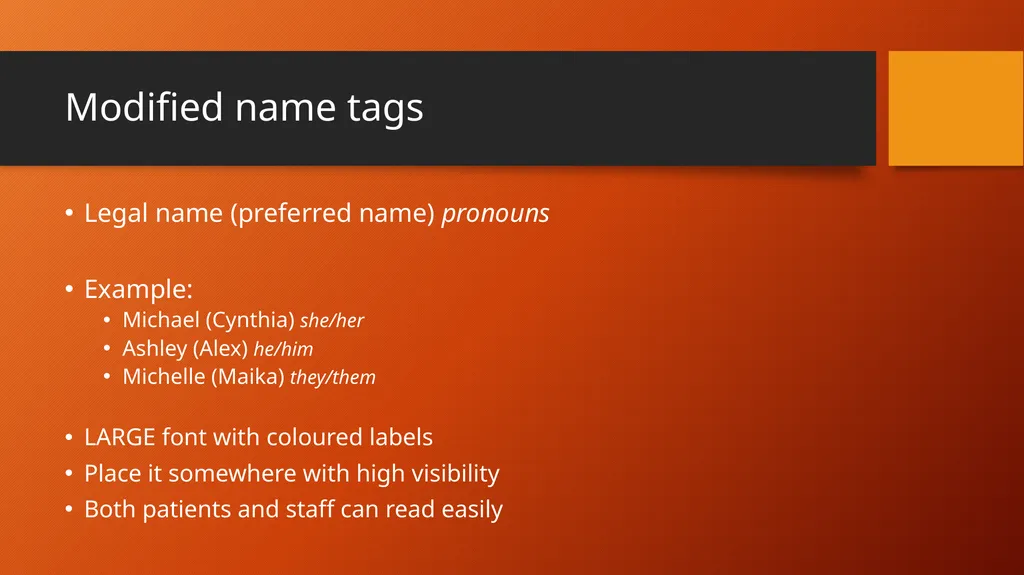
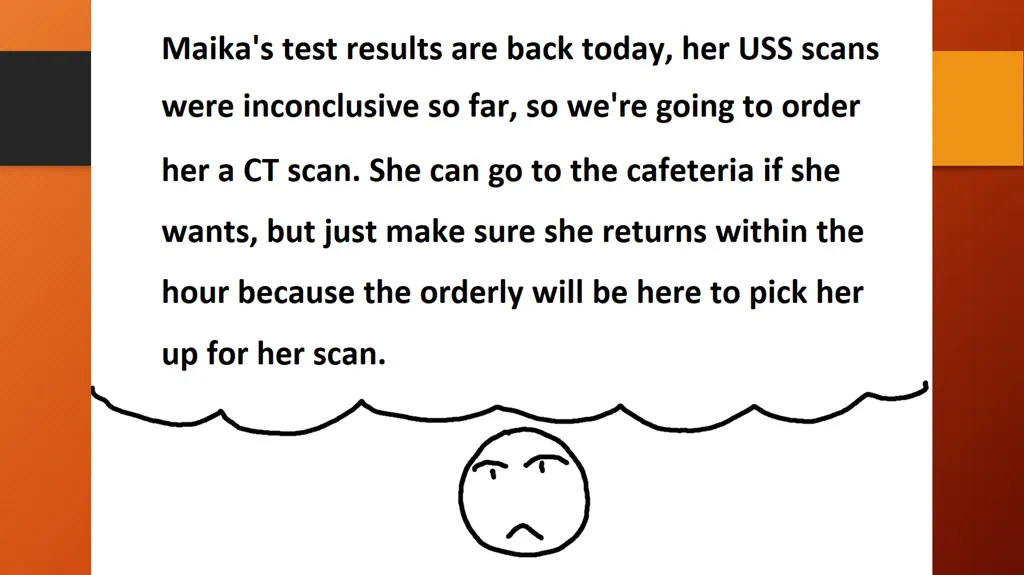
Modified name tags Legal name (preferred name) pronouns
Example:
Michael (Cynthia) she/her
Ashley (Alex) he/him
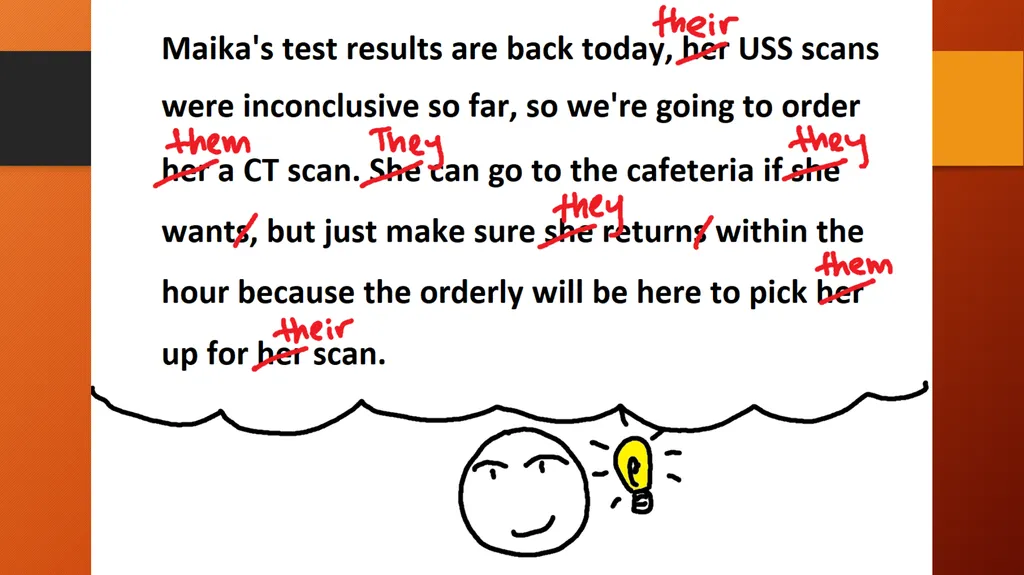
Michelle (Maika) they/them
LARGE font with coloured labels
Place it somewhere with high visibility
Both patients and staff can read easily<br>
Example:
Michael (Cynthia) she/her
Ashley (Alex) he/him
Michelle (Maika) they/them
LARGE font with coloured labels
Place it somewhere with high visibility
Both patients and staff can read easily<br>
44
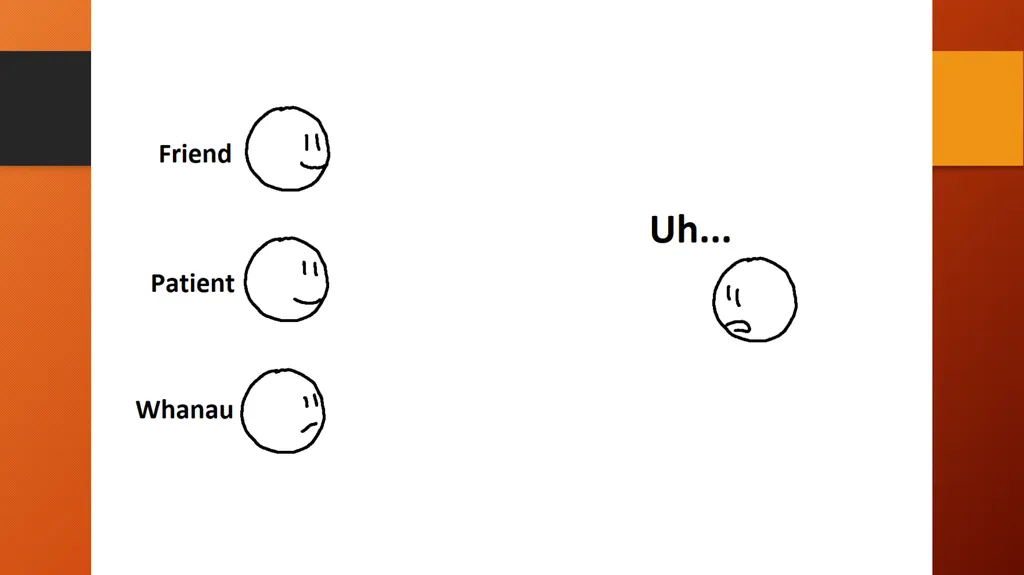
How to avoid misgendering a patient?<br>
45
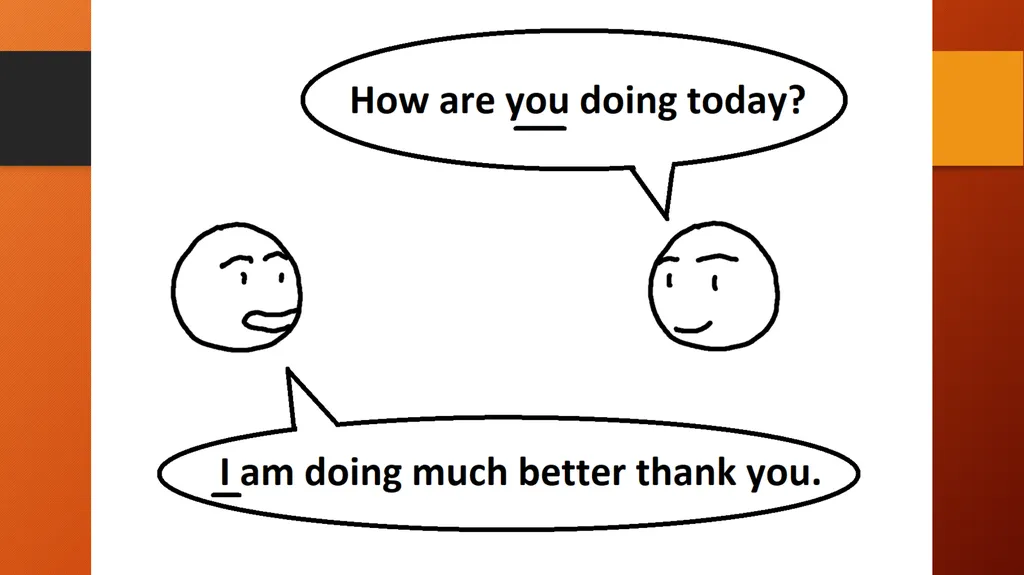
Slow down… and think…<br>
46
Isn’t that obvious? Yes…
And No.<br>
And No.<br>
47
Gender is performative Appearance
Voice
Mannerisms
We are VERY quick to determine gender based on performance<br>
Voice
Mannerisms
We are VERY quick to determine gender based on performance<br>
48
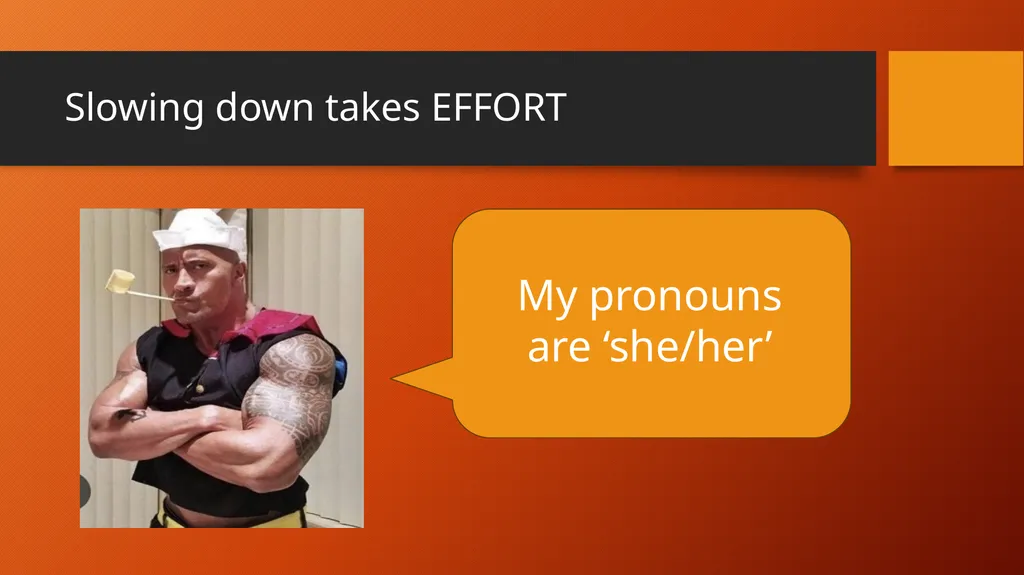
Slowing down takes EFFORT My pronouns are ‘she/her’<br>
49
Are you willing to exert effort to slow down? “Hell no. Everybody deserves equal treatment.”
“I don’t tell you what to say, so don’t tell me what to say.”
“Oh I’m sure they don’t mind.”
“This is too hard, I’m going to screw up, I can’t do it!”<br>
“I don’t tell you what to say, so don’t tell me what to say.”
“Oh I’m sure they don’t mind.”
“This is too hard, I’m going to screw up, I can’t do it!”<br>
50
It takes the right attitude… …And lots of practice
You will misgender occasionally
Apologize (don’t ignore it)
Move on, try again.<br>
You will misgender occasionally
Apologize (don’t ignore it)
Move on, try again.<br>
51
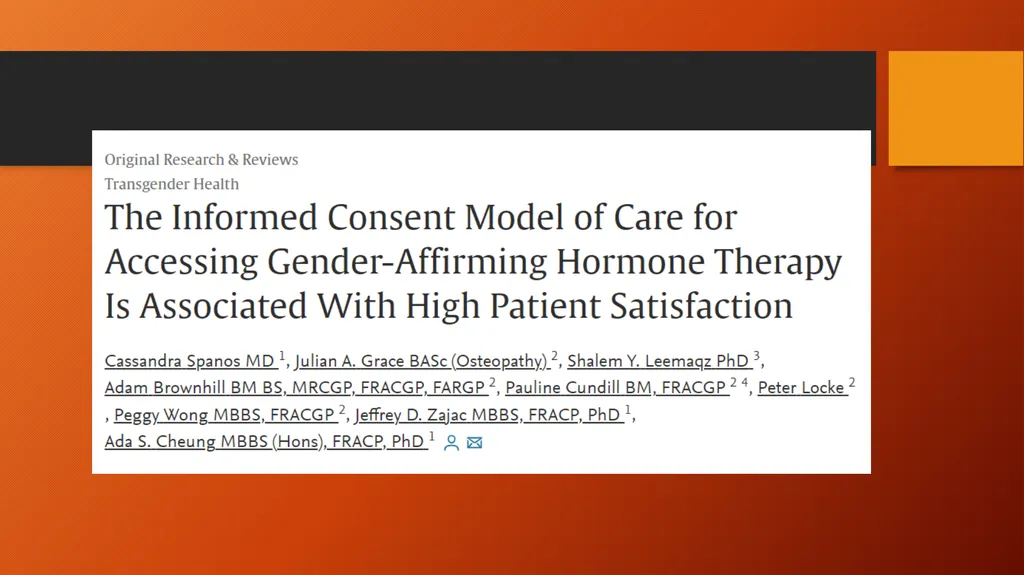
Informed consent model<br>
52
What is informed consent? “Informed consent is the process of exchanging information so that a patient / consumer can make an informed decision about their healthcare options, including the option of refusing the treatment, procedure or intervention.”
- Te Whatu Ora Waitemata 2023<br>
- Te Whatu Ora Waitemata 2023<br>
53
Gatekeeping model Patients require clinician’s authorization to access healthcare
Clinicians can deny healthcare even if patient is making an informed decision
Is this a human rights violation? (debate)<br>
Clinicians can deny healthcare even if patient is making an informed decision
Is this a human rights violation? (debate)<br>
54
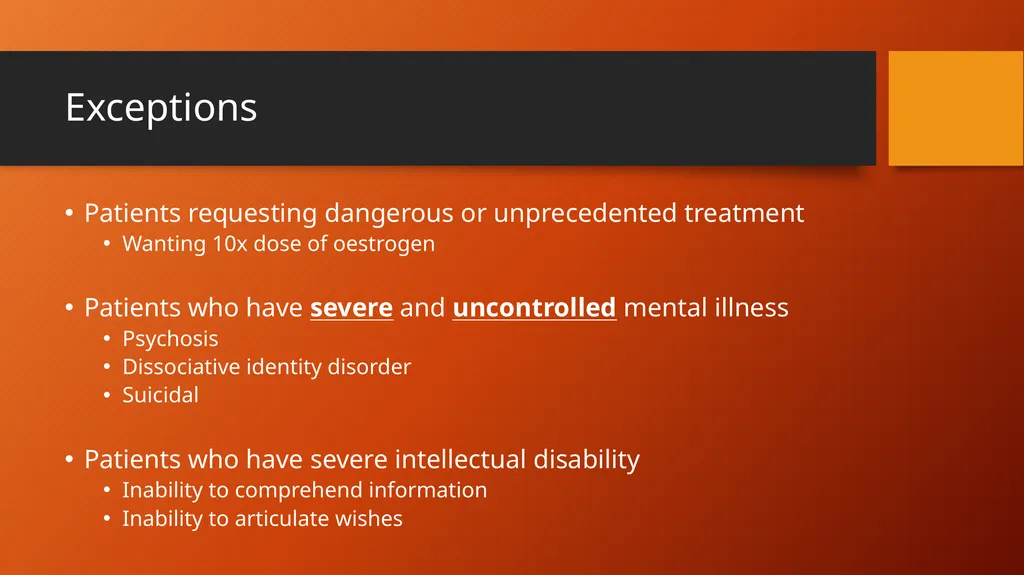
Exceptions Patients requesting dangerous or unprecedented treatment
Wanting 10x dose of oestrogen
Patients who have severe and uncontrolled mental illness
Psychosis
Dissociative identity disorder
Suicidal
Patients who have severe intellectual disability
Inability to comprehend information
Inability to articulate wishes<br>
Wanting 10x dose of oestrogen
Patients who have severe and uncontrolled mental illness
Psychosis
Dissociative identity disorder
Suicidal
Patients who have severe intellectual disability
Inability to comprehend information
Inability to articulate wishes<br>
55
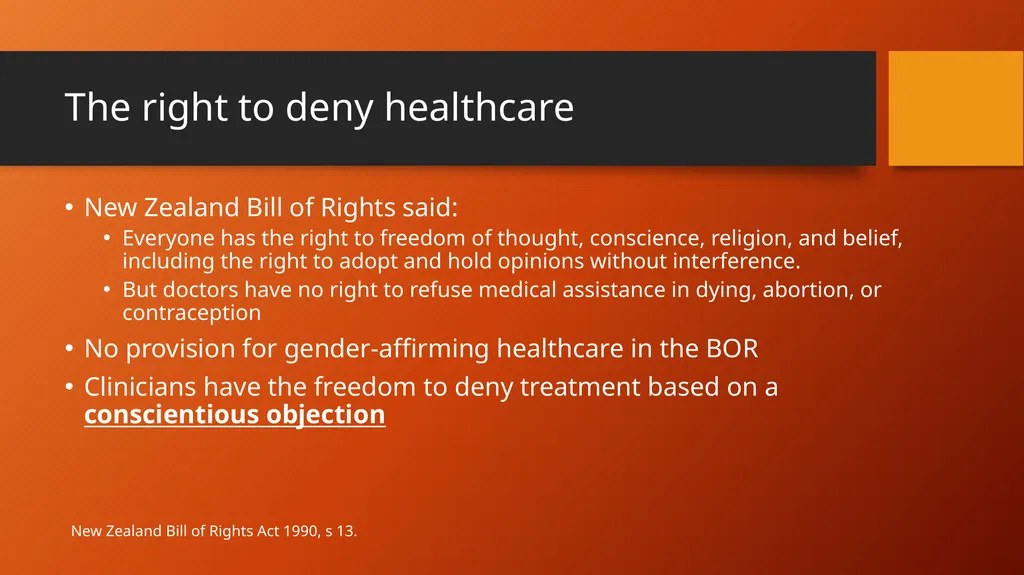
The right to deny healthcare New Zealand Bill of Rights said:
Everyone has the right to freedom of thought, conscience, religion, and belief, including the right to adopt and hold opinions without interference.
But doctors have no right to refuse medical assistance in dying, abortion, or contraception
No provision for gender-affirming healthcare in the BOR
Clinicians have the freedom to deny treatment based on a conscientious objection New Zealand Bill of Rights Act 1990, s 13.<br>
Everyone has the right to freedom of thought, conscience, religion, and belief, including the right to adopt and hold opinions without interference.
But doctors have no right to refuse medical assistance in dying, abortion, or contraception
No provision for gender-affirming healthcare in the BOR
Clinicians have the freedom to deny treatment based on a conscientious objection New Zealand Bill of Rights Act 1990, s 13.<br>
56
In summary Brief introduction to the clinical presentation of gender dysphoria with its variations and nuances.
Potential biological underpinnings, psychological aspects, and sociological considerations of GD.
The risks associated with medical and social transitioning.<br>
Potential biological underpinnings, psychological aspects, and sociological considerations of GD.
The risks associated with medical and social transitioning.<br>
57
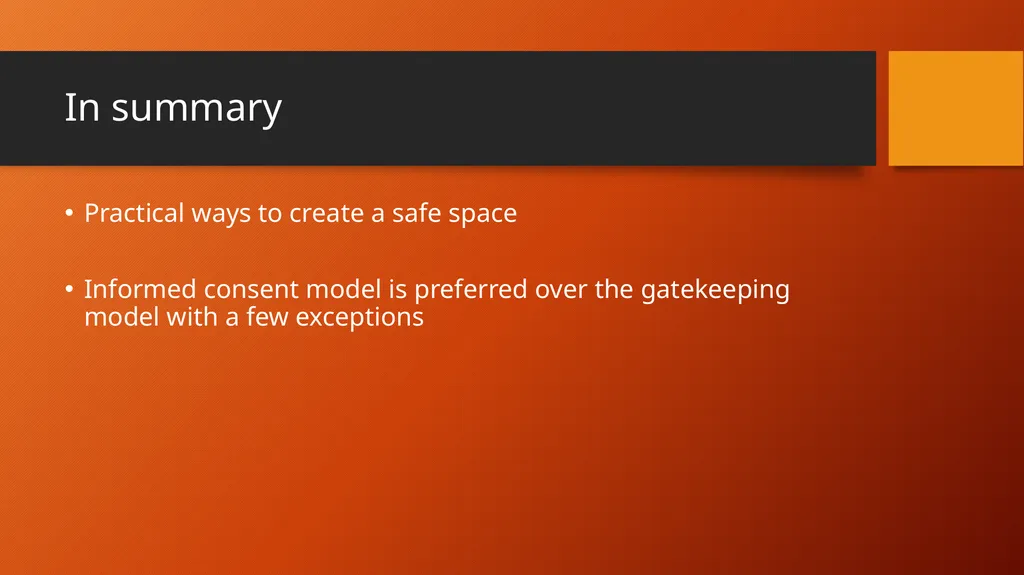
In summary Practical ways to create a safe space
Informed consent model is preferred over the gatekeeping model with a few exceptions<br>
Informed consent model is preferred over the gatekeeping model with a few exceptions<br>