
Transition metals organometallic compounds 1
FD
Published · 25 slides · 0 views

1 / 1




Description
Transition metals organometallic compounds 1 Transition metals organometallic compounds Transition metal σbonded organometallic compounds like the metal alkyls, aryls and the hydrides derivatives are by far the most common organometallic
Related Topics
Share
Embed code
Download this presentation From Below
"Transition metals organometallic compounds 1" is the property of its rightful owner. Permission is granted to download and print the materials on this website for personal, non-commercial use only, and to display it on your personal computer provided you do not modify the materials and that you retain all copyright notices contained in the materials. By downloading content from our website, you accept the terms of this agreement.
Presentation Transcript
01
Transition metals organometallic compounds 1<br>
02
Transition metals organometallic compounds
Transition metal σ−bonded organometallic compounds like the metal alkyls, aryls and the hydrides derivatives are by far the most common organometallic species encountered in the world of chemistry.
Ligands play a vital role in stabilizing transition metal complexes. The stability as well as the reactivity of a metal in its complex form thus depend upon the number and the type of ligands it is bound to.
In this regard, the organometallic carbon based ligands come in diverse varieties displaying a wide range of binding modes to a metal. In general, the binding modes of the carbon-derived ligands depend upon the hybridization state of the metal bound carbon atom.
These ligands can thus bind to a metal in many different ways as depicted below 2<br>
Transition metal σ−bonded organometallic compounds like the metal alkyls, aryls and the hydrides derivatives are by far the most common organometallic species encountered in the world of chemistry.
Ligands play a vital role in stabilizing transition metal complexes. The stability as well as the reactivity of a metal in its complex form thus depend upon the number and the type of ligands it is bound to.
In this regard, the organometallic carbon based ligands come in diverse varieties displaying a wide range of binding modes to a metal. In general, the binding modes of the carbon-derived ligands depend upon the hybridization state of the metal bound carbon atom.
These ligands can thus bind to a metal in many different ways as depicted below 2<br>
03
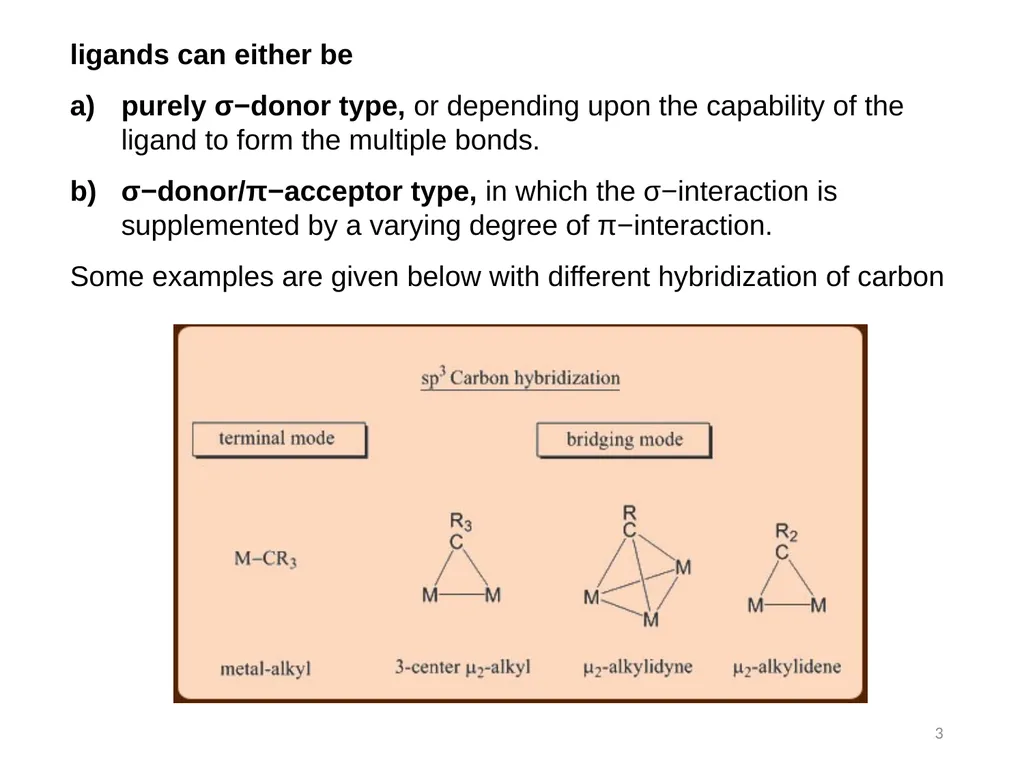
ligands can either be
purely σ−donor type, or depending upon the capability of the ligand to form the multiple bonds.
σ−donor/π−acceptor type, in which the σ−interaction is supplemented by a varying degree of π−interaction.
Some examples are given below with different hybridization of carbon 3<br>
purely σ−donor type, or depending upon the capability of the ligand to form the multiple bonds.
σ−donor/π−acceptor type, in which the σ−interaction is supplemented by a varying degree of π−interaction.
Some examples are given below with different hybridization of carbon 3<br>
04
4<br>
05
5<br>
06
Preparation of transition metal-alkyl
and transition metal-aryl complexes
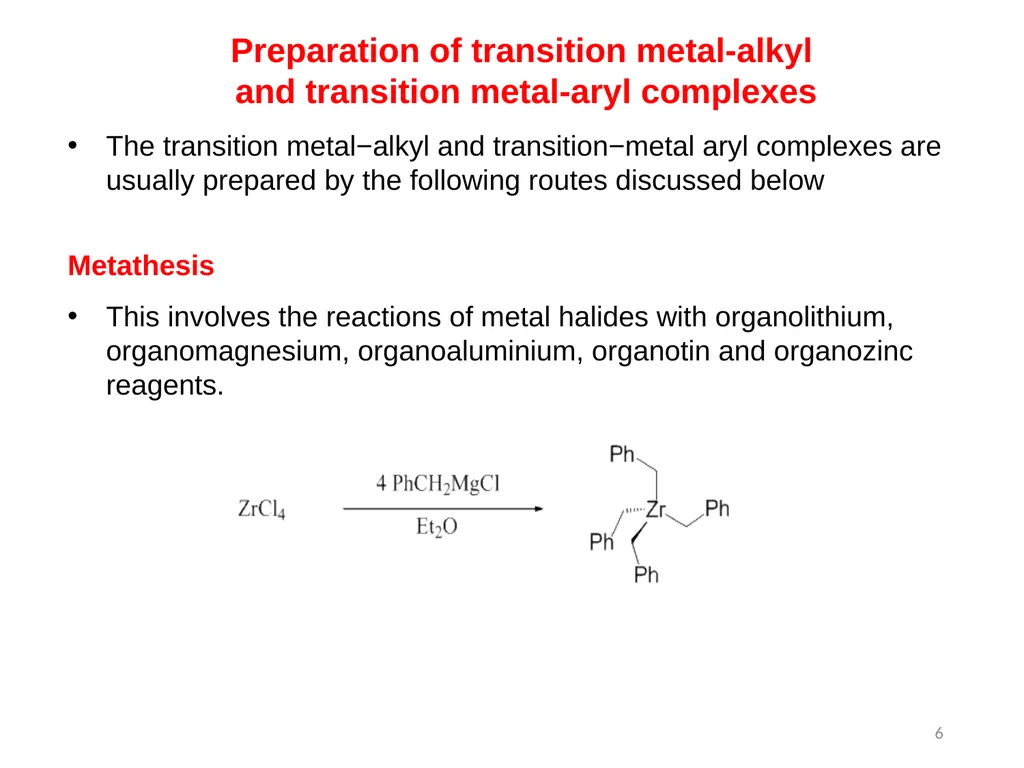
The transition metal−alkyl and transition−metal aryl complexes are usually prepared by the following routes discussed below
Metathesis
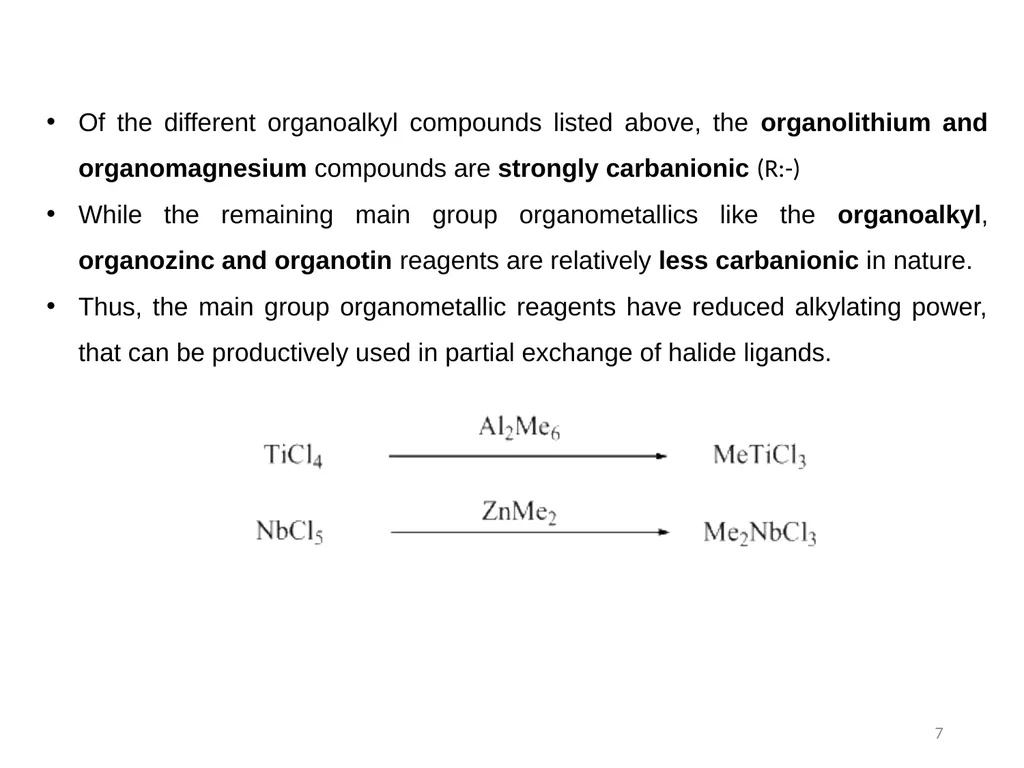
This involves the reactions of metal halides with organolithium, organomagnesium, organoaluminium, organotin and organozinc reagents. 6<br>
The transition metal−alkyl and transition−metal aryl complexes are usually prepared by the following routes discussed below
Metathesis
This involves the reactions of metal halides with organolithium, organomagnesium, organoaluminium, organotin and organozinc reagents. 6<br>
07
Of the different organoalkyl compounds listed above, the organolithium and organomagnesium compounds are strongly carbanionic (R:-)
While the remaining main group organometallics like the organoalkyl, organozinc and organotin reagents are relatively less carbanionic in nature.
Thus, the main group organometallic reagents have reduced alkylating power, that can be productively used in partial exchange of halide ligands. 7<br>
While the remaining main group organometallics like the organoalkyl, organozinc and organotin reagents are relatively less carbanionic in nature.
Thus, the main group organometallic reagents have reduced alkylating power, that can be productively used in partial exchange of halide ligands. 7<br>
08
Alkene insertion or Hydrometallation
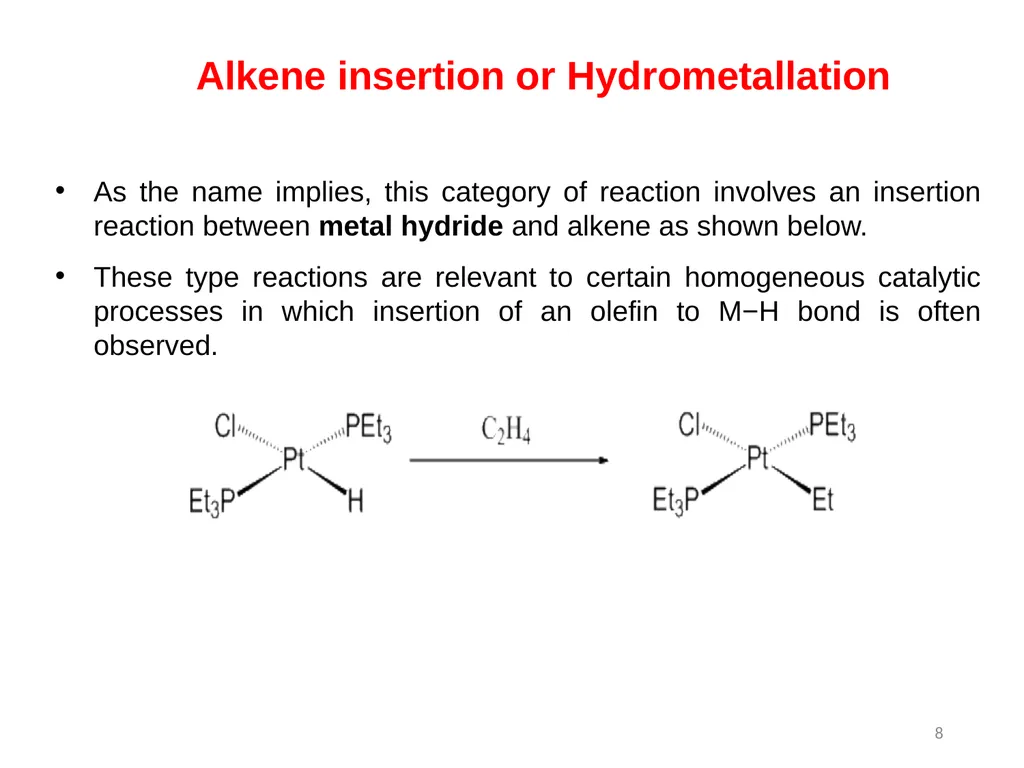
As the name implies, this category of reaction involves an insertion reaction between metal hydride and alkene as shown below.
These type reactions are relevant to certain homogeneous catalytic processes in which insertion of an olefin to M−H bond is often observed. 8<br>
As the name implies, this category of reaction involves an insertion reaction between metal hydride and alkene as shown below.
These type reactions are relevant to certain homogeneous catalytic processes in which insertion of an olefin to M−H bond is often observed. 8<br>
09
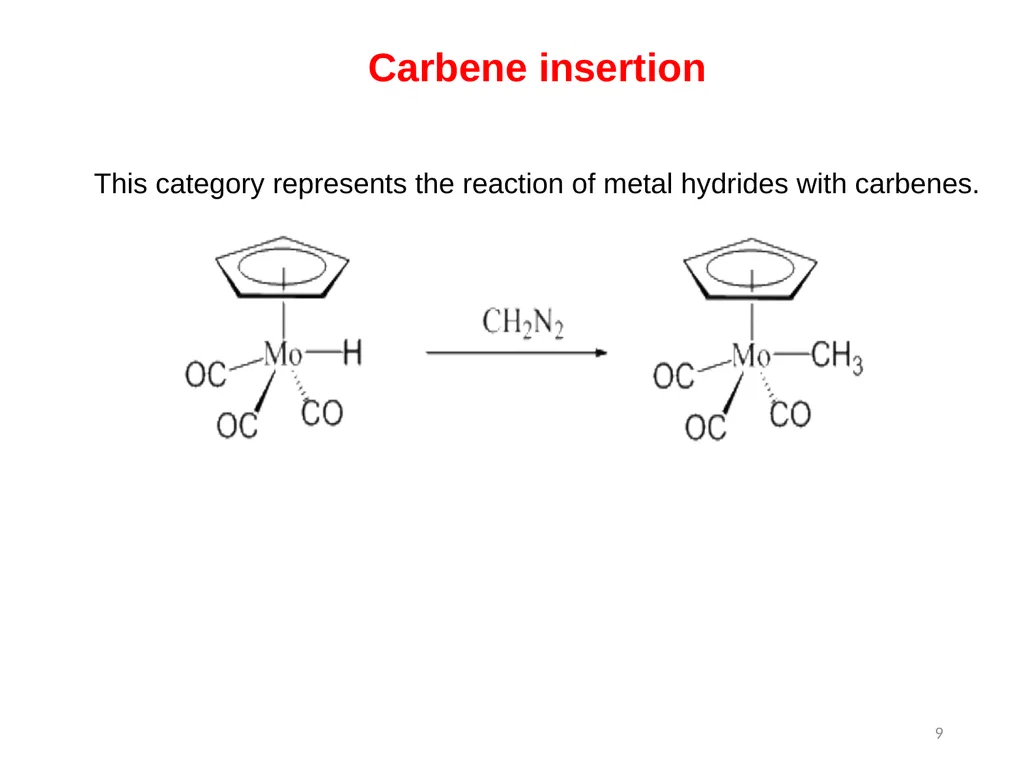
Carbene insertion
This category represents the reaction of metal hydrides with carbenes. 9<br>
This category represents the reaction of metal hydrides with carbenes. 9<br>
10
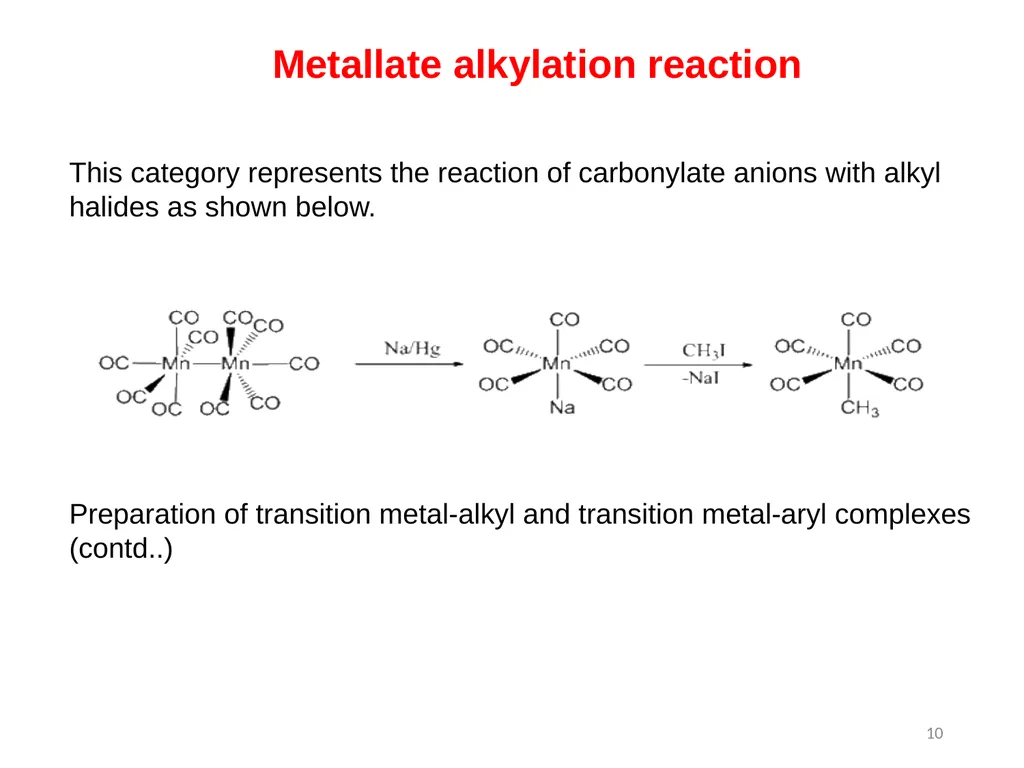
Metallate alkylation reaction
This category represents the reaction of carbonylate anions with alkyl halides as shown below.
Preparation of transition metal-alkyl and transition metal-aryl complexes (contd..) 10<br>
This category represents the reaction of carbonylate anions with alkyl halides as shown below.
Preparation of transition metal-alkyl and transition metal-aryl complexes (contd..) 10<br>
11
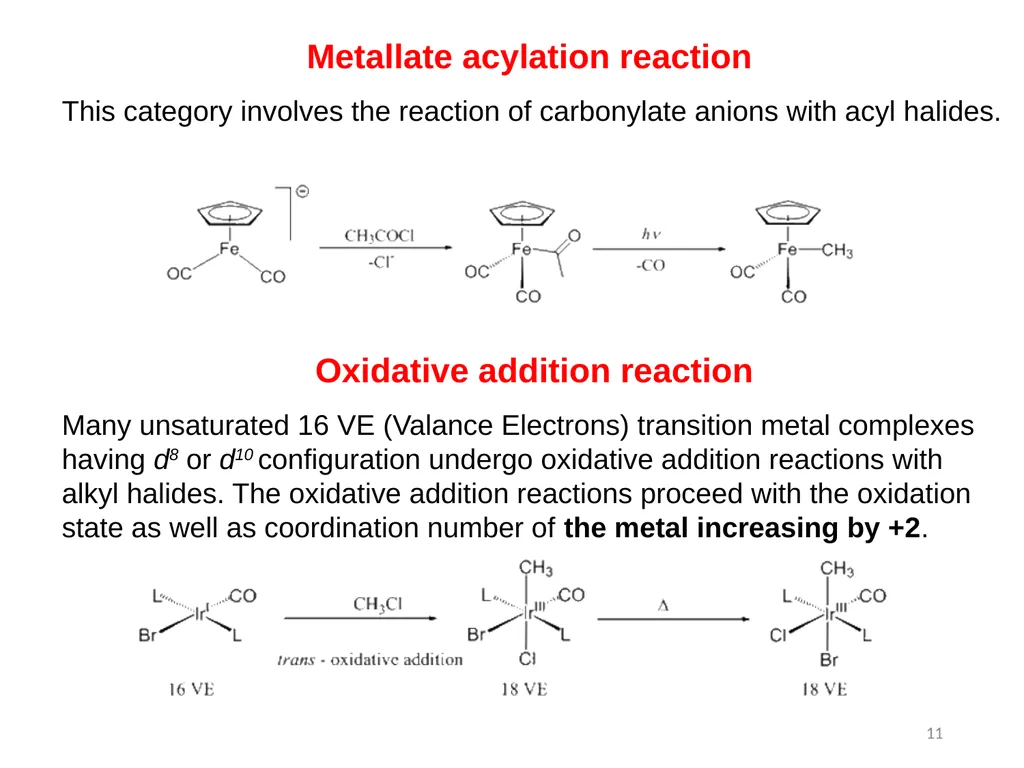
Metallate acylation reaction
This category involves the reaction of carbonylate anions with acyl halides.
Oxidative addition reaction
Many unsaturated 16 VE (Valance Electrons) transition metal complexes having d8 or d10 configuration undergo oxidative addition reactions with alkyl halides. The oxidative addition reactions proceed with the oxidation state as well as coordination number of the metal increasing by +2. 11<br>
This category involves the reaction of carbonylate anions with acyl halides.
Oxidative addition reaction
Many unsaturated 16 VE (Valance Electrons) transition metal complexes having d8 or d10 configuration undergo oxidative addition reactions with alkyl halides. The oxidative addition reactions proceed with the oxidation state as well as coordination number of the metal increasing by +2. 11<br>
12
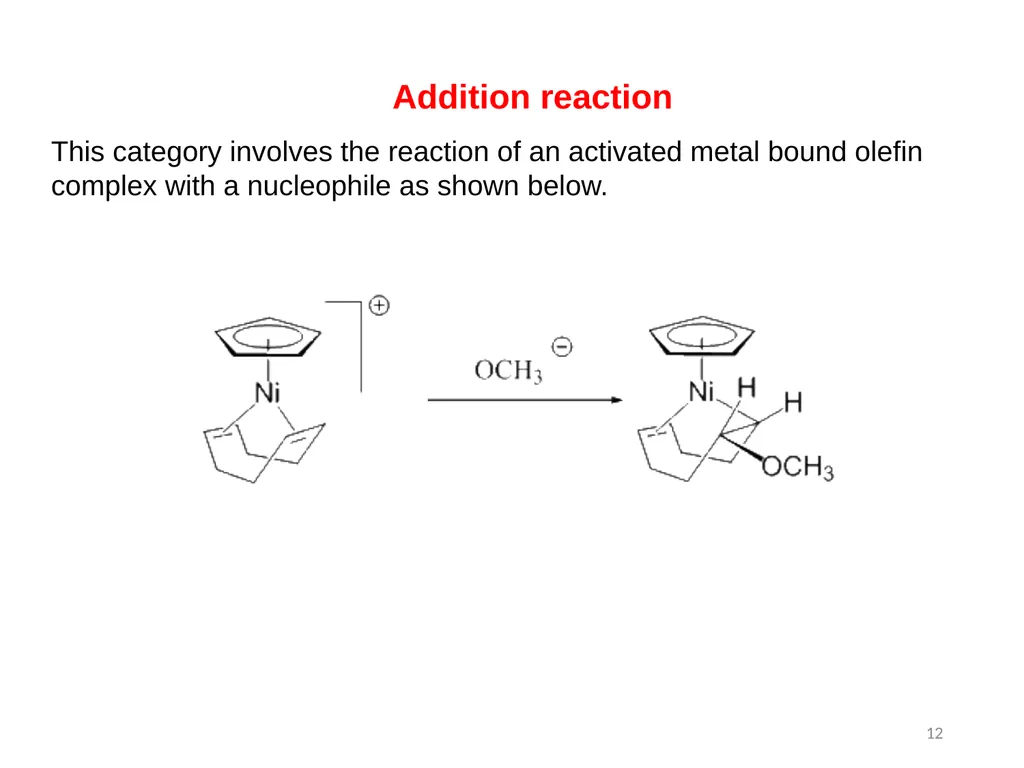
Addition reaction
This category involves the reaction of an activated metal bound olefin complex with a nucleophile as shown below. 12<br>
This category involves the reaction of an activated metal bound olefin complex with a nucleophile as shown below. 12<br>
13
Cyclopentadienyl complex
A cyclopentadienyl complex is a metal complex with one or more cyclopentadienyl groups (C5H−5, abbreviated as Cp−).
Cyclopentadienyl ligands almost invariable bind to metals as pentahapto (η5-) bonding mode. The metal–cyclopentadienyl interaction is typically drawn as a single line from the metal center to the center of the Cp ring.
Biscyclopentadienyl complexes are called metallocenes. A famous example of this type of complex is ferrocene (FeCp2), which has many analogues for other metals, such as chromocene (CrCp2), cobaltocene (CoCp2), and nickelocene (NiCp2). When the Cp rings are mutually parallel the compound is known as a sandwich complex. 13<br>
A cyclopentadienyl complex is a metal complex with one or more cyclopentadienyl groups (C5H−5, abbreviated as Cp−).
Cyclopentadienyl ligands almost invariable bind to metals as pentahapto (η5-) bonding mode. The metal–cyclopentadienyl interaction is typically drawn as a single line from the metal center to the center of the Cp ring.
Biscyclopentadienyl complexes are called metallocenes. A famous example of this type of complex is ferrocene (FeCp2), which has many analogues for other metals, such as chromocene (CrCp2), cobaltocene (CoCp2), and nickelocene (NiCp2). When the Cp rings are mutually parallel the compound is known as a sandwich complex. 13<br>
14
Ferrocene
Ferrocene is an organometallic compound with the formula Fe(C5H5)2. The molecule consists of two cyclopentadienyl rings bound on opposite sides of a central iron atom.
It is a orange solid with a camphor-like odor, that sublimes above room temperature, and is soluble in most organic solvents. It is remarkable for its stability:
it is unaffected by air, water, strong bases, and can be heated to 400 °C without decomposition.
In oxidizing conditions it can reversibly react with strong acids to form the ferrocenium cation Fe(C5H5)2+. 14<br>
Ferrocene is an organometallic compound with the formula Fe(C5H5)2. The molecule consists of two cyclopentadienyl rings bound on opposite sides of a central iron atom.
It is a orange solid with a camphor-like odor, that sublimes above room temperature, and is soluble in most organic solvents. It is remarkable for its stability:
it is unaffected by air, water, strong bases, and can be heated to 400 °C without decomposition.
In oxidizing conditions it can reversibly react with strong acids to form the ferrocenium cation Fe(C5H5)2+. 14<br>
15
Pauson and Kealy synthesized ferrocene using iron(III) chloride and a Grignard reagent and cyclopentadienyl magnesium bromide. Iron(III) chloride is suspended in anhydrous diethyl ether and added to the Grignard reagent.
A redox reaction occurs, forming the cyclopentadienyl radical and iron(II) ions. Dihydrofulvalene is produced by radical-radical recombination while the iron(II) reacts with the Grignard reagent to form ferrocene. 15<br>
A redox reaction occurs, forming the cyclopentadienyl radical and iron(II) ions. Dihydrofulvalene is produced by radical-radical recombination while the iron(II) reacts with the Grignard reagent to form ferrocene. 15<br>
16
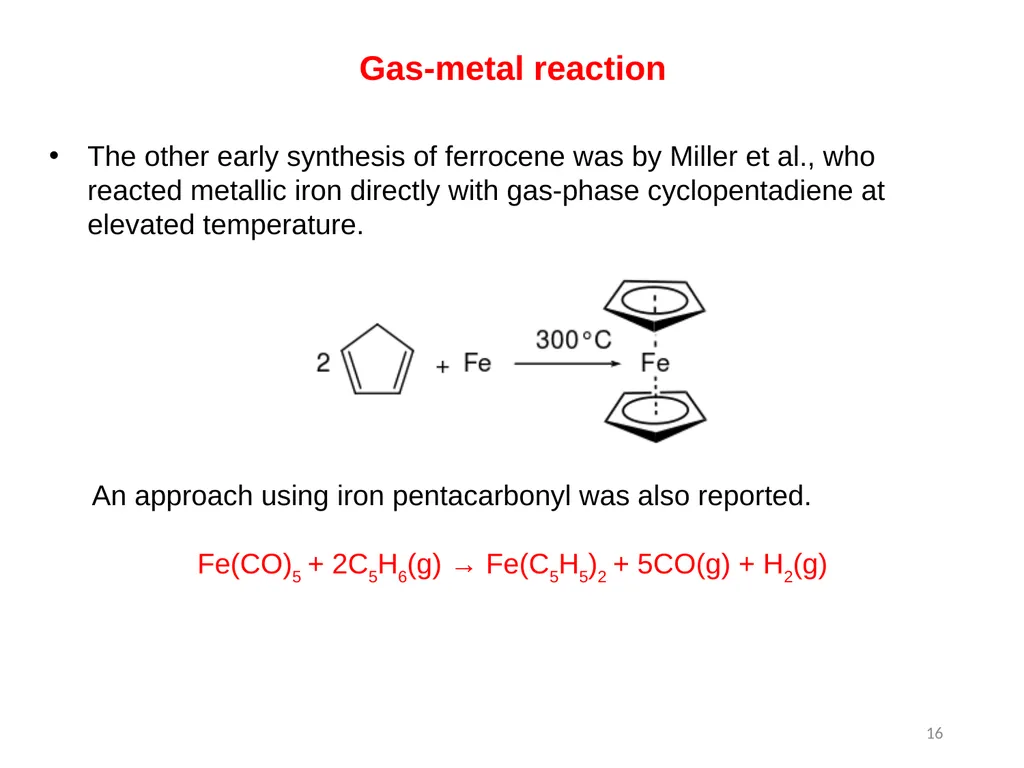
Gas-metal reaction An approach using iron pentacarbonyl was also reported.
Fe(CO)5 + 2C5H6(g) → Fe(C5H5)2 + 5CO(g) + H2(g) 16 The other early synthesis of ferrocene was by Miller et al., who reacted metallic iron directly with gas-phase cyclopentadiene at elevated temperature.<br>
Fe(CO)5 + 2C5H6(g) → Fe(C5H5)2 + 5CO(g) + H2(g) 16 The other early synthesis of ferrocene was by Miller et al., who reacted metallic iron directly with gas-phase cyclopentadiene at elevated temperature.<br>
17
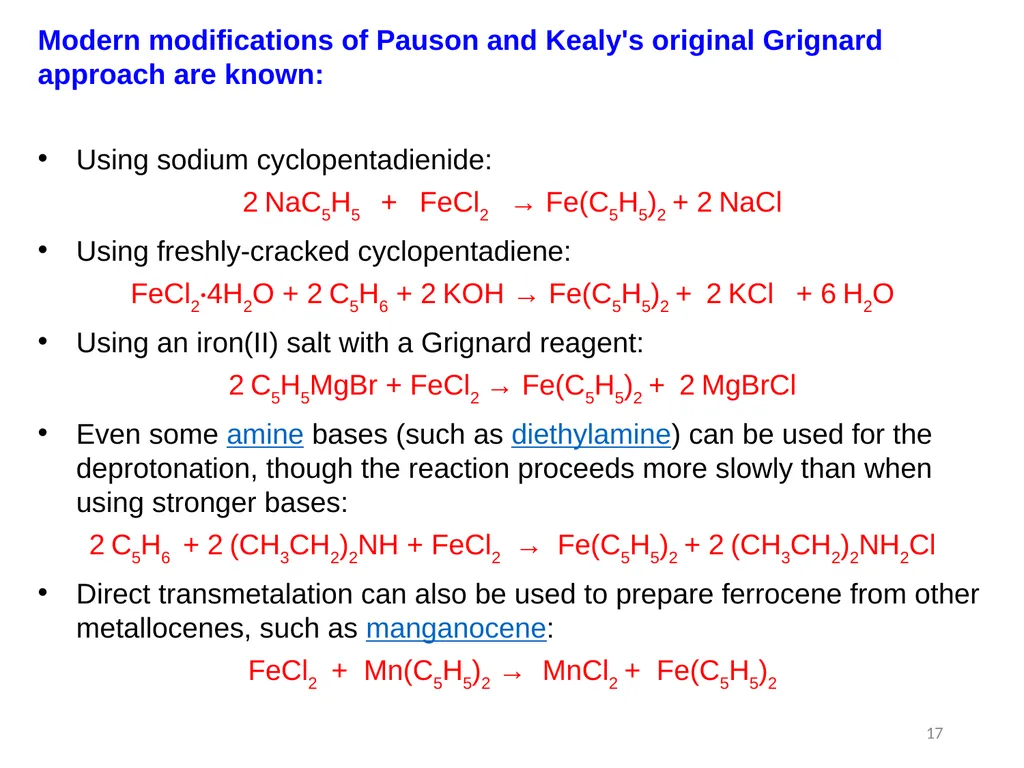
Modern modifications of Pauson and Kealy's original Grignard approach are known:
Using sodium cyclopentadienide:
2 NaC5H5 + FeCl2 → Fe(C5H5)2 + 2 NaCl
Using freshly-cracked cyclopentadiene:
FeCl2·4H2O + 2 C5H6 + 2 KOH → Fe(C5H5)2 + 2 KCl + 6 H2O
Using an iron(II) salt with a Grignard reagent:
2 C5H5MgBr + FeCl2 → Fe(C5H5)2 + 2 MgBrCl
Even some amine bases (such as diethylamine) can be used for the deprotonation, though the reaction proceeds more slowly than when using stronger bases:
2 C5H6 + 2 (CH3CH2)2NH + FeCl2 → Fe(C5H5)2 + 2 (CH3CH2)2NH2Cl
Direct transmetalation can also be used to prepare ferrocene from other metallocenes, such as manganocene:
FeCl2 + Mn(C5H5)2 → MnCl2 + Fe(C5H5)2 17<br>
Using sodium cyclopentadienide:
2 NaC5H5 + FeCl2 → Fe(C5H5)2 + 2 NaCl
Using freshly-cracked cyclopentadiene:
FeCl2·4H2O + 2 C5H6 + 2 KOH → Fe(C5H5)2 + 2 KCl + 6 H2O
Using an iron(II) salt with a Grignard reagent:
2 C5H5MgBr + FeCl2 → Fe(C5H5)2 + 2 MgBrCl
Even some amine bases (such as diethylamine) can be used for the deprotonation, though the reaction proceeds more slowly than when using stronger bases:
2 C5H6 + 2 (CH3CH2)2NH + FeCl2 → Fe(C5H5)2 + 2 (CH3CH2)2NH2Cl
Direct transmetalation can also be used to prepare ferrocene from other metallocenes, such as manganocene:
FeCl2 + Mn(C5H5)2 → MnCl2 + Fe(C5H5)2 17<br>
18
Reactions With electrophiles
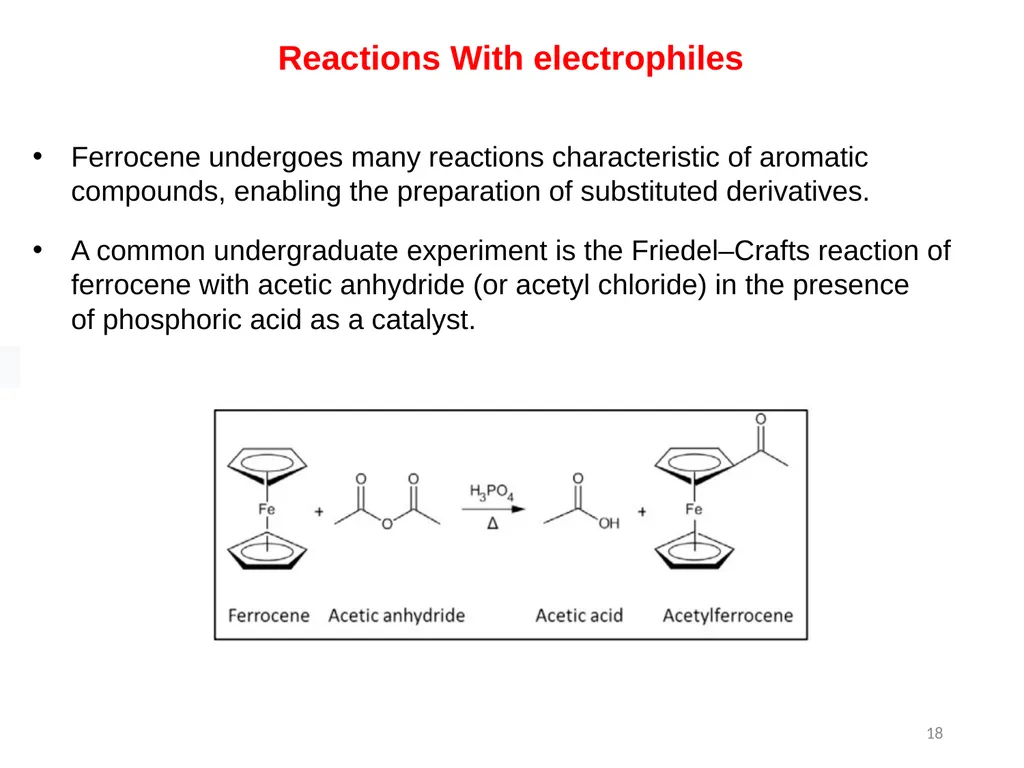
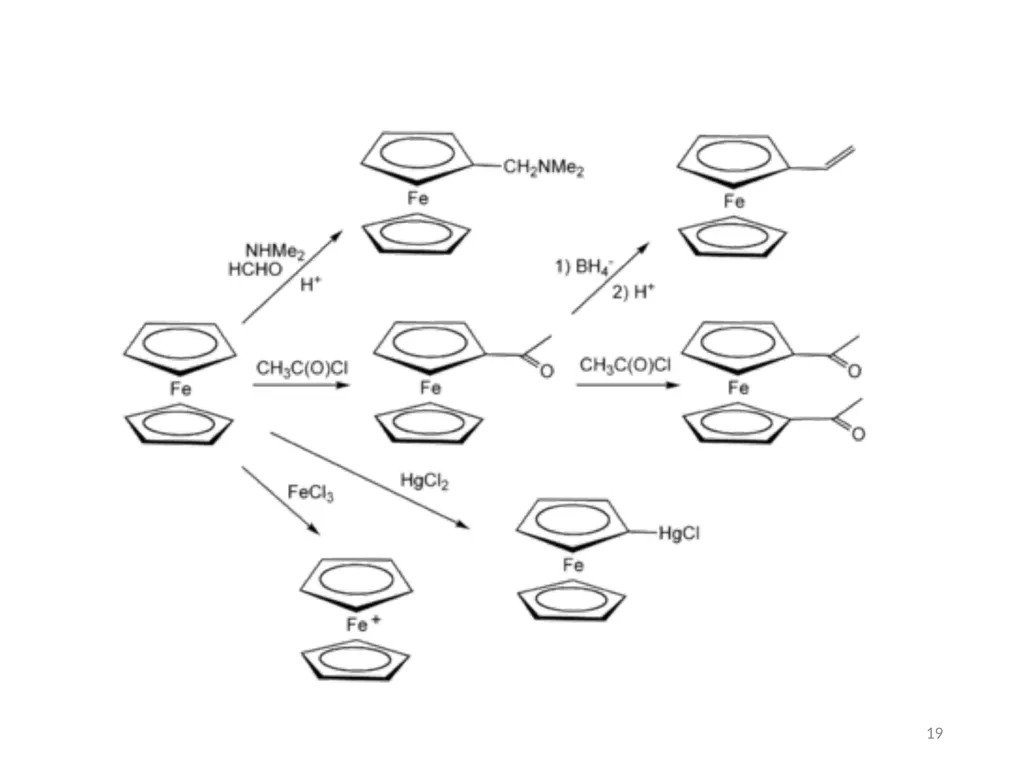
Ferrocene undergoes many reactions characteristic of aromatic compounds, enabling the preparation of substituted derivatives.
A common undergraduate experiment is the Friedel–Crafts reaction of ferrocene with acetic anhydride (or acetyl chloride) in the presence of phosphoric acid as a catalyst. 18<br>
Ferrocene undergoes many reactions characteristic of aromatic compounds, enabling the preparation of substituted derivatives.
A common undergraduate experiment is the Friedel–Crafts reaction of ferrocene with acetic anhydride (or acetyl chloride) in the presence of phosphoric acid as a catalyst. 18<br>
19
19<br>
20
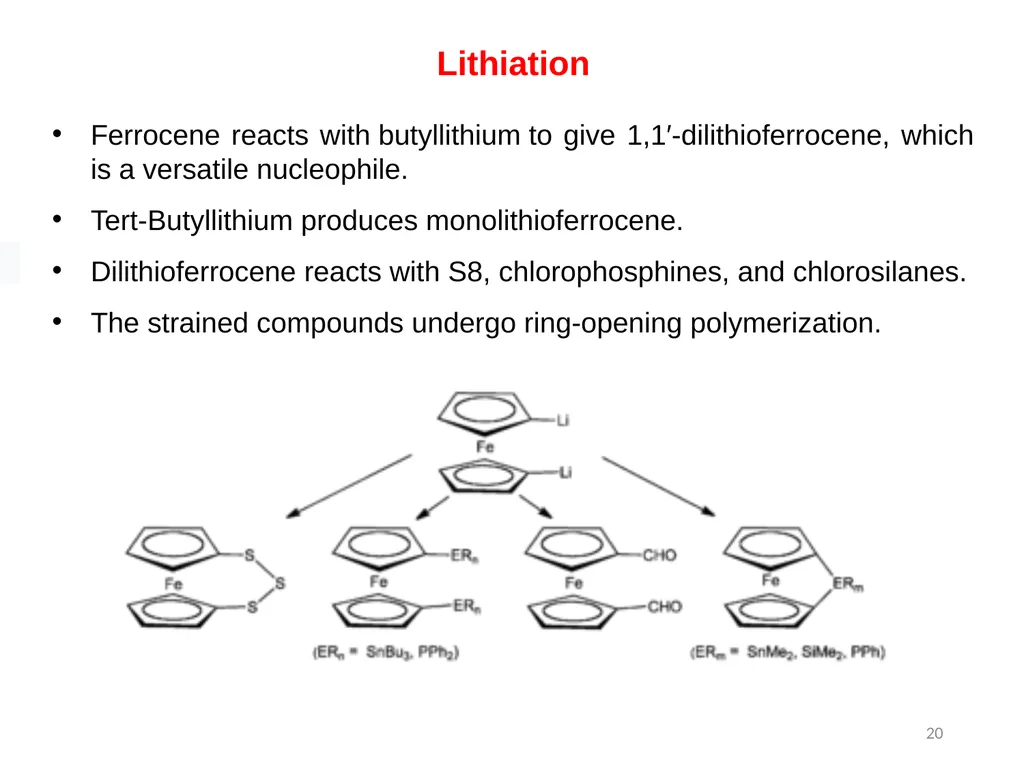
Lithiation
Ferrocene reacts with butyllithium to give 1,1′-dilithioferrocene, which is a versatile nucleophile.
Tert-Butyllithium produces monolithioferrocene.
Dilithioferrocene reacts with S8, chlorophosphines, and chlorosilanes.
The strained compounds undergo ring-opening polymerization. 20<br>
Ferrocene reacts with butyllithium to give 1,1′-dilithioferrocene, which is a versatile nucleophile.
Tert-Butyllithium produces monolithioferrocene.
Dilithioferrocene reacts with S8, chlorophosphines, and chlorosilanes.
The strained compounds undergo ring-opening polymerization. 20<br>
21
Chromocene
Chromocene, formally known as bis(η5- cyclopentadienyl)chromium(II), is a chemical compound with the condensed structural formula [Cr(C5H5)2].
Each molecule contains an atom of chromium bound between two planar systems of five carbon atoms known as cyclopentadienyl (Cp) rings in a sandwich arrangement, which is the reason its formula is often abbreviated as Cp2Cr.
It is an organometallic compound as it has (haptic) covalent chromium–carbon bonds.
Chromocene is structurally similar to ferrocene, the prototype for the metallocene class of compounds; however, as it has only 16 valence electrons, it does not follow the 18-electron rule 21<br>
Chromocene, formally known as bis(η5- cyclopentadienyl)chromium(II), is a chemical compound with the condensed structural formula [Cr(C5H5)2].
Each molecule contains an atom of chromium bound between two planar systems of five carbon atoms known as cyclopentadienyl (Cp) rings in a sandwich arrangement, which is the reason its formula is often abbreviated as Cp2Cr.
It is an organometallic compound as it has (haptic) covalent chromium–carbon bonds.
Chromocene is structurally similar to ferrocene, the prototype for the metallocene class of compounds; however, as it has only 16 valence electrons, it does not follow the 18-electron rule 21<br>
22
Ernst Otto Fischer, who shared the 1973 Nobel Prize in Chemistry for his work on sandwich compounds, was the first to report a synthesis for chromocene. One simple method of preparation involves the reaction of chromium(II) chloride with sodium cyclopentadienide:
CrCl2 + 2 NaC5H5 → Cr(C5H5)2 + 2 NaCl
Such syntheses are typically conducted in THF; decamethylchromocene, Cr[C5(CH3)5]2, can be prepared analogously from LiC5(CH3)5.
Chromocene can also be prepared from chromium(III) chloride in a redox process:
2 CrCl3 + 6 NaC5H5 → 2 Cr(C5H5)2 + C10H10 + 6 NaCl
The chromium(0) organometallic complex chromium hexacarbonyl can be oxidised by cyclopentadiene in the presence of diethylamine to produce chromocene, the removed protons being reduced to produce hydrogen gas.
Cr(CO)6 + 2 C5H6 → Cr(C5H5)2 + 6 CO + H2 22<br>
CrCl2 + 2 NaC5H5 → Cr(C5H5)2 + 2 NaCl
Such syntheses are typically conducted in THF; decamethylchromocene, Cr[C5(CH3)5]2, can be prepared analogously from LiC5(CH3)5.
Chromocene can also be prepared from chromium(III) chloride in a redox process:
2 CrCl3 + 6 NaC5H5 → 2 Cr(C5H5)2 + C10H10 + 6 NaCl
The chromium(0) organometallic complex chromium hexacarbonyl can be oxidised by cyclopentadiene in the presence of diethylamine to produce chromocene, the removed protons being reduced to produce hydrogen gas.
Cr(CO)6 + 2 C5H6 → Cr(C5H5)2 + 6 CO + H2 22<br>
23
Cobaltocene
Cobaltocene, known also as bis(cyclopentadienyl)cobalt(II) or even "bis Cp cobalt", is an organocobalt compound with the formula Co(C5H5)2.
It is a darkpurple solid that sublimes readily slightly above room temperature. Cobaltocene was discovered shortly after ferrocene, the first metallocene.
Due to the ease with which it reacts with oxygen, the compound must be handled and stored using air-free techniques.
Cobaltocene is prepared by the reaction of sodium cyclopentadienide (NaC5H5) with anhydrous cobalt(II) chloride in THF solution. Sodium chloride is cogenerated, and the organometallic product is usually purified by vacuum sublimation. 23<br>
Cobaltocene, known also as bis(cyclopentadienyl)cobalt(II) or even "bis Cp cobalt", is an organocobalt compound with the formula Co(C5H5)2.
It is a darkpurple solid that sublimes readily slightly above room temperature. Cobaltocene was discovered shortly after ferrocene, the first metallocene.
Due to the ease with which it reacts with oxygen, the compound must be handled and stored using air-free techniques.
Cobaltocene is prepared by the reaction of sodium cyclopentadienide (NaC5H5) with anhydrous cobalt(II) chloride in THF solution. Sodium chloride is cogenerated, and the organometallic product is usually purified by vacuum sublimation. 23<br>
24
Nickelocene
Nickelocene is the organonickel compound with the formula Ni(η5-C5H5)2.
Also known as bis(cyclopentadienyl)nickel or NiCp2, this bright green paramagnetic solid is of enduring academic interest, although it does not yet have any known practical applications.
Preparation Nickelocene was first prepared by E. O. Fischer in 1953, shortly after the discovery of ferrocene, the first metallocene compound.
It has been prepared in a one-pot reaction, by deprotonating cyclopentadiene with ethylmagnesium bromide, and adding anhydrous nickel(II) acetylacetonate.
A modern synthesis entails treatment of anhydrous sources of NiCl2 (such as hexaamminenickel chloride) with sodium cyclopentadienyl:
[Ni(NH3)6]Cl2 + 2 NaC5H5 → Ni(C5H5)2 + 2 NaCl + 6 NH3 24<br>
Nickelocene is the organonickel compound with the formula Ni(η5-C5H5)2.
Also known as bis(cyclopentadienyl)nickel or NiCp2, this bright green paramagnetic solid is of enduring academic interest, although it does not yet have any known practical applications.
Preparation Nickelocene was first prepared by E. O. Fischer in 1953, shortly after the discovery of ferrocene, the first metallocene compound.
It has been prepared in a one-pot reaction, by deprotonating cyclopentadiene with ethylmagnesium bromide, and adding anhydrous nickel(II) acetylacetonate.
A modern synthesis entails treatment of anhydrous sources of NiCl2 (such as hexaamminenickel chloride) with sodium cyclopentadienyl:
[Ni(NH3)6]Cl2 + 2 NaC5H5 → Ni(C5H5)2 + 2 NaCl + 6 NH3 24<br>
25
Half sandwich compounds
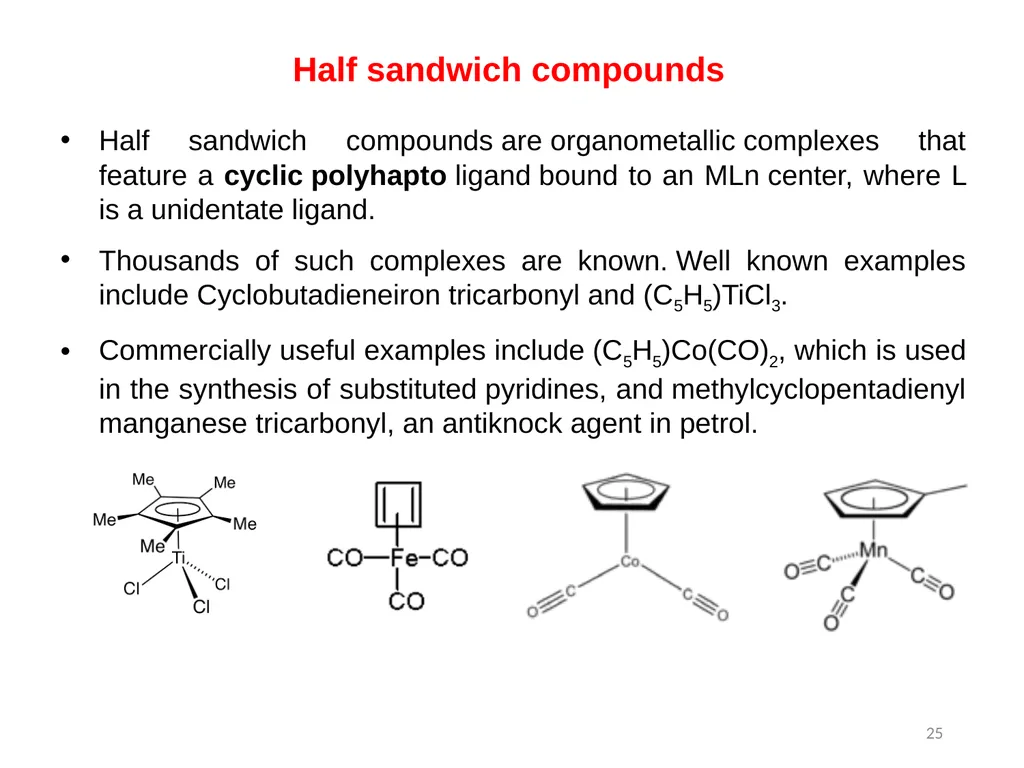
Half sandwich compounds are organometallic complexes that feature a cyclic polyhapto ligand bound to an MLn center, where L is a unidentate ligand.
Thousands of such complexes are known. Well known examples include Cyclobutadieneiron tricarbonyl and (C5H5)TiCl3.
Commercially useful examples include (C5H5)Co(CO)2, which is used in the synthesis of substituted pyridines, and methylcyclopentadienyl manganese tricarbonyl, an antiknock agent in petrol. 25<br>
Half sandwich compounds are organometallic complexes that feature a cyclic polyhapto ligand bound to an MLn center, where L is a unidentate ligand.
Thousands of such complexes are known. Well known examples include Cyclobutadieneiron tricarbonyl and (C5H5)TiCl3.
Commercially useful examples include (C5H5)Co(CO)2, which is used in the synthesis of substituted pyridines, and methylcyclopentadienyl manganese tricarbonyl, an antiknock agent in petrol. 25<br>