
Transport Operations CHAPTER 47 Introduction
FD
Published · 63 slides · 0 views
1 / 1

Description
Transport Operations CHAPTER 47 Introduction Todays emergency vehicles are equipped with state-of-the-art technology. Driving an emergency vehicle is a tremendous responsibility. Emergency Vehicle Design (1 of 4) Current specifications for
Related Topics
Share
Embed code
Download this presentation From Below
"Transport Operations CHAPTER 47 Introduction" is the property of its rightful owner. Permission is granted to download and print the materials on this website for personal, non-commercial use only, and to display it on your personal computer provided you do not modify the materials and that you retain all copyright notices contained in the materials. By downloading content from our website, you accept the terms of this agreement.
Presentation Transcript
01
Transport Operations CHAPTER 47<br>
02
Introduction Today’s emergency vehicles are equipped with state-of-the-art technology.
Driving an emergency vehicle is a tremendous responsibility.<br>
Driving an emergency vehicle is a tremendous responsibility.<br>
03
Emergency Vehicle Design (1 of 4) Current specifications for emergency medical transport vehicles were originally developed in the early 1970s.
Design and manufacturing guidelines were reviewed and updated every 5 years.
Outlined by the DOT KKK 1822<br>
Design and manufacturing guidelines were reviewed and updated every 5 years.
Outlined by the DOT KKK 1822<br>
04
Emergency Vehicle Design (2 of 4) Two specifications are being considered as replacements for the GSA KKK 1822 guidelines:
The National Fire Prevention Agency (NFPA)
The Commission on Accreditation of Ambulance Services<br>
The National Fire Prevention Agency (NFPA)
The Commission on Accreditation of Ambulance Services<br>
05
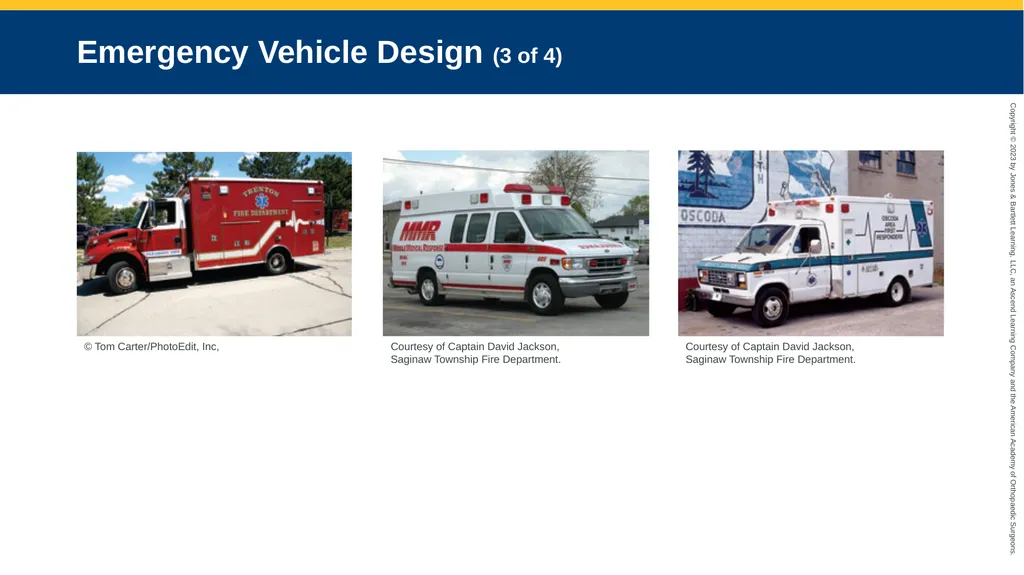
Emergency Vehicle Design (3 of 4) © Tom Carter/PhotoEdit, Inc, Courtesy of Captain David Jackson, Saginaw Township Fire Department. Courtesy of Captain David Jackson, Saginaw Township Fire Department.<br>
06
Emergency Vehicle Design (4 of 4) Specialized transport vehicles
Mobile stroke units
Pediatric mobile intensive units
Reduce the time between symptom onset and advanced care<br>
Mobile stroke units
Pediatric mobile intensive units
Reduce the time between symptom onset and advanced care<br>
07
Emergency Vehicle Equipment Every inch of space on an emergency vehicle stores and secures equipment.
Organizations influence the list of supplies and equipment that should be carried.
OSHA
ACS<br>
Organizations influence the list of supplies and equipment that should be carried.
OSHA
ACS<br>
08
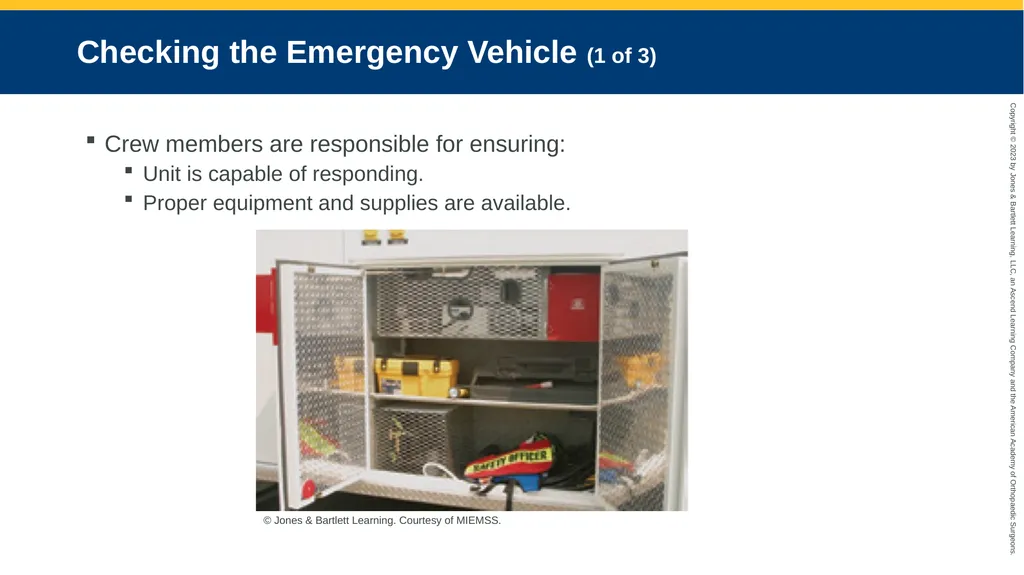
Checking the Emergency Vehicle (1 of 3) Crew members are responsible for ensuring:
Unit is capable of responding.
Proper equipment and supplies are available. © Jones & Bartlett Learning. Courtesy of MIEMSS.<br>
Unit is capable of responding.
Proper equipment and supplies are available. © Jones & Bartlett Learning. Courtesy of MIEMSS.<br>
09
Checking the Emergency Vehicle (2 of 3) Any threat to one of the “four Ss” should put the vehicle out of service:
Start
Steer
Stop
Stay running<br>
Start
Steer
Stop
Stay running<br>
10
Checking the Emergency Vehicle (3 of 3) Warning signs
Belt noise
Break fade
Brake pull
Drift
Steering pull Pulsating brake
Steering play
Tire squeal
Wheel bounce
Wheel wobble<br>
Belt noise
Break fade
Brake pull
Drift
Steering pull Pulsating brake
Steering play
Tire squeal
Wheel bounce
Wheel wobble<br>
11
Emergency Vehicle Staffing and Development Maximize productivity and minimize response times by analyzing:
Response times
Productivity
Unit costs
Taxpayer subsidies<br>
Response times
Productivity
Unit costs
Taxpayer subsidies<br>
12
Emergency Vehicle and EMS Systems In US, most first-response EMS are delivered by the fire department.
Other models include:
Public agency (not part of fire department)
Public-private partnerships
Private, for-profit agencies
Nonprofit corporation<br>
Other models include:
Public agency (not part of fire department)
Public-private partnerships
Private, for-profit agencies
Nonprofit corporation<br>
13
System Status Management (SSM) Goals:
Maximize efficiency
Reduce response time
Considerations:
Peak loads
Strategic deployment<br>
Maximize efficiency
Reduce response time
Considerations:
Peak loads
Strategic deployment<br>
14
Emergency Vehicle Stationing Goals:
Maximize efficiency
Reduce response times Factors include:
Distance vs call volume
Special facilities
Need for maintenance
Storage
Disinfection facilities
Classrooms
Sleeping quarters<br>
Maximize efficiency
Reduce response times Factors include:
Distance vs call volume
Special facilities
Need for maintenance
Storage
Disinfection facilities
Classrooms
Sleeping quarters<br>
15
En Route to Scene Prepare to respond.
While en route:
Prepare to assess and care for the patient.
Review dispatch information.
Assign duties and tasks.
Decide which equipment to take.
Decide which stretcher to take.<br>
While en route:
Prepare to assess and care for the patient.
Review dispatch information.
Assign duties and tasks.
Decide which equipment to take.
Decide which stretcher to take.<br>
16
Securing Equipment Make sure all equipment is secured before placing a vehicle in motion.
Poorly secured items can shift or break.
Some equipment can become lethal projectiles if not secured properly.<br>
Poorly secured items can shift or break.
Some equipment can become lethal projectiles if not secured properly.<br>
17
Arrival at the Scene (1 of 2) Perform scene size-up and report to dispatch.
Look for safety hazards.
Evaluate the need for additional units.
Determine the MOI or nature of the illness.<br>
Look for safety hazards.
Evaluate the need for additional units.
Determine the MOI or nature of the illness.<br>
18
Arrival at the Scene (2 of 2) Evaluate the need for specialized equipment or additional response vehicle.
Take standard precautions.
If you are the first at a scene with multiple patients, estimate the number of patients.<br>
Take standard precautions.
If you are the first at a scene with multiple patients, estimate the number of patients.<br>
19
Traffic Control Ensure orderly traffic flow and prevent another crash.
Place reflectors and other warning devices on both sides of crash.<br>
Place reflectors and other warning devices on both sides of crash.<br>
20
Safe Patient Transport Excessive speed is unnecessary and dangerous.
Secure the patient with shoulder straps and at least three straps across the body.<br>
Secure the patient with shoulder straps and at least three straps across the body.<br>
21
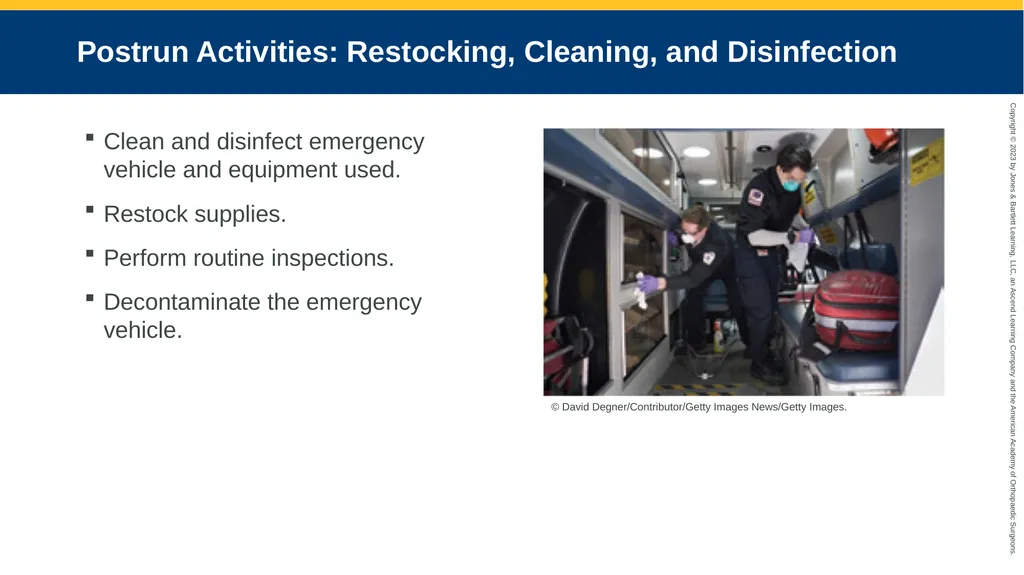
Postrun Activities: Restocking, Cleaning, and Disinfection Clean and disinfect emergency vehicle and equipment used.
Restock supplies.
Perform routine inspections.
Decontaminate the emergency vehicle. © David Degner/Contributor/Getty Images News/Getty Images.<br>
Restock supplies.
Perform routine inspections.
Decontaminate the emergency vehicle. © David Degner/Contributor/Getty Images News/Getty Images.<br>
22
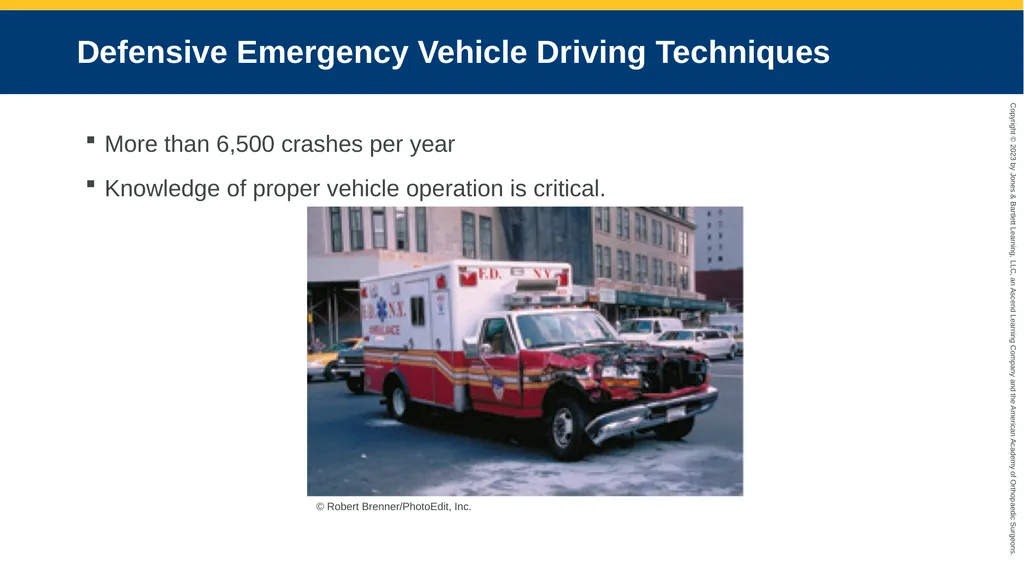
Defensive Emergency Vehicle Driving Techniques More than 6,500 crashes per year
Knowledge of proper vehicle operation is critical. © Robert Brenner/PhotoEdit, Inc.<br>
Knowledge of proper vehicle operation is critical. © Robert Brenner/PhotoEdit, Inc.<br>
23
Driver Characteristics Diligence and caution
Positive attitude about your ability
Tolerance of other drivers
Physical fitness
Emotional fitness
Proper attitude
Good judgment and knowledge<br>
Positive attitude about your ability
Tolerance of other drivers
Physical fitness
Emotional fitness
Proper attitude
Good judgment and knowledge<br>
24
Safe Driving Practices (1 of 10) Route planning and navigation
Have access to street and area maps.
Become familiar with the roads and traffic patterns in your area.<br>
Have access to street and area maps.
Become familiar with the roads and traffic patterns in your area.<br>
25
Safe Driving Practices (2 of 10) Fatigue
Place yourself out of service until fatigue has passed. Distractions
Never attempt to:
Type
Text
Operate personal data devices
Listen to music
Eat or drink<br>
Place yourself out of service until fatigue has passed. Distractions
Never attempt to:
Type
Text
Operate personal data devices
Listen to music
Eat or drink<br>
26
Safe Driving Practices (3 of 10) Use safety restraints.
Always drive with caution.
Siren risk-benefit analysis
Never use to transport a nonemergency patient.<br>
Always drive with caution.
Siren risk-benefit analysis
Never use to transport a nonemergency patient.<br>
27
Safe Driving Practices (4 of 10) Driver anticipation
All other drivers are unpredictable.
Maintain a safe travel distance behind vehicles.
Do not respond aggressively to drivers.
Do not accelerate through intersections.<br>
All other drivers are unpredictable.
Maintain a safe travel distance behind vehicles.
Do not respond aggressively to drivers.
Do not accelerate through intersections.<br>
28
Safe Driving Practices (5 of 10) Driver anticipation (cont’d)
Make eye contact with fellow drivers.
Use turn signals.
Never force a vehicle into oncoming traffic.<br>
Make eye contact with fellow drivers.
Use turn signals.
Never force a vehicle into oncoming traffic.<br>
29
Safe Driving Practices (6 of 10) Cushion of safety
Maintain a safe distance from vehicles.
Avoid being tailgated.
Be aware of blind spots.<br>
Maintain a safe distance from vehicles.
Avoid being tailgated.
Be aware of blind spots.<br>
30
Safe Driving Practices (7 of 10) Vehicle size and distance judgment
Vehicle length and width are critical when:
Maneuvering
Driving
Parking
Braking and passing<br>
Vehicle length and width are critical when:
Maneuvering
Driving
Parking
Braking and passing<br>
31
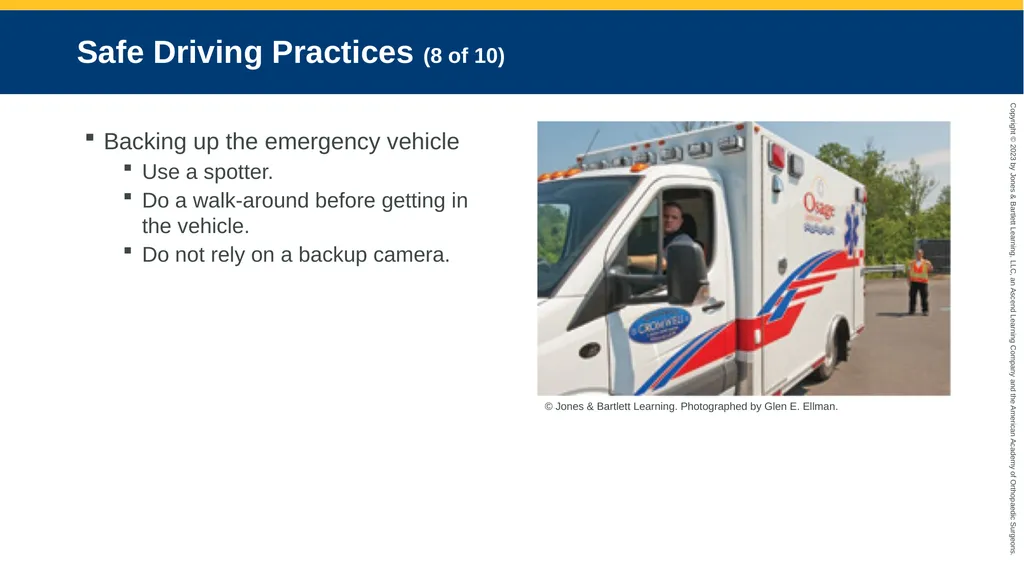
Safe Driving Practices (8 of 10) Backing up the emergency vehicle
Use a spotter.
Do a walk-around before getting in the vehicle.
Do not rely on a backup camera. © Jones & Bartlett Learning. Photographed by Glen E. Ellman.<br>
Use a spotter.
Do a walk-around before getting in the vehicle.
Do not rely on a backup camera. © Jones & Bartlett Learning. Photographed by Glen E. Ellman.<br>
32
Safe Driving Practices (9 of 10) Parking at an emergency scene
Allow for efficient traffic control and flow.
Do not block other emergency vehicles.
Park uphill or upwind.
Stay away from structures that might collapse.<br>
Allow for efficient traffic control and flow.
Do not block other emergency vehicles.
Park uphill or upwind.
Stay away from structures that might collapse.<br>
33
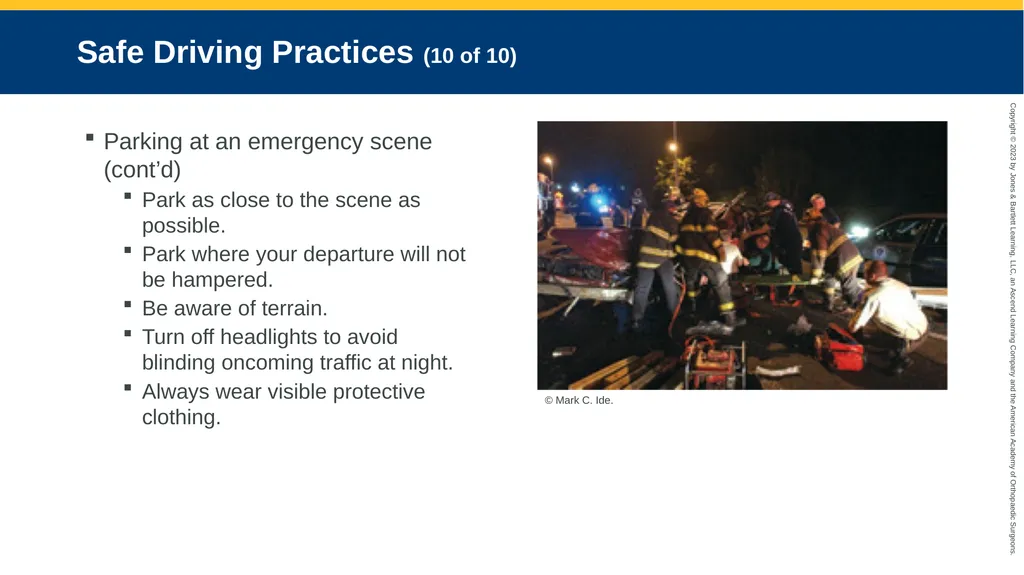
Safe Driving Practices (10 of 10) Parking at an emergency scene (cont’d)
Park as close to the scene as possible.
Park where your departure will not be hampered.
Be aware of terrain.
Turn off headlights to avoid blinding oncoming traffic at night.
Always wear visible protective clothing. © Mark C. Ide.<br>
Park as close to the scene as possible.
Park where your departure will not be hampered.
Be aware of terrain.
Turn off headlights to avoid blinding oncoming traffic at night.
Always wear visible protective clothing. © Mark C. Ide.<br>
34
Emergency Vehicle Control (1 of 2) Two ways to control a vehicle:
Changing directions
Changing speed
Drivers must constantly evaluate the road surface.<br>
Changing directions
Changing speed
Drivers must constantly evaluate the road surface.<br>
35
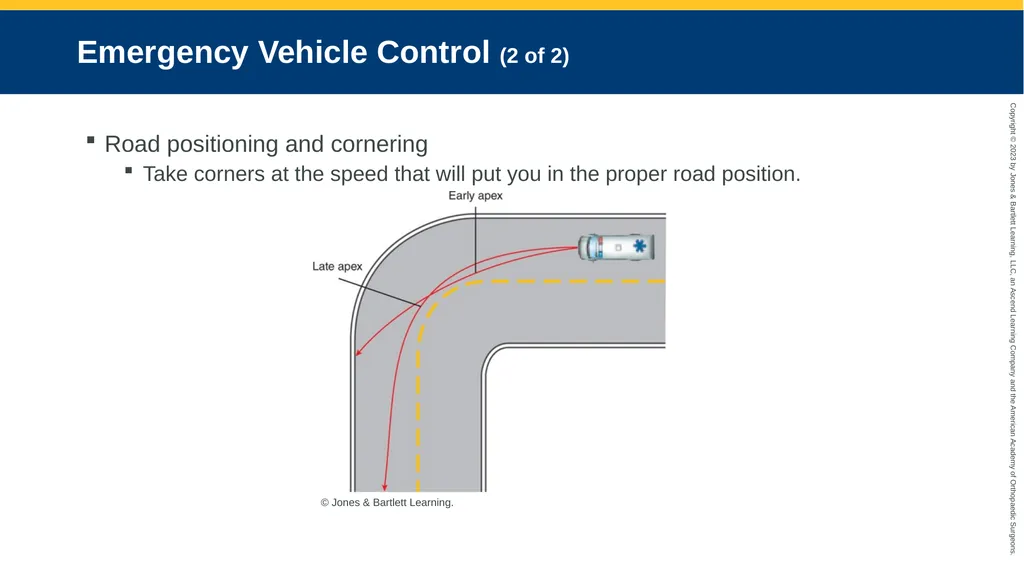
Emergency Vehicle Control (2 of 2) Road positioning and cornering
Take corners at the speed that will put you in the proper road position. © Jones & Bartlett Learning.<br>
Take corners at the speed that will put you in the proper road position. © Jones & Bartlett Learning.<br>
36
Braking Getting a feel for brake pressure comes with experience and practice.
Types I and III vehicles have heavier-feeling brakes than Type II vehicles.<br>
Types I and III vehicles have heavier-feeling brakes than Type II vehicles.<br>
37
Controlled Braking (1 of 3) Weather and road conditions
Weight distribution should be taken into consideration during inclement weather.
Hydroplaning
Gradually slow down without slamming on the brakes.<br>
Weight distribution should be taken into consideration during inclement weather.
Hydroplaning
Gradually slow down without slamming on the brakes.<br>
38
Controlled Braking (2 of 3) Water on the roadway
Lightly tap the brakes several times after driving through water to dry them.
Decreased visibility
Use low headlights during fog, smog, snow, or heavy rain.
Use headlights during the day.<br>
Lightly tap the brakes several times after driving through water to dry them.
Decreased visibility
Use low headlights during fog, smog, snow, or heavy rain.
Use headlights during the day.<br>
39
Controlled Braking (3 of 3) Ice and slippery surfaces
All-weather tires and appropriate speed will reduce traction problems.
Be especially careful on bridges and overpasses.<br>
All-weather tires and appropriate speed will reduce traction problems.
Be especially careful on bridges and overpasses.<br>
40
Laws and Regulations (1 of 6) Vary from state to state and city to city
Emergency vehicle drivers have certain limited privileges.
Privileges don’t lessen liability in a crash.<br>
Emergency vehicle drivers have certain limited privileges.
Privileges don’t lessen liability in a crash.<br>
41
Laws and Regulations (2 of 6) Right-of-way privileges
Only use when necessary
Some states allow you to proceed through a red light or stop sign after stopping.
Some states allow you to proceed through controlled intersection “with due regard.”<br>
Only use when necessary
Some states allow you to proceed through a red light or stop sign after stopping.
Some states allow you to proceed through controlled intersection “with due regard.”<br>
42
Laws and Regulations (3 of 6) Use of warning lights and sirens
Unit must be on a true emergency call.
Audible and visual warning devices must be used simultaneously.
Unit must be operated with due regard for the safety of others.
Siren is most overused piece of equipment.<br>
Unit must be on a true emergency call.
Audible and visual warning devices must be used simultaneously.
Unit must be operated with due regard for the safety of others.
Siren is most overused piece of equipment.<br>
43
Laws and Regulations (4 of 6) Use of escorts
Generally not a good idea
Leave space between vehicles.
Use a siren tone different from that of first vehicle.
Instruct family members not to drive closely behind you.<br>
Generally not a good idea
Leave space between vehicles.
Use a siren tone different from that of first vehicle.
Instruct family members not to drive closely behind you.<br>
44
Laws and Regulations (5 of 6) Intersection hazards
Look for other motorists and pedestrians before proceeding into the intersection.
Unpaved roadways and rural settings
Operate the vehicle at a lower speed.
Maintain a firm grip on the steering wheel.<br>
Look for other motorists and pedestrians before proceeding into the intersection.
Unpaved roadways and rural settings
Operate the vehicle at a lower speed.
Maintain a firm grip on the steering wheel.<br>
45
Laws and Regulations (6 of 6) School buses
Never pass a school bus that has stopped.
School zones
In many states, it is illegal to exceed the speed limit in school zones. Funeral processions
Most states offer no exemption.
Out of respect, most drivers turn off audible devices.<br>
Never pass a school bus that has stopped.
School zones
In many states, it is illegal to exceed the speed limit in school zones. Funeral processions
Most states offer no exemption.
Out of respect, most drivers turn off audible devices.<br>
46
Air Medical Transport Can speed up transfer of patients
Factors to consider:
Does the patient’s condition warrant the risk of using air medical transport?
Will the use of air medical transport truly save time?<br>
Factors to consider:
Does the patient’s condition warrant the risk of using air medical transport?
Will the use of air medical transport truly save time?<br>
47
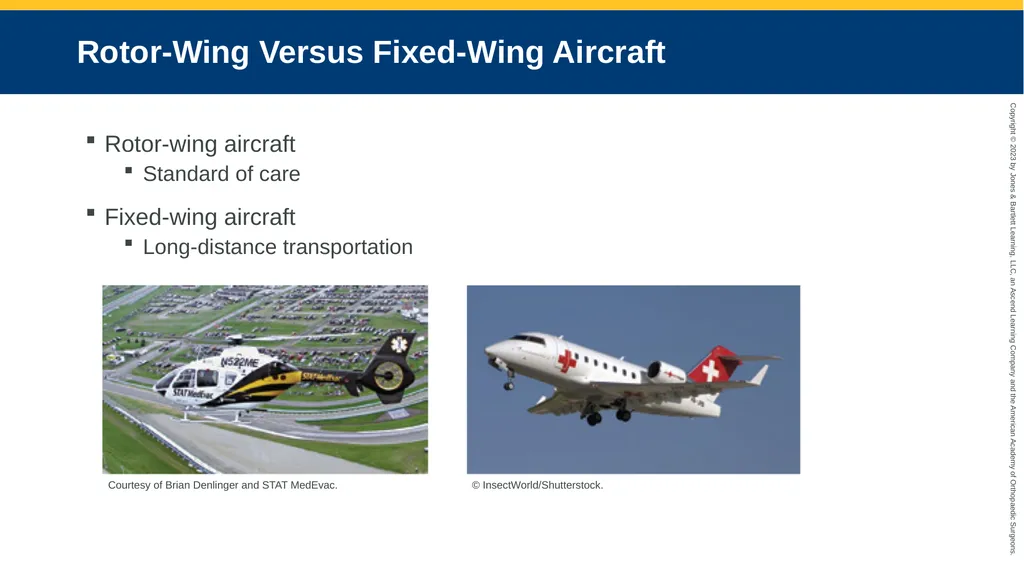
Rotor-Wing Versus Fixed-Wing Aircraft Rotor-wing aircraft
Standard of care
Fixed-wing aircraft
Long-distance transportation Courtesy of Brian Denlinger and STAT MedEvac. © InsectWorld/Shutterstock.<br>
Standard of care
Fixed-wing aircraft
Long-distance transportation Courtesy of Brian Denlinger and STAT MedEvac. © InsectWorld/Shutterstock.<br>
48
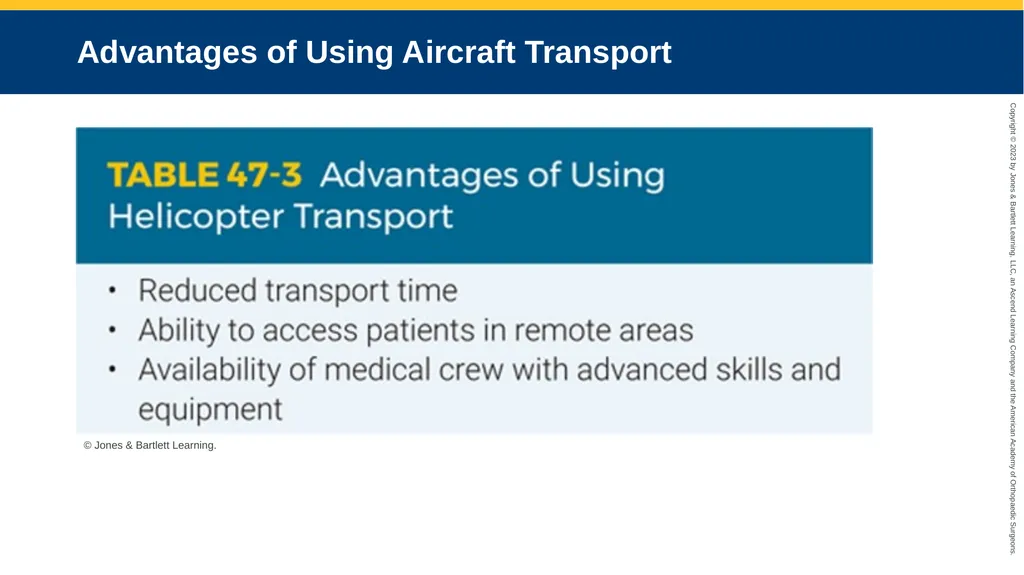
Advantages of Using Aircraft Transport © Jones & Bartlett Learning.<br>
49
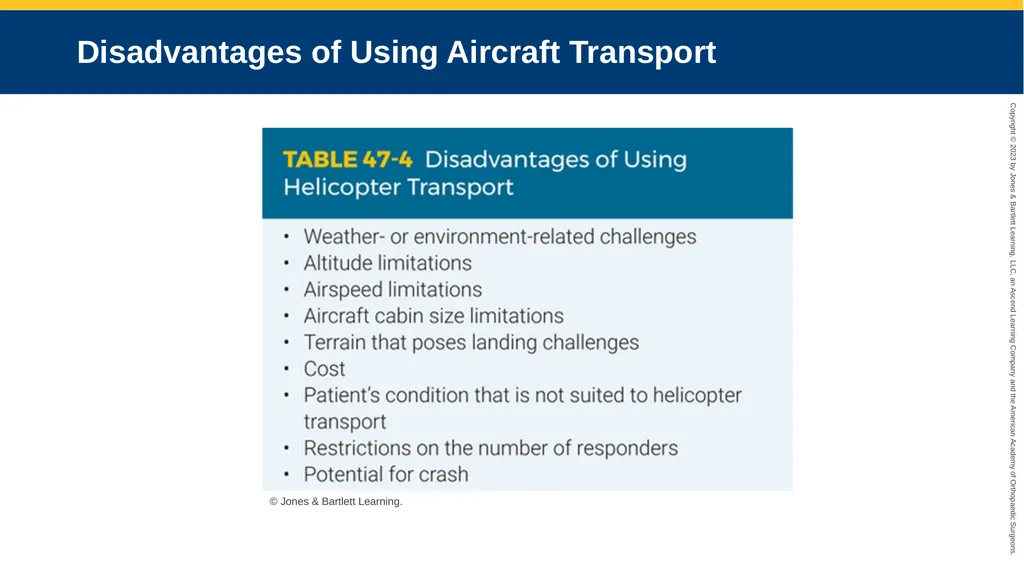
Disadvantages of Using Aircraft Transport © Jones & Bartlett Learning.<br>
50
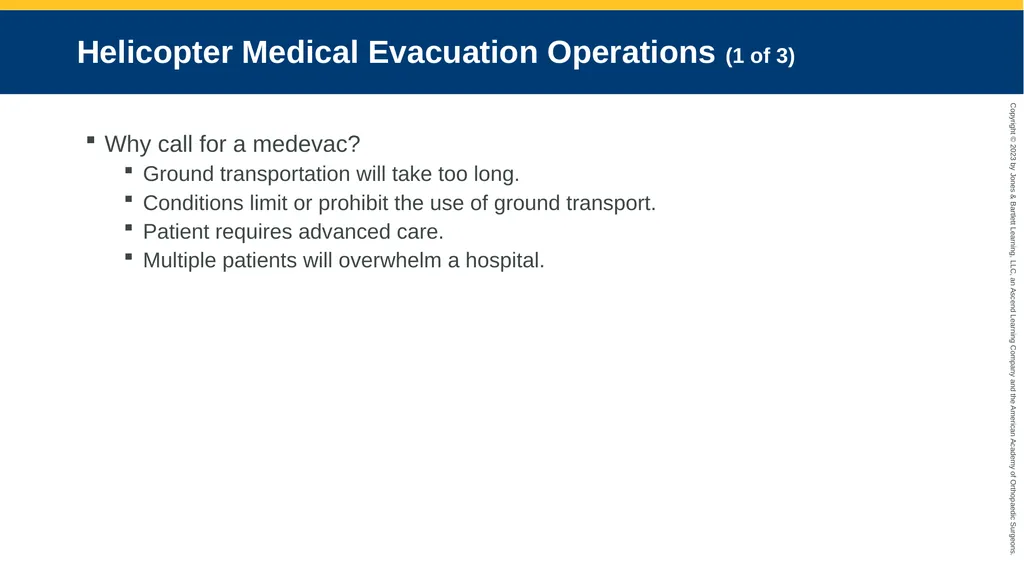
Helicopter Medical Evacuation Operations (1 of 3) Why call for a medevac?
Ground transportation will take too long.
Conditions limit or prohibit the use of ground transport.
Patient requires advanced care.
Multiple patients will overwhelm a hospital.<br>
Ground transportation will take too long.
Conditions limit or prohibit the use of ground transport.
Patient requires advanced care.
Multiple patients will overwhelm a hospital.<br>
51
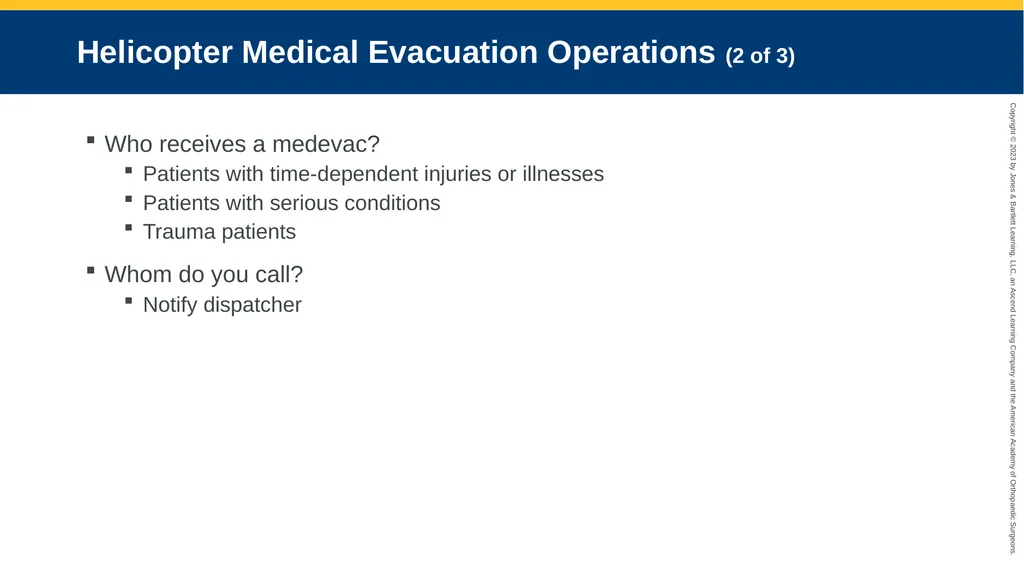
Helicopter Medical Evacuation Operations (2 of 3) Who receives a medevac?
Patients with time-dependent injuries or illnesses
Patients with serious conditions
Trauma patients
Whom do you call?
Notify dispatcher<br>
Patients with time-dependent injuries or illnesses
Patients with serious conditions
Trauma patients
Whom do you call?
Notify dispatcher<br>
52
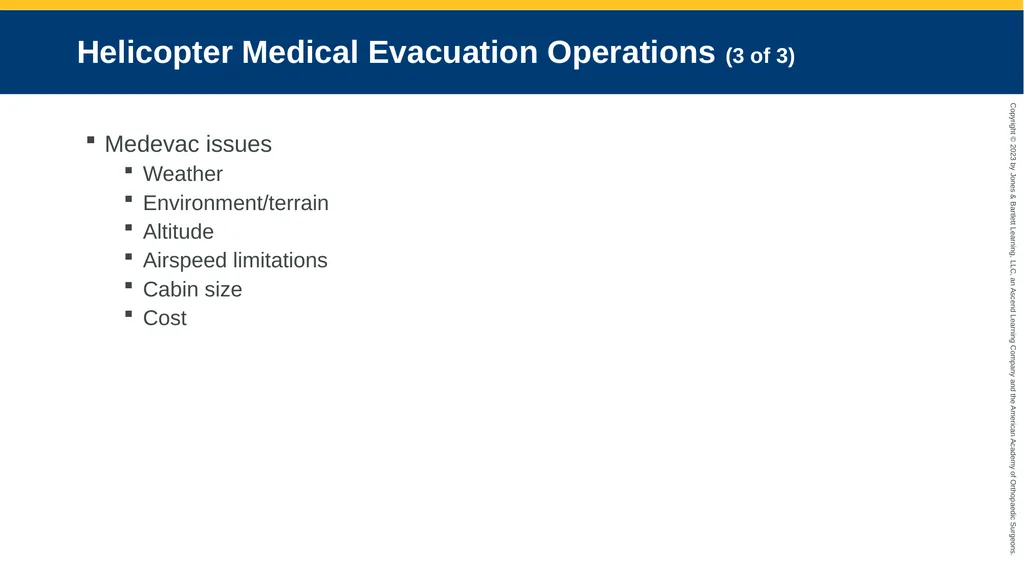
Helicopter Medical Evacuation Operations (3 of 3) Medevac issues
Weather
Environment/terrain
Altitude
Airspeed limitations
Cabin size
Cost<br>
Weather
Environment/terrain
Altitude
Airspeed limitations
Cabin size
Cost<br>
53
Establishing a Landing Zone Hard or cropped grassy level surface
Not less than 60 ft by 60 ft
Cleared of loose debris
Clear of overhead or tall hazards
Marked with weighted cones or emergency vehicles
Nonessential persons and vehicles removed<br>
Not less than 60 ft by 60 ft
Cleared of loose debris
Clear of overhead or tall hazards
Marked with weighted cones or emergency vehicles
Nonessential persons and vehicles removed<br>
54
Landing Zone Safety and Patient Transfer (1 of 6) Be familiar with capabilities, protocols, and methods for accessing helicopters.
Go only where the pilot or crew directs you.
Keep a safe distance from the aircraft whenever it’s on the ground and “hot.”<br>
Go only where the pilot or crew directs you.
Keep a safe distance from the aircraft whenever it’s on the ground and “hot.”<br>
55
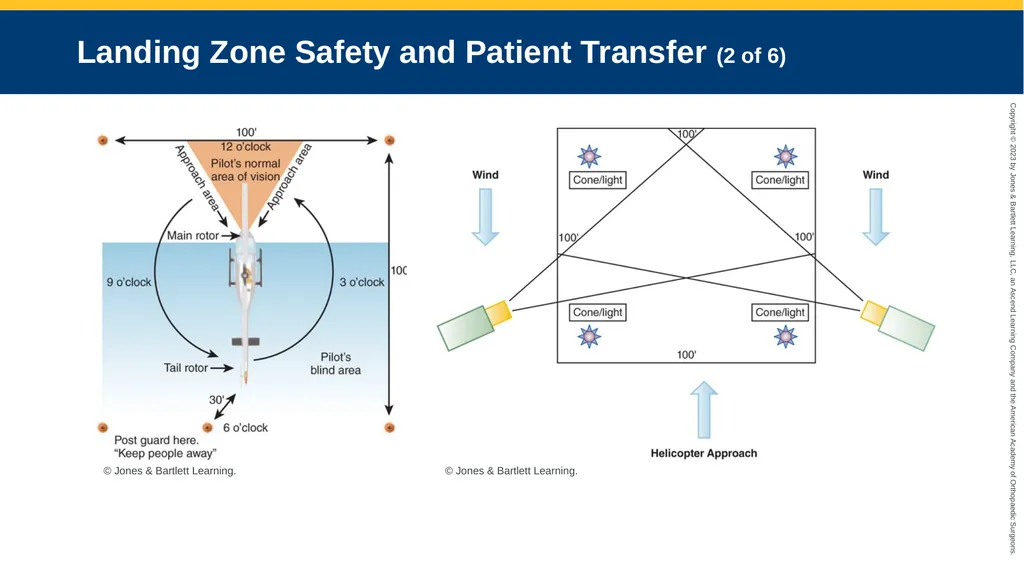
Landing Zone Safety and Patient Transfer (2 of 6) © Jones & Bartlett Learning. © Jones & Bartlett Learning.<br>
56
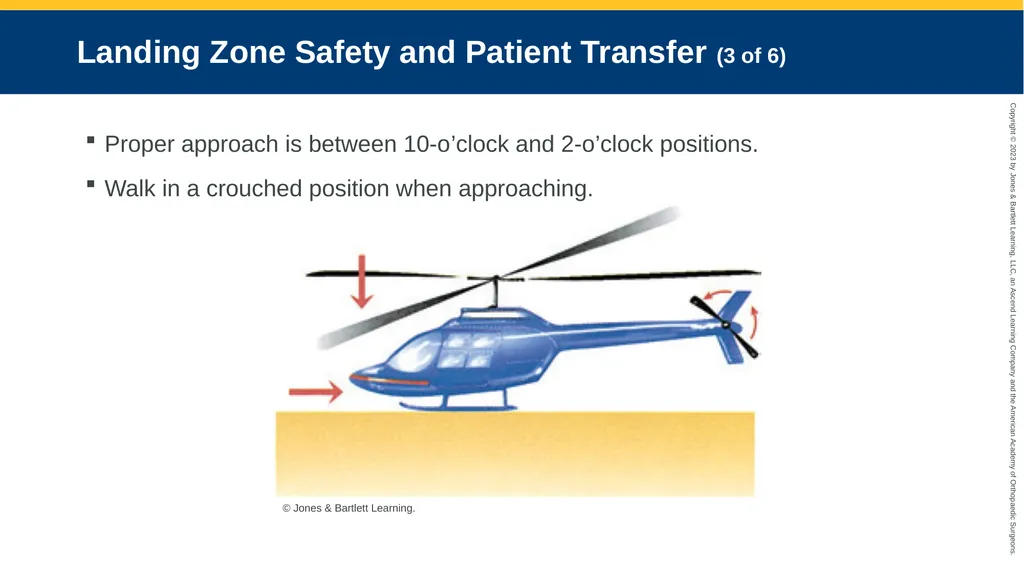
Landing Zone Safety and Patient Transfer (3 of 6) Proper approach is between 10-o’clock and 2-o’clock positions.
Walk in a crouched position when approaching. © Jones & Bartlett Learning.<br>
Walk in a crouched position when approaching. © Jones & Bartlett Learning.<br>
57
Landing Zone Safety and Patient Transfer (4 of 6) When operating at a landing zone:
Pay attention to the flight crew.
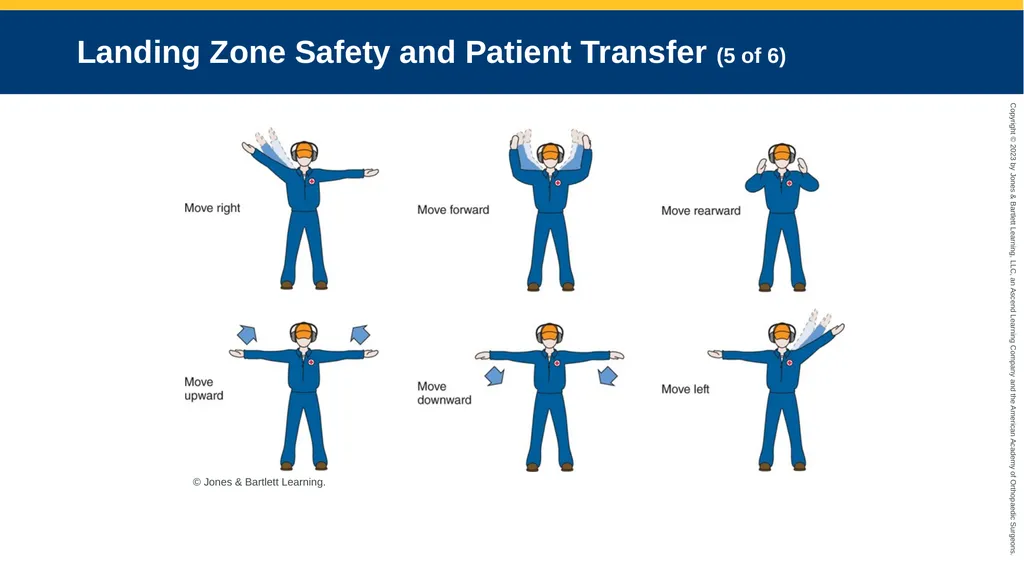
Become familiar with hand signals.
Do not approach unless instructed by flight crew.<br>
Pay attention to the flight crew.
Become familiar with hand signals.
Do not approach unless instructed by flight crew.<br>
58
Landing Zone Safety and Patient Transfer (5 of 6) © Jones & Bartlett Learning.<br>
59
Landing Zone Safety and Patient Transfer (6 of 6) When operating at a landing zone (cont’d):
Make sure all equipment/patients are secured.
Always approach from the front.
Smoking, open flames, and flares are prohibited within 50 ft (15 m) of the aircraft.<br>
Make sure all equipment/patients are secured.
Always approach from the front.
Smoking, open flames, and flares are prohibited within 50 ft (15 m) of the aircraft.<br>
60
Communicating With Other Agencies Medevacs respond to service requests throughout a large, multijurisdictional area.
To prevent miscommunication, requests should include:
A ground contact radio channel
A call sign of the unit with which the medevac should make contact<br>
To prevent miscommunication, requests should include:
A ground contact radio channel
A call sign of the unit with which the medevac should make contact<br>
61
Special Considerations (1 of 3) Night landings
Do not shine lights in the air to help the pilot.
Direct light toward the ground.<br>
Do not shine lights in the air to help the pilot.
Direct light toward the ground.<br>
62
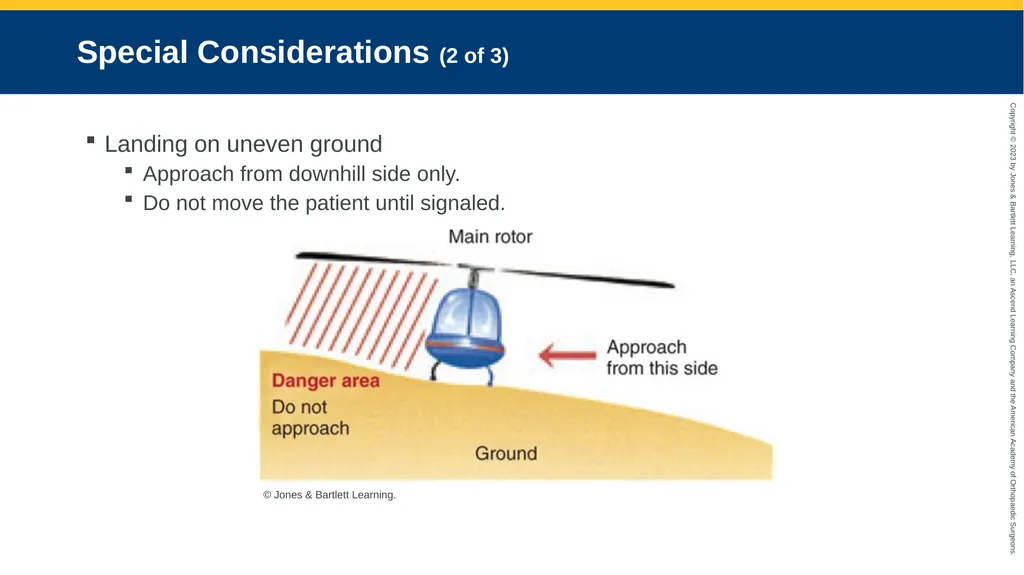
Special Considerations (2 of 3) Landing on uneven ground
Approach from downhill side only.
Do not move the patient until signaled. © Jones & Bartlett Learning.<br>
Approach from downhill side only.
Do not move the patient until signaled. © Jones & Bartlett Learning.<br>
63
Special Considerations (3 of 3) Medevacs at hazardous materials incidents
Flight crew should be notified immediately.
Landing zone should be established upwind and uphill from the scene.
Exposed patients must be decontaminated before being loaded into the aircraft.<br>
Flight crew should be notified immediately.
Landing zone should be established upwind and uphill from the scene.
Exposed patients must be decontaminated before being loaded into the aircraft.<br>