
Trauma Informed Techniques Elizabeth Rogers, M.A.,
SB
Published · 22 slides · 0 views

1 / 1







Description
Trauma Informed Techniques Elizabeth Rogers, M.A., Deputy Title IX Coordinator Kathryn Underwood Smith, JD Title IX Coordinator Content Warning The material in this presentation deals with sexual harassment and sexual misconduct. Why this
Related Topics
Share
Embed code
Download this presentation From Below
"Trauma Informed Techniques Elizabeth Rogers, M.A.," is the property of its rightful owner. Permission is granted to download and print the materials on this website for personal, non-commercial use only, and to display it on your personal computer provided you do not modify the materials and that you retain all copyright notices contained in the materials. By downloading content from our website, you accept the terms of this agreement.
Presentation Transcript
01
Trauma Informed Techniques Elizabeth Rogers, M.A.,
Deputy Title IX Coordinator Kathryn Underwood Smith, JD
Title IX Coordinator<br>
Deputy Title IX Coordinator Kathryn Underwood Smith, JD
Title IX Coordinator<br>
02
Content Warning The material in this presentation deals with sexual harassment and sexual misconduct.<br>
03
Why this Training? Empathy for those served, for one another, and for oneself can enhance the quality of life for those in law enforcement.
Further, empathy is enhanced through understanding why many people behave as they do, which is a central tenet of being trauma informed.<br>
Further, empathy is enhanced through understanding why many people behave as they do, which is a central tenet of being trauma informed.<br>
04
Agenda Recognizing Trauma
Trauma informed approach to policing
Additional Considerations<br>
Trauma informed approach to policing
Additional Considerations<br>
05
TRAUMA Defining Trauma Trauma can be broadly defined as an emotional or psychological response to an event or series of events that are shocking, distressing, or harmful.
Trauma can result from various experiences, such as physical or sexual assault, accidents, natural disasters, loss, abuse, or exposure to violence. Impact of Trauma Trauma has profound effects on individuals, often leading to a range of emotional, physical, and psychological symptoms.
Common emotional responses include fear, anxiety, guilt, shame, anger, and sadness.
Physically, trauma can lead to sleep disturbances, headaches, and other stress-related ailments.
Trauma can also impact cognitive and social functioning, affecting memory, concentration, and interpersonal relationships.<br>
Trauma can result from various experiences, such as physical or sexual assault, accidents, natural disasters, loss, abuse, or exposure to violence. Impact of Trauma Trauma has profound effects on individuals, often leading to a range of emotional, physical, and psychological symptoms.
Common emotional responses include fear, anxiety, guilt, shame, anger, and sadness.
Physically, trauma can lead to sleep disturbances, headaches, and other stress-related ailments.
Trauma can also impact cognitive and social functioning, affecting memory, concentration, and interpersonal relationships.<br>
06
Trauma on College Campuses Prevalence of Trauma Trauma is more prevalent on college campuses than one might expect. College students can experience trauma both before and during their time in higher education.
Red Zone
Factors contributing to trauma on campuses may include the high prevalence of sexual assault, hazing incidents, accidents, mental health challenges, and the general transition to college life. Signs Signs of trauma can manifest in various ways among students, affecting their academic performance, mental health, and social well-being.
Addressing trauma on campuses is crucial not only for the well-being of survivors but also for creating a safe and supportive environment for all students.<br>
Red Zone
Factors contributing to trauma on campuses may include the high prevalence of sexual assault, hazing incidents, accidents, mental health challenges, and the general transition to college life. Signs Signs of trauma can manifest in various ways among students, affecting their academic performance, mental health, and social well-being.
Addressing trauma on campuses is crucial not only for the well-being of survivors but also for creating a safe and supportive environment for all students.<br>
07
Role of Campus Safety and Police<br>
08
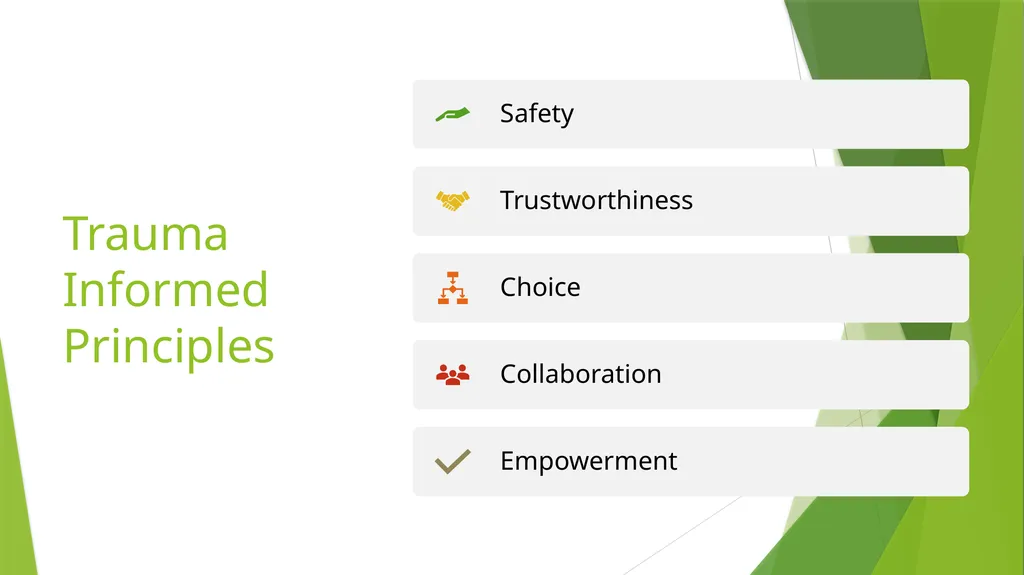
Trauma Informed Principles<br>
09
Trauma Informed Principles + Policing Focus on Understanding: In traditional policing, the emphasis is primarily on law enforcement, investigations, and control. Trauma-informed policing, however, places a strong focus on understanding individuals' experiences and the potential impact of trauma on their behavior.
De-Escalation Over Confrontation: While traditional policing may prioritize confrontation and assertive tactics, trauma-informed policing encourages de-escalation techniques. Officers are trained to defuse potentially volatile situations and prioritize the safety and well-being of all involved parties.
Empathy and Compassion: Trauma-informed policing encourages officers to approach individuals with empathy and compassion. Instead of judgment, officers are trained to provide support and resources for trauma survivors.
Preventing Re-Traumatization: Traditional policing methods can unintentionally re-traumatize individuals, especially survivors of violence or abuse. Trauma-informed policing is dedicated to preventing re-traumatization through sensitivity and understanding.
Holistic Approach: Trauma-informed policing takes a holistic approach to law enforcement, recognizing that social, economic, and environmental factors can contribute to trauma. It considers the root causes of crime and seeks to address them.
Building Trust: Building and maintaining trust with the community is a core component of trauma-informed policing. Traditional policing may prioritize authority and control, while trauma-informed policing recognizes that trust is essential for effective community policing.
Collaboration with Support Services: Trauma-informed policing often involves collaborating with mental health professionals, social workers, and victim advocates. This multidisciplinary approach helps address the complex needs of trauma survivors.<br>
De-Escalation Over Confrontation: While traditional policing may prioritize confrontation and assertive tactics, trauma-informed policing encourages de-escalation techniques. Officers are trained to defuse potentially volatile situations and prioritize the safety and well-being of all involved parties.
Empathy and Compassion: Trauma-informed policing encourages officers to approach individuals with empathy and compassion. Instead of judgment, officers are trained to provide support and resources for trauma survivors.
Preventing Re-Traumatization: Traditional policing methods can unintentionally re-traumatize individuals, especially survivors of violence or abuse. Trauma-informed policing is dedicated to preventing re-traumatization through sensitivity and understanding.
Holistic Approach: Trauma-informed policing takes a holistic approach to law enforcement, recognizing that social, economic, and environmental factors can contribute to trauma. It considers the root causes of crime and seeks to address them.
Building Trust: Building and maintaining trust with the community is a core component of trauma-informed policing. Traditional policing may prioritize authority and control, while trauma-informed policing recognizes that trust is essential for effective community policing.
Collaboration with Support Services: Trauma-informed policing often involves collaborating with mental health professionals, social workers, and victim advocates. This multidisciplinary approach helps address the complex needs of trauma survivors.<br>
10
Benefits of Being Trauma Informed By adopting trauma-informed policing, law enforcement agencies can build stronger relationships with the community, reduce the risk of violent encounters, and contribute to a safer, more supportive environment for all residents.
Additionally, this approach can improve the mental and emotional well-being of police officers by reducing their exposure to high-stress situations and enhancing job satisfaction.
As we move forward, we will delve deeper into the principles and techniques that can be integrated into everyday policing to ensure that trauma survivors receive the care and support they need, contributing to a safer and more compassionate community.<br>
Additionally, this approach can improve the mental and emotional well-being of police officers by reducing their exposure to high-stress situations and enhancing job satisfaction.
As we move forward, we will delve deeper into the principles and techniques that can be integrated into everyday policing to ensure that trauma survivors receive the care and support they need, contributing to a safer and more compassionate community.<br>
11
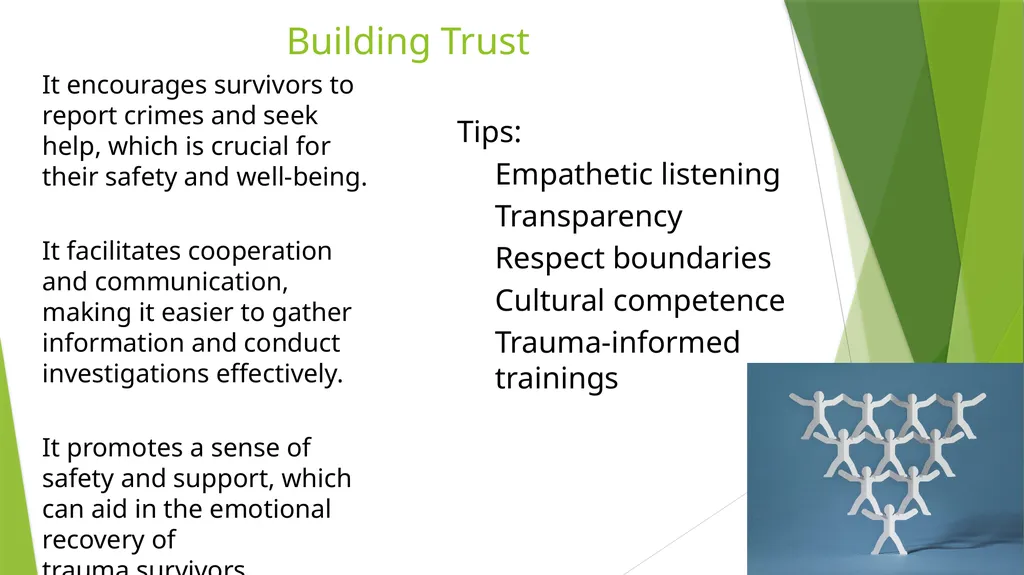
Building Trust It encourages survivors to report crimes and seek help, which is crucial for their safety and well-being.
It facilitates cooperation and communication, making it easier to gather information and conduct investigations effectively.
It promotes a sense of safety and support, which can aid in the emotional recovery of trauma survivors Tips:
Empathetic listening
Transparency
Respect boundaries
Cultural competence
Trauma-informed trainings<br>
It facilitates cooperation and communication, making it easier to gather information and conduct investigations effectively.
It promotes a sense of safety and support, which can aid in the emotional recovery of trauma survivors Tips:
Empathetic listening
Transparency
Respect boundaries
Cultural competence
Trauma-informed trainings<br>
12
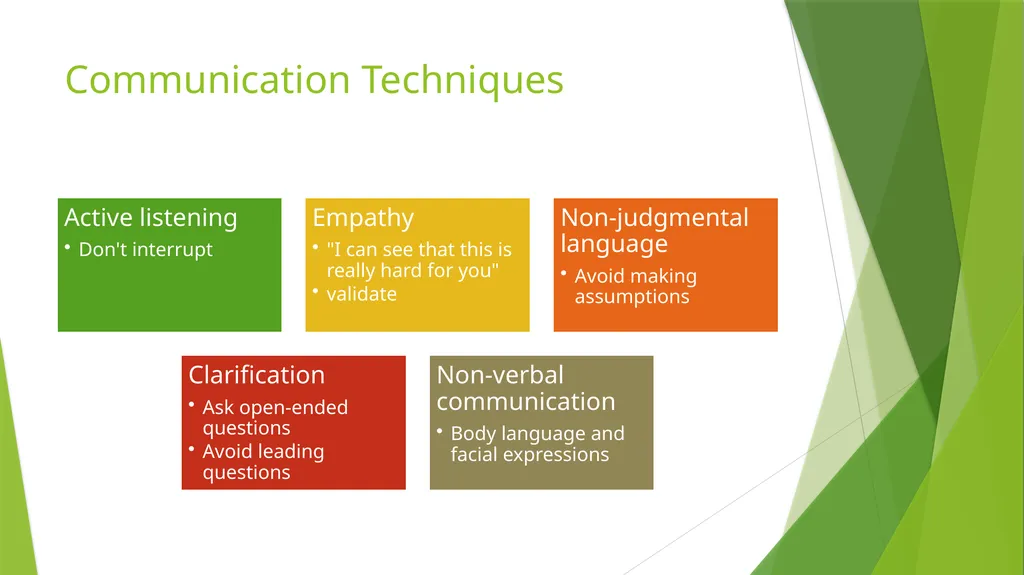
Communication Techniques<br>
13
De-escalation and Crisis Intervention Importance of being Trauma-Informed It minimizes the risk of re-traumatizing survivors or exacerbating their emotional distress.
It reduces the potential for violent confrontations and ensures the safety of all parties involved.
It allows officers to build rapport and trust with survivors, improving the chances of successful conflict resolution. Strategies for Handling Crises<br>
It reduces the potential for violent confrontations and ensures the safety of all parties involved.
It allows officers to build rapport and trust with survivors, improving the chances of successful conflict resolution. Strategies for Handling Crises<br>
14
Significance of Self-Care for Campus Police Officers<br>
15
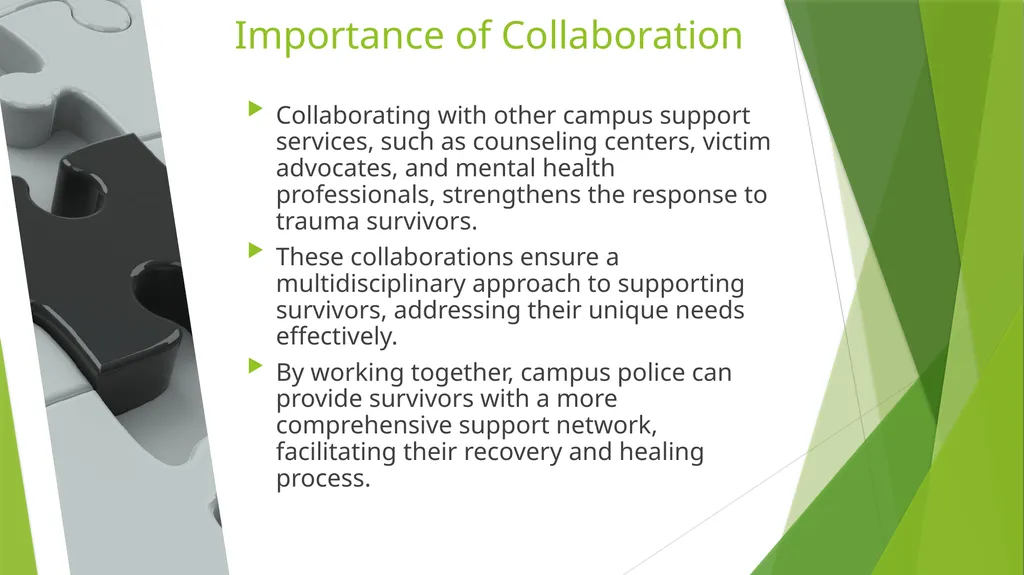
Importance of Collaboration Collaborating with other campus support services, such as counseling centers, victim advocates, and mental health professionals, strengthens the response to trauma survivors.
These collaborations ensure a multidisciplinary approach to supporting survivors, addressing their unique needs effectively.
By working together, campus police can provide survivors with a more comprehensive support network, facilitating their recovery and healing process.<br>
These collaborations ensure a multidisciplinary approach to supporting survivors, addressing their unique needs effectively.
By working together, campus police can provide survivors with a more comprehensive support network, facilitating their recovery and healing process.<br>
16
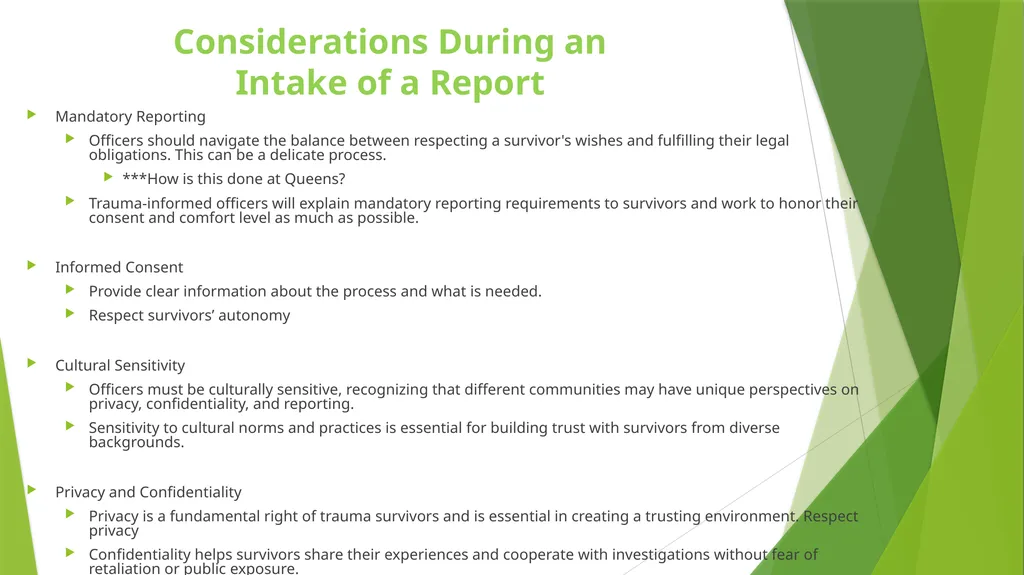
Mandatory Reporting
Officers should navigate the balance between respecting a survivor's wishes and fulfilling their legal obligations. This can be a delicate process.
***How is this done at Queens?
Trauma-informed officers will explain mandatory reporting requirements to survivors and work to honor their consent and comfort level as much as possible.
Informed Consent
Provide clear information about the process and what is needed.
Respect survivors’ autonomy
Cultural Sensitivity
Officers must be culturally sensitive, recognizing that different communities may have unique perspectives on privacy, confidentiality, and reporting.
Sensitivity to cultural norms and practices is essential for building trust with survivors from diverse backgrounds.
Privacy and Confidentiality
Privacy is a fundamental right of trauma survivors and is essential in creating a trusting environment. Respect privacy
Confidentiality helps survivors share their experiences and cooperate with investigations without fear of retaliation or public exposure. Considerations During an Intake of a Report<br>
Officers should navigate the balance between respecting a survivor's wishes and fulfilling their legal obligations. This can be a delicate process.
***How is this done at Queens?
Trauma-informed officers will explain mandatory reporting requirements to survivors and work to honor their consent and comfort level as much as possible.
Informed Consent
Provide clear information about the process and what is needed.
Respect survivors’ autonomy
Cultural Sensitivity
Officers must be culturally sensitive, recognizing that different communities may have unique perspectives on privacy, confidentiality, and reporting.
Sensitivity to cultural norms and practices is essential for building trust with survivors from diverse backgrounds.
Privacy and Confidentiality
Privacy is a fundamental right of trauma survivors and is essential in creating a trusting environment. Respect privacy
Confidentiality helps survivors share their experiences and cooperate with investigations without fear of retaliation or public exposure. Considerations During an Intake of a Report<br>
17
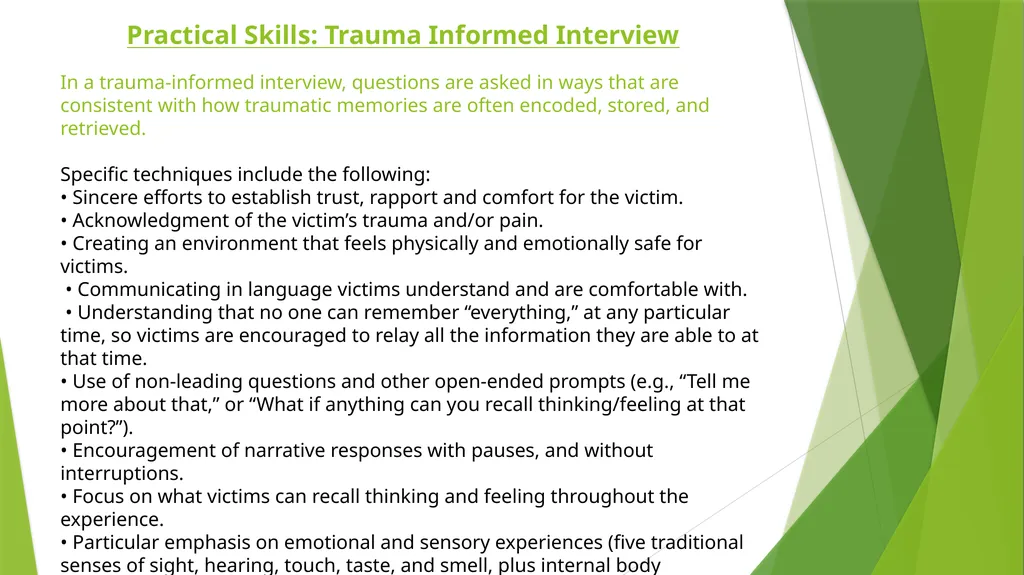
Practical Skills: Trauma Informed Interview
In a trauma-informed interview, questions are asked in ways that are consistent with how traumatic memories are often encoded, stored, and retrieved.
Specific techniques include the following:
• Sincere efforts to establish trust, rapport and comfort for the victim.
• Acknowledgment of the victim’s trauma and/or pain.
• Creating an environment that feels physically and emotionally safe for victims.
• Communicating in language victims understand and are comfortable with.
• Understanding that no one can remember “everything,” at any particular time, so victims are encouraged to relay all the information they are able to at that time.
• Use of non-leading questions and other open-ended prompts (e.g., “Tell me more about that,” or “What if anything can you recall thinking/feeling at that point?”).
• Encouragement of narrative responses with pauses, and without interruptions.
• Focus on what victims can recall thinking and feeling throughout the experience.
• Particular emphasis on emotional and sensory experiences (five traditional senses of sight, hearing, touch, taste, and smell, plus internal body sensations).
• Expressions of patience, empathy, and understanding throughout the interview<br>
18
Key Take-Aways Trauma-informed policing vs traditional policing
Building trust with survivors
Effective communication
De-escaltaiton and crisis intervetnion
Self-care for officers
Collaboration
Legal and Ethical Consideration<br>
Building trust with survivors
Effective communication
De-escaltaiton and crisis intervetnion
Self-care for officers
Collaboration
Legal and Ethical Consideration<br>
19
Hypothetical CP & RP meet at a party and realize they live in the same apartment complex. CP & RP each drink about 4-5 drinks over about 4 hours while at the party. When the party ends, RP offers to share an Uber-ride home from downtown. During the Uber-ride, CP & RP kiss. Then, CP texts a friend that CP met a “hot” person at a party and is “totally going to hook up.” Once at the apartment complex, RP asks CP if CP wants to have sex; CP shakes CP’s head up and down and kisses RP. CP & RP walk to RP’s apartment mutually holding hands, and immediately walk to RP’s bedroom. When RP & CP get to the bed, they undress themselves and RP penetrates CP. At the same time, RP begins engaging in “rough sex” (slapping CP). CP was silent during the entire sexual activity, and leaves RP’s apartment afterwards. CP files a Formal Complaint and states that RP “sexually assaulted” CP, explaining that CP was scared and “froze” once the “rough sex” began. CP states “I consented to sex, but not ‘rough sex’.”<br>
20
Resources Title IX Office: 704-337-2558, Morrison 200
Campus Safety and Police: 704-337-2306
Health and Wellness: 704-337-2220
QU Counseling Services: 704-337-2556
Chaplain Office (Adrian Bird): 704-337-2290
Rabbi Judy Schindler: 704-337-2507
Safe Alliance HOPELINE: 980-771-4673<br>
Campus Safety and Police: 704-337-2306
Health and Wellness: 704-337-2220
QU Counseling Services: 704-337-2556
Chaplain Office (Adrian Bird): 704-337-2290
Rabbi Judy Schindler: 704-337-2507
Safe Alliance HOPELINE: 980-771-4673<br>
21
Where to Make a Report Elizabeth Rogers
Associate Director for Interpersonal Violence Prevention and Title Response (Deputy Title IX Coordinator)
Rogerse2@queens.edu
704-227-2558
Morrison 206 Kathryn Underwood Smith
Director of Title IX and Equity Services
smithk15@queens.edu
704-337-2228
Morrison Hall 200 Title IX Office<br>
Associate Director for Interpersonal Violence Prevention and Title Response (Deputy Title IX Coordinator)
Rogerse2@queens.edu
704-227-2558
Morrison 206 Kathryn Underwood Smith
Director of Title IX and Equity Services
smithk15@queens.edu
704-337-2228
Morrison Hall 200 Title IX Office<br>
22
Thank you! Any questions? Comments?<br>