
TS OTHER DISORDERS EATING DISORDERS Adapted by
KB
Published · 40 slides · 0 views

1 / 1






Description
TS OTHER DISORDERS EATING DISORDERS Adapted by Julie Chilton Chapter H1 Companion PowerPoint Presentation Phillipa Hay Jane Morris The IACAPAP Textbook of Child and Adolescent Mental Health is available at the IACAPAP website
Related Topics
Share
Embed code
Download this presentation From Below
"TS OTHER DISORDERS EATING DISORDERS Adapted by" is the property of its rightful owner. Permission is granted to download and print the materials on this website for personal, non-commercial use only, and to display it on your personal computer provided you do not modify the materials and that you retain all copyright notices contained in the materials. By downloading content from our website, you accept the terms of this agreement.
Presentation Transcript
01
TS OTHER DISORDERS EATING
DISORDERS Adapted by Julie Chilton Chapter H1 Companion PowerPoint Presentation Phillipa Hay
&
Jane Morris<br>
&
Jane Morris<br>
02
The “IACAPAP Textbook of Child and Adolescent Mental Health” is available at the IACAPAP website http://iacapap.org/iacapap-textbook-of-child-and-adolescent-mental-health
Please note that this book and its companion PowerPoint are:
· Free and no registration is required to read or download it
· This is an open-access publication under the Creative Commons Attribution Non- commercial License. According to this, use, distribution and reproduction in any medium are allowed without prior permission provided the original work is properly cited and the use is non-commercial.<br>
03
Eating Disorders
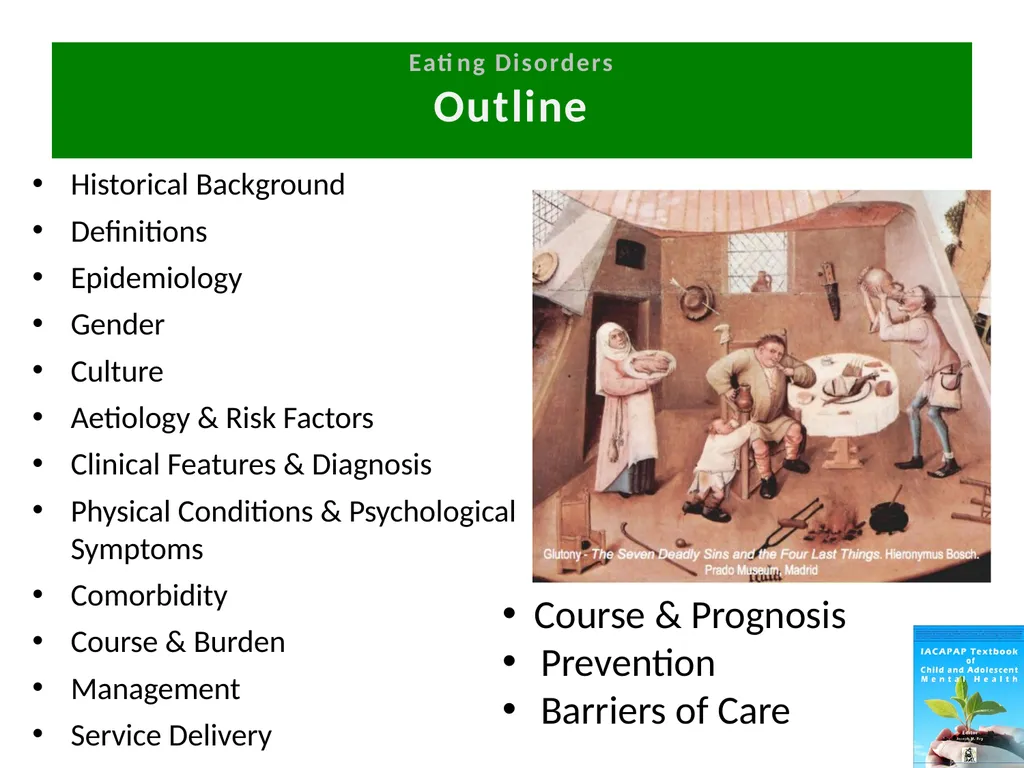
Outline Historical Background
Definitions
Epidemiology
Gender
Culture
Aetiology & Risk Factors
Clinical Features & Diagnosis
Physical Conditions & Psychological Symptoms
Comorbidity
Course & Burden
Management
Service Delivery Course & Prognosis
Prevention
Barriers of Care<br>
Definitions
Epidemiology
Gender
Culture
Aetiology & Risk Factors
Clinical Features & Diagnosis
Physical Conditions & Psychological Symptoms
Comorbidity
Course & Burden
Management
Service Delivery Course & Prognosis
Prevention
Barriers of Care<br>
04
Eating Disorders
Introduction<br>
05
Eating Disorders
Historical Background<br>
06
Eating Disorders
Red Flags for Eating Disorders Menstrual irregularities
Fertility problems
Unexplained seizures
“Funny turns”
Chronic fatigue
Callouses on hands
Loss of dental enamel<br>
Fertility problems
Unexplained seizures
“Funny turns”
Chronic fatigue
Callouses on hands
Loss of dental enamel<br>
07
Eating Disorders
Definitions<br>
08
Eating Disorders
Body Mass Index (BMI) Commonly used index of adiposity
Controls for effects of height when assessing weight
BMI= weight in kg divided by height (in meters) squared
Used in actuarial tables
BMI 20-25 associated with lower morbidity and mortality
May be blind to fall-off in expected height or weight<br>
Controls for effects of height when assessing weight
BMI= weight in kg divided by height (in meters) squared
Used in actuarial tables
BMI 20-25 associated with lower morbidity and mortality
May be blind to fall-off in expected height or weight<br>
09
Eating Disorders
Comparative symptoms<br>
10
Eating Disorders
Epidemiology, Gender & Culture: Anorexia Average age of onset= 15-19
Most common cause of:
Weight loss in teen girls
Inpatient admission
Life history--1% in 20 yr old women
Increased risk of comorbidities
90% female prevalence
Rationale varies across cultures
Somatic
Ascetic
Media-endorsed thinness<br>
Most common cause of:
Weight loss in teen girls
Inpatient admission
Life history--1% in 20 yr old women
Increased risk of comorbidities
90% female prevalence
Rationale varies across cultures
Somatic
Ascetic
Media-endorsed thinness<br>
11
Eating Disorders
Epidemiology, Gender & Culture:
Bulimia & Binge Eating DIsorder Emergence corresponds with:
Media glorification of thinness
High calorie snack food
Loss of mealtimes
Peak age of onset=15-20 yrs
Average clinical presentation after 10 yrs
12% adolescent girls have some form
Gay boys may be more vulnerable
Increasing prevalence in men>15 yrs<br>
Media glorification of thinness
High calorie snack food
Loss of mealtimes
Peak age of onset=15-20 yrs
Average clinical presentation after 10 yrs
12% adolescent girls have some form
Gay boys may be more vulnerable
Increasing prevalence in men>15 yrs<br>
12
Eating Disorders
Aetiology & Risk Factors Complex genetic factors
Concordance: mono> dizygotic twins
Possible increase of anorexia in autism
Anorexia: family with high perfectionistic and obsessive traits
Bulimia or bingeing: family with obesity, depression, substance misuse
Eating disorders comorbid with borderline personality disorder
Environmental risk possible in families<br>
Concordance: mono> dizygotic twins
Possible increase of anorexia in autism
Anorexia: family with high perfectionistic and obsessive traits
Bulimia or bingeing: family with obesity, depression, substance misuse
Eating disorders comorbid with borderline personality disorder
Environmental risk possible in families<br>
13
Eating Disorders
Aetiology & Risk Factors: Triggers<br>
14
Eating Disorders
Clinical Features and Diagnosis: Anorexia Restricted eating leading to deliberate weight loss or failure to grow and increase in weight and height as expected according to age and gender with:
Fear of weight gain and/or persistent failure to maintain a normal weight for age and height, and:
Disturbance of body image, which translates any distress into a perception that their
body is too fat<br>
Fear of weight gain and/or persistent failure to maintain a normal weight for age and height, and:
Disturbance of body image, which translates any distress into a perception that their
body is too fat<br>
15
Eating Disorders
Clinical Features and Diagnosis: Anorexia Loss of 15% of minimal normal weight
BMI <17.5 in adults
Exceptions
Other specified feeding
or eating disorder:
atypical anorexia
Children and adolescents—watch fall-offs from trends in growth charts
Menstruation typically absent in females
Low testosterone leading to atrophied genitalia and absence of morning erections in males<br>
BMI <17.5 in adults
Exceptions
Other specified feeding
or eating disorder:
atypical anorexia
Children and adolescents—watch fall-offs from trends in growth charts
Menstruation typically absent in females
Low testosterone leading to atrophied genitalia and absence of morning erections in males<br>
16
Eating Disorders
Important Information: Anorexia Weight loss timeline
Collateral information about
consequences
Highest, lowest, and preferred weight
Menstruation
Current daily food and liquid intake
Alcohol, drugs, medications
Vomiting, compulsive exercise, laxatives, diet pills
Herbal medicines, exposure to cold
Body-checking , avoidance
Social withdrawal or conflict
Physical diseases: diabetes, thyrotoxicosis, cystic fibrosis, bowel disease, malignancies<br>
Collateral information about
consequences
Highest, lowest, and preferred weight
Menstruation
Current daily food and liquid intake
Alcohol, drugs, medications
Vomiting, compulsive exercise, laxatives, diet pills
Herbal medicines, exposure to cold
Body-checking , avoidance
Social withdrawal or conflict
Physical diseases: diabetes, thyrotoxicosis, cystic fibrosis, bowel disease, malignancies<br>
17
Eating Disorders
SCOFF Questionnaire: Anorexia Do you make yourself Sick because you feel uncomfortably full?
Do you worry you have lost Control over how much you eat?
Have you recently lost more than One stone (6kg) in weight over a 3 month period?
Do you believe yourself to be Fat when others say you are thin?
Would you say that Food dominates your life?<br>
Do you worry you have lost Control over how much you eat?
Have you recently lost more than One stone (6kg) in weight over a 3 month period?
Do you believe yourself to be Fat when others say you are thin?
Would you say that Food dominates your life?<br>
18
Eating Disorders
Example of Weight Graph: Anorexia<br>
19
Eating Disorders
Binge Eating Disorder Recurrent regular binge eating (weekly x 3 months)
Larger amount of food than most people would eat in 2 hour period
Sense of lack of control
No purging, vomiting, fasting or compulsive exercise
Body image concern not a requirement
Marked distress
At least 3 other symptoms
Eating more rapidly than normal
Eating until uncomfortably full
Large amounts of food when not hungry
Eating alone due to embarrassment
Feeling disgusted, depressed, or guilty afterward<br>
Larger amount of food than most people would eat in 2 hour period
Sense of lack of control
No purging, vomiting, fasting or compulsive exercise
Body image concern not a requirement
Marked distress
At least 3 other symptoms
Eating more rapidly than normal
Eating until uncomfortably full
Large amounts of food when not hungry
Eating alone due to embarrassment
Feeling disgusted, depressed, or guilty afterward<br>
20
Eating Disorders
Bulimia Nervosa Binge symptoms
Purge symptoms
Self-induced vomiting
Misuse of laxatives, diuretics, other medications
Fasting
Excessive exercise
Both symptoms occur weekly x 3 months
Self-evaluation unduly influenced by body shape and weight
Usually normal weight
Bulimic Inventory Test (BITE):
http://www.davidfaeh.ch/fileadmin/media/pdf_norm/bite.pdf<br>
Purge symptoms
Self-induced vomiting
Misuse of laxatives, diuretics, other medications
Fasting
Excessive exercise
Both symptoms occur weekly x 3 months
Self-evaluation unduly influenced by body shape and weight
Usually normal weight
Bulimic Inventory Test (BITE):
http://www.davidfaeh.ch/fileadmin/media/pdf_norm/bite.pdf<br>
21
Eating Disorders
Other Disorders DSM-5: Other Specified Feeding or Eating Disorders (OSFED)
Atypical Anorexia Nervosa
Subthreshold bulimia nervosa
Binge-eating disorder (of low frequency or limited duration)
Purging disorder
Night eating syndrome
Avoidant Restrictive Food Intake Disorder (ARFID)
Unspecified Feeding or Eating Disorder (UFED)<br>
Atypical Anorexia Nervosa
Subthreshold bulimia nervosa
Binge-eating disorder (of low frequency or limited duration)
Purging disorder
Night eating syndrome
Avoidant Restrictive Food Intake Disorder (ARFID)
Unspecified Feeding or Eating Disorder (UFED)<br>
22
Eating Disorders
Rating Scales The Eating Disorders Examination (EDE-Q)
Eating Disorders Inventory-3
The Children’s Eating Attitudes Test
Morgan-Russell Average Outcome Scale (MRAOS)
Bulimic Investigatory Test (BITE)<br>
Eating Disorders Inventory-3
The Children’s Eating Attitudes Test
Morgan-Russell Average Outcome Scale (MRAOS)
Bulimic Investigatory Test (BITE)<br>
23
Eating Disorders
Investigation of Physical Conditions and Psychological Symptoms Physical investigations
Food diaries
Growth charts
Psychiatric assessment
Family history and involvement
Observation of family meal
Height and weight
Routine blood tests: glucose, thyroid, electrolytes, liver function tests, pregnancy, complete blood count
Electrocardiogram
Bone density<br>
Food diaries
Growth charts
Psychiatric assessment
Family history and involvement
Observation of family meal
Height and weight
Routine blood tests: glucose, thyroid, electrolytes, liver function tests, pregnancy, complete blood count
Electrocardiogram
Bone density<br>
24
Psychological Depression
Anxiety and obsessionality
Autism spectrum disorders
Emerging borderline personality disorder
Substance abuse
Chronic fatigue syndrome Physical Diabetes
Cystic fibrosis
Gastrointestinal conditions
Obesity Eating Disorders Comorbidity<br>
Anxiety and obsessionality
Autism spectrum disorders
Emerging borderline personality disorder
Substance abuse
Chronic fatigue syndrome Physical Diabetes
Cystic fibrosis
Gastrointestinal conditions
Obesity Eating Disorders Comorbidity<br>
25
Anorexia One of the most lethal psychiatric conditions
~40% achieve full recovery
Small percentage severe and enduring course
Ave time to recovery= 6-7 years Bulimia May remit spontaneously in young
>50% achieve remission at 5 yrs
Untreated symptoms likely to persist with significant impact Eating Disorders Course and Burden<br>
~40% achieve full recovery
Small percentage severe and enduring course
Ave time to recovery= 6-7 years Bulimia May remit spontaneously in young
>50% achieve remission at 5 yrs
Untreated symptoms likely to persist with significant impact Eating Disorders Course and Burden<br>
26
Eating Disorders
Management of Anorexia: Issues to Consider Challenging management of acute physical risk
Precipitous weight loss >1kg/week
Purging
Substance use
Weakness in emaciated patients
Behavioral risk
Urgency to refeeding underweight children
Consequences of starvation on developing brain and cognition
Importance of family/caregiver education
Specialist dietetic input
Family-based therapy most effective
Individual therapy for depression before re-nutrition likely
ineffective<br>
Precipitous weight loss >1kg/week
Purging
Substance use
Weakness in emaciated patients
Behavioral risk
Urgency to refeeding underweight children
Consequences of starvation on developing brain and cognition
Importance of family/caregiver education
Specialist dietetic input
Family-based therapy most effective
Individual therapy for depression before re-nutrition likely
ineffective<br>
27
Eating Disorders
Management of Anorexia: Principles of Maudsley Model of Family Therapy Family encouraged to take illness very seriously
Anorexia externalized ~life-threatening illness
Therapy NOT focused on causes/avoids blaming family
Responsibility for recovery IS placed with family and professionals
Family assumed to know best how to feed child
Adults re-take control to child can feed self
Appropriate autonomy encouraged ONLY when adequately nourished<br>
Anorexia externalized ~life-threatening illness
Therapy NOT focused on causes/avoids blaming family
Responsibility for recovery IS placed with family and professionals
Family assumed to know best how to feed child
Adults re-take control to child can feed self
Appropriate autonomy encouraged ONLY when adequately nourished<br>
28
Eating Disorders
Management of Anorexia:
Motivational Approach Help children see links between anorexia and symptoms they dislike:
Weariness
Agitation
Obsessionality
Preoccupation with food and its avoidance
Sleep problems
Feeling cold
Lost friendships
Inability to join in socially
Falling sport/academic performance
“Fussing” by parents<br>
Weariness
Agitation
Obsessionality
Preoccupation with food and its avoidance
Sleep problems
Feeling cold
Lost friendships
Inability to join in socially
Falling sport/academic performance
“Fussing” by parents<br>
29
Eating Disorders
Management of Anorexia:
Motivational Approach Help children see benefits of weight gain:
More energy
Clear headedness
Resistance to cold
Growing in height
Capacity for fun with friends
Being well enough to join in games<br>
More energy
Clear headedness
Resistance to cold
Growing in height
Capacity for fun with friends
Being well enough to join in games<br>
30
Eating Disorders
Management of Anorexia: Acknowledgement of benefits of eating disorder Power to oblige people to care and placate
Relief from social and sexual demands
Sense that body is controlled vs terrifyingly unpredictable
***Young patients need new techniques for coping with these aspects of life rather than starving themselves***<br>
Relief from social and sexual demands
Sense that body is controlled vs terrifyingly unpredictable
***Young patients need new techniques for coping with these aspects of life rather than starving themselves***<br>
31
Eating Disorders
Management of Anorexia: Medication Food is medicine
Food must be taken in amounts prescribed and at the times specified
Choice for the child is how they take the medicine
Orally as food
Orally as supplement drink
Naso-gastric tube
Little evidence for psychoactive medication
Important to avoid medication with QTc prolongation
Some evidence for olanzapine or other antipsychotic to help with rumination and aid weight gain in anorexia<br>
Food must be taken in amounts prescribed and at the times specified
Choice for the child is how they take the medicine
Orally as food
Orally as supplement drink
Naso-gastric tube
Little evidence for psychoactive medication
Important to avoid medication with QTc prolongation
Some evidence for olanzapine or other antipsychotic to help with rumination and aid weight gain in anorexia<br>
32
Eating Disorders
Management of Anorexia:
Home vs Inpatient Outcome better in outpatient clinics with eating disorder specialists
Even general outpatient child and adolescent psychiatrists brought about better outcomes than inpatient
Guidelines now recommend outpatient care if patients with anorexia are medically stable
Where no outpatient clinic available, consider outreach medicine and telemedicine for home-based care
(Gowers et al 2007)<br>
Even general outpatient child and adolescent psychiatrists brought about better outcomes than inpatient
Guidelines now recommend outpatient care if patients with anorexia are medically stable
Where no outpatient clinic available, consider outreach medicine and telemedicine for home-based care
(Gowers et al 2007)<br>
33
Eating Disorders
Anorexia Treatment: Refeeding Syndrome Potentially fatal shift in electrolytes and fluids
Too fast, imperfectly balanced, artificial or oral feeding
Hypophosphatemia, hypomagnesemia, hypokalemia, gastric dilation, congestive cardiac failure, severe edema, confusion, coma, death
Criticism: current guidelines are over cautious
Should not occur with adequate monitoring, especially phosphate<br>
Too fast, imperfectly balanced, artificial or oral feeding
Hypophosphatemia, hypomagnesemia, hypokalemia, gastric dilation, congestive cardiac failure, severe edema, confusion, coma, death
Criticism: current guidelines are over cautious
Should not occur with adequate monitoring, especially phosphate<br>
34
Eating Disorders
Management of Bulimia Nervosa and Binge-Eating Disorder Antidepressants—fluoxetine 60 mg
Cognitive Behavioral Therapy targeting bulimic symptoms = gold standard
Self-help books, CDs, web-based programs when no trained therapist available
Interpersonal Therapy model for bulimia
Fairburn’s CBT-E for patients 15 and older and with BMI=15<br>
Cognitive Behavioral Therapy targeting bulimic symptoms = gold standard
Self-help books, CDs, web-based programs when no trained therapist available
Interpersonal Therapy model for bulimia
Fairburn’s CBT-E for patients 15 and older and with BMI=15<br>
35
Eating Disorders
Models of Service Delivery for Eating Disorders Coordinated systemic response is key
Return to school
Less supervision
Competitive academic environment as trigger
Group therapy
Potential for competition in anorexia
Successful for bulimia and binge eating disorder
Growing evidence for multi-family groups
Adjunctive web-based and CD-ROM manualized treatment
Getting Better Bit(e) by Bit(e)
(Schmidt & Treasure, 1993)<br>
Return to school
Less supervision
Competitive academic environment as trigger
Group therapy
Potential for competition in anorexia
Successful for bulimia and binge eating disorder
Growing evidence for multi-family groups
Adjunctive web-based and CD-ROM manualized treatment
Getting Better Bit(e) by Bit(e)
(Schmidt & Treasure, 1993)<br>
36
Eating Disorders
Course and Prognosis: Anorexia Older studies: ~20% mortality rate
Now: 10 x that in general population
Average time to recovery 6-7 years
Younger, more intensively treated show more rapid improvement
Tolerant, respectful relationship vs rewarding/punishing based on weight
Effects on fertility
High death rates
Ambivalent overdoses
Substance abuse at low weight
Perforations from vomiting
Cold climates: exercise, hypothermia, and infections
Hot climates: dehydration and enteric infections<br>
Now: 10 x that in general population
Average time to recovery 6-7 years
Younger, more intensively treated show more rapid improvement
Tolerant, respectful relationship vs rewarding/punishing based on weight
Effects on fertility
High death rates
Ambivalent overdoses
Substance abuse at low weight
Perforations from vomiting
Cold climates: exercise, hypothermia, and infections
Hot climates: dehydration and enteric infections<br>
37
Eating Disorders
Prevention Usually in groups at schools, clinics or athletic clubs
Results mixed
Targeted programs more effective
Minimum BMI for dancers and models
Anti-obesity campaigns
emphasis on healthy nutrition and exercise rather than weight reduction important<br>
Results mixed
Targeted programs more effective
Minimum BMI for dancers and models
Anti-obesity campaigns
emphasis on healthy nutrition and exercise rather than weight reduction important<br>
38
Eating Disorders
Barriers to the Implementation of Care in Developing Countries Until recently, culture in developing countries protective vs eating disorders
Structured regular eating patterns
Eat what is put in front of you
Eat alongside others
Thin body image ideal not endorsed
Disordered and obsessive body image values transmitted by TV, internet, other media
Anorexia treatment, especially, related to level of experience of clinician
Families are most likely source of recovery<br>
Structured regular eating patterns
Eat what is put in front of you
Eat alongside others
Thin body image ideal not endorsed
Disordered and obsessive body image values transmitted by TV, internet, other media
Anorexia treatment, especially, related to level of experience of clinician
Families are most likely source of recovery<br>
39
Eating Disorders
Websites The Centre for Eating and Dieting Disorders (Australia)http://cedd.org.au/?id=1
Academy of Eating Disorders
http://www.aedweb.org
Royal College of Paediatrics and Child Health
http://www.rcpch.ac.uk
Royal College of Psychiatrists
http://www.rcpsych.ac.uk/workinpsychiatry/faculties/eatingdisorders/resourcesforprofessionals.aspx
BEAT (formerly UK Eating Disorders Association)https://www.b-eat.co.uk
Diabetics with Eating Disorders (DWED)
http://dwed.org.uk
Men get eating disorders too
http://mengeteatingdisorderstoo.tumblr.com
Something Fishy
http://www.something-fishy.org
The Butterfly Foundation (Australia)
https://thebutterflyfoundation.org.au<br>
Academy of Eating Disorders
http://www.aedweb.org
Royal College of Paediatrics and Child Health
http://www.rcpch.ac.uk
Royal College of Psychiatrists
http://www.rcpsych.ac.uk/workinpsychiatry/faculties/eatingdisorders/resourcesforprofessionals.aspx
BEAT (formerly UK Eating Disorders Association)https://www.b-eat.co.uk
Diabetics with Eating Disorders (DWED)
http://dwed.org.uk
Men get eating disorders too
http://mengeteatingdisorderstoo.tumblr.com
Something Fishy
http://www.something-fishy.org
The Butterfly Foundation (Australia)
https://thebutterflyfoundation.org.au<br>
40
Anxiety Disorders in Children and Adolescents
Thank You!<br>