
TYPES O COMPA F NIES Its voluntary incorporated
DP
Published · 25 slides · 0 views

1 / 1


Description
TYPES O COMPA F NIES Its voluntary incorporated association which is an artificial person created by law with limited liability having common seal and perpetual succession . According sec3(1) of companies act company means a company formed
Related Topics
Share
Embed code
Download this presentation From Below
"TYPES O COMPA F NIES Its voluntary incorporated" is the property of its rightful owner. Permission is granted to download and print the materials on this website for personal, non-commercial use only, and to display it on your personal computer provided you do not modify the materials and that you retain all copyright notices contained in the materials. By downloading content from our website, you accept the terms of this agreement.
Presentation Transcript
01
TYPES O COMPA F NIES<br>
02
Its voluntary incorporated association which is an artificial person created by law with limited liability having common seal and perpetual succession . According sec3(1) of companies act company means “a company formed and registered under the act , or an existing company. COMPANY : DEFINITION<br>
03
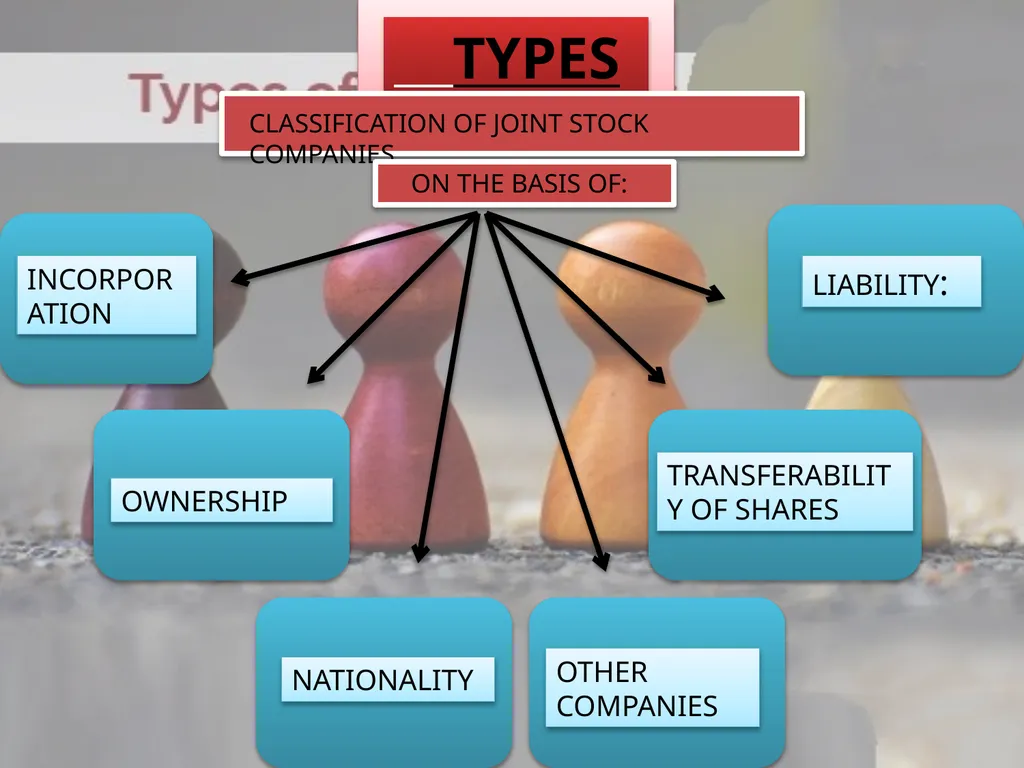
TYPES CLASSIFICATION OF JOINT STOCK COMPANIES ON THE BASIS OF: INCORPORATION LIABILITY: TRANSFERABILITY OF SHARES OWNERSHIP NATIONALITY OTHER COMPANIES<br>
04
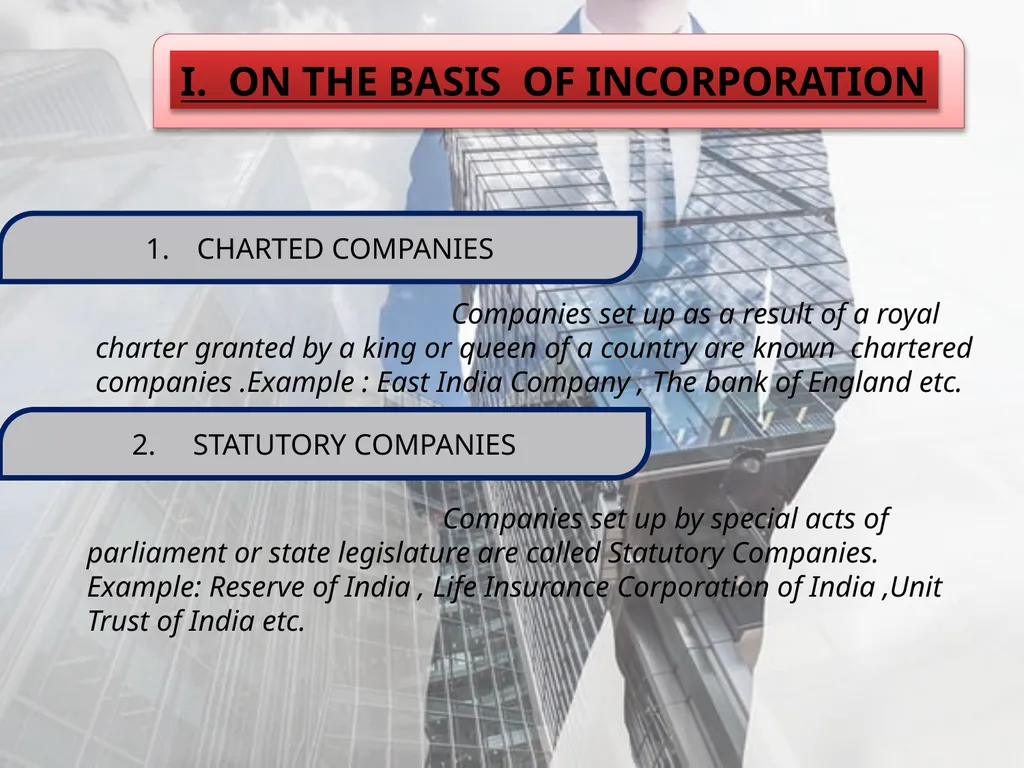
Companies set up as a result of a royal charter granted by a king or queen of a country are known chartered companies .Example : East India Company , The bank of England etc. Companies set up by special acts of parliament or state legislature are called Statutory Companies. Example: Reserve of India , Life Insurance Corporation of India ,Unit Trust of India etc. I. ON THE BASIS OF INCORPORATION CHARTED COMPANIES 2. STATUTORY COMPANIES<br>
05
Companies registered under the India Companies Act, 1956 or under any of the previous Companies Acts are called registered companies. Most of the companies in India belong to this category. Companies established for the promotions of arts, science, religion, charity or any other similar objects can obtain license under Sec.25 from the central Government and enjoy certain privileges. 4. LICENSED COMPANIES: 3. REGISTERED COMPANIES:<br>
06
II. ON THE BASIS OF LIABILITY 1. LIMITED LIABILITY: It is a company where the liability of the shareholder remains limited to the nominal value of the shares held by him. 2. UNLIMITED LIABILITY: Here the liability of its members is unlimited . In other words , their liability extends to their private properties also. Unlimited companies are almost non–existence these days . COMAPANIES LIMITED BY GUARANTEE: In a guarantee company the liability of a shareholder is limited to the amount he has voluntarily Undertaken to contribute towards the assets of the company to meet out any deficiency at the time of winding up. Such a Company may or may have a share capital .<br>
07
III. ON THE BASIS OF OWNERSHIPSHIP 1. GOVERNMENT COMPANY : A Government Company means any company in which not less than 51 per cent of the paid-up share capital is held by the Central Government ,or
any State Government or Governments , or
Partly by the Central Government and partly by one or more State Governments. A subsidiary of a Government Company is also called a Government company
Example : Hindustan Machine Tools Ltd., Heavy Engineering Corporation,etc.<br>
any State Government or Governments , or
Partly by the Central Government and partly by one or more State Governments. A subsidiary of a Government Company is also called a Government company
Example : Hindustan Machine Tools Ltd., Heavy Engineering Corporation,etc.<br>
08
2. HOLDING COMPANY: According to Section 2(46)of the Companies Act ,2013 ,”A Company shall be deemed to be the holding company of another if, but only if, that other company is subsidiary . 3. Subsidiary company : According to Section 2(46) of the Companies Act, 2013,” A company shall be deemed to be a subsidiary of another if, but only if: That other (company)controls the composition of its Board of Directors ; or
that other holds more than fifty per cent of the nominal value of its equity sharer capital or more than fifty percent of the total voting power of the company ;or
The company is a subsidiary of another company which is itself a subsidiary of some other company. 4. ASSOCIATE COMPANY : An Associate company , in another company, was defined under the 2013 Act as a company in which that other company has a ‘significant influence’ and included a joint venture company .<br>
09
III. ON THE BASIS OF TRANSFERABILITY OF SHARES Private Companies Section 2 (68) 0f the Companies (Amendment) Act ,2015 defines a ‘private company ‘as a company which has a minimum paid up capital as may be prescribed and by articles . 2. PUBLIC COMPANIES According to Section 2(71) of the Companies Act , 2015 a ‘public company’ means :
A company which is not a private company .
Has a minimum paid up capital as may be prescribed.<br>
A company which is not a private company .
Has a minimum paid up capital as may be prescribed.<br>
10
IV. ON THE BASIS OF NATIONALITY INLAND COMPANIES: An inland company is one that is incorporated in India under the Companies Act and is operating under the provisions of the Act. b. FOREIGN COMPANIES: According to Section 2(42) of Companies Act 2013 ,foreign company means any company or body corporate incorporated outside India.<br>
11
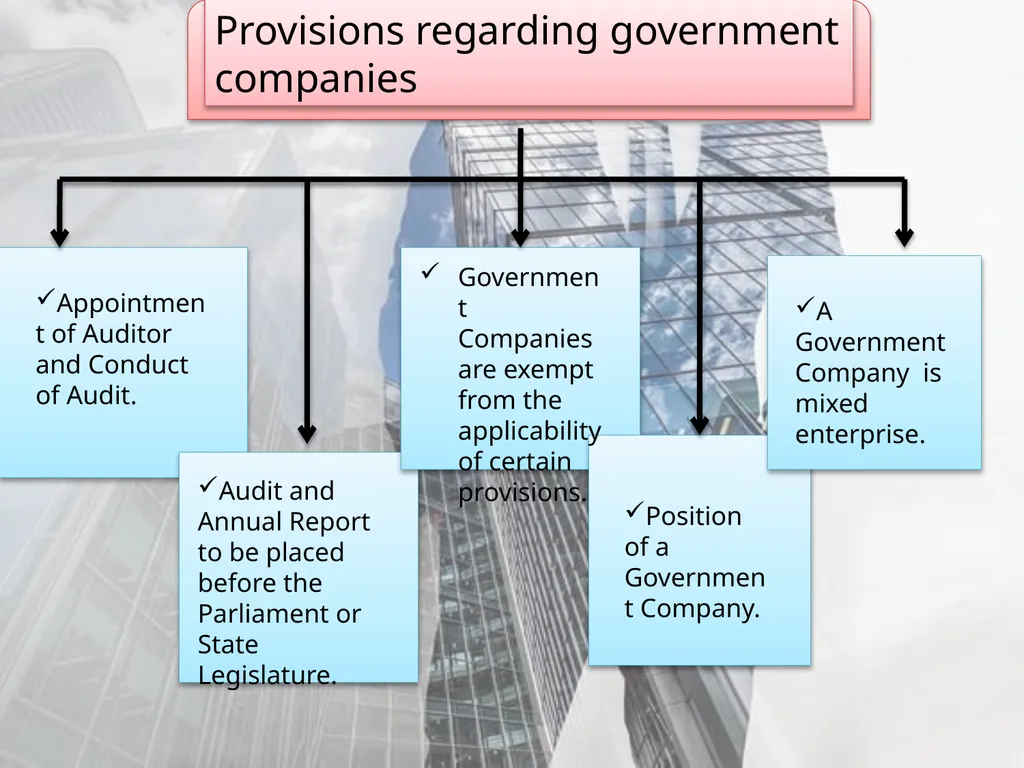
Provisions regarding government companies Appointment of Auditor and Conduct of Audit. Audit and Annual Report to be placed before the Parliament or State Legislature. Government Companies are exempt from the applicability of certain provisions. Position of a Government Company. A Government Company is mixed enterprise.<br>
12
V. ON THE BASIS OF OTHER COMPANIES MNCs: The companies enterprises or corporations that manage production or deliver services in more than one country. 2. DEFUNCT COMPANY: A Defunct Company is one that has ceased to be operative and is no more doing any business. 3. ILLEGAL COMANIES Any association that violates the provisions of Section464 of the Companies Act ,2013,is deemed to be an illegal association.<br>
13
4. FINANCE COMPANIES: A non-banking company ,which is a financial institution within the meaning of section 45(1) (c) of The Reserve Bank Of India Act 1934. 5. FERA COMPANIES: The companies working in India under the Foreign Exchange Regulation Act,1973 are technically called the FERA Companies. 6. INVESTMENT COMPANIES: A non- banking company , which is a financial institution within the meaning of section 45(1)(c) of The Reserve Bank Of India Act ,1934.<br>
14
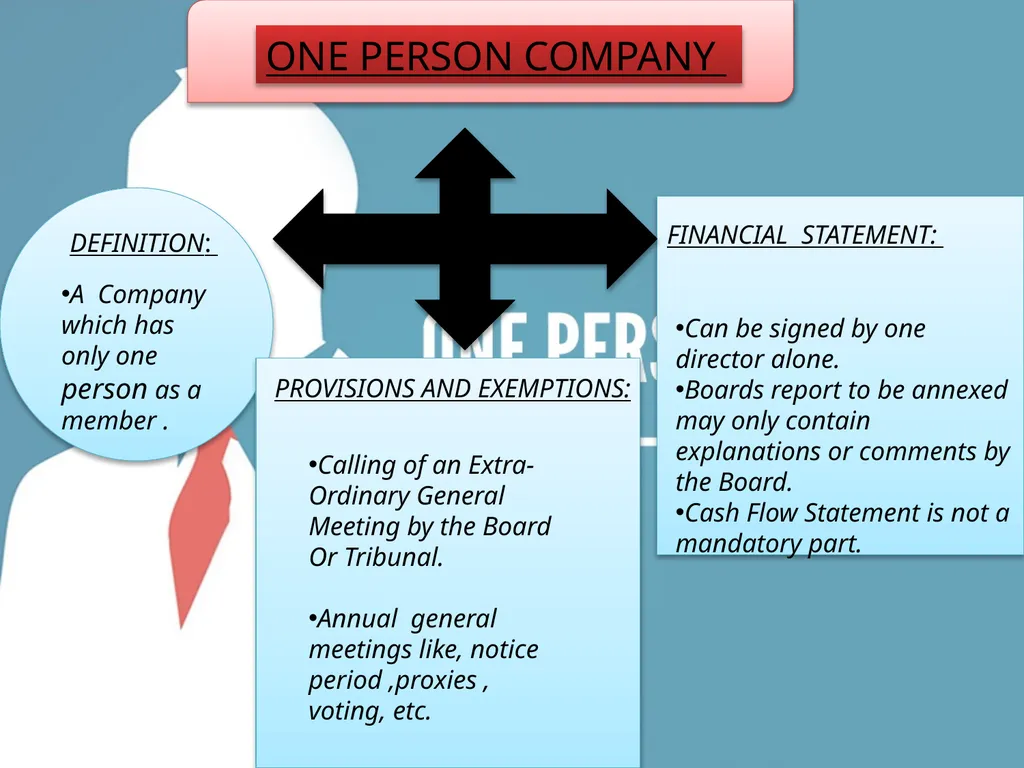
ONE PERSON COMPANY A Company which has only one person as a member . DEFINITION: PROVISIONS AND EXEMPTIONS: Calling of an Extra-Ordinary General Meeting by the Board Or Tribunal.
Annual general meetings like, notice period ,proxies , voting, etc. FINANCIAL STATEMENT: Can be signed by one director alone.
Boards report to be annexed may only contain explanations or comments by the Board.
Cash Flow Statement is not a mandatory part.<br>
Annual general meetings like, notice period ,proxies , voting, etc. FINANCIAL STATEMENT: Can be signed by one director alone.
Boards report to be annexed may only contain explanations or comments by the Board.
Cash Flow Statement is not a mandatory part.<br>
15
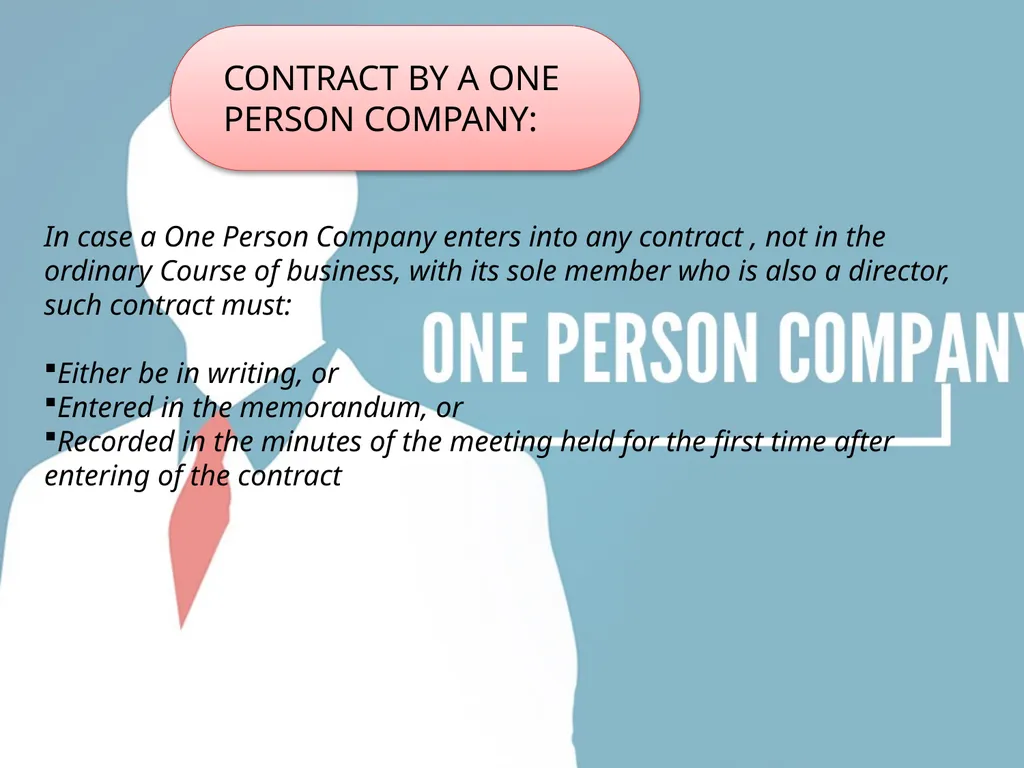
In case a One Person Company enters into any contract , not in the ordinary Course of business, with its sole member who is also a director, such contract must:
Either be in writing, or
Entered in the memorandum, or
Recorded in the minutes of the meeting held for the first time after entering of the contract CONTRACT BY A ONE PERSON COMPANY:<br>
Either be in writing, or
Entered in the memorandum, or
Recorded in the minutes of the meeting held for the first time after entering of the contract CONTRACT BY A ONE PERSON COMPANY:<br>
16
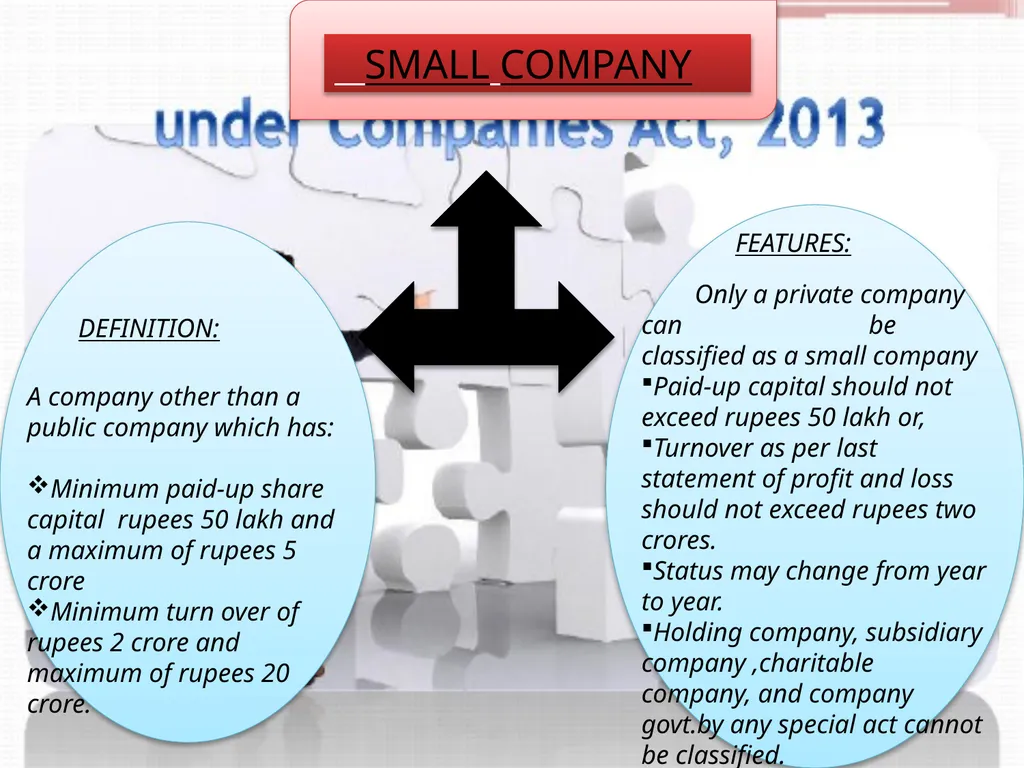
SMALL COMPANY DEFINITION: A company other than a public company which has:
Minimum paid-up share capital rupees 50 lakh and a maximum of rupees 5 crore
Minimum turn over of rupees 2 crore and maximum of rupees 20 crore. FEATURES: Only a private company can be classified as a small company
Paid-up capital should not exceed rupees 50 lakh or,
Turnover as per last statement of profit and loss should not exceed rupees two crores.
Status may change from year to year.
Holding company, subsidiary company ,charitable company, and company govt.by any special act cannot be classified.<br>
17
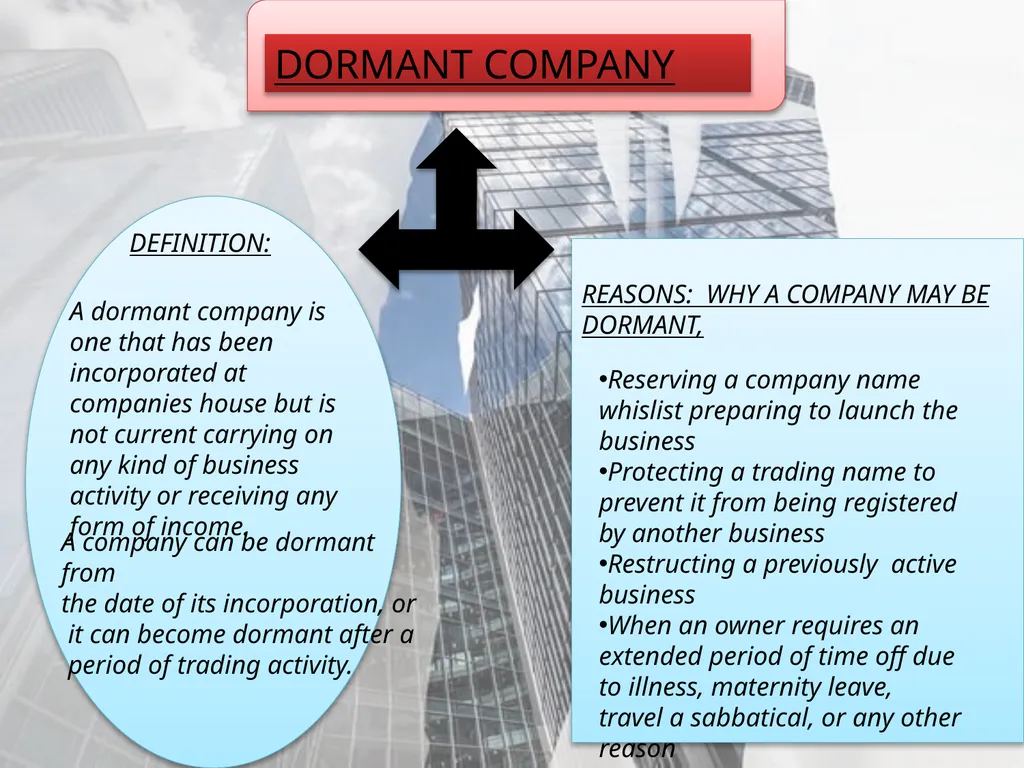
DORMANT COMPANY DEFINITION: A dormant company is one that has been incorporated at companies house but is not current carrying on any kind of business activity or receiving any form of income. A company can be dormant from
the date of its incorporation, or
it can become dormant after a
period of trading activity. REASONS: WHY A COMPANY MAY BE DORMANT, Reserving a company name whislist preparing to launch the business
Protecting a trading name to prevent it from being registered by another business
Restructing a previously active business
When an owner requires an extended period of time off due to illness, maternity leave, travel a sabbatical, or any other reason<br>
18
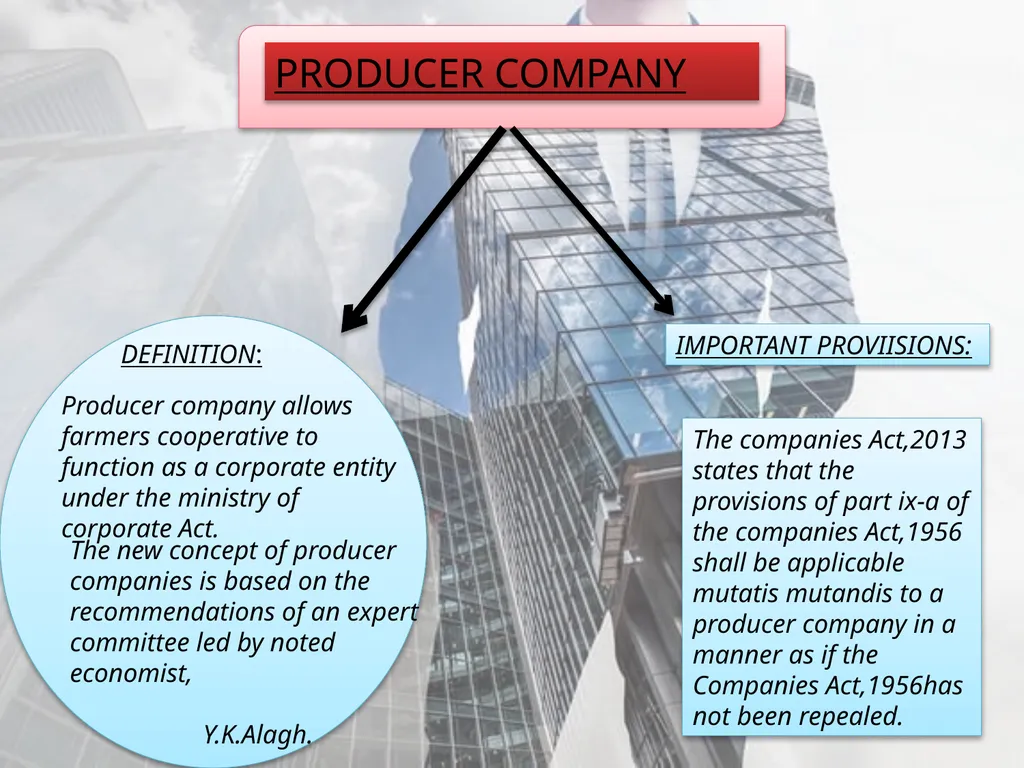
PRODUCER COMPANY DEFINITION: Producer company allows farmers cooperative to function as a corporate entity under the ministry of corporate Act. The new concept of producer companies is based on the recommendations of an expert committee led by noted economist, Y.K.Alagh. IMPORTANT PROVIISIONS: The companies Act,2013 states that the provisions of part ix-a of the companies Act,1956 shall be applicable mutatis mutandis to a producer company in a manner as if the Companies Act,1956has not been repealed.<br>
19
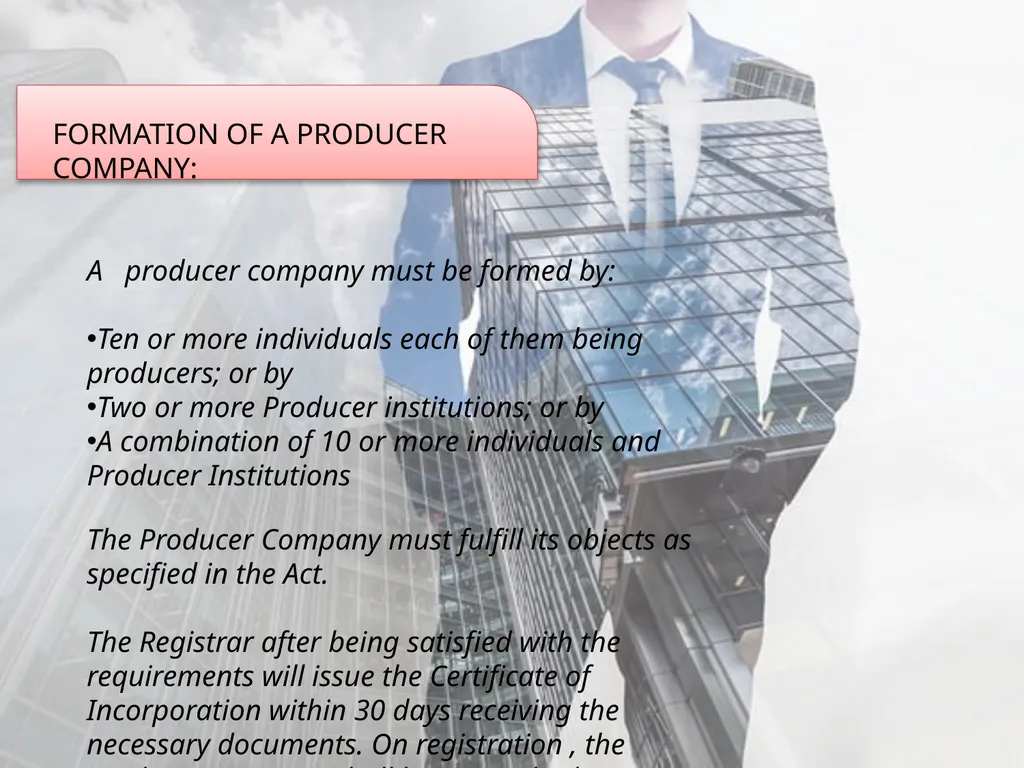
FORMATION OF A PRODUCER COMPANY: A producer company must be formed by:
Ten or more individuals each of them being producers; or by
Two or more Producer institutions; or by
A combination of 10 or more individuals and Producer Institutions The Producer Company must fulfill its objects as specified in the Act.
The Registrar after being satisfied with the requirements will issue the Certificate of Incorporation within 30 days receiving the necessary documents. On registration , the producer company shall become a body corporate.<br>
20
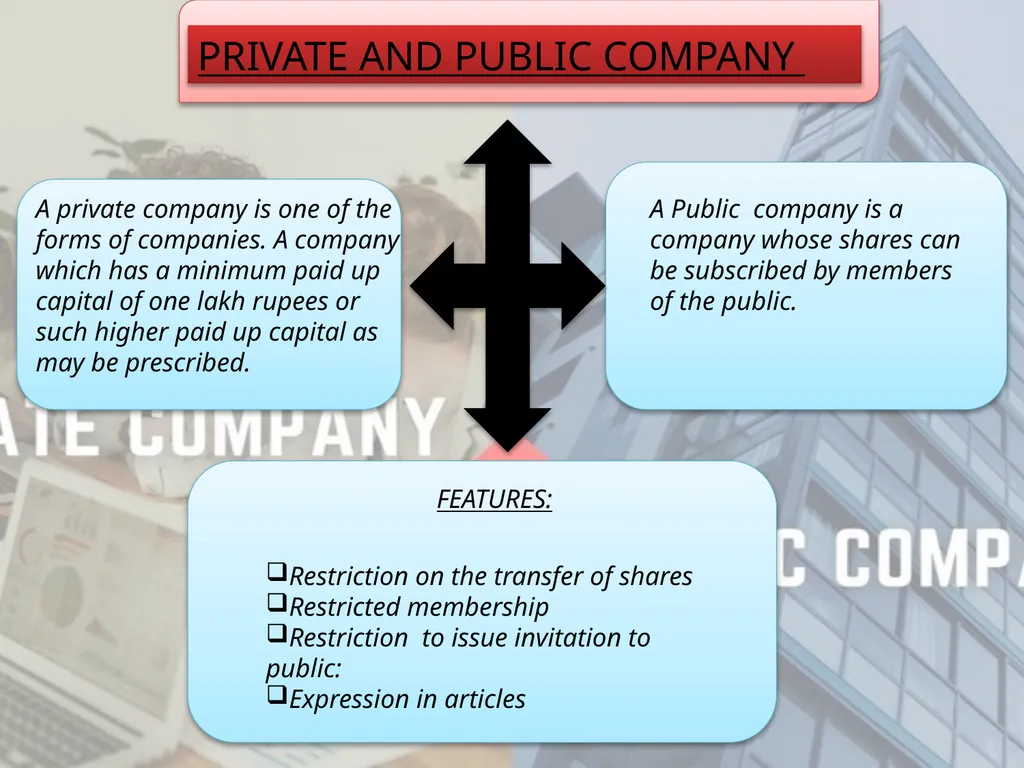
PRIVATE AND PUBLIC COMPANY A private company is one of the forms of companies. A company which has a minimum paid up capital of one lakh rupees or such higher paid up capital as may be prescribed. A Public company is a company whose shares can be subscribed by members of the public. FEATURES: Restriction on the transfer of shares
Restricted membership
Restriction to issue invitation to public:
Expression in articles<br>
Restricted membership
Restriction to issue invitation to public:
Expression in articles<br>
21
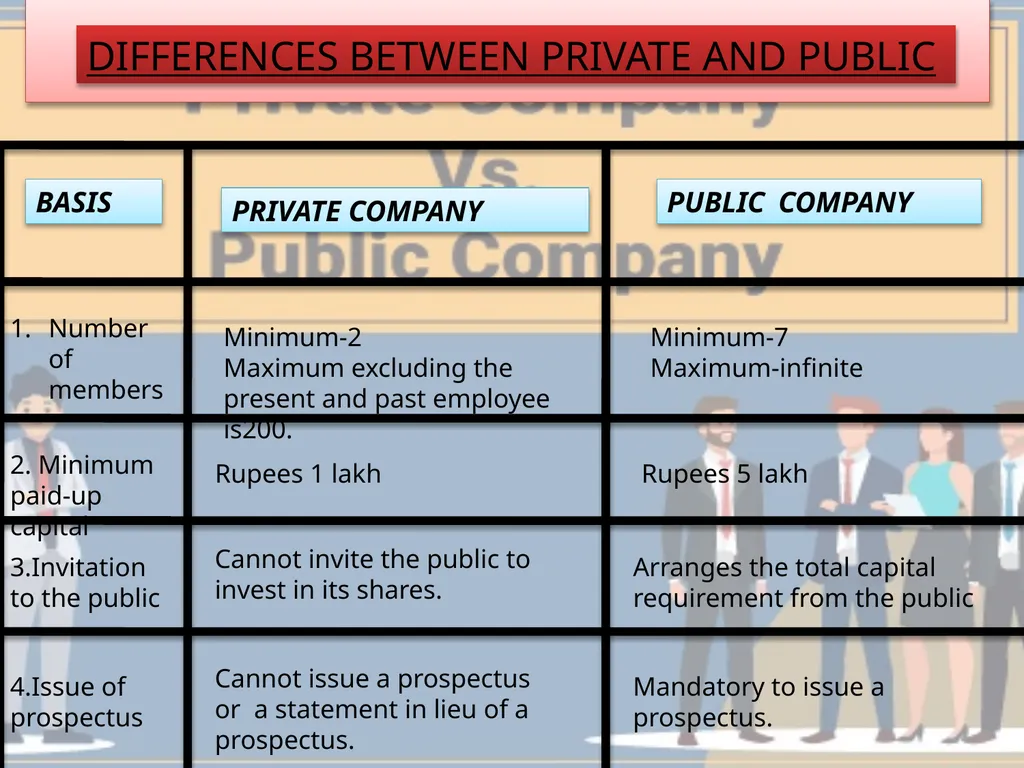
DIFFERENCES BETWEEN PRIVATE AND PUBLIC BASIS PRIVATE COMPANY PUBLIC COMPANY Number of members Minimum-2
Maximum excluding the present and past employee is200. Minimum-7
Maximum-infinite 2. Minimum paid-up capital Rupees 1 lakh Rupees 5 lakh 3.Invitation to the public Cannot invite the public to invest in its shares. Arranges the total capital requirement from the public 4.Issue of prospectus Cannot issue a prospectus or a statement in lieu of a prospectus. Mandatory to issue a prospectus.<br>
22
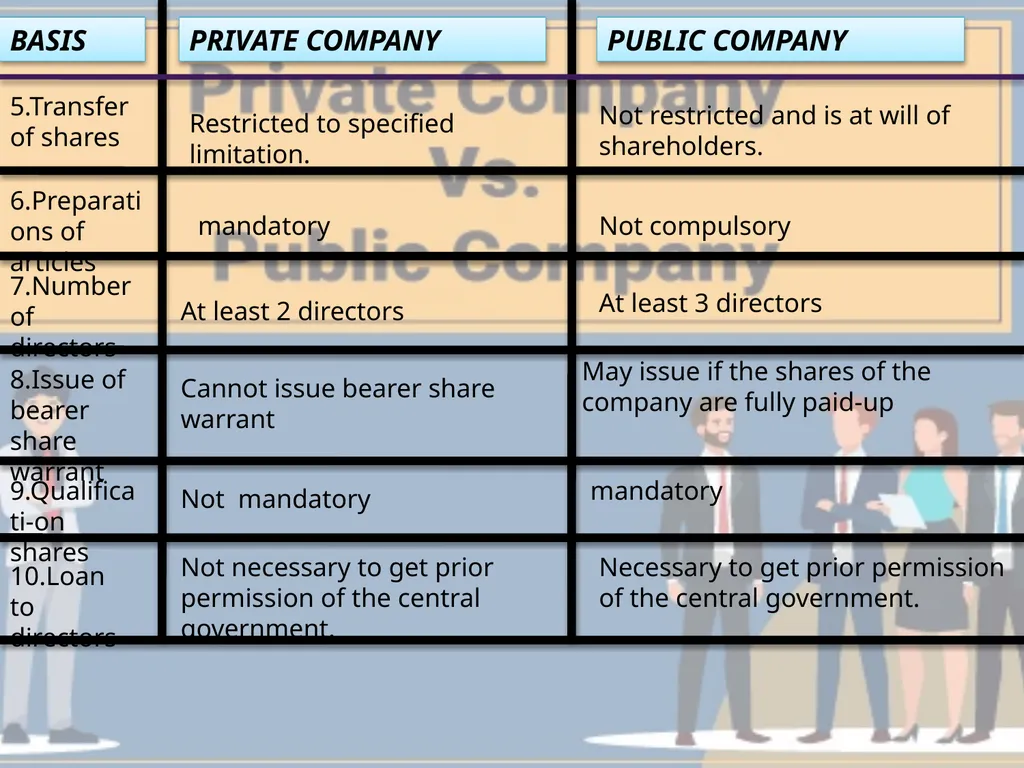
5.Transfer of shares Restricted to specified limitation. Not restricted and is at will of shareholders. 6.Preparations of articles mandatory Not compulsory 7.Number of directors At least 2 directors At least 3 directors 8.Issue of bearer share warrant Cannot issue bearer share warrant May issue if the shares of the company are fully paid-up 9.Qualificati-on shares Not mandatory mandatory 10.Loan to directors Not necessary to get prior permission of the central government. Necessary to get prior permission of the central government. BASIS PRIVATE COMPANY PUBLIC COMPANY<br>
23
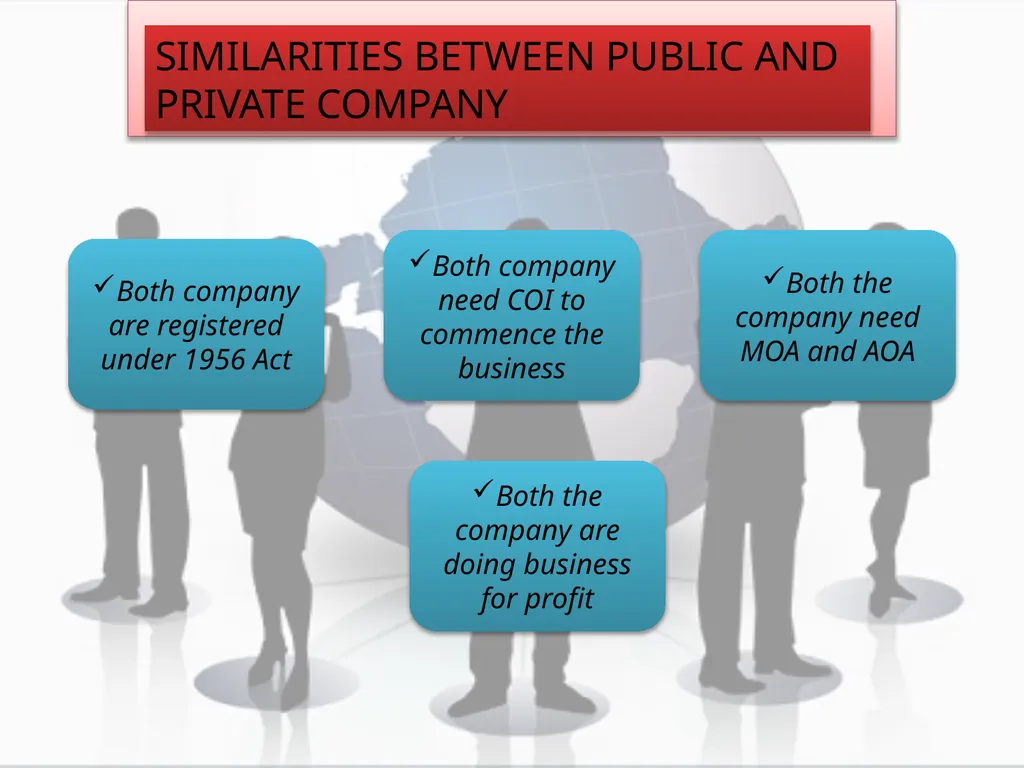
SIMILARITIES BETWEEN PUBLIC AND PRIVATE COMPANY Both company are registered under 1956 Act Both company need COI to commence the business Both the company need MOA and AOA Both the company are doing business for profit<br>
24
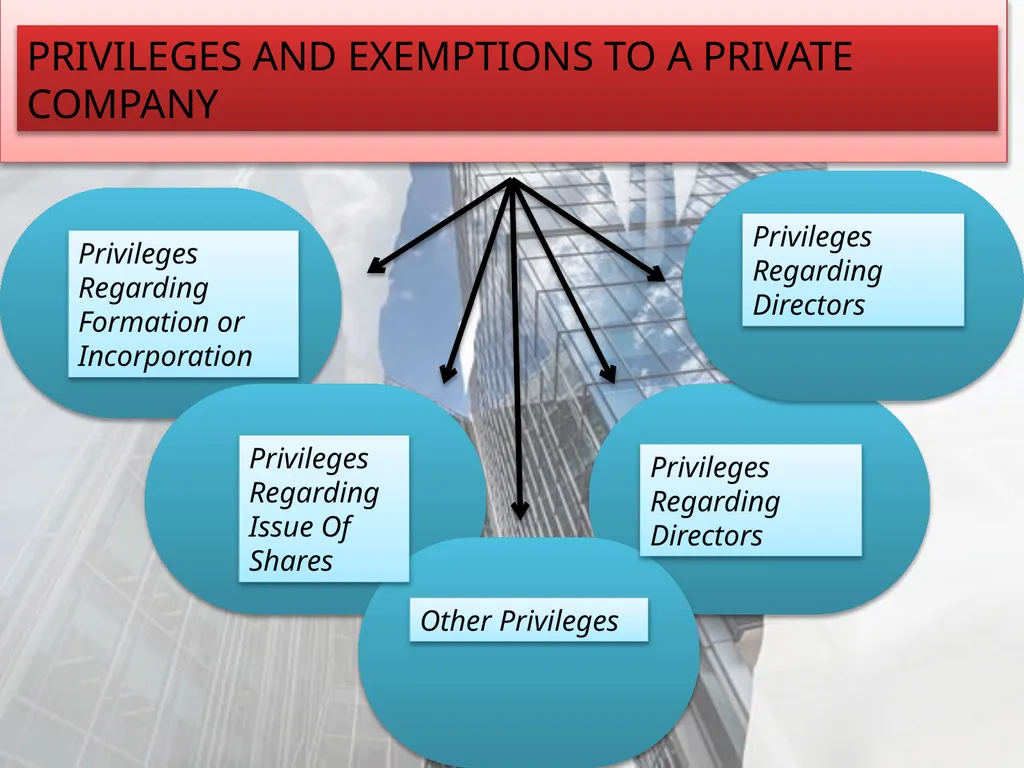
PRIVILEGES AND EXEMPTIONS TO A PRIVATE COMPANY Privileges Regarding Formation or Incorporation Privileges Regarding Issue Of Shares Privileges Regarding Directors Privileges Regarding Directors Other Privileges<br>