
TYPES OF ENVIRONMENTAL ISSUES- COPY SLIDES A, B,


Description: TYPES OF ENVIRONMENTAL ISSUES- COPY SLIDES A, B, C, AND D. https:ourworldindata.org The environment plays a crucial role in the sustainability of life as we know it here on Earth. All living things depend on the planets resources to
Related Topics
Download Presentation
"TYPES OF ENVIRONMENTAL ISSUES- COPY SLIDES A, B," is the property of its rightful owner. Permission is granted to download and print the materials on this website for personal, non-commercial use only, and to display it on your personal computer provided you do not modify the materials and that you retain all copyright notices contained in the materials. By downloading content from our website, you accept the terms of this agreement.
Presentation Transcript
slide1. TYPES OF ENVIRONMENTAL ISSUES- COPY SLIDES A, B, C, AND D. https://ourworldindata.org/<br>
slide2. The environment plays a crucial role in the sustainability of life as we know it here on Earth. All living things depend on the planet's resources to survive and, if humans continue to pollute and over-use these resources, they may be completely destroyed or depleted in a matter of years. Recently, a number of environmental issues have risen to new heights, affecting economies and policies worldwide.<br>
slide3. The U.S. is just one of many countries suffering from—and contributing to—these effects. From air pollution to the depletion of non-renewable resources, the nation is beginning to recognize and address environmental issues within its borders.<br>
slide4. 1. Deforestation
Each year, the U.S. population grows by more than 1,700,000 people. And each person, statistically speaking, requires an additional acre of land and highways. This rapid influx of people has increased the demand for urbanization, resulting in a troubling rise in deforestation as we seek to find more land on which to build. Of course, using the land to house more and more people means less open land and farmland, more overcrowding and a huge loss of biodiversity and animal habitats all over the country.<br>
slide5. 2. Air Pollution
While air quality has improved greatly in the last 50 years, it still remains an issue in many major cities with large populations. Sunny California is particularly pressed to improve its air quality. Last year, the top 12 U.S. cities with the most polluted ozone were all located in California. And, by year-round particle pollution, three California cities tied for first place as the most polluted. So, while the U.S. may not struggle with air pollution as much as India or China, we still have much room for improvement.<br>
slide6. 3. Global Warming
Of all the current environmental issues in the U.S., global warming may be the most notable because its effects are so far-reaching. From melting glaciers to more intense hurricanes, Earth’s rising temperatures are causing any number of negative effects on both local climates, weather patterns, and nearly every community in the U.S. and on the planet as a whole.
The issue even contributes to air pollution as spikes in temperature spark wildfires across the nation. Just take a look at Australia’s recent blazes and its struggle with air pollution. These fires burn for months, releasing carbon and particulate matter into the air. Moreover, wildfires destroy crops and wildlife habitats, exacerbating food shortages and the loss of biodiversity.<br>
slide7. 4. Water Pollution
While the Environmental Protection Agency (EPA) does a relatively good job of regulating drinking water quality, our lakes, oceans and rivers are still suffering a great deal of water pollution. On a global scale, people dump two million tons of sewage into waterways every single day. Plus, pesticides and other chemicals on land often add to water and drainage runoff that funnels into these waterways, putting chemicals in our main bodies of water and drinking sources.
And some pollutants, like microplastics and dissolved metals and medications, are difficult to remove even through industrial wastewater purification processes. Additionally, abandoned U.S. mines continue to release pollutants into waterways. In Colorado alone, mines have polluted 2,300 kilometers of streams.<br>
slide8. 5. Natural Resource Depletion
The demand for resources will only grow as the U.S. population continues to increase. Energy and water demand, in particular, are set to grow by 50 percent in the next 10 years, intensifying resource stresses and bringing new uncertainties to our sustainability as a nation and international relations. Agricultural commodities will also remain tight over the next decade as the U.S. turns farmland into urban communities. Non-renewable materials like oil, minerals and metals will also continue to vanish over time. How much longer until there are no more of these resources left?
Worried Enough to Do Something?
If the U.S. carries on with urbanization at its current breakneck pace, biodiversity, natural resources, trade agreements and the economy will likely continue to suffer. However, as Americans become increasingly aware of environmental issues and their effects on their personal well-being, more people are beginning to take action to slow these effects.<br>
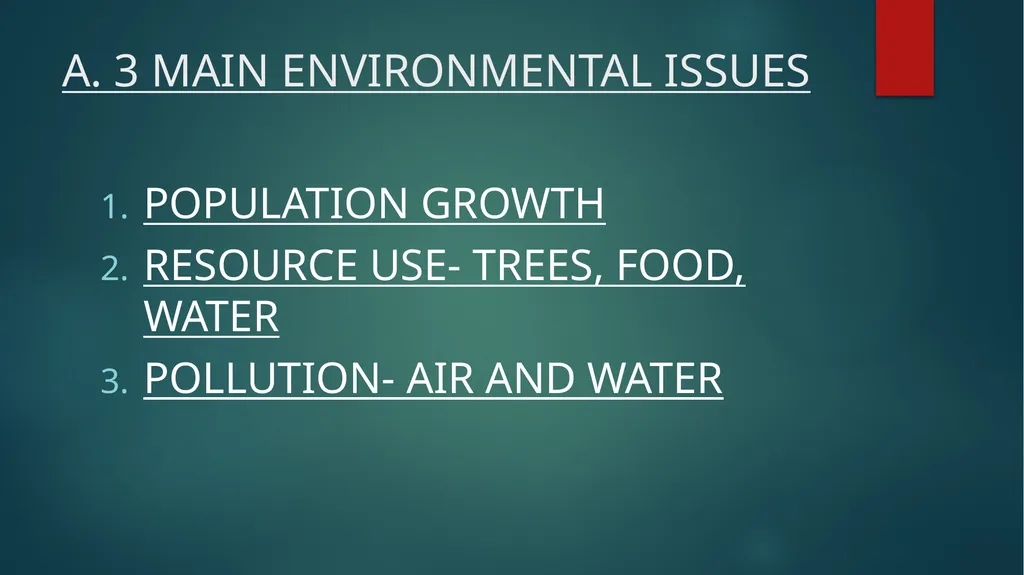
slide9. A. 3 MAIN ENVIRONMENTAL ISSUES POPULATION GROWTH
RESOURCE USE- TREES, FOOD, WATER
POLLUTION- AIR AND WATER<br>
slide10. POPULATION GROWTH<br>
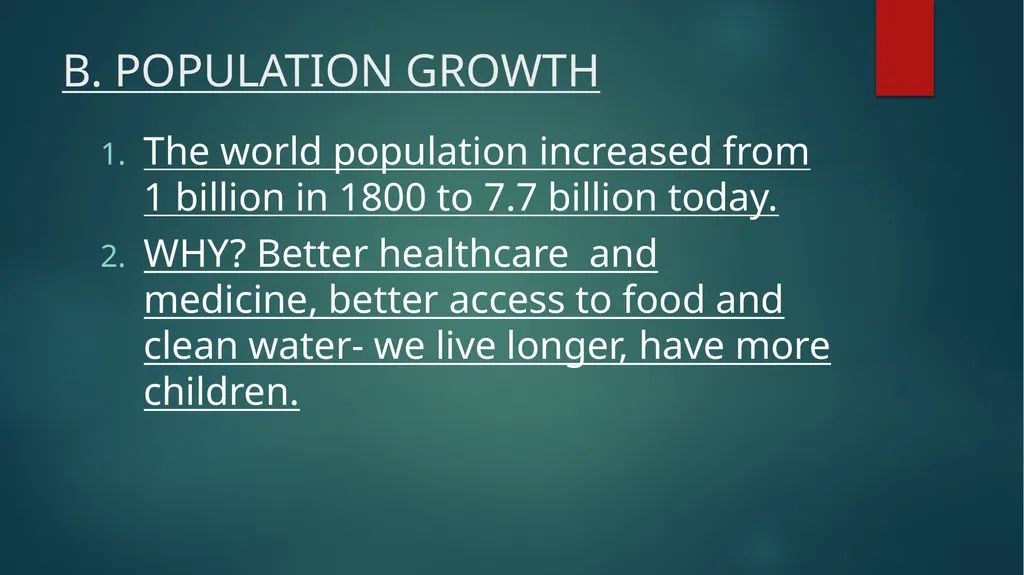
slide11. B. POPULATION GROWTH The world population increased from 1 billion in 1800 to 7.7 billion today.
WHY? Better healthcare and medicine, better access to food and clean water- we live longer, have more children.<br>
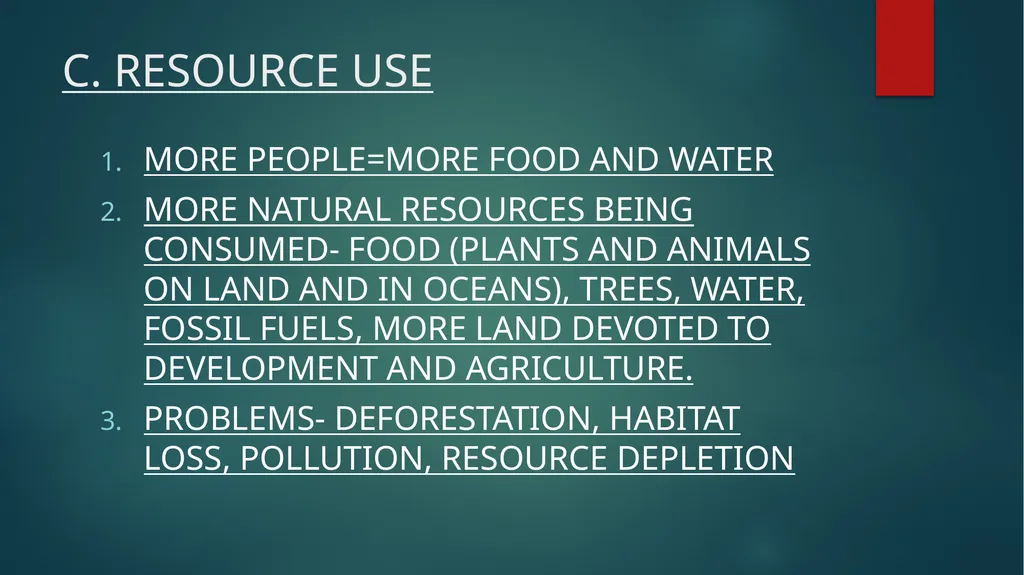
slide12. C. RESOURCE USE MORE PEOPLE=MORE FOOD AND WATER
MORE NATURAL RESOURCES BEING CONSUMED- FOOD (PLANTS AND ANIMALS ON LAND AND IN OCEANS), TREES, WATER, FOSSIL FUELS, MORE LAND DEVOTED TO DEVELOPMENT AND AGRICULTURE.
PROBLEMS- DEFORESTATION, HABITAT LOSS, POLLUTION, RESOURCE DEPLETION<br>
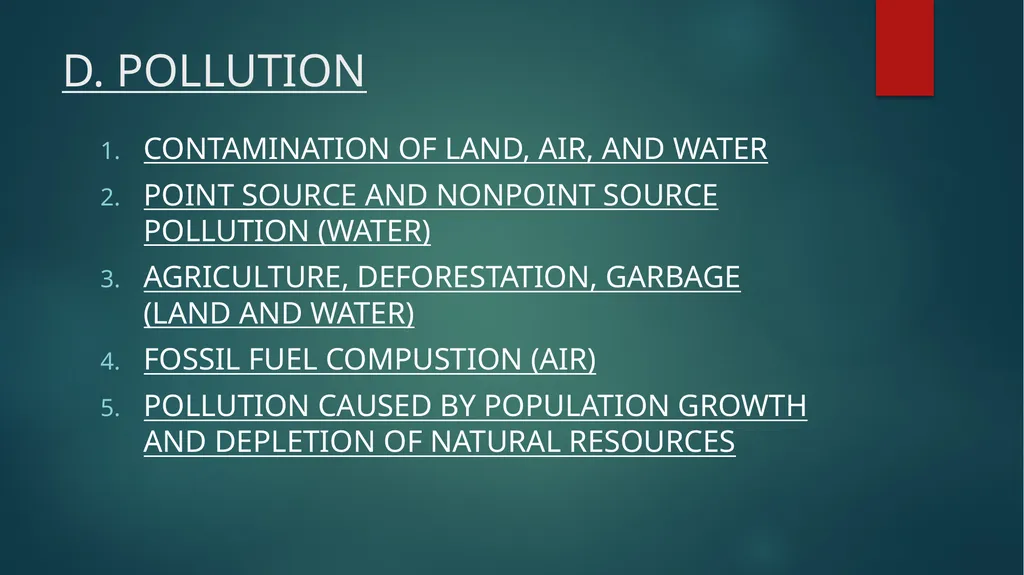
slide13. D. POLLUTION CONTAMINATION OF LAND, AIR, AND WATER
POINT SOURCE AND NONPOINT SOURCE POLLUTION (WATER)
AGRICULTURE, DEFORESTATION, GARBAGE (LAND AND WATER)
FOSSIL FUEL COMPUSTION (AIR)
POLLUTION CAUSED BY POPULATION GROWTH AND DEPLETION OF NATURAL RESOURCES<br>
slide2. The environment plays a crucial role in the sustainability of life as we know it here on Earth. All living things depend on the planet's resources to survive and, if humans continue to pollute and over-use these resources, they may be completely destroyed or depleted in a matter of years. Recently, a number of environmental issues have risen to new heights, affecting economies and policies worldwide.<br>
slide3. The U.S. is just one of many countries suffering from—and contributing to—these effects. From air pollution to the depletion of non-renewable resources, the nation is beginning to recognize and address environmental issues within its borders.<br>
slide4. 1. Deforestation
Each year, the U.S. population grows by more than 1,700,000 people. And each person, statistically speaking, requires an additional acre of land and highways. This rapid influx of people has increased the demand for urbanization, resulting in a troubling rise in deforestation as we seek to find more land on which to build. Of course, using the land to house more and more people means less open land and farmland, more overcrowding and a huge loss of biodiversity and animal habitats all over the country.<br>
slide5. 2. Air Pollution
While air quality has improved greatly in the last 50 years, it still remains an issue in many major cities with large populations. Sunny California is particularly pressed to improve its air quality. Last year, the top 12 U.S. cities with the most polluted ozone were all located in California. And, by year-round particle pollution, three California cities tied for first place as the most polluted. So, while the U.S. may not struggle with air pollution as much as India or China, we still have much room for improvement.<br>
slide6. 3. Global Warming
Of all the current environmental issues in the U.S., global warming may be the most notable because its effects are so far-reaching. From melting glaciers to more intense hurricanes, Earth’s rising temperatures are causing any number of negative effects on both local climates, weather patterns, and nearly every community in the U.S. and on the planet as a whole.
The issue even contributes to air pollution as spikes in temperature spark wildfires across the nation. Just take a look at Australia’s recent blazes and its struggle with air pollution. These fires burn for months, releasing carbon and particulate matter into the air. Moreover, wildfires destroy crops and wildlife habitats, exacerbating food shortages and the loss of biodiversity.<br>
slide7. 4. Water Pollution
While the Environmental Protection Agency (EPA) does a relatively good job of regulating drinking water quality, our lakes, oceans and rivers are still suffering a great deal of water pollution. On a global scale, people dump two million tons of sewage into waterways every single day. Plus, pesticides and other chemicals on land often add to water and drainage runoff that funnels into these waterways, putting chemicals in our main bodies of water and drinking sources.
And some pollutants, like microplastics and dissolved metals and medications, are difficult to remove even through industrial wastewater purification processes. Additionally, abandoned U.S. mines continue to release pollutants into waterways. In Colorado alone, mines have polluted 2,300 kilometers of streams.<br>
slide8. 5. Natural Resource Depletion
The demand for resources will only grow as the U.S. population continues to increase. Energy and water demand, in particular, are set to grow by 50 percent in the next 10 years, intensifying resource stresses and bringing new uncertainties to our sustainability as a nation and international relations. Agricultural commodities will also remain tight over the next decade as the U.S. turns farmland into urban communities. Non-renewable materials like oil, minerals and metals will also continue to vanish over time. How much longer until there are no more of these resources left?
Worried Enough to Do Something?
If the U.S. carries on with urbanization at its current breakneck pace, biodiversity, natural resources, trade agreements and the economy will likely continue to suffer. However, as Americans become increasingly aware of environmental issues and their effects on their personal well-being, more people are beginning to take action to slow these effects.<br>
slide9. A. 3 MAIN ENVIRONMENTAL ISSUES POPULATION GROWTH
RESOURCE USE- TREES, FOOD, WATER
POLLUTION- AIR AND WATER<br>
slide10. POPULATION GROWTH<br>
slide11. B. POPULATION GROWTH The world population increased from 1 billion in 1800 to 7.7 billion today.
WHY? Better healthcare and medicine, better access to food and clean water- we live longer, have more children.<br>
slide12. C. RESOURCE USE MORE PEOPLE=MORE FOOD AND WATER
MORE NATURAL RESOURCES BEING CONSUMED- FOOD (PLANTS AND ANIMALS ON LAND AND IN OCEANS), TREES, WATER, FOSSIL FUELS, MORE LAND DEVOTED TO DEVELOPMENT AND AGRICULTURE.
PROBLEMS- DEFORESTATION, HABITAT LOSS, POLLUTION, RESOURCE DEPLETION<br>
slide13. D. POLLUTION CONTAMINATION OF LAND, AIR, AND WATER
POINT SOURCE AND NONPOINT SOURCE POLLUTION (WATER)
AGRICULTURE, DEFORESTATION, GARBAGE (LAND AND WATER)
FOSSIL FUEL COMPUSTION (AIR)
POLLUTION CAUSED BY POPULATION GROWTH AND DEPLETION OF NATURAL RESOURCES<br>