UK Ireland Programming Contest 2026 UKIEPC 2026 Problem Solutions Contest Walkthrough Reference Guide Presented by the UKIEPC 2026 Jury Problem A: Austere Sign Time Complexity: O(N Σ log Σ) O(N) Adjust the letters on a sign to use
"UK & Ireland Programming Contest 2026 UKIEPC 2026" is the property of its rightful owner. Permission is granted to
download and print the materials on this website for personal, non-commercial use only, and to display it
on your personal computer provided you do not modify the materials and that you retain all copyright
notices contained in the materials. By downloading content from our website, you accept the terms of this
agreement.
Presentation Transcript
01
UK & Ireland Programming Contest 2026 UKIEPC 2026 Problem Solutions Contest Walkthrough & Reference Guide Presented by the UKIEPC 2026 Jury<br>
02
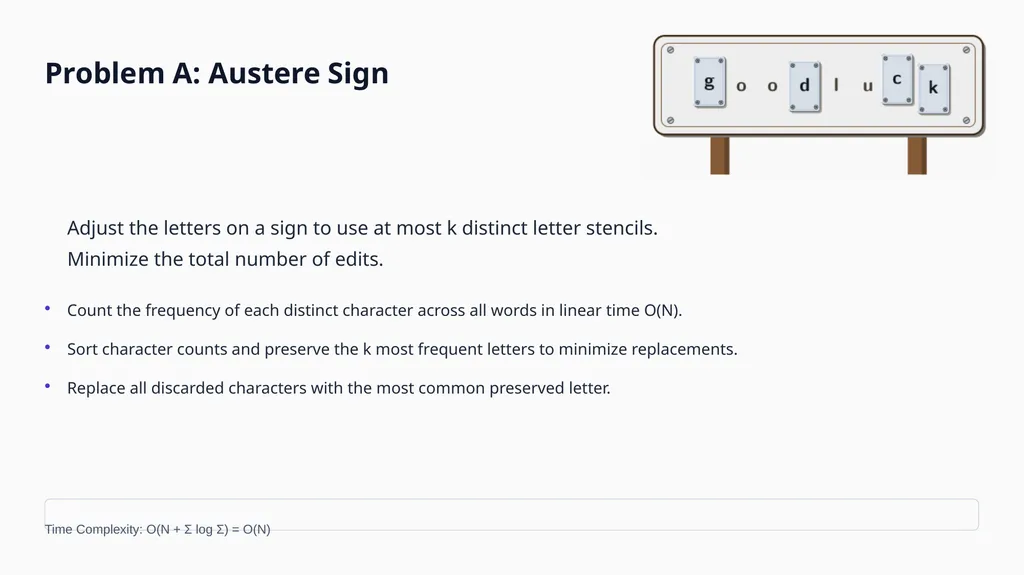
Problem A: Austere Sign Time Complexity: O(N + Σ log Σ) = O(N) Adjust the letters on a sign to use at most k distinct letter stencils.
Minimize the total number of edits. • Count the frequency of each distinct character across all words in linear time O(N). • Sort character counts and preserve the k most frequent letters to minimize replacements. • Replace all discarded characters with the most common preserved letter.<br>
03
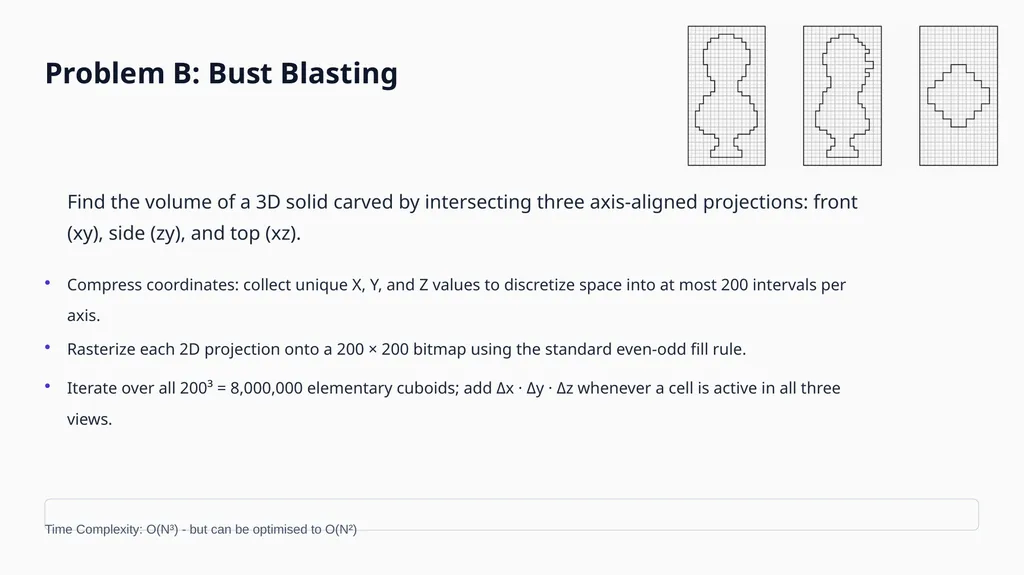
Problem B: Bust Blasting Time Complexity: O(N³) - but can be optimised to O(N²) Find the volume of a 3D solid carved by intersecting three axis-aligned projections: front (xy), side (zy), and top (xz). • Compress coordinates: collect unique X, Y, and Z values to discretize space into at most 200 intervals per axis. • Rasterize each 2D projection onto a 200 × 200 bitmap using the standard even-odd fill rule. • Iterate over all 200³ = 8,000,000 elementary cuboids; add Δx · Δy · Δz whenever a cell is active in all three views.<br>
04
Problem C: Cryptlet Time Complexity: O(|X| + KK) Solve the cryptarithm X + Y = Z where operands have up to 1,000 digits but use only 5 distinct letters (a through e). • Assigning 5 distinct digits from 0–9 yields only 10! / 5! = 30,240 candidate permutations to test. • Precompute base-10 positional weight sums for each letter modulo large primes in linear time O(|X|). • Check linear combinations in O(1) time per permutation; verify candidates with 2 additional primes.<br>
05
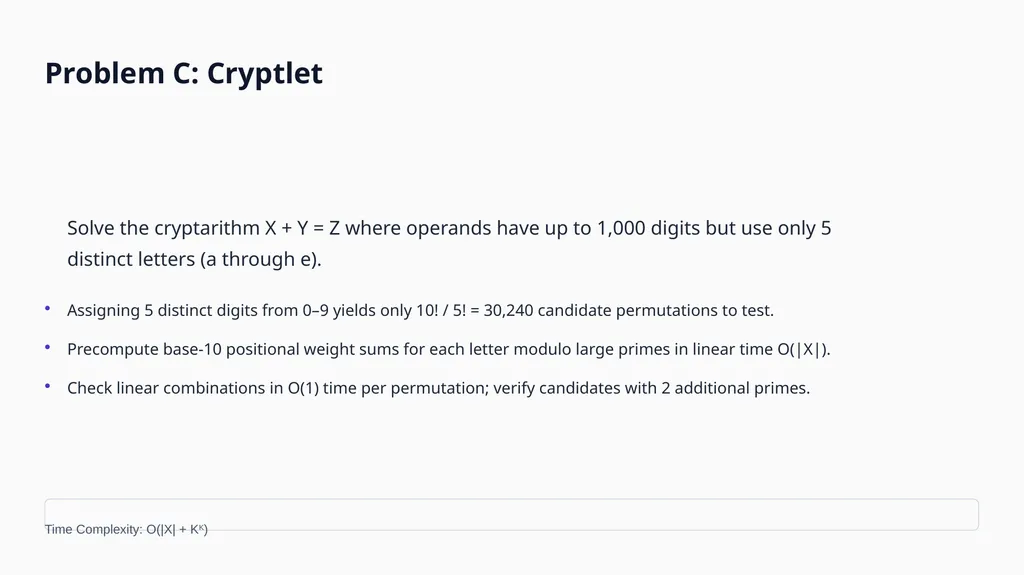
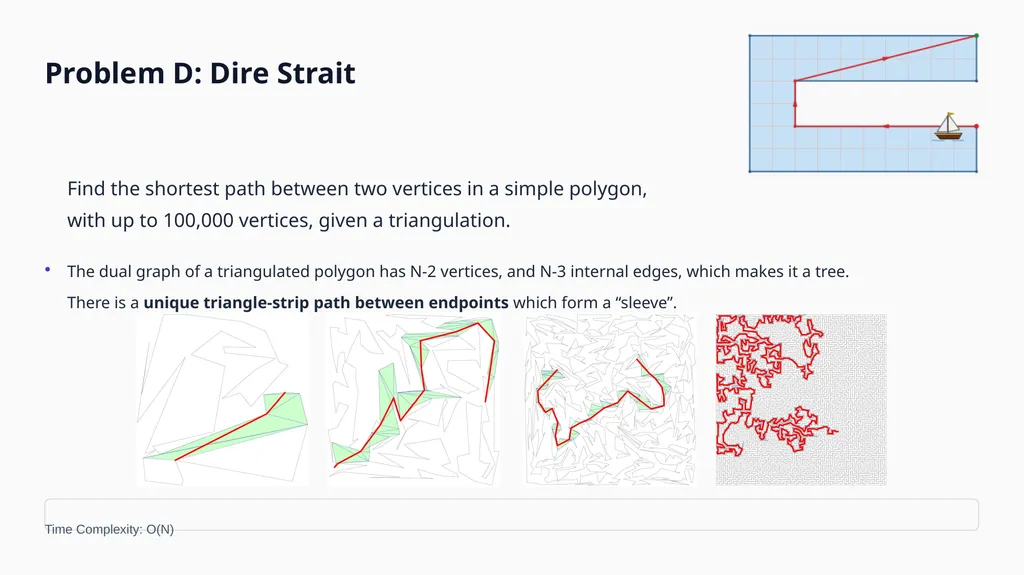
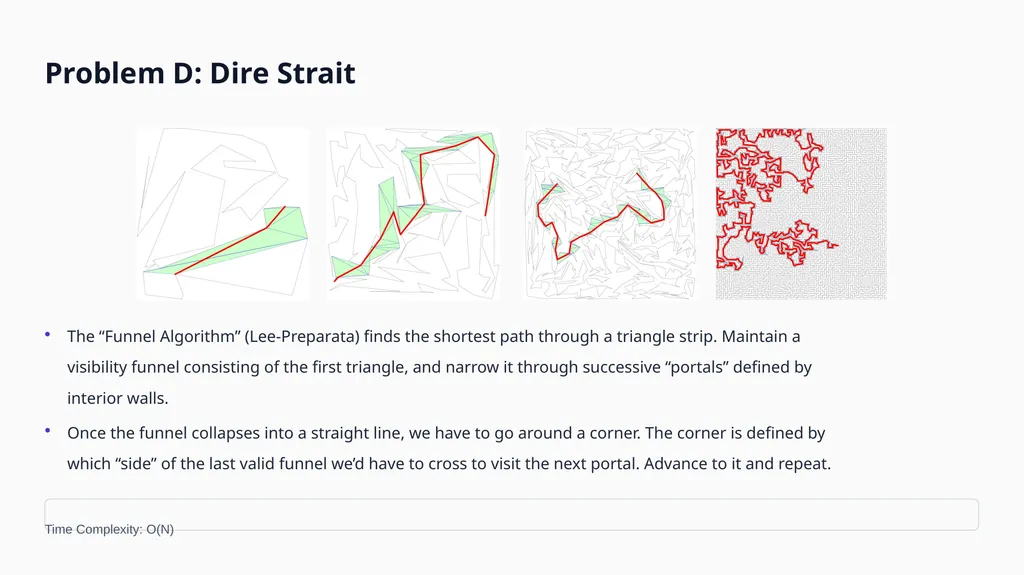
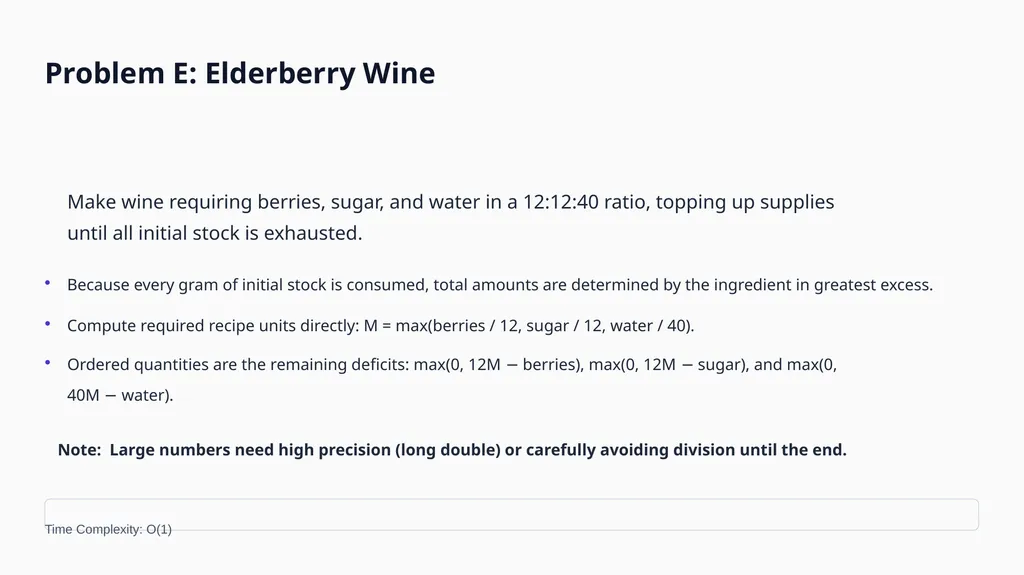
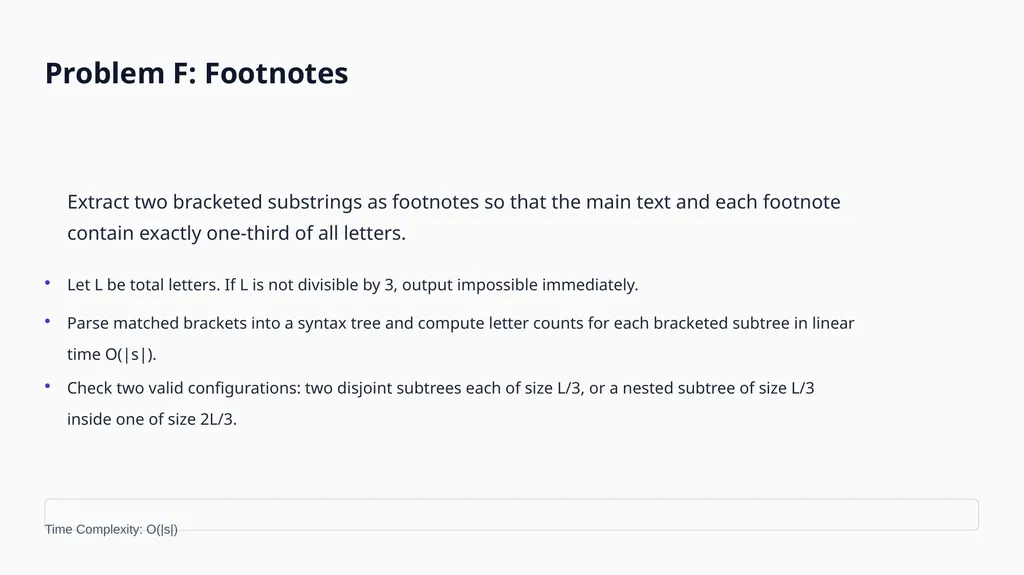
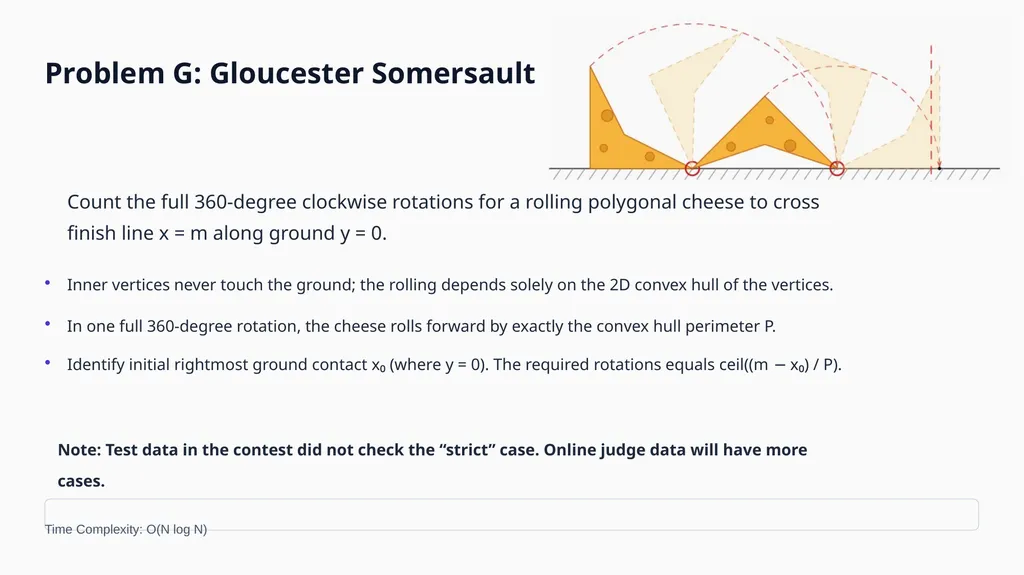
Problem D: Dire Strait Time Complexity: O(N) Find the shortest path between two vertices in a simple polygon,
with up to 100,000 vertices, given a triangulation. • The dual graph of a triangulated polygon has N-2 vertices, and N-3 internal edges, which makes it a tree. There is a unique triangle-strip path between endpoints which form a “sleeve”.<br>
06
Problem D: Dire Strait Time Complexity: O(N) The “Funnel Algorithm” (Lee-Preparata) finds the shortest path through a triangle strip. Maintain a visibility funnel consisting of the first triangle, and narrow it through successive “portals” defined by interior walls. • • Once the funnel collapses into a straight line, we have to go around a corner. The corner is defined by which “side” of the last valid funnel we’d have to cross to visit the next portal. Advance to it and repeat.<br>
07
Problem E: Elderberry Wine Time Complexity: O(1) Make wine requiring berries, sugar, and water in a 12:12:40 ratio, topping up supplies until all initial stock is exhausted. • Because every gram of initial stock is consumed, total amounts are determined by the ingredient in greatest excess. • Compute required recipe units directly: M = max(berries / 12, sugar / 12, water / 40). • Ordered quantities are the remaining deficits: max(0, 12M − berries), max(0, 12M − sugar), and max(0, 40M − water). Note: Large numbers need high precision (long double) or carefully avoiding division until the end.<br>
08
Problem F: Footnotes Time Complexity: O(|s|) Extract two bracketed substrings as footnotes so that the main text and each footnote contain exactly one-third of all letters. • Let L be total letters. If L is not divisible by 3, output impossible immediately. • Parse matched brackets into a syntax tree and compute letter counts for each bracketed subtree in linear time O(|s|). • Check two valid configurations: two disjoint subtrees each of size L/3, or a nested subtree of size L/3 inside one of size 2L/3.<br>
09
Problem G: Gloucester Somersault Time Complexity: O(N log N) Count the full 360-degree clockwise rotations for a rolling polygonal cheese to cross finish line x = m along ground y = 0. • Inner vertices never touch the ground; the rolling depends solely on the 2D convex hull of the vertices. • In one full 360-degree rotation, the cheese rolls forward by exactly the convex hull perimeter P. • Identify initial rightmost ground contact x₀ (where y = 0). The required rotations equals ceil((m − x₀) / P). Note: Test data in the contest did not check the “strict” case. Online judge data will have more cases.<br>
10
Problem H: Hoptimisation Time Complexity: O(N + 2^k · k) Order up to 16 distinct cell names along a 1D hopscotch line to minimize the total travel distance across N consecutive hops. • This is the NP-hard Minimum Linear Arrangement problem. Since k ≤ 16 allows us to use an exponential-time algorithm, we can still solve it exactly. • Rewrite total hopping distance as the sum of “cutting across” all cell boundaries between all hops. • Evaluate DP over 2¹⁶ subsets: dp[mask] = min(dp[mask \ {v}]) + cut_cost[mask] The cut_cost counts edges crossing the boundary between “mask” and “~mask”.<br>
11
Problem I: Inverse Sum Time Complexity: O(√n + d(n²)) // where “d(n)” is the number of divisors of n Find distinct positive integers a and b that minimize a + b subject to 1/n = 1/a + 1/b. • Rearrange 1/n = 1/a + 1/b to ab − na − nb = 0, which factors cleanly into (a − n)(b − n) = n². • Set x = a − n and y = b − n so that x · y = n². The sum to minimize is a + b = 2n + x + y with x ≠ y. • The sum x + y is minimized when divisors are closest. Factor n in O(√n) and use the factorisation to pick the largest divisor x < n of n².<br>
12
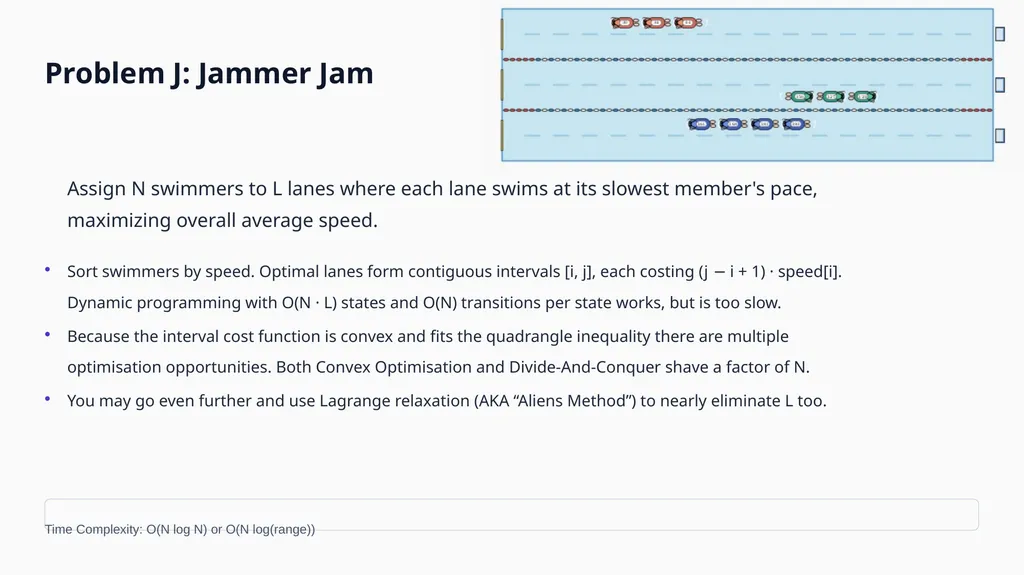
Problem J: Jammer Jam Time Complexity: O(N log N) or O(N log(range)) Assign N swimmers to L lanes where each lane swims at its slowest member's pace, maximizing overall average speed. • Sort swimmers by speed. Optimal lanes form contiguous intervals [i, j], each costing (j − i + 1) · speed[i]. Dynamic programming with O(N · L) states and O(N) transitions per state works, but is too slow. • Because the interval cost function is convex and fits the quadrangle inequality there are multiple optimisation opportunities. Both Convex Optimisation and Divide-And-Conquer shave a factor of N. • You may go even further and use Lagrange relaxation (AKA “Aliens Method”) to nearly eliminate L too.<br>
13
Problem L: Lawn Stripes Time Complexity: O(N²) Direct a lawn roller across an n × n garden so each square metre finishes flattened in its designated cardinal direction in under 10n² moves. • Each cell has out-degree 1 pointing in its required exit direction, making the lawn a directed functional graph. • Following arrows from the starting position leads to a reachable cycle or boundary sink. • Reverse graph edges to form trees rooted at the sink; perform DFS to construct an Euler tour covering all cells within 10n² moves.<br>
14
Problem K: Kilt Quilt Time Complexity: O(N³) Reconstruct a minimum sequence of full horizontal and vertical brush strokes to paint an n × m tartan canvas. • Every cell must be covered: either all rows or all columns must be painted. Assume without loss of generality all rows are painted. • Any unpainted "clean" column reveals the authentic required color of every single row stroke. • Non-matching cells establish strict stroke precedence (row before column or column before row); verify acyclicity via topological sort.<br>
15
Problem M: Mid Clocking Time Complexity: O(N log N + log(range / ε) · log N) Allocate N tasks to S slots in a row to minimize makespan, where processors run at 100% (0 neighbors), 60% (1 neighbor), or 30% (2 neighbors). • Binary search the optimal makespan T with a precision tolerance of 10⁻⁶. • For a candidate time T, classify tasks: duration / 0.6 > T requires 0 neighbors; duration / 0.3 > T requires at most 1 neighbor. • Check feasibility against the optimal periodic layout pattern: isolated singletons, adjacent pairs, and dense 30% blocks.<br>