
Ukrainian grammar against Slavic and typological
A
Published · 53 slides · 0 views

1 / 1


Description
Ukrainian grammar against Slavic and typological background Dmitri Sitchinava Leipzig University Helsinki university mitriusgmail.com Ukrainian An East Slavic language The official state language of Ukraine The native language of about
Related Topics
Share
Embed code
Download this presentation From Below
"Ukrainian grammar against Slavic and typological" is the property of its rightful owner. Permission is granted to download and print the materials on this website for personal, non-commercial use only, and to display it on your personal computer provided you do not modify the materials and that you retain all copyright notices contained in the materials. By downloading content from our website, you accept the terms of this agreement.
Presentation Transcript
01
Ukrainian grammar against Slavic and typological background Dmitri Sitchinava
Leipzig University / Helsinki university
mitrius@gmail.com<br>
Leipzig University / Helsinki university
mitrius@gmail.com<br>
02
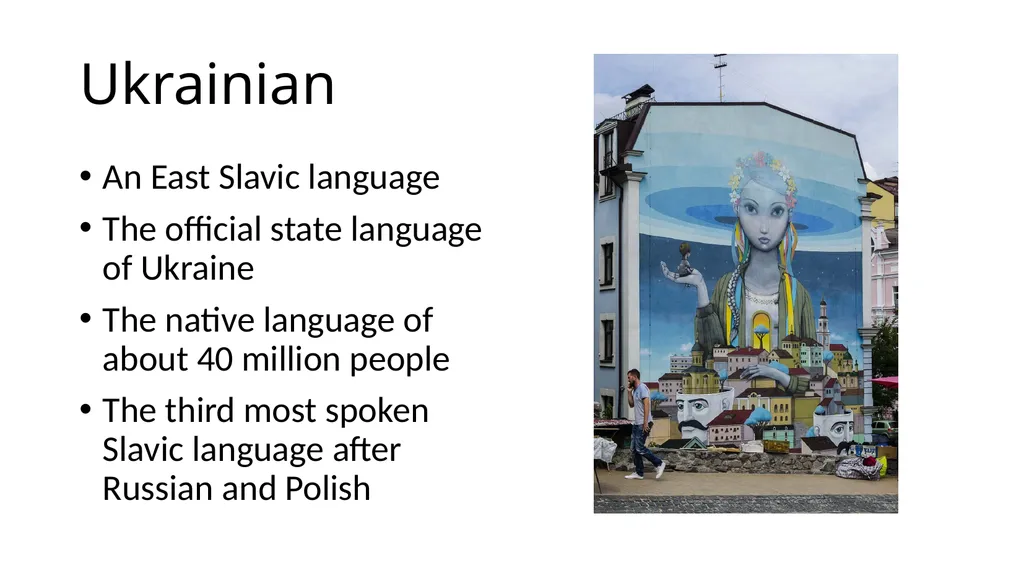
Ukrainian An East Slavic language
The official state language of Ukraine
The native language of about 40 million people
The third most spoken Slavic language after Russian and Polish<br>
The official state language of Ukraine
The native language of about 40 million people
The third most spoken Slavic language after Russian and Polish<br>
03
Ukrainian Descendant of Old East Slavic (called also davnjo-rus’-kyj old-Rus’-ADJ < rus’kyj from Rus’ not Russia; Old Russian, Altrussisch are [at least after 1917] misleading)
A language sharing typological features with most Slavic languages
«free» word order with SVO unmarked; word order is typically topic/focus-marking;
7 cases and 3 genders;
no articles;
Slavic-type aspect (lexical feature) as a pivot verbal category; preverbs marking Perfective;
Future for Perfectives formed as a morphological Present; Past (<Perfect) is a morphological participle with no person marking but agreed in gender
(NB Bulgarian and Macedonian depart from the Slavic standard in that they have articles and a more rich inventory of tenses and lack cases)<br>
A language sharing typological features with most Slavic languages
«free» word order with SVO unmarked; word order is typically topic/focus-marking;
7 cases and 3 genders;
no articles;
Slavic-type aspect (lexical feature) as a pivot verbal category; preverbs marking Perfective;
Future for Perfectives formed as a morphological Present; Past (<Perfect) is a morphological participle with no person marking but agreed in gender
(NB Bulgarian and Macedonian depart from the Slavic standard in that they have articles and a more rich inventory of tenses and lack cases)<br>
04
Ukrainian Archaisms absent in Russian / Belarusian, to cite but a few:
no vowel reduction;
no final devocing;
archaic word stress paradigms;
positional vs. phonological palatalization of consonants
analytic future with TAKE rather than BE;
dual number (in dialects)
Innovations, including contact-induced (dax „roof“, čekaty na kohos’ wait on smb.-ACC < warten auf wait on; Polish; Russian; other)
NB high degree of variation even in the standard language!<br>
no vowel reduction;
no final devocing;
archaic word stress paradigms;
positional vs. phonological palatalization of consonants
analytic future with TAKE rather than BE;
dual number (in dialects)
Innovations, including contact-induced (dax „roof“, čekaty na kohos’ wait on smb.-ACC < warten auf wait on; Polish; Russian; other)
NB high degree of variation even in the standard language!<br>
05
In focus in this talk Grammar (rather than phonology and lexicon)
Typological and areal context
Corpus-based research
Regional norms and regional distribution (see next talk)<br>
Typological and areal context
Corpus-based research
Regional norms and regional distribution (see next talk)<br>
06
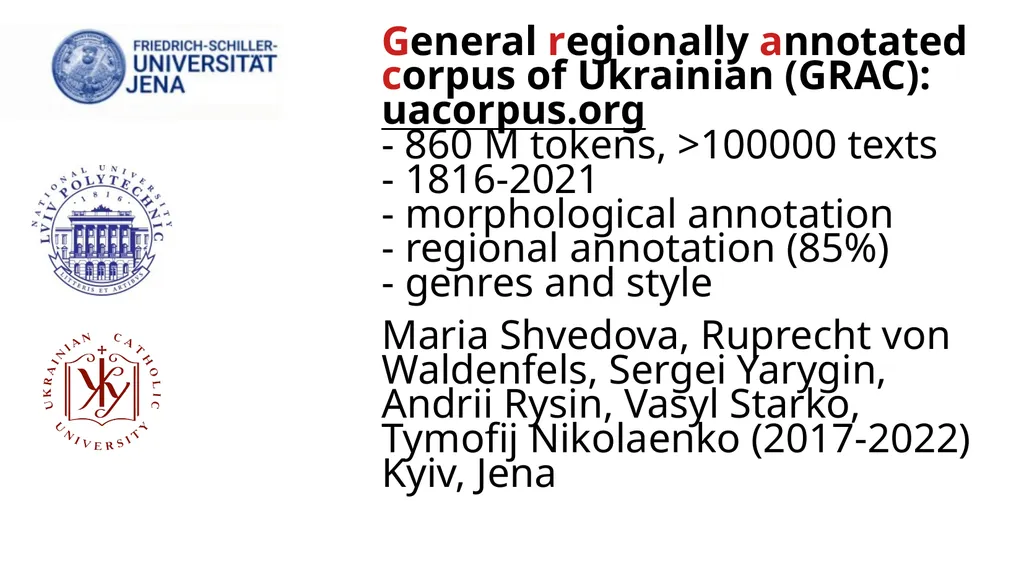
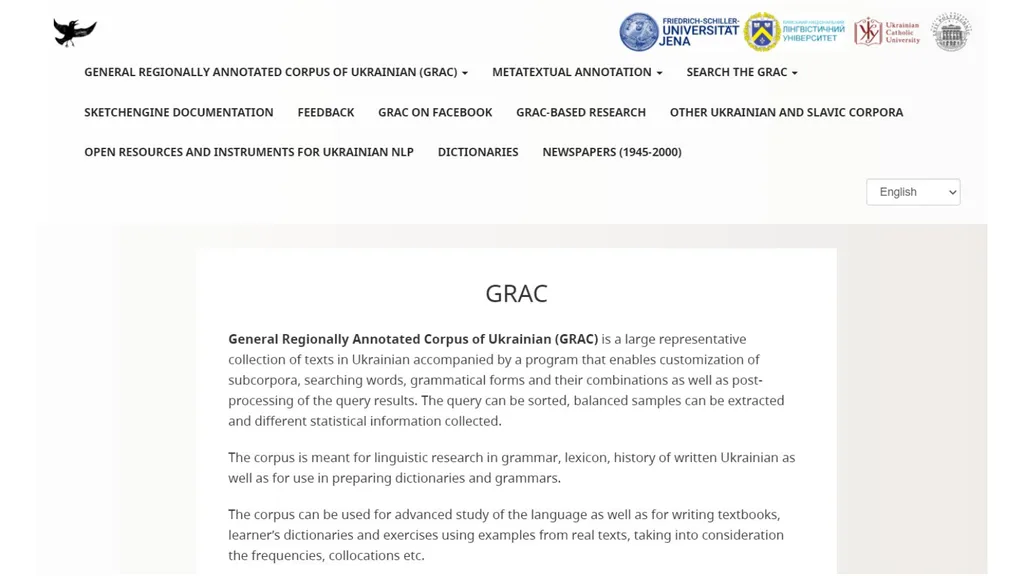
General regionally annotated corpus of Ukrainian (GRAC): uacorpus.org
- 860 M tokens, >100000 texts
- 1816-2021
- morphological annotation
- regional annotation (85%)
- genres and style
Maria Shvedova, Ruprecht von Waldenfels, Sergei Yarygin, Andrii Rysin, Vasyl Starko, Tymofij Nikolaenko (2017-2022) Kyiv, Jena<br>
07
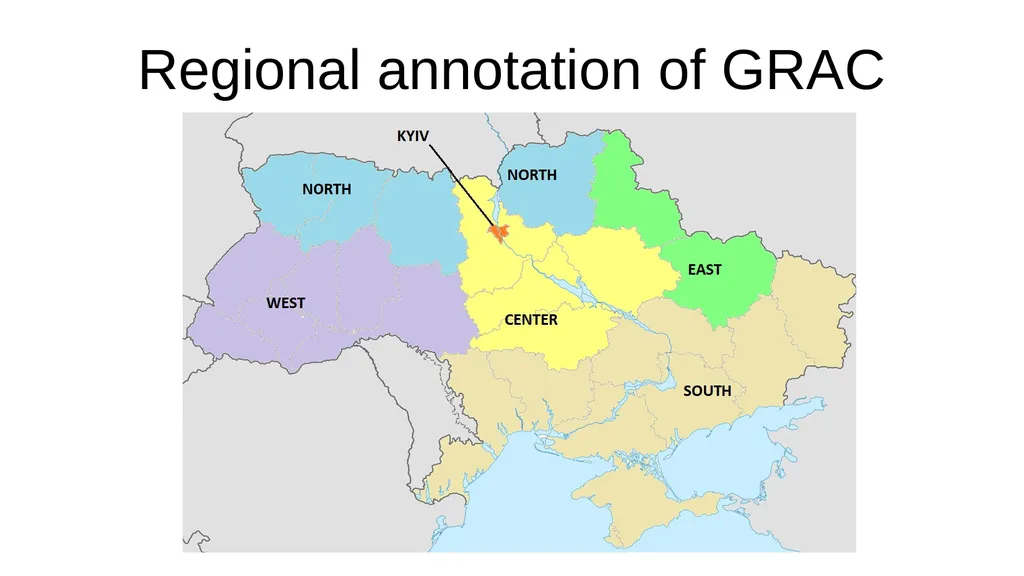
Regional annotation of GRAC<br>
08
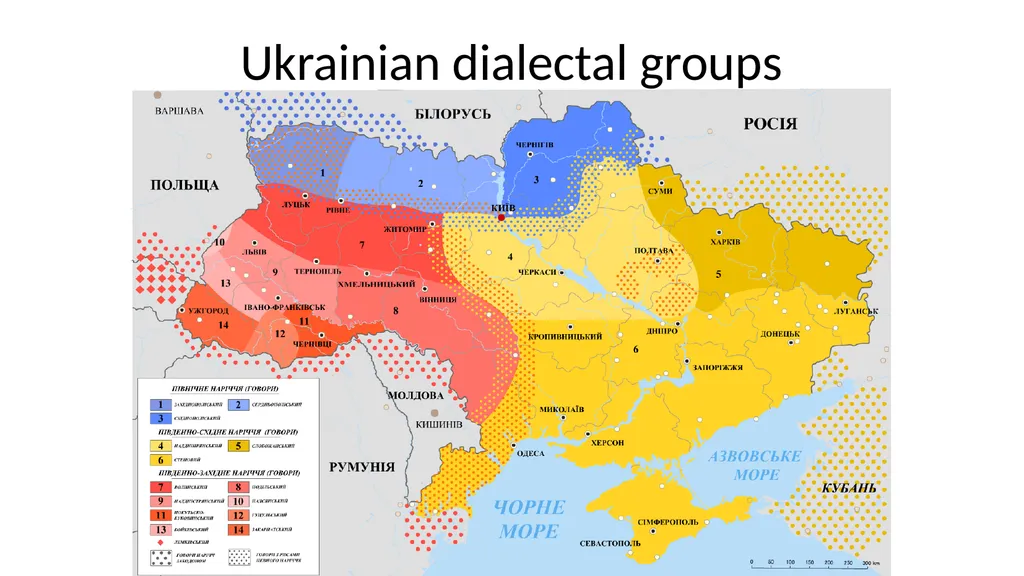
Ukrainian dialectal groups<br>
09
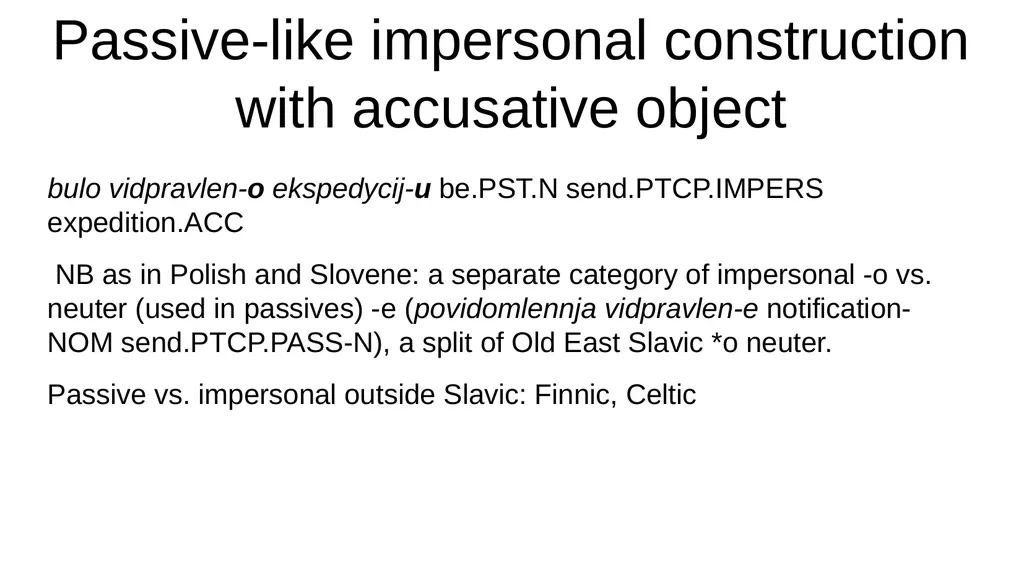
Passive-like impersonal construction with accusative object bulo vidpravlen-o ekspedycij-u be.PST.N send.PTCP.IMPERS expedition.ACC
NB as in Polish and Slovene: a separate category of impersonal -o vs. neuter (used in passives) -e (povidomlennja vidpravlen-e notification-NOM send.PTCP.PASS-N), a split of Old East Slavic *o neuter.
Passive vs. impersonal outside Slavic: Finnic, Celtic<br>
NB as in Polish and Slovene: a separate category of impersonal -o vs. neuter (used in passives) -e (povidomlennja vidpravlen-e notification-NOM send.PTCP.PASS-N), a split of Old East Slavic *o neuter.
Passive vs. impersonal outside Slavic: Finnic, Celtic<br>
10
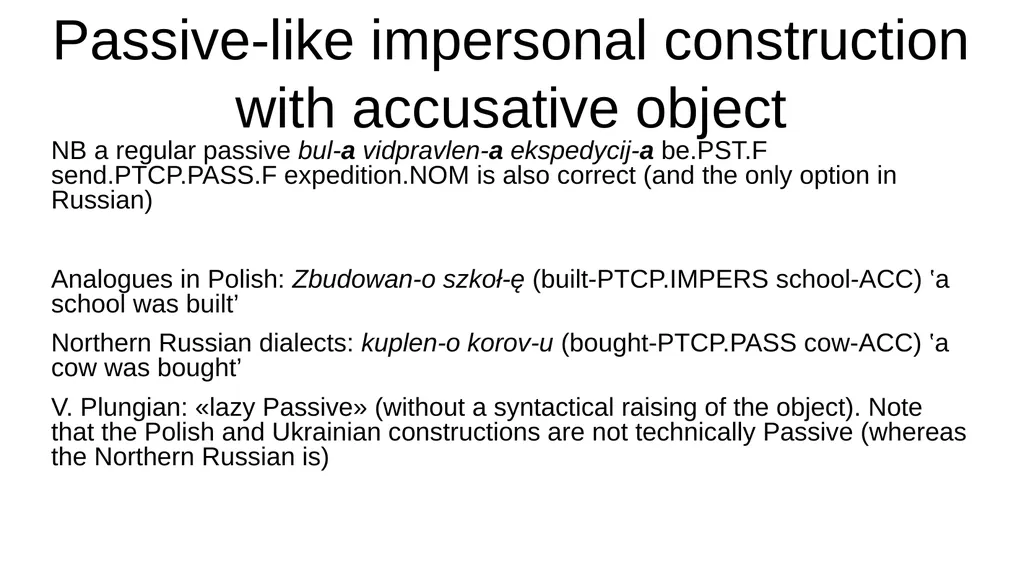
Passive-like impersonal construction with accusative object NB a regular passive bul-a vidpravlen-a ekspedycij-a be.PST.F send.PTCP.PASS.F expedition.NOM is also correct (and the only option in Russian)
Analogues in Polish: Zbudowan-o szkoł-ę (built-PTCP.IMPERS school-ACC) ‛a school was built’
Northern Russian dialects: kuplen-o korov-u (bought-PTCP.PASS cow-ACC) ‛a cow was bought’
V. Plungian: «lazy Passive» (without a syntactical raising of the object). Note that the Polish and Ukrainian constructions are not technically Passive (whereas the Northern Russian is)<br>
Analogues in Polish: Zbudowan-o szkoł-ę (built-PTCP.IMPERS school-ACC) ‛a school was built’
Northern Russian dialects: kuplen-o korov-u (bought-PTCP.PASS cow-ACC) ‛a cow was bought’
V. Plungian: «lazy Passive» (without a syntactical raising of the object). Note that the Polish and Ukrainian constructions are not technically Passive (whereas the Northern Russian is)<br>
11
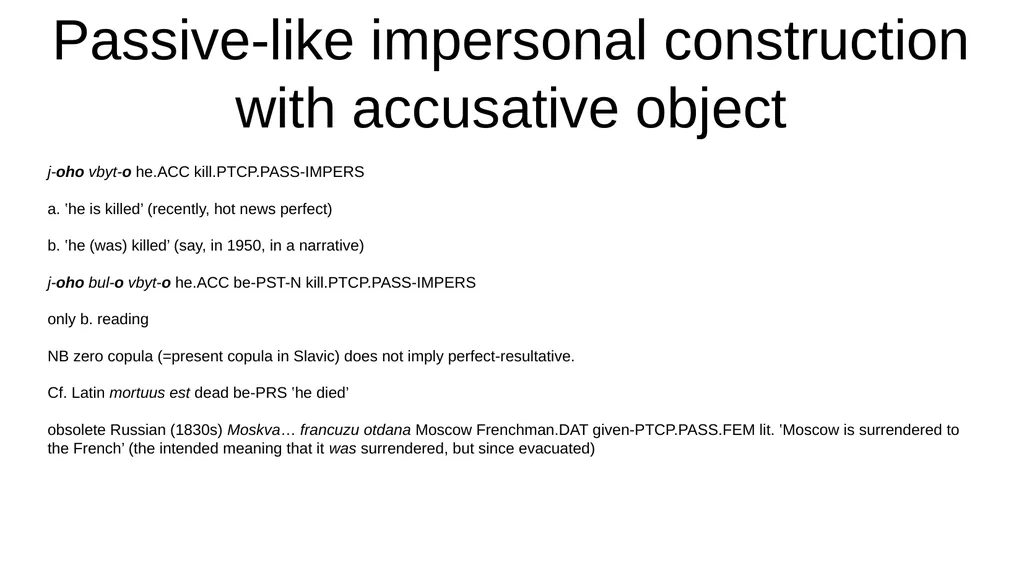
Passive-like impersonal construction with accusative object j-oho vbyt-o he.ACC kill.PTCP.PASS-IMPERS
a. ‛he is killed’ (recently, hot news perfect)
b. ‛he (was) killed’ (say, in 1950, in a narrative)
j-oho bul-o vbyt-o he.ACC be-PST-N kill.PTCP.PASS-IMPERS
only b. reading
NB zero copula (=present copula in Slavic) does not imply perfect-resultative.
Cf. Latin mortuus est dead be-PRS ‛he died’
obsolete Russian (1830s) Moskva… francuzu otdana Moscow Frenchman.DAT given-PTCP.PASS.FEM lit. ‛Moscow is surrendered to the French’ (the intended meaning that it was surrendered, but since evacuated)<br>
a. ‛he is killed’ (recently, hot news perfect)
b. ‛he (was) killed’ (say, in 1950, in a narrative)
j-oho bul-o vbyt-o he.ACC be-PST-N kill.PTCP.PASS-IMPERS
only b. reading
NB zero copula (=present copula in Slavic) does not imply perfect-resultative.
Cf. Latin mortuus est dead be-PRS ‛he died’
obsolete Russian (1830s) Moskva… francuzu otdana Moscow Frenchman.DAT given-PTCP.PASS.FEM lit. ‛Moscow is surrendered to the French’ (the intended meaning that it was surrendered, but since evacuated)<br>
12
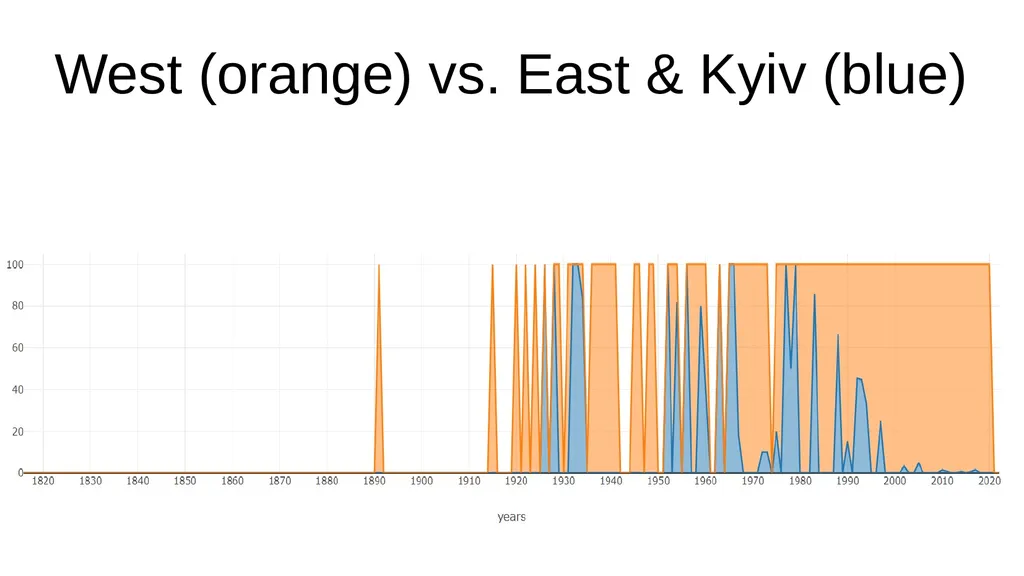
West (orange) vs. East & Kyiv (blue)<br>
13
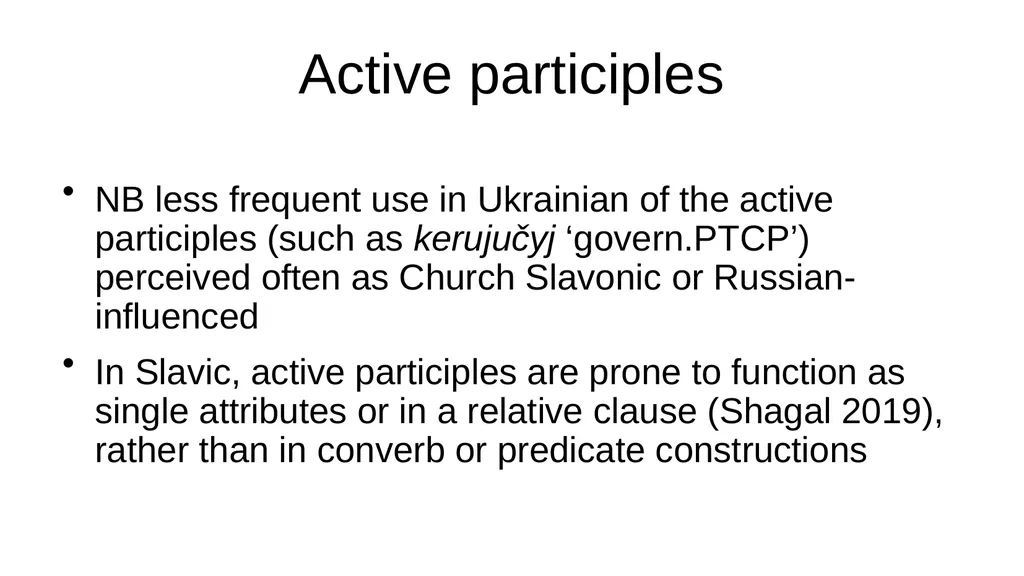
Active participles NB less frequent use in Ukrainian of the active participles (such as kerujučyj ‘govern.PTCP’) perceived often as Church Slavonic or Russian-influenced
In Slavic, active participles are prone to function as single attributes or in a relative clause (Shagal 2019), rather than in converb or predicate constructions<br>
In Slavic, active participles are prone to function as single attributes or in a relative clause (Shagal 2019), rather than in converb or predicate constructions<br>
14
-Jaščij/-juščij active participles Deriving from Church Slavonic with its characteristic feature of -šč- instead of East Slavic cognate -č-
Standard Ukrainian and Belarusian avoid them (as does spoken Russian) in favor of relatives: U toj, ščo… ‘the one that…’, B jaki… ‘which…’ even in single attribute contexts
NB even the inherited ES participial active forms (-č- PRS.PTCP and -š- PST.PTCP) are avoided as ‘too Russian’ syntactically save some lexicalizations (studied by M. Švedova 2020) in single attribute (not relative clause) contexts<br>
Standard Ukrainian and Belarusian avoid them (as does spoken Russian) in favor of relatives: U toj, ščo… ‘the one that…’, B jaki… ‘which…’ even in single attribute contexts
NB even the inherited ES participial active forms (-č- PRS.PTCP and -š- PST.PTCP) are avoided as ‘too Russian’ syntactically save some lexicalizations (studied by M. Švedova 2020) in single attribute (not relative clause) contexts<br>
15
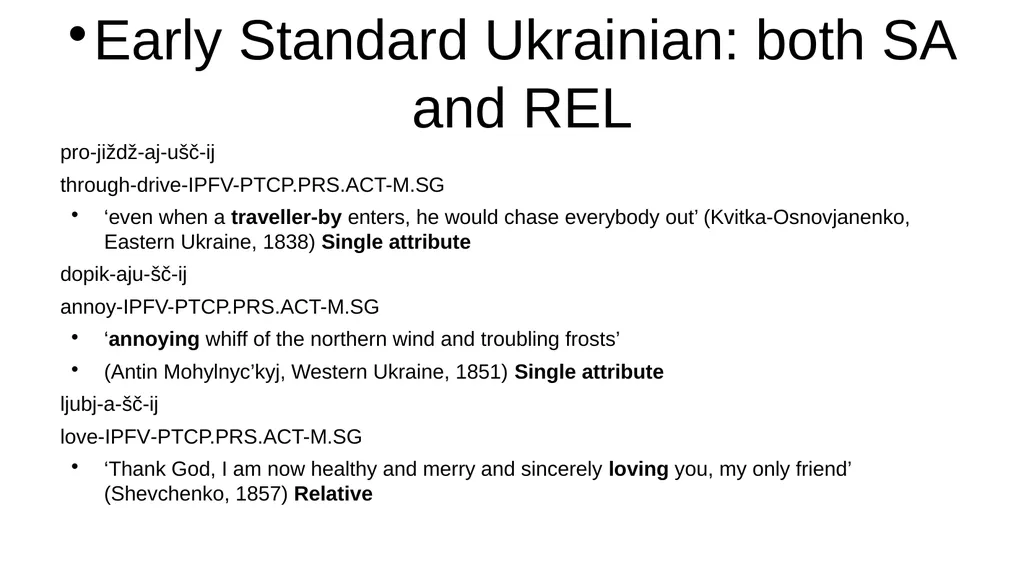
Early Standard Ukrainian: both SA and REL pro-jiždž-aj-ušč-ij
through-drive-IPFV-PTCP.PRS.ACT-M.SG
‘even when a traveller-by enters, he would chase everybody out’ (Kvitka-Osnovjanenko, Eastern Ukraine, 1838) Single attribute
dopik-aju-šč-ij
annoy-IPFV-PTCP.PRS.ACT-M.SG
‘annoying whiff of the northern wind and troubling frosts’
(Antin Mohylnyc’kyj, Western Ukraine, 1851) Single attribute
ljubj-a-šč-ij
love-IPFV-PTCP.PRS.ACT-M.SG
‘Thank God, I am now healthy and merry and sincerely loving you, my only friend’ (Shevchenko, 1857) Relative<br>
through-drive-IPFV-PTCP.PRS.ACT-M.SG
‘even when a traveller-by enters, he would chase everybody out’ (Kvitka-Osnovjanenko, Eastern Ukraine, 1838) Single attribute
dopik-aju-šč-ij
annoy-IPFV-PTCP.PRS.ACT-M.SG
‘annoying whiff of the northern wind and troubling frosts’
(Antin Mohylnyc’kyj, Western Ukraine, 1851) Single attribute
ljubj-a-šč-ij
love-IPFV-PTCP.PRS.ACT-M.SG
‘Thank God, I am now healthy and merry and sincerely loving you, my only friend’ (Shevchenko, 1857) Relative<br>
16
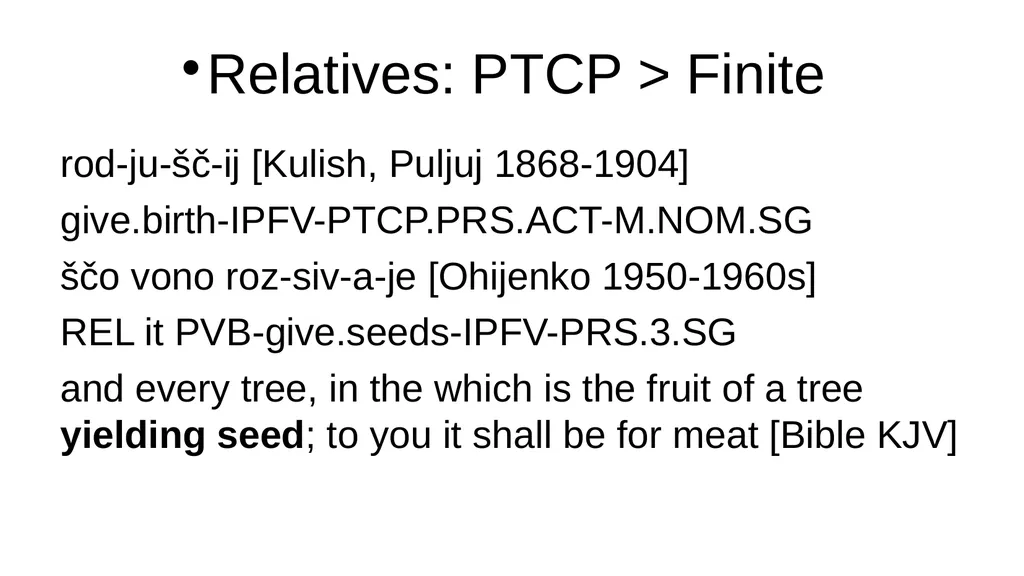
Relatives: PTCP > Finite rod-ju-šč-ij [Kulish, Puljuj 1868-1904]
give.birth-IPFV-PTCP.PRS.ACT-M.NOM.SG
ščo vono roz-siv-a-je [Ohijenko 1950-1960s]
REL it PVB-give.seeds-IPFV-PRS.3.SG
and every tree, in the which is the fruit of a tree yielding seed; to you it shall be for meat [Bible KJV]<br>
give.birth-IPFV-PTCP.PRS.ACT-M.NOM.SG
ščo vono roz-siv-a-je [Ohijenko 1950-1960s]
REL it PVB-give.seeds-IPFV-PRS.3.SG
and every tree, in the which is the fruit of a tree yielding seed; to you it shall be for meat [Bible KJV]<br>
17
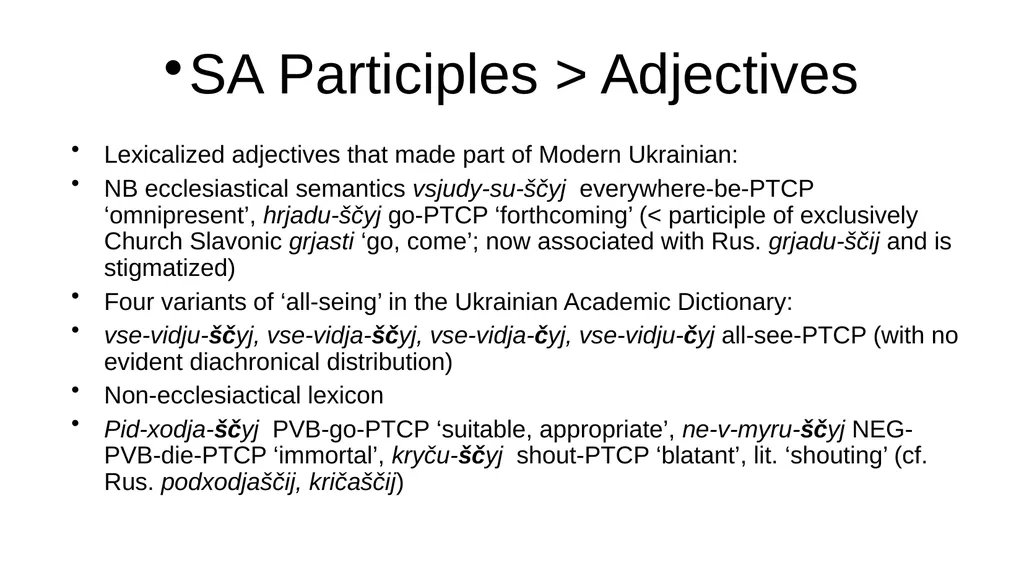
SA Participles > Adjectives Lexicalized adjectives that made part of Modern Ukrainian:
NB ecclesiastical semantics vsjudy-su-ščyj everywhere-be-PTCP ‘omnipresent’, hrjadu-ščyj go-PTCP ‘forthcoming’ (< participle of exclusively Church Slavonic grjasti ‘go, come’; now associated with Rus. grjadu-ščij and is stigmatized)
Four variants of ‘all-seing’ in the Ukrainian Academic Dictionary:
vse-vidju-ščyj, vse-vidja-ščyj, vse-vidja-čyj, vse-vidju-čyj all-see-PTCP (with no evident diachronical distribution)
Non-ecclesiactical lexicon
Pid-xodja-ščyj PVB-go-PTCP ‘suitable, appropriate’, ne-v-myru-ščyj NEG-PVB-die-PTCP ‘immortal’, kryču-ščyj shout-PTCP ‘blatant’, lit. ‘shouting’ (cf. Rus. podxodjaščij, kričaščij)<br>
NB ecclesiastical semantics vsjudy-su-ščyj everywhere-be-PTCP ‘omnipresent’, hrjadu-ščyj go-PTCP ‘forthcoming’ (< participle of exclusively Church Slavonic grjasti ‘go, come’; now associated with Rus. grjadu-ščij and is stigmatized)
Four variants of ‘all-seing’ in the Ukrainian Academic Dictionary:
vse-vidju-ščyj, vse-vidja-ščyj, vse-vidja-čyj, vse-vidju-čyj all-see-PTCP (with no evident diachronical distribution)
Non-ecclesiactical lexicon
Pid-xodja-ščyj PVB-go-PTCP ‘suitable, appropriate’, ne-v-myru-ščyj NEG-PVB-die-PTCP ‘immortal’, kryču-ščyj shout-PTCP ‘blatant’, lit. ‘shouting’ (cf. Rus. podxodjaščij, kričaščij)<br>
18
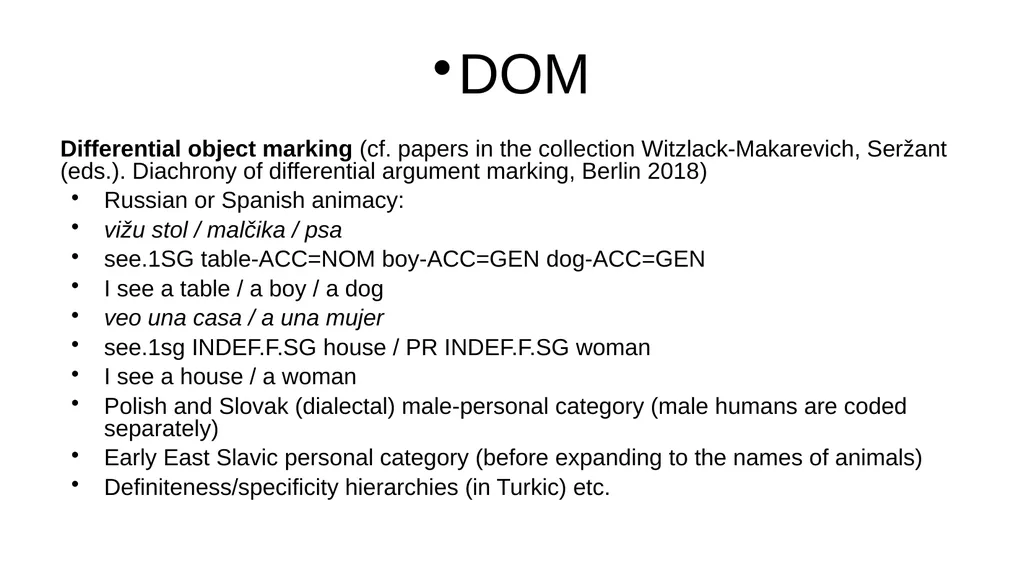
DOM Differential object marking (cf. papers in the collection Witzlack-Makarevich, Seržant (eds.). Diachrony of differential argument marking, Berlin 2018)
Russian or Spanish animacy:
vižu stol / malčika / psa
see.1SG table-ACC=NOM boy-ACC=GEN dog-ACC=GEN
I see a table / a boy / a dog
veo una casa / a una mujer
see.1sg INDEF.F.SG house / PR INDEF.F.SG woman
I see a house / a woman
Polish and Slovak (dialectal) male-personal category (male humans are coded separately)
Early East Slavic personal category (before expanding to the names of animals)
Definiteness/specificity hierarchies (in Turkic) etc.<br>
Russian or Spanish animacy:
vižu stol / malčika / psa
see.1SG table-ACC=NOM boy-ACC=GEN dog-ACC=GEN
I see a table / a boy / a dog
veo una casa / a una mujer
see.1sg INDEF.F.SG house / PR INDEF.F.SG woman
I see a house / a woman
Polish and Slovak (dialectal) male-personal category (male humans are coded separately)
Early East Slavic personal category (before expanding to the names of animals)
Definiteness/specificity hierarchies (in Turkic) etc.<br>
19
Slavic -a-masculine beyond animacy Polish:
widzę papiros-a
see.1sg cigarette-ACC=GEN
mam mercedes-a
have.1sg Mercedes-ACC=GEN
Dialectal and popular (Karas 1979, Banko 2001, Stefanczyk 2007), often rejected by educated speakers
Swan 2002: «mental states; hits and kisses; cars; cigarettes; trademarks; dances; money; plays; gestures; mushrooms; garbage; wine; fruits; varia»<br>
widzę papiros-a
see.1sg cigarette-ACC=GEN
mam mercedes-a
have.1sg Mercedes-ACC=GEN
Dialectal and popular (Karas 1979, Banko 2001, Stefanczyk 2007), often rejected by educated speakers
Swan 2002: «mental states; hits and kisses; cars; cigarettes; trademarks; dances; money; plays; gestures; mushrooms; garbage; wine; fruits; varia»<br>
20
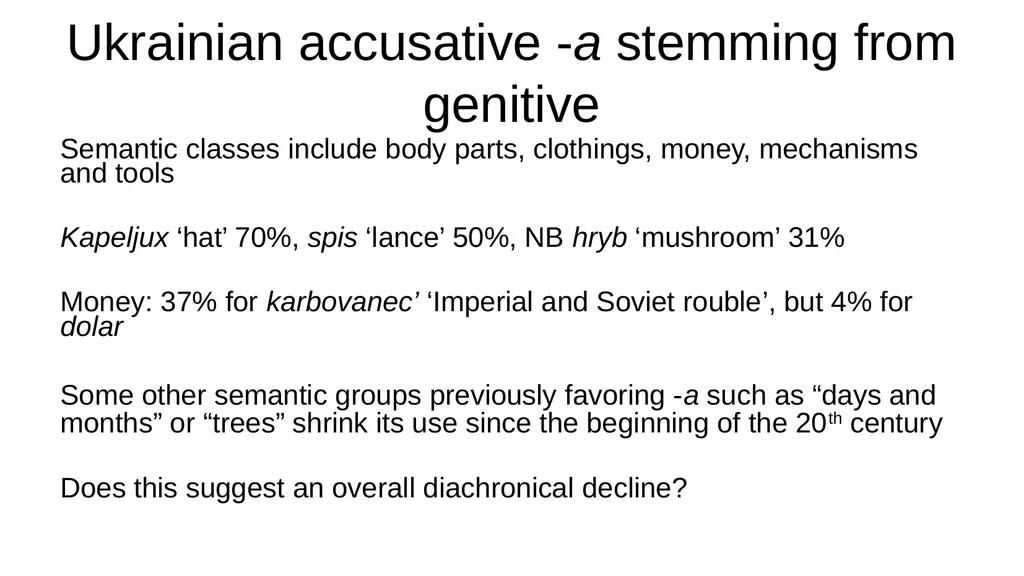
Ukrainian accusative -a stemming from genitive Semantic classes include body parts, clothings, money, mechanisms and tools
Kapeljux ‘hat’ 70%, spis ‘lance’ 50%, NB hryb ‘mushroom’ 31%
Money: 37% for karbovanec’ ‘Imperial and Soviet rouble’, but 4% for dolar
Some other semantic groups previously favoring -a such as “days and months” or “trees” shrink its use since the beginning of the 20th century
Does this suggest an overall diachronical decline?<br>
Kapeljux ‘hat’ 70%, spis ‘lance’ 50%, NB hryb ‘mushroom’ 31%
Money: 37% for karbovanec’ ‘Imperial and Soviet rouble’, but 4% for dolar
Some other semantic groups previously favoring -a such as “days and months” or “trees” shrink its use since the beginning of the 20th century
Does this suggest an overall diachronical decline?<br>
21
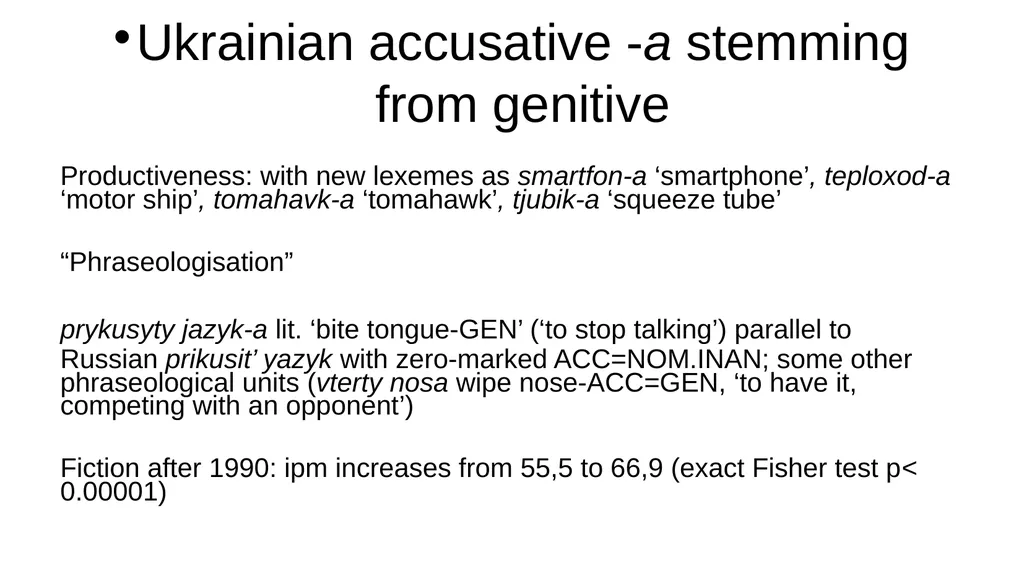
Ukrainian accusative -a stemming from genitive Productiveness: with new lexemes as smartfon-a ‘smartphone’, teploxod-a ‘motor ship’, tomahavk-a ‘tomahawk’, tjubik-a ‘squeeze tube’
“Phraseologisation”
prykusyty jazyk-a lit. ‘bite tongue-GEN’ (‘to stop talking’) parallel to
Russian prikusit’ yazyk with zero-marked ACC=NOM.INAN; some other phraseological units (vterty nosa wipe nose-ACC=GEN, ‘to have it, competing with an opponent’)
Fiction after 1990: ipm increases from 55,5 to 66,9 (exact Fisher test p< 0.00001)<br>
“Phraseologisation”
prykusyty jazyk-a lit. ‘bite tongue-GEN’ (‘to stop talking’) parallel to
Russian prikusit’ yazyk with zero-marked ACC=NOM.INAN; some other phraseological units (vterty nosa wipe nose-ACC=GEN, ‘to have it, competing with an opponent’)
Fiction after 1990: ipm increases from 55,5 to 66,9 (exact Fisher test p< 0.00001)<br>
22
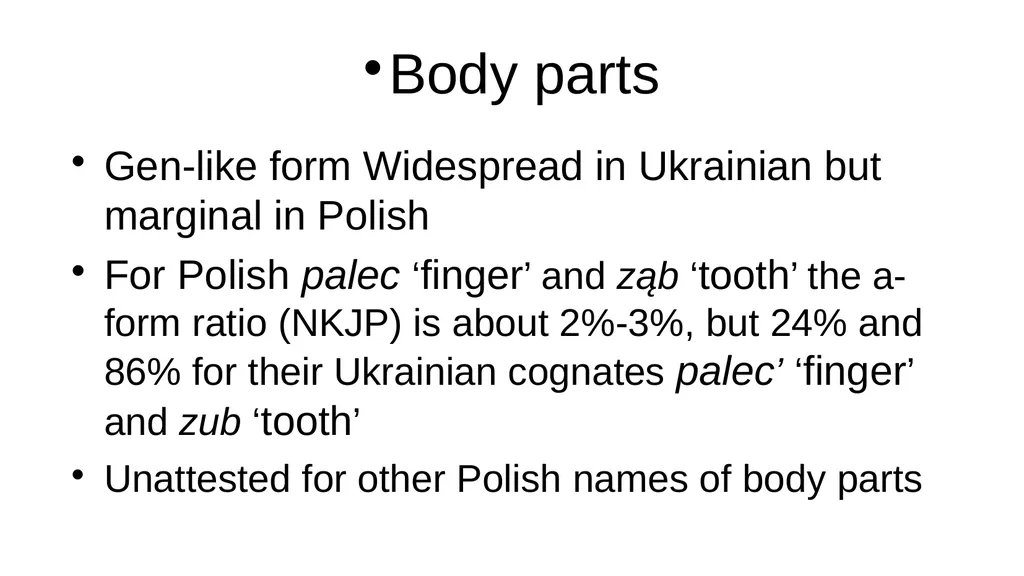
Body parts Gen-like form Widespread in Ukrainian but marginal in Polish
For Polish palec ‘finger’ and ząb ‘tooth’ the a-form ratio (NKJP) is about 2%-3%, but 24% and 86% for their Ukrainian cognates palec’ ‘finger’ and zub ‘tooth’
Unattested for other Polish names of body parts<br>
For Polish palec ‘finger’ and ząb ‘tooth’ the a-form ratio (NKJP) is about 2%-3%, but 24% and 86% for their Ukrainian cognates palec’ ‘finger’ and zub ‘tooth’
Unattested for other Polish names of body parts<br>
23
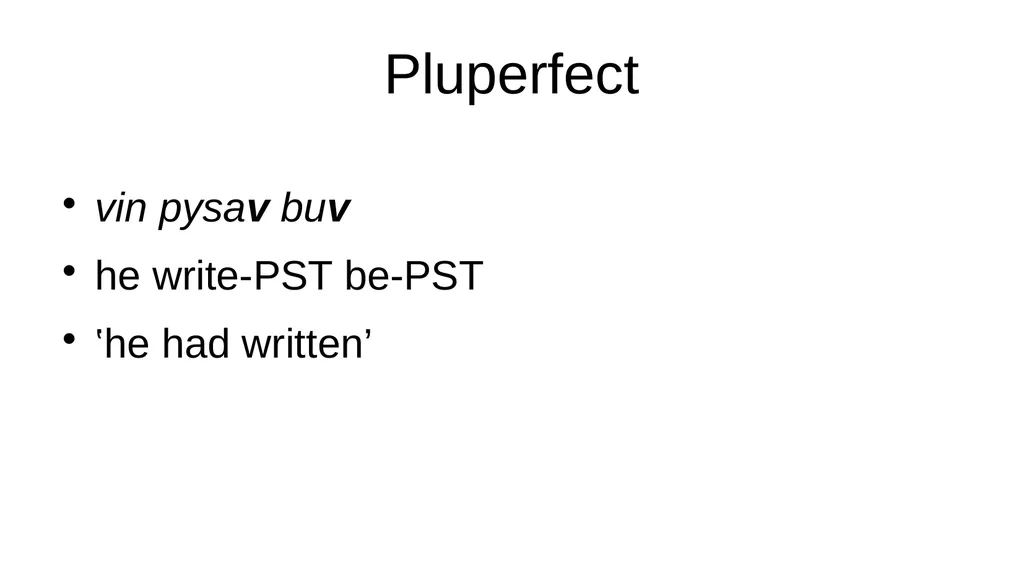
Pluperfect vin pysav buv
he write-PST be-PST
‛he had written’<br>
he write-PST be-PST
‛he had written’<br>
24
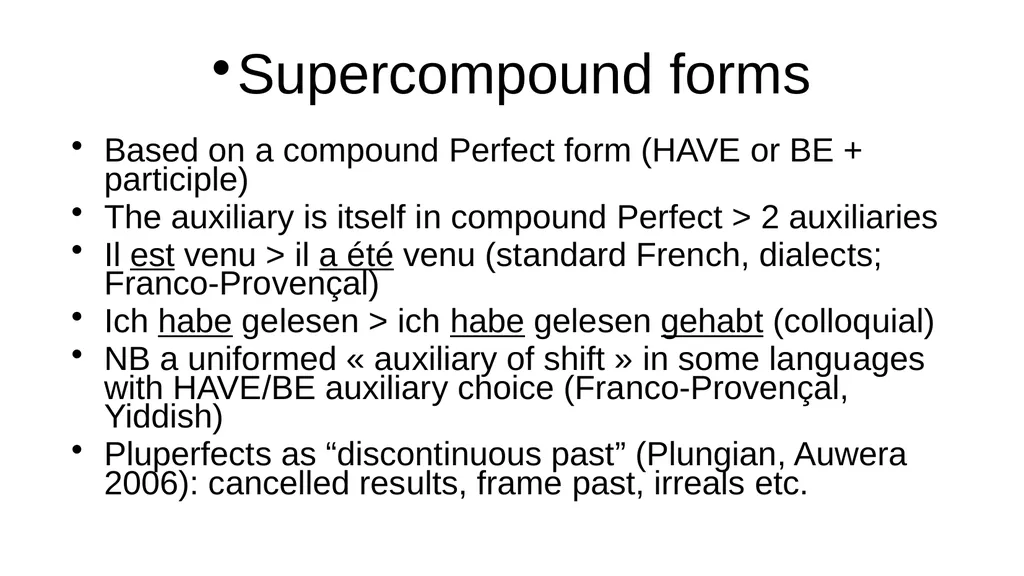
Supercompound forms Based on a compound Perfect form (HAVE or BE + participle)
The auxiliary is itself in compound Perfect > 2 auxiliaries
Il est venu > il a été venu (standard French, dialects; Franco-Provençal)
Ich habe gelesen > ich habe gelesen gehabt (colloquial)
NB a uniformed « auxiliary of shift » in some languages with HAVE/BE auxiliary choice (Franco-Provençal, Yiddish)
Pluperfects as “discontinuous past” (Plungian, Auwera 2006): cancelled results, frame past, irreals etc.<br>
The auxiliary is itself in compound Perfect > 2 auxiliaries
Il est venu > il a été venu (standard French, dialects; Franco-Provençal)
Ich habe gelesen > ich habe gelesen gehabt (colloquial)
NB a uniformed « auxiliary of shift » in some languages with HAVE/BE auxiliary choice (Franco-Provençal, Yiddish)
Pluperfects as “discontinuous past” (Plungian, Auwera 2006): cancelled results, frame past, irreals etc.<br>
25
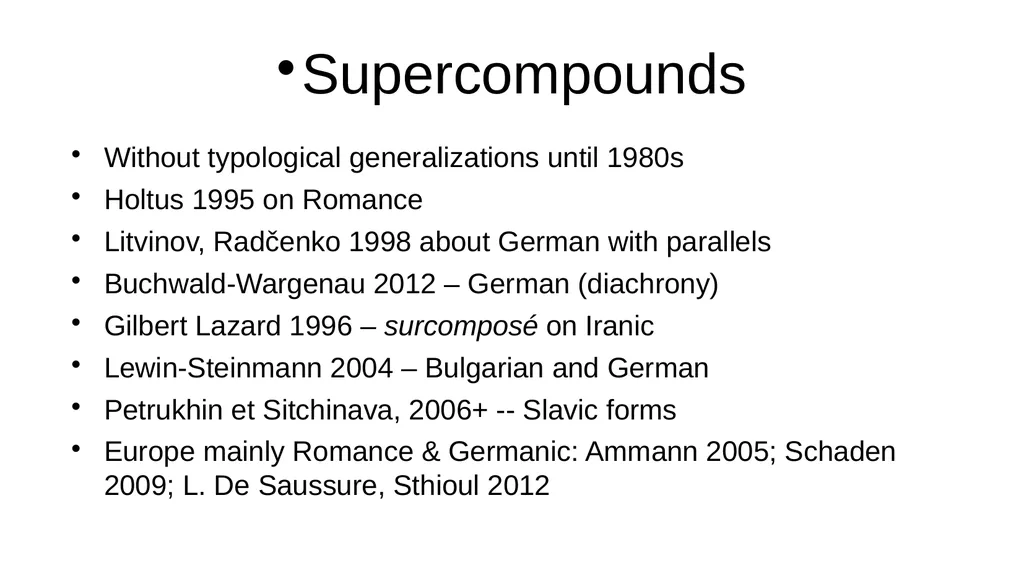
Supercompounds Without typological generalizations until 1980s
Holtus 1995 on Romance
Litvinov, Radčenko 1998 about German with parallels
Buchwald-Wargenau 2012 – German (diachrony)
Gilbert Lazard 1996 – surcomposé on Iranic
Lewin-Steinmann 2004 – Bulgarian and German
Petrukhin et Sitchinava, 2006+ -- Slavic forms
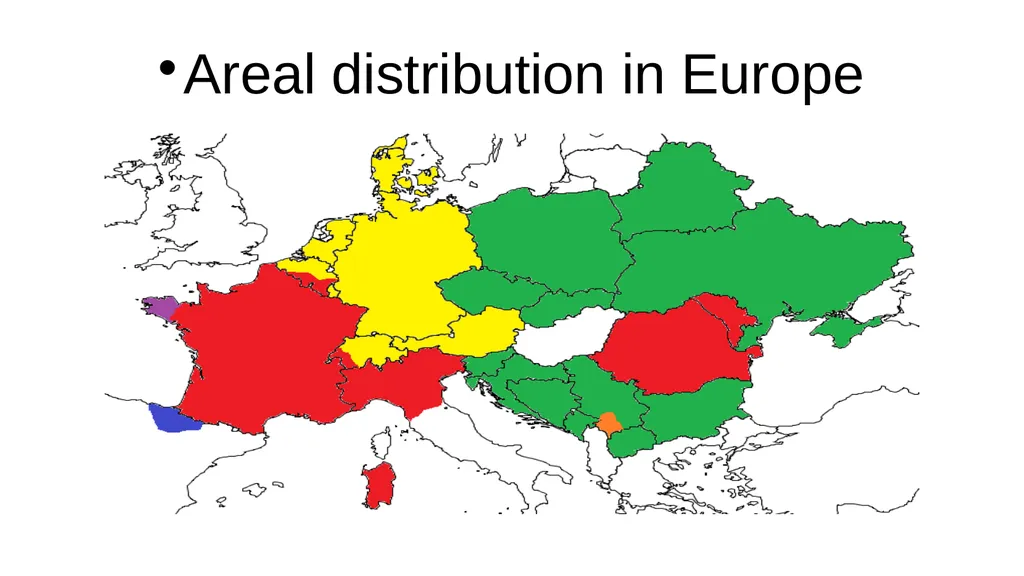
Europe mainly Romance & Germanic: Ammann 2005; Schaden 2009; L. De Saussure, Sthioul 2012<br>
Holtus 1995 on Romance
Litvinov, Radčenko 1998 about German with parallels
Buchwald-Wargenau 2012 – German (diachrony)
Gilbert Lazard 1996 – surcomposé on Iranic
Lewin-Steinmann 2004 – Bulgarian and German
Petrukhin et Sitchinava, 2006+ -- Slavic forms
Europe mainly Romance & Germanic: Ammann 2005; Schaden 2009; L. De Saussure, Sthioul 2012<br>
26
Areal distribution in Europe<br>
27
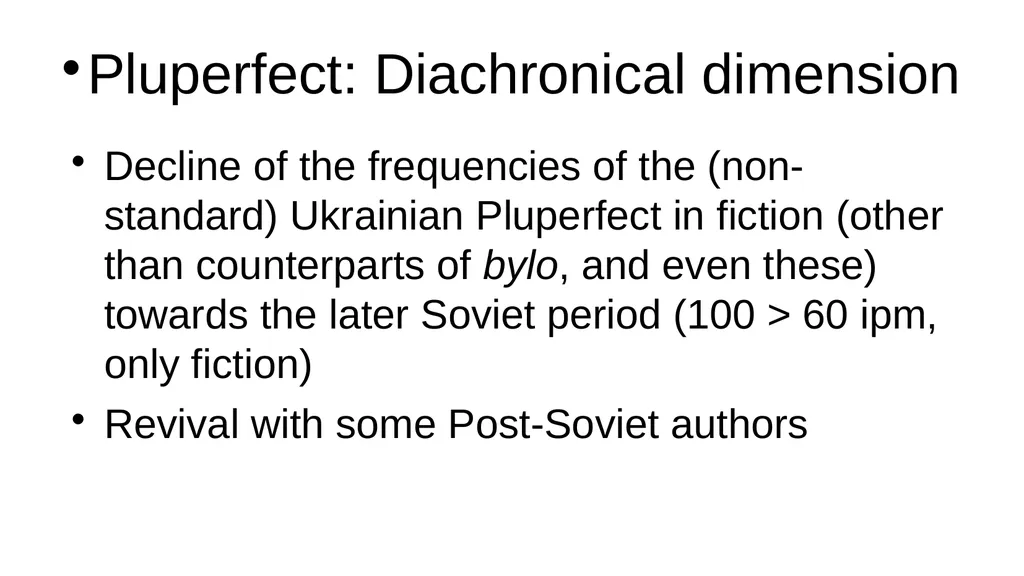
Pluperfect: Diachronical dimension Decline of the frequencies of the (non-standard) Ukrainian Pluperfect in fiction (other than counterparts of bylo, and even these) towards the later Soviet period (100 > 60 ipm, only fiction)
Revival with some Post-Soviet authors<br>
Revival with some Post-Soviet authors<br>
28
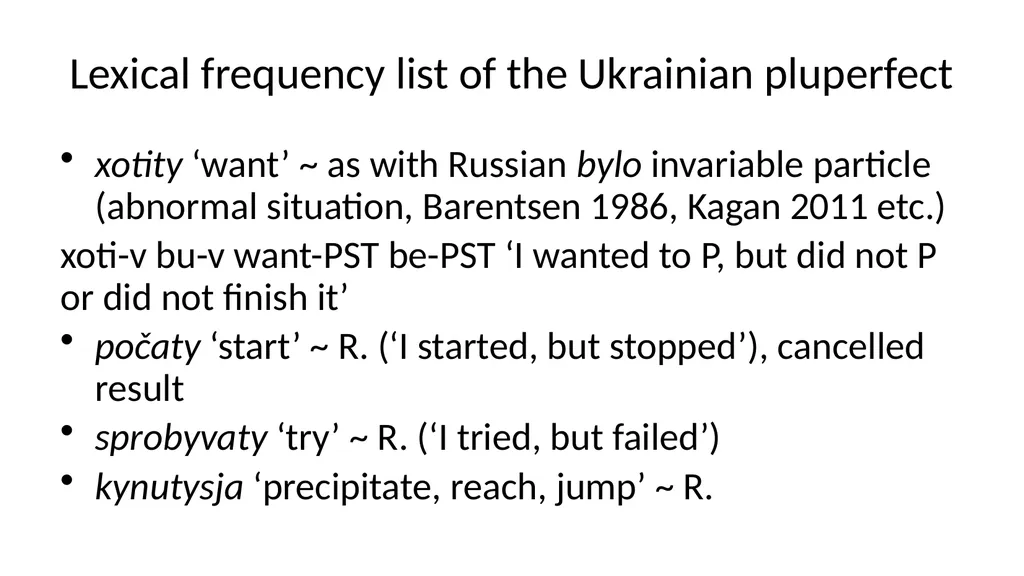
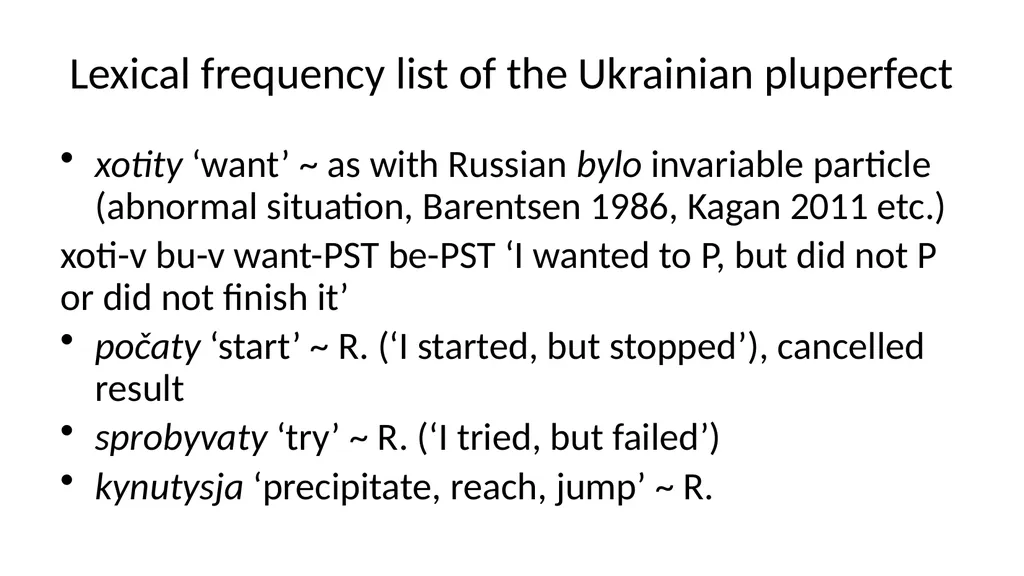
Lexical frequency list of the Ukrainian pluperfect xotity ‘want’ ~ as with Russian bylo invariable particle (abnormal situation, Barentsen 1986, Kagan 2011 etc.)
xoti-v bu-v want-PST be-PST ‘I wanted to P, but did not P or did not finish it’
počaty ‘start’ ~ R. (‘I started, but stopped’), cancelled result
sprobyvaty ‘try’ ~ R. (‘I tried, but failed’)
kynutysja ‘precipitate, reach, jump’ ~ R.<br>
xoti-v bu-v want-PST be-PST ‘I wanted to P, but did not P or did not finish it’
počaty ‘start’ ~ R. (‘I started, but stopped’), cancelled result
sprobyvaty ‘try’ ~ R. (‘I tried, but failed’)
kynutysja ‘precipitate, reach, jump’ ~ R.<br>
29
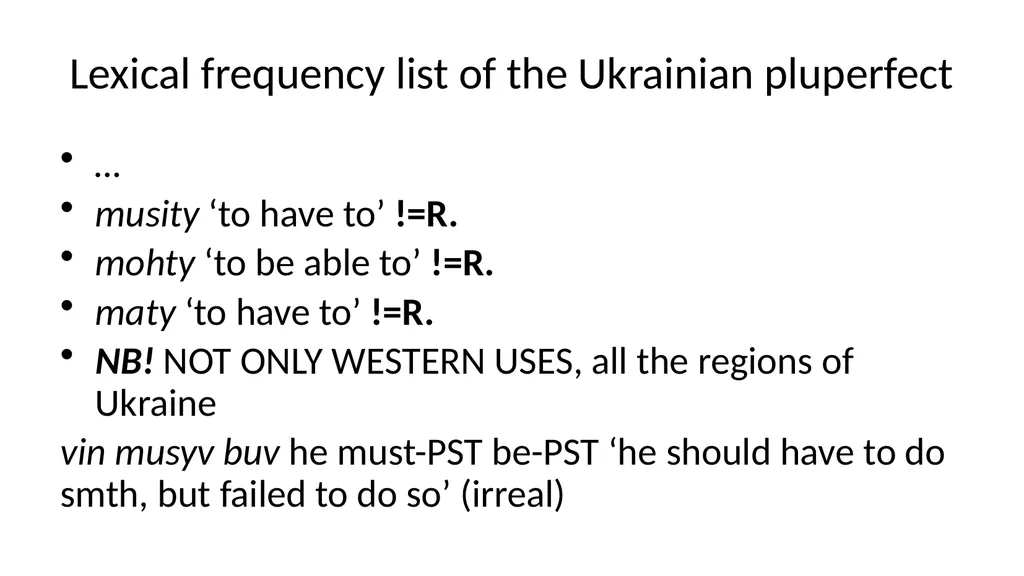
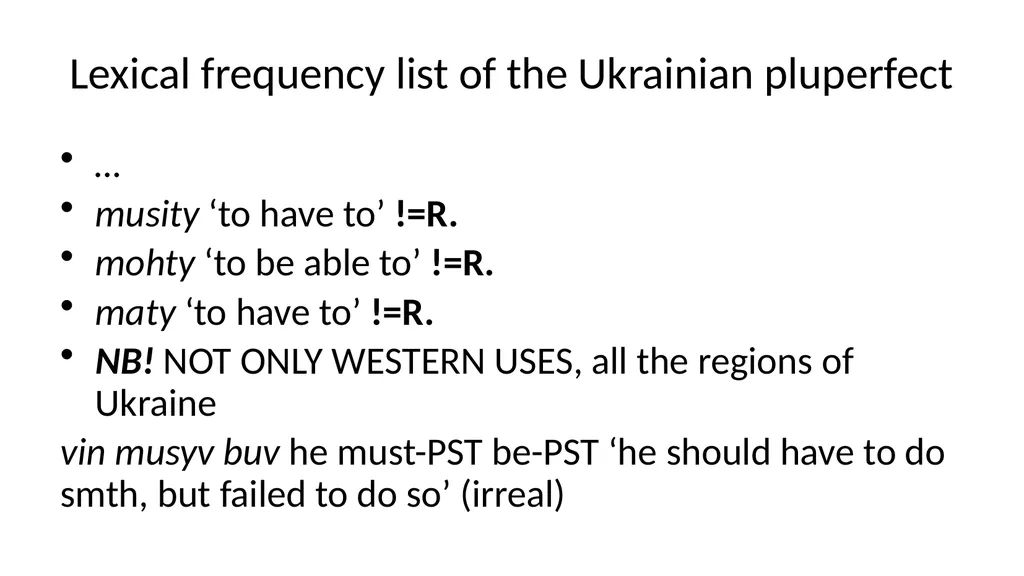
Lexical frequency list of the Ukrainian pluperfect …
musity ‘to have to’ !=R.
mohty ‘to be able to’ !=R.
maty ‘to have to’ !=R.
NB! NOT ONLY WESTERN USES, all the regions of Ukraine
vin musyv buv he must-PST be-PST ‘he should have to do smth, but failed to do so’ (irreal)<br>
musity ‘to have to’ !=R.
mohty ‘to be able to’ !=R.
maty ‘to have to’ !=R.
NB! NOT ONLY WESTERN USES, all the regions of Ukraine
vin musyv buv he must-PST be-PST ‘he should have to do smth, but failed to do so’ (irreal)<br>
30
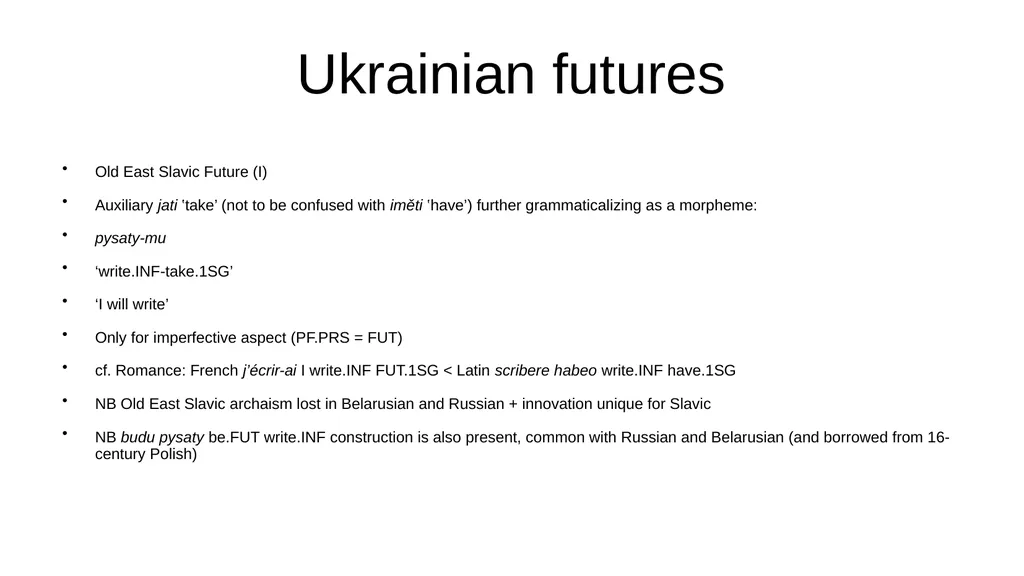
Ukrainian futures Old East Slavic Future (I)
Auxiliary jati ‛take’ (not to be confused with iměti ‛have’) further grammaticalizing as a morpheme:
pysaty-mu
‘write.INF-take.1SG’
‘I will write’
Only for imperfective aspect (PF.PRS = FUT)
cf. Romance: French j’écrir-ai I write.INF FUT.1SG < Latin scribere habeo write.INF have.1SG
NB Old East Slavic archaism lost in Belarusian and Russian + innovation unique for Slavic
NB budu pysaty be.FUT write.INF construction is also present, common with Russian and Belarusian (and borrowed from 16-century Polish)<br>
Auxiliary jati ‛take’ (not to be confused with iměti ‛have’) further grammaticalizing as a morpheme:
pysaty-mu
‘write.INF-take.1SG’
‘I will write’
Only for imperfective aspect (PF.PRS = FUT)
cf. Romance: French j’écrir-ai I write.INF FUT.1SG < Latin scribere habeo write.INF have.1SG
NB Old East Slavic archaism lost in Belarusian and Russian + innovation unique for Slavic
NB budu pysaty be.FUT write.INF construction is also present, common with Russian and Belarusian (and borrowed from 16-century Polish)<br>
31
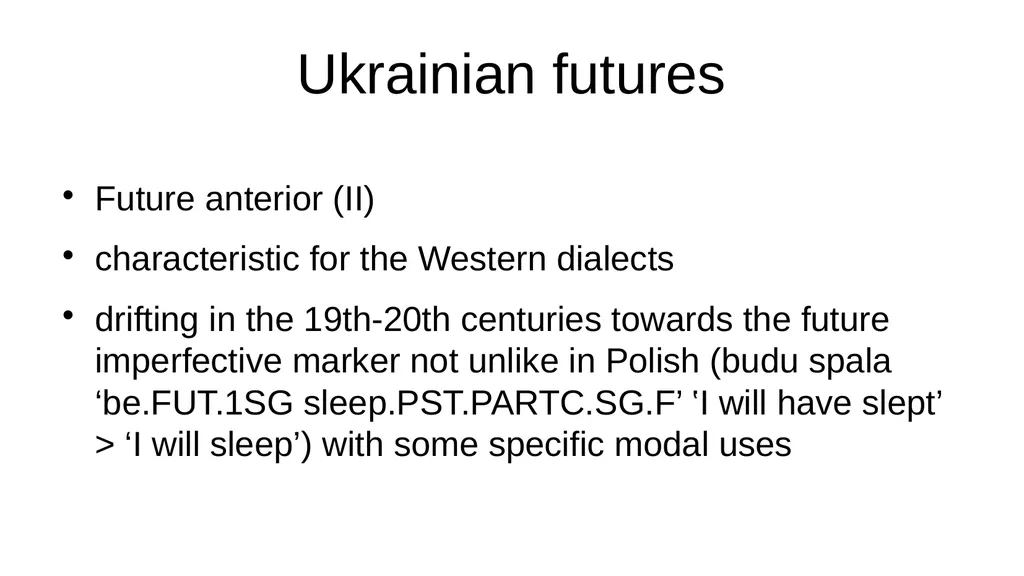
Ukrainian futures Future anterior (II)
characteristic for the Western dialects
drifting in the 19th-20th centuries towards the future imperfective marker not unlike in Polish (budu spala ‘be.FUT.1SG sleep.PST.PARTC.SG.F’ ‛I will have slept’ > ‘I will sleep’) with some specific modal uses<br>
characteristic for the Western dialects
drifting in the 19th-20th centuries towards the future imperfective marker not unlike in Polish (budu spala ‘be.FUT.1SG sleep.PST.PARTC.SG.F’ ‛I will have slept’ > ‘I will sleep’) with some specific modal uses<br>
32
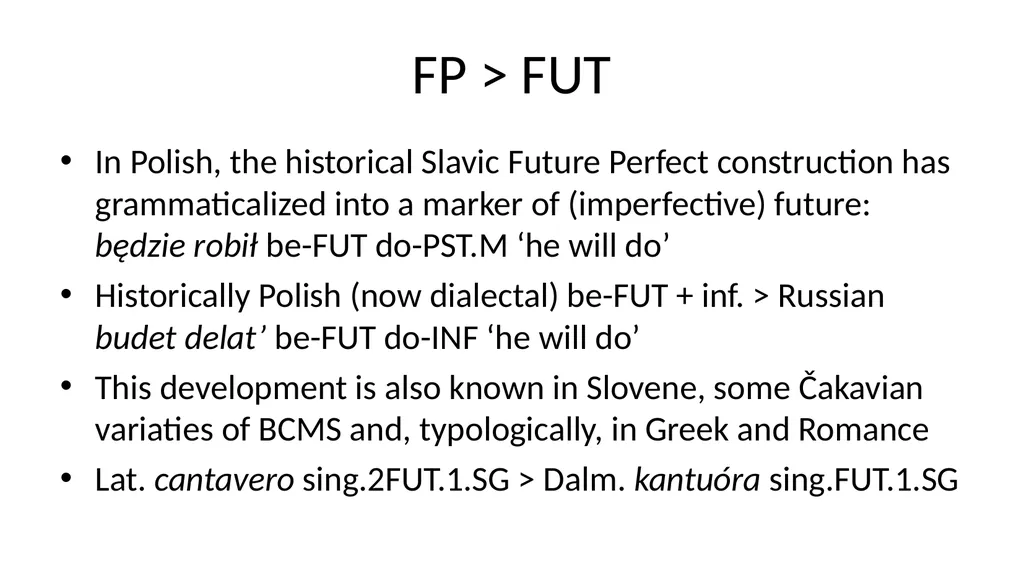
FP > FUT In Polish, the historical Slavic Future Perfect construction has grammaticalized into a marker of (imperfective) future: będzie robił be-FUT do-PST.M ‘he will do’
Historically Polish (now dialectal) be-FUT + inf. > Russian budet delat’ be-FUT do-INF ‘he will do’
This development is also known in Slovene, some Čakavian variaties of BCMS and, typologically, in Greek and Romance
Lat. cantavero sing.2FUT.1.SG > Dalm. kantuóra sing.FUT.1.SG<br>
Historically Polish (now dialectal) be-FUT + inf. > Russian budet delat’ be-FUT do-INF ‘he will do’
This development is also known in Slovene, some Čakavian variaties of BCMS and, typologically, in Greek and Romance
Lat. cantavero sing.2FUT.1.SG > Dalm. kantuóra sing.FUT.1.SG<br>
33
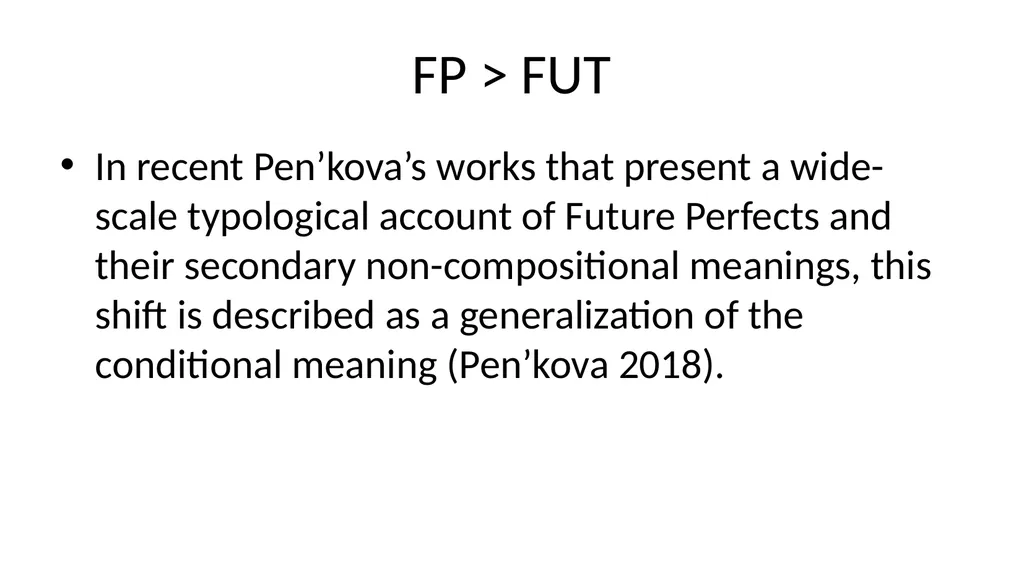
FP > FUT In recent Pen’kova’s works that present a wide-scale typological account of Future Perfects and their secondary non-compositional meanings, this shift is described as a generalization of the conditional meaning (Pen’kova 2018).<br>
34
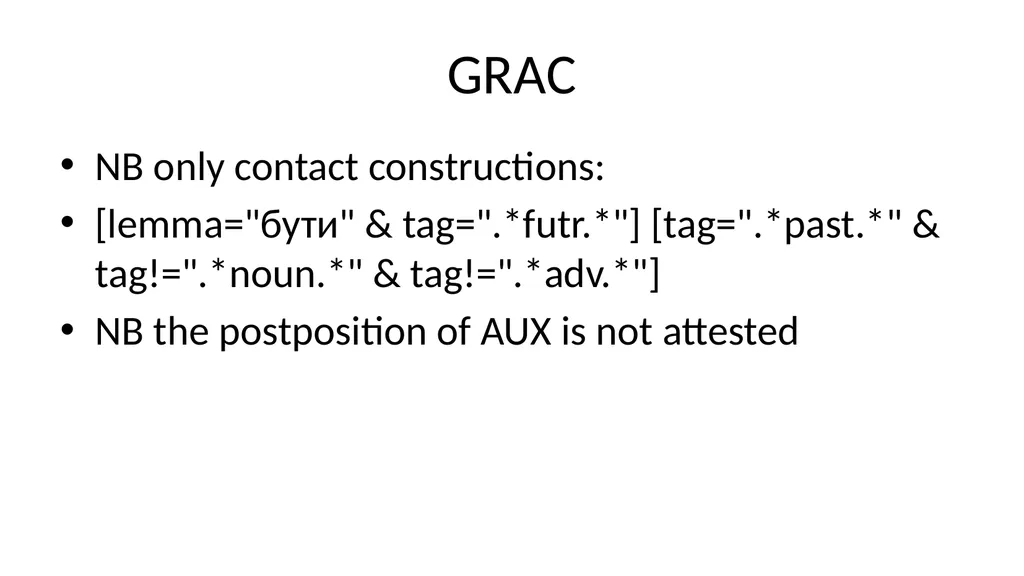
GRAC NB only contact constructions:
[lemma="бути" & tag=".*futr.*"] [tag=".*past.*" & tag!=".*noun.*" & tag!=".*adv.*"]
NB the postposition of AUX is not attested<br>
[lemma="бути" & tag=".*futr.*"] [tag=".*past.*" & tag!=".*noun.*" & tag!=".*adv.*"]
NB the postposition of AUX is not attested<br>
35
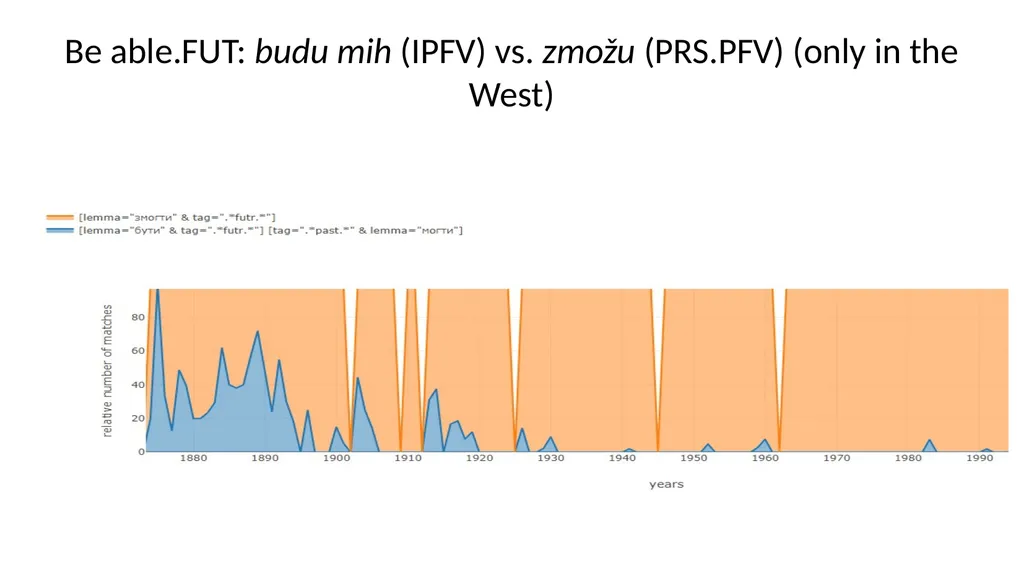
Be able.FUT: budu mih (IPFV) vs. zmožu (PRS.PFV) (only in the West)<br>
36
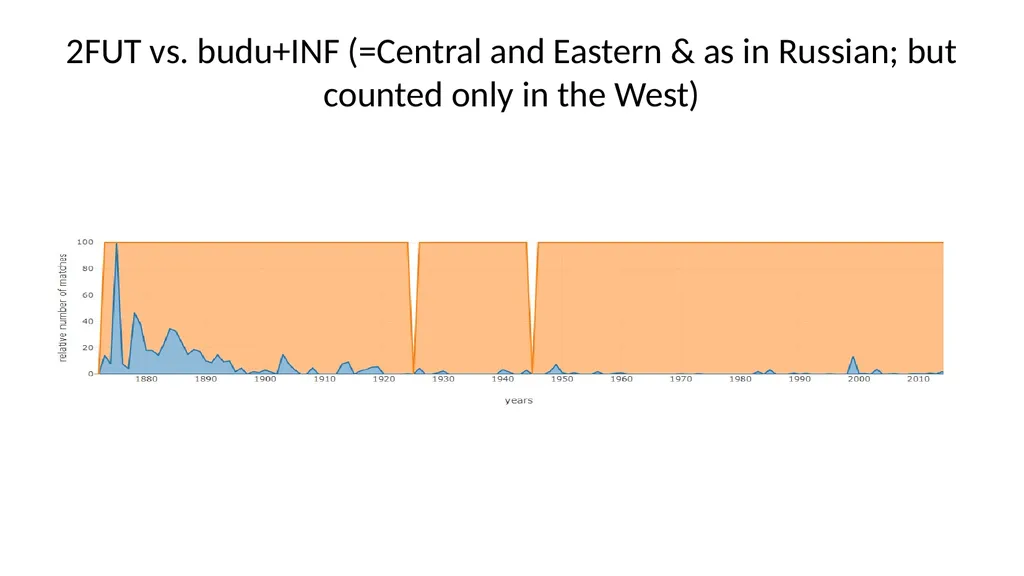
2FUT vs. budu+INF (=Central and Eastern & as in Russian; but counted only in the West)<br>
37
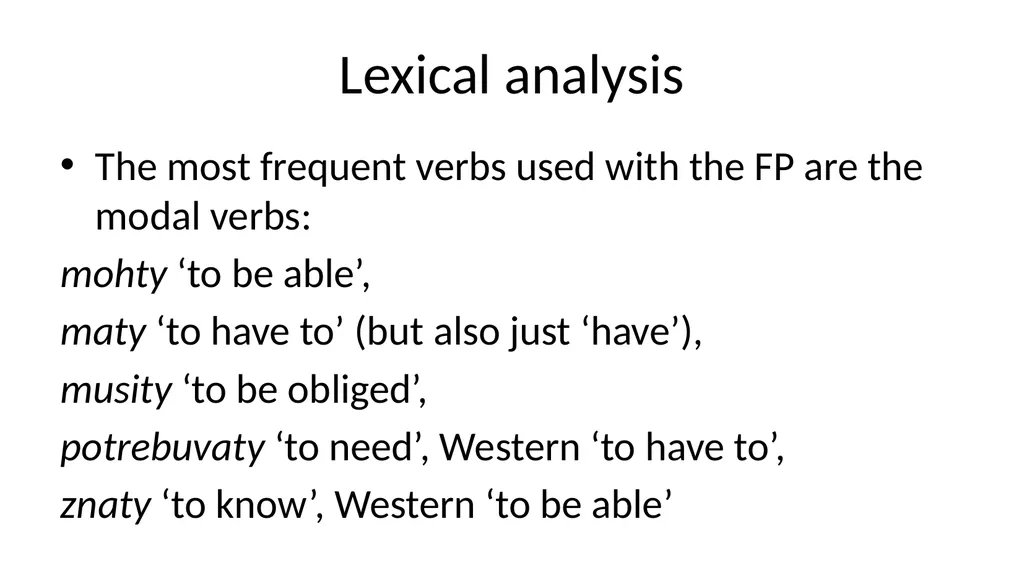
Lexical analysis The most frequent verbs used with the FP are the modal verbs:
mohty ‘to be able’,
maty ‘to have to’ (but also just ‘have’),
musity ‘to be obliged’,
potrebuvaty ‘to need’, Western ‘to have to’,
znaty ‘to know’, Western ‘to be able’<br>
mohty ‘to be able’,
maty ‘to have to’ (but also just ‘have’),
musity ‘to be obliged’,
potrebuvaty ‘to need’, Western ‘to have to’,
znaty ‘to know’, Western ‘to be able’<br>
38
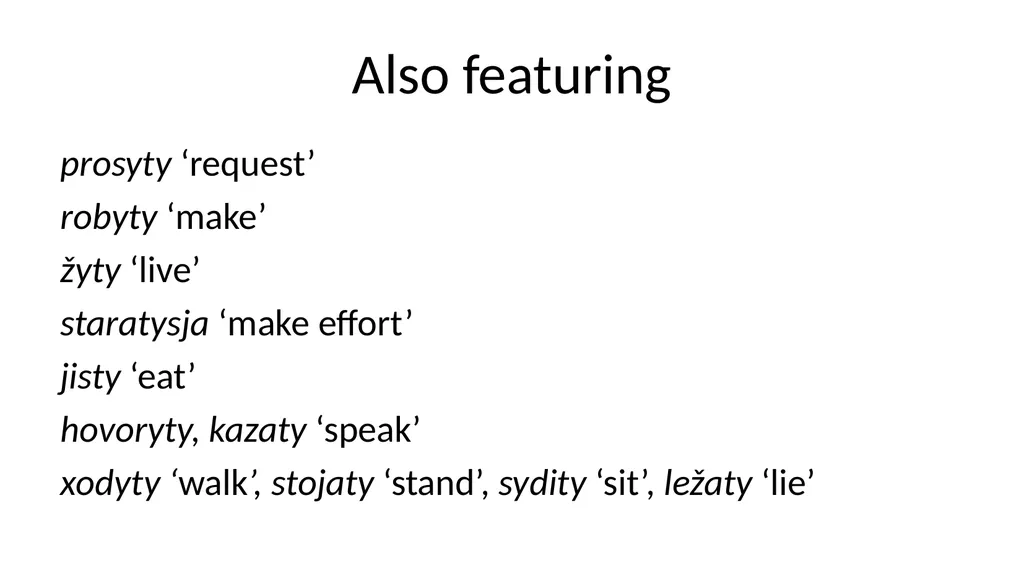
Also featuring prosyty ‘request’
robyty ‘make’
žyty ‘live’
staratysja ‘make effort’
jisty ‘eat’
hovoryty, kazaty ‘speak’
xodyty ‘walk’, stojaty ‘stand’, sydity ‘sit’, ležaty ‘lie’<br>
robyty ‘make’
žyty ‘live’
staratysja ‘make effort’
jisty ‘eat’
hovoryty, kazaty ‘speak’
xodyty ‘walk’, stojaty ‘stand’, sydity ‘sit’, ležaty ‘lie’<br>
39
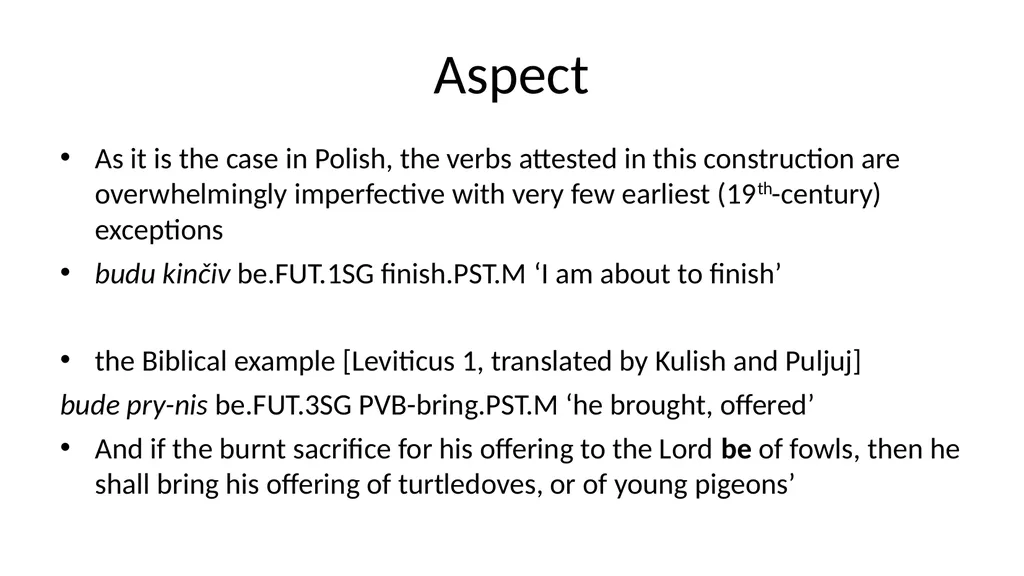
Aspect As it is the case in Polish, the verbs attested in this construction are overwhelmingly imperfective with very few earliest (19th-century) exceptions
budu kinčiv be.FUT.1SG finish.PST.M ‘I am about to finish’
the Biblical example [Leviticus 1, translated by Kulish and Puljuj]
bude pry-nis be.FUT.3SG PVB-bring.PST.M ‘he brought, offered’
And if the burnt sacrifice for his offering to the Lord be of fowls, then he shall bring his offering of turtledoves, or of young pigeons’<br>
budu kinčiv be.FUT.1SG finish.PST.M ‘I am about to finish’
the Biblical example [Leviticus 1, translated by Kulish and Puljuj]
bude pry-nis be.FUT.3SG PVB-bring.PST.M ‘he brought, offered’
And if the burnt sacrifice for his offering to the Lord be of fowls, then he shall bring his offering of turtledoves, or of young pigeons’<br>
40
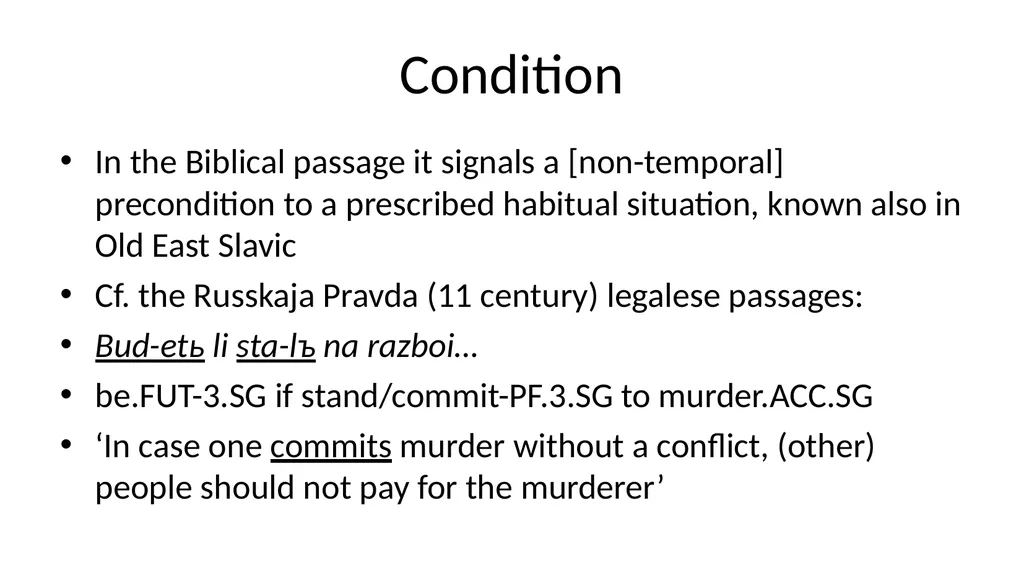
Condition In the Biblical passage it signals a [non-temporal] precondition to a prescribed habitual situation, known also in Old East Slavic
Cf. the Russkaja Pravda (11 century) legalese passages:
Bud-etь li sta-lъ na razboi…
be.FUT-3.SG if stand/commit-PF.3.SG to murder.ACC.SG
‘In case one commits murder without a conflict, (other) people should not pay for the murderer’<br>
Cf. the Russkaja Pravda (11 century) legalese passages:
Bud-etь li sta-lъ na razboi…
be.FUT-3.SG if stand/commit-PF.3.SG to murder.ACC.SG
‘In case one commits murder without a conflict, (other) people should not pay for the murderer’<br>
41
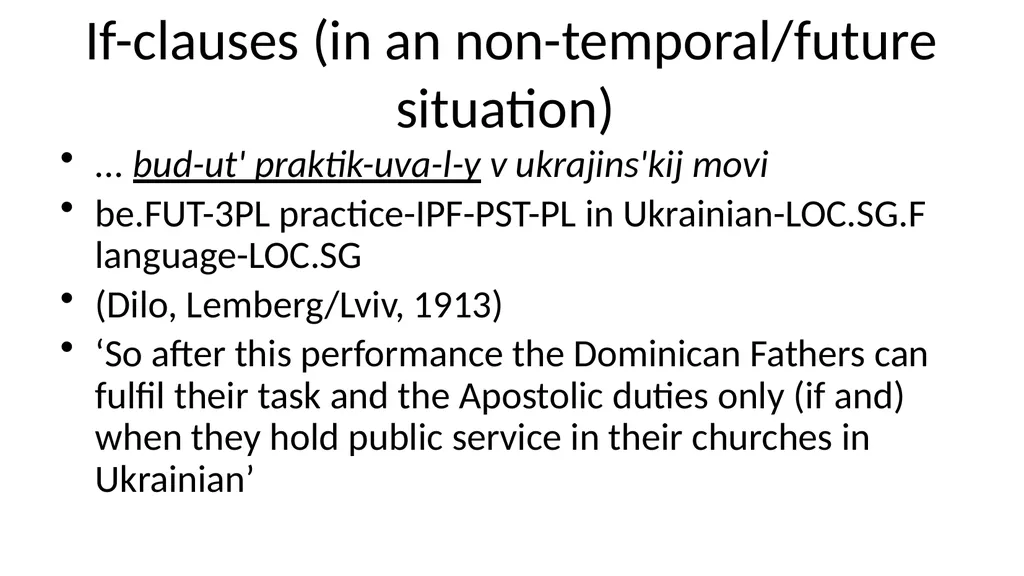
If-clauses (in an non-temporal/future situation) ... bud-ut' praktik-uva-l-y v ukrajins'kіj movі
be.FUT-3PL practice-IPF-PST-PL in Ukrainian-LOC.SG.F language-LOC.SG
(Dilo, Lemberg/Lviv, 1913)
‘So after this performance the Dominican Fathers can fulfil their task and the Apostolic duties only (if and) when they hold public service in their churches in Ukrainian’<br>
be.FUT-3PL practice-IPF-PST-PL in Ukrainian-LOC.SG.F language-LOC.SG
(Dilo, Lemberg/Lviv, 1913)
‘So after this performance the Dominican Fathers can fulfil their task and the Apostolic duties only (if and) when they hold public service in their churches in Ukrainian’<br>
42
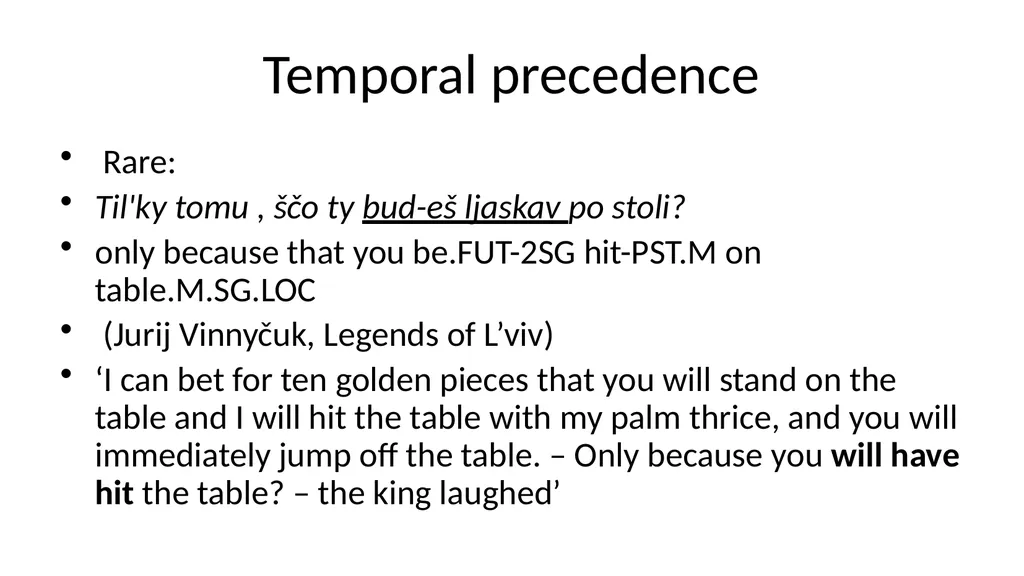
Temporal precedence Rare:
Tіl'ky tomu , ščo ty bud-eš ljaskav po stolі?
only because that you be.FUT-2SG hit-PST.M on table.M.SG.LOC
(Jurij Vinnyčuk, Legends of L’viv)
‘I can bet for ten golden pieces that you will stand on the table and I will hit the table with my palm thrice, and you will immediately jump off the table. – Only because you will have hit the table? – the king laughed’<br>
Tіl'ky tomu , ščo ty bud-eš ljaskav po stolі?
only because that you be.FUT-2SG hit-PST.M on table.M.SG.LOC
(Jurij Vinnyčuk, Legends of L’viv)
‘I can bet for ten golden pieces that you will stand on the table and I will hit the table with my palm thrice, and you will immediately jump off the table. – Only because you will have hit the table? – the king laughed’<br>
43
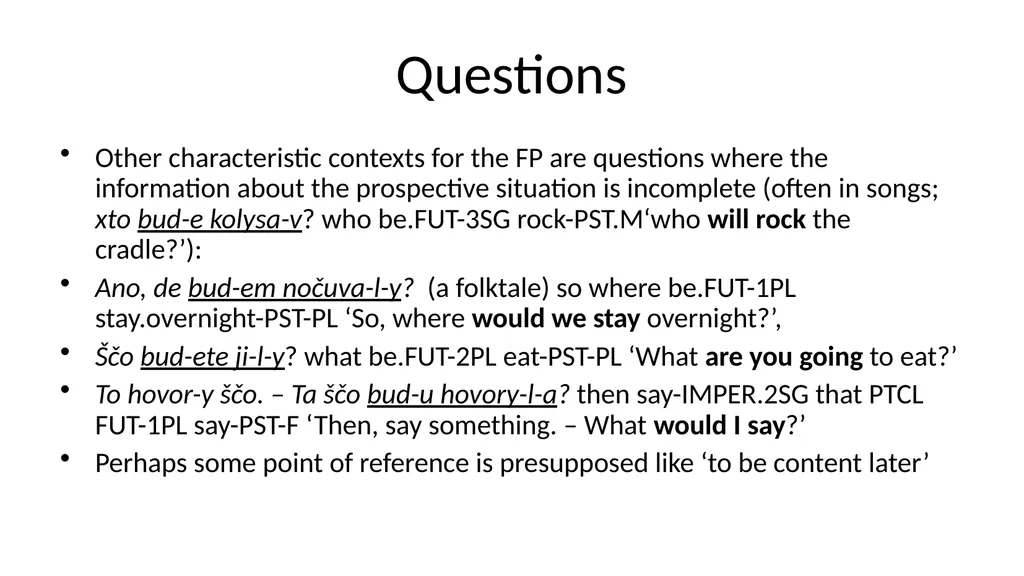
Questions Other characteristic contexts for the FP are questions where the information about the prospective situation is incomplete (often in songs; xto bud-e kolysa-v? who be.FUT-3SG rock-PST.M‘who will rock the cradle?’):
Ano, de bud-em nočuva-l-y? (a folktale) so where be.FUT-1PL stay.overnight-PST-PL ‘So, where would we stay overnight?’,
Ščo bud-ete ji-l-y? what be.FUT-2PL eat-PST-PL ‘What are you going to eat?’
To hovor-y ščo. – Ta ščo bud-u hovory-l-a? then say-IMPER.2SG that PTCL FUT-1PL say-PST-F ‘Then, say something. – What would I say?’
Perhaps some point of reference is presupposed like ‘to be content later’<br>
Ano, de bud-em nočuva-l-y? (a folktale) so where be.FUT-1PL stay.overnight-PST-PL ‘So, where would we stay overnight?’,
Ščo bud-ete ji-l-y? what be.FUT-2PL eat-PST-PL ‘What are you going to eat?’
To hovor-y ščo. – Ta ščo bud-u hovory-l-a? then say-IMPER.2SG that PTCL FUT-1PL say-PST-F ‘Then, say something. – What would I say?’
Perhaps some point of reference is presupposed like ‘to be content later’<br>
44
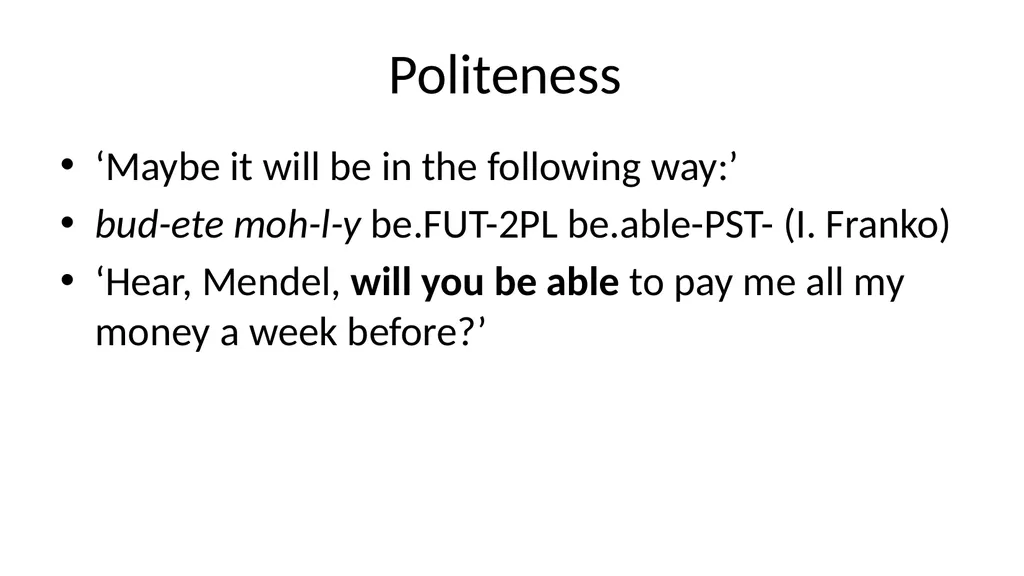
Politeness ‘Maybe it will be in the following way:’
bud-ete moh-l-y be.FUT-2PL be.able-PST- (I. Franko)
‘Hear, Mendel, will you be able to pay me all my money a week before?’<br>
bud-ete moh-l-y be.FUT-2PL be.able-PST- (I. Franko)
‘Hear, Mendel, will you be able to pay me all my money a week before?’<br>
45
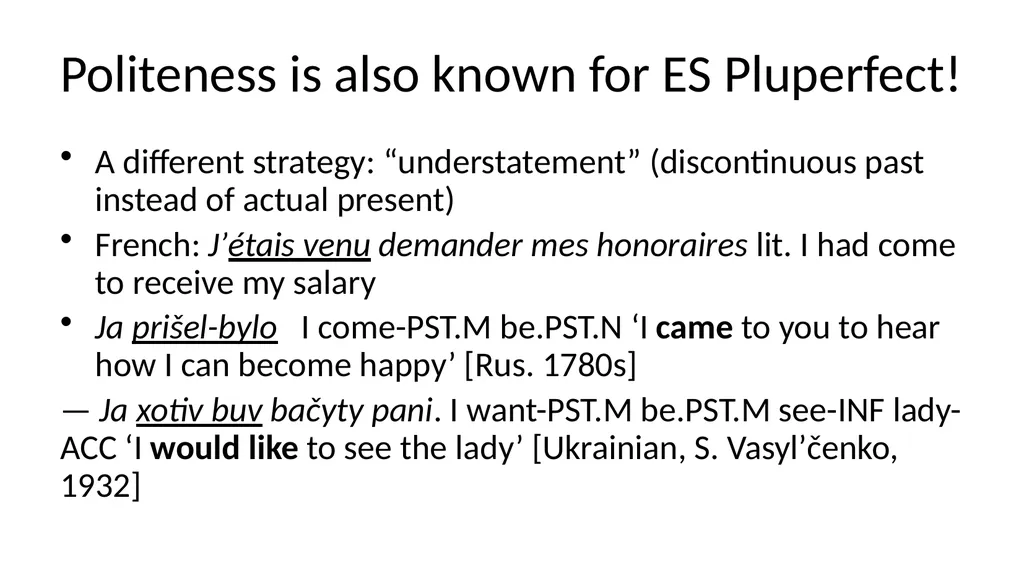
Politeness is also known for ES Pluperfect! A different strategy: “understatement” (discontinuous past instead of actual present)
French: J’étais venu demander mes honoraires lit. I had come to receive my salary
Ja prišel-bylo I come-PST.M be.PST.N ‘I came to you to hear how I can become happy’ [Rus. 1780s]
— Ja xotiv buv bačyty pani. I want-PST.M be.PST.M see-INF lady-ACC ‘I would like to see the lady’ [Ukrainian, S. Vasyl’čenko, 1932]<br>
French: J’étais venu demander mes honoraires lit. I had come to receive my salary
Ja prišel-bylo I come-PST.M be.PST.N ‘I came to you to hear how I can become happy’ [Rus. 1780s]
— Ja xotiv buv bačyty pani. I want-PST.M be.PST.M see-INF lady-ACC ‘I would like to see the lady’ [Ukrainian, S. Vasyl’čenko, 1932]<br>
46
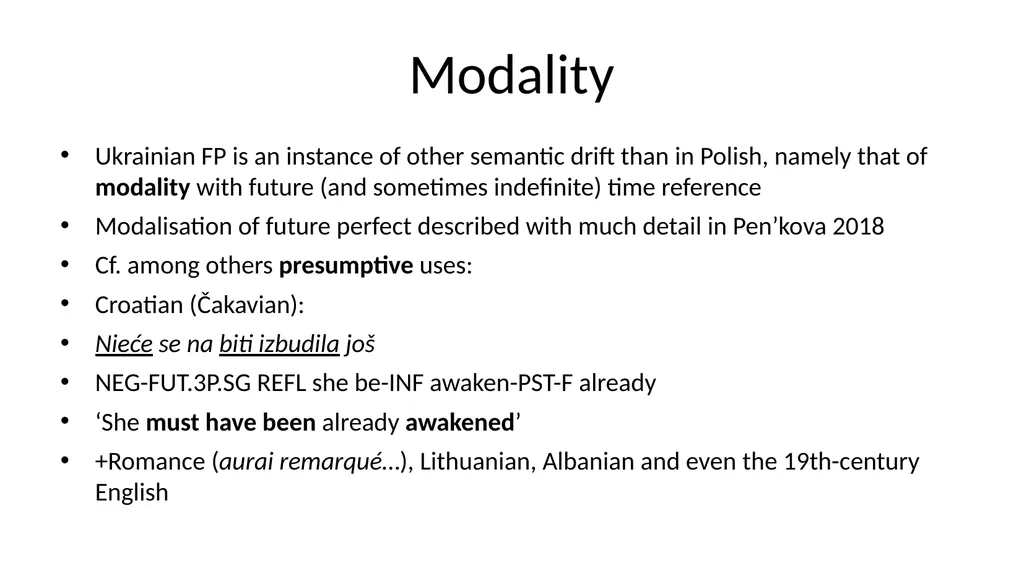
Modality Ukrainian FP is an instance of other semantic drift than in Polish, namely that of modality with future (and sometimes indefinite) time reference
Modalisation of future perfect described with much detail in Pen’kova 2018
Cf. among others presumptive uses:
Croatian (Čakavian):
Nieće se na biti izbudila još
NEG-FUT.3P.SG REFL she be-INF awaken-PST-F already
‘She must have been already awakened’
+Romance (aurai remarqué…), Lithuanian, Albanian and even the 19th-century English<br>
Modalisation of future perfect described with much detail in Pen’kova 2018
Cf. among others presumptive uses:
Croatian (Čakavian):
Nieće se na biti izbudila još
NEG-FUT.3P.SG REFL she be-INF awaken-PST-F already
‘She must have been already awakened’
+Romance (aurai remarqué…), Lithuanian, Albanian and even the 19th-century English<br>
47
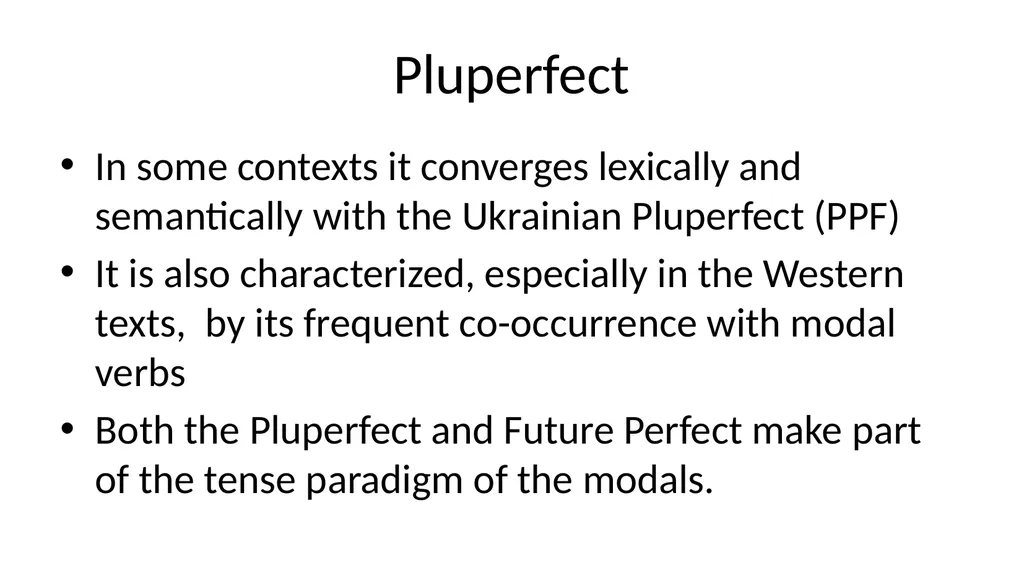
Pluperfect In some contexts it converges lexically and semantically with the Ukrainian Pluperfect (PPF)
It is also characterized, especially in the Western texts, by its frequent co-occurrence with modal verbs
Both the Pluperfect and Future Perfect make part of the tense paradigm of the modals.<br>
It is also characterized, especially in the Western texts, by its frequent co-occurrence with modal verbs
Both the Pluperfect and Future Perfect make part of the tense paradigm of the modals.<br>
48
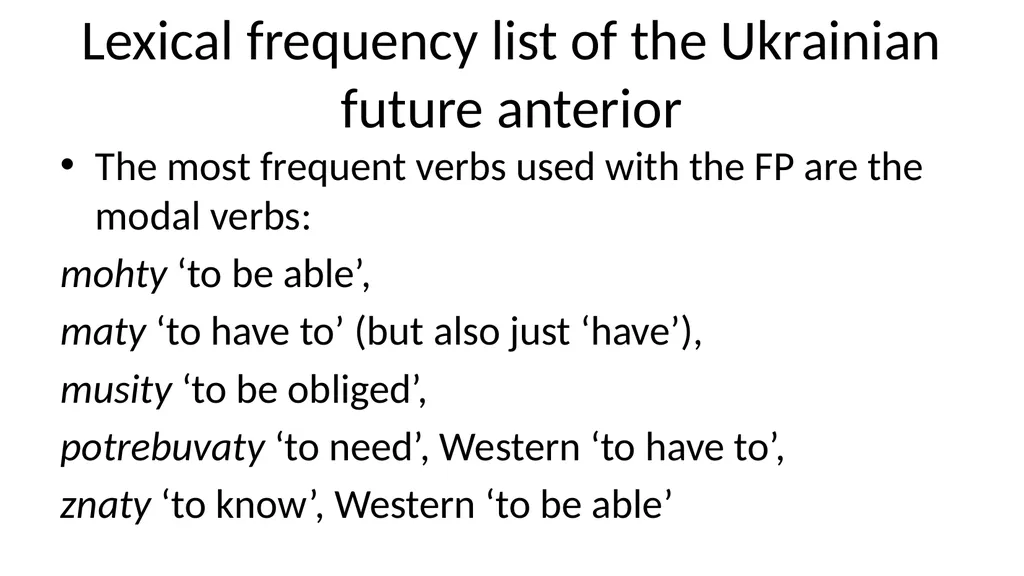
Lexical frequency list of the Ukrainian future anterior The most frequent verbs used with the FP are the modal verbs:
mohty ‘to be able’,
maty ‘to have to’ (but also just ‘have’),
musity ‘to be obliged’,
potrebuvaty ‘to need’, Western ‘to have to’,
znaty ‘to know’, Western ‘to be able’<br>
mohty ‘to be able’,
maty ‘to have to’ (but also just ‘have’),
musity ‘to be obliged’,
potrebuvaty ‘to need’, Western ‘to have to’,
znaty ‘to know’, Western ‘to be able’<br>
49
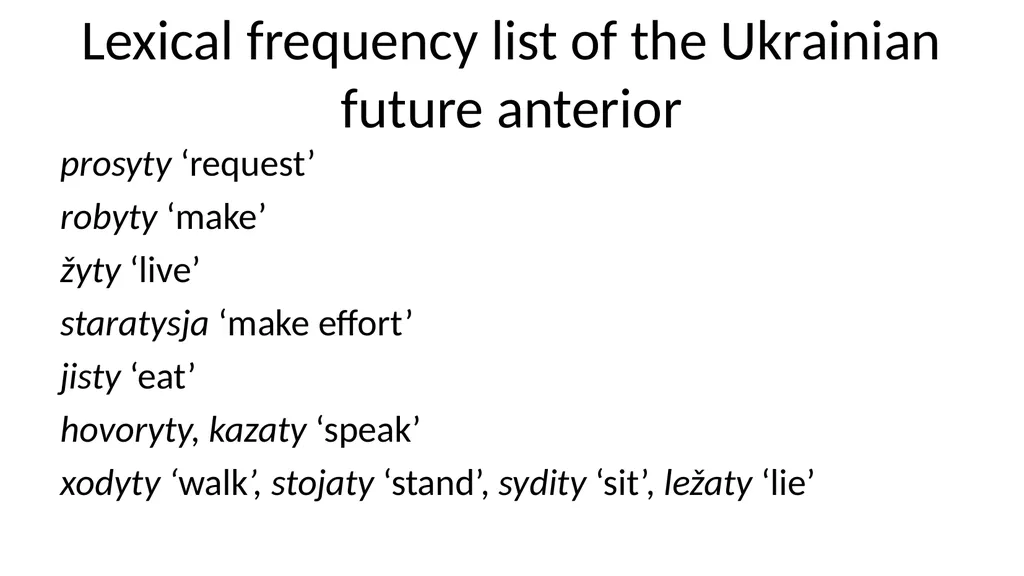
Lexical frequency list of the Ukrainian future anterior prosyty ‘request’
robyty ‘make’
žyty ‘live’
staratysja ‘make effort’
jisty ‘eat’
hovoryty, kazaty ‘speak’
xodyty ‘walk’, stojaty ‘stand’, sydity ‘sit’, ležaty ‘lie’<br>
robyty ‘make’
žyty ‘live’
staratysja ‘make effort’
jisty ‘eat’
hovoryty, kazaty ‘speak’
xodyty ‘walk’, stojaty ‘stand’, sydity ‘sit’, ležaty ‘lie’<br>
50
Lexical frequency list of the Ukrainian pluperfect xotity ‘want’ ~ as with Russian bylo invariable particle (abnormal situation, Barentsen 1986, Kagan 2011 etc.)
xoti-v bu-v want-PST be-PST ‘I wanted to P, but did not P or did not finish it’
počaty ‘start’ ~ R. (‘I started, but stopped’), cancelled result
sprobyvaty ‘try’ ~ R. (‘I tried, but failed’)
kynutysja ‘precipitate, reach, jump’ ~ R.<br>
xoti-v bu-v want-PST be-PST ‘I wanted to P, but did not P or did not finish it’
počaty ‘start’ ~ R. (‘I started, but stopped’), cancelled result
sprobyvaty ‘try’ ~ R. (‘I tried, but failed’)
kynutysja ‘precipitate, reach, jump’ ~ R.<br>
51
Lexical frequency list of the Ukrainian pluperfect …
musity ‘to have to’ !=R.
mohty ‘to be able to’ !=R.
maty ‘to have to’ !=R.
NB! NOT ONLY WESTERN USES, all the regions of Ukraine
vin musyv buv he must-PST be-PST ‘he should have to do smth, but failed to do so’ (irreal)<br>
musity ‘to have to’ !=R.
mohty ‘to be able to’ !=R.
maty ‘to have to’ !=R.
NB! NOT ONLY WESTERN USES, all the regions of Ukraine
vin musyv buv he must-PST be-PST ‘he should have to do smth, but failed to do so’ (irreal)<br>
52
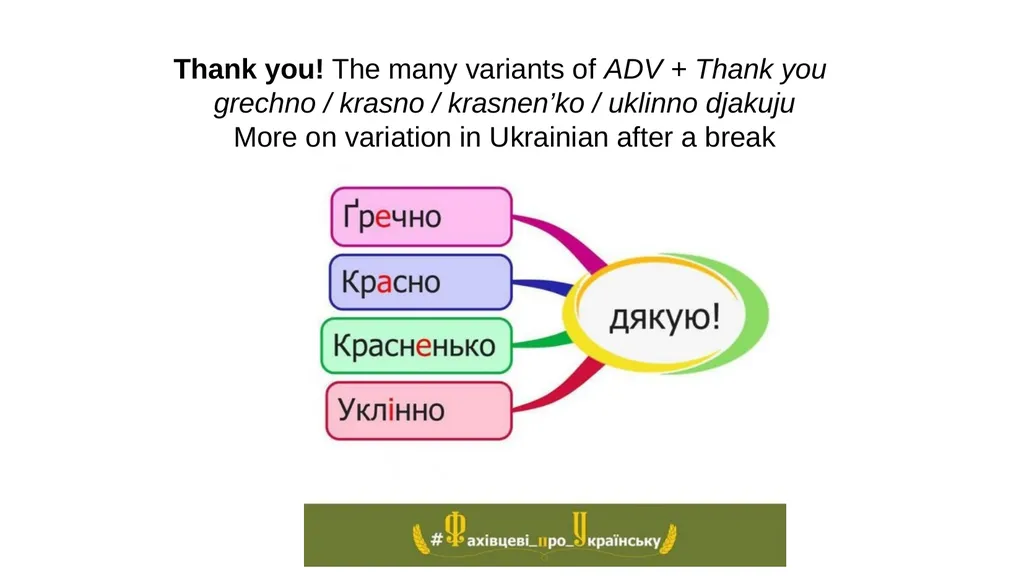
Thank you! The many variants of ADV + Thank you
grechno / krasno / krasnen’ko / uklinno djakuju
More on variation in Ukrainian after a break<br>
grechno / krasno / krasnen’ko / uklinno djakuju
More on variation in Ukrainian after a break<br>