Uncertainty and Retirement Planning Lecture for FIN 352 Professor Dow CSUN 2016 The situation (from the last presentation) Save and invest money until retirement (the accumulation phase) Once retired, withdraw money from investment accounts
Related Topics
Share
Embed code
Download this presentation From Below
"Uncertainty and Retirement Planning Lecture for" is the property of its rightful owner. Permission is granted to
download and print the materials on this website for personal, non-commercial use only, and to display it
on your personal computer provided you do not modify the materials and that you retain all copyright
notices contained in the materials. By downloading content from our website, you accept the terms of this
agreement.
Presentation Transcript
01
Uncertainty and Retirement Planning Lecture for FIN 352
Professor Dow
CSUN
2016<br>
02
The situation (from the last presentation) Save and invest money until retirement (the accumulation phase)
Once retired, withdraw money from investment accounts (the spending phase)
We solved the problem in reverse order
Spending phase:
How much do you need each year in retirement?
This determines desired (target) wealth at retirement
Accumulation phase
Goal is to end with the targeted level of wealth
How much do you need to save to reach the target?<br>
03
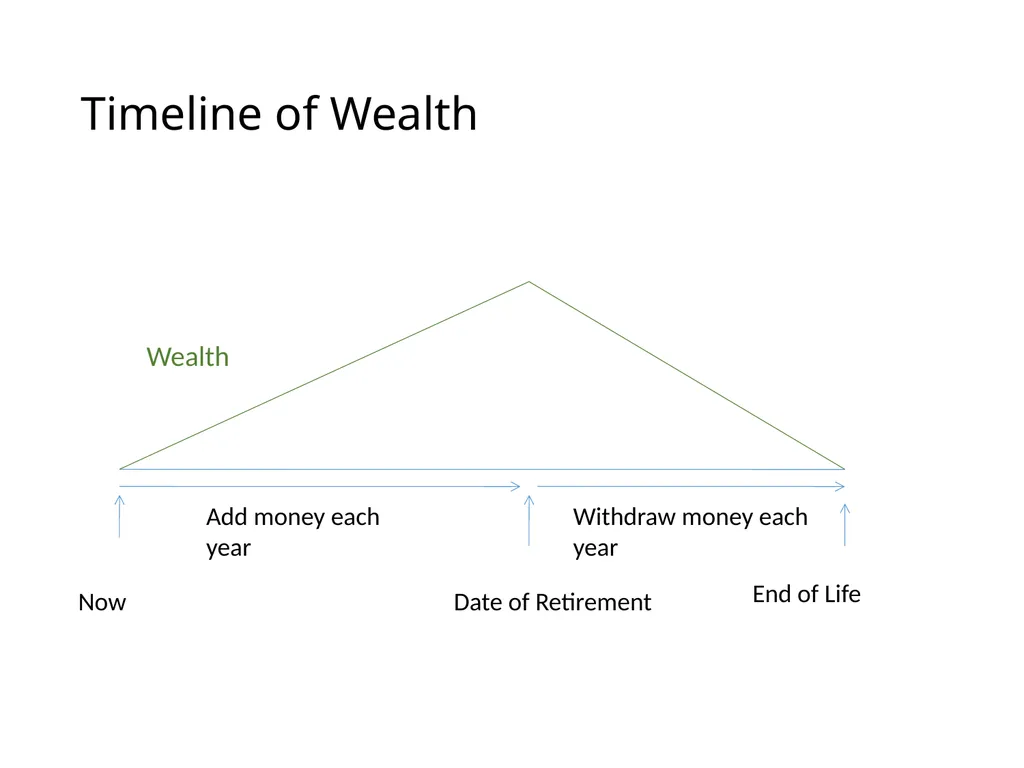
Timeline of Wealth Now End of Life Date of Retirement Add money each year Withdraw money each year Wealth<br>
04
The accumulation phase Two decisions
How much to save each month
The asset allocation
This affects the portfolio return (and risk)
On a financial calculator
N: number of years to retirement
PV: starting wealth
PMT: How much you save each year
I: The return to your portfolio
FV: Your target wealth<br>
05
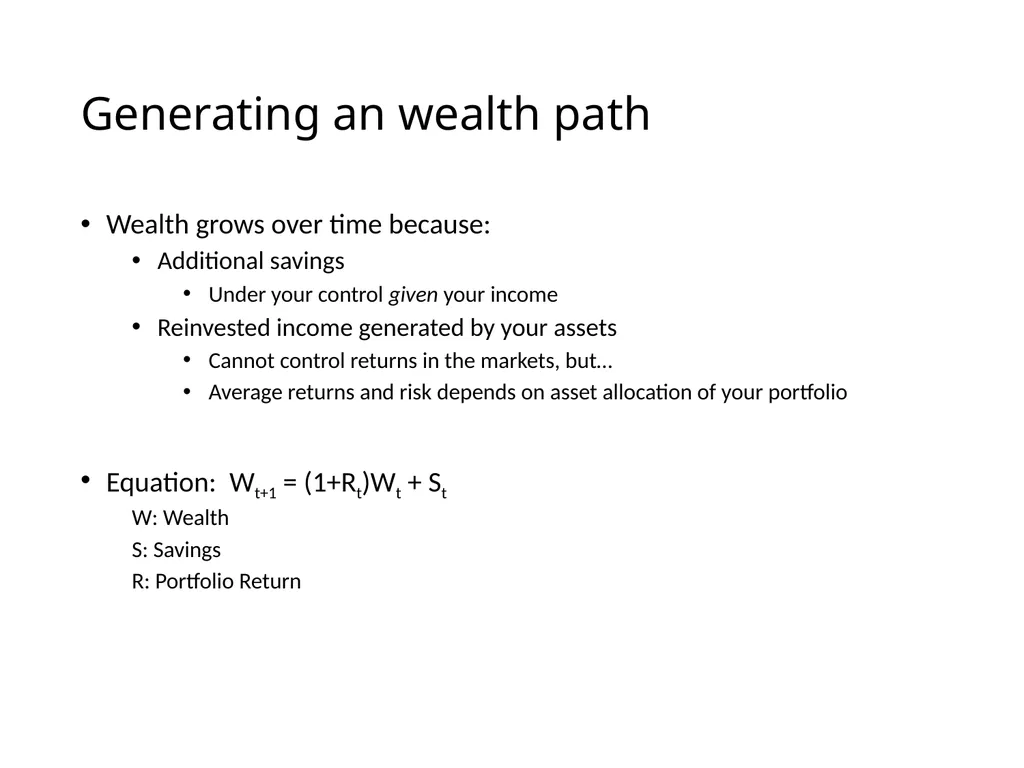
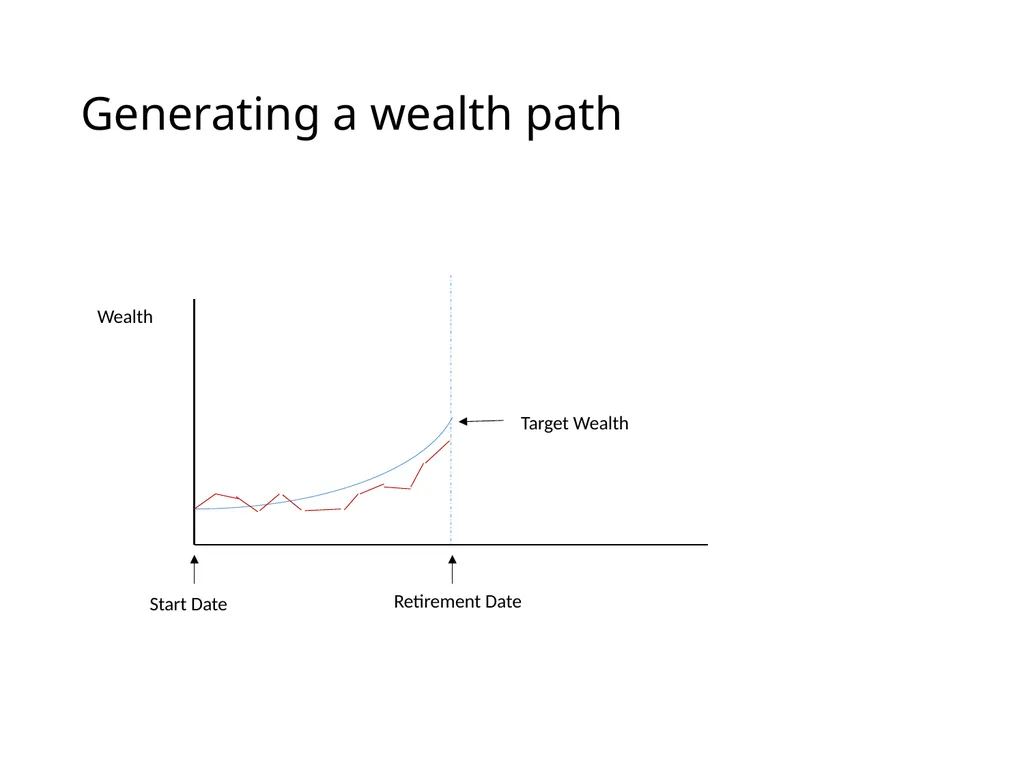
Generating an wealth path Wealth grows over time because:
Additional savings
Under your control given your income
Reinvested income generated by your assets
Cannot control returns in the markets, but…
Average returns and risk depends on asset allocation of your portfolio
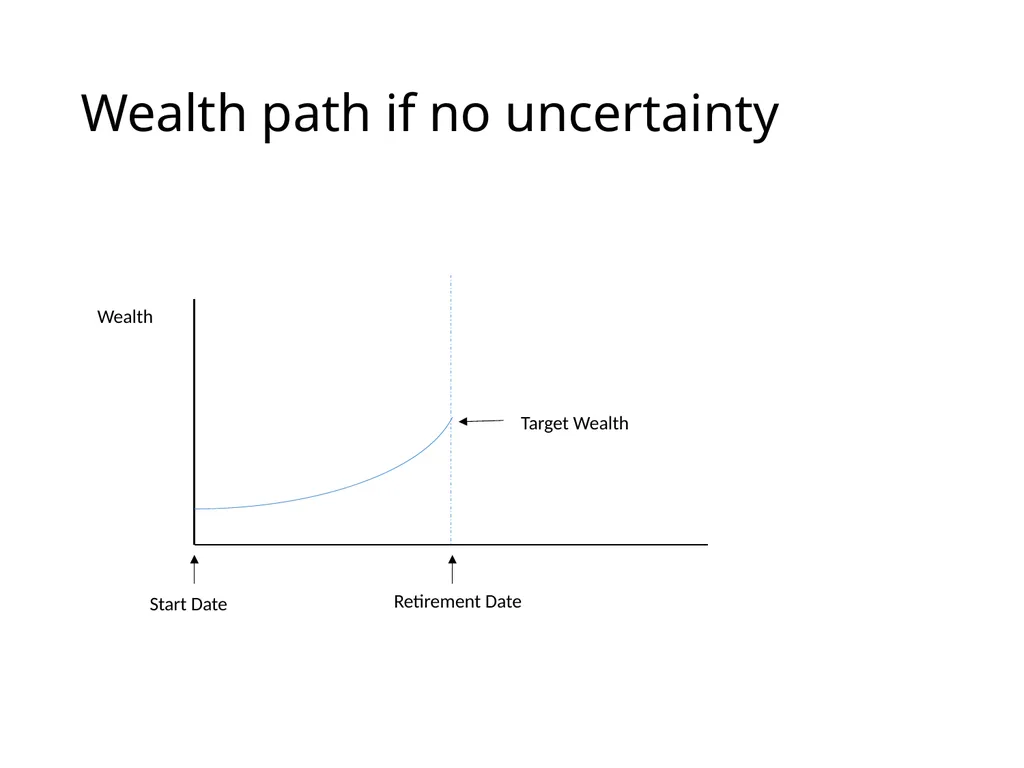
Wealth path if no uncertainty Retirement Date Wealth Start Date Target Wealth<br>
07
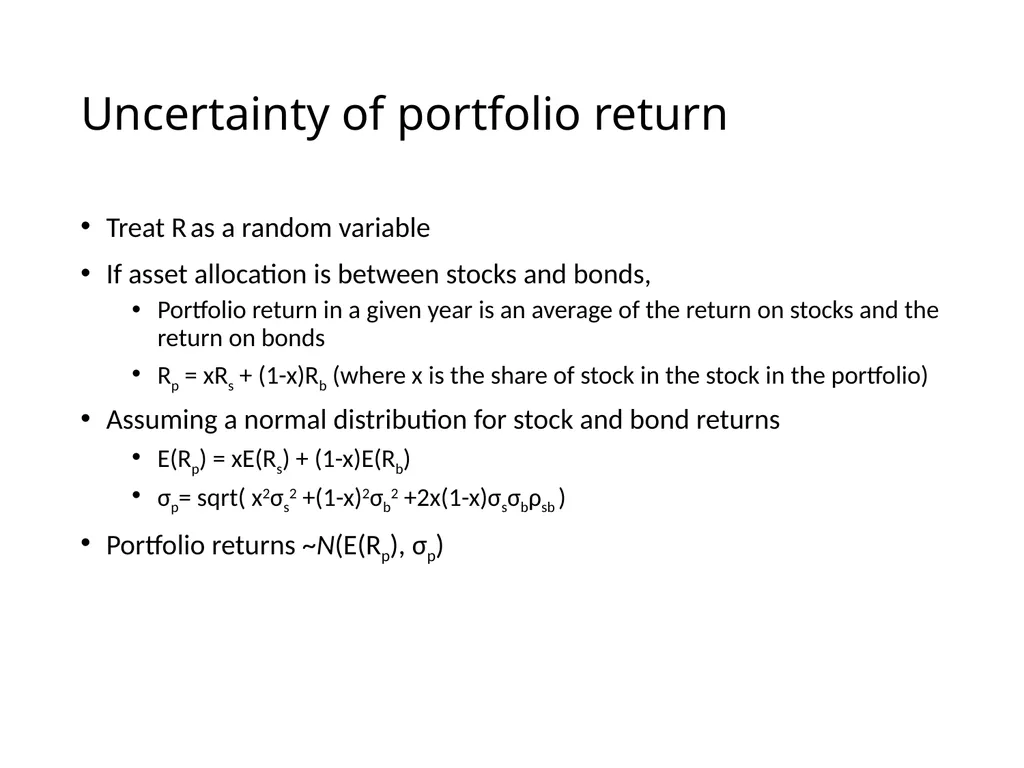
Uncertainty of portfolio return Treat R as a random variable
If asset allocation is between stocks and bonds,
Portfolio return in a given year is an average of the return on stocks and the return on bonds
Rp = xRs + (1-x)Rb (where x is the share of stock in the stock in the portfolio)
Assuming a normal distribution for stock and bond returns
E(Rp) = xE(Rs) + (1-x)E(Rb)
σp= sqrt( x2σs2 +(1-x)2σb2 +2x(1-x)σsσbρsb )
Portfolio returns ~N(E(Rp), σp)<br>
08
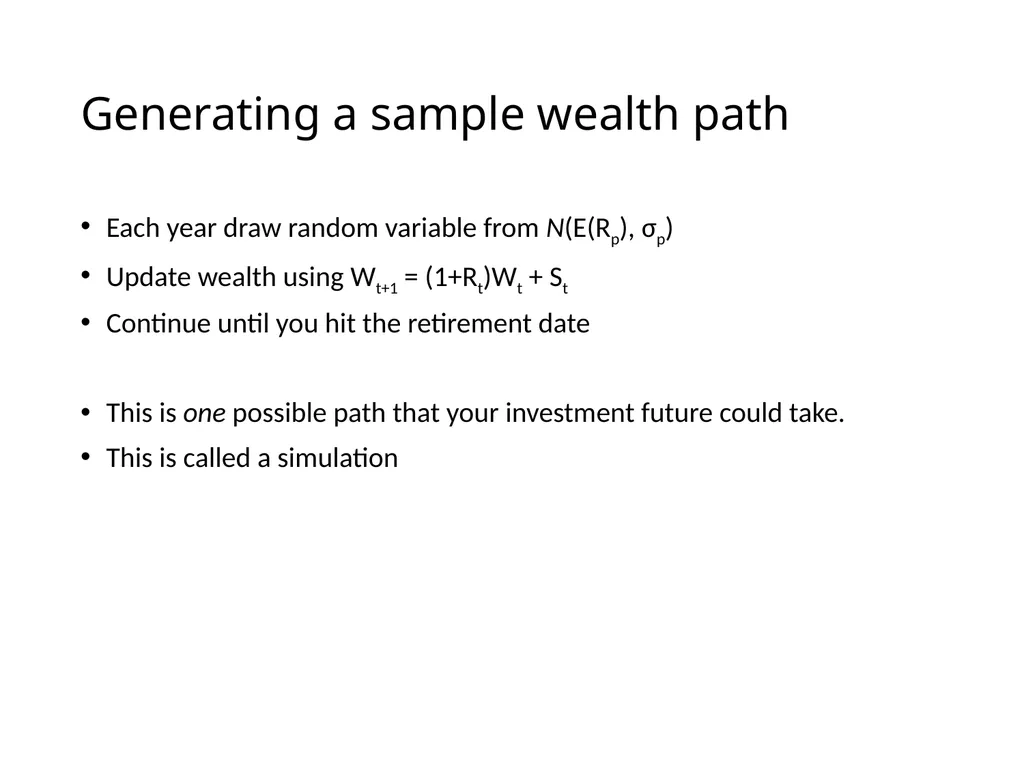
Generating a sample wealth path Each year draw random variable from N(E(Rp), σp)
Update wealth using Wt+1 = (1+Rt)Wt + St
Continue until you hit the retirement date
This is one possible path that your investment future could take.
This is called a simulation<br>
09
Generating a wealth path Retirement Date Wealth Start Date Target Wealth<br>
10
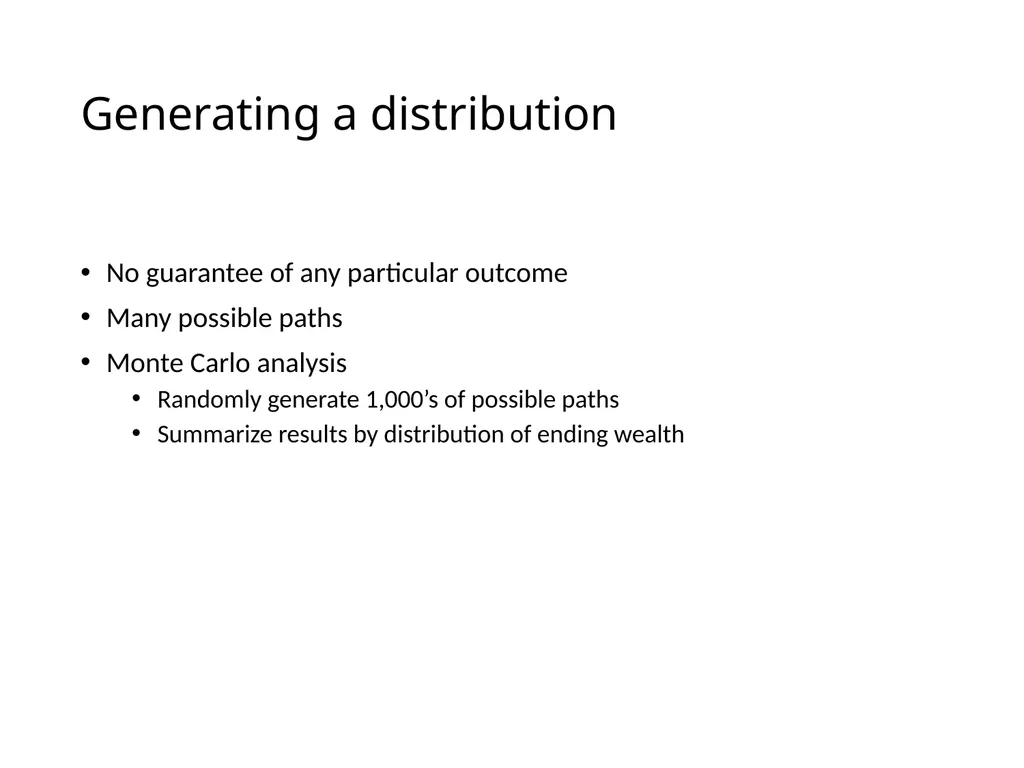
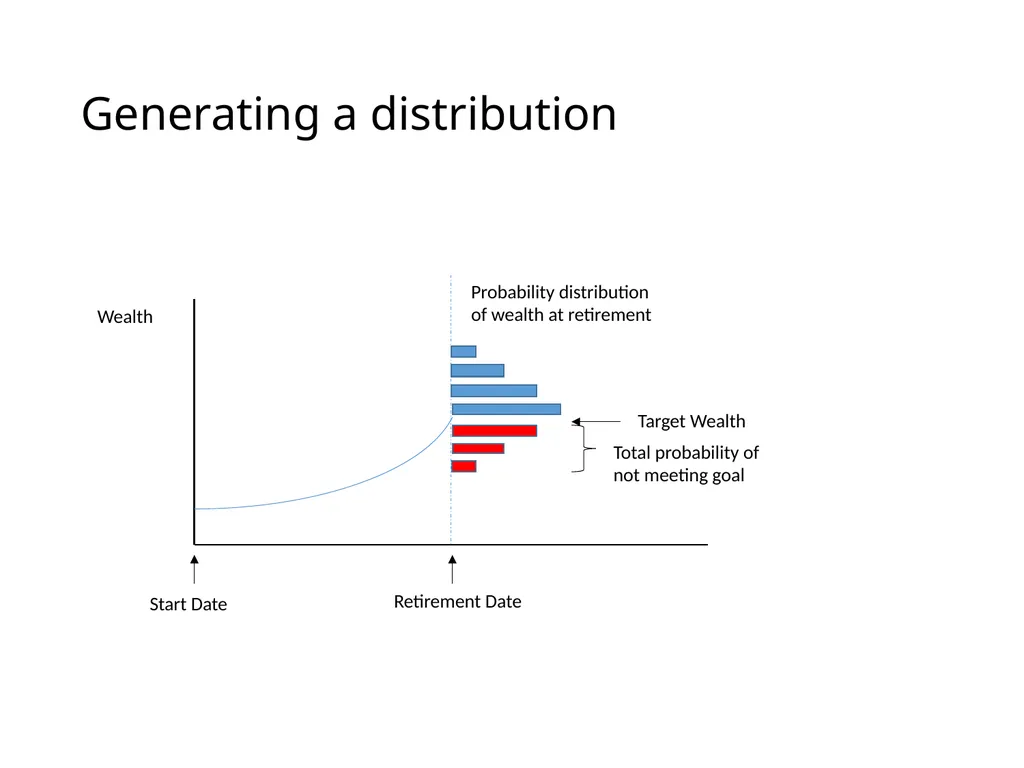
Generating a distribution No guarantee of any particular outcome
Many possible paths
Monte Carlo analysis
Randomly generate 1,000’s of possible paths
Summarize results by distribution of ending wealth<br>
11
Generating a distribution Retirement Date Wealth Start Date Target Wealth Probability distribution
of wealth at retirement Total probability of not meeting goal<br>
12
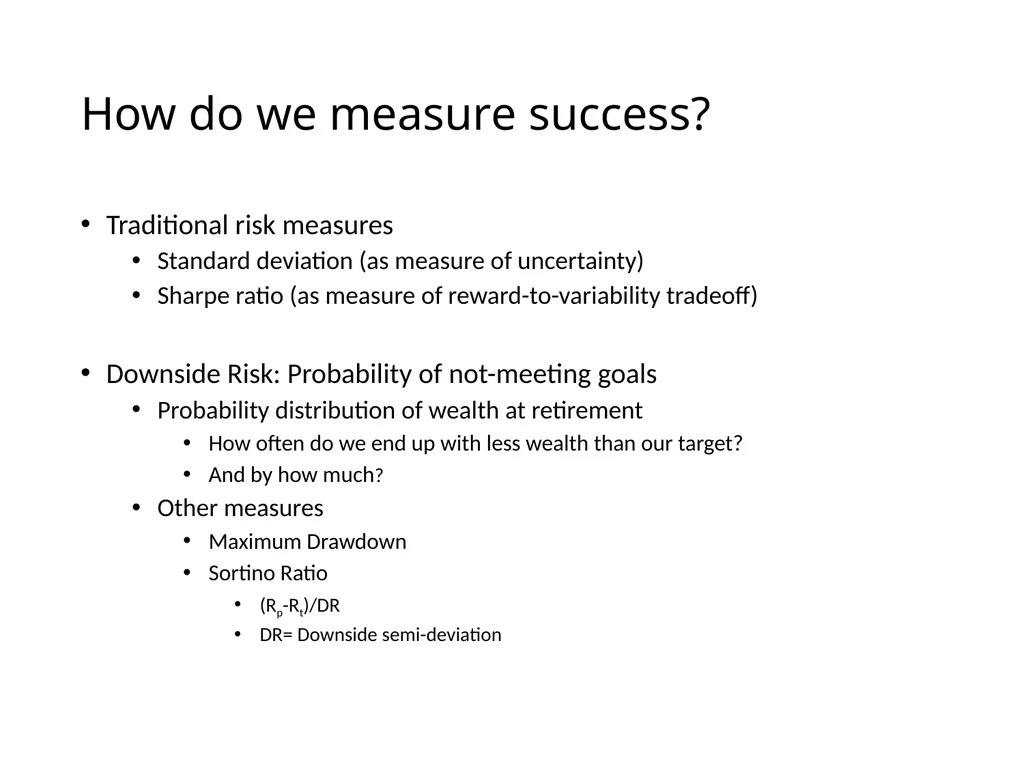
How do we measure success? Traditional risk measures
Standard deviation (as measure of uncertainty)
Sharpe ratio (as measure of reward-to-variability tradeoff)
Downside Risk: Probability of not-meeting goals
Probability distribution of wealth at retirement
How often do we end up with less wealth than our target?
And by how much?
Other measures
Maximum Drawdown
Sortino Ratio
(Rp-Rt)/DR
DR= Downside semi-deviation<br>
13
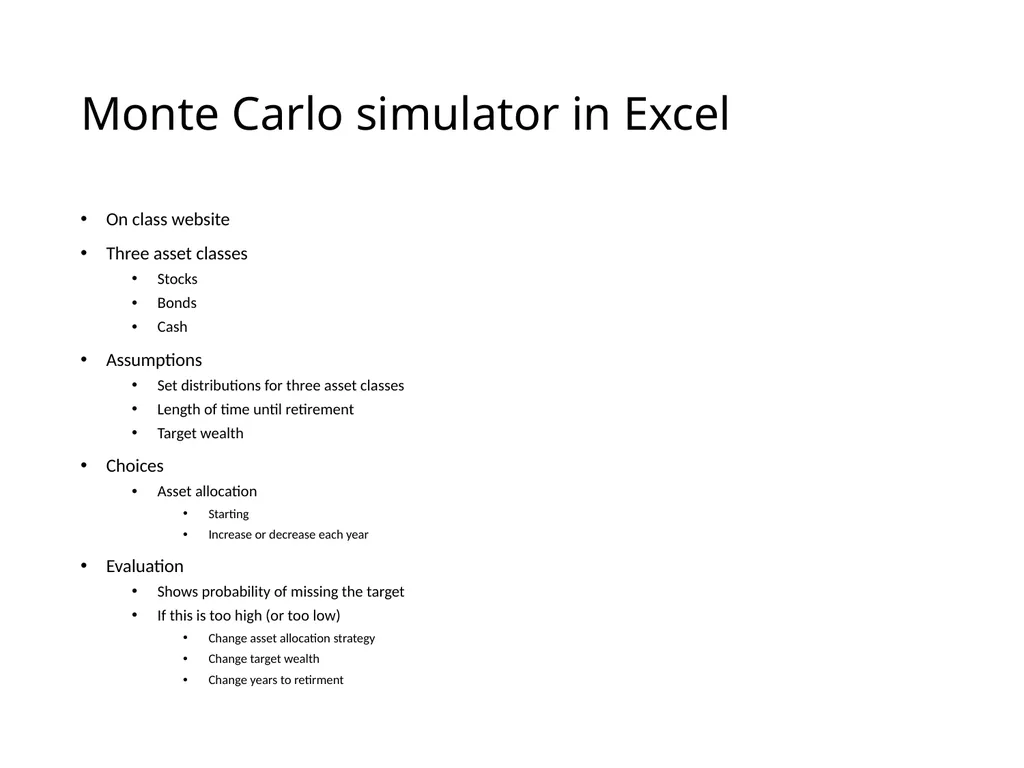
Monte Carlo simulator in Excel On class website
Three asset classes
Stocks
Bonds
Cash
Assumptions
Set distributions for three asset classes
Length of time until retirement
Target wealth
Choices
Asset allocation
Starting
Increase or decrease each year
Evaluation
Shows probability of missing the target
If this is too high (or too low)
Change asset allocation strategy
Change target wealth
Change years to retirment<br>
14
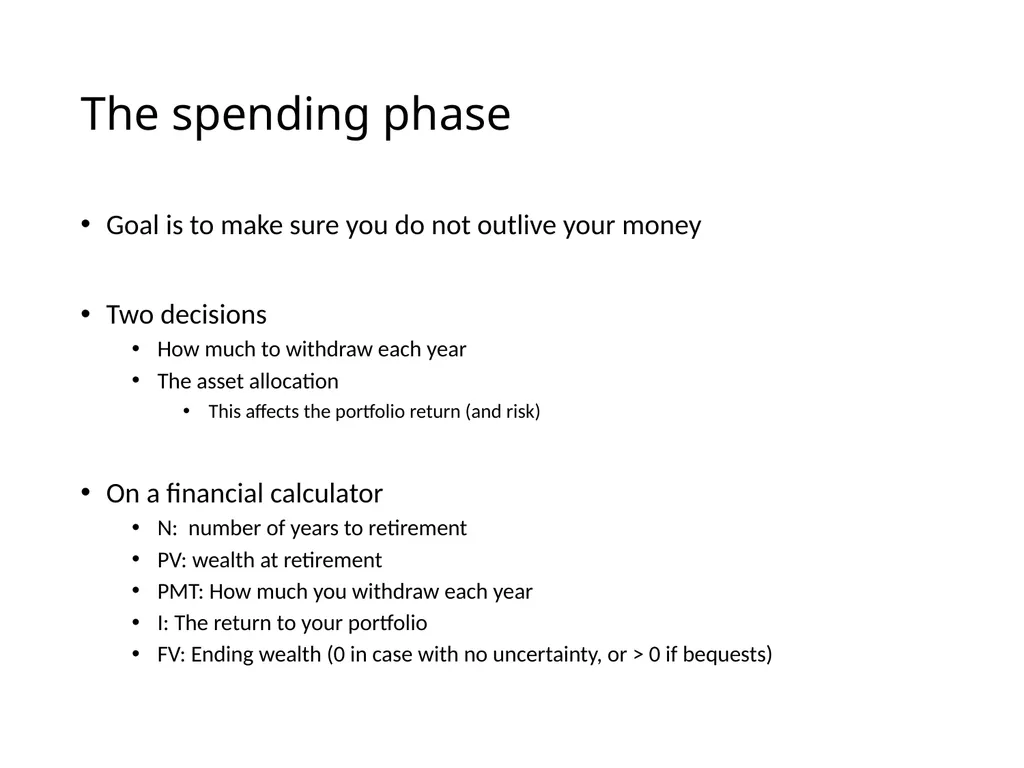
The spending phase Goal is to make sure you do not outlive your money
Two decisions
How much to withdraw each year
The asset allocation
This affects the portfolio return (and risk)
On a financial calculator
N: number of years to retirement
PV: wealth at retirement
PMT: How much you withdraw each year
I: The return to your portfolio
FV: Ending wealth (0 in case with no uncertainty, or > 0 if bequests)<br>
15
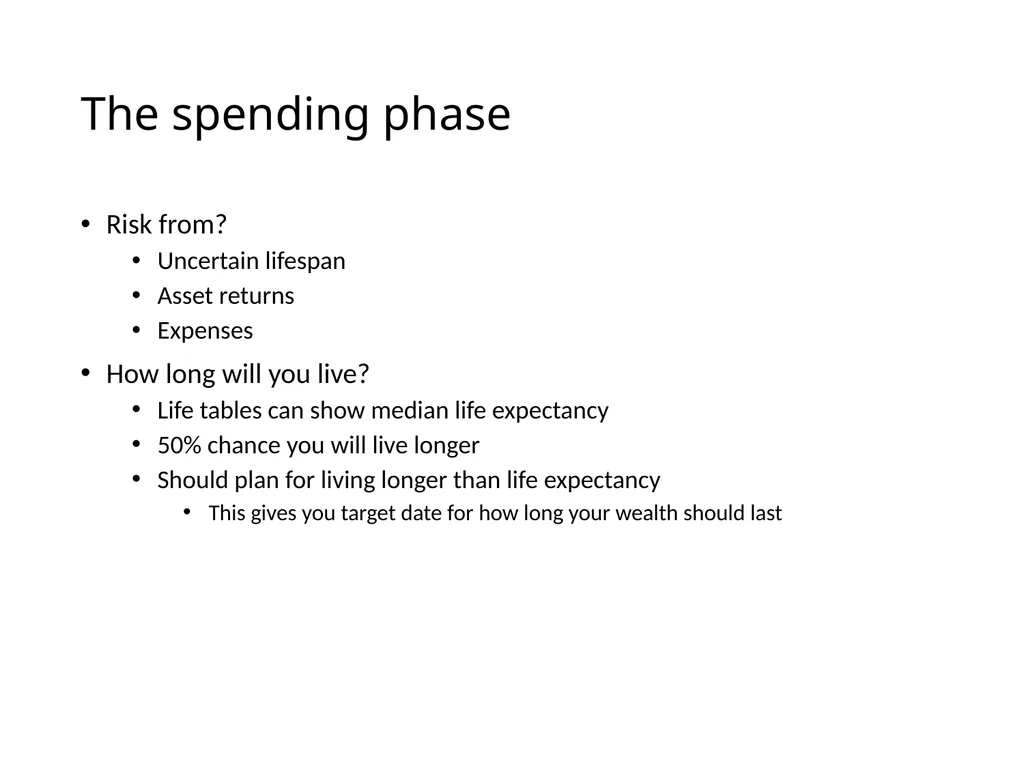
The spending phase Risk from?
Uncertain lifespan
Asset returns
Expenses
How long will you live?
Life tables can show median life expectancy
50% chance you will live longer
Should plan for living longer than life expectancy
This gives you target date for how long your wealth should last<br>
16
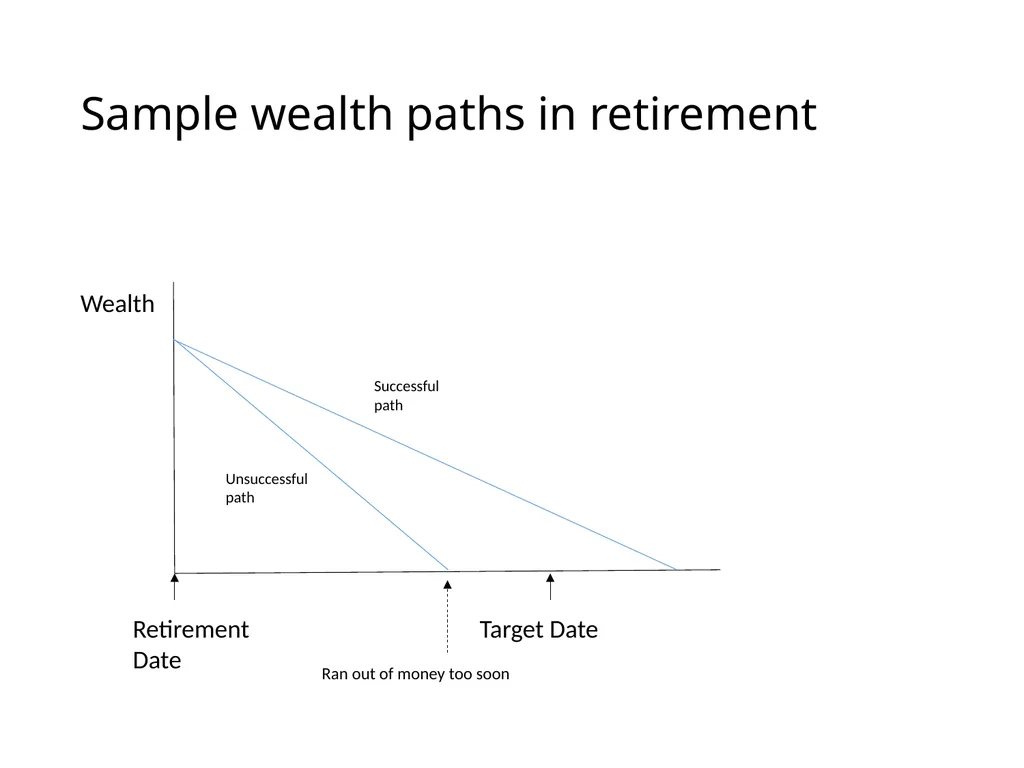
Sample wealth paths in retirement Retirement Date Wealth Target Date Unsuccessful
path Ran out of money too soon Successful
path<br>
17
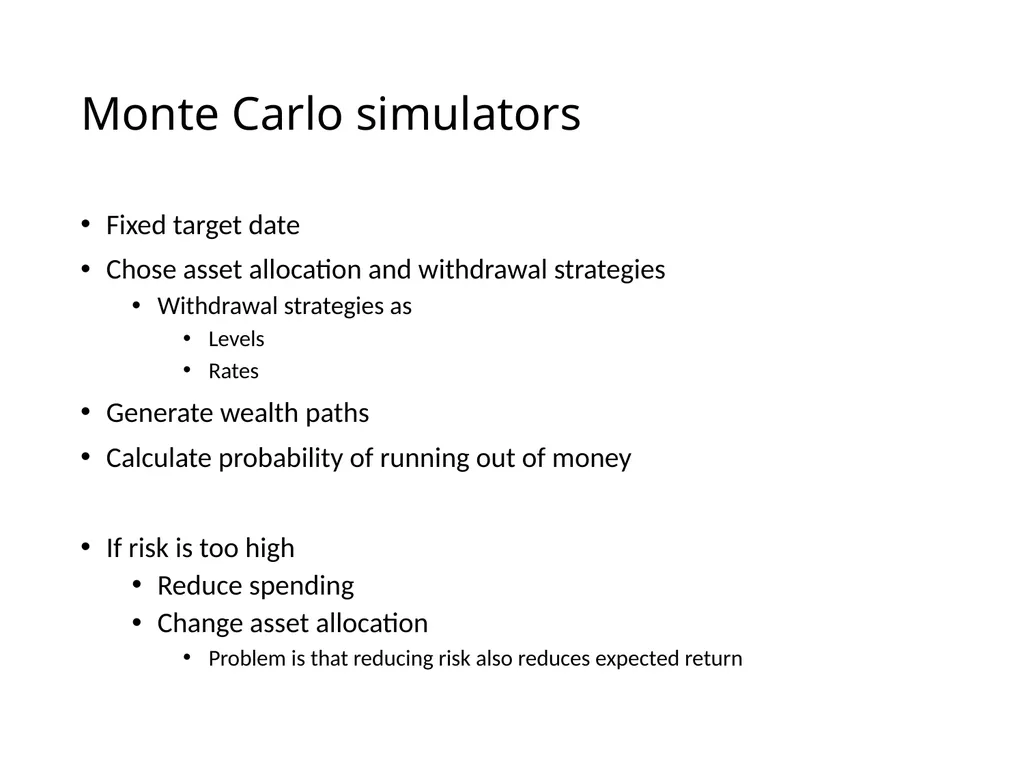
Monte Carlo simulators Fixed target date
Chose asset allocation and withdrawal strategies
Withdrawal strategies as
Levels
Rates
Generate wealth paths
Calculate probability of running out of money
If risk is too high
Reduce spending
Change asset allocation
Problem is that reducing risk also reduces expected return<br>
18
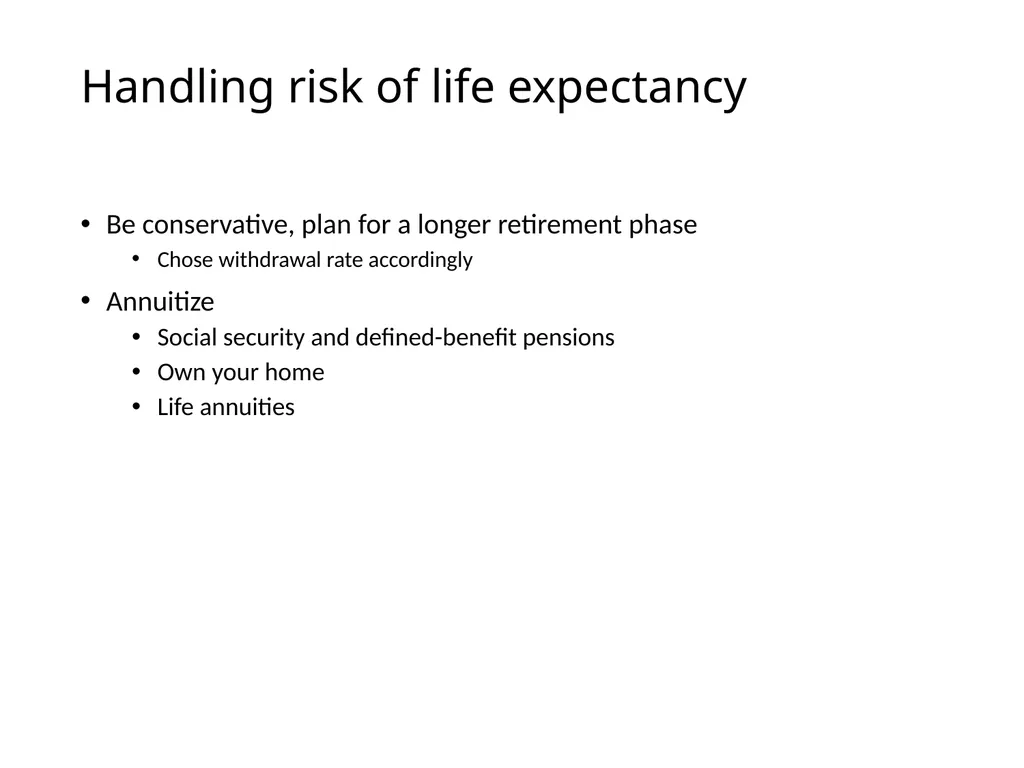
Handling risk of life expectancy Be conservative, plan for a longer retirement phase
Chose withdrawal rate accordingly
Annuitize
Social security and defined-benefit pensions
Own your home
Life annuities<br>