Under Indian Administrative System Kautilya: Theory of the State Kautilya Born in 375 BCE ; Died in 283 BCE. Teacher in University of Takshashila. Assisted Chandragupta Maurya to established Maurya Empire. His magnum opus is Arthsashtra.
"Under Indian Administrative System Kautilya:" is the property of its rightful owner. Permission is granted to
download and print the materials on this website for personal, non-commercial use only, and to display it
on your personal computer provided you do not modify the materials and that you retain all copyright
notices contained in the materials. By downloading content from our website, you accept the terms of this
agreement.
Presentation Transcript
01
Under Indian Administrative System Kautilya: Theory of the State<br>
02
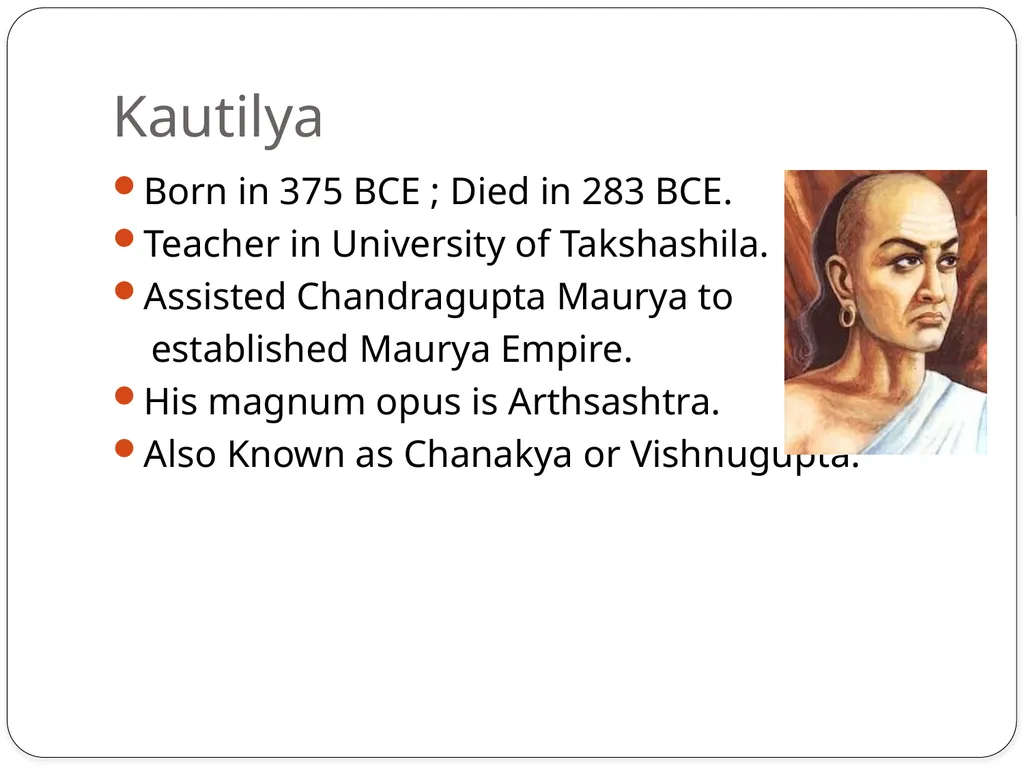
Kautilya Born in 375 BCE ; Died in 283 BCE.
Teacher in University of Takshashila.
Assisted Chandragupta Maurya to
established Maurya Empire.
His magnum opus is Arthsashtra.
Also Known as Chanakya or Vishnugupta.<br>
03
Arthsashtra Assumed to be written by Kautilya between 4th century BCE 3rd century BCE.
Though part of a broader arthsashtra tradition, Kautilya’s version is only the only complete text to survive.
Unearthed in 1904 by R. Shamasastry and first published in english in 1915.
Scope of the text: a. Covers governance, administration, economy, military strategy, and foreign policy. B. structured around the theory of the state (saptanga), including the king, ministers, territory, fort, treasury, army and allies.<br>
04
It has 15 parts/books, 150 chapters and 6000 verses.
first 5 books: Internal matters of the state.
6 to 13 books: External matters of the state.
14 to 15 books: Other issues of the state.
It was first Shastra to make politics autonomous of religion, ethics, morality, first to prescribe politics of statecraft on notion of national interest, first to provide such detailed description on public administration and governance.<br>
05
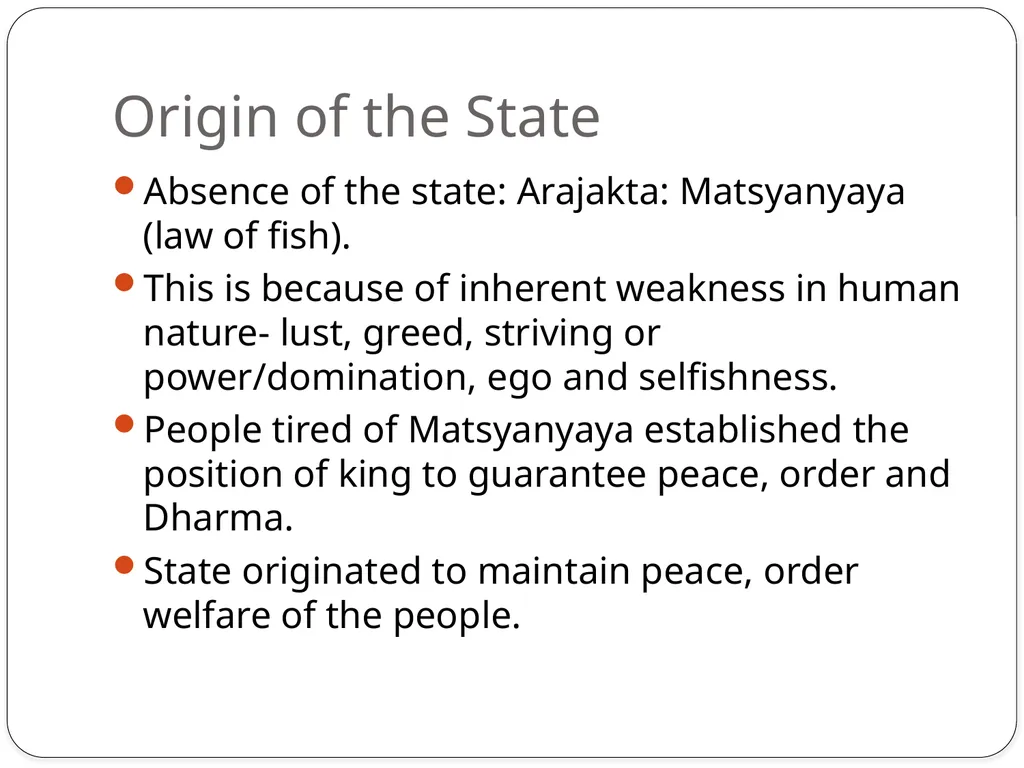
Origin of the State Absence of the state: Arajakta: Matsyanyaya (law of fish).
This is because of inherent weakness in human nature- lust, greed, striving or power/domination, ego and selfishness.
People tired of Matsyanyaya established the position of king to guarantee peace, order and Dharma.
State originated to maintain peace, order welfare of the people.<br>
06
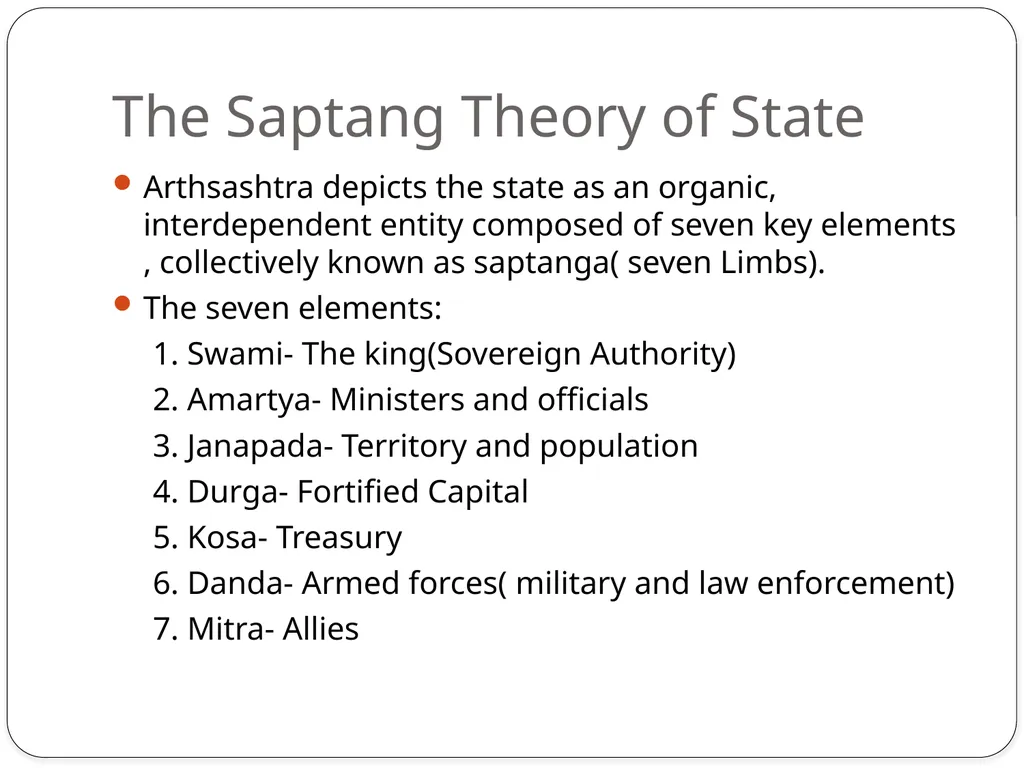
The Saptang Theory of State Arthsashtra depicts the state as an organic, interdependent entity composed of seven key elements , collectively known as saptanga( seven Limbs).
The seven elements:
1. Swami- The king(Sovereign Authority)
2. Amartya- Ministers and officials
3. Janapada- Territory and population
4. Durga- Fortified Capital
5. Kosa- Treasury
6. Danda- Armed forces( military and law enforcement)
7. Mitra- Allies<br>
07
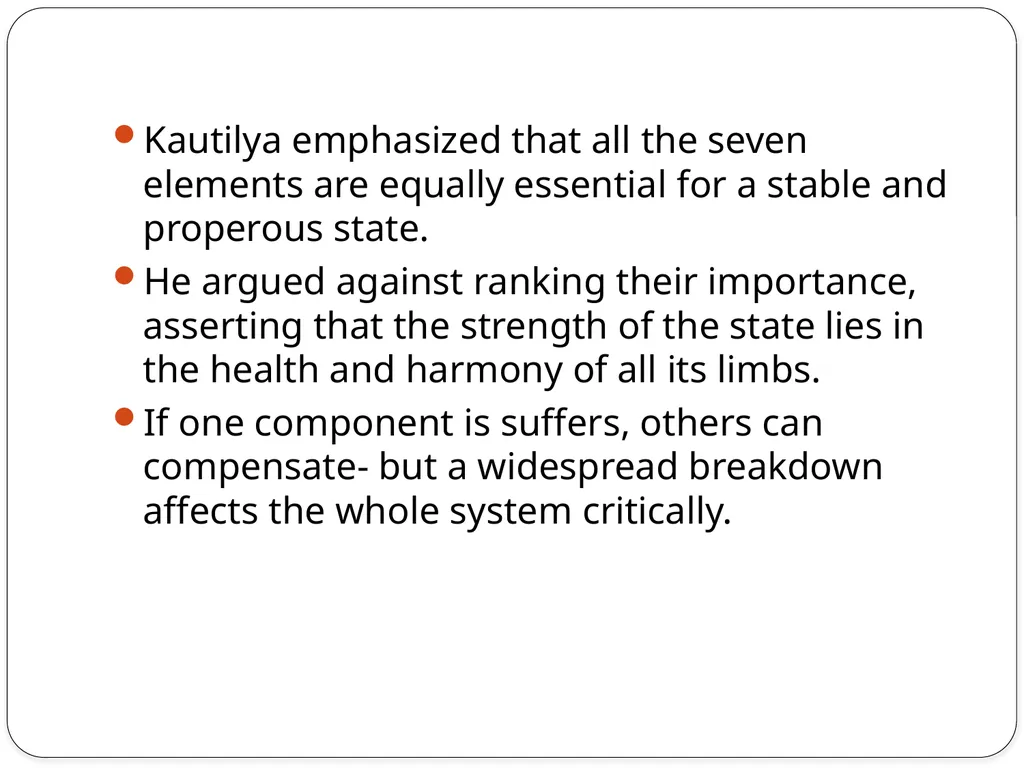
Kautilya emphasized that all the seven elements are equally essential for a stable and properous state.
He argued against ranking their importance, asserting that the strength of the state lies in the health and harmony of all its limbs.
If one component is suffers, others can compensate- but a widespread breakdown affects the whole system critically.<br>
08
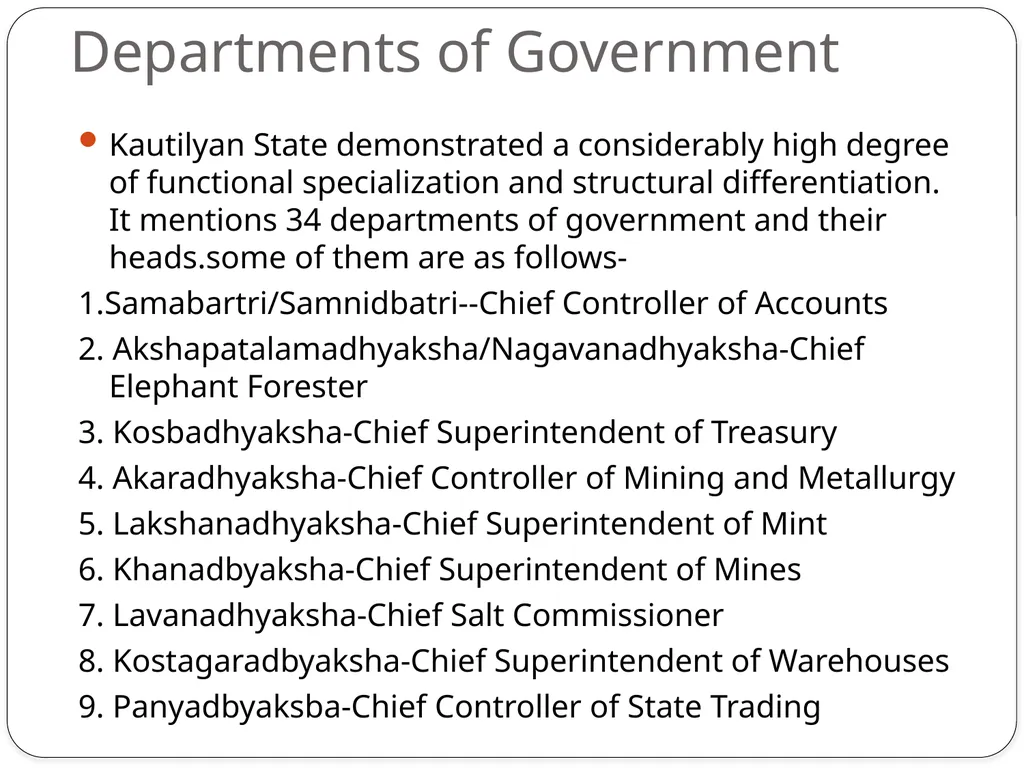
Departments of Government Kautilyan State demonstrated a considerably high degree of functional specialization and structural differentiation. It mentions 34 departments of government and their heads.some of them are as follows-
1.Samabartri/Samnidbatri--Chief Controller of Accounts
2. Akshapatalamadhyaksha/Nagavanadhyaksha-Chief Elephant Forester
3. Kosbadhyaksha-Chief Superintendent of Treasury
4. Akaradhyaksha-Chief Controller of Mining and Metallurgy
5. Lakshanadhyaksha-Chief Superintendent of Mint
6. Khanadbyaksha-Chief Superintendent of Mines
7. Lavanadhyaksha-Chief Salt Commissioner
8. Kostagaradbyaksha-Chief Superintendent of Warehouses
9. Panyadbyaksba-Chief Controller of State Trading<br>
09
10. Kupyadbyaksha-Chief Superintendent of Forest Produce
11. Ayudbgbaradbyaksha-Chief of Ordinance
12. Pauthavadbyaksba-Chief Controller of Weight and Measures
13. Sutradbyaksha-Chief Textile
14. Suradbyaksba-Chief Controller of Alcoholic Beverages
15. Sunadbyaksba-Chief Protector of Animals and Controller of Animal Slaughter
16. Ganikadbyaksha-Chief Controller of Entertainment
17. Pattanadbyaksba-Chief Controller of Ports and
18. Asbwadbyaksha-Chief Commander of Cavalry
19. Pattadbyaksba-Chief Commander of Infantry
20. Mudradbyaksha-Chief Passport
21. Dbyutadhyaksba -Chief Controller of Gambling
22. Bandanagradbyaksha-Chief Superintendent of Jails
23. Devtadbyaksha-Chief Superintendent of Temples<br>
10
Structure, Supervision and Strategy of the Government Department Horizontal Structure: 34 departments functioned independently under central supervision.
Vertical Authority:
Division between central and provincial administration is not clear in the text. The only vertical administrative hierarchies clearly mentioned appear to be those for the village, city/town level, including fortified cities.
Qualification and Testing:
Officials were assessed via four test: Dharma(ethics), Artha(profit), kama(desire), bhaya( fear).
King as Apex:
Monarch supervised policy and appointments.<br>
11
Was Kautilya’s State Centralized? Kautilya breaks from Dharmashastra tradition( society Focused) to a Rajdharma approach( state focsed).
Indicators of Centralization:
a. empowered monarch and bureaucracy.
b. extensive state monopolies and regulations in economy and culture.
c.State controlled settlement of lands and immigration.
d. Massive network of spies for surveillance and enforcement.
The text lacks clear bureaucratic hierarchies , chain of command, internal administrative coordination<br>
12
Texual perspective: mixed; recognizes centralized elements but notes vague command structure.
Kangle likens Kautilya to Machiavelli, not Bismarck – both advocate realpolitik but not detailed bureaucratic execution.
Heesterman's Critique:Argues Arthashastra attempts but fails to truly define a centralized bureaucracy.Lacks clarity on departmental accountability and reporting mechanisms. Suggests the king was more a first among equals (primus inter pares) than an absolute autocrat.
Romila Thapar suggests a mixed administrative mode:
1. centralized at capital
2. Devolutionary in key core areas.
3. Decentralization in peripheries.<br>
13
Theory of Rajamandala( the circle of states) Arthsashtra also explains interstate relations and foreign policies.
Based on the idea:"A neighbor is likely to be an enemy; a neighbor’s neighbor is a potential ally.“
Core Principles:
Accumulation of resources for conquest.
Elimination of enemies.
Cultivation and support of allies.
Prefer prudence over reckless valor.
Prefer peace over war.
Pursue justice in both victory and defeat.<br>
14
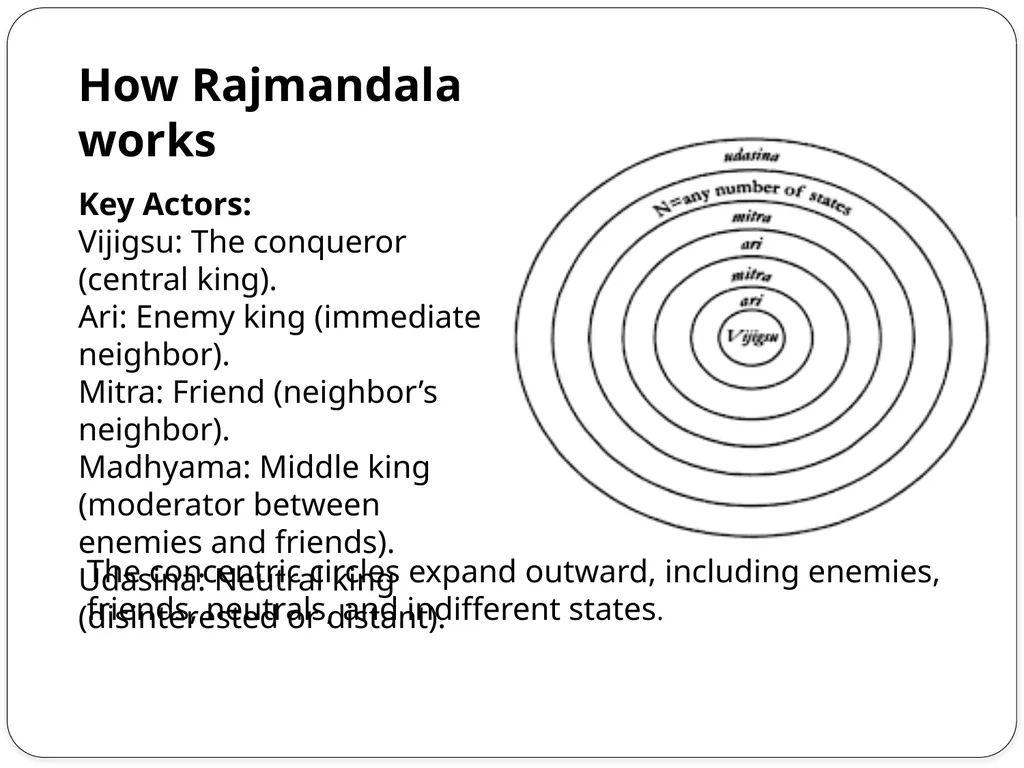
Key Actors:
Vijigsu: The conqueror (central king).
Ari: Enemy king (immediate neighbor).
Mitra: Friend (neighbor’s neighbor).
Madhyama: Middle king (moderator between enemies and friends).
Udasina: Neutral king (disinterested or distant). How Rajmandala works The concentric circles expand outward, including enemies, friends, neutrals, and indifferent states.<br>
15
Significance and Practical Use of the Rajamandala Model Strategic Flexibility and Realpolitik
Kautilya’s model is highly pragmatic—it doesn't rely on permanent friends or enemies.
A king (Vijigsu – one seeking conquest) should constantly assess power dynamics:
Ally with some, neutralize others, and subdue the rest depending on current interests.
Success depends on the wise use of diplomacy, intelligence, and war, depending on what benefits the state most.
Adapting to Context and Power Balance
The Rajamandala recognizes that political relationships shift.
Strategic decisions are based on:
Relative strength of allies and enemies.
Unpredictable events, such as leadership changes or wars elsewhere.
Motivations and past behavior of other rulers.<br>