
UNDERSTANDING HOW THE BRAIN DEVELOPS BIAS CRRF


Description: UNDERSTANDING HOW THE BRAIN DEVELOPS BIAS CRRF Learning about Racism course COURSE DEVELOPED BY: Dr. Hooley McLaughlin (University of Toronto) Copyright 2020 Canadian Race Relations Foundation All rights reserved. No part of this
Related Topics
Download Presentation
"UNDERSTANDING HOW THE BRAIN DEVELOPS BIAS CRRF" is the property of its rightful owner. Permission is granted to download and print the materials on this website for personal, non-commercial use only, and to display it on your personal computer provided you do not modify the materials and that you retain all copyright notices contained in the materials. By downloading content from our website, you accept the terms of this agreement.
Presentation Transcript
slide1. UNDERSTANDING HOW THE BRAIN DEVELOPS BIAS CRRF Learning about Racism course
COURSE DEVELOPED BY:
Dr. Hooley McLaughlin
(University of Toronto)<br>
slide2. Copyright © 2020 Canadian Race Relations Foundation All rights reserved. No part of this publication may be reproduced in any form or by any means, electronic or mechanical including photocopying or by any information storage or retrieval systems without the permission of the publisher.<br>
slide3. Disclaimer: The learning courses are provided for information and educational purposes only, and does not constitute legal or professional advice. The content published herein represents the belief and work of its authors, and does not necessarily reflect the official policy or positions of the Canadian Race Relations Foundation.<br>
slide4. Course overview This course examines how new insights in the fields of psychology and neuroscience help to show how the brain develops bias, and how understanding unconscious bias is important for anti-racism work.<br>
slide5. Agenda Unit 1: Bias - a natural outcome of explaining the world around us
Unit 2: When categorizing goes too far
Unit 3: Habits that affect our judgement
Unit 4: Studies in Artificial Intelligence - what AI tells us about ourselves
Unit 5: Theories of brain development over evolution versus spontaneous Team allegiances<br>
slide6. Agenda Unit 6: Attempts to measure implicit racism - using the mechanics of the brain
Unit 7: Considerations for early learning programmes to mitigate against racist biases - using more discrimination to fight generalizations and stereotyping
Unit 8: Cautionary observations from researchers on IAT - what we can say for sure and what we have to continue testing
Unit 9: Non-Western models of the mind and alternative approaches to fighting racism
Unit 10: The future of the science of racism - bringing together people from all cultures and involving scientists in a public dialogue<br>
slide7. Unit One: Bias - a natural outcome of explaining the world around us<br>
slide8. Unit One: Bias - a natural outcome of explaining the world around us Discriminating between objects - noting their characteristics and the differences between one object and another - is a necessary part of analysing and successfully negotiating with the world around us. As we discriminate between objects, we find some things are becoming more comfortable or familiar than others. This is the beginning of bias, a natural aspect of being human and aware.
https://crrf-fcrr.box.com/s/oac0ghy3k43tzaduaqyzqjyts80e0tw9<br>
slide9. Exercise No. 1: Working with another person, have that person take you blindfolded into a room that you haven't experienced before. Take your time walking or crawling slowly through the room feeling the objects in it. Try to discern what you are feeling and how you feel about what you are feeling.
Was the activity confusing at first?
Did you become more aware of what you were feeling as you explored the objects with your hands?
Did some things frighten you at first?
Did you like some objects more than others? Why or why not?<br>
slide10. Exercise No. 1: The blindfolded episode is an approximation of what it was like for you when you were a newborn learning about the world around you for the first time.
Do you think you could experience the world without forming theories about what you are seeing?<br>
slide11. Categorizing in Early Childhood Alison Gopnik is a psychologist who has studied how babies and young children think. Categorizing is a natural outcome of making sense of the world around us. This is closely connected to having a favourite food or activity, or to making decisions or forming hypotheses. And we are influenced by how we think people around us are feeling, no matter what age we are.
Bias of any kind is connected to things that influences us when we make decisions. For more insight into this area of study - how babies think - have a look at the Ted Talk given by Dr. Gopnik in 2011:
https://youtu.be/cplaWsiu7Yg<br>
slide12. Unit Two: When categorizing goes too far<br>
slide13. When categorizing goes too far Quite often we feel prejudice against people that are not as familiar to us as the people in our own family and our own everyday personal experience. Our comfort zone has developed since our early childhood when we were beginning to form categories around us. These categories included the people in our lives.
https://crrf-fcrr.box.com/s/mjhnhm5ulbghfy162kbukrcv5vq6y8x3
Please note Orlando's decision to forgive his aggressors in an attempt to end the cycle of reprisal and hatred between people who associate with different groups.<br>
slide14. Statistics on Racial Bias in Canada The CRRF commissioned Environics to do a survey in 2018 on Canadian attitudes towards immigrants. The results show a promising trend - attitudes on immigration have grown more positive in recent years, with the majority of people expressing the belief that immigration is good for Canadian society. On the other hand, as we can see from the CRRF report in 2017, we have a lot more to do with regard to how Canadians feels about people from different races and religions.
2018 Environics Survey:
https://crrf-fcrr.app.box.com/s/vig9r3w8l456hpzk5s2vjvrm3fqxf78n
2017 CRRF report on Inter-group Opinions:
https://crrf-fcrr.app.box.com/file/255613040292?v=CapPulse2017Report<br>
slide15. Unit Three: Habits that affect our judgement<br>
slide16. Habits that affect our judgement Discerning the world around us becomes automatic as we repeat the same actions again and again in a context that maintains the same general conditions form day to day.
One could look at this habituation as if it were a habitual reaction to events around us. This can lead to predictable patterns of behaviour.
Psychologists and neurobiologists studying these patterns find that behaviour can be linked to predictable brain activity.
These leads us to interesting and somewhat disconcerting questions:<br>
slide17. Habits that affect our judgement How deeply buried is our bias? Is it partly implicit? Has it become part of our natural brain activity in response to the world around us. During our development as young children, did we habituate ourselves to a particular pattern of biased response to others?
Science is only at the earliest stages of this study, but results from cognitive and perceptual experiments since the early part of the last century indicate that our brains often have trouble dealing with input that conflicts with our habitual patterns of responding to our environment.<br>
slide18. Exercise 2: The Stroop Test Much of the testing used by psychologists to show the existence of implicit bias is derived from early studies into the relationship between brain physiology/response and cognitive awareness. The Stroop effect was first shown in the 1920s and 30s.
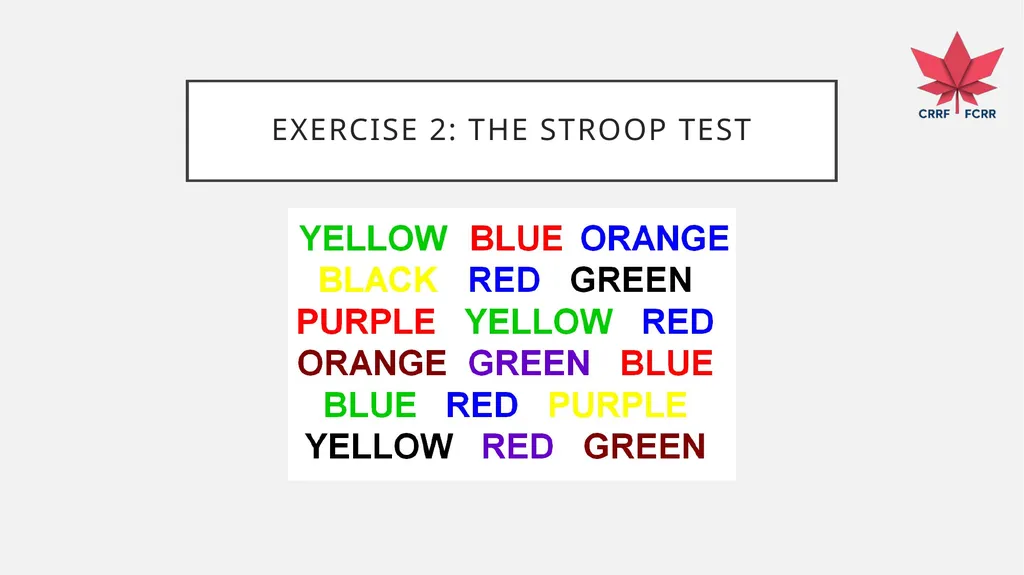
A person is asked to read out loud a list words in differently coloured fonts. In the most popular variant of the test, a person is asked to read out the following list of words, then they are asked to read out the font colours of the words in this list.<br>
slide19. Exercise 2: The Stroop Test<br>
slide20. Exercise 2: The Stroop Test Individuals usually stumble when reading out the list of font colours and not the words.
The Stroop Test has revealed a cognitive dissonance that cannot be overcome, even with practice. The meaning of the words is in conflict with our perception of the colour itself. Two aspects of our lifelong experience and learning are fighting against one another - in the one case, our association of the appearance of a colour with a spoken word, and in the other case our association of a list of phonemes with the sound of a written word, something we have learned from our childhood development in a literate society.
You could say that these are two habits that cannot tolerate one another.<br>
slide21. Exercise 2: The Stroop Test The essential message here is two-fold:
1.) there are aspects of our brain that we can only see through specialized tests developed by scientific researchers; and
2.) while the effect is a little disconcerting, it is rather fun to try and leads to a lot of interest and engagement.
And as an added bonus we are reminded that scientists have been looking into counterintuitive and disconcerting workings of the brain for at least the last century.<br>
slide22. Exercise No. 3 - Visual Illusions In introducing the concept of implicit bias in their book Blind Spot, Mahzarin Banaji and Anthony Greenwald talk about "mindbugs.“
There are many examples of experiences that our brains seem completely unable to engage without bias.
These can be quirky traits such as altered memories, illogical solutions to simple mathematical questions, and lack of judgement in social situations.<br>
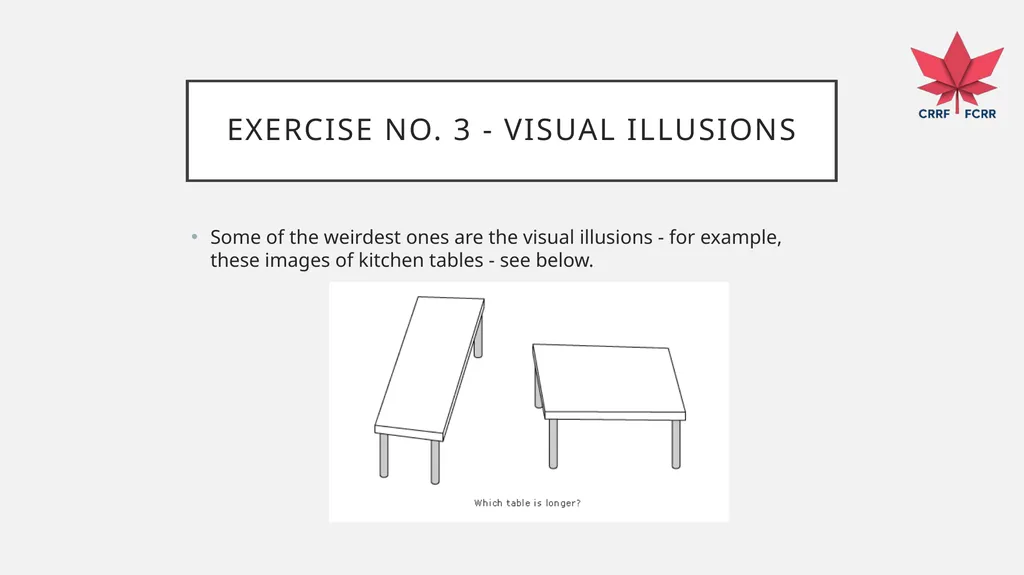
slide23. Exercise No. 3 - Visual Illusions Some of the weirdest ones are the visual illusions - for example, these images of kitchen tables - see below.<br>
slide24. Exercise No. 3 - Visual Illusions We are asked which table is the largest; which one is longest; which one is the shortest?
That doesn't seem difficult to the average viewer.
However, as Banaji and Greenwald point out to us, this image, a special kind of mindbug, reveals our perspective bias.
It turns out that the two table tops are absolutely identical in shape and size. Even after proving this to ourselves - by cutting out the tabletop shapes and physically placing one over the other - we cannot overcome the sensation that there is a short fat shape and a long thin shape and that they are completely unlike one another.<br>
slide25. Exercise No. 3 - Visual Illusions We could ask why Banaji and Greenwald chose to start their book by introducing us to what seems to be an irrelevant illusion that does not reflect the gravity we expect from a study on the effect of optical illusions, it turns out, can be a good icebreaker for a conversation that leads to further revelations on the nature of human thought.
Mindbugs are examples of our inability to see what is actually in front of us because of the way that our brain sorts and frames what we are experiencing through our senses.<br>
slide26. Exercise No. 3 - Visual Illusions As a guide for an exhibition on Behind Racism: Challenging the Way We Think, we could not find a better model than the methods used by Banaji and Greenwald.
They invite discussion through the use of an enjoyable experiment and they simplify the concepts without ignoring the significance of the underlying research.<br>
slide27. The surprising limitations of fast-thinking Daniel Kahneman and Amos Tversky studied how people tended to act quickly under pressure, often making logical errors in the process (see Kahneman 2011 [1]).
They argued that the need for quick thinking tends to work well for general survival but does little when applied to problems that need more critical analysis.
In many ways, Kahneman's and Tversky's cognitive tests, that reveal our tendency toward non-logical thinking when we are in a hurry, show the same kind of bias as Banaji's and Greenwald's mindbugs.
And they are often just as surprising, allowing us an entrée for introducing the quirkiness of human thought.<br>
slide28. Quiz question For example, one of the questions that falls under Kahneman's and Tversky's regimen is the following:
In a pond, there is a patch of lily pads. Each day, the lily pad patch doubles in size. If it takes lily pads 48 days to cover the whole pond, how many days does it take to cover half the pond?
24 days
47 days<br>
slide29. Quiz question - answer The correct answer is 47 days.
Whatever day the lily pads covered half the pond, the whole pond would be covered the next day. When we are compelled to answer the riddle quickly, it is surprising upon retrospect that so many of us will answer that day 24 half the pond is covered. The answer, when revealed, is easy to understand and allows us to open up a discussion about how we jump to conclusions.
When we are compelled to answer the riddle quickly, it is surprising upon retrospect that so many of us will answer that day 24 half the pond is covered. The answer, when revealed, is easy to understand and allows us to open up a discussion about how we jump to conclusions. The correct answer is 47 days. Whatever day the lily pads covered half the pond, the whole pond would be covered the next day.<br>
slide30. Quiz question - Reflection For most people, the answer to the riddle is obvious only once it is revealed. We ask ourselves why we didn't see the obvious.
Kahneman and Tversky point out that we are prone to fast thinking and therefore to making logical errors regularly.
They suggest that taking more time to analyse a situation could result in less bias in many areas of life.<br>
slide31. Unit 4: Studies in Artificial Intelligence - what AI tells us about ourselves<br>
slide32. Studies in Artificial Intelligence - what AI tells us about ourselves Recent findings at the University of Toronto indicate that we are discovering methods for deciphering the electrical signals emanating from the human brain.
It is conceivable that we will eventually be able to read thoughts.
What does that reveal about the mechanisms that underlie our conscious thinking and behaviour?
If the brain is shown to be a very complex organic machine that stores information in the form of energy packets and that sends signals using electrical circuits, can we build an artificial brain that rivals a human one? And can we therefore study the nature of human thought by reverse engineering the human brain?<br>
slide33. Studies in Artificial Intelligence - what AI tells us about ourselves In Unit Four we will explore the concept of the brain as a machine.
We will examine the brain from an engineering perspective. We will ask if this model of human thought will help us to consider a more mathematical and mechanical model of thought than we are used to.
Will this approach help us to uncover the nature of decision-making as well?
Does it help us to unravel our tendency toward biased decision-making?<br>
slide34. Studies in Artificial Intelligence - what AI tells us about ourselves As reported on February 22, 2018, Adrian Nestor's laboratory at the University of Toronto Scarborough, postdoctoral fellow Dan Nemrodov showed he is able to digitally reconstruct images seen by test subjects from electroencephalogram data.
https://youtu.be/9uYvim8OEzM
Similar results had been reported by Adrian Nestor in earlier studies using fMRI imagery. fMRI shows activity in the brain by monitoring blood flow measured through magnetic resonance. EEG , on the other hand, has the advantage of showing changes that occur extremely quickly in the brain, thereby more closely mirroring thought itself.<br>
slide35. Exercise No. 5 As a personal thought exercise, write down your thoughts during a one minute period as you are thinking them. Try to capture as many of the fleeting references as you can. Include awareness of ongoing actions around you - include anything that you are aware of, internally or externally.
If you are in a group setting, share as many of these thoughts with one another as you are comfortable doing. Or you could try the following: one person sits and lets her thoughts drift while another person periodically touches her arm upon which the subject thinker tells the other what she is thinking about.<br>
slide36. Exercise No. 5 In analysing the results of your short look into your own thoughts, what did you notice?
Were you thinking about only one thing?
Were your thoughts jumping around from topic to topic?
Were the various thoughts related to one another or note related?
Were your thoughts revealing of issues or concerns you are having today or these days?<br>
slide37. Exercise No. 5 Would you say your thoughts reveal something about the person you really are?
Would you be comfortable letting others have access to all your thoughts?
Were you comfortable telling others all your thoughts today?
Do you think there may be aspects of your thoughts that are not easily detected by others?
Do you think there are aspects of your own thoughts that are not easily detected by you, yourself?<br>
slide38. What AI reveals about the physical nature of the human brain Artificial brains segment thinking into memory banks, sensory retrievers and processors that find ways to solve problems. They do this by storing information in the form of electromagnetic packets. The animal brain operates on the same principles.
In this sub-unit, we will briefly show the following:
1.) how nerves in the brain and throughout the body deliver messages using electricity - as was shown in Exercise No. 5. ;
2.) the anatomy of the brain and the functions of these parts - information derived from work done by biologists and psychologists over the past 150 years;<br>
slide39. What AI reveals about the physical nature of the human brain: 3.) the two primary models used for AI - a.) the brute force model that uses a giant store of memory that provides information for processors that compare sensory input to past examples; and b.) the learning artificial brain that tries solutions and gradually learns to correct its assumptions from the results - largely learning from its mistakes. This latter type of artificial brain is considered to be more like the organic animal brain.
4.) that artificial brain that learns from experience develops a perspective on the world that is being sensed through devices that look and listen to events happening around it. Patterns that yield good results are repeated. While this leads to success, it does show us that any form of analytical examination of the world through our senses requires a framework for analysis - a bias.
Read: AI Needs to Start Over:
https://www.i-programmer.info/news/105-artificial-intelligence/11135--geoffrey-hinton-says-ai-needs-to-start-over.html<br>
slide40. Unit 5: Theories of brain development over evolution versus spontaneous Team allegiances<br>
slide41. Theories of brain development over evolution versus spontaneous Team allegiances Psychologists have speculated that since bias seems essential for human activity then it must have roots in evolutionary terms. This has led to theories that contemporary humans retain traits that were necessary during the hunter-gatherer period of human history.
But counter-arguments from anthropologists who study groups still living as hunter-gatherers dispute the concept that people form generalized group concepts based on outward traits such as skin colour. Rather, it is observed, people appear to be most likely to form groups based on local contexts and access to resources such as food and other basic needs. (For further reading see Dan Everett [1],[2],[3])<br>
slide42. Theories of brain development over evolution versus spontaneous Team allegiances Psychological studies in the 1950s showed that people will make allegiances with any close group and will associate any activity with reference to that group. (See, for example, Sherif - robber cave studies 50s and 60s [4])
These results were a lot like the observations made by anthropologists like Everett. People tend to make allegiances with the people who are living or working most closely with them. Other characteristics, such as skin colour, background, religion, etc. do not tend to factor into the allegiances of this immediate need to support one's "Team.“
https://youtu.be/6QGNxRGgBwM<br>
slide43. Thinking about our "Exclusive Clubs" 1.) After hearing about the group dynamics experiments that Muzafer Sherif did with adolescent boys in the 1950s, can you think about how his results relate to behaviours you have observed in your own life?
2.) Are there groups you have belonged to that form allegiances to the exclusion of others not in your group?<br>
slide44. Thinking about our "Exclusive Clubs" 3.) Have you noticed, at times, that these allegiances have very little or nothing to do with the ethnic, racial or religious background of the people in your group?
4.) Ask yourself, if it is so easy to form a group that excludes others, could we possibly overcome this tendency by paying more attention to this seemingly natural human tendency toward a group loyalty that causes us to dislike other people for no good reason?<br>
slide45. Unit 6: Attempts to measure implicit racism - using the mechanics of the brain<br>
slide46. Attempts to measure implicit racism - using the mechanics of the brain Mahzarin Banaji and Anthony Greenwald discovered a further use of the natural cognitive dissonance associated with human thinking when they experimented with their Implicit Attribution Test (IAT) in the 1990s and early 2000s.<br>
slide47. Exercise No. 7 - IAT using Insects and Flowers https://implicit.harvard.edu/implicit/user/agg/blindspot/indexfi.htm
In Blindspot, Banaji and Greenwald use a relatively neutral human bias to introduce the IAT as an instrument for probing into our thoughts:
The likely choice between flowers and insects for most people will be flowers. An IAT is a test developed by Banaji and Greenwald [1],[2] that builds on the same principle that Kahneman and Tversky used to study fast and slow thinking. In an IAT that tests our degree of prejudice and discrimination when applied to insects and flowers, Banaji and Greenwald set up an experiment that requires the subject to assign images of insects and flowers to left or right hand columns.
While doing this, they are also required to associate positive and negative words to the same left or right hand columns.<br>
slide48. Exercise No. 7 - IAT using Insects and Flowers The IAT is a psychological instrument that quantifies our reaction time when we classify items.
When asked to work quickly at the test, a cognitive dissonance similar to that seen in the Stroop Test causes us to take different relative amounts of time when associating flowers, insects and positive and negative words.
For most of us, when we perform an IAT that asks us to categorize flowers and insects associated with positive or negative words, we falter (take a slightly longer time) or make mistakes when we are asked to relegate images of insects and positive words to one column and flowers with negative words into the opposite column. The reverse is much easier for us, since we often associate flowers with positive words and insects with negative words.
Thus we have another example of a scientifically interesting study into the way our brain works presented in a fun and engaging manner.<br>
slide49. Exercise No. 7 - IAT using Insects and Flowers By introducing the IAT using Insects and Flowers, Banaji and Greenwald in their book Blindspot eased the reader gently into an application that induced one to categorize faces of Black and White people, again associated with either negative or positive words.
Their observation is that overwhelmingly we lean toward an association of Black with negative words and White with positive words.
And they are quick to point out that this appears to be an implicit level response, one that is revealed before we can cover-up the bias by adjusting our outward presentation of our attitudes regarding race.<br>
slide50. Take the IAT To take the Insects versus Flowers IAT visit:
https://implicit.harvard.edu/implicit/user/agg/blindspot/indexfi.htm<br>
slide51. Take the IAT On first examination, it would seem we have a pretty obvious route for public experience in an exhibition on the science of racism.
We introduce the human brain's tendency toward cognitive dissonance when confronted with an experience that contains parts that cannot be resolved easily by our senses and by the brain's response to those stimuli.
Then we show that these highly-regarded scientific techniques can be used to reveal a hidden level of pre-conscious racial bias.
At some level, we can fall back on the idea that we have been pre-conditioned by a society that feeds us racially-biased imagery, so we are not entirely to blame as individuals. Yet, the realization that we may be inherently biased requires mediation, so we will be open to a dialogue on methods for mediation.<br>
slide52. Unit 7: Considerations for early learning programmes to mitigate against racist biases - using more discrimination to fight generalizations and stereotyping<br>
slide53. Considerations for early learning programmes to mitigate against racist biases - using more discrimination to fight generalizations and stereotyping Research into this project, while conflicted regarding many aspects of the study, has revealed nevertheless one approach that seems to satisfy everyone. Mindfulness, an awareness of the immediate experience one has with people, provides the means to apply a great level of scrutiny to our categorizations of others.
Almost counter-intuitively, by applying more discrimination rather than less, we see the other person as a whole human being and appreciate her, him or them for all the distinguishing traits [1]. This breaks one away from generalizations that are at the heart of hostile and dismissive bias.
https://crrf-fcrr.box.com/s/p5ltai6eiqwmtcojzgnia56f6v9ayabq<br>
slide54. Considerations for early learning programmes to mitigate against racist biases - using more discrimination to fight generalizations and stereotyping The hope is that mindfulness training applied to cross-racial communication will lead to a lessening of the apparent implicit bias we carry within us. Further to that, there is the suggestion that early childhood educational techniques could lead to a society that is less inherently biased[3],[4].
The link between cognitive and emotional centres of the brain revealed through neurobiological studies:
The studies on optical illusions, the Stroop Test, fast and slow thinking, and the Implicit Attribution Test have yielded quantitative results that go a step beyond the often-used technique of a questionnaire that asks subjects in an experiment to assess their own thinking in response to a stimulus, or their relative levels of preference when categorizing items.<br>
slide55. Considerations for early learning programmes to mitigate against racist biases - using more discrimination to fight generalizations and stereotyping Measurements that don't rely on self-reported data are more easily adapted into quantitative studies on real-time brain activity while people are in the process of categorization doing such things as IAT test. fMRI measurements have shown activity correlations between the parts of the brain associated with emotional responses and the prefrontal (cognitive/decision-making) sectors of the brain.
In this regard, Norman Farb's University of Toronto laboratory has looked into a number of studies that examine brain sector correlations during tasks that require both an emotional and a cognitive response (often involving implicit behaviour) [5],[6].
https://crrf-fcrr.box.com/s/zo89ll69yij6e1x4ozuilj3x5v4rpwhs<br>
slide56. Questions Ask yourself these questions:
What do you actually know about your neighbour, the people who work in the local stores near your home, the people you see on the way to work?
Ask yourself, do you feel friendlier toward people whom you've met socially, whose names you know?
Have you tried introducing yourself to people in your local neighbourhood who you feel are not like you in terms of their background, or social setting?<br>
slide57. Unit 8: Cautionary observations from researchers on IAT - what we can say for sure and what we have to continue testing<br>
slide58. Cautionary observations from researchers on IAT - what we can say for sure and what we have to continue testing So far it would appear that we have an ideal mix of physiological/psychological instruments (such as the IAT) and neurobiological analysis to describe the newly developing science of mind/brain science - as it can be applied to the study of human categorization tendencies.
For our purposes, a public dialogue on the science of racism would seem to be on firm footing, given the recent work on the study of human bias and the mechanisms that lie within our brains (and in our thinking consciousness) that are associated with discrimination and prejudice.
However, as will be revealed further into this report, despite all the work being done that seems to support one direction, there are often disparate interpretations of the data. With a subject as important as the study of racism, it will behoove us to consider disagreements between researchers carefully.<br>
slide59. Cautionary observations from researchers on IAT - what we can say for sure and what we have to continue testing The need to apply constraint and balance when introducing a subject that is being debated rigorously within academic institutions:
The field of psychology has been a battleground for schools of thought for well over a hundred and fifty years in Western institutions.
The IAT comes from social cognitive psychological research that in turn has origins in earlier social psychology as well as physiological/psychological measurement research. On the whole, however, social psychological research has been concerned not so much with actions at the brain level as with inter-group behaviour.
In the 1950s and early 60s, Muzafer Sherif studied intergroup conflict behaviour in an experiment that divided 12-year-old boys into two arbitrary groups that were pitted against one another [1].
The resulting intergroup hostility and conflict , it was concluded, was based on the intra-group association, familiarity and artificially-induced group loyalty and allegiance.<br>
slide60. Cautionary observations from researchers on IAT - what we can say for sure and what we have to continue testing Psychologists citing these studies by Sherif point out that given a competitive context for limited resources, groups coalesce based on their personal relationships and experience. Bias has been exogenously and arbitrarily induced therefore, and the framework through which we see the world is shown to be dependent on immediate needs.While this observation does not challenge the IAT hypothesis that we carry inherent bias (because, after all, bias is acknowledged as a longer-term condition most likely at least partly induced by societal norms), it does draw attention to the fact that we cannot know for certain what framework the individual experimental subjects are carrying into the IAT testing experience. We cannot know whether a subject is doing the test with a brain that is working within the same categories that the experimenters have themselves. So attributions of Black and White faces may be confused by other categories that are unconscious within the subject and unknown to the experimenters. This is a problem that cannot be understated, if we are playing with a subject as volatile and divisive as racism.<br>
slide61. Cautionary observations from researchers on IAT - what we can say for sure and what we have to continue testing Social psychology on the whole is not quick to subscribe to tools that simplify the process of describing mechanisms for bias as attributes of brain function.
The societal level of study precludes a reductionist analysis as being even remotely sufficient. Some studies have attempted to analyse the IAT results themselves with respect to our social context.
Uhlmann, Brescoll & Paluck [1] after examining the results of IAT experiments pointed out that it is undetermined whether subjects associated Black faces more with negative words because of inherent bias against Black members of society or because of an association of Black people with a society that treats them badly.<br>
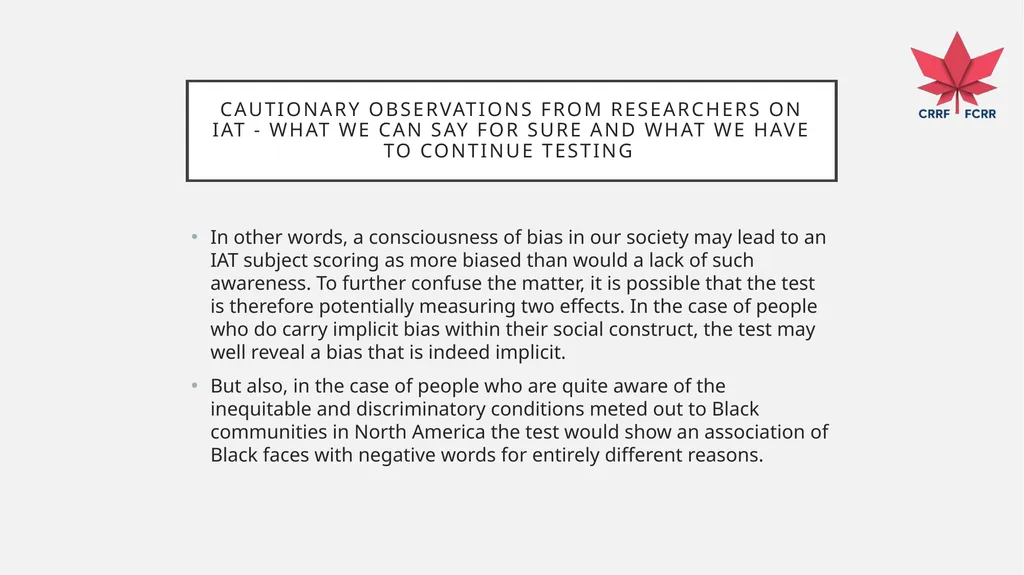
slide62. Cautionary observations from researchers on IAT - what we can say for sure and what we have to continue testing In other words, a consciousness of bias in our society may lead to an IAT subject scoring as more biased than would a lack of such awareness. To further confuse the matter, it is possible that the test is therefore potentially measuring two effects. In the case of people who do carry implicit bias within their social construct, the test may well reveal a bias that is indeed implicit.
But also, in the case of people who are quite aware of the inequitable and discriminatory conditions meted out to Black communities in North America the test would show an association of Black faces with negative words for entirely different reasons.<br>
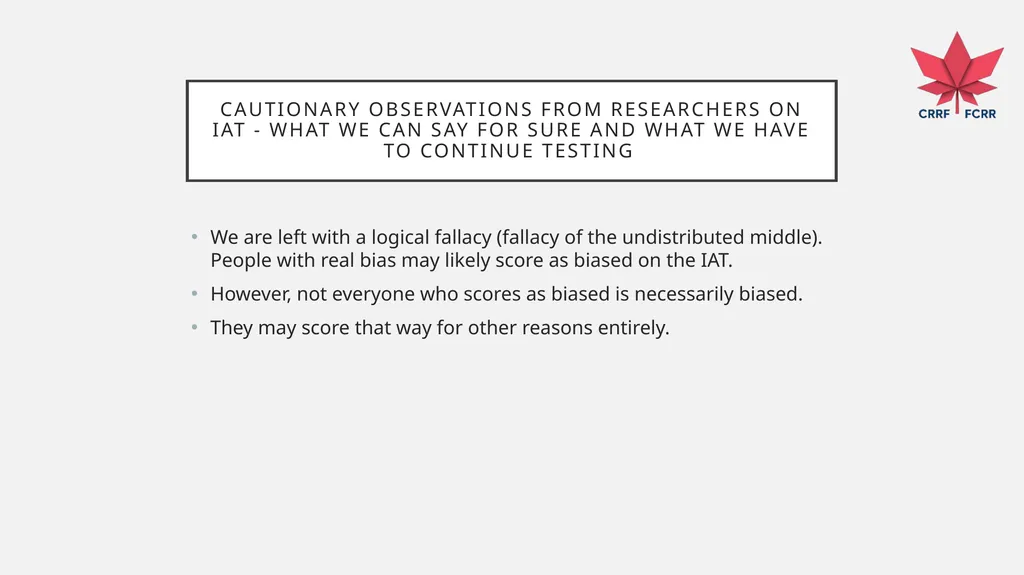
slide63. Cautionary observations from researchers on IAT - what we can say for sure and what we have to continue testing We are left with a logical fallacy (fallacy of the undistributed middle). People with real bias may likely score as biased on the IAT.
However, not everyone who scores as biased is necessarily biased.
They may score that way for other reasons entirely.<br>
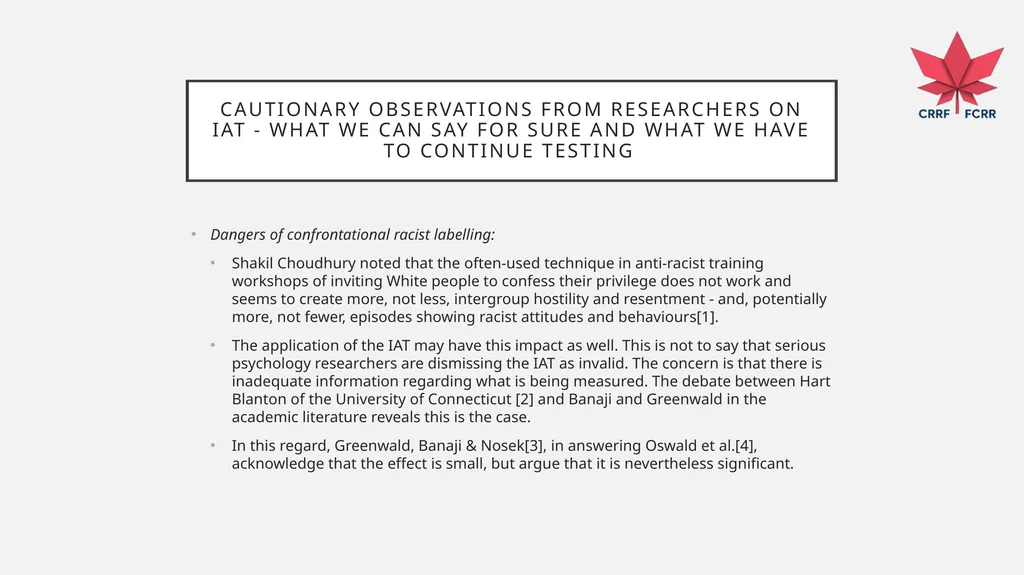
slide64. Cautionary observations from researchers on IAT - what we can say for sure and what we have to continue testing Dangers of confrontational racist labelling:
Shakil Choudhury noted that the often-used technique in anti-racist training workshops of inviting White people to confess their privilege does not work and seems to create more, not less, intergroup hostility and resentment - and, potentially more, not fewer, episodes showing racist attitudes and behaviours[1].
The application of the IAT may have this impact as well. This is not to say that serious psychology researchers are dismissing the IAT as invalid. The concern is that there is inadequate information regarding what is being measured. The debate between Hart Blanton of the University of Connecticut [2] and Banaji and Greenwald in the academic literature reveals this is the case.
In this regard, Greenwald, Banaji & Nosek[3], in answering Oswald et al.[4], acknowledge that the effect is small, but argue that it is nevertheless significant.<br>
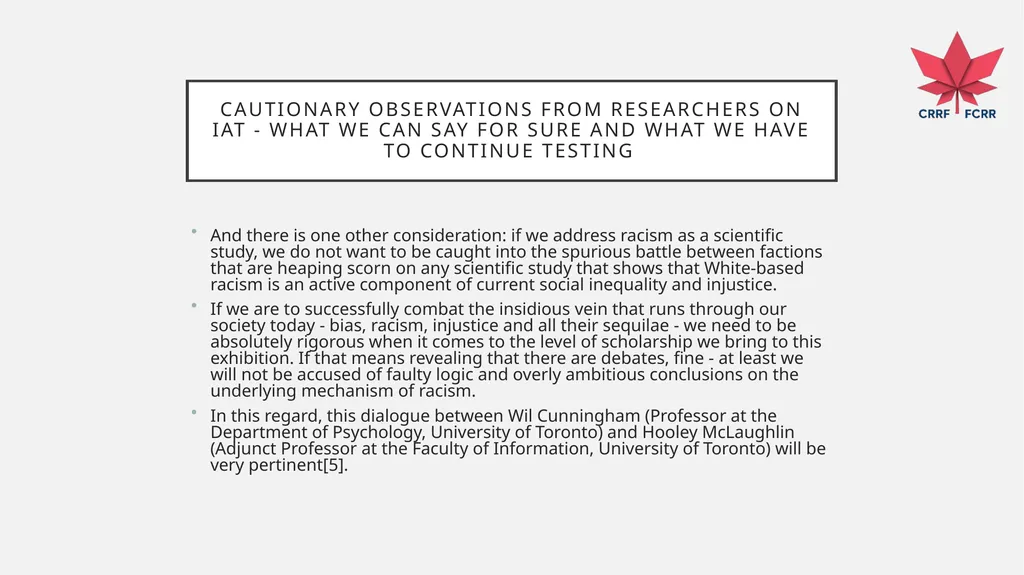
slide65. Cautionary observations from researchers on IAT - what we can say for sure and what we have to continue testing And there is one other consideration: if we address racism as a scientific study, we do not want to be caught into the spurious battle between factions that are heaping scorn on any scientific study that shows that White-based racism is an active component of current social inequality and injustice.
If we are to successfully combat the insidious vein that runs through our society today - bias, racism, injustice and all their sequilae - we need to be absolutely rigorous when it comes to the level of scholarship we bring to this exhibition. If that means revealing that there are debates, fine - at least we will not be accused of faulty logic and overly ambitious conclusions on the underlying mechanism of racism.
In this regard, this dialogue between Wil Cunningham (Professor at the Department of Psychology, University of Toronto) and Hooley McLaughlin (Adjunct Professor at the Faculty of Information, University of Toronto) will be very pertinent[5].<br>
slide66. Cautionary observations from researchers on IAT - what we can say for sure and what we have to continue testing Wil Cunningham was among the first scientists to work on the IAT with Mahzarin Banaji in the late 1990s and 2000s[6],[7].
He considers the future work on the study of human psychology as it relates to bias to be of the utmost importance. For that reason, he has become a cautionary voice in this field, asking us all to be very careful not to be overconfident about the early results of psychological studies such as those involving the IAT.
https://crrf-fcrr.box.com/s/kfjof0lhzt2zxxrvwrq9l6jgvzzzklhs<br>
slide67. Non-Western models of the mind and alternative approaches to fighting racism The need for non-Western systems of thought as part of the narrative:
Notwithstanding the power of the Western-institution based research into the mechanisms that underlie racism and other types of bias (and its concomitant academic debate), the voices of the oppressed peoples in our society include the acknowledgement of the importance of indigenous knowledge systems. These systems of thought have addressed bias and intra and inter-group communication for longer than the Western institutions have been in existence [1].
Examples include health practice in Africa that treats the village when one member of the group falls ill, and the non-hierarchical exchanges used in conflict resolution within first peoples societies of the Americas. (See also video interview with George Dei [2].)<br>
slide68. Unit 9: Non-Western models of the mind and alternative approaches to fighting racism<br>
slide69. Non-Western models of the mind and alternative approaches to fighting racism https://crrf-fcrr.box.com/s/ify2zps80zjccrd8vzht6o6kp60tccmn
Of particular importance is the understanding that categorizations tested by Western scientists are choices made within a Western context. The framing of the world, or one's World-view, World-sense, dictates the categories that we use when discriminating between people we encounter.
North American universities are so far from even accepting that there are epistemologies other than the one we use for Western science, that we would be well-advised not to overstate any conclusions we can make from the use of the recently developed instruments - such as the IAT - within the scope of a project that hopes to be inclusive of the very people who suffer the most from bias and injustice in our society.<br>
slide70. Unit 10: The future of the science of racism - bringing together people from all cultures and involving scientists in a public dialogue<br>
slide71. The future of the science of racism https://crrf-fcrr.box.com/s/6zm14z2lgrb96vztg2mukdtssajgr6js
The scientific study of racism is in its very earliest stages. The science of the future must involve members of the public - from all our communities. This is especially pertinent for the study of racism and other similarly insidious aspects of our modern society - society where all of us are becoming extremely close to one another due to our increasingly rapid communication.
https://crrf-fcrr.box.com/s/2pqo7d5p1d07yjnb7wlcbpd2mnl8yvzy<br>
slide72. Thank You! Thank you for engaging in this online module! We hope you have gained a deeper understanding of systemic racism and how it operates in Canada as well as some practical ways you can work towards interrupting and disrupting the values, norms, policies, practices, etc. that serve the status quo and maintain systemic racism.<br>
COURSE DEVELOPED BY:
Dr. Hooley McLaughlin
(University of Toronto)<br>
slide2. Copyright © 2020 Canadian Race Relations Foundation All rights reserved. No part of this publication may be reproduced in any form or by any means, electronic or mechanical including photocopying or by any information storage or retrieval systems without the permission of the publisher.<br>
slide3. Disclaimer: The learning courses are provided for information and educational purposes only, and does not constitute legal or professional advice. The content published herein represents the belief and work of its authors, and does not necessarily reflect the official policy or positions of the Canadian Race Relations Foundation.<br>
slide4. Course overview This course examines how new insights in the fields of psychology and neuroscience help to show how the brain develops bias, and how understanding unconscious bias is important for anti-racism work.<br>
slide5. Agenda Unit 1: Bias - a natural outcome of explaining the world around us
Unit 2: When categorizing goes too far
Unit 3: Habits that affect our judgement
Unit 4: Studies in Artificial Intelligence - what AI tells us about ourselves
Unit 5: Theories of brain development over evolution versus spontaneous Team allegiances<br>
slide6. Agenda Unit 6: Attempts to measure implicit racism - using the mechanics of the brain
Unit 7: Considerations for early learning programmes to mitigate against racist biases - using more discrimination to fight generalizations and stereotyping
Unit 8: Cautionary observations from researchers on IAT - what we can say for sure and what we have to continue testing
Unit 9: Non-Western models of the mind and alternative approaches to fighting racism
Unit 10: The future of the science of racism - bringing together people from all cultures and involving scientists in a public dialogue<br>
slide7. Unit One: Bias - a natural outcome of explaining the world around us<br>
slide8. Unit One: Bias - a natural outcome of explaining the world around us Discriminating between objects - noting their characteristics and the differences between one object and another - is a necessary part of analysing and successfully negotiating with the world around us. As we discriminate between objects, we find some things are becoming more comfortable or familiar than others. This is the beginning of bias, a natural aspect of being human and aware.
https://crrf-fcrr.box.com/s/oac0ghy3k43tzaduaqyzqjyts80e0tw9<br>
slide9. Exercise No. 1: Working with another person, have that person take you blindfolded into a room that you haven't experienced before. Take your time walking or crawling slowly through the room feeling the objects in it. Try to discern what you are feeling and how you feel about what you are feeling.
Was the activity confusing at first?
Did you become more aware of what you were feeling as you explored the objects with your hands?
Did some things frighten you at first?
Did you like some objects more than others? Why or why not?<br>
slide10. Exercise No. 1: The blindfolded episode is an approximation of what it was like for you when you were a newborn learning about the world around you for the first time.
Do you think you could experience the world without forming theories about what you are seeing?<br>
slide11. Categorizing in Early Childhood Alison Gopnik is a psychologist who has studied how babies and young children think. Categorizing is a natural outcome of making sense of the world around us. This is closely connected to having a favourite food or activity, or to making decisions or forming hypotheses. And we are influenced by how we think people around us are feeling, no matter what age we are.
Bias of any kind is connected to things that influences us when we make decisions. For more insight into this area of study - how babies think - have a look at the Ted Talk given by Dr. Gopnik in 2011:
https://youtu.be/cplaWsiu7Yg<br>
slide12. Unit Two: When categorizing goes too far<br>
slide13. When categorizing goes too far Quite often we feel prejudice against people that are not as familiar to us as the people in our own family and our own everyday personal experience. Our comfort zone has developed since our early childhood when we were beginning to form categories around us. These categories included the people in our lives.
https://crrf-fcrr.box.com/s/mjhnhm5ulbghfy162kbukrcv5vq6y8x3
Please note Orlando's decision to forgive his aggressors in an attempt to end the cycle of reprisal and hatred between people who associate with different groups.<br>
slide14. Statistics on Racial Bias in Canada The CRRF commissioned Environics to do a survey in 2018 on Canadian attitudes towards immigrants. The results show a promising trend - attitudes on immigration have grown more positive in recent years, with the majority of people expressing the belief that immigration is good for Canadian society. On the other hand, as we can see from the CRRF report in 2017, we have a lot more to do with regard to how Canadians feels about people from different races and religions.
2018 Environics Survey:
https://crrf-fcrr.app.box.com/s/vig9r3w8l456hpzk5s2vjvrm3fqxf78n
2017 CRRF report on Inter-group Opinions:
https://crrf-fcrr.app.box.com/file/255613040292?v=CapPulse2017Report<br>
slide15. Unit Three: Habits that affect our judgement<br>
slide16. Habits that affect our judgement Discerning the world around us becomes automatic as we repeat the same actions again and again in a context that maintains the same general conditions form day to day.
One could look at this habituation as if it were a habitual reaction to events around us. This can lead to predictable patterns of behaviour.
Psychologists and neurobiologists studying these patterns find that behaviour can be linked to predictable brain activity.
These leads us to interesting and somewhat disconcerting questions:<br>
slide17. Habits that affect our judgement How deeply buried is our bias? Is it partly implicit? Has it become part of our natural brain activity in response to the world around us. During our development as young children, did we habituate ourselves to a particular pattern of biased response to others?
Science is only at the earliest stages of this study, but results from cognitive and perceptual experiments since the early part of the last century indicate that our brains often have trouble dealing with input that conflicts with our habitual patterns of responding to our environment.<br>
slide18. Exercise 2: The Stroop Test Much of the testing used by psychologists to show the existence of implicit bias is derived from early studies into the relationship between brain physiology/response and cognitive awareness. The Stroop effect was first shown in the 1920s and 30s.
A person is asked to read out loud a list words in differently coloured fonts. In the most popular variant of the test, a person is asked to read out the following list of words, then they are asked to read out the font colours of the words in this list.<br>
slide19. Exercise 2: The Stroop Test<br>
slide20. Exercise 2: The Stroop Test Individuals usually stumble when reading out the list of font colours and not the words.
The Stroop Test has revealed a cognitive dissonance that cannot be overcome, even with practice. The meaning of the words is in conflict with our perception of the colour itself. Two aspects of our lifelong experience and learning are fighting against one another - in the one case, our association of the appearance of a colour with a spoken word, and in the other case our association of a list of phonemes with the sound of a written word, something we have learned from our childhood development in a literate society.
You could say that these are two habits that cannot tolerate one another.<br>
slide21. Exercise 2: The Stroop Test The essential message here is two-fold:
1.) there are aspects of our brain that we can only see through specialized tests developed by scientific researchers; and
2.) while the effect is a little disconcerting, it is rather fun to try and leads to a lot of interest and engagement.
And as an added bonus we are reminded that scientists have been looking into counterintuitive and disconcerting workings of the brain for at least the last century.<br>
slide22. Exercise No. 3 - Visual Illusions In introducing the concept of implicit bias in their book Blind Spot, Mahzarin Banaji and Anthony Greenwald talk about "mindbugs.“
There are many examples of experiences that our brains seem completely unable to engage without bias.
These can be quirky traits such as altered memories, illogical solutions to simple mathematical questions, and lack of judgement in social situations.<br>
slide23. Exercise No. 3 - Visual Illusions Some of the weirdest ones are the visual illusions - for example, these images of kitchen tables - see below.<br>
slide24. Exercise No. 3 - Visual Illusions We are asked which table is the largest; which one is longest; which one is the shortest?
That doesn't seem difficult to the average viewer.
However, as Banaji and Greenwald point out to us, this image, a special kind of mindbug, reveals our perspective bias.
It turns out that the two table tops are absolutely identical in shape and size. Even after proving this to ourselves - by cutting out the tabletop shapes and physically placing one over the other - we cannot overcome the sensation that there is a short fat shape and a long thin shape and that they are completely unlike one another.<br>
slide25. Exercise No. 3 - Visual Illusions We could ask why Banaji and Greenwald chose to start their book by introducing us to what seems to be an irrelevant illusion that does not reflect the gravity we expect from a study on the effect of optical illusions, it turns out, can be a good icebreaker for a conversation that leads to further revelations on the nature of human thought.
Mindbugs are examples of our inability to see what is actually in front of us because of the way that our brain sorts and frames what we are experiencing through our senses.<br>
slide26. Exercise No. 3 - Visual Illusions As a guide for an exhibition on Behind Racism: Challenging the Way We Think, we could not find a better model than the methods used by Banaji and Greenwald.
They invite discussion through the use of an enjoyable experiment and they simplify the concepts without ignoring the significance of the underlying research.<br>
slide27. The surprising limitations of fast-thinking Daniel Kahneman and Amos Tversky studied how people tended to act quickly under pressure, often making logical errors in the process (see Kahneman 2011 [1]).
They argued that the need for quick thinking tends to work well for general survival but does little when applied to problems that need more critical analysis.
In many ways, Kahneman's and Tversky's cognitive tests, that reveal our tendency toward non-logical thinking when we are in a hurry, show the same kind of bias as Banaji's and Greenwald's mindbugs.
And they are often just as surprising, allowing us an entrée for introducing the quirkiness of human thought.<br>
slide28. Quiz question For example, one of the questions that falls under Kahneman's and Tversky's regimen is the following:
In a pond, there is a patch of lily pads. Each day, the lily pad patch doubles in size. If it takes lily pads 48 days to cover the whole pond, how many days does it take to cover half the pond?
24 days
47 days<br>
slide29. Quiz question - answer The correct answer is 47 days.
Whatever day the lily pads covered half the pond, the whole pond would be covered the next day. When we are compelled to answer the riddle quickly, it is surprising upon retrospect that so many of us will answer that day 24 half the pond is covered. The answer, when revealed, is easy to understand and allows us to open up a discussion about how we jump to conclusions.
When we are compelled to answer the riddle quickly, it is surprising upon retrospect that so many of us will answer that day 24 half the pond is covered. The answer, when revealed, is easy to understand and allows us to open up a discussion about how we jump to conclusions. The correct answer is 47 days. Whatever day the lily pads covered half the pond, the whole pond would be covered the next day.<br>
slide30. Quiz question - Reflection For most people, the answer to the riddle is obvious only once it is revealed. We ask ourselves why we didn't see the obvious.
Kahneman and Tversky point out that we are prone to fast thinking and therefore to making logical errors regularly.
They suggest that taking more time to analyse a situation could result in less bias in many areas of life.<br>
slide31. Unit 4: Studies in Artificial Intelligence - what AI tells us about ourselves<br>
slide32. Studies in Artificial Intelligence - what AI tells us about ourselves Recent findings at the University of Toronto indicate that we are discovering methods for deciphering the electrical signals emanating from the human brain.
It is conceivable that we will eventually be able to read thoughts.
What does that reveal about the mechanisms that underlie our conscious thinking and behaviour?
If the brain is shown to be a very complex organic machine that stores information in the form of energy packets and that sends signals using electrical circuits, can we build an artificial brain that rivals a human one? And can we therefore study the nature of human thought by reverse engineering the human brain?<br>
slide33. Studies in Artificial Intelligence - what AI tells us about ourselves In Unit Four we will explore the concept of the brain as a machine.
We will examine the brain from an engineering perspective. We will ask if this model of human thought will help us to consider a more mathematical and mechanical model of thought than we are used to.
Will this approach help us to uncover the nature of decision-making as well?
Does it help us to unravel our tendency toward biased decision-making?<br>
slide34. Studies in Artificial Intelligence - what AI tells us about ourselves As reported on February 22, 2018, Adrian Nestor's laboratory at the University of Toronto Scarborough, postdoctoral fellow Dan Nemrodov showed he is able to digitally reconstruct images seen by test subjects from electroencephalogram data.
https://youtu.be/9uYvim8OEzM
Similar results had been reported by Adrian Nestor in earlier studies using fMRI imagery. fMRI shows activity in the brain by monitoring blood flow measured through magnetic resonance. EEG , on the other hand, has the advantage of showing changes that occur extremely quickly in the brain, thereby more closely mirroring thought itself.<br>
slide35. Exercise No. 5 As a personal thought exercise, write down your thoughts during a one minute period as you are thinking them. Try to capture as many of the fleeting references as you can. Include awareness of ongoing actions around you - include anything that you are aware of, internally or externally.
If you are in a group setting, share as many of these thoughts with one another as you are comfortable doing. Or you could try the following: one person sits and lets her thoughts drift while another person periodically touches her arm upon which the subject thinker tells the other what she is thinking about.<br>
slide36. Exercise No. 5 In analysing the results of your short look into your own thoughts, what did you notice?
Were you thinking about only one thing?
Were your thoughts jumping around from topic to topic?
Were the various thoughts related to one another or note related?
Were your thoughts revealing of issues or concerns you are having today or these days?<br>
slide37. Exercise No. 5 Would you say your thoughts reveal something about the person you really are?
Would you be comfortable letting others have access to all your thoughts?
Were you comfortable telling others all your thoughts today?
Do you think there may be aspects of your thoughts that are not easily detected by others?
Do you think there are aspects of your own thoughts that are not easily detected by you, yourself?<br>
slide38. What AI reveals about the physical nature of the human brain Artificial brains segment thinking into memory banks, sensory retrievers and processors that find ways to solve problems. They do this by storing information in the form of electromagnetic packets. The animal brain operates on the same principles.
In this sub-unit, we will briefly show the following:
1.) how nerves in the brain and throughout the body deliver messages using electricity - as was shown in Exercise No. 5. ;
2.) the anatomy of the brain and the functions of these parts - information derived from work done by biologists and psychologists over the past 150 years;<br>
slide39. What AI reveals about the physical nature of the human brain: 3.) the two primary models used for AI - a.) the brute force model that uses a giant store of memory that provides information for processors that compare sensory input to past examples; and b.) the learning artificial brain that tries solutions and gradually learns to correct its assumptions from the results - largely learning from its mistakes. This latter type of artificial brain is considered to be more like the organic animal brain.
4.) that artificial brain that learns from experience develops a perspective on the world that is being sensed through devices that look and listen to events happening around it. Patterns that yield good results are repeated. While this leads to success, it does show us that any form of analytical examination of the world through our senses requires a framework for analysis - a bias.
Read: AI Needs to Start Over:
https://www.i-programmer.info/news/105-artificial-intelligence/11135--geoffrey-hinton-says-ai-needs-to-start-over.html<br>
slide40. Unit 5: Theories of brain development over evolution versus spontaneous Team allegiances<br>
slide41. Theories of brain development over evolution versus spontaneous Team allegiances Psychologists have speculated that since bias seems essential for human activity then it must have roots in evolutionary terms. This has led to theories that contemporary humans retain traits that were necessary during the hunter-gatherer period of human history.
But counter-arguments from anthropologists who study groups still living as hunter-gatherers dispute the concept that people form generalized group concepts based on outward traits such as skin colour. Rather, it is observed, people appear to be most likely to form groups based on local contexts and access to resources such as food and other basic needs. (For further reading see Dan Everett [1],[2],[3])<br>
slide42. Theories of brain development over evolution versus spontaneous Team allegiances Psychological studies in the 1950s showed that people will make allegiances with any close group and will associate any activity with reference to that group. (See, for example, Sherif - robber cave studies 50s and 60s [4])
These results were a lot like the observations made by anthropologists like Everett. People tend to make allegiances with the people who are living or working most closely with them. Other characteristics, such as skin colour, background, religion, etc. do not tend to factor into the allegiances of this immediate need to support one's "Team.“
https://youtu.be/6QGNxRGgBwM<br>
slide43. Thinking about our "Exclusive Clubs" 1.) After hearing about the group dynamics experiments that Muzafer Sherif did with adolescent boys in the 1950s, can you think about how his results relate to behaviours you have observed in your own life?
2.) Are there groups you have belonged to that form allegiances to the exclusion of others not in your group?<br>
slide44. Thinking about our "Exclusive Clubs" 3.) Have you noticed, at times, that these allegiances have very little or nothing to do with the ethnic, racial or religious background of the people in your group?
4.) Ask yourself, if it is so easy to form a group that excludes others, could we possibly overcome this tendency by paying more attention to this seemingly natural human tendency toward a group loyalty that causes us to dislike other people for no good reason?<br>
slide45. Unit 6: Attempts to measure implicit racism - using the mechanics of the brain<br>
slide46. Attempts to measure implicit racism - using the mechanics of the brain Mahzarin Banaji and Anthony Greenwald discovered a further use of the natural cognitive dissonance associated with human thinking when they experimented with their Implicit Attribution Test (IAT) in the 1990s and early 2000s.<br>
slide47. Exercise No. 7 - IAT using Insects and Flowers https://implicit.harvard.edu/implicit/user/agg/blindspot/indexfi.htm
In Blindspot, Banaji and Greenwald use a relatively neutral human bias to introduce the IAT as an instrument for probing into our thoughts:
The likely choice between flowers and insects for most people will be flowers. An IAT is a test developed by Banaji and Greenwald [1],[2] that builds on the same principle that Kahneman and Tversky used to study fast and slow thinking. In an IAT that tests our degree of prejudice and discrimination when applied to insects and flowers, Banaji and Greenwald set up an experiment that requires the subject to assign images of insects and flowers to left or right hand columns.
While doing this, they are also required to associate positive and negative words to the same left or right hand columns.<br>
slide48. Exercise No. 7 - IAT using Insects and Flowers The IAT is a psychological instrument that quantifies our reaction time when we classify items.
When asked to work quickly at the test, a cognitive dissonance similar to that seen in the Stroop Test causes us to take different relative amounts of time when associating flowers, insects and positive and negative words.
For most of us, when we perform an IAT that asks us to categorize flowers and insects associated with positive or negative words, we falter (take a slightly longer time) or make mistakes when we are asked to relegate images of insects and positive words to one column and flowers with negative words into the opposite column. The reverse is much easier for us, since we often associate flowers with positive words and insects with negative words.
Thus we have another example of a scientifically interesting study into the way our brain works presented in a fun and engaging manner.<br>
slide49. Exercise No. 7 - IAT using Insects and Flowers By introducing the IAT using Insects and Flowers, Banaji and Greenwald in their book Blindspot eased the reader gently into an application that induced one to categorize faces of Black and White people, again associated with either negative or positive words.
Their observation is that overwhelmingly we lean toward an association of Black with negative words and White with positive words.
And they are quick to point out that this appears to be an implicit level response, one that is revealed before we can cover-up the bias by adjusting our outward presentation of our attitudes regarding race.<br>
slide50. Take the IAT To take the Insects versus Flowers IAT visit:
https://implicit.harvard.edu/implicit/user/agg/blindspot/indexfi.htm<br>
slide51. Take the IAT On first examination, it would seem we have a pretty obvious route for public experience in an exhibition on the science of racism.
We introduce the human brain's tendency toward cognitive dissonance when confronted with an experience that contains parts that cannot be resolved easily by our senses and by the brain's response to those stimuli.
Then we show that these highly-regarded scientific techniques can be used to reveal a hidden level of pre-conscious racial bias.
At some level, we can fall back on the idea that we have been pre-conditioned by a society that feeds us racially-biased imagery, so we are not entirely to blame as individuals. Yet, the realization that we may be inherently biased requires mediation, so we will be open to a dialogue on methods for mediation.<br>
slide52. Unit 7: Considerations for early learning programmes to mitigate against racist biases - using more discrimination to fight generalizations and stereotyping<br>
slide53. Considerations for early learning programmes to mitigate against racist biases - using more discrimination to fight generalizations and stereotyping Research into this project, while conflicted regarding many aspects of the study, has revealed nevertheless one approach that seems to satisfy everyone. Mindfulness, an awareness of the immediate experience one has with people, provides the means to apply a great level of scrutiny to our categorizations of others.
Almost counter-intuitively, by applying more discrimination rather than less, we see the other person as a whole human being and appreciate her, him or them for all the distinguishing traits [1]. This breaks one away from generalizations that are at the heart of hostile and dismissive bias.
https://crrf-fcrr.box.com/s/p5ltai6eiqwmtcojzgnia56f6v9ayabq<br>
slide54. Considerations for early learning programmes to mitigate against racist biases - using more discrimination to fight generalizations and stereotyping The hope is that mindfulness training applied to cross-racial communication will lead to a lessening of the apparent implicit bias we carry within us. Further to that, there is the suggestion that early childhood educational techniques could lead to a society that is less inherently biased[3],[4].
The link between cognitive and emotional centres of the brain revealed through neurobiological studies:
The studies on optical illusions, the Stroop Test, fast and slow thinking, and the Implicit Attribution Test have yielded quantitative results that go a step beyond the often-used technique of a questionnaire that asks subjects in an experiment to assess their own thinking in response to a stimulus, or their relative levels of preference when categorizing items.<br>
slide55. Considerations for early learning programmes to mitigate against racist biases - using more discrimination to fight generalizations and stereotyping Measurements that don't rely on self-reported data are more easily adapted into quantitative studies on real-time brain activity while people are in the process of categorization doing such things as IAT test. fMRI measurements have shown activity correlations between the parts of the brain associated with emotional responses and the prefrontal (cognitive/decision-making) sectors of the brain.
In this regard, Norman Farb's University of Toronto laboratory has looked into a number of studies that examine brain sector correlations during tasks that require both an emotional and a cognitive response (often involving implicit behaviour) [5],[6].
https://crrf-fcrr.box.com/s/zo89ll69yij6e1x4ozuilj3x5v4rpwhs<br>
slide56. Questions Ask yourself these questions:
What do you actually know about your neighbour, the people who work in the local stores near your home, the people you see on the way to work?
Ask yourself, do you feel friendlier toward people whom you've met socially, whose names you know?
Have you tried introducing yourself to people in your local neighbourhood who you feel are not like you in terms of their background, or social setting?<br>
slide57. Unit 8: Cautionary observations from researchers on IAT - what we can say for sure and what we have to continue testing<br>
slide58. Cautionary observations from researchers on IAT - what we can say for sure and what we have to continue testing So far it would appear that we have an ideal mix of physiological/psychological instruments (such as the IAT) and neurobiological analysis to describe the newly developing science of mind/brain science - as it can be applied to the study of human categorization tendencies.
For our purposes, a public dialogue on the science of racism would seem to be on firm footing, given the recent work on the study of human bias and the mechanisms that lie within our brains (and in our thinking consciousness) that are associated with discrimination and prejudice.
However, as will be revealed further into this report, despite all the work being done that seems to support one direction, there are often disparate interpretations of the data. With a subject as important as the study of racism, it will behoove us to consider disagreements between researchers carefully.<br>
slide59. Cautionary observations from researchers on IAT - what we can say for sure and what we have to continue testing The need to apply constraint and balance when introducing a subject that is being debated rigorously within academic institutions:
The field of psychology has been a battleground for schools of thought for well over a hundred and fifty years in Western institutions.
The IAT comes from social cognitive psychological research that in turn has origins in earlier social psychology as well as physiological/psychological measurement research. On the whole, however, social psychological research has been concerned not so much with actions at the brain level as with inter-group behaviour.
In the 1950s and early 60s, Muzafer Sherif studied intergroup conflict behaviour in an experiment that divided 12-year-old boys into two arbitrary groups that were pitted against one another [1].
The resulting intergroup hostility and conflict , it was concluded, was based on the intra-group association, familiarity and artificially-induced group loyalty and allegiance.<br>
slide60. Cautionary observations from researchers on IAT - what we can say for sure and what we have to continue testing Psychologists citing these studies by Sherif point out that given a competitive context for limited resources, groups coalesce based on their personal relationships and experience. Bias has been exogenously and arbitrarily induced therefore, and the framework through which we see the world is shown to be dependent on immediate needs.While this observation does not challenge the IAT hypothesis that we carry inherent bias (because, after all, bias is acknowledged as a longer-term condition most likely at least partly induced by societal norms), it does draw attention to the fact that we cannot know for certain what framework the individual experimental subjects are carrying into the IAT testing experience. We cannot know whether a subject is doing the test with a brain that is working within the same categories that the experimenters have themselves. So attributions of Black and White faces may be confused by other categories that are unconscious within the subject and unknown to the experimenters. This is a problem that cannot be understated, if we are playing with a subject as volatile and divisive as racism.<br>
slide61. Cautionary observations from researchers on IAT - what we can say for sure and what we have to continue testing Social psychology on the whole is not quick to subscribe to tools that simplify the process of describing mechanisms for bias as attributes of brain function.
The societal level of study precludes a reductionist analysis as being even remotely sufficient. Some studies have attempted to analyse the IAT results themselves with respect to our social context.
Uhlmann, Brescoll & Paluck [1] after examining the results of IAT experiments pointed out that it is undetermined whether subjects associated Black faces more with negative words because of inherent bias against Black members of society or because of an association of Black people with a society that treats them badly.<br>
slide62. Cautionary observations from researchers on IAT - what we can say for sure and what we have to continue testing In other words, a consciousness of bias in our society may lead to an IAT subject scoring as more biased than would a lack of such awareness. To further confuse the matter, it is possible that the test is therefore potentially measuring two effects. In the case of people who do carry implicit bias within their social construct, the test may well reveal a bias that is indeed implicit.
But also, in the case of people who are quite aware of the inequitable and discriminatory conditions meted out to Black communities in North America the test would show an association of Black faces with negative words for entirely different reasons.<br>
slide63. Cautionary observations from researchers on IAT - what we can say for sure and what we have to continue testing We are left with a logical fallacy (fallacy of the undistributed middle). People with real bias may likely score as biased on the IAT.
However, not everyone who scores as biased is necessarily biased.
They may score that way for other reasons entirely.<br>
slide64. Cautionary observations from researchers on IAT - what we can say for sure and what we have to continue testing Dangers of confrontational racist labelling:
Shakil Choudhury noted that the often-used technique in anti-racist training workshops of inviting White people to confess their privilege does not work and seems to create more, not less, intergroup hostility and resentment - and, potentially more, not fewer, episodes showing racist attitudes and behaviours[1].
The application of the IAT may have this impact as well. This is not to say that serious psychology researchers are dismissing the IAT as invalid. The concern is that there is inadequate information regarding what is being measured. The debate between Hart Blanton of the University of Connecticut [2] and Banaji and Greenwald in the academic literature reveals this is the case.
In this regard, Greenwald, Banaji & Nosek[3], in answering Oswald et al.[4], acknowledge that the effect is small, but argue that it is nevertheless significant.<br>
slide65. Cautionary observations from researchers on IAT - what we can say for sure and what we have to continue testing And there is one other consideration: if we address racism as a scientific study, we do not want to be caught into the spurious battle between factions that are heaping scorn on any scientific study that shows that White-based racism is an active component of current social inequality and injustice.
If we are to successfully combat the insidious vein that runs through our society today - bias, racism, injustice and all their sequilae - we need to be absolutely rigorous when it comes to the level of scholarship we bring to this exhibition. If that means revealing that there are debates, fine - at least we will not be accused of faulty logic and overly ambitious conclusions on the underlying mechanism of racism.
In this regard, this dialogue between Wil Cunningham (Professor at the Department of Psychology, University of Toronto) and Hooley McLaughlin (Adjunct Professor at the Faculty of Information, University of Toronto) will be very pertinent[5].<br>
slide66. Cautionary observations from researchers on IAT - what we can say for sure and what we have to continue testing Wil Cunningham was among the first scientists to work on the IAT with Mahzarin Banaji in the late 1990s and 2000s[6],[7].
He considers the future work on the study of human psychology as it relates to bias to be of the utmost importance. For that reason, he has become a cautionary voice in this field, asking us all to be very careful not to be overconfident about the early results of psychological studies such as those involving the IAT.
https://crrf-fcrr.box.com/s/kfjof0lhzt2zxxrvwrq9l6jgvzzzklhs<br>
slide67. Non-Western models of the mind and alternative approaches to fighting racism The need for non-Western systems of thought as part of the narrative:
Notwithstanding the power of the Western-institution based research into the mechanisms that underlie racism and other types of bias (and its concomitant academic debate), the voices of the oppressed peoples in our society include the acknowledgement of the importance of indigenous knowledge systems. These systems of thought have addressed bias and intra and inter-group communication for longer than the Western institutions have been in existence [1].
Examples include health practice in Africa that treats the village when one member of the group falls ill, and the non-hierarchical exchanges used in conflict resolution within first peoples societies of the Americas. (See also video interview with George Dei [2].)<br>
slide68. Unit 9: Non-Western models of the mind and alternative approaches to fighting racism<br>
slide69. Non-Western models of the mind and alternative approaches to fighting racism https://crrf-fcrr.box.com/s/ify2zps80zjccrd8vzht6o6kp60tccmn
Of particular importance is the understanding that categorizations tested by Western scientists are choices made within a Western context. The framing of the world, or one's World-view, World-sense, dictates the categories that we use when discriminating between people we encounter.
North American universities are so far from even accepting that there are epistemologies other than the one we use for Western science, that we would be well-advised not to overstate any conclusions we can make from the use of the recently developed instruments - such as the IAT - within the scope of a project that hopes to be inclusive of the very people who suffer the most from bias and injustice in our society.<br>
slide70. Unit 10: The future of the science of racism - bringing together people from all cultures and involving scientists in a public dialogue<br>
slide71. The future of the science of racism https://crrf-fcrr.box.com/s/6zm14z2lgrb96vztg2mukdtssajgr6js
The scientific study of racism is in its very earliest stages. The science of the future must involve members of the public - from all our communities. This is especially pertinent for the study of racism and other similarly insidious aspects of our modern society - society where all of us are becoming extremely close to one another due to our increasingly rapid communication.
https://crrf-fcrr.box.com/s/2pqo7d5p1d07yjnb7wlcbpd2mnl8yvzy<br>
slide72. Thank You! Thank you for engaging in this online module! We hope you have gained a deeper understanding of systemic racism and how it operates in Canada as well as some practical ways you can work towards interrupting and disrupting the values, norms, policies, practices, etc. that serve the status quo and maintain systemic racism.<br>