
Understanding Individuals with Autism Spectrum
MY
Published · 26 slides · 0 views
1 / 1
Description
Understanding Individuals with Autism Spectrum Conditions within Vocational Rehabilitation Services Mary Baker-Ericzen, PhD WINTAC Interwork Institute, SDSU Agenda Overview of Autism Spectrum Conditions Prevalence, Diagnosis, Causes,
Related Topics
Share
Embed code
Download this presentation From Below
"Understanding Individuals with Autism Spectrum" is the property of its rightful owner. Permission is granted to download and print the materials on this website for personal, non-commercial use only, and to display it on your personal computer provided you do not modify the materials and that you retain all copyright notices contained in the materials. By downloading content from our website, you accept the terms of this agreement.
Presentation Transcript
01
Understanding Individuals with Autism Spectrum Conditions within Vocational Rehabilitation Services Mary Baker-Ericzen, PhD
WINTAC
Interwork Institute, SDSU<br>
WINTAC
Interwork Institute, SDSU<br>
02
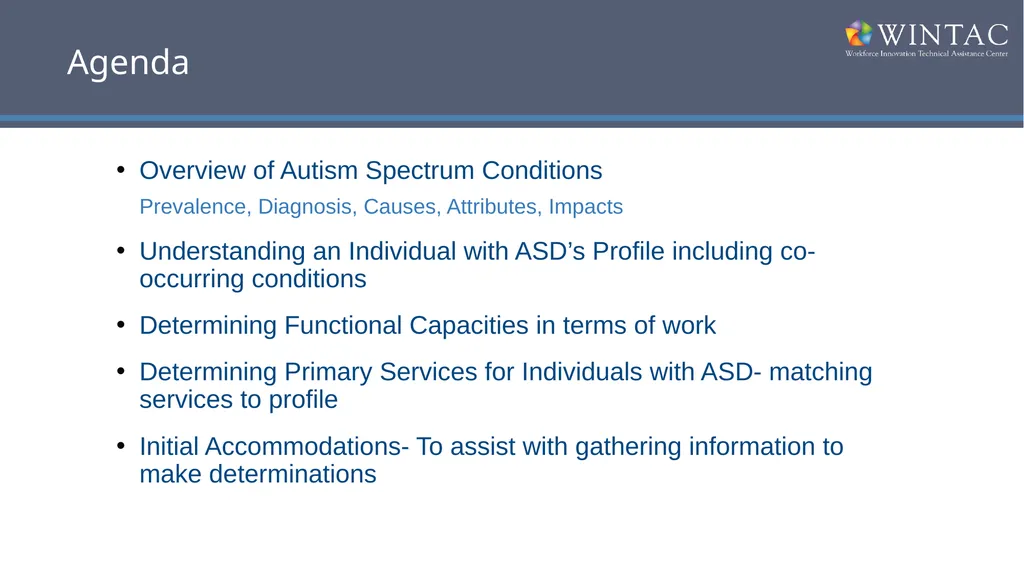
Agenda Overview of Autism Spectrum Conditions
Prevalence, Diagnosis, Causes, Attributes, Impacts
Understanding an Individual with ASD’s Profile including co-occurring conditions
Determining Functional Capacities in terms of work
Determining Primary Services for Individuals with ASD- matching services to profile
Initial Accommodations- To assist with gathering information to make determinations<br>
Prevalence, Diagnosis, Causes, Attributes, Impacts
Understanding an Individual with ASD’s Profile including co-occurring conditions
Determining Functional Capacities in terms of work
Determining Primary Services for Individuals with ASD- matching services to profile
Initial Accommodations- To assist with gathering information to make determinations<br>
03
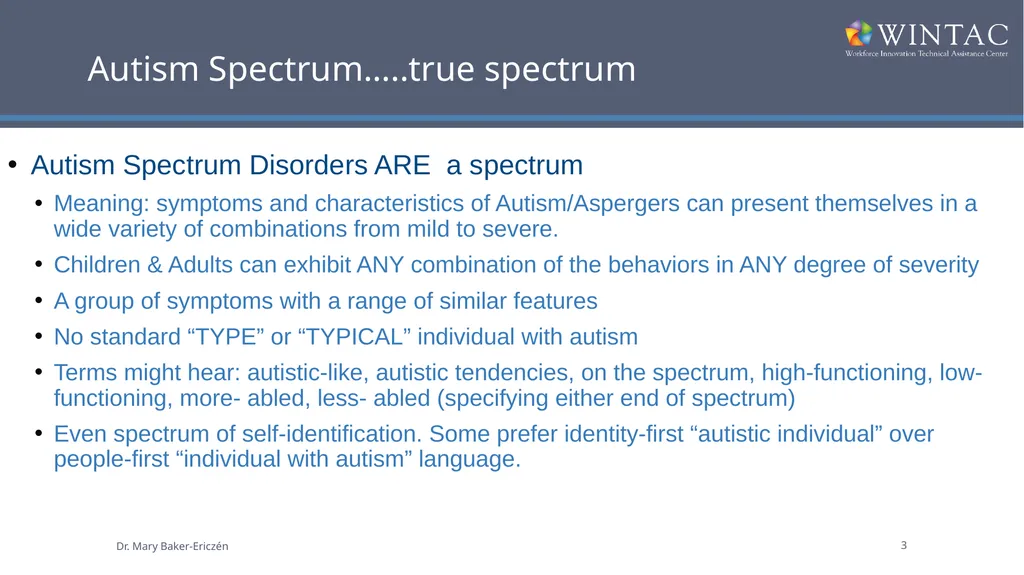
Dr. Mary Baker-Ericzén 3 Autism Spectrum…..true spectrum Autism Spectrum Disorders ARE a spectrum
Meaning: symptoms and characteristics of Autism/Aspergers can present themselves in a wide variety of combinations from mild to severe.
Children & Adults can exhibit ANY combination of the behaviors in ANY degree of severity
A group of symptoms with a range of similar features
No standard “TYPE” or “TYPICAL” individual with autism
Terms might hear: autistic-like, autistic tendencies, on the spectrum, high-functioning, low-functioning, more- abled, less- abled (specifying either end of spectrum)
Even spectrum of self-identification. Some prefer identity-first “autistic individual” over people-first “individual with autism” language.<br>
Meaning: symptoms and characteristics of Autism/Aspergers can present themselves in a wide variety of combinations from mild to severe.
Children & Adults can exhibit ANY combination of the behaviors in ANY degree of severity
A group of symptoms with a range of similar features
No standard “TYPE” or “TYPICAL” individual with autism
Terms might hear: autistic-like, autistic tendencies, on the spectrum, high-functioning, low-functioning, more- abled, less- abled (specifying either end of spectrum)
Even spectrum of self-identification. Some prefer identity-first “autistic individual” over people-first “individual with autism” language.<br>
04
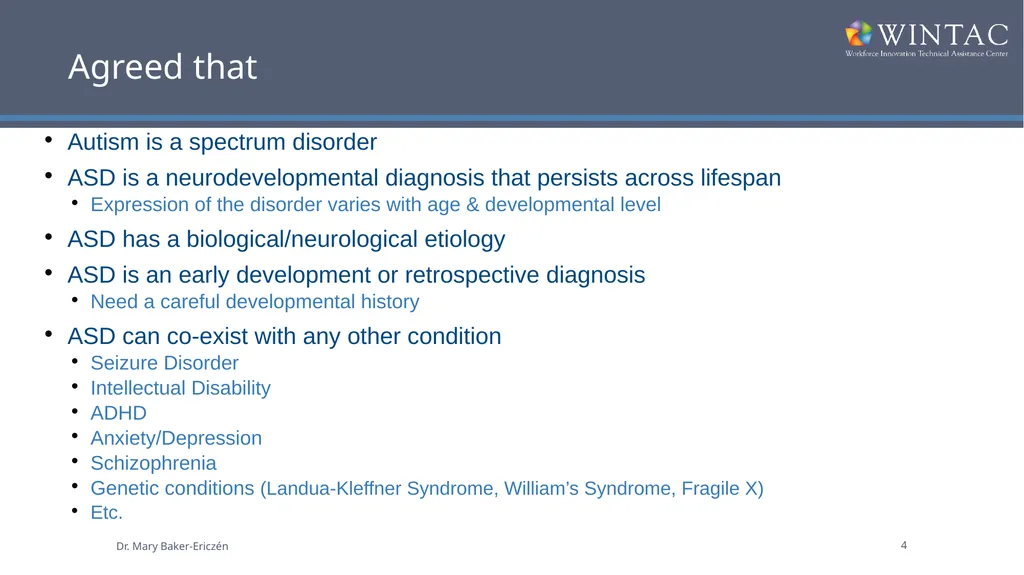
Dr. Mary Baker-Ericzén 4 Agreed that Autism is a spectrum disorder
ASD is a neurodevelopmental diagnosis that persists across lifespan
Expression of the disorder varies with age & developmental level
ASD has a biological/neurological etiology
ASD is an early development or retrospective diagnosis
Need a careful developmental history
ASD can co-exist with any other condition
Seizure Disorder
Intellectual Disability
ADHD
Anxiety/Depression
Schizophrenia
Genetic conditions (Landua-Kleffner Syndrome, William’s Syndrome, Fragile X)
Etc.<br>
ASD is a neurodevelopmental diagnosis that persists across lifespan
Expression of the disorder varies with age & developmental level
ASD has a biological/neurological etiology
ASD is an early development or retrospective diagnosis
Need a careful developmental history
ASD can co-exist with any other condition
Seizure Disorder
Intellectual Disability
ADHD
Anxiety/Depression
Schizophrenia
Genetic conditions (Landua-Kleffner Syndrome, William’s Syndrome, Fragile X)
Etc.<br>
05
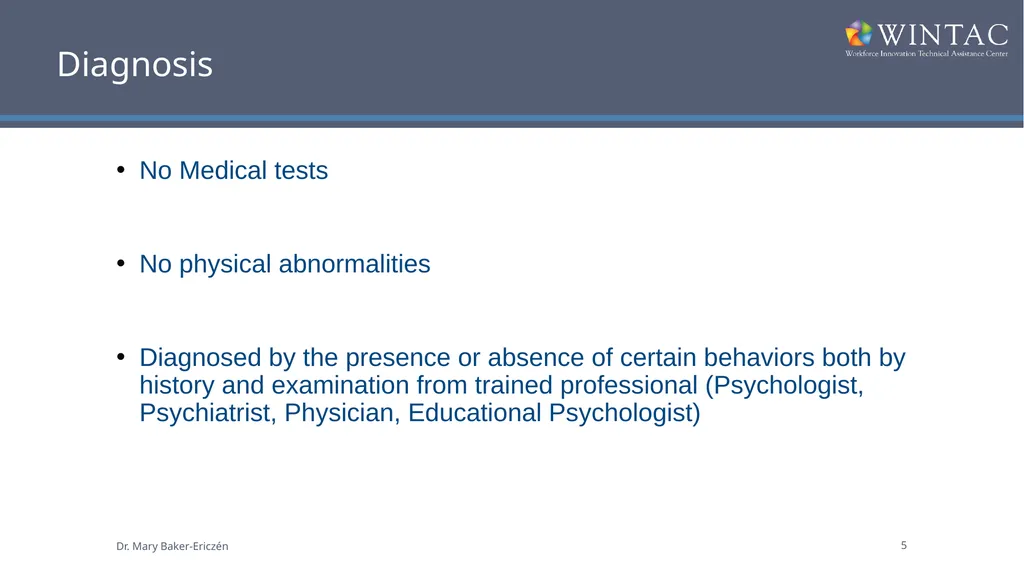
Dr. Mary Baker-Ericzén 5 Diagnosis No Medical tests
No physical abnormalities
Diagnosed by the presence or absence of certain behaviors both by history and examination from trained professional (Psychologist, Psychiatrist, Physician, Educational Psychologist)<br>
No physical abnormalities
Diagnosed by the presence or absence of certain behaviors both by history and examination from trained professional (Psychologist, Psychiatrist, Physician, Educational Psychologist)<br>
06
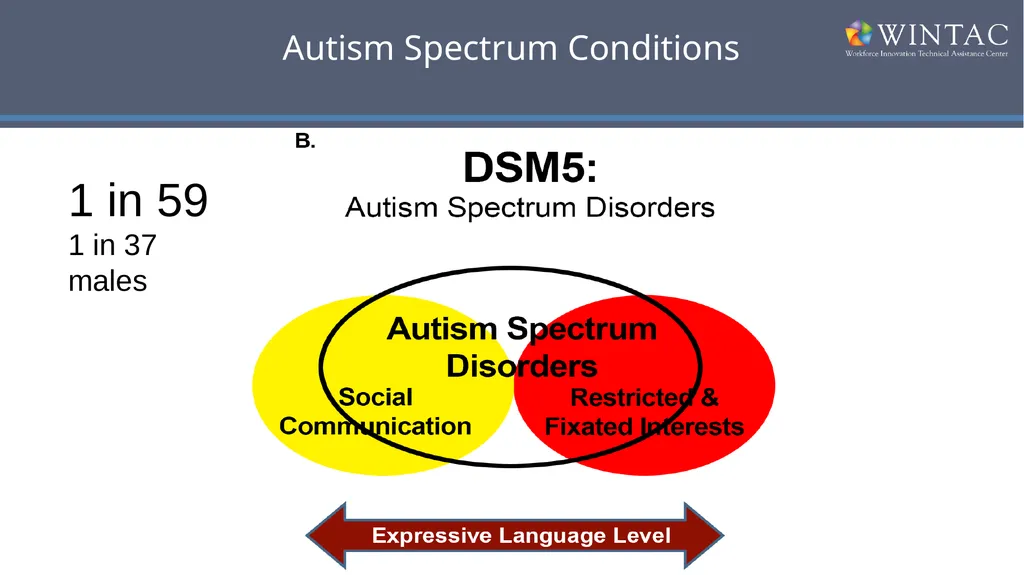
Autism Spectrum Conditions 1 in 59
1 in 37 males<br>
1 in 37 males<br>
07
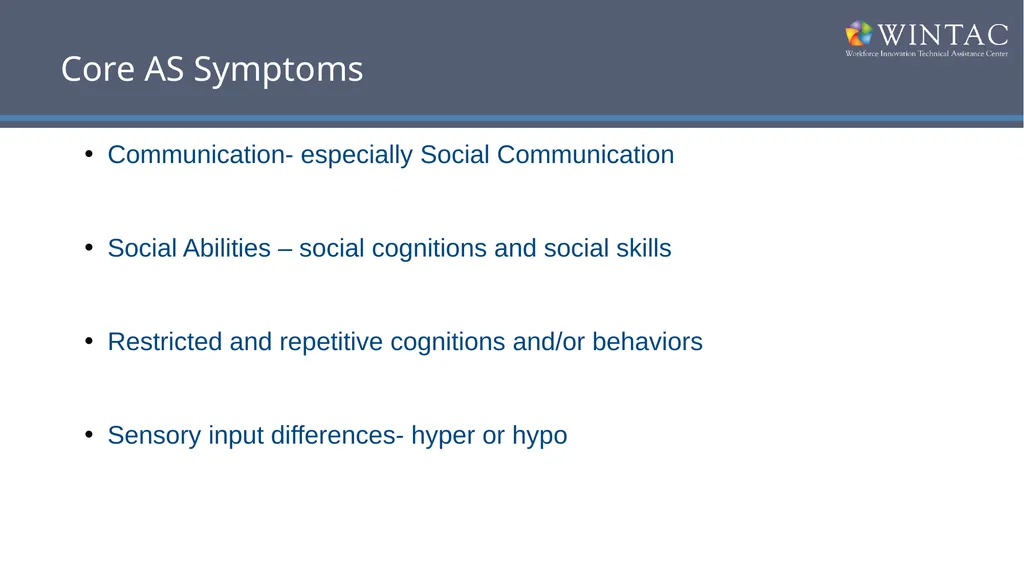
Core AS Symptoms Communication- especially Social Communication
Social Abilities – social cognitions and social skills
Restricted and repetitive cognitions and/or behaviors
Sensory input differences- hyper or hypo<br>
Social Abilities – social cognitions and social skills
Restricted and repetitive cognitions and/or behaviors
Sensory input differences- hyper or hypo<br>
08
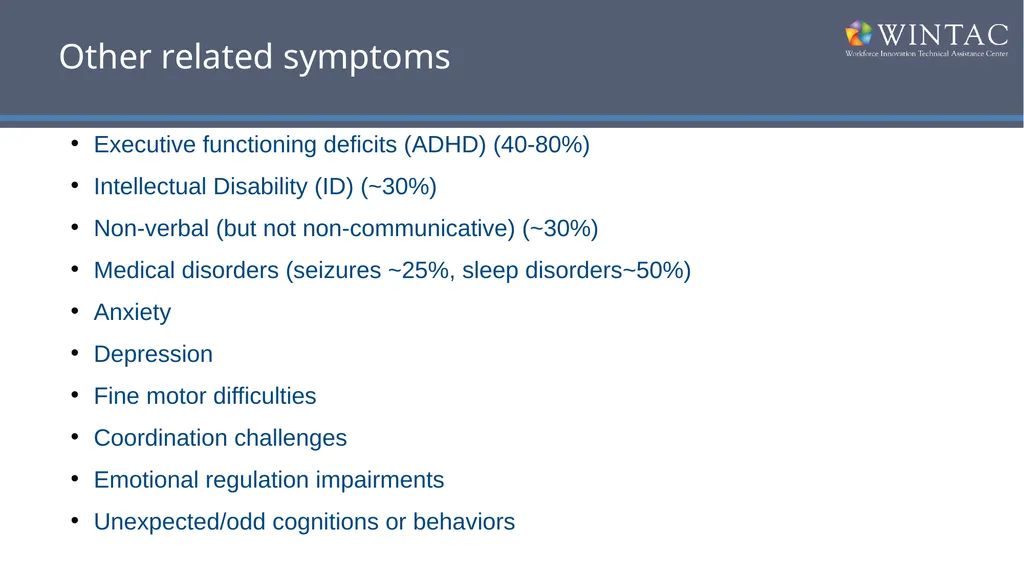
Other related symptoms Executive functioning deficits (ADHD) (40-80%)
Intellectual Disability (ID) (~30%)
Non-verbal (but not non-communicative) (~30%)
Medical disorders (seizures ~25%, sleep disorders~50%)
Anxiety
Depression
Fine motor difficulties
Coordination challenges
Emotional regulation impairments
Unexpected/odd cognitions or behaviors<br>
Intellectual Disability (ID) (~30%)
Non-verbal (but not non-communicative) (~30%)
Medical disorders (seizures ~25%, sleep disorders~50%)
Anxiety
Depression
Fine motor difficulties
Coordination challenges
Emotional regulation impairments
Unexpected/odd cognitions or behaviors<br>
09
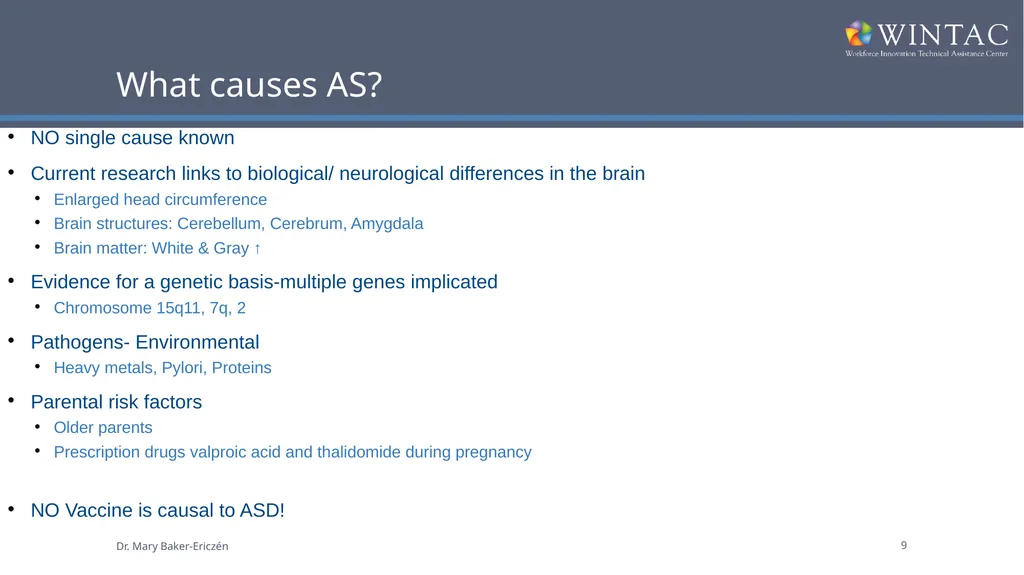
Dr. Mary Baker-Ericzén 9 What causes AS? NO single cause known
Current research links to biological/ neurological differences in the brain
Enlarged head circumference
Brain structures: Cerebellum, Cerebrum, Amygdala
Brain matter: White & Gray ↑
Evidence for a genetic basis-multiple genes implicated
Chromosome 15q11, 7q, 2
Pathogens- Environmental
Heavy metals, Pylori, Proteins
Parental risk factors
Older parents
Prescription drugs valproic acid and thalidomide during pregnancy
NO Vaccine is causal to ASD!<br>
Current research links to biological/ neurological differences in the brain
Enlarged head circumference
Brain structures: Cerebellum, Cerebrum, Amygdala
Brain matter: White & Gray ↑
Evidence for a genetic basis-multiple genes implicated
Chromosome 15q11, 7q, 2
Pathogens- Environmental
Heavy metals, Pylori, Proteins
Parental risk factors
Older parents
Prescription drugs valproic acid and thalidomide during pregnancy
NO Vaccine is causal to ASD!<br>
10
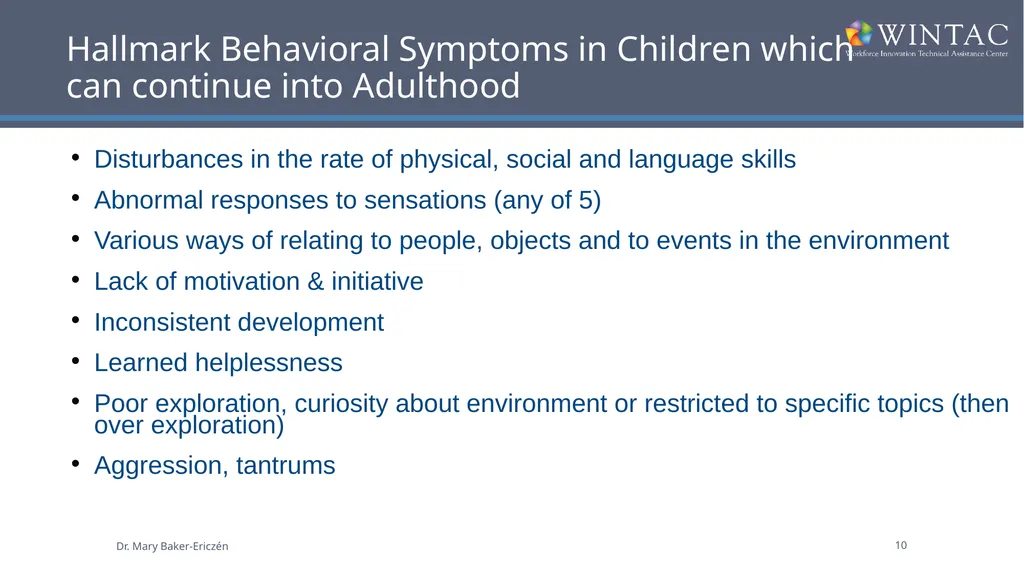
Dr. Mary Baker-Ericzén 10 Hallmark Behavioral Symptoms in Children which can continue into Adulthood Disturbances in the rate of physical, social and language skills
Abnormal responses to sensations (any of 5)
Various ways of relating to people, objects and to events in the environment
Lack of motivation & initiative
Inconsistent development
Learned helplessness
Poor exploration, curiosity about environment or restricted to specific topics (then over exploration)
Aggression, tantrums<br>
Abnormal responses to sensations (any of 5)
Various ways of relating to people, objects and to events in the environment
Lack of motivation & initiative
Inconsistent development
Learned helplessness
Poor exploration, curiosity about environment or restricted to specific topics (then over exploration)
Aggression, tantrums<br>
11
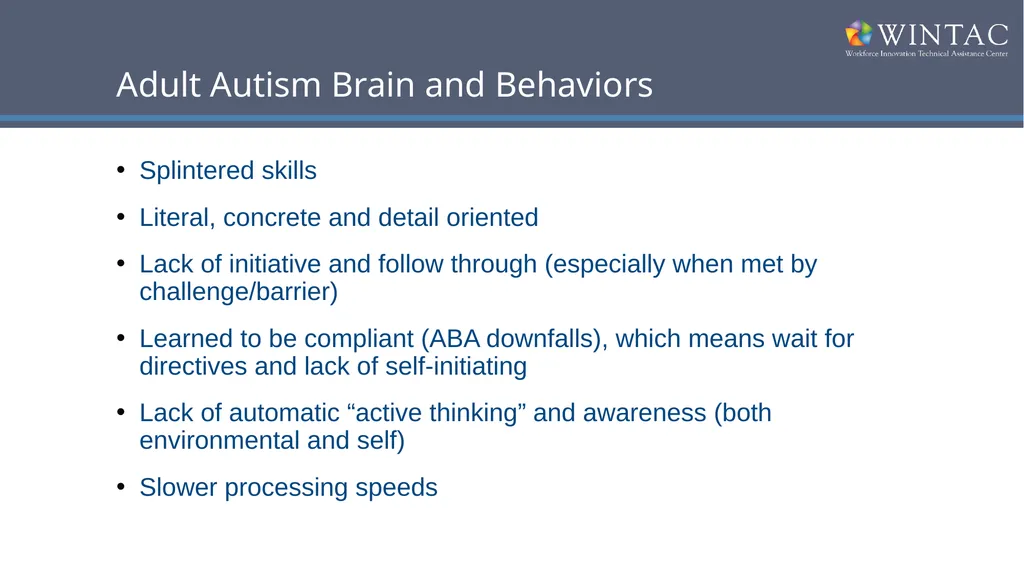
Adult Autism Brain and Behaviors Splintered skills
Literal, concrete and detail oriented
Lack of initiative and follow through (especially when met by challenge/barrier)
Learned to be compliant (ABA downfalls), which means wait for directives and lack of self-initiating
Lack of automatic “active thinking” and awareness (both environmental and self)
Slower processing speeds<br>
Literal, concrete and detail oriented
Lack of initiative and follow through (especially when met by challenge/barrier)
Learned to be compliant (ABA downfalls), which means wait for directives and lack of self-initiating
Lack of automatic “active thinking” and awareness (both environmental and self)
Slower processing speeds<br>
12
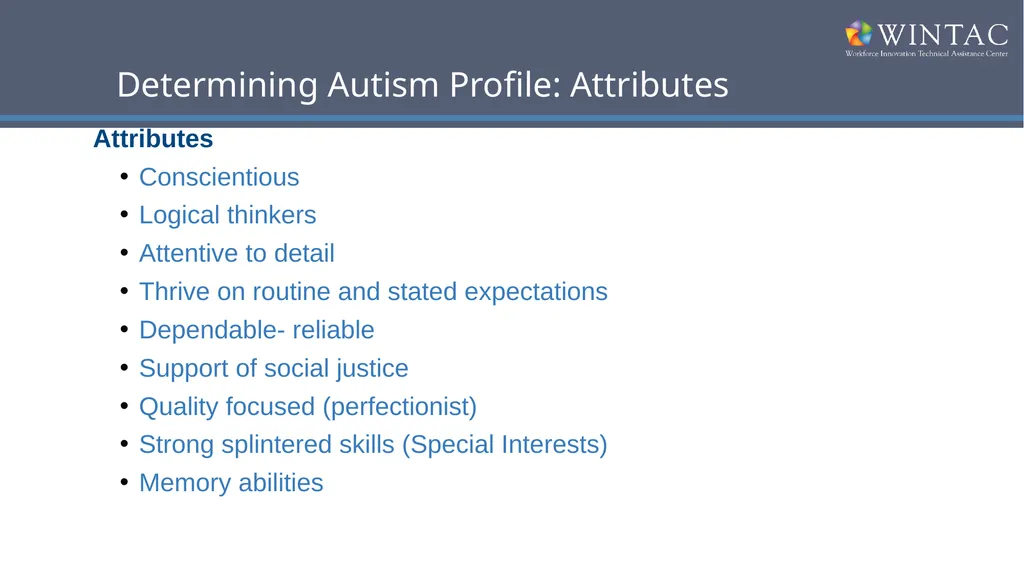
Determining Autism Profile: Attributes Attributes
Conscientious
Logical thinkers
Attentive to detail
Thrive on routine and stated expectations
Dependable- reliable
Support of social justice
Quality focused (perfectionist)
Strong splintered skills (Special Interests)
Memory abilities<br>
Conscientious
Logical thinkers
Attentive to detail
Thrive on routine and stated expectations
Dependable- reliable
Support of social justice
Quality focused (perfectionist)
Strong splintered skills (Special Interests)
Memory abilities<br>
13
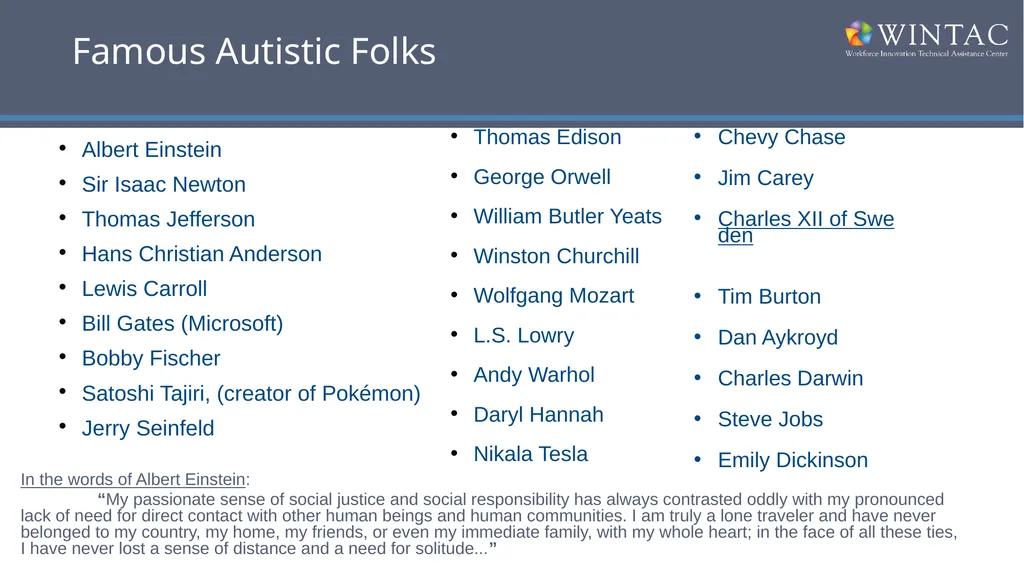
Famous Autistic Folks Albert Einstein
Sir Isaac Newton
Thomas Jefferson
Hans Christian Anderson
Lewis Carroll
Bill Gates (Microsoft)
Bobby Fischer
Satoshi Tajiri, (creator of Pokémon)
Jerry Seinfeld Thomas Edison
George Orwell
William Butler Yeats
Winston Churchill
Wolfgang Mozart
L.S. Lowry
Andy Warhol
Daryl Hannah
Nikala Tesla In the words of Albert Einstein:
“My passionate sense of social justice and social responsibility has always contrasted oddly with my pronounced lack of need for direct contact with other human beings and human communities. I am truly a lone traveler and have never belonged to my country, my home, my friends, or even my immediate family, with my whole heart; in the face of all these ties, I have never lost a sense of distance and a need for solitude...” Chevy Chase
Jim Carey
Charles XII of Sweden
Tim Burton
Dan Aykroyd
Charles Darwin
Steve Jobs
Emily Dickinson<br>
Sir Isaac Newton
Thomas Jefferson
Hans Christian Anderson
Lewis Carroll
Bill Gates (Microsoft)
Bobby Fischer
Satoshi Tajiri, (creator of Pokémon)
Jerry Seinfeld Thomas Edison
George Orwell
William Butler Yeats
Winston Churchill
Wolfgang Mozart
L.S. Lowry
Andy Warhol
Daryl Hannah
Nikala Tesla In the words of Albert Einstein:
“My passionate sense of social justice and social responsibility has always contrasted oddly with my pronounced lack of need for direct contact with other human beings and human communities. I am truly a lone traveler and have never belonged to my country, my home, my friends, or even my immediate family, with my whole heart; in the face of all these ties, I have never lost a sense of distance and a need for solitude...” Chevy Chase
Jim Carey
Charles XII of Sweden
Tim Burton
Dan Aykroyd
Charles Darwin
Steve Jobs
Emily Dickinson<br>
14
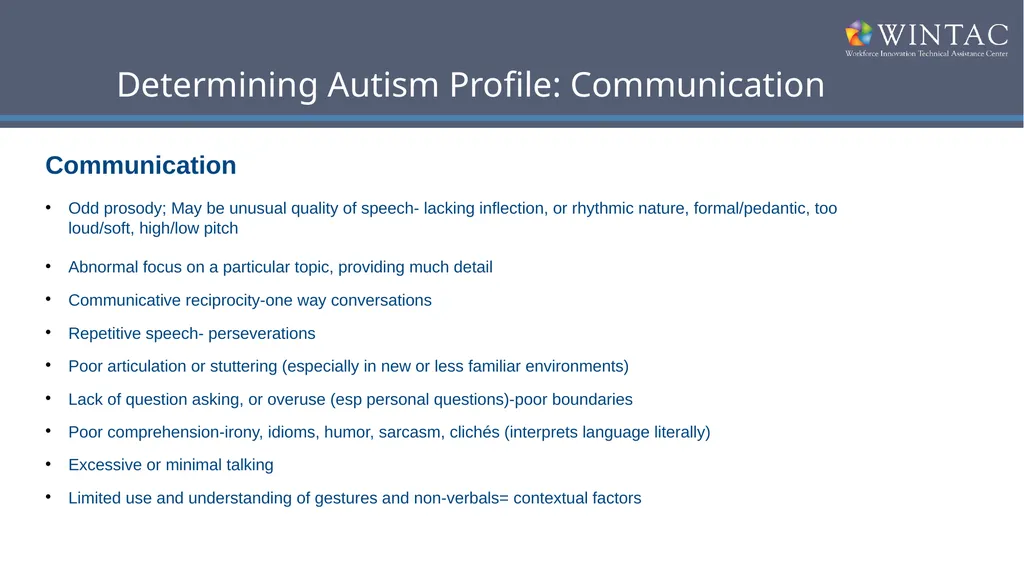
Determining Autism Profile: Communication Communication
Odd prosody; May be unusual quality of speech- lacking inflection, or rhythmic nature, formal/pedantic, too loud/soft, high/low pitch
Abnormal focus on a particular topic, providing much detail
Communicative reciprocity-one way conversations
Repetitive speech- perseverations
Poor articulation or stuttering (especially in new or less familiar environments)
Lack of question asking, or overuse (esp personal questions)-poor boundaries
Poor comprehension-irony, idioms, humor, sarcasm, clichés (interprets language literally)
Excessive or minimal talking
Limited use and understanding of gestures and non-verbals= contextual factors<br>
Odd prosody; May be unusual quality of speech- lacking inflection, or rhythmic nature, formal/pedantic, too loud/soft, high/low pitch
Abnormal focus on a particular topic, providing much detail
Communicative reciprocity-one way conversations
Repetitive speech- perseverations
Poor articulation or stuttering (especially in new or less familiar environments)
Lack of question asking, or overuse (esp personal questions)-poor boundaries
Poor comprehension-irony, idioms, humor, sarcasm, clichés (interprets language literally)
Excessive or minimal talking
Limited use and understanding of gestures and non-verbals= contextual factors<br>
15
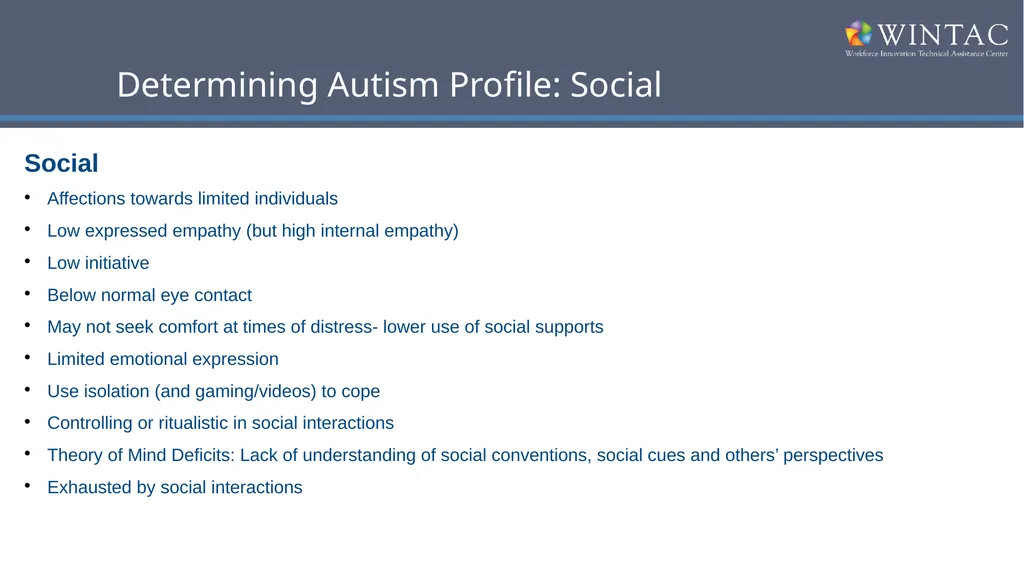
Determining Autism Profile: Social Social
Affections towards limited individuals
Low expressed empathy (but high internal empathy)
Low initiative
Below normal eye contact
May not seek comfort at times of distress- lower use of social supports
Limited emotional expression
Use isolation (and gaming/videos) to cope
Controlling or ritualistic in social interactions
Theory of Mind Deficits: Lack of understanding of social conventions, social cues and others’ perspectives
Exhausted by social interactions<br>
Affections towards limited individuals
Low expressed empathy (but high internal empathy)
Low initiative
Below normal eye contact
May not seek comfort at times of distress- lower use of social supports
Limited emotional expression
Use isolation (and gaming/videos) to cope
Controlling or ritualistic in social interactions
Theory of Mind Deficits: Lack of understanding of social conventions, social cues and others’ perspectives
Exhausted by social interactions<br>
16
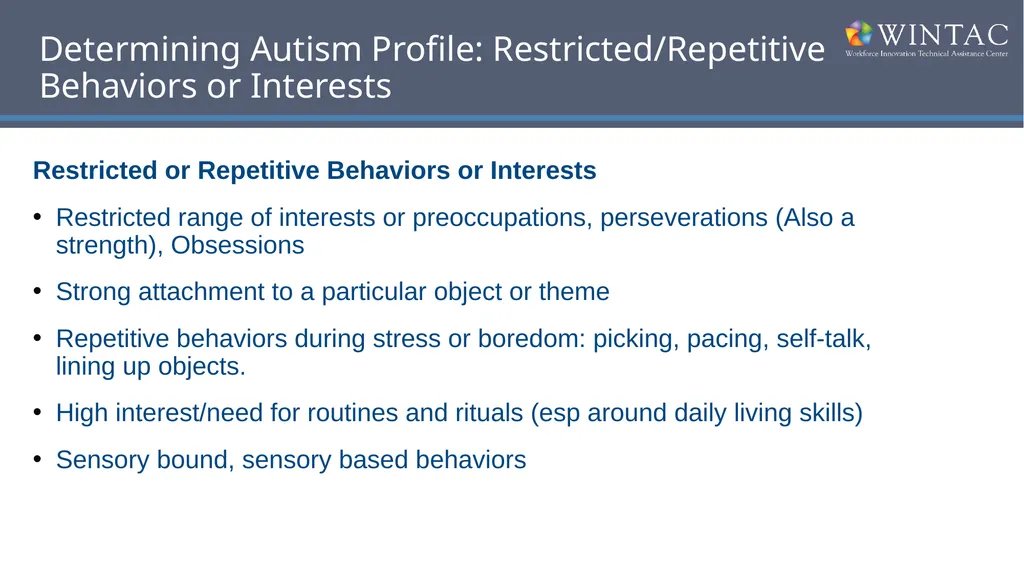
Determining Autism Profile: Restricted/Repetitive Behaviors or Interests Restricted or Repetitive Behaviors or Interests
Restricted range of interests or preoccupations, perseverations (Also a strength), Obsessions
Strong attachment to a particular object or theme
Repetitive behaviors during stress or boredom: picking, pacing, self-talk, lining up objects.
High interest/need for routines and rituals (esp around daily living skills)
Sensory bound, sensory based behaviors<br>
Restricted range of interests or preoccupations, perseverations (Also a strength), Obsessions
Strong attachment to a particular object or theme
Repetitive behaviors during stress or boredom: picking, pacing, self-talk, lining up objects.
High interest/need for routines and rituals (esp around daily living skills)
Sensory bound, sensory based behaviors<br>
17
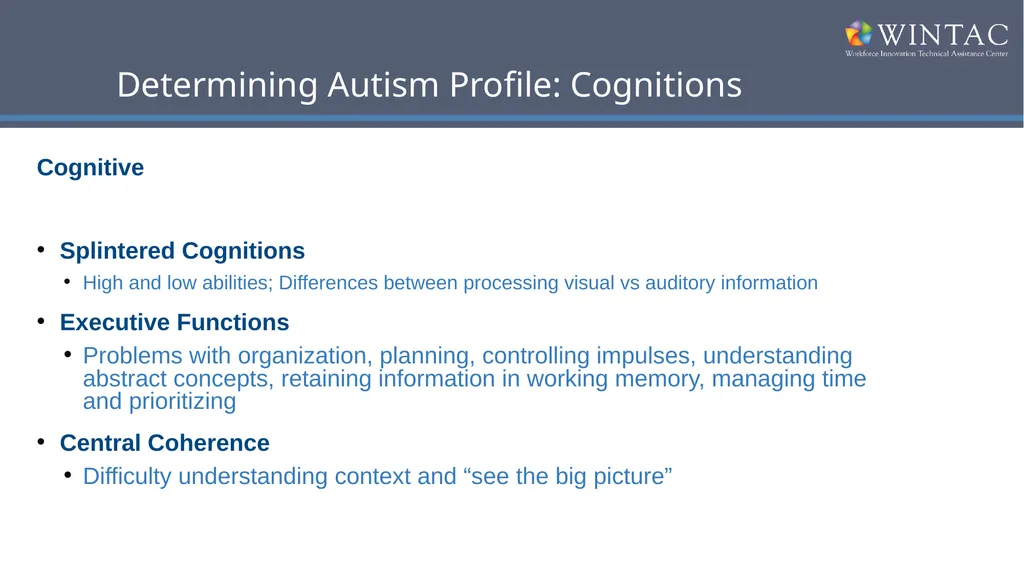
Determining Autism Profile: Cognitions Cognitive
Splintered Cognitions
High and low abilities; Differences between processing visual vs auditory information
Executive Functions
Problems with organization, planning, controlling impulses, understanding abstract concepts, retaining information in working memory, managing time and prioritizing
Central Coherence
Difficulty understanding context and “see the big picture”<br>
Splintered Cognitions
High and low abilities; Differences between processing visual vs auditory information
Executive Functions
Problems with organization, planning, controlling impulses, understanding abstract concepts, retaining information in working memory, managing time and prioritizing
Central Coherence
Difficulty understanding context and “see the big picture”<br>
18
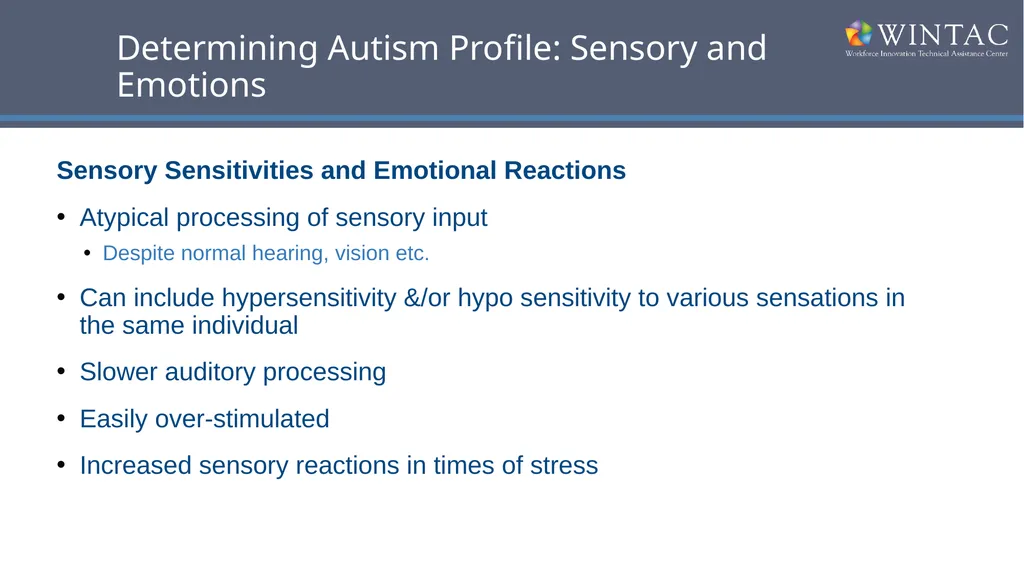
Determining Autism Profile: Sensory and Emotions Sensory Sensitivities and Emotional Reactions
Atypical processing of sensory input
Despite normal hearing, vision etc.
Can include hypersensitivity &/or hypo sensitivity to various sensations in the same individual
Slower auditory processing
Easily over-stimulated
Increased sensory reactions in times of stress<br>
Atypical processing of sensory input
Despite normal hearing, vision etc.
Can include hypersensitivity &/or hypo sensitivity to various sensations in the same individual
Slower auditory processing
Easily over-stimulated
Increased sensory reactions in times of stress<br>
19
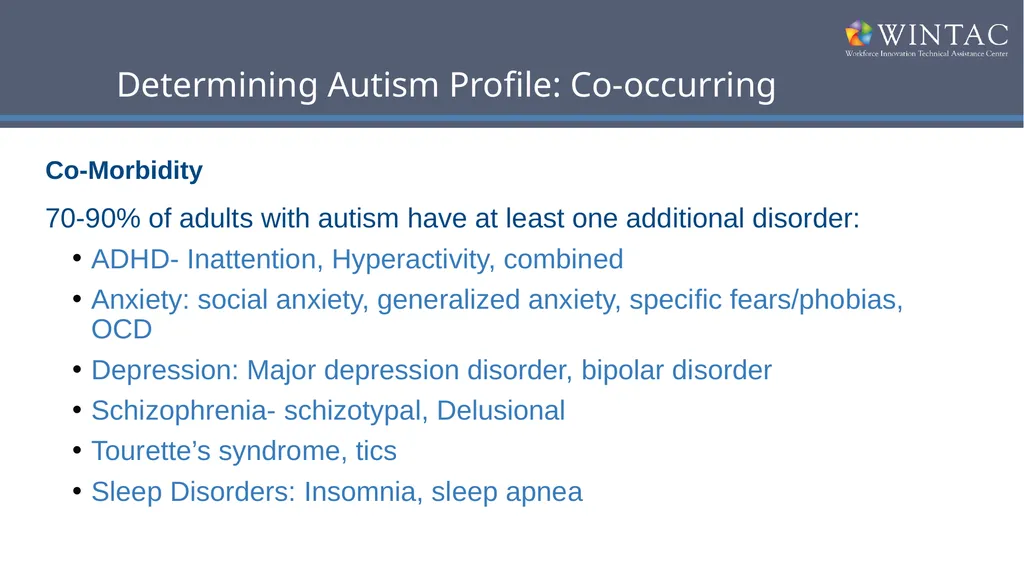
Determining Autism Profile: Co-occurring Co-Morbidity
70-90% of adults with autism have at least one additional disorder:
ADHD- Inattention, Hyperactivity, combined
Anxiety: social anxiety, generalized anxiety, specific fears/phobias, OCD
Depression: Major depression disorder, bipolar disorder
Schizophrenia- schizotypal, Delusional
Tourette’s syndrome, tics
Sleep Disorders: Insomnia, sleep apnea<br>
70-90% of adults with autism have at least one additional disorder:
ADHD- Inattention, Hyperactivity, combined
Anxiety: social anxiety, generalized anxiety, specific fears/phobias, OCD
Depression: Major depression disorder, bipolar disorder
Schizophrenia- schizotypal, Delusional
Tourette’s syndrome, tics
Sleep Disorders: Insomnia, sleep apnea<br>
20
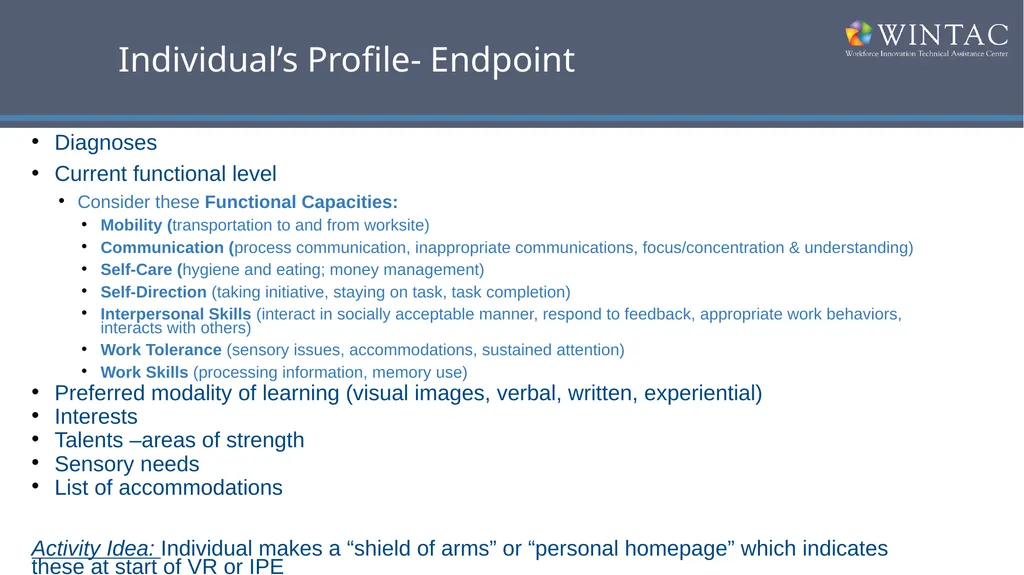
Individual’s Profile- Endpoint Diagnoses
Current functional level
Consider these Functional Capacities:
Mobility (transportation to and from worksite)
Communication (process communication, inappropriate communications, focus/concentration & understanding)
Self-Care (hygiene and eating; money management)
Self-Direction (taking initiative, staying on task, task completion)
Interpersonal Skills (interact in socially acceptable manner, respond to feedback, appropriate work behaviors, interacts with others)
Work Tolerance (sensory issues, accommodations, sustained attention)
Work Skills (processing information, memory use)
Preferred modality of learning (visual images, verbal, written, experiential)
Interests
Talents –areas of strength
Sensory needs
List of accommodations
Activity Idea: Individual makes a “shield of arms” or “personal homepage” which indicates these at start of VR or IPE<br>
Current functional level
Consider these Functional Capacities:
Mobility (transportation to and from worksite)
Communication (process communication, inappropriate communications, focus/concentration & understanding)
Self-Care (hygiene and eating; money management)
Self-Direction (taking initiative, staying on task, task completion)
Interpersonal Skills (interact in socially acceptable manner, respond to feedback, appropriate work behaviors, interacts with others)
Work Tolerance (sensory issues, accommodations, sustained attention)
Work Skills (processing information, memory use)
Preferred modality of learning (visual images, verbal, written, experiential)
Interests
Talents –areas of strength
Sensory needs
List of accommodations
Activity Idea: Individual makes a “shield of arms” or “personal homepage” which indicates these at start of VR or IPE<br>
21
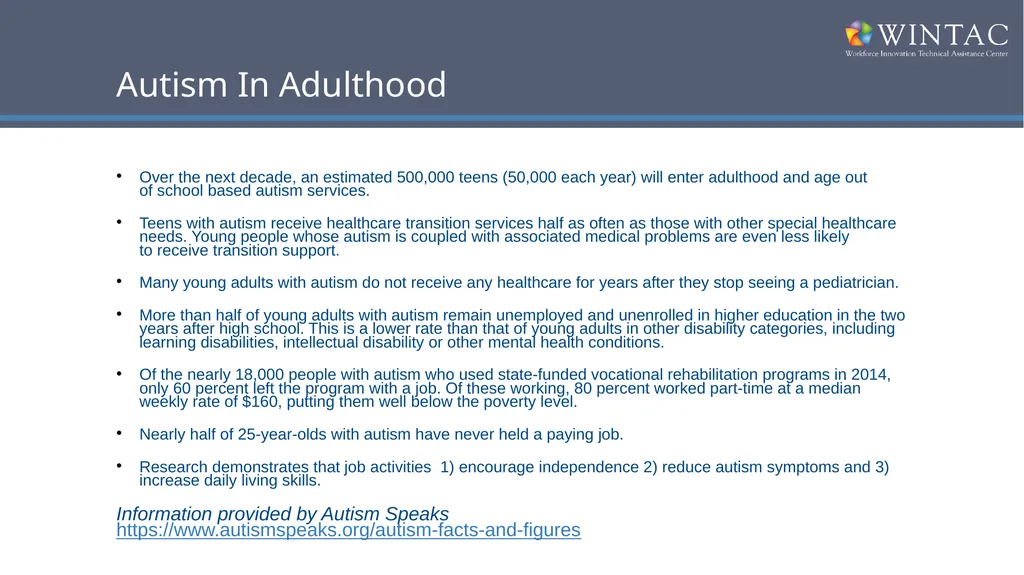
Autism In Adulthood Over the next decade, an estimated 500,000 teens (50,000 each year) will enter adulthood and age out of school based autism services.
Teens with autism receive healthcare transition services half as often as those with other special healthcare needs. Young people whose autism is coupled with associated medical problems are even less likely to receive transition support.
Many young adults with autism do not receive any healthcare for years after they stop seeing a pediatrician.
More than half of young adults with autism remain unemployed and unenrolled in higher education in the two years after high school. This is a lower rate than that of young adults in other disability categories, including learning disabilities, intellectual disability or other mental health conditions.
Of the nearly 18,000 people with autism who used state-funded vocational rehabilitation programs in 2014, only 60 percent left the program with a job. Of these working, 80 percent worked part-time at a median weekly rate of $160, putting them well below the poverty level.
Nearly half of 25-year-olds with autism have never held a paying job.
Research demonstrates that job activities 1) encourage independence 2) reduce autism symptoms and 3) increase daily living skills.
Information provided by Autism Speaks https://www.autismspeaks.org/autism-facts-and-figures<br>
Teens with autism receive healthcare transition services half as often as those with other special healthcare needs. Young people whose autism is coupled with associated medical problems are even less likely to receive transition support.
Many young adults with autism do not receive any healthcare for years after they stop seeing a pediatrician.
More than half of young adults with autism remain unemployed and unenrolled in higher education in the two years after high school. This is a lower rate than that of young adults in other disability categories, including learning disabilities, intellectual disability or other mental health conditions.
Of the nearly 18,000 people with autism who used state-funded vocational rehabilitation programs in 2014, only 60 percent left the program with a job. Of these working, 80 percent worked part-time at a median weekly rate of $160, putting them well below the poverty level.
Nearly half of 25-year-olds with autism have never held a paying job.
Research demonstrates that job activities 1) encourage independence 2) reduce autism symptoms and 3) increase daily living skills.
Information provided by Autism Speaks https://www.autismspeaks.org/autism-facts-and-figures<br>
22
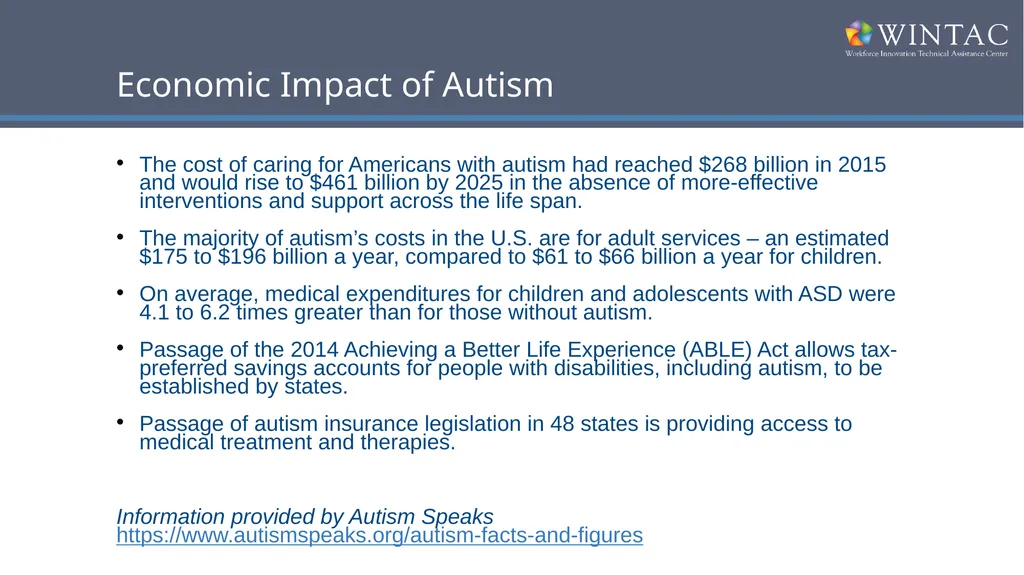
Economic Impact of Autism The cost of caring for Americans with autism had reached $268 billion in 2015 and would rise to $461 billion by 2025 in the absence of more-effective interventions and support across the life span.
The majority of autism’s costs in the U.S. are for adult services – an estimated $175 to $196 billion a year, compared to $61 to $66 billion a year for children.
On average, medical expenditures for children and adolescents with ASD were 4.1 to 6.2 times greater than for those without autism.
Passage of the 2014 Achieving a Better Life Experience (ABLE) Act allows tax-preferred savings accounts for people with disabilities, including autism, to be established by states.
Passage of autism insurance legislation in 48 states is providing access to medical treatment and therapies.
Information provided by Autism Speaks https://www.autismspeaks.org/autism-facts-and-figures<br>
The majority of autism’s costs in the U.S. are for adult services – an estimated $175 to $196 billion a year, compared to $61 to $66 billion a year for children.
On average, medical expenditures for children and adolescents with ASD were 4.1 to 6.2 times greater than for those without autism.
Passage of the 2014 Achieving a Better Life Experience (ABLE) Act allows tax-preferred savings accounts for people with disabilities, including autism, to be established by states.
Passage of autism insurance legislation in 48 states is providing access to medical treatment and therapies.
Information provided by Autism Speaks https://www.autismspeaks.org/autism-facts-and-figures<br>
23
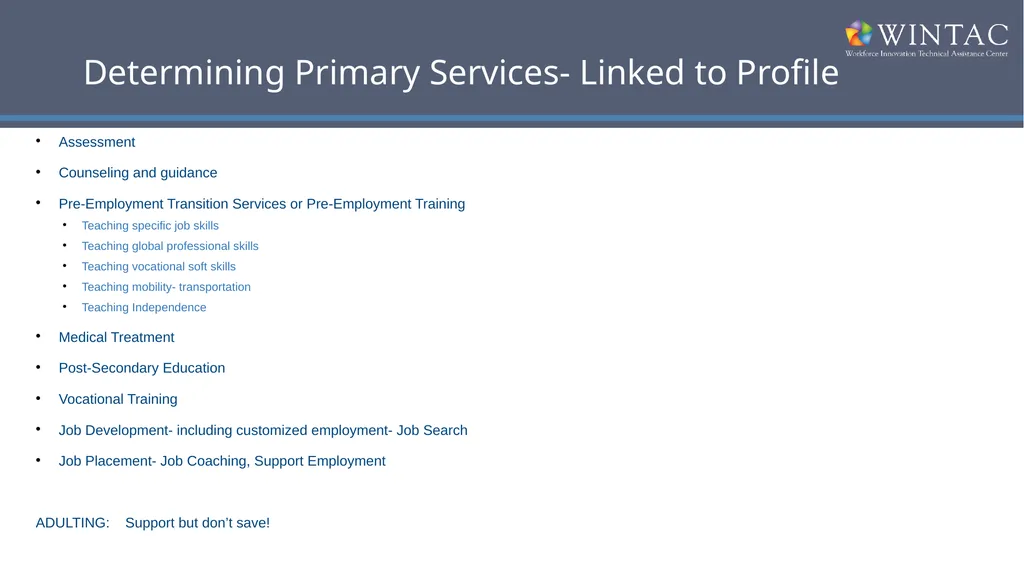
Determining Primary Services- Linked to Profile Assessment
Counseling and guidance
Pre-Employment Transition Services or Pre-Employment Training
Teaching specific job skills
Teaching global professional skills
Teaching vocational soft skills
Teaching mobility- transportation
Teaching Independence
Medical Treatment
Post-Secondary Education
Vocational Training
Job Development- including customized employment- Job Search
Job Placement- Job Coaching, Support Employment
ADULTING: Support but don’t save!<br>
Counseling and guidance
Pre-Employment Transition Services or Pre-Employment Training
Teaching specific job skills
Teaching global professional skills
Teaching vocational soft skills
Teaching mobility- transportation
Teaching Independence
Medical Treatment
Post-Secondary Education
Vocational Training
Job Development- including customized employment- Job Search
Job Placement- Job Coaching, Support Employment
ADULTING: Support but don’t save!<br>
24
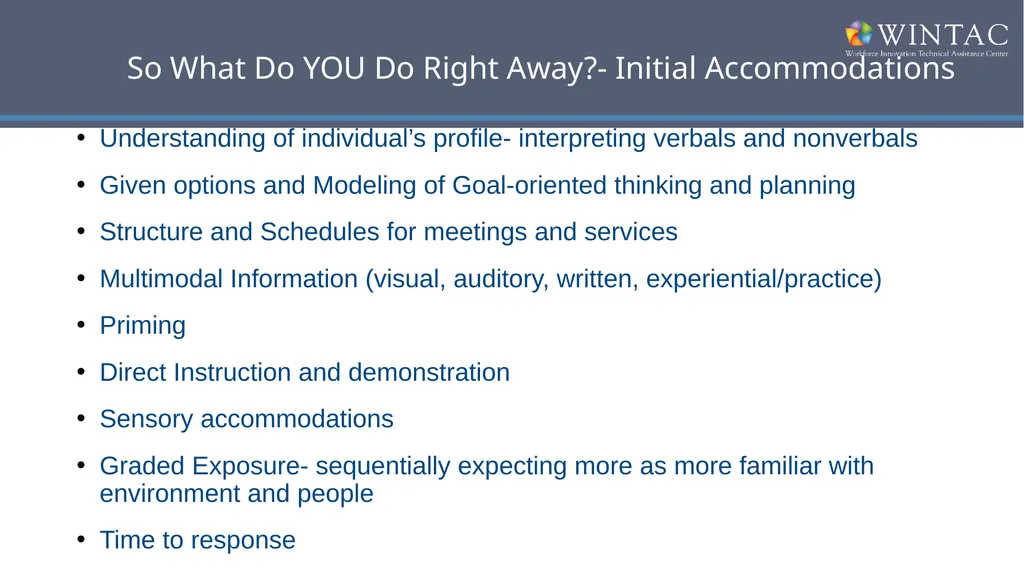
So What Do YOU Do Right Away?- Initial Accommodations Understanding of individual’s profile- interpreting verbals and nonverbals
Given options and Modeling of Goal-oriented thinking and planning
Structure and Schedules for meetings and services
Multimodal Information (visual, auditory, written, experiential/practice)
Priming
Direct Instruction and demonstration
Sensory accommodations
Graded Exposure- sequentially expecting more as more familiar with environment and people
Time to response<br>
Given options and Modeling of Goal-oriented thinking and planning
Structure and Schedules for meetings and services
Multimodal Information (visual, auditory, written, experiential/practice)
Priming
Direct Instruction and demonstration
Sensory accommodations
Graded Exposure- sequentially expecting more as more familiar with environment and people
Time to response<br>
25
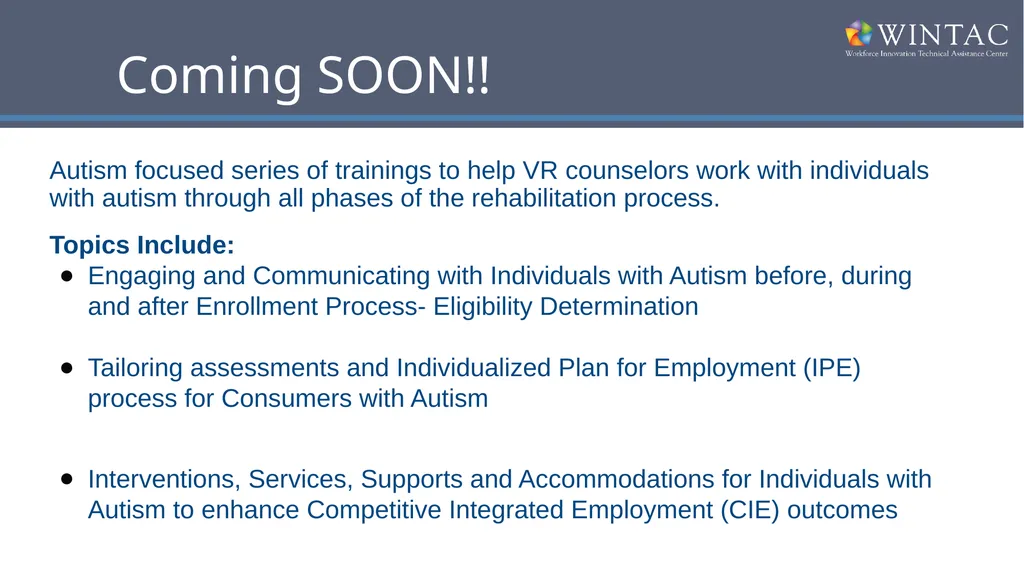
Coming SOON!! Autism focused series of trainings to help VR counselors work with individuals with autism through all phases of the rehabilitation process.
Topics Include:
Engaging and Communicating with Individuals with Autism before, during and after Enrollment Process- Eligibility Determination
Tailoring assessments and Individualized Plan for Employment (IPE) process for Consumers with Autism
Interventions, Services, Supports and Accommodations for Individuals with Autism to enhance Competitive Integrated Employment (CIE) outcomes<br>
Topics Include:
Engaging and Communicating with Individuals with Autism before, during and after Enrollment Process- Eligibility Determination
Tailoring assessments and Individualized Plan for Employment (IPE) process for Consumers with Autism
Interventions, Services, Supports and Accommodations for Individuals with Autism to enhance Competitive Integrated Employment (CIE) outcomes<br>
26
The End THANK YOU!!!!
mbakerericzen@sdsu.edu<br>
mbakerericzen@sdsu.edu<br>