
Understanding Sentence Types Information for
AS
Published · 28 slides · 0 views
1 / 1

Description
Understanding Sentence Types Information for Teachers A grammar task: Identify the sentence types that are highlighted in the extract from Skellig by David Almond, and explain your decisions. Choices are: simplecompoundcomplexminor I
Related Topics
Share
Embed code
Download this presentation From Below
"Understanding Sentence Types Information for" is the property of its rightful owner. Permission is granted to download and print the materials on this website for personal, non-commercial use only, and to display it on your personal computer provided you do not modify the materials and that you retain all copyright notices contained in the materials. By downloading content from our website, you accept the terms of this agreement.
Presentation Transcript
01
Understanding Sentence Types Information for Teachers<br>
02
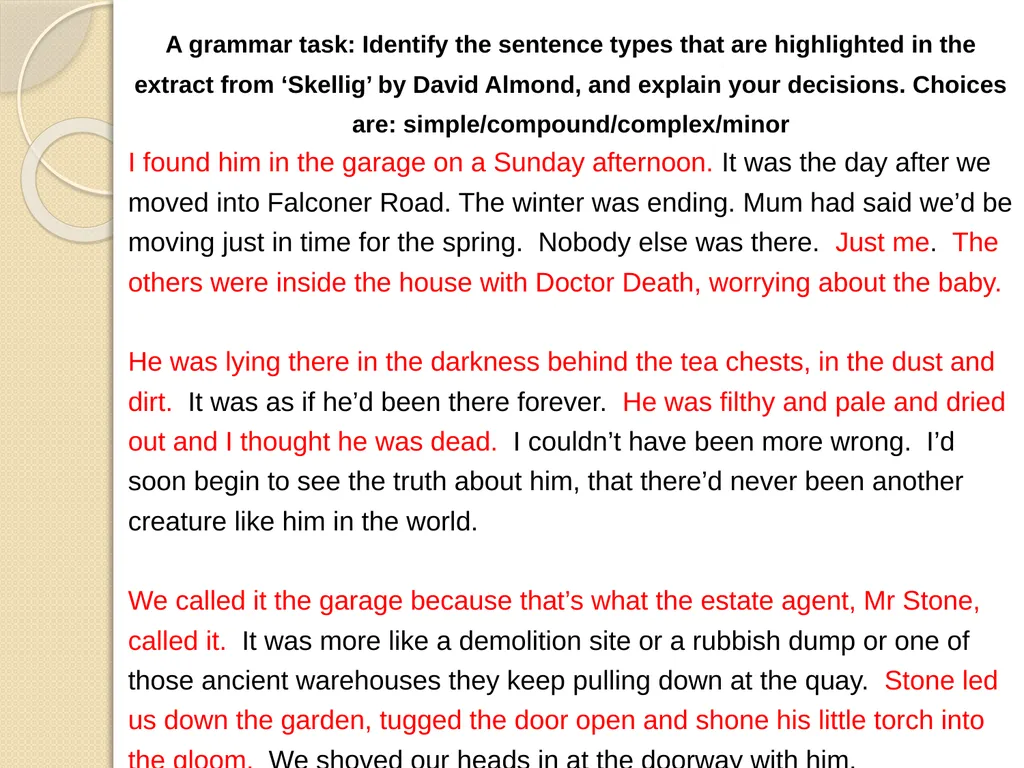
A grammar task: Identify the sentence types that are highlighted in the extract from ‘Skellig’ by David Almond, and explain your decisions. Choices are: simple/compound/complex/minor
I found him in the garage on a Sunday afternoon. It was the day after we moved into Falconer Road. The winter was ending. Mum had said we’d be moving just in time for the spring. Nobody else was there. Just me. The others were inside the house with Doctor Death, worrying about the baby.
He was lying there in the darkness behind the tea chests, in the dust and dirt. It was as if he’d been there forever. He was filthy and pale and dried out and I thought he was dead. I couldn’t have been more wrong. I’d soon begin to see the truth about him, that there’d never been another creature like him in the world.
We called it the garage because that’s what the estate agent, Mr Stone, called it. It was more like a demolition site or a rubbish dump or one of those ancient warehouses they keep pulling down at the quay. Stone led us down the garden, tugged the door open and shone his little torch into the gloom. We shoved our heads in at the doorway with him.<br>
I found him in the garage on a Sunday afternoon. It was the day after we moved into Falconer Road. The winter was ending. Mum had said we’d be moving just in time for the spring. Nobody else was there. Just me. The others were inside the house with Doctor Death, worrying about the baby.
He was lying there in the darkness behind the tea chests, in the dust and dirt. It was as if he’d been there forever. He was filthy and pale and dried out and I thought he was dead. I couldn’t have been more wrong. I’d soon begin to see the truth about him, that there’d never been another creature like him in the world.
We called it the garage because that’s what the estate agent, Mr Stone, called it. It was more like a demolition site or a rubbish dump or one of those ancient warehouses they keep pulling down at the quay. Stone led us down the garden, tugged the door open and shone his little torch into the gloom. We shoved our heads in at the doorway with him.<br>
03
I found him in the garage on a Sunday afternoon.
A simple sentence which has one finite verb (found).
Just me.
A minor sentence which does not have a verb.
The others were inside the house with Doctor Death, worrying about the baby.
A complex sentence which has one main clause with a finite verb (were) and one subordinate clause, formed with a non-finite verb ending in –ing (worrying).
He was lying there in the darkness behind the tea chests, in the dust and dirt.
A simple sentence with one verb (a verb phrase – was lying)<br>
A simple sentence which has one finite verb (found).
Just me.
A minor sentence which does not have a verb.
The others were inside the house with Doctor Death, worrying about the baby.
A complex sentence which has one main clause with a finite verb (were) and one subordinate clause, formed with a non-finite verb ending in –ing (worrying).
He was lying there in the darkness behind the tea chests, in the dust and dirt.
A simple sentence with one verb (a verb phrase – was lying)<br>
04
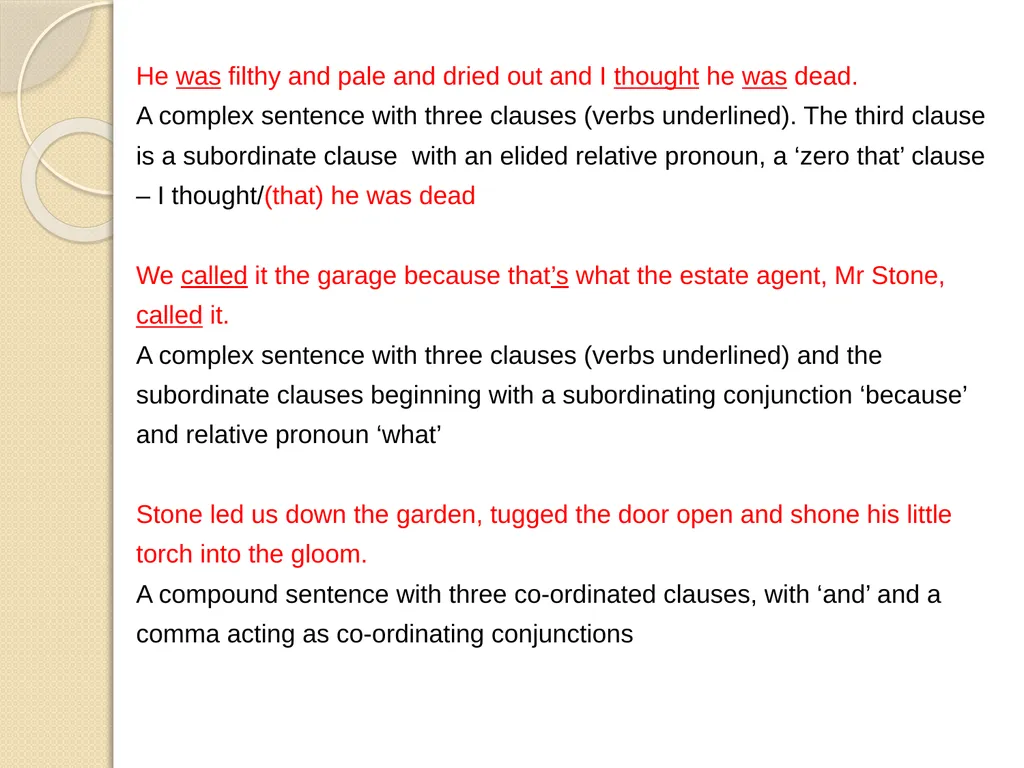
He was filthy and pale and dried out and I thought he was dead.
A complex sentence with three clauses (verbs underlined). The third clause is a subordinate clause with an elided relative pronoun, a ‘zero that’ clause – I thought/(that) he was dead
We called it the garage because that’s what the estate agent, Mr Stone, called it.
A complex sentence with three clauses (verbs underlined) and the subordinate clauses beginning with a subordinating conjunction ‘because’ and relative pronoun ‘what’
Stone led us down the garden, tugged the door open and shone his little torch into the gloom.
A compound sentence with three co-ordinated clauses, with ‘and’ and a comma acting as co-ordinating conjunctions<br>
A complex sentence with three clauses (verbs underlined). The third clause is a subordinate clause with an elided relative pronoun, a ‘zero that’ clause – I thought/(that) he was dead
We called it the garage because that’s what the estate agent, Mr Stone, called it.
A complex sentence with three clauses (verbs underlined) and the subordinate clauses beginning with a subordinating conjunction ‘because’ and relative pronoun ‘what’
Stone led us down the garden, tugged the door open and shone his little torch into the gloom.
A compound sentence with three co-ordinated clauses, with ‘and’ and a comma acting as co-ordinating conjunctions<br>
05
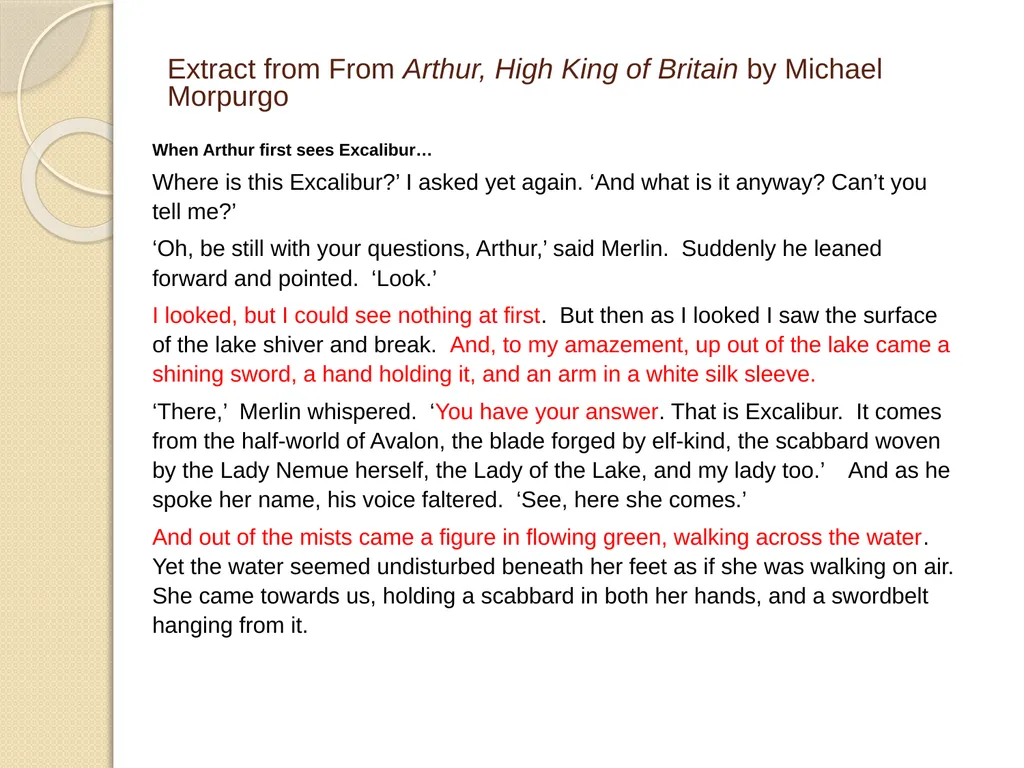
Extract from From Arthur, High King of Britain by Michael Morpurgo When Arthur first sees Excalibur…
Where is this Excalibur?’ I asked yet again. ‘And what is it anyway? Can’t you tell me?’
‘Oh, be still with your questions, Arthur,’ said Merlin. Suddenly he leaned forward and pointed. ‘Look.’
I looked, but I could see nothing at first. But then as I looked I saw the surface of the lake shiver and break. And, to my amazement, up out of the lake came a shining sword, a hand holding it, and an arm in a white silk sleeve.
‘There,’ Merlin whispered. ‘You have your answer. That is Excalibur. It comes from the half-world of Avalon, the blade forged by elf-kind, the scabbard woven by the Lady Nemue herself, the Lady of the Lake, and my lady too.’ And as he spoke her name, his voice faltered. ‘See, here she comes.’
And out of the mists came a figure in flowing green, walking across the water. Yet the water seemed undisturbed beneath her feet as if she was walking on air. She came towards us, holding a scabbard in both her hands, and a swordbelt hanging from it.<br>
Where is this Excalibur?’ I asked yet again. ‘And what is it anyway? Can’t you tell me?’
‘Oh, be still with your questions, Arthur,’ said Merlin. Suddenly he leaned forward and pointed. ‘Look.’
I looked, but I could see nothing at first. But then as I looked I saw the surface of the lake shiver and break. And, to my amazement, up out of the lake came a shining sword, a hand holding it, and an arm in a white silk sleeve.
‘There,’ Merlin whispered. ‘You have your answer. That is Excalibur. It comes from the half-world of Avalon, the blade forged by elf-kind, the scabbard woven by the Lady Nemue herself, the Lady of the Lake, and my lady too.’ And as he spoke her name, his voice faltered. ‘See, here she comes.’
And out of the mists came a figure in flowing green, walking across the water. Yet the water seemed undisturbed beneath her feet as if she was walking on air. She came towards us, holding a scabbard in both her hands, and a swordbelt hanging from it.<br>
06
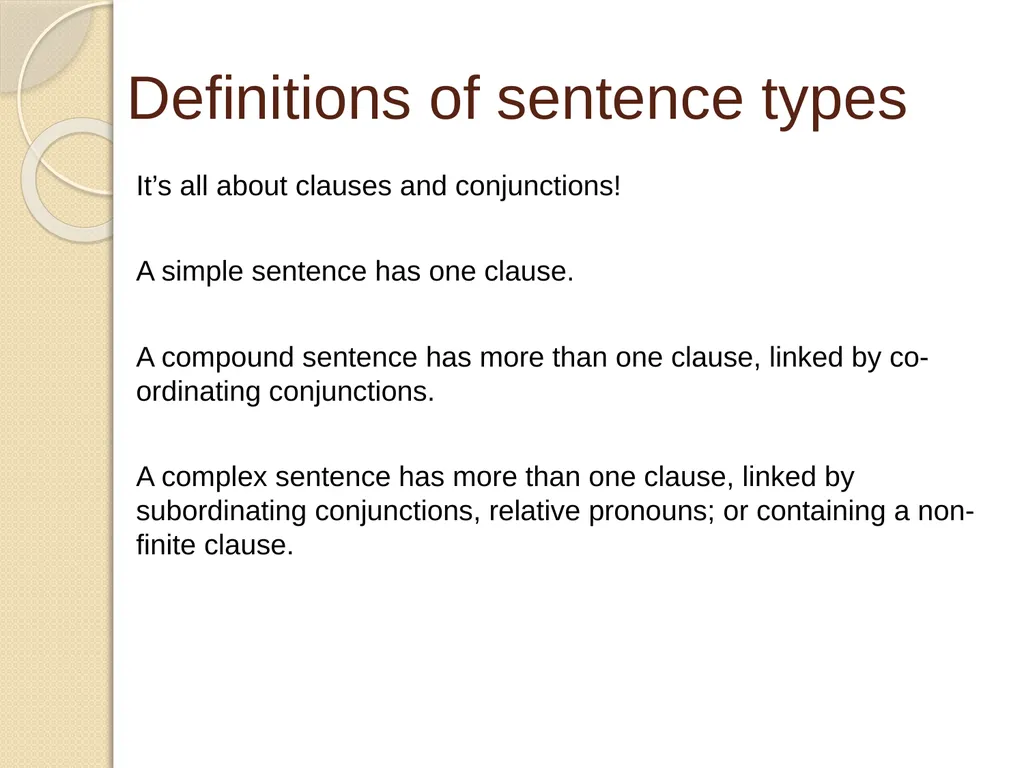
Definitions of sentence types It’s all about clauses and conjunctions!
A simple sentence has one clause.
A compound sentence has more than one clause, linked by co-ordinating conjunctions.
A complex sentence has more than one clause, linked by subordinating conjunctions, relative pronouns; or containing a non-finite clause.<br>
A simple sentence has one clause.
A compound sentence has more than one clause, linked by co-ordinating conjunctions.
A complex sentence has more than one clause, linked by subordinating conjunctions, relative pronouns; or containing a non-finite clause.<br>
07
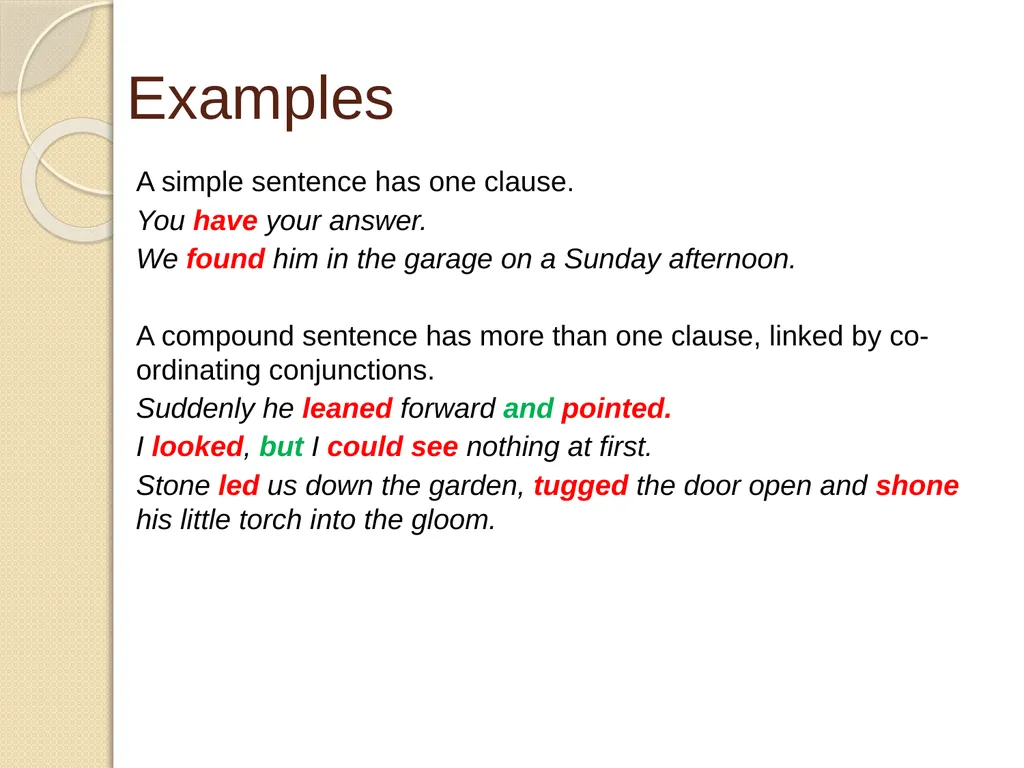
Examples A simple sentence has one clause.
You have your answer.
We found him in the garage on a Sunday afternoon.
A compound sentence has more than one clause, linked by co-ordinating conjunctions.
Suddenly he leaned forward and pointed.
I looked, but I could see nothing at first.
Stone led us down the garden, tugged the door open and shone his little torch into the gloom.<br>
You have your answer.
We found him in the garage on a Sunday afternoon.
A compound sentence has more than one clause, linked by co-ordinating conjunctions.
Suddenly he leaned forward and pointed.
I looked, but I could see nothing at first.
Stone led us down the garden, tugged the door open and shone his little torch into the gloom.<br>
08
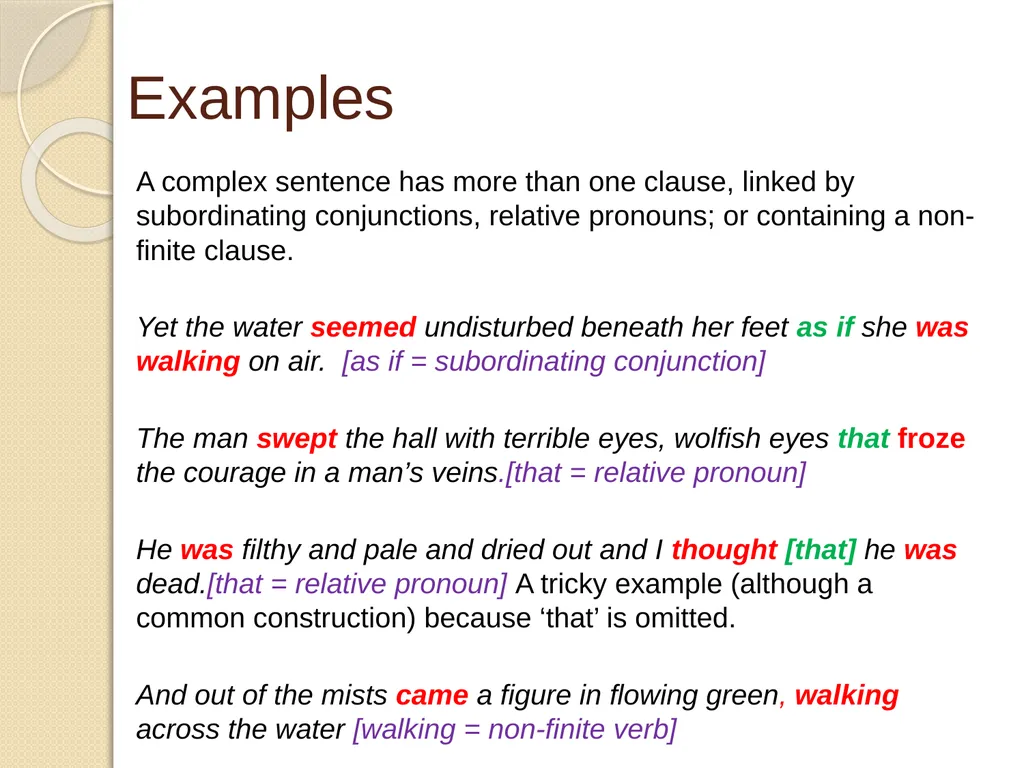
Examples A complex sentence has more than one clause, linked by subordinating conjunctions, relative pronouns; or containing a non-finite clause.
Yet the water seemed undisturbed beneath her feet as if she was walking on air. [as if = subordinating conjunction]
The man swept the hall with terrible eyes, wolfish eyes that froze the courage in a man’s veins.[that = relative pronoun]
He was filthy and pale and dried out and I thought [that] he was dead.[that = relative pronoun] A tricky example (although a common construction) because ‘that’ is omitted.
And out of the mists came a figure in flowing green, walking across the water [walking = non-finite verb]<br>
Yet the water seemed undisturbed beneath her feet as if she was walking on air. [as if = subordinating conjunction]
The man swept the hall with terrible eyes, wolfish eyes that froze the courage in a man’s veins.[that = relative pronoun]
He was filthy and pale and dried out and I thought [that] he was dead.[that = relative pronoun] A tricky example (although a common construction) because ‘that’ is omitted.
And out of the mists came a figure in flowing green, walking across the water [walking = non-finite verb]<br>
09
Practice! Check your understanding of this by looking back to the texts from ‘Skellig’ and ‘Arthur, High King of Britain’. See if you can find more examples of each sentence type that match those on the slides.<br>
10
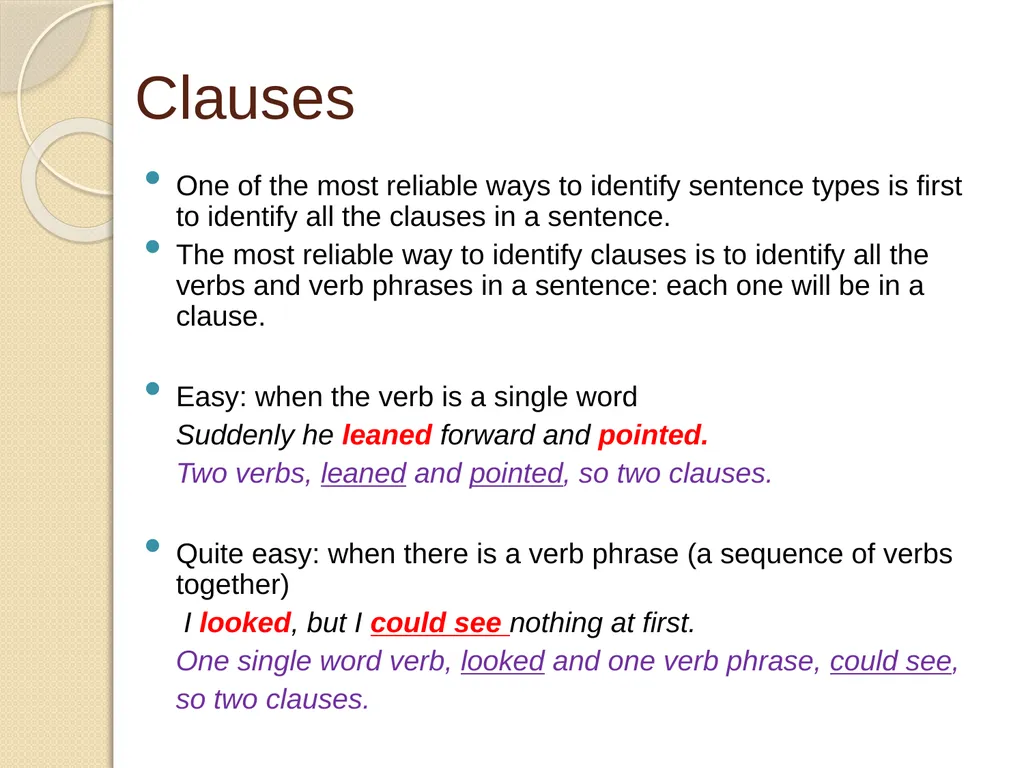
Clauses One of the most reliable ways to identify sentence types is first to identify all the clauses in a sentence.
The most reliable way to identify clauses is to identify all the verbs and verb phrases in a sentence: each one will be in a clause.
Easy: when the verb is a single word
Suddenly he leaned forward and pointed.
Two verbs, leaned and pointed, so two clauses.
Quite easy: when there is a verb phrase (a sequence of verbs together)
I looked, but I could see nothing at first.
One single word verb, looked and one verb phrase, could see,
so two clauses.<br>
The most reliable way to identify clauses is to identify all the verbs and verb phrases in a sentence: each one will be in a clause.
Easy: when the verb is a single word
Suddenly he leaned forward and pointed.
Two verbs, leaned and pointed, so two clauses.
Quite easy: when there is a verb phrase (a sequence of verbs together)
I looked, but I could see nothing at first.
One single word verb, looked and one verb phrase, could see,
so two clauses.<br>
11
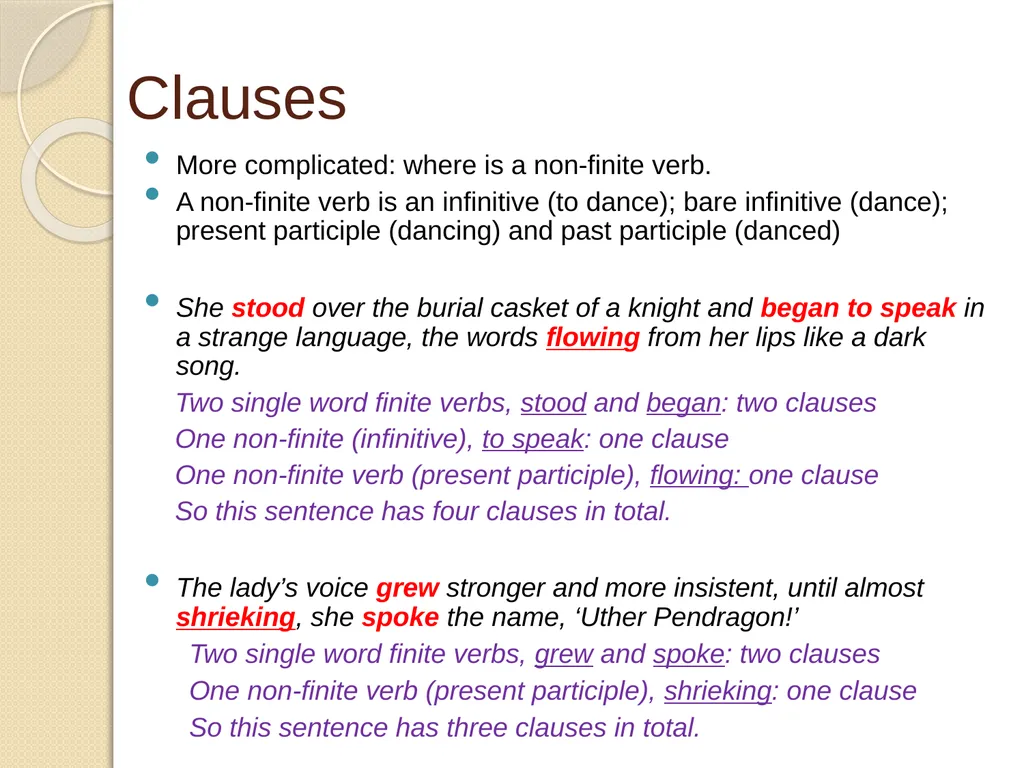
Clauses More complicated: where is a non-finite verb.
A non-finite verb is an infinitive (to dance); bare infinitive (dance); present participle (dancing) and past participle (danced)
She stood over the burial casket of a knight and began to speak in a strange language, the words flowing from her lips like a dark song.
Two single word finite verbs, stood and began: two clauses
One non-finite (infinitive), to speak: one clause
One non-finite verb (present participle), flowing: one clause
So this sentence has four clauses in total.
The lady’s voice grew stronger and more insistent, until almost shrieking, she spoke the name, ‘Uther Pendragon!’
Two single word finite verbs, grew and spoke: two clauses
One non-finite verb (present participle), shrieking: one clause
So this sentence has three clauses in total.<br>
A non-finite verb is an infinitive (to dance); bare infinitive (dance); present participle (dancing) and past participle (danced)
She stood over the burial casket of a knight and began to speak in a strange language, the words flowing from her lips like a dark song.
Two single word finite verbs, stood and began: two clauses
One non-finite (infinitive), to speak: one clause
One non-finite verb (present participle), flowing: one clause
So this sentence has four clauses in total.
The lady’s voice grew stronger and more insistent, until almost shrieking, she spoke the name, ‘Uther Pendragon!’
Two single word finite verbs, grew and spoke: two clauses
One non-finite verb (present participle), shrieking: one clause
So this sentence has three clauses in total.<br>
12
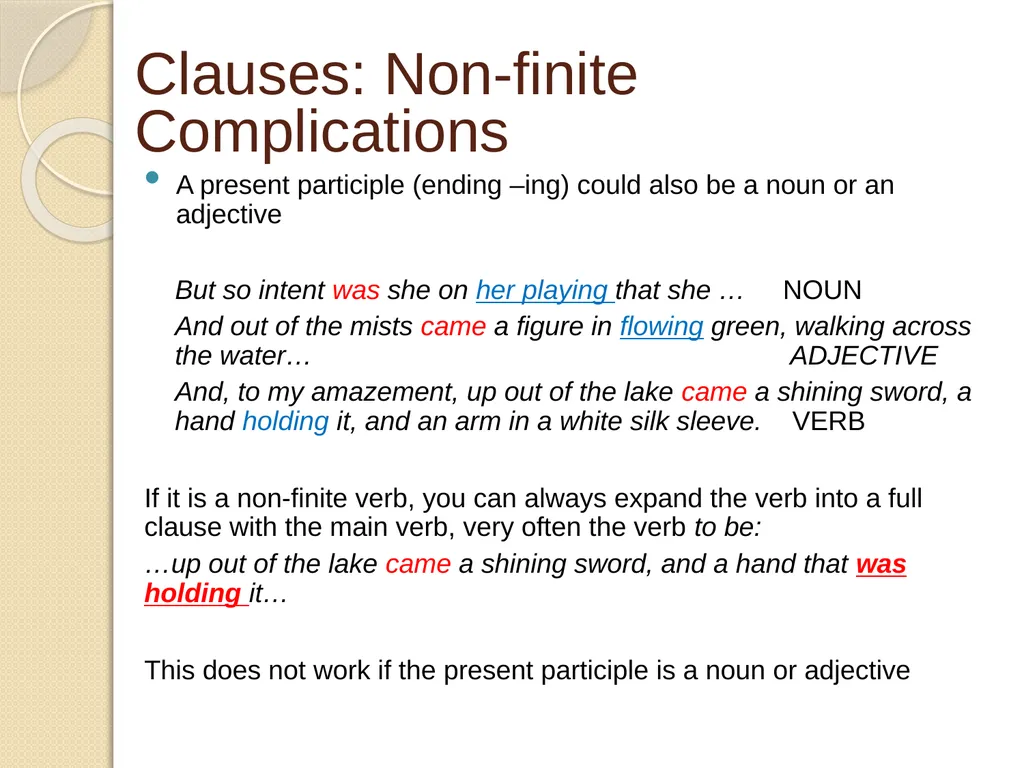
Clauses: Non-finite Complications A present participle (ending –ing) could also be a noun or an adjective
But so intent was she on her playing that she … NOUN
And out of the mists came a figure in flowing green, walking across the water… ADJECTIVE
And, to my amazement, up out of the lake came a shining sword, a hand holding it, and an arm in a white silk sleeve. VERB
If it is a non-finite verb, you can always expand the verb into a full clause with the main verb, very often the verb to be:
…up out of the lake came a shining sword, and a hand that was holding it…
This does not work if the present participle is a noun or adjective<br>
But so intent was she on her playing that she … NOUN
And out of the mists came a figure in flowing green, walking across the water… ADJECTIVE
And, to my amazement, up out of the lake came a shining sword, a hand holding it, and an arm in a white silk sleeve. VERB
If it is a non-finite verb, you can always expand the verb into a full clause with the main verb, very often the verb to be:
…up out of the lake came a shining sword, and a hand that was holding it…
This does not work if the present participle is a noun or adjective<br>
13
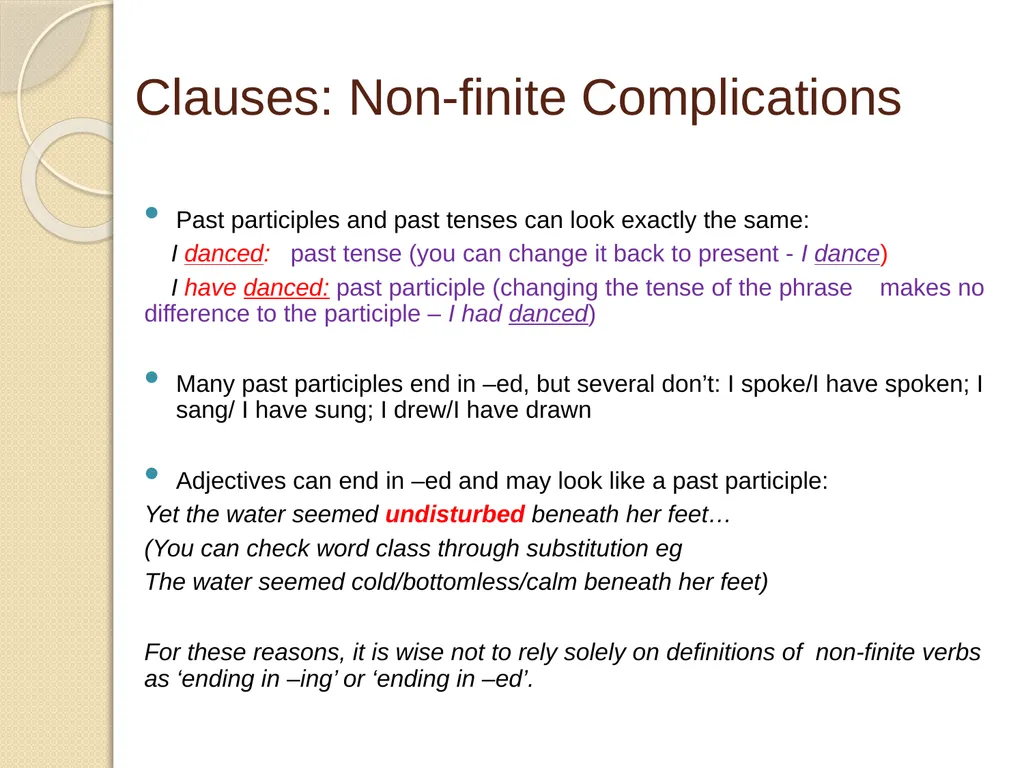
Clauses: Non-finite Complications Past participles and past tenses can look exactly the same:
I danced: past tense (you can change it back to present - I dance)
I have danced: past participle (changing the tense of the phrase makes no difference to the participle – I had danced)
Many past participles end in –ed, but several don’t: I spoke/I have spoken; I sang/ I have sung; I drew/I have drawn
Adjectives can end in –ed and may look like a past participle:
Yet the water seemed undisturbed beneath her feet…
(You can check word class through substitution eg
The water seemed cold/bottomless/calm beneath her feet)
For these reasons, it is wise not to rely solely on definitions of non-finite verbs as ‘ending in –ing’ or ‘ending in –ed’.<br>
I danced: past tense (you can change it back to present - I dance)
I have danced: past participle (changing the tense of the phrase makes no difference to the participle – I had danced)
Many past participles end in –ed, but several don’t: I spoke/I have spoken; I sang/ I have sung; I drew/I have drawn
Adjectives can end in –ed and may look like a past participle:
Yet the water seemed undisturbed beneath her feet…
(You can check word class through substitution eg
The water seemed cold/bottomless/calm beneath her feet)
For these reasons, it is wise not to rely solely on definitions of non-finite verbs as ‘ending in –ing’ or ‘ending in –ed’.<br>
14
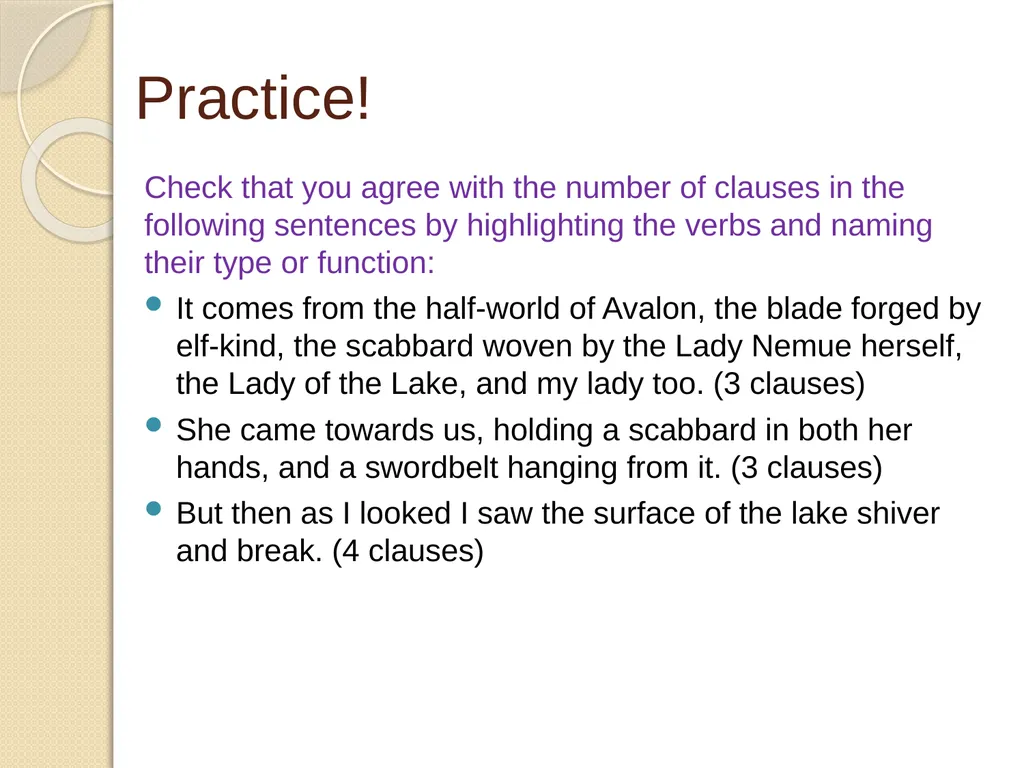
Practice! Check that you agree with the number of clauses in the following sentences by highlighting the verbs and naming their type or function:
It comes from the half-world of Avalon, the blade forged by elf-kind, the scabbard woven by the Lady Nemue herself, the Lady of the Lake, and my lady too. (3 clauses)
She came towards us, holding a scabbard in both her hands, and a swordbelt hanging from it. (3 clauses)
But then as I looked I saw the surface of the lake shiver and break. (4 clauses)<br>
It comes from the half-world of Avalon, the blade forged by elf-kind, the scabbard woven by the Lady Nemue herself, the Lady of the Lake, and my lady too. (3 clauses)
She came towards us, holding a scabbard in both her hands, and a swordbelt hanging from it. (3 clauses)
But then as I looked I saw the surface of the lake shiver and break. (4 clauses)<br>
15
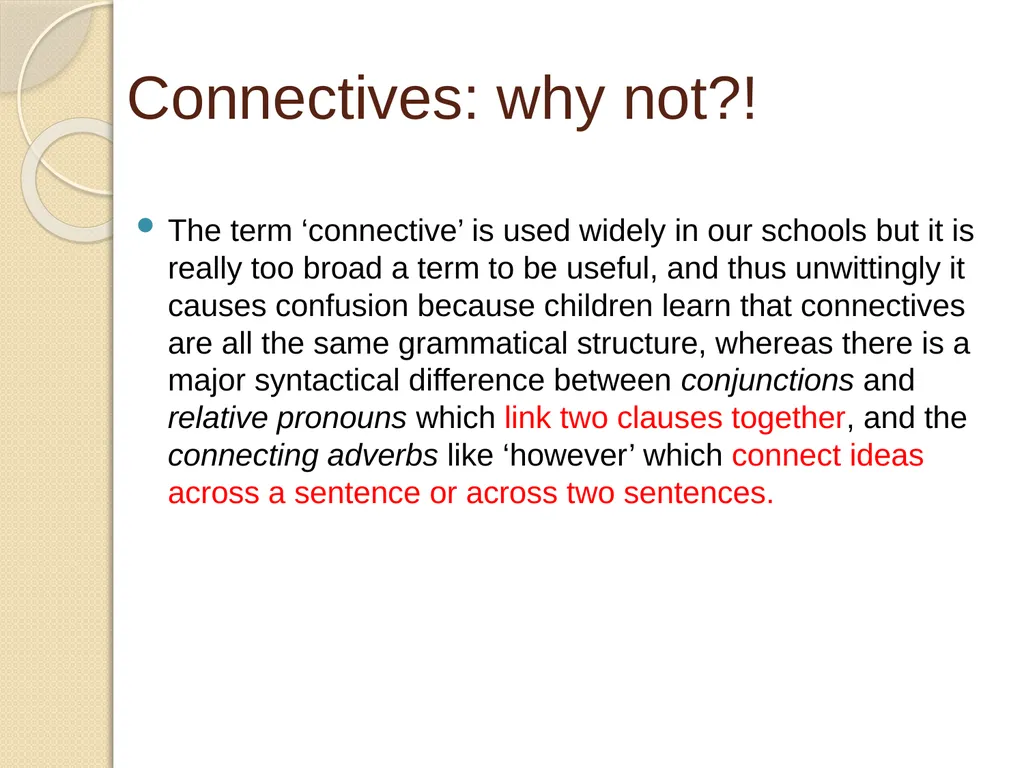
Connectives: why not?! The term ‘connective’ is used widely in our schools but it is really too broad a term to be useful, and thus unwittingly it causes confusion because children learn that connectives are all the same grammatical structure, whereas there is a major syntactical difference between conjunctions and relative pronouns which link two clauses together, and the connecting adverbs like ‘however’ which connect ideas across a sentence or across two sentences.<br>
16
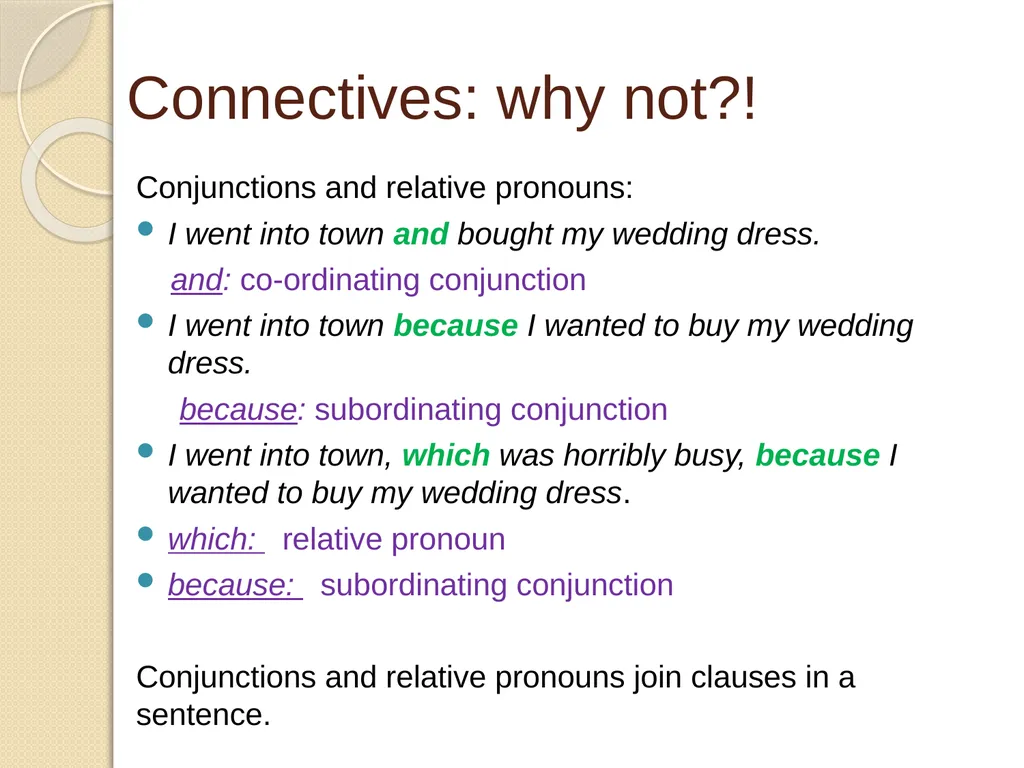
Connectives: why not?! Conjunctions and relative pronouns:
I went into town and bought my wedding dress.
and: co-ordinating conjunction
I went into town because I wanted to buy my wedding dress.
because: subordinating conjunction
I went into town, which was horribly busy, because I wanted to buy my wedding dress.
which: relative pronoun
because: subordinating conjunction
Conjunctions and relative pronouns join clauses in a sentence.<br>
I went into town and bought my wedding dress.
and: co-ordinating conjunction
I went into town because I wanted to buy my wedding dress.
because: subordinating conjunction
I went into town, which was horribly busy, because I wanted to buy my wedding dress.
which: relative pronoun
because: subordinating conjunction
Conjunctions and relative pronouns join clauses in a sentence.<br>
17
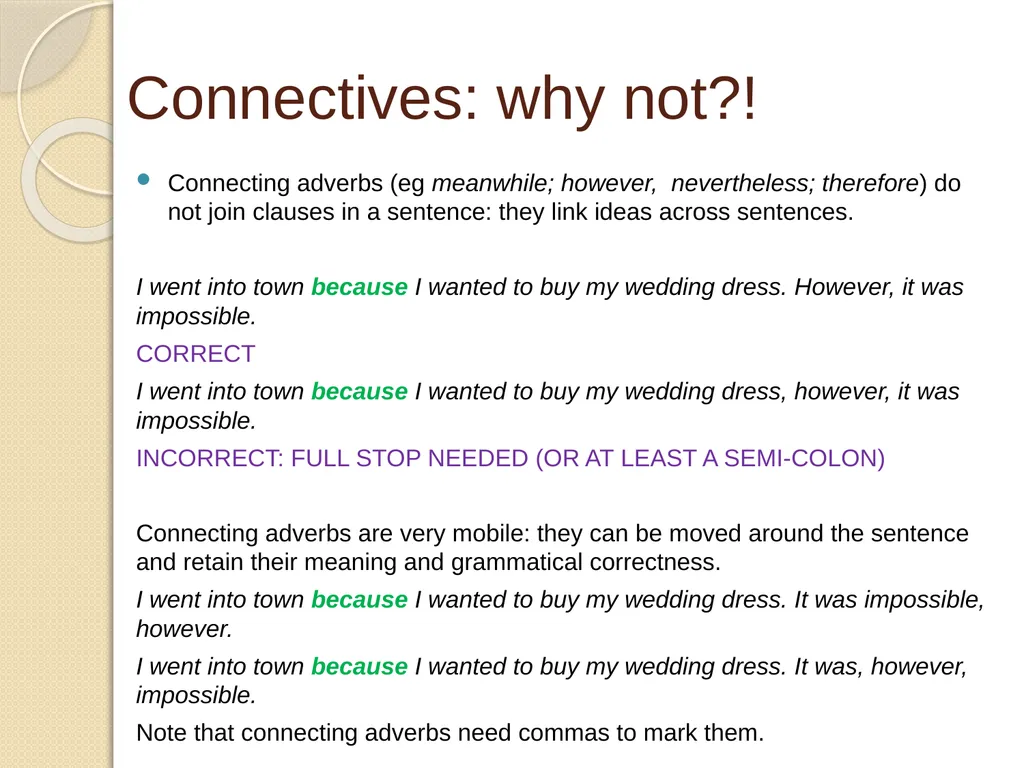
Connectives: why not?! Connecting adverbs (eg meanwhile; however, nevertheless; therefore) do not join clauses in a sentence: they link ideas across sentences.
I went into town because I wanted to buy my wedding dress. However, it was impossible.
CORRECT
I went into town because I wanted to buy my wedding dress, however, it was impossible.
INCORRECT: FULL STOP NEEDED (OR AT LEAST A SEMI-COLON)
Connecting adverbs are very mobile: they can be moved around the sentence and retain their meaning and grammatical correctness.
I went into town because I wanted to buy my wedding dress. It was impossible, however.
I went into town because I wanted to buy my wedding dress. It was, however, impossible.
Note that connecting adverbs need commas to mark them.<br>
I went into town because I wanted to buy my wedding dress. However, it was impossible.
CORRECT
I went into town because I wanted to buy my wedding dress, however, it was impossible.
INCORRECT: FULL STOP NEEDED (OR AT LEAST A SEMI-COLON)
Connecting adverbs are very mobile: they can be moved around the sentence and retain their meaning and grammatical correctness.
I went into town because I wanted to buy my wedding dress. It was impossible, however.
I went into town because I wanted to buy my wedding dress. It was, however, impossible.
Note that connecting adverbs need commas to mark them.<br>
18
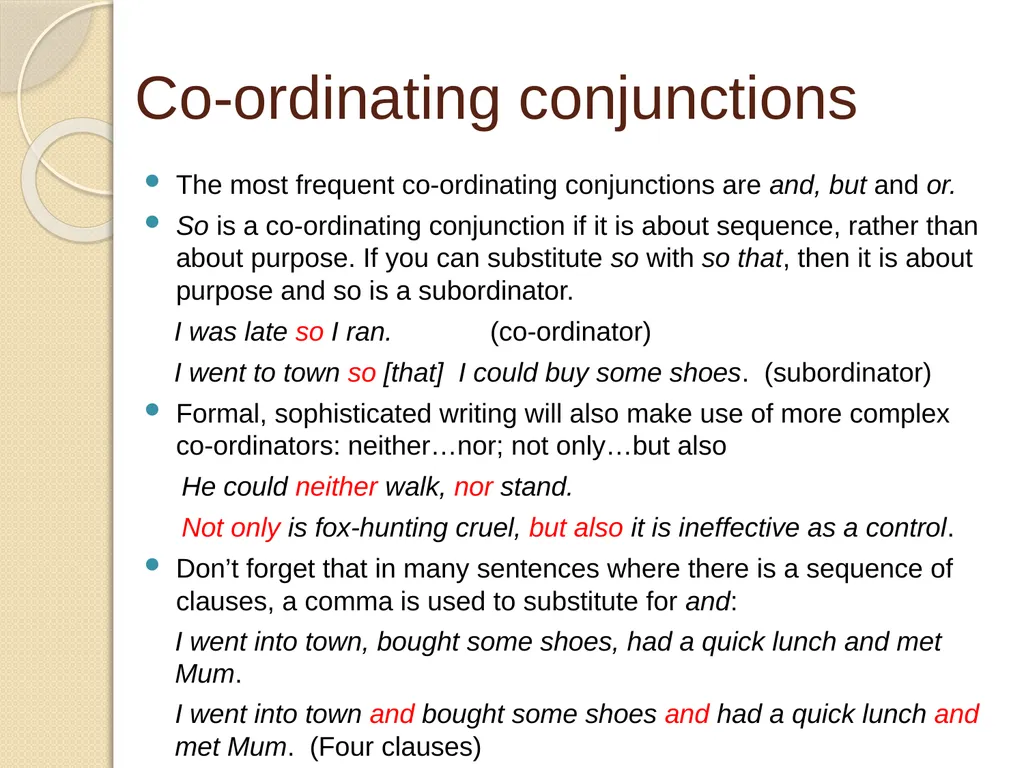
Co-ordinating conjunctions The most frequent co-ordinating conjunctions are and, but and or.
So is a co-ordinating conjunction if it is about sequence, rather than about purpose. If you can substitute so with so that, then it is about purpose and so is a subordinator.
I was late so I ran. (co-ordinator)
I went to town so [that] I could buy some shoes. (subordinator)
Formal, sophisticated writing will also make use of more complex co-ordinators: neither…nor; not only…but also
He could neither walk, nor stand.
Not only is fox-hunting cruel, but also it is ineffective as a control.
Don’t forget that in many sentences where there is a sequence of clauses, a comma is used to substitute for and:
I went into town, bought some shoes, had a quick lunch and met Mum.
I went into town and bought some shoes and had a quick lunch and met Mum. (Four clauses)<br>
So is a co-ordinating conjunction if it is about sequence, rather than about purpose. If you can substitute so with so that, then it is about purpose and so is a subordinator.
I was late so I ran. (co-ordinator)
I went to town so [that] I could buy some shoes. (subordinator)
Formal, sophisticated writing will also make use of more complex co-ordinators: neither…nor; not only…but also
He could neither walk, nor stand.
Not only is fox-hunting cruel, but also it is ineffective as a control.
Don’t forget that in many sentences where there is a sequence of clauses, a comma is used to substitute for and:
I went into town, bought some shoes, had a quick lunch and met Mum.
I went into town and bought some shoes and had a quick lunch and met Mum. (Four clauses)<br>
19
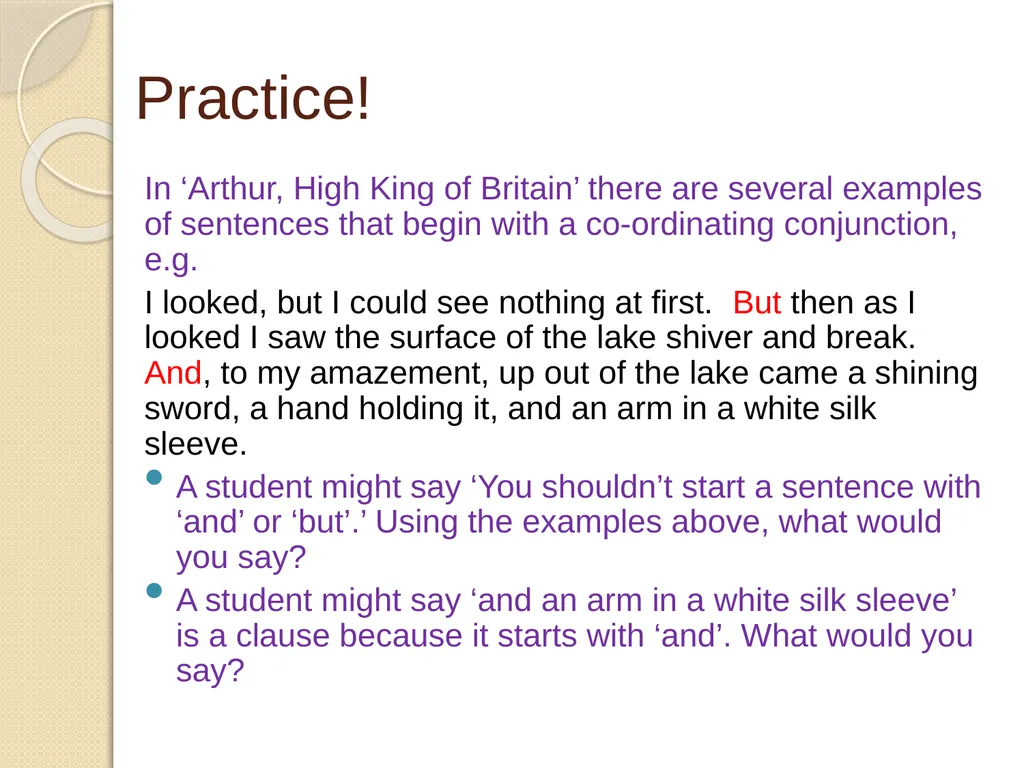
Practice! In ‘Arthur, High King of Britain’ there are several examples of sentences that begin with a co-ordinating conjunction, e.g.
I looked, but I could see nothing at first. But then as I looked I saw the surface of the lake shiver and break. And, to my amazement, up out of the lake came a shining sword, a hand holding it, and an arm in a white silk sleeve.
A student might say ‘You shouldn’t start a sentence with ‘and’ or ‘but’.’ Using the examples above, what would you say?
A student might say ‘and an arm in a white silk sleeve’ is a clause because it starts with ‘and’. What would you say?<br>
I looked, but I could see nothing at first. But then as I looked I saw the surface of the lake shiver and break. And, to my amazement, up out of the lake came a shining sword, a hand holding it, and an arm in a white silk sleeve.
A student might say ‘You shouldn’t start a sentence with ‘and’ or ‘but’.’ Using the examples above, what would you say?
A student might say ‘and an arm in a white silk sleeve’ is a clause because it starts with ‘and’. What would you say?<br>
20
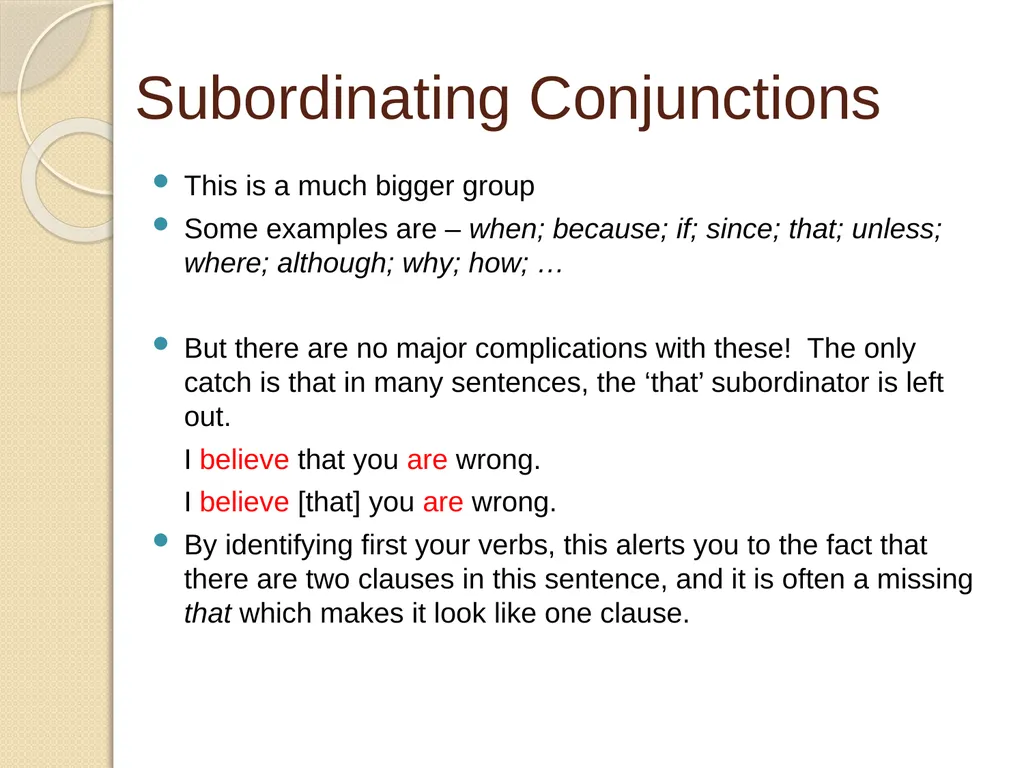
Subordinating Conjunctions This is a much bigger group
Some examples are – when; because; if; since; that; unless; where; although; why; how; …
But there are no major complications with these! The only catch is that in many sentences, the ‘that’ subordinator is left out.
I believe that you are wrong.
I believe [that] you are wrong.
By identifying first your verbs, this alerts you to the fact that there are two clauses in this sentence, and it is often a missing that which makes it look like one clause.<br>
Some examples are – when; because; if; since; that; unless; where; although; why; how; …
But there are no major complications with these! The only catch is that in many sentences, the ‘that’ subordinator is left out.
I believe that you are wrong.
I believe [that] you are wrong.
By identifying first your verbs, this alerts you to the fact that there are two clauses in this sentence, and it is often a missing that which makes it look like one clause.<br>
21
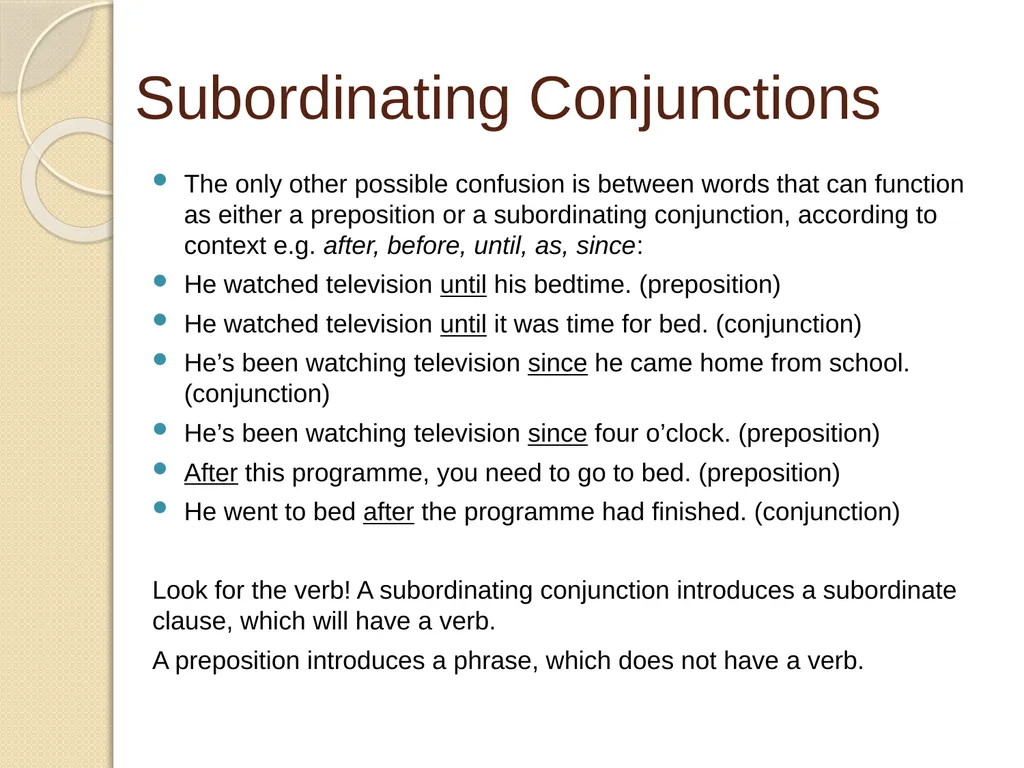
Subordinating Conjunctions The only other possible confusion is between words that can function as either a preposition or a subordinating conjunction, according to context e.g. after, before, until, as, since:
He watched television until his bedtime. (preposition)
He watched television until it was time for bed. (conjunction)
He’s been watching television since he came home from school. (conjunction)
He’s been watching television since four o’clock. (preposition)
After this programme, you need to go to bed. (preposition)
He went to bed after the programme had finished. (conjunction)
Look for the verb! A subordinating conjunction introduces a subordinate clause, which will have a verb.
A preposition introduces a phrase, which does not have a verb.<br>
He watched television until his bedtime. (preposition)
He watched television until it was time for bed. (conjunction)
He’s been watching television since he came home from school. (conjunction)
He’s been watching television since four o’clock. (preposition)
After this programme, you need to go to bed. (preposition)
He went to bed after the programme had finished. (conjunction)
Look for the verb! A subordinating conjunction introduces a subordinate clause, which will have a verb.
A preposition introduces a phrase, which does not have a verb.<br>
22
Practice! Check your understanding of this by looking back to the texts from ‘Skellig’ and ‘Arthur, High King of Britain’. See if you can find more examples of subordinating conjunctions that introduce subordinate clauses. What variety is there in the choice of conjunctions?<br>
23
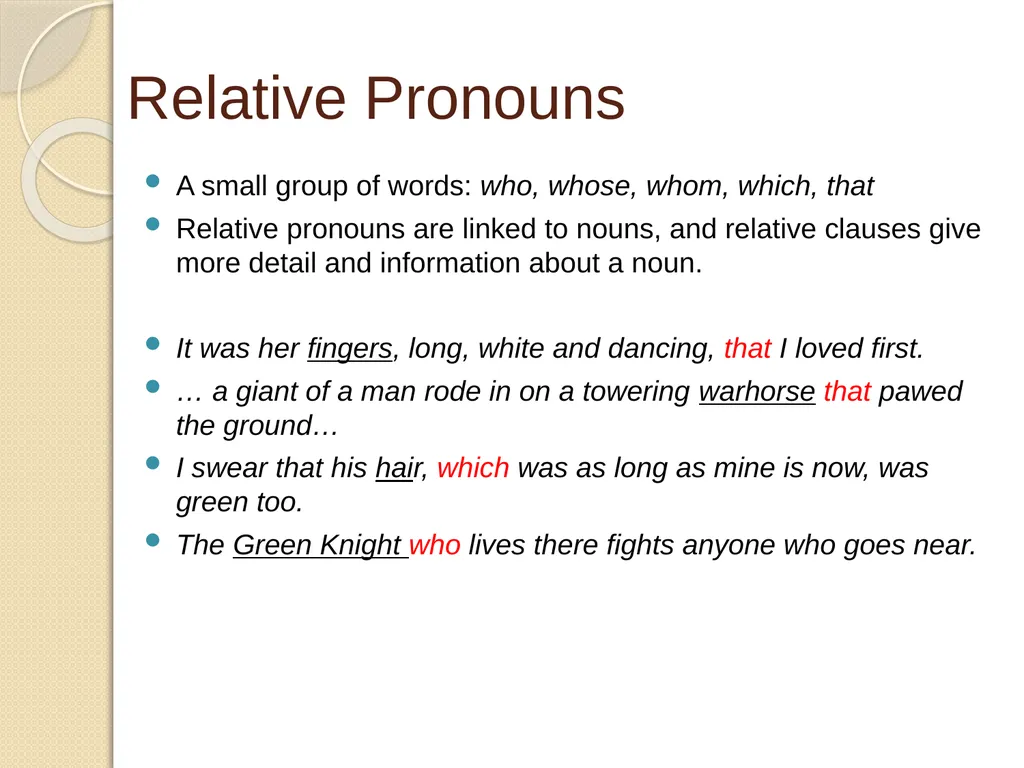
Relative Pronouns A small group of words: who, whose, whom, which, that
Relative pronouns are linked to nouns, and relative clauses give more detail and information about a noun.
It was her fingers, long, white and dancing, that I loved first.
… a giant of a man rode in on a towering warhorse that pawed the ground…
I swear that his hair, which was as long as mine is now, was green too.
The Green Knight who lives there fights anyone who goes near.<br>
Relative pronouns are linked to nouns, and relative clauses give more detail and information about a noun.
It was her fingers, long, white and dancing, that I loved first.
… a giant of a man rode in on a towering warhorse that pawed the ground…
I swear that his hair, which was as long as mine is now, was green too.
The Green Knight who lives there fights anyone who goes near.<br>
24
Practice! We called it the garage because that’s what the estate agent, Mr Stone, called it.
Many of the students we interviewed identified ‘Mr Stone’ as ‘an embedded clause’ and a few said it was ‘a relative clause’. They said that the pair of commas made it a clause.
How would you explain that ‘Mr Stone’ is not a clause?
Clarify your own understanding of the term ‘relative clause’ eg by providing examples that could be added to the sentence above.<br>
Many of the students we interviewed identified ‘Mr Stone’ as ‘an embedded clause’ and a few said it was ‘a relative clause’. They said that the pair of commas made it a clause.
How would you explain that ‘Mr Stone’ is not a clause?
Clarify your own understanding of the term ‘relative clause’ eg by providing examples that could be added to the sentence above.<br>
25
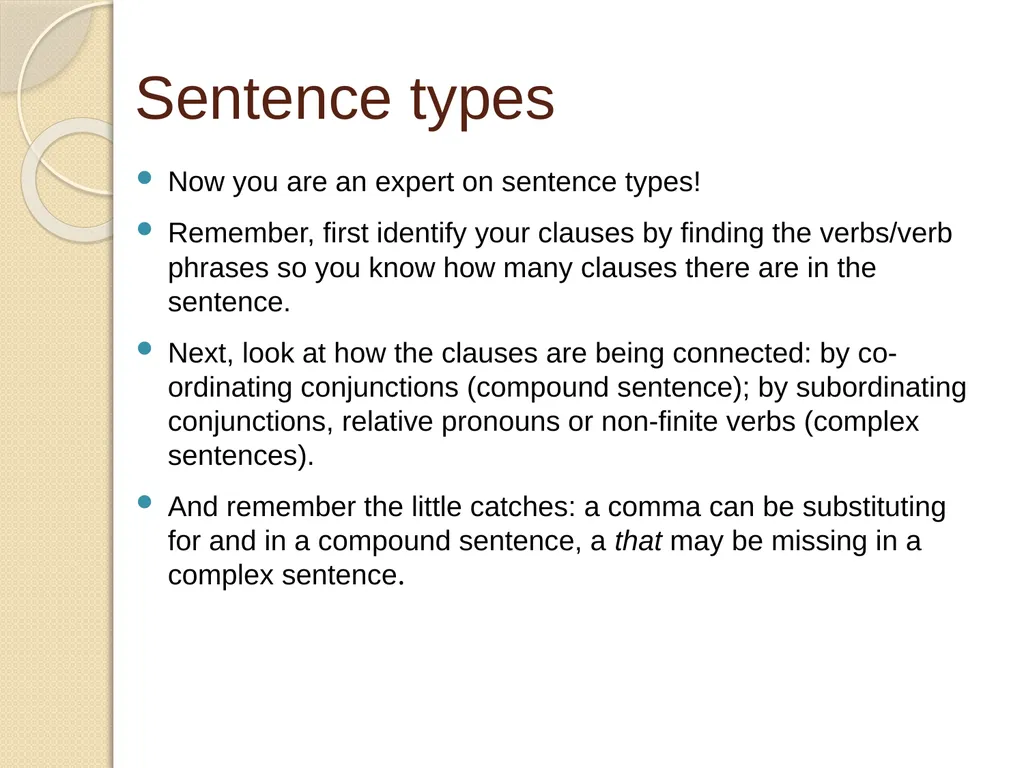
Sentence types Now you are an expert on sentence types!
Remember, first identify your clauses by finding the verbs/verb phrases so you know how many clauses there are in the sentence.
Next, look at how the clauses are being connected: by co-ordinating conjunctions (compound sentence); by subordinating conjunctions, relative pronouns or non-finite verbs (complex sentences).
And remember the little catches: a comma can be substituting for and in a compound sentence, a that may be missing in a complex sentence.<br>
Remember, first identify your clauses by finding the verbs/verb phrases so you know how many clauses there are in the sentence.
Next, look at how the clauses are being connected: by co-ordinating conjunctions (compound sentence); by subordinating conjunctions, relative pronouns or non-finite verbs (complex sentences).
And remember the little catches: a comma can be substituting for and in a compound sentence, a that may be missing in a complex sentence.<br>
26
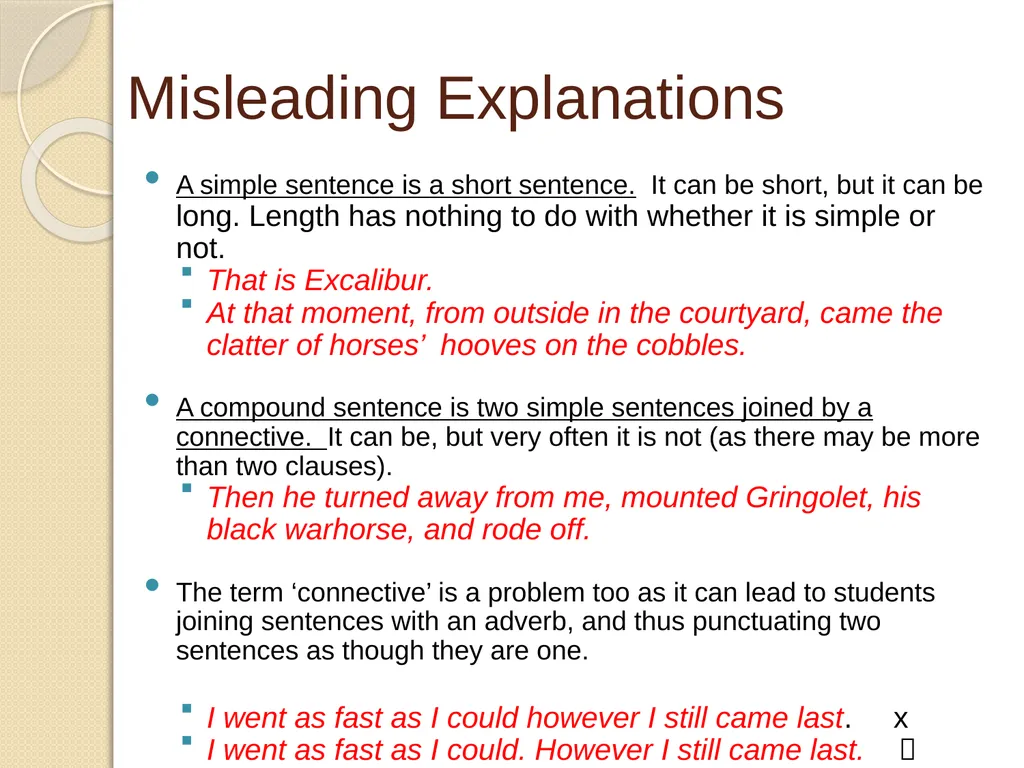
Misleading Explanations A simple sentence is a short sentence. It can be short, but it can be long. Length has nothing to do with whether it is simple or not.
That is Excalibur.
At that moment, from outside in the courtyard, came the clatter of horses’ hooves on the cobbles.
A compound sentence is two simple sentences joined by a connective. It can be, but very often it is not (as there may be more than two clauses).
Then he turned away from me, mounted Gringolet, his black warhorse, and rode off.
The term ‘connective’ is a problem too as it can lead to students joining sentences with an adverb, and thus punctuating two sentences as though they are one.
I went as fast as I could however I still came last. x
I went as fast as I could. However I still came last. <br>
That is Excalibur.
At that moment, from outside in the courtyard, came the clatter of horses’ hooves on the cobbles.
A compound sentence is two simple sentences joined by a connective. It can be, but very often it is not (as there may be more than two clauses).
Then he turned away from me, mounted Gringolet, his black warhorse, and rode off.
The term ‘connective’ is a problem too as it can lead to students joining sentences with an adverb, and thus punctuating two sentences as though they are one.
I went as fast as I could however I still came last. x
I went as fast as I could. However I still came last. <br>
27
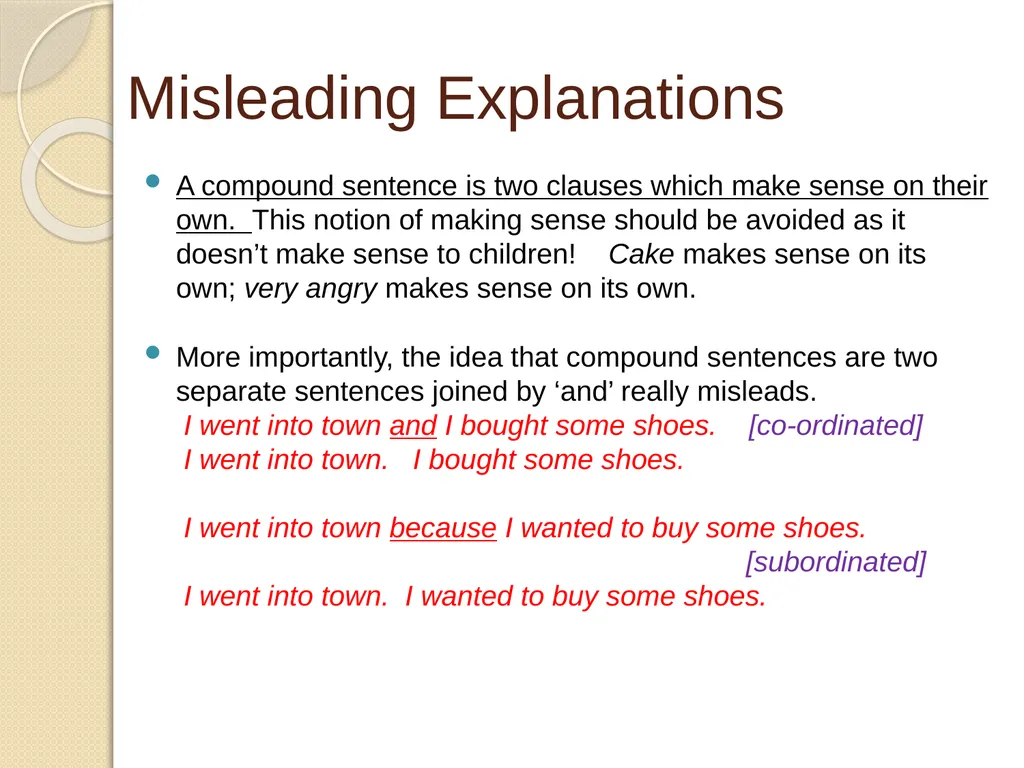
Misleading Explanations A compound sentence is two clauses which make sense on their own. This notion of making sense should be avoided as it doesn’t make sense to children! Cake makes sense on its own; very angry makes sense on its own.
More importantly, the idea that compound sentences are two separate sentences joined by ‘and’ really misleads.
I went into town and I bought some shoes. [co-ordinated]
I went into town. I bought some shoes.
I went into town because I wanted to buy some shoes.
[subordinated]
I went into town. I wanted to buy some shoes.<br>
More importantly, the idea that compound sentences are two separate sentences joined by ‘and’ really misleads.
I went into town and I bought some shoes. [co-ordinated]
I went into town. I bought some shoes.
I went into town because I wanted to buy some shoes.
[subordinated]
I went into town. I wanted to buy some shoes.<br>
28
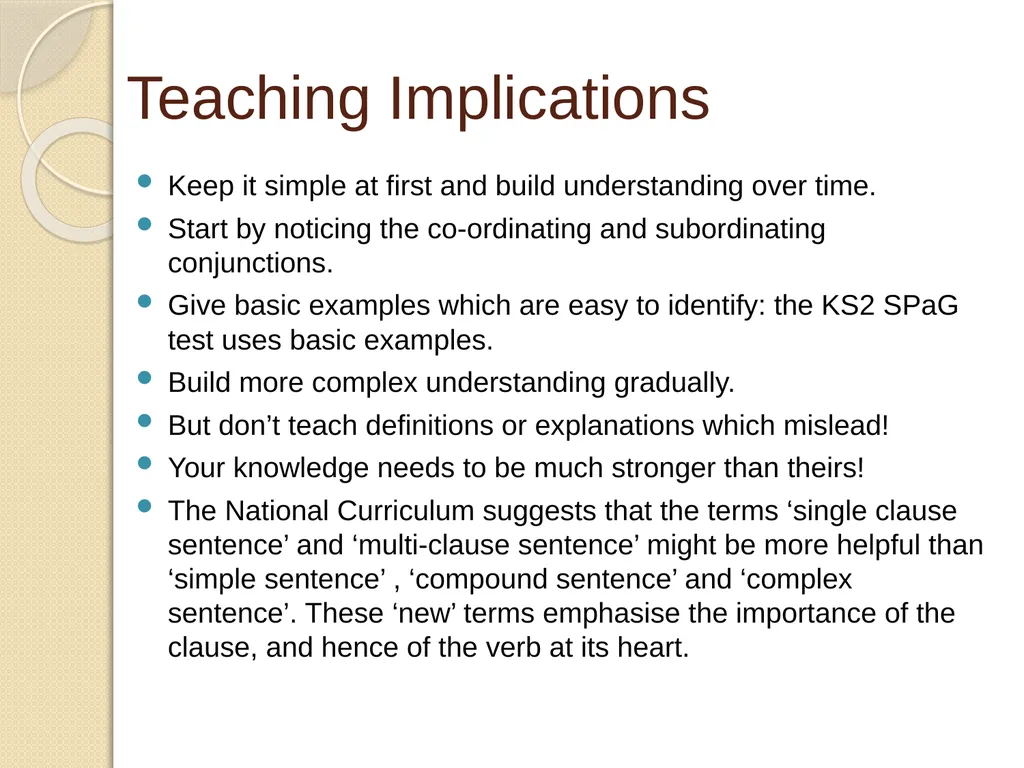
Teaching Implications Keep it simple at first and build understanding over time.
Start by noticing the co-ordinating and subordinating conjunctions.
Give basic examples which are easy to identify: the KS2 SPaG test uses basic examples.
Build more complex understanding gradually.
But don’t teach definitions or explanations which mislead!
Your knowledge needs to be much stronger than theirs!
The National Curriculum suggests that the terms ‘single clause sentence’ and ‘multi-clause sentence’ might be more helpful than ‘simple sentence’ , ‘compound sentence’ and ‘complex sentence’. These ‘new’ terms emphasise the importance of the clause, and hence of the verb at its heart.<br>
Start by noticing the co-ordinating and subordinating conjunctions.
Give basic examples which are easy to identify: the KS2 SPaG test uses basic examples.
Build more complex understanding gradually.
But don’t teach definitions or explanations which mislead!
Your knowledge needs to be much stronger than theirs!
The National Curriculum suggests that the terms ‘single clause sentence’ and ‘multi-clause sentence’ might be more helpful than ‘simple sentence’ , ‘compound sentence’ and ‘complex sentence’. These ‘new’ terms emphasise the importance of the clause, and hence of the verb at its heart.<br>