
Understanding the College Application Process
AM
Published · 35 slides · 0 views
1 / 1



Description
Understanding the College Application Process Joann P. DiGennaro, President Center for Excellence in Education Introduction to U.S. College and Universities What Will it Take to Get Admitted to a U.S. Top TierGood Institution of Higher
Related Topics
Download this presentation From Below
"Understanding the College Application Process" is the property of its rightful owner. Permission is granted to download and print the materials on this website for personal, non-commercial use only, and to display it on your personal computer provided you do not modify the materials and that you retain all copyright notices contained in the materials. By downloading content from our website, you accept the terms of this agreement.
Share
Embed code
Presentation Transcript
01
Understanding the College Application Process Joann P. DiGennaro, President
Center for Excellence in Education<br>
02
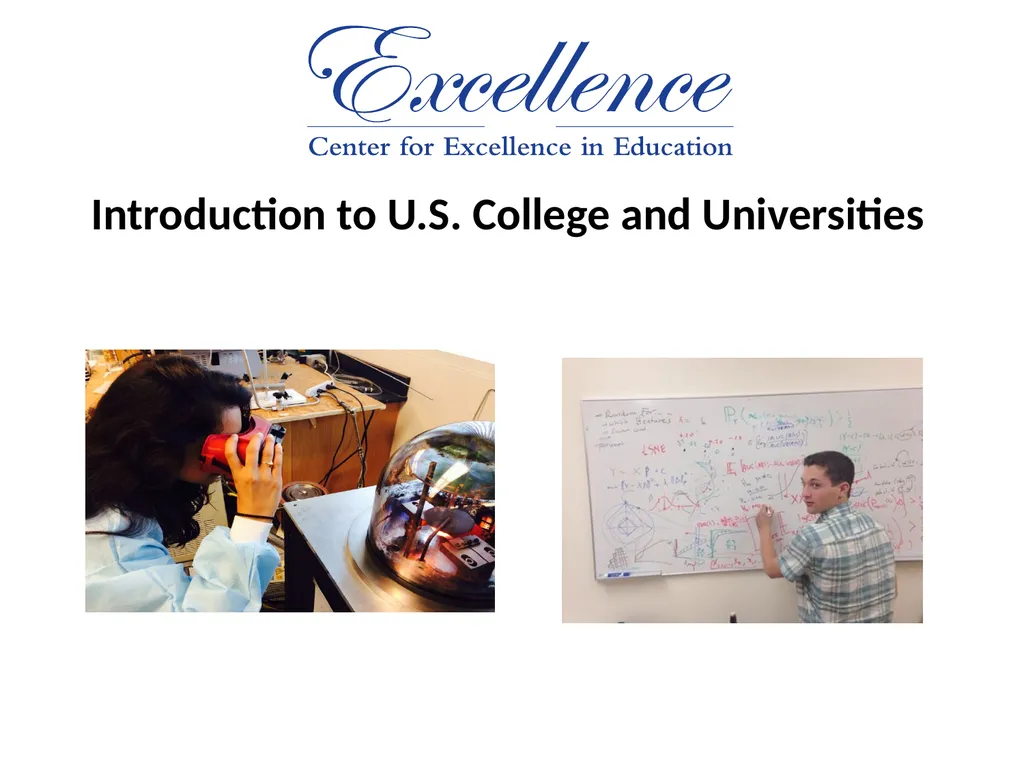
Introduction to U.S. College and Universities<br>
03
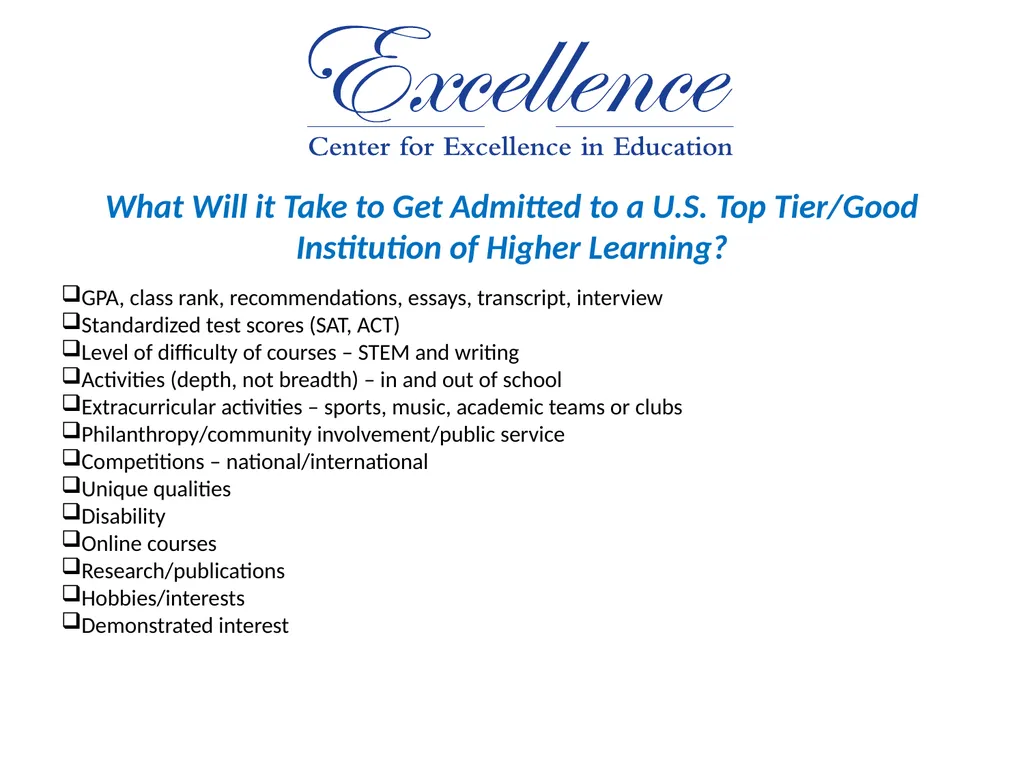
What Will it Take to Get Admitted to a U.S. Top Tier/Good Institution of Higher Learning?
GPA, class rank, recommendations, essays, transcript, interview
Standardized test scores (SAT, ACT)
Level of difficulty of courses – STEM and writing
Activities (depth, not breadth) – in and out of school
Extracurricular activities – sports, music, academic teams or clubs
Philanthropy/community involvement/public service
Competitions – national/international
Unique qualities
Disability
Online courses
Research/publications
Hobbies/interests
Demonstrated interest<br>
GPA, class rank, recommendations, essays, transcript, interview
Standardized test scores (SAT, ACT)
Level of difficulty of courses – STEM and writing
Activities (depth, not breadth) – in and out of school
Extracurricular activities – sports, music, academic teams or clubs
Philanthropy/community involvement/public service
Competitions – national/international
Unique qualities
Disability
Online courses
Research/publications
Hobbies/interests
Demonstrated interest<br>
04
College vs. University
A college is generally defined as an institution of higher education that may stand alone or make up one part of a university. There may be several colleges on a single university campus (e.g., college of medicine).
Universities are larger and more independent than colleges. They are more likely to offer graduate and post-graduate courses and degrees.
There may be several colleges that cater to a variety of specialized professions in law, medicine, the liberal arts, etc. on a single university's campus. Sometimes "college" and "university" are used interchangeably.<br>
A college is generally defined as an institution of higher education that may stand alone or make up one part of a university. There may be several colleges on a single university campus (e.g., college of medicine).
Universities are larger and more independent than colleges. They are more likely to offer graduate and post-graduate courses and degrees.
There may be several colleges that cater to a variety of specialized professions in law, medicine, the liberal arts, etc. on a single university's campus. Sometimes "college" and "university" are used interchangeably.<br>
05
Ivy League Schools
The term Ivy League has connotations of academic excellence, selectivity in admissions, and social elitism.
Ivy League: Brown University, Columbia University, Cornell University, Dartmouth College, Harvard University, the University of Pennsylvania, Princeton University, and Yale University<br>
The term Ivy League has connotations of academic excellence, selectivity in admissions, and social elitism.
Ivy League: Brown University, Columbia University, Cornell University, Dartmouth College, Harvard University, the University of Pennsylvania, Princeton University, and Yale University<br>
06
Liberal Arts College
A liberal arts college emphasizes undergraduate study in the liberal arts and sciences and aims to impart a broad general knowledge to develop general intellectual capacities. This is in contrast to a professional, vocational, or technical curriculum. Students in a liberal arts college generally major in a particular discipline while receiving exposure to a wide range of academic subjects, including sciences as well as the traditional humanities subjects such as literature, philosophy, or music.
Although many liberal arts colleges are exclusively undergraduate, some also offer graduate programs that lead to a master's degree or doctoral degree in subjects such as business administration, nursing, medicine, and law.
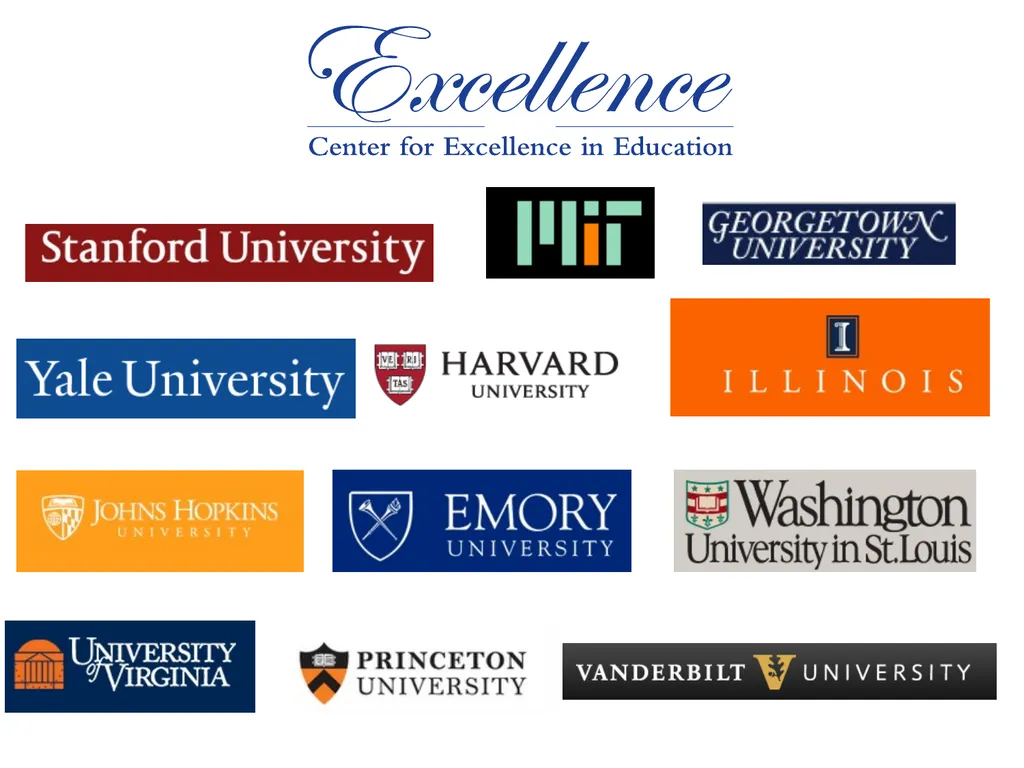
Some include: Amherst College, Barnard College, Claremont McKenna College, Emory University, Georgetown University, Harvey Mudd College, Middlebury College, Pomona College, Stanford University, Swarthmore College, University of Virginia, Vassar College, Wellesley College and Williams College<br>
A liberal arts college emphasizes undergraduate study in the liberal arts and sciences and aims to impart a broad general knowledge to develop general intellectual capacities. This is in contrast to a professional, vocational, or technical curriculum. Students in a liberal arts college generally major in a particular discipline while receiving exposure to a wide range of academic subjects, including sciences as well as the traditional humanities subjects such as literature, philosophy, or music.
Although many liberal arts colleges are exclusively undergraduate, some also offer graduate programs that lead to a master's degree or doctoral degree in subjects such as business administration, nursing, medicine, and law.
Some include: Amherst College, Barnard College, Claremont McKenna College, Emory University, Georgetown University, Harvey Mudd College, Middlebury College, Pomona College, Stanford University, Swarthmore College, University of Virginia, Vassar College, Wellesley College and Williams College<br>
07
Business School
A business school is a university-level institution that confers degrees in business administration or management. Such a school can also be known as school of management, school of business, school of business administration, or, colloquially, b-school or biz school. A business school teaches topics such as accounting, administration, strategy, economics, entrepreneurship, finance, human resource management, information systems, logistics, marketing, organizational psychology, organizational behavior, public relations, research methods and real estate among others.
Business Schools include: University of Pennsylvania (Wharton School), University of California – Berkeley (Haas School), MIT (Sloan School) and Carnegie Mellon University (Tepper School)<br>
A business school is a university-level institution that confers degrees in business administration or management. Such a school can also be known as school of management, school of business, school of business administration, or, colloquially, b-school or biz school. A business school teaches topics such as accounting, administration, strategy, economics, entrepreneurship, finance, human resource management, information systems, logistics, marketing, organizational psychology, organizational behavior, public relations, research methods and real estate among others.
Business Schools include: University of Pennsylvania (Wharton School), University of California – Berkeley (Haas School), MIT (Sloan School) and Carnegie Mellon University (Tepper School)<br>
08
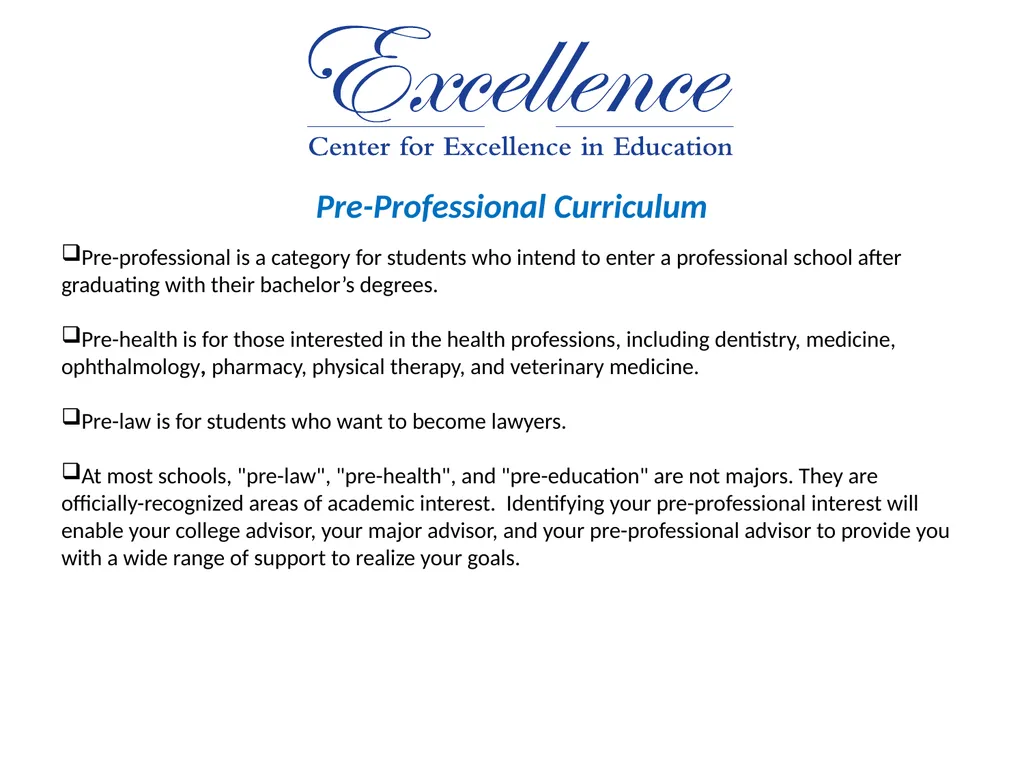
Pre-Professional Curriculum
Pre-professional is a category for students who intend to enter a professional school after graduating with their bachelor’s degrees.
Pre-health is for those interested in the health professions, including dentistry, medicine, ophthalmology, pharmacy, physical therapy, and veterinary medicine.
Pre-law is for students who want to become lawyers.
At most schools, "pre-law", "pre-health", and "pre-education" are not majors. They are officially-recognized areas of academic interest. Identifying your pre-professional interest will enable your college advisor, your major advisor, and your pre-professional advisor to provide you with a wide range of support to realize your goals.<br>
Pre-professional is a category for students who intend to enter a professional school after graduating with their bachelor’s degrees.
Pre-health is for those interested in the health professions, including dentistry, medicine, ophthalmology, pharmacy, physical therapy, and veterinary medicine.
Pre-law is for students who want to become lawyers.
At most schools, "pre-law", "pre-health", and "pre-education" are not majors. They are officially-recognized areas of academic interest. Identifying your pre-professional interest will enable your college advisor, your major advisor, and your pre-professional advisor to provide you with a wide range of support to realize your goals.<br>
09
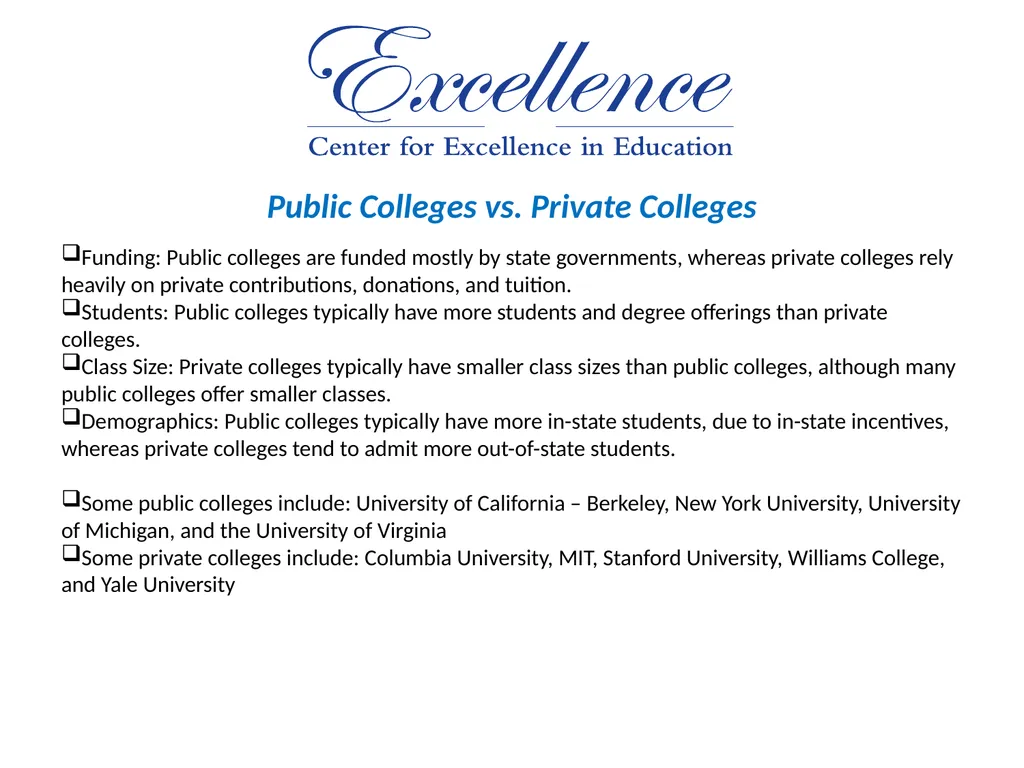
Public Colleges vs. Private Colleges
Funding: Public colleges are funded mostly by state governments, whereas private colleges rely heavily on private contributions, donations, and tuition.
Students: Public colleges typically have more students and degree offerings than private colleges.
Class Size: Private colleges typically have smaller class sizes than public colleges, although many public colleges offer smaller classes.
Demographics: Public colleges typically have more in-state students, due to in-state incentives, whereas private colleges tend to admit more out-of-state students.
Some public colleges include: University of California – Berkeley, New York University, University of Michigan, and the University of Virginia
Some private colleges include: Columbia University, MIT, Stanford University, Williams College, and Yale University<br>
Funding: Public colleges are funded mostly by state governments, whereas private colleges rely heavily on private contributions, donations, and tuition.
Students: Public colleges typically have more students and degree offerings than private colleges.
Class Size: Private colleges typically have smaller class sizes than public colleges, although many public colleges offer smaller classes.
Demographics: Public colleges typically have more in-state students, due to in-state incentives, whereas private colleges tend to admit more out-of-state students.
Some public colleges include: University of California – Berkeley, New York University, University of Michigan, and the University of Virginia
Some private colleges include: Columbia University, MIT, Stanford University, Williams College, and Yale University<br>
10
Land-Grant Schools
A land-grant university (also called land-grant college or land-grant institution) is an institution of higher education in the United States designated by a state to receive the benefits of the Morrill Acts of 1862 and 1890.
The Morrill Acts funded educational institutions by granting federally controlled land to the states for them to sell to raise funds to establish and endow "land-grant" colleges. The mission of these institutions as set forth in the 1862 Act is to focus on the teaching of practical agriculture, science, military science and engineering (though "without excluding ... classical studies"), as a response to the industrial revolution. This mission was in contrast to the historic practice of higher education to focus on an abstract liberal arts curriculum.
Ultimately, most land-grant colleges became large public universities that today offer a full spectrum of educational opportunities.
Some Land-Grant Schools include: Florida A&M University, Michigan State University, Ohio State University, Purdue University, University of California, University of Illinois at Urbana-Champaign, and Virginia Tech<br>
A land-grant university (also called land-grant college or land-grant institution) is an institution of higher education in the United States designated by a state to receive the benefits of the Morrill Acts of 1862 and 1890.
The Morrill Acts funded educational institutions by granting federally controlled land to the states for them to sell to raise funds to establish and endow "land-grant" colleges. The mission of these institutions as set forth in the 1862 Act is to focus on the teaching of practical agriculture, science, military science and engineering (though "without excluding ... classical studies"), as a response to the industrial revolution. This mission was in contrast to the historic practice of higher education to focus on an abstract liberal arts curriculum.
Ultimately, most land-grant colleges became large public universities that today offer a full spectrum of educational opportunities.
Some Land-Grant Schools include: Florida A&M University, Michigan State University, Ohio State University, Purdue University, University of California, University of Illinois at Urbana-Champaign, and Virginia Tech<br>
11
Big Ten Schools
The Big Ten Conference (B1G), formerly Western Conference and Big Nine Conference, is the oldest Division I collegiate athletic conference in the United States. The conference competes in the NCAA's Division I; its football teams compete in the Football Bowl Subdivision (FBS), the highest level of NCAA competition in that sport. The conference includes the flagship public university in each of 11 states stretching from New Jersey to Nebraska, as well as two additional public land grant schools and a private university.
The Western Division includes: Illinois, Iowa, Minnesota, Nebraska, Northwestern, Purdue, and Wisconsin
The Eastern Division includes: Indiana, Maryland, Michigan, Michigan State, Ohio State, Penn State, and Rutgers<br>
The Big Ten Conference (B1G), formerly Western Conference and Big Nine Conference, is the oldest Division I collegiate athletic conference in the United States. The conference competes in the NCAA's Division I; its football teams compete in the Football Bowl Subdivision (FBS), the highest level of NCAA competition in that sport. The conference includes the flagship public university in each of 11 states stretching from New Jersey to Nebraska, as well as two additional public land grant schools and a private university.
The Western Division includes: Illinois, Iowa, Minnesota, Nebraska, Northwestern, Purdue, and Wisconsin
The Eastern Division includes: Indiana, Maryland, Michigan, Michigan State, Ohio State, Penn State, and Rutgers<br>
12
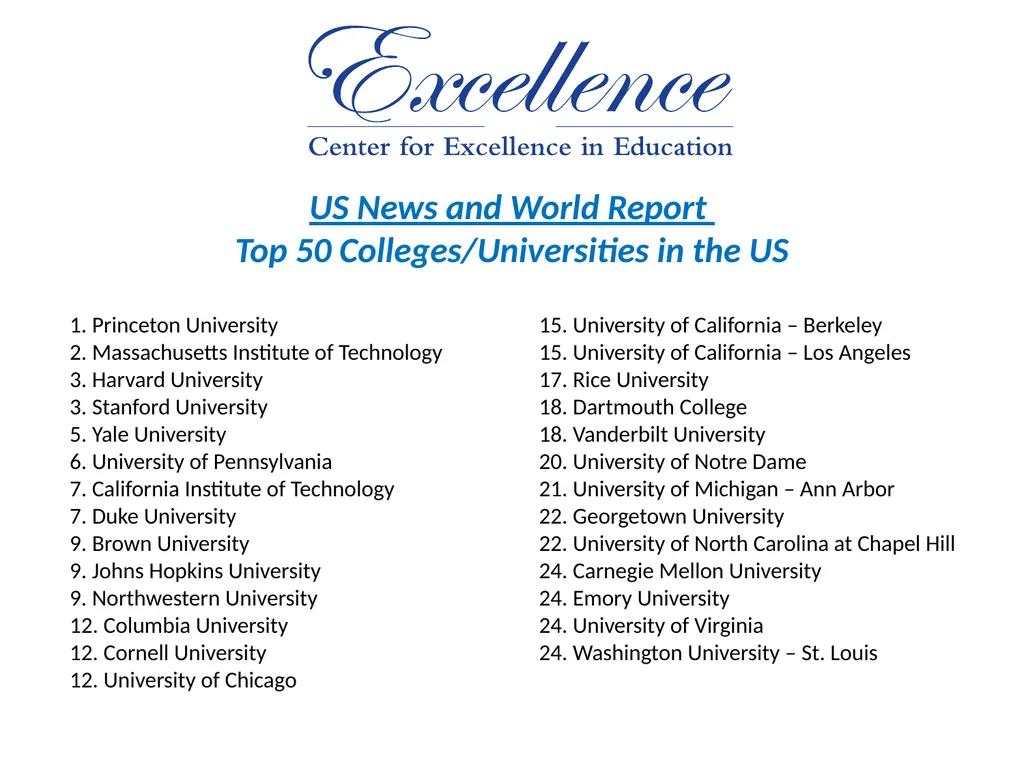
US News and World Report
Top 50 Colleges/Universities in the US 1. Princeton University
2. Massachusetts Institute of Technology
3. Harvard University
3. Stanford University
5. Yale University
6. University of Pennsylvania
7. California Institute of Technology
7. Duke University
9. Brown University
9. Johns Hopkins University
9. Northwestern University
12. Columbia University
12. Cornell University
12. University of Chicago 15. University of California – Berkeley
15. University of California – Los Angeles
17. Rice University
18. Dartmouth College
18. Vanderbilt University
20. University of Notre Dame
21. University of Michigan – Ann Arbor
22. Georgetown University
22. University of North Carolina at Chapel Hill
24. Carnegie Mellon University
24. Emory University
24. University of Virginia
24. Washington University – St. Louis<br>
Top 50 Colleges/Universities in the US 1. Princeton University
2. Massachusetts Institute of Technology
3. Harvard University
3. Stanford University
5. Yale University
6. University of Pennsylvania
7. California Institute of Technology
7. Duke University
9. Brown University
9. Johns Hopkins University
9. Northwestern University
12. Columbia University
12. Cornell University
12. University of Chicago 15. University of California – Berkeley
15. University of California – Los Angeles
17. Rice University
18. Dartmouth College
18. Vanderbilt University
20. University of Notre Dame
21. University of Michigan – Ann Arbor
22. Georgetown University
22. University of North Carolina at Chapel Hill
24. Carnegie Mellon University
24. Emory University
24. University of Virginia
24. Washington University – St. Louis<br>
13
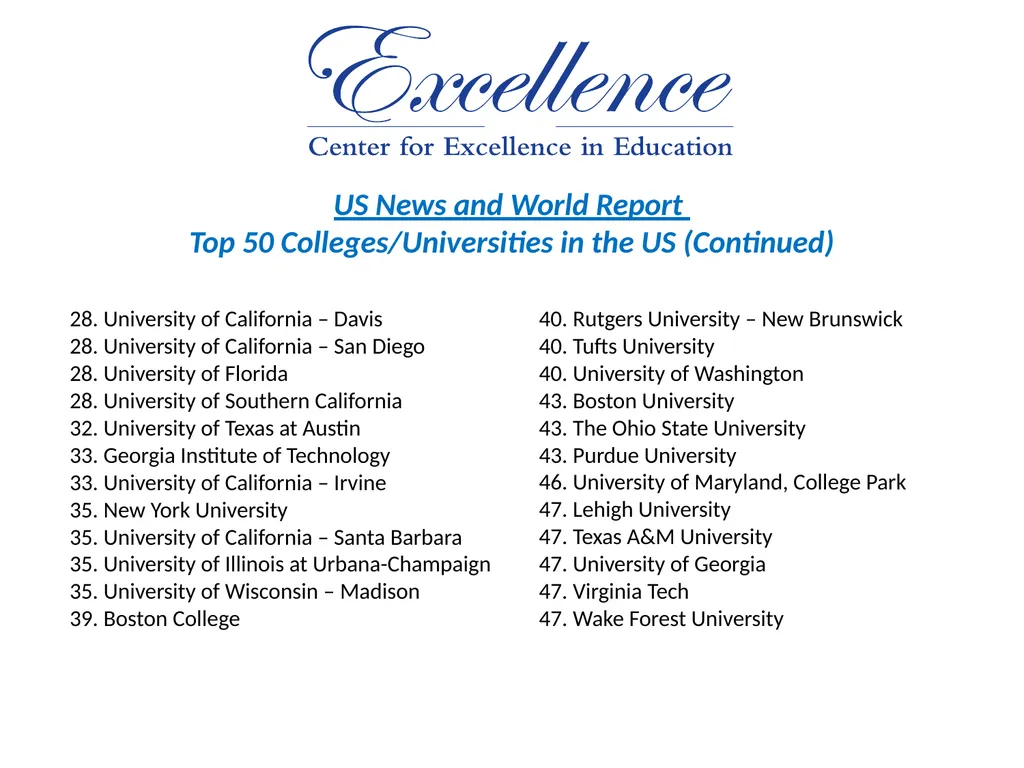
US News and World Report
Top 50 Colleges/Universities in the US (Continued) 28. University of California – Davis
28. University of California – San Diego
28. University of Florida
28. University of Southern California
32. University of Texas at Austin
33. Georgia Institute of Technology
33. University of California – Irvine
35. New York University
35. University of California – Santa Barbara
35. University of Illinois at Urbana-Champaign
35. University of Wisconsin – Madison
39. Boston College 40. Rutgers University – New Brunswick
40. Tufts University
40. University of Washington
43. Boston University
43. The Ohio State University
43. Purdue University
46. University of Maryland, College Park
47. Lehigh University
47. Texas A&M University
47. University of Georgia
47. Virginia Tech
47. Wake Forest University<br>
Top 50 Colleges/Universities in the US (Continued) 28. University of California – Davis
28. University of California – San Diego
28. University of Florida
28. University of Southern California
32. University of Texas at Austin
33. Georgia Institute of Technology
33. University of California – Irvine
35. New York University
35. University of California – Santa Barbara
35. University of Illinois at Urbana-Champaign
35. University of Wisconsin – Madison
39. Boston College 40. Rutgers University – New Brunswick
40. Tufts University
40. University of Washington
43. Boston University
43. The Ohio State University
43. Purdue University
46. University of Maryland, College Park
47. Lehigh University
47. Texas A&M University
47. University of Georgia
47. Virginia Tech
47. Wake Forest University<br>
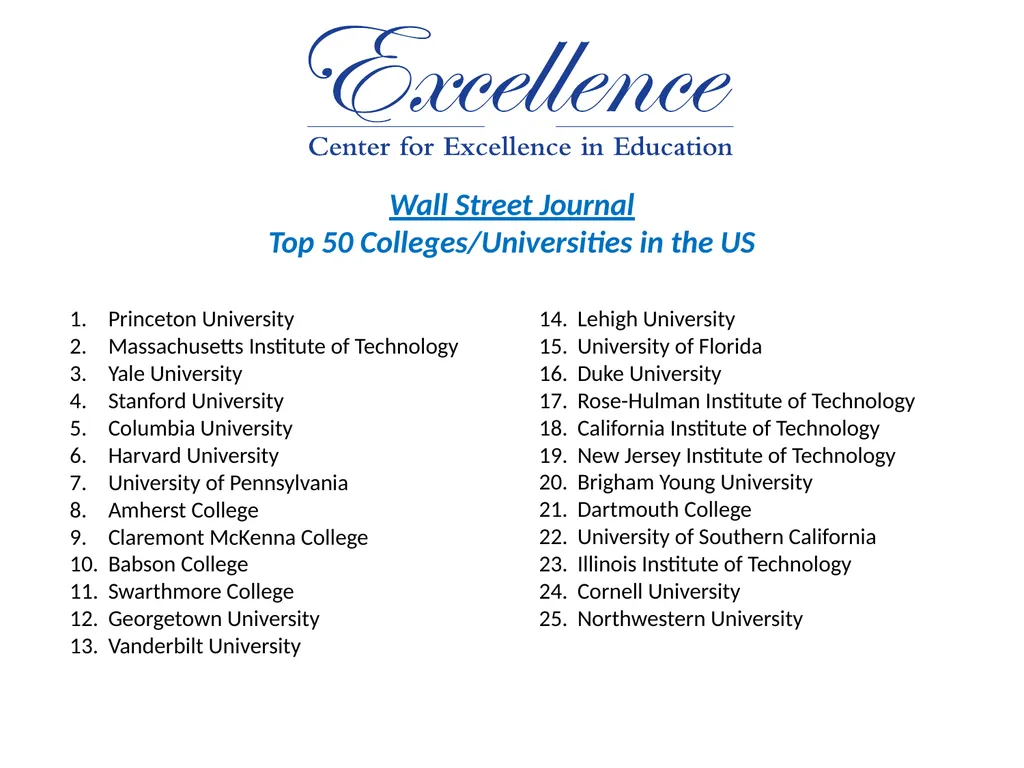
14
Wall Street Journal
Top 50 Colleges/Universities in the US Princeton University
Massachusetts Institute of Technology
Yale University
Stanford University
Columbia University
Harvard University
University of Pennsylvania
Amherst College
Claremont McKenna College
Babson College
Swarthmore College
Georgetown University
Vanderbilt University Lehigh University
University of Florida
Duke University
Rose-Hulman Institute of Technology
California Institute of Technology
New Jersey Institute of Technology
Brigham Young University
Dartmouth College
University of Southern California
Illinois Institute of Technology
Cornell University
Northwestern University<br>
Top 50 Colleges/Universities in the US Princeton University
Massachusetts Institute of Technology
Yale University
Stanford University
Columbia University
Harvard University
University of Pennsylvania
Amherst College
Claremont McKenna College
Babson College
Swarthmore College
Georgetown University
Vanderbilt University Lehigh University
University of Florida
Duke University
Rose-Hulman Institute of Technology
California Institute of Technology
New Jersey Institute of Technology
Brigham Young University
Dartmouth College
University of Southern California
Illinois Institute of Technology
Cornell University
Northwestern University<br>
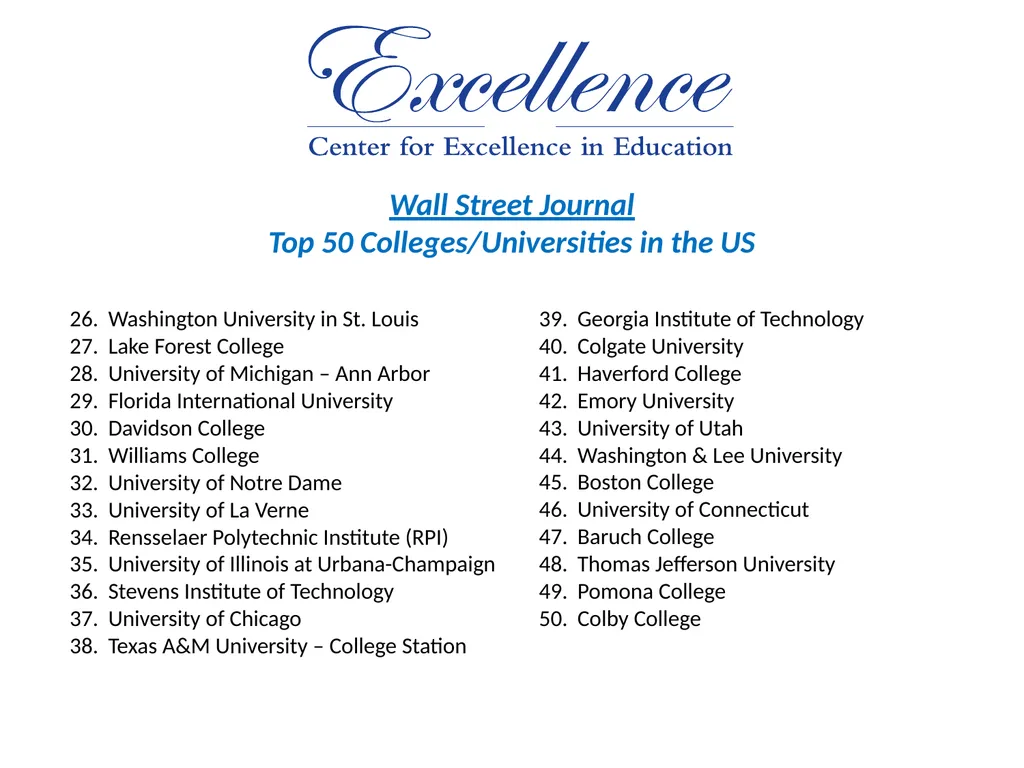
15
Wall Street Journal
Top 50 Colleges/Universities in the US Washington University in St. Louis
Lake Forest College
University of Michigan – Ann Arbor
Florida International University
Davidson College
Williams College
University of Notre Dame
University of La Verne
Rensselaer Polytechnic Institute (RPI)
University of Illinois at Urbana-Champaign
Stevens Institute of Technology
University of Chicago
Texas A&M University – College Station Georgia Institute of Technology
Colgate University
Haverford College
Emory University
University of Utah
Washington & Lee University
Boston College
University of Connecticut
Baruch College
Thomas Jefferson University
Pomona College
Colby College<br>
Top 50 Colleges/Universities in the US Washington University in St. Louis
Lake Forest College
University of Michigan – Ann Arbor
Florida International University
Davidson College
Williams College
University of Notre Dame
University of La Verne
Rensselaer Polytechnic Institute (RPI)
University of Illinois at Urbana-Champaign
Stevens Institute of Technology
University of Chicago
Texas A&M University – College Station Georgia Institute of Technology
Colgate University
Haverford College
Emory University
University of Utah
Washington & Lee University
Boston College
University of Connecticut
Baruch College
Thomas Jefferson University
Pomona College
Colby College<br>
16
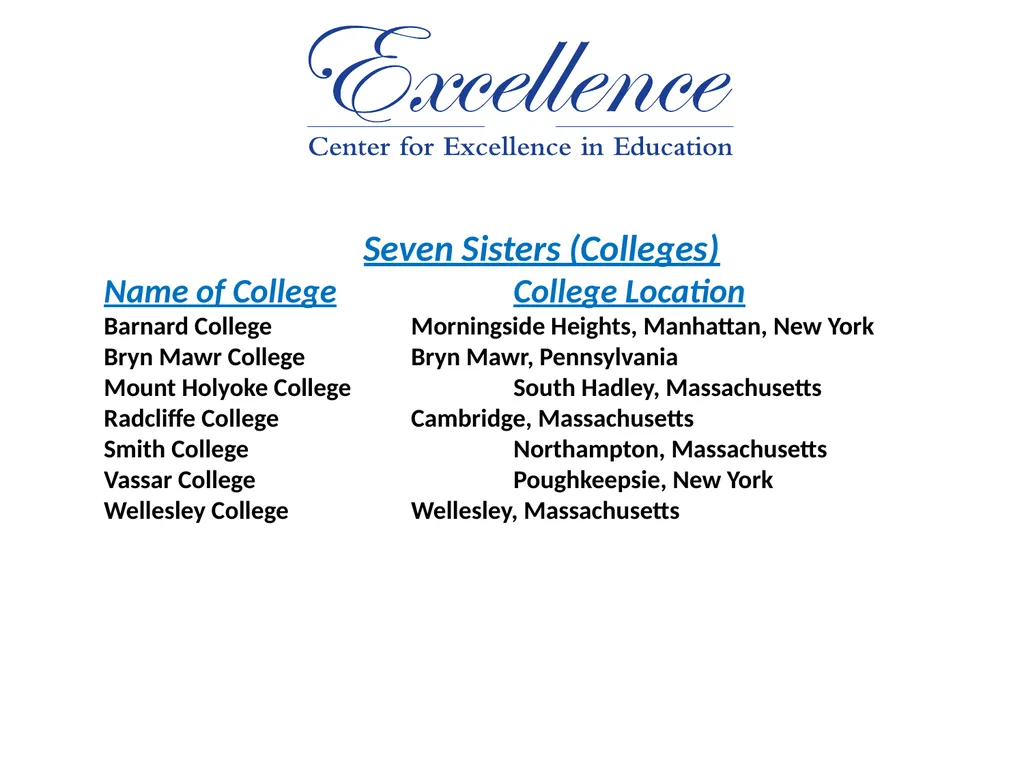
Seven Sisters (Colleges)
Name of College College Location
Barnard College Morningside Heights, Manhattan, New York
Bryn Mawr College Bryn Mawr, Pennsylvania
Mount Holyoke College South Hadley, Massachusetts
Radcliffe College Cambridge, Massachusetts
Smith College Northampton, Massachusetts
Vassar College Poughkeepsie, New York
Wellesley College Wellesley, Massachusetts<br>
Name of College College Location
Barnard College Morningside Heights, Manhattan, New York
Bryn Mawr College Bryn Mawr, Pennsylvania
Mount Holyoke College South Hadley, Massachusetts
Radcliffe College Cambridge, Massachusetts
Smith College Northampton, Massachusetts
Vassar College Poughkeepsie, New York
Wellesley College Wellesley, Massachusetts<br>
17
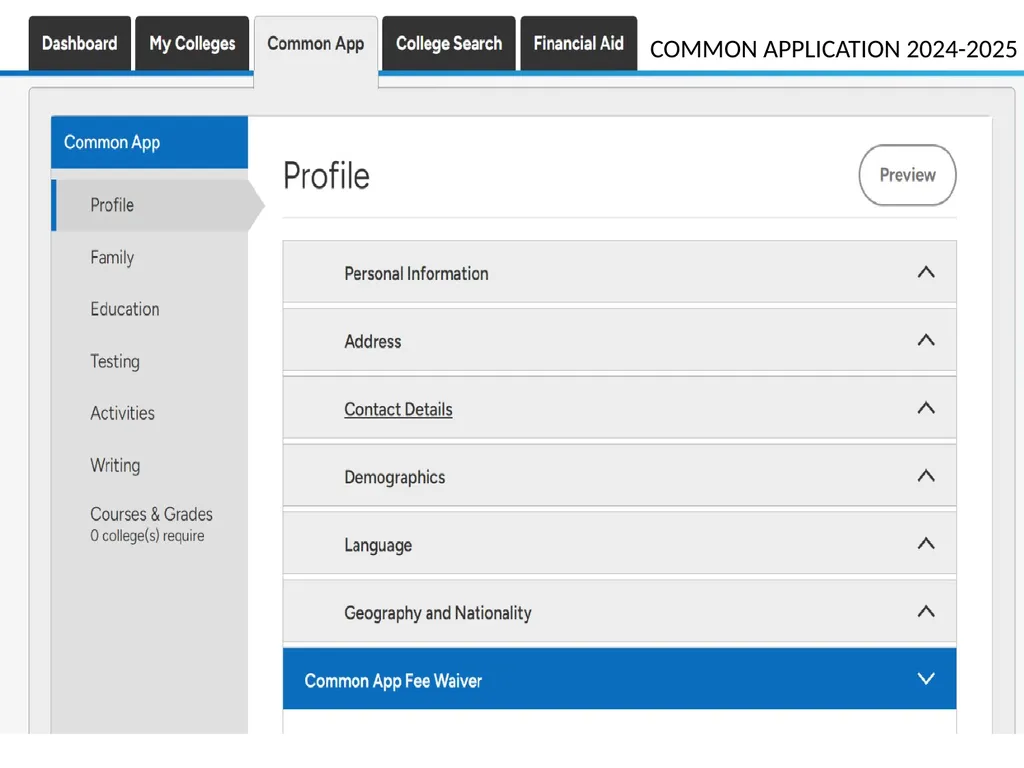
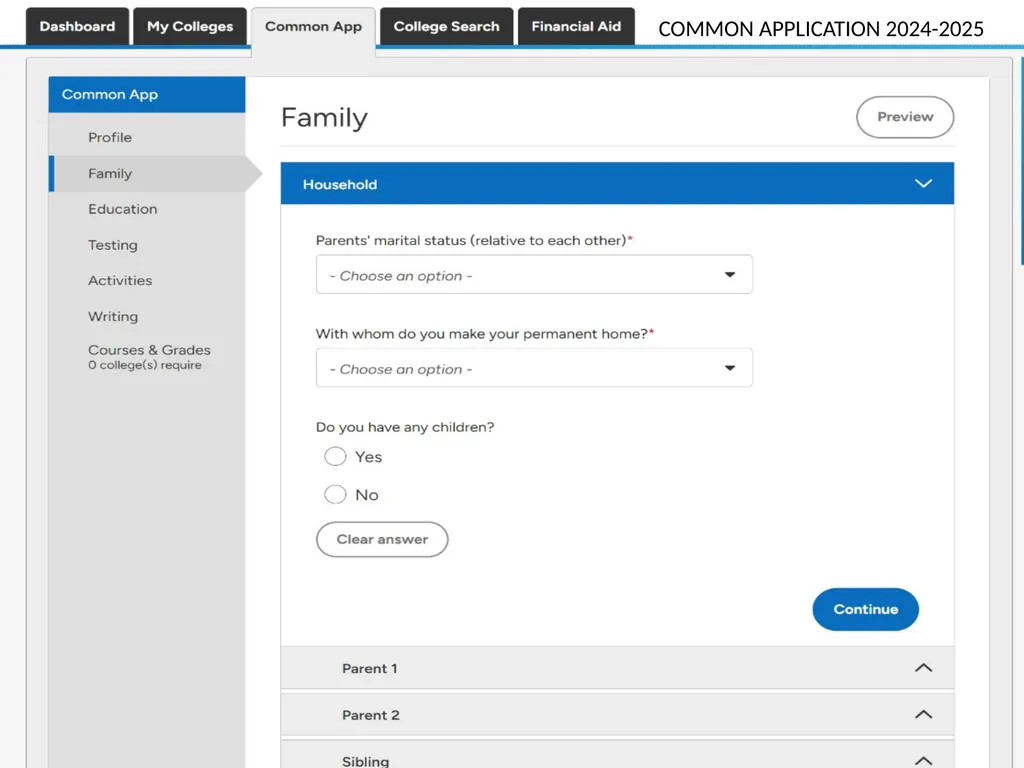
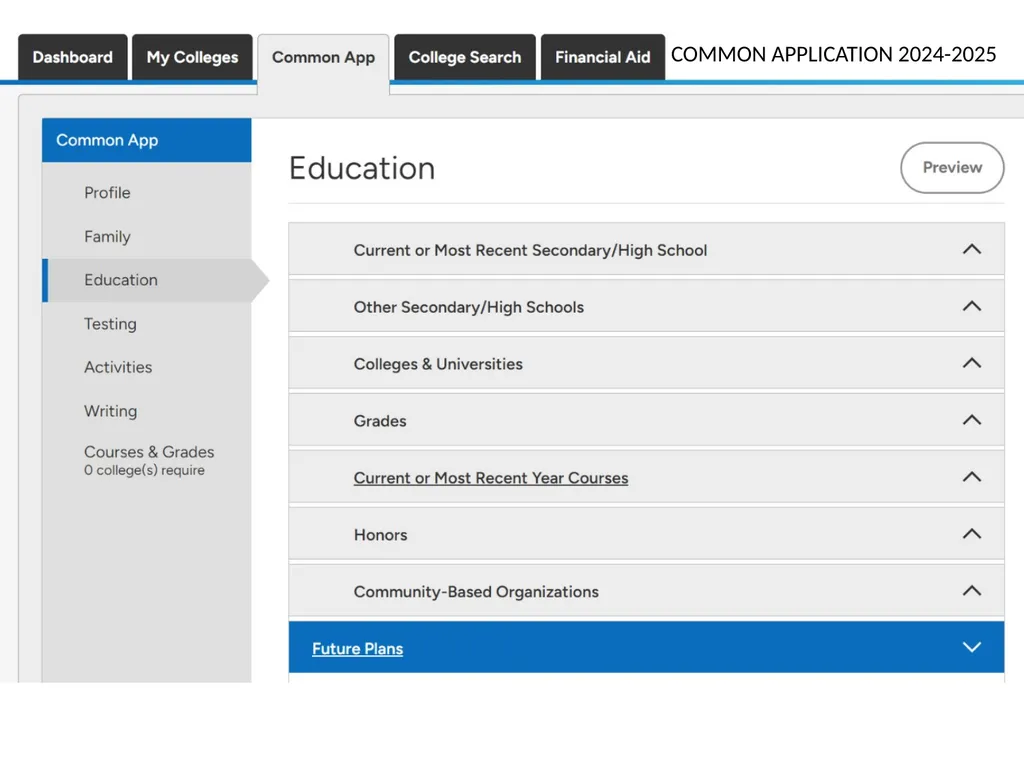
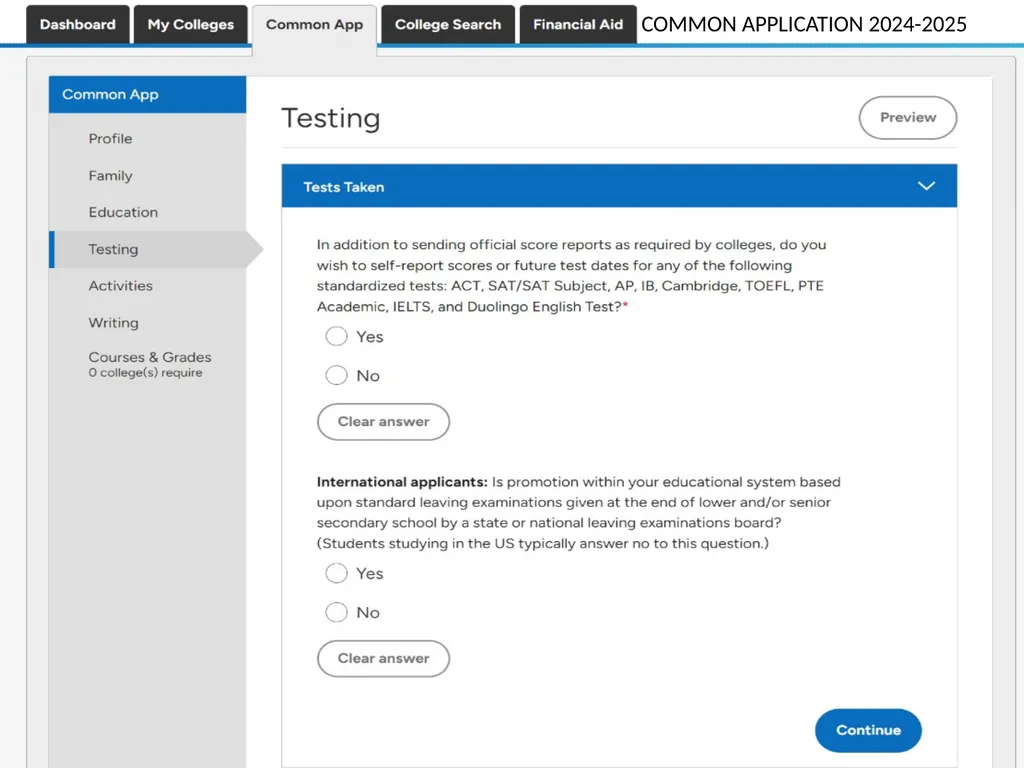
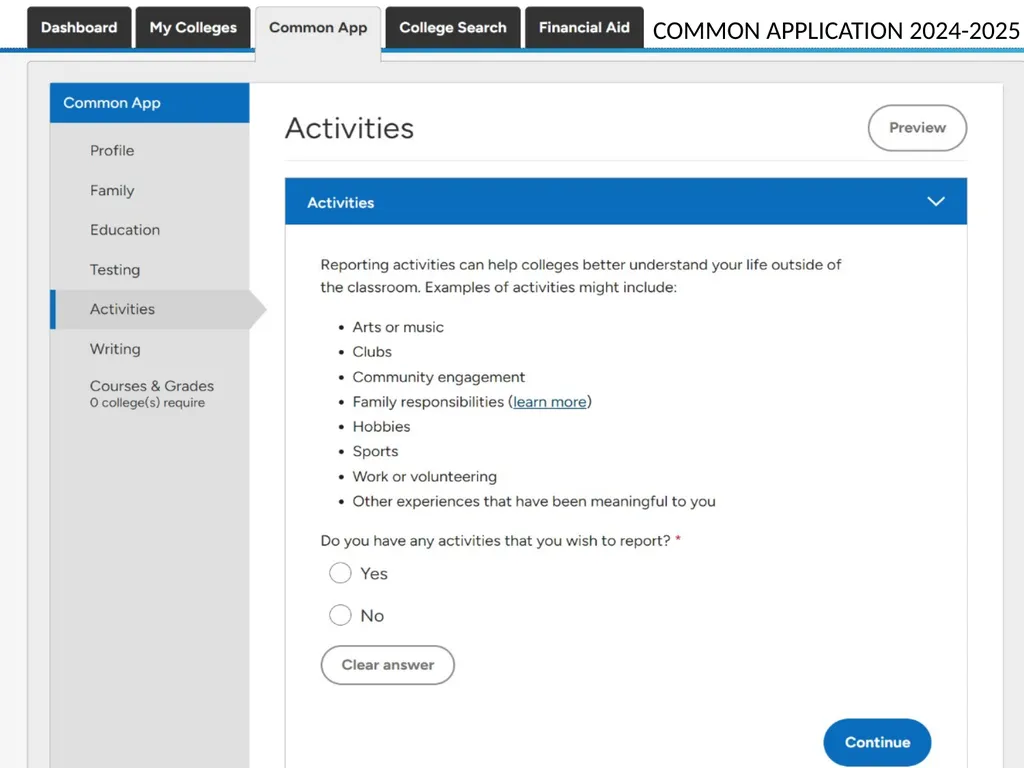
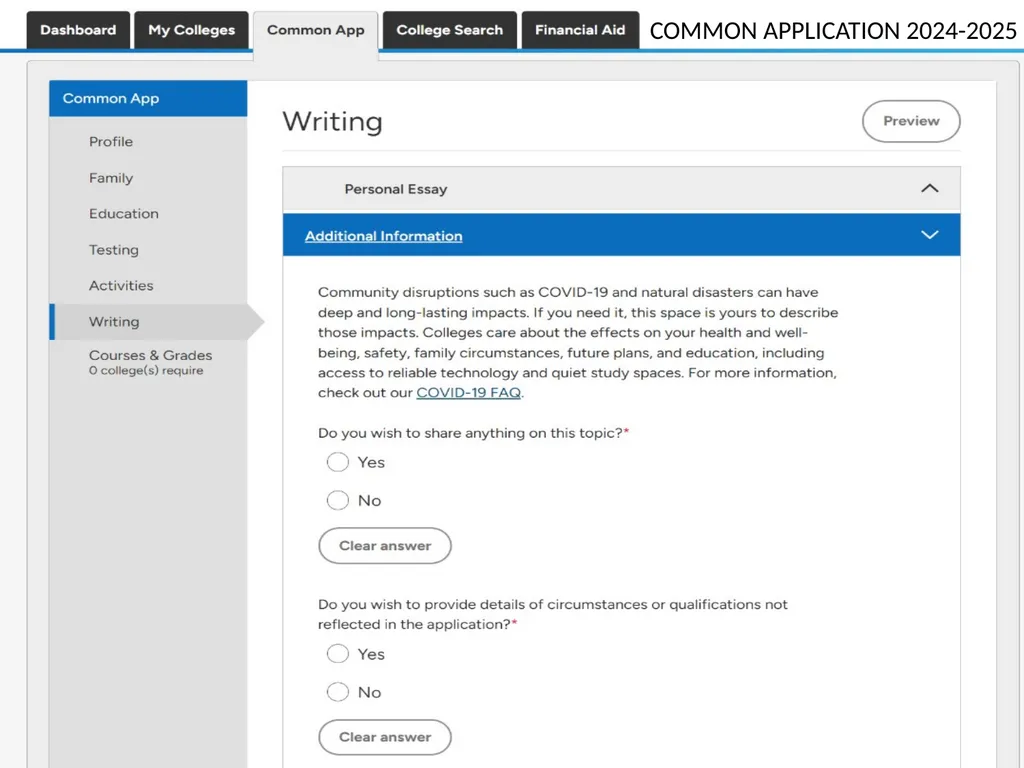
COMMON APPLICATION 2024-2025 COMMON APPLICATION 2024-2025<br>
18
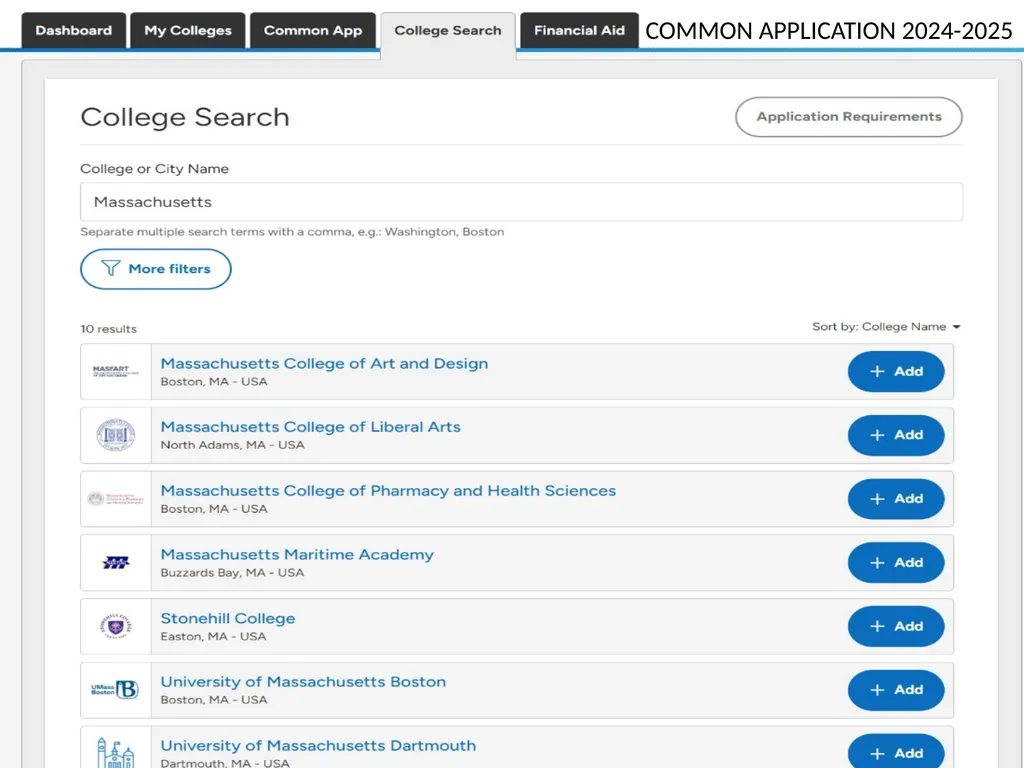
COMMON APPLICATION 2024-2025<br>
19
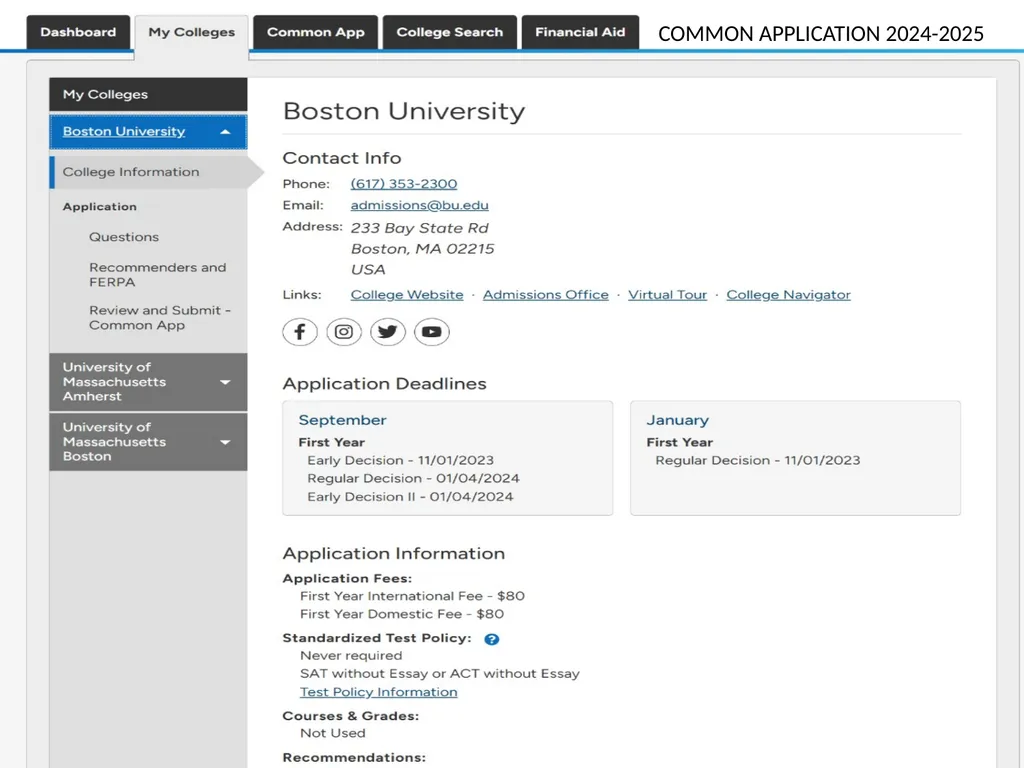
COMMON APPLICATION 2024-2025<br>
20
COMMON APPLICATION 2024-2025<br>
21
COMMON APPLICATION 2024-2025<br>
22
COMMON APPLICATION 2024-2025<br>
23
COMMON APPLICATION 2024-2025<br>
24
COMMON APPLICATION 2024-2025<br>
25
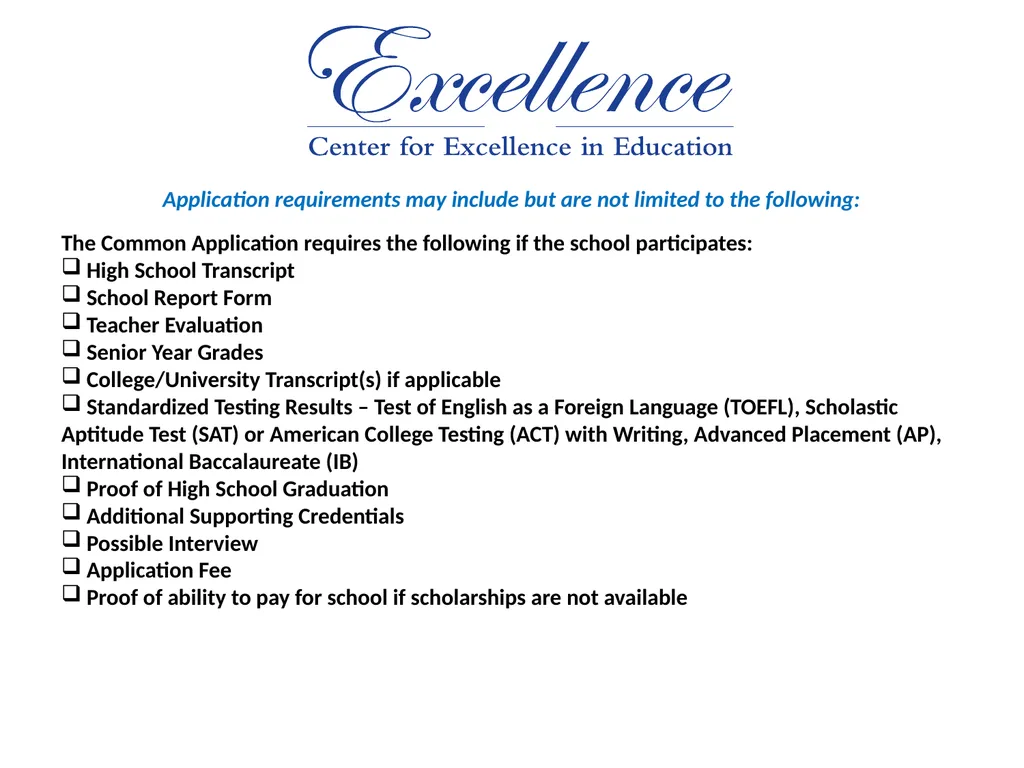
Application requirements may include but are not limited to the following:
The Common Application requires the following if the school participates:
High School Transcript
School Report Form
Teacher Evaluation
Senior Year Grades
College/University Transcript(s) if applicable
Standardized Testing Results – Test of English as a Foreign Language (TOEFL), Scholastic Aptitude Test (SAT) or American College Testing (ACT) with Writing, Advanced Placement (AP), International Baccalaureate (IB)
Proof of High School Graduation
Additional Supporting Credentials
Possible Interview
Application Fee
Proof of ability to pay for school if scholarships are not available<br>
The Common Application requires the following if the school participates:
High School Transcript
School Report Form
Teacher Evaluation
Senior Year Grades
College/University Transcript(s) if applicable
Standardized Testing Results – Test of English as a Foreign Language (TOEFL), Scholastic Aptitude Test (SAT) or American College Testing (ACT) with Writing, Advanced Placement (AP), International Baccalaureate (IB)
Proof of High School Graduation
Additional Supporting Credentials
Possible Interview
Application Fee
Proof of ability to pay for school if scholarships are not available<br>
26
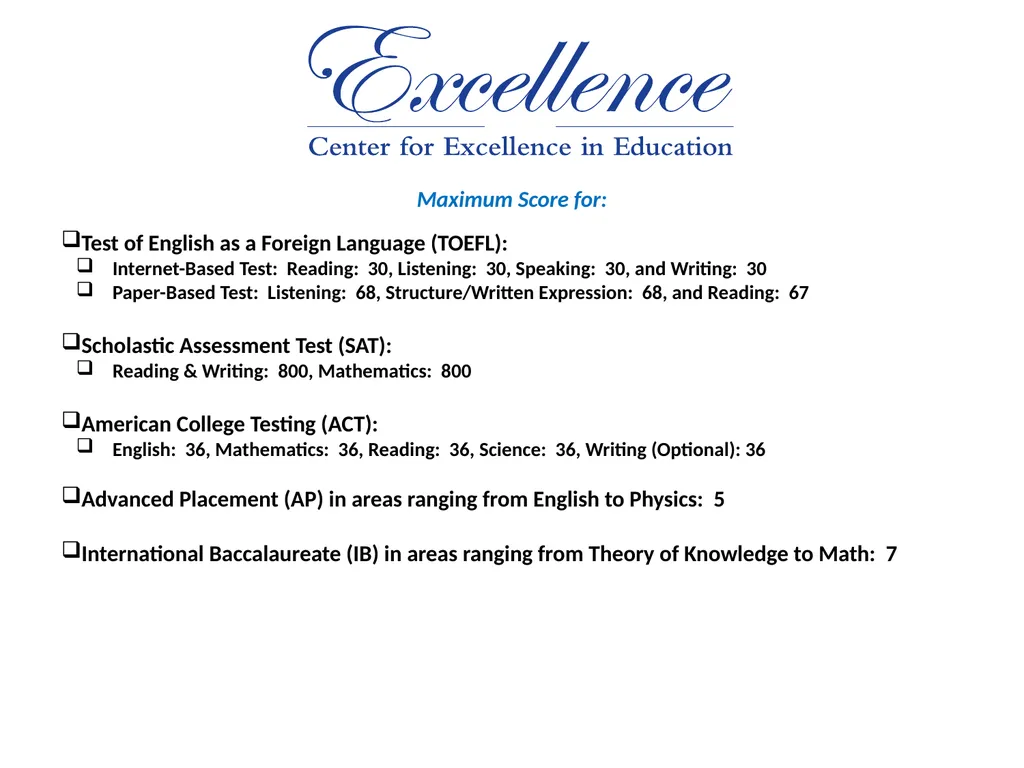
Maximum Score for:
Test of English as a Foreign Language (TOEFL):
Internet-Based Test: Reading: 30, Listening: 30, Speaking: 30, and Writing: 30
Paper-Based Test: Listening: 68, Structure/Written Expression: 68, and Reading: 67
Scholastic Assessment Test (SAT):
Reading & Writing: 800, Mathematics: 800
American College Testing (ACT):
English: 36, Mathematics: 36, Reading: 36, Science: 36, Writing (Optional): 36
Advanced Placement (AP) in areas ranging from English to Physics: 5
International Baccalaureate (IB) in areas ranging from Theory of Knowledge to Math: 7<br>
Test of English as a Foreign Language (TOEFL):
Internet-Based Test: Reading: 30, Listening: 30, Speaking: 30, and Writing: 30
Paper-Based Test: Listening: 68, Structure/Written Expression: 68, and Reading: 67
Scholastic Assessment Test (SAT):
Reading & Writing: 800, Mathematics: 800
American College Testing (ACT):
English: 36, Mathematics: 36, Reading: 36, Science: 36, Writing (Optional): 36
Advanced Placement (AP) in areas ranging from English to Physics: 5
International Baccalaureate (IB) in areas ranging from Theory of Knowledge to Math: 7<br>
27
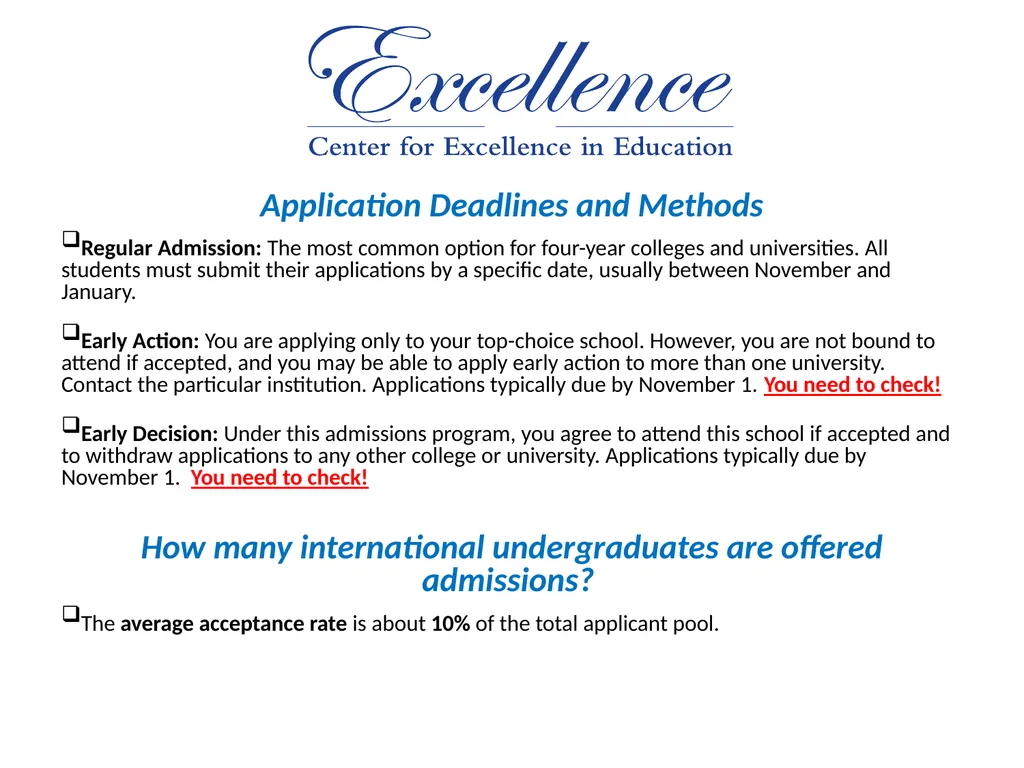
Application Deadlines and Methods
Regular Admission: The most common option for four-year colleges and universities. All students must submit their applications by a specific date, usually between November and January.
Early Action: You are applying only to your top-choice school. However, you are not bound to attend if accepted, and you may be able to apply early action to more than one university. Contact the particular institution. Applications typically due by November 1. You need to check!
Early Decision: Under this admissions program, you agree to attend this school if accepted and to withdraw applications to any other college or university. Applications typically due by November 1. You need to check!
How many international undergraduates are offered admissions?
The average acceptance rate is about 10% of the total applicant pool.<br>
Regular Admission: The most common option for four-year colleges and universities. All students must submit their applications by a specific date, usually between November and January.
Early Action: You are applying only to your top-choice school. However, you are not bound to attend if accepted, and you may be able to apply early action to more than one university. Contact the particular institution. Applications typically due by November 1. You need to check!
Early Decision: Under this admissions program, you agree to attend this school if accepted and to withdraw applications to any other college or university. Applications typically due by November 1. You need to check!
How many international undergraduates are offered admissions?
The average acceptance rate is about 10% of the total applicant pool.<br>
28
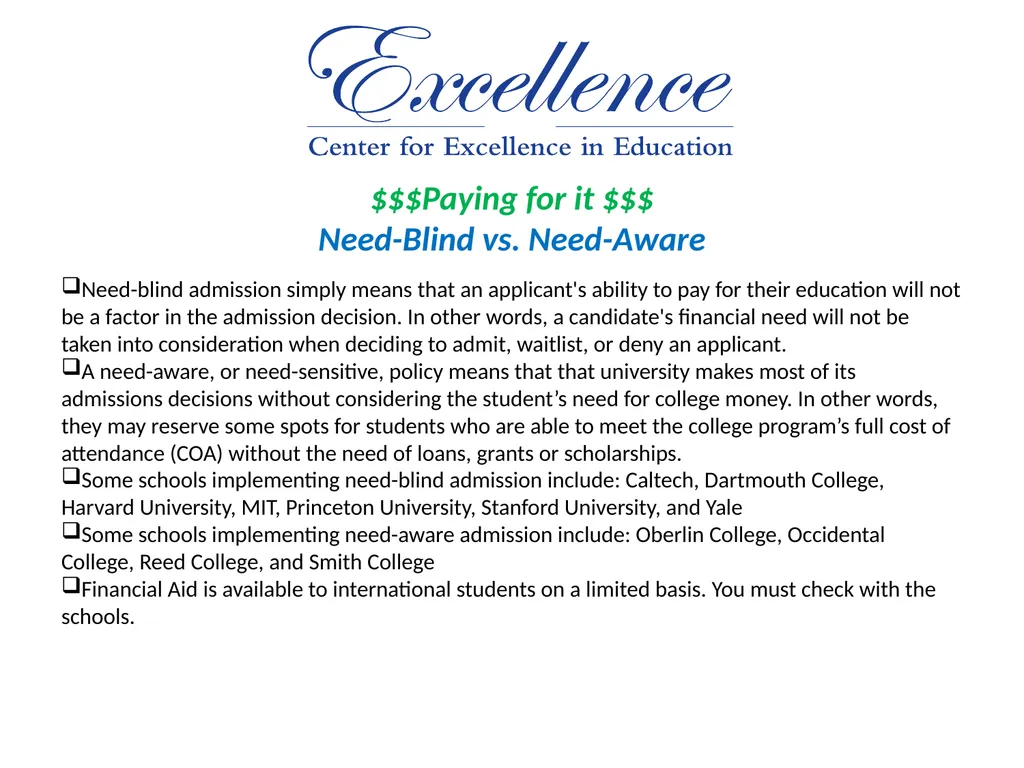
$$$Paying for it $$$
Need-Blind vs. Need-Aware
Need-blind admission simply means that an applicant's ability to pay for their education will not be a factor in the admission decision. In other words, a candidate's financial need will not be taken into consideration when deciding to admit, waitlist, or deny an applicant.
A need-aware, or need-sensitive, policy means that that university makes most of its admissions decisions without considering the student’s need for college money. In other words, they may reserve some spots for students who are able to meet the college program’s full cost of attendance (COA) without the need of loans, grants or scholarships.
Some schools implementing need-blind admission include: Caltech, Dartmouth College, Harvard University, MIT, Princeton University, Stanford University, and Yale
Some schools implementing need-aware admission include: Oberlin College, Occidental College, Reed College, and Smith College
Financial Aid is available to international students on a limited basis. You must check with the schools.<br>
Need-Blind vs. Need-Aware
Need-blind admission simply means that an applicant's ability to pay for their education will not be a factor in the admission decision. In other words, a candidate's financial need will not be taken into consideration when deciding to admit, waitlist, or deny an applicant.
A need-aware, or need-sensitive, policy means that that university makes most of its admissions decisions without considering the student’s need for college money. In other words, they may reserve some spots for students who are able to meet the college program’s full cost of attendance (COA) without the need of loans, grants or scholarships.
Some schools implementing need-blind admission include: Caltech, Dartmouth College, Harvard University, MIT, Princeton University, Stanford University, and Yale
Some schools implementing need-aware admission include: Oberlin College, Occidental College, Reed College, and Smith College
Financial Aid is available to international students on a limited basis. You must check with the schools.<br>
29
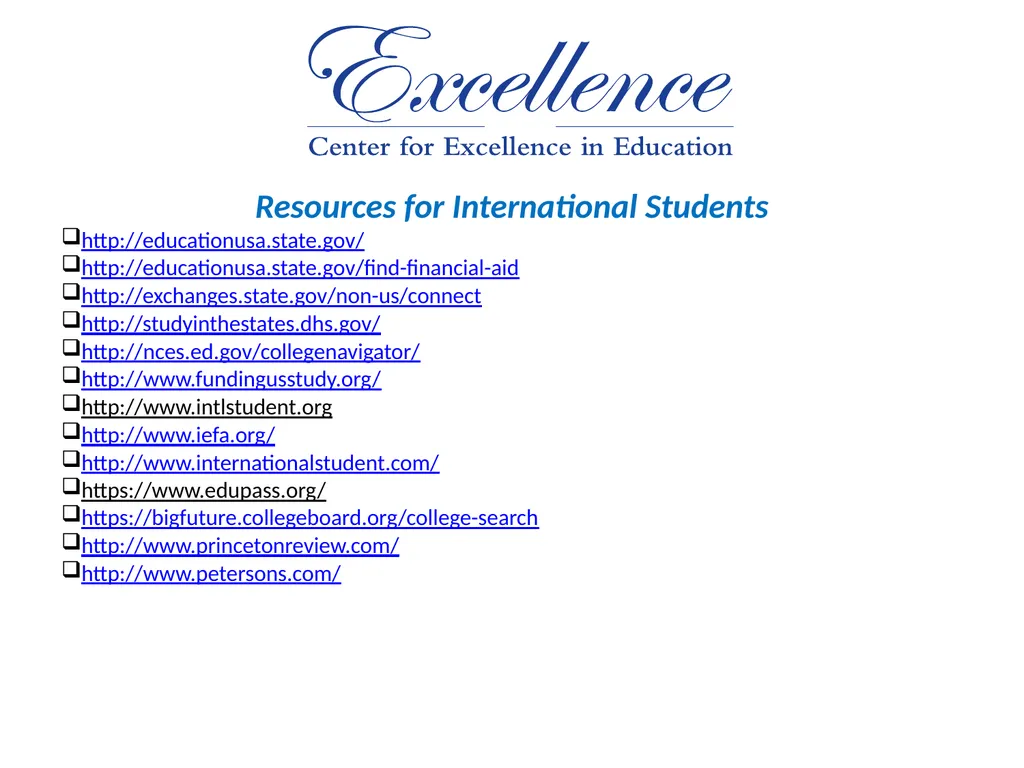
Resources for International Students
http://educationusa.state.gov/
http://educationusa.state.gov/find-financial-aid
http://exchanges.state.gov/non-us/connect
http://studyinthestates.dhs.gov/
http://nces.ed.gov/collegenavigator/
http://www.fundingusstudy.org/
http://www.intlstudent.org
http://www.iefa.org/
http://www.internationalstudent.com/
https://www.edupass.org/
https://bigfuture.collegeboard.org/college-search
http://www.princetonreview.com/
http://www.petersons.com/<br>
http://educationusa.state.gov/
http://educationusa.state.gov/find-financial-aid
http://exchanges.state.gov/non-us/connect
http://studyinthestates.dhs.gov/
http://nces.ed.gov/collegenavigator/
http://www.fundingusstudy.org/
http://www.intlstudent.org
http://www.iefa.org/
http://www.internationalstudent.com/
https://www.edupass.org/
https://bigfuture.collegeboard.org/college-search
http://www.princetonreview.com/
http://www.petersons.com/<br>
30
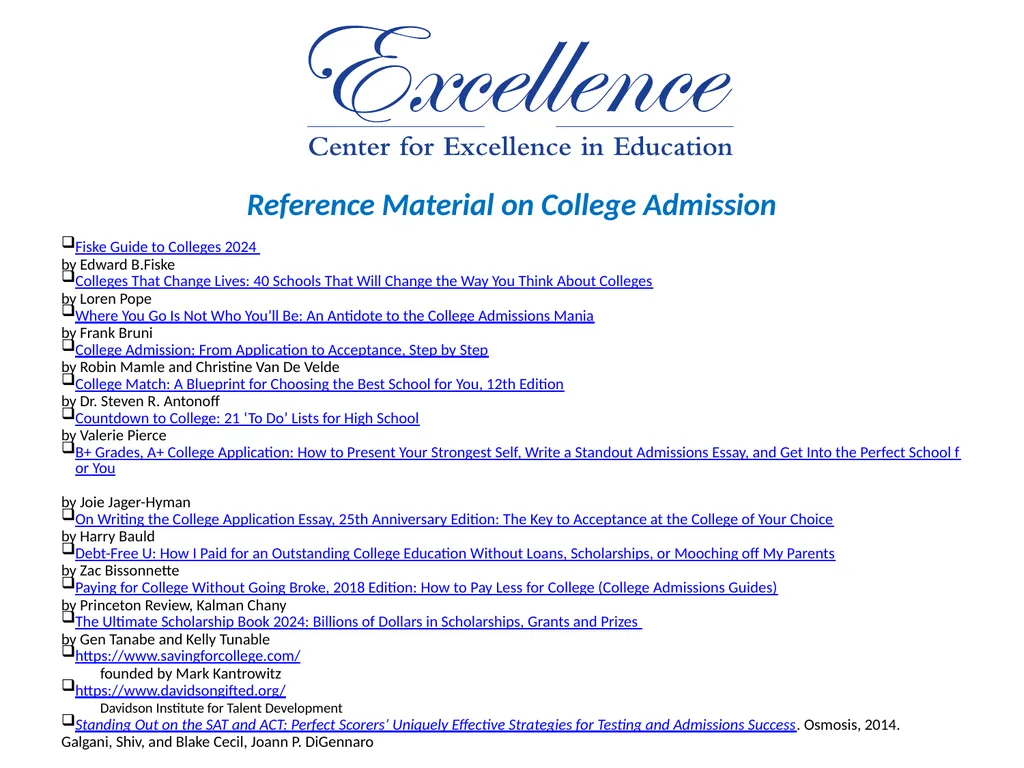
Reference Material on College Admission
Fiske Guide to Colleges 2024 by Edward B.Fiske
Colleges That Change Lives: 40 Schools That Will Change the Way You Think About Colleges by Loren Pope
Where You Go Is Not Who You’ll Be: An Antidote to the College Admissions Mania by Frank Bruni
College Admission: From Application to Acceptance, Step by Step by Robin Mamle and Christine Van De Velde
College Match: A Blueprint for Choosing the Best School for You, 12th Edition by Dr. Steven R. Antonoff
Countdown to College: 21 ‘To Do’ Lists for High School by Valerie Pierce
B+ Grades, A+ College Application: How to Present Your Strongest Self, Write a Standout Admissions Essay, and Get Into the Perfect School for You by Joie Jager-Hyman
On Writing the College Application Essay, 25th Anniversary Edition: The Key to Acceptance at the College of Your Choice by Harry Bauld
Debt-Free U: How I Paid for an Outstanding College Education Without Loans, Scholarships, or Mooching off My Parents by Zac Bissonnette
Paying for College Without Going Broke, 2018 Edition: How to Pay Less for College (College Admissions Guides) by Princeton Review, Kalman Chany
The Ultimate Scholarship Book 2024: Billions of Dollars in Scholarships, Grants and Prizes by Gen Tanabe and Kelly Tunable
https://www.savingforcollege.com/
founded by Mark Kantrowitz
https://www.davidsongifted.org/
Davidson Institute for Talent Development
Standing Out on the SAT and ACT: Perfect Scorers’ Uniquely Effective Strategies for Testing and Admissions Success. Osmosis, 2014. Galgani, Shiv, and Blake Cecil, Joann P. DiGennaro<br>
Fiske Guide to Colleges 2024 by Edward B.Fiske
Colleges That Change Lives: 40 Schools That Will Change the Way You Think About Colleges by Loren Pope
Where You Go Is Not Who You’ll Be: An Antidote to the College Admissions Mania by Frank Bruni
College Admission: From Application to Acceptance, Step by Step by Robin Mamle and Christine Van De Velde
College Match: A Blueprint for Choosing the Best School for You, 12th Edition by Dr. Steven R. Antonoff
Countdown to College: 21 ‘To Do’ Lists for High School by Valerie Pierce
B+ Grades, A+ College Application: How to Present Your Strongest Self, Write a Standout Admissions Essay, and Get Into the Perfect School for You by Joie Jager-Hyman
On Writing the College Application Essay, 25th Anniversary Edition: The Key to Acceptance at the College of Your Choice by Harry Bauld
Debt-Free U: How I Paid for an Outstanding College Education Without Loans, Scholarships, or Mooching off My Parents by Zac Bissonnette
Paying for College Without Going Broke, 2018 Edition: How to Pay Less for College (College Admissions Guides) by Princeton Review, Kalman Chany
The Ultimate Scholarship Book 2024: Billions of Dollars in Scholarships, Grants and Prizes by Gen Tanabe and Kelly Tunable
https://www.savingforcollege.com/
founded by Mark Kantrowitz
https://www.davidsongifted.org/
Davidson Institute for Talent Development
Standing Out on the SAT and ACT: Perfect Scorers’ Uniquely Effective Strategies for Testing and Admissions Success. Osmosis, 2014. Galgani, Shiv, and Blake Cecil, Joann P. DiGennaro<br>
31
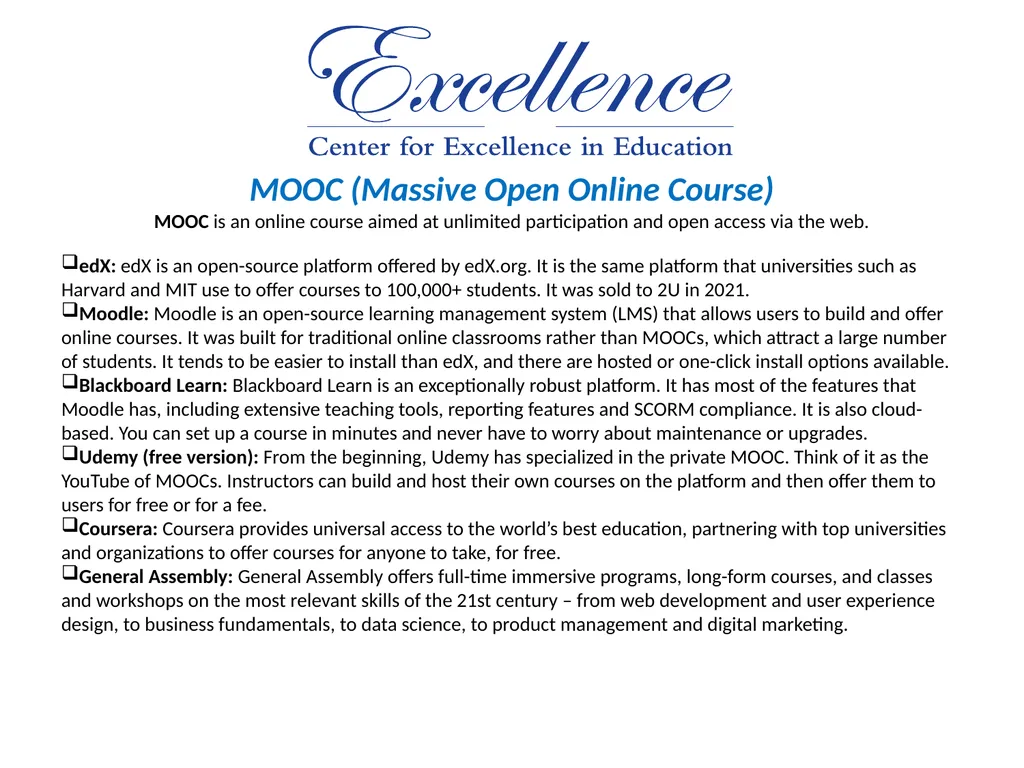
MOOC (Massive Open Online Course)
MOOC is an online course aimed at unlimited participation and open access via the web.
edX: edX is an open-source platform offered by edX.org. It is the same platform that universities such as Harvard and MIT use to offer courses to 100,000+ students. It was sold to 2U in 2021.
Moodle: Moodle is an open-source learning management system (LMS) that allows users to build and offer online courses. It was built for traditional online classrooms rather than MOOCs, which attract a large number of students. It tends to be easier to install than edX, and there are hosted or one-click install options available.
Blackboard Learn: Blackboard Learn is an exceptionally robust platform. It has most of the features that Moodle has, including extensive teaching tools, reporting features and SCORM compliance. It is also cloud-based. You can set up a course in minutes and never have to worry about maintenance or upgrades.
Udemy (free version): From the beginning, Udemy has specialized in the private MOOC. Think of it as the YouTube of MOOCs. Instructors can build and host their own courses on the platform and then offer them to users for free or for a fee.
Coursera: Coursera provides universal access to the world’s best education, partnering with top universities and organizations to offer courses for anyone to take, for free.
General Assembly: General Assembly offers full-time immersive programs, long-form courses, and classes and workshops on the most relevant skills of the 21st century – from web development and user experience design, to business fundamentals, to data science, to product management and digital marketing.<br>
MOOC is an online course aimed at unlimited participation and open access via the web.
edX: edX is an open-source platform offered by edX.org. It is the same platform that universities such as Harvard and MIT use to offer courses to 100,000+ students. It was sold to 2U in 2021.
Moodle: Moodle is an open-source learning management system (LMS) that allows users to build and offer online courses. It was built for traditional online classrooms rather than MOOCs, which attract a large number of students. It tends to be easier to install than edX, and there are hosted or one-click install options available.
Blackboard Learn: Blackboard Learn is an exceptionally robust platform. It has most of the features that Moodle has, including extensive teaching tools, reporting features and SCORM compliance. It is also cloud-based. You can set up a course in minutes and never have to worry about maintenance or upgrades.
Udemy (free version): From the beginning, Udemy has specialized in the private MOOC. Think of it as the YouTube of MOOCs. Instructors can build and host their own courses on the platform and then offer them to users for free or for a fee.
Coursera: Coursera provides universal access to the world’s best education, partnering with top universities and organizations to offer courses for anyone to take, for free.
General Assembly: General Assembly offers full-time immersive programs, long-form courses, and classes and workshops on the most relevant skills of the 21st century – from web development and user experience design, to business fundamentals, to data science, to product management and digital marketing.<br>
32
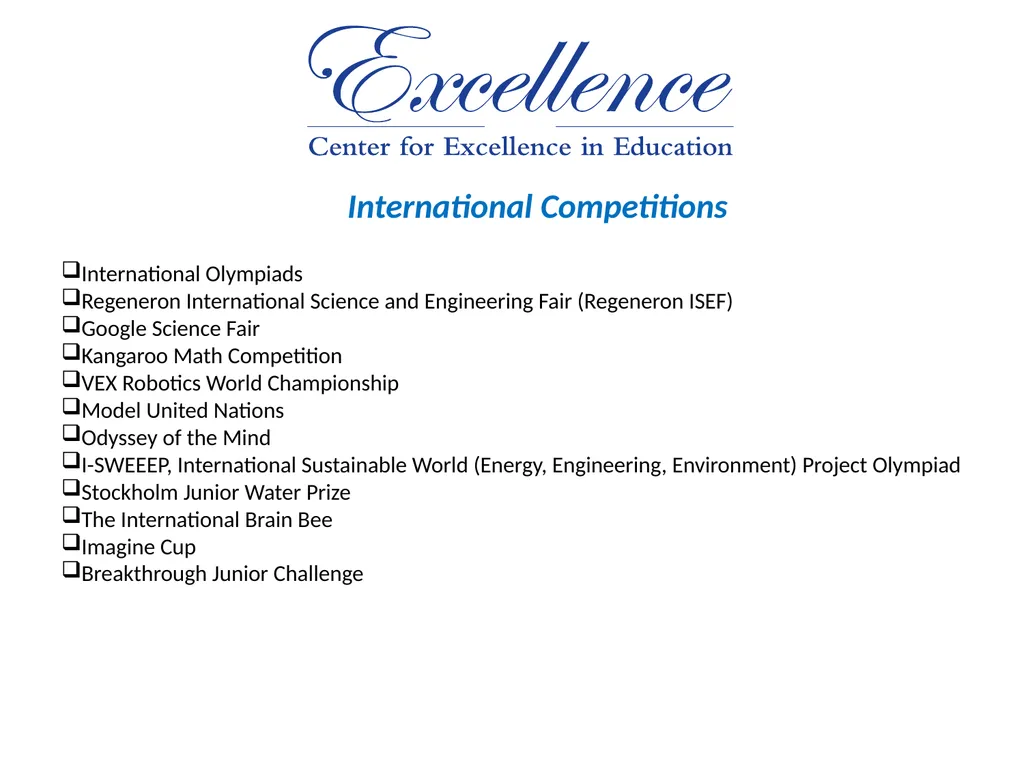
International Competitions
International Olympiads
Regeneron International Science and Engineering Fair (Regeneron ISEF)
Google Science Fair
Kangaroo Math Competition
VEX Robotics World Championship
Model United Nations
Odyssey of the Mind
I-SWEEEP, International Sustainable World (Energy, Engineering, Environment) Project Olympiad
Stockholm Junior Water Prize
The International Brain Bee
Imagine Cup
Breakthrough Junior Challenge<br>
International Olympiads
Regeneron International Science and Engineering Fair (Regeneron ISEF)
Google Science Fair
Kangaroo Math Competition
VEX Robotics World Championship
Model United Nations
Odyssey of the Mind
I-SWEEEP, International Sustainable World (Energy, Engineering, Environment) Project Olympiad
Stockholm Junior Water Prize
The International Brain Bee
Imagine Cup
Breakthrough Junior Challenge<br>
33
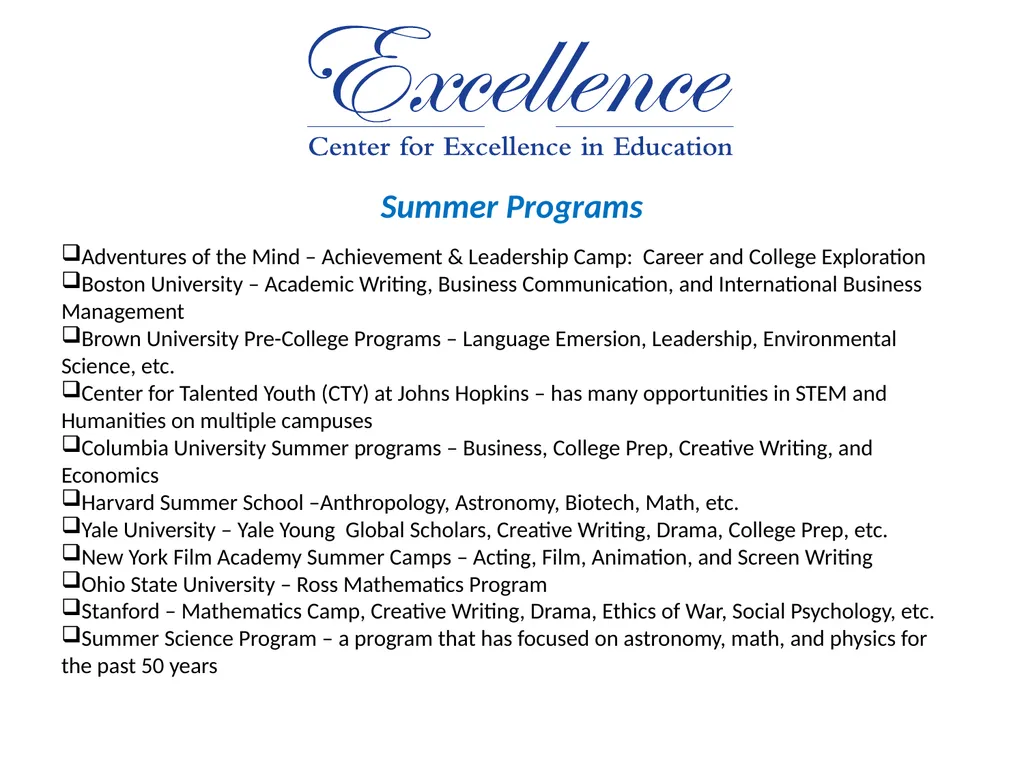
Summer Programs
Adventures of the Mind – Achievement & Leadership Camp: Career and College Exploration
Boston University – Academic Writing, Business Communication, and International Business Management
Brown University Pre-College Programs – Language Emersion, Leadership, Environmental Science, etc.
Center for Talented Youth (CTY) at Johns Hopkins – has many opportunities in STEM and Humanities on multiple campuses
Columbia University Summer programs – Business, College Prep, Creative Writing, and Economics
Harvard Summer School –Anthropology, Astronomy, Biotech, Math, etc.
Yale University – Yale Young Global Scholars, Creative Writing, Drama, College Prep, etc.
New York Film Academy Summer Camps – Acting, Film, Animation, and Screen Writing
Ohio State University – Ross Mathematics Program
Stanford – Mathematics Camp, Creative Writing, Drama, Ethics of War, Social Psychology, etc.
Summer Science Program – a program that has focused on astronomy, math, and physics for the past 50 years<br>
Adventures of the Mind – Achievement & Leadership Camp: Career and College Exploration
Boston University – Academic Writing, Business Communication, and International Business Management
Brown University Pre-College Programs – Language Emersion, Leadership, Environmental Science, etc.
Center for Talented Youth (CTY) at Johns Hopkins – has many opportunities in STEM and Humanities on multiple campuses
Columbia University Summer programs – Business, College Prep, Creative Writing, and Economics
Harvard Summer School –Anthropology, Astronomy, Biotech, Math, etc.
Yale University – Yale Young Global Scholars, Creative Writing, Drama, College Prep, etc.
New York Film Academy Summer Camps – Acting, Film, Animation, and Screen Writing
Ohio State University – Ross Mathematics Program
Stanford – Mathematics Camp, Creative Writing, Drama, Ethics of War, Social Psychology, etc.
Summer Science Program – a program that has focused on astronomy, math, and physics for the past 50 years<br>
34
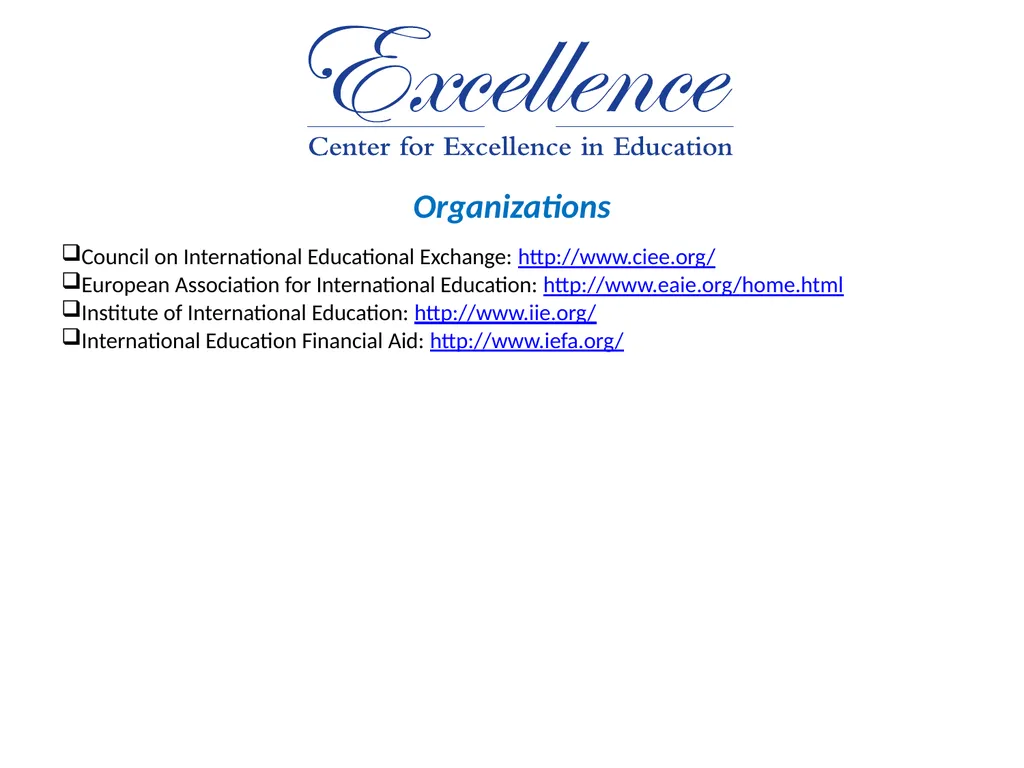
Organizations
Council on International Educational Exchange: http://www.ciee.org/
European Association for International Education: http://www.eaie.org/home.html
Institute of International Education: http://www.iie.org/
International Education Financial Aid: http://www.iefa.org/<br>
Council on International Educational Exchange: http://www.ciee.org/
European Association for International Education: http://www.eaie.org/home.html
Institute of International Education: http://www.iie.org/
International Education Financial Aid: http://www.iefa.org/<br>