
UNIT-02 (EXTENSION EDUCATION AND DEVELOPMENT) Dr.

Description: UNIT-02 (EXTENSION EDUCATION AND DEVELOPMENT) Dr. Puspendra Kumar Singh Department of Veterinary Animal Husbandry Extension Education, BVC Extension Education and Development 3rd Year, VAHEE Topics covered Pre Independent rural
Related Topics
Download Presentation
"UNIT-02 (EXTENSION EDUCATION AND DEVELOPMENT) Dr." is the property of its rightful owner. Permission is granted to download and print the materials on this website for personal, non-commercial use only, and to display it on your personal computer provided you do not modify the materials and that you retain all copyright notices contained in the materials. By downloading content from our website, you accept the terms of this agreement.
Presentation Transcript
slide1. UNIT-02 (EXTENSION EDUCATION AND DEVELOPMENT)
Dr. Puspendra Kumar Singh
Department of Veterinary & Animal Husbandry Extension Education, BVC<br>
slide2. Extension Education and Development 3rd Year, VAHEE<br>
slide3. Topics covered Pre Independent rural development programmes<br>
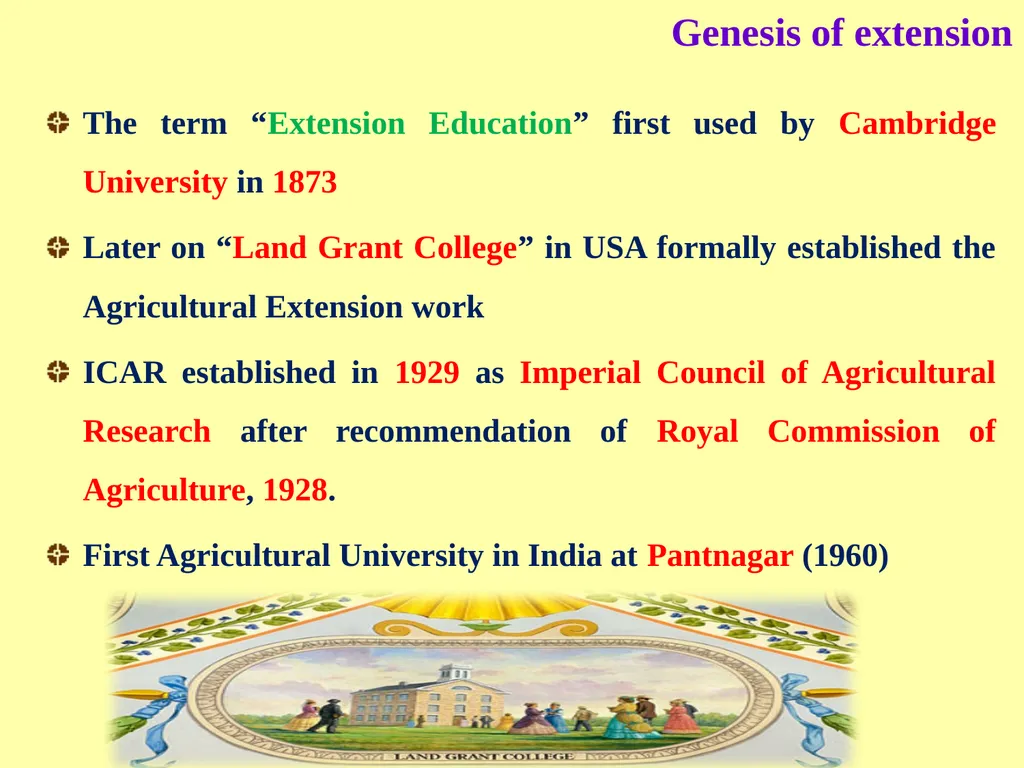
slide4. Genesis of extension The term “Extension Education” first used by Cambridge University in 1873
Later on “Land Grant College” in USA formally established the Agricultural Extension work
ICAR established in 1929 as Imperial Council of Agricultural Research after recommendation of Royal Commission of Agriculture, 1928.
First Agricultural University in India at Pantnagar (1960)<br>
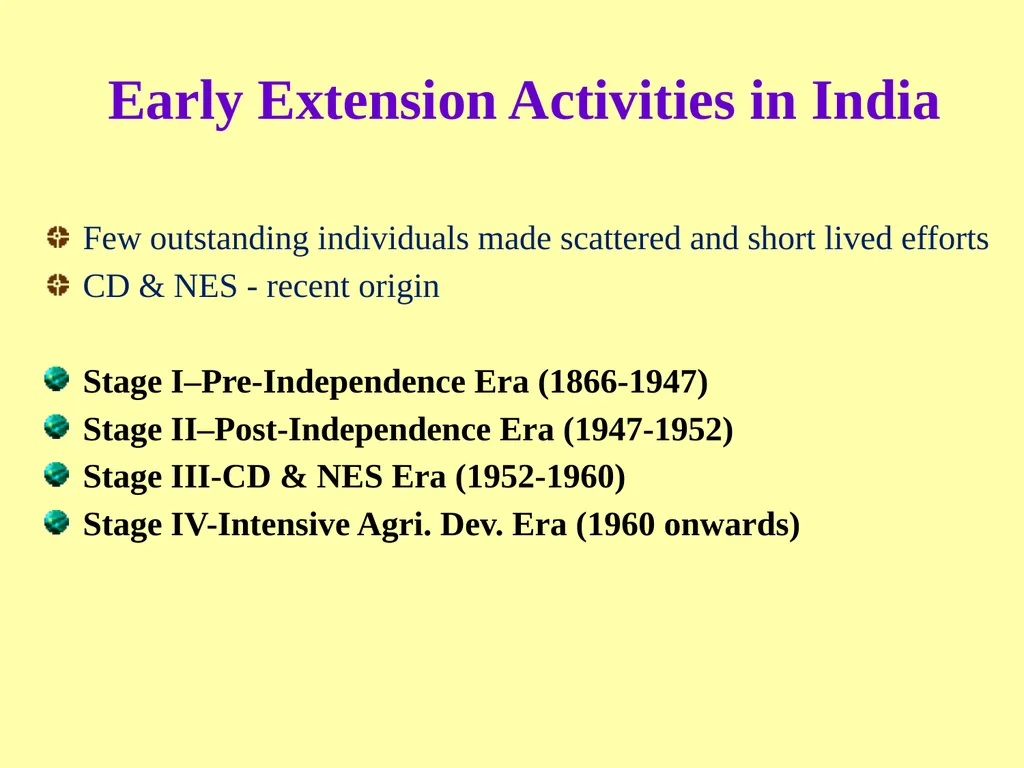
slide5. Early Extension Activities in India Few outstanding individuals made scattered and short lived efforts
CD & NES - recent origin
Stage I–Pre-Independence Era (1866-1947)
Stage II–Post-Independence Era (1947-1952)
Stage III-CD & NES Era (1952-1960)
Stage IV-Intensive Agri. Dev. Era (1960 onwards)<br>
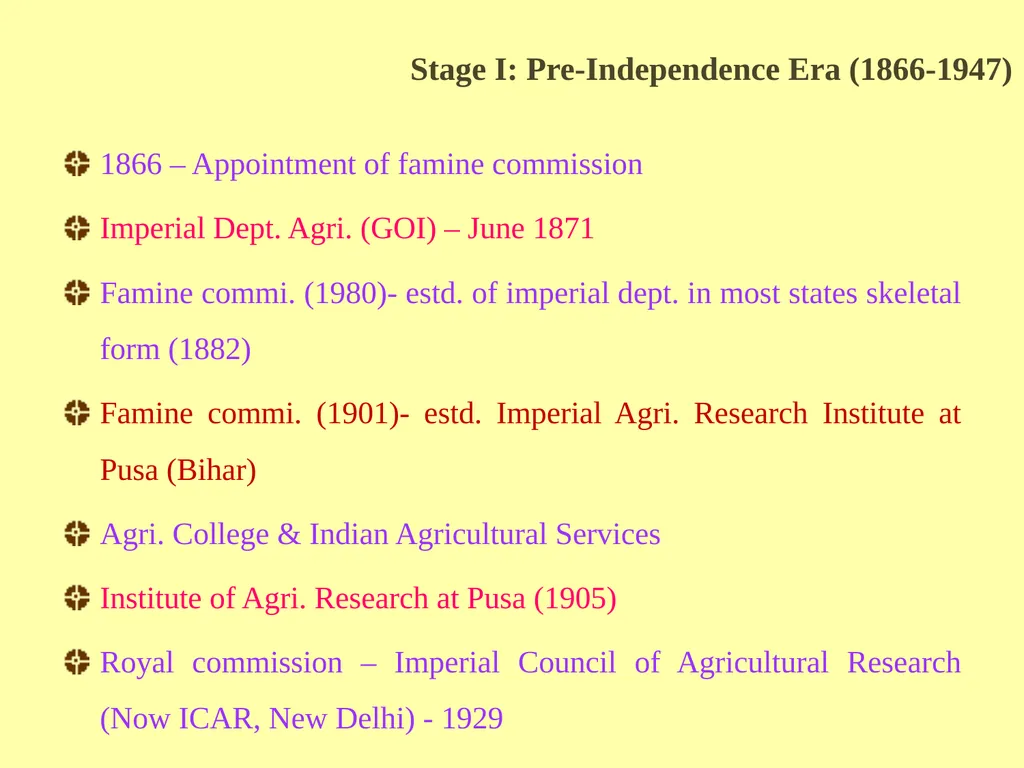
slide6. Stage I: Pre-Independence Era (1866-1947) 1866 – Appointment of famine commission
Imperial Dept. Agri. (GOI) – June 1871
Famine commi. (1980)- estd. of imperial dept. in most states skeletal form (1882)
Famine commi. (1901)- estd. Imperial Agri. Research Institute at Pusa (Bihar)
Agri. College & Indian Agricultural Services
Institute of Agri. Research at Pusa (1905)
Royal commission – Imperial Council of Agricultural Research (Now ICAR, New Delhi) - 1929<br>
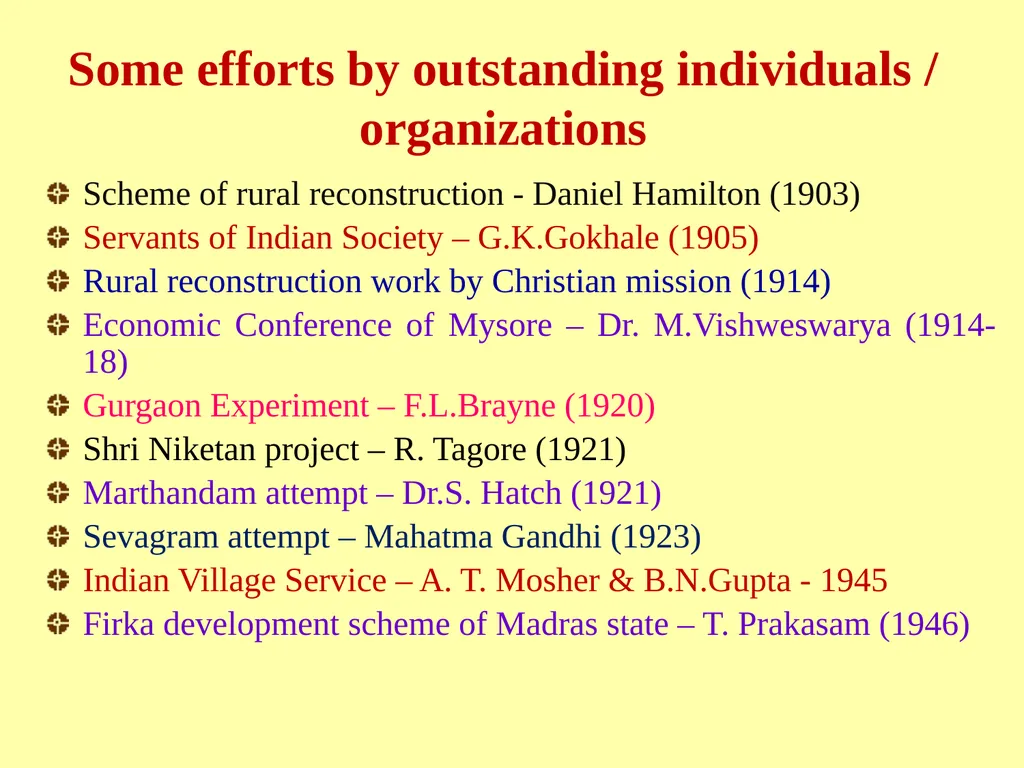
slide7. Some efforts by outstanding individuals / organizations Scheme of rural reconstruction - Daniel Hamilton (1903)
Servants of Indian Society – G.K.Gokhale (1905)
Rural reconstruction work by Christian mission (1914)
Economic Conference of Mysore – Dr. M.Vishweswarya (1914-18)
Gurgaon Experiment – F.L.Brayne (1920)
Shri Niketan project – R. Tagore (1921)
Marthandam attempt – Dr.S. Hatch (1921)
Sevagram attempt – Mahatma Gandhi (1923)
Indian Village Service – A. T. Mosher & B.N.Gupta - 1945
Firka development scheme of Madras state – T. Prakasam (1946)<br>
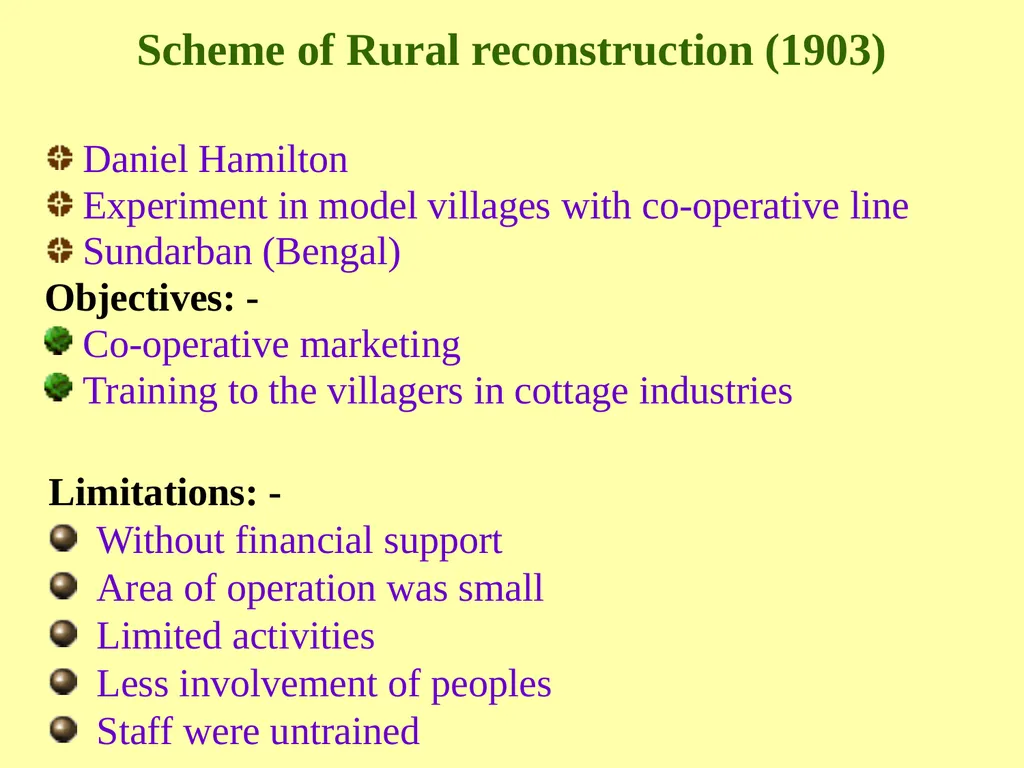
slide8. Scheme of Rural reconstruction (1903) Daniel Hamilton
Experiment in model villages with co-operative line
Sundarban (Bengal)
Objectives: -
Co-operative marketing
Training to the villagers in cottage industries Limitations: -
Without financial support
Area of operation was small
Limited activities
Less involvement of peoples
Staff were untrained<br>
slide9. Servants of Indian Society (1905) Objectives: -
Socio-economic & educational activities
Training centres, published booklets Limitations: -
Lack of finance
Lack of involvement of peoples
Untrained staff Gopal Krishna Gokhale
Pune<br>
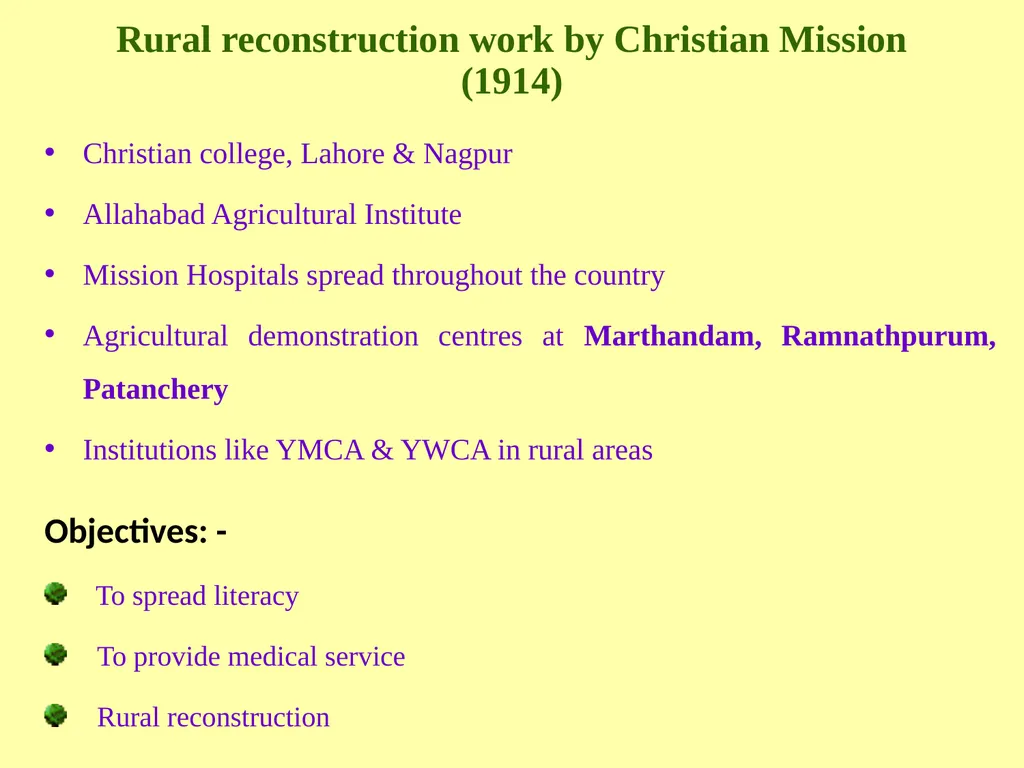
slide10. Rural reconstruction work by Christian Mission (1914) Christian college, Lahore & Nagpur
Allahabad Agricultural Institute
Mission Hospitals spread throughout the country
Agricultural demonstration centres at Marthandam, Ramnathpurum, Patanchery
Institutions like YMCA & YWCA in rural areas
Objectives: -
To spread literacy
To provide medical service
Rural reconstruction<br>
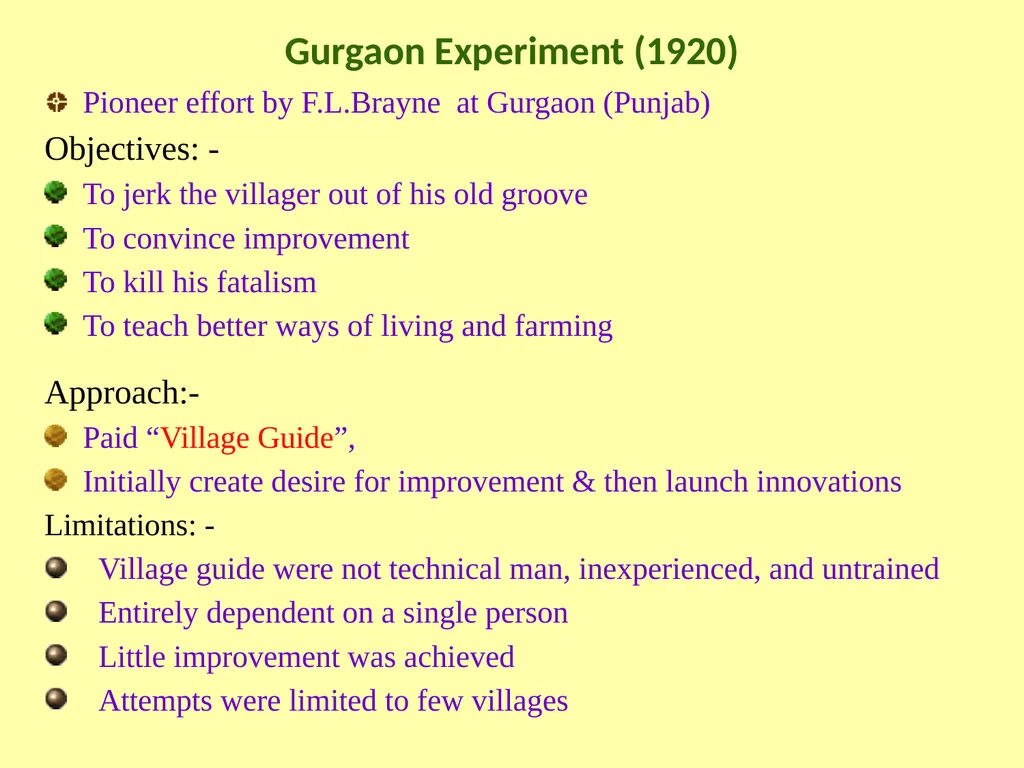
slide11. Gurgaon Experiment (1920) Pioneer effort by F.L.Brayne at Gurgaon (Punjab)
Objectives: -
To jerk the villager out of his old groove
To convince improvement
To kill his fatalism
To teach better ways of living and farming
Approach:-
Paid “Village Guide”,
Initially create desire for improvement & then launch innovations
Limitations: -
Village guide were not technical man, inexperienced, and untrained
Entirely dependent on a single person
Little improvement was achieved
Attempts were limited to few villages<br>
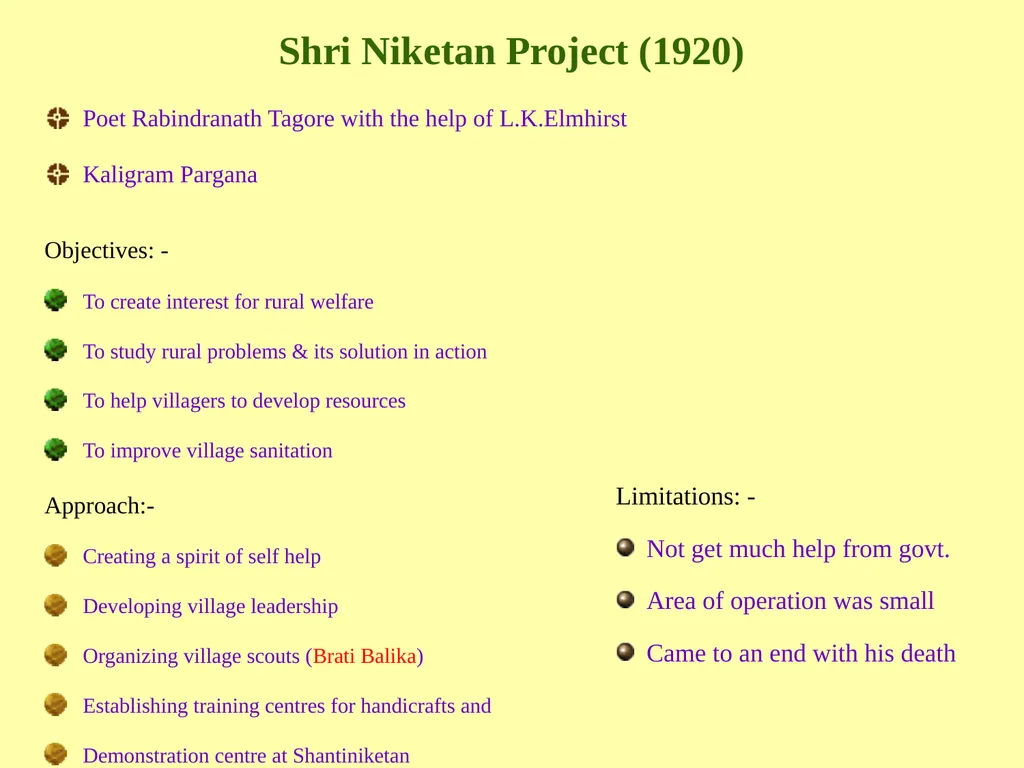
slide12. Shri Niketan Project (1920) Poet Rabindranath Tagore with the help of L.K.Elmhirst
Kaligram Pargana
Objectives: -
To create interest for rural welfare
To study rural problems & its solution in action
To help villagers to develop resources
To improve village sanitation
Approach:-
Creating a spirit of self help
Developing village leadership
Organizing village scouts (Brati Balika)
Establishing training centres for handicrafts and
Demonstration centre at Shantiniketan Limitations: -
Not get much help from govt.
Area of operation was small
Came to an end with his death<br>
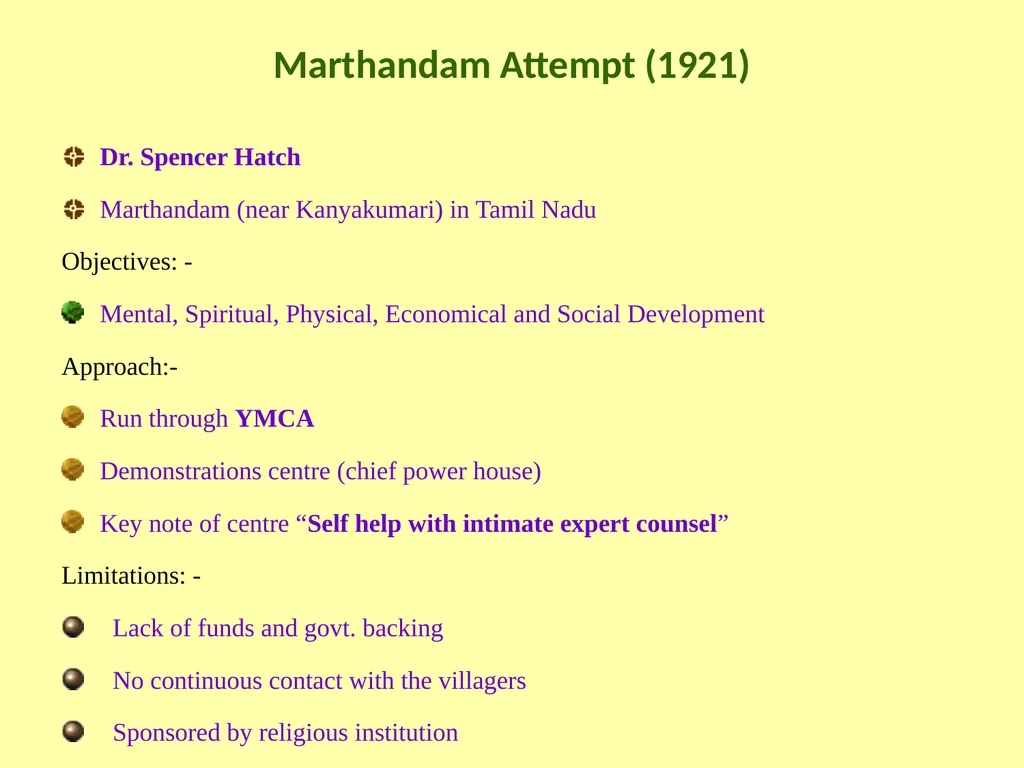
slide13. Marthandam Attempt (1921) Dr. Spencer Hatch
Marthandam (near Kanyakumari) in Tamil Nadu
Objectives: -
Mental, Spiritual, Physical, Economical and Social Development
Approach:-
Run through YMCA
Demonstrations centre (chief power house)
Key note of centre “Self help with intimate expert counsel”
Limitations: -
Lack of funds and govt. backing
No continuous contact with the villagers
Sponsored by religious institution<br>
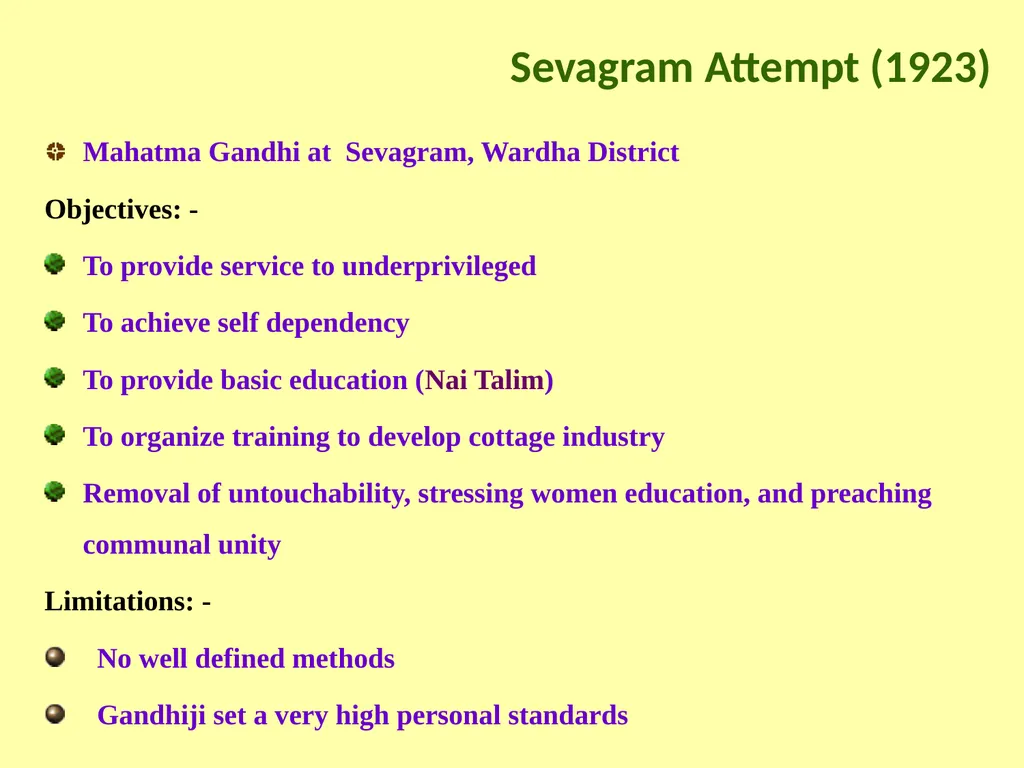
slide14. Sevagram Attempt (1923) Mahatma Gandhi at Sevagram, Wardha District
Objectives: -
To provide service to underprivileged
To achieve self dependency
To provide basic education (Nai Talim)
To organize training to develop cottage industry
Removal of untouchability, stressing women education, and preaching communal unity
Limitations: -
No well defined methods
Gandhiji set a very high personal standards<br>
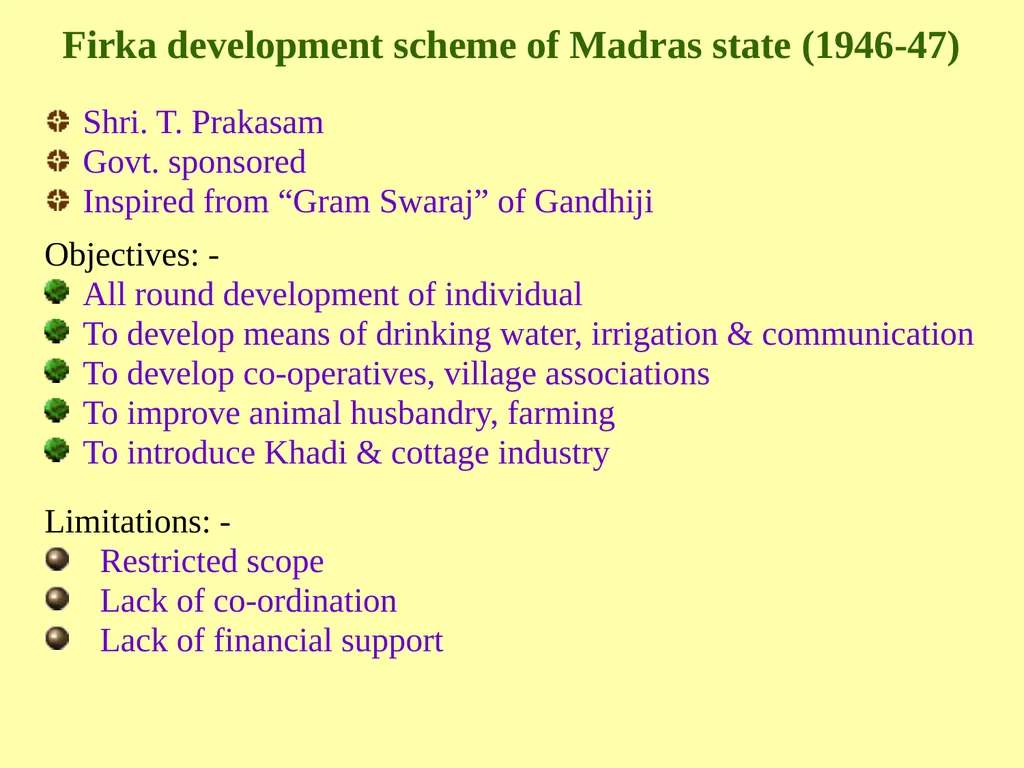
slide15. Firka development scheme of Madras state (1946-47) Shri. T. Prakasam
Govt. sponsored
Inspired from “Gram Swaraj” of Gandhiji
Objectives: -
All round development of individual
To develop means of drinking water, irrigation & communication
To develop co-operatives, village associations
To improve animal husbandry, farming
To introduce Khadi & cottage industry
Limitations: -
Restricted scope
Lack of co-ordination
Lack of financial support<br>
Dr. Puspendra Kumar Singh
Department of Veterinary & Animal Husbandry Extension Education, BVC<br>
slide2. Extension Education and Development 3rd Year, VAHEE<br>
slide3. Topics covered Pre Independent rural development programmes<br>
slide4. Genesis of extension The term “Extension Education” first used by Cambridge University in 1873
Later on “Land Grant College” in USA formally established the Agricultural Extension work
ICAR established in 1929 as Imperial Council of Agricultural Research after recommendation of Royal Commission of Agriculture, 1928.
First Agricultural University in India at Pantnagar (1960)<br>
slide5. Early Extension Activities in India Few outstanding individuals made scattered and short lived efforts
CD & NES - recent origin
Stage I–Pre-Independence Era (1866-1947)
Stage II–Post-Independence Era (1947-1952)
Stage III-CD & NES Era (1952-1960)
Stage IV-Intensive Agri. Dev. Era (1960 onwards)<br>
slide6. Stage I: Pre-Independence Era (1866-1947) 1866 – Appointment of famine commission
Imperial Dept. Agri. (GOI) – June 1871
Famine commi. (1980)- estd. of imperial dept. in most states skeletal form (1882)
Famine commi. (1901)- estd. Imperial Agri. Research Institute at Pusa (Bihar)
Agri. College & Indian Agricultural Services
Institute of Agri. Research at Pusa (1905)
Royal commission – Imperial Council of Agricultural Research (Now ICAR, New Delhi) - 1929<br>
slide7. Some efforts by outstanding individuals / organizations Scheme of rural reconstruction - Daniel Hamilton (1903)
Servants of Indian Society – G.K.Gokhale (1905)
Rural reconstruction work by Christian mission (1914)
Economic Conference of Mysore – Dr. M.Vishweswarya (1914-18)
Gurgaon Experiment – F.L.Brayne (1920)
Shri Niketan project – R. Tagore (1921)
Marthandam attempt – Dr.S. Hatch (1921)
Sevagram attempt – Mahatma Gandhi (1923)
Indian Village Service – A. T. Mosher & B.N.Gupta - 1945
Firka development scheme of Madras state – T. Prakasam (1946)<br>
slide8. Scheme of Rural reconstruction (1903) Daniel Hamilton
Experiment in model villages with co-operative line
Sundarban (Bengal)
Objectives: -
Co-operative marketing
Training to the villagers in cottage industries Limitations: -
Without financial support
Area of operation was small
Limited activities
Less involvement of peoples
Staff were untrained<br>
slide9. Servants of Indian Society (1905) Objectives: -
Socio-economic & educational activities
Training centres, published booklets Limitations: -
Lack of finance
Lack of involvement of peoples
Untrained staff Gopal Krishna Gokhale
Pune<br>
slide10. Rural reconstruction work by Christian Mission (1914) Christian college, Lahore & Nagpur
Allahabad Agricultural Institute
Mission Hospitals spread throughout the country
Agricultural demonstration centres at Marthandam, Ramnathpurum, Patanchery
Institutions like YMCA & YWCA in rural areas
Objectives: -
To spread literacy
To provide medical service
Rural reconstruction<br>
slide11. Gurgaon Experiment (1920) Pioneer effort by F.L.Brayne at Gurgaon (Punjab)
Objectives: -
To jerk the villager out of his old groove
To convince improvement
To kill his fatalism
To teach better ways of living and farming
Approach:-
Paid “Village Guide”,
Initially create desire for improvement & then launch innovations
Limitations: -
Village guide were not technical man, inexperienced, and untrained
Entirely dependent on a single person
Little improvement was achieved
Attempts were limited to few villages<br>
slide12. Shri Niketan Project (1920) Poet Rabindranath Tagore with the help of L.K.Elmhirst
Kaligram Pargana
Objectives: -
To create interest for rural welfare
To study rural problems & its solution in action
To help villagers to develop resources
To improve village sanitation
Approach:-
Creating a spirit of self help
Developing village leadership
Organizing village scouts (Brati Balika)
Establishing training centres for handicrafts and
Demonstration centre at Shantiniketan Limitations: -
Not get much help from govt.
Area of operation was small
Came to an end with his death<br>
slide13. Marthandam Attempt (1921) Dr. Spencer Hatch
Marthandam (near Kanyakumari) in Tamil Nadu
Objectives: -
Mental, Spiritual, Physical, Economical and Social Development
Approach:-
Run through YMCA
Demonstrations centre (chief power house)
Key note of centre “Self help with intimate expert counsel”
Limitations: -
Lack of funds and govt. backing
No continuous contact with the villagers
Sponsored by religious institution<br>
slide14. Sevagram Attempt (1923) Mahatma Gandhi at Sevagram, Wardha District
Objectives: -
To provide service to underprivileged
To achieve self dependency
To provide basic education (Nai Talim)
To organize training to develop cottage industry
Removal of untouchability, stressing women education, and preaching communal unity
Limitations: -
No well defined methods
Gandhiji set a very high personal standards<br>
slide15. Firka development scheme of Madras state (1946-47) Shri. T. Prakasam
Govt. sponsored
Inspired from “Gram Swaraj” of Gandhiji
Objectives: -
All round development of individual
To develop means of drinking water, irrigation & communication
To develop co-operatives, village associations
To improve animal husbandry, farming
To introduce Khadi & cottage industry
Limitations: -
Restricted scope
Lack of co-ordination
Lack of financial support<br>